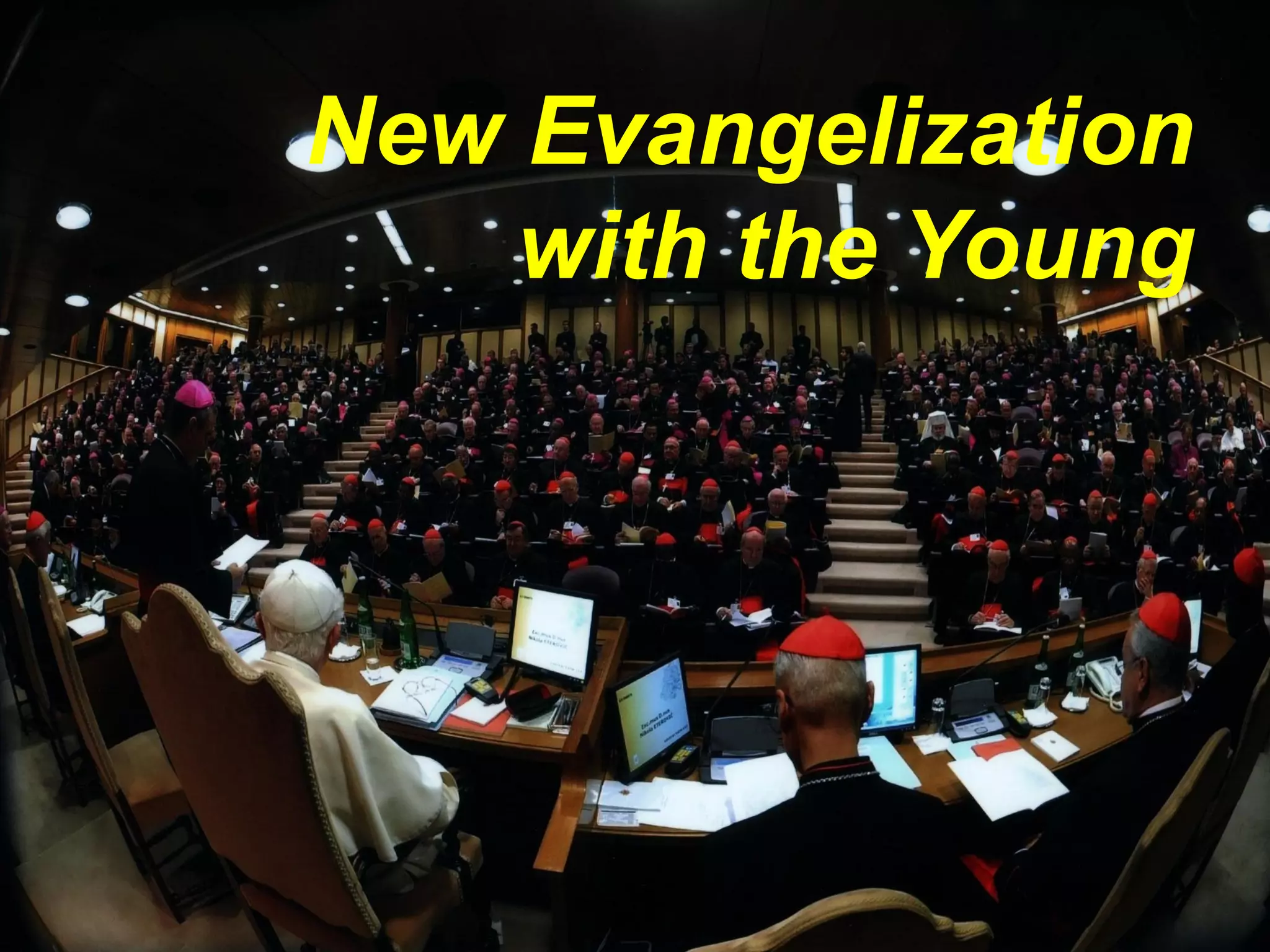
New Evangelization
with the Young
SAPIN – SAPIN
FILIPINO
PERSPECTIVE
the foundation
of the New Evangelization
The Synod Message
to the Young
Proposition 51
The Banana leaf or
“Dahon ng Saging”
What is New in the
Synod on NE? What
does it have for us
Filipino Catholics?
continuing
rather than
starting all
over again…
to proclaim the Good News
with courage and sense of
urgency in the spirit of Jesus
and the apostles.
St. Paul:
“Woe to me if I do not preach
the Gospel.”
“Preach the Gospel in season
and out of season.”.
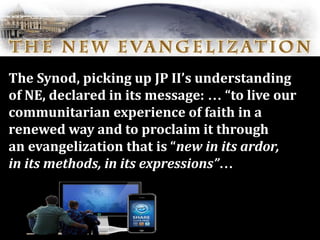
The Synod, picking up JP II’s understanding
of NE, declared in its message: … “to live our
communitarian experience of faith in a
renewed way and to proclaim it through
an evangelization that is “new in its ardor,
in its methods, in its expressions”…
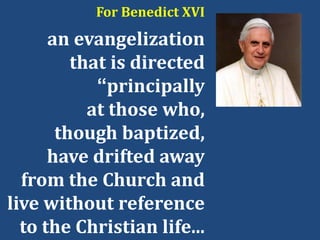
For Benedict XVI
an evangelization
that is directed
“principally
at those who,
though baptized,
have drifted away
from the Church and
live without reference
to the Christian life...
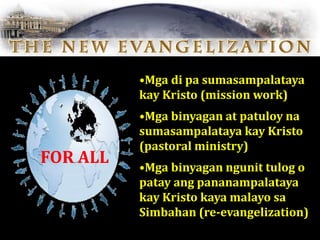
•Mga di pa sumasampalataya
kay Kristo (mission work)
•Mga binyagan at patuloy na
sumasampalataya kay Kristo
(pastoral ministry)
•Mga binyagan ngunit tulog o
patay ang pananampalataya
kay Kristo kaya malayo sa
Simbahan (re-evangelization)
FOR ALL
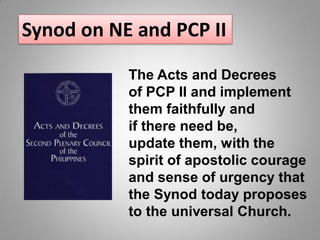
The Acts and Decrees
of PCP II and implement
them faithfully and
if there need be,
update them, with the
spirit of apostolic courage
and sense of urgency that
the Synod today proposes
to the universal Church.
Synod on NE and PCP II
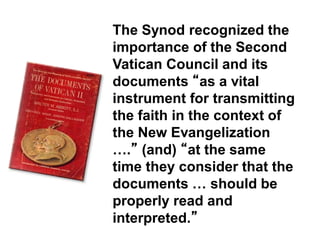
The Synod recognized the
importance of the Second
Vatican Council and its
documents “as a vital
instrument for transmitting
the faith in the context of
the New Evangelization
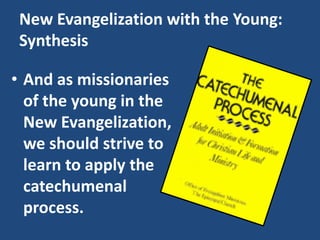
….” (and) “at the same
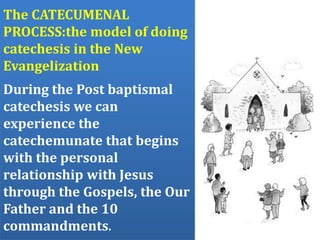
time they consider that the
documents … should be
properly read and
interpreted.”
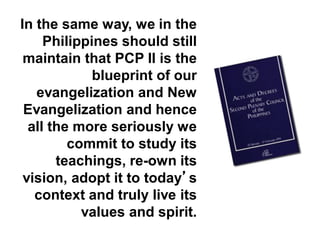
In the same way, we in the
Philippines should still
maintain that PCP II is the
blueprint of our
evangelization and New
Evangelization and hence
all the more seriously we
commit to study its
teachings, re-own its
vision, adopt it to today’s
context and truly live its
values and spirit.
“the need for a New
Evangelization is not peculiar
to the Church in the
Philippines…
At the same time this
Plenary Council is in line with
Vatican II (with its) leitmotif
of aggiornamento...
The spirit of PCP II is the spirit
of the New Evangelization…”
“this unified document
of our Council could well
become the Magna Carta
guiding the evangelizing
mission of the Church in
the Philippines into the
third millennium.”
The First “Sapin” or
Layer of Glutinous Rice
The Foundations of NE
according to the Synod
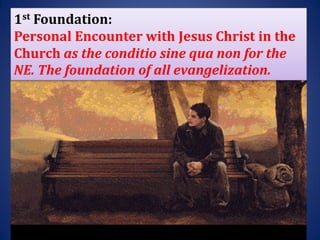
1st Foundation:
Personal Encounter with Jesus Christ in the
Church as the conditio sine qua non for the
NE. The foundation of all evangelization.
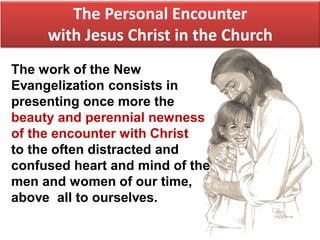
The Personal Encounter
with Jesus Christ in the Church
The work of the New
Evangelization consists in
presenting once more the
beauty and perennial newness
of the encounter with Christ
to the often distracted and
confused heart and mind of the
men and women of our time,
above all to ourselves.
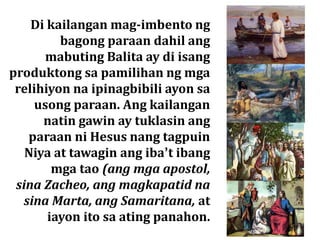
Di kailangan mag-imbento ng
bagong paraan dahil ang
mabuting Balita ay di isang
produktong sa pamilihan ng mga
relihiyon na ipinagbibili ayon sa
usong paraan. Ang kailangan
natin gawin ay tuklasin ang
paraan ni Hesus nang tagpuin
Niya at tawagin ang iba’t ibang
mga tao (ang mga apostol,
sina Zacheo, ang magkapatid na
sina Marta, ang Samaritana, at
iayon ito sa ating panahon.
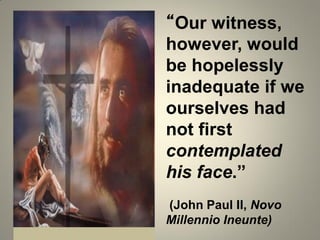
“Our witness,
however, would
be hopelessly
inadequate if we
ourselves had
not first
contemplated
his face.”
(John Paul II, Novo
Millennio Ineunte)
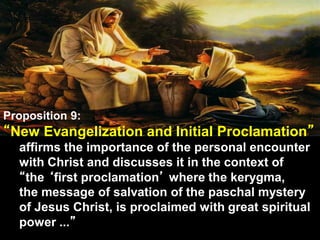
Proposition 9:
“New Evangelization and Initial Proclamation”
affirms the importance of the personal encounter
with Christ and discusses it in the context of
“the ‘first proclamation’ where the kerygma,
the message of salvation of the paschal mystery
of Jesus Christ, is proclaimed with great spiritual
power ...”
What is new in this
proposition is
the necessity of a
Pastoral Plan for
initial proclamation,
teaching a living
encounter with
Jesus Christ.
SAAN
Matatagpuan
si Kristo?
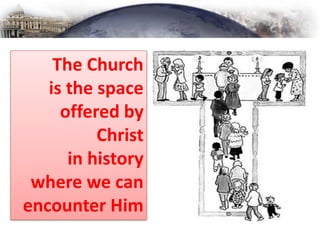
The Church
is the space
offered by
Christ
in history
where we can
encounter Him
• the Baptism
that makes us
God’s children
because He entrusted to her
• His Word
• the grace of
forgiveness of sins
above all in the
Sacrament of
Reconciliation
because He entrusted to her
• His Body and
• His Blood
• and the strength
of the Spirit that generates
charity towards all
because He entrusted to her
• the experience of
communion that reflects
the very mystery of the
Holy Trinity
PCP II on the personal encounter
with Jesus Christ
“How to live as
Catholic Christians
today?”
It is to know, to love,
to follow Christ in the
Church which he
founded.
This is why
we need
to contemplate
the face---and
the heart of Christ.
We have to retell
His story
to ourselves,
that we may,
more credibly,
more authoritatively,
tell it to others.
This is our belief.
The Personal Encounter
with Christ and Catechesis
in the Philippines
There is a need to ascertain
that there has been the initial
proclamation and personal encounter
of Jesus among the catechized,
be they children, youth, or adults.
How can the catechized
“be in touch and in communion with
Jesus (the goal of catechesis) if they have
not first of all encountered him?
The Personal Encounter
with Christ and Catechesis
in the Philippines
The Sacrament of Baptism gives the
baptized the grace to encounter
Jesus Christ for the first time.
This encounter of Christ by the baptized
should be brought to their awareness,
deepened and confirmed through the various
means the Church offers, starting with prayer
at home and liturgy in the Christian
community, and in particular, catechesis.
From systematic instruction to deepening of faith
the catechized are helped to personally encounter
Jesus the Evangelizer and commit themselves to
think like him, to judge like him and to live as he
lived as they integrate knowledge of faith with their
daily life through fostering Gospel values and
developing faith convictions.
But does this take place when the catechists
conduct catechesis in the schools and in the
parishes?
The Personal Encounter
with Christ and Catechesis
in the Philippines
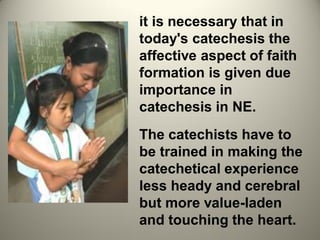
it is necessary that in
today's catechesis the
affective aspect of faith
formation is given due
importance in
catechesis in NE.
The catechists have to
be trained in making the
catechetical experience
less heady and cerebral
but more value-laden
and touching the heart.
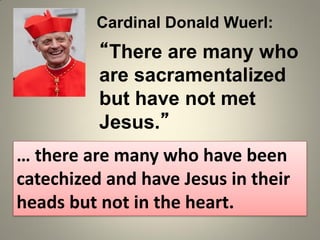
“There are many who
are sacramentalized
but have not met
Jesus.”
Cardinal Donald Wuerl:
… there are many who have been
catechized and have Jesus in their
heads but not in the heart.
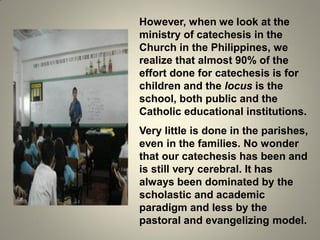
However, when we look at the
ministry of catechesis in the
Church in the Philippines, we
realize that almost 90% of the
effort done for catechesis is for
children and the locus is the
school, both public and the
Catholic educational institutions.
Very little is done in the parishes,
even in the families. No wonder
that our catechesis has been and
is still very cerebral. It has
always been dominated by the
scholastic and academic
paradigm and less by the
pastoral and evangelizing model.
How can we expect
that the graduates
of the Catholic
schools be young
men and women
with strong faith
convictions, who
have been truly
catechized and
evangelized?
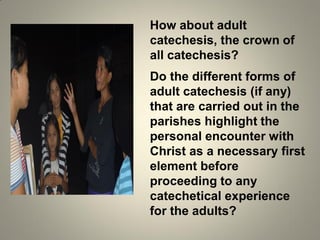
How about adult
catechesis, the crown of
all catechesis?
Do the different forms of
adult catechesis (if any)
that are carried out in the
parishes highlight the
personal encounter with
Christ as a necessary first
element before
proceeding to any
catechetical experience
for the adults?
2nd Foundation:
Conversion/Holiness
- End or Goal of all Evangelization
The personal encounter with Christ
leads the evangelized to a conversion
experience and to answer the call to
holiness. This is both the proof of an
authentic Christ encounter as well as
the goal of all evangelization.
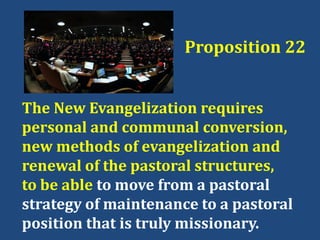
Proposition 22
The New Evangelization requires
personal and communal conversion,
new methods of evangelization and
renewal of the pastoral structures,
to be able to move from a pastoral
strategy of maintenance to a pastoral
position that is truly missionary.
The New Evangelization guides us to an
authentic pastoral conversion which
moves us to attitudes and initiatives
which leads to evaluations and changes
in the dynamics of pastoral structures
which no longer respond to the
evangelical demands of the current time.
Proposition 22
PCP II on Conversion
“At the beginning of all renewed
evangelization is conversion.
Unless a person turns away from sin and
turns to God, undergoes a change of mind
and heart, and decides to follow Christ,
no evangelization will bear fruit.”
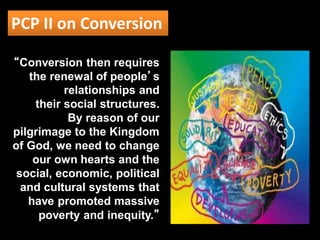
PCP II on Conversion
“Conversion then requires
the renewal of people’s
relationships and
their social structures.
By reason of our
pilgrimage to the Kingdom
of God, we need to change
our own hearts and the
social, economic, political
and cultural systems that
have promoted massive
poverty and inequity.”
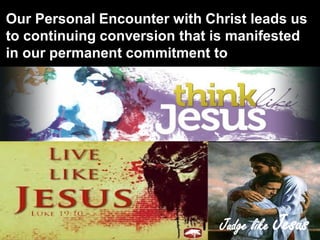
Judge like Jesus
Our Personal Encounter with Christ leads us
to continuing conversion that is manifested
in our permanent commitment to
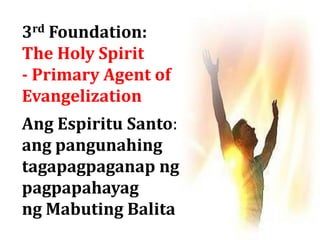
3rd Foundation:
The Holy Spirit
- Primary Agent of
Evangelization
Ang Espiritu Santo:
ang pangunahing
tagapagpaganap ng
pagpapahayag
ng Mabuting Balita
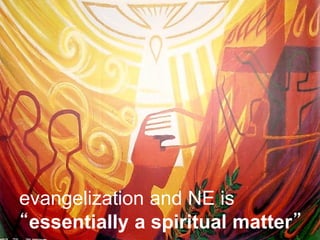
evangelization and NE is
“essentially a spiritual matter”
Proposition 36:
The principal agent of
evangelization is the Holy
Spirit, who opens hearts
and converts them to God.
The experience of
encountering the Lord
Jesus, made possible by
the Spirit, which introduces
one into the Trinitarian life,
welcomed in a spirit of
adoration, supplication and
of praise, must be
fundamental to every aspect
of the New Evangelization…
“The first word,
the true initiative,
the true activity comes
from God and
only by inserting
ourselves in to the divine
initiative,
only by begging this
divine initiative,
will we too be able
to become
— with him and in him —
evangelizers.”
The Holy Spirit
in PCP II
“… continues
and brings the
work of Christ
to perfection.”
The Second “Sapin” or
Layer of Glutinous Rice
The Synod Message
to the Young (no. 9)
The Synod Fathers
are optimistic about the
young, while at the same
time concerned that
they are exposed to
various forms of
aggressions
The Synod Fathers encourage communities
• to listen to,
dialogue with and
respond boldly and
without reservation to
the difficult condition
of the youth
• to harness, not to
suppress, the power of
their enthusiasm
The Synod Fathers encourage communities
• to struggle for them
against the fallacies and
selfish ventures of worldly
powers which, to their
own advantage, dissipate
the energies and waste
the passion of the young,
taking from them every
grateful memory of the
past and every profound
vision of the future.”
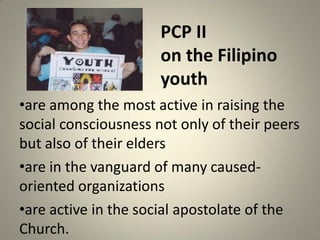
PCP II
on the Filipino
youth
•are among the most active in raising the
social consciousness not only of their peers
but also of their elders
•are in the vanguard of many caused-
oriented organizations
•are active in the social apostolate of the
Church.
The Synod Fathers conclude:
• the world of the young is a demanding but
also particularly promising field of the New
Evangelization
• “Young people’s active role in evangelizing
first and foremost their world is to be
recognized.”
Briefly, the Synod recognizes that in the
New Evangelization the young can be and
are evangelizers among their peers
PCP II decreed:
• that “every diocese should form, organize and
mobilize the young in such a way that they get
creatively involved in the life of the diocese/
parish as evangelizers of their fellow youth.
• A systematic and comprehensive program
must be designed for this purpose
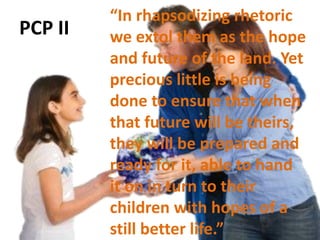
PCP II
“In rhapsodizing rhetoric
we extol them as the hope
and future of the land. Yet
precious little is being
done to ensure that when
that future will be theirs,
they will be prepared and
ready for it, able to hand
it on in turn to their
children with hopes of a
still better life.”
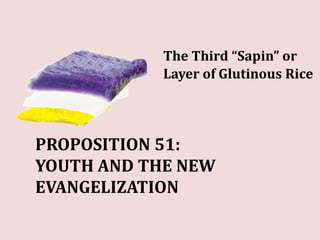
The Third “Sapin” or
Layer of Glutinous Rice
PROPOSITION 51:
YOUTH AND THE NEW
EVANGELIZATION
“In the New
Evangelization,
the youth are not
only the future
but also the
present (and gift)
in the Church.
the youth are a gift
of God who has an
extraordinarily
loving vision for the
young: one that is
truly incarnate,
preferential and
unconditional.
According to
According to
“in contrast with some
societies which see the
young people as in a
period of preparation for
a future role but as
lacking any significant
present role, the Church
instead views the young
less futuristically and
more positively.”
According to
The Church is in
“a profound solidarity
and identification
with the young,
calling upon them and
integrating them truly
as children of God
entrusted
to her.”
Proposition 51: “the stage of searching for
truth and meaning in life that Jesus who is
the Truth and their Friend can provide.”
The young are at a moment in
life that they long for friends
and they want to connect.
All their connections will end
nowhere when they are not
connected with Christ, even if
only as a Friend.
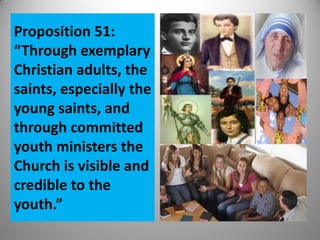
Proposition 51:
“Through exemplary
Christian adults, the
saints, especially the
young saints, and
through committed
youth ministers the
Church is visible and
credible to the
youth.”
Proposition 51:
“Wherever they are, at home, in school, or in
the Christian community, it is necessary that
evangelizers:
- meet the young and spend time with them
- propose to them and accompany them in
following Jesus
- guide them to discover their vocation in life
and in the Church.
YOUTH MINISTRY
IN CAPSULE
- Friendly Presence
- Christ Proposal and
accompaniment
- Vocational discernment and
discovery: the crown of youth
ministry
Proposition 51:
“the great influence of media on “the
physical, emotional, mental and
spiritual well-being of the youth”
Proposition 51:
through catechesis and
youth ministry the young
who are “digital natives”
are enabled and equipped:
• to discern between good and evil,
• to choose Gospel values over worldly
values, and
• to form firm faith convictions.
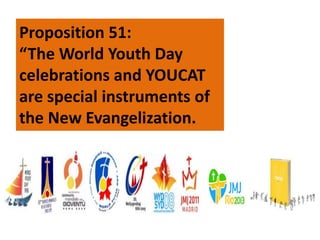
Proposition 51:
“The World Youth Day
celebrations and YOUCAT
are special instruments of
the New Evangelization.
New Evangelization with the Young:
Synthesis
• the youth in the
New Evangelization
demand from us
youth ministers
a new missionary spirit.
We need to connect with them in their
home and in social media as the new
mission territories for us.
New Evangelization with the Young:
Synthesis
• And as missionaries
of the young in the
New Evangelization,
we should strive to
learn to apply the
catechumenal
process.
The CATECUMENAL
PROCESS:the model of doing
catechesis in the New
Evangelization
During the Post baptismal
catechesis we can
experience the
catechemunate that begins
with the personal
relationship with Jesus
through the Gospels, the Our
Father and the 10
commandments.
New Evangelization with the Young:
Synthesis
• In the New Evangelization, the “new
youth” are today’s catechumens who
need a postbaptismal
catechumenate such that they grow
as Christ’s disciples not only because
of tradition but above because of
their personal decision.
Need to understand and practice
catechumenal model of catechesis
Post baptismal catechesis, without slavishly
imitating the structure of the baptismal
catechumenate, and recognizing in those to
be catechized the reality of their Baptism,
does well, however to draw inspiration from
“this preparatory school for the Christian life,”
and to allow itself to be enriched by those
principal elements which characterize the
catechumenate.
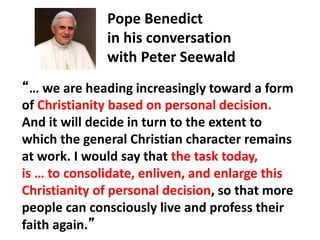
Pope Benedict
in his conversation
with Peter Seewald
“… we are heading increasingly toward a form
of Christianity based on personal decision.
And it will decide in turn to the extent to
which the general Christian character remains
at work. I would say that the task today,
is … to consolidate, enliven, and enlarge this
Christianity of personal decision, so that more
people can consciously live and profess their
faith again.”
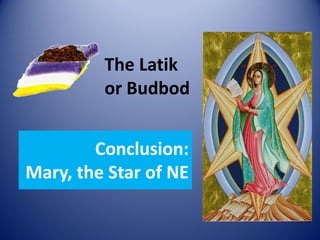
Conclusion:
Mary, the Star of NE
The Latik
or Budbod
The Paper Bag
The Task of NE – The Transmission of
the Christian Faith
Let it be packed and let us bring it to the
Christian community the Lord sends us.
The “sapin-sapin” known as NE has the
task to transmit the Christian faith. May
we have the energy to get into the path of
NE and share the Christian faith with the
people we encounter at home, in the
neighborhood, in the Christian
community, in the workplace, wherever we
are. Like the apostles, may we preach the
Word in season and out of season. May we
be witnesses of the Gospel as Proposition
57 challenges every Catholic today.
“You will be my witnesses” (Acts 1:8). From the very
beginning the Church has understood her
responsibility to pass on the Good News. The task of
the New Evangelization, following in this apostolic
tradition, is the transmission of the faith. The Second
Vatican Council reminds us that this task is a complex
process which involves the faith and life of every
Christian. This faith cannot be transmitted in a life
which is not modeled after the Gospel or a life which
does not find its meaning, truth and future based on
the Gospel.
For this reason, the New Evangelization
for the transmission of the Christian faith calls all
believers to renew their faith and their personal
encounter with Jesus in the Church, to deepen their
appreciation of the truth of the faith and joyfully to
share it.
In all these, with
the Spirit leading us
let us be directed
both by the
documents of
Vatican II and by
the Acts and
Decrees of PCP II.
The End

Sharing synod for jpii cymc1

  • 1.
  • 2.
  • 3.
  • 4.
    the foundation of theNew Evangelization The Synod Message to the Young Proposition 51
  • 5.
    The Banana leafor “Dahon ng Saging” What is New in the Synod on NE? What does it have for us Filipino Catholics?
  • 6.
  • 7.
    to proclaim theGood News with courage and sense of urgency in the spirit of Jesus and the apostles. St. Paul: “Woe to me if I do not preach the Gospel.” “Preach the Gospel in season and out of season.”.
  • 8.
    The Synod, pickingup JP II’s understanding of NE, declared in its message: … “to live our communitarian experience of faith in a renewed way and to proclaim it through an evangelization that is “new in its ardor, in its methods, in its expressions”…
  • 9.
    For Benedict XVI anevangelization that is directed “principally at those who, though baptized, have drifted away from the Church and live without reference to the Christian life...
  • 10.
    •Mga di pasumasampalataya kay Kristo (mission work) •Mga binyagan at patuloy na sumasampalataya kay Kristo (pastoral ministry) •Mga binyagan ngunit tulog o patay ang pananampalataya kay Kristo kaya malayo sa Simbahan (re-evangelization) FOR ALL
  • 11.
    The Acts andDecrees of PCP II and implement them faithfully and if there need be, update them, with the spirit of apostolic courage and sense of urgency that the Synod today proposes to the universal Church. Synod on NE and PCP II
  • 12.
    The Synod recognizedthe importance of the Second Vatican Council and its documents “as a vital instrument for transmitting the faith in the context of the New Evangelization ….” (and) “at the same time they consider that the documents … should be properly read and interpreted.”
  • 13.
    In the sameway, we in the Philippines should still maintain that PCP II is the blueprint of our evangelization and New Evangelization and hence all the more seriously we commit to study its teachings, re-own its vision, adopt it to today’s context and truly live its values and spirit.
  • 14.
    “the need fora New Evangelization is not peculiar to the Church in the Philippines… At the same time this Plenary Council is in line with Vatican II (with its) leitmotif of aggiornamento... The spirit of PCP II is the spirit of the New Evangelization…”
  • 15.
    “this unified document ofour Council could well become the Magna Carta guiding the evangelizing mission of the Church in the Philippines into the third millennium.”
  • 16.
    The First “Sapin”or Layer of Glutinous Rice The Foundations of NE according to the Synod
  • 17.
    1st Foundation: Personal Encounterwith Jesus Christ in the Church as the conditio sine qua non for the NE. The foundation of all evangelization.
  • 18.
    The Personal Encounter withJesus Christ in the Church The work of the New Evangelization consists in presenting once more the beauty and perennial newness of the encounter with Christ to the often distracted and confused heart and mind of the men and women of our time, above all to ourselves.
  • 19.
    Di kailangan mag-imbentong bagong paraan dahil ang mabuting Balita ay di isang produktong sa pamilihan ng mga relihiyon na ipinagbibili ayon sa usong paraan. Ang kailangan natin gawin ay tuklasin ang paraan ni Hesus nang tagpuin Niya at tawagin ang iba’t ibang mga tao (ang mga apostol, sina Zacheo, ang magkapatid na sina Marta, ang Samaritana, at iayon ito sa ating panahon.
  • 20.
    “Our witness, however, would behopelessly inadequate if we ourselves had not first contemplated his face.” (John Paul II, Novo Millennio Ineunte)
  • 21.
    Proposition 9: “New Evangelizationand Initial Proclamation” affirms the importance of the personal encounter with Christ and discusses it in the context of “the ‘first proclamation’ where the kerygma, the message of salvation of the paschal mystery of Jesus Christ, is proclaimed with great spiritual power ...”
  • 22.
    What is newin this proposition is the necessity of a Pastoral Plan for initial proclamation, teaching a living encounter with Jesus Christ.
  • 23.
  • 24.
    The Church is thespace offered by Christ in history where we can encounter Him
  • 25.
    • the Baptism thatmakes us God’s children because He entrusted to her • His Word
  • 26.
    • the graceof forgiveness of sins above all in the Sacrament of Reconciliation because He entrusted to her • His Body and • His Blood
  • 27.
    • and thestrength of the Spirit that generates charity towards all because He entrusted to her • the experience of communion that reflects the very mystery of the Holy Trinity
  • 29.
    PCP II onthe personal encounter with Jesus Christ “How to live as Catholic Christians today?” It is to know, to love, to follow Christ in the Church which he founded.
  • 30.
    This is why weneed to contemplate the face---and the heart of Christ. We have to retell His story to ourselves, that we may, more credibly, more authoritatively, tell it to others. This is our belief.
  • 31.
    The Personal Encounter withChrist and Catechesis in the Philippines There is a need to ascertain that there has been the initial proclamation and personal encounter of Jesus among the catechized, be they children, youth, or adults. How can the catechized “be in touch and in communion with Jesus (the goal of catechesis) if they have not first of all encountered him?
  • 32.
    The Personal Encounter withChrist and Catechesis in the Philippines The Sacrament of Baptism gives the baptized the grace to encounter Jesus Christ for the first time. This encounter of Christ by the baptized should be brought to their awareness, deepened and confirmed through the various means the Church offers, starting with prayer at home and liturgy in the Christian community, and in particular, catechesis.
  • 33.
    From systematic instructionto deepening of faith the catechized are helped to personally encounter Jesus the Evangelizer and commit themselves to think like him, to judge like him and to live as he lived as they integrate knowledge of faith with their daily life through fostering Gospel values and developing faith convictions. But does this take place when the catechists conduct catechesis in the schools and in the parishes? The Personal Encounter with Christ and Catechesis in the Philippines
  • 34.
    it is necessarythat in today's catechesis the affective aspect of faith formation is given due importance in catechesis in NE. The catechists have to be trained in making the catechetical experience less heady and cerebral but more value-laden and touching the heart.
  • 35.
    “There are manywho are sacramentalized but have not met Jesus.” Cardinal Donald Wuerl: … there are many who have been catechized and have Jesus in their heads but not in the heart.
  • 36.
    However, when welook at the ministry of catechesis in the Church in the Philippines, we realize that almost 90% of the effort done for catechesis is for children and the locus is the school, both public and the Catholic educational institutions. Very little is done in the parishes, even in the families. No wonder that our catechesis has been and is still very cerebral. It has always been dominated by the scholastic and academic paradigm and less by the pastoral and evangelizing model.
  • 37.
    How can weexpect that the graduates of the Catholic schools be young men and women with strong faith convictions, who have been truly catechized and evangelized?
  • 38.
    How about adult catechesis,the crown of all catechesis? Do the different forms of adult catechesis (if any) that are carried out in the parishes highlight the personal encounter with Christ as a necessary first element before proceeding to any catechetical experience for the adults?
  • 39.
    2nd Foundation: Conversion/Holiness - Endor Goal of all Evangelization The personal encounter with Christ leads the evangelized to a conversion experience and to answer the call to holiness. This is both the proof of an authentic Christ encounter as well as the goal of all evangelization.
  • 40.
    Proposition 22 The NewEvangelization requires personal and communal conversion, new methods of evangelization and renewal of the pastoral structures, to be able to move from a pastoral strategy of maintenance to a pastoral position that is truly missionary.
  • 41.
    The New Evangelizationguides us to an authentic pastoral conversion which moves us to attitudes and initiatives which leads to evaluations and changes in the dynamics of pastoral structures which no longer respond to the evangelical demands of the current time. Proposition 22
  • 42.
    PCP II onConversion “At the beginning of all renewed evangelization is conversion. Unless a person turns away from sin and turns to God, undergoes a change of mind and heart, and decides to follow Christ, no evangelization will bear fruit.”
  • 43.
    PCP II onConversion “Conversion then requires the renewal of people’s relationships and their social structures. By reason of our pilgrimage to the Kingdom of God, we need to change our own hearts and the social, economic, political and cultural systems that have promoted massive poverty and inequity.”
  • 45.
    Judge like Jesus OurPersonal Encounter with Christ leads us to continuing conversion that is manifested in our permanent commitment to
  • 46.
    3rd Foundation: The HolySpirit - Primary Agent of Evangelization Ang Espiritu Santo: ang pangunahing tagapagpaganap ng pagpapahayag ng Mabuting Balita
  • 47.
    evangelization and NEis “essentially a spiritual matter”
  • 48.
    Proposition 36: The principalagent of evangelization is the Holy Spirit, who opens hearts and converts them to God. The experience of encountering the Lord Jesus, made possible by the Spirit, which introduces one into the Trinitarian life, welcomed in a spirit of adoration, supplication and of praise, must be fundamental to every aspect of the New Evangelization…
  • 49.
    “The first word, thetrue initiative, the true activity comes from God and only by inserting ourselves in to the divine initiative, only by begging this divine initiative, will we too be able to become — with him and in him — evangelizers.”
  • 50.
    The Holy Spirit inPCP II “… continues and brings the work of Christ to perfection.”
  • 51.
    The Second “Sapin”or Layer of Glutinous Rice The Synod Message to the Young (no. 9)
  • 52.
    The Synod Fathers areoptimistic about the young, while at the same time concerned that they are exposed to various forms of aggressions
  • 53.
    The Synod Fathersencourage communities • to listen to, dialogue with and respond boldly and without reservation to the difficult condition of the youth • to harness, not to suppress, the power of their enthusiasm
  • 54.
    The Synod Fathersencourage communities • to struggle for them against the fallacies and selfish ventures of worldly powers which, to their own advantage, dissipate the energies and waste the passion of the young, taking from them every grateful memory of the past and every profound vision of the future.”
  • 55.
    PCP II on theFilipino youth •are among the most active in raising the social consciousness not only of their peers but also of their elders •are in the vanguard of many caused- oriented organizations •are active in the social apostolate of the Church.
  • 56.
    The Synod Fathersconclude: • the world of the young is a demanding but also particularly promising field of the New Evangelization • “Young people’s active role in evangelizing first and foremost their world is to be recognized.” Briefly, the Synod recognizes that in the New Evangelization the young can be and are evangelizers among their peers
  • 57.
    PCP II decreed: •that “every diocese should form, organize and mobilize the young in such a way that they get creatively involved in the life of the diocese/ parish as evangelizers of their fellow youth. • A systematic and comprehensive program must be designed for this purpose
  • 58.
    PCP II “In rhapsodizingrhetoric we extol them as the hope and future of the land. Yet precious little is being done to ensure that when that future will be theirs, they will be prepared and ready for it, able to hand it on in turn to their children with hopes of a still better life.”
  • 59.
    The Third “Sapin”or Layer of Glutinous Rice PROPOSITION 51: YOUTH AND THE NEW EVANGELIZATION
  • 60.
    “In the New Evangelization, theyouth are not only the future but also the present (and gift) in the Church.
  • 61.
    the youth area gift of God who has an extraordinarily loving vision for the young: one that is truly incarnate, preferential and unconditional. According to
  • 62.
    According to “in contrastwith some societies which see the young people as in a period of preparation for a future role but as lacking any significant present role, the Church instead views the young less futuristically and more positively.”
  • 63.
    According to The Churchis in “a profound solidarity and identification with the young, calling upon them and integrating them truly as children of God entrusted to her.”
  • 64.
    Proposition 51: “thestage of searching for truth and meaning in life that Jesus who is the Truth and their Friend can provide.” The young are at a moment in life that they long for friends and they want to connect. All their connections will end nowhere when they are not connected with Christ, even if only as a Friend.
  • 65.
    Proposition 51: “Through exemplary Christianadults, the saints, especially the young saints, and through committed youth ministers the Church is visible and credible to the youth.”
  • 66.
    Proposition 51: “Wherever theyare, at home, in school, or in the Christian community, it is necessary that evangelizers: - meet the young and spend time with them - propose to them and accompany them in following Jesus - guide them to discover their vocation in life and in the Church.
  • 67.
    YOUTH MINISTRY IN CAPSULE -Friendly Presence - Christ Proposal and accompaniment - Vocational discernment and discovery: the crown of youth ministry
  • 68.
    Proposition 51: “the greatinfluence of media on “the physical, emotional, mental and spiritual well-being of the youth”
  • 69.
    Proposition 51: through catechesisand youth ministry the young who are “digital natives” are enabled and equipped: • to discern between good and evil, • to choose Gospel values over worldly values, and • to form firm faith convictions.
  • 70.
    Proposition 51: “The WorldYouth Day celebrations and YOUCAT are special instruments of the New Evangelization.
  • 71.
    New Evangelization withthe Young: Synthesis • the youth in the New Evangelization demand from us youth ministers a new missionary spirit. We need to connect with them in their home and in social media as the new mission territories for us.
  • 72.
    New Evangelization withthe Young: Synthesis • And as missionaries of the young in the New Evangelization, we should strive to learn to apply the catechumenal process.
  • 73.
    The CATECUMENAL PROCESS:the modelof doing catechesis in the New Evangelization During the Post baptismal catechesis we can experience the catechemunate that begins with the personal relationship with Jesus through the Gospels, the Our Father and the 10 commandments.
  • 74.
    New Evangelization withthe Young: Synthesis • In the New Evangelization, the “new youth” are today’s catechumens who need a postbaptismal catechumenate such that they grow as Christ’s disciples not only because of tradition but above because of their personal decision.
  • 75.
    Need to understandand practice catechumenal model of catechesis Post baptismal catechesis, without slavishly imitating the structure of the baptismal catechumenate, and recognizing in those to be catechized the reality of their Baptism, does well, however to draw inspiration from “this preparatory school for the Christian life,” and to allow itself to be enriched by those principal elements which characterize the catechumenate.
  • 76.
    Pope Benedict in hisconversation with Peter Seewald “… we are heading increasingly toward a form of Christianity based on personal decision. And it will decide in turn to the extent to which the general Christian character remains at work. I would say that the task today, is … to consolidate, enliven, and enlarge this Christianity of personal decision, so that more people can consciously live and profess their faith again.”
  • 77.
    Conclusion: Mary, the Starof NE The Latik or Budbod
  • 79.
    The Paper Bag TheTask of NE – The Transmission of the Christian Faith Let it be packed and let us bring it to the Christian community the Lord sends us. The “sapin-sapin” known as NE has the task to transmit the Christian faith. May we have the energy to get into the path of NE and share the Christian faith with the people we encounter at home, in the neighborhood, in the Christian community, in the workplace, wherever we are. Like the apostles, may we preach the Word in season and out of season. May we be witnesses of the Gospel as Proposition 57 challenges every Catholic today.
  • 80.
    “You will bemy witnesses” (Acts 1:8). From the very beginning the Church has understood her responsibility to pass on the Good News. The task of the New Evangelization, following in this apostolic tradition, is the transmission of the faith. The Second Vatican Council reminds us that this task is a complex process which involves the faith and life of every Christian. This faith cannot be transmitted in a life which is not modeled after the Gospel or a life which does not find its meaning, truth and future based on the Gospel.
For this reason, the New Evangelization for the transmission of the Christian faith calls all believers to renew their faith and their personal encounter with Jesus in the Church, to deepen their appreciation of the truth of the faith and joyfully to share it.
  • 81.
    In all these,with the Spirit leading us let us be directed both by the documents of Vatican II and by the Acts and Decrees of PCP II.
  • 82.