Transformation into a
Cashless Sweden
Niklas Arvidsson
Royal Institute of Technology (KTH)
Sweden
1st APO Sustainable Development Summit in Tokyo
July 10, 2018
Niklas Arvidsson
Research on innovation in payment systems
• When do merchants stop accepting cash?
• Effects on retail industries from new digital platforms
• Interoperability for mobile payments and digital services
• The growth of mobile, electronic payment services in Sweden
• Disruptive innovations in the payment system – Swish
• Mobile payments, more than transactions
• The cashless society
• Test of a proof-of-concept mobile payment service in Sweden
• The future payment system
Associate Professor, INDEK, Royal Institute of Technology (KTH)
niklas.arvidsson@indek.kth.se
www.indek.kth.se
CONTENT
1. Sweden’s route towards a cashless society
2. Key factors in the development of cashless society
3. How this is affecting people’s lives
4. Implications for other countries
5. Conclusions and summary
SUMMARY OF MY PRESENTATION
1. Sweden is moving towards a practically cash-free society.
2. Social concerns grow as access to cash deteriorates.
3. Digital currencies are highly interesting and may replace cash.
4. There are many actions that can be taken to reduce the use of cash.
4
1. SWEDEN’S ROUTE TOWARDS A CASHLESS
SOCIETY
Sweden hit peak cash on Dec 21, 2007.
Since then the amount of cash has rapidly declined.
CASH IN SWEDEN PEAKED
DECEMBER 21, 2007
-9,5 % in 2018
Source: Sveriges Riksbank www.riksbank.se
HISTORY OF CASH IN SWEDEN
- Nominal value of cash in circulation (Billion SEK) - Cash in circulation / GDP (%)
Bank
accounts
Card
payments
and checks
phased out
Robberies &
unions
Tax
incentives
Swish and
other
services
Panaxia
Cashless
banks
New bills
and coins
Cash
rebellion
Access to
payment
services is
a problem
~ 1 %
in 2018
Cash register
law
CARDS DOMINATE RETAIL PAYMENTS
Payment service Share of value (%)
Cards – total 71
- Debit cards
- Credit and charge cards
- Merchants’ own cards (to customers)
- Other cards (like employers’ cards)
47
18
3
3
Cash 18
Invoicing 10
Others (like coupons, loyalty bonuses, etc.) 0,6
Mobile payments 0,4
Total 100
Average numbers from the most cash-intensive industries (food, clothing, tobacco stores, newspaper stands, etc. ).
Source: Current study (When will merchants stop accepting cash? Preliminary results June 2017
based on 741 replies from Swedish merchants.
50 PERCENT OF MERCHANTS WILL HAVE STOPPED
ACCEPTING CASH BY 2025!
This is probably an underestimation:
• We can expect costs for cash handling will
increase
• We can expect that access to ATMs and deposit
machines will decrease – especially in rural areas
• This does not consider the effect from negative
network economics as fewer payers use cash and
fewer payment receivers accept cash
When will you stop accepting cash?
Senast 2020 Senast 2025 Senast 2030 Efter 2030Before 2020 2021 - 2025 2026 - 2030 After 2030
Sweden may be
practically cashless
in 2023!
• 97 percent of merchants accepted cash in 2017 but…
• merchants have no incentives to accept cash when the overall sales in cash is
below 7 percent of total sales…
• and if the current rate of the decline of the use cash continues, this will happen
in 2023.
This is when
we practically
say goodbye
to cash in
Sweden….we
think
2. KEY FACTORS IN THE DEVELOPMENT OF
CASHLESS SOCIETY
SWEDISH GOVERNMENT LEAVE IT TO THE MARKET
• The objective:
• Everybody in the society should have access to basic payment services.
• The responsibility:
• Banks and other actors have the primary responsibility to provide cash handling services.
• The central bank – the Riksbank - has the responsibility to provide cash but the volume is decided by demand. The
central bank also runs a cash handling board which focuses on solving operational problems related to cash handling.
• County administration boards have the responsibility to study and evaluate access to basic payment services in
Sweden and to initiate support and services that improve this access.
• The post and telecommunication board (pts) has the role to support county administration boards and to support
development of user-friendly electronic communication services in Sweden.
• The state of Sweden’s responsibility only relates to areas where the market fails to provide these services.
Source: https://www.regeringen.se/artiklar/2016/08/ansvarsfordelning-for-kontanthantering/
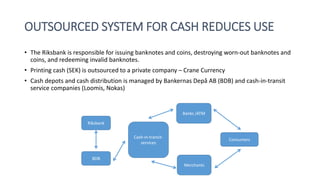
OUTSOURCED SYSTEM FOR CASH REDUCES USE
• The Riksbank is responsible for issuing banknotes and coins, destroying worn-out banknotes and
coins, and redeeming invalid banknotes.
• Printing cash (SEK) is outsourced to a private company – Crane Currency
• Cash depots and cash distribution is managed by Bankernas Depå AB (BDB) and cash-in-transit
service companies (Loomis, Nokas)
Riksbank
Cash-in-transit-
services
Consumers
Banks /ATM
BDB
Merchants
LAWS MAKES IT POSSIBLE TO REFUSE CASH
1. Riksbankslagen - Lagen (1988:1385) om Sveriges riksbank i dess lydelse den 1 juli 2012
Central bank law1 stipulates
that cash is legal tender and
should be accepted by those
receiving a payment
Contract law states that two parties –
a merchant and a consumer – can
enter an agreement where the central
bank law is set aside.
If a store has a sign saying that cash is
not accepted in this store, the
consumer is assumed to have entered
this agreement if he/she steps into the
store and wants to buy something.
Contract law takes
presidency over central
bank law
It is ok for a merchant to say no to cash!
LAWS MAKES IT POSSIBLE TO REFUSE CASH
1. Riksbankslagen - Lagen (1988:1385) om Sveriges riksbank i dess lydelse den 1 juli 2012
Central bank law1 stipulates
that cash is legal tender and
should be accepted by those
receiving a payment
Contract law states that two parties –
a merchant and a consumer – can
enter an agreement where the central
bank law is set aside.
If a store has a sign saying that cash is
not accepted in this store, the
consumer is assumed to have entered
this agreement if he/she steps into the
store and wants to buy something.
Contract law takes
presidency over central
bank law
It is ok for a merchant to say no to cash!
1. Riksbankslagen - Lagen (1988:1385) om Sveriges riksbank i dess lydelse den 1 juli 2012
Central bank law1 stipulates
that cash is legal tender and
should be accepted by those
receiving a payment
Contract law states that two parties –
a merchant and a consumer – can
enter an agreement where the central
bank law is set aside.
If a store has a sign saying that cash is
not accepted in this store, the
consumer is assumed to have entered
this agreement if he/she steps into the
store and wants to buy something.
Contract law takes
presidency over central
bank law
It is ok for a merchant to say no to cash!
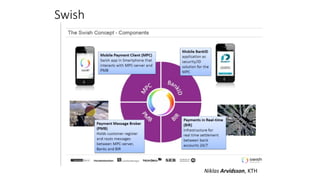
SWISH – A SUBSTITUTE TO CASH
Source: www.getswish.se
• Sweden has 10 million inhabitants where 8,2 million are older than 15; Swish covers 70 %
• The value of card payments are 62 billion SEK per month; Swish is 20 % of this.
Value of Swish transactions 2013 – 2017 (Billion SEK)
On December 12, 2012, at 00:12, the new mobile payment Swish was
launched in the Swedish market by the six banks.
Swish is a disruptive innovation in the mobile payment service
industry that has succeeded in creating an interoperable service for
the Swedish market that has become a successful substitute to cash
for person-to-person payments.
SWISH – A SUBSTITUTE TO CASH
Source: www.getswish.se
• Sweden has 10 million inhabitants where 8,2 million are older than 15; Swish covers 70 %
• The value of card payments are 62 billion SEK per month; Swish is 20 % of this.
Value of Swish transactions 2013 – 2017 (Billion SEK)
Swish
Niklas Arvidsson, KTH
CENTRAL BANK DIGITAL CURRENCY: E-KRONA BY THE RIKSBANK
IS A POSSIBLE PAYMENT SERVICE IN THE FUTURE
"If the market can make use of the new technology to launch new and popular payment services, why
shouldn't the Riksbank be able to do the same?"
says Deputy Governor Cecilia Skingsley.
http://www.riksbank.se/Documents/Avdelningar/AFS/2017/Projektplan%20e-kronan_170314_eng.pdf
http://www.riksbank.se/en/Press-and-published/Speeches/2016/Skingsley-Should-the-Riksbank-issue-e-krona/
http://www.riksbank.se/en/Press-and-published/Notices/2017/This-is-what-an-e-krona-could-look-like/
The current review
of the Central Bank
Law in Sweden
may make it
possible for the
Central Bank to
issue electronic
cash (CBDC)
DIGITAL CURRENCIES – LIKE BITCOIN – DOES
NOT MEET CRITICAL DEMANDS ON PAYMENTS
Cryptocurrency (Bitcoin)
Medium of exchange -
accepted means for
economic transactions
Low. Few accept Bitcoin as a medium of exchange.
Primarily used in Internet transactions within the
Bitcoin community.
Unit of account – base
for comparisons of
value in the trade
Low/Medium. Few prices are quoted in Bitcoin. But
it is convertible to other currencies.
Store of value – how
well value is stored
over time
Low. Depends on the exchange rate for Bitcoin on
markets and this is highly volatile.
KEY FACTORS TURNING SWEDEN INTO A
CASHLESS SOCIETY
1. Wages and salaries being paid directly into bank accounts
2. A well-functioning system for card payments (technology and business models)
3. Laws on bank secrecy / private information guarantees trust from consumers
4. Outsourced and privatized system makes consumer demand decide cash use
5. Unions lobbied against cash from employee perspective, i.e. to avoid robberies
6. Cash register laws made stores say no to cash and report sales to tax authorities
KEY FACTORS TURNING SWEDEN INTO A
CASHLESS SOCIETY
7. Tax incentives made household services (cleaning and construction) “white”
8. Banks’ business models make them uninterested in cash-handling services
9. Crimes by cash-in-transit service provider made stores less interested in cash
10. New innovative services directly substituted cash (Swish and Izettle)
11. Technology-interested and skilled consumers prefer mobile payments over cash
12. Factors working against a reduction of cash which need to be handled
• Problems for groups that suffer (elderly, disabled, immigrants, unbanked) which – for good
reasons! - are studied by County Administration Boards
• Lobbying from cash-in-transit service companies and elderly – “a cash rebellion”
3. HOW THIS IS AFFECTING PEOPLE’S LIVES
Number of counties
Good Satisfactory Rather poor Poor
Counties / regions with
Satisfactory access to basic
payment services are decreasing
SOME FACE POOR ACCESS TO PAYMENT SERVICES
Source: Report by the Swedish County Administration Board (www.lst.se )
Counties / regions with Rather
poor access to basic payment
services are increasing
OTHERS ACHIEVE FINANCIAL
INCLUSION VIA NEW SERVICES
• Homeless people in Stockholm sell a magazine called Situation
Stockholm to get money to food and housing, and accept card
and mobile payments. http://www.situationsthlm.se/
• Churches – like Svenska Kyrkan i Sundbyberg - in Stockholm –
accept card payments and mobile payments for donations
https://www.svenskakyrkan.se/sundbyberg
• Donations to aid organizations like the Red Cross, Save the
Children, Mediciniers sans frontier (MSF), Amnesty
International and many others can be done via mobile
payments https://www.getswish.se/insamlingsorganisationer/
4. IMPLICATIONS FOR OTHER COUNTRIES
ACTIONS LEADING TOWARD A CASHLESS SOCIETY
• Payment system
• Create a well-functioning system for electronic payments (technologies and business models)
• Stimulate a cash system where consumer demand of cash plays a central role
• Lobby for a reduction of cash from an employee perspective, i.e. to avoid robberies
• Roles and rules for critical actors
• Make sure all consumers are banked and that bank accounts are the key to all payments
• Make sure payments to and from the state (taxes, well-fare, fines, etc.) are electronic
• Make sure employers pay wages and salaries directly into bank accounts
• Educate consumers to start trusting and using electronic payments over cash
• Provide help to groups that suffer the most when cash is reduced
ACTIONS LEADING TOWARD A CASHLESS SOCIETY
• Innovation policies and legal framework
• Use public procurement to procure innovative payment services that replace cash
• Build laws on bank secrecy and personal information to guarantee trust from consumers
• Make it legally possible for merchants to say no to cash and only accept electronic payments
• Stimulate Fintech companies that can launch innovative services that replace cash – create
innovation milieus for start-ups and innovative providers
• Introduce cash register laws making it difficult for stores to hide sales from tax authorities
• Build tax incentives to turn “grey” payments into ”white” payments (household services?)
• Introduce a framework similar to the Payment Service Directives (PSD) in the European Union
to stimulate competition, low fees and innovation
AIMS WITH PSD2
The PSD2 updates and complements the EU rules put in place by the Payment Services Directive
(2007/64/EC). Its main objectives are to:
• Contribute to a more integrated and efficient European payments market
• Improve the level playing field for payment service providers (including new players)
• Third party providers (TPP)
• Payment initiation service providers (PISP)
• Account information service providers (AISP)
• Make payments safer and more secure
• Protect consumers
• Encourage lower prices for payments
Source: http://europa.eu/rapid/press-release_MEMO-15-5793_en.htm?locale=en
PAYMENT SERVICES THE TRADITIONAL WAY
Infrastructure – RIX and Bankgirot
Bank accounts
Cash handling
CONSUMER (PAYER) MERCHANT(PAYEE)
CARDISSUERS CARDACQUIRER
Real time:Informationabout payer
Real time: Supply of goods
and/or service
Real time:Approval of
transaction
Later: Payment minus a fee (i.e.
50 € minus fee)
On-going:
Annual card fee
Later: Payment from card issuerto card acquirer minus interchange fee
(i.e. 50 € minus fee)
Later: Payment from card holder
(consumer) to card issuer(50 €)
On-going:Card connected to
accountorcredit + Insurance
against fraud
Card
framework
Real time:
Information
about payer
and
transaction
Real time:
Approval of
transaction
Real time:
Approval of
transaction
Real time:
Information
about payer
and
transaction
Real time:
Information
about payer
and transaction
Card system
Mobile payments based
on accounts
Mobile payments based
on cards
Kortutgivare
Konsumenter,
butiker, handel
Konsumenter
Kortinlösare
Kortoperatör
Izettle
Bank accounts
constitute the
backbone in the
system. These give
bank a strong
position to sell (e.g.)
card payments
Dominant design
PAYMENT SERVICES IN A NEW WAY
Infrastructure – RIX and Bankgirot
Bank accounts
Cash handling
CONSUMER (PAYER) MERCHANT(PAYEE)
CARDISSUERS CARDACQUIRER
Real time:Informationabout payer
Real time: Supply of goods
and/or service
Real time:Approval of
transaction
Later: Payment minus a fee (i.e.
50 € minus fee)
On-going:
Annual card fee
Later: Payment from card issuerto card acquirer minus interchange fee
(i.e. 50 € minus fee)
Later: Payment from card holder
(consumer) to card issuer(50 €)
On-going:Card connected to
accountorcredit + Insurance
against fraud
Card
framework
Real time:
Information
about payer
and
transaction
Real time:
Approval of
transaction
Real time:
Approval of
transaction
Real time:
Information
about payer
and
transaction
Real time:
Information
about payer
and transaction
Card system
Mobile payments based
on accounts
Mobile payments based
on cards
Kortutgivare
Konsumenter,
butiker, handel
Konsumenter
Kortinlösare
Kortoperatör
Izettle
New payment
services sold by
PISP:s to consumers
New account
information
services sold by
AISP:s to
consumers
A NEW LANDSCAPE FOR PAYMENTS
Bank accounts
Consumers
Services provided by Third Parties (TPPs)
- Card services
- Swish
- Direct debit transfers
- Mobile payment services
- Block-chain based services
Bank services
- Card services
- Swish
- Direct debit transfers
- Mobile payment services
- Block-chain based services
This is
how it
used to
be
This is
how it
can
become
after
PSD2
Bank accounts may
become bit pipes to
other services that
are sold directly to
consumers by TTPs.
5. CONCLUSIONS AND SUMMARY
SUMMARY
1. Sweden is moving fast towards a practically cash-free society.
• Cash peaked 2007 and Sweden may be practically cashless in 2023!
• Consumers use cash in 18 % of retail payments and over 50 % of bank offices are cash-free.
• The average merchant in Sweden will not earn money from cash-based sales after 2023.
2. There are social concerns as access to basic payment services deteriorates.
• Elderly, people with physical and cognitive disabilities, immigrants and small- and medium-
sized companies in rural areas.
3. Digital currencies are highly interesting and may replace cash.
• Central bank digital currencies are very interesting but not yet here.
• Crypto-currencies – like Bitcoin – are here but not yet a viable option.
4. There are many actions that can be taken to reduce the use of cash.
• Create trust in an electronic payment system
• Build a payment system that favors electronic payments
• Educate consumers
34
Thank you! Questions?
niklas.arvidsson@indek.kth.se
PUBLICATIONS IN THE AREA OF PAYMENTS
• Apanasevic, T., Arvidsson, N. and J., Markendahl. Accepted for publication. Mobile payments: a proposal for a context-oriented approach based on socio-technical
system theory. Journal of Innovation Management.
• Arvidsson, N. 2018. The future of cash. In The Rise and Development of FinTech - Accounts of Disruption from Sweden and Beyond. Eds. R. Teigland, S. Siri, A.
Larsson, A. Moreno Puertas & C. Ingram Bogusz. Chapter 4, pp. 85-98. Routledge. Routledge International Studies in Money and Banking. Taylor & Francis Group,
London and New York.
• Arvidsson, N. 2018. The payment landscape in Sweden. In The Rise and Development of FinTech - Accounts of Disruption from Sweden and Beyond. Eds. R.
Teigland, S. Siri, A. Larsson, A. Moreno Puertas & C. Ingram Bogusz. Chapter 13, pp. 238-252. Routledge. Routledge International Studies in Money and Banking.
Taylor & Francis Group, London and New York.
• Arvidsson, N., Hedman, J. & B. Segendorf. 2018. När slutar svenska handlare acceptera kontanter? (When do merchants stop accepting cash?). Handelsrådet,
Forskningsrapport 2018:1
• Apanasevic, T., Markendahl, J. & N., Arvidsson. 2016. Stakeholders ' expectations of mobile payment in retail: lessons from Sweden. International Journal of Bank
Marketing, 34(1): 37-61.
• Arvidsson, N. 2016. Framväxten av mobila, elektroniska betalningstjänster i Sverige En studie av förändring inom betalsystemet (The growth of mobile, electronic
payment services in Sweden - a study of change in the payment system). Uppdragsforskningsrapport 2016:4 Av Niklas Arvidsson på uppdrag av Konkurrensverket.
• Arvidsson, N. 2015. Emergence of an ICT-based disruptive mobile payment service. In Small and Beautiful –The ICT success of Finland & Sweden. Eds. E. Giertz, A.
Rickne and P. Rouvinen. VINNOVA Analysis, VA 2015:06 (Ch. 15, pp. 200-208).
• Arvidsson, N. 2014. A study of turbulence in the Swedish payment system – is there a way forward? Foresight, 16(5).
• Arvidsson, N. 2013. Consumer attitudes on mobile payment services – results from a proof of concept test. International Journal of Bank Marketing, 32(2).
• Arvidsson, N. 2013. Det kontantlösa samhället – rapport från ett forskningsprojekt (The cashless society - report from a research project). TRITA IEO-R 2013:01.
INDEK, KTH.
• Arvidsson, N. 2009. Framtidens Betalsystem – En studie av förnyelse av det svenska betalsystemet (The future payment system - a study of renewal in the Swedish
payment system). Rapport SR 09, CEFIN KTH.

Future Cashless Society

  • 1.
    Transformation into a CashlessSweden Niklas Arvidsson Royal Institute of Technology (KTH) Sweden 1st APO Sustainable Development Summit in Tokyo July 10, 2018
  • 2.
    Niklas Arvidsson Research oninnovation in payment systems • When do merchants stop accepting cash? • Effects on retail industries from new digital platforms • Interoperability for mobile payments and digital services • The growth of mobile, electronic payment services in Sweden • Disruptive innovations in the payment system – Swish • Mobile payments, more than transactions • The cashless society • Test of a proof-of-concept mobile payment service in Sweden • The future payment system Associate Professor, INDEK, Royal Institute of Technology (KTH) niklas.arvidsson@indek.kth.se www.indek.kth.se
  • 3.
    CONTENT 1. Sweden’s routetowards a cashless society 2. Key factors in the development of cashless society 3. How this is affecting people’s lives 4. Implications for other countries 5. Conclusions and summary
  • 4.
    SUMMARY OF MYPRESENTATION 1. Sweden is moving towards a practically cash-free society. 2. Social concerns grow as access to cash deteriorates. 3. Digital currencies are highly interesting and may replace cash. 4. There are many actions that can be taken to reduce the use of cash. 4
  • 5.
    1. SWEDEN’S ROUTETOWARDS A CASHLESS SOCIETY
  • 6.
    Sweden hit peakcash on Dec 21, 2007. Since then the amount of cash has rapidly declined. CASH IN SWEDEN PEAKED DECEMBER 21, 2007 -9,5 % in 2018
  • 7.
    Source: Sveriges Riksbankwww.riksbank.se HISTORY OF CASH IN SWEDEN - Nominal value of cash in circulation (Billion SEK) - Cash in circulation / GDP (%) Bank accounts Card payments and checks phased out Robberies & unions Tax incentives Swish and other services Panaxia Cashless banks New bills and coins Cash rebellion Access to payment services is a problem ~ 1 % in 2018 Cash register law
  • 8.
    CARDS DOMINATE RETAILPAYMENTS Payment service Share of value (%) Cards – total 71 - Debit cards - Credit and charge cards - Merchants’ own cards (to customers) - Other cards (like employers’ cards) 47 18 3 3 Cash 18 Invoicing 10 Others (like coupons, loyalty bonuses, etc.) 0,6 Mobile payments 0,4 Total 100 Average numbers from the most cash-intensive industries (food, clothing, tobacco stores, newspaper stands, etc. ). Source: Current study (When will merchants stop accepting cash? Preliminary results June 2017 based on 741 replies from Swedish merchants.
  • 9.
    50 PERCENT OFMERCHANTS WILL HAVE STOPPED ACCEPTING CASH BY 2025! This is probably an underestimation: • We can expect costs for cash handling will increase • We can expect that access to ATMs and deposit machines will decrease – especially in rural areas • This does not consider the effect from negative network economics as fewer payers use cash and fewer payment receivers accept cash When will you stop accepting cash? Senast 2020 Senast 2025 Senast 2030 Efter 2030Before 2020 2021 - 2025 2026 - 2030 After 2030
  • 10.
    Sweden may be practicallycashless in 2023! • 97 percent of merchants accepted cash in 2017 but… • merchants have no incentives to accept cash when the overall sales in cash is below 7 percent of total sales… • and if the current rate of the decline of the use cash continues, this will happen in 2023. This is when we practically say goodbye to cash in Sweden….we think
  • 11.
    2. KEY FACTORSIN THE DEVELOPMENT OF CASHLESS SOCIETY
  • 12.
    SWEDISH GOVERNMENT LEAVEIT TO THE MARKET • The objective: • Everybody in the society should have access to basic payment services. • The responsibility: • Banks and other actors have the primary responsibility to provide cash handling services. • The central bank – the Riksbank - has the responsibility to provide cash but the volume is decided by demand. The central bank also runs a cash handling board which focuses on solving operational problems related to cash handling. • County administration boards have the responsibility to study and evaluate access to basic payment services in Sweden and to initiate support and services that improve this access. • The post and telecommunication board (pts) has the role to support county administration boards and to support development of user-friendly electronic communication services in Sweden. • The state of Sweden’s responsibility only relates to areas where the market fails to provide these services. Source: https://www.regeringen.se/artiklar/2016/08/ansvarsfordelning-for-kontanthantering/
  • 13.
    OUTSOURCED SYSTEM FORCASH REDUCES USE • The Riksbank is responsible for issuing banknotes and coins, destroying worn-out banknotes and coins, and redeeming invalid banknotes. • Printing cash (SEK) is outsourced to a private company – Crane Currency • Cash depots and cash distribution is managed by Bankernas Depå AB (BDB) and cash-in-transit service companies (Loomis, Nokas) Riksbank Cash-in-transit- services Consumers Banks /ATM BDB Merchants
  • 14.
    LAWS MAKES ITPOSSIBLE TO REFUSE CASH 1. Riksbankslagen - Lagen (1988:1385) om Sveriges riksbank i dess lydelse den 1 juli 2012 Central bank law1 stipulates that cash is legal tender and should be accepted by those receiving a payment Contract law states that two parties – a merchant and a consumer – can enter an agreement where the central bank law is set aside. If a store has a sign saying that cash is not accepted in this store, the consumer is assumed to have entered this agreement if he/she steps into the store and wants to buy something. Contract law takes presidency over central bank law It is ok for a merchant to say no to cash!
  • 15.
    LAWS MAKES ITPOSSIBLE TO REFUSE CASH 1. Riksbankslagen - Lagen (1988:1385) om Sveriges riksbank i dess lydelse den 1 juli 2012 Central bank law1 stipulates that cash is legal tender and should be accepted by those receiving a payment Contract law states that two parties – a merchant and a consumer – can enter an agreement where the central bank law is set aside. If a store has a sign saying that cash is not accepted in this store, the consumer is assumed to have entered this agreement if he/she steps into the store and wants to buy something. Contract law takes presidency over central bank law It is ok for a merchant to say no to cash! 1. Riksbankslagen - Lagen (1988:1385) om Sveriges riksbank i dess lydelse den 1 juli 2012 Central bank law1 stipulates that cash is legal tender and should be accepted by those receiving a payment Contract law states that two parties – a merchant and a consumer – can enter an agreement where the central bank law is set aside. If a store has a sign saying that cash is not accepted in this store, the consumer is assumed to have entered this agreement if he/she steps into the store and wants to buy something. Contract law takes presidency over central bank law It is ok for a merchant to say no to cash!
  • 16.
    SWISH – ASUBSTITUTE TO CASH Source: www.getswish.se • Sweden has 10 million inhabitants where 8,2 million are older than 15; Swish covers 70 % • The value of card payments are 62 billion SEK per month; Swish is 20 % of this. Value of Swish transactions 2013 – 2017 (Billion SEK) On December 12, 2012, at 00:12, the new mobile payment Swish was launched in the Swedish market by the six banks. Swish is a disruptive innovation in the mobile payment service industry that has succeeded in creating an interoperable service for the Swedish market that has become a successful substitute to cash for person-to-person payments.
  • 17.
    SWISH – ASUBSTITUTE TO CASH Source: www.getswish.se • Sweden has 10 million inhabitants where 8,2 million are older than 15; Swish covers 70 % • The value of card payments are 62 billion SEK per month; Swish is 20 % of this. Value of Swish transactions 2013 – 2017 (Billion SEK)
  • 18.
  • 19.
    CENTRAL BANK DIGITALCURRENCY: E-KRONA BY THE RIKSBANK IS A POSSIBLE PAYMENT SERVICE IN THE FUTURE "If the market can make use of the new technology to launch new and popular payment services, why shouldn't the Riksbank be able to do the same?" says Deputy Governor Cecilia Skingsley. http://www.riksbank.se/Documents/Avdelningar/AFS/2017/Projektplan%20e-kronan_170314_eng.pdf http://www.riksbank.se/en/Press-and-published/Speeches/2016/Skingsley-Should-the-Riksbank-issue-e-krona/ http://www.riksbank.se/en/Press-and-published/Notices/2017/This-is-what-an-e-krona-could-look-like/ The current review of the Central Bank Law in Sweden may make it possible for the Central Bank to issue electronic cash (CBDC)
  • 20.
    DIGITAL CURRENCIES –LIKE BITCOIN – DOES NOT MEET CRITICAL DEMANDS ON PAYMENTS Cryptocurrency (Bitcoin) Medium of exchange - accepted means for economic transactions Low. Few accept Bitcoin as a medium of exchange. Primarily used in Internet transactions within the Bitcoin community. Unit of account – base for comparisons of value in the trade Low/Medium. Few prices are quoted in Bitcoin. But it is convertible to other currencies. Store of value – how well value is stored over time Low. Depends on the exchange rate for Bitcoin on markets and this is highly volatile.
  • 21.
    KEY FACTORS TURNINGSWEDEN INTO A CASHLESS SOCIETY 1. Wages and salaries being paid directly into bank accounts 2. A well-functioning system for card payments (technology and business models) 3. Laws on bank secrecy / private information guarantees trust from consumers 4. Outsourced and privatized system makes consumer demand decide cash use 5. Unions lobbied against cash from employee perspective, i.e. to avoid robberies 6. Cash register laws made stores say no to cash and report sales to tax authorities
  • 22.
    KEY FACTORS TURNINGSWEDEN INTO A CASHLESS SOCIETY 7. Tax incentives made household services (cleaning and construction) “white” 8. Banks’ business models make them uninterested in cash-handling services 9. Crimes by cash-in-transit service provider made stores less interested in cash 10. New innovative services directly substituted cash (Swish and Izettle) 11. Technology-interested and skilled consumers prefer mobile payments over cash 12. Factors working against a reduction of cash which need to be handled • Problems for groups that suffer (elderly, disabled, immigrants, unbanked) which – for good reasons! - are studied by County Administration Boards • Lobbying from cash-in-transit service companies and elderly – “a cash rebellion”
  • 23.
    3. HOW THISIS AFFECTING PEOPLE’S LIVES
  • 24.
    Number of counties GoodSatisfactory Rather poor Poor Counties / regions with Satisfactory access to basic payment services are decreasing SOME FACE POOR ACCESS TO PAYMENT SERVICES Source: Report by the Swedish County Administration Board (www.lst.se ) Counties / regions with Rather poor access to basic payment services are increasing
  • 25.
    OTHERS ACHIEVE FINANCIAL INCLUSIONVIA NEW SERVICES • Homeless people in Stockholm sell a magazine called Situation Stockholm to get money to food and housing, and accept card and mobile payments. http://www.situationsthlm.se/ • Churches – like Svenska Kyrkan i Sundbyberg - in Stockholm – accept card payments and mobile payments for donations https://www.svenskakyrkan.se/sundbyberg • Donations to aid organizations like the Red Cross, Save the Children, Mediciniers sans frontier (MSF), Amnesty International and many others can be done via mobile payments https://www.getswish.se/insamlingsorganisationer/
  • 26.
    4. IMPLICATIONS FOROTHER COUNTRIES
  • 27.
    ACTIONS LEADING TOWARDA CASHLESS SOCIETY • Payment system • Create a well-functioning system for electronic payments (technologies and business models) • Stimulate a cash system where consumer demand of cash plays a central role • Lobby for a reduction of cash from an employee perspective, i.e. to avoid robberies • Roles and rules for critical actors • Make sure all consumers are banked and that bank accounts are the key to all payments • Make sure payments to and from the state (taxes, well-fare, fines, etc.) are electronic • Make sure employers pay wages and salaries directly into bank accounts • Educate consumers to start trusting and using electronic payments over cash • Provide help to groups that suffer the most when cash is reduced
  • 28.
    ACTIONS LEADING TOWARDA CASHLESS SOCIETY • Innovation policies and legal framework • Use public procurement to procure innovative payment services that replace cash • Build laws on bank secrecy and personal information to guarantee trust from consumers • Make it legally possible for merchants to say no to cash and only accept electronic payments • Stimulate Fintech companies that can launch innovative services that replace cash – create innovation milieus for start-ups and innovative providers • Introduce cash register laws making it difficult for stores to hide sales from tax authorities • Build tax incentives to turn “grey” payments into ”white” payments (household services?) • Introduce a framework similar to the Payment Service Directives (PSD) in the European Union to stimulate competition, low fees and innovation
  • 29.
    AIMS WITH PSD2 ThePSD2 updates and complements the EU rules put in place by the Payment Services Directive (2007/64/EC). Its main objectives are to: • Contribute to a more integrated and efficient European payments market • Improve the level playing field for payment service providers (including new players) • Third party providers (TPP) • Payment initiation service providers (PISP) • Account information service providers (AISP) • Make payments safer and more secure • Protect consumers • Encourage lower prices for payments Source: http://europa.eu/rapid/press-release_MEMO-15-5793_en.htm?locale=en
  • 30.
    PAYMENT SERVICES THETRADITIONAL WAY Infrastructure – RIX and Bankgirot Bank accounts Cash handling CONSUMER (PAYER) MERCHANT(PAYEE) CARDISSUERS CARDACQUIRER Real time:Informationabout payer Real time: Supply of goods and/or service Real time:Approval of transaction Later: Payment minus a fee (i.e. 50 € minus fee) On-going: Annual card fee Later: Payment from card issuerto card acquirer minus interchange fee (i.e. 50 € minus fee) Later: Payment from card holder (consumer) to card issuer(50 €) On-going:Card connected to accountorcredit + Insurance against fraud Card framework Real time: Information about payer and transaction Real time: Approval of transaction Real time: Approval of transaction Real time: Information about payer and transaction Real time: Information about payer and transaction Card system Mobile payments based on accounts Mobile payments based on cards Kortutgivare Konsumenter, butiker, handel Konsumenter Kortinlösare Kortoperatör Izettle Bank accounts constitute the backbone in the system. These give bank a strong position to sell (e.g.) card payments Dominant design
  • 31.
    PAYMENT SERVICES INA NEW WAY Infrastructure – RIX and Bankgirot Bank accounts Cash handling CONSUMER (PAYER) MERCHANT(PAYEE) CARDISSUERS CARDACQUIRER Real time:Informationabout payer Real time: Supply of goods and/or service Real time:Approval of transaction Later: Payment minus a fee (i.e. 50 € minus fee) On-going: Annual card fee Later: Payment from card issuerto card acquirer minus interchange fee (i.e. 50 € minus fee) Later: Payment from card holder (consumer) to card issuer(50 €) On-going:Card connected to accountorcredit + Insurance against fraud Card framework Real time: Information about payer and transaction Real time: Approval of transaction Real time: Approval of transaction Real time: Information about payer and transaction Real time: Information about payer and transaction Card system Mobile payments based on accounts Mobile payments based on cards Kortutgivare Konsumenter, butiker, handel Konsumenter Kortinlösare Kortoperatör Izettle New payment services sold by PISP:s to consumers New account information services sold by AISP:s to consumers
  • 32.
    A NEW LANDSCAPEFOR PAYMENTS Bank accounts Consumers Services provided by Third Parties (TPPs) - Card services - Swish - Direct debit transfers - Mobile payment services - Block-chain based services Bank services - Card services - Swish - Direct debit transfers - Mobile payment services - Block-chain based services This is how it used to be This is how it can become after PSD2 Bank accounts may become bit pipes to other services that are sold directly to consumers by TTPs.
  • 33.
  • 34.
    SUMMARY 1. Sweden ismoving fast towards a practically cash-free society. • Cash peaked 2007 and Sweden may be practically cashless in 2023! • Consumers use cash in 18 % of retail payments and over 50 % of bank offices are cash-free. • The average merchant in Sweden will not earn money from cash-based sales after 2023. 2. There are social concerns as access to basic payment services deteriorates. • Elderly, people with physical and cognitive disabilities, immigrants and small- and medium- sized companies in rural areas. 3. Digital currencies are highly interesting and may replace cash. • Central bank digital currencies are very interesting but not yet here. • Crypto-currencies – like Bitcoin – are here but not yet a viable option. 4. There are many actions that can be taken to reduce the use of cash. • Create trust in an electronic payment system • Build a payment system that favors electronic payments • Educate consumers 34
  • 35.
  • 36.
    PUBLICATIONS IN THEAREA OF PAYMENTS • Apanasevic, T., Arvidsson, N. and J., Markendahl. Accepted for publication. Mobile payments: a proposal for a context-oriented approach based on socio-technical system theory. Journal of Innovation Management. • Arvidsson, N. 2018. The future of cash. In The Rise and Development of FinTech - Accounts of Disruption from Sweden and Beyond. Eds. R. Teigland, S. Siri, A. Larsson, A. Moreno Puertas & C. Ingram Bogusz. Chapter 4, pp. 85-98. Routledge. Routledge International Studies in Money and Banking. Taylor & Francis Group, London and New York. • Arvidsson, N. 2018. The payment landscape in Sweden. In The Rise and Development of FinTech - Accounts of Disruption from Sweden and Beyond. Eds. R. Teigland, S. Siri, A. Larsson, A. Moreno Puertas & C. Ingram Bogusz. Chapter 13, pp. 238-252. Routledge. Routledge International Studies in Money and Banking. Taylor & Francis Group, London and New York. • Arvidsson, N., Hedman, J. & B. Segendorf. 2018. När slutar svenska handlare acceptera kontanter? (When do merchants stop accepting cash?). Handelsrådet, Forskningsrapport 2018:1 • Apanasevic, T., Markendahl, J. & N., Arvidsson. 2016. Stakeholders ' expectations of mobile payment in retail: lessons from Sweden. International Journal of Bank Marketing, 34(1): 37-61. • Arvidsson, N. 2016. Framväxten av mobila, elektroniska betalningstjänster i Sverige En studie av förändring inom betalsystemet (The growth of mobile, electronic payment services in Sweden - a study of change in the payment system). Uppdragsforskningsrapport 2016:4 Av Niklas Arvidsson på uppdrag av Konkurrensverket. • Arvidsson, N. 2015. Emergence of an ICT-based disruptive mobile payment service. In Small and Beautiful –The ICT success of Finland & Sweden. Eds. E. Giertz, A. Rickne and P. Rouvinen. VINNOVA Analysis, VA 2015:06 (Ch. 15, pp. 200-208). • Arvidsson, N. 2014. A study of turbulence in the Swedish payment system – is there a way forward? Foresight, 16(5). • Arvidsson, N. 2013. Consumer attitudes on mobile payment services – results from a proof of concept test. International Journal of Bank Marketing, 32(2). • Arvidsson, N. 2013. Det kontantlösa samhället – rapport från ett forskningsprojekt (The cashless society - report from a research project). TRITA IEO-R 2013:01. INDEK, KTH. • Arvidsson, N. 2009. Framtidens Betalsystem – En studie av förnyelse av det svenska betalsystemet (The future payment system - a study of renewal in the Swedish payment system). Rapport SR 09, CEFIN KTH.