World
Payments
  REPORT   2011
Table of Contents
 3   Preface

 4   Summary of Key Findings

     Section 1: World Non-Cash Markets and Trends
 7   Highlights
 8   Chapter 1:   Non-Cash Payments Continue to Grow
14   Chapter 2:   Initial Trends in 2010
18   Hot Topics: Trade Finance – A Business of Volume and High Specialization
19   Hot Topics: Workers’ Remittances – A Platform for Cards and Mobile Payments
20   Hot Topics: Cash – Reducing Costs While Developing Cards and Mobile Payments
22   Spotlight:   Governments Adopt Different Approaches to Reduce Check Usage
25   Spotlight:   In the Fight Against Card Fraud, Chip-and-PIN Technology Proves Effective

     Section 2: Regulatory and Industry Initiatives
29   Highlights
36   Sidebar:     Key Regulatory and Industry Initiatives
39   Sidebar:     SEPA at a Glance
40   Spotlight:   SEPA Update
42   Spotlight:   eGovernment Efforts Could Help to Drive Non-Cash Adoption

     Section 3: Capturing the Value in Payments as the Industry Transforms
45   Highlights
46   Chapter 1:   Evolution in Other Industries Offers Insight on Payments
48   Chapter 2:   Payments Evolution Could Result in a Paradigm Shift over the Mid-to-Long Term
50   Chapter 3:   Being Proactive and Innovative in the Near-Term
52   Spotlight:   Mobile Payments

54   The Way Forward

55   Methodology

56   Glossary
Preface
Now in its seventh year, the World Payments Report (WPR) from Capgemini, The Royal Bank of Scotland
(RBS), and Efma looks at how the global payments landscape is responding to shifts in economic and
competitive conditions, advances in technology, increased regulatory pressure, and evolving customer
demands.

Payments have weathered the economic crisis well: the volume of non-cash payments globally continued
to grow in 2009, albeit at a more modest pace than in recent years. Initial data suggests the growth in
volumes picked up again in 2010, but several external and internal factors are driving banks and forcing
transformation in the industry.

The World Payments Report 2011 looks first at the global and regional trends in payments volumes; then
outlines the potential effects of various regulations and industry initiatives on payments; before
exploring how those trends are driving industry transformation.

Along the way, the WPR also spotlights a range of topical issues, including the declining use of checks,
the progress of the Single Euro Payments Area (SEPA), the relationship between eGovernment
initiatives and non-cash payments, and the key role that mobile payments, and innovation in general,
will continue to play in the future of the industry.

In exploring the future shape of the payments landscape, we consider how other network
industries have evolved, noting for example how deregulation and commoditization in the Energy
and Telecommunications sectors have transformed the value chains of those industries. These examples
should provide food-for-thought for banks and payment service providers (PSPs), which in due course
may need to rethink their own business models in much the same way as participants in those sectors
have had to.

We conclude by looking at how banks need to prepare for potentially radical shifts in the
longer-term by devising strategies for future flexibility and by differentiating and proving their
value through innovation.

We hope this year’s report provides useful insights.


Jean Lassignardie                        Scott Barton                             Patrick Desmarès
Global Head of Sales and Marketing       Chief Executive                          Secretary General
Global Financial Services                Global Transaction Services              Efma
Capgemini                                The Royal Bank of Scotland


                                                                                                           3
Summary of Key Findings
    The global volume of non-cash payments has continued to grow, and payments have proved resilient to the
    effects of the financial crisis. Macroeconomic weakness decreased the rate of growth in non-cash payments
    volumes in 2008-09, but initial data suggests volumes resumed a higher growth rate in 2010. Nevertheless, the
    payments industry is under pressure to evolve, due to both exogenous and endogenous forces, and key
    regulatory and industry initiatives are converging to drive change far into the future.

    The World Payments Report 2011 explores the trends in payments volumes and instruments usage, the
    payments-related regulatory and industry initiatives that are driving change in the payments landscape, and the
    consequent strategic challenges and options for banks.

    The key findings of this report include the following:

    ƒ The global volume of non-cash payments transactions (using direct debits, credit transfers, cards
        and checks) grew by 5% in 2009 to 260 billion. The global use of such instruments, which expanded at a
        compound annual rate of 6.8% in 2001-09, has proved resilient to the effects of the financial crisis.
        Nevertheless, macroeconomic weakness did restrain the rate of growth, as the pre-crisis 2001-07 annual
        growth rate had been 7.2%. Moreover, in 2009, non-cash transaction volumes rose just 1.8% in North
        America and 4.7% in Europe, but considerably more (10.1%) in Mature Asia-Pacific.1

    ƒ Initial data suggests the growth in global payments picked up again in 2010, with transaction volumes
        rising at an estimated 7.8%, again driven by emerging markets and Mature Asia-Pacific. Non-cash payments
        are expected to show growth of 37% in CEMEA (Central Europe, Middle East, Africa), 23% in Rest of Asia
        (excluding China and India), 14% in BRIC (Brazil, Russia, India, and China), and 14% in Mature Asia-Pacific. In
        developed Europe and North America, non-cash payments seem likely to have grown less rapidly but still
        faster than in 2009.

    ƒ The use of credit and debit cards continued to grow in most markets in 2009 and global transaction
        volumes were up 9.7%. Cards remain the preferred non-cash payment instrument globally, with a market
        share of more than 40% in most markets and a high of 68% in Canada. At the same time, the average value
        per card transaction is decreasing in most markets. In the U.S., for example, volumes rose 5% while the
        average value per transaction dropped to €40 from €43.

    ƒ Check usage continued to decline across the globe in 2009, and accounted for 16% of all non-cash
        global transactions in 2009, down from 22% in 2005. This is a clear indicator of the global shift toward
        electronic payments.

    ƒ Europe continues to incur significant costs from rising euro cash-in-circulation. The ratio of cash over
        gross domestic product (GDP) in the Eurozone is more than twice that of the U.S. If the Eurozone could
        reduce cash usage, even accounting for the inefficiencies created by fragmentation, it could save
        approximately €20 billion per year, just through the proportional reduction in euro cash-handling costs, and
        would probably improve tax transparency.

    ƒ E-payments and m-payments collectively accounted for an estimated 22.5 billion transactions in
        2010. E-payments (online payments for e-commerce activities) are expected to grow globally to 30.3 billion
        transactions from 17.9 (in 2010-13), while m-payments are expected to grow globally to 15.3 billion
        transactions from 4.6 billion in the same period.

    ƒ Key Regulatory and Industry Initiatives (KRIIs) are driving five main industry transformation trends
        (ITTs), which are reworking—or soon will—aspects of the payments market and the positioning of
        participants. Those trends are:


    1
        Mature Asia-Pacific comprises Australia, Japan, Singapore and South Korea.


4
SummARy of KEy fINdINGS


 – Systemic-risk reduction and control. In the wake of the financial crisis, regulators are seeking to
   minimize systemic risk by asking for stricter requirements on capital and liquidity, but there is potential for
   unintended consequences, especially for certain business lines.
 – Standardization initiatives continue to improve efficiency, streamline processes and reduce costs. Some
   payments instruments and/or aspects of the value chain are becoming commoditized in the process,
   making it more difficult for banks to differentiate themselves.
 – A drive for higher levels of Transparency is increasingly being seen in the payments industry overall and in
   the cards business in particular. Several initiatives are focusing on making service fees to both corporate
   and retail clients more transparent, and this is likely to have implications for current business models.
 – Convergence. Developments in technology and evolving user and regulatory requirements are contributing
   to a gradual blurring of the lines between traditional payments activities supplied by infrastructure
   providers, potentially increasing competition between Real-Time Gross Settlement (RTGS) and Automated
   Clearing Houses (ACHs) for certain types of low-value payments.
 – Innovation allows players to specialize and to make use of emerging technologies and trends, such as
   mobile devices and contactless payments, to deliver state-of-the-art solutions. Non-bank PSPs may be
   better placed than many banks to leverage emerging technologies to create user needs.
ƒ Single Euro Payments Area (SEPA) adoption has increased in the last year in terms of SEPA Credit
 Transfers (SCT). However, SEPA Direct Debit (SDD) use is still developing. All stakeholders are agreed on the
 need for a firm end-date for migrating to SEPA, and the EU has proposed February 2013 for CTs and
 February 2014 for DDs. Final agreement on an EU Regulation designed to set firm end-dates is expected by
 the end of 2011.

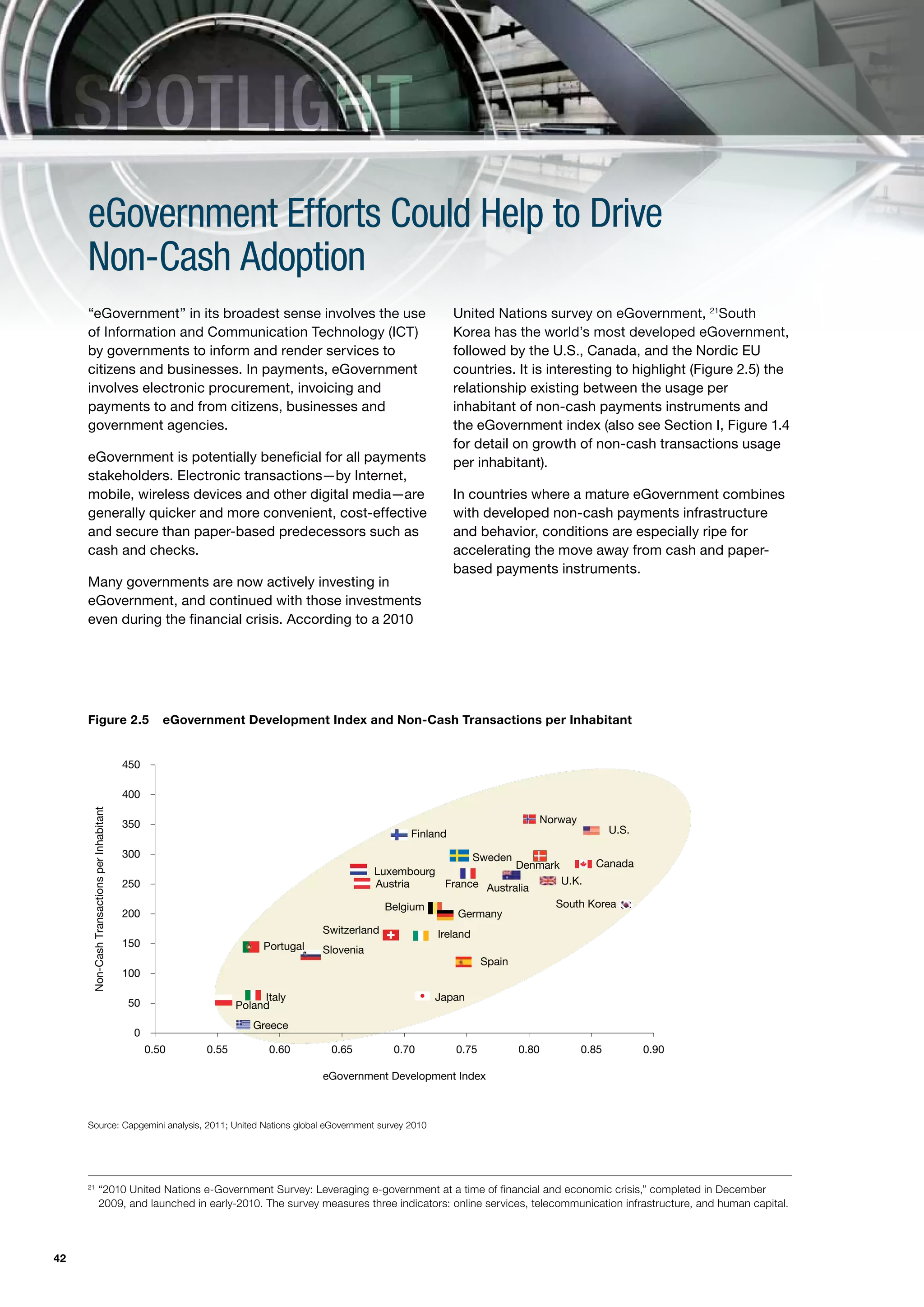
ƒ eGovernment initiatives are emerging as a key enabler of non-cash payments. In countries where a
 mature eGovernment combines with developed non-cash payments infrastructure and behavior, conditions
 are especially ripe for eGovernment payments to spur overall non-cash payments usage. This may have a
 knock-on effect in areas of the market still relying on dated technologies.

ƒ Market conditions and trends are driving standardization in the payments landscape, increasing
 commoditization in most payments instruments. In this environment, the imperative for banks and PSPs
 is to distinguish their propositions and prove their value through specialization.

 – The Energy and the Telecom industries have strong similarities to payments—and offer lessons
   learned—in that their basic products are commodities that are difficult to differentiate. Energy and
   Telecoms have also both been pressured by regulation, competition and technological innovations. In both
   cases, this pressure has resulted in a disaggregation of the value chain and a clear polarization of the
   production and distribution ends of the underlying product/service.
 – A similar disaggregation of the value chain could also take place in the payments industry, leading
   to clear business specialization: For example, production requiring operational excellence, volume scale,
   and cost leadership; and distribution hinging on customer intimacy, understanding the business and client
   needs, and the ability to build a distinctive set of products and services.
 – In the mid-to-long term, many PSPs could evolve into one of two specialist roles—Wholesale
   Payments Providers (WPPs) or Retail Payment Services Providers (RPSPs)—since few are likely to have
   the scale, capabilities, strategic ambition or will to pursue both ends of the value chain as it disaggregates.
 – Banks need to understand the role they will likely play in the longer-term and prepare for any
   potentially radical shifts. Evolving into a WPP, playing the RPSP role, or preparing to assume both roles
   requires vision and imposes strategic decisions. Meanwhile, innovation remains vital for banks and PSPs as
   it allows them to differentiate their propositions and prove their value. Many players will need to stretch
   beyond their traditional roles when positioning for longer-term success, even if shorter-term opportunities
   lie firmly in their grasp.


WoRld PAymENTS REPoRT 2011                                                                                           5
6
SECTIoN TITlE l1
                                                                                                 SECTIoN TITlE l2


1
HIGHLIGHTS   World Non-Cash
             Markets and Trends
             ƒ The global volume of non-cash payments transactions grew by 5% in 2009 to 260 billion.
              The global use of such instruments, which expanded at a compound annual rate of 6.8% during
              2001-09, has proved resilient to the effects of the financial crisis. Nevertheless, macroeconomic
              weakness did restrain the rate of growth, as the pre-crisis 2001-07 annual growth rate had been
              7.2%. Moreover, in 2009, non-cash transaction volumes rose just 1.8% in North America and 4.7%
              in Europe, but considerably more (10.1%) in Mature Asia-Pacific.

             ƒ The volume of non-cash payments continued to grow quickly in developing economies in
              2009. Usage rose 22.0% in CEMEA (Central Europe, Middle East, Africa), 15.4% in Latin America
              excluding Brazil, and 11.1% in the Rest of Asia. In the BRIC (Brazil, Russia, India, China) countries,
              non-cash transaction volumes gained 8.6% in 2009, a slower pace than in recent years, but BRIC
              has nevertheless showed a sustained gain in usage (12.4% a year in 2001-09), fueled by the
              growing use of cards.

             ƒ The U.S. remained by far the largest non-cash payments market in the world in 2009,
              accounting for more than 40% of the global total in 2009. Individuals in the U.S. are also the most
              frequent users of non-cash payments instruments in the world. The Eurozone remained the
              next largest payments market, with over 21% of the total. Together, North America, Europe,
              and Mature Asia-Pacific accounted for a combined 83% of non-cash payments volumes in 2009.

             ƒ The use of cards (credit and debit) continued to grow in most markets in 2009 and global
              transaction volumes were up 9.7%. Cards remain the preferred non-cash payment instrument
              globally, with a market share of more than 40% in most markets and a high of 68% in Canada.
              Also, the average value per card transaction is decreasing in most markets. In the U.S., for
              example, volumes rose 5% while the average value per transaction dropped to €40 from €43.

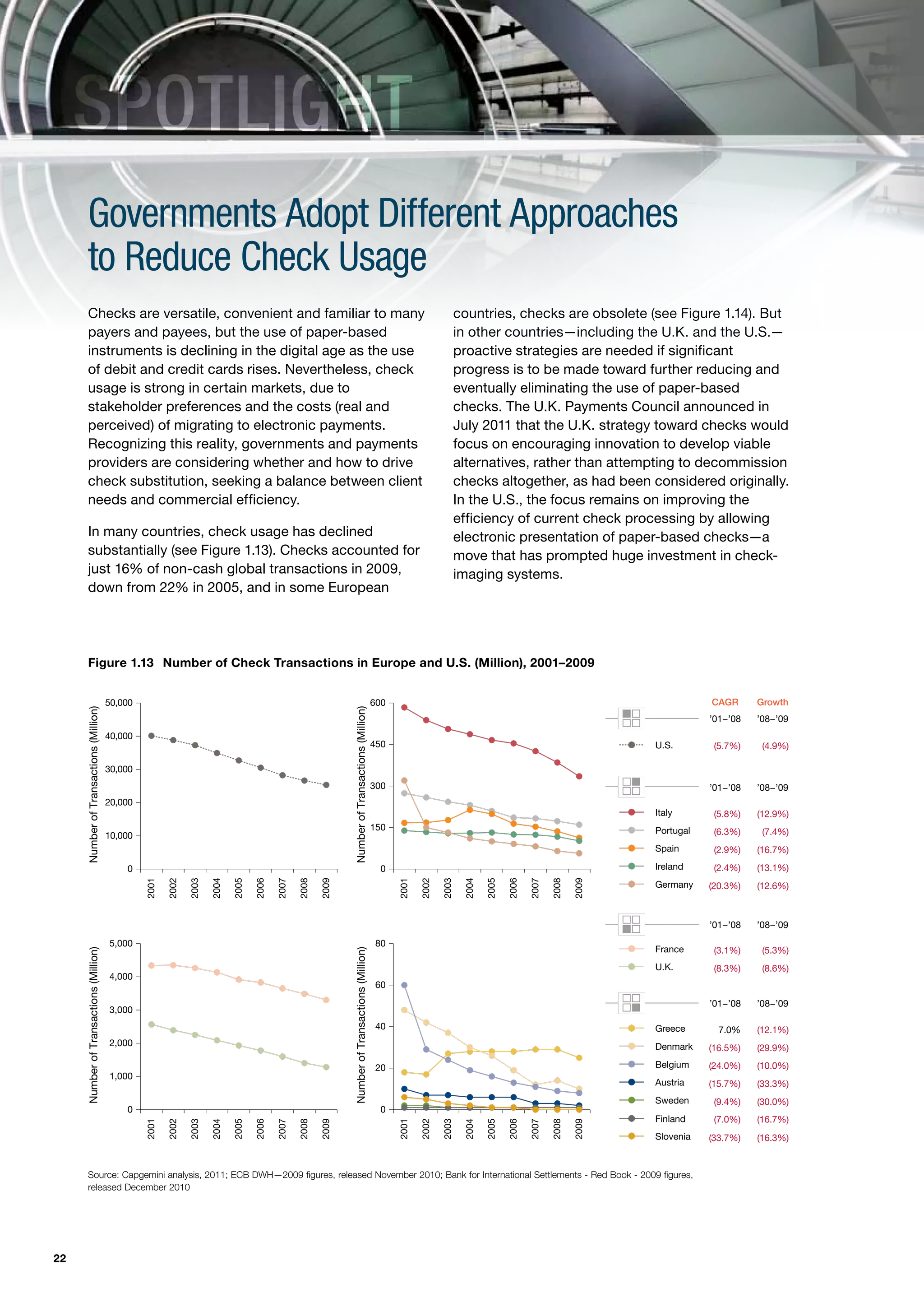
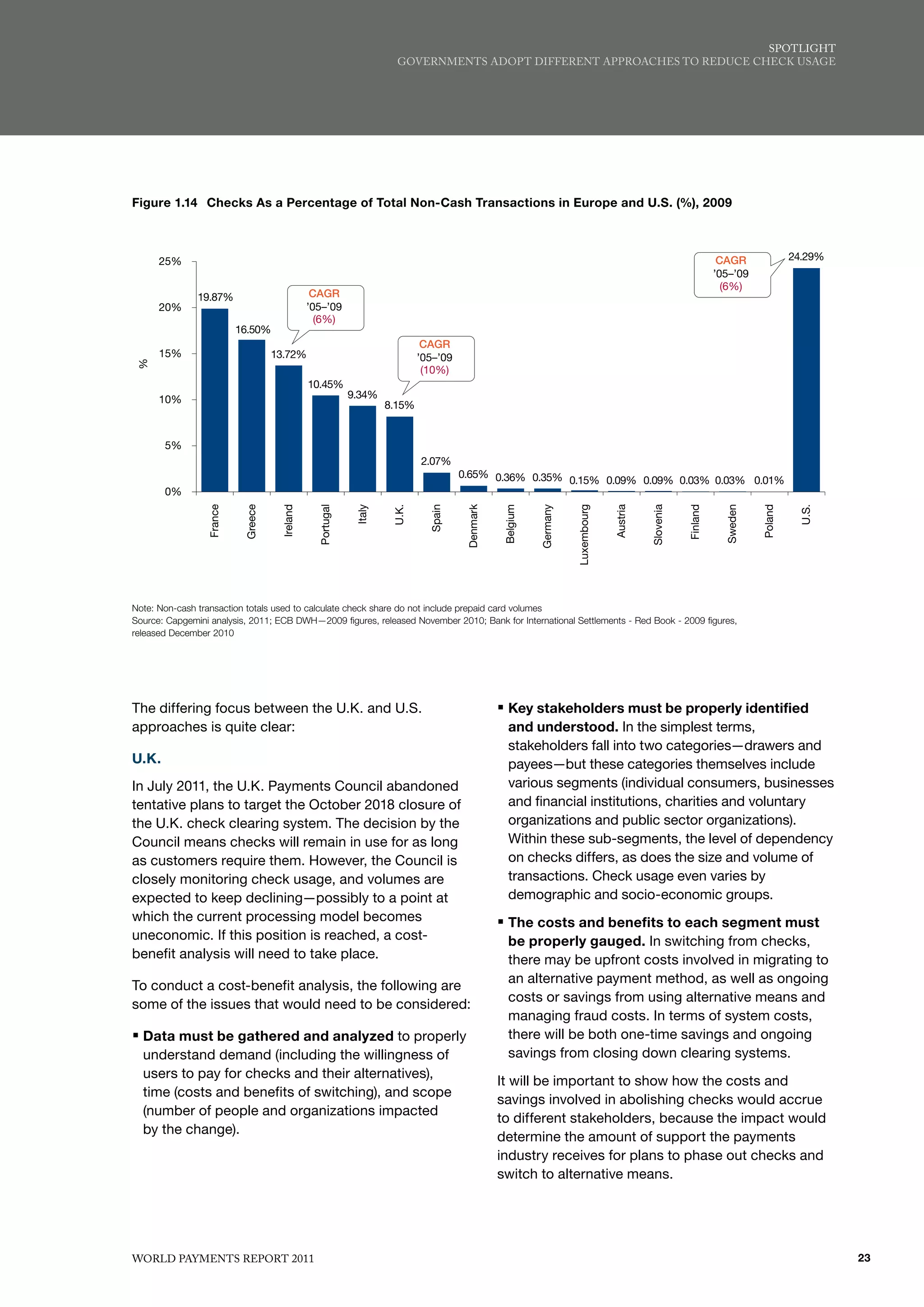
             ƒ Check usage continued to decline across the globe and accounted for 16% of all non-cash
              global transactions in 2009, down from 22% in 2005. This is a clear indicator of the global shift
              toward electronic payments. Several European economies have already decommissioned the
              use of checks.

             ƒ Europe continues to incur huge costs from rising euro cash-in-circulation. The ratio of
              cash over GDP in the Eurozone is more than twice that of the U.S. If the Eurozone could have
              reduced this ratio to U.S. levels in 2009, even accounting for the inefficiencies created by
              Eurozone fragmentation, it could have saved around €18 billion-€21 billion per year just through
              the proportional reduction in euro cash-handling costs, as well as improved tax transparency.

             ƒ Initial data suggests the growth in global payments picked up again in 2010, with transaction
              volumes rising at an estimated 7.8%, again driven by emerging markets and Mature Asia-Pacific
              and, in particular, by the growing use of cards in those markets. Non-cash payments are expected
              to show growth of 37% in CEMEA, 23% in Rest of Asia (excluding China and India), 14% in BRIC,
              and 14% in Mature Asia-Pacific. In developed Europe and North America, indications are that the
              growth in non-cash payments is also greater than in 2009.

             ƒ Trade finance demand is expanding as exports increase. Exports were 24% higher at the end
              of 2010 than at the beginning of 2009, with Asian trade flows rebounding more strongly than those of
              most developed economies. Workers’ remittances were hit hard by the crisis and global volumes
              contracted 5% in 2009, with remittances to Europe and Central Asia sinking 23%. However,
              remittances appear to have resumed growth in 2010, albeit at a slower pace (6%) than pre-crisis.

             ƒ E-payments and m-payments collectively accounted for an estimated 22.5 billion
              transactions in 2010. E-payments (online payments for e-commerce activities) are expected to
              grow globally from 17.9 to 30.3 billion transactions (between 2010 and 2013), while m-payments
              are expected to grow globally from 4.6 to 15.3 billion transactions in the same period.


WoRld PAymENTS REPoRT 2011                                                                                             7
CHAPTER 1


    Non-Cash Payments Continue to Grow
    GLOBAL USE OF NON-CASH PAYMENTS GREW                                          In developing markets, the increase in volumes
    AGAIN IN 2009, BUT AT A MORE MODEST PACE                                      remained strong in 2009—up 22.0% in CEmEA
    The global volume of non-cash transactions totaled                            and 15.4% in latin America excluding Brazil.
    260 billion 2 in 2009, after sustained average annual                         Emerging markets such as these are improving their
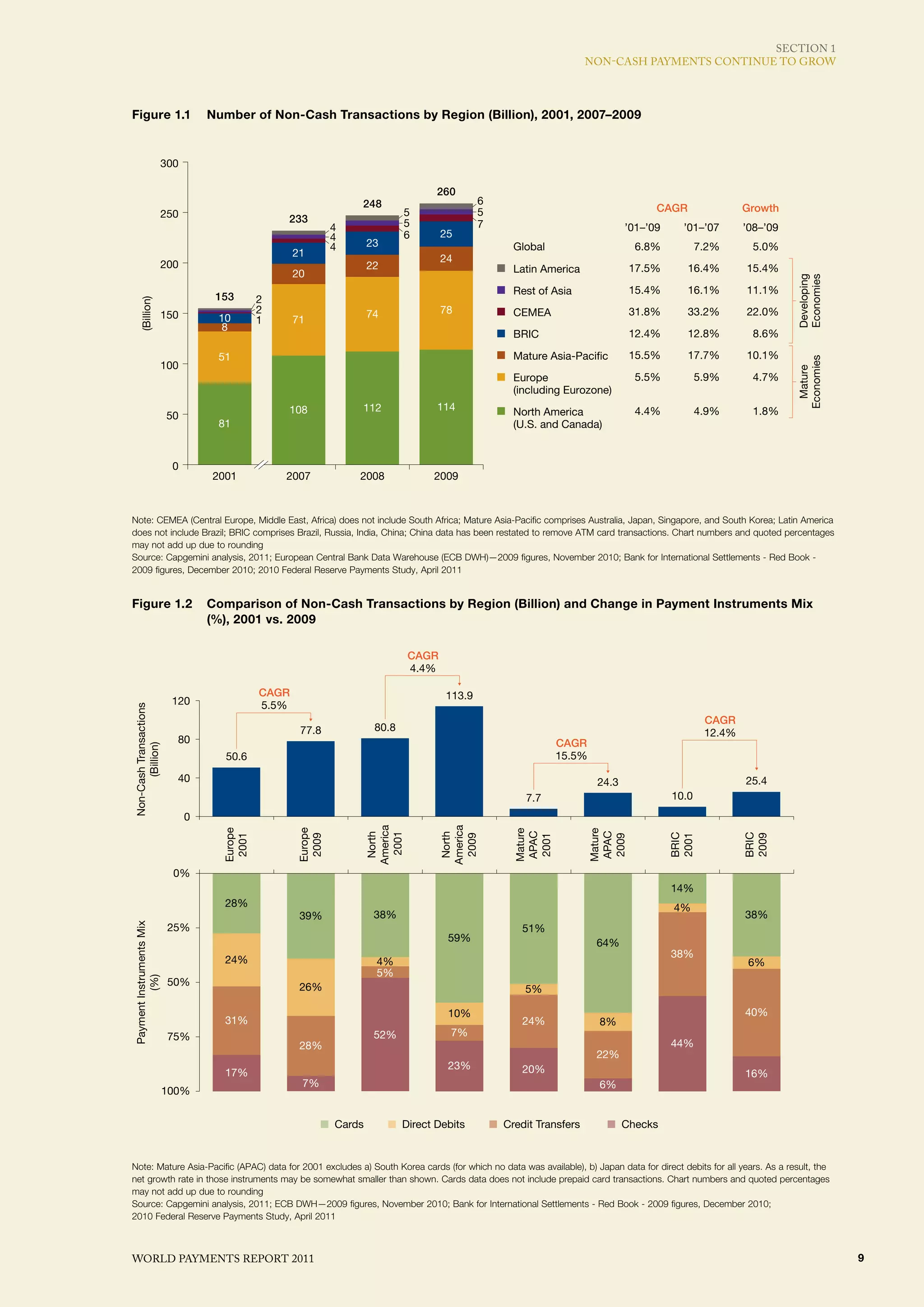
    gains of 6.8% since 2001 (see figure 1.1). Global                             payments infrastructures, enabling wider adoption
    payments volumes have proved resilient to the effects                         and greater usage of non-cash means and channels.
    of the global financial crisis, but the rate of growth                        They also tend to be open to innovations that can
    has been constrained by tough economic conditions,                            broaden their still-nascent base of users. In the BRIC
    with volumes showing an increase of 5% in 2009,                               countries, non-cash transaction volumes rose 8.6% in
    down from an average annual gain of 7.2% in the                               2009, a slower pace than in recent years.
    years prior to the crisis (2001-07). As for the two
    largest payments markets, non-cash transaction                                Nevertheless, BRIC has shown a sustained gain in
    volumes in North America (u.S. and Canada) rose                               usage of 12.4% a year from 2001 through 2009 (see
    just 1.8% in 2009, and volumes in Europe3 rose 4.7%.                          figure 1.2). during that time, there has also been a
                                                                                  tangible shift in the mix of payments instruments,
    The outright volume of non-cash payments remains                              with cards accounting for 38% of all BRIC non-cash
    heavily concentrated in developed markets, with                               payments in 2009, up from just 14% in 2001.
    North America, Europe and mature Asia-Pacific
    accounting for a combined 83% of non-cash payments                            In fact, cards have accounted for a consistently
    volumes in 2009, and with 89% of global volumes                               increasing share of non-cash transactions in every
    concentrated in ten4 payments markets.                                        region in recent years. In North America, for
                                                                                  instance, cards accounted for 59% of all non-cash
    While the pace of growth in many developed                                    transactions in 2009, up from 38% in 20015. The
    markets has been restrained by the slowdown in                                global growth of card usage has coincided with
    economic activity, usage jumped 10.1% in mature                               a steady decline in check usage, a slight increase in
    Asia-Pacific. Gains were robust in South Korea and                            the number of direct debits across all regions, and
    Singapore, where economic growth has remained                                 minimal change in the use of credit transfers.
    strong and technology adoption has helped to drive
    non-cash payment innovations and usage. In Japan,
    volumes jumped 12.6%, the highest rate of growth
    among the mature payments markets, fueled by
    pervasive card usage.


    2
        Transaction volumes cited in the WPR 2011 differ in some respects from those provided in previous years as certain data has been normalized
        to provide more accurate comparisons between regional datasets (see methodology). Also note the WPR data does not include prepaid card
        transactions, which are included in some official country datasets, notably the U.S. and Canada, where such usage is well-developed (also see
        footnote 5).
    3
        Europe data includes the Eurozone, U.K., Sweden, Poland, and Denmark. In this chapter, Eurozone includes: Austria, Belgium, Finland, France,
        Germany, Greece, Ireland, Italy, Luxembourg, Netherlands, Portugal, Slovenia, and Spain. (Cyprus and Malta joined in 2008, Slovakia in 2009,
        and Estonia in 2011). Also see methodology.
    4
        The top ten non-cash payments markets, in order of size, are the U.S., Eurozone, U.K., Brazil, South Korea, Canada, Japan, Australia, China,
        and Russia.
    5
        To ensure consistency and accuracy in regional comparisons, WPR cards data does not include prepaid card transactions—numbers that are
        included in some country data. The U.S. Federal Reserve, for example, reports there were 6 billion prepaid card transactions in 2009 and that
        prepaid usage has risen 21.5% annually since 2006. These transactions involve private label, general purpose, and EBT cards (which store
        electronic benefit transfers to federal aid recipients). These and other country prepaid totals are not included in WPR data as the majority of
        countries in the WPR study scope do not report this data in the same way.

8
SECTIoN 1
                                                                                                                       NoN-CASh PAymENTS CoNTINuE To GRoW


Figure 1.1 Number of Non-Cash Transactions by Region (Billion), 2001, 2007–2009
FIGURE 1.1. Number of Non-Cash Transactions by Region (Billion), 2001, 2007–2009


                          300

                                                                                     260
                                                                  248                           6
                                                                              5                 5                                    CAGR                Growth
                          250                     233
                                                              4               5                 7                              ’01–’09     ’01–’07       ’08–’09
                                                              4               6        25
                                                              4       23                              Global                     6.8%           7.2%       5.0%
                                                     21
                                                                                       24
                          200                                         22                              Latin America             17.5%       16.4%         15.4%
                                                     20


                                                                                                                                                                      Developing
                                                                                                                                                                      Economies
                                                                                                      Rest of Asia              15.4%       16.1%         11.1%
                                    153       2
    (Billion)


                          150                 2                       74               78             CEMEA                     31.8%       33.2%         22.0%
                                    10        1      71
                                     8
                                                                                                      BRIC                      12.4%       12.8%          8.6%

                                    51                                                                Mature Asia-Paci c        15.5%       17.7%         10.1%


                                                                                                                                                                      Economies
                          100


                                                                                                                                                                        Mature
                                                                                                      Europe                     5.5%           5.9%       4.7%
                                                                                                      (including Eurozone)
                                                  108             112                114              North America              4.4%           4.9%       1.8%
                           50
                                    81                                                                (U.S. and Canada)


                            0
                                    2001          2007            2008              2009


Note: CEMEA (Central Europe, Middle East, Africa) does not include South Africa; Mature Asia-Pacific comprises Australia, Japan, Singapore, and South Korea; Latin America
does not include Brazil; BRIC comprises Brazil, Russia, India, China; China data has been restated to remove ATM card transactions. Chart numbers and quoted percentages
may not add up due to rounding
Source: Capgemini analysis, 2011; European Central Bank Data Warehouse (ECB DWH)—2009 figures, November 2010; Bank for International Settlements - Red Book -
2009 figures, December 2010; 2010 Federal Reserve Payments Study, April 2011


Figure 1.2 Comparisonof Non-Cash Transactions byby Region (Billion) and ChangeMixPayment Instruments Mix 2009
FIGURE 1.2. Comparison of Non-Cash Transactions Region (Billion) and Change in in of Payments (%), 2001 vs.
            (%), 2001 vs. 2009

                                                                                CAGR
                                                                                4.4%

                                              CAGR                                      113.9
                           120                5.5%
Non-Cash Transactions


                                                                                                                                                 CAGR
                                                      77.8             80.8
                                                                                                                                                 12.4%
                            80                                                                                 CAGR
      (Billion)


                                      50.6                                                                     15.5%

                            40                                                                                          24.3                              25.4
                                                                                                        7.7                              10.0
                                0
                                                                      America


                                                                                       America
                                     Europe


                                                     Europe


                                                                                                      Mature


                                                                                                                       Mature
                                                                                                      APAC


                                                                                                                       APAC
                                                                       2001
                                                                       North


                                                                                        North


                                                                                                                                         BRIC


                                                                                                                                                         BRIC
                                                                                        2009
                                      2001


                                                      2009


                                                                                                       2001


                                                                                                                        2009


                                                                                                                                         2001


                                                                                                                                                         2009


                            0%
                                                                                                                                         14%
                                      28%                                                                                                4%
                                                      39%              38%                                                                               38%
Payment Instruments Mix


                           25%                                                                         51%
                                                                                        59%                             64%
                                                                                                                                         38%
                                      24%                               4%                                                                                6%
                                                                        5%
          (%)


                           50%                        26%                                               5%

                                                                                        10%                                                              40%
                                      31%                                                              24%               8%
                           75%                                         52%               7%
                                                      28%                                                                                44%
                                                                                                                        22%
                                                                                        23%            20%
                                      17%                                                                                                                16%
                                                      7%                                                                 6%
                          100%


                                                              Cards           Direct Debits         Credit Transfers           Checks


Note: Mature Asia-Pacific (APAC) data for 2001 excludes a) South Korea cards (for which no data was available), b) Japan data for direct debits for all years. As a result, the
net growth rate in those instruments may be somewhat smaller than shown. Cards data does not include prepaid card transactions. Chart numbers and quoted percentages
may not add up due to rounding
Source: Capgemini analysis, 2011; ECB DWH—2009 figures, November 2010; Bank for International Settlements - Red Book - 2009 figures, December 2010;
2010 Federal Reserve Payments Study, April 2011


WoRld PAymENTS REPoRT 2011                                                                                                                                                         9
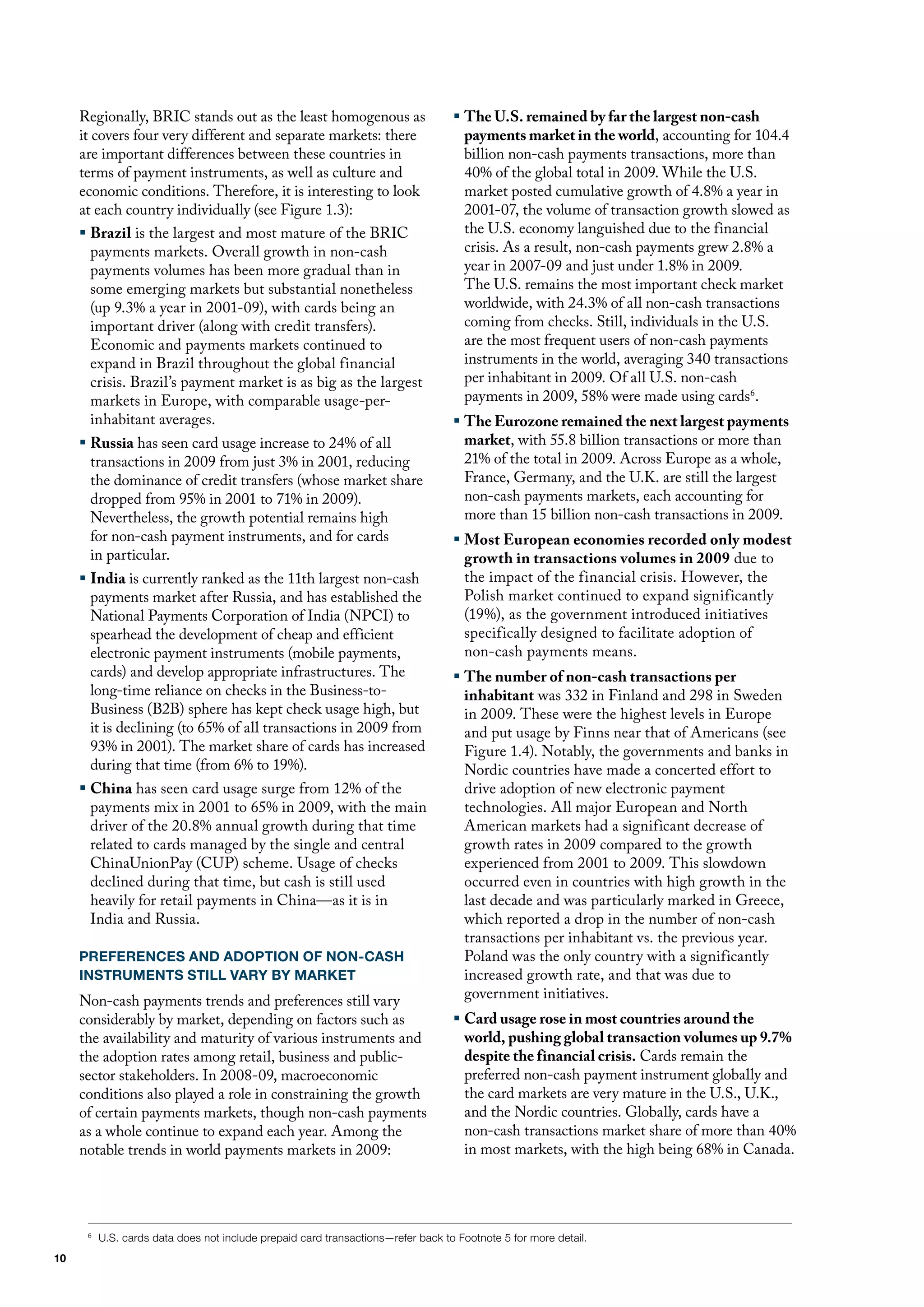
Regionally, BRIC stands out as the least homogenous as                       ƒ The U.S. remained by far the largest non-cash
     it covers four very different and separate markets: there                      payments market in the world, accounting for 104.4
     are important differences between these countries in                           billion non-cash payments transactions, more than
     terms of payment instruments, as well as culture and                           40% of the global total in 2009. While the u.S.
     economic conditions. Therefore, it is interesting to look                      market posted cumulative growth of 4.8% a year in
     at each country individually (see figure 1.3):                                 2001-07, the volume of transaction growth slowed as
     ƒ Brazil is the largest and most mature of the BRIC                            the u.S. economy languished due to the financial
        payments markets. overall growth in non-cash                                crisis. As a result, non-cash payments grew 2.8% a
        payments volumes has been more gradual than in                              year in 2007-09 and just under 1.8% in 2009.
        some emerging markets but substantial nonetheless                           The u.S. remains the most important check market
        (up 9.3% a year in 2001-09), with cards being an                            worldwide, with 24.3% of all non-cash transactions
        important driver (along with credit transfers).                             coming from checks. Still, individuals in the u.S.
        Economic and payments markets continued to                                  are the most frequent users of non-cash payments
        expand in Brazil throughout the global financial                            instruments in the world, averaging 340 transactions
        crisis. Brazil’s payment market is as big as the largest                    per inhabitant in 2009. of all u.S. non-cash
        markets in Europe, with comparable usage-per-                               payments in 2009, 58% were made using cards6.
        inhabitant averages.                                                      ƒ The Eurozone remained the next largest payments
     ƒ Russia has seen card usage increase to 24% of all                            market, with 55.8 billion transactions or more than
       transactions in 2009 from just 3% in 2001, reducing                          21% of the total in 2009. Across Europe as a whole,
       the dominance of credit transfers (whose market share                        france, Germany, and the u.K. are still the largest
       dropped from 95% in 2001 to 71% in 2009).                                    non-cash payments markets, each accounting for
       Nevertheless, the growth potential remains high                              more than 15 billion non-cash transactions in 2009.
       for non-cash payment instruments, and for cards                            ƒ Most European economies recorded only modest
       in particular.                                                               growth in transactions volumes in 2009 due to
     ƒ India is currently ranked as the 11th largest non-cash                       the impact of the financial crisis. however, the
       payments market after Russia, and has established the                        Polish market continued to expand significantly
       National Payments Corporation of India (NPCI) to                             (19%), as the government introduced initiatives
       spearhead the development of cheap and efficient                             specifically designed to facilitate adoption of
       electronic payment instruments (mobile payments,                             non-cash payments means.
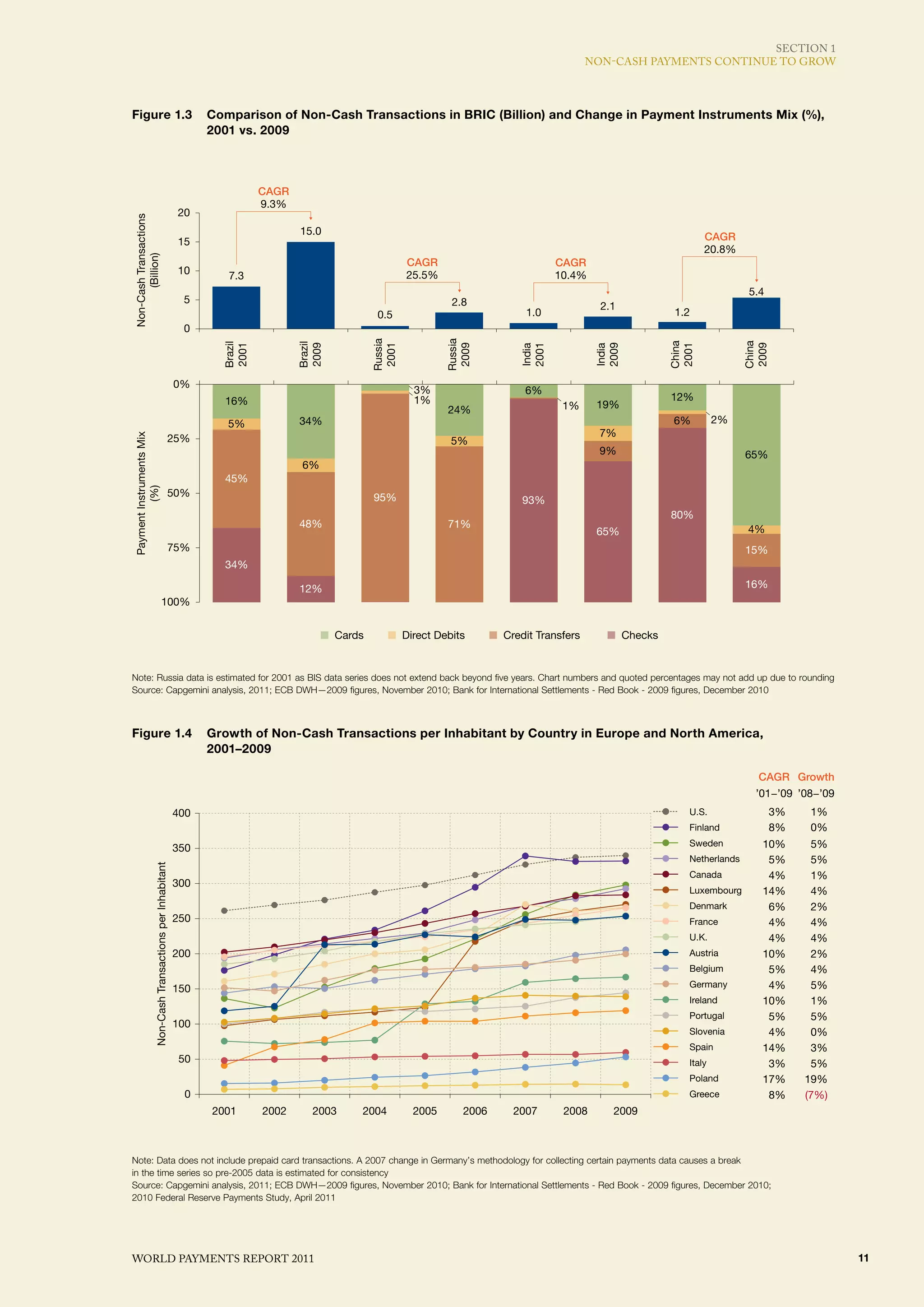
       cards) and develop appropriate infrastructures. The                        ƒ The number of non-cash transactions per
       long-time reliance on checks in the Business-to-                             inhabitant was 332 in finland and 298 in Sweden
       Business (B2B) sphere has kept check usage high, but                         in 2009. These were the highest levels in Europe
       it is declining (to 65% of all transactions in 2009 from                     and put usage by finns near that of Americans (see
       93% in 2001). The market share of cards has increased                        figure 1.4). Notably, the governments and banks in
       during that time (from 6% to 19%).                                           Nordic countries have made a concerted effort to
     ƒ China has seen card usage surge from 12% of the                              drive adoption of new electronic payment
       payments mix in 2001 to 65% in 2009, with the main                           technologies. All major European and North
       driver of the 20.8% annual growth during that time                           American markets had a significant decrease of
       related to cards managed by the single and central                           growth rates in 2009 compared to the growth
       ChinaunionPay (CuP) scheme. usage of checks                                  experienced from 2001 to 2009. This slowdown
       declined during that time, but cash is still used                            occurred even in countries with high growth in the
       heavily for retail payments in China—as it is in                             last decade and was particularly marked in Greece,
       India and Russia.                                                            which reported a drop in the number of non-cash
                                                                                    transactions per inhabitant vs. the previous year.
     PREFERENCES AND ADOPTION OF NON-CASH                                           Poland was the only country with a significantly
     INSTRUMENTS STILL VARY BY MARKET                                               increased growth rate, and that was due to
     Non-cash payments trends and preferences still vary                            government initiatives.
     considerably by market, depending on factors such as                         ƒ Card usage rose in most countries around the
     the availability and maturity of various instruments and                       world, pushing global transaction volumes up 9.7%
     the adoption rates among retail, business and public-                          despite the financial crisis. Cards remain the
     sector stakeholders. In 2008-09, macroeconomic                                 preferred non-cash payment instrument globally and
     conditions also played a role in constraining the growth                       the card markets are very mature in the u.S., u.K.,
     of certain payments markets, though non-cash payments                          and the Nordic countries. Globally, cards have a
     as a whole continue to expand each year. Among the                             non-cash transactions market share of more than 40%
     notable trends in world payments markets in 2009:                              in most markets, with the high being 68% in Canada.


      6
          U.S. cards data does not include prepaid card transactions—refer back to Footnote 5 for more detail.
10
SECTIoN 1
                                                                                                                                                  NoN-CASh PAymENTS CoNTINuE To GRoW


Figure 1.3 Comparisonof Non-Cash Transactions in in BRIC (Billion) and Change in Payment Instruments Mix (%),
FIGURE 1.3. Comparison of Non-Cash Transactions BRIC (Billion) and Change in Payments Mix (%), 2001 vs. 2009
            2001 vs. 2009


                                                                          CAGR
                                                                          9.3%
                                                         20
Non-Cash Transactions


                                                                                 15.0
                                                         15                                                                                                                 CAGR
                                                                                                                                                                            20.8%
      (Billion)


                                                                                                           CAGR                           CAGR
                                                         10       7.3                                      25.5%                          10.4%
                                                                                                                                                                                       5.4
                                                          5                                                          2.8                            2.1
                                                                                                   0.5                             1.0                               1.2
                                                          0


                                                                                                  Russia


                                                                                                                    Russia


                                                                                                                                                                    China


                                                                                                                                                                                      China
                                                                 Brazil


                                                                                 Brazil
                                                                 2001


                                                                                 2009


                                                                                                   2001


                                                                                                                     2009


                                                                                                                                  2001


                                                                                                                                                   2009


                                                                                                                                                                    2001


                                                                                                                                                                                      2009
                                                                                                                                  India


                                                                                                                                                   India
                                                         0%
                                                                                                             3%                    6%
                                                                 16%                                         1%                                                     12%
                                                                                                                    24%                    1%      19%
                                                                  5%             34%                                                                                 6%         2%
                                                                                                                                                    7%
Payment Instruments Mix


                                                     25%                                                             5%
                                                                                                                                                    9%                                65%
                                                                                  6%
                                                                 45%
          (%)


                                                     50%                                          95%                             93%
                                                                                                                                                                    80%
                                                                                 48%                                71%
                                                                                                                                                   65%                                 4%
                                                     75%                                                                                                                              15%
                                                                 34%

                                                                                 12%                                                                                                  16%
                                   100%


                                                                                          Cards            Direct Debits       Credit Transfers            Checks


Note: Russia data is estimated for 2001 as BIS data series does not extend back beyond five years. Chart numbers and quoted percentages may not add up due to rounding
Source: Capgemini analysis, 2011; ECB DWH—2009 figures, November 2010; Bank for International Settlements - Red Book - 2009 figures, December 2010


Figure 1.4                                                     Growth of Non-Cash Transactions per Inhabitant by Country in Europe and North America,
FIGURE 1.4.                                                    Growth of Non-Cash Transactions per Inhabitant per Country in Europe and North America, 2001–2009
                                                               2001–2009

                                                                                                                                                                                         CAGR Growth
                                                                                                                                                                                        ’01−’09 ’08−’09
                                                         400                                                                                                            U.S.                  3%    1%
                                                                                                                                                                        Finland               8%    0%
                                                         350                                                                                                            Sweden           10%        5%
                                                                                                                                                                        Netherlands       5%        5%
                  Non-Cash Transactions per Inhabitant


                                                                                                                                                                        Canada            4%        1%
                                                         300
                                                                                                                                                                        Luxembourg       14%        4%
                                                                                                                                                                        Denmark           6%        2%
                                                         250                                                                                                            France            4%        4%
                                                                                                                                                                        U.K.              4%        4%
                                                         200                                                                                                            Austria          10%        2%
                                                                                                                                                                        Belgium           5%        4%
                                                         150                                                                                                            Germany           4%        5%
                                                                                                                                                                        Ireland          10%        1%
                                                                                                                                                                        Portugal          5%        5%
                                                         100
                                                                                                                                                                        Slovenia          4%        0%
                                                                                                                                                                        Spain            14%        3%
                                                         50                                                                                                             Italy             3%        5%
                                                                                                                                                                        Poland           17%       19%
                                                          0                                                                                                             Greece            8%       (7%)
                                                               2001       2002      2003      2004           2005       2006     2007      2008       2009


Note: Data does not include prepaid card transactions. A 2007 change in Germany’s methodology for collecting certain payments data causes a break
in the time series so pre-2005 data is estimated for consistency
Source: Capgemini analysis, 2011; ECB DWH—2009 figures, November 2010; Bank for International Settlements - Red Book - 2009 figures, December 2010;
2010 Federal Reserve Payments Study, April 2011


WoRld PAymENTS REPoRT 2011                                                                                                                                                                                11
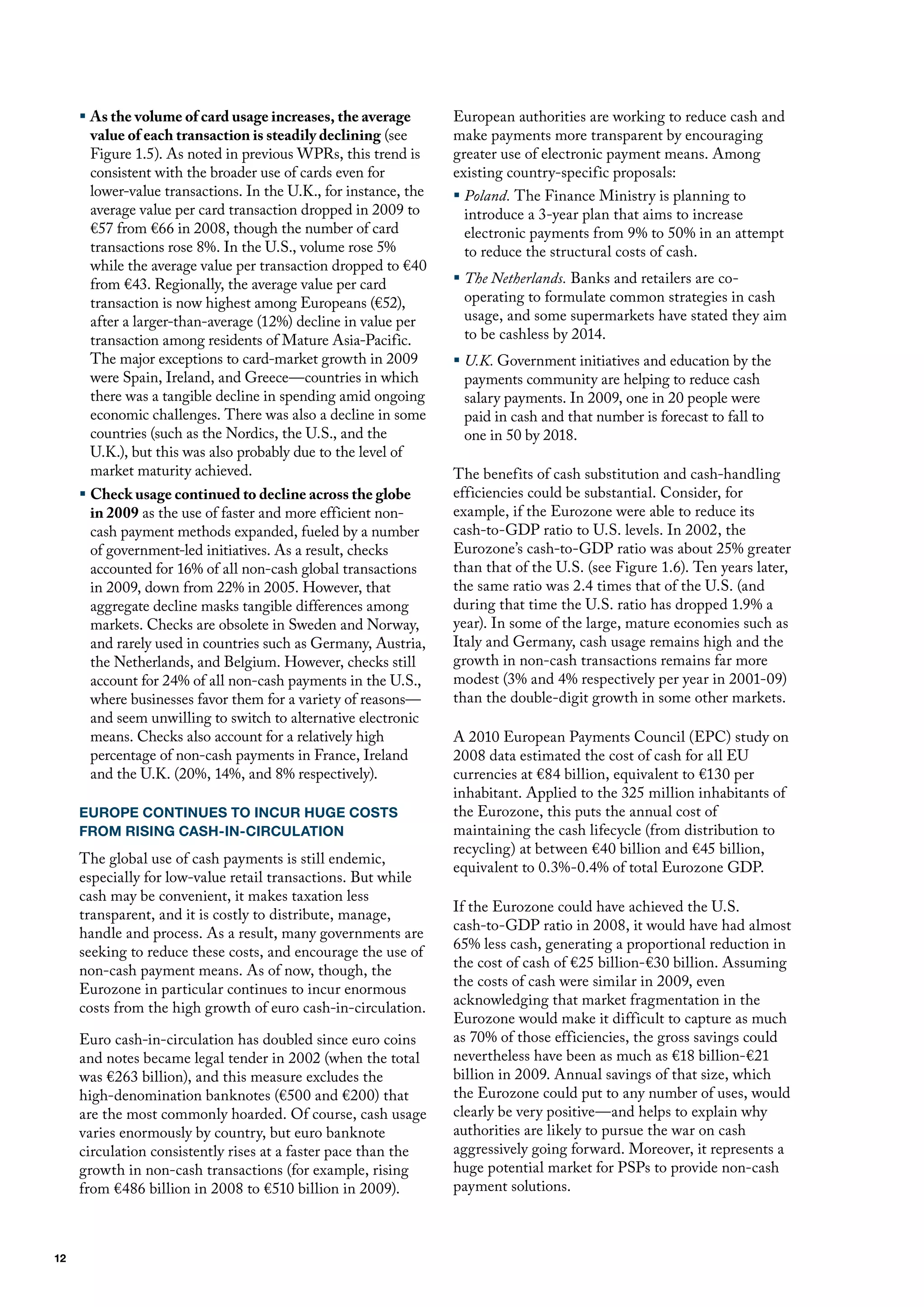
ƒ As the volume of card usage increases, the average         European authorities are working to reduce cash and
       value of each transaction is steadily declining (see       make payments more transparent by encouraging
       figure 1.5). As noted in previous WPRs, this trend is      greater use of electronic payment means. Among
       consistent with the broader use of cards even for          existing country-specific proposals:
       lower-value transactions. In the u.K., for instance, the   ƒ Poland. The finance ministry is planning to
       average value per card transaction dropped in 2009 to        introduce a 3-year plan that aims to increase
       €57 from €66 in 2008, though the number of card              electronic payments from 9% to 50% in an attempt
       transactions rose 8%. In the u.S., volume rose 5%            to reduce the structural costs of cash.
       while the average value per transaction dropped to €40
       from €43. Regionally, the average value per card           ƒ The Netherlands. Banks and retailers are co-
       transaction is now highest among Europeans (€52),            operating to formulate common strategies in cash
       after a larger-than-average (12%) decline in value per       usage, and some supermarkets have stated they aim
       transaction among residents of mature Asia-Pacific.          to be cashless by 2014.
       The major exceptions to card-market growth in 2009         ƒ U.K. Government initiatives and education by the
       were Spain, Ireland, and Greece—countries in which           payments community are helping to reduce cash
       there was a tangible decline in spending amid ongoing        salary payments. In 2009, one in 20 people were
       economic challenges. There was also a decline in some        paid in cash and that number is forecast to fall to
       countries (such as the Nordics, the u.S., and the            one in 50 by 2018.
       u.K.), but this was also probably due to the level of
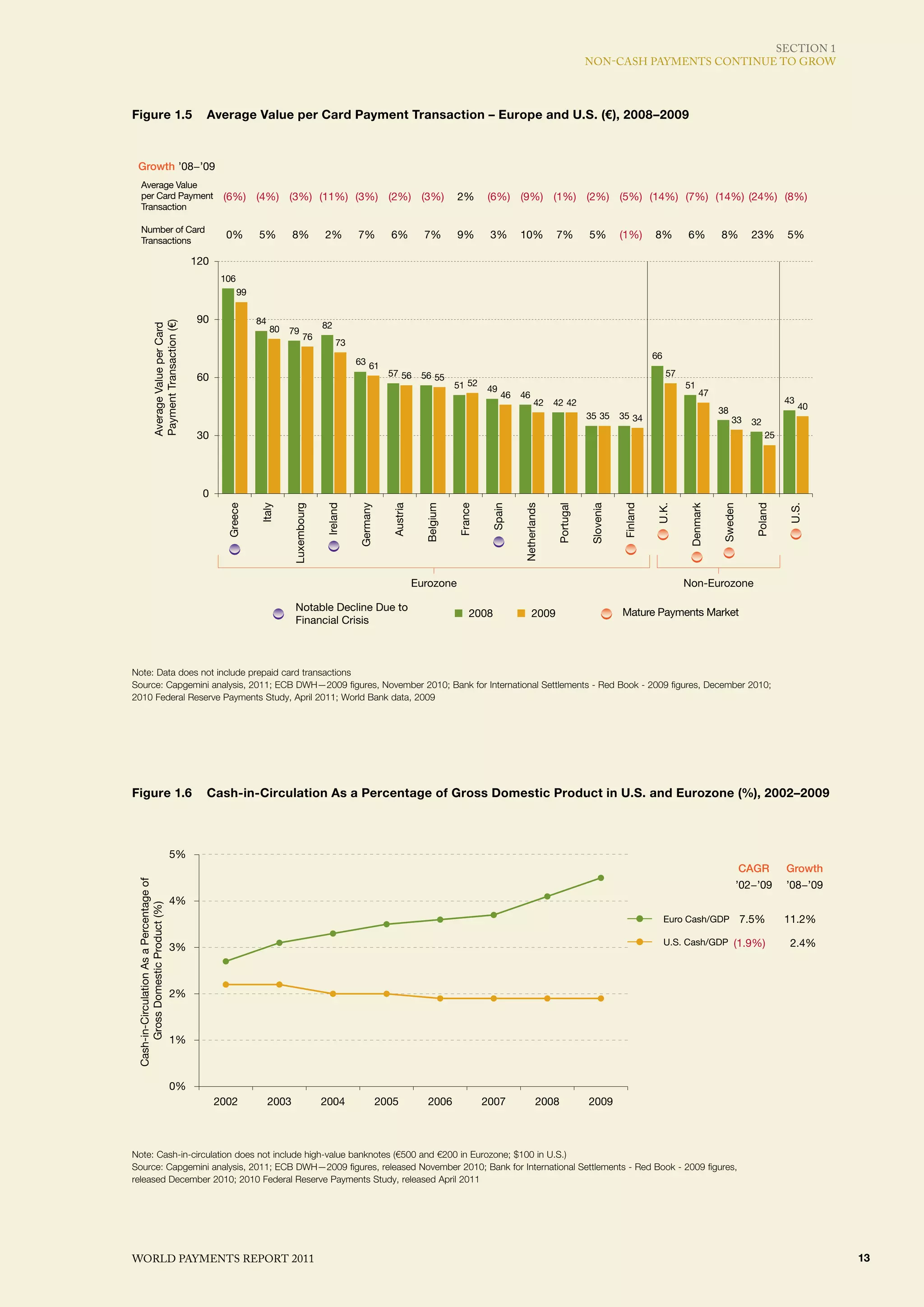
       market maturity achieved.                                  The benefits of cash substitution and cash-handling
     ƒ Check usage continued to decline across the globe          efficiencies could be substantial. Consider, for
       in 2009 as the use of faster and more efficient non-       example, if the Eurozone were able to reduce its
       cash payment methods expanded, fueled by a number          cash-to-GdP ratio to u.S. levels. In 2002, the
       of government-led initiatives. As a result, checks         Eurozone’s cash-to-GdP ratio was about 25% greater
       accounted for 16% of all non-cash global transactions      than that of the u.S. (see figure 1.6). Ten years later,
       in 2009, down from 22% in 2005. however, that              the same ratio was 2.4 times that of the u.S. (and
       aggregate decline masks tangible differences among         during that time the u.S. ratio has dropped 1.9% a
       markets. Checks are obsolete in Sweden and Norway,         year). In some of the large, mature economies such as
       and rarely used in countries such as Germany, Austria,     Italy and Germany, cash usage remains high and the
       the Netherlands, and Belgium. however, checks still        growth in non-cash transactions remains far more
       account for 24% of all non-cash payments in the u.S.,      modest (3% and 4% respectively per year in 2001-09)
       where businesses favor them for a variety of reasons—      than the double-digit growth in some other markets.
       and seem unwilling to switch to alternative electronic
       means. Checks also account for a relatively high           A 2010 European Payments Council (EPC) study on
       percentage of non-cash payments in france, Ireland         2008 data estimated the cost of cash for all Eu
       and the u.K. (20%, 14%, and 8% respectively).              currencies at €84 billion, equivalent to €130 per
                                                                  inhabitant. Applied to the 325 million inhabitants of
     EUROPE CONTINUES TO INCUR HUGE COSTS                         the Eurozone, this puts the annual cost of
     FROM RISING CASH-IN-CIRCULATION                              maintaining the cash lifecycle (from distribution to
                                                                  recycling) at between €40 billion and €45 billion,
     The global use of cash payments is still endemic,
                                                                  equivalent to 0.3%-0.4% of total Eurozone GdP.
     especially for low-value retail transactions. But while
     cash may be convenient, it makes taxation less
                                                                  If the Eurozone could have achieved the u.S.
     transparent, and it is costly to distribute, manage,
                                                                  cash-to-GdP ratio in 2008, it would have had almost
     handle and process. As a result, many governments are
                                                                  65% less cash, generating a proportional reduction in
     seeking to reduce these costs, and encourage the use of
                                                                  the cost of cash of €25 billion-€30 billion. Assuming
     non-cash payment means. As of now, though, the
                                                                  the costs of cash were similar in 2009, even
     Eurozone in particular continues to incur enormous
                                                                  acknowledging that market fragmentation in the
     costs from the high growth of euro cash-in-circulation.
                                                                  Eurozone would make it difficult to capture as much
     Euro cash-in-circulation has doubled since euro coins        as 70% of those efficiencies, the gross savings could
     and notes became legal tender in 2002 (when the total        nevertheless have been as much as €18 billion-€21
     was €263 billion), and this measure excludes the             billion in 2009. Annual savings of that size, which
     high-denomination banknotes (€500 and €200) that             the Eurozone could put to any number of uses, would
     are the most commonly hoarded. of course, cash usage         clearly be very positive—and helps to explain why
     varies enormously by country, but euro banknote              authorities are likely to pursue the war on cash
     circulation consistently rises at a faster pace than the     aggressively going forward. moreover, it represents a
     growth in non-cash transactions (for example, rising         huge potential market for PSPs to provide non-cash
     from €486 billion in 2008 to €510 billion in 2009).          payment solutions.


12
SECTIoN 1
                                                                                                                                                                                   NoN-CASh PAymENTS CoNTINuE To GRoW


Figure 1.5 Average Value per Card Payment Transaction – – Europe and U.S. (€), 2008–2009
FIGURE 1.5. Average Value per Card Payment Transaction Europe and U.S. (€), 2008–2009


 Growth ’08−’09
     Average Value
     per Card Payment                                 (6%) (4%) (3%) (11%) (3%) (2%) (3%)                                              2%       (6%) (9%) (1%) (2%) (5%) (14%) (7%) (14%) (24%) (8%)
     Transaction

     Number of Card
     Transactions
                                                       0%        5%          8%           2%        7%          6%           7%        9%        3%       10%           7%         5%         (1%)      8%        6%         8%        23%       5%

                                               120
                                                      106
                                                            99

                                                90               84
                     Payment Transaction (€)


                                                                                          82
                     Average Value per Card


                                                                      80   79
                                                                                   76
                                                                                               73
                                                                                                                                                                                                        66
                                                                                                    63 61
                                                60                                                              57 56       56 55                                                                            57
                                                                                                                                       51 52    49                                                                51
                                                                                                                                                     46   46                                                           47
                                                                                                                                                                 42     42 42                                                                    43
                                                                                                                                                                                                                             38                       40
                                                                                                                                                                                   35 35      35 34                               33   32
                                                30                                                                                                                                                                                          25


                                                 0
                                                       Greece


                                                                 Italy


                                                                             Luxembourg


                                                                                          Ireland


                                                                                                    Germany


                                                                                                                 Austria


                                                                                                                             Belgium


                                                                                                                                       France


                                                                                                                                                 Spain


                                                                                                                                                          Netherlands


                                                                                                                                                                        Portugal


                                                                                                                                                                                   Slovenia


                                                                                                                                                                                              Finland


                                                                                                                                                                                                        U.K.


                                                                                                                                                                                                                   Denmark


                                                                                                                                                                                                                             Sweden


                                                                                                                                                                                                                                        Poland


                                                                                                                                                                                                                                                 U.S.
                                                                                                                           Eurozone                                                                               Non-Eurozone

                                                                              Notable Decline Due to                                                                                          Mature Payments Market
                                                                                                                                           2008                2009
                                                                              Financial Crisis


Note: Data does not include prepaid card transactions
Source: Capgemini analysis, 2011; ECB DWH—2009 figures, November 2010; Bank for International Settlements - Red Book - 2009 figures, December 2010;
2010 Federal Reserve Payments Study, April 2011; World Bank data, 2009


Figure 1.6                                       Cash-in-Circulation As a Percentage of Gross Domestic Product in U.S. and Eurozone (%), 2002–2009
FIGURE 1.6.                                      Ratio of Cash-in-Circulation to GDP in U.S. and Eurozone, 2002–2009

                                          5%
                                                                                                                                                                                                                                      CAGR       Growth
 Cash-in-Circulation As a Percentage of


                                                                                                                                                                                                                                  ’02−’09        ’08−’09
                                          4%
     Gross Domestic Product (%)


                                                                                                                                                                                                             Euro Cash/GDP            7.5%       11.2%

                                                                                                                                                                                                             U.S. Cash/GDP (1.9%)                 2.4%
                                          3%


                                          2%


                                          1%


                                          0%
                                                     2002             2003                2004                2005            2006              2007               2008            2009


Note: Cash-in-circulation does not include high-value banknotes (€500 and €200 in Eurozone; $100 in U.S.)
Source: Capgemini analysis, 2011; ECB DWH—2009 figures, released November 2010; Bank for International Settlements - Red Book - 2009 figures,
released December 2010; 2010 Federal Reserve Payments Study, released April 2011


WoRld PAymENTS REPoRT 2011                                                                                                                                                                                                                                 13
CHAPTER 2


     Initial Trends in 2010
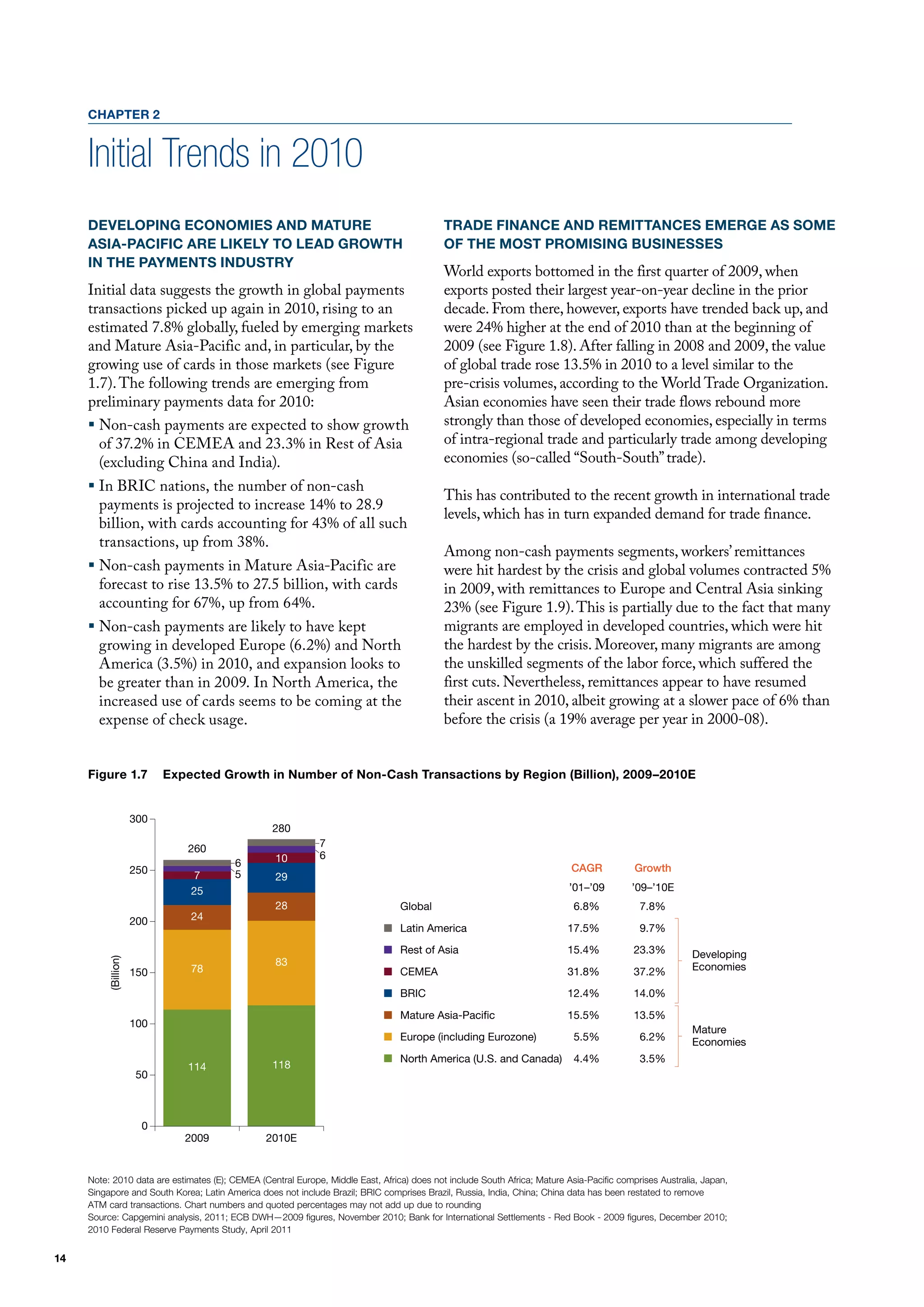
     DEVELOPING ECONOMIES AND MATURE                                                        TRADE FINANCE AND REMITTANCES EMERGE AS SOME
     ASIA-PACIFIC ARE LIKELY TO LEAD GROWTH                                                 OF THE MOST PROMISING BUSINESSES
     IN THE PAYMENTS INDUSTRY
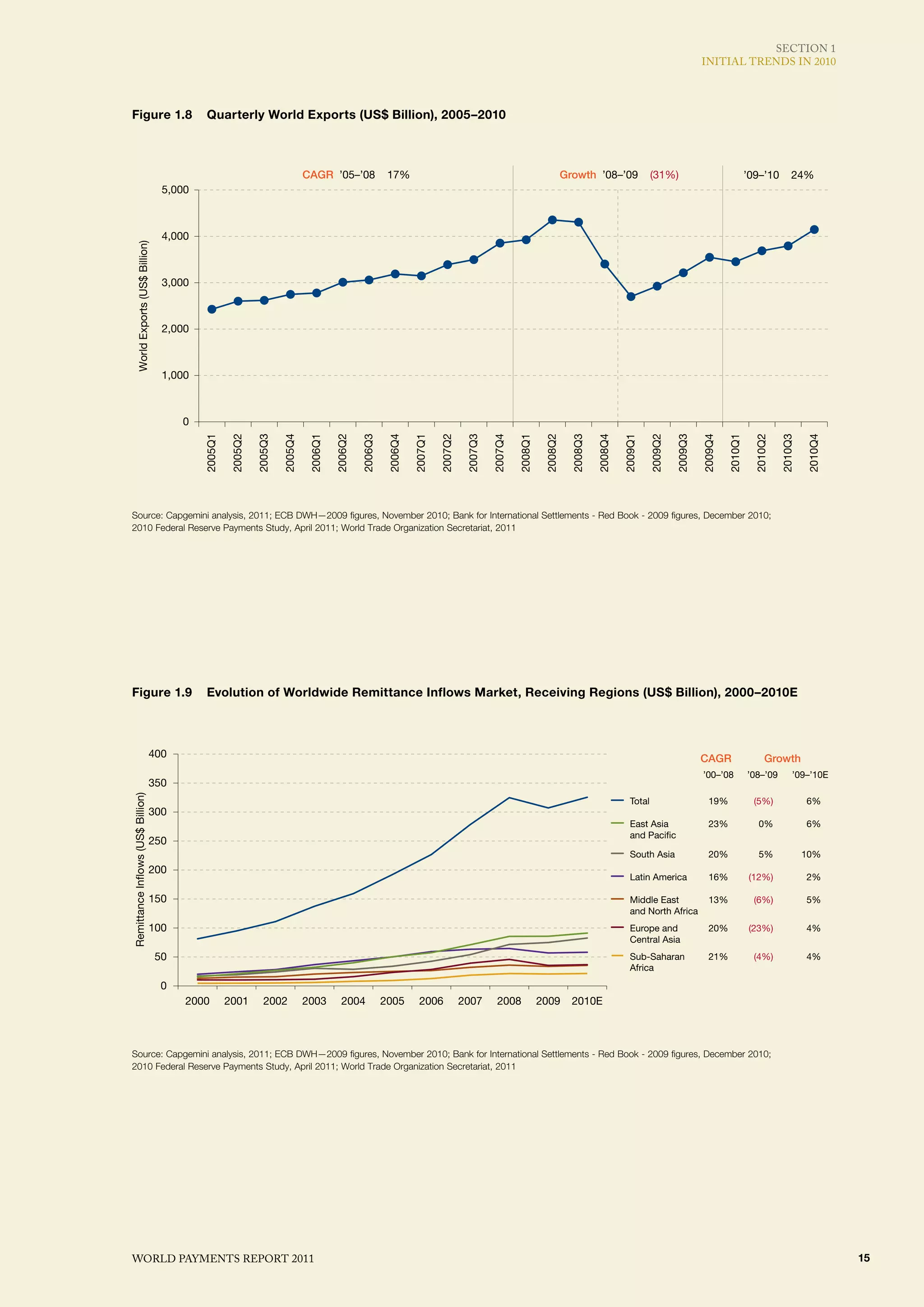
                                                                                            World exports bottomed in the first quarter of 2009, when
     Initial data suggests the growth in global payments                                    exports posted their largest year-on-year decline in the prior
     transactions picked up again in 2010, rising to an                                     decade. from there, however, exports have trended back up, and
     estimated 7.8% globally, fueled by emerging markets                                    were 24% higher at the end of 2010 than at the beginning of
     and mature Asia-Pacific and, in particular, by the                                     2009 (see figure 1.8). After falling in 2008 and 2009, the value
     growing use of cards in those markets (see figure                                      of global trade rose 13.5% in 2010 to a level similar to the
     1.7). The following trends are emerging from                                           pre-crisis volumes, according to the World Trade organization.
     preliminary payments data for 2010:                                                    Asian economies have seen their trade flows rebound more
     ƒ Non-cash payments are expected to show growth                                        strongly than those of developed economies, especially in terms
       of 37.2% in CEmEA and 23.3% in Rest of Asia                                          of intra-regional trade and particularly trade among developing
       (excluding China and India).                                                         economies (so-called “South-South” trade).
     ƒ In BRIC nations, the number of non-cash
                                                                                            This has contributed to the recent growth in international trade
       payments is projected to increase 14% to 28.9
                                                                                            levels, which has in turn expanded demand for trade finance.
       billion, with cards accounting for 43% of all such
       transactions, up from 38%.
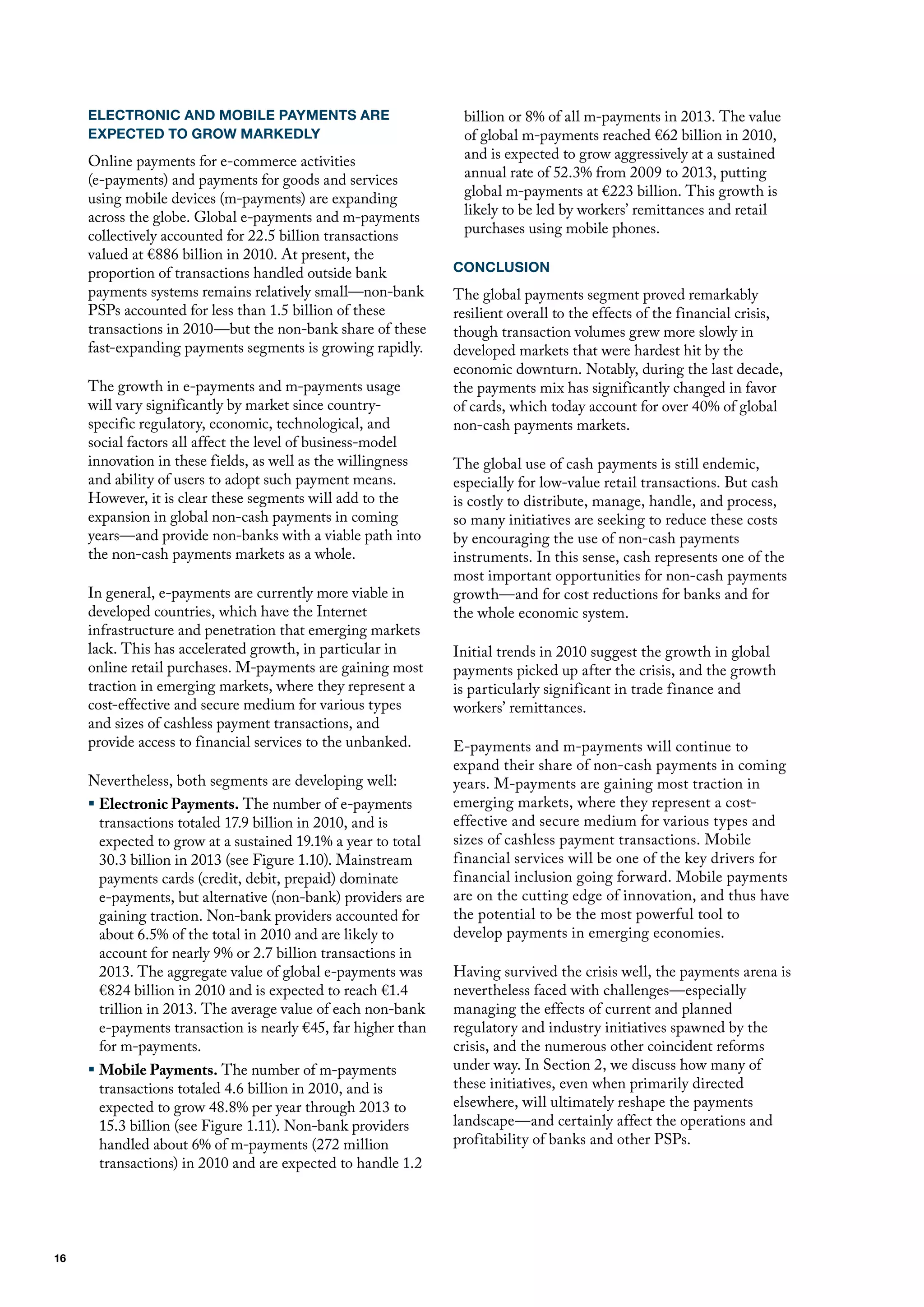
                                                                                            Among non-cash payments segments, workers’ remittances
     ƒ Non-cash payments in mature Asia-Pacific are                                         were hit hardest by the crisis and global volumes contracted 5%
       forecast to rise 13.5% to 27.5 billion, with cards                                   in 2009, with remittances to Europe and Central Asia sinking
       accounting for 67%, up from 64%.                                                     23% (see figure 1.9). This is partially due to the fact that many
     ƒ Non-cash payments are likely to have kept                                            migrants are employed in developed countries, which were hit
       growing in developed Europe (6.2%) and North                                         the hardest by the crisis. moreover, many migrants are among
       America (3.5%) in 2010, and expansion looks to                                       the unskilled segments of the labor force, which suffered the
       be greater than in 2009. In North America, the                                       first cuts. Nevertheless, remittances appear to have resumed
       increased use of cards seems to be coming at the                                     their ascent in 2010, albeit growing at a slower pace of 6% than
       expense of check usage.                                                              before the crisis (a 19% average per year in 2000-08).


     Figure 1.7 ExpectedGrowth in Number of Non-Cash Transactions by by Region (Billion), 2009–2010E
     FIGURE 1.7. Expected Growth in Number of Non-Cash Transactions Region (Billion), 2009–2010E


                      300
                                                  280
                             260                             7
                                                   10        6
                                         6                                                                                 CAGR            Growth
                      250      7         5         29
                              25                                                                                           ’01–’09        ’09–’10E
                                                   28                            Global                                     6.8%            7.8%
                      200     24
                                                                                 Latin America                            17.5%             9.7%

                                                                                 Rest of Asia                             15.4%           23.3%          Developing
          (Billion)


                                                   83                                                                                                    Economies
                      150     78                                                 CEMEA                                    31.8%           37.2%

                                                                                 BRIC                                     12.4%           14.0%

                                                                                 Mature Asia-Paci c                       15.5%           13.5%
                      100
                                                                                                                                                         Mature
                                                                                 Europe (including Eurozone)                5.5%            6.2%         Economies
                                                                                 North America (U.S. and Canada)            4.4%            3.5%
                             114                  118
                       50


                        0
                            2009                2010E


     Note: 2010 data are estimates (E); CEMEA (Central Europe, Middle East, Africa) does not include South Africa; Mature Asia-Pacific comprises Australia, Japan,
     Singapore and South Korea; Latin America does not include Brazil; BRIC comprises Brazil, Russia, India, China; China data has been restated to remove
     ATM card transactions. Chart numbers and quoted percentages may not add up due to rounding
     Source: Capgemini analysis, 2011; ECB DWH—2009 figures, November 2010; Bank for International Settlements - Red Book - 2009 figures, December 2010;
     2010 Federal Reserve Payments Study, April 2011


14
SECTIoN 1
                                                                                                                                                                                                                                 INITIAl TRENdS IN 2010


Figure 1.8                                    Quarterly World Exports (US$ Billion), 2005–2010
FIGURE 1.8.                                    Quarterly World Exports (US$ Billion), 2005–2010

                                                                                   CAGR ’05–’08                 17%                                                              Growth ’08–’09                (31%)                               ’09–’10        24%
                                      5,000


                                      4,000
       World Exports (US$ Billion)


                                      3,000


                                      2,000


                                      1,000


                                          0
                                              2005Q1

                                                        2005Q2

                                                                 2005Q3

                                                                          2005Q4

                                                                                    2006Q1

                                                                                             2006Q2

                                                                                                      2006Q3

                                                                                                                2006Q4

                                                                                                                         2007Q1

                                                                                                                                  2007Q2

                                                                                                                                            2007Q3

                                                                                                                                                     2007Q4

                                                                                                                                                              2008Q1

                                                                                                                                                                        2008Q2

                                                                                                                                                                                   2008Q3

                                                                                                                                                                                            2008Q4

                                                                                                                                                                                                     2009Q1

                                                                                                                                                                                                               2009Q2

                                                                                                                                                                                                                        2009Q3

                                                                                                                                                                                                                                 2009Q4

                                                                                                                                                                                                                                          2010Q1

                                                                                                                                                                                                                                                     2010Q2

                                                                                                                                                                                                                                                              2010Q3

                                                                                                                                                                                                                                                                       2010Q4
Source: Capgemini analysis, 2011; ECB DWH—2009 figures, November 2010; Bank for International Settlements - Red Book - 2009 figures, December 2010;
2010 Federal Reserve Payments Study, April 2011; World Trade Organization Secretariat, 2011


Figure 1.9                                    Evolution of Worldwide Remittance Inflows Market, Receiving Regions (US$ Billion), 2000–2010E
FIGURE 1.9.                                    Evolution of Worldwide Remittance Inflows Market, Receiving Regions (US$ Billion), 2000–2010E

                                  400                                                                                                                                                                                            CAGR                    Growth
                                                                                                                                                                                                                                 ’00–’08           ’08–’09         ’09–’10E
                                  350
Remittance In ows (US$ Billion)


                                                                                                                                                                                                       Total                       19%               (5%)              6%
                                  300
                                                                                                                                                                                                       East Asia                   23%                0%               6%
                                                                                                                                                                                                       and Paci c
                                  250
                                                                                                                                                                                                       South Asia                  20%                5%               10%
                                  200
                                                                                                                                                                                                       Latin America               16%              (12%)              2%

                                  150                                                                                                                                                                  Middle East                 13%               (6%)              5%
                                                                                                                                                                                                       and North Africa
                                  100                                                                                                                                                                  Europe and                  20%              (23%)              4%
                                                                                                                                                                                                       Central Asia
                                     50                                                                                                                                                                Sub-Saharan                 21%               (4%)              4%
                                                                                                                                                                                                       Africa
                                      0
                                          2000         2001        2002            2003        2004            2005        2006            2007        2008            2009        2010E


Source: Capgemini analysis, 2011; ECB DWH—2009 figures, November 2010; Bank for International Settlements - Red Book - 2009 figures, December 2010;
2010 Federal Reserve Payments Study, April 2011; World Trade Organization Secretariat, 2011


WoRld PAymENTS REPoRT 2011                                                                                                                                                                                                                                                      15
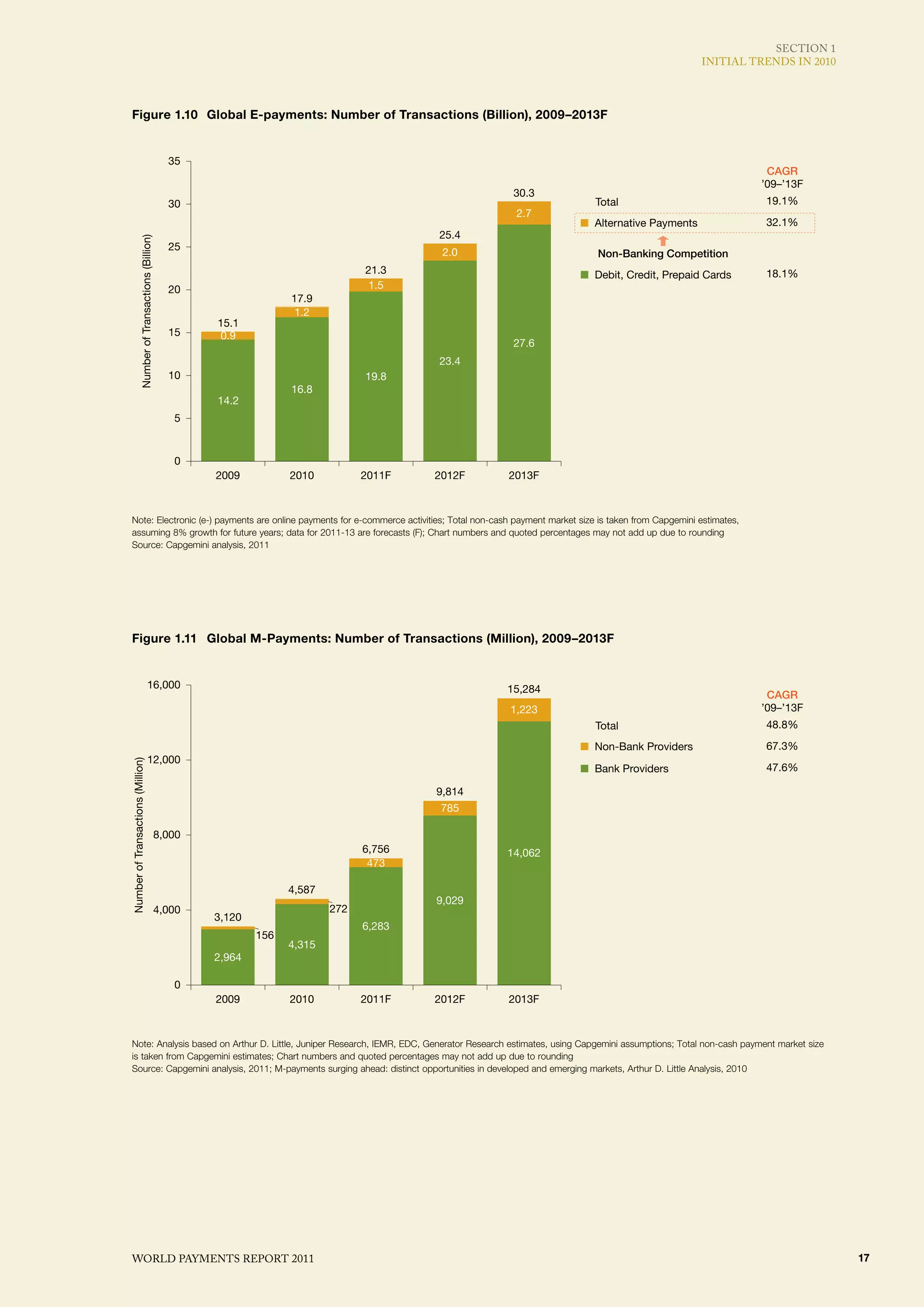
ELECTRONIC AND MOBILE PAYMENTS ARE                         billion or 8% of all m-payments in 2013. The value
     EXPECTED TO GROW MARKEDLY                                  of global m-payments reached €62 billion in 2010,
     online payments for e-commerce activities                  and is expected to grow aggressively at a sustained
     (e-payments) and payments for goods and services           annual rate of 52.3% from 2009 to 2013, putting
     using mobile devices (m-payments) are expanding            global m-payments at €223 billion. This growth is
     across the globe. Global e-payments and m-payments         likely to be led by workers’ remittances and retail
     collectively accounted for 22.5 billion transactions       purchases using mobile phones.
     valued at €886 billion in 2010. At present, the
     proportion of transactions handled outside bank           CONCLUSION
     payments systems remains relatively small—non-bank        The global payments segment proved remarkably
     PSPs accounted for less than 1.5 billion of these         resilient overall to the effects of the financial crisis,
     transactions in 2010—but the non-bank share of these      though transaction volumes grew more slowly in
     fast-expanding payments segments is growing rapidly.      developed markets that were hardest hit by the
                                                               economic downturn. Notably, during the last decade,
     The growth in e-payments and m-payments usage             the payments mix has significantly changed in favor
     will vary significantly by market since country-          of cards, which today account for over 40% of global
     specific regulatory, economic, technological, and         non-cash payments markets.
     social factors all affect the level of business-model
     innovation in these fields, as well as the willingness    The global use of cash payments is still endemic,
     and ability of users to adopt such payment means.         especially for low-value retail transactions. But cash
     however, it is clear these segments will add to the       is costly to distribute, manage, handle, and process,
     expansion in global non-cash payments in coming           so many initiatives are seeking to reduce these costs
     years—and provide non-banks with a viable path into       by encouraging the use of non-cash payments
     the non-cash payments markets as a whole.                 instruments. In this sense, cash represents one of the
                                                               most important opportunities for non-cash payments
     In general, e-payments are currently more viable in       growth—and for cost reductions for banks and for
     developed countries, which have the Internet              the whole economic system.
     infrastructure and penetration that emerging markets
     lack. This has accelerated growth, in particular in       Initial trends in 2010 suggest the growth in global
     online retail purchases. m-payments are gaining most      payments picked up after the crisis, and the growth
     traction in emerging markets, where they represent a      is particularly significant in trade finance and
     cost-effective and secure medium for various types        workers’ remittances.
     and sizes of cashless payment transactions, and
     provide access to financial services to the unbanked.     E-payments and m-payments will continue to
                                                               expand their share of non-cash payments in coming
     Nevertheless, both segments are developing well:          years. m-payments are gaining most traction in
     ƒ Electronic Payments. The number of e-payments           emerging markets, where they represent a cost-
       transactions totaled 17.9 billion in 2010, and is       effective and secure medium for various types and
       expected to grow at a sustained 19.1% a year to total   sizes of cashless payment transactions. mobile
       30.3 billion in 2013 (see figure 1.10). mainstream      financial services will be one of the key drivers for
       payments cards (credit, debit, prepaid) dominate        financial inclusion going forward. mobile payments
       e-payments, but alternative (non-bank) providers are    are on the cutting edge of innovation, and thus have
       gaining traction. Non-bank providers accounted for      the potential to be the most powerful tool to
       about 6.5% of the total in 2010 and are likely to       develop payments in emerging economies.
       account for nearly 9% or 2.7 billion transactions in
       2013. The aggregate value of global e-payments was      having survived the crisis well, the payments arena is
       €824 billion in 2010 and is expected to reach €1.4      nevertheless faced with challenges—especially
       trillion in 2013. The average value of each non-bank    managing the effects of current and planned
       e-payments transaction is nearly €45, far higher than   regulatory and industry initiatives spawned by the
       for m-payments.                                         crisis, and the numerous other coincident reforms
     ƒ Mobile Payments. The number of m-payments               under way. In Section 2, we discuss how many of
       transactions totaled 4.6 billion in 2010, and is        these initiatives, even when primarily directed
       expected to grow 48.8% per year through 2013 to         elsewhere, will ultimately reshape the payments
       15.3 billion (see figure 1.11). Non-bank providers      landscape—and certainly affect the operations and
       handled about 6% of m-payments (272 million             profitability of banks and other PSPs.
       transactions) in 2010 and are expected to handle 1.2


16
SECTIoN 1
                                                                                                                                          INITIAl TRENdS IN 2010


FIGURE 1.10. Number of Non-Cash Transactions by Region (Billion), 2001, 2007–2009
Figure 1.10 Global E-payments: Number of Transactions (Billion), 2009–2013F


                                                        35
                                                                                                                                                       CAGR
                                                                                                                                                      ’09–’13F
                                                                                                           30.3
                                                        30                                                         Total                              19.1%
                                                                                                           2.7
                                                                                                                   Alternative Payments               32.1%
                                                                                                  25.4
                   Number of Transactions (Billion)


                                                        25
                                                                                                   2.0             Non-Banking Competition
                                                                                          21.3                     Debit, Credit, Prepaid Cards       18.1%
                                                        20                                 1.5
                                                                            17.9
                                                                             1.2
                                                              15.1
                                                        15     0.9
                                                                                                           27.6
                                                                                                  23.4
                                                        10                                19.8
                                                                            16.8
                                                              14.2
                                                         5


                                                         0
                                                              2009          2010          2011F   2012F   2013F


Note: Electronic (e-) payments are online payments for e-commerce activities; Total non-cash payment market size is taken from Capgemini estimates,
assuming 8% growth for future years; data for 2011-13 are forecasts (F); Chart numbers and quoted percentages may not add up due to rounding
Source: Capgemini analysis, 2011


Figure 1.11 Global M-Payments: Number of Transactions (Million), 2009-2013F
FIGURE 1.11. Global M-Payments: Number of Transactions (Million), 2009–2013F


                                     16,000                                                               15,284
                                                                                                                                                       CAGR
                                                                                                          1,223                                       ’09–’13F
                                                                                                                   Total                              48.8%

                                                                                                                   Non-Bank Providers                 67.3%
                                     12,000
Number of Transactions (Million)


                                                                                                                   Bank Providers                     47.6%

                                                                                                  9,814
                                                                                                   785

                                                      8,000
                                                                                          6,756           14,062
                                                                                           473

                                                                            4,587
                                                                                                  9,029
                                                      4,000                         272
                                                              3,120
                                                                                          6,283
                                                                      156
                                                                            4,315
                                                              2,964

                                                         0
                                                              2009          2010          2011F   2012F   2013F


Note: Analysis based on Arthur D. Little, Juniper Research, IEMR, EDC, Generator Research estimates, using Capgemini assumptions; Total non-cash payment market size
is taken from Capgemini estimates; Chart numbers and quoted percentages may not add up due to rounding
Source: Capgemini analysis, 2011; M-payments surging ahead: distinct opportunities in developed and emerging markets, Arthur D. Little Analysis, 2010


WoRld PAymENTS REPoRT 2011                                                                                                                                             17
Hot Topics:                                    Trade Finance—A Business of Volume
                                                    and High Specialization

     TRENDS AND MARKET SIzE                                                                       As global economies become more integrated, it is easier for
     Trade Finance (TF) is an important part of the Transaction                                   exporters and importers themselves to access dependable
     Services offering for most international banks, sometimes                                    information about foreign-trade partners, and they are less
     serving as a “hook” product, but more recently as a stable                                   willing to pay for the risk protection afforded by traditional
     revenue generator even during the financial crisis. TF is also                               products. This has led to a preference for Open Accounts
     a critical product for bank clients and for global trade, which                              (OA). Banks can provide value through Supply Chain Finance
     is recovering after declines during the financial crisis. The                                (SCF), taking care of invoices and funding suppliers (and
     value of global trade rose 13.5% in 2010 to a level similar to                               buyers) against invoices. OAs make up about 80% of total TF
     the pre-crisis volumes7, after falling in 2008 and 2009.                                     transactions. TF is far more lucrative than OA: of global TF
                                                                                                  revenues, traditional TF accounts for around 60%—despite
     During this recovery, the global number of SWIFT                                             accounting for less than 20% of the volumes9.
     transactions has also been rising, indicating an increased
     use of traditional TF products, such as Letters of Credit                                    A WORD ABOUT SUPPLY CHAIN FINANCE (SCF)
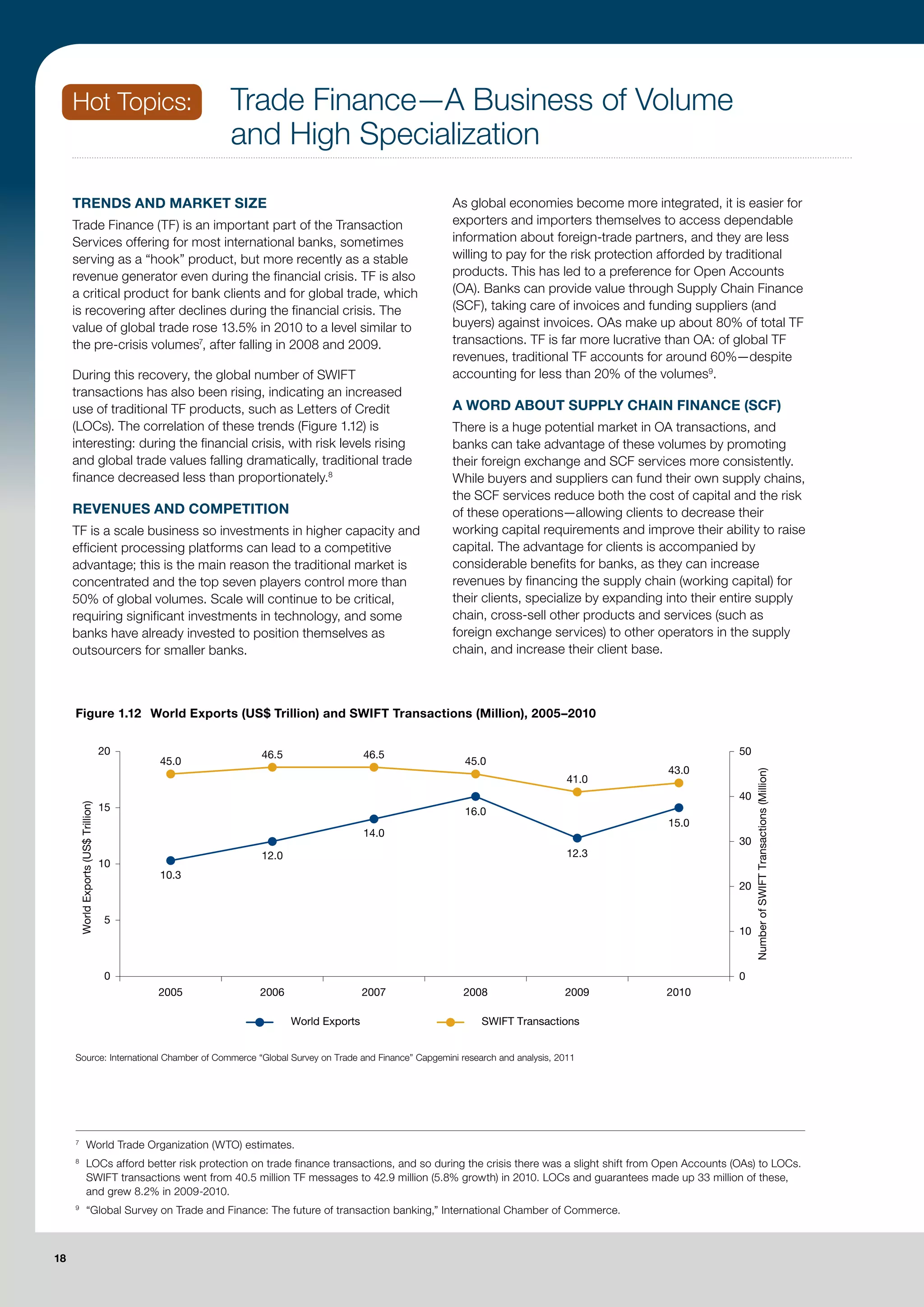
     (LOCs). The correlation of these trends (Figure 1.12) is                                     There is a huge potential market in OA transactions, and
     interesting: during the financial crisis, with risk levels rising                            banks can take advantage of these volumes by promoting
     and global trade values falling dramatically, traditional trade                              their foreign exchange and SCF services more consistently.
     finance decreased less than proportionately.8                                                While buyers and suppliers can fund their own supply chains,
                                                                                                  the SCF services reduce both the cost of capital and the risk
     REVENUES AND COMPETITION                                                                     of these operations—allowing clients to decrease their
     TF is a scale business so investments in higher capacity and                                 working capital requirements and improve their ability to raise
     efficient processing platforms can lead to a competitive                                     capital. The advantage for clients is accompanied by
     advantage; this is the main reason the traditional market is                                 considerable benefits for banks, as they can increase
     concentrated and the top seven players control more than                                     revenues by financing the supply chain (working capital) for
     50% of global volumes. Scale will continue to be critical,                                   their clients, specialize by expanding into their entire supply
     requiring significant investments in technology, and some                                    chain, cross-sell other products and services (such as
     banks have already invested to position themselves as                                        foreign exchange services) to other operators in the supply
     outsourcers for smaller banks.                                                               chain, and increase their client base.


     Figure 1.12 World Exports ($Trillion) and and SWIFT Transactions (Million), 2005–2010
     FIGURE 1.12. Global Exports
                                 (US$ Trillion) SWIFT Transations (Million) Trends

                                        20                46.5                   46.5                                                                         50
                                             45.0                                                   45.0
                                                                                                                                               43.0
                                                                                                                                                                   Number of SWIFT Transactions (Million)
                                                                                                                          41.0
                                                                                                                                                              40
                                        15
         World Exports (US$ Trillion)


                                                                                                    16.0
                                                                                                                                               15.0
                                                                                 14.0
                                                                                                                                                              30
                                                          12.0                                                            12.3
                                        10
                                             10.3
                                                                                                                                                              20


                                         5
                                                                                                                                                              10


                                         0                                                                                                                    0
                                             2005         2006                   2007               2008                 2009                 2010

                                                                 World Exports                          SWIFT Transactions


     Source: International Chamber of Commerce “Global Survey on Trade and Finance” Capgemini research and analysis, 2011


     7
                      World Trade Organization (WTO) estimates.
     8
                      LOCs afford better risk protection on trade finance transactions, and so during the crisis there was a slight shift from Open Accounts (OAs) to LOCs.
                      SWIFT transactions went from 40.5 million TF messages to 42.9 million (5.8% growth) in 2010. LOCs and guarantees made up 33 million of these,
                      and grew 8.2% in 2009-2010.
     9
                      “Global Survey on Trade and Finance: The future of transaction banking,” International Chamber of Commerce.


18
EMERGING TRADING CORRIDORS                                                            BASEL III COULD INFLATE THE COST
The recovery in trade is strong, but not globally uniform.                            OF TRADE FINANCE
Furthermore, credit Credit risk and Know Your Customer                                Basel III is having a direct and indirect impact on TF as banks
(KYC) issues are relevant in certain geographies and                                  are required to hold capital as a percentage of their assets
segments.                                                                             (see Section 2). Before Basel III, only 20% of the value of TF
                                                                                      assets was counted in total assets; Basel III plans to
China recently surpassed Germany as the number one                                    eliminate this exception, making TF assets attract 100% in
exporter in the world (and 64% of all LOCs are issued in                              the calculation of the total. This would lead to a fivefold
Asia). More intra-regional trading is emerging—in Asia as well                        increase in the cost of capital for TF products—which Basel
as inter-regionally, such as that between Brazil and China. As                        III categorizes in the same way as far riskier products.10
each BRIC market is large, developing countries with                                  BAFT-IFSA (Bankers’ Association for Finance and Trade and
established connections to BRIC countries have managed to                             the International Financial Services Association) and other
stay strong during the crisis, and the South-South share of                           organizations are lobbying to change these inconsistencies,
global imports is now 38% (up from 24% in 2000).                                      but if the rules are not changed, banks might need to
                                                                                      increase the costs of trade finance to account for these
                                                                                      heightened capital costs. In the light of the evidence
                                                                                      presented, most observers anticipate that regulators may
                                                                                      adjust Basel III to avoid the negative impacts on trade.


Hot Topics:                          Workers’ Remittances – A Platform for
                                     Cards and Mobile Payments

OPPORTUNITIES REMAIN AS THE MARKET                                                    DIFFERENT CHANNELS ARE ADOPTED
RETURNS TO GROWTH                                                                     The main traditional channels include non-bank Money
Workers’ remittances declined during the financial crisis but                         Transfer Operators (MTOs), banks, post offices, Informal
have fully recovered, despite the fact that many countries                            Money Transfer Services (IMTS). New entrants such as
that employ a lot of migrant workers are reducing                                     mobile operators are pushing innovative channels (mobile
immigration because of high domestic unemployment levels.                             payments, prepaid cards, peer-to-peer portals), but IMTS still
Remittance flows to developing countries are expected to                              represent 20%-25% of global remittances, so official data
increase by 6.2% in 2011 and 8.1% in 2012 to reach $347                               significantly underestimates the full scale of remittance flows.
billion by 2012,11 with India, China, Mexico and the Philippines                      The remittance preferences of migrant groups vary by
being the top recipients of migrant remittances.12                                    country, depending on cost, reliability, speed, local financial
                                                                                      network, etc. National policies, including those on financial
The scale of migrant remittances is even greater in the                               inclusion, could improve transparency in remittances and
growing market of cross-border payments when including                                encourage greater use of formal channels.
informal flows that are not tracked in data, so remittances is
clearly a growing business—especially since international aid                         REGULATORY ISSUES
and financial organizations, from the World Bank to the G8,                           Traditional players say the current regulatory framework for
consider remittance solutions to be critical for financial                            Remittance Service Providers (RSPs) may need to be
inclusion (the availability of financial services at affordable                       enhanced in the interests of a level playing field, and argue
costs to disadvantaged and low-income segments of society).                           that new entrants are unregulated or at least less regulated.
                                                                                      However, new entrants tend not to be very active in cross-
                                                                                      border payments, so regulators have an opportunity to
                                                                                      cooperate with Mobile Network Operators (MNOs) to
                                                                                      balance the risks and benefits of new channels.


10
     For example, a 30-day LOC (which is short-term and collateralized) is treated the same way as a 10-year unsecured loan when in fact, the risk of
     default on TF transactions was less than 0.02% even during the crisis.
11
     “Migration and Development Brief”, S. Mohapatra, D. Ratha, A. Silwal, World Bank, November 2010. (Note this data does not include an estimated
     $9.1billion in remittances to Poland, which the World Bank no longer classifies as “developing”.)
12
     Ibid. (Flows to East Asia and the Pacific are expected to grow 7.2% and 8.5% in 2011 and 2012 respectively to reach $106 billion, led by China (which had
     inflows of $51 billion in 2010) and the Philippines ($21.3 billion). Flows to Europe and Central Asia are expected to recover to reach $43 billion in 2012.)


     WoRld PAymENTS REPoRT 2011                                                                                                                                     19
The U.S. Dodd-Frank Act and the EU Payment Services                        ƒ Develop complementary partnerships—for example, a
     Directive (PSD) are also improving transparency and                          bank with a retail presence in a significant send country
     competition in both payments and remittance services. U.S.                   could partner with a local bank with subscribers in a
     service providers, for example, will be required to disclose to              significant receive country.
     senders the amount that will actually be credited to the
     beneficiary, stipulating fees and charges per transaction and              If successful, remittances could create significant adjunct
     other information. The PSD has established capital,                        opportunities for banks to develop new revenue streams and
     reporting, licensing, and other requirements for PSPs                      acquire customers in new markets. Most banks do not have
     managing workers’ remittances.                                             the global infrastructure to be a standalone player in
                                                                                remittances but some are establishing partnerships and/or
     REVENUES AND OPPORTUNITIES                                                 acquisitions to overcome their limitations.
     Remittances present a significant opportunity; revenues have
                                                                                Market potential clearly exists, and banks at least should
     been estimated at around €15 billion-€17 billion,13 when
                                                                                be able to:
     taking account of related cross-border, correspondent-
     banking and currency-conversion services. Accessibility for                ƒ Define a clear strategy on remittance offerings.
     both sender and receiver is key to success in the remittances              ƒ Make estimates to define which of the remittance corridors
     business and requires physical and remote channels,                          offer opportunities.
     systems and competitive foreign exchange.                                  ƒ Define an overall framework to interact with identified
                                                                                  counterparties.
     Many banks can provide some but not all of these elements,
     and are likely to need to pursue one of three approaches to                ƒ Market and bundle new and compelling value-added
     provide an end-to-end remittances service:                                   services.

     ƒ Build capabilities—to ensure a presence in both send and
       receive countries.
     ƒ Acquire capabilities—partnering with technology providers/
       MTOs/other banks.


     Hot Topics:                     Cash – Reducing Costs While Developing
                                     Cards and Mobile Payments

     The highly mature economies of the U.S. and Eurozone                       CASH-HANDLING EFFICIENCIES
     together accounted for 160 billion non-cash transactions in                The main costs of managing the cash cycle are borne by
     2009—the highest numbers in the world—and yet those                        banks and retail businesses, so these stakeholders could
     volumes are dwarfed by the number of transactions                          both reduce costs and improve margins if operational
     conducted in cash.                                                         processes could be made more efficient, and if economies
                                                                                of scale could be achieved in cash processing, distribution,
     In fact, more than 80% (about 715 billion)14 of all transactions
                                                                                and machine management—most likely by outsourcing
     were made using cash. At the same time, the cash-in-
                                                                                cash functions or cooperating with other banks. (One
     circulation in the U.S. and Eurozone in 2009 (not counting
                                                                                example of such inter-bank cooperation is an initiative to
     high-value €200, €500, and US$100 notes) was worth
                                                                                pool automated teller machines (ATMs) in Sweden, where
     approximately €675 billion.
                                                                                five of the biggest banks have announced that by the end of
     The lifecycle of cash is expensive. Cash passes through                    2011, they will transfer ownership of their ATMs to a
     central banks, businesses, banks and secure cash-in-transit                separate company so as to obtain economies of scale.)
     (CIT) agents. And while it is unrealistic to imagine a society
     without cash, it would clearly be beneficial to the system to
     shift more cash payments to electronic means. But this shift
     requires cash-replacement initiatives to reduce cash-in-
     circulation, and cash-handling efficiencies to minimize the
     cost of managing the cash that remains in circulation.


     13
          Capgemini analysis of SWIFT data and SWIFT Worker Remittances Factsheet, October 2010.
     14
          Capgemini estimates 2011, EPC Newsletter January 2011.


20
Operational processes could also be reorganized to optimize                    In fact, consumers may need to be incentivized to change
and shorten the cash lifecycle, eliminating or reducing costly                 their habits. The public sector could play an integral role in
intermediate steps (e.g., double-counting, transportation).                    cash substitution, however, by shifting its own activities to
The benefits would include cost reductions (e.g., less                         electronic means, and by legislating that payments be
headcount, logistics and infrastructure) and security                          electronic and thus fully traceable to fight the “black
enhancements (minimal inventory differences, cash losses,                      economy” and other illegal transactions (also see the
fraud, theft, etc.).                                                           eGovernment Spotlight on p42).

Banks have been moving for some time toward more                               Cards play an important role in any transition to a cashless
efficient cash-in operations, both at the teller and at the ATM,               society. Usage of cards is growing around the world, and
allowing customers to deposit cash automatically, for                          cards will remain the most commonly used non-cash
example. There are also major benefits to implementing                         payment means in the near future. Banks are already
closed circuits for cash recycling within an organization (e.g.,               leveraging prepaid cards in a move to target unbanked
a bank branch or retail point-of-sale), re-using deposited                     customers, and prepaid cards are emerging as a mainstream
cash for cash-out operations and thus reducing the volume                      payment means. (In the U.S., for example, the number of
of cash-in-circulation.                                                        prepaid card transactions has risen from 3.3 billion in 2006
                                                                               to 6.0 billion in 2009.)
Another option is cross-sector closed cycles via
collaboration—for instance between banks, retail businesses,                   Looking further ahead, the use of advanced payments
and CITs. By adopting integrated cash lifecycle management                     technologies based on Internet, mobile, and contactless
solutions, cash received at the POS can be fed into nearby                     methods will further drive cashless initiatives. eCommerce is
ATMs. (One such example is the venture between Shell Oil                       already a reality and will be propelled even more in the future
and Postbank in Germany in which Shell stations’ cash                          by trends such as the Peer-to-Peer (P2P) payments used in
receipts are used to replenish on-site ATMs. The system is                     social media and social networks. Near-field communication
entirely self-contained so the bank almost never has to                        (NFC) technology (in both mobile and cards) also opens up
transport cash from its branches).                                             many different opportunities because it has manifold uses.

CASH REDUCTION                                                                 Contactless technologies have already been widely piloted in
Innovations in micro-payments—payments of small                                the public transportation sector (among others), most notably
denominations—could drive significant cash substitution in                     in Japan, Hong Kong, and Singapore, but to an extent in
the future and improve the efficiency of cash handling and                     Europe and the U.S. too. For example, the Isis project in the
reduce its costs. In the U.K. for example, 80% of cash                         U.S. was formed by three major mobile operators (AT&T,
transactions are under £10;15 in Canada, cash is king for                      Verizon, and T-Mobile). The original plan was for Isis to set up
any transaction under $25.16 The potential is greatest in                      its own payments network, but today, the project is
retail businesses where cash transactions tend to be in                        collaborating with VISA and MasterCard to provide a “mobile
small amounts.                                                                 wallet” using traditional card networks and innovative NFC
                                                                               technology. Initial trials are planned for early-2012.
Importantly, there are plenty of non-bank operators willing
and able to experiment with ways of handling such
payments, but they will need to deliver solutions that can
compete with the simplicity of cash, which is quick, easy,
secure and anonymous.


15
     “The Way We Pay 2010,” The U.K. Payments Council.
16
     “Trends in Retail Payments and Insights from Public Survey Results” – Bank of Canada, 2006.


     WoRld PAymENTS REPoRT 2011                                                                                                                   21
SPOTLIGHT
       Governments Adopt Different Approaches
       to Reduce Check Usage
       Checks are versatile, convenient and familiar to many                                                                                                                  countries, checks are obsolete (see Figure 1.14). But
       payers and payees, but the use of paper-based                                                                                                                          in other countries—including the U.K. and the U.S.—
       instruments is declining in the digital age as the use                                                                                                                 proactive strategies are needed if significant
       of debit and credit cards rises. Nevertheless, check                                                                                                                   progress is to be made toward further reducing and
       usage is strong in certain markets, due to                                                                                                                             eventually eliminating the use of paper-based
       stakeholder preferences and the costs (real and                                                                                                                        checks. The U.K. Payments Council announced in
       perceived) of migrating to electronic payments.                                                                                                                        July 2011 that the U.K. strategy toward checks would
       Recognizing this reality, governments and payments                                                                                                                     focus on encouraging innovation to develop viable
       providers are considering whether and how to drive                                                                                                                     alternatives, rather than attempting to decommission
       check substitution, seeking a balance between client                                                                                                                   checks altogether, as had been considered originally.
       needs and commercial efficiency.                                                                                                                                       In the U.S., the focus remains on improving the
                                                                                                                                                                              efficiency of current check processing by allowing
       In many countries, check usage has declined                                                                                                                            electronic presentation of paper-based checks—a
       substantially (see Figure 1.13). Checks accounted for                                                                                                                  move that has prompted huge investment in check-
       just 16% of non-cash global transactions in 2009,                                                                                                                      imaging systems.
       down from 22% in 2005, and in some European


       Figure 1.13 NumberUsage in Europe and U.S. (Million), 2001–2009
       FIGURE 1.13. Cheque of Check Transactions in Europe and U.S. (Million), 2001–2009


                                        50,000                                                                                                     600                                                                              CAGR      Growth
     Number of Transactions (Million)


                                                                                                                Number of Transactions (Million)


                                                                                                                                                                                                                                    ’01−’08   ’08−’09
                                        40,000
                                                                                                                                                   450                                                                   U.S.        (5.7%)    (4.9%)

                                        30,000
                                                                                                                                                   300                                                                              ’01−’08   ’08−’09
                                        20,000
                                                                                                                                                                                                                         Italy       (5.8%)   (12.9%)
                                                                                                                                                   150                                                                   Portugal    (6.3%)    (7.4%)
                                        10,000
                                                                                                                                                                                                                         Spain       (2.9%)   (16.7%)

                                            0                                                                                                       0                                                                    Ireland     (2.4%)   (13.1%)
                                                 2001

                                                        2002

                                                               2003

                                                                      2004

                                                                             2005

                                                                                    2006

                                                                                           2007

                                                                                                  2008

                                                                                                         2009


                                                                                                                                                         2001

                                                                                                                                                                2002

                                                                                                                                                                       2003

                                                                                                                                                                               2004

                                                                                                                                                                                      2005

                                                                                                                                                                                             2006

                                                                                                                                                                                                    2007

                                                                                                                                                                                                           2008

                                                                                                                                                                                                                  2009


                                                                                                                                                                                                                         Germany    (20.3%)   (12.6%)


                                                                                                                                                                                                                                    ’01−’08   ’08−’09
                                        5,000                                                                                                      80
                                                                                                                                                                                                                         France      (3.1%)    (5.3%)
     Number of Transactions (Million)


                                                                                                                Number of Transactions (Million)


                                                                                                                                                                                                                         U.K.        (8.3%)    (8.6%)
                                        4,000
                                                                                                                                                   60

                                                                                                                                                                                                                                    ’01−’08   ’08−’09
                                        3,000
                                                                                                                                                   40                                                                    Greece       7.0%    (12.1%)
                                        2,000                                                                                                                                                                            Denmark    (16.5%)   (29.9%)

                                                                                                                                                   20                                                                    Belgium    (24.0%)   (10.0%)
                                        1,000
                                                                                                                                                                                                                         Austria    (15.7%)   (33.3%)
                                                                                                                                                                                                                         Sweden      (9.4%)   (30.0%)
                                            0                                                                                                       0
                                                                                                                                                                                                                         Finland     (7.0%)   (16.7%)
                                                 2001

                                                        2002

                                                               2003

                                                                      2004

                                                                             2005

                                                                                    2006

                                                                                           2007

                                                                                                  2008

                                                                                                         2009


                                                                                                                                                         2001

                                                                                                                                                                2002

                                                                                                                                                                       2003

                                                                                                                                                                               2004

                                                                                                                                                                                      2005

                                                                                                                                                                                             2006

                                                                                                                                                                                                    2007

                                                                                                                                                                                                           2008

                                                                                                                                                                                                                  2009


                                                                                                                                                                                                                         Slovenia   (33.7%)   (16.3%)


       Source: Capgemini analysis, 2011; ECB DWH—2009 figures, released November 2010; Bank for International Settlements - Red Book - 2009 figures,
       released December 2010


22
SPoTlIGhT
                                                                       GovERNmENTS AdoPT dIffERENT APPRoAChES To REduCE ChECK uSAGE


Figure 1.14 Checks As a Percentageof Total Non-Cash Transactions in Europe and U.S. (%), 2009
FIGURE 1.14. Cheques as a Proportion of Total Non-Cash Transactions in Europe and U.S. (%), 2009


      25%                                                                                                                                                           CAGR               24.29%
                                                                                                                                                                   ’05–’09
                                                                                                                                                                     (6%)
               19.87%                           CAGR
      20%                                      ’05–’09
                                                 (6%)
                          16.50%
                                                                              CAGR
      15%                           13.72%                                   ’05–’09
 %


                                                                              (10%)
                                               10.45%
      10%                                                   9.34%
                                                                     8.15%


       5%
                                                                             2.07%
                                                                                       0.65% 0.36% 0.35%
                                                                                                         0.15% 0.09% 0.09% 0.03% 0.03% 0.01%
       0%
                 France


                           Greece


                                     Ireland


                                                 Portugal


                                                             Italy


                                                                      U.K.


                                                                               Spain


                                                                                        Denmark


                                                                                                   Belgium


                                                                                                             Germany


                                                                                                                       Luxembourg


                                                                                                                                    Austria


                                                                                                                                              Slovenia


                                                                                                                                                         Finland


                                                                                                                                                                     Sweden


                                                                                                                                                                              Poland


                                                                                                                                                                                        U.S.
Note: Non-cash transaction totals used to calculate check share do not include prepaid card volumes
Source: Capgemini analysis, 2011; ECB DWH—2009 figures, released November 2010; Bank for International Settlements - Red Book - 2009 figures,
released December 2010


The differing focus between the U.K. and U.S.                                                     ƒ Key stakeholders must be properly identified
approaches is quite clear:                                                                           and understood. In the simplest terms,
                                                                                                     stakeholders fall into two categories—drawers and
U.K.                                                                                                 payees—but these categories themselves include
In July 2011, the U.K. Payments Council abandoned                                                    various segments (individual consumers, businesses
tentative plans to target the October 2018 closure of                                                and financial institutions, charities and voluntary
the U.K. check clearing system. The decision by the                                                  organizations and public sector organizations).
Council means checks will remain in use for as long                                                  Within these sub-segments, the level of dependency
as customers require them. However, the Council is                                                   on checks differs, as does the size and volume of
closely monitoring check usage, and volumes are                                                      transactions. Check usage even varies by
expected to keep declining—possibly to a point at                                                    demographic and socio-economic groups.
which the current processing model becomes                                                        ƒ The costs and benefits to each segment must
uneconomic. If this position is reached, a cost-                                                     be properly gauged. In switching from checks,
benefit analysis will need to take place.                                                            there may be upfront costs involved in migrating to
                                                                                                     an alternative payment method, as well as ongoing
To conduct a cost-benefit analysis, the following are
                                                                                                     costs or savings from using alternative means and
some of the issues that would need to be considered:
                                                                                                     managing fraud costs. In terms of system costs,
ƒ Data must be gathered and analyzed to properly                                                     there will be both one-time savings and ongoing
  understand demand (including the willingness of                                                    savings from closing down clearing systems.
  users to pay for checks and their alternatives),
                                                                                                  It will be important to show how the costs and
  time (costs and benefits of switching), and scope
                                                                                                  savings involved in abolishing checks would accrue
  (number of people and organizations impacted
                                                                                                  to different stakeholders, because the impact would
  by the change).
                                                                                                  determine the amount of support the payments
                                                                                                  industry receives for plans to phase out checks and
                                                                                                  switch to alternative means.


WoRld PAymENTS REPoRT 2011                                                                                                                                                                      23
U.S.                                                                  deposits so customers can, for instance, make
                                                                           deposits by uploading a check image to their bank
     Check payments continue to decline in the U.S., and
                                                                           via a mobile device.
     have already been eclipsed by debit cards as the
     most commonly used non-cash instrument. Checks                        Image-based check clearing has also reduced
     written by consumers to businesses for household                      check-processing costs (handling, sorting,
     bill payments and POS transactions represented                        transporting, storing, guarding, etc.), and thereby
     44% of all checks written in 2009—after a 10%-per-                    removed some of the urgency to transition from
     year decline since 2006.                                              checks. Certainly, the number of financial institutions
                                                                           handling electronic checks in the U.S. is growing
     However, the B2B use of checks remains common
                                                                           rapidly, with the number of routing transit numbers
     for a variety of reasons, not least because tangible
                                                                           (R/Ts) assigned to financial institutions that can
     float benefits are still available in the U.S. Moreover,
                                                                           process check images growing 36.8% a year
     counterparties may not accept electronic payments
                                                                           in 2006-10.
     and few incentivize them (e.g., through discounts
     offered for electronic payments). In fact, businesses
                                                                           CONCLUSION
     appear to see little reason to switch from checks,
     because they do not believe they have the                             In the last five years, check usage has declined in
     transaction scale to capture worthwhile savings from                  most markets; but it remains to be seen how
     switching or because of new costs (in infrastructure                  successful government and industry initiatives will be
     and processes) in adopting electronic alternatives.                   in reducing usage further or in eliminating the use of
     Given these attitudes, financial institutions will need               checks altogether.
     to demonstrate real cost and efficiency benefits from
     electronic alternatives to reduce check usage.                        Clearly, the U.K. and the U.S., are each taking a
                                                                           different approach, designed to address the
     In the meantime, the U.S. has created the regulatory                  preferences and realities of their local markets. In
     framework (via the Check Clearing for the 21st                        Europe, a number of countries have tended toward
     Century Act, or “Check 21”) to clear and settle                       full decommissioning of checks—within the
     checks electronically. Electronic check clearing and                  limitations imposed by certain social categories; this
     settlement is expected to show sustained annual                       is in contrast to the U.S., which has decided not to
     growth of 9.8% in 2008-12 (see Figure 1.15). The                      invest in decommissioning, but rather to focus on
     Check 21 infrastructure has also enabled remote                       streamlining processes and reducing costs.


     Figure 1.15 U.S. Electronic1.15. U.S. Electronic Clearing and Settlement of2008–2012F
                         FIGURE Clearing and Settlement of Checks (Billion), Cheques (Billion), 2008–2012F


                                              20                 CAGR ’08–’12F   9.8%


                                                                                                 16.0
                                                                                        15.0
                                              15
                                                                        14.0

                                                          12.0
                                                   11.0
                                  (Billion)


                                              10


                                               5


                                               0
                                                   2008   2009          2010            2011F   2012F


     Source: Capgemini analysis, 2011


24
SPOTLIGHT
In the Fight Against Card Fraud, Chip-and-PIN
Technology Proves Effective
As the use of non-cash payments instruments grows,                                         access to far more accounts than they could through
so does concern about the potential for fraud. The                                         traditional means such as stealing physical cards
payments industry is pursuing various innovations to                                       from wallets or mailboxes.
tackle fraud and better secure non-cash
transactions—and thereby bolster consumer                                                  To help fight card fraud, many countries have moved
confidence. Attention is focused most, however, on                                         toward chip technology, which has significant
e-commerce transactions, especially as electronic                                          advantages over cards that only have magnetic
thefts increasingly hit the headlines.                                                     stripes. Most notably, chips combined with a
                                                                                           personal identification number (PIN) can generate
Global card fraud has increased consistently along                                         dynamic data, producing a unique, one-time
with card usage in recent years (see Figure 1.16). The                                     authentication for a specific transaction. This
number of fraudulent card transactions grew 7.2%                                           contrasts with “magstripe-only” cards, which use
and 12.8% respectively in 2008 and 2009, with the                                          static data just to verify the card itself. The U.S. still
amount lost to card fraud totaling €4.9 billion in 2009,                                   uses mostly magstripe-only cards, but Europe and
up from €4.4 billion in 2008 and €3.4 billion in 2001.                                     much of the rest of the world has or plans to
As a result, the scale of card-fraud losses is growing                                     transition to chip-and-PIN technologies, mostly
as a percentage of total transaction values.                                               using EuropayMastercardVisa (EMV) specifications
                                                                                           that define the global interoperable standards for
This rapid growth is largely because fraudsters have                                       such cards.
found more ways to compromise merchants’
databases and processor data centers, gaining


Figure 1.16 Global Card Fraud (€ Billion) and Global Card Transaction Values (€ Trillion), 2001–2009
FIGURE 1.16. Global Card Fraud (€ Billion) and Global Card Transaction Values (€ Trillion), 2001–2009


                                 8                                                                                                            8

                                                                                                                                      6.4
                                                                                                                                                  Global Card Transaction Values


                                                                                                                              5.9
 Global Card Fraud (€ Billion)


                                 6                                                                                 5.7                        6
                                                                                                     5.3
                                                                                     4.6                                              4.9
                                                                       4.2                                                    4.4
                                                                                                                                                            (€ Trillion)


                                                  4.1     4.0                                                      4.1
                                 4   3.5                                                             3.8                                      4
                                                                                     3.5
                                            3.4                        3.3
                                                  3.1     3.1


                                 2                                                                                                            2


                                 0                                                                                                            0
                                     2001         2002   2003          2004         2005             2006          2007       2008   2009

                                                                                                 CAGR               Growth
                                                                                           ’01–’09     ’01–’08      ’08–’09
                                                         Global Card Fraud                  4.9%            3.8%     12.8%

                                                         Global Card Transaction Values     7.8%            7.7%      8.0%


Source: Capgemini analysis, 2011


WoRld PAymENTS REPoRT 2011                                                                                                                                                         25
In fact, 95% of European ATMs are now EMV-                                                      The U.S. is the single biggest exception in the global
     compliant. Asia-Pacific has also witnessed growth                                               move toward EMV adoption. The U.S. employs
     in EMV-based smart cards, though adoption is                                                    sophisticated fraud-detection measures of its own,
     greater in developed countries such as Japan and                                                including real-time issuer authorization systems, but
     South Korea than in emerging markets such as India                                              U.S. merchant groups and the Federal Reserve are
     and China. EMV has proved highly effective in                                                   nevertheless studying whether the growing
     reducing fraud, especially related to face-to-face                                              vulnerability of magstripe cards warrants a shift to
     (POS) transactions, ATM withdrawals and lost and                                                EMV-based chip-and-PIN cards. However, there
     stolen cards. In the U.K., for example, counterfeit                                             would clearly be substantial costs involved in
     card fraud losses have dropped by 77% since 2004                                                undertaking EMV implementation. EMV-compliant
     when chip-and-PIN cards were first rolled out.17 And                                            cards are more expensive to produce and issue
     across Europe, fraud losses have declined                                                       than cards with a magnetic stripe, and switching to
     dramatically as more ATMs have become EMV-                                                      EMV would involve additional infrastructure and
     compliant (see Figure 1.17).                                                                    device costs.


     Figure 1.17 European ATM EMV Compliance Rate (%) and European Card Issuers’ Domestic Fraud
     FIGURE 1.17. Losses Card Issuers’ Fraud Losses and EMV Compliance Rates (%), 2005–2010
                  Europe (€ Million), 2005–H1 2010

                                       100%                                                                                   94%       95%       95%      70
                                                                                                         90%       92%
                                                                  62
                                                                                                                                                                Issuers' Domestic Fraud Losses (€ Million)
                                                                                               84%
     European ATM EMV Compliance (%)


                                                                                                                                                           60
                                                                                        77%
                                       80%
                                                                             70%
                                              46                                                                                                           50
                                                                 63%
                                                      58%
                                       60%                                                                47
                                              52%                                                                   45                                     40
                                                                                                                               41        43

                                                                                                                                                           30
                                       40%             32                     31
                                                                                               29
                                                                                        27
                                                                                                                                                   24      20
                                       20%
                                                                                                                                                           10

                                        0%                                                                                                                 0
                                              2005               2006                   2007             2008                2009                H1 2010

                                                                       European ATM EMV Compliance              Issuers' Domestic Fraud Losses


     Source: Capgemini analysis, 2011; The European ATM Security Team (EAST): “European ATM Crime Report 2010”


     17
                               Financial Fraud Action U.K., “Fraud: The Facts, 2010”.


26
SPoTlIGhT
                                 IN ThE fIGhT AGAINST CARd fRAud, ChIP-ANd-PIN TEChNoloGy PRovES EffECTIvE


In fact, a switch to EMV could cost the U.S. cards         Technology and technical specifications are proving
industry several billion dollars, making the business      to be a critical tool in fighting fraud, and full global
case complex; however there may be benefits                interoperability, most likely around EMV standards,
beyond the simple reduction in existing fraud              could potentially prevent even more fraud from a
trends. At a systemic level, for instance, the U.S. will   variety of attack points within the payments system.
need to consider whether it could become an                This would position stakeholders to wage a more
international magnet for credit-card theft if it keeps     comprehensive fight on card fraud as a greater
using cards that are easier to counterfeit. In             proportion of transactions become contactless
addition, issuers and merchants will need to               and electronic.
consider customer experience—as well as the
potential loss of transaction volumes—if U.S.              The U.S. may or may not choose to follow the
cardholders are unable to use their magstripe cards        EMV route, but it seems likely that if EMV standards
easily while traveling abroad.                             do continue to gain traction around the globe,
                                                           fraud costs will increasingly shift toward non-
CONCLUSION                                                 compliant areas.
At present, financial institutions and merchants are
absorbing fraud-related costs, and significant
investment continues to be made in fraud prevention
solutions, using both tactical and strategic measures.


WoRld PAymENTS REPoRT 2011                                                                                            27
28
SECTIoN TITlE l1
                                                                                                SECTIoN TITlE l2


2            Regulatory and
             Industry Initiatives
             The payments industry is evolving due to a combination of exogenous and endogenous forces;
HIGHLIGHTS


             that pressure has intensified even further since the financial crisis and the combined forces of
             key regulatory and industry initiatives (KRIIs) are now converging to drive change far into
             the future.

             This Section outlines some of the many KRIIs now under way, and evaluates their impact on the
             payments landscape. Among the key findings:

             ƒ KRIIs are at the heart of five main industry transformation trends (ITTs), which together
              are reworking—or soon will—many aspects of the payments market and the positioning of
              participants. Those trends are:

              – Systemic-risk reduction and control. In the wake of the financial crisis, regulators are
                seeking to minimize systemic risk by imposing stricter requirements on capital and liquidity,
                but there is potential for unintended consequences, including in the way in which these
                standards can potentially change the economics of some business lines.
              – Standardization initiatives continue to improve efficiency, streamline processes and reduce
                costs. Some payments instruments and/or aspects of the value chain are becoming
                commoditized in the process, making it more difficult for banks to differentiate themselves in
                the market.
              – A drive for higher levels of Transparency is increasingly being seen in the payments industry.
                Several initiatives are focusing on making service fees to both corporate and retail clients
                more transparent, and this could have an impact on current business models.
              – Convergence. Developments in technology and evolving user and regulatory requirements
                are contributing to a gradual blurring of the lines between traditional payments activities
                supplied by infrastructure providers. There is more overlap, for example, between Low-Value
                (high-volume) ACH payments and High-Value (low-volume) RTGS payments. This type of
                convergence may increase competition between the RTGS and ACH systems for certain
                types of low-value payments.
              – Innovation remains one of the cornerstones of the payments industry. It allows players to
                specialize and to make use of emerging technologies and trends, such as mobile devices
                and contactless payments, to deliver state-of-the-art solutions. Non-bank PSPs—which tend
                not to be burdened by legacy infrastructures—may be better placed than many banks to
                leverage emerging technologies to satisfy user needs.
             ƒ SEPA adoption levels reflect increased usage in the last year of SEPA Credit Transfers
              (SCTs). On the other hand, SEPA Direct Debit (SDD) use is still extremely low. All stakeholders
              now agree on the need for a firm end-date for migration. The final text of the SEPA Migration
              Regulation looks likely to be agreed by the European Parliament and Council before the end of
              2011 and potential end-date(s) of 2013-14 seem probable. Nevertheless, challenges and issues
              remain and discussions among stakeholders continue.

             ƒ eGovernment initiatives are emerging as a key enabler of non-cash payments. In
              countries where a mature eGovernment combines with developed non-cash payments
              infrastructure and behavior, conditions are especially ripe to trigger increases in overall
              non-cash payments usage.


WoRld PAymENTS REPoRT 2011                                                                                         29
NUMEROUS INITIATIVES ARE DRIVING CHANGE                                     INITIATIVES ARE FUELING FIVE
     IN THE PAYMENTS LANDSCAPE                                                   DISTINCT PAYMENTS INDUSTRY
                                                                                 TRANSFORMATION TRENDS
     The payments system, as an integral part of the
     global economy, is continually subject to forces of                         The extent to which specific regulatory and
     change, but regulatory oversight has greatly                                industry initiatives have the potential to affect the
     intensified in the wake of the financial crisis, with                       payments industry is not always obvious at first
     implications for the operations and profitability of                        sight. eGovernment initiatives, for example, are
     financial Institutions (fIs). Initiatives such as Basel                     primarily civic schemes designed to enhance digital
     III and the u.S. dodd-frank Act are designed to                             interaction between Public Administrations (PAs)
     reduce systemic risk and strengthen the ability of fIs                      and citizens and enterprises. however, the impact
     to withstand systemic shocks. These initiatives are                         on payments could ultimately be substantial (also
     raising capital and liquidity requirements and, in                          see Spotlight on eGovernment on p42) as public
     turn, changing the economics of certain fI activities                       authorities are potentially powerful drivers of the
     including payments, and potentially affecting the                           move away from paper-based and cash
     attractiveness of some business lines (see Trade                            instruments—a shift that will intensify competition
     finance in Section 1, on p18 as an example).                                between non-bank PSPs and traditional players.

     At the same time, initiatives designed to improve                           The objectives and scope of a number of initiatives
     transparency are targeting legacy fee and charging                          have been evaluated on a heat map (see figure 2.1)
     structures in relation to many payment instruments,                         to show the impact on payments. Analysis shows
     most notably cards. The u.S. durbin Amendment,                              that various initiatives are complementary in nature,
     for instance, was designed to give the government                           and can together be expected to trigger an
     additional control over debit card “swipe fees” and the                     evolutionary path of transformation for the
     Canadian Code of Conduct for Cards assigns the                              payments market and the behavior and attitudes of
     minister of finance power to regulate the market                            its participants.
     conduct of cards networks.
                                                                                 figure 2.2 maps each initiative into one of five
     In Europe, meanwhile, the Payment Services                                  major Industry Transformation Trends (ITTs)—
     directive (PSd) is now fully in force in all Eu                             with each initiative categorized by the single trend
     countries (with the exception of Poland at the time of                      that best reflects its primary nature. In reality, some
     writing), and the adoption of Single Euro Payments                          initiatives will also have a secondary and sometimes
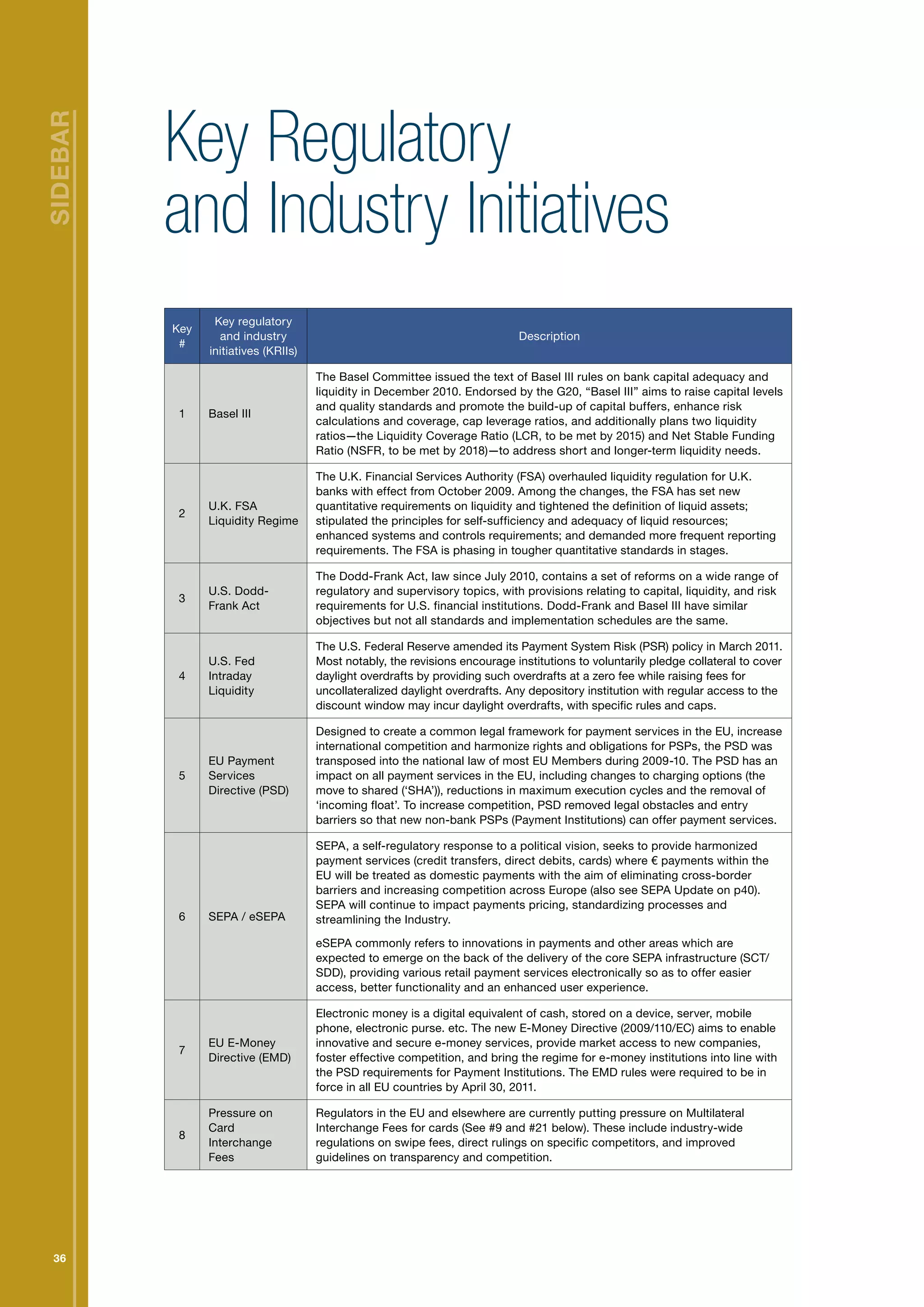
     Area (SEPA) instruments, in particular the SCT, is                          tertiary aspect.
     starting to grow. The PSd and SEPA represent
     sweeping changes that seek to create a common legal                         This analysis helps to show how emergent trends
     framework and a standardized environment for euro                           have exerted regulatory and/or competitive pressure
     payment services in the European union (Eu)—with                            on banks and other PSPs in recent years, forcing
     a view to transforming the fragmented national                              them to adapt.18 It also provides insight into which
     payments markets of the Eurozone countries into a                           transformation trends are likely to predominate in
     unified and highly competitive ‘domestic’ market.                           the next 5-10 years—prompting further adaptation.

     Numerous other initiatives being formulated and
     implemented around the globe will also have an
     impact on payments. These measures, including
     examples such as the Eu digital Agenda (part of the
     Europe 2020 Strategy) and the International
     Payments framework Association (IPfA) initiative
     to name but two, are further pushing the payments
     market toward increased levels of standardization,
     interoperability and de-fragmentation. (See figure
     2.1 for a heat map of some key regulatory industry
     initiatives on a global and regional level and the
     Sidebar for an overview of each initiative).


     18
          For more detail on industry responses, see Section 3 of the WPR 2010, specifically references to the “Revenue-focused and Cost-focused” paths
          open to banks.


30
SECTIoN 2
                                                                                                                   REGulAToRy ANd INduSTRy INITIATIvES


Figure 2.1        Heat Map of Key Regulatory and Industry Initiatives at a Global and Regional Level, 2010


                                                                                      Global
                                                                                                                                                                 IMPACT ON
                                                       ƒ   Basel III                             HIGH
                                                                                                                                                                 PAYMENTS

                                                       ƒ   Checks Transformation                                                                            HIGH
                                                       ƒ   Mobile Payments                                                                                IMPACT

                                                       ƒ   Contactless Cards / NFC
                                                       ƒ   e-Invoicing
                                                       ƒ   eGovernment
                                                       ƒ   International Payments Framework (IPFA)
                                                                                                                                                            LOW
                                                       ƒ   AML / ATF                                                                                      IMPACT
                                                       ƒ   UCITS(1) IV                           LOW


                                North America                                                                                  Asia Pacific
     ƒ   Dodd-Frank Act                                          HIGH                               ƒ   Hong Kong Multi-Currency Clearing      HIGH
     ƒ   Fed Intraday Liquidity                                                                     ƒ   Japanese Payments Services Act
     ƒ   Durbin Amendment                                                                           ƒ   National Payments Corporation of India
     ƒ   Canada Code of Conduct for Cards                        LOW                                ƒ   Renminbi as a Settlement Currency      LOW


                                                                                      Europe
                                                       ƒ   FSA Liquidity Regime                                HIGH
                                                       ƒ   PSD
                                                       ƒ   SEPA / eSEPA
                                                       ƒ   e-Money Directive
                                                       ƒ   Pressure on Card Interchange Fees
                                                       ƒ   Evolution of TARGET2
                                                       ƒ   UK Faster Payment Services
                                                       ƒ   Digital Agenda
                                                       ƒ   ACH Frequent Settlement
                                                                                                                LOW
                                                       ƒ   Alternative Card Schemes
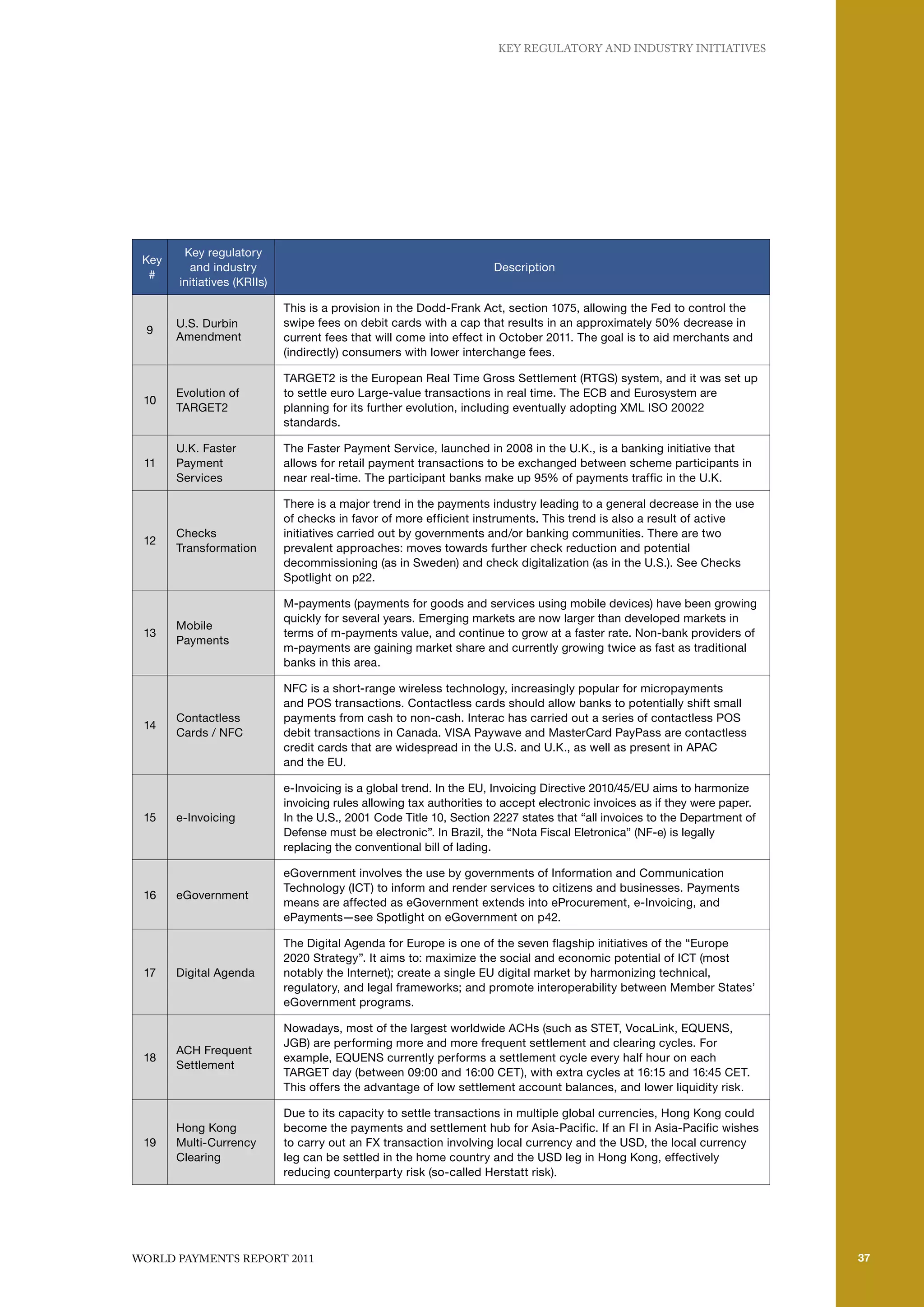

Note: Red denotes the regulation or initiative will have an impact in the near-term or the potential impact on payments business models, competition, and the industry is high.
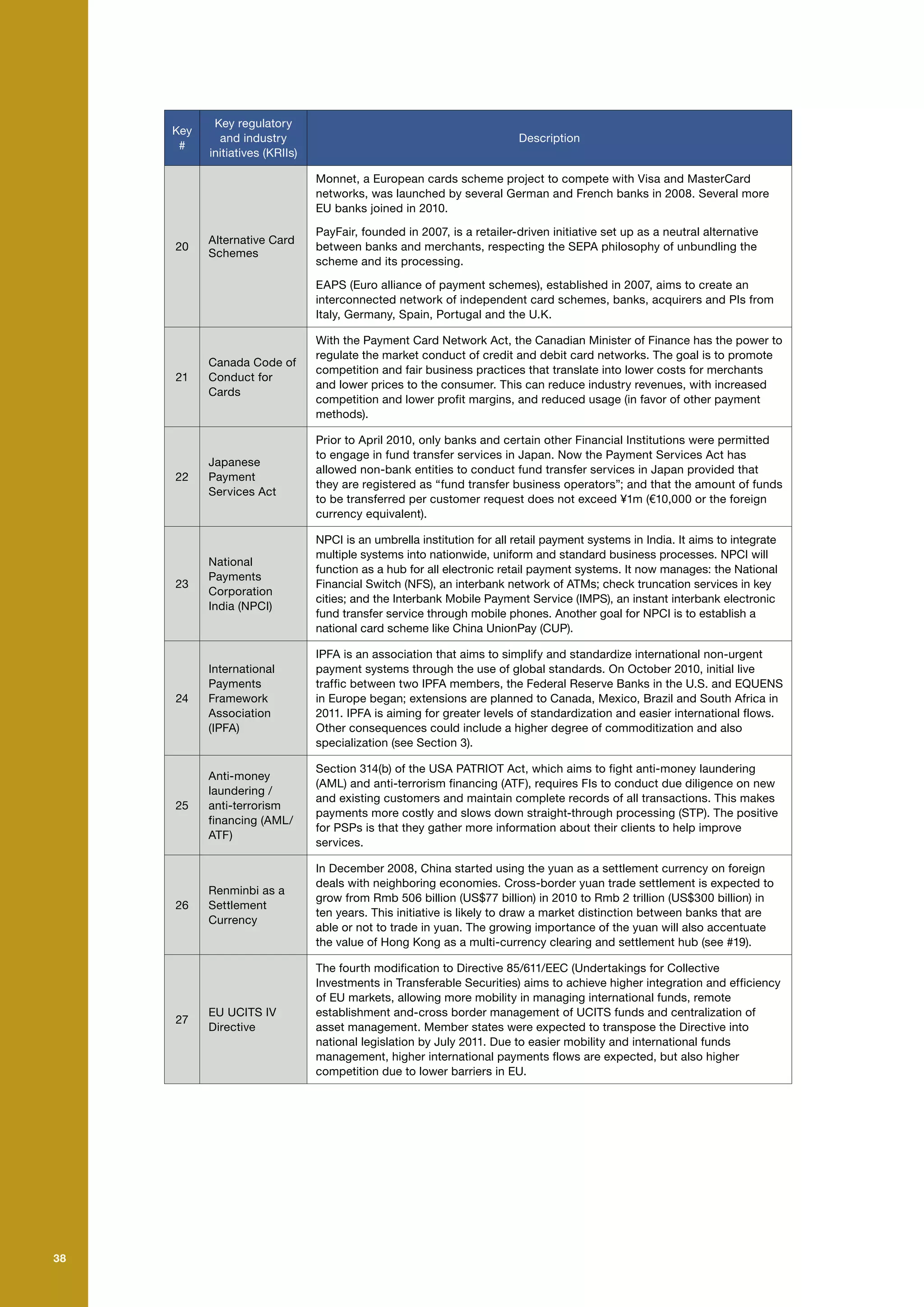
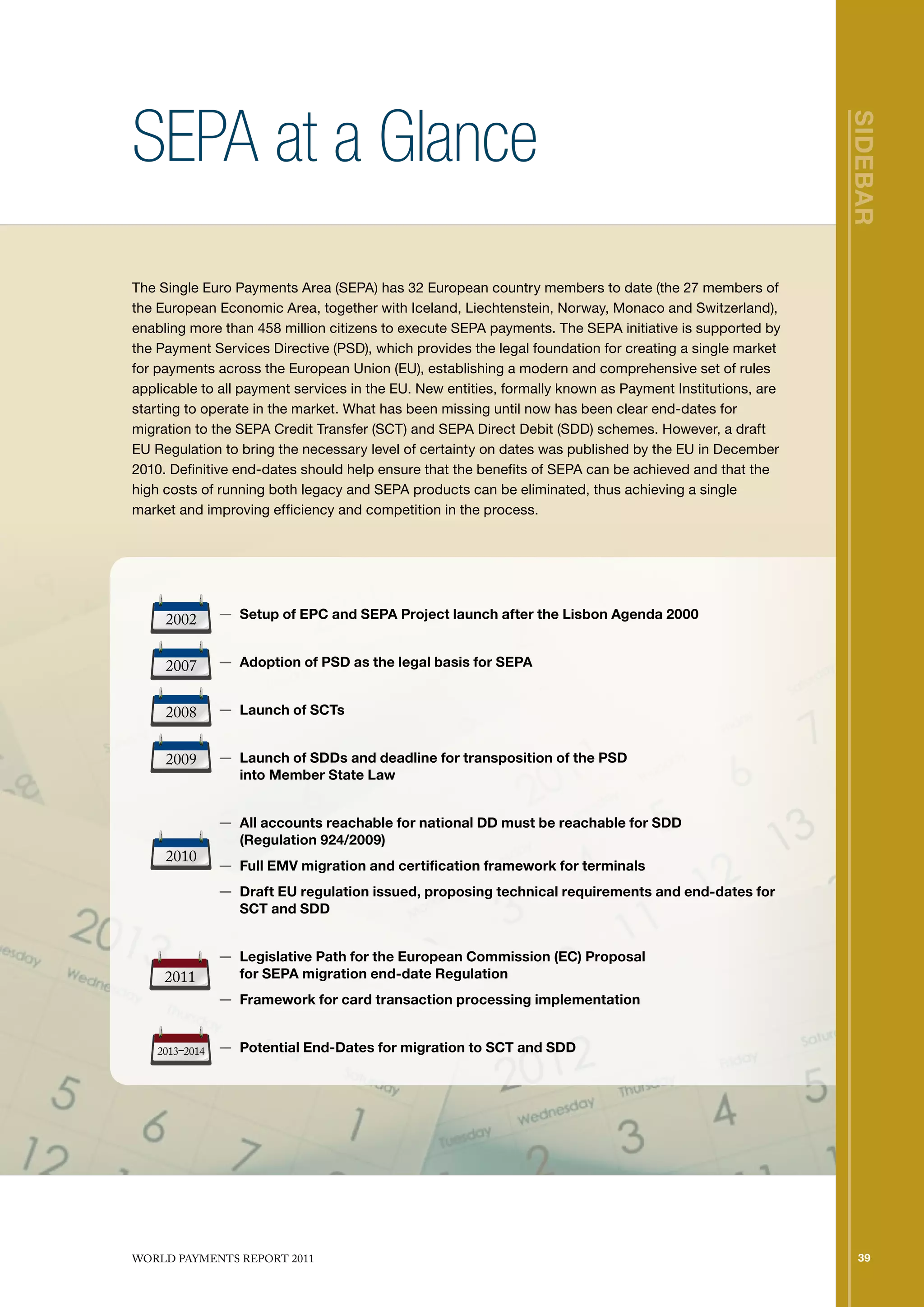
Green indicates the impact is either further in the future or its impact will be indirect or less significant.
1
  Undertakings Collective Investment in Transferable Securities
Source: Capgemini analysis, 2011


Figure 2.2        Five Industry Transformation Trends Driven by KRIIs


         IMPACT ON           Systemic Risk                      Transparency
         PAYMENTS          Reduction & Control                   of Services                  Innovation                 Standardization               Convergence
      HIGH
                            1      2      3      4         8       9                   12                              5      6      7               10     11
    IMPACT
                                                                                       13 14 15 16 17                                                18
                                                           21                                                          20    22     23               19
                           25                                                                                          24    26
      LOW
    IMPACT                                                                                                             27


KRII                                                       10.   Evolution of TARGET2                                 20. Alternative Card Schemes
1. Basel III                                               11.   U.K. Faster Payment Services                         21. Canada Code of Conduct for cards
2. FSA Liquidity Regime                                    12.   Checks Transformation                                22. Japanese Payment Services Act
3. Dodd-Frank Act                                          13.   Mobile Payments                                      23. National Payments Corporation of India
4. Fed Intraday Liquidity                                  14.   Contactless Cards / NFC                              24. International Payments Framework
5. PSD                                                     15.   e-Invoicing                                              Association (IPFA)
6. SEPA / eSEPA                                            16.   eGovernment                                          25. AML / ATF
7. e-Money Directive                                       17.   Digital Agenda                                       26. Renminbi as a Settlement Currency
8. Pressure on Card Interchange Fees                       18.   ACH Frequent Settlement                              27. UCITS(1) IV Directive
9. Durbin Amendment                                        19.   Hong Kong Multi-Currency Clearing

1
 Undertakings Collective Investment in Transferable Securities
Source: Capgemini analysis, 2011


WoRld PAymENTS REPoRT 2011                                                                                                                                                        31
These ITTs may be developing alone or in                                      various card fees, including debit-card ‘swipe’ fees
     conjunction with others, but each is a major change                           and interchange fees. These fees are integral to the
     driver within the payments landscape.                                         economics of the card business, so mandated
                                                                                   changes will have a significant impact on current
     SySTEmIC RISK REduCTIoN ANd CoNTRol                                           business models.
     Since the financial crisis, regulators around the world
                                                                                   CoNvERGENCE
     have been in the process of increasing capital
     requirements and setting more stringent liquidity                             There is an increasing blurring of a number of
     regimes for fIs. As a result of the Basel III proposals,                      traditional distinctions between different types of
     the cost of capital and liquidity will increase. This                         payment systems, for example, between low-value
     includes implications for the cost and availability of                        (high-volume) ACh payments and high-value
     intra-day liquidity in a payments context, which will                         (low-volume) RTGS payments. The faster Payments
     see banks managing their positions and those of their                         System (fPS) in the u.K., a good example of this
     customers in a real-time and more granular way in                             trend, is increasingly attracting volumes from both
     the future—and may reach a point at which some                                BACS and ChAPS.19 AChs generally are
     banks might need to reconsider their participation in                         shortening their clearing cycles in the process,
     certain business lines. fIs will also be increasingly                         sometimes making their services more attractive for
     focused on securing more stable sources of liquidity,                         Treasurers than those provided by the more costly
     such as retail deposits and prepaid cards, and may, in                        RTGS systems, even for more urgent transactions.
     some cases, need to reshape aspects of their business                         however, in the second half of 2010, more than 60%
     models to acquire them. Conversely, liquidity and the                         of payments in TARGET2 (the European Central
     increasingly sophisticated management of intra-day                            Bank RTGS) were for amounts that it considers to be
     liquidity could become a differentiating and                                  “retail payments” (less than €50,000), showing that
     competitive edge for some banks.                                              while RTGS is designed for high-value payments, it
                                                                                   also handles many low-value payments. As a result,
     STANdARdIZATIoN                                                               RTGS is starting to compete with AChs for certain
                                                                                   types of low-value payments.
     Standardization is a powerful trend fueled primarily
     by the combination of:
                                                                                   INNovATIoN
     ƒ Regulatory initiatives that are aimed at increasing
       competition and improving consumer transparency                             Innovation, which fuels transformation, is currently
       and protection.                                                             being driven by several different and sometimes
                                                                                   opposing forces, including:
     ƒ Industry initiatives aimed at improving efficiency,
       reducing costs and streamlining the most                                    ƒ Client needs, with Corporate and Retail
       automated elements of the payments value chain                                clients expecting ever more advanced and
       (i.e., the processing segments).                                              efficient solutions.
                                                                                   ƒ Technology, which has been embraced by non-
     Standardization also results from initiatives                                   bank PSPs and leveraged by banks to bring speedy
     developed individually or jointly by banks,                                     solutions and associated information to the market.
     Automated Clearing houses (AChs) and other PSPs
     seeking to boost transaction volumes and scale to                             ƒ Competition. An increasing level of competition
     expand existing businesses and generate additional                              from existing and emerging non-bank PSPs,
     revenues or facilitate new business models.                                     which are often not burdened by legacy
                                                                                     infrastructure, creates potential for agility in
     TRANSPARENCy of SERvICES
                                                                                     designing new solutions in the B2B, Business-to-
                                                                                     Consumer (B2C) and P2P domains in the modern
     In a payments context, transparency initiatives mostly                          payments Industry.20
     focus on making service fees transparent to clients
                                                                                   ƒ Government initiatives, including eGovernment
     (particularly consumers). In the Eu, for example, the
                                                                                     programs all over the world and the digital
     PSd has a strong focus on enhancing the level of
                                                                                     Agenda in the Eu. (See the Spotlight on
     transparency, particularly in relation to charging.
                                                                                     eGovernment on p42)
     more generally, of all the instruments affected by this
     trend, cards are arguably feeling the most impact.                            ƒ Industry initiatives to keep costs low while
     Banks and other PSPs generate revenues from                                     competing for new revenue sources.


     19
          BACS (Bankers’ Automated Clearing Services) is the electronic system that processes financial transactions (direct debits, direct credits and
          standing orders) for U.K. banks and in which clearing takes two working days. CHAPS (Clearing House Automated Payment System) is an
          RTGS system that offers same-day sterling fund transfers.
     20
          For more detail, see Section 3, Chapter 1 of WPR 2010: “How the Payments Industry is Evolving”.

32
SECTIoN 2
                                                                                                          REGulAToRy ANd INduSTRy INITIATIvES


INNOVATION IS BEING DRIVEN BY MANY                                                        In this dynamic structure, the diverse nature of
REGULATORY AND INDUSTRY INITIATIVES                                                       initiatives such as ACh frequent Settlement (#18)
While it is helpful to isolate the primary impact of                                      becomes more evident. The essence of this particular
each KRII on each of the five discrete ITTs, the                                          initiative lies in the blurring line between high-value
reality is that many initiatives have aspects or drivers                                  (low volume) RTGS payment systems and the low-
that relate to more than one industry trend. figure                                       value (high volume) ACh payment systems. It thus
2.3 provides a more dynamic view of the                                                   appears in the “convergence” cluster in figure 2.2. more
compounded effects of the KRIIs on the                                                    broadly, however, this trend could also be classified
interconnected world of payments—in which many                                            within the “innovation” cluster as only with the
trends overlap.                                                                           advancement of new technologies is it possible for AChs
                                                                                          to intensify settlement frequency. ultimately, in looking
                                                                                          at the overall payments landscape, this behavior is
                                                                                          resulting in a de facto standard, and so it also appears in
                                                                                          the “standardization” cluster in figure 2.3.


Figure 2.3        Overlap of Industry Transformation Trends Driven by KRIIs

          IMPACT ON                         Systemic Risk
          PAYMENTS                        Reduction & Control                                    Convergence
      HIGH
    IMPACT                            1      2       3       4                                                 11

                                                                           Innovation
                                                                                                               19
                                                                            12
                                     25
      LOW                                                                   13     14
    IMPACT


                                                                              20          10   18   24

                                                                                    5      6    7   15
                                                 8       9
                                                                                    16 17      22   26
                                                     21
                                                                                               23

                                                                                               27
                                                     Transparency
                                                      of Services                       Standardization

KRII                                                         11.   U.K. Faster Payment Services            22. Japanese Payment Services Act
1. Basel III                                                 12.   Checks Transformation                   23. National Payments Corporation of India
2. FSA Liquidity Regime                                      13.   Mobile Payments                         24. International Payments Framework
3. Dodd-Frank Act                                            14.   Contactless Cards / NFC                     Association
4. Fed Intraday Liquidity                                    15.   e-Invoicing                             25. AML / ATF
5. PSD                                                       16.   eGovernment                             26. Renminbi as a Settlement Currency
6. SEPA / eSEPA                                              17.   Digital Agenda                          27. UCITS(1) IV Directive
7. e-Money Directive                                         18.   ACH Frequent Settlement
8. Pressure on Card Interchange Fees                         19.   Hong Kong Multi-Currency Clearing
9. Durbin Amendment                                          20.   Alternative Card Schemes
10. Evolution of TARGET2                                     21.   Canada Code of Conduct for Cards

1
 Undertakings Collective Investment in Transferable Securities
Source: Capgemini analysis, 2011


WoRld PAymENTS REPoRT 2011                                                                                                                              33
THE INDUSTRY TRANSFORMATION MAP                                                                             figure 2.4 provides an Industry Transformation map
     The pressure exerted by KRIIs will increase over                                                            that shows a high-level picture of how the KRIIs
     time. As product/service margins decrease and bank                                                          identified herein may evolve in the next decade. This
     liquidity and capital costs increase, industry players                                                      perspective illustrates the complexity of the global
     will need to gauge the effects and reshape their                                                            transformation of the payments industry—and shows
     business models accordingly—if, that is, they want to                                                       just how many factors, events and conditions industry
     continue providing the same services to their clients                                                       players, including PSPs, have to deal with in the
     efficiently and effectively. moreover, as the trends of                                                     evolving landscape.
     standardization and convergence increase
     international competition and potentially reduce                                                            Not all of the KRIIs included in the Transformation
     margins for banks and non-banks, innovation and                                                             map contain a distinct start, intermediate, and end
     emerging technologies could be expected to deliver                                                          marker, since some are market-driven initiatives
     competitive advantage to certain market players.                                                            whose lifecycles are difficult to determine. (Time
                                                                                                                 markers specified on the figure are largely indicative
                                                                                                                 of events within the lifecycle of each KRII.)


     FIGURE 2.4. Industry Transformation Map
     Figure 2.4 Payments Industry Transformation Map, 2010–2019


                                                                                                                                                                         From                      From
                                               2010                                                                 2011                       2012                   2013 to 2015              2016 to 2018                                   >2019

                                                   Basel III S                                                                                                              I                         I                        E

                                                   FSA Liquidity Regime                                                                                                                                                               E
                                                                                                                                                                                                  E                                                            E
                                                                    t
                                                      Dodd-Frank Ac
                                   Systemic                                                       y                                                        E
                                                                                  day    Liquidit                                                                       I
                             Risk Reduction                             to Intra
                                                             proach
                                   & Control          Fed Ap

                                                            TF                                                                                      E
                                                       AML/A

                                                         PSD
                                                                                                                                                                            E
                                                                A
                                                             SEP                   ctiv
                                                                                        e                                                                                                                                                        I
                                                                              Dire                     es                                                                          E
                                                                         y                      hem                   ct                S                                                                                                 E
                                                                    ne                     Sc                    A                             tio
                                                                                                                                                  n
                                                                 Mo                                           es                dia
                                                               E-                      ard                  ic                 n            cia
                                                                                 eC                    erv                 nI             so
                                                                          nativ                 n tS                 ratio
                                                                                                                                 k      As
                                                                    Alter                   yme                  rpo          or
                                                                                       Pa                   Co           ew
                                                                                  se                   ts           ram
                                                                               ne                   en            F
                                                                           pa                m               nts
                                                                                                                                               y
                                          Standardization               Ja                ay                                                nc
                                                                                       lP               me          S                    re
                                                                                    na                ay                              ur
                                                                                                                                                                                                            es


                                                                                tio              al
                                                                                                    P                              tC
                                                                             Na                                 ive
                                                                                                                                                                                                          Fe


                                                                                             on                                 en                                S
                                                                                          ati                ct
                                                                                                                                                                                                        e


                                                                                                                              m
                                                                                                                                                                                                     ng


                                                                                        rn               ire              tle
                                                                                                                                                                                                    s


                                                                                      e                                 t
                                                                                                                                                                                                   ha


                                                                                   Int                 D
                                                                                                                                                                                                  rd


                                                                                                    IV               Se
                                                                                                                                                                                                rc


                                                                                                                                                                                              ca


                                                                                                                  a
                                                                                                                                                                                             te


                                                                                                TS             as                           S
                                                                                             CI
                                                                                                                                                                                          for
                                                                                                                                   In


                                                                                                            bi
                                                                                                                             rd


                                                                                           U
                                                                                                                                                                                       ct


                                                                                                         in
                                                                                                                           Ca


                                                                                                                                           t
                                                                                                                                         en


                                                                                                                                                                                   du


                                                                                                                                                                                     g


                                                                                                      nm
                                                                                                                                                                                arin
                                                                                                                      on


                                                                                                                                     dm


                                                                                                                                                                                on


                                                                                                  Re
                                                                                                                                                                                2
                                                                                                                    re


                                                                                                                                                                              fC
                                                                                                                                   en


                                                                                                                                                                            Cle
                                                                                                                                                                             ET
                                                                                                                  su


                                                                                                                                                                          ent
                                                                                                                              Am


                                                                                                                                                                          eo


                                                                                                                                                                           ts
                                                                                                                                                                         RG
                                                                                                              es


                                                                                                                                                                       ncy
                                                                                                                                                                        en

                                                                                                                                                                      lem
                                                                                                            Pr


                                                                                                                                         od
                                                                                                                             in


                                                                                                                                                                     TA

                                                                                                                                                                   ym
                                                                                                                          rb


                                                                                                                                       C


                                                                                                                                                                 urre
                                                                                                                                                                  ett
                                                                                                                     Du


                                                                                                                                                                  of
                                                                                                                                    da


                                                                                                                                                                 n
                                                                                                                                                                Pa

                                                                                                                                                              tS


                                                                                                                                                            atio
                                                                                                                                                             ion
                                                                                                                                   na


                                                                                                                                                           lti C


                                                                              Transparency
                                                                                                                                                           ter
                                                                                                                                Ca


                                                                                                                                                        uen
                                                                                                                                                t
                                                                                                                                            olu


                                                                                                                                                     form
                                                                                                                                                      Mu
                                                                                                                                                        as


                                                                                of Services
                                                                                                                                                    ents

                                                                                                                                                s/NFC
                                                                                                                                                    req
                                                                                                                                         Ev


                                                                                                                                                     .F


                                                                                                                                                                                                                                   S              S
                                                                                                                                                  ong

                                                                                                                                                rans
                                                                                                                                                 U.K


                                                                                                                                                HF


                                                                                                                                               aym


            S Start of the initiative / regulation (if ≥ 2010)
                                                                                                                                              gK


                                                                                                                                                                                                                                              Digital Agenda
                                                                                                                                                                                                                                t
                                                                                                                                           ck T
                                                                                                                                             AC


                                                                                                                                        actles


                                                                                                                                                                                                                             eGovernmen
                                                                                                                                         ile P
                                                                                                                                         Hon


                                                                                                                                                                                                                    g


            I   Intermediate point / milestone
                                                                                                                                                                                                                 eInvoicin
                                                                                                                                      Che

                                                                                                                                    Mob

                                                                                                                                   Contr


                                                                                                                                Convergence
            E End of the initiative / regulation

                           Elapsed time
                                                                                                                                                                                        Innovation


     Source: Capgemini analysis, 2011


34
SECTIoN 2
                                                                            REGulAToRy ANd INduSTRy INITIATIvES


CONCLUSION: TRANSFORMATION PRESSURES                        As more initiatives converge in the future, industry
EXTEND FAR INTO THE FUTURE                                  transformation will intensify. As product/service
When discussing global or regional regulatory               margins decrease and bank liquidity and capital costs
initiatives like Basel III or the PSd, it might seem        increase, industry players will need to gauge the
that the regulations will create a level playing field      effects and reshape their business (and delivery)
for all players in all impacted countries, but this may     models accordingly to keep pace with clients’
not always be the case. The potential for differing         expectations while also providing services in an ever
domestic interpretations presents particular                more efficient and effective way.
challenges for those banks and corporates that
operate in multiple jurisdictions.                          The trends of standardization and convergence (and
                                                            transparency, to a certain extent) will increase the
Additionally, while individual regulatory and industry      level of competition and accelerate the
initiatives have finite parameters and goals, few involve   commoditization of payments, making it more
a “Big Bang” revolution. most involve a series of           difficult for individual banks and non-bank PSPs to
component measures that are phased in over time—            differentiate and prove their value. Innovation,
often creating an impact at the same time as other          emerging technologies, and partnerships can,
related or unrelated initiatives. Even analyzing and        however, help them to differentiate their services and
extrapolating just those initiatives identified in this     achieve competitive advantage.
Report, it is clear that payments transformation will be
extensive throughout the coming 10 years—presenting         It is likely that in future, banks will find it harder to
banks and other PSPs with multiple factors and              operate on a standalone basis in relation to all aspects
scenarios to consider as they plan future strategies.       of the payments value chain, and the majority might
                                                            have to specialize in certain segments over time, as
Not only will industry players need to continue to          we will explore further in Section 3.
identify, assess and select market opportunities, they
must do so while simultaneously managing growing
compliance and liquidity costs, and anticipating how
other parts of the industry and market will react (e.g.,
the strategies and ambitions of competitors and
partners and evolving client needs). moreover,
internal decision-making will increasingly need to
accommodate a greater number of factors and
perspectives, requiring closer interaction, for example,
with the Risk management and Treasury functions.


WoRld PAymENTS REPoRT 2011                                                                                              35
Key Regulatory
     SIDEBAR


               and Industry Initiatives
                      Key regulatory
               Key
                       and industry                                                Description
                #
                     initiatives (KRIIs)

                                           The Basel Committee issued the text of Basel III rules on bank capital adequacy and
                                           liquidity in December 2010. Endorsed by the G20, “Basel III” aims to raise capital levels
                                           and quality standards and promote the build-up of capital buffers, enhance risk
                1    Basel III
                                           calculations and coverage, cap leverage ratios, and additionally plans two liquidity
                                           ratios—the Liquidity Coverage Ratio (LCR, to be met by 2015) and Net Stable Funding
                                           Ratio (NSFR, to be met by 2018)—to address short and longer-term liquidity needs.

                                           The U.K. Financial Services Authority (FSA) overhauled liquidity regulation for U.K.
                                           banks with effect from October 2009. Among the changes, the FSA has set new
                     U.K. FSA              quantitative requirements on liquidity and tightened the definition of liquid assets;
                2
                     Liquidity Regime      stipulated the principles for self-sufficiency and adequacy of liquid resources;
                                           enhanced systems and controls requirements; and demanded more frequent reporting
                                           requirements. The FSA is phasing in tougher quantitative standards in stages.

                                           The Dodd-Frank Act, law since July 2010, contains a set of reforms on a wide range of
                     U.S. Dodd-            regulatory and supervisory topics, with provisions relating to capital, liquidity, and risk
                3
                     Frank Act             requirements for U.S. financial institutions. Dodd-Frank and Basel III have similar
                                           objectives but not all standards and implementation schedules are the same.

                                           The U.S. Federal Reserve amended its Payment System Risk (PSR) policy in March 2011.
                     U.S. Fed              Most notably, the revisions encourage institutions to voluntarily pledge collateral to cover
                4    Intraday              daylight overdrafts by providing such overdrafts at a zero fee while raising fees for
                     Liquidity             uncollateralized daylight overdrafts. Any depository institution with regular access to the
                                           discount window may incur daylight overdrafts, with specific rules and caps.

                                           Designed to create a common legal framework for payment services in the EU, increase
                                           international competition and harmonize rights and obligations for PSPs, the PSD was
                     EU Payment            transposed into the national law of most EU Members during 2009-10. The PSD has an
                5    Services              impact on all payment services in the EU, including changes to charging options (the
                     Directive (PSD)       move to shared (‘SHA’)), reductions in maximum execution cycles and the removal of
                                           ‘incoming float’. To increase competition, PSD removed legal obstacles and entry
                                           barriers so that new non-bank PSPs (Payment Institutions) can offer payment services.

                                           SEPA, a self-regulatory response to a political vision, seeks to provide harmonized
                                           payment services (credit transfers, direct debits, cards) where € payments within the
                                           EU will be treated as domestic payments with the aim of eliminating cross-border
                                           barriers and increasing competition across Europe (also see SEPA Update on p40).
                                           SEPA will continue to impact payments pricing, standardizing processes and
                6    SEPA / eSEPA          streamlining the Industry.

                                           eSEPA commonly refers to innovations in payments and other areas which are
                                           expected to emerge on the back of the delivery of the core SEPA infrastructure (SCT/
                                           SDD), providing various retail payment services electronically so as to offer easier
                                           access, better functionality and an enhanced user experience.

                                           Electronic money is a digital equivalent of cash, stored on a device, server, mobile
                                           phone, electronic purse. etc. The new E-Money Directive (2009/110/EC) aims to enable
                     EU E-Money            innovative and secure e-money services, provide market access to new companies,
                7
                     Directive (EMD)       foster effective competition, and bring the regime for e-money institutions into line with
                                           the PSD requirements for Payment Institutions. The EMD rules were required to be in
                                           force in all EU countries by April 30, 2011.

                     Pressure on           Regulators in the EU and elsewhere are currently putting pressure on Multilateral
                     Card                  Interchange Fees for cards (See #9 and #21 below). These include industry-wide
                8
                     Interchange           regulations on swipe fees, direct rulings on specific competitors, and improved
                     Fees                  guidelines on transparency and competition.


36     36
KEy REGulAToRy ANd INduSTRy INITIATIvES


        Key regulatory
 Key
         and industry                                                 Description
  #
       initiatives (KRIIs)

                             This is a provision in the Dodd-Frank Act, section 1075, allowing the Fed to control the
       U.S. Durbin           swipe fees on debit cards with a cap that results in an approximately 50% decrease in
  9
       Amendment             current fees that will come into effect in October 2011. The goal is to aid merchants and
                             (indirectly) consumers with lower interchange fees.

                             TARGET2 is the European Real Time Gross Settlement (RTGS) system, and it was set up
       Evolution of          to settle euro Large-value transactions in real time. The ECB and Eurosystem are
 10
       TARGET2               planning for its further evolution, including eventually adopting XML ISO 20022
                             standards.

       U.K. Faster           The Faster Payment Service, launched in 2008 in the U.K., is a banking initiative that
 11    Payment               allows for retail payment transactions to be exchanged between scheme participants in
       Services              near real-time. The participant banks make up 95% of payments traffic in the U.K.

                             There is a major trend in the payments industry leading to a general decrease in the use
                             of checks in favor of more efficient instruments. This trend is also a result of active
       Checks                initiatives carried out by governments and/or banking communities. There are two
 12
       Transformation        prevalent approaches: moves towards further check reduction and potential
                             decommissioning (as in Sweden) and check digitalization (as in the U.S.). See Checks
                             Spotlight on p22.

                             M-payments (payments for goods and services using mobile devices) have been growing
                             quickly for several years. Emerging markets are now larger than developed markets in
       Mobile
 13                          terms of m-payments value, and continue to grow at a faster rate. Non-bank providers of
       Payments
                             m-payments are gaining market share and currently growing twice as fast as traditional
                             banks in this area.

                             NFC is a short-range wireless technology, increasingly popular for micropayments
                             and POS transactions. Contactless cards should allow banks to potentially shift small
       Contactless           payments from cash to non-cash. Interac has carried out a series of contactless POS
 14
       Cards / NFC           debit transactions in Canada. VISA Paywave and MasterCard PayPass are contactless
                             credit cards that are widespread in the U.S. and U.K., as well as present in APAC
                             and the EU.

                             e-Invoicing is a global trend. In the EU, Invoicing Directive 2010/45/EU aims to harmonize
                             invoicing rules allowing tax authorities to accept electronic invoices as if they were paper.
 15    e-Invoicing           In the U.S., 2001 Code Title 10, Section 2227 states that “all invoices to the Department of
                             Defense must be electronic”. In Brazil, the “Nota Fiscal Eletronica” (NF-e) is legally
                             replacing the conventional bill of lading.

                             eGovernment involves the use by governments of Information and Communication
                             Technology (ICT) to inform and render services to citizens and businesses. Payments
 16    eGovernment
                             means are affected as eGovernment extends into eProcurement, e-Invoicing, and
                             ePayments—see Spotlight on eGovernment on p42.

                             The Digital Agenda for Europe is one of the seven flagship initiatives of the “Europe
                             2020 Strategy”. It aims to: maximize the social and economic potential of ICT (most
 17    Digital Agenda        notably the Internet); create a single EU digital market by harmonizing technical,
                             regulatory, and legal frameworks; and promote interoperability between Member States’
                             eGovernment programs.

                             Nowadays, most of the largest worldwide ACHs (such as STET, VocaLink, EQUENS,
                             JGB) are performing more and more frequent settlement and clearing cycles. For
       ACH Frequent
 18                          example, EQUENS currently performs a settlement cycle every half hour on each
       Settlement
                             TARGET day (between 09:00 and 16:00 CET), with extra cycles at 16:15 and 16:45 CET.
                             This offers the advantage of low settlement account balances, and lower liquidity risk.

                             Due to its capacity to settle transactions in multiple global currencies, Hong Kong could
       Hong Kong             become the payments and settlement hub for Asia-Pacific. If an FI in Asia-Pacific wishes
 19    Multi-Currency        to carry out an FX transaction involving local currency and the USD, the local currency
       Clearing              leg can be settled in the home country and the USD leg in Hong Kong, effectively
                             reducing counterparty risk (so-called Herstatt risk).


WoRld PAymENTS REPoRT 2011                                                                                                   37   37
Key regulatory
          Key
                  and industry                                                Description
           #
                initiatives (KRIIs)

                                      Monnet, a European cards scheme project to compete with Visa and MasterCard
                                      networks, was launched by several German and French banks in 2008. Several more
                                      EU banks joined in 2010.

                                      PayFair, founded in 2007, is a retailer-driven initiative set up as a neutral alternative
                Alternative Card
          20                          between banks and merchants, respecting the SEPA philosophy of unbundling the
                Schemes
                                      scheme and its processing.

                                      EAPS (Euro alliance of payment schemes), established in 2007, aims to create an
                                      interconnected network of independent card schemes, banks, acquirers and PIs from
                                      Italy, Germany, Spain, Portugal and the U.K.

                                      With the Payment Card Network Act, the Canadian Minister of Finance has the power to
                                      regulate the market conduct of credit and debit card networks. The goal is to promote
                Canada Code of
                                      competition and fair business practices that translate into lower costs for merchants
          21    Conduct for
                                      and lower prices to the consumer. This can reduce industry revenues, with increased
                Cards
                                      competition and lower profit margins, and reduced usage (in favor of other payment
                                      methods).

                                      Prior to April 2010, only banks and certain other Financial Institutions were permitted
                                      to engage in fund transfer services in Japan. Now the Payment Services Act has
                Japanese
                                      allowed non-bank entities to conduct fund transfer services in Japan provided that
          22    Payment
                                      they are registered as “fund transfer business operators”; and that the amount of funds
                Services Act
                                      to be transferred per customer request does not exceed ¥1m (€10,000 or the foreign
                                      currency equivalent).

                                      NPCI is an umbrella institution for all retail payment systems in India. It aims to integrate
                                      multiple systems into nationwide, uniform and standard business processes. NPCI will
                National
                                      function as a hub for all electronic retail payment systems. It now manages: the National
                Payments
          23                          Financial Switch (NFS), an interbank network of ATMs; check truncation services in key
                Corporation
                                      cities; and the Interbank Mobile Payment Service (IMPS), an instant interbank electronic
                India (NPCI)
                                      fund transfer service through mobile phones. Another goal for NPCI is to establish a
                                      national card scheme like China UnionPay (CUP).

                                      IPFA is an association that aims to simplify and standardize international non-urgent
                International         payment systems through the use of global standards. On October 2010, initial live
                Payments              traffic between two IPFA members, the Federal Reserve Banks in the U.S. and EQUENS
          24    Framework             in Europe began; extensions are planned to Canada, Mexico, Brazil and South Africa in
                Association           2011. IPFA is aiming for greater levels of standardization and easier international flows.
                (IPFA)                Other consequences could include a higher degree of commoditization and also
                                      specialization (see Section 3).

                                      Section 314(b) of the USA PATRIOT Act, which aims to fight anti-money laundering
                Anti-money
                                      (AML) and anti-terrorism financing (ATF), requires FIs to conduct due diligence on new
                laundering /
                                      and existing customers and maintain complete records of all transactions. This makes
          25    anti-terrorism
                                      payments more costly and slows down straight-through processing (STP). The positive
                financing (AML/
                                      for PSPs is that they gather more information about their clients to help improve
                ATF)
                                      services.

                                      In December 2008, China started using the yuan as a settlement currency on foreign
                                      deals with neighboring economies. Cross-border yuan trade settlement is expected to
                Renminbi as a
                                      grow from Rmb 506 billion (US$77 billion) in 2010 to Rmb 2 trillion (US$300 billion) in
          26    Settlement
                                      ten years. This initiative is likely to draw a market distinction between banks that are
                Currency
                                      able or not to trade in yuan. The growing importance of the yuan will also accentuate
                                      the value of Hong Kong as a multi-currency clearing and settlement hub (see #19).

                                      The fourth modification to Directive 85/611/EEC (Undertakings for Collective
                                      Investments in Transferable Securities) aims to achieve higher integration and efficiency
                                      of EU markets, allowing more mobility in managing international funds, remote
                EU UCITS IV           establishment and-cross border management of UCITS funds and centralization of
          27
                Directive             asset management. Member states were expected to transpose the Directive into
                                      national legislation by July 2011. Due to easier mobility and international funds
                                      management, higher international payments flows are expected, but also higher
                                      competition due to lower barriers in EU.


38   38
SEPA at a Glance


                                                                                                          SIDEBAR
The Single Euro Payments Area (SEPA) has 32 European country members to date (the 27 members of
the European Economic Area, together with Iceland, Liechtenstein, Norway, Monaco and Switzerland),
enabling more than 458 million citizens to execute SEPA payments. The SEPA initiative is supported by
the Payment Services Directive (PSD), which provides the legal foundation for creating a single market
for payments across the European Union (EU), establishing a modern and comprehensive set of rules
applicable to all payment services in the EU. New entities, formally known as Payment Institutions, are
starting to operate in the market. What has been missing until now has been clear end-dates for
migration to the SEPA Credit Transfer (SCT) and SEPA Direct Debit (SDD) schemes. However, a draft
EU Regulation to bring the necessary level of certainty on dates was published by the EU in December
2010. Definitive end-dates should help ensure that the benefits of SEPA can be achieved and that the
high costs of running both legacy and SEPA products can be eliminated, thus achieving a single
market and improving efficiency and competition in the process.


     2002       — Setup of EPC and SEPA Project launch after the Lisbon Agenda 2000


     2007       — Adoption of PSD as the legal basis for SEPA


     2008       — Launch of SCTs


     2009       — Launch of SDDs and deadline for transposition of the PSD
                   into Member State Law


                — All accounts reachable for national DD must be reachable for SDD
                   (Regulation 924/2009)
     2010
                — Full EMV migration and certification framework for terminals
                — Draft EU regulation issued, proposing technical requirements and end-dates for
                   SCT and SDD


                — Legislative Path for the European Commission (EC) Proposal
     2011          for SEPA migration end-date Regulation
                — Framework for card transaction processing implementation


    2013–2014   — Potential End-Dates for migration to SCT and SDD


WoRld PAymENTS REPoRT 2011                                                                                 39       39
SPOTLIGHT
     SEPA Update
     The following provides a brief update on key SEPA         SEPA MIGRATION END-DATE
     developments since the comprehensive overview
                                                               Given the slow rate of adoption and the significant
     provided in the WPR 2010:
                                                               benefits at stake, many stakeholders, including the
     ƒ PSD implementation: The vast majority of                ECB and the EPC, reached the conclusion during
      member states have transposed the PSD into               2010 that targeted EU legislation was needed to
      national law. At the time of writing, Poland and         establish end-dates for the replacement of the
      Iceland are the only EU/EEA countries still to           national legacy payment schemes by the harmonized
      complete this task.                                      SEPA schemes. EU legislation to support SEPA is not
                                                               a new concept. The PSD had already provided initial
     ƒ SCT and SDD usage: In May 2011, SCTs                    support by providing a harmonized legal environment
      accounted for 19.37% of all eligible bank credit         and EU Regulation 924/2009 went further by requiring
      transfers, up materially from 9.6% in October 2010,      that all banks offering domestic euro direct debit
      while the volume of transactions rose to over 109        services within the Eurozone had to make themselves
      million from 49 million. SDDs, by contrast, still        reachable for SDDs by November 1, 2010. But a clear
      accounted for only 0.11% of all eligible direct debits   end-date for the migration process was still missing.
      in May 2011, equivalent to 0.69 million transactions.
      While the use of SEPA instruments is clearly             Against this background, the most important SEPA
      broadening (see public-sector use below), there is       development since our WPR 2010 update is the
      still a long way to go.                                  December 2010 publication by the EC of a proposal
                                                               for an EU Regulation ‘Establishing technical
     ƒ Public Administration (PA) usage of SEPA: As of
                                                               requirements for credit transfers and direct debits in
      October 2010, the SCT migration rate among PAs
                                                               euros and amending Regulation EC 924/2009’. As
      for the first time exceeded the corresponding rate
                                                               published, some aspects of the proposed Regulation
      for the overall market (14.5% vs. 9.6%), with the
                                                               have proved to be controversial. The EPC and many
      most significant growth reported by Finland,
                                                               other stakeholders had been hoping for a ‘clean’
      Belgium, Austria, Spain, France and Germany. SDD
                                                               approach simply requiring existing domestic euro
      migration so far remains marginal, partly as few
                                                               retail payment schemes to migrate to the SEPA
      PAs use DDs as a payment means. Notably,
                                                               schemes. However, in practice, political and
      countries with the fastest rates of migration growth
                                                               competition sensitivities resulted in a much more
      also predominate in eGovernment development
                                                               complex proposal, based on mandating a set of
      (i.e., their services are highly sophisticated and
                                                               guiding principles on technical standards that all euro
      accessible and have a low take-up gap). Finland is
                                                               retail credit transfer and direct debit schemes would
      one of the few cases in which the government,
                                                               have to meet by certain end-dates. Those dates—12
      users and banks are cooperating fully to adopt SCT
                                                               months after the ‘in force’ date of the Regulation was
      within 2011.
                                                               proposed for credit transfers and 24 months for
     ƒ eSEPA Models: The EPC has been continuing with          direct debits—potentially put those end-dates at
      its work on various eSEPA initiatives, with ongoing      end-2012 and end-2013 respectively, assuming the
      work on e-Mandates, e-payments and                       Regulation is finalized by the end of 2011.
      m-payments. Additionally, the EC is also pushing
      on with its work on e-Invoicing. Nevertheless, all of
      these future-looking developments hinge first on
      the successful migration to SCT and SDD.


40
SPoTlIGhT
                                                                                                        SEPA uPdATE


Enshrining technical details in a legal text always         On all of these topics, the opportunity for changes
entails challenges. One potential risk, for example, is     still exists at the time of writing, as the Regulation is
that the Regulation might inadvertently allow for           subject to the usual EU ‘co-decision’ process—
divergence and continuing variations to messaging           meaning that before it can be formally adopted, it
formats at the national level—and potentially even the      needs to be negotiated and formally agreed between
continued existence of national payment schemes             three bodies—the European Parliament and Council
alongside their SEPA equivalents. This would result in      as well as the Commission. So with this objective in
a ‘mini SEPA’ outcome, where different requirements         mind, dialogue is continuing with the Regulatory
and schemes continue to co-exist, forcing                   community, particularly via key industry bodies,
companies and their banks to maintain different             including the EPC and the European Banking
processes and systems for different countries and           Federation (EBF) via its Payment Regulatory Expert
significantly diluting the benefits of SEPA. Avoiding a     Group. At the moment, everything remains on track
mini-SEPA outcome will require the final wording of         to finalize the Regulation by the end of 2011, but it is
certain core definitions and principles in the              clear that the few months before that will be pivotal.
Regulation (particularly the key concepts
‘Reachability’ and ‘Interoperability’) to be particularly   Once the SEPA Regulation is agreed and comes into
carefully drafted.                                          force, and the adoption of SEPA instruments finally
                                                            takes off, this will in turn drive the business case for
Another specific issue that has provoked discussion         further innovative developments, such as e-mandates
is that, as published, the scope included customer          and e-payment solutions, that are dependent on the
payments made via ‘Large Value Payment Systems’             success of the core SEPA migration. Similarly, efforts
(such as TARGET2), not just via retail payment              to make e-invoicing a reality—a bigger prize for many
systems. Following widespread expressions of                corporates than SEPA itself—are expected to
concern that this would have meant major additional         accelerate as SEPA gains ground.
and unexpected adjustments costs across the
industry, all the key parties now seem to accept that       Separate discussions are continuing over how to
transactions through these systems need to be               optimize SEPA governance. As the SEPA schemes
excluded from the scope.                                    continue to evolve, it remains an issue how to
                                                            balance the needs of European citizens, businesses
The topic of per-transaction Multilateral Interchange       and retailers. The SEPA Council has been
Fees (MIFs) for DDs continues to be a hotly debated         established to represent both the demand and
issue. The EC proposal is to ban all per-transaction        supply sides of the market in driving SEPA forward
DD MIFs after a transition period, except in the case       and would seem to have a major role to play here.
of ‘R-transactions’ (such as returned payments). The
whole MIF issue is a very delicate one, especially
because MIFs are a fundamental element of the
business models within a number of EU countries,
such as France and Italy, and finding an acceptable
compromise is proving to be a challenge.


WoRld PAymENTS REPoRT 2011                                                                                              41
SPOTLIGHT
     eGovernment Efforts Could Help to Drive
     Non-Cash Adoption
     “eGovernment” in its broadest sense involves the use                                                 United Nations survey on eGovernment, 21South
     of Information and Communication Technology (ICT)                                                    Korea has the world’s most developed eGovernment,
     by governments to inform and render services to                                                      followed by the U.S., Canada, and the Nordic EU
     citizens and businesses. In payments, eGovernment                                                    countries. It is interesting to highlight (Figure 2.5) the
     involves electronic procurement, invoicing and                                                       relationship existing between the usage per
     payments to and from citizens, businesses and                                                        inhabitant of non-cash payments instruments and
     government agencies.                                                                                 the eGovernment index (also see Section I, Figure 1.4
                                                                                                          for detail on growth of non-cash transactions usage
     eGovernment is potentially beneficial for all payments                                               per inhabitant).
     stakeholders. Electronic transactions—by Internet,
     mobile, wireless devices and other digital media—are                                                 In countries where a mature eGovernment combines
     generally quicker and more convenient, cost-effective                                                with developed non-cash payments infrastructure
     and secure than paper-based predecessors such as                                                     and behavior, conditions are especially ripe for
     cash and checks.                                                                                     accelerating the move away from cash and paper-
                                                                                                          based payments instruments.
     Many governments are now actively investing in
     eGovernment, and continued with those investments
     even during the financial crisis. According to a 2010


     Figure 2.5 eGovernmentDevelopment Index and Non-Cash Transactions perper Inhabitant
     FIGURE 2.5. eGovernment Development Index and Non-Cash Transactions Inhabitant


                                             450

                                             400
      Non-Cash Transactions per Inhabitant


                                             350                                                                            Norway
                                                                                                Finland                                     U.S.

                                             300                                                              Sweden
                                                                                                                     Denmark      Canada
                                                                                           Luxembourg
                                             250                                           Austria      France Australia     U.K.

                                                                                             Belgium                       South Korea
                                             200                                                           Germany
                                                                                 Switzerland          Ireland
                                             150                      Portugal   Slovenia
                                                                                                                 Spain
                                             100

                                                                      Italy                         Japan
                                              50                 Poland
                                                                    Greece
                                               0
                                                   0.50   0.55         0.60       0.65       0.70         0.75           0.80        0.85          0.90

                                                                                 eGovernment Development Index


     Source: Capgemini analysis, 2011; United Nations global eGovernment survey 2010


     21
                      “2010 United Nations e-Government Survey: Leveraging e-government at a time of financial and economic crisis,” completed in December
                      2009, and launched in early-2010. The survey measures three indicators: online services, telecommunication infrastructure, and human capital.


42
SPoTlIGhT
                                                                eGovERNmENT EffoRTS Could hElP To dRIvE NoN-CASh AdoPTIoN


The U.S. and Canada are actively pursuing                                   e-Procurement is one of the high-impact services
eGovernment, and have well-developed portals and a                          representing a major portion of Europe’s economy—
wide spectrum of e-services for their citizens. Among                       some €1.3 trillion in public administration
their specific payments initiatives:                                        expenditure. In terms of cross-border e-Procurement
                                                                            in the EU, the main initiative is PEPPOL: Pan-
ƒ The U.S. launched Pay.gov, a secure government-                           European Public Procurement Online. The goal of this
     wide collection portal, in 2000. It offers a suite of                  project is to set up a pan-EU solution that facilitates
     online services that Federal agencies can use to                       interoperable public e-Procurement. However, in the
     meet their responsibilities toward the public. The                     post-award phases of the e-Procurement process,
     web-based application allows client interaction and                    the availability of e-Invoicing and e-payment services
     online payments to more than forty government                          is somewhat problematic, suffering from legal and
     agencies (including the Health, Defense and Justice                    practical barriers.24
     departments) by ACH debit or credit card.
                                                                            To help overcome these barriers, EU governments
ƒ The U.S. Treasury Department, as part of an
                                                                            are working toward digitalization in payments and
     ongoing campaign to increase ePayments,22 has
                                                                            invoicing. In some member States, the public sector
     also started to shift its social security and Federal
                                                                            has launched or is preparing to launch initiatives to
     benefits payments from checks to ePayments
                                                                            make eInvoices mandatory in public contracts.
     (direct debit or prepaid cards). It hopes as a result
                                                                            Denmark mandated eInvoicing for the public sector in
     to reduce government expenses by $1 billion over
                                                                            2005, Sweden in 2008, and Finland in 2010. Italy,
     the next 10 years.23
                                                                            Estonia, Spain, and France are likely to follow soon,
ƒ Canada, which has a robust national eGovernment                           and other countries such as Belgium and Austria are
     portal, launched a new user-friendly procurement                       also considering it.
     Website in 2010 (buyandsell.gc.ca). It provides
     Canadian businesses with an easy way to access                         CONCLUSION
     information and execute business transactions with                     Governments can be a driving force in non-cash
     the government.                                                        payments adoption because they affect such large
Europe also has many eGovernment initiatives under                          economic segments. Some, for example, are already
way. The European Commission’s Digital Agenda calls                         moving salary and social-benefit payments online, and
for developing cross-border eGovernment services for                        many now allow and encourage online tax payments.
citizens and businesses, regardless of their country of
                                                                            One of the goals of such initiatives is to capture
origin,—by promoting systems interoperability and key
                                                                            efficiencies and cost-savings from substituting
enablers such as e-payments, e-Signatures and
                                                                            manual processes, but eGovernment requires the
e-Identification. Services accessible across the EU
                                                                            ability to initiate and accept a broad range of
strengthen the single digital market and complement
                                                                            electronic transactions, so governments need to
existing legislation in domains such as eIdentification,
                                                                            work closely with PSPs to facilitate a full suite of
e-Procurement, e-Justice, e-Health, mobility and
                                                                            appropriate electronic-payments solutions.
social security.


22
     http://www.godirect.org/
23
     “U.S. Treasury prepares to retire checks”, finextra.com.
24
     This problem will be easier to solve once SEPA has completely migrated on core products, allowing secondary products such as e-Invoicing
     (and eSEPA in general) to become a reality.


WoRld PAymENTS REPoRT 2011                                                                                                                      43
44
SECTIoN TITlE l1
                                                                                              SECTIoN TITlE l2


3            Capturing the Value in
             Payments as the
             Industry Transforms
             Forces of standardization and commoditization are evident and intensifying in payments,
HIGHLIGHTS


             and regulation is changing both the operational standards and economics of many payments
             business lines. Payment options are also proliferating,—especially as an increasing number of
             non-bank players emerge, often bypassing existing providers to engage customers directly.

             In this environment, the imperative for banks and PSPs going forward will be to distinguish their
             propositions and demonstrate their value through increased specialization. This Section outlines
             some of the issues they will need to consider:

             ƒ Banks and PSPs could learn lessons from the evolution of other network industries
              such as Energy and Telecommunications. Both industries have been subject to forces of
              regulation, liberalization, commoditization and technological advances, which have combined
              to prompt innovation from service providers seeking to distinguish themselves and their
              propositions. In both cases, as underlying products and services became more standardized,
              the industry value chains disaggregated and the production and distribution ends of the
              industry value chain became polarized, giving rise to specialist business models.

             ƒ Many banks may find that the efficiency of the traditional integrated “produce-to-
              deliver” payments model is no longer optimal. The traditional approach in which banks
              handle everything—from developing propositions to producing payments, managing client
              relationships and offering a whole series of other services to their clients—may no longer prove
              optimal when dealing with current industry challenges. If the payments value-chain
              disaggregates in the way seen in Energy and Telecoms, the “produce-to-deliver” model could
              over time be supplanted by a “produce-or-deliver” model for many institutions.

             ƒ In the mid-to-long term, many PSPs could evolve into one of two specialist roles—
              Wholesale Payments Provider (WPP) or Retail Payment Services Provider (RPSP)—since
              few are likely to have the scale, capabilities, strategic ambition or will to pursue both ends of
              the value chain as it disaggregates. (WPPs would provide low-cost basic payments and RPSPs
              would focus on one or a few of the client-facing segments of the payments value chain).

             ƒ In the near-term, banks need to consider what role they might play in the future, and
              prepare for any potentially radical shifts. Evolving into a WPP, playing the RPSP role, or
              preparing to assume both roles requires vision and imposes strategic decisions. In any event:

              – Innovation is vital for banks and PSPs to be proactive and strategic in the near-term.
                Mastering innovation will allow banks and other PSPs (mainly RPSPs) to differentiate their
                propositions and to prove their value as the payments industry progressively becomes
                more commoditized.
              – Innovation will continue be critical to the future success of banks and other PSPs, and
                the degree to which they succeed in delivering and creating value in both the near-term and
                the mid-to-long term. Many players will need to stretch beyond their comfort zones when
                positioning for longer-term success, even though opportunities may remain firmly in their
                grasp in the shorter-term.


WoRld PAymENTS REPoRT 2011                                                                                        45
CHAPTER 1


     Evolution in Other Industries Offers Insight on Payments
     To ascertain where value pools will lie in the payments                      cater to specific needs within the value chain
     market of the future, it is useful to consider other                         (generation, wholesale, distribution, retail,
     industries that have undergone similar changes. for                          aggregation). Energy is by definition a commodity so
     payments, that means looking at industries in which                          retailers have strived to develop differentiators to
     industry regulation, liberalization, commoditization                         retain or attract customers. These include new billing
     and technological advances have converged, prompting                         and payment services, such as monthly payments or
     innovation from service providers to distinguish                             web-based invoicing and settlement, provided in some
     themselves and their propositions. Two prime                                 countries via banking partnerships.
     examples are Energy and Telecoms.
                                                                                  The drivers of success differ by specialty. for those
     In both cases, as underlying products and services                           companies pursuing customer intimacy and product
     became more standardized, the industry value chains                          leadership as their strategic goals, agility is a key
     disaggregated. In the process, the production and                            differentiator; for those focusing on production and
     distribution ends of the value chain became polarized                        volumes, operational excellence is the main
     and specialist models were developed to cater to the                         competitive advantage. These specialties are at
     unique needs at each end of the chain. It seems possible                     opposite ends of the value chain and the tension
     that this type of value-chain disaggregation could also                      between them has separated the value chain into more
     result in new business specialization in payments:                           distinct parts: upstream, there are companies focused
     ƒ Producing “Basic Payments” requires operational                            on volumes and operations excellence; and
       excellence, volume scale and cost leadership.                              downstream, companies are focused on customer
     ƒ distributing value-added services (vAS) requires a                         relationships and services:26
       deep understanding of customer businesses, and the                         ƒ Upstream Players. Energy-generation companies
       ability to build a distinctive set of products and services.                 focus on cost and operational excellence: The
                                                                                    complexity of producing energy at low cost has led to
     Additionally, in such an environment, sourcing strategies,                     technical collaboration between industry
     partnerships and enabling platforms like Payments hubs                         participants, while value has been maximized
     (described in WPR 2010) will be increasingly critical to                       through increased efficiency and higher production
     success for banks and PSPs, especially given the kind of                       volumes. Achieving cost/quality leadership is vital in
     trends seen in Energy and Telecoms.                                            this sector. Similarly, wholesalers focus on high
                                                                                    volumes, high speed, low costs per transaction
     ENERGY INDUSTRY – HIGH LEVEL OF                                                (usually) and highly secure systems.
     SPECIALIzATION25                                                             ƒ Downstream Players. Retailers focus on customer
     The Energy industry value chain has constantly                                 intimacy, providing multiple commodity supply
     evolved under pressure from technological progress                             services such as performance contracting, energy
     and regulation, especially the global deregulation drive                       management, consolidated billing, and commodity
     of the past 15 years or so. In the process, the energy                         management. distributors focus on maximizing the
     value chain has separated, creating distinct business                          value of customer interactions, leveraging customer
     propositions in each segment.                                                  relationships and offering a broad range of products
                                                                                    and services, as well as product leadership. This is
     Companies can still operate in all segments, but                               done, for example, by partnering with retailers/
     vertically integrated monopolies have become less                              commodity providers and/or expanding sales within
     common. Indeed, specialist players have emerged to                             the existing customer base.27


     25
          Based on Capgemini Energy & Utilities Sector expertise, papers and analysis from Meta Group.
     26
          We hereafter use “Upstream” to identify the production or wholesale part of the business and “Downstream” to refer to the client-facing component.
          This terminology, while used primarily in manufacturing, is also fitting for payments in the transformation context used in this Section.
     27
          For example, companies like ENEL Produzione (in Italy) and Iberdrola (in Spain) produce and offer electricity to the wholesale market; while
          companies like ENEL Distribuzione, Sorgenia, A2A, Edison (in Italy), Iberdrola Distribuciòn, HC Energia – Grupo EDP and Union Fenosa (in Spain)
          provide electricity services to clients.


46
SECTIoN 3
                                                                   EvoluTIoN IN oThER INduSTRIES offERS INSIGhT oN PAymENTS


TELECOMMUNICATIONS INDUSTRY –                                                To adapt to the industry transformation, in which
MNOS VS. MVNOS28                                                             products and services are increasingly unbundled,
Telecoms, especially the mobile component, has                               mNos have had to reshape their business models and
undergone a profound transformation due to                                   specialize by focusing on their strengths, which can
technological advancements, regulation and de-                               sometimes limit them to certain segments of the value
regulation, and the proliferation of new market                              chain. Some mNos started to provide wholesale
entrants and competition. The standardized nature of                         services to new entrants, rather than competing at a
delivery, given international agreements on systems                          retail level, especially in price-sensitive segments. 30
and infrastructure29 and de facto standards (e.g.,                           Standardization has played a part by greatly reducing
Internet protocols) has combined with national and                           the complexity of operations and enabling streamlined
international regulations on interoperability and                            processes, but mNos still need to recoup their
mobility to push the market toward increased                                 infrastructure and license expenditures, and can do so
competition and commoditization—and has separated                            by selling off a piece of their mobile spectrum.
the value chain.
                                                                             The value chain may be completely different for
In addition, the most potentially lucrative segments of                      different segments: in price-sensitive customer
the value chain have been the subject of competition                         segments, mNos will provide wholesale capacity and
from new global players, such as Google, Apple,                              network infrastructure, while mvNos buy capacity
Amazon, eBay, which have been able to provide                                and sell services to the retail consumer. however, there
over-the-top (oTT) networked services without the                            are still customers that are better served by a “full-
burden of first having to invest in the underlying                           service” model, as traditional mNos are able to
network infrastructure. These trends have restructured                       guarantee a wide range of services. Telecoms, like
the industry value chain and shifted profit flows.                           Energy, is therefore seeing a polarization of production
                                                                             and distribution.
Recent new entrants, known as mobile virtual
Network operators (mvNos), have taken a                                      If we extrapolate the concept to payments, we could
comparatively radical approach to the traditional                            ultimately see a similarly radical transformation, in
industry value chain. Rarely do they own network                             which many PSPs may also specialize as payments
infrastructure; instead they depend for mobile access                        wholesalers or retailers.
on commercial agreements with incumbent mobile
Network operators (mNos). usually, mvNos enter
the market with a primary offering comprising basic
voice and data (SmS) services, and they operate in
spare capacity on an established network. The process
is technically straightforward, and the economics
hinge on international roaming arrangements.


28
     Based on Capgemini Telecommunication Sector expertise, and papers from Business Strategy Review.
29
     For example, Global System for Mobile communications (GSM), Universal Mobile Telecommunications System (UMTS) and Long-Term Evolution (LTE).
30
     For example, Sprint Nextel Corporation providing network for Virgin Mobile USA, or T-Mobile providing the same services to Virgin Mobile UK.


WoRld PAymENTS REPoRT 2011                                                                                                                          47
CHAPTER 2


     Payments Evolution Could Result in a Paradigm Shift
     over the Mid-to-Long Term
     Regulation and the drive toward standardization and            Within a decade, a real paradigm shift in payments could
     commoditization, as well as innovation and new                 potentially see banks moving from an integrated “produce-to-
     technologies, are clearly propelling fundamental               deliver” model to a more industrial “produce-or-deliver” model,
     transformation in the payments landscape.                      causing substantial disaggregation and restructuring in elements
                                                                    of the industry value chain, as illustrated in figure 3.3.
     To date, banks have typically adopted an integrated
     “produce-to-deliver” model, covering the entire                If the payments value chain restructures in this way, most PSPs
     payments’ value chain (illustrated in figure 3.1)—             will essentially need to select from one of two roles, since very
     from developing propositions to producing payments,            few will have the scale, capabilities and strategic ambition to
     managing client relationships and offering other services      pursue both.
     to their clients (though most use partners such as AChs
     for clearing and settlement). Banks consequently have          Traditional segments, as well as potentially new segments,
     crafted and implemented their processes, platforms and         might be managed by one or more specialists, which would have
     applications to align with that model.                         to interact in order to provide vAS to the final client. The two
                                                                    roles that may potentially emerge in the mid-to-long term are
     If payments were to experience the same kind of                Wholesale Payments Providers (WPPs) and Retail Payment
     transformation seen in industries such as Energy and           Services Providers (RPSPs).
     Telecoms, this “produce-to-deliver” model could be seen as
     sub-optimal for most players in the mid-to-long term,          WholESAlE PAymENTS PRovIdERS (WPPs)
     because it could be too costly and too difficult to adapt.     upstream Specialists, concentrating on operations processing,
     These intrinsic challenges could make it difficult for many    clearing and settlement, and potentially some parts of basic
     banks to develop the revenue-focused and cost-focused          payments instruction, WPPs would need to seek volumes and
     strategies they need to thrive—strategies that involve         scale and concentrate on cost-focused sourcing strategies and
     pursuing additional sources of business and revenues and       operational excellence. They would provide low-cost basic
     looking for volumes and scale to reduce costs.                 payments to the downstream Specialists.
     Currently, the payments market is arguably still in the
                                                                    Industry concentration is inevitable in this paradigm, with the
     “Evolution Phase” (see figure 3.2) in which the
                                                                    focus on only a few large global or regional banks (and AChs)
     industry—and existing business and delivery models—are
                                                                    that are able to produce basic payments services at a much lower
     starting to feel the pressure of exogenous and endogenous
                                                                    price than smaller local/regional banks—and able to make the
     forces. for banks, this means competitive pressure is rising
                                                                    requisite heavy investment in payment infrastructures (and/or in
     as new entrants emerge, facilitated by the liberalization in
                                                                    Payment hubs) to be competitive. Still, that competitive
     the sector and by technological developments.
                                                                    advantage would enable WPPs to provide outsourcing services
     In the near term (the next three to four years), the effects   to smaller banks and to other PSPs. This is attractive as it
     of forces such as regulation and standardization/              achieves and maintains adequate scale to depreciate their
     commoditization seem likely to continue to push the            investments. however, this situation might be seen as having
     payments business toward the “Transformation Phase” in         implications for concentration risk and systemic risk, which
     which the need to review models and strategies becomes         would need to managed appropriately.
     more urgent. As a result, PSPs will likely be required to:
                                                                    RETAIl PAymENT SERvICES PRovIdERS (RPSPs)
     ƒ further streamline their processes;
                                                                    downstream Specialists, focusing on one or a few of the
     ƒ Improve their sourcing strategies and consider new
                                                                    client-facing segments of the value chain, RPSPs would most
       business partnerships.
                                                                    likely be banks (though they could also be non-banks)
     ultimately, in seven to twelve years, as the drivers of        partnering with vendors and industry specialists to increase the
     change exert continued pressure, the payments industry         quality and quantity of their services to end-clients.
     could potentially enter a “Specialization Phase,” in which     RPSPs would buy basic payments from WPPs, bundling them
     business and delivery models become more segmented             with additional services to provide sophisticated vAS. They
     and specialized in specific segments of the value chain.       would capture value by leveraging their relationships (and their
     This would be close to the path of evolution taken by          attitude toward building relationships) with customers, as well as
     other network industries such as Energy and Telecoms—          their industry know-how. Since this role is custom by definition,
     one in which polarization also occurs in the value chain,      it is unlikely to result in industry concentration.
     tending to drive most market players to one end or the         Critically, even in the quite radical value-chain evolution and
     other (production or distribution), depending on their         restructuring described, there would be value in payments at both
     characteristics, capabilities and strategies.                  ends of the payments value chain (upstream and downstream).


48
SECTIoN 3
                                                                                             PAymENTS EvoluTIoN Could RESulT IN A PARAdIGm ShIfT
                                                                                                                     ovER ThE mId-To-loNG TERm


Figure 3.1           Traditional Integrated “Produce-to-Deliver” Payments Value Chain


                                       MARKETING, SALES, AND SUPPORT                           INITIATION                   PROCESSING


                                                                            Client
               Proposition                          Contract                                      Payment           Operations            Clearing and
                                                                         Reporting and
              Development                          Management                                    Instruction        Processing             Settlement
                                                                           Support


                                                                                   Client-facing segments


Source: World Payments Report 2010; Capgemini analysis, 2011


Figure 3.2           Payments: From Evolution to Specialization


                                  +      Specialization Phase


                                                                                          PAYMENTS
                                                                                          INDUSTRY


                                         Transformation Phase
                                                                                                                               ENERGY
                                                                                                                              INDUSTRY
                Regulatory Pressures


                                                                          PAYMENTS
                                                                          INDUSTRY


                                         Evolution Phase


                                                                                                                  MOBILE
                                                                                                                 TELECOMS
                                                                                                                 INDUSTRY
                                                           PAYMENTS
                                                           INDUSTRY


                                —                                           Next 3-4 Years              Next 4-7 Years            Next 7-12 Years

                                        —                                                                                                           +
                                                                                Level Of Commoditization
Source: Capgemini analysis, 2011


Figure 3.3            Disaggregating and Restructuring the Payments Value Chain


                                                                             Basic Payment Services


              Retail Payment                                                                                      Wholesale Payments Provider (WPP)
             Services Provider
         (RPSP – Industry specialist)                                 RPSP – Industry Specialist

                                                     Contract                                     Payment
                                                    Management               Client              Instruction
               Proposition                                                                                           Operations           Clearing and
                                                                          Reporting and
              Development                                                                                            Processing            Settlement
                                                                            Support

                                       MARKETING, SALES, AND SUPPORT                           INITIATION                   PROCESSING


                                                   Business Interactions

Source: Capgemini analysis, 2011


WoRld PAymENTS REPoRT 2011                                                                                                                               49
CHAPTER 3


     Being Proactive and Innovative in the Near-Term
     It obviously takes time to move from the Evolution                          In the disaggregated value chain, RPSPs would be
     Phase to the Specialization Phase (shown in figure 3.2)                     prime value Game players, mainly regional and/or local
     and the consequent value-chain transformation (figure                       banks, unable (or unwilling) to reach the volumes and
     3.3) will likely be a gradual process. In the meantime,                     scale needed to be volume Game players.
     banks need to determine which role they want or are able
     to play in the longer-term and to prepare for potentially
                                                            for many traditional “produce-to-deliver” players, it
     radical and systemic market shifts.                    could be a challenge to deliver in the future paradigm
                                                            described, because existing infrastructure and
     The payments market has already had to evolve from its applications tend to be segmented and siloed. Therefore
     one-dimensional roots around the settlement process    they may need to:
     (d1) to the more bilateral dimension in which banks    ƒ devise strategies for future flexibility.
     interact directly or through third parties with
                                                            ƒ Analyze the different ways and the implications of
     consumers and businesses (d2). Emerging now is the
                                                              decoupling payments from core banking systems.
     next dimension (d3), reflecting today’s more dynamic
     payment flows, changing payment preferences, new       ƒ Consider whether and how to split payments
     technologies, competitive pressures and the              production from payments distribution.
     interconnectedness of the global economy itself.31
                                                            As banks and PSPs position themselves for the long-
     This more dynamic payments universe is marked also     term, they will need to devise a clear strategy and
     by the shifting mix of payment instruments over the    business vision, and the ability to manage potentially
     last decade, as shown in Section 1, and the emergence  complex transformation programs, in order to succeed.
     of non-bank competition that is already evident in     This will be especially important as payments evolve
     payments trends and innovations.                       from the Evolution Phase to the Specialization Phase.

     The behavior of different market players shifts as the                      Non-bank PSPs (in particular the oTT players, such
     payments space evolves and figure 3.4 shows how                             as Google, Amazon, Apple, facebook) could increase
     specialists in volume and value fit into the payments                       their focus on retail business, interacting with the
     landscape as it shifts through the different dimensions.                    WPPs and broadening their offering—thus increasing
                                                                                 competition. In particular, mobile telecoms operators
                                                                                 might easily position themselves progressively more in
     In the “volume Game” (x-axis), players looking for
                                                                                 the P2P space.
     economies of scale and operational excellence can
     develop sourcing strategies and partnerships to increase
     global volumes and efficient Payments hub platforms.                        INNOVATION REMAINS KEY TO SUSTAINED
                                                                                 SUCCESS
     If the value chain does indeed disaggregate (in the way                     Innovation will continue to be key to the way banks
     depicted in figure 3.3), these players would be the                         and other PSPs survive and succeed in delivering and
     WPPs—most likely the players of the inter-banking                           creating value—both in the near-term and in the
     space (AChs, card schemes)—plus some global banks/                          mid-to-long term and mainly in the d3 dimension of
     PSPs big enough to produce basic payments at low cost                       payments (see figure 3.4). many players will need to
     and having the ability to differentiate by providing                        stretch beyond their comfort zones when positioning
     vAS in specific niches or segments of business.                             for longer-term success, even though shorter-term
                                                                                 opportunities may lie firmly in their grasp.
     In the “value Game” (y-axis), traditional banking
     players are often followers, reacting to more aggressive                    In the near-term, banks will need to consider investing
     and technologically evolved non-bank new entrants.                          in innovation and in emerging technologies so they can
     (Notably, some such as Google and Amazon, are                               compete, or partner with, more agile non-bank PSPs
     already challengers in telecoms, providing “over-the-                       and with players from adjacent industries, including
     top” services such as Internet Tv).                                         Retail, distribution and Telecoms.


     31
          See WPR 2010 for a detailed description of the three “D” dimensions of the Payments Universe.


50
SECTIoN 3
                                                                                                                                            BEING PRoACTIvE ANd INNovATIvE IN ThE NEAR-TERm


Figure 3.4                                                   The Expanding Payments Universe


                                                                                           ‘Derivative’ transformation               D3        ‘Disintermediation’ transformation

                                                        To-Be / Next-Generation        Newer players build on existing                         Newer players bypass banks, card
                                                                                       network/clearing infrastructure to                      networks, etc., to engage custom-
                   Business Model (Value Proposition)


                                                                                       radically transform client-facing value                 ers directly with alternate options
                                                                                       proposition, often combined with a                      (payments and funding). Traditional
                                                                                       newer delivery channel(s). Traditional                  players react through partnerships
                                                                                       players react through partnerships                      and innovation
                                                                                       and innovation
                                                                                                                                             D2
      Value Game


                                                                                          ‘As-Is proposition’ of banks                            ‘De-leverage’ transformation
                                                        Historic / As-Is


                                                                                       Payments and cards mainly                               Traditional players engage in
                                                                                       delivered and processed in the                          transformation programs like
                                                                                       inter-bank space                                        Hubs, outsourcing, etc., as part of
                                                                                                                                               their cost-focused strategy while
                                                                                                                                               building/running their revenue-
                                                                                                                                               focused strategy

                                                                                  D1


                                                                                                   Historic / As-Is                                  To-Be / Next-Generation
                                                                                                      Operating Model (Delivery capability, scale, leading practices, etc)

                                                                                                                                 Volume Game

Source: Capgemini analysis, 2011


In this sense, mobile Payments will be an important                                                                                       In the near-term, banks and PSPs need to start
tool for many banks if they hope to be                                                                                                    preparing for the potential long-term paradigm shift
competitive—and address and develop some of the                                                                                           by deciding which role(s) they will be able (or willing)
more promising business segments (see Spotlight on                                                                                        to play in that context; and then start defining
mobile Payments on p52).                                                                                                                  specific strategies and plans to adapt the way they
                                                                                                                                          produce and deliver payments accordingly.
CONCLUSION
                                                                                                                                          As the payments industry moves from the Evolution
The convergence of specialization and
                                                                                                                                          Phase to the Specialization Phase, and the payments
commoditization and regulatory forces is becoming
                                                                                                                                          universe develops in the more volatile d3 dimension,
evident in payments. Indeed, cards offer a clear
                                                                                                                                          innovation will continue be vital for banks and
example of these forces at work. As shown in
                                                                                                                                          non-bank PSPs to compete and differentiate their
Section 1, cards are becoming more ubiquitous—
                                                                                                                                          propositions. mobile payments are perhaps the most
and are now used for about 40% of all non-cash
                                                                                                                                          significant tool for development and innovation in
payments globally and more in North America
                                                                                                                                          the d3 dimension. There is obviously no one-size-
(59%) and mature Asia-Pacific (64%). however, the
                                                                                                                                          fits-all approach to mobile payments strategy, or to
average value of each card transaction is declining as
                                                                                                                                          any other innovation path, but as banks seek to
cards become more mainstream, especially for retail
                                                                                                                                          bolster revenues and margins in the near-term, they
transactions. In the process, cards are becoming
                                                                                                                                          will certainly need to consider longer-term strategies
more of a commodity, making it hard for one card
                                                                                                                                          and plans too.
to differentiate itself from another. Cards are also
under pressure from regulatory initiatives, as shown
in Section 2.                                                                                                                             Whatever their chosen path, banks will need to
                                                                                                                                          consider existing infrastructure, user preferences, and
                                                                                                                                          their own capabilities and aspirations in developing an
learning from the experience and evolution of
                                                                                                                                          integrated plan and business case that can realize the
other network industries, such as Energy and
                                                                                                                                          true value of payments as the universe evolves, perhaps
Telecoms, it could be argued the payments industry
                                                                                                                                          quite radically, over the next five-to-ten years.
could undergo a quite radical transformation in the
mid-to-long term.


WoRld PAymENTS REPoRT 2011                                                                                                                                                                           51
SPOTLIGHT
     Mobile Payments

     As noted in Section 1, the volume of mobile payments                                           b. Purchase on Mobile: This assumes ‘mobile
     is expected to grow at almost a 50% rate in the next                                                commerce’ evolves, with payers using more
     three years. The largest banks, especially those with a                                             sophisticated actions such as ‘search’ and ‘share’ to
     significant presence in the cards businesses and                                                    fulfill the purchase loop. (Social media also offers
     schemes, and mobile operators are investing in these                                                unique possibilities in this space).
     new technologies, sometimes in partnership with
                                                                                                    c. Presence on mobile: This space has only the basic
     producers of cell phones and providers of
                                                                                                         building blocks of enabling technologies that kick-
     smartphone operating systems. It is uncertain at this
                                                                                                         start the adoption of mobile payments. These include
     point which models will be successful and how
                                                                                                         short-message-service (SMS, text messaging)
     revenues will be shared.
                                                                                                         enablement, applications, NFC chip/sticker, etc.
     Figure 3.5 maps the mobile payments market into four                                           d. Possibilities on Mobile: This space blends elements
     quadrants to show today’s achievements and to define                                                from the demand and supply sides to offer enhanced
     the ‘value spaces’ that define tomorrow’s                                                           customer experience:
     opportunities, as well as incorporating the potential
     barriers to mobile-payments adoption.                                                           – Demand side: Builds on possibilities from ‘knowing
                                                                                                       the customer’—for example leveraging social,
     Each value space hinges on a different proposition:                                               CRM-based insights and/or location-based services
                                                                                                       to generate and present dynamic offers to
     a. Pay on mobile: This includes initiation of payments,                                           customers.
                            such as paying through contactless NFC. Volume
                            growth is constrained in this space by handset/                          – Supply side: Builds on the ability of players to
                            acceptance concerns.                                                       co operate—perhaps offering management (e.g.,
                                                                                                       co-branding arrangements), revenue-sharing, etc


     Figure 3.5                        Mobile Payments Is a Multi-Layered Solution Requiring Players to Calibrate
                                       Their Actions per the zone of Play
                                                                                                          J.P. Morgan Chase, Wells Fargo and Bank of America –
                                                                                                     1
                                                                                                          ClearXchange – P2P and C2B payments (SME)
                                                                                                          Google launched a new payment service (with Citigroup,
                                                                                                     2
                                                                                                          MasterCard, and Sprint)
      Possibilities on Mobile


                                                                                                          Verizon Wireless, AT&T Inc., and T-Mobile USA in
                                                                                                     3
                                Information &                                                             cooperation with Visa and Mastercard launched Isis
                                Cooperation barriers
                                                                                                          Bank of America launched a Mobile Wallet payment
                                                                                                     4
                                                                                                          service in cooperation with Research In Motion
                                                                         C Explore
                                                                           space                          RBS launched a mobile service on Research In Motion’s
                                                                                                     5
                                         9
                                                                                                          new Blackberry tablet to provide information on FICC

                                                               6
                                                                   2                                      Dutch six-pack: T-Mobile, Vodafone, KPN, ABN Amro,
                                5                                                                    6
                                                           8                                              ING, Rabobank launched an NFC-based payment service
                                Handset /
                                POS barriers                            3                                 In Italy, main telecom operators (TIM, Vodafone, Wind, 3
      Presence on Mobile


                                                                                                     7
                                                   B Enable                                               Italy, PosteMobile, Fastweb) launched a platform for
                                                     space                                                clients to buy digital content with their mobile accounts
                                                       4
                                                                   1                                      U.K. Payments Council launched a project focused on
                                                                                                     8
                                                                        10                                transferring money from one account to another
                                       A Execute                                                          In the U.K., PayPal and Pizza Express launched an iPhone
                                         space                               7                       9
                                                                                                          app allowing customers to pay their bill at any time
                                      Transaction Zone                           Interaction Zone         Telia Denmark, TDC, Telenor Denmark & 3 Denmark are
                                                                                                     10
                                                                                                          developing a common platform for NFC m-payments
                                       Pay on Mobile                   Purchase on Mobile
     Source: Capgemini analysis, 2011


52
SPoTlIGhT:
                                                                                              moBIlE PAymENTS


BARRIERS TO ADOPTION                                          In addition, there are several initiatives that
                                                              originate solely from mobile telecommunication
Barriers to adoption exist alongside the potential value of
                                                              operators. For example, Telia Denmark, TDC,
mobile payments. A critical barrier is the compatibility of
                                                              Telenor Denmark, and 3 Denmark have formed a
handsets and POS terminals and fears that not all
                                                              joint company to develop their mobile wallet
stakeholders will fully cooperate. (Both of these barriers
                                                              platform. As a response, Danish banks are
are mapped on Figure 3.5). These obstacles may make
                                                              developing mobile payments using text
the mobile business case a ‘tough sell’—especially in the
                                                              messaging. BankSMS will launch later this year,
shorter-term and for any player that views mobile
                                                              enabling users to initiate purchases of things like
primarily as just another delivery channel and cannot
                                                              train tickets by sending a text message with a
envisage its potential for cross-selling, location-based
                                                              product code. Another example is in Italy, where
services, etc. The extent of these obstacles differs by
                                                              main telecom operators (TIM, Vodafone, Wind, 3
market, depending on infrastructure, regulation, user
                                                              Italy, PosteMobile, Fastweb) launched MPay, an
preferences, etc., so business cases will need to be
                                                              open platform for clients to buy digital content
evaluated accordingly.
                                                              with their mobile account credit.
DRIVING VALUE IN MOBILE PAYMENTS
                                                              C. Explore (the Opportunities)
One way for banks to create value from mobile payments        In this space, players iterate their propositions,
is to drive an actionable agenda across the four              though not in any pre-defined way. The focus
quadrants (and two barriers) of Figure 3.5—delivering a       may be on technology or revenue-sharing.
mobile payments program that fits in one of three             ‘Possibilities’ could combine with commerce
spaces: Execute, Enable, Explore.                             to transform the landscape (i.e., in the emerging,
                                                              interconnected D3 dimension of the
A. Execute (Mobile Payments)                                  payments universe).
In this space, players need to provide, at a minimum, the
ability for customers to make mobile payments. The            Adjunct players like Google, Apple and non-bank
increased availability of technologies like NFC-enabled       players like PayPal are at the forefront of the
phones, contactless POS, mobile phone POS will                possibilities, and some players will need to
increase the opportunity. In some markets, transit            engage and brainstorm with like-minded partners
ticketing and top-up, etc. are already possible in this       to succeed. In particular, Google is offering an
space due to the homogeneity of infrastructure (e.g., in      NFC sticker in partnership with VeriFone,
Hong Kong and Kenya).                                         MasterCard, Citi, Sprint, and First Data, that can
                                                              be connected to a credit card and communicate
B. Enable (the Project Frameworks)                            with a virtual wallet app (Google Wallet) through
In this space, players look to leverage initial investments   cloud computing. The company is also working to
and explore opportunities to provide enhanced services        equip leading merchants with NFC-enabled
and circumvent barriers to adoption. These could take         terminals. Taken together, these systems aim to
the form of ‘pilots’ for specific offerings targeting the     combine payments and merchant discounts at
customer base of a given bank, such as Bank of America        the POS, using the smartphone as an evolved
and RIM piloting microSDs as a bridge to NFC to               “wallet of the future”.
overcome handset barriers. Along the same lines, RBS
has launched a mobile service on Research In Motion’s         Revenue streams that could be targeted include:
(RIM) new Blackberry tablet to provide information on
fixed income, currencies and commodities.                     ƒ Mobile marketing, couponing and advertising,
                                                               such as mobile coupons at fast food chains
Similarly, Facebook Deals and Google Offers stimulate a        (e.g., McDonalds, Qdoba Mexican Grill, Arby’s,
closer relationship with local dealers while maintaining       Dairy Queen and Dunkin’ Donuts in the U.S. and
‘presence on mobile’. Some revenue streams that could          retailer Tape à l’oeil in France).
be explored within the cooperation barriers are:
                                                              ƒ Co-branding arrangements, analogous to
ƒ Customer fees for traditional services such as               today’s co-branded credit cards, generating
 registration, money transfer or withdrawal,                   revenue from bonuses and incentives.
 and bill payment.                                            ƒ Customer fees for new services, such as home
ƒ Customer fees for new services, such as application load     or building access or location-based services
 fees, secure identification, top-up and transit ticketing.    (e.g., tracking of lost devices).


WoRld PAymENTS REPoRT 2011                                                                                          53
The Way Forward
                       When payments volumes initially showed resilience during the global financial crisis, it was
     THE WAY FORWARD


                       unclear if the trend would last. This report finds the payments market is not only healthy and
                       well, its growth is recovering more rapidly and comprehensively than many dared to hope. But
                       for banks and other PSPs, the future is not without challenges.
                       Regulatory pressure has increased since the crisis and, together with the drive toward
                       standardization and commoditization, it is propelling a fundamental transformation in the
                       payments landscape in the mid-to-longer term.
                       It is not yet certain what the payments market will look like in ten years time, but it is clear that it
                       will be different from today. We have postulated in this Report that banks could eventually react
                       to the combination of endogenous and exogenous pressures in a similar way as participants in
                       industries such as Energy and Telecoms have done—by enhancing the level of specialization to
                       counter the increased commoditization of basic payment instruments.
                       This scenario could potentially result in a radical reorganization of the payments value chain and
                       potentially see banks and other PSPs shifting to either end of the newly disaggregated value
                       chain so as to specialize in the sphere where they can best demonstrate sustainable value.
                       A move to greater specialization, which also implies greater flexibility, could additionally mean
                       that PSPs (banks in particular) may consider moving away in the mid-to-long term from today’s
                       integrated “produce-to-deliver” model in favor of a more efficient and agile “produce-or-deliver”
                       model. This shift would better enable PSPs to address and manage the different segments of
                       the payments value chain and ensure the requisite level of specialization.
                       While the end-game is not certain, it is beyond doubt that the evolution of the payments
                       landscape is accelerating. As banks and PSPs consider this reality, they need to find ways to
                       thrive in the payments market in the nearer-term—while positioning themselves for the risks and
                       opportunities created by the industry’s transformation in the longer-term.
                       Banks / PSPs should select their future path based on their capabilities and ambitions, as well
                       as the competitive environment, but the key will be finding those business activities in which true
                       potential exists—and will continue to grow as the operating environment transforms.
                       To tap into that potential, PSPs will need to be innovative—incorporating or even developing new
                       technologies and approaches. The most agile players will use that innovation to maximize
                       nearer-term opportunities while also positioning themselves (alone or in partnerships) for
                       long-term success.


54
Methodology
NON-CASH PAYMENTS                                                   due to a lack of reliable historical data trends, data for some
This year’s World Payments Report offers insights on the            countries has been estimated and then grouped under the
payments segments in the following areas:                           appropriate regional heading: other Asian countries, other
                                                                    latin America countries, or other CEmEA countries.
ƒ North America: the u.S. and Canada.
                                                                    for worldwide macro descriptive graphs (number of
ƒ Europe:
                                                                    transactions per region), seven regions were defined: Europe
  – The thirteen countries that were members of the Eurozone        without Russia, North America, Japan-Australia-South
    in 2007: Austria, Belgium, finland, france, Germany,            Korea-Singapore, BRIC (Brazil, Russia, India, China), latin
    Greece, Ireland, Italy, luxembourg, Netherlands, Portugal,      America without Brazil, Rest of Asia, and CEmEA, grouped
    Slovenia and Spain. (Cyprus and malta joined in 2008,           by geographic, economic, and non-cash payment-market
    Slovakia in 2009, and Estonia in 2011.)                         maturity criteria.
  – four non-Eurozone countries: the u.K., denmark,
                                                                    The source for the Workers’ Remittances market Evolution is
    Sweden and Poland.
                                                                    the World Bank migration and Remittances factbook 2011
ƒ mature Asia-Pacific: Australia, Japan, Singapore, hong            and for the World Exports Evolution, the World Trade
  Kong and South Korea;                                             organization Secretariat. The values used in remittances
ƒ BRIC: Brazil, Russia, India, and China;                           analysis are inflows (credit) of the workers’ remittances,
ƒ latin America: excluding Brazil;                                  compensation of employees, and migrant transfers.
ƒ Central Europe, middle-East, Africa (CEmEA): ukraine,             E-PAYMENTS AND M-PAYMENTS
  Turkey, South Africa, Saudi Arabia and Africa.                    Size estimates for the overall m-payments market are derived
figures for the u.S., Canada, Russia, China, South Africa,          from various industry sources, including Juniper Research, IE
hong Kong, Japan and Singapore were taken from the latest           market research, EdC Advanced Payments model, and
Bank for International Settlements payment statistics (Red          Generator Research; for alternative payments and
Book, march 2011). The source of figures for the Eurozone is        e-commerce, the size of the market is derived from various
the ECB’s payment statistics (ECB Statistical data Warehouse,       industry sources, including Celent, datamonitor, EdC
2010). for the remaining countries, figures were taken from         Advanced Payments model, and Packaged facts.
central bank publications and websites. macroeconomic               Average transaction sizes for m-payments and e-payments
indicators (GdP and population) were collected from the             were estimated using sources such as vodafone m-PESA,
World Bank and International monetary fund (Imf).                   masterCard trial in Canada and IE market Research, along
Total non-cash circulation is the sum of check, debit card,         with the following assumptions:
credit card, credit transfer and direct debit transactions. due     ƒ Average transaction size for m-payments has been
to the numerous revisions in official data made by the ECB,           estimated according to the stage of development of the
along with changes in reporting methodology in certain                country (€20 for emerging markets, driven by
countries (Germany and france), data from previous years              m-remittances, and €10 for developed markets, driven by
may diverge from data initially reported in the WPR 2010.             convenience proximity transactions).
Wherever data was unavailable or substantially different, data      ƒ Average transaction size for e-payments and alternative
was estimated on a linear basis. Also note that in 2007,              payments was estimated to be €45.95 from PayPal numbers
Germany changed its methodology for collecting certain                using total payment value and number of transactions.
payments data, causing a break in the time series, so we took
the growth rates for 2001 and 2008, and averaged out data for       CASH SPOTLIGHT
the intervening years to make data directly comparable
                                                                    The analysis of cash-in-circulation versus non-cash
year-on-year. These German numbers have been used in all
                                                                    transactions was conducted on all Eurozone countries to give
our analysis. In 2004, france also changed its methodology
                                                                    the widest possible view. Notes of €200 and €500 were
for collecting credit transfer data, so we have restated the data
                                                                    excluded from the study, as these large-currency notes are
from 2001 to 2004 using the same growth rate as previously
                                                                    largely used for hoarding rather than for payments. The same
published, but going backward from the 2005 figure.
                                                                    approach was used in the u.S. analysis, where $100 notes
figures for the BRIC countries have been largely restated due       were excluded. Cash figures were provided by the ECB, the
to the fact that, for the first time, the BIS Red Book has          fed and National Central Banks.
published data for these countries. It has thus become evident
that the data initially used for China, for example, included       FRAUD SPOTLIGHT
more than 10 billion ATm transactions. As these transactions
are not considered in the WPR analysis, the new dataset is          The analysis on global card fraud was based on data from the
taken entirely from the BIS Red Book and restated backward          Nilson Report of June 2011 and the 2011 AfP Payments
so as to demonstrate the trend excluding ATm transactions.          fraud and Control Survey. The analysis of fraud losses and
                                                                    Emv compliance rates was based primarily on data from the
u.S. data from the BIS Red Book does not include prepaid            European ATm Security Team (EAST)’s report: “European
cards data, which is included in data from the central bank         ATm Crime Report 2010”.
(2010 federal Reserve Payments Study). The fed reported 6
billion prepaid card transactions for 2009.


WoRld PAymENTS REPoRT 2011                                                                                                            55
Glossary
     ACH                                       EC                                          e-Procurement
     Automated clearing house                  European Commission                         Use of electronic communications
                                                                                           and transaction processing by
     AML / ATF                                 ECB                                         government institutions and other
     Anti-Money Laundering / Anti-             European Central Bank                       public sector organizations when
     Terrorist Financing                                                                   buying supplies and services or
                                               ECB DWH                                     tendering public works
     ATM                                       European Central Bank’s Statistical
     Automated teller machine                  Data Warehouse (DWH), the official          eSEPA
                                               ECB publication covering the main           Services that make use of advanced
     B2B                                       payment and securities settlement           information and communication
     Business-to-business                      systems in EU Member States                 technology when offering pre-
                                                                                           payment, payment and/or post-
     B2C                                       EDI                                         payment services within the SEPA
     Business-to-consumer                      Electronic Data Interchange                 framework


     BAFT-IFSA                                 EEA                                         EU
     Bankers’ Association for Finance and      European Economic Area                      European Union
     Trade-International Financial Services
     Association                               Efma                                        Eurozone
                                               European Financial Management &             The Eurozone comprises the Member
     BRIC                                      Marketing Association                       States of the EU that have adopted
     Refers collectively to the countries of                                               the euro as their national currency.
     Brazil, Russia, India, China              eGovernment                                 Eurozone data in the first chapter of
                                               The use of Information and                  this Report cover the thirteen
     CAGR                                      Communication Technology (ICT) by           countries that were members in 2007
     Compound annual growth rate               governments to inform and render            – Austria, Belgium, Finland, France,
                                               services to citizens and businesses         Germany, Greece, Ireland, Italy,
                                                                                           Luxembourg, Netherlands, Portugal,
     CEMEA
                                                                                           Spain and Slovenia. Since then,
     Central Europe, Middle East, Africa       e-Invoicing
                                                                                           Cyprus, Malta, Slovakia, and Estonia
                                               The transmission and storage of
                                                                                           have also joined, bringing the number
     CHAPS                                     invoices, without the delivery of paper
                                                                                           of Eurozone members to 17 as of 2011
     Clearing House Automated                  documents, by electronic means
     Payments System
                                                                                           FATF
                                               e-Mandate
                                                                                           Financial Action Task Force, an
     CIT                                       The process of issuing an e-Mandate
                                                                                           inter-governmental body whose
     Cash in Transit                           that will allow debtors and creditors to
                                                                                           objective is the development and
     (secure transport agents)                 exchange mandates in a fully electronic
                                                                                           promotion of policies to combat
                                               way
                                                                                           money laundering and terrorist
     CNP                                                                                   financing
     Card not present                          EMV standard
                                               Europay MasterCard Visa, a global
                                                                                           FI
     CT                                        standard for cards, POS, and ATM
                                                                                           Financial institution
     Credit transfer                           terminals in relation to credit and debit
                                               card payments
                                                                                           FICC
     CUP                                                                                   Fixed Income, Currencies, and
     China UnionPay                            e-payments
                                                                                           Commodities
                                               Online payments for e-commerce
     DD                                        transactions
                                                                                           FPS
     Direct Debit                                                                          Faster Payment Service
                                               EPC
     EBT                                       European Payments Council
                                                                                           FSA
     Electronic Benefit Transfers                                                          Financial Services Authority (U.K.)


56
GloSSARy


FSB                                     Mandate                                   Red Book
Financial Stability Board               In payments, the “mandate” is the         An official publication of the Bank for
                                        authorisation required                    International Settlements (BIS)
GDP
Gross Domestic Product                  MNO                                       RPSP
                                        Mobile Network Operator                   Retail Payment Services Provider
GSM
Global System for Mobile                MIF                                       RTGS
Communication                           Multilateral Interchange Fee              Real Time Gross Settlement

IMTS                                    MTO                                       SCF
Informal Money Transfer Services        Money Transfer Operators                  Supply Chain Finance

Interchange fee                         MVNO                                      SCT
The fee paid by the acquirer to the     Mobile Virtual Network Operator           SEPA Credit Transfer
issuer mainly to reimburse for
payment guarantees, fraud               NFC                                       SDD
management and issuer                   Near-field communications                 SEPA Direct Debit
processing costs                        (short-range wireless technology)
                                        used for contactless payments             SEPA
IPFA                                                                              The Single Euro Payments Area
International Payments Framework        Non-Cash Payments                         is a domain in which the EU 31 is
Association                             Payments made with instruments            standardizing all euro payments and
                                        other than notes and coins, i.e., using   collections so they can be treated as
ISO 20022                               credit transfers, direct debits, credit   domestic transactions
Abbreviated term referring to the ISO   or debit cards or checks
message scheme used by SEPA                                                       SMS
instruments                             OA                                        Short-message service (more
                                        Open Accounts                             commonly known as text messaging)
ITTs
Industry Transformation Trends          P2P                                       STP
                                        Person-to-person                          Straight-through processing
KPI
Key performance indicator               PA                                        SWIFT
                                        Public Administration                     Society for Worldwide Interbank
KRIIs                                                                             Financial Telecommunication
Key Regulatory And Industry             Payments Hub
Initiatives                             The “business evolution” of the           TF
                                        Payments Factory: it also focuses on      Trade Finance
KYC                                     people and processes and enables a
Know Your Customer                      wide range of sourcing strategies         UMTS
                                                                                  Universal Mobile Telecommunications
Legacy payments                         PI                                        System
Term used to describe domestic          Payment institution
payment instruments that pre-date                                                 WPP
SEPA                                    POS                                       Wholesale Payments Provider
                                        Point-of-sale
LOC                                                                               WTO
Letters of Credit                       PSD                                       World Trade Organization
                                        Payment Services Directive
m-payments
Mobile payments, any payment            PSP
initiated through a mobile device       Payment Service Provider


WoRld PAymENTS REPoRT 2011                                                                                                  57
About Us


     With 115,000 people in 40 countries,                The RBS group is a large international banking and financial
     Capgemini is one of the world’s foremost            services company serving over 27 million clients across the
     providers of consulting, technology and             uK, Europe, middle East, Africa, Americas and Asia. Its
     outsourcing services. The Group reported 2010       Global Transaction Services business ranks among the
     global revenues of EuR 8.7 billion. Together        leading international providers of transaction banking
     with its clients, Capgemini creates and delivers    services – delivering domestic and international payments,
     business and technology solutions that fit their    cash and liquidity management services, trade finance
     needs and drive the results they want. A deeply     solutions and commercial cards to corporates, financial
     multicultural organization, Capgemini has           institutions and public sector organisations around the world.
     developed its own way of working, the
     Collaborative Business ExperienceTm, and draws      RBS’s solutions range from single onshore clearing
     on Rightshore®, its worldwide delivery model.       accounts, through innovative liquidity and short-term
     learn more about us at www.capgemini.com.           investment solutions to full white-labelling of our cash
                                                         management and trade finance capabilities. An on-the-
     Capgemini’s financial Services unit brings deep     ground presence in 37 major trading economies and partner
     industry experience, innovative service offerings   bank agreements worldwide, gives us the global reach and
     and next generation global delivery to serve the    local expertise to help drive your business forward. This
     financial services industry. With a network of      extensive footprint simplifies the clearing process across
     17,000 professionals serving over 900 clients       currencies and geographies and enables you to leverage our
     worldwide, Capgemini collaborates with leading      proven trade solutions to manage your trade flow products
     banks, insurers and capital market companies to     and trade finance transactions. Access to specialist advisory
     deliver business and IT solutions and thought       teams, an award-winning product set and integrated
     leadership which create tangible value.             end-to-end solutions gives you the tools you need to
                                                         enhance your capabilities.
     visit www.capgemini.com/financialservices           visit www.rbs.com

     Rightshore® is a trademark belonging to Capgemini


                                                         Efma, a not-for-profit association formed in 1971 by bankers
                                                         and insurers, specialises in retail financial marketing and
                                                         distribution. Today, more than 3,000 brands in 130 countries
                                                         are Efma members including over 80% of Europe’s largest
                                                         retail financial institutions.

                                                         Efma offers exclusive access to the retail financial service
                                                         community to a multitude of resources, databases, studies,
                                                         articles, news feeds and publications. Efma also provides
                                                         numerous networking opportunities through work groups,
                                                         online communities and international meetings.

                                                         visit www.efma.com


58
We thank                             the following contributors to this report:
Shamira Alidina, Giacomo Austin, Jane Barber, Deborah Baxley,
Thomas Berndorfer, Andy Brown, Kevin Brown, Bart Cant, Massimo Cappuccio,
Fabio Cirino, Nadine Coleshill, Teresa Connors, Alison Coombe, Marco Folcia,
David Gagne, Adnan Ghani, Andy Hamilton, Matt Hebel, Don Henderson,
Jeroen Holscher, Chris King, Linda Larbi, Sergio Magnante, Mia Mohammed,
Lesly Murray, Simon Newstead, Veronica Pichi, Matthew Richardson,
Nicola Russell, Karen Schneider, Kesava Chakravarthy Singampalli,
William Sullivan, Venugopal Pappu Subrahmanya Venkata, Sunoj Vazhapilly,
Christophe Vergne, Jenny Way, Jackie Wiles, and David Wilson.


© 2011 Capgemini and The Royal Bank of Scotland plc (RBS).
All Rights Reserved. Capgemini and RBS, their services mentioned herein as well as their respective
logos, are trademarks or registered trademarks of their respective companies. All other company,
product and service names mentioned are the trademarks of their respective owners and are used
herein with no intention of trademark infringement. No part of this document may be reproduced or
copied in any form or by any means without written permission from Capgemini and RBS.

Disclaimer
The information contained herein is general in nature and is not intended, and should not be
construed, as professional advice or opinion provided to the user. This document does not purport
to be a complete statement of the approaches or steps, which may vary accordingly to individual
factors and circumstances, necessary for a business to accomplish any particular business goal.
This document is provided for informational purposes only; it is meant solely to provide helpful
information to the user. This document is not a recommendation of any particular approach and
should not be relied upon to address or solve any particular matter. The text of this document was
originally written in English. Translations to languages other than English are provided as a
convenience to our users. Capgemini, RBS and Efma disclaim any responsibility for translation
inaccuracies. The information provided herein is on an “as-is” basis. Capgemini, RBS and Efma
disclaim any and all warranties of any kind concerning any information provided in this report.
For more information, please contact:
                          Capgemini                          payments@capgemini.com
                          RBS                                wpr2011@rbs.com
               Visit      Efma                               wpr@efma.com


         www.wpr11.com    For press inquiries, please contact:

www.capgemini.com/wpr11   Marta Saez (Pan-Europe)            msaez@webershandwick.com
           www.rbs.com    Pinar Posluk (North America)       pposluk@webershandwick.com
                          Karen Schneider (Capgemini)        karen.schneider@capgemini.com
                          Shamira Alidina (RBS)              shamira.alidina@rbs.com
                          Emma Collins (Efma)                emma.collins@fwdmarketing.co.uk

World Payments Report, 2011

  • 1.
  • 2.
    Table of Contents 3 Preface 4 Summary of Key Findings Section 1: World Non-Cash Markets and Trends 7 Highlights 8 Chapter 1: Non-Cash Payments Continue to Grow 14 Chapter 2: Initial Trends in 2010 18 Hot Topics: Trade Finance – A Business of Volume and High Specialization 19 Hot Topics: Workers’ Remittances – A Platform for Cards and Mobile Payments 20 Hot Topics: Cash – Reducing Costs While Developing Cards and Mobile Payments 22 Spotlight: Governments Adopt Different Approaches to Reduce Check Usage 25 Spotlight: In the Fight Against Card Fraud, Chip-and-PIN Technology Proves Effective Section 2: Regulatory and Industry Initiatives 29 Highlights 36 Sidebar: Key Regulatory and Industry Initiatives 39 Sidebar: SEPA at a Glance 40 Spotlight: SEPA Update 42 Spotlight: eGovernment Efforts Could Help to Drive Non-Cash Adoption Section 3: Capturing the Value in Payments as the Industry Transforms 45 Highlights 46 Chapter 1: Evolution in Other Industries Offers Insight on Payments 48 Chapter 2: Payments Evolution Could Result in a Paradigm Shift over the Mid-to-Long Term 50 Chapter 3: Being Proactive and Innovative in the Near-Term 52 Spotlight: Mobile Payments 54 The Way Forward 55 Methodology 56 Glossary
  • 3.
    Preface Now in itsseventh year, the World Payments Report (WPR) from Capgemini, The Royal Bank of Scotland (RBS), and Efma looks at how the global payments landscape is responding to shifts in economic and competitive conditions, advances in technology, increased regulatory pressure, and evolving customer demands. Payments have weathered the economic crisis well: the volume of non-cash payments globally continued to grow in 2009, albeit at a more modest pace than in recent years. Initial data suggests the growth in volumes picked up again in 2010, but several external and internal factors are driving banks and forcing transformation in the industry. The World Payments Report 2011 looks first at the global and regional trends in payments volumes; then outlines the potential effects of various regulations and industry initiatives on payments; before exploring how those trends are driving industry transformation. Along the way, the WPR also spotlights a range of topical issues, including the declining use of checks, the progress of the Single Euro Payments Area (SEPA), the relationship between eGovernment initiatives and non-cash payments, and the key role that mobile payments, and innovation in general, will continue to play in the future of the industry. In exploring the future shape of the payments landscape, we consider how other network industries have evolved, noting for example how deregulation and commoditization in the Energy and Telecommunications sectors have transformed the value chains of those industries. These examples should provide food-for-thought for banks and payment service providers (PSPs), which in due course may need to rethink their own business models in much the same way as participants in those sectors have had to. We conclude by looking at how banks need to prepare for potentially radical shifts in the longer-term by devising strategies for future flexibility and by differentiating and proving their value through innovation. We hope this year’s report provides useful insights. Jean Lassignardie Scott Barton Patrick Desmarès Global Head of Sales and Marketing Chief Executive Secretary General Global Financial Services Global Transaction Services Efma Capgemini The Royal Bank of Scotland 3
  • 4.
    Summary of KeyFindings The global volume of non-cash payments has continued to grow, and payments have proved resilient to the effects of the financial crisis. Macroeconomic weakness decreased the rate of growth in non-cash payments volumes in 2008-09, but initial data suggests volumes resumed a higher growth rate in 2010. Nevertheless, the payments industry is under pressure to evolve, due to both exogenous and endogenous forces, and key regulatory and industry initiatives are converging to drive change far into the future. The World Payments Report 2011 explores the trends in payments volumes and instruments usage, the payments-related regulatory and industry initiatives that are driving change in the payments landscape, and the consequent strategic challenges and options for banks. The key findings of this report include the following: ƒ The global volume of non-cash payments transactions (using direct debits, credit transfers, cards and checks) grew by 5% in 2009 to 260 billion. The global use of such instruments, which expanded at a compound annual rate of 6.8% in 2001-09, has proved resilient to the effects of the financial crisis. Nevertheless, macroeconomic weakness did restrain the rate of growth, as the pre-crisis 2001-07 annual growth rate had been 7.2%. Moreover, in 2009, non-cash transaction volumes rose just 1.8% in North America and 4.7% in Europe, but considerably more (10.1%) in Mature Asia-Pacific.1 ƒ Initial data suggests the growth in global payments picked up again in 2010, with transaction volumes rising at an estimated 7.8%, again driven by emerging markets and Mature Asia-Pacific. Non-cash payments are expected to show growth of 37% in CEMEA (Central Europe, Middle East, Africa), 23% in Rest of Asia (excluding China and India), 14% in BRIC (Brazil, Russia, India, and China), and 14% in Mature Asia-Pacific. In developed Europe and North America, non-cash payments seem likely to have grown less rapidly but still faster than in 2009. ƒ The use of credit and debit cards continued to grow in most markets in 2009 and global transaction volumes were up 9.7%. Cards remain the preferred non-cash payment instrument globally, with a market share of more than 40% in most markets and a high of 68% in Canada. At the same time, the average value per card transaction is decreasing in most markets. In the U.S., for example, volumes rose 5% while the average value per transaction dropped to €40 from €43. ƒ Check usage continued to decline across the globe in 2009, and accounted for 16% of all non-cash global transactions in 2009, down from 22% in 2005. This is a clear indicator of the global shift toward electronic payments. ƒ Europe continues to incur significant costs from rising euro cash-in-circulation. The ratio of cash over gross domestic product (GDP) in the Eurozone is more than twice that of the U.S. If the Eurozone could reduce cash usage, even accounting for the inefficiencies created by fragmentation, it could save approximately €20 billion per year, just through the proportional reduction in euro cash-handling costs, and would probably improve tax transparency. ƒ E-payments and m-payments collectively accounted for an estimated 22.5 billion transactions in 2010. E-payments (online payments for e-commerce activities) are expected to grow globally to 30.3 billion transactions from 17.9 (in 2010-13), while m-payments are expected to grow globally to 15.3 billion transactions from 4.6 billion in the same period. ƒ Key Regulatory and Industry Initiatives (KRIIs) are driving five main industry transformation trends (ITTs), which are reworking—or soon will—aspects of the payments market and the positioning of participants. Those trends are: 1 Mature Asia-Pacific comprises Australia, Japan, Singapore and South Korea. 4
  • 5.
    SummARy of KEyfINdINGS – Systemic-risk reduction and control. In the wake of the financial crisis, regulators are seeking to minimize systemic risk by asking for stricter requirements on capital and liquidity, but there is potential for unintended consequences, especially for certain business lines. – Standardization initiatives continue to improve efficiency, streamline processes and reduce costs. Some payments instruments and/or aspects of the value chain are becoming commoditized in the process, making it more difficult for banks to differentiate themselves. – A drive for higher levels of Transparency is increasingly being seen in the payments industry overall and in the cards business in particular. Several initiatives are focusing on making service fees to both corporate and retail clients more transparent, and this is likely to have implications for current business models. – Convergence. Developments in technology and evolving user and regulatory requirements are contributing to a gradual blurring of the lines between traditional payments activities supplied by infrastructure providers, potentially increasing competition between Real-Time Gross Settlement (RTGS) and Automated Clearing Houses (ACHs) for certain types of low-value payments. – Innovation allows players to specialize and to make use of emerging technologies and trends, such as mobile devices and contactless payments, to deliver state-of-the-art solutions. Non-bank PSPs may be better placed than many banks to leverage emerging technologies to create user needs. ƒ Single Euro Payments Area (SEPA) adoption has increased in the last year in terms of SEPA Credit Transfers (SCT). However, SEPA Direct Debit (SDD) use is still developing. All stakeholders are agreed on the need for a firm end-date for migrating to SEPA, and the EU has proposed February 2013 for CTs and February 2014 for DDs. Final agreement on an EU Regulation designed to set firm end-dates is expected by the end of 2011. ƒ eGovernment initiatives are emerging as a key enabler of non-cash payments. In countries where a mature eGovernment combines with developed non-cash payments infrastructure and behavior, conditions are especially ripe for eGovernment payments to spur overall non-cash payments usage. This may have a knock-on effect in areas of the market still relying on dated technologies. ƒ Market conditions and trends are driving standardization in the payments landscape, increasing commoditization in most payments instruments. In this environment, the imperative for banks and PSPs is to distinguish their propositions and prove their value through specialization. – The Energy and the Telecom industries have strong similarities to payments—and offer lessons learned—in that their basic products are commodities that are difficult to differentiate. Energy and Telecoms have also both been pressured by regulation, competition and technological innovations. In both cases, this pressure has resulted in a disaggregation of the value chain and a clear polarization of the production and distribution ends of the underlying product/service. – A similar disaggregation of the value chain could also take place in the payments industry, leading to clear business specialization: For example, production requiring operational excellence, volume scale, and cost leadership; and distribution hinging on customer intimacy, understanding the business and client needs, and the ability to build a distinctive set of products and services. – In the mid-to-long term, many PSPs could evolve into one of two specialist roles—Wholesale Payments Providers (WPPs) or Retail Payment Services Providers (RPSPs)—since few are likely to have the scale, capabilities, strategic ambition or will to pursue both ends of the value chain as it disaggregates. – Banks need to understand the role they will likely play in the longer-term and prepare for any potentially radical shifts. Evolving into a WPP, playing the RPSP role, or preparing to assume both roles requires vision and imposes strategic decisions. Meanwhile, innovation remains vital for banks and PSPs as it allows them to differentiate their propositions and prove their value. Many players will need to stretch beyond their traditional roles when positioning for longer-term success, even if shorter-term opportunities lie firmly in their grasp. WoRld PAymENTS REPoRT 2011 5
  • 6.
  • 7.
    SECTIoN TITlE l1 SECTIoN TITlE l2 1 HIGHLIGHTS World Non-Cash Markets and Trends ƒ The global volume of non-cash payments transactions grew by 5% in 2009 to 260 billion. The global use of such instruments, which expanded at a compound annual rate of 6.8% during 2001-09, has proved resilient to the effects of the financial crisis. Nevertheless, macroeconomic weakness did restrain the rate of growth, as the pre-crisis 2001-07 annual growth rate had been 7.2%. Moreover, in 2009, non-cash transaction volumes rose just 1.8% in North America and 4.7% in Europe, but considerably more (10.1%) in Mature Asia-Pacific. ƒ The volume of non-cash payments continued to grow quickly in developing economies in 2009. Usage rose 22.0% in CEMEA (Central Europe, Middle East, Africa), 15.4% in Latin America excluding Brazil, and 11.1% in the Rest of Asia. In the BRIC (Brazil, Russia, India, China) countries, non-cash transaction volumes gained 8.6% in 2009, a slower pace than in recent years, but BRIC has nevertheless showed a sustained gain in usage (12.4% a year in 2001-09), fueled by the growing use of cards. ƒ The U.S. remained by far the largest non-cash payments market in the world in 2009, accounting for more than 40% of the global total in 2009. Individuals in the U.S. are also the most frequent users of non-cash payments instruments in the world. The Eurozone remained the next largest payments market, with over 21% of the total. Together, North America, Europe, and Mature Asia-Pacific accounted for a combined 83% of non-cash payments volumes in 2009. ƒ The use of cards (credit and debit) continued to grow in most markets in 2009 and global transaction volumes were up 9.7%. Cards remain the preferred non-cash payment instrument globally, with a market share of more than 40% in most markets and a high of 68% in Canada. Also, the average value per card transaction is decreasing in most markets. In the U.S., for example, volumes rose 5% while the average value per transaction dropped to €40 from €43. ƒ Check usage continued to decline across the globe and accounted for 16% of all non-cash global transactions in 2009, down from 22% in 2005. This is a clear indicator of the global shift toward electronic payments. Several European economies have already decommissioned the use of checks. ƒ Europe continues to incur huge costs from rising euro cash-in-circulation. The ratio of cash over GDP in the Eurozone is more than twice that of the U.S. If the Eurozone could have reduced this ratio to U.S. levels in 2009, even accounting for the inefficiencies created by Eurozone fragmentation, it could have saved around €18 billion-€21 billion per year just through the proportional reduction in euro cash-handling costs, as well as improved tax transparency. ƒ Initial data suggests the growth in global payments picked up again in 2010, with transaction volumes rising at an estimated 7.8%, again driven by emerging markets and Mature Asia-Pacific and, in particular, by the growing use of cards in those markets. Non-cash payments are expected to show growth of 37% in CEMEA, 23% in Rest of Asia (excluding China and India), 14% in BRIC, and 14% in Mature Asia-Pacific. In developed Europe and North America, indications are that the growth in non-cash payments is also greater than in 2009. ƒ Trade finance demand is expanding as exports increase. Exports were 24% higher at the end of 2010 than at the beginning of 2009, with Asian trade flows rebounding more strongly than those of most developed economies. Workers’ remittances were hit hard by the crisis and global volumes contracted 5% in 2009, with remittances to Europe and Central Asia sinking 23%. However, remittances appear to have resumed growth in 2010, albeit at a slower pace (6%) than pre-crisis. ƒ E-payments and m-payments collectively accounted for an estimated 22.5 billion transactions in 2010. E-payments (online payments for e-commerce activities) are expected to grow globally from 17.9 to 30.3 billion transactions (between 2010 and 2013), while m-payments are expected to grow globally from 4.6 to 15.3 billion transactions in the same period. WoRld PAymENTS REPoRT 2011 7
  • 8.
    CHAPTER 1 Non-Cash Payments Continue to Grow GLOBAL USE OF NON-CASH PAYMENTS GREW In developing markets, the increase in volumes AGAIN IN 2009, BUT AT A MORE MODEST PACE remained strong in 2009—up 22.0% in CEmEA The global volume of non-cash transactions totaled and 15.4% in latin America excluding Brazil. 260 billion 2 in 2009, after sustained average annual Emerging markets such as these are improving their gains of 6.8% since 2001 (see figure 1.1). Global payments infrastructures, enabling wider adoption payments volumes have proved resilient to the effects and greater usage of non-cash means and channels. of the global financial crisis, but the rate of growth They also tend to be open to innovations that can has been constrained by tough economic conditions, broaden their still-nascent base of users. In the BRIC with volumes showing an increase of 5% in 2009, countries, non-cash transaction volumes rose 8.6% in down from an average annual gain of 7.2% in the 2009, a slower pace than in recent years. years prior to the crisis (2001-07). As for the two largest payments markets, non-cash transaction Nevertheless, BRIC has shown a sustained gain in volumes in North America (u.S. and Canada) rose usage of 12.4% a year from 2001 through 2009 (see just 1.8% in 2009, and volumes in Europe3 rose 4.7%. figure 1.2). during that time, there has also been a tangible shift in the mix of payments instruments, The outright volume of non-cash payments remains with cards accounting for 38% of all BRIC non-cash heavily concentrated in developed markets, with payments in 2009, up from just 14% in 2001. North America, Europe and mature Asia-Pacific accounting for a combined 83% of non-cash payments In fact, cards have accounted for a consistently volumes in 2009, and with 89% of global volumes increasing share of non-cash transactions in every concentrated in ten4 payments markets. region in recent years. In North America, for instance, cards accounted for 59% of all non-cash While the pace of growth in many developed transactions in 2009, up from 38% in 20015. The markets has been restrained by the slowdown in global growth of card usage has coincided with economic activity, usage jumped 10.1% in mature a steady decline in check usage, a slight increase in Asia-Pacific. Gains were robust in South Korea and the number of direct debits across all regions, and Singapore, where economic growth has remained minimal change in the use of credit transfers. strong and technology adoption has helped to drive non-cash payment innovations and usage. In Japan, volumes jumped 12.6%, the highest rate of growth among the mature payments markets, fueled by pervasive card usage. 2 Transaction volumes cited in the WPR 2011 differ in some respects from those provided in previous years as certain data has been normalized to provide more accurate comparisons between regional datasets (see methodology). Also note the WPR data does not include prepaid card transactions, which are included in some official country datasets, notably the U.S. and Canada, where such usage is well-developed (also see footnote 5). 3 Europe data includes the Eurozone, U.K., Sweden, Poland, and Denmark. In this chapter, Eurozone includes: Austria, Belgium, Finland, France, Germany, Greece, Ireland, Italy, Luxembourg, Netherlands, Portugal, Slovenia, and Spain. (Cyprus and Malta joined in 2008, Slovakia in 2009, and Estonia in 2011). Also see methodology. 4 The top ten non-cash payments markets, in order of size, are the U.S., Eurozone, U.K., Brazil, South Korea, Canada, Japan, Australia, China, and Russia. 5 To ensure consistency and accuracy in regional comparisons, WPR cards data does not include prepaid card transactions—numbers that are included in some country data. The U.S. Federal Reserve, for example, reports there were 6 billion prepaid card transactions in 2009 and that prepaid usage has risen 21.5% annually since 2006. These transactions involve private label, general purpose, and EBT cards (which store electronic benefit transfers to federal aid recipients). These and other country prepaid totals are not included in WPR data as the majority of countries in the WPR study scope do not report this data in the same way. 8
  • 9.
    SECTIoN 1 NoN-CASh PAymENTS CoNTINuE To GRoW Figure 1.1 Number of Non-Cash Transactions by Region (Billion), 2001, 2007–2009 FIGURE 1.1. Number of Non-Cash Transactions by Region (Billion), 2001, 2007–2009 300 260 248 6 5 5 CAGR Growth 250 233 4 5 7 ’01–’09 ’01–’07 ’08–’09 4 6 25 4 23 Global 6.8% 7.2% 5.0% 21 24 200 22 Latin America 17.5% 16.4% 15.4% 20 Developing Economies Rest of Asia 15.4% 16.1% 11.1% 153 2 (Billion) 150 2 74 78 CEMEA 31.8% 33.2% 22.0% 10 1 71 8 BRIC 12.4% 12.8% 8.6% 51 Mature Asia-Paci c 15.5% 17.7% 10.1% Economies 100 Mature Europe 5.5% 5.9% 4.7% (including Eurozone) 108 112 114 North America 4.4% 4.9% 1.8% 50 81 (U.S. and Canada) 0 2001 2007 2008 2009 Note: CEMEA (Central Europe, Middle East, Africa) does not include South Africa; Mature Asia-Pacific comprises Australia, Japan, Singapore, and South Korea; Latin America does not include Brazil; BRIC comprises Brazil, Russia, India, China; China data has been restated to remove ATM card transactions. Chart numbers and quoted percentages may not add up due to rounding Source: Capgemini analysis, 2011; European Central Bank Data Warehouse (ECB DWH)—2009 figures, November 2010; Bank for International Settlements - Red Book - 2009 figures, December 2010; 2010 Federal Reserve Payments Study, April 2011 Figure 1.2 Comparisonof Non-Cash Transactions byby Region (Billion) and ChangeMixPayment Instruments Mix 2009 FIGURE 1.2. Comparison of Non-Cash Transactions Region (Billion) and Change in in of Payments (%), 2001 vs. (%), 2001 vs. 2009 CAGR 4.4% CAGR 113.9 120 5.5% Non-Cash Transactions CAGR 77.8 80.8 12.4% 80 CAGR (Billion) 50.6 15.5% 40 24.3 25.4 7.7 10.0 0 America America Europe Europe Mature Mature APAC APAC 2001 North North BRIC BRIC 2009 2001 2009 2001 2009 2001 2009 0% 14% 28% 4% 39% 38% 38% Payment Instruments Mix 25% 51% 59% 64% 38% 24% 4% 6% 5% (%) 50% 26% 5% 10% 40% 31% 24% 8% 75% 52% 7% 28% 44% 22% 23% 20% 17% 16% 7% 6% 100% Cards Direct Debits Credit Transfers Checks Note: Mature Asia-Pacific (APAC) data for 2001 excludes a) South Korea cards (for which no data was available), b) Japan data for direct debits for all years. As a result, the net growth rate in those instruments may be somewhat smaller than shown. Cards data does not include prepaid card transactions. Chart numbers and quoted percentages may not add up due to rounding Source: Capgemini analysis, 2011; ECB DWH—2009 figures, November 2010; Bank for International Settlements - Red Book - 2009 figures, December 2010; 2010 Federal Reserve Payments Study, April 2011 WoRld PAymENTS REPoRT 2011 9
  • 10.
    Regionally, BRIC standsout as the least homogenous as ƒ The U.S. remained by far the largest non-cash it covers four very different and separate markets: there payments market in the world, accounting for 104.4 are important differences between these countries in billion non-cash payments transactions, more than terms of payment instruments, as well as culture and 40% of the global total in 2009. While the u.S. economic conditions. Therefore, it is interesting to look market posted cumulative growth of 4.8% a year in at each country individually (see figure 1.3): 2001-07, the volume of transaction growth slowed as ƒ Brazil is the largest and most mature of the BRIC the u.S. economy languished due to the financial payments markets. overall growth in non-cash crisis. As a result, non-cash payments grew 2.8% a payments volumes has been more gradual than in year in 2007-09 and just under 1.8% in 2009. some emerging markets but substantial nonetheless The u.S. remains the most important check market (up 9.3% a year in 2001-09), with cards being an worldwide, with 24.3% of all non-cash transactions important driver (along with credit transfers). coming from checks. Still, individuals in the u.S. Economic and payments markets continued to are the most frequent users of non-cash payments expand in Brazil throughout the global financial instruments in the world, averaging 340 transactions crisis. Brazil’s payment market is as big as the largest per inhabitant in 2009. of all u.S. non-cash markets in Europe, with comparable usage-per- payments in 2009, 58% were made using cards6. inhabitant averages. ƒ The Eurozone remained the next largest payments ƒ Russia has seen card usage increase to 24% of all market, with 55.8 billion transactions or more than transactions in 2009 from just 3% in 2001, reducing 21% of the total in 2009. Across Europe as a whole, the dominance of credit transfers (whose market share france, Germany, and the u.K. are still the largest dropped from 95% in 2001 to 71% in 2009). non-cash payments markets, each accounting for Nevertheless, the growth potential remains high more than 15 billion non-cash transactions in 2009. for non-cash payment instruments, and for cards ƒ Most European economies recorded only modest in particular. growth in transactions volumes in 2009 due to ƒ India is currently ranked as the 11th largest non-cash the impact of the financial crisis. however, the payments market after Russia, and has established the Polish market continued to expand significantly National Payments Corporation of India (NPCI) to (19%), as the government introduced initiatives spearhead the development of cheap and efficient specifically designed to facilitate adoption of electronic payment instruments (mobile payments, non-cash payments means. cards) and develop appropriate infrastructures. The ƒ The number of non-cash transactions per long-time reliance on checks in the Business-to- inhabitant was 332 in finland and 298 in Sweden Business (B2B) sphere has kept check usage high, but in 2009. These were the highest levels in Europe it is declining (to 65% of all transactions in 2009 from and put usage by finns near that of Americans (see 93% in 2001). The market share of cards has increased figure 1.4). Notably, the governments and banks in during that time (from 6% to 19%). Nordic countries have made a concerted effort to ƒ China has seen card usage surge from 12% of the drive adoption of new electronic payment payments mix in 2001 to 65% in 2009, with the main technologies. All major European and North driver of the 20.8% annual growth during that time American markets had a significant decrease of related to cards managed by the single and central growth rates in 2009 compared to the growth ChinaunionPay (CuP) scheme. usage of checks experienced from 2001 to 2009. This slowdown declined during that time, but cash is still used occurred even in countries with high growth in the heavily for retail payments in China—as it is in last decade and was particularly marked in Greece, India and Russia. which reported a drop in the number of non-cash transactions per inhabitant vs. the previous year. PREFERENCES AND ADOPTION OF NON-CASH Poland was the only country with a significantly INSTRUMENTS STILL VARY BY MARKET increased growth rate, and that was due to Non-cash payments trends and preferences still vary government initiatives. considerably by market, depending on factors such as ƒ Card usage rose in most countries around the the availability and maturity of various instruments and world, pushing global transaction volumes up 9.7% the adoption rates among retail, business and public- despite the financial crisis. Cards remain the sector stakeholders. In 2008-09, macroeconomic preferred non-cash payment instrument globally and conditions also played a role in constraining the growth the card markets are very mature in the u.S., u.K., of certain payments markets, though non-cash payments and the Nordic countries. Globally, cards have a as a whole continue to expand each year. Among the non-cash transactions market share of more than 40% notable trends in world payments markets in 2009: in most markets, with the high being 68% in Canada. 6 U.S. cards data does not include prepaid card transactions—refer back to Footnote 5 for more detail. 10
  • 11.
    SECTIoN 1 NoN-CASh PAymENTS CoNTINuE To GRoW Figure 1.3 Comparisonof Non-Cash Transactions in in BRIC (Billion) and Change in Payment Instruments Mix (%), FIGURE 1.3. Comparison of Non-Cash Transactions BRIC (Billion) and Change in Payments Mix (%), 2001 vs. 2009 2001 vs. 2009 CAGR 9.3% 20 Non-Cash Transactions 15.0 15 CAGR 20.8% (Billion) CAGR CAGR 10 7.3 25.5% 10.4% 5.4 5 2.8 2.1 0.5 1.0 1.2 0 Russia Russia China China Brazil Brazil 2001 2009 2001 2009 2001 2009 2001 2009 India India 0% 3% 6% 16% 1% 12% 24% 1% 19% 5% 34% 6% 2% 7% Payment Instruments Mix 25% 5% 9% 65% 6% 45% (%) 50% 95% 93% 80% 48% 71% 65% 4% 75% 15% 34% 12% 16% 100% Cards Direct Debits Credit Transfers Checks Note: Russia data is estimated for 2001 as BIS data series does not extend back beyond five years. Chart numbers and quoted percentages may not add up due to rounding Source: Capgemini analysis, 2011; ECB DWH—2009 figures, November 2010; Bank for International Settlements - Red Book - 2009 figures, December 2010 Figure 1.4 Growth of Non-Cash Transactions per Inhabitant by Country in Europe and North America, FIGURE 1.4. Growth of Non-Cash Transactions per Inhabitant per Country in Europe and North America, 2001–2009 2001–2009 CAGR Growth ’01−’09 ’08−’09 400 U.S. 3% 1% Finland 8% 0% 350 Sweden 10% 5% Netherlands 5% 5% Non-Cash Transactions per Inhabitant Canada 4% 1% 300 Luxembourg 14% 4% Denmark 6% 2% 250 France 4% 4% U.K. 4% 4% 200 Austria 10% 2% Belgium 5% 4% 150 Germany 4% 5% Ireland 10% 1% Portugal 5% 5% 100 Slovenia 4% 0% Spain 14% 3% 50 Italy 3% 5% Poland 17% 19% 0 Greece 8% (7%) 2001 2002 2003 2004 2005 2006 2007 2008 2009 Note: Data does not include prepaid card transactions. A 2007 change in Germany’s methodology for collecting certain payments data causes a break in the time series so pre-2005 data is estimated for consistency Source: Capgemini analysis, 2011; ECB DWH—2009 figures, November 2010; Bank for International Settlements - Red Book - 2009 figures, December 2010; 2010 Federal Reserve Payments Study, April 2011 WoRld PAymENTS REPoRT 2011 11
  • 12.
    ƒ As thevolume of card usage increases, the average European authorities are working to reduce cash and value of each transaction is steadily declining (see make payments more transparent by encouraging figure 1.5). As noted in previous WPRs, this trend is greater use of electronic payment means. Among consistent with the broader use of cards even for existing country-specific proposals: lower-value transactions. In the u.K., for instance, the ƒ Poland. The finance ministry is planning to average value per card transaction dropped in 2009 to introduce a 3-year plan that aims to increase €57 from €66 in 2008, though the number of card electronic payments from 9% to 50% in an attempt transactions rose 8%. In the u.S., volume rose 5% to reduce the structural costs of cash. while the average value per transaction dropped to €40 from €43. Regionally, the average value per card ƒ The Netherlands. Banks and retailers are co- transaction is now highest among Europeans (€52), operating to formulate common strategies in cash after a larger-than-average (12%) decline in value per usage, and some supermarkets have stated they aim transaction among residents of mature Asia-Pacific. to be cashless by 2014. The major exceptions to card-market growth in 2009 ƒ U.K. Government initiatives and education by the were Spain, Ireland, and Greece—countries in which payments community are helping to reduce cash there was a tangible decline in spending amid ongoing salary payments. In 2009, one in 20 people were economic challenges. There was also a decline in some paid in cash and that number is forecast to fall to countries (such as the Nordics, the u.S., and the one in 50 by 2018. u.K.), but this was also probably due to the level of market maturity achieved. The benefits of cash substitution and cash-handling ƒ Check usage continued to decline across the globe efficiencies could be substantial. Consider, for in 2009 as the use of faster and more efficient non- example, if the Eurozone were able to reduce its cash payment methods expanded, fueled by a number cash-to-GdP ratio to u.S. levels. In 2002, the of government-led initiatives. As a result, checks Eurozone’s cash-to-GdP ratio was about 25% greater accounted for 16% of all non-cash global transactions than that of the u.S. (see figure 1.6). Ten years later, in 2009, down from 22% in 2005. however, that the same ratio was 2.4 times that of the u.S. (and aggregate decline masks tangible differences among during that time the u.S. ratio has dropped 1.9% a markets. Checks are obsolete in Sweden and Norway, year). In some of the large, mature economies such as and rarely used in countries such as Germany, Austria, Italy and Germany, cash usage remains high and the the Netherlands, and Belgium. however, checks still growth in non-cash transactions remains far more account for 24% of all non-cash payments in the u.S., modest (3% and 4% respectively per year in 2001-09) where businesses favor them for a variety of reasons— than the double-digit growth in some other markets. and seem unwilling to switch to alternative electronic means. Checks also account for a relatively high A 2010 European Payments Council (EPC) study on percentage of non-cash payments in france, Ireland 2008 data estimated the cost of cash for all Eu and the u.K. (20%, 14%, and 8% respectively). currencies at €84 billion, equivalent to €130 per inhabitant. Applied to the 325 million inhabitants of EUROPE CONTINUES TO INCUR HUGE COSTS the Eurozone, this puts the annual cost of FROM RISING CASH-IN-CIRCULATION maintaining the cash lifecycle (from distribution to recycling) at between €40 billion and €45 billion, The global use of cash payments is still endemic, equivalent to 0.3%-0.4% of total Eurozone GdP. especially for low-value retail transactions. But while cash may be convenient, it makes taxation less If the Eurozone could have achieved the u.S. transparent, and it is costly to distribute, manage, cash-to-GdP ratio in 2008, it would have had almost handle and process. As a result, many governments are 65% less cash, generating a proportional reduction in seeking to reduce these costs, and encourage the use of the cost of cash of €25 billion-€30 billion. Assuming non-cash payment means. As of now, though, the the costs of cash were similar in 2009, even Eurozone in particular continues to incur enormous acknowledging that market fragmentation in the costs from the high growth of euro cash-in-circulation. Eurozone would make it difficult to capture as much Euro cash-in-circulation has doubled since euro coins as 70% of those efficiencies, the gross savings could and notes became legal tender in 2002 (when the total nevertheless have been as much as €18 billion-€21 was €263 billion), and this measure excludes the billion in 2009. Annual savings of that size, which high-denomination banknotes (€500 and €200) that the Eurozone could put to any number of uses, would are the most commonly hoarded. of course, cash usage clearly be very positive—and helps to explain why varies enormously by country, but euro banknote authorities are likely to pursue the war on cash circulation consistently rises at a faster pace than the aggressively going forward. moreover, it represents a growth in non-cash transactions (for example, rising huge potential market for PSPs to provide non-cash from €486 billion in 2008 to €510 billion in 2009). payment solutions. 12
  • 13.
    SECTIoN 1 NoN-CASh PAymENTS CoNTINuE To GRoW Figure 1.5 Average Value per Card Payment Transaction – – Europe and U.S. (€), 2008–2009 FIGURE 1.5. Average Value per Card Payment Transaction Europe and U.S. (€), 2008–2009 Growth ’08−’09 Average Value per Card Payment (6%) (4%) (3%) (11%) (3%) (2%) (3%) 2% (6%) (9%) (1%) (2%) (5%) (14%) (7%) (14%) (24%) (8%) Transaction Number of Card Transactions 0% 5% 8% 2% 7% 6% 7% 9% 3% 10% 7% 5% (1%) 8% 6% 8% 23% 5% 120 106 99 90 84 Payment Transaction (€) 82 Average Value per Card 80 79 76 73 66 63 61 60 57 56 56 55 57 51 52 49 51 46 46 47 42 42 42 43 38 40 35 35 35 34 33 32 30 25 0 Greece Italy Luxembourg Ireland Germany Austria Belgium France Spain Netherlands Portugal Slovenia Finland U.K. Denmark Sweden Poland U.S. Eurozone Non-Eurozone Notable Decline Due to Mature Payments Market 2008 2009 Financial Crisis Note: Data does not include prepaid card transactions Source: Capgemini analysis, 2011; ECB DWH—2009 figures, November 2010; Bank for International Settlements - Red Book - 2009 figures, December 2010; 2010 Federal Reserve Payments Study, April 2011; World Bank data, 2009 Figure 1.6 Cash-in-Circulation As a Percentage of Gross Domestic Product in U.S. and Eurozone (%), 2002–2009 FIGURE 1.6. Ratio of Cash-in-Circulation to GDP in U.S. and Eurozone, 2002–2009 5% CAGR Growth Cash-in-Circulation As a Percentage of ’02−’09 ’08−’09 4% Gross Domestic Product (%) Euro Cash/GDP 7.5% 11.2% U.S. Cash/GDP (1.9%) 2.4% 3% 2% 1% 0% 2002 2003 2004 2005 2006 2007 2008 2009 Note: Cash-in-circulation does not include high-value banknotes (€500 and €200 in Eurozone; $100 in U.S.) Source: Capgemini analysis, 2011; ECB DWH—2009 figures, released November 2010; Bank for International Settlements - Red Book - 2009 figures, released December 2010; 2010 Federal Reserve Payments Study, released April 2011 WoRld PAymENTS REPoRT 2011 13
  • 14.
    CHAPTER 2 Initial Trends in 2010 DEVELOPING ECONOMIES AND MATURE TRADE FINANCE AND REMITTANCES EMERGE AS SOME ASIA-PACIFIC ARE LIKELY TO LEAD GROWTH OF THE MOST PROMISING BUSINESSES IN THE PAYMENTS INDUSTRY World exports bottomed in the first quarter of 2009, when Initial data suggests the growth in global payments exports posted their largest year-on-year decline in the prior transactions picked up again in 2010, rising to an decade. from there, however, exports have trended back up, and estimated 7.8% globally, fueled by emerging markets were 24% higher at the end of 2010 than at the beginning of and mature Asia-Pacific and, in particular, by the 2009 (see figure 1.8). After falling in 2008 and 2009, the value growing use of cards in those markets (see figure of global trade rose 13.5% in 2010 to a level similar to the 1.7). The following trends are emerging from pre-crisis volumes, according to the World Trade organization. preliminary payments data for 2010: Asian economies have seen their trade flows rebound more ƒ Non-cash payments are expected to show growth strongly than those of developed economies, especially in terms of 37.2% in CEmEA and 23.3% in Rest of Asia of intra-regional trade and particularly trade among developing (excluding China and India). economies (so-called “South-South” trade). ƒ In BRIC nations, the number of non-cash This has contributed to the recent growth in international trade payments is projected to increase 14% to 28.9 levels, which has in turn expanded demand for trade finance. billion, with cards accounting for 43% of all such transactions, up from 38%. Among non-cash payments segments, workers’ remittances ƒ Non-cash payments in mature Asia-Pacific are were hit hardest by the crisis and global volumes contracted 5% forecast to rise 13.5% to 27.5 billion, with cards in 2009, with remittances to Europe and Central Asia sinking accounting for 67%, up from 64%. 23% (see figure 1.9). This is partially due to the fact that many ƒ Non-cash payments are likely to have kept migrants are employed in developed countries, which were hit growing in developed Europe (6.2%) and North the hardest by the crisis. moreover, many migrants are among America (3.5%) in 2010, and expansion looks to the unskilled segments of the labor force, which suffered the be greater than in 2009. In North America, the first cuts. Nevertheless, remittances appear to have resumed increased use of cards seems to be coming at the their ascent in 2010, albeit growing at a slower pace of 6% than expense of check usage. before the crisis (a 19% average per year in 2000-08). Figure 1.7 ExpectedGrowth in Number of Non-Cash Transactions by by Region (Billion), 2009–2010E FIGURE 1.7. Expected Growth in Number of Non-Cash Transactions Region (Billion), 2009–2010E 300 280 260 7 10 6 6 CAGR Growth 250 7 5 29 25 ’01–’09 ’09–’10E 28 Global 6.8% 7.8% 200 24 Latin America 17.5% 9.7% Rest of Asia 15.4% 23.3% Developing (Billion) 83 Economies 150 78 CEMEA 31.8% 37.2% BRIC 12.4% 14.0% Mature Asia-Paci c 15.5% 13.5% 100 Mature Europe (including Eurozone) 5.5% 6.2% Economies North America (U.S. and Canada) 4.4% 3.5% 114 118 50 0 2009 2010E Note: 2010 data are estimates (E); CEMEA (Central Europe, Middle East, Africa) does not include South Africa; Mature Asia-Pacific comprises Australia, Japan, Singapore and South Korea; Latin America does not include Brazil; BRIC comprises Brazil, Russia, India, China; China data has been restated to remove ATM card transactions. Chart numbers and quoted percentages may not add up due to rounding Source: Capgemini analysis, 2011; ECB DWH—2009 figures, November 2010; Bank for International Settlements - Red Book - 2009 figures, December 2010; 2010 Federal Reserve Payments Study, April 2011 14
  • 15.
    SECTIoN 1 INITIAl TRENdS IN 2010 Figure 1.8 Quarterly World Exports (US$ Billion), 2005–2010 FIGURE 1.8. Quarterly World Exports (US$ Billion), 2005–2010 CAGR ’05–’08 17% Growth ’08–’09 (31%) ’09–’10 24% 5,000 4,000 World Exports (US$ Billion) 3,000 2,000 1,000 0 2005Q1 2005Q2 2005Q3 2005Q4 2006Q1 2006Q2 2006Q3 2006Q4 2007Q1 2007Q2 2007Q3 2007Q4 2008Q1 2008Q2 2008Q3 2008Q4 2009Q1 2009Q2 2009Q3 2009Q4 2010Q1 2010Q2 2010Q3 2010Q4 Source: Capgemini analysis, 2011; ECB DWH—2009 figures, November 2010; Bank for International Settlements - Red Book - 2009 figures, December 2010; 2010 Federal Reserve Payments Study, April 2011; World Trade Organization Secretariat, 2011 Figure 1.9 Evolution of Worldwide Remittance Inflows Market, Receiving Regions (US$ Billion), 2000–2010E FIGURE 1.9. Evolution of Worldwide Remittance Inflows Market, Receiving Regions (US$ Billion), 2000–2010E 400 CAGR Growth ’00–’08 ’08–’09 ’09–’10E 350 Remittance In ows (US$ Billion) Total 19% (5%) 6% 300 East Asia 23% 0% 6% and Paci c 250 South Asia 20% 5% 10% 200 Latin America 16% (12%) 2% 150 Middle East 13% (6%) 5% and North Africa 100 Europe and 20% (23%) 4% Central Asia 50 Sub-Saharan 21% (4%) 4% Africa 0 2000 2001 2002 2003 2004 2005 2006 2007 2008 2009 2010E Source: Capgemini analysis, 2011; ECB DWH—2009 figures, November 2010; Bank for International Settlements - Red Book - 2009 figures, December 2010; 2010 Federal Reserve Payments Study, April 2011; World Trade Organization Secretariat, 2011 WoRld PAymENTS REPoRT 2011 15
  • 16.
    ELECTRONIC AND MOBILEPAYMENTS ARE billion or 8% of all m-payments in 2013. The value EXPECTED TO GROW MARKEDLY of global m-payments reached €62 billion in 2010, online payments for e-commerce activities and is expected to grow aggressively at a sustained (e-payments) and payments for goods and services annual rate of 52.3% from 2009 to 2013, putting using mobile devices (m-payments) are expanding global m-payments at €223 billion. This growth is across the globe. Global e-payments and m-payments likely to be led by workers’ remittances and retail collectively accounted for 22.5 billion transactions purchases using mobile phones. valued at €886 billion in 2010. At present, the proportion of transactions handled outside bank CONCLUSION payments systems remains relatively small—non-bank The global payments segment proved remarkably PSPs accounted for less than 1.5 billion of these resilient overall to the effects of the financial crisis, transactions in 2010—but the non-bank share of these though transaction volumes grew more slowly in fast-expanding payments segments is growing rapidly. developed markets that were hardest hit by the economic downturn. Notably, during the last decade, The growth in e-payments and m-payments usage the payments mix has significantly changed in favor will vary significantly by market since country- of cards, which today account for over 40% of global specific regulatory, economic, technological, and non-cash payments markets. social factors all affect the level of business-model innovation in these fields, as well as the willingness The global use of cash payments is still endemic, and ability of users to adopt such payment means. especially for low-value retail transactions. But cash however, it is clear these segments will add to the is costly to distribute, manage, handle, and process, expansion in global non-cash payments in coming so many initiatives are seeking to reduce these costs years—and provide non-banks with a viable path into by encouraging the use of non-cash payments the non-cash payments markets as a whole. instruments. In this sense, cash represents one of the most important opportunities for non-cash payments In general, e-payments are currently more viable in growth—and for cost reductions for banks and for developed countries, which have the Internet the whole economic system. infrastructure and penetration that emerging markets lack. This has accelerated growth, in particular in Initial trends in 2010 suggest the growth in global online retail purchases. m-payments are gaining most payments picked up after the crisis, and the growth traction in emerging markets, where they represent a is particularly significant in trade finance and cost-effective and secure medium for various types workers’ remittances. and sizes of cashless payment transactions, and provide access to financial services to the unbanked. E-payments and m-payments will continue to expand their share of non-cash payments in coming Nevertheless, both segments are developing well: years. m-payments are gaining most traction in ƒ Electronic Payments. The number of e-payments emerging markets, where they represent a cost- transactions totaled 17.9 billion in 2010, and is effective and secure medium for various types and expected to grow at a sustained 19.1% a year to total sizes of cashless payment transactions. mobile 30.3 billion in 2013 (see figure 1.10). mainstream financial services will be one of the key drivers for payments cards (credit, debit, prepaid) dominate financial inclusion going forward. mobile payments e-payments, but alternative (non-bank) providers are are on the cutting edge of innovation, and thus have gaining traction. Non-bank providers accounted for the potential to be the most powerful tool to about 6.5% of the total in 2010 and are likely to develop payments in emerging economies. account for nearly 9% or 2.7 billion transactions in 2013. The aggregate value of global e-payments was having survived the crisis well, the payments arena is €824 billion in 2010 and is expected to reach €1.4 nevertheless faced with challenges—especially trillion in 2013. The average value of each non-bank managing the effects of current and planned e-payments transaction is nearly €45, far higher than regulatory and industry initiatives spawned by the for m-payments. crisis, and the numerous other coincident reforms ƒ Mobile Payments. The number of m-payments under way. In Section 2, we discuss how many of transactions totaled 4.6 billion in 2010, and is these initiatives, even when primarily directed expected to grow 48.8% per year through 2013 to elsewhere, will ultimately reshape the payments 15.3 billion (see figure 1.11). Non-bank providers landscape—and certainly affect the operations and handled about 6% of m-payments (272 million profitability of banks and other PSPs. transactions) in 2010 and are expected to handle 1.2 16
  • 17.
    SECTIoN 1 INITIAl TRENdS IN 2010 FIGURE 1.10. Number of Non-Cash Transactions by Region (Billion), 2001, 2007–2009 Figure 1.10 Global E-payments: Number of Transactions (Billion), 2009–2013F 35 CAGR ’09–’13F 30.3 30 Total 19.1% 2.7 Alternative Payments 32.1% 25.4 Number of Transactions (Billion) 25 2.0 Non-Banking Competition 21.3 Debit, Credit, Prepaid Cards 18.1% 20 1.5 17.9 1.2 15.1 15 0.9 27.6 23.4 10 19.8 16.8 14.2 5 0 2009 2010 2011F 2012F 2013F Note: Electronic (e-) payments are online payments for e-commerce activities; Total non-cash payment market size is taken from Capgemini estimates, assuming 8% growth for future years; data for 2011-13 are forecasts (F); Chart numbers and quoted percentages may not add up due to rounding Source: Capgemini analysis, 2011 Figure 1.11 Global M-Payments: Number of Transactions (Million), 2009-2013F FIGURE 1.11. Global M-Payments: Number of Transactions (Million), 2009–2013F 16,000 15,284 CAGR 1,223 ’09–’13F Total 48.8% Non-Bank Providers 67.3% 12,000 Number of Transactions (Million) Bank Providers 47.6% 9,814 785 8,000 6,756 14,062 473 4,587 9,029 4,000 272 3,120 6,283 156 4,315 2,964 0 2009 2010 2011F 2012F 2013F Note: Analysis based on Arthur D. Little, Juniper Research, IEMR, EDC, Generator Research estimates, using Capgemini assumptions; Total non-cash payment market size is taken from Capgemini estimates; Chart numbers and quoted percentages may not add up due to rounding Source: Capgemini analysis, 2011; M-payments surging ahead: distinct opportunities in developed and emerging markets, Arthur D. Little Analysis, 2010 WoRld PAymENTS REPoRT 2011 17
  • 18.
    Hot Topics: Trade Finance—A Business of Volume and High Specialization TRENDS AND MARKET SIzE As global economies become more integrated, it is easier for Trade Finance (TF) is an important part of the Transaction exporters and importers themselves to access dependable Services offering for most international banks, sometimes information about foreign-trade partners, and they are less serving as a “hook” product, but more recently as a stable willing to pay for the risk protection afforded by traditional revenue generator even during the financial crisis. TF is also products. This has led to a preference for Open Accounts a critical product for bank clients and for global trade, which (OA). Banks can provide value through Supply Chain Finance is recovering after declines during the financial crisis. The (SCF), taking care of invoices and funding suppliers (and value of global trade rose 13.5% in 2010 to a level similar to buyers) against invoices. OAs make up about 80% of total TF the pre-crisis volumes7, after falling in 2008 and 2009. transactions. TF is far more lucrative than OA: of global TF revenues, traditional TF accounts for around 60%—despite During this recovery, the global number of SWIFT accounting for less than 20% of the volumes9. transactions has also been rising, indicating an increased use of traditional TF products, such as Letters of Credit A WORD ABOUT SUPPLY CHAIN FINANCE (SCF) (LOCs). The correlation of these trends (Figure 1.12) is There is a huge potential market in OA transactions, and interesting: during the financial crisis, with risk levels rising banks can take advantage of these volumes by promoting and global trade values falling dramatically, traditional trade their foreign exchange and SCF services more consistently. finance decreased less than proportionately.8 While buyers and suppliers can fund their own supply chains, the SCF services reduce both the cost of capital and the risk REVENUES AND COMPETITION of these operations—allowing clients to decrease their TF is a scale business so investments in higher capacity and working capital requirements and improve their ability to raise efficient processing platforms can lead to a competitive capital. The advantage for clients is accompanied by advantage; this is the main reason the traditional market is considerable benefits for banks, as they can increase concentrated and the top seven players control more than revenues by financing the supply chain (working capital) for 50% of global volumes. Scale will continue to be critical, their clients, specialize by expanding into their entire supply requiring significant investments in technology, and some chain, cross-sell other products and services (such as banks have already invested to position themselves as foreign exchange services) to other operators in the supply outsourcers for smaller banks. chain, and increase their client base. Figure 1.12 World Exports ($Trillion) and and SWIFT Transactions (Million), 2005–2010 FIGURE 1.12. Global Exports (US$ Trillion) SWIFT Transations (Million) Trends 20 46.5 46.5 50 45.0 45.0 43.0 Number of SWIFT Transactions (Million) 41.0 40 15 World Exports (US$ Trillion) 16.0 15.0 14.0 30 12.0 12.3 10 10.3 20 5 10 0 0 2005 2006 2007 2008 2009 2010 World Exports SWIFT Transactions Source: International Chamber of Commerce “Global Survey on Trade and Finance” Capgemini research and analysis, 2011 7 World Trade Organization (WTO) estimates. 8 LOCs afford better risk protection on trade finance transactions, and so during the crisis there was a slight shift from Open Accounts (OAs) to LOCs. SWIFT transactions went from 40.5 million TF messages to 42.9 million (5.8% growth) in 2010. LOCs and guarantees made up 33 million of these, and grew 8.2% in 2009-2010. 9 “Global Survey on Trade and Finance: The future of transaction banking,” International Chamber of Commerce. 18
  • 19.
    EMERGING TRADING CORRIDORS BASEL III COULD INFLATE THE COST The recovery in trade is strong, but not globally uniform. OF TRADE FINANCE Furthermore, credit Credit risk and Know Your Customer Basel III is having a direct and indirect impact on TF as banks (KYC) issues are relevant in certain geographies and are required to hold capital as a percentage of their assets segments. (see Section 2). Before Basel III, only 20% of the value of TF assets was counted in total assets; Basel III plans to China recently surpassed Germany as the number one eliminate this exception, making TF assets attract 100% in exporter in the world (and 64% of all LOCs are issued in the calculation of the total. This would lead to a fivefold Asia). More intra-regional trading is emerging—in Asia as well increase in the cost of capital for TF products—which Basel as inter-regionally, such as that between Brazil and China. As III categorizes in the same way as far riskier products.10 each BRIC market is large, developing countries with BAFT-IFSA (Bankers’ Association for Finance and Trade and established connections to BRIC countries have managed to the International Financial Services Association) and other stay strong during the crisis, and the South-South share of organizations are lobbying to change these inconsistencies, global imports is now 38% (up from 24% in 2000). but if the rules are not changed, banks might need to increase the costs of trade finance to account for these heightened capital costs. In the light of the evidence presented, most observers anticipate that regulators may adjust Basel III to avoid the negative impacts on trade. Hot Topics: Workers’ Remittances – A Platform for Cards and Mobile Payments OPPORTUNITIES REMAIN AS THE MARKET DIFFERENT CHANNELS ARE ADOPTED RETURNS TO GROWTH The main traditional channels include non-bank Money Workers’ remittances declined during the financial crisis but Transfer Operators (MTOs), banks, post offices, Informal have fully recovered, despite the fact that many countries Money Transfer Services (IMTS). New entrants such as that employ a lot of migrant workers are reducing mobile operators are pushing innovative channels (mobile immigration because of high domestic unemployment levels. payments, prepaid cards, peer-to-peer portals), but IMTS still Remittance flows to developing countries are expected to represent 20%-25% of global remittances, so official data increase by 6.2% in 2011 and 8.1% in 2012 to reach $347 significantly underestimates the full scale of remittance flows. billion by 2012,11 with India, China, Mexico and the Philippines The remittance preferences of migrant groups vary by being the top recipients of migrant remittances.12 country, depending on cost, reliability, speed, local financial network, etc. National policies, including those on financial The scale of migrant remittances is even greater in the inclusion, could improve transparency in remittances and growing market of cross-border payments when including encourage greater use of formal channels. informal flows that are not tracked in data, so remittances is clearly a growing business—especially since international aid REGULATORY ISSUES and financial organizations, from the World Bank to the G8, Traditional players say the current regulatory framework for consider remittance solutions to be critical for financial Remittance Service Providers (RSPs) may need to be inclusion (the availability of financial services at affordable enhanced in the interests of a level playing field, and argue costs to disadvantaged and low-income segments of society). that new entrants are unregulated or at least less regulated. However, new entrants tend not to be very active in cross- border payments, so regulators have an opportunity to cooperate with Mobile Network Operators (MNOs) to balance the risks and benefits of new channels. 10 For example, a 30-day LOC (which is short-term and collateralized) is treated the same way as a 10-year unsecured loan when in fact, the risk of default on TF transactions was less than 0.02% even during the crisis. 11 “Migration and Development Brief”, S. Mohapatra, D. Ratha, A. Silwal, World Bank, November 2010. (Note this data does not include an estimated $9.1billion in remittances to Poland, which the World Bank no longer classifies as “developing”.) 12 Ibid. (Flows to East Asia and the Pacific are expected to grow 7.2% and 8.5% in 2011 and 2012 respectively to reach $106 billion, led by China (which had inflows of $51 billion in 2010) and the Philippines ($21.3 billion). Flows to Europe and Central Asia are expected to recover to reach $43 billion in 2012.) WoRld PAymENTS REPoRT 2011 19
  • 20.
    The U.S. Dodd-FrankAct and the EU Payment Services ƒ Develop complementary partnerships—for example, a Directive (PSD) are also improving transparency and bank with a retail presence in a significant send country competition in both payments and remittance services. U.S. could partner with a local bank with subscribers in a service providers, for example, will be required to disclose to significant receive country. senders the amount that will actually be credited to the beneficiary, stipulating fees and charges per transaction and If successful, remittances could create significant adjunct other information. The PSD has established capital, opportunities for banks to develop new revenue streams and reporting, licensing, and other requirements for PSPs acquire customers in new markets. Most banks do not have managing workers’ remittances. the global infrastructure to be a standalone player in remittances but some are establishing partnerships and/or REVENUES AND OPPORTUNITIES acquisitions to overcome their limitations. Remittances present a significant opportunity; revenues have Market potential clearly exists, and banks at least should been estimated at around €15 billion-€17 billion,13 when be able to: taking account of related cross-border, correspondent- banking and currency-conversion services. Accessibility for ƒ Define a clear strategy on remittance offerings. both sender and receiver is key to success in the remittances ƒ Make estimates to define which of the remittance corridors business and requires physical and remote channels, offer opportunities. systems and competitive foreign exchange. ƒ Define an overall framework to interact with identified counterparties. Many banks can provide some but not all of these elements, and are likely to need to pursue one of three approaches to ƒ Market and bundle new and compelling value-added provide an end-to-end remittances service: services. ƒ Build capabilities—to ensure a presence in both send and receive countries. ƒ Acquire capabilities—partnering with technology providers/ MTOs/other banks. Hot Topics: Cash – Reducing Costs While Developing Cards and Mobile Payments The highly mature economies of the U.S. and Eurozone CASH-HANDLING EFFICIENCIES together accounted for 160 billion non-cash transactions in The main costs of managing the cash cycle are borne by 2009—the highest numbers in the world—and yet those banks and retail businesses, so these stakeholders could volumes are dwarfed by the number of transactions both reduce costs and improve margins if operational conducted in cash. processes could be made more efficient, and if economies of scale could be achieved in cash processing, distribution, In fact, more than 80% (about 715 billion)14 of all transactions and machine management—most likely by outsourcing were made using cash. At the same time, the cash-in- cash functions or cooperating with other banks. (One circulation in the U.S. and Eurozone in 2009 (not counting example of such inter-bank cooperation is an initiative to high-value €200, €500, and US$100 notes) was worth pool automated teller machines (ATMs) in Sweden, where approximately €675 billion. five of the biggest banks have announced that by the end of The lifecycle of cash is expensive. Cash passes through 2011, they will transfer ownership of their ATMs to a central banks, businesses, banks and secure cash-in-transit separate company so as to obtain economies of scale.) (CIT) agents. And while it is unrealistic to imagine a society without cash, it would clearly be beneficial to the system to shift more cash payments to electronic means. But this shift requires cash-replacement initiatives to reduce cash-in- circulation, and cash-handling efficiencies to minimize the cost of managing the cash that remains in circulation. 13 Capgemini analysis of SWIFT data and SWIFT Worker Remittances Factsheet, October 2010. 14 Capgemini estimates 2011, EPC Newsletter January 2011. 20
  • 21.
    Operational processes couldalso be reorganized to optimize In fact, consumers may need to be incentivized to change and shorten the cash lifecycle, eliminating or reducing costly their habits. The public sector could play an integral role in intermediate steps (e.g., double-counting, transportation). cash substitution, however, by shifting its own activities to The benefits would include cost reductions (e.g., less electronic means, and by legislating that payments be headcount, logistics and infrastructure) and security electronic and thus fully traceable to fight the “black enhancements (minimal inventory differences, cash losses, economy” and other illegal transactions (also see the fraud, theft, etc.). eGovernment Spotlight on p42). Banks have been moving for some time toward more Cards play an important role in any transition to a cashless efficient cash-in operations, both at the teller and at the ATM, society. Usage of cards is growing around the world, and allowing customers to deposit cash automatically, for cards will remain the most commonly used non-cash example. There are also major benefits to implementing payment means in the near future. Banks are already closed circuits for cash recycling within an organization (e.g., leveraging prepaid cards in a move to target unbanked a bank branch or retail point-of-sale), re-using deposited customers, and prepaid cards are emerging as a mainstream cash for cash-out operations and thus reducing the volume payment means. (In the U.S., for example, the number of of cash-in-circulation. prepaid card transactions has risen from 3.3 billion in 2006 to 6.0 billion in 2009.) Another option is cross-sector closed cycles via collaboration—for instance between banks, retail businesses, Looking further ahead, the use of advanced payments and CITs. By adopting integrated cash lifecycle management technologies based on Internet, mobile, and contactless solutions, cash received at the POS can be fed into nearby methods will further drive cashless initiatives. eCommerce is ATMs. (One such example is the venture between Shell Oil already a reality and will be propelled even more in the future and Postbank in Germany in which Shell stations’ cash by trends such as the Peer-to-Peer (P2P) payments used in receipts are used to replenish on-site ATMs. The system is social media and social networks. Near-field communication entirely self-contained so the bank almost never has to (NFC) technology (in both mobile and cards) also opens up transport cash from its branches). many different opportunities because it has manifold uses. CASH REDUCTION Contactless technologies have already been widely piloted in Innovations in micro-payments—payments of small the public transportation sector (among others), most notably denominations—could drive significant cash substitution in in Japan, Hong Kong, and Singapore, but to an extent in the future and improve the efficiency of cash handling and Europe and the U.S. too. For example, the Isis project in the reduce its costs. In the U.K. for example, 80% of cash U.S. was formed by three major mobile operators (AT&T, transactions are under £10;15 in Canada, cash is king for Verizon, and T-Mobile). The original plan was for Isis to set up any transaction under $25.16 The potential is greatest in its own payments network, but today, the project is retail businesses where cash transactions tend to be in collaborating with VISA and MasterCard to provide a “mobile small amounts. wallet” using traditional card networks and innovative NFC technology. Initial trials are planned for early-2012. Importantly, there are plenty of non-bank operators willing and able to experiment with ways of handling such payments, but they will need to deliver solutions that can compete with the simplicity of cash, which is quick, easy, secure and anonymous. 15 “The Way We Pay 2010,” The U.K. Payments Council. 16 “Trends in Retail Payments and Insights from Public Survey Results” – Bank of Canada, 2006. WoRld PAymENTS REPoRT 2011 21
  • 22.
    SPOTLIGHT Governments Adopt Different Approaches to Reduce Check Usage Checks are versatile, convenient and familiar to many countries, checks are obsolete (see Figure 1.14). But payers and payees, but the use of paper-based in other countries—including the U.K. and the U.S.— instruments is declining in the digital age as the use proactive strategies are needed if significant of debit and credit cards rises. Nevertheless, check progress is to be made toward further reducing and usage is strong in certain markets, due to eventually eliminating the use of paper-based stakeholder preferences and the costs (real and checks. The U.K. Payments Council announced in perceived) of migrating to electronic payments. July 2011 that the U.K. strategy toward checks would Recognizing this reality, governments and payments focus on encouraging innovation to develop viable providers are considering whether and how to drive alternatives, rather than attempting to decommission check substitution, seeking a balance between client checks altogether, as had been considered originally. needs and commercial efficiency. In the U.S., the focus remains on improving the efficiency of current check processing by allowing In many countries, check usage has declined electronic presentation of paper-based checks—a substantially (see Figure 1.13). Checks accounted for move that has prompted huge investment in check- just 16% of non-cash global transactions in 2009, imaging systems. down from 22% in 2005, and in some European Figure 1.13 NumberUsage in Europe and U.S. (Million), 2001–2009 FIGURE 1.13. Cheque of Check Transactions in Europe and U.S. (Million), 2001–2009 50,000 600 CAGR Growth Number of Transactions (Million) Number of Transactions (Million) ’01−’08 ’08−’09 40,000 450 U.S. (5.7%) (4.9%) 30,000 300 ’01−’08 ’08−’09 20,000 Italy (5.8%) (12.9%) 150 Portugal (6.3%) (7.4%) 10,000 Spain (2.9%) (16.7%) 0 0 Ireland (2.4%) (13.1%) 2001 2002 2003 2004 2005 2006 2007 2008 2009 2001 2002 2003 2004 2005 2006 2007 2008 2009 Germany (20.3%) (12.6%) ’01−’08 ’08−’09 5,000 80 France (3.1%) (5.3%) Number of Transactions (Million) Number of Transactions (Million) U.K. (8.3%) (8.6%) 4,000 60 ’01−’08 ’08−’09 3,000 40 Greece 7.0% (12.1%) 2,000 Denmark (16.5%) (29.9%) 20 Belgium (24.0%) (10.0%) 1,000 Austria (15.7%) (33.3%) Sweden (9.4%) (30.0%) 0 0 Finland (7.0%) (16.7%) 2001 2002 2003 2004 2005 2006 2007 2008 2009 2001 2002 2003 2004 2005 2006 2007 2008 2009 Slovenia (33.7%) (16.3%) Source: Capgemini analysis, 2011; ECB DWH—2009 figures, released November 2010; Bank for International Settlements - Red Book - 2009 figures, released December 2010 22
  • 23.
    SPoTlIGhT GovERNmENTS AdoPT dIffERENT APPRoAChES To REduCE ChECK uSAGE Figure 1.14 Checks As a Percentageof Total Non-Cash Transactions in Europe and U.S. (%), 2009 FIGURE 1.14. Cheques as a Proportion of Total Non-Cash Transactions in Europe and U.S. (%), 2009 25% CAGR 24.29% ’05–’09 (6%) 19.87% CAGR 20% ’05–’09 (6%) 16.50% CAGR 15% 13.72% ’05–’09 % (10%) 10.45% 10% 9.34% 8.15% 5% 2.07% 0.65% 0.36% 0.35% 0.15% 0.09% 0.09% 0.03% 0.03% 0.01% 0% France Greece Ireland Portugal Italy U.K. Spain Denmark Belgium Germany Luxembourg Austria Slovenia Finland Sweden Poland U.S. Note: Non-cash transaction totals used to calculate check share do not include prepaid card volumes Source: Capgemini analysis, 2011; ECB DWH—2009 figures, released November 2010; Bank for International Settlements - Red Book - 2009 figures, released December 2010 The differing focus between the U.K. and U.S. ƒ Key stakeholders must be properly identified approaches is quite clear: and understood. In the simplest terms, stakeholders fall into two categories—drawers and U.K. payees—but these categories themselves include In July 2011, the U.K. Payments Council abandoned various segments (individual consumers, businesses tentative plans to target the October 2018 closure of and financial institutions, charities and voluntary the U.K. check clearing system. The decision by the organizations and public sector organizations). Council means checks will remain in use for as long Within these sub-segments, the level of dependency as customers require them. However, the Council is on checks differs, as does the size and volume of closely monitoring check usage, and volumes are transactions. Check usage even varies by expected to keep declining—possibly to a point at demographic and socio-economic groups. which the current processing model becomes ƒ The costs and benefits to each segment must uneconomic. If this position is reached, a cost- be properly gauged. In switching from checks, benefit analysis will need to take place. there may be upfront costs involved in migrating to an alternative payment method, as well as ongoing To conduct a cost-benefit analysis, the following are costs or savings from using alternative means and some of the issues that would need to be considered: managing fraud costs. In terms of system costs, ƒ Data must be gathered and analyzed to properly there will be both one-time savings and ongoing understand demand (including the willingness of savings from closing down clearing systems. users to pay for checks and their alternatives), It will be important to show how the costs and time (costs and benefits of switching), and scope savings involved in abolishing checks would accrue (number of people and organizations impacted to different stakeholders, because the impact would by the change). determine the amount of support the payments industry receives for plans to phase out checks and switch to alternative means. WoRld PAymENTS REPoRT 2011 23
  • 24.
    U.S. deposits so customers can, for instance, make deposits by uploading a check image to their bank Check payments continue to decline in the U.S., and via a mobile device. have already been eclipsed by debit cards as the most commonly used non-cash instrument. Checks Image-based check clearing has also reduced written by consumers to businesses for household check-processing costs (handling, sorting, bill payments and POS transactions represented transporting, storing, guarding, etc.), and thereby 44% of all checks written in 2009—after a 10%-per- removed some of the urgency to transition from year decline since 2006. checks. Certainly, the number of financial institutions handling electronic checks in the U.S. is growing However, the B2B use of checks remains common rapidly, with the number of routing transit numbers for a variety of reasons, not least because tangible (R/Ts) assigned to financial institutions that can float benefits are still available in the U.S. Moreover, process check images growing 36.8% a year counterparties may not accept electronic payments in 2006-10. and few incentivize them (e.g., through discounts offered for electronic payments). In fact, businesses CONCLUSION appear to see little reason to switch from checks, because they do not believe they have the In the last five years, check usage has declined in transaction scale to capture worthwhile savings from most markets; but it remains to be seen how switching or because of new costs (in infrastructure successful government and industry initiatives will be and processes) in adopting electronic alternatives. in reducing usage further or in eliminating the use of Given these attitudes, financial institutions will need checks altogether. to demonstrate real cost and efficiency benefits from electronic alternatives to reduce check usage. Clearly, the U.K. and the U.S., are each taking a different approach, designed to address the In the meantime, the U.S. has created the regulatory preferences and realities of their local markets. In framework (via the Check Clearing for the 21st Europe, a number of countries have tended toward Century Act, or “Check 21”) to clear and settle full decommissioning of checks—within the checks electronically. Electronic check clearing and limitations imposed by certain social categories; this settlement is expected to show sustained annual is in contrast to the U.S., which has decided not to growth of 9.8% in 2008-12 (see Figure 1.15). The invest in decommissioning, but rather to focus on Check 21 infrastructure has also enabled remote streamlining processes and reducing costs. Figure 1.15 U.S. Electronic1.15. U.S. Electronic Clearing and Settlement of2008–2012F FIGURE Clearing and Settlement of Checks (Billion), Cheques (Billion), 2008–2012F 20 CAGR ’08–’12F 9.8% 16.0 15.0 15 14.0 12.0 11.0 (Billion) 10 5 0 2008 2009 2010 2011F 2012F Source: Capgemini analysis, 2011 24
  • 25.
    SPOTLIGHT In the FightAgainst Card Fraud, Chip-and-PIN Technology Proves Effective As the use of non-cash payments instruments grows, access to far more accounts than they could through so does concern about the potential for fraud. The traditional means such as stealing physical cards payments industry is pursuing various innovations to from wallets or mailboxes. tackle fraud and better secure non-cash transactions—and thereby bolster consumer To help fight card fraud, many countries have moved confidence. Attention is focused most, however, on toward chip technology, which has significant e-commerce transactions, especially as electronic advantages over cards that only have magnetic thefts increasingly hit the headlines. stripes. Most notably, chips combined with a personal identification number (PIN) can generate Global card fraud has increased consistently along dynamic data, producing a unique, one-time with card usage in recent years (see Figure 1.16). The authentication for a specific transaction. This number of fraudulent card transactions grew 7.2% contrasts with “magstripe-only” cards, which use and 12.8% respectively in 2008 and 2009, with the static data just to verify the card itself. The U.S. still amount lost to card fraud totaling €4.9 billion in 2009, uses mostly magstripe-only cards, but Europe and up from €4.4 billion in 2008 and €3.4 billion in 2001. much of the rest of the world has or plans to As a result, the scale of card-fraud losses is growing transition to chip-and-PIN technologies, mostly as a percentage of total transaction values. using EuropayMastercardVisa (EMV) specifications that define the global interoperable standards for This rapid growth is largely because fraudsters have such cards. found more ways to compromise merchants’ databases and processor data centers, gaining Figure 1.16 Global Card Fraud (€ Billion) and Global Card Transaction Values (€ Trillion), 2001–2009 FIGURE 1.16. Global Card Fraud (€ Billion) and Global Card Transaction Values (€ Trillion), 2001–2009 8 8 6.4 Global Card Transaction Values 5.9 Global Card Fraud (€ Billion) 6 5.7 6 5.3 4.6 4.9 4.2 4.4 (€ Trillion) 4.1 4.0 4.1 4 3.5 3.8 4 3.5 3.4 3.3 3.1 3.1 2 2 0 0 2001 2002 2003 2004 2005 2006 2007 2008 2009 CAGR Growth ’01–’09 ’01–’08 ’08–’09 Global Card Fraud 4.9% 3.8% 12.8% Global Card Transaction Values 7.8% 7.7% 8.0% Source: Capgemini analysis, 2011 WoRld PAymENTS REPoRT 2011 25
  • 26.
    In fact, 95%of European ATMs are now EMV- The U.S. is the single biggest exception in the global compliant. Asia-Pacific has also witnessed growth move toward EMV adoption. The U.S. employs in EMV-based smart cards, though adoption is sophisticated fraud-detection measures of its own, greater in developed countries such as Japan and including real-time issuer authorization systems, but South Korea than in emerging markets such as India U.S. merchant groups and the Federal Reserve are and China. EMV has proved highly effective in nevertheless studying whether the growing reducing fraud, especially related to face-to-face vulnerability of magstripe cards warrants a shift to (POS) transactions, ATM withdrawals and lost and EMV-based chip-and-PIN cards. However, there stolen cards. In the U.K., for example, counterfeit would clearly be substantial costs involved in card fraud losses have dropped by 77% since 2004 undertaking EMV implementation. EMV-compliant when chip-and-PIN cards were first rolled out.17 And cards are more expensive to produce and issue across Europe, fraud losses have declined than cards with a magnetic stripe, and switching to dramatically as more ATMs have become EMV- EMV would involve additional infrastructure and compliant (see Figure 1.17). device costs. Figure 1.17 European ATM EMV Compliance Rate (%) and European Card Issuers’ Domestic Fraud FIGURE 1.17. Losses Card Issuers’ Fraud Losses and EMV Compliance Rates (%), 2005–2010 Europe (€ Million), 2005–H1 2010 100% 94% 95% 95% 70 90% 92% 62 Issuers' Domestic Fraud Losses (€ Million) 84% European ATM EMV Compliance (%) 60 77% 80% 70% 46 50 63% 58% 60% 47 52% 45 40 41 43 30 40% 32 31 29 27 24 20 20% 10 0% 0 2005 2006 2007 2008 2009 H1 2010 European ATM EMV Compliance Issuers' Domestic Fraud Losses Source: Capgemini analysis, 2011; The European ATM Security Team (EAST): “European ATM Crime Report 2010” 17 Financial Fraud Action U.K., “Fraud: The Facts, 2010”. 26
  • 27.
    SPoTlIGhT IN ThE fIGhT AGAINST CARd fRAud, ChIP-ANd-PIN TEChNoloGy PRovES EffECTIvE In fact, a switch to EMV could cost the U.S. cards Technology and technical specifications are proving industry several billion dollars, making the business to be a critical tool in fighting fraud, and full global case complex; however there may be benefits interoperability, most likely around EMV standards, beyond the simple reduction in existing fraud could potentially prevent even more fraud from a trends. At a systemic level, for instance, the U.S. will variety of attack points within the payments system. need to consider whether it could become an This would position stakeholders to wage a more international magnet for credit-card theft if it keeps comprehensive fight on card fraud as a greater using cards that are easier to counterfeit. In proportion of transactions become contactless addition, issuers and merchants will need to and electronic. consider customer experience—as well as the potential loss of transaction volumes—if U.S. The U.S. may or may not choose to follow the cardholders are unable to use their magstripe cards EMV route, but it seems likely that if EMV standards easily while traveling abroad. do continue to gain traction around the globe, fraud costs will increasingly shift toward non- CONCLUSION compliant areas. At present, financial institutions and merchants are absorbing fraud-related costs, and significant investment continues to be made in fraud prevention solutions, using both tactical and strategic measures. WoRld PAymENTS REPoRT 2011 27
  • 28.
  • 29.
    SECTIoN TITlE l1 SECTIoN TITlE l2 2 Regulatory and Industry Initiatives The payments industry is evolving due to a combination of exogenous and endogenous forces; HIGHLIGHTS that pressure has intensified even further since the financial crisis and the combined forces of key regulatory and industry initiatives (KRIIs) are now converging to drive change far into the future. This Section outlines some of the many KRIIs now under way, and evaluates their impact on the payments landscape. Among the key findings: ƒ KRIIs are at the heart of five main industry transformation trends (ITTs), which together are reworking—or soon will—many aspects of the payments market and the positioning of participants. Those trends are: – Systemic-risk reduction and control. In the wake of the financial crisis, regulators are seeking to minimize systemic risk by imposing stricter requirements on capital and liquidity, but there is potential for unintended consequences, including in the way in which these standards can potentially change the economics of some business lines. – Standardization initiatives continue to improve efficiency, streamline processes and reduce costs. Some payments instruments and/or aspects of the value chain are becoming commoditized in the process, making it more difficult for banks to differentiate themselves in the market. – A drive for higher levels of Transparency is increasingly being seen in the payments industry. Several initiatives are focusing on making service fees to both corporate and retail clients more transparent, and this could have an impact on current business models. – Convergence. Developments in technology and evolving user and regulatory requirements are contributing to a gradual blurring of the lines between traditional payments activities supplied by infrastructure providers. There is more overlap, for example, between Low-Value (high-volume) ACH payments and High-Value (low-volume) RTGS payments. This type of convergence may increase competition between the RTGS and ACH systems for certain types of low-value payments. – Innovation remains one of the cornerstones of the payments industry. It allows players to specialize and to make use of emerging technologies and trends, such as mobile devices and contactless payments, to deliver state-of-the-art solutions. Non-bank PSPs—which tend not to be burdened by legacy infrastructures—may be better placed than many banks to leverage emerging technologies to satisfy user needs. ƒ SEPA adoption levels reflect increased usage in the last year of SEPA Credit Transfers (SCTs). On the other hand, SEPA Direct Debit (SDD) use is still extremely low. All stakeholders now agree on the need for a firm end-date for migration. The final text of the SEPA Migration Regulation looks likely to be agreed by the European Parliament and Council before the end of 2011 and potential end-date(s) of 2013-14 seem probable. Nevertheless, challenges and issues remain and discussions among stakeholders continue. ƒ eGovernment initiatives are emerging as a key enabler of non-cash payments. In countries where a mature eGovernment combines with developed non-cash payments infrastructure and behavior, conditions are especially ripe to trigger increases in overall non-cash payments usage. WoRld PAymENTS REPoRT 2011 29
  • 30.
    NUMEROUS INITIATIVES AREDRIVING CHANGE INITIATIVES ARE FUELING FIVE IN THE PAYMENTS LANDSCAPE DISTINCT PAYMENTS INDUSTRY TRANSFORMATION TRENDS The payments system, as an integral part of the global economy, is continually subject to forces of The extent to which specific regulatory and change, but regulatory oversight has greatly industry initiatives have the potential to affect the intensified in the wake of the financial crisis, with payments industry is not always obvious at first implications for the operations and profitability of sight. eGovernment initiatives, for example, are financial Institutions (fIs). Initiatives such as Basel primarily civic schemes designed to enhance digital III and the u.S. dodd-frank Act are designed to interaction between Public Administrations (PAs) reduce systemic risk and strengthen the ability of fIs and citizens and enterprises. however, the impact to withstand systemic shocks. These initiatives are on payments could ultimately be substantial (also raising capital and liquidity requirements and, in see Spotlight on eGovernment on p42) as public turn, changing the economics of certain fI activities authorities are potentially powerful drivers of the including payments, and potentially affecting the move away from paper-based and cash attractiveness of some business lines (see Trade instruments—a shift that will intensify competition finance in Section 1, on p18 as an example). between non-bank PSPs and traditional players. At the same time, initiatives designed to improve The objectives and scope of a number of initiatives transparency are targeting legacy fee and charging have been evaluated on a heat map (see figure 2.1) structures in relation to many payment instruments, to show the impact on payments. Analysis shows most notably cards. The u.S. durbin Amendment, that various initiatives are complementary in nature, for instance, was designed to give the government and can together be expected to trigger an additional control over debit card “swipe fees” and the evolutionary path of transformation for the Canadian Code of Conduct for Cards assigns the payments market and the behavior and attitudes of minister of finance power to regulate the market its participants. conduct of cards networks. figure 2.2 maps each initiative into one of five In Europe, meanwhile, the Payment Services major Industry Transformation Trends (ITTs)— directive (PSd) is now fully in force in all Eu with each initiative categorized by the single trend countries (with the exception of Poland at the time of that best reflects its primary nature. In reality, some writing), and the adoption of Single Euro Payments initiatives will also have a secondary and sometimes Area (SEPA) instruments, in particular the SCT, is tertiary aspect. starting to grow. The PSd and SEPA represent sweeping changes that seek to create a common legal This analysis helps to show how emergent trends framework and a standardized environment for euro have exerted regulatory and/or competitive pressure payment services in the European union (Eu)—with on banks and other PSPs in recent years, forcing a view to transforming the fragmented national them to adapt.18 It also provides insight into which payments markets of the Eurozone countries into a transformation trends are likely to predominate in unified and highly competitive ‘domestic’ market. the next 5-10 years—prompting further adaptation. Numerous other initiatives being formulated and implemented around the globe will also have an impact on payments. These measures, including examples such as the Eu digital Agenda (part of the Europe 2020 Strategy) and the International Payments framework Association (IPfA) initiative to name but two, are further pushing the payments market toward increased levels of standardization, interoperability and de-fragmentation. (See figure 2.1 for a heat map of some key regulatory industry initiatives on a global and regional level and the Sidebar for an overview of each initiative). 18 For more detail on industry responses, see Section 3 of the WPR 2010, specifically references to the “Revenue-focused and Cost-focused” paths open to banks. 30
  • 31.
    SECTIoN 2 REGulAToRy ANd INduSTRy INITIATIvES Figure 2.1 Heat Map of Key Regulatory and Industry Initiatives at a Global and Regional Level, 2010 Global IMPACT ON ƒ Basel III HIGH PAYMENTS ƒ Checks Transformation HIGH ƒ Mobile Payments IMPACT ƒ Contactless Cards / NFC ƒ e-Invoicing ƒ eGovernment ƒ International Payments Framework (IPFA) LOW ƒ AML / ATF IMPACT ƒ UCITS(1) IV LOW North America Asia Pacific ƒ Dodd-Frank Act HIGH ƒ Hong Kong Multi-Currency Clearing HIGH ƒ Fed Intraday Liquidity ƒ Japanese Payments Services Act ƒ Durbin Amendment ƒ National Payments Corporation of India ƒ Canada Code of Conduct for Cards LOW ƒ Renminbi as a Settlement Currency LOW Europe ƒ FSA Liquidity Regime HIGH ƒ PSD ƒ SEPA / eSEPA ƒ e-Money Directive ƒ Pressure on Card Interchange Fees ƒ Evolution of TARGET2 ƒ UK Faster Payment Services ƒ Digital Agenda ƒ ACH Frequent Settlement LOW ƒ Alternative Card Schemes Note: Red denotes the regulation or initiative will have an impact in the near-term or the potential impact on payments business models, competition, and the industry is high. Green indicates the impact is either further in the future or its impact will be indirect or less significant. 1 Undertakings Collective Investment in Transferable Securities Source: Capgemini analysis, 2011 Figure 2.2 Five Industry Transformation Trends Driven by KRIIs IMPACT ON Systemic Risk Transparency PAYMENTS Reduction & Control of Services Innovation Standardization Convergence HIGH 1 2 3 4 8 9 12 5 6 7 10 11 IMPACT 13 14 15 16 17 18 21 20 22 23 19 25 24 26 LOW IMPACT 27 KRII 10. Evolution of TARGET2 20. Alternative Card Schemes 1. Basel III 11. U.K. Faster Payment Services 21. Canada Code of Conduct for cards 2. FSA Liquidity Regime 12. Checks Transformation 22. Japanese Payment Services Act 3. Dodd-Frank Act 13. Mobile Payments 23. National Payments Corporation of India 4. Fed Intraday Liquidity 14. Contactless Cards / NFC 24. International Payments Framework 5. PSD 15. e-Invoicing Association (IPFA) 6. SEPA / eSEPA 16. eGovernment 25. AML / ATF 7. e-Money Directive 17. Digital Agenda 26. Renminbi as a Settlement Currency 8. Pressure on Card Interchange Fees 18. ACH Frequent Settlement 27. UCITS(1) IV Directive 9. Durbin Amendment 19. Hong Kong Multi-Currency Clearing 1 Undertakings Collective Investment in Transferable Securities Source: Capgemini analysis, 2011 WoRld PAymENTS REPoRT 2011 31
  • 32.
    These ITTs maybe developing alone or in various card fees, including debit-card ‘swipe’ fees conjunction with others, but each is a major change and interchange fees. These fees are integral to the driver within the payments landscape. economics of the card business, so mandated changes will have a significant impact on current SySTEmIC RISK REduCTIoN ANd CoNTRol business models. Since the financial crisis, regulators around the world CoNvERGENCE have been in the process of increasing capital requirements and setting more stringent liquidity There is an increasing blurring of a number of regimes for fIs. As a result of the Basel III proposals, traditional distinctions between different types of the cost of capital and liquidity will increase. This payment systems, for example, between low-value includes implications for the cost and availability of (high-volume) ACh payments and high-value intra-day liquidity in a payments context, which will (low-volume) RTGS payments. The faster Payments see banks managing their positions and those of their System (fPS) in the u.K., a good example of this customers in a real-time and more granular way in trend, is increasingly attracting volumes from both the future—and may reach a point at which some BACS and ChAPS.19 AChs generally are banks might need to reconsider their participation in shortening their clearing cycles in the process, certain business lines. fIs will also be increasingly sometimes making their services more attractive for focused on securing more stable sources of liquidity, Treasurers than those provided by the more costly such as retail deposits and prepaid cards, and may, in RTGS systems, even for more urgent transactions. some cases, need to reshape aspects of their business however, in the second half of 2010, more than 60% models to acquire them. Conversely, liquidity and the of payments in TARGET2 (the European Central increasingly sophisticated management of intra-day Bank RTGS) were for amounts that it considers to be liquidity could become a differentiating and “retail payments” (less than €50,000), showing that competitive edge for some banks. while RTGS is designed for high-value payments, it also handles many low-value payments. As a result, STANdARdIZATIoN RTGS is starting to compete with AChs for certain types of low-value payments. Standardization is a powerful trend fueled primarily by the combination of: INNovATIoN ƒ Regulatory initiatives that are aimed at increasing competition and improving consumer transparency Innovation, which fuels transformation, is currently and protection. being driven by several different and sometimes opposing forces, including: ƒ Industry initiatives aimed at improving efficiency, reducing costs and streamlining the most ƒ Client needs, with Corporate and Retail automated elements of the payments value chain clients expecting ever more advanced and (i.e., the processing segments). efficient solutions. ƒ Technology, which has been embraced by non- Standardization also results from initiatives bank PSPs and leveraged by banks to bring speedy developed individually or jointly by banks, solutions and associated information to the market. Automated Clearing houses (AChs) and other PSPs seeking to boost transaction volumes and scale to ƒ Competition. An increasing level of competition expand existing businesses and generate additional from existing and emerging non-bank PSPs, revenues or facilitate new business models. which are often not burdened by legacy infrastructure, creates potential for agility in TRANSPARENCy of SERvICES designing new solutions in the B2B, Business-to- Consumer (B2C) and P2P domains in the modern In a payments context, transparency initiatives mostly payments Industry.20 focus on making service fees transparent to clients ƒ Government initiatives, including eGovernment (particularly consumers). In the Eu, for example, the programs all over the world and the digital PSd has a strong focus on enhancing the level of Agenda in the Eu. (See the Spotlight on transparency, particularly in relation to charging. eGovernment on p42) more generally, of all the instruments affected by this trend, cards are arguably feeling the most impact. ƒ Industry initiatives to keep costs low while Banks and other PSPs generate revenues from competing for new revenue sources. 19 BACS (Bankers’ Automated Clearing Services) is the electronic system that processes financial transactions (direct debits, direct credits and standing orders) for U.K. banks and in which clearing takes two working days. CHAPS (Clearing House Automated Payment System) is an RTGS system that offers same-day sterling fund transfers. 20 For more detail, see Section 3, Chapter 1 of WPR 2010: “How the Payments Industry is Evolving”. 32
  • 33.
    SECTIoN 2 REGulAToRy ANd INduSTRy INITIATIvES INNOVATION IS BEING DRIVEN BY MANY In this dynamic structure, the diverse nature of REGULATORY AND INDUSTRY INITIATIVES initiatives such as ACh frequent Settlement (#18) While it is helpful to isolate the primary impact of becomes more evident. The essence of this particular each KRII on each of the five discrete ITTs, the initiative lies in the blurring line between high-value reality is that many initiatives have aspects or drivers (low volume) RTGS payment systems and the low- that relate to more than one industry trend. figure value (high volume) ACh payment systems. It thus 2.3 provides a more dynamic view of the appears in the “convergence” cluster in figure 2.2. more compounded effects of the KRIIs on the broadly, however, this trend could also be classified interconnected world of payments—in which many within the “innovation” cluster as only with the trends overlap. advancement of new technologies is it possible for AChs to intensify settlement frequency. ultimately, in looking at the overall payments landscape, this behavior is resulting in a de facto standard, and so it also appears in the “standardization” cluster in figure 2.3. Figure 2.3 Overlap of Industry Transformation Trends Driven by KRIIs IMPACT ON Systemic Risk PAYMENTS Reduction & Control Convergence HIGH IMPACT 1 2 3 4 11 Innovation 19 12 25 LOW 13 14 IMPACT 20 10 18 24 5 6 7 15 8 9 16 17 22 26 21 23 27 Transparency of Services Standardization KRII 11. U.K. Faster Payment Services 22. Japanese Payment Services Act 1. Basel III 12. Checks Transformation 23. National Payments Corporation of India 2. FSA Liquidity Regime 13. Mobile Payments 24. International Payments Framework 3. Dodd-Frank Act 14. Contactless Cards / NFC Association 4. Fed Intraday Liquidity 15. e-Invoicing 25. AML / ATF 5. PSD 16. eGovernment 26. Renminbi as a Settlement Currency 6. SEPA / eSEPA 17. Digital Agenda 27. UCITS(1) IV Directive 7. e-Money Directive 18. ACH Frequent Settlement 8. Pressure on Card Interchange Fees 19. Hong Kong Multi-Currency Clearing 9. Durbin Amendment 20. Alternative Card Schemes 10. Evolution of TARGET2 21. Canada Code of Conduct for Cards 1 Undertakings Collective Investment in Transferable Securities Source: Capgemini analysis, 2011 WoRld PAymENTS REPoRT 2011 33
  • 34.
    THE INDUSTRY TRANSFORMATIONMAP figure 2.4 provides an Industry Transformation map The pressure exerted by KRIIs will increase over that shows a high-level picture of how the KRIIs time. As product/service margins decrease and bank identified herein may evolve in the next decade. This liquidity and capital costs increase, industry players perspective illustrates the complexity of the global will need to gauge the effects and reshape their transformation of the payments industry—and shows business models accordingly—if, that is, they want to just how many factors, events and conditions industry continue providing the same services to their clients players, including PSPs, have to deal with in the efficiently and effectively. moreover, as the trends of evolving landscape. standardization and convergence increase international competition and potentially reduce Not all of the KRIIs included in the Transformation margins for banks and non-banks, innovation and map contain a distinct start, intermediate, and end emerging technologies could be expected to deliver marker, since some are market-driven initiatives competitive advantage to certain market players. whose lifecycles are difficult to determine. (Time markers specified on the figure are largely indicative of events within the lifecycle of each KRII.) FIGURE 2.4. Industry Transformation Map Figure 2.4 Payments Industry Transformation Map, 2010–2019 From From 2010 2011 2012 2013 to 2015 2016 to 2018 >2019 Basel III S I I E FSA Liquidity Regime E E E t Dodd-Frank Ac Systemic y E day Liquidit I Risk Reduction to Intra proach & Control Fed Ap TF E AML/A PSD E A SEP ctiv e I Dire es E y hem ct S E ne Sc A tio n Mo es dia E- ard ic n cia eC erv nI so nativ n tS ratio k As Alter yme rpo or Pa Co ew se ts ram ne en F pa m nts y Standardization Ja ay nc lP me S re na ay ur es tio al P tC Na ive Fe on en S ati ct e m ng rn ire tle s e t ha Int D rd IV Se rc ca a te TS as S CI for In bi rd U ct in Ca t en du g nm arin on dm on Re 2 re fC en Cle ET su ent Am eo ts RG es ncy en lem Pr od in TA ym rb C urre ett Du of da n Pa tS atio ion na lti C Transparency ter Ca uen t olu form Mu as of Services ents s/NFC req Ev .F S S ong rans U.K HF aym S Start of the initiative / regulation (if ≥ 2010) gK Digital Agenda t ck T AC actles eGovernmen ile P Hon g I Intermediate point / milestone eInvoicin Che Mob Contr Convergence E End of the initiative / regulation Elapsed time Innovation Source: Capgemini analysis, 2011 34
  • 35.
    SECTIoN 2 REGulAToRy ANd INduSTRy INITIATIvES CONCLUSION: TRANSFORMATION PRESSURES As more initiatives converge in the future, industry EXTEND FAR INTO THE FUTURE transformation will intensify. As product/service When discussing global or regional regulatory margins decrease and bank liquidity and capital costs initiatives like Basel III or the PSd, it might seem increase, industry players will need to gauge the that the regulations will create a level playing field effects and reshape their business (and delivery) for all players in all impacted countries, but this may models accordingly to keep pace with clients’ not always be the case. The potential for differing expectations while also providing services in an ever domestic interpretations presents particular more efficient and effective way. challenges for those banks and corporates that operate in multiple jurisdictions. The trends of standardization and convergence (and transparency, to a certain extent) will increase the Additionally, while individual regulatory and industry level of competition and accelerate the initiatives have finite parameters and goals, few involve commoditization of payments, making it more a “Big Bang” revolution. most involve a series of difficult for individual banks and non-bank PSPs to component measures that are phased in over time— differentiate and prove their value. Innovation, often creating an impact at the same time as other emerging technologies, and partnerships can, related or unrelated initiatives. Even analyzing and however, help them to differentiate their services and extrapolating just those initiatives identified in this achieve competitive advantage. Report, it is clear that payments transformation will be extensive throughout the coming 10 years—presenting It is likely that in future, banks will find it harder to banks and other PSPs with multiple factors and operate on a standalone basis in relation to all aspects scenarios to consider as they plan future strategies. of the payments value chain, and the majority might have to specialize in certain segments over time, as Not only will industry players need to continue to we will explore further in Section 3. identify, assess and select market opportunities, they must do so while simultaneously managing growing compliance and liquidity costs, and anticipating how other parts of the industry and market will react (e.g., the strategies and ambitions of competitors and partners and evolving client needs). moreover, internal decision-making will increasingly need to accommodate a greater number of factors and perspectives, requiring closer interaction, for example, with the Risk management and Treasury functions. WoRld PAymENTS REPoRT 2011 35
  • 36.
    Key Regulatory SIDEBAR and Industry Initiatives Key regulatory Key and industry Description # initiatives (KRIIs) The Basel Committee issued the text of Basel III rules on bank capital adequacy and liquidity in December 2010. Endorsed by the G20, “Basel III” aims to raise capital levels and quality standards and promote the build-up of capital buffers, enhance risk 1 Basel III calculations and coverage, cap leverage ratios, and additionally plans two liquidity ratios—the Liquidity Coverage Ratio (LCR, to be met by 2015) and Net Stable Funding Ratio (NSFR, to be met by 2018)—to address short and longer-term liquidity needs. The U.K. Financial Services Authority (FSA) overhauled liquidity regulation for U.K. banks with effect from October 2009. Among the changes, the FSA has set new U.K. FSA quantitative requirements on liquidity and tightened the definition of liquid assets; 2 Liquidity Regime stipulated the principles for self-sufficiency and adequacy of liquid resources; enhanced systems and controls requirements; and demanded more frequent reporting requirements. The FSA is phasing in tougher quantitative standards in stages. The Dodd-Frank Act, law since July 2010, contains a set of reforms on a wide range of U.S. Dodd- regulatory and supervisory topics, with provisions relating to capital, liquidity, and risk 3 Frank Act requirements for U.S. financial institutions. Dodd-Frank and Basel III have similar objectives but not all standards and implementation schedules are the same. The U.S. Federal Reserve amended its Payment System Risk (PSR) policy in March 2011. U.S. Fed Most notably, the revisions encourage institutions to voluntarily pledge collateral to cover 4 Intraday daylight overdrafts by providing such overdrafts at a zero fee while raising fees for Liquidity uncollateralized daylight overdrafts. Any depository institution with regular access to the discount window may incur daylight overdrafts, with specific rules and caps. Designed to create a common legal framework for payment services in the EU, increase international competition and harmonize rights and obligations for PSPs, the PSD was EU Payment transposed into the national law of most EU Members during 2009-10. The PSD has an 5 Services impact on all payment services in the EU, including changes to charging options (the Directive (PSD) move to shared (‘SHA’)), reductions in maximum execution cycles and the removal of ‘incoming float’. To increase competition, PSD removed legal obstacles and entry barriers so that new non-bank PSPs (Payment Institutions) can offer payment services. SEPA, a self-regulatory response to a political vision, seeks to provide harmonized payment services (credit transfers, direct debits, cards) where € payments within the EU will be treated as domestic payments with the aim of eliminating cross-border barriers and increasing competition across Europe (also see SEPA Update on p40). SEPA will continue to impact payments pricing, standardizing processes and 6 SEPA / eSEPA streamlining the Industry. eSEPA commonly refers to innovations in payments and other areas which are expected to emerge on the back of the delivery of the core SEPA infrastructure (SCT/ SDD), providing various retail payment services electronically so as to offer easier access, better functionality and an enhanced user experience. Electronic money is a digital equivalent of cash, stored on a device, server, mobile phone, electronic purse. etc. The new E-Money Directive (2009/110/EC) aims to enable EU E-Money innovative and secure e-money services, provide market access to new companies, 7 Directive (EMD) foster effective competition, and bring the regime for e-money institutions into line with the PSD requirements for Payment Institutions. The EMD rules were required to be in force in all EU countries by April 30, 2011. Pressure on Regulators in the EU and elsewhere are currently putting pressure on Multilateral Card Interchange Fees for cards (See #9 and #21 below). These include industry-wide 8 Interchange regulations on swipe fees, direct rulings on specific competitors, and improved Fees guidelines on transparency and competition. 36 36
  • 37.
    KEy REGulAToRy ANdINduSTRy INITIATIvES Key regulatory Key and industry Description # initiatives (KRIIs) This is a provision in the Dodd-Frank Act, section 1075, allowing the Fed to control the U.S. Durbin swipe fees on debit cards with a cap that results in an approximately 50% decrease in 9 Amendment current fees that will come into effect in October 2011. The goal is to aid merchants and (indirectly) consumers with lower interchange fees. TARGET2 is the European Real Time Gross Settlement (RTGS) system, and it was set up Evolution of to settle euro Large-value transactions in real time. The ECB and Eurosystem are 10 TARGET2 planning for its further evolution, including eventually adopting XML ISO 20022 standards. U.K. Faster The Faster Payment Service, launched in 2008 in the U.K., is a banking initiative that 11 Payment allows for retail payment transactions to be exchanged between scheme participants in Services near real-time. The participant banks make up 95% of payments traffic in the U.K. There is a major trend in the payments industry leading to a general decrease in the use of checks in favor of more efficient instruments. This trend is also a result of active Checks initiatives carried out by governments and/or banking communities. There are two 12 Transformation prevalent approaches: moves towards further check reduction and potential decommissioning (as in Sweden) and check digitalization (as in the U.S.). See Checks Spotlight on p22. M-payments (payments for goods and services using mobile devices) have been growing quickly for several years. Emerging markets are now larger than developed markets in Mobile 13 terms of m-payments value, and continue to grow at a faster rate. Non-bank providers of Payments m-payments are gaining market share and currently growing twice as fast as traditional banks in this area. NFC is a short-range wireless technology, increasingly popular for micropayments and POS transactions. Contactless cards should allow banks to potentially shift small Contactless payments from cash to non-cash. Interac has carried out a series of contactless POS 14 Cards / NFC debit transactions in Canada. VISA Paywave and MasterCard PayPass are contactless credit cards that are widespread in the U.S. and U.K., as well as present in APAC and the EU. e-Invoicing is a global trend. In the EU, Invoicing Directive 2010/45/EU aims to harmonize invoicing rules allowing tax authorities to accept electronic invoices as if they were paper. 15 e-Invoicing In the U.S., 2001 Code Title 10, Section 2227 states that “all invoices to the Department of Defense must be electronic”. In Brazil, the “Nota Fiscal Eletronica” (NF-e) is legally replacing the conventional bill of lading. eGovernment involves the use by governments of Information and Communication Technology (ICT) to inform and render services to citizens and businesses. Payments 16 eGovernment means are affected as eGovernment extends into eProcurement, e-Invoicing, and ePayments—see Spotlight on eGovernment on p42. The Digital Agenda for Europe is one of the seven flagship initiatives of the “Europe 2020 Strategy”. It aims to: maximize the social and economic potential of ICT (most 17 Digital Agenda notably the Internet); create a single EU digital market by harmonizing technical, regulatory, and legal frameworks; and promote interoperability between Member States’ eGovernment programs. Nowadays, most of the largest worldwide ACHs (such as STET, VocaLink, EQUENS, JGB) are performing more and more frequent settlement and clearing cycles. For ACH Frequent 18 example, EQUENS currently performs a settlement cycle every half hour on each Settlement TARGET day (between 09:00 and 16:00 CET), with extra cycles at 16:15 and 16:45 CET. This offers the advantage of low settlement account balances, and lower liquidity risk. Due to its capacity to settle transactions in multiple global currencies, Hong Kong could Hong Kong become the payments and settlement hub for Asia-Pacific. If an FI in Asia-Pacific wishes 19 Multi-Currency to carry out an FX transaction involving local currency and the USD, the local currency Clearing leg can be settled in the home country and the USD leg in Hong Kong, effectively reducing counterparty risk (so-called Herstatt risk). WoRld PAymENTS REPoRT 2011 37 37
  • 38.
    Key regulatory Key and industry Description # initiatives (KRIIs) Monnet, a European cards scheme project to compete with Visa and MasterCard networks, was launched by several German and French banks in 2008. Several more EU banks joined in 2010. PayFair, founded in 2007, is a retailer-driven initiative set up as a neutral alternative Alternative Card 20 between banks and merchants, respecting the SEPA philosophy of unbundling the Schemes scheme and its processing. EAPS (Euro alliance of payment schemes), established in 2007, aims to create an interconnected network of independent card schemes, banks, acquirers and PIs from Italy, Germany, Spain, Portugal and the U.K. With the Payment Card Network Act, the Canadian Minister of Finance has the power to regulate the market conduct of credit and debit card networks. The goal is to promote Canada Code of competition and fair business practices that translate into lower costs for merchants 21 Conduct for and lower prices to the consumer. This can reduce industry revenues, with increased Cards competition and lower profit margins, and reduced usage (in favor of other payment methods). Prior to April 2010, only banks and certain other Financial Institutions were permitted to engage in fund transfer services in Japan. Now the Payment Services Act has Japanese allowed non-bank entities to conduct fund transfer services in Japan provided that 22 Payment they are registered as “fund transfer business operators”; and that the amount of funds Services Act to be transferred per customer request does not exceed ¥1m (€10,000 or the foreign currency equivalent). NPCI is an umbrella institution for all retail payment systems in India. It aims to integrate multiple systems into nationwide, uniform and standard business processes. NPCI will National function as a hub for all electronic retail payment systems. It now manages: the National Payments 23 Financial Switch (NFS), an interbank network of ATMs; check truncation services in key Corporation cities; and the Interbank Mobile Payment Service (IMPS), an instant interbank electronic India (NPCI) fund transfer service through mobile phones. Another goal for NPCI is to establish a national card scheme like China UnionPay (CUP). IPFA is an association that aims to simplify and standardize international non-urgent International payment systems through the use of global standards. On October 2010, initial live Payments traffic between two IPFA members, the Federal Reserve Banks in the U.S. and EQUENS 24 Framework in Europe began; extensions are planned to Canada, Mexico, Brazil and South Africa in Association 2011. IPFA is aiming for greater levels of standardization and easier international flows. (IPFA) Other consequences could include a higher degree of commoditization and also specialization (see Section 3). Section 314(b) of the USA PATRIOT Act, which aims to fight anti-money laundering Anti-money (AML) and anti-terrorism financing (ATF), requires FIs to conduct due diligence on new laundering / and existing customers and maintain complete records of all transactions. This makes 25 anti-terrorism payments more costly and slows down straight-through processing (STP). The positive financing (AML/ for PSPs is that they gather more information about their clients to help improve ATF) services. In December 2008, China started using the yuan as a settlement currency on foreign deals with neighboring economies. Cross-border yuan trade settlement is expected to Renminbi as a grow from Rmb 506 billion (US$77 billion) in 2010 to Rmb 2 trillion (US$300 billion) in 26 Settlement ten years. This initiative is likely to draw a market distinction between banks that are Currency able or not to trade in yuan. The growing importance of the yuan will also accentuate the value of Hong Kong as a multi-currency clearing and settlement hub (see #19). The fourth modification to Directive 85/611/EEC (Undertakings for Collective Investments in Transferable Securities) aims to achieve higher integration and efficiency of EU markets, allowing more mobility in managing international funds, remote EU UCITS IV establishment and-cross border management of UCITS funds and centralization of 27 Directive asset management. Member states were expected to transpose the Directive into national legislation by July 2011. Due to easier mobility and international funds management, higher international payments flows are expected, but also higher competition due to lower barriers in EU. 38 38
  • 39.
    SEPA at aGlance SIDEBAR The Single Euro Payments Area (SEPA) has 32 European country members to date (the 27 members of the European Economic Area, together with Iceland, Liechtenstein, Norway, Monaco and Switzerland), enabling more than 458 million citizens to execute SEPA payments. The SEPA initiative is supported by the Payment Services Directive (PSD), which provides the legal foundation for creating a single market for payments across the European Union (EU), establishing a modern and comprehensive set of rules applicable to all payment services in the EU. New entities, formally known as Payment Institutions, are starting to operate in the market. What has been missing until now has been clear end-dates for migration to the SEPA Credit Transfer (SCT) and SEPA Direct Debit (SDD) schemes. However, a draft EU Regulation to bring the necessary level of certainty on dates was published by the EU in December 2010. Definitive end-dates should help ensure that the benefits of SEPA can be achieved and that the high costs of running both legacy and SEPA products can be eliminated, thus achieving a single market and improving efficiency and competition in the process. 2002 — Setup of EPC and SEPA Project launch after the Lisbon Agenda 2000 2007 — Adoption of PSD as the legal basis for SEPA 2008 — Launch of SCTs 2009 — Launch of SDDs and deadline for transposition of the PSD into Member State Law — All accounts reachable for national DD must be reachable for SDD (Regulation 924/2009) 2010 — Full EMV migration and certification framework for terminals — Draft EU regulation issued, proposing technical requirements and end-dates for SCT and SDD — Legislative Path for the European Commission (EC) Proposal 2011 for SEPA migration end-date Regulation — Framework for card transaction processing implementation 2013–2014 — Potential End-Dates for migration to SCT and SDD WoRld PAymENTS REPoRT 2011 39 39
  • 40.
    SPOTLIGHT SEPA Update The following provides a brief update on key SEPA SEPA MIGRATION END-DATE developments since the comprehensive overview Given the slow rate of adoption and the significant provided in the WPR 2010: benefits at stake, many stakeholders, including the ƒ PSD implementation: The vast majority of ECB and the EPC, reached the conclusion during member states have transposed the PSD into 2010 that targeted EU legislation was needed to national law. At the time of writing, Poland and establish end-dates for the replacement of the Iceland are the only EU/EEA countries still to national legacy payment schemes by the harmonized complete this task. SEPA schemes. EU legislation to support SEPA is not a new concept. The PSD had already provided initial ƒ SCT and SDD usage: In May 2011, SCTs support by providing a harmonized legal environment accounted for 19.37% of all eligible bank credit and EU Regulation 924/2009 went further by requiring transfers, up materially from 9.6% in October 2010, that all banks offering domestic euro direct debit while the volume of transactions rose to over 109 services within the Eurozone had to make themselves million from 49 million. SDDs, by contrast, still reachable for SDDs by November 1, 2010. But a clear accounted for only 0.11% of all eligible direct debits end-date for the migration process was still missing. in May 2011, equivalent to 0.69 million transactions. While the use of SEPA instruments is clearly Against this background, the most important SEPA broadening (see public-sector use below), there is development since our WPR 2010 update is the still a long way to go. December 2010 publication by the EC of a proposal for an EU Regulation ‘Establishing technical ƒ Public Administration (PA) usage of SEPA: As of requirements for credit transfers and direct debits in October 2010, the SCT migration rate among PAs euros and amending Regulation EC 924/2009’. As for the first time exceeded the corresponding rate published, some aspects of the proposed Regulation for the overall market (14.5% vs. 9.6%), with the have proved to be controversial. The EPC and many most significant growth reported by Finland, other stakeholders had been hoping for a ‘clean’ Belgium, Austria, Spain, France and Germany. SDD approach simply requiring existing domestic euro migration so far remains marginal, partly as few retail payment schemes to migrate to the SEPA PAs use DDs as a payment means. Notably, schemes. However, in practice, political and countries with the fastest rates of migration growth competition sensitivities resulted in a much more also predominate in eGovernment development complex proposal, based on mandating a set of (i.e., their services are highly sophisticated and guiding principles on technical standards that all euro accessible and have a low take-up gap). Finland is retail credit transfer and direct debit schemes would one of the few cases in which the government, have to meet by certain end-dates. Those dates—12 users and banks are cooperating fully to adopt SCT months after the ‘in force’ date of the Regulation was within 2011. proposed for credit transfers and 24 months for ƒ eSEPA Models: The EPC has been continuing with direct debits—potentially put those end-dates at its work on various eSEPA initiatives, with ongoing end-2012 and end-2013 respectively, assuming the work on e-Mandates, e-payments and Regulation is finalized by the end of 2011. m-payments. Additionally, the EC is also pushing on with its work on e-Invoicing. Nevertheless, all of these future-looking developments hinge first on the successful migration to SCT and SDD. 40
  • 41.
    SPoTlIGhT SEPA uPdATE Enshrining technical details in a legal text always On all of these topics, the opportunity for changes entails challenges. One potential risk, for example, is still exists at the time of writing, as the Regulation is that the Regulation might inadvertently allow for subject to the usual EU ‘co-decision’ process— divergence and continuing variations to messaging meaning that before it can be formally adopted, it formats at the national level—and potentially even the needs to be negotiated and formally agreed between continued existence of national payment schemes three bodies—the European Parliament and Council alongside their SEPA equivalents. This would result in as well as the Commission. So with this objective in a ‘mini SEPA’ outcome, where different requirements mind, dialogue is continuing with the Regulatory and schemes continue to co-exist, forcing community, particularly via key industry bodies, companies and their banks to maintain different including the EPC and the European Banking processes and systems for different countries and Federation (EBF) via its Payment Regulatory Expert significantly diluting the benefits of SEPA. Avoiding a Group. At the moment, everything remains on track mini-SEPA outcome will require the final wording of to finalize the Regulation by the end of 2011, but it is certain core definitions and principles in the clear that the few months before that will be pivotal. Regulation (particularly the key concepts ‘Reachability’ and ‘Interoperability’) to be particularly Once the SEPA Regulation is agreed and comes into carefully drafted. force, and the adoption of SEPA instruments finally takes off, this will in turn drive the business case for Another specific issue that has provoked discussion further innovative developments, such as e-mandates is that, as published, the scope included customer and e-payment solutions, that are dependent on the payments made via ‘Large Value Payment Systems’ success of the core SEPA migration. Similarly, efforts (such as TARGET2), not just via retail payment to make e-invoicing a reality—a bigger prize for many systems. Following widespread expressions of corporates than SEPA itself—are expected to concern that this would have meant major additional accelerate as SEPA gains ground. and unexpected adjustments costs across the industry, all the key parties now seem to accept that Separate discussions are continuing over how to transactions through these systems need to be optimize SEPA governance. As the SEPA schemes excluded from the scope. continue to evolve, it remains an issue how to balance the needs of European citizens, businesses The topic of per-transaction Multilateral Interchange and retailers. The SEPA Council has been Fees (MIFs) for DDs continues to be a hotly debated established to represent both the demand and issue. The EC proposal is to ban all per-transaction supply sides of the market in driving SEPA forward DD MIFs after a transition period, except in the case and would seem to have a major role to play here. of ‘R-transactions’ (such as returned payments). The whole MIF issue is a very delicate one, especially because MIFs are a fundamental element of the business models within a number of EU countries, such as France and Italy, and finding an acceptable compromise is proving to be a challenge. WoRld PAymENTS REPoRT 2011 41
  • 42.
    SPOTLIGHT eGovernment Efforts Could Help to Drive Non-Cash Adoption “eGovernment” in its broadest sense involves the use United Nations survey on eGovernment, 21South of Information and Communication Technology (ICT) Korea has the world’s most developed eGovernment, by governments to inform and render services to followed by the U.S., Canada, and the Nordic EU citizens and businesses. In payments, eGovernment countries. It is interesting to highlight (Figure 2.5) the involves electronic procurement, invoicing and relationship existing between the usage per payments to and from citizens, businesses and inhabitant of non-cash payments instruments and government agencies. the eGovernment index (also see Section I, Figure 1.4 for detail on growth of non-cash transactions usage eGovernment is potentially beneficial for all payments per inhabitant). stakeholders. Electronic transactions—by Internet, mobile, wireless devices and other digital media—are In countries where a mature eGovernment combines generally quicker and more convenient, cost-effective with developed non-cash payments infrastructure and secure than paper-based predecessors such as and behavior, conditions are especially ripe for cash and checks. accelerating the move away from cash and paper- based payments instruments. Many governments are now actively investing in eGovernment, and continued with those investments even during the financial crisis. According to a 2010 Figure 2.5 eGovernmentDevelopment Index and Non-Cash Transactions perper Inhabitant FIGURE 2.5. eGovernment Development Index and Non-Cash Transactions Inhabitant 450 400 Non-Cash Transactions per Inhabitant 350 Norway Finland U.S. 300 Sweden Denmark Canada Luxembourg 250 Austria France Australia U.K. Belgium South Korea 200 Germany Switzerland Ireland 150 Portugal Slovenia Spain 100 Italy Japan 50 Poland Greece 0 0.50 0.55 0.60 0.65 0.70 0.75 0.80 0.85 0.90 eGovernment Development Index Source: Capgemini analysis, 2011; United Nations global eGovernment survey 2010 21 “2010 United Nations e-Government Survey: Leveraging e-government at a time of financial and economic crisis,” completed in December 2009, and launched in early-2010. The survey measures three indicators: online services, telecommunication infrastructure, and human capital. 42
  • 43.
    SPoTlIGhT eGovERNmENT EffoRTS Could hElP To dRIvE NoN-CASh AdoPTIoN The U.S. and Canada are actively pursuing e-Procurement is one of the high-impact services eGovernment, and have well-developed portals and a representing a major portion of Europe’s economy— wide spectrum of e-services for their citizens. Among some €1.3 trillion in public administration their specific payments initiatives: expenditure. In terms of cross-border e-Procurement in the EU, the main initiative is PEPPOL: Pan- ƒ The U.S. launched Pay.gov, a secure government- European Public Procurement Online. The goal of this wide collection portal, in 2000. It offers a suite of project is to set up a pan-EU solution that facilitates online services that Federal agencies can use to interoperable public e-Procurement. However, in the meet their responsibilities toward the public. The post-award phases of the e-Procurement process, web-based application allows client interaction and the availability of e-Invoicing and e-payment services online payments to more than forty government is somewhat problematic, suffering from legal and agencies (including the Health, Defense and Justice practical barriers.24 departments) by ACH debit or credit card. To help overcome these barriers, EU governments ƒ The U.S. Treasury Department, as part of an are working toward digitalization in payments and ongoing campaign to increase ePayments,22 has invoicing. In some member States, the public sector also started to shift its social security and Federal has launched or is preparing to launch initiatives to benefits payments from checks to ePayments make eInvoices mandatory in public contracts. (direct debit or prepaid cards). It hopes as a result Denmark mandated eInvoicing for the public sector in to reduce government expenses by $1 billion over 2005, Sweden in 2008, and Finland in 2010. Italy, the next 10 years.23 Estonia, Spain, and France are likely to follow soon, ƒ Canada, which has a robust national eGovernment and other countries such as Belgium and Austria are portal, launched a new user-friendly procurement also considering it. Website in 2010 (buyandsell.gc.ca). It provides Canadian businesses with an easy way to access CONCLUSION information and execute business transactions with Governments can be a driving force in non-cash the government. payments adoption because they affect such large Europe also has many eGovernment initiatives under economic segments. Some, for example, are already way. The European Commission’s Digital Agenda calls moving salary and social-benefit payments online, and for developing cross-border eGovernment services for many now allow and encourage online tax payments. citizens and businesses, regardless of their country of One of the goals of such initiatives is to capture origin,—by promoting systems interoperability and key efficiencies and cost-savings from substituting enablers such as e-payments, e-Signatures and manual processes, but eGovernment requires the e-Identification. Services accessible across the EU ability to initiate and accept a broad range of strengthen the single digital market and complement electronic transactions, so governments need to existing legislation in domains such as eIdentification, work closely with PSPs to facilitate a full suite of e-Procurement, e-Justice, e-Health, mobility and appropriate electronic-payments solutions. social security. 22 http://www.godirect.org/ 23 “U.S. Treasury prepares to retire checks”, finextra.com. 24 This problem will be easier to solve once SEPA has completely migrated on core products, allowing secondary products such as e-Invoicing (and eSEPA in general) to become a reality. WoRld PAymENTS REPoRT 2011 43
  • 44.
  • 45.
    SECTIoN TITlE l1 SECTIoN TITlE l2 3 Capturing the Value in Payments as the Industry Transforms Forces of standardization and commoditization are evident and intensifying in payments, HIGHLIGHTS and regulation is changing both the operational standards and economics of many payments business lines. Payment options are also proliferating,—especially as an increasing number of non-bank players emerge, often bypassing existing providers to engage customers directly. In this environment, the imperative for banks and PSPs going forward will be to distinguish their propositions and demonstrate their value through increased specialization. This Section outlines some of the issues they will need to consider: ƒ Banks and PSPs could learn lessons from the evolution of other network industries such as Energy and Telecommunications. Both industries have been subject to forces of regulation, liberalization, commoditization and technological advances, which have combined to prompt innovation from service providers seeking to distinguish themselves and their propositions. In both cases, as underlying products and services became more standardized, the industry value chains disaggregated and the production and distribution ends of the industry value chain became polarized, giving rise to specialist business models. ƒ Many banks may find that the efficiency of the traditional integrated “produce-to- deliver” payments model is no longer optimal. The traditional approach in which banks handle everything—from developing propositions to producing payments, managing client relationships and offering a whole series of other services to their clients—may no longer prove optimal when dealing with current industry challenges. If the payments value-chain disaggregates in the way seen in Energy and Telecoms, the “produce-to-deliver” model could over time be supplanted by a “produce-or-deliver” model for many institutions. ƒ In the mid-to-long term, many PSPs could evolve into one of two specialist roles— Wholesale Payments Provider (WPP) or Retail Payment Services Provider (RPSP)—since few are likely to have the scale, capabilities, strategic ambition or will to pursue both ends of the value chain as it disaggregates. (WPPs would provide low-cost basic payments and RPSPs would focus on one or a few of the client-facing segments of the payments value chain). ƒ In the near-term, banks need to consider what role they might play in the future, and prepare for any potentially radical shifts. Evolving into a WPP, playing the RPSP role, or preparing to assume both roles requires vision and imposes strategic decisions. In any event: – Innovation is vital for banks and PSPs to be proactive and strategic in the near-term. Mastering innovation will allow banks and other PSPs (mainly RPSPs) to differentiate their propositions and to prove their value as the payments industry progressively becomes more commoditized. – Innovation will continue be critical to the future success of banks and other PSPs, and the degree to which they succeed in delivering and creating value in both the near-term and the mid-to-long term. Many players will need to stretch beyond their comfort zones when positioning for longer-term success, even though opportunities may remain firmly in their grasp in the shorter-term. WoRld PAymENTS REPoRT 2011 45
  • 46.
    CHAPTER 1 Evolution in Other Industries Offers Insight on Payments To ascertain where value pools will lie in the payments cater to specific needs within the value chain market of the future, it is useful to consider other (generation, wholesale, distribution, retail, industries that have undergone similar changes. for aggregation). Energy is by definition a commodity so payments, that means looking at industries in which retailers have strived to develop differentiators to industry regulation, liberalization, commoditization retain or attract customers. These include new billing and technological advances have converged, prompting and payment services, such as monthly payments or innovation from service providers to distinguish web-based invoicing and settlement, provided in some themselves and their propositions. Two prime countries via banking partnerships. examples are Energy and Telecoms. The drivers of success differ by specialty. for those In both cases, as underlying products and services companies pursuing customer intimacy and product became more standardized, the industry value chains leadership as their strategic goals, agility is a key disaggregated. In the process, the production and differentiator; for those focusing on production and distribution ends of the value chain became polarized volumes, operational excellence is the main and specialist models were developed to cater to the competitive advantage. These specialties are at unique needs at each end of the chain. It seems possible opposite ends of the value chain and the tension that this type of value-chain disaggregation could also between them has separated the value chain into more result in new business specialization in payments: distinct parts: upstream, there are companies focused ƒ Producing “Basic Payments” requires operational on volumes and operations excellence; and excellence, volume scale and cost leadership. downstream, companies are focused on customer ƒ distributing value-added services (vAS) requires a relationships and services:26 deep understanding of customer businesses, and the ƒ Upstream Players. Energy-generation companies ability to build a distinctive set of products and services. focus on cost and operational excellence: The complexity of producing energy at low cost has led to Additionally, in such an environment, sourcing strategies, technical collaboration between industry partnerships and enabling platforms like Payments hubs participants, while value has been maximized (described in WPR 2010) will be increasingly critical to through increased efficiency and higher production success for banks and PSPs, especially given the kind of volumes. Achieving cost/quality leadership is vital in trends seen in Energy and Telecoms. this sector. Similarly, wholesalers focus on high volumes, high speed, low costs per transaction ENERGY INDUSTRY – HIGH LEVEL OF (usually) and highly secure systems. SPECIALIzATION25 ƒ Downstream Players. Retailers focus on customer The Energy industry value chain has constantly intimacy, providing multiple commodity supply evolved under pressure from technological progress services such as performance contracting, energy and regulation, especially the global deregulation drive management, consolidated billing, and commodity of the past 15 years or so. In the process, the energy management. distributors focus on maximizing the value chain has separated, creating distinct business value of customer interactions, leveraging customer propositions in each segment. relationships and offering a broad range of products and services, as well as product leadership. This is Companies can still operate in all segments, but done, for example, by partnering with retailers/ vertically integrated monopolies have become less commodity providers and/or expanding sales within common. Indeed, specialist players have emerged to the existing customer base.27 25 Based on Capgemini Energy & Utilities Sector expertise, papers and analysis from Meta Group. 26 We hereafter use “Upstream” to identify the production or wholesale part of the business and “Downstream” to refer to the client-facing component. This terminology, while used primarily in manufacturing, is also fitting for payments in the transformation context used in this Section. 27 For example, companies like ENEL Produzione (in Italy) and Iberdrola (in Spain) produce and offer electricity to the wholesale market; while companies like ENEL Distribuzione, Sorgenia, A2A, Edison (in Italy), Iberdrola Distribuciòn, HC Energia – Grupo EDP and Union Fenosa (in Spain) provide electricity services to clients. 46
  • 47.
    SECTIoN 3 EvoluTIoN IN oThER INduSTRIES offERS INSIGhT oN PAymENTS TELECOMMUNICATIONS INDUSTRY – To adapt to the industry transformation, in which MNOS VS. MVNOS28 products and services are increasingly unbundled, Telecoms, especially the mobile component, has mNos have had to reshape their business models and undergone a profound transformation due to specialize by focusing on their strengths, which can technological advancements, regulation and de- sometimes limit them to certain segments of the value regulation, and the proliferation of new market chain. Some mNos started to provide wholesale entrants and competition. The standardized nature of services to new entrants, rather than competing at a delivery, given international agreements on systems retail level, especially in price-sensitive segments. 30 and infrastructure29 and de facto standards (e.g., Standardization has played a part by greatly reducing Internet protocols) has combined with national and the complexity of operations and enabling streamlined international regulations on interoperability and processes, but mNos still need to recoup their mobility to push the market toward increased infrastructure and license expenditures, and can do so competition and commoditization—and has separated by selling off a piece of their mobile spectrum. the value chain. The value chain may be completely different for In addition, the most potentially lucrative segments of different segments: in price-sensitive customer the value chain have been the subject of competition segments, mNos will provide wholesale capacity and from new global players, such as Google, Apple, network infrastructure, while mvNos buy capacity Amazon, eBay, which have been able to provide and sell services to the retail consumer. however, there over-the-top (oTT) networked services without the are still customers that are better served by a “full- burden of first having to invest in the underlying service” model, as traditional mNos are able to network infrastructure. These trends have restructured guarantee a wide range of services. Telecoms, like the industry value chain and shifted profit flows. Energy, is therefore seeing a polarization of production and distribution. Recent new entrants, known as mobile virtual Network operators (mvNos), have taken a If we extrapolate the concept to payments, we could comparatively radical approach to the traditional ultimately see a similarly radical transformation, in industry value chain. Rarely do they own network which many PSPs may also specialize as payments infrastructure; instead they depend for mobile access wholesalers or retailers. on commercial agreements with incumbent mobile Network operators (mNos). usually, mvNos enter the market with a primary offering comprising basic voice and data (SmS) services, and they operate in spare capacity on an established network. The process is technically straightforward, and the economics hinge on international roaming arrangements. 28 Based on Capgemini Telecommunication Sector expertise, and papers from Business Strategy Review. 29 For example, Global System for Mobile communications (GSM), Universal Mobile Telecommunications System (UMTS) and Long-Term Evolution (LTE). 30 For example, Sprint Nextel Corporation providing network for Virgin Mobile USA, or T-Mobile providing the same services to Virgin Mobile UK. WoRld PAymENTS REPoRT 2011 47
  • 48.
    CHAPTER 2 Payments Evolution Could Result in a Paradigm Shift over the Mid-to-Long Term Regulation and the drive toward standardization and Within a decade, a real paradigm shift in payments could commoditization, as well as innovation and new potentially see banks moving from an integrated “produce-to- technologies, are clearly propelling fundamental deliver” model to a more industrial “produce-or-deliver” model, transformation in the payments landscape. causing substantial disaggregation and restructuring in elements of the industry value chain, as illustrated in figure 3.3. To date, banks have typically adopted an integrated “produce-to-deliver” model, covering the entire If the payments value chain restructures in this way, most PSPs payments’ value chain (illustrated in figure 3.1)— will essentially need to select from one of two roles, since very from developing propositions to producing payments, few will have the scale, capabilities and strategic ambition to managing client relationships and offering other services pursue both. to their clients (though most use partners such as AChs for clearing and settlement). Banks consequently have Traditional segments, as well as potentially new segments, crafted and implemented their processes, platforms and might be managed by one or more specialists, which would have applications to align with that model. to interact in order to provide vAS to the final client. The two roles that may potentially emerge in the mid-to-long term are If payments were to experience the same kind of Wholesale Payments Providers (WPPs) and Retail Payment transformation seen in industries such as Energy and Services Providers (RPSPs). Telecoms, this “produce-to-deliver” model could be seen as sub-optimal for most players in the mid-to-long term, WholESAlE PAymENTS PRovIdERS (WPPs) because it could be too costly and too difficult to adapt. upstream Specialists, concentrating on operations processing, These intrinsic challenges could make it difficult for many clearing and settlement, and potentially some parts of basic banks to develop the revenue-focused and cost-focused payments instruction, WPPs would need to seek volumes and strategies they need to thrive—strategies that involve scale and concentrate on cost-focused sourcing strategies and pursuing additional sources of business and revenues and operational excellence. They would provide low-cost basic looking for volumes and scale to reduce costs. payments to the downstream Specialists. Currently, the payments market is arguably still in the Industry concentration is inevitable in this paradigm, with the “Evolution Phase” (see figure 3.2) in which the focus on only a few large global or regional banks (and AChs) industry—and existing business and delivery models—are that are able to produce basic payments services at a much lower starting to feel the pressure of exogenous and endogenous price than smaller local/regional banks—and able to make the forces. for banks, this means competitive pressure is rising requisite heavy investment in payment infrastructures (and/or in as new entrants emerge, facilitated by the liberalization in Payment hubs) to be competitive. Still, that competitive the sector and by technological developments. advantage would enable WPPs to provide outsourcing services In the near term (the next three to four years), the effects to smaller banks and to other PSPs. This is attractive as it of forces such as regulation and standardization/ achieves and maintains adequate scale to depreciate their commoditization seem likely to continue to push the investments. however, this situation might be seen as having payments business toward the “Transformation Phase” in implications for concentration risk and systemic risk, which which the need to review models and strategies becomes would need to managed appropriately. more urgent. As a result, PSPs will likely be required to: RETAIl PAymENT SERvICES PRovIdERS (RPSPs) ƒ further streamline their processes; downstream Specialists, focusing on one or a few of the ƒ Improve their sourcing strategies and consider new client-facing segments of the value chain, RPSPs would most business partnerships. likely be banks (though they could also be non-banks) ultimately, in seven to twelve years, as the drivers of partnering with vendors and industry specialists to increase the change exert continued pressure, the payments industry quality and quantity of their services to end-clients. could potentially enter a “Specialization Phase,” in which RPSPs would buy basic payments from WPPs, bundling them business and delivery models become more segmented with additional services to provide sophisticated vAS. They and specialized in specific segments of the value chain. would capture value by leveraging their relationships (and their This would be close to the path of evolution taken by attitude toward building relationships) with customers, as well as other network industries such as Energy and Telecoms— their industry know-how. Since this role is custom by definition, one in which polarization also occurs in the value chain, it is unlikely to result in industry concentration. tending to drive most market players to one end or the Critically, even in the quite radical value-chain evolution and other (production or distribution), depending on their restructuring described, there would be value in payments at both characteristics, capabilities and strategies. ends of the payments value chain (upstream and downstream). 48
  • 49.
    SECTIoN 3 PAymENTS EvoluTIoN Could RESulT IN A PARAdIGm ShIfT ovER ThE mId-To-loNG TERm Figure 3.1 Traditional Integrated “Produce-to-Deliver” Payments Value Chain MARKETING, SALES, AND SUPPORT INITIATION PROCESSING Client Proposition Contract Payment Operations Clearing and Reporting and Development Management Instruction Processing Settlement Support Client-facing segments Source: World Payments Report 2010; Capgemini analysis, 2011 Figure 3.2 Payments: From Evolution to Specialization + Specialization Phase PAYMENTS INDUSTRY Transformation Phase ENERGY INDUSTRY Regulatory Pressures PAYMENTS INDUSTRY Evolution Phase MOBILE TELECOMS INDUSTRY PAYMENTS INDUSTRY — Next 3-4 Years Next 4-7 Years Next 7-12 Years — + Level Of Commoditization Source: Capgemini analysis, 2011 Figure 3.3 Disaggregating and Restructuring the Payments Value Chain Basic Payment Services Retail Payment Wholesale Payments Provider (WPP) Services Provider (RPSP – Industry specialist) RPSP – Industry Specialist Contract Payment Management Client Instruction Proposition Operations Clearing and Reporting and Development Processing Settlement Support MARKETING, SALES, AND SUPPORT INITIATION PROCESSING Business Interactions Source: Capgemini analysis, 2011 WoRld PAymENTS REPoRT 2011 49
  • 50.
    CHAPTER 3 Being Proactive and Innovative in the Near-Term It obviously takes time to move from the Evolution In the disaggregated value chain, RPSPs would be Phase to the Specialization Phase (shown in figure 3.2) prime value Game players, mainly regional and/or local and the consequent value-chain transformation (figure banks, unable (or unwilling) to reach the volumes and 3.3) will likely be a gradual process. In the meantime, scale needed to be volume Game players. banks need to determine which role they want or are able to play in the longer-term and to prepare for potentially for many traditional “produce-to-deliver” players, it radical and systemic market shifts. could be a challenge to deliver in the future paradigm described, because existing infrastructure and The payments market has already had to evolve from its applications tend to be segmented and siloed. Therefore one-dimensional roots around the settlement process they may need to: (d1) to the more bilateral dimension in which banks ƒ devise strategies for future flexibility. interact directly or through third parties with ƒ Analyze the different ways and the implications of consumers and businesses (d2). Emerging now is the decoupling payments from core banking systems. next dimension (d3), reflecting today’s more dynamic payment flows, changing payment preferences, new ƒ Consider whether and how to split payments technologies, competitive pressures and the production from payments distribution. interconnectedness of the global economy itself.31 As banks and PSPs position themselves for the long- This more dynamic payments universe is marked also term, they will need to devise a clear strategy and by the shifting mix of payment instruments over the business vision, and the ability to manage potentially last decade, as shown in Section 1, and the emergence complex transformation programs, in order to succeed. of non-bank competition that is already evident in This will be especially important as payments evolve payments trends and innovations. from the Evolution Phase to the Specialization Phase. The behavior of different market players shifts as the Non-bank PSPs (in particular the oTT players, such payments space evolves and figure 3.4 shows how as Google, Amazon, Apple, facebook) could increase specialists in volume and value fit into the payments their focus on retail business, interacting with the landscape as it shifts through the different dimensions. WPPs and broadening their offering—thus increasing competition. In particular, mobile telecoms operators might easily position themselves progressively more in In the “volume Game” (x-axis), players looking for the P2P space. economies of scale and operational excellence can develop sourcing strategies and partnerships to increase global volumes and efficient Payments hub platforms. INNOVATION REMAINS KEY TO SUSTAINED SUCCESS If the value chain does indeed disaggregate (in the way Innovation will continue to be key to the way banks depicted in figure 3.3), these players would be the and other PSPs survive and succeed in delivering and WPPs—most likely the players of the inter-banking creating value—both in the near-term and in the space (AChs, card schemes)—plus some global banks/ mid-to-long term and mainly in the d3 dimension of PSPs big enough to produce basic payments at low cost payments (see figure 3.4). many players will need to and having the ability to differentiate by providing stretch beyond their comfort zones when positioning vAS in specific niches or segments of business. for longer-term success, even though shorter-term opportunities may lie firmly in their grasp. In the “value Game” (y-axis), traditional banking players are often followers, reacting to more aggressive In the near-term, banks will need to consider investing and technologically evolved non-bank new entrants. in innovation and in emerging technologies so they can (Notably, some such as Google and Amazon, are compete, or partner with, more agile non-bank PSPs already challengers in telecoms, providing “over-the- and with players from adjacent industries, including top” services such as Internet Tv). Retail, distribution and Telecoms. 31 See WPR 2010 for a detailed description of the three “D” dimensions of the Payments Universe. 50
  • 51.
    SECTIoN 3 BEING PRoACTIvE ANd INNovATIvE IN ThE NEAR-TERm Figure 3.4 The Expanding Payments Universe ‘Derivative’ transformation D3 ‘Disintermediation’ transformation To-Be / Next-Generation Newer players build on existing Newer players bypass banks, card network/clearing infrastructure to networks, etc., to engage custom- Business Model (Value Proposition) radically transform client-facing value ers directly with alternate options proposition, often combined with a (payments and funding). Traditional newer delivery channel(s). Traditional players react through partnerships players react through partnerships and innovation and innovation D2 Value Game ‘As-Is proposition’ of banks ‘De-leverage’ transformation Historic / As-Is Payments and cards mainly Traditional players engage in delivered and processed in the transformation programs like inter-bank space Hubs, outsourcing, etc., as part of their cost-focused strategy while building/running their revenue- focused strategy D1 Historic / As-Is To-Be / Next-Generation Operating Model (Delivery capability, scale, leading practices, etc) Volume Game Source: Capgemini analysis, 2011 In this sense, mobile Payments will be an important In the near-term, banks and PSPs need to start tool for many banks if they hope to be preparing for the potential long-term paradigm shift competitive—and address and develop some of the by deciding which role(s) they will be able (or willing) more promising business segments (see Spotlight on to play in that context; and then start defining mobile Payments on p52). specific strategies and plans to adapt the way they produce and deliver payments accordingly. CONCLUSION As the payments industry moves from the Evolution The convergence of specialization and Phase to the Specialization Phase, and the payments commoditization and regulatory forces is becoming universe develops in the more volatile d3 dimension, evident in payments. Indeed, cards offer a clear innovation will continue be vital for banks and example of these forces at work. As shown in non-bank PSPs to compete and differentiate their Section 1, cards are becoming more ubiquitous— propositions. mobile payments are perhaps the most and are now used for about 40% of all non-cash significant tool for development and innovation in payments globally and more in North America the d3 dimension. There is obviously no one-size- (59%) and mature Asia-Pacific (64%). however, the fits-all approach to mobile payments strategy, or to average value of each card transaction is declining as any other innovation path, but as banks seek to cards become more mainstream, especially for retail bolster revenues and margins in the near-term, they transactions. In the process, cards are becoming will certainly need to consider longer-term strategies more of a commodity, making it hard for one card and plans too. to differentiate itself from another. Cards are also under pressure from regulatory initiatives, as shown in Section 2. Whatever their chosen path, banks will need to consider existing infrastructure, user preferences, and their own capabilities and aspirations in developing an learning from the experience and evolution of integrated plan and business case that can realize the other network industries, such as Energy and true value of payments as the universe evolves, perhaps Telecoms, it could be argued the payments industry quite radically, over the next five-to-ten years. could undergo a quite radical transformation in the mid-to-long term. WoRld PAymENTS REPoRT 2011 51
  • 52.
    SPOTLIGHT Mobile Payments As noted in Section 1, the volume of mobile payments b. Purchase on Mobile: This assumes ‘mobile is expected to grow at almost a 50% rate in the next commerce’ evolves, with payers using more three years. The largest banks, especially those with a sophisticated actions such as ‘search’ and ‘share’ to significant presence in the cards businesses and fulfill the purchase loop. (Social media also offers schemes, and mobile operators are investing in these unique possibilities in this space). new technologies, sometimes in partnership with c. Presence on mobile: This space has only the basic producers of cell phones and providers of building blocks of enabling technologies that kick- smartphone operating systems. It is uncertain at this start the adoption of mobile payments. These include point which models will be successful and how short-message-service (SMS, text messaging) revenues will be shared. enablement, applications, NFC chip/sticker, etc. Figure 3.5 maps the mobile payments market into four d. Possibilities on Mobile: This space blends elements quadrants to show today’s achievements and to define from the demand and supply sides to offer enhanced the ‘value spaces’ that define tomorrow’s customer experience: opportunities, as well as incorporating the potential barriers to mobile-payments adoption. – Demand side: Builds on possibilities from ‘knowing the customer’—for example leveraging social, Each value space hinges on a different proposition: CRM-based insights and/or location-based services to generate and present dynamic offers to a. Pay on mobile: This includes initiation of payments, customers. such as paying through contactless NFC. Volume growth is constrained in this space by handset/ – Supply side: Builds on the ability of players to acceptance concerns. co operate—perhaps offering management (e.g., co-branding arrangements), revenue-sharing, etc Figure 3.5 Mobile Payments Is a Multi-Layered Solution Requiring Players to Calibrate Their Actions per the zone of Play J.P. Morgan Chase, Wells Fargo and Bank of America – 1 ClearXchange – P2P and C2B payments (SME) Google launched a new payment service (with Citigroup, 2 MasterCard, and Sprint) Possibilities on Mobile Verizon Wireless, AT&T Inc., and T-Mobile USA in 3 Information & cooperation with Visa and Mastercard launched Isis Cooperation barriers Bank of America launched a Mobile Wallet payment 4 service in cooperation with Research In Motion C Explore space RBS launched a mobile service on Research In Motion’s 5 9 new Blackberry tablet to provide information on FICC 6 2 Dutch six-pack: T-Mobile, Vodafone, KPN, ABN Amro, 5 6 8 ING, Rabobank launched an NFC-based payment service Handset / POS barriers 3 In Italy, main telecom operators (TIM, Vodafone, Wind, 3 Presence on Mobile 7 B Enable Italy, PosteMobile, Fastweb) launched a platform for space clients to buy digital content with their mobile accounts 4 1 U.K. Payments Council launched a project focused on 8 10 transferring money from one account to another A Execute In the U.K., PayPal and Pizza Express launched an iPhone space 7 9 app allowing customers to pay their bill at any time Transaction Zone Interaction Zone Telia Denmark, TDC, Telenor Denmark & 3 Denmark are 10 developing a common platform for NFC m-payments Pay on Mobile Purchase on Mobile Source: Capgemini analysis, 2011 52
  • 53.
    SPoTlIGhT: moBIlE PAymENTS BARRIERS TO ADOPTION In addition, there are several initiatives that originate solely from mobile telecommunication Barriers to adoption exist alongside the potential value of operators. For example, Telia Denmark, TDC, mobile payments. A critical barrier is the compatibility of Telenor Denmark, and 3 Denmark have formed a handsets and POS terminals and fears that not all joint company to develop their mobile wallet stakeholders will fully cooperate. (Both of these barriers platform. As a response, Danish banks are are mapped on Figure 3.5). These obstacles may make developing mobile payments using text the mobile business case a ‘tough sell’—especially in the messaging. BankSMS will launch later this year, shorter-term and for any player that views mobile enabling users to initiate purchases of things like primarily as just another delivery channel and cannot train tickets by sending a text message with a envisage its potential for cross-selling, location-based product code. Another example is in Italy, where services, etc. The extent of these obstacles differs by main telecom operators (TIM, Vodafone, Wind, 3 market, depending on infrastructure, regulation, user Italy, PosteMobile, Fastweb) launched MPay, an preferences, etc., so business cases will need to be open platform for clients to buy digital content evaluated accordingly. with their mobile account credit. DRIVING VALUE IN MOBILE PAYMENTS C. Explore (the Opportunities) One way for banks to create value from mobile payments In this space, players iterate their propositions, is to drive an actionable agenda across the four though not in any pre-defined way. The focus quadrants (and two barriers) of Figure 3.5—delivering a may be on technology or revenue-sharing. mobile payments program that fits in one of three ‘Possibilities’ could combine with commerce spaces: Execute, Enable, Explore. to transform the landscape (i.e., in the emerging, interconnected D3 dimension of the A. Execute (Mobile Payments) payments universe). In this space, players need to provide, at a minimum, the ability for customers to make mobile payments. The Adjunct players like Google, Apple and non-bank increased availability of technologies like NFC-enabled players like PayPal are at the forefront of the phones, contactless POS, mobile phone POS will possibilities, and some players will need to increase the opportunity. In some markets, transit engage and brainstorm with like-minded partners ticketing and top-up, etc. are already possible in this to succeed. In particular, Google is offering an space due to the homogeneity of infrastructure (e.g., in NFC sticker in partnership with VeriFone, Hong Kong and Kenya). MasterCard, Citi, Sprint, and First Data, that can be connected to a credit card and communicate B. Enable (the Project Frameworks) with a virtual wallet app (Google Wallet) through In this space, players look to leverage initial investments cloud computing. The company is also working to and explore opportunities to provide enhanced services equip leading merchants with NFC-enabled and circumvent barriers to adoption. These could take terminals. Taken together, these systems aim to the form of ‘pilots’ for specific offerings targeting the combine payments and merchant discounts at customer base of a given bank, such as Bank of America the POS, using the smartphone as an evolved and RIM piloting microSDs as a bridge to NFC to “wallet of the future”. overcome handset barriers. Along the same lines, RBS has launched a mobile service on Research In Motion’s Revenue streams that could be targeted include: (RIM) new Blackberry tablet to provide information on fixed income, currencies and commodities. ƒ Mobile marketing, couponing and advertising, such as mobile coupons at fast food chains Similarly, Facebook Deals and Google Offers stimulate a (e.g., McDonalds, Qdoba Mexican Grill, Arby’s, closer relationship with local dealers while maintaining Dairy Queen and Dunkin’ Donuts in the U.S. and ‘presence on mobile’. Some revenue streams that could retailer Tape à l’oeil in France). be explored within the cooperation barriers are: ƒ Co-branding arrangements, analogous to ƒ Customer fees for traditional services such as today’s co-branded credit cards, generating registration, money transfer or withdrawal, revenue from bonuses and incentives. and bill payment. ƒ Customer fees for new services, such as home ƒ Customer fees for new services, such as application load or building access or location-based services fees, secure identification, top-up and transit ticketing. (e.g., tracking of lost devices). WoRld PAymENTS REPoRT 2011 53
  • 54.
    The Way Forward When payments volumes initially showed resilience during the global financial crisis, it was THE WAY FORWARD unclear if the trend would last. This report finds the payments market is not only healthy and well, its growth is recovering more rapidly and comprehensively than many dared to hope. But for banks and other PSPs, the future is not without challenges. Regulatory pressure has increased since the crisis and, together with the drive toward standardization and commoditization, it is propelling a fundamental transformation in the payments landscape in the mid-to-longer term. It is not yet certain what the payments market will look like in ten years time, but it is clear that it will be different from today. We have postulated in this Report that banks could eventually react to the combination of endogenous and exogenous pressures in a similar way as participants in industries such as Energy and Telecoms have done—by enhancing the level of specialization to counter the increased commoditization of basic payment instruments. This scenario could potentially result in a radical reorganization of the payments value chain and potentially see banks and other PSPs shifting to either end of the newly disaggregated value chain so as to specialize in the sphere where they can best demonstrate sustainable value. A move to greater specialization, which also implies greater flexibility, could additionally mean that PSPs (banks in particular) may consider moving away in the mid-to-long term from today’s integrated “produce-to-deliver” model in favor of a more efficient and agile “produce-or-deliver” model. This shift would better enable PSPs to address and manage the different segments of the payments value chain and ensure the requisite level of specialization. While the end-game is not certain, it is beyond doubt that the evolution of the payments landscape is accelerating. As banks and PSPs consider this reality, they need to find ways to thrive in the payments market in the nearer-term—while positioning themselves for the risks and opportunities created by the industry’s transformation in the longer-term. Banks / PSPs should select their future path based on their capabilities and ambitions, as well as the competitive environment, but the key will be finding those business activities in which true potential exists—and will continue to grow as the operating environment transforms. To tap into that potential, PSPs will need to be innovative—incorporating or even developing new technologies and approaches. The most agile players will use that innovation to maximize nearer-term opportunities while also positioning themselves (alone or in partnerships) for long-term success. 54
  • 55.
    Methodology NON-CASH PAYMENTS due to a lack of reliable historical data trends, data for some This year’s World Payments Report offers insights on the countries has been estimated and then grouped under the payments segments in the following areas: appropriate regional heading: other Asian countries, other latin America countries, or other CEmEA countries. ƒ North America: the u.S. and Canada. for worldwide macro descriptive graphs (number of ƒ Europe: transactions per region), seven regions were defined: Europe – The thirteen countries that were members of the Eurozone without Russia, North America, Japan-Australia-South in 2007: Austria, Belgium, finland, france, Germany, Korea-Singapore, BRIC (Brazil, Russia, India, China), latin Greece, Ireland, Italy, luxembourg, Netherlands, Portugal, America without Brazil, Rest of Asia, and CEmEA, grouped Slovenia and Spain. (Cyprus and malta joined in 2008, by geographic, economic, and non-cash payment-market Slovakia in 2009, and Estonia in 2011.) maturity criteria. – four non-Eurozone countries: the u.K., denmark, The source for the Workers’ Remittances market Evolution is Sweden and Poland. the World Bank migration and Remittances factbook 2011 ƒ mature Asia-Pacific: Australia, Japan, Singapore, hong and for the World Exports Evolution, the World Trade Kong and South Korea; organization Secretariat. The values used in remittances ƒ BRIC: Brazil, Russia, India, and China; analysis are inflows (credit) of the workers’ remittances, ƒ latin America: excluding Brazil; compensation of employees, and migrant transfers. ƒ Central Europe, middle-East, Africa (CEmEA): ukraine, E-PAYMENTS AND M-PAYMENTS Turkey, South Africa, Saudi Arabia and Africa. Size estimates for the overall m-payments market are derived figures for the u.S., Canada, Russia, China, South Africa, from various industry sources, including Juniper Research, IE hong Kong, Japan and Singapore were taken from the latest market research, EdC Advanced Payments model, and Bank for International Settlements payment statistics (Red Generator Research; for alternative payments and Book, march 2011). The source of figures for the Eurozone is e-commerce, the size of the market is derived from various the ECB’s payment statistics (ECB Statistical data Warehouse, industry sources, including Celent, datamonitor, EdC 2010). for the remaining countries, figures were taken from Advanced Payments model, and Packaged facts. central bank publications and websites. macroeconomic Average transaction sizes for m-payments and e-payments indicators (GdP and population) were collected from the were estimated using sources such as vodafone m-PESA, World Bank and International monetary fund (Imf). masterCard trial in Canada and IE market Research, along Total non-cash circulation is the sum of check, debit card, with the following assumptions: credit card, credit transfer and direct debit transactions. due ƒ Average transaction size for m-payments has been to the numerous revisions in official data made by the ECB, estimated according to the stage of development of the along with changes in reporting methodology in certain country (€20 for emerging markets, driven by countries (Germany and france), data from previous years m-remittances, and €10 for developed markets, driven by may diverge from data initially reported in the WPR 2010. convenience proximity transactions). Wherever data was unavailable or substantially different, data ƒ Average transaction size for e-payments and alternative was estimated on a linear basis. Also note that in 2007, payments was estimated to be €45.95 from PayPal numbers Germany changed its methodology for collecting certain using total payment value and number of transactions. payments data, causing a break in the time series, so we took the growth rates for 2001 and 2008, and averaged out data for CASH SPOTLIGHT the intervening years to make data directly comparable The analysis of cash-in-circulation versus non-cash year-on-year. These German numbers have been used in all transactions was conducted on all Eurozone countries to give our analysis. In 2004, france also changed its methodology the widest possible view. Notes of €200 and €500 were for collecting credit transfer data, so we have restated the data excluded from the study, as these large-currency notes are from 2001 to 2004 using the same growth rate as previously largely used for hoarding rather than for payments. The same published, but going backward from the 2005 figure. approach was used in the u.S. analysis, where $100 notes figures for the BRIC countries have been largely restated due were excluded. Cash figures were provided by the ECB, the to the fact that, for the first time, the BIS Red Book has fed and National Central Banks. published data for these countries. It has thus become evident that the data initially used for China, for example, included FRAUD SPOTLIGHT more than 10 billion ATm transactions. As these transactions are not considered in the WPR analysis, the new dataset is The analysis on global card fraud was based on data from the taken entirely from the BIS Red Book and restated backward Nilson Report of June 2011 and the 2011 AfP Payments so as to demonstrate the trend excluding ATm transactions. fraud and Control Survey. The analysis of fraud losses and Emv compliance rates was based primarily on data from the u.S. data from the BIS Red Book does not include prepaid European ATm Security Team (EAST)’s report: “European cards data, which is included in data from the central bank ATm Crime Report 2010”. (2010 federal Reserve Payments Study). The fed reported 6 billion prepaid card transactions for 2009. WoRld PAymENTS REPoRT 2011 55
  • 56.
    Glossary ACH EC e-Procurement Automated clearing house European Commission Use of electronic communications and transaction processing by AML / ATF ECB government institutions and other Anti-Money Laundering / Anti- European Central Bank public sector organizations when Terrorist Financing buying supplies and services or ECB DWH tendering public works ATM European Central Bank’s Statistical Automated teller machine Data Warehouse (DWH), the official eSEPA ECB publication covering the main Services that make use of advanced B2B payment and securities settlement information and communication Business-to-business systems in EU Member States technology when offering pre- payment, payment and/or post- B2C EDI payment services within the SEPA Business-to-consumer Electronic Data Interchange framework BAFT-IFSA EEA EU Bankers’ Association for Finance and European Economic Area European Union Trade-International Financial Services Association Efma Eurozone European Financial Management & The Eurozone comprises the Member BRIC Marketing Association States of the EU that have adopted Refers collectively to the countries of the euro as their national currency. Brazil, Russia, India, China eGovernment Eurozone data in the first chapter of The use of Information and this Report cover the thirteen CAGR Communication Technology (ICT) by countries that were members in 2007 Compound annual growth rate governments to inform and render – Austria, Belgium, Finland, France, services to citizens and businesses Germany, Greece, Ireland, Italy, Luxembourg, Netherlands, Portugal, CEMEA Spain and Slovenia. Since then, Central Europe, Middle East, Africa e-Invoicing Cyprus, Malta, Slovakia, and Estonia The transmission and storage of have also joined, bringing the number CHAPS invoices, without the delivery of paper of Eurozone members to 17 as of 2011 Clearing House Automated documents, by electronic means Payments System FATF e-Mandate Financial Action Task Force, an CIT The process of issuing an e-Mandate inter-governmental body whose Cash in Transit that will allow debtors and creditors to objective is the development and (secure transport agents) exchange mandates in a fully electronic promotion of policies to combat way money laundering and terrorist CNP financing Card not present EMV standard Europay MasterCard Visa, a global FI CT standard for cards, POS, and ATM Financial institution Credit transfer terminals in relation to credit and debit card payments FICC CUP Fixed Income, Currencies, and China UnionPay e-payments Commodities Online payments for e-commerce DD transactions FPS Direct Debit Faster Payment Service EPC EBT European Payments Council FSA Electronic Benefit Transfers Financial Services Authority (U.K.) 56
  • 57.
    GloSSARy FSB Mandate Red Book Financial Stability Board In payments, the “mandate” is the An official publication of the Bank for authorisation required International Settlements (BIS) GDP Gross Domestic Product MNO RPSP Mobile Network Operator Retail Payment Services Provider GSM Global System for Mobile MIF RTGS Communication Multilateral Interchange Fee Real Time Gross Settlement IMTS MTO SCF Informal Money Transfer Services Money Transfer Operators Supply Chain Finance Interchange fee MVNO SCT The fee paid by the acquirer to the Mobile Virtual Network Operator SEPA Credit Transfer issuer mainly to reimburse for payment guarantees, fraud NFC SDD management and issuer Near-field communications SEPA Direct Debit processing costs (short-range wireless technology) used for contactless payments SEPA IPFA The Single Euro Payments Area International Payments Framework Non-Cash Payments is a domain in which the EU 31 is Association Payments made with instruments standardizing all euro payments and other than notes and coins, i.e., using collections so they can be treated as ISO 20022 credit transfers, direct debits, credit domestic transactions Abbreviated term referring to the ISO or debit cards or checks message scheme used by SEPA SMS instruments OA Short-message service (more Open Accounts commonly known as text messaging) ITTs Industry Transformation Trends P2P STP Person-to-person Straight-through processing KPI Key performance indicator PA SWIFT Public Administration Society for Worldwide Interbank KRIIs Financial Telecommunication Key Regulatory And Industry Payments Hub Initiatives The “business evolution” of the TF Payments Factory: it also focuses on Trade Finance KYC people and processes and enables a Know Your Customer wide range of sourcing strategies UMTS Universal Mobile Telecommunications Legacy payments PI System Term used to describe domestic Payment institution payment instruments that pre-date WPP SEPA POS Wholesale Payments Provider Point-of-sale LOC WTO Letters of Credit PSD World Trade Organization Payment Services Directive m-payments Mobile payments, any payment PSP initiated through a mobile device Payment Service Provider WoRld PAymENTS REPoRT 2011 57
  • 58.
    About Us With 115,000 people in 40 countries, The RBS group is a large international banking and financial Capgemini is one of the world’s foremost services company serving over 27 million clients across the providers of consulting, technology and uK, Europe, middle East, Africa, Americas and Asia. Its outsourcing services. The Group reported 2010 Global Transaction Services business ranks among the global revenues of EuR 8.7 billion. Together leading international providers of transaction banking with its clients, Capgemini creates and delivers services – delivering domestic and international payments, business and technology solutions that fit their cash and liquidity management services, trade finance needs and drive the results they want. A deeply solutions and commercial cards to corporates, financial multicultural organization, Capgemini has institutions and public sector organisations around the world. developed its own way of working, the Collaborative Business ExperienceTm, and draws RBS’s solutions range from single onshore clearing on Rightshore®, its worldwide delivery model. accounts, through innovative liquidity and short-term learn more about us at www.capgemini.com. investment solutions to full white-labelling of our cash management and trade finance capabilities. An on-the- Capgemini’s financial Services unit brings deep ground presence in 37 major trading economies and partner industry experience, innovative service offerings bank agreements worldwide, gives us the global reach and and next generation global delivery to serve the local expertise to help drive your business forward. This financial services industry. With a network of extensive footprint simplifies the clearing process across 17,000 professionals serving over 900 clients currencies and geographies and enables you to leverage our worldwide, Capgemini collaborates with leading proven trade solutions to manage your trade flow products banks, insurers and capital market companies to and trade finance transactions. Access to specialist advisory deliver business and IT solutions and thought teams, an award-winning product set and integrated leadership which create tangible value. end-to-end solutions gives you the tools you need to enhance your capabilities. visit www.capgemini.com/financialservices visit www.rbs.com Rightshore® is a trademark belonging to Capgemini Efma, a not-for-profit association formed in 1971 by bankers and insurers, specialises in retail financial marketing and distribution. Today, more than 3,000 brands in 130 countries are Efma members including over 80% of Europe’s largest retail financial institutions. Efma offers exclusive access to the retail financial service community to a multitude of resources, databases, studies, articles, news feeds and publications. Efma also provides numerous networking opportunities through work groups, online communities and international meetings. visit www.efma.com 58
  • 59.
    We thank the following contributors to this report: Shamira Alidina, Giacomo Austin, Jane Barber, Deborah Baxley, Thomas Berndorfer, Andy Brown, Kevin Brown, Bart Cant, Massimo Cappuccio, Fabio Cirino, Nadine Coleshill, Teresa Connors, Alison Coombe, Marco Folcia, David Gagne, Adnan Ghani, Andy Hamilton, Matt Hebel, Don Henderson, Jeroen Holscher, Chris King, Linda Larbi, Sergio Magnante, Mia Mohammed, Lesly Murray, Simon Newstead, Veronica Pichi, Matthew Richardson, Nicola Russell, Karen Schneider, Kesava Chakravarthy Singampalli, William Sullivan, Venugopal Pappu Subrahmanya Venkata, Sunoj Vazhapilly, Christophe Vergne, Jenny Way, Jackie Wiles, and David Wilson. © 2011 Capgemini and The Royal Bank of Scotland plc (RBS). All Rights Reserved. Capgemini and RBS, their services mentioned herein as well as their respective logos, are trademarks or registered trademarks of their respective companies. All other company, product and service names mentioned are the trademarks of their respective owners and are used herein with no intention of trademark infringement. No part of this document may be reproduced or copied in any form or by any means without written permission from Capgemini and RBS. Disclaimer The information contained herein is general in nature and is not intended, and should not be construed, as professional advice or opinion provided to the user. This document does not purport to be a complete statement of the approaches or steps, which may vary accordingly to individual factors and circumstances, necessary for a business to accomplish any particular business goal. This document is provided for informational purposes only; it is meant solely to provide helpful information to the user. This document is not a recommendation of any particular approach and should not be relied upon to address or solve any particular matter. The text of this document was originally written in English. Translations to languages other than English are provided as a convenience to our users. Capgemini, RBS and Efma disclaim any responsibility for translation inaccuracies. The information provided herein is on an “as-is” basis. Capgemini, RBS and Efma disclaim any and all warranties of any kind concerning any information provided in this report.
  • 60.
    For more information,please contact: Capgemini payments@capgemini.com RBS wpr2011@rbs.com Visit Efma wpr@efma.com www.wpr11.com For press inquiries, please contact: www.capgemini.com/wpr11 Marta Saez (Pan-Europe) msaez@webershandwick.com www.rbs.com Pinar Posluk (North America) pposluk@webershandwick.com Karen Schneider (Capgemini) karen.schneider@capgemini.com Shamira Alidina (RBS) shamira.alidina@rbs.com Emma Collins (Efma) emma.collins@fwdmarketing.co.uk