BITCOIN
GROUP- 8
MIMANSHA BAHADUR| SHAIK SAIF AZAM| SHREYA AMANCHI
| SOUMYA SEN | SUDHANSHU SHARMA | VANI BANSAL |
INTRODUCTION
• Digital currency created in 2009 by
Satoshi Nakamoto.
• It offers lower transaction fees than
traditional online payment
mechanisms.
• There are no physical bitcoins, only
balances kept on a public ledger.
• It allows online payments to be sent
directly from one party to another
without involving any third party.
• Bitcoins are not issued or backed by
any banks or governments.
HOW BITCOIN
WORKS ?
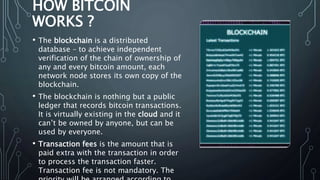
• The blockchain is a distributed
database – to achieve independent
verification of the chain of ownership of
any and every bitcoin amount, each
network node stores its own copy of the
blockchain.
• The blockchain is nothing but a public
ledger that records bitcoin transactions.
It is virtually existing in the cloud and it
can’t be owned by anyone, but can be
used by everyone.
• Transaction fees is the amount that is
paid extra with the transaction in order
to process the transaction faster.
Transaction fee is not mandatory. The
HOW BITCOIN WORKS ?
• There can be only one owner of any Bitcoin. For every bitcoin an owner
holds, that bitcoin has a unique address and this address changes only
when a transaction of that bitcoin takes place. This address is nothing but
a unique set of characters that one bitcoin can have and it does not
overlap with others.
• Miners are responsible for handling the Blockchains. They make sure all
the transactions are recorded and they generate new addresses to Bitcoins
when the transaction is completed.
• The best thing about Bitcoin is that, despite using a public distributed
system where people can see the transactions, use of private keys hides
the owner’s identity thereby preserving the privacy.
PUBLIC PRIVATE
KEY ENCRYPTION
• In Bitcoin, we hold the private key,
a key to our money.
• When we send a bitcoin to
someone else, we send it to a
public key. Then we need to sign
with our private key where the
bitcoin currently resides to
actually send it to the person we
want to pay.
• It is estimated that Bitcoin Miners
will produce bitcoins till year
2140.
• Today 0.001 Bitcoin is equal to
around 45 cents.
• It is estimated that till year 2140,
price of one hundred millionth of
a bitcoin will be less than one
GOVERNANC
E
• Bitcoin’s system of radically
decentralized governance is
facing perhaps the biggest test in
the digital currency’s history.
• Bitcoin was initially led by Satoshi
Nakamoto. Nakamoto stepped
back in 2010 and handed the
network alert key to Gavin
Andresen. He subsequently
sought to decentralize control.
• Bitcoin’s current governance
structure prevents undue
influence from any single
individual or organization.
PRICE AND
VOLATILITY
According to Mark T. Williams, as of 2014, bitcoin
has volatility seven times greater than gold, eight times
greater than the S&P 500, and 18 times greater than the
US dollar.
• In 2011, The price of Bitcoin rose to US$32 before
returning to US$2.
• It was as high as US$266 on 10 April 2013, before
crashing to around US$50.
• On 29 November 2013, the cost of one bitcoin rose to a
peak of US$1,242.
• On 3 March 2017, the price of a bitcoin surpassed the
market value of an ounce of gold for the first time as its
price surged to an all-time high of $1,268.
A study in Electronic Commerce Research and
Applications, going back through the network's historical
data, showed the value of the bitcoin network as measured
by the price of bitcoins, to be roughly proportional to the
square of the number of daily unique users participating
on the network.
BLACK MARKET THEFT
MALWARE
STEALING
RANSOMWARE
CRIMINAL
ACTIVITIES
CRIMINAL
ACTIVITIES
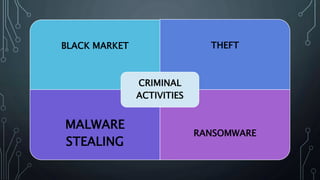
BLACK MARKET
• 4.5% to 9% of all transactions on all
exchanges in the world were for drug trades
on a single dark web drugs market.
• Illegal goods and services like child
pornography, murder-for-hire services, and
weapons are also allegedly available on
black market sites that sell in bitcoin.
THEFT
• One way bitcoin theft can be done involves a
third party accessing the private key to a
victim's bitcoin address, or of an online
wallet.
• The network does not have any provisions to
identify the thief, block further transactions
of those stolen bitcoins, or return them to
the legitimate owner.
• In one of the many cases, an Australian
wallet service, was hacked twice in October
2013 and lost more than $1 million in
bitcoins.
CRIMINAL
ACTIVITIES
MALWARE
Malware Stealing
• Some malware can steal private keys for
bitcoin wallets allowing the bitcoins
themselves to be stolen.
• Malwares also log keystrokes to record
passwords, often avoiding the need to
crack the keys.
Ransomware
• A program called CryptoLocker, typically
spread through legitimate-looking email
attachments.
• The email encrypts the hard drive of an
infected computer, then displays a
countdown timer and demands a ransom,
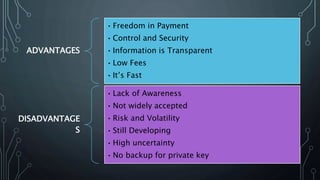
ADVANTAGES
•Freedom in Payment
•Control and Security
•Information is Transparent
•Low Fees
•It’s Fast
DISADVANTAGE
S
•Lack of Awareness
•Not widely accepted
•Risk and Volatility
•Still Developing
•High uncertainty
•No backup for private key
FUTURE OF
BITCOIN
• Bitcoin frees people from the traditional
gatekeepers of their wealth. People will be in
possession of their money.
• Even people with no IDs or bank accounts
can use bitcoin with just access to internet
and a cell phone and be part of the world
economy.
• No government or bank can stop a
transaction through bitcoin.
• It gives financial privacy.
• Financial institutions will not be able to cause
bail-outs or bail-ins.
• Japan is already working on cyber currency
laws. Bitcoin is already popular in some
countries like Argentina, China, Iran and
Japan.
• It will disrupt our financial industry and laws
but will also rapidly decentralize the capital.
THANK-YOU!

BITCOIN- A Presentation.

  • 1.
    BITCOIN GROUP- 8 MIMANSHA BAHADUR|SHAIK SAIF AZAM| SHREYA AMANCHI | SOUMYA SEN | SUDHANSHU SHARMA | VANI BANSAL |
  • 2.
    INTRODUCTION • Digital currencycreated in 2009 by Satoshi Nakamoto. • It offers lower transaction fees than traditional online payment mechanisms. • There are no physical bitcoins, only balances kept on a public ledger. • It allows online payments to be sent directly from one party to another without involving any third party. • Bitcoins are not issued or backed by any banks or governments.
  • 3.
    HOW BITCOIN WORKS ? •The blockchain is a distributed database – to achieve independent verification of the chain of ownership of any and every bitcoin amount, each network node stores its own copy of the blockchain. • The blockchain is nothing but a public ledger that records bitcoin transactions. It is virtually existing in the cloud and it can’t be owned by anyone, but can be used by everyone. • Transaction fees is the amount that is paid extra with the transaction in order to process the transaction faster. Transaction fee is not mandatory. The
  • 4.
    HOW BITCOIN WORKS? • There can be only one owner of any Bitcoin. For every bitcoin an owner holds, that bitcoin has a unique address and this address changes only when a transaction of that bitcoin takes place. This address is nothing but a unique set of characters that one bitcoin can have and it does not overlap with others. • Miners are responsible for handling the Blockchains. They make sure all the transactions are recorded and they generate new addresses to Bitcoins when the transaction is completed. • The best thing about Bitcoin is that, despite using a public distributed system where people can see the transactions, use of private keys hides the owner’s identity thereby preserving the privacy.
  • 5.
    PUBLIC PRIVATE KEY ENCRYPTION •In Bitcoin, we hold the private key, a key to our money. • When we send a bitcoin to someone else, we send it to a public key. Then we need to sign with our private key where the bitcoin currently resides to actually send it to the person we want to pay. • It is estimated that Bitcoin Miners will produce bitcoins till year 2140. • Today 0.001 Bitcoin is equal to around 45 cents. • It is estimated that till year 2140, price of one hundred millionth of a bitcoin will be less than one
  • 6.
    GOVERNANC E • Bitcoin’s systemof radically decentralized governance is facing perhaps the biggest test in the digital currency’s history. • Bitcoin was initially led by Satoshi Nakamoto. Nakamoto stepped back in 2010 and handed the network alert key to Gavin Andresen. He subsequently sought to decentralize control. • Bitcoin’s current governance structure prevents undue influence from any single individual or organization.
  • 7.
    PRICE AND VOLATILITY According toMark T. Williams, as of 2014, bitcoin has volatility seven times greater than gold, eight times greater than the S&P 500, and 18 times greater than the US dollar. • In 2011, The price of Bitcoin rose to US$32 before returning to US$2. • It was as high as US$266 on 10 April 2013, before crashing to around US$50. • On 29 November 2013, the cost of one bitcoin rose to a peak of US$1,242. • On 3 March 2017, the price of a bitcoin surpassed the market value of an ounce of gold for the first time as its price surged to an all-time high of $1,268. A study in Electronic Commerce Research and Applications, going back through the network's historical data, showed the value of the bitcoin network as measured by the price of bitcoins, to be roughly proportional to the square of the number of daily unique users participating on the network.
  • 8.
  • 9.
    CRIMINAL ACTIVITIES BLACK MARKET • 4.5%to 9% of all transactions on all exchanges in the world were for drug trades on a single dark web drugs market. • Illegal goods and services like child pornography, murder-for-hire services, and weapons are also allegedly available on black market sites that sell in bitcoin. THEFT • One way bitcoin theft can be done involves a third party accessing the private key to a victim's bitcoin address, or of an online wallet. • The network does not have any provisions to identify the thief, block further transactions of those stolen bitcoins, or return them to the legitimate owner. • In one of the many cases, an Australian wallet service, was hacked twice in October 2013 and lost more than $1 million in bitcoins.
  • 10.
    CRIMINAL ACTIVITIES MALWARE Malware Stealing • Somemalware can steal private keys for bitcoin wallets allowing the bitcoins themselves to be stolen. • Malwares also log keystrokes to record passwords, often avoiding the need to crack the keys. Ransomware • A program called CryptoLocker, typically spread through legitimate-looking email attachments. • The email encrypts the hard drive of an infected computer, then displays a countdown timer and demands a ransom,
  • 11.
    ADVANTAGES •Freedom in Payment •Controland Security •Information is Transparent •Low Fees •It’s Fast DISADVANTAGE S •Lack of Awareness •Not widely accepted •Risk and Volatility •Still Developing •High uncertainty •No backup for private key
  • 12.
    FUTURE OF BITCOIN • Bitcoinfrees people from the traditional gatekeepers of their wealth. People will be in possession of their money. • Even people with no IDs or bank accounts can use bitcoin with just access to internet and a cell phone and be part of the world economy. • No government or bank can stop a transaction through bitcoin. • It gives financial privacy. • Financial institutions will not be able to cause bail-outs or bail-ins. • Japan is already working on cyber currency laws. Bitcoin is already popular in some countries like Argentina, China, Iran and Japan. • It will disrupt our financial industry and laws but will also rapidly decentralize the capital.
  • 13.