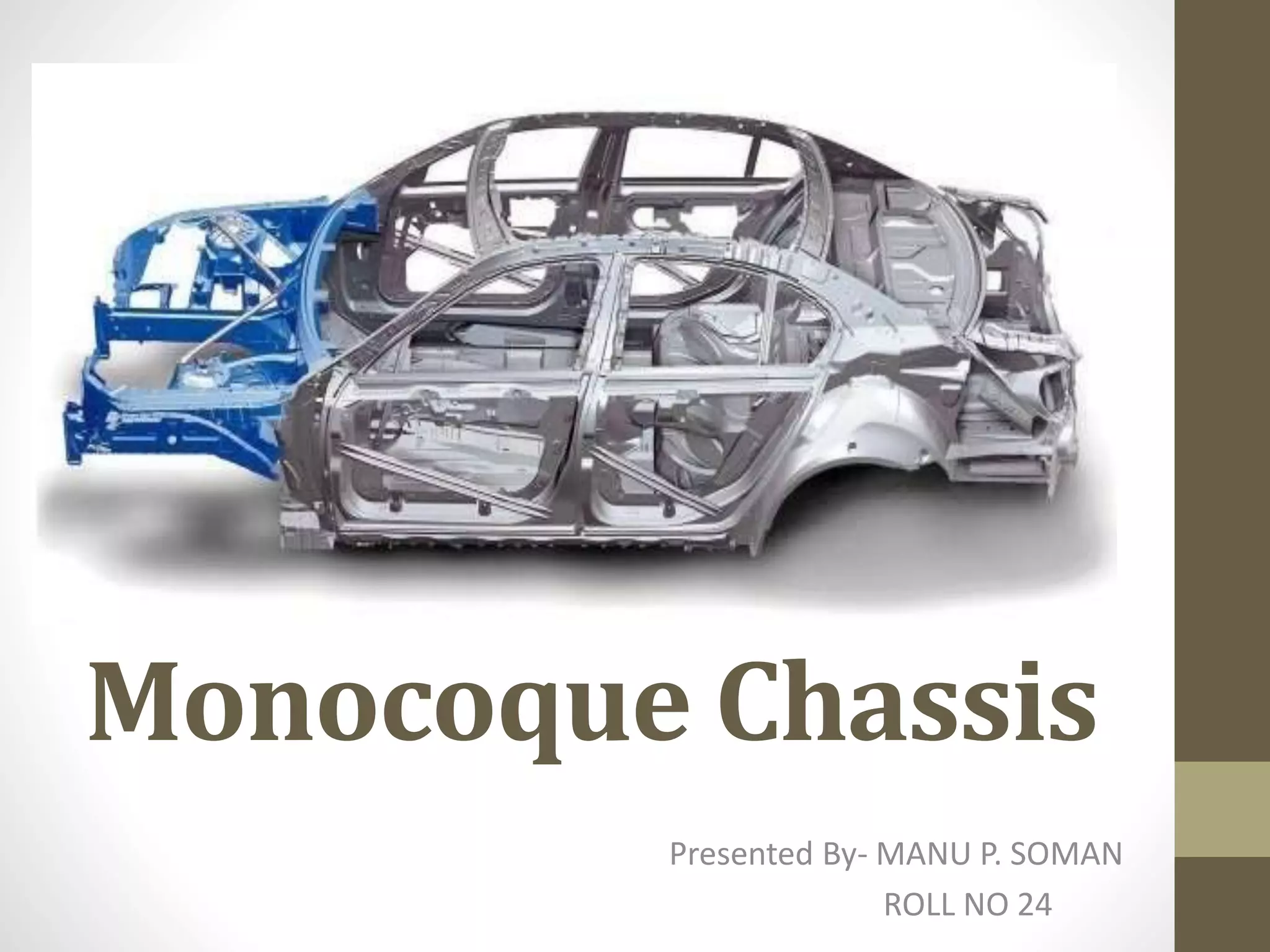
Monocoque Chassis
Presented By- MANU P. SOMAN
ROLL NO 24
Contents
• What is a Chassis?
• Different Types of Chassis
• Ladder frame chassis
• Tubular space frame chassis
• Aluminum space frame
• ULSAB Monocoque chassis
• Back bone frame chassis
• Introduction to Monocoque Design
• What is Monocoque construction?
• Where is this used?
• Origin of Monocoque design
• History of Monocoque Frame
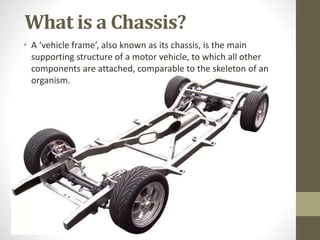
What is a Chassis?
• A ‘vehicle frame’, also known as its chassis, is the main
supporting structure of a motor vehicle, to which all other
components are attached, comparable to the skeleton of an
organism.
Different Types of Chassis
• Ladder frame chassis
• Tubular space frame chassis
• Monocoque frame chassis
• ULSAB Monocoque chassis
• Back bone frame chassis
• Aluminium space frame
• Carbon fibre Monocoque
Ladder frame chassis
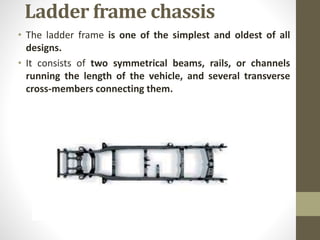
• The ladder frame is one of the simplest and oldest of all
designs.
• It consists of two symmetrical beams, rails, or channels
running the length of the vehicle, and several transverse
cross-members connecting them.
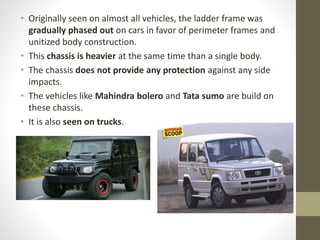
• Originally seen on almost all vehicles, the ladder frame was
gradually phased out on cars in favor of perimeter frames and
unitized body construction.
• This chassis is heavier at the same time than a single body.
• The chassis does not provide any protection against any side
impacts.
• The vehicles like Mahindra bolero and Tata sumo are build on
these chassis.
• It is also seen on trucks.
Tubular space frame chassis
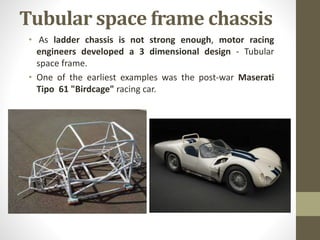
• As ladder chassis is not strong enough, motor racing
engineers developed a 3 dimensional design - Tubular
space frame.
• One of the earliest examples was the post-war Maserati
Tipo 61 "Birdcage" racing car.
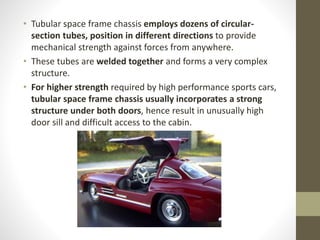
• Tubular space frame chassis employs dozens of circular-
section tubes, position in different directions to provide
mechanical strength against forces from anywhere.
• These tubes are welded together and forms a very complex
structure.
• For higher strength required by high performance sports cars,
tubular space frame chassis usually incorporates a strong
structure under both doors, hence result in unusually high
door sill and difficult access to the cabin.
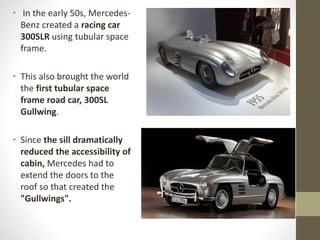
• In the early 50s, Mercedes-
Benz created a racing car
300SLR using tubular space
frame.
• This also brought the world
the first tubular space
frame road car, 300SL
Gullwing.
• Since the sill dramatically
reduced the accessibility of
cabin, Mercedes had to
extend the doors to the
roof so that created the
"Gullwings".
• Since the mid 60s, many high-end sports cars also adopted
tubular space frame to enhance the rigidity / weight ratio.
• Some of them used space frames for the front and rear
structure and made the cabin out of monocoque to cut cost.
Aluminium space frame
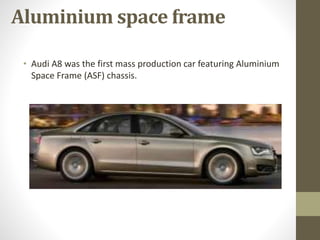
• Audi A8 was the first mass production car featuring Aluminium
Space Frame (ASF) chassis.
ULSAB Monocoque chassis
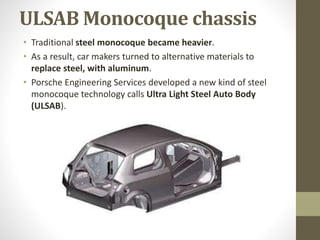
• Traditional steel monocoque became heavier.
• As a result, car makers turned to alternative materials to
replace steel, with aluminum.
• Porsche Engineering Services developed a new kind of steel
monocoque technology calls Ultra Light Steel Auto Body
(ULSAB).
• Compared with conventional
monocoque, Porsche Engineering
claimed it is 36% lighter yet over 50%
stiffer.
• Although ULSAB was just announced
in early 1998, the Opel Astra and
BMW 3-Series have already used it in
some parts.
Back bone frame chassis
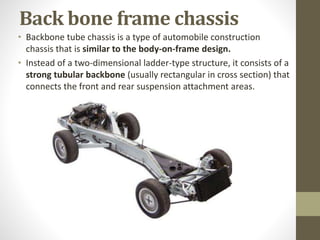
• Backbone tube chassis is a type of automobile construction
chassis that is similar to the body-on-frame design.
• Instead of a two-dimensional ladder-type structure, it consists of a
strong tubular backbone (usually rectangular in cross section) that
connects the front and rear suspension attachment areas.
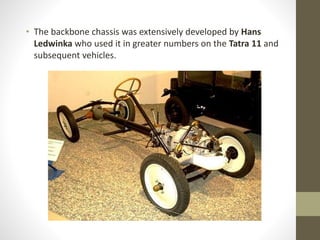
• The backbone chassis was extensively developed by Hans
Ledwinka who used it in greater numbers on the Tatra 11 and
subsequent vehicles.
Introduction to Monocoque
Design
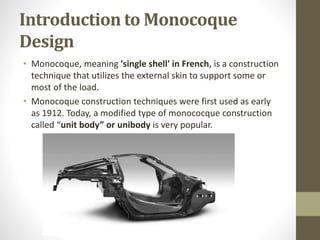
• Monocoque, meaning 'single shell' in French, is a construction
technique that utilizes the external skin to support some or
most of the load.
• Monocoque construction techniques were first used as early
as 1912. Today, a modified type of monococque construction
called “unit body” or unibody is very popular.
• A Monocoque chassis is a structure which
integrates body and chassis together to form a
composite structure which has better stiffness as
well as weight advantage.
• In a Monocoque chassis the stress generated by the
vehicle during motion is being distributed among
the structure and does not form localised stress
which may have higher value of deformation.
Where is this used?
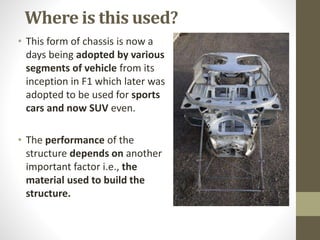
• This form of chassis is now a
days being adopted by various
segments of vehicle from its
inception in F1 which later was
adopted to be used for sports
cars and now SUV even.
• The performance of the
structure depends on another
important factor i.e., the
material used to build the
structure.
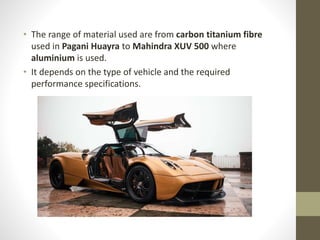
• The range of material used are from carbon titanium fibre
used in Pagani Huayra to Mahindra XUV 500 where
aluminium is used.
• It depends on the type of vehicle and the required
performance specifications.
Origin of Monocoque design
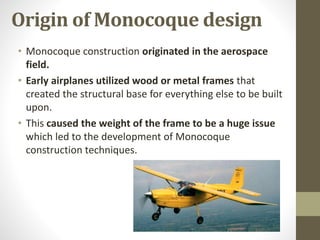
• Monocoque construction originated in the aerospace
field.
• Early airplanes utilized wood or metal frames that
created the structural base for everything else to be built
upon.
• This caused the weight of the frame to be a huge issue
which led to the development of Monocoque
construction techniques.
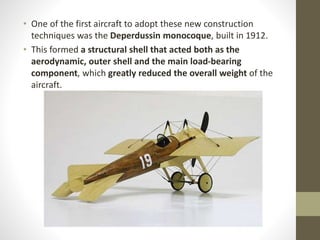
• One of the first aircraft to adopt these new construction
techniques was the Deperdussin monocoque, built in 1912.
• This formed a structural shell that acted both as the
aerodynamic, outer shell and the main load-bearing
component, which greatly reduced the overall weight of the
aircraft.
History of Monocoque Frame
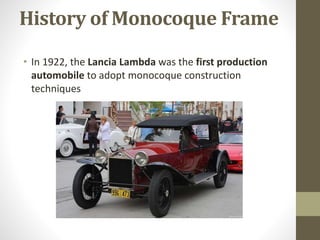
• In 1922, the Lancia Lambda was the first production
automobile to adopt monocoque construction
techniques
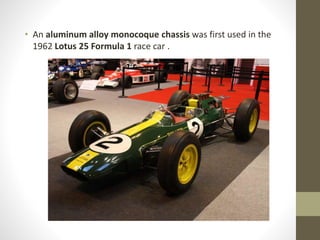
• An aluminum alloy monocoque chassis was first used in the
1962 Lotus 25 Formula 1 race car .
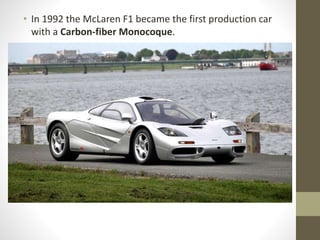
• In 1992 the McLaren F1 became the first production car
with a Carbon-fiber Monocoque.
Construction of Monocoque
Chassis
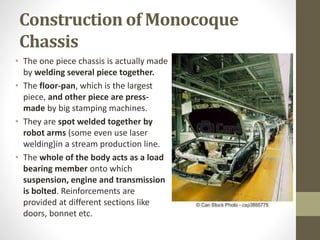
• The one piece chassis is actually made
by welding several piece together.
• The floor-pan, which is the largest
piece, and other piece are press-
made by big stamping machines.
• They are spot welded together by
robot arms (some even use laser
welding)in a stream production line.
• The whole of the body acts as a load
bearing member onto which
suspension, engine and transmission
is bolted. Reinforcements are
provided at different sections like
doors, bonnet etc.
Benefits of Monocoque Chassis
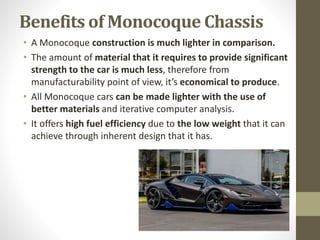
• A Monocoque construction is much lighter in comparison.
• The amount of material that it requires to provide significant
strength to the car is much less, therefore from
manufacturability point of view, it’s economical to produce.
• All Monocoque cars can be made lighter with the use of
better materials and iterative computer analysis.
• It offers high fuel efficiency due to the low weight that it can
achieve through inherent design that it has.
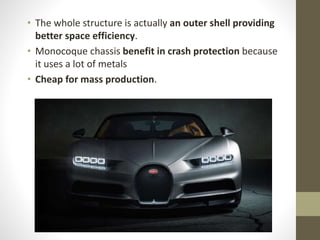
• The whole structure is actually an outer shell providing
better space efficiency.
• Monocoque chassis benefit in crash protection because
it uses a lot of metals
• Cheap for mass production.
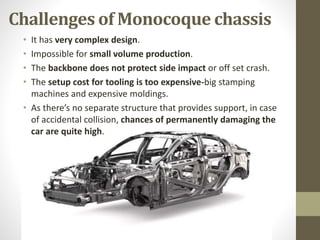
Challenges of Monocoque chassis
• It has very complex design.
• Impossible for small volume production.
• The backbone does not protect side impact or off set crash.
• The setup cost for tooling is too expensive-big stamping
machines and expensive moldings.
• As there’s no separate structure that provides support, in case
of accidental collision, chances of permanently damaging the
car are quite high.
Advantages of BOF over Monocoque structure
• Can tackle bad roads better.
• Much better for off-roading.
• Repair bills are much less when it comes to damage
control after hardcore off-roading.
• Accident repair is also less because of separate
chassis and body.
Advantages of Monocoque structure over BOF
• More light, hence fuel efficient.
• More safe because of integrated chassis/body.
• Better handling.
• Much better in ride comfort.
Carbon fibre Monocoque
• Carbon fiber Monocoque is better than traditional
monocoques due to its superior rigidity-to-weight ratio.
• Cars with Carbon-Fiber body panels include Ferrari
288GTO and Porsche 959.
Reference
• Bicheno, J. (1998) ‘The Lean Toolbox’ Picsie Books,
Buckingham.
• Bramley, A. Mileham, A Newnes, L Owen, G. (1999) ‘Advances
in manufacturing technology’
• Professional Engineering Publishing Ltd, Bury St Edmunds &
London.
• Monden, Y. (1993) ‘Toyota Production System‘ Industrial
Engineering and Management Press
• Institute of Industrial Engineers, Norcross, Georgia.
• Nieuwenhuis, P. & Wells, P. (1997) The Death of Motoring?
• Storey, J. (1994) New Wave Manufacturing Strategies, London:
Paul Chapman
THANK YOU & ANY QUESTIONS?

Monocoque chassis

  • 1.
    Monocoque Chassis Presented By-MANU P. SOMAN ROLL NO 24
  • 2.
    Contents • What isa Chassis? • Different Types of Chassis • Ladder frame chassis • Tubular space frame chassis • Aluminum space frame • ULSAB Monocoque chassis • Back bone frame chassis • Introduction to Monocoque Design • What is Monocoque construction? • Where is this used? • Origin of Monocoque design • History of Monocoque Frame
  • 3.
    What is aChassis? • A ‘vehicle frame’, also known as its chassis, is the main supporting structure of a motor vehicle, to which all other components are attached, comparable to the skeleton of an organism.
  • 4.
    Different Types ofChassis • Ladder frame chassis • Tubular space frame chassis • Monocoque frame chassis • ULSAB Monocoque chassis • Back bone frame chassis • Aluminium space frame • Carbon fibre Monocoque
  • 5.
    Ladder frame chassis •The ladder frame is one of the simplest and oldest of all designs. • It consists of two symmetrical beams, rails, or channels running the length of the vehicle, and several transverse cross-members connecting them.
  • 6.
    • Originally seenon almost all vehicles, the ladder frame was gradually phased out on cars in favor of perimeter frames and unitized body construction. • This chassis is heavier at the same time than a single body. • The chassis does not provide any protection against any side impacts. • The vehicles like Mahindra bolero and Tata sumo are build on these chassis. • It is also seen on trucks.
  • 7.
    Tubular space framechassis • As ladder chassis is not strong enough, motor racing engineers developed a 3 dimensional design - Tubular space frame. • One of the earliest examples was the post-war Maserati Tipo 61 "Birdcage" racing car.
  • 8.
    • Tubular spaceframe chassis employs dozens of circular- section tubes, position in different directions to provide mechanical strength against forces from anywhere. • These tubes are welded together and forms a very complex structure. • For higher strength required by high performance sports cars, tubular space frame chassis usually incorporates a strong structure under both doors, hence result in unusually high door sill and difficult access to the cabin.
  • 9.
    • In theearly 50s, Mercedes- Benz created a racing car 300SLR using tubular space frame. • This also brought the world the first tubular space frame road car, 300SL Gullwing. • Since the sill dramatically reduced the accessibility of cabin, Mercedes had to extend the doors to the roof so that created the "Gullwings".
  • 10.
    • Since themid 60s, many high-end sports cars also adopted tubular space frame to enhance the rigidity / weight ratio. • Some of them used space frames for the front and rear structure and made the cabin out of monocoque to cut cost.
  • 11.
    Aluminium space frame •Audi A8 was the first mass production car featuring Aluminium Space Frame (ASF) chassis.
  • 12.
    ULSAB Monocoque chassis •Traditional steel monocoque became heavier. • As a result, car makers turned to alternative materials to replace steel, with aluminum. • Porsche Engineering Services developed a new kind of steel monocoque technology calls Ultra Light Steel Auto Body (ULSAB).
  • 13.
    • Compared withconventional monocoque, Porsche Engineering claimed it is 36% lighter yet over 50% stiffer. • Although ULSAB was just announced in early 1998, the Opel Astra and BMW 3-Series have already used it in some parts.
  • 14.
    Back bone framechassis • Backbone tube chassis is a type of automobile construction chassis that is similar to the body-on-frame design. • Instead of a two-dimensional ladder-type structure, it consists of a strong tubular backbone (usually rectangular in cross section) that connects the front and rear suspension attachment areas.
  • 15.
    • The backbonechassis was extensively developed by Hans Ledwinka who used it in greater numbers on the Tatra 11 and subsequent vehicles.
  • 16.
    Introduction to Monocoque Design •Monocoque, meaning 'single shell' in French, is a construction technique that utilizes the external skin to support some or most of the load. • Monocoque construction techniques were first used as early as 1912. Today, a modified type of monococque construction called “unit body” or unibody is very popular.
  • 17.
    • A Monocoquechassis is a structure which integrates body and chassis together to form a composite structure which has better stiffness as well as weight advantage. • In a Monocoque chassis the stress generated by the vehicle during motion is being distributed among the structure and does not form localised stress which may have higher value of deformation.
  • 18.
    Where is thisused? • This form of chassis is now a days being adopted by various segments of vehicle from its inception in F1 which later was adopted to be used for sports cars and now SUV even. • The performance of the structure depends on another important factor i.e., the material used to build the structure.
  • 19.
    • The rangeof material used are from carbon titanium fibre used in Pagani Huayra to Mahindra XUV 500 where aluminium is used. • It depends on the type of vehicle and the required performance specifications.
  • 20.
    Origin of Monocoquedesign • Monocoque construction originated in the aerospace field. • Early airplanes utilized wood or metal frames that created the structural base for everything else to be built upon. • This caused the weight of the frame to be a huge issue which led to the development of Monocoque construction techniques.
  • 21.
    • One ofthe first aircraft to adopt these new construction techniques was the Deperdussin monocoque, built in 1912. • This formed a structural shell that acted both as the aerodynamic, outer shell and the main load-bearing component, which greatly reduced the overall weight of the aircraft.
  • 22.
    History of MonocoqueFrame • In 1922, the Lancia Lambda was the first production automobile to adopt monocoque construction techniques
  • 23.
    • An aluminumalloy monocoque chassis was first used in the 1962 Lotus 25 Formula 1 race car .
  • 24.
    • In 1992the McLaren F1 became the first production car with a Carbon-fiber Monocoque.
  • 25.
    Construction of Monocoque Chassis •The one piece chassis is actually made by welding several piece together. • The floor-pan, which is the largest piece, and other piece are press- made by big stamping machines. • They are spot welded together by robot arms (some even use laser welding)in a stream production line. • The whole of the body acts as a load bearing member onto which suspension, engine and transmission is bolted. Reinforcements are provided at different sections like doors, bonnet etc.
  • 26.
    Benefits of MonocoqueChassis • A Monocoque construction is much lighter in comparison. • The amount of material that it requires to provide significant strength to the car is much less, therefore from manufacturability point of view, it’s economical to produce. • All Monocoque cars can be made lighter with the use of better materials and iterative computer analysis. • It offers high fuel efficiency due to the low weight that it can achieve through inherent design that it has.
  • 27.
    • The wholestructure is actually an outer shell providing better space efficiency. • Monocoque chassis benefit in crash protection because it uses a lot of metals • Cheap for mass production.
  • 28.
    Challenges of Monocoquechassis • It has very complex design. • Impossible for small volume production. • The backbone does not protect side impact or off set crash. • The setup cost for tooling is too expensive-big stamping machines and expensive moldings. • As there’s no separate structure that provides support, in case of accidental collision, chances of permanently damaging the car are quite high.
  • 29.
    Advantages of BOFover Monocoque structure • Can tackle bad roads better. • Much better for off-roading. • Repair bills are much less when it comes to damage control after hardcore off-roading. • Accident repair is also less because of separate chassis and body.
  • 30.
    Advantages of Monocoquestructure over BOF • More light, hence fuel efficient. • More safe because of integrated chassis/body. • Better handling. • Much better in ride comfort.
  • 31.
    Carbon fibre Monocoque •Carbon fiber Monocoque is better than traditional monocoques due to its superior rigidity-to-weight ratio. • Cars with Carbon-Fiber body panels include Ferrari 288GTO and Porsche 959.
  • 32.
    Reference • Bicheno, J.(1998) ‘The Lean Toolbox’ Picsie Books, Buckingham. • Bramley, A. Mileham, A Newnes, L Owen, G. (1999) ‘Advances in manufacturing technology’ • Professional Engineering Publishing Ltd, Bury St Edmunds & London. • Monden, Y. (1993) ‘Toyota Production System‘ Industrial Engineering and Management Press • Institute of Industrial Engineers, Norcross, Georgia. • Nieuwenhuis, P. & Wells, P. (1997) The Death of Motoring? • Storey, J. (1994) New Wave Manufacturing Strategies, London: Paul Chapman
  • 33.
    THANK YOU &ANY QUESTIONS?