What is a set?
Set is a well defined
collection of objects.
TWO FORMS OF SET
Roster Form- In this method a set is described by
listing elements, separated by commas, within
braces { }.
Set-Builder Form-In this method, a set is
described by a characterizing property P(x) of
its element x. In such a case the set is described
by {x:P(x) holds}.
TYPES OF SET
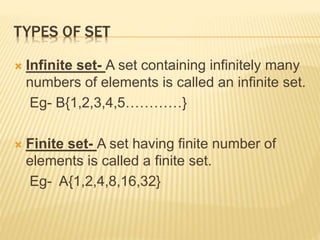
 Infinite set- A set containing infinitely many
numbers of elements is called an infinite set.
Eg- B{1,2,3,4,5…………}
 Finite set- A set having finite number of
elements is called a finite set.
Eg- A{1,2,4,8,16,32}
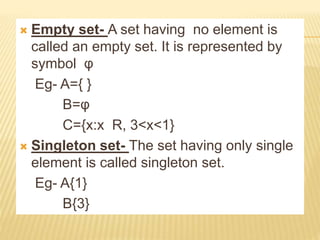
 Empty set- A set having no element is
called an empty set. It is represented by
symbol φ
Eg- A={ }
B=φ
C={x:x R, 3<x<1}
 Singleton set- The set having only single
element is called singleton set.
Eg- A{1}
B{3}
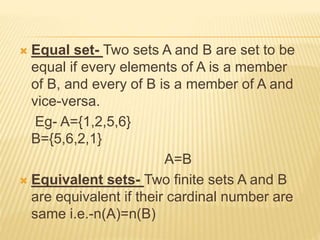
 Equal set- Two sets A and B are set to be
equal if every elements of A is a member
of B, and every of B is a member of A and
vice-versa.
Eg- A={1,2,5,6}
B={5,6,2,1}
A=B
 Equivalent sets- Two finite sets A and B
are equivalent if their cardinal number are
same i.e.-n(A)=n(B)
SUBSET AND SUPERSET
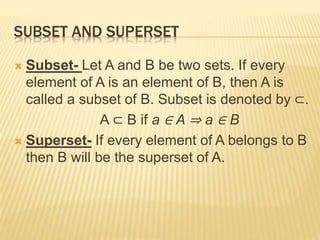
 Subset- Let A and B be two sets. If every
element of A is an element of B, then A is
called a subset of B. Subset is denoted by ⊂.
A ⊂ B if a ∈ A ⇒ a ∈ B
 Superset- If every element of A belongs to B
then B will be the superset of A.
INTERVAL AS SUBSET
 Closed interval- Let a and b be two given
real number such that a<b. Then the set of
all real numbers x such that a ≤ x ≤ b is
called a closed interval and denoted by [a,b].
 Open interval-If a and b are two real
numbers such that a<b ,then the of all real
numbers x satisfying a<x<b is called an open
interval and is denoted by (a,b).
UNIVERSAL AND POWER SET
 Power set-The collection of all subsets of a
set A is called the power set of A. It is
denoted by P(A).
 Universal set-A set that contains all sets in
a given context is called the universal set.
VENN DIAGRAM
Most of the relationships between sets can be
represented by means of diagrams which are known
as Venn diagrams. Venn diagrams are named after
the English logician, John Venn (1834-1883). These
diagrams consist of rectangles and closed curves
usually circles. The universal set is represented
usually by a rectangle and its subsets by circles.
OPERATION ON SETS
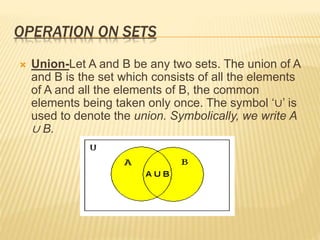
 Union-Let A and B be any two sets. The union of A
and B is the set which consists of all the elements
of A and all the elements of B, the common
elements being taken only once. The symbol ‘∪’ is
used to denote the union. Symbolically, we write A
∪ B.
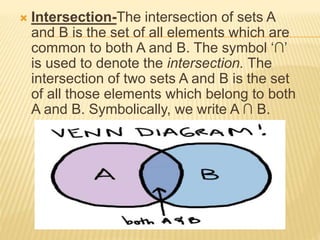
 Intersection-The intersection of sets A
and B is the set of all elements which are
common to both A and B. The symbol ‘∩’
is used to denote the intersection. The
intersection of two sets A and B is the set
of all those elements which belong to both
A and B. Symbolically, we write A ∩ B.
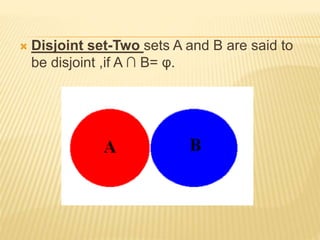
 Disjoint set-Two sets A and B are said to
be disjoint ,if A ∩ B= φ.
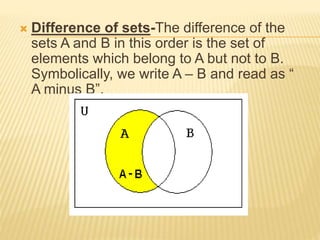
 Difference of sets-The difference of the
sets A and B in this order is the set of
elements which belong to A but not to B.
Symbolically, we write A – B and read as “
A minus B”.
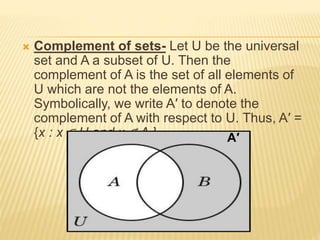
 Complement of sets- Let U be the universal
set and A a subset of U. Then the
complement of A is the set of all elements of
U which are not the elements of A.
Symbolically, we write A′ to denote the
complement of A with respect to U. Thus, A′ =
{x : x ∈ U and x ∉ A } A′
PROPERTIES AND LAWS
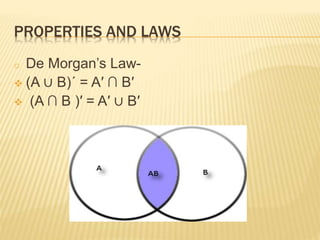
o De Morgan’s Law-
 (A ∪ B)´ = A′ ∩ B′
 (A ∩ B )′ = A′ ∪ B′
maths set

maths set

  • 2.
    What is aset? Set is a well defined collection of objects.
  • 3.
    TWO FORMS OFSET Roster Form- In this method a set is described by listing elements, separated by commas, within braces { }. Set-Builder Form-In this method, a set is described by a characterizing property P(x) of its element x. In such a case the set is described by {x:P(x) holds}.
  • 4.
    TYPES OF SET Infinite set- A set containing infinitely many numbers of elements is called an infinite set. Eg- B{1,2,3,4,5…………}  Finite set- A set having finite number of elements is called a finite set. Eg- A{1,2,4,8,16,32}
  • 5.
     Empty set-A set having no element is called an empty set. It is represented by symbol φ Eg- A={ } B=φ C={x:x R, 3<x<1}  Singleton set- The set having only single element is called singleton set. Eg- A{1} B{3}
  • 6.
     Equal set-Two sets A and B are set to be equal if every elements of A is a member of B, and every of B is a member of A and vice-versa. Eg- A={1,2,5,6} B={5,6,2,1} A=B  Equivalent sets- Two finite sets A and B are equivalent if their cardinal number are same i.e.-n(A)=n(B)
  • 7.
    SUBSET AND SUPERSET Subset- Let A and B be two sets. If every element of A is an element of B, then A is called a subset of B. Subset is denoted by ⊂. A ⊂ B if a ∈ A ⇒ a ∈ B  Superset- If every element of A belongs to B then B will be the superset of A.
  • 8.
    INTERVAL AS SUBSET Closed interval- Let a and b be two given real number such that a<b. Then the set of all real numbers x such that a ≤ x ≤ b is called a closed interval and denoted by [a,b].  Open interval-If a and b are two real numbers such that a<b ,then the of all real numbers x satisfying a<x<b is called an open interval and is denoted by (a,b).
  • 9.
    UNIVERSAL AND POWERSET  Power set-The collection of all subsets of a set A is called the power set of A. It is denoted by P(A).  Universal set-A set that contains all sets in a given context is called the universal set.
  • 10.
    VENN DIAGRAM Most ofthe relationships between sets can be represented by means of diagrams which are known as Venn diagrams. Venn diagrams are named after the English logician, John Venn (1834-1883). These diagrams consist of rectangles and closed curves usually circles. The universal set is represented usually by a rectangle and its subsets by circles.
  • 11.
    OPERATION ON SETS Union-Let A and B be any two sets. The union of A and B is the set which consists of all the elements of A and all the elements of B, the common elements being taken only once. The symbol ‘∪’ is used to denote the union. Symbolically, we write A ∪ B.
  • 12.
     Intersection-The intersectionof sets A and B is the set of all elements which are common to both A and B. The symbol ‘∩’ is used to denote the intersection. The intersection of two sets A and B is the set of all those elements which belong to both A and B. Symbolically, we write A ∩ B.
  • 13.
     Disjoint set-Twosets A and B are said to be disjoint ,if A ∩ B= φ.
  • 14.
     Difference ofsets-The difference of the sets A and B in this order is the set of elements which belong to A but not to B. Symbolically, we write A – B and read as “ A minus B”.
  • 15.
     Complement ofsets- Let U be the universal set and A a subset of U. Then the complement of A is the set of all elements of U which are not the elements of A. Symbolically, we write A′ to denote the complement of A with respect to U. Thus, A′ = {x : x ∈ U and x ∉ A } A′
  • 16.
    PROPERTIES AND LAWS oDe Morgan’s Law-  (A ∪ B)´ = A′ ∩ B′  (A ∩ B )′ = A′ ∪ B′