AmygdalaWhat is it? Where is it? How does it effect us?
What is it?Processing of Memory and emotional reactions. Detailed: the connection of the amygdala to various centers of the brain such as the neocortex and visual cortex through several nerves.Forms part of the limbic system, which is an important part of the nervous system.
					    AMYGDALA
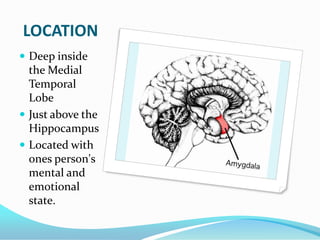
LOCATIONDeep inside the Medial Temporal Lobe
Just above the Hippocampus
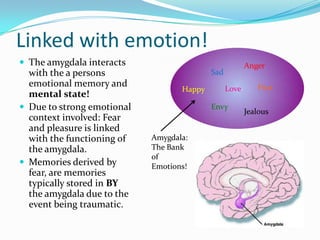
Located with ones person's mental and emotional state.Linked with emotion!The amygdala interacts with the a persons emotional memory and mental state!Due to strong emotional context involved: Fear and pleasure is linked with the functioning of the amygdala. Memories derived by fear, are memories typically stored in BY the amygdala due to the event being traumatic. AngerSadFearLove HappyEnvyJealousAmygdala: The Bank of Emotions!
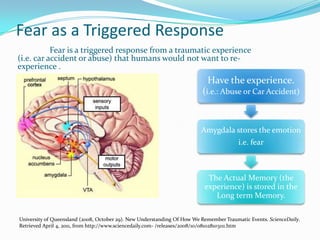
Fear as a Triggered Response 	Fear is a triggered response from a traumatic experience (i.e. car accident or abuse) that humans would not want to re- experience . University of Queensland (2008, October 29). New Understanding Of How We Remember Traumatic Events. ScienceDaily. Retrieved April 4, 2011, from http://www.sciencedaily.com­ /releases/2008/10/081028103111.htm
And She Had NO Fear! Literally!!!!!University of Iowa: Feinstein et al. (2010): A Girl without an Amygdala “Without our amygdala, the alarm in our brain that pushes us to avoid danger is missing” ~FeinsteinShe does NOT have an amygdala, and other areas of the brain (i.e. bed Nuclei) were unable to compensate. The participant felt no emotion
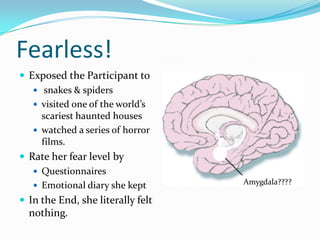
Fearless!Exposed the Participant to snakes & spidersvisited one of the world’s scariest haunted houseswatched a series of horror films.Rate her fear level byQuestionnairesEmotional diary she keptIn the End, she literally felt nothing. Amygdala????
Fear & Traumatic Events: University of Queensland, 2008traumatic experience (i.e. car accident or abuse) triggered response fearEmotional events may lead to disturbing long term memories.
Stronger Memories are formed when there is an emotional attachment; i.e. fear.
Found that the formation of emotional memories is from a underlying cellular mechanism and a stress hormone.

Amygdala pp

  • 1.
    AmygdalaWhat is it?Where is it? How does it effect us?
  • 2.
    What is it?Processingof Memory and emotional reactions. Detailed: the connection of the amygdala to various centers of the brain such as the neocortex and visual cortex through several nerves.Forms part of the limbic system, which is an important part of the nervous system.
  • 3.
    AMYGDALA
  • 4.
    LOCATIONDeep inside theMedial Temporal Lobe
  • 5.
    Just above theHippocampus
  • 6.
    Located with onesperson's mental and emotional state.Linked with emotion!The amygdala interacts with the a persons emotional memory and mental state!Due to strong emotional context involved: Fear and pleasure is linked with the functioning of the amygdala. Memories derived by fear, are memories typically stored in BY the amygdala due to the event being traumatic. AngerSadFearLove HappyEnvyJealousAmygdala: The Bank of Emotions!
  • 7.
    Fear as aTriggered Response Fear is a triggered response from a traumatic experience (i.e. car accident or abuse) that humans would not want to re- experience . University of Queensland (2008, October 29). New Understanding Of How We Remember Traumatic Events. ScienceDaily. Retrieved April 4, 2011, from http://www.sciencedaily.com­ /releases/2008/10/081028103111.htm
  • 8.
    And She HadNO Fear! Literally!!!!!University of Iowa: Feinstein et al. (2010): A Girl without an Amygdala “Without our amygdala, the alarm in our brain that pushes us to avoid danger is missing” ~FeinsteinShe does NOT have an amygdala, and other areas of the brain (i.e. bed Nuclei) were unable to compensate. The participant felt no emotion
  • 9.
    Fearless!Exposed the Participantto snakes & spidersvisited one of the world’s scariest haunted houseswatched a series of horror films.Rate her fear level byQuestionnairesEmotional diary she keptIn the End, she literally felt nothing. Amygdala????
  • 10.
    Fear & TraumaticEvents: University of Queensland, 2008traumatic experience (i.e. car accident or abuse) triggered response fearEmotional events may lead to disturbing long term memories.
  • 11.
    Stronger Memories areformed when there is an emotional attachment; i.e. fear.
  • 12.
    Found that theformation of emotional memories is from a underlying cellular mechanism and a stress hormone.