GRAPH THEORY
DISCRETE MATHEMATICS
Introduction
 Graph Theory is the study of points and lines.
 In particular, it involves the ways in which sets of
points, called vertices, can be connected by lines
called edges.
 Graph Theory has proven useful in the design of
integrated circuits for computers and other
electronic devices.
 Graph Theory was invented by Leonhard Euler.
Graphs And Basic Terminologies
 A Graph is an ordered pair G = (V, E) comprising
a set V of vertices, nodes or points together with a
set E of edges, arcs or lines, which are 2-element subsets
of V.
 An edge is associated with two vertices, and the
association takes the form of the unordered pair of the
vertices.
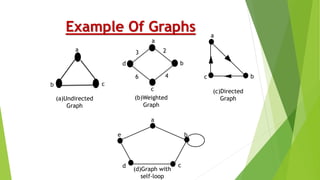
 A Graph may be directed or undirected, weighted or
unweighted.
 A Graph may be with self-loop or self-edge.
Example Of Graphs
(a)Undirected
Graph
a
b
c
d
a
b c
3 2
6 4
(b)Weighted
Graph
a
bc
(c)Directed
Graph
(d)Graph with
self-loop
a
be
cd
Types Of Graphs
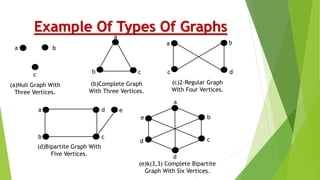
Null Graph:
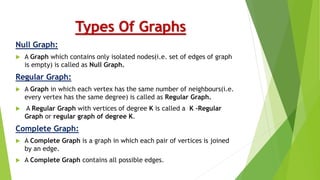
 A Graph which contains only isolated nodes(i.e. set of edges of graph
is empty) is called as Null Graph.
Regular Graph:
 A Graph in which each vertex has the same number of neighbours(i.e.
every vertex has the same degree) is called as Regular Graph.
 A Regular Graph with vertices of degree K is called a K -Regular
Graph or regular graph of degree K.
Complete Graph:
 A Complete Graph is a graph in which each pair of vertices is joined
by an edge.
 A Complete Graph contains all possible edges.
Types Of Graphs
Bipartite Graph:
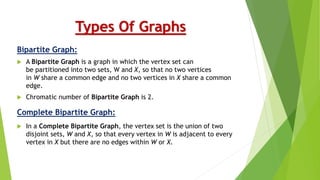
 A Bipartite Graph is a graph in which the vertex set can
be partitioned into two sets, W and X, so that no two vertices
in W share a common edge and no two vertices in X share a common
edge.
 Chromatic number of Bipartite Graph is 2.
Complete Bipartite Graph:
 In a Complete Bipartite Graph, the vertex set is the union of two
disjoint sets, W and X, so that every vertex in W is adjacent to every
vertex in X but there are no edges within W or X.
Example Of Types Of Graphs
(a)Null Graph With
Three Vertices.
a b
c
(b)Complete Graph
With Three Vertices.
a b
cc db
a
(c)2-Regular Graph
With Four Vertices.
a
b c
ed
(d)Bipartite Graph With
Five Vertices.
a
b
c
d
d
e
(e)k(3,3) Complete Bipartite
Graph With Six Vertices.
Representation Of Graph
Two most common ways to represent a Graph:
1. Adjacency Matrix
2. Adjacency List
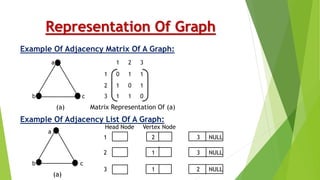
Adjacency Matrix:
 Adjacency Matrix is a 2D array of size V x V where V is the number of
vertices in a graph.
 Let the 2D array be adj [][], a slot adj [i][j] = 1 indicates that there is
an edge from vertex i to vertex j.
 Adjacency matrix for undirected graph is always symmetric.
 Adjacency Matrix is also used to represent weighted graphs.
 If adj [i][j] = w, then there is an edge from vertex i to vertex j with
weight w.
Representation Of Graph
Adjacency List:
 An array of lists is used.
 Size of the array is equal to the number of vertices.
 Let the array be array []. An entry array [i] represents the
list of vertices adjacent to the ith vertex.
 This representation can also be used to represent a
weighted graph.
 The weights of edges can be represented as lists of pairs.
Representation Of Graph
Example Of Adjacency Matrix Of A Graph:
a 1 2 3
1 0 1 1
2 1 0 1
b c 3 1 1 0
(a) Matrix Representation Of (a)
Example Of Adjacency List Of A Graph:
a
b c
(a)
Head Node Vertex Node
1 2 3 NULL
2 1 3 NULL
3 1 2 NULL
Graph Algorithms
Some Basic Graph Algorithms Are:
1.Depth First Search(DFS)
2.Breadth First Search(BFS)
3.Shortest Path Algorithm
4.Dijskstra’s Algorithm
Graph Coloring
 Graph Coloring is a method to assign colors to the vertices of a graph
so that no two adjacent vertices have the same color.
Some Graph Coloring problems are :
 Vertex coloring : A way of coloring the vertices of a graph so that no
two adjacent vertices share the same color.
 Edge Coloring : It is the method of assigning a color to each edge so
that no two adjacent edges have the same color.
 Face coloring : It assigns a color to each face or region of a planar
graph so that no two faces that share a common boundary have the
same color.
Chromatic Number:
 Chromatic Number is the minimum number of colors required to
color a graph.
THANK YOU
Insert Group
Member Names
Here..

Graph theory

  • 1.
  • 2.
    Introduction  Graph Theoryis the study of points and lines.  In particular, it involves the ways in which sets of points, called vertices, can be connected by lines called edges.  Graph Theory has proven useful in the design of integrated circuits for computers and other electronic devices.  Graph Theory was invented by Leonhard Euler.
  • 3.
    Graphs And BasicTerminologies  A Graph is an ordered pair G = (V, E) comprising a set V of vertices, nodes or points together with a set E of edges, arcs or lines, which are 2-element subsets of V.  An edge is associated with two vertices, and the association takes the form of the unordered pair of the vertices.  A Graph may be directed or undirected, weighted or unweighted.  A Graph may be with self-loop or self-edge.
  • 4.
    Example Of Graphs (a)Undirected Graph a b c d a bc 3 2 6 4 (b)Weighted Graph a bc (c)Directed Graph (d)Graph with self-loop a be cd
  • 5.
    Types Of Graphs NullGraph:  A Graph which contains only isolated nodes(i.e. set of edges of graph is empty) is called as Null Graph. Regular Graph:  A Graph in which each vertex has the same number of neighbours(i.e. every vertex has the same degree) is called as Regular Graph.  A Regular Graph with vertices of degree K is called a K -Regular Graph or regular graph of degree K. Complete Graph:  A Complete Graph is a graph in which each pair of vertices is joined by an edge.  A Complete Graph contains all possible edges.
  • 6.
    Types Of Graphs BipartiteGraph:  A Bipartite Graph is a graph in which the vertex set can be partitioned into two sets, W and X, so that no two vertices in W share a common edge and no two vertices in X share a common edge.  Chromatic number of Bipartite Graph is 2. Complete Bipartite Graph:  In a Complete Bipartite Graph, the vertex set is the union of two disjoint sets, W and X, so that every vertex in W is adjacent to every vertex in X but there are no edges within W or X.
  • 7.
    Example Of TypesOf Graphs (a)Null Graph With Three Vertices. a b c (b)Complete Graph With Three Vertices. a b cc db a (c)2-Regular Graph With Four Vertices. a b c ed (d)Bipartite Graph With Five Vertices. a b c d d e (e)k(3,3) Complete Bipartite Graph With Six Vertices.
  • 8.
    Representation Of Graph Twomost common ways to represent a Graph: 1. Adjacency Matrix 2. Adjacency List Adjacency Matrix:  Adjacency Matrix is a 2D array of size V x V where V is the number of vertices in a graph.  Let the 2D array be adj [][], a slot adj [i][j] = 1 indicates that there is an edge from vertex i to vertex j.  Adjacency matrix for undirected graph is always symmetric.  Adjacency Matrix is also used to represent weighted graphs.  If adj [i][j] = w, then there is an edge from vertex i to vertex j with weight w.
  • 9.
    Representation Of Graph AdjacencyList:  An array of lists is used.  Size of the array is equal to the number of vertices.  Let the array be array []. An entry array [i] represents the list of vertices adjacent to the ith vertex.  This representation can also be used to represent a weighted graph.  The weights of edges can be represented as lists of pairs.
  • 10.
    Representation Of Graph ExampleOf Adjacency Matrix Of A Graph: a 1 2 3 1 0 1 1 2 1 0 1 b c 3 1 1 0 (a) Matrix Representation Of (a) Example Of Adjacency List Of A Graph: a b c (a) Head Node Vertex Node 1 2 3 NULL 2 1 3 NULL 3 1 2 NULL
  • 11.
    Graph Algorithms Some BasicGraph Algorithms Are: 1.Depth First Search(DFS) 2.Breadth First Search(BFS) 3.Shortest Path Algorithm 4.Dijskstra’s Algorithm
  • 12.
    Graph Coloring  GraphColoring is a method to assign colors to the vertices of a graph so that no two adjacent vertices have the same color. Some Graph Coloring problems are :  Vertex coloring : A way of coloring the vertices of a graph so that no two adjacent vertices share the same color.  Edge Coloring : It is the method of assigning a color to each edge so that no two adjacent edges have the same color.  Face coloring : It assigns a color to each face or region of a planar graph so that no two faces that share a common boundary have the same color. Chromatic Number:  Chromatic Number is the minimum number of colors required to color a graph.
  • 13.