CopyrightPrismTech,2017
Angelo	Corsaro,	PhD
CTO,	ADLINK	Tech.	Inc.	
Co-Chair,	OMG	DDS-SIG	
Board	Director,	OMG	
angelo.corsaro@adlinktech.com
Data
Distribution
Service
the
What is DDS?
DDS
DDS is a standard technology for ubiquitous,
interoperable, secure, platform independent,
and real-time data sharing across network
connected devices
CopyrightPrismTech,2017
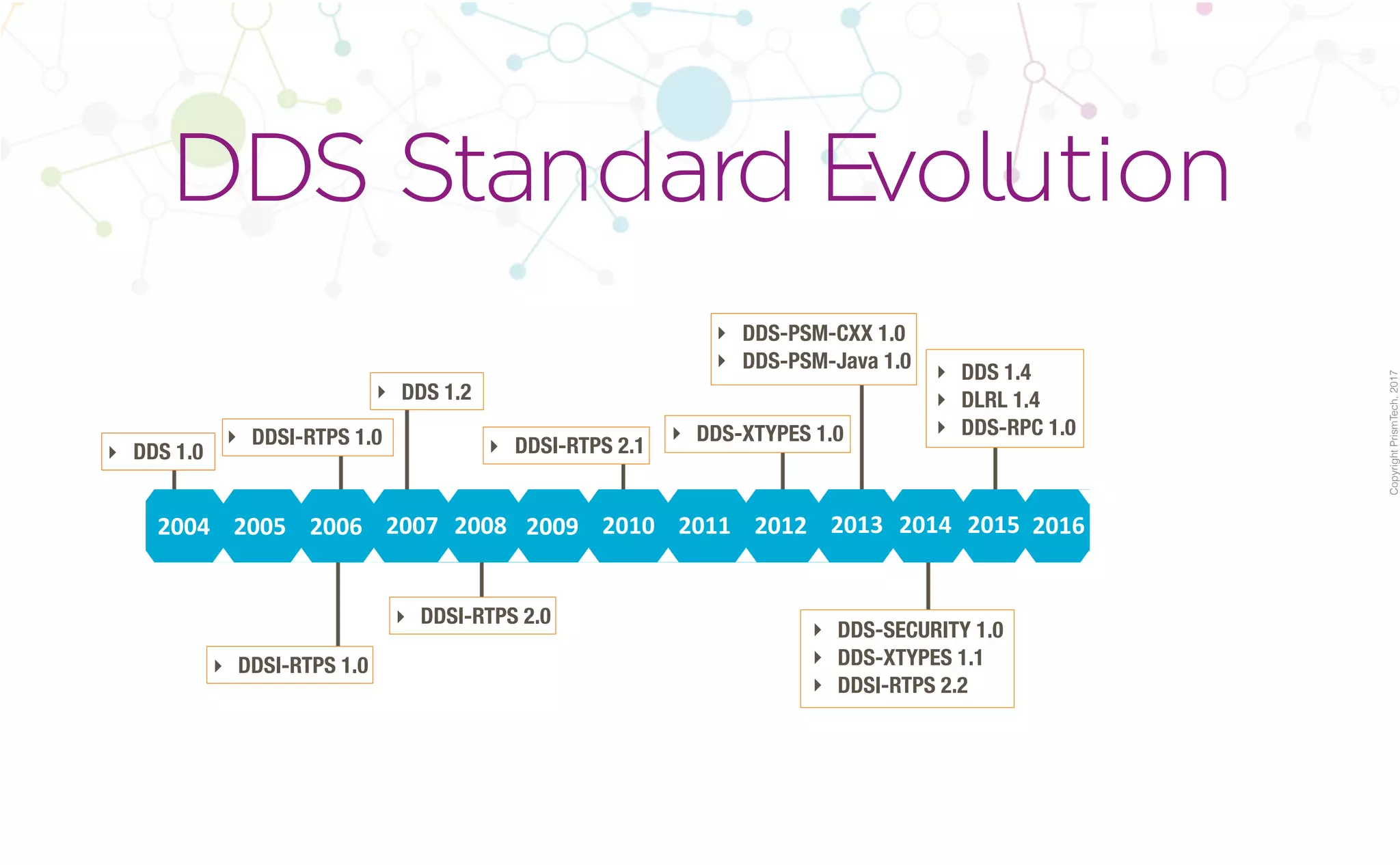
DDS Standard Evolution
2004 2005 2006 2007 2008 2009 2010 2011 2012 2013 2014 2015
‣ DDS 1.0
‣ DDSI-RTPS 1.0 ‣ DDS-XTYPES 1.0
‣ DDS-SECURITY 1.0
‣ DDS-XTYPES 1.1
‣ DDSI-RTPS 2.2
‣ DDS 1.4
‣ DLRL 1.4
‣ DDS-RPC 1.0
‣ DDSI-RTPS 2.0
‣ DDS 1.2
‣ DDS-PSM-CXX 1.0
‣ DDS-PSM-Java 1.0
‣ DDSI-RTPS 2.1
‣ DDSI-RTPS 1.0
2016
CopyrightPrismTech,2017
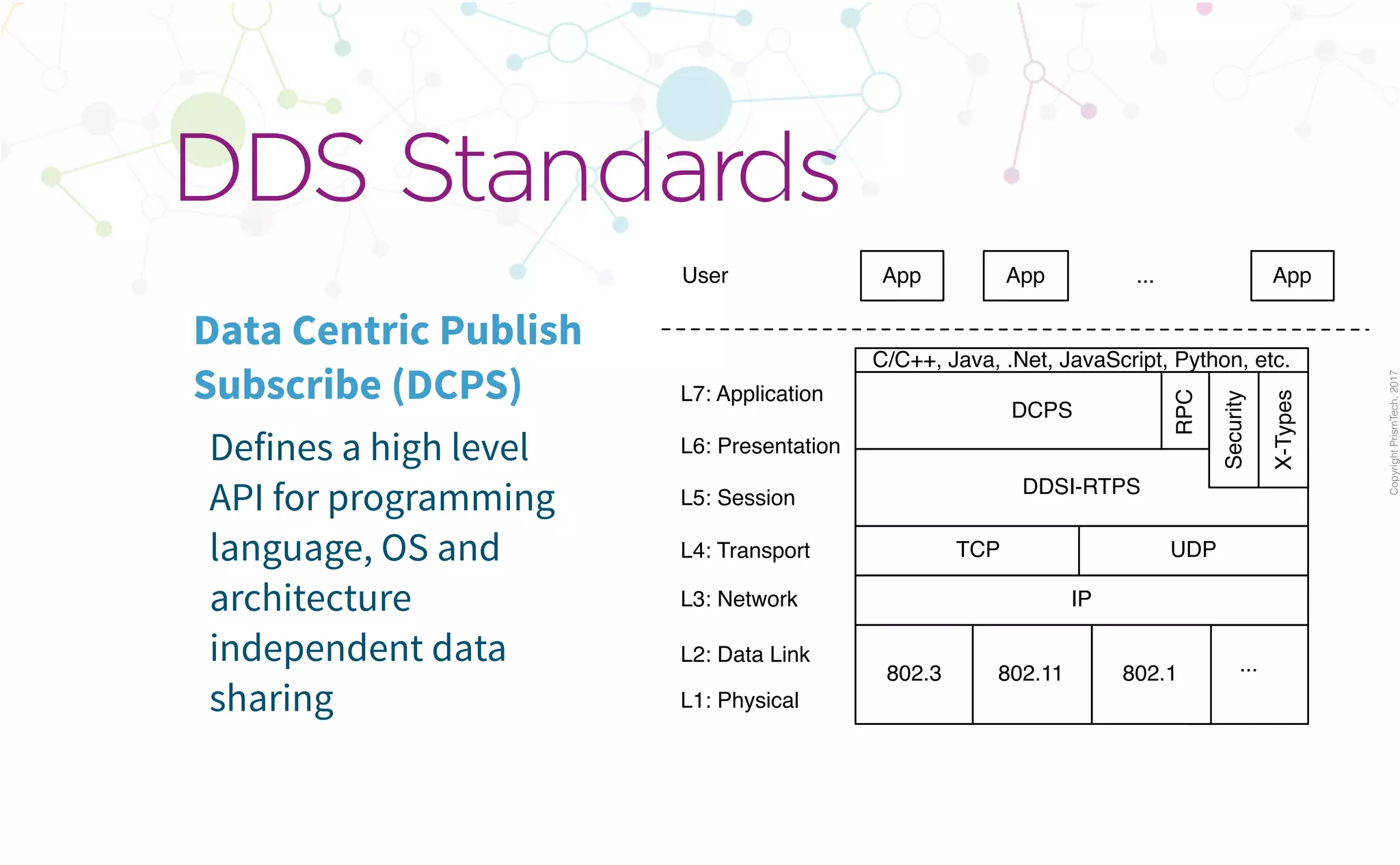
Defines a high level
API for programming
language, OS and
architecture
independent data
sharing
DDS Standards
TCP UDP
IP
802.3 802.11
DDSI-RTPS
L3: Network
App App App
L2: Data Link
L1: Physical
L4: Transport
L5: Session
L6: Presentation
User
L7: Application
Security
X-Types
DCPS
RPC
...
802.1 ...
C/C++, Java, .Net, JavaScript, Python, etc.
Data Centric Publish
Subscribe (DCPS)
CopyrightPrismTech,2017
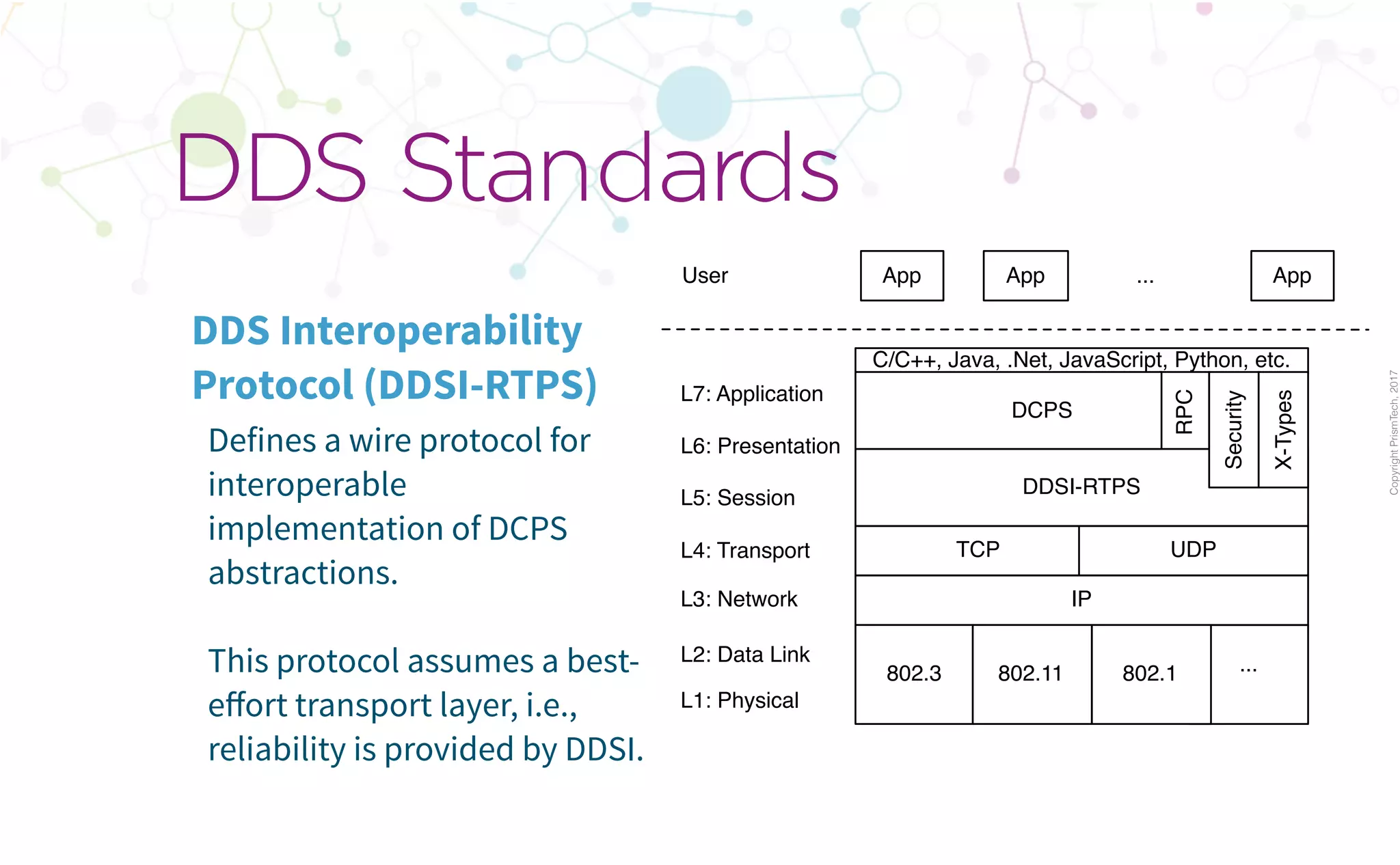
Defines a wire protocol for
interoperable
implementation of DCPS
abstractions.
This protocol assumes a best-
effort transport layer, i.e.,
reliability is provided by DDSI.
DDS Standards
DDS Interoperability
Protocol (DDSI-RTPS)
TCP UDP
IP
802.3 802.11
DDSI-RTPS
L3: Network
App App App
L2: Data Link
L1: Physical
L4: Transport
L5: Session
L6: Presentation
User
L7: Application
Security
X-Types
DCPS
RPC
...
802.1 ...
C/C++, Java, .Net, JavaScript, Python, etc.
CopyrightPrismTech,2017
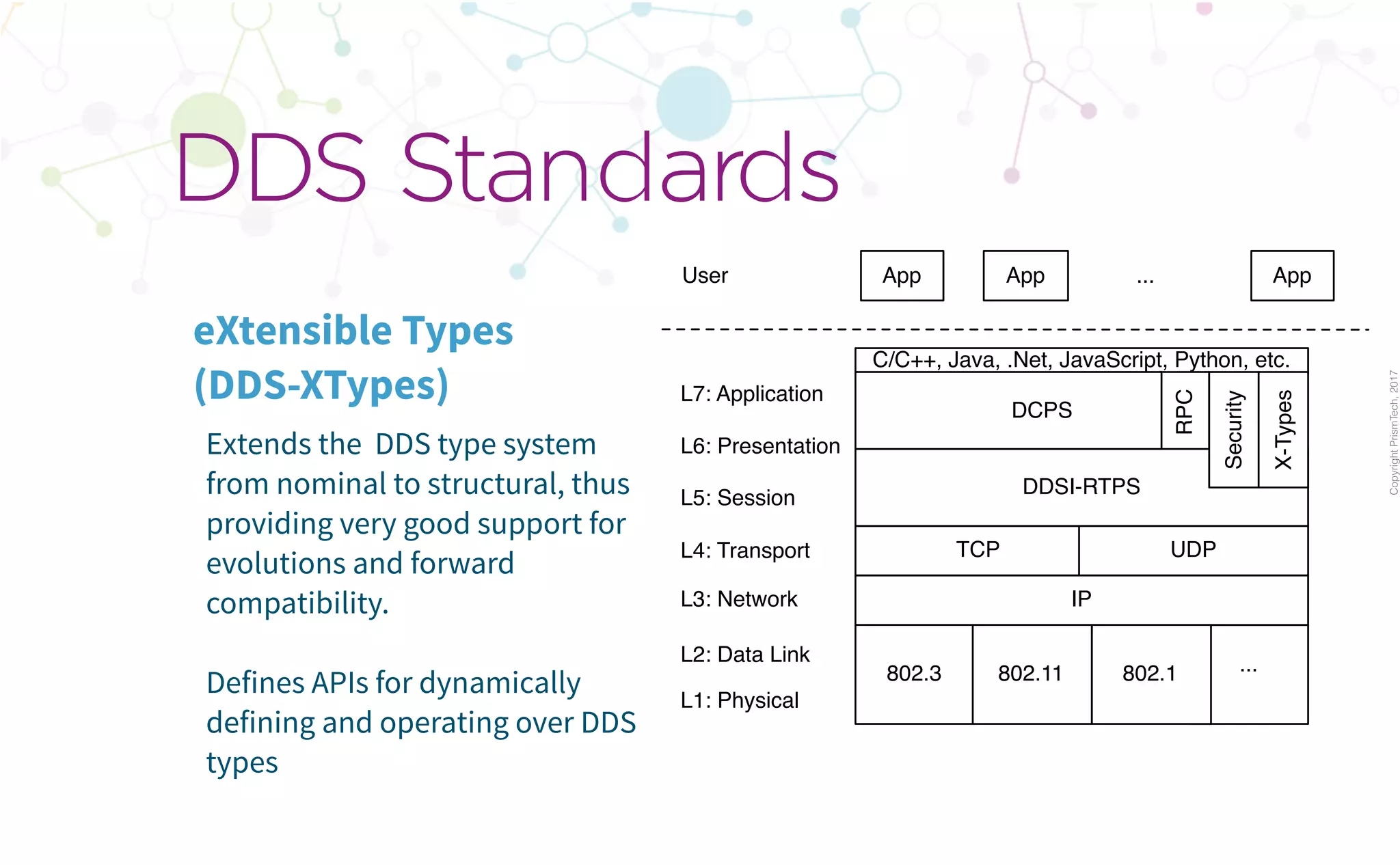
Extends the DDS type system
from nominal to structural, thus
providing very good support for
evolutions and forward
compatibility.
Defines APIs for dynamically
defining and operating over DDS
types
DDS Standards
eXtensible Types
(DDS-XTypes)
TCP UDP
IP
802.3 802.11
DDSI-RTPS
L3: Network
App App App
L2: Data Link
L1: Physical
L4: Transport
L5: Session
L6: Presentation
User
L7: Application
Security
X-Types
DCPS
RPC
...
802.1 ...
C/C++, Java, .Net, JavaScript, Python, etc.
CopyrightPrismTech,2017
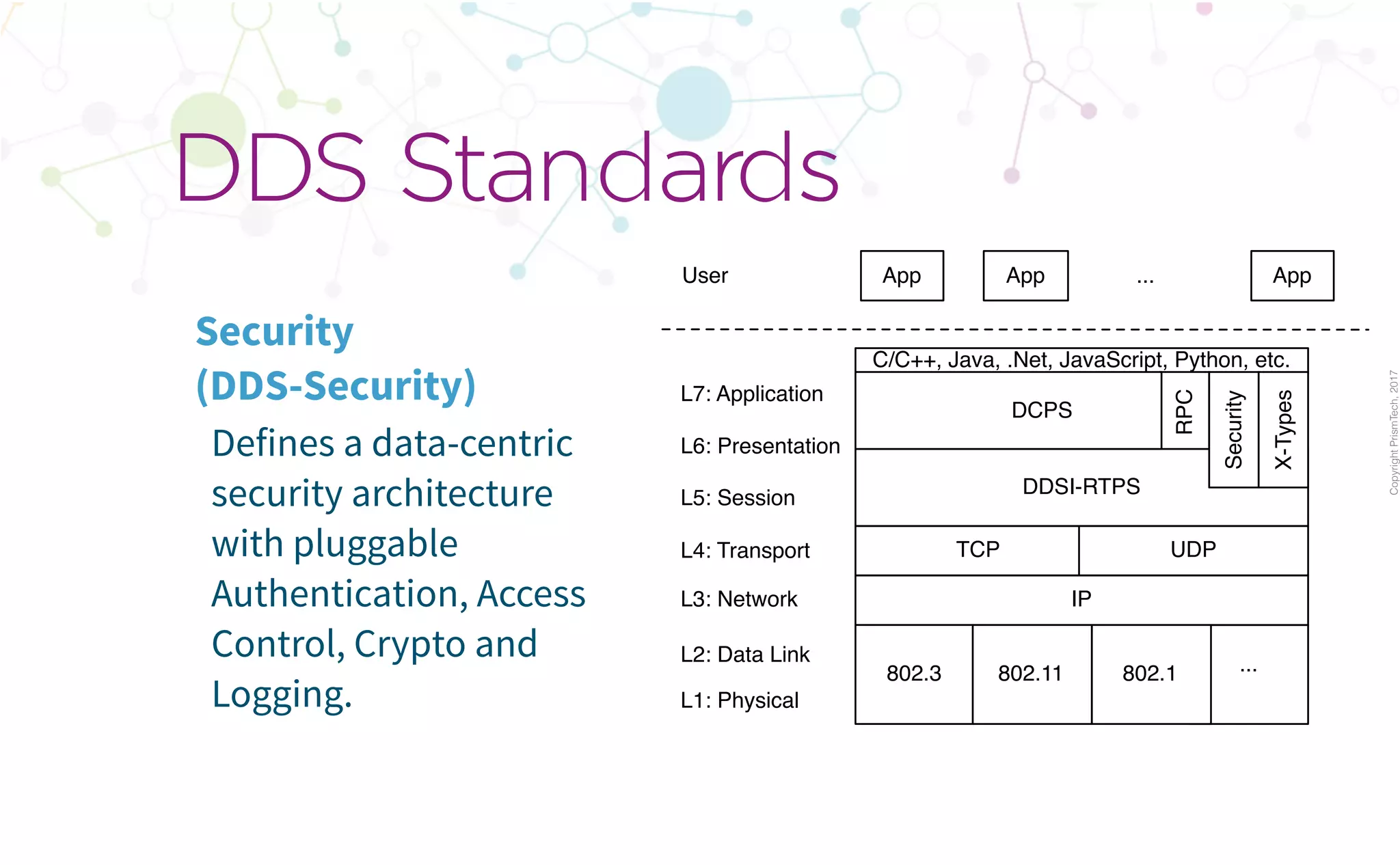
Defines a data-centric
security architecture
with pluggable
Authentication, Access
Control, Crypto and
Logging.
DDS Standards
Security
(DDS-Security)
TCP UDP
IP
802.3 802.11
DDSI-RTPS
L3: Network
App App App
L2: Data Link
L1: Physical
L4: Transport
L5: Session
L6: Presentation
User
L7: Application
Security
X-Types
DCPS
RPC
...
802.1 ...
C/C++, Java, .Net, JavaScript, Python, etc.
CopyrightPrismTech,2017
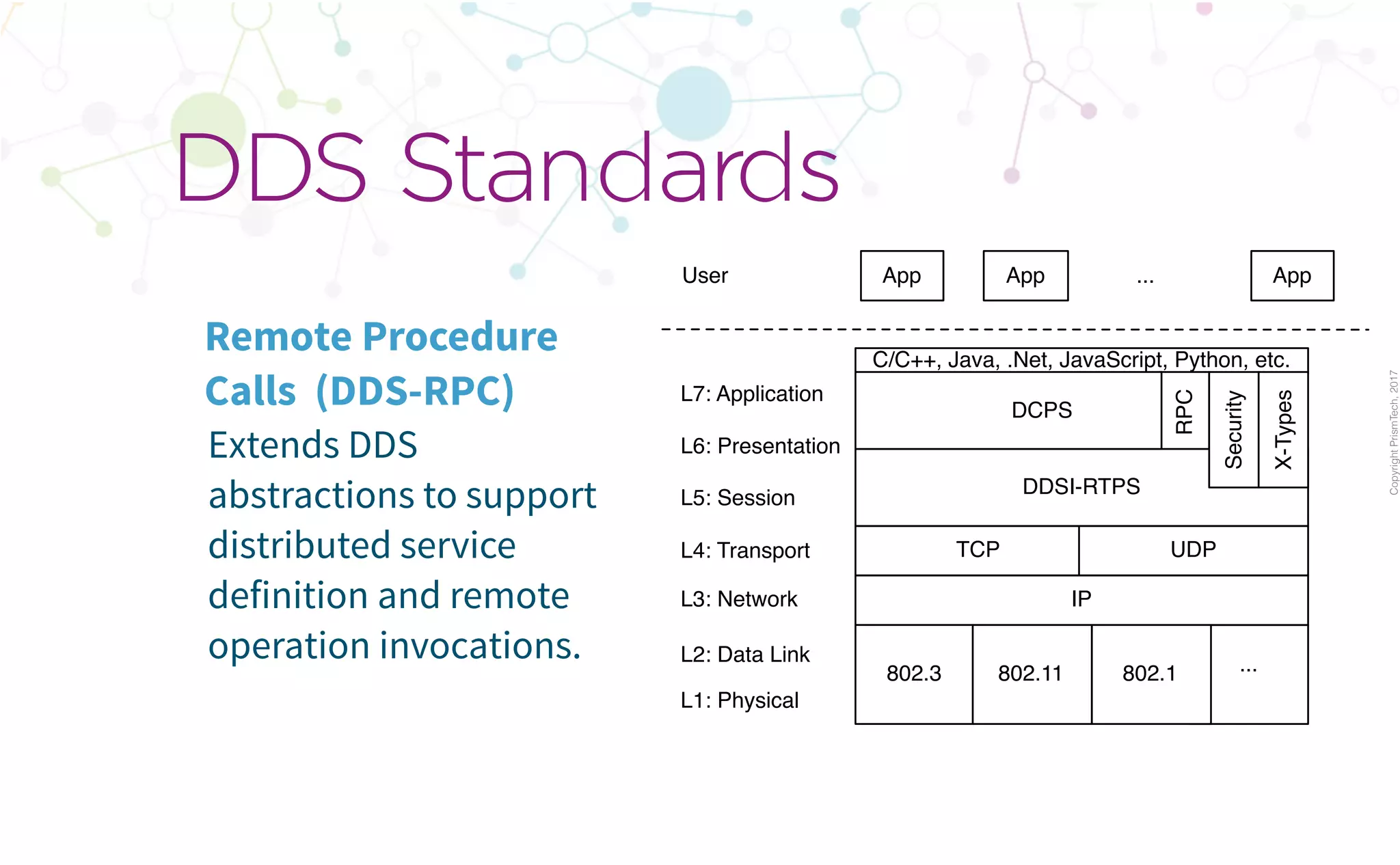
Extends DDS
abstractions to support
distributed service
definition and remote
operation invocations.
DDS Standards
Remote Procedure
Calls (DDS-RPC)
TCP UDP
IP
802.3 802.11
DDSI-RTPS
L3: Network
App App App
L2: Data Link
L1: Physical
L4: Transport
L5: Session
L6: Presentation
User
L7: Application
Security
X-Types
DCPS
RPC
...
802.1 ...
C/C++, Java, .Net, JavaScript, Python, etc.
CopyrightPrismTech,2017
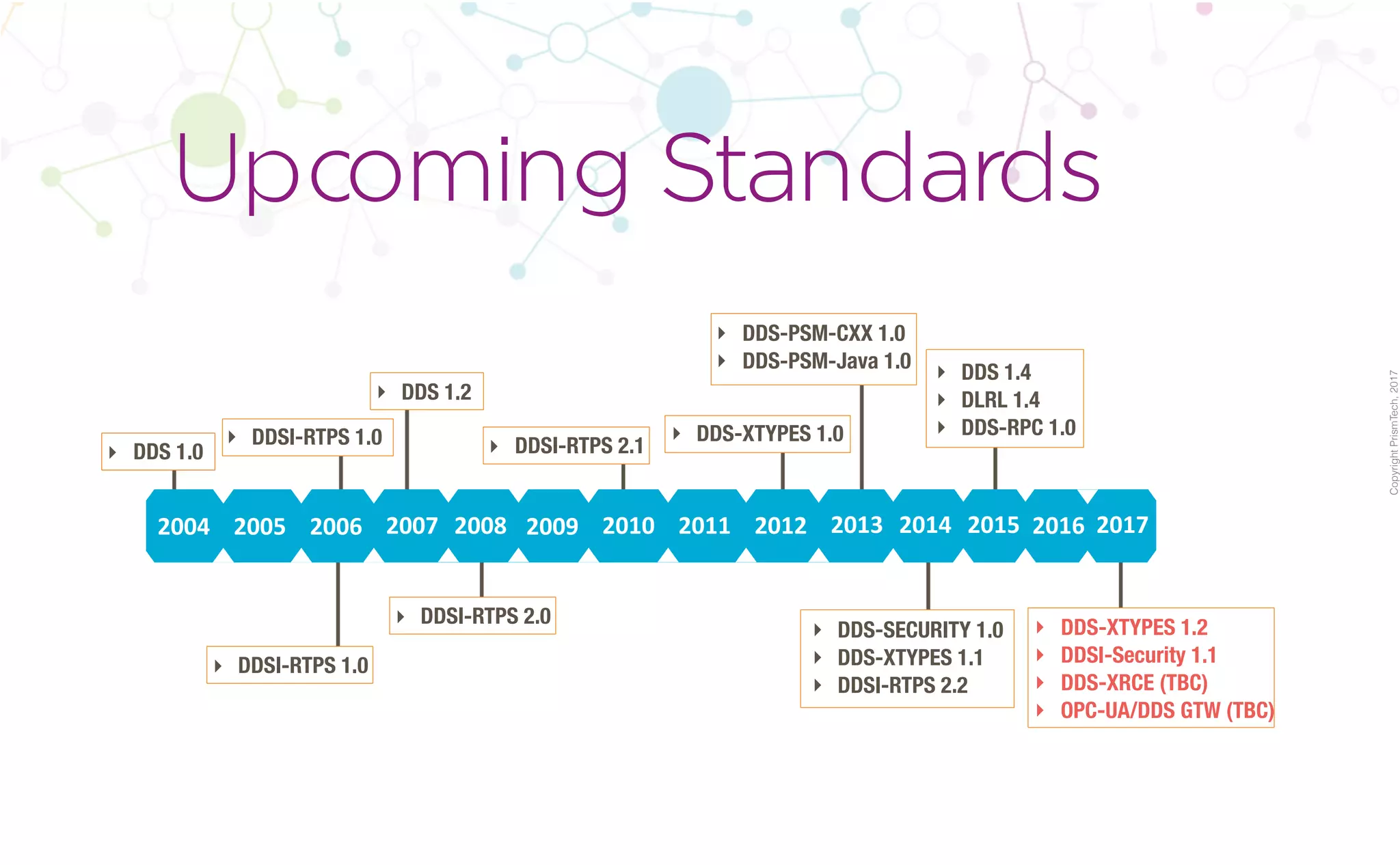
Upcoming Standards
2004 2005 2006 2007 2008 2009 2010 2011 2012 2013 2014 2015
‣ DDS 1.0
‣ DDSI-RTPS 1.0 ‣ DDS-XTYPES 1.0
‣ DDS-SECURITY 1.0
‣ DDS-XTYPES 1.1
‣ DDSI-RTPS 2.2
‣ DDS 1.4
‣ DLRL 1.4
‣ DDS-RPC 1.0
‣ DDSI-RTPS 2.0
‣ DDS 1.2
‣ DDS-PSM-CXX 1.0
‣ DDS-PSM-Java 1.0
‣ DDSI-RTPS 2.1
‣ DDSI-RTPS 1.0
2016 2017
‣ DDS-XTYPES 1.2
‣ DDSI-Security 1.1
‣ DDS-XRCE (TBC)
‣ OPC-UA/DDS GTW (TBC)
CopyrightPrismTech,2017
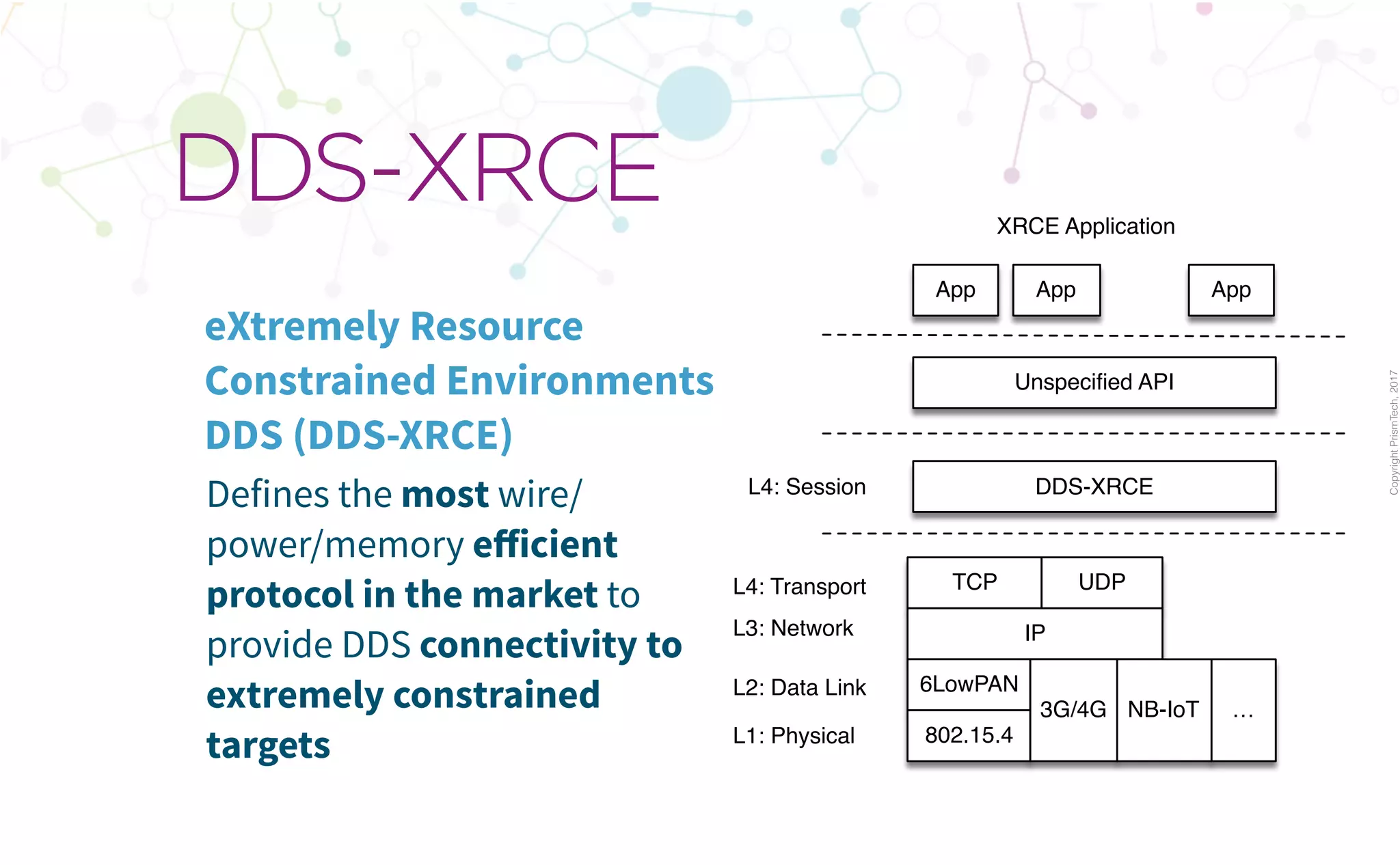
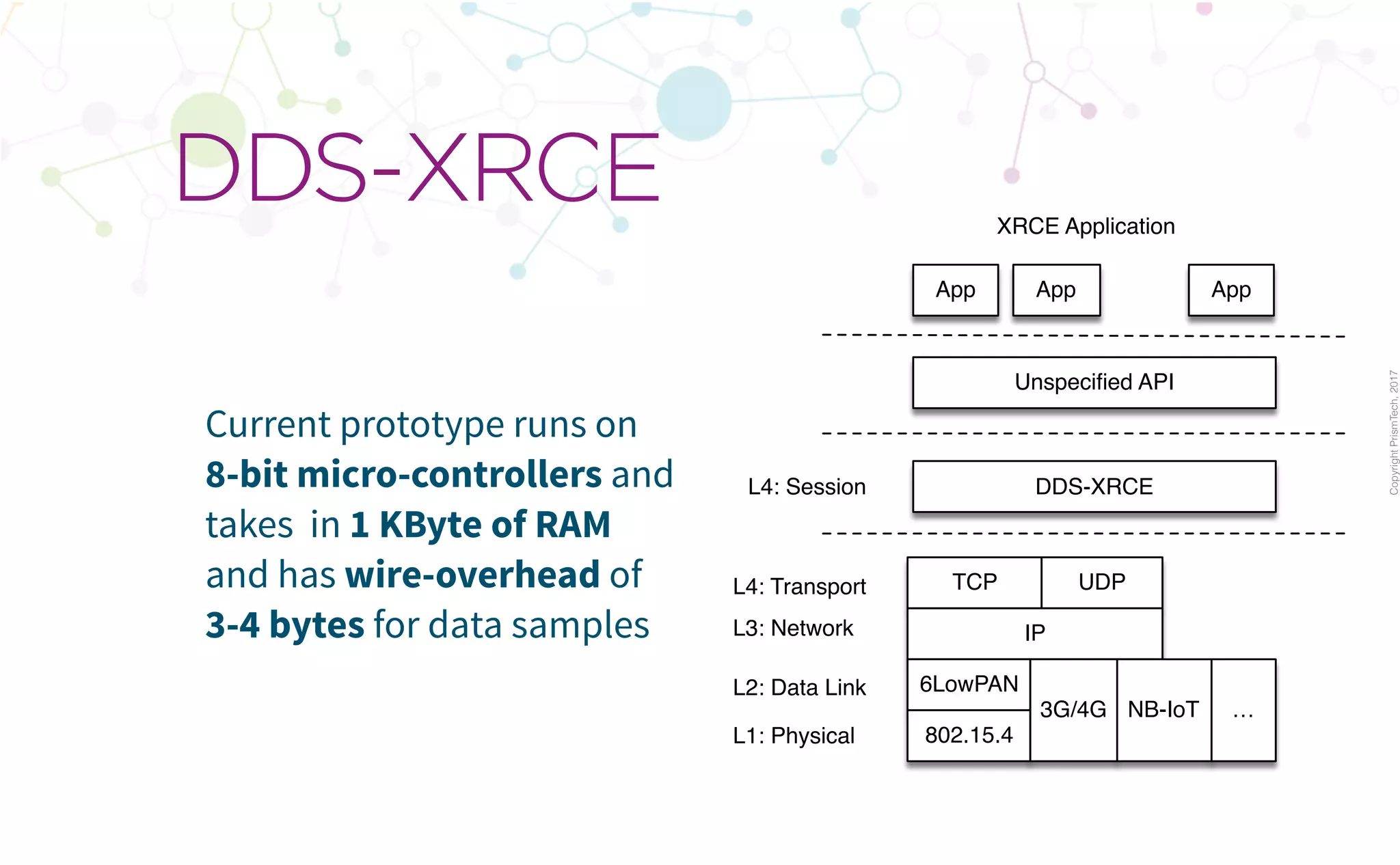
Defines the most wire/
power/memory efficient
protocol in the market to
provide DDS connectivity to
extremely constrained
targets
DDS-XRCE
eXtremely Resource
Constrained Environments
DDS (DDS-XRCE)
DDS-XRCE
XRCE Application
L3: Network
TCP UDP
IP
6LowPAN
802.15.4
NB-IoT3G/4G
Unspecified API
App App App
L2: Data Link
L1: Physical
L4: Transport
L4: Session
…
CopyrightPrismTech,2017
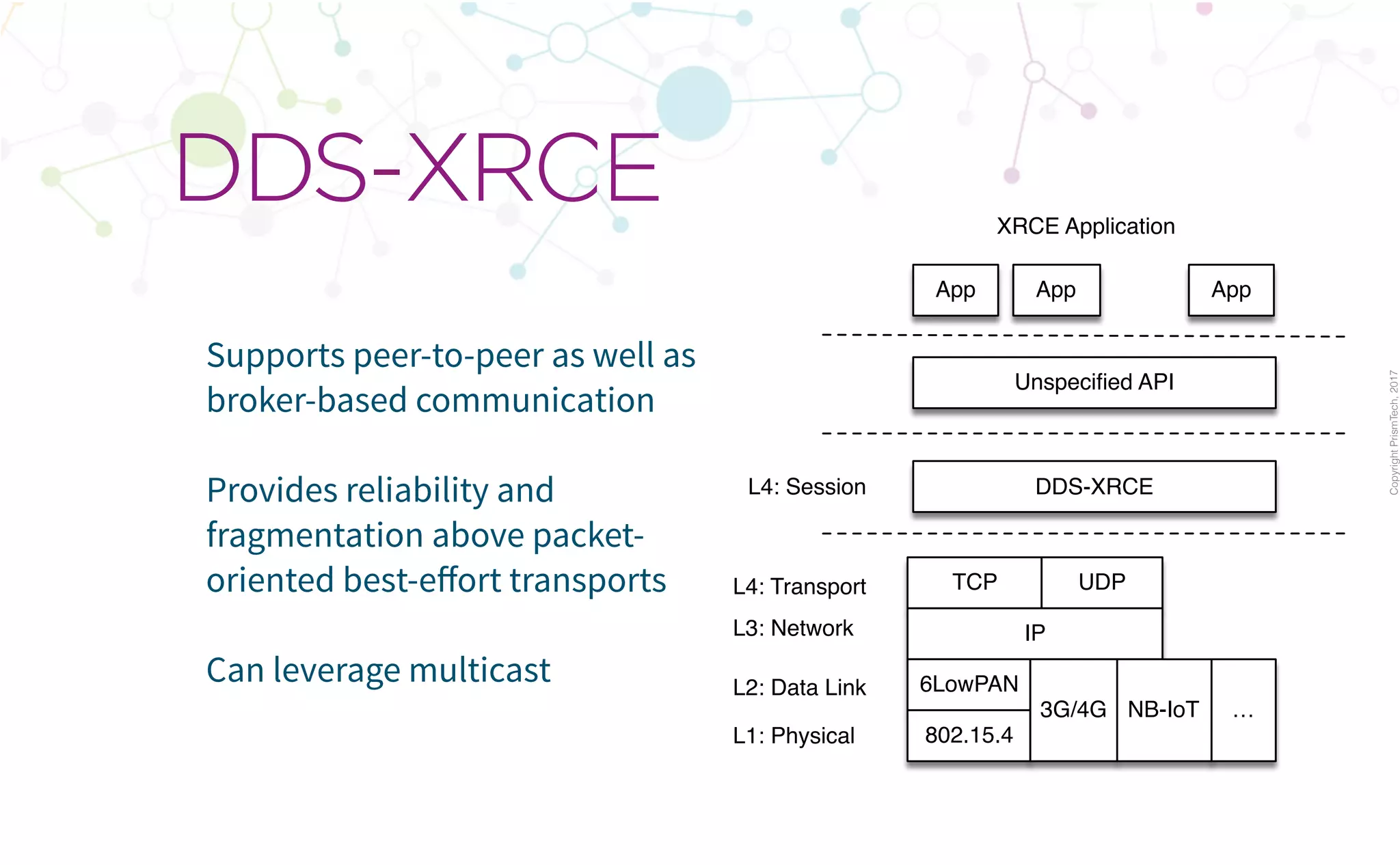
Supports peer-to-peer as well as
broker-based communication
Provides reliability and
fragmentation above packet-
oriented best-effort transports
Can leverage multicast
DDS-XRCE
DDS-XRCE
XRCE Application
L3: Network
TCP UDP
IP
6LowPAN
802.15.4
NB-IoT3G/4G
Unspecified API
App App App
L2: Data Link
L1: Physical
L4: Transport
L4: Session
…
CopyrightPrismTech,2017
Current prototype runs on
8-bit micro-controllers and
takes in 1 KByte of RAM
and has wire-overhead of
3-4 bytes for data samples
DDS-XRCE
DDS-XRCE
XRCE Application
L3: Network
TCP UDP
IP
6LowPAN
802.15.4
NB-IoT3G/4G
Unspecified API
App App App
L2: Data Link
L1: Physical
L4: Transport
L4: Session
…
CopyrightPrismTech,2017
DDS Standard in IIoT
CopyrightPrismTech,2017
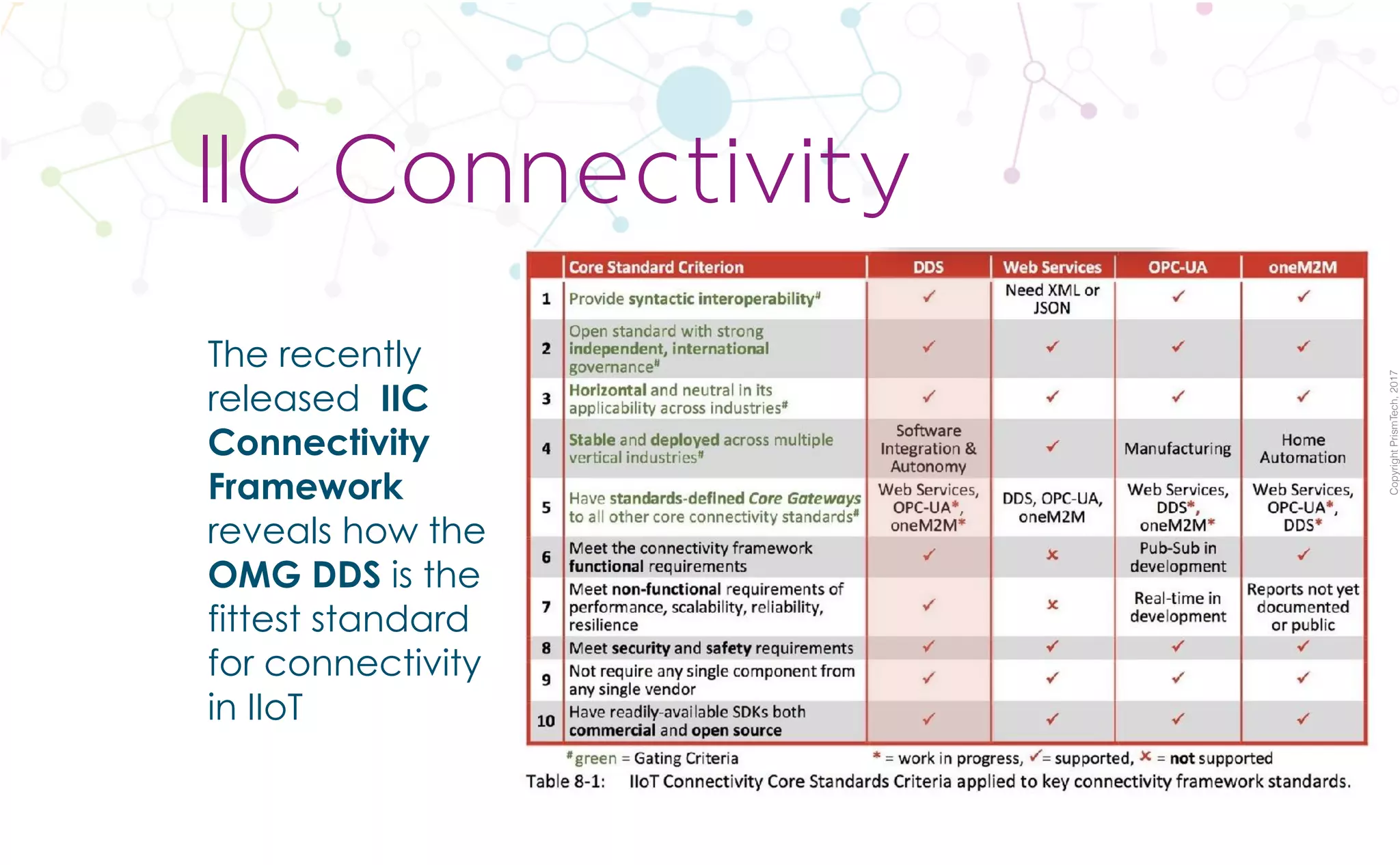
The recently
released IIC
Connectivity
Framework
reveals how the
OMG DDS is the
fittest standard
for connectivity
in IIoT
IIC Connectivity
CopyrightPrismTech,2017
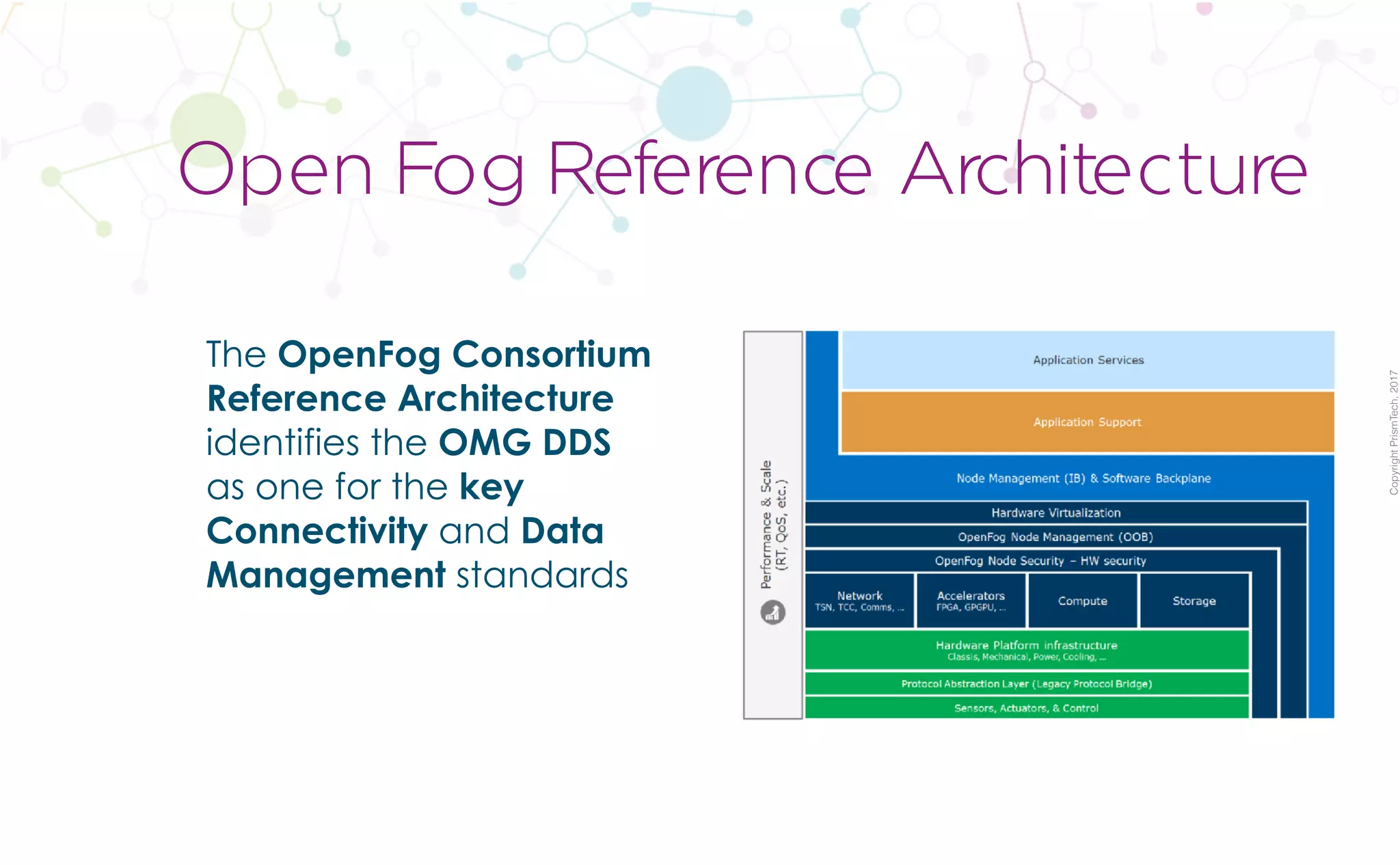
The OpenFog Consortium
Reference Architecture
identifies the OMG DDS
as one for the key
Connectivity and Data
Management standards
Open Fog Reference Architecture
CopyrightPrismTech,2017
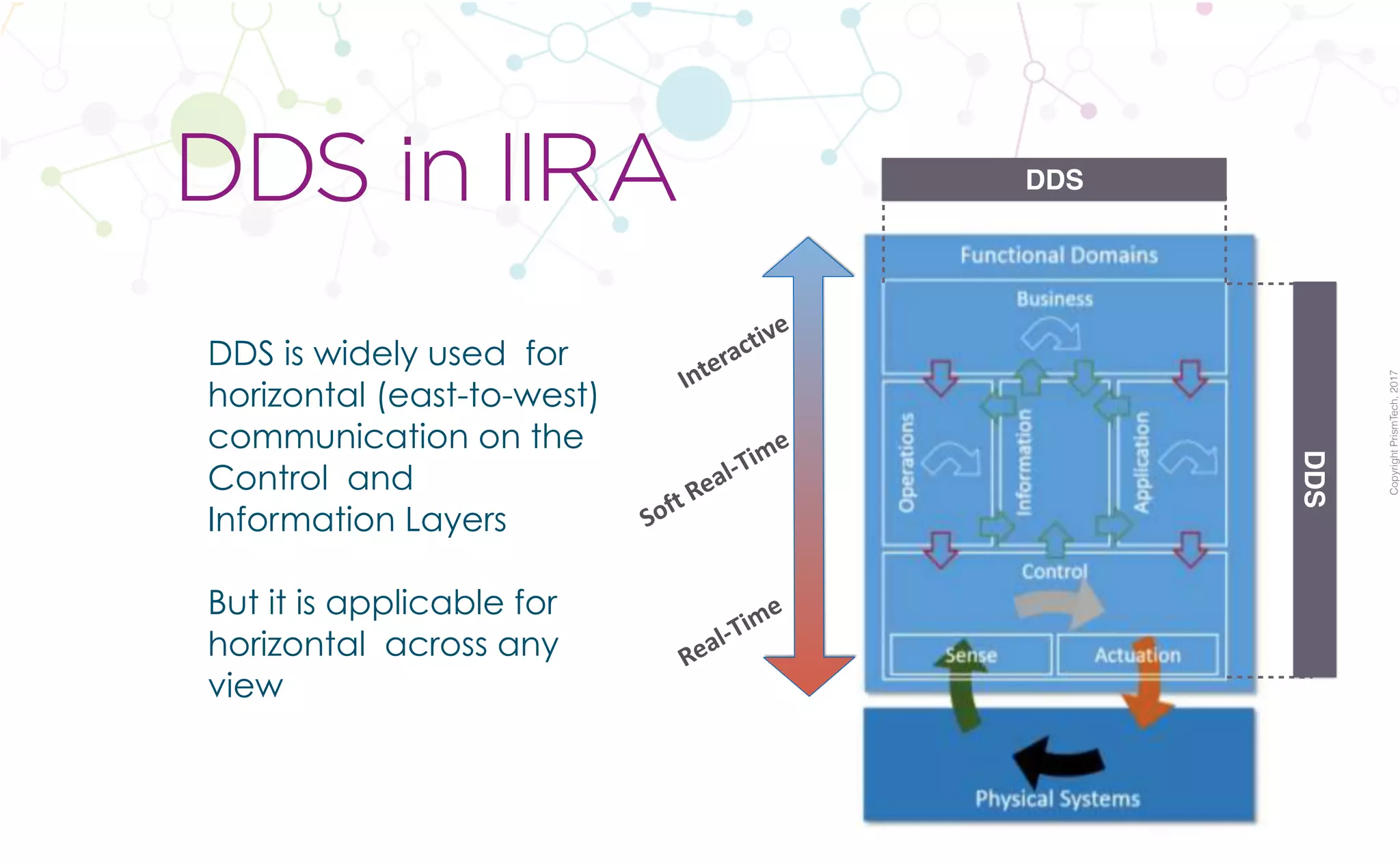
DDS is widely used for
horizontal (east-to-west)
communication on the
Control and
Information Layers
But it is applicable for
horizontal across any
view
DDS in IIRA
Real-Time
Soft	Real-Time
Interactive
DDS
DDS
CopyrightPrismTech,2017
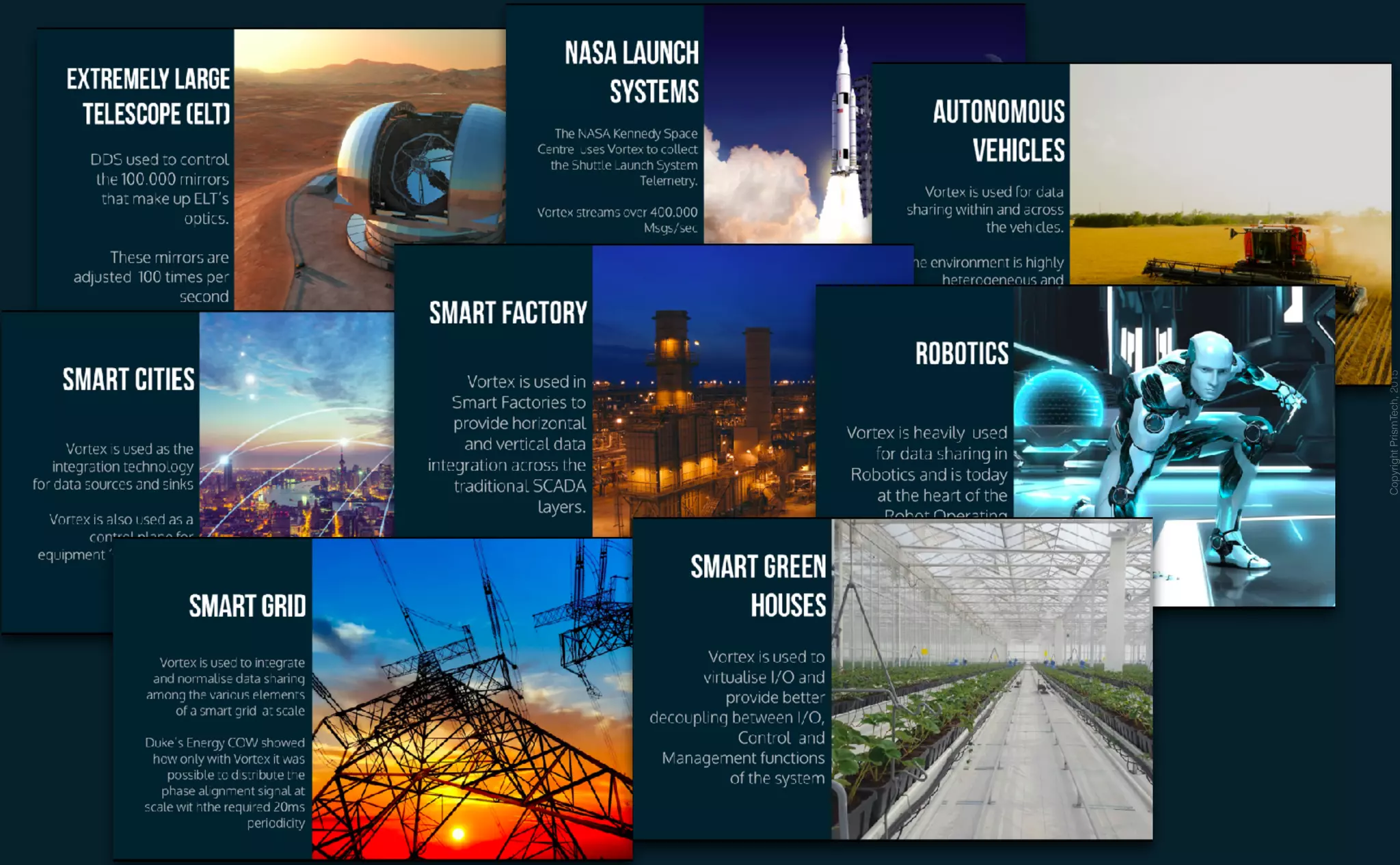
Who is using DDS?
CopyrightPrismTech,2015
Abstractions
CopyrightPrismTech,2017
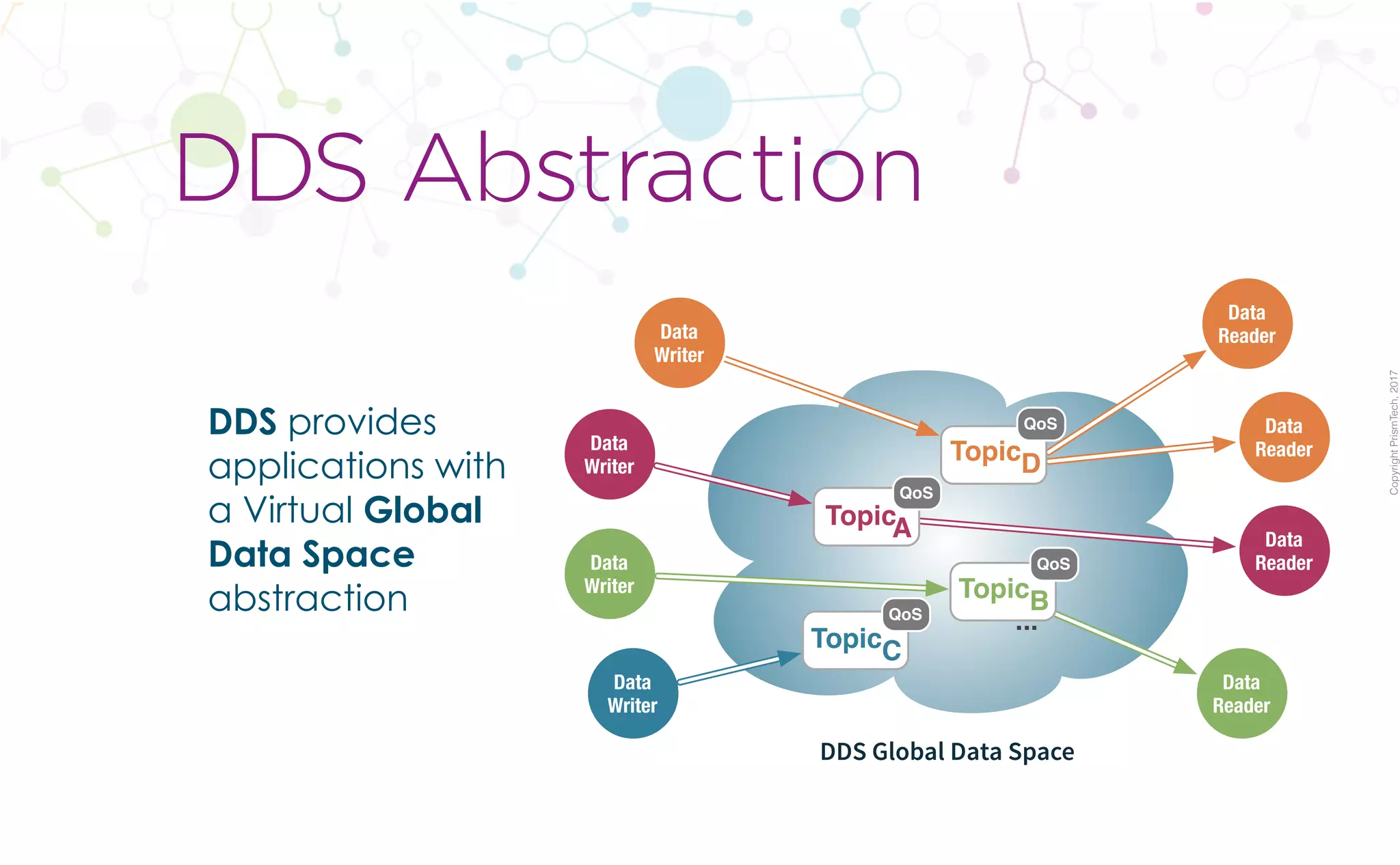
DDS provides
applications with
a Virtual Global
Data Space
abstraction
DDS Abstraction
DDS Global Data Space
...
Data
Writer
Data
Writer
Data
Writer
Data
Reader
Data
Reader
Data
Reader
Data
Reader
Data
Writer
TopicA
QoS
TopicB
QoS
TopicC
QoS
TopicD
QoS
CopyrightPrismTech,2017
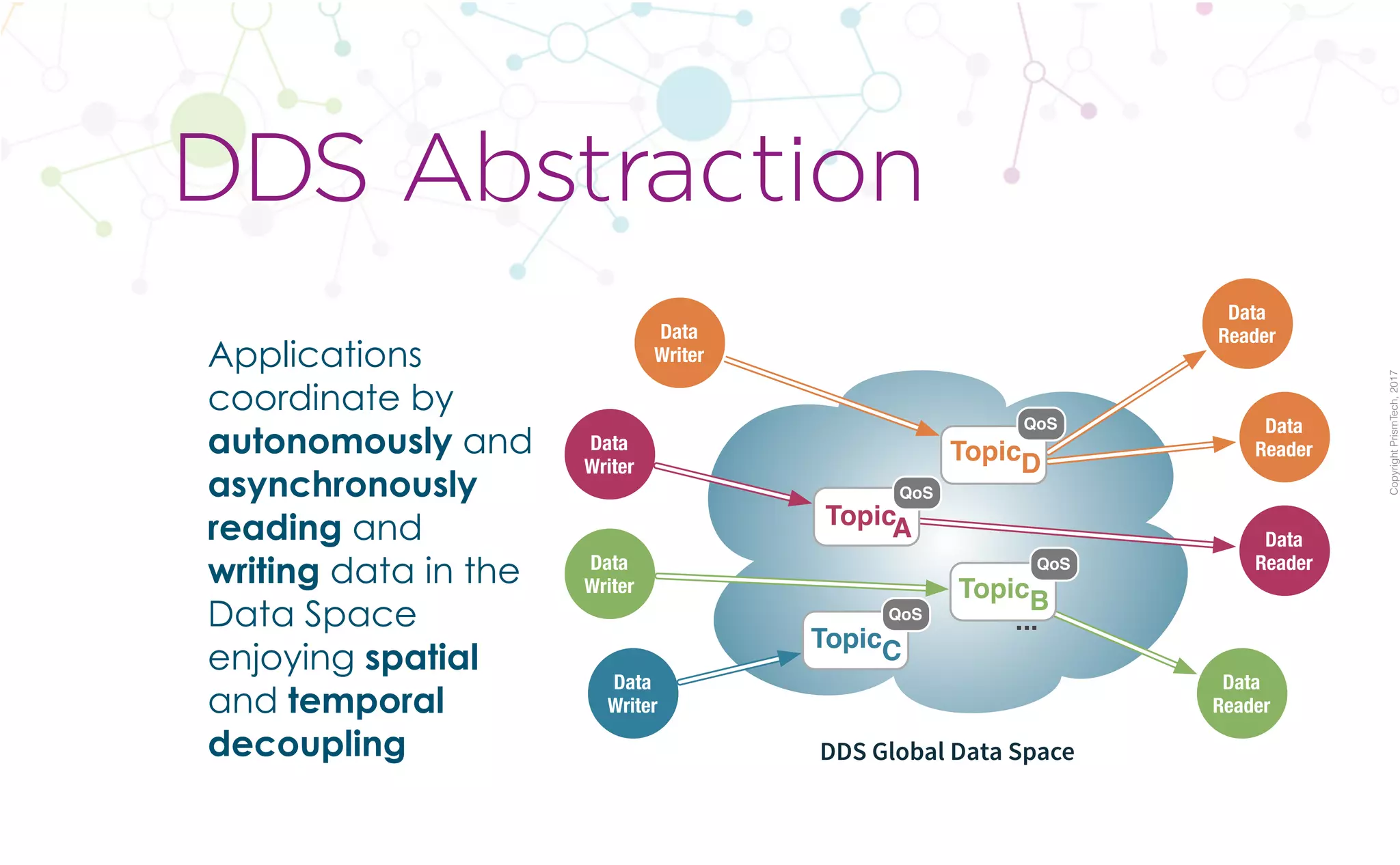
Applications
coordinate by
autonomously and
asynchronously
reading and
writing data in the
Data Space
enjoying spatial
and temporal
decoupling
DDS Abstraction
DDS Global Data Space
...
Data
Writer
Data
Writer
Data
Writer
Data
Reader
Data
Reader
Data
Reader
Data
Reader
Data
Writer
TopicA
QoS
TopicB
QoS
TopicC
QoS
TopicD
QoS
CopyrightPrismTech,2017
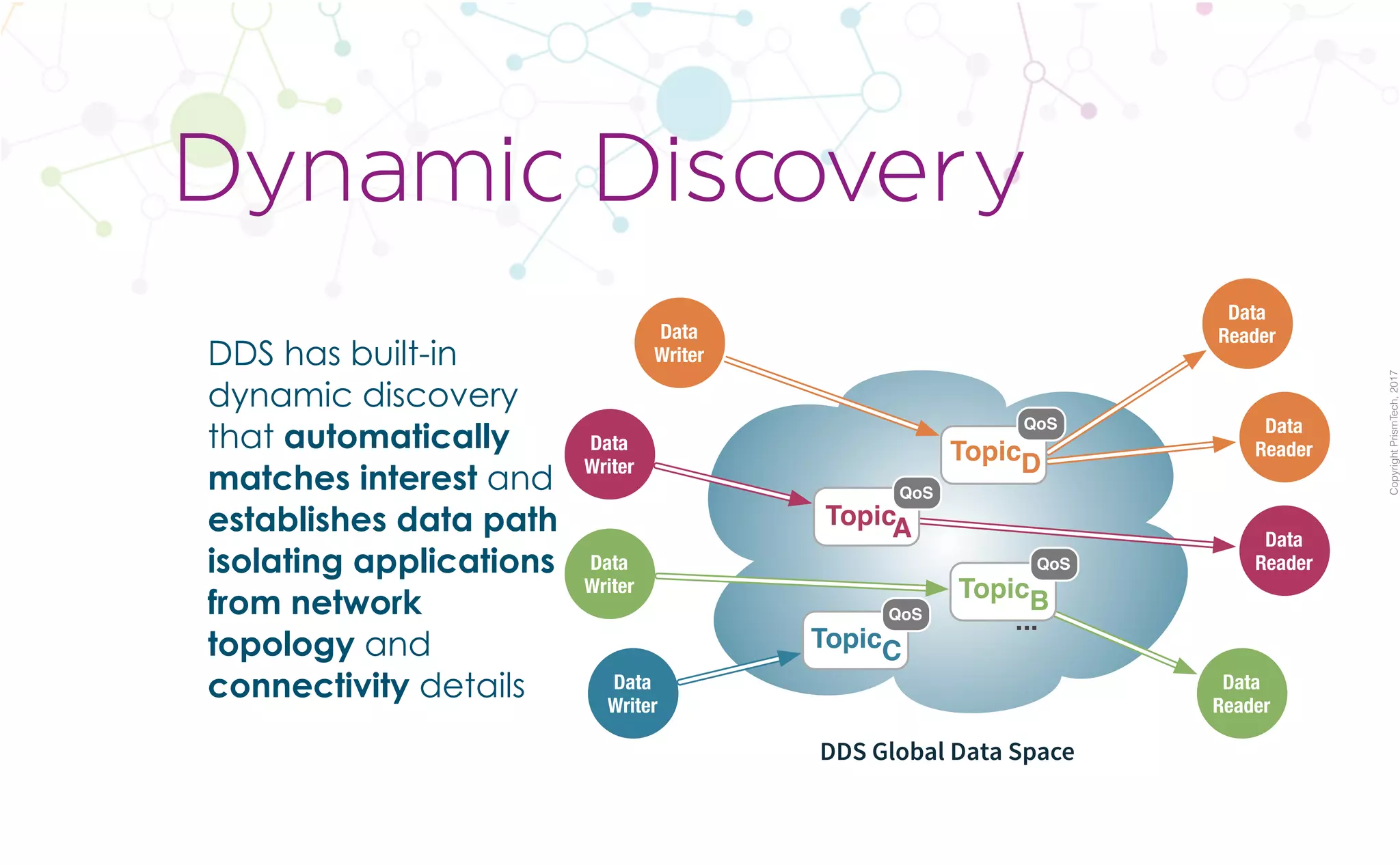
DDS has built-in
dynamic discovery
that automatically
matches interest and
establishes data path
isolating applications
from network
topology and
connectivity details
Dynamic Discovery
DDS Global Data Space
...
Data
Writer
Data
Writer
Data
Writer
Data
Reader
Data
Reader
Data
Reader
Data
Reader
Data
Writer
TopicA
QoS
TopicB
QoS
TopicC
QoS
TopicD
QoS
CopyrightPrismTech,2017
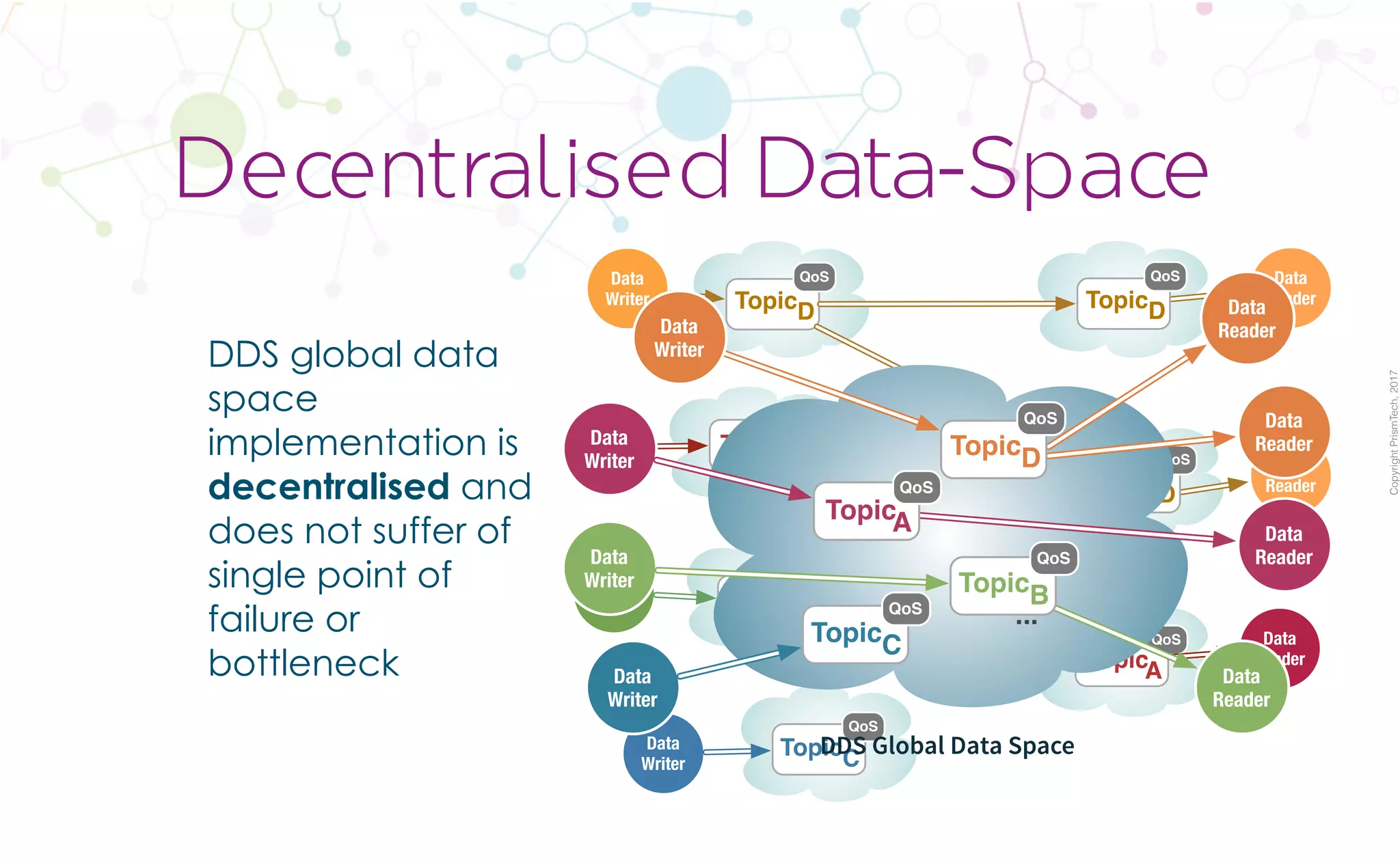
DDS global data
space
implementation is
decentralised and
does not suffer of
single point of
failure or
bottleneck
Decentralised Data-Space
Data
Writer
Data
Writer
Data
Writer
Data
Reader
Data
Reader
Data
Reader
Data
Writer
TopicA
QoS
TopicB
QoS
TopicC
QoS
TopicD
QoS
TopicD
QoS
TopicD
QoS
TopicA
QoS
DDS Global Data Space
...
Data
Writer
Data
Writer
Data
Writer
Data
Reader
Data
Reader
Data
Reader
Data
Reader
Data
Writer
TopicA
QoS
TopicB
QoS
TopicC
QoS
TopicD
QoS
CopyrightPrismTech,2017
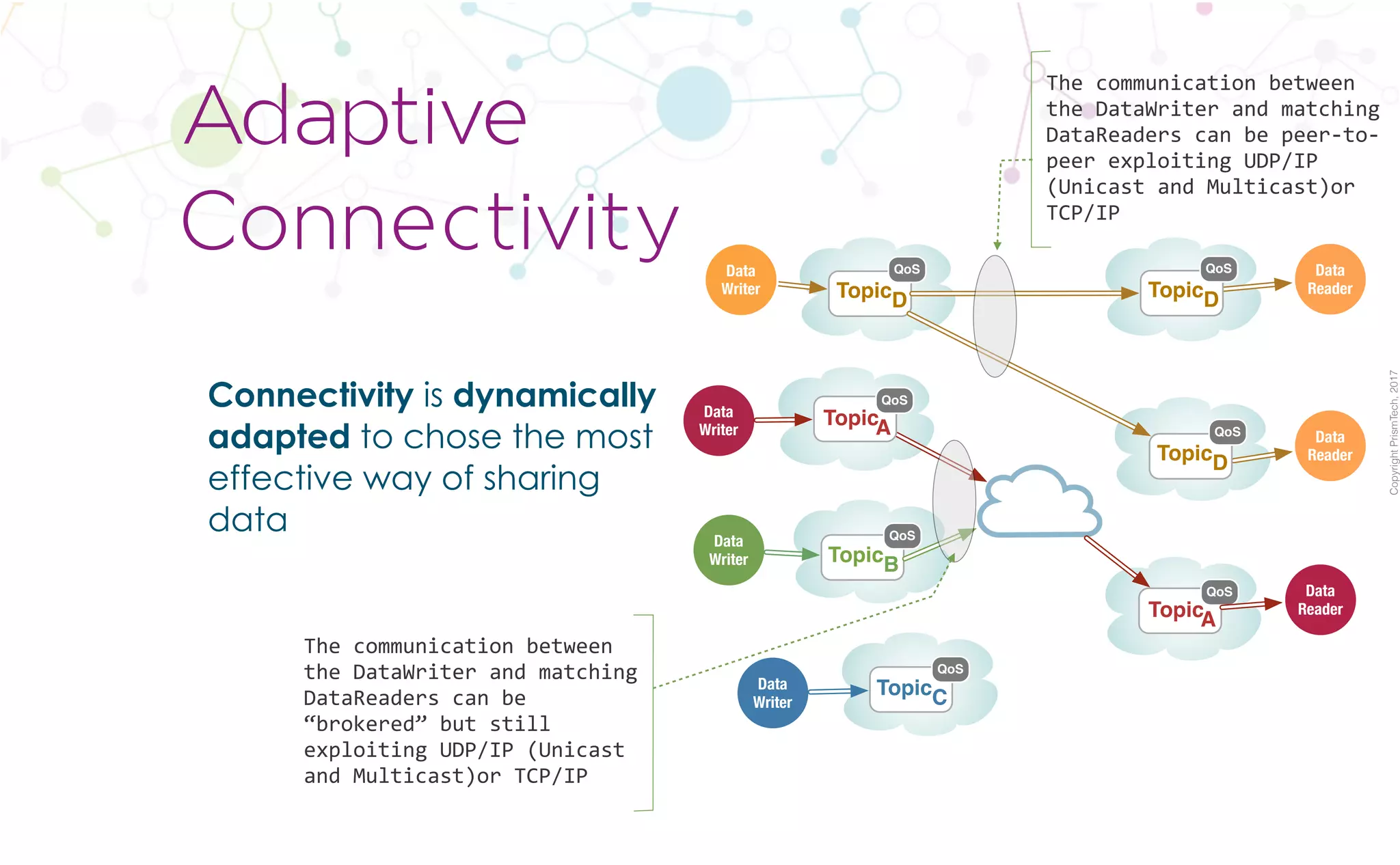
Connectivity is dynamically
adapted to chose the most
effective way of sharing
data
Adaptive 

Connectivity
Data
Writer
Data
Writer
Data
Writer
Data
Reader
Data
Reader
Data
Reader
Data
Writer
TopicA
QoS
TopicB
QoS
TopicC
QoS
TopicD
QoS
TopicD
QoS
TopicD
QoS
TopicA
QoS
The	communication	between	
the	DataWriter	and	matching	
DataReaders	can	be	peer-to-
peer	exploiting	UDP/IP	
(Unicast	and	Multicast)or	
TCP/IP
The	communication	between	
the	DataWriter	and	matching	
DataReaders	can	be	
“brokered”	but	still	
exploiting	UDP/IP	(Unicast	
and	Multicast)or	TCP/IP
Information Organisation
CopyrightPrismTech,2017
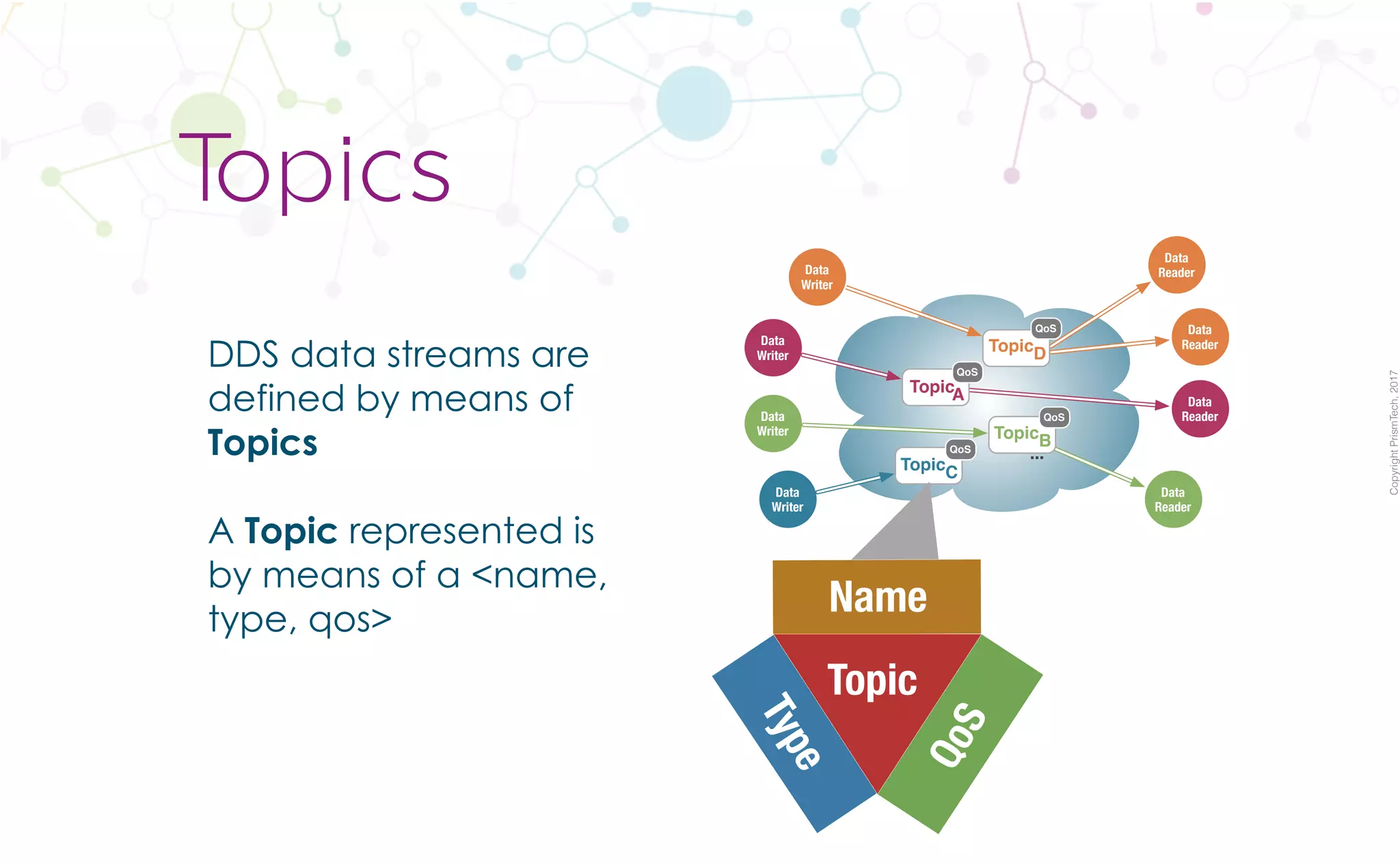
DDS data streams are
defined by means of
Topics
A Topic represented is
by means of a <name,
type, qos>
Topics
DDS Global Data Space
...
Data
Writer
Data
Writer
Data
Writer
Data
Reader
Data
Reader
Data
Reader
Data
Reader
Data
Writer
TopicA
QoS
TopicB
QoS
TopicC
QoS
TopicD
QoS
Topic
Type
Name
QoS
CopyrightPrismTech,2017
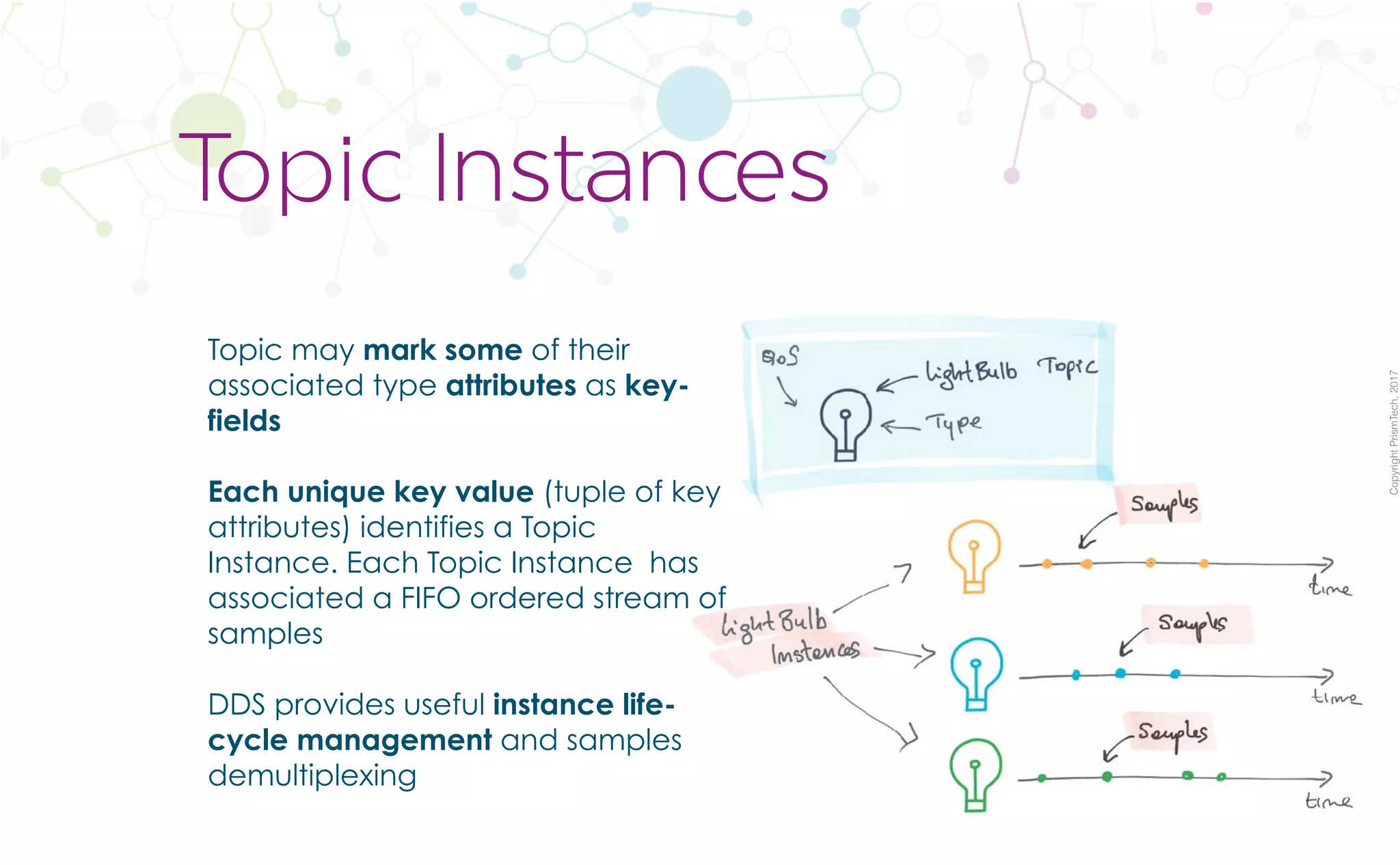
Topic may mark some of their
associated type attributes as key-
fields
Each unique key value (tuple of key
attributes) identifies a Topic
Instance. Each Topic Instance has
associated a FIFO ordered stream of
samples
DDS provides useful instance life-
cycle management and samples
demultiplexing
Topic Instances
CopyrightPrismTech,2017
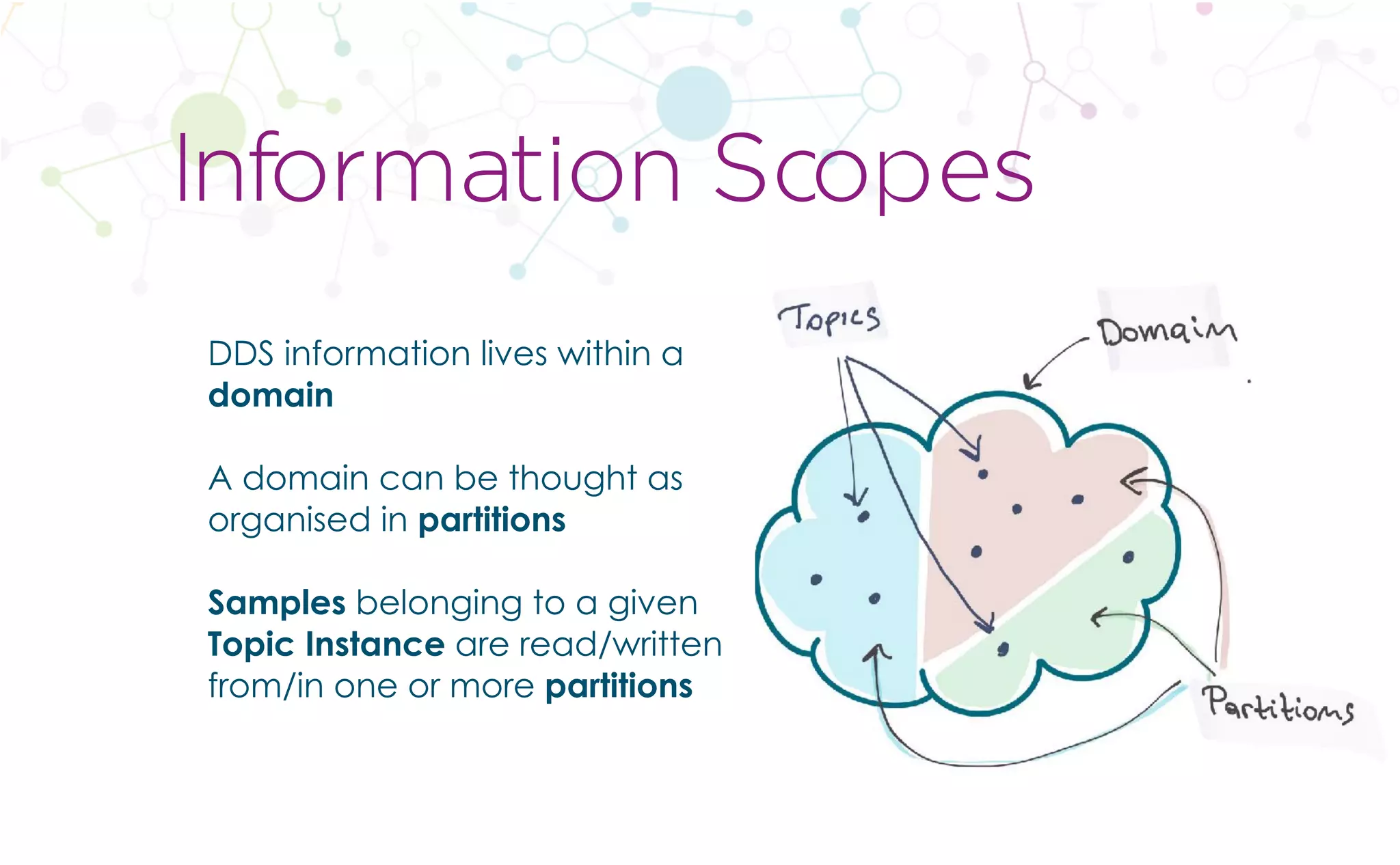
DDS information lives within a
domain
A domain can be thought as
organised in partitions
Samples belonging to a given
Topic Instance are read/written
from/in one or more partitions
Information Scopes
CopyrightPrismTech,2017
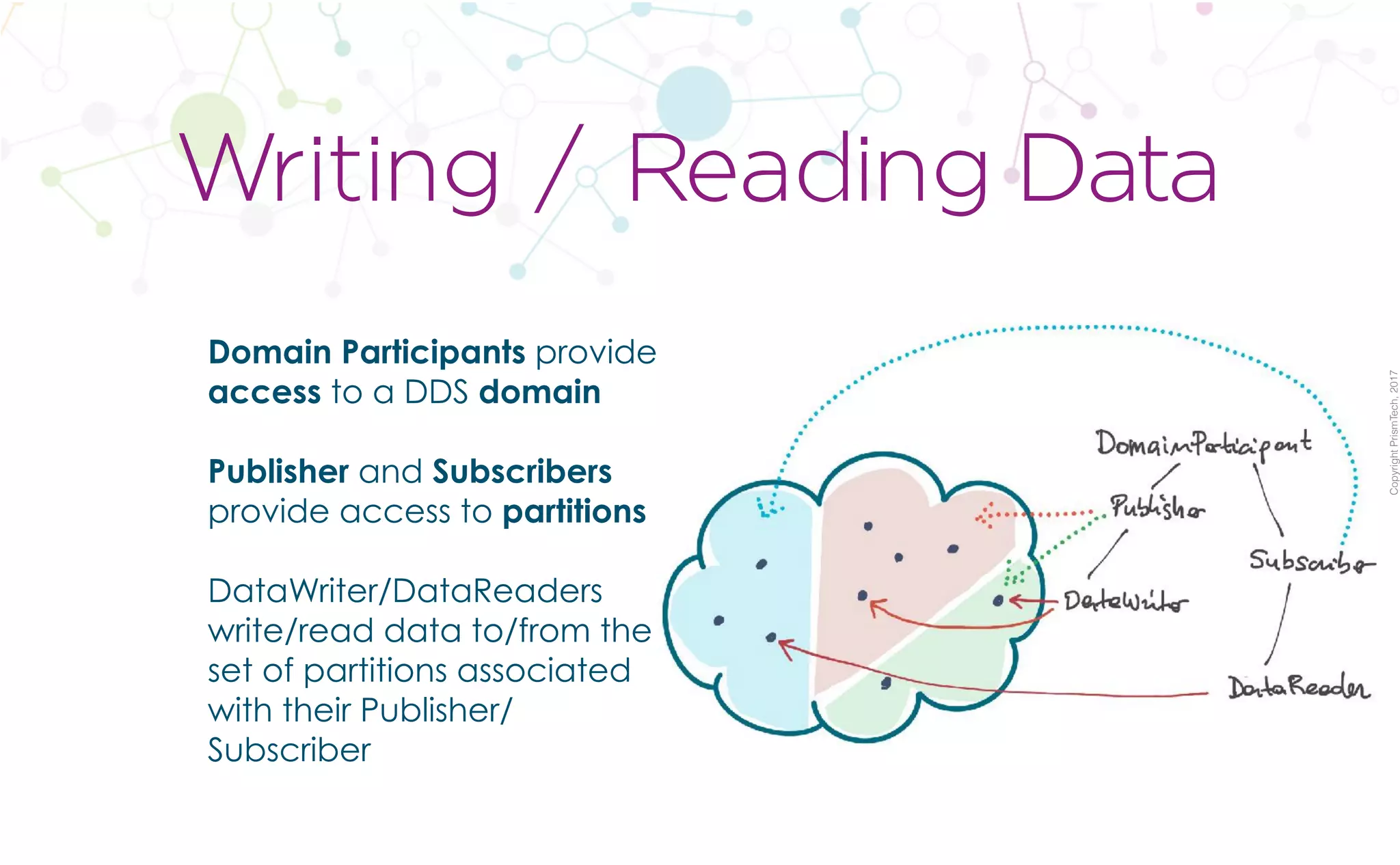
Domain Participants provide
access to a DDS domain
Publisher and Subscribers
provide access to partitions
DataWriter/DataReaders
write/read data to/from the
set of partitions associated
with their Publisher/
Subscriber
Writing / Reading Data
Content Awareness
CopyrightPrismTech,2017
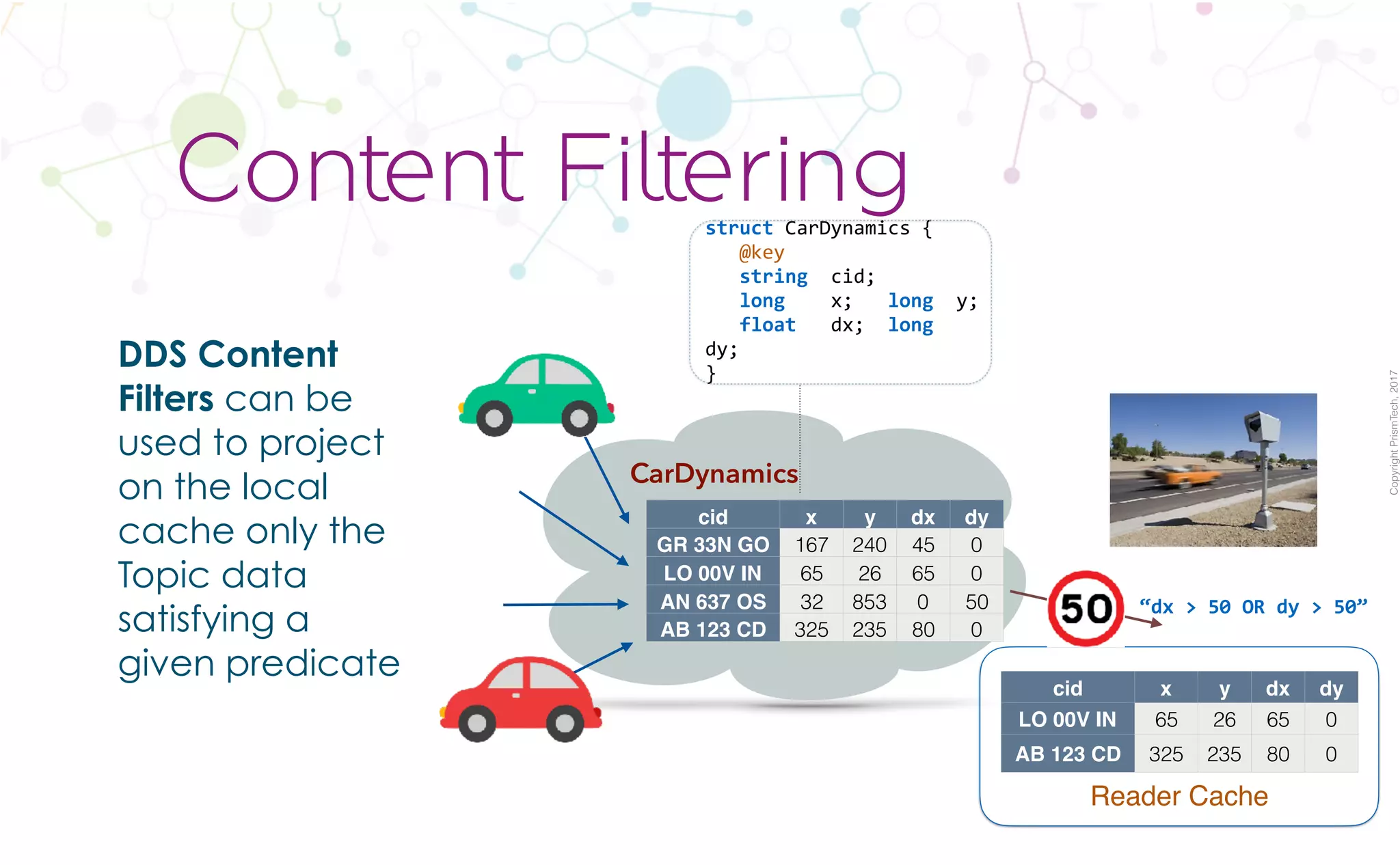
DDS Content
Filters can be
used to project
on the local
cache only the
Topic data
satisfying a
given predicate
Content Filteringstruct	CarDynamics	{	
			@key	
			string		cid;	
			long				x;			long		y;	
			float			dx;		long		
dy;	
}
cid x y dx dy
GR 33N GO 167 240 45 0
LO 00V IN 65 26 65 0
AN 637 OS 32 853 0 50
AB 123 CD 325 235 80 0
“dx	>	50	OR	dy	>	50”
CarDynamics
cid x y dx dy
LO 00V IN 65 26 65 0
AB 123 CD 325 235 80 0
Reader Cache
CopyrightPrismTech,2017
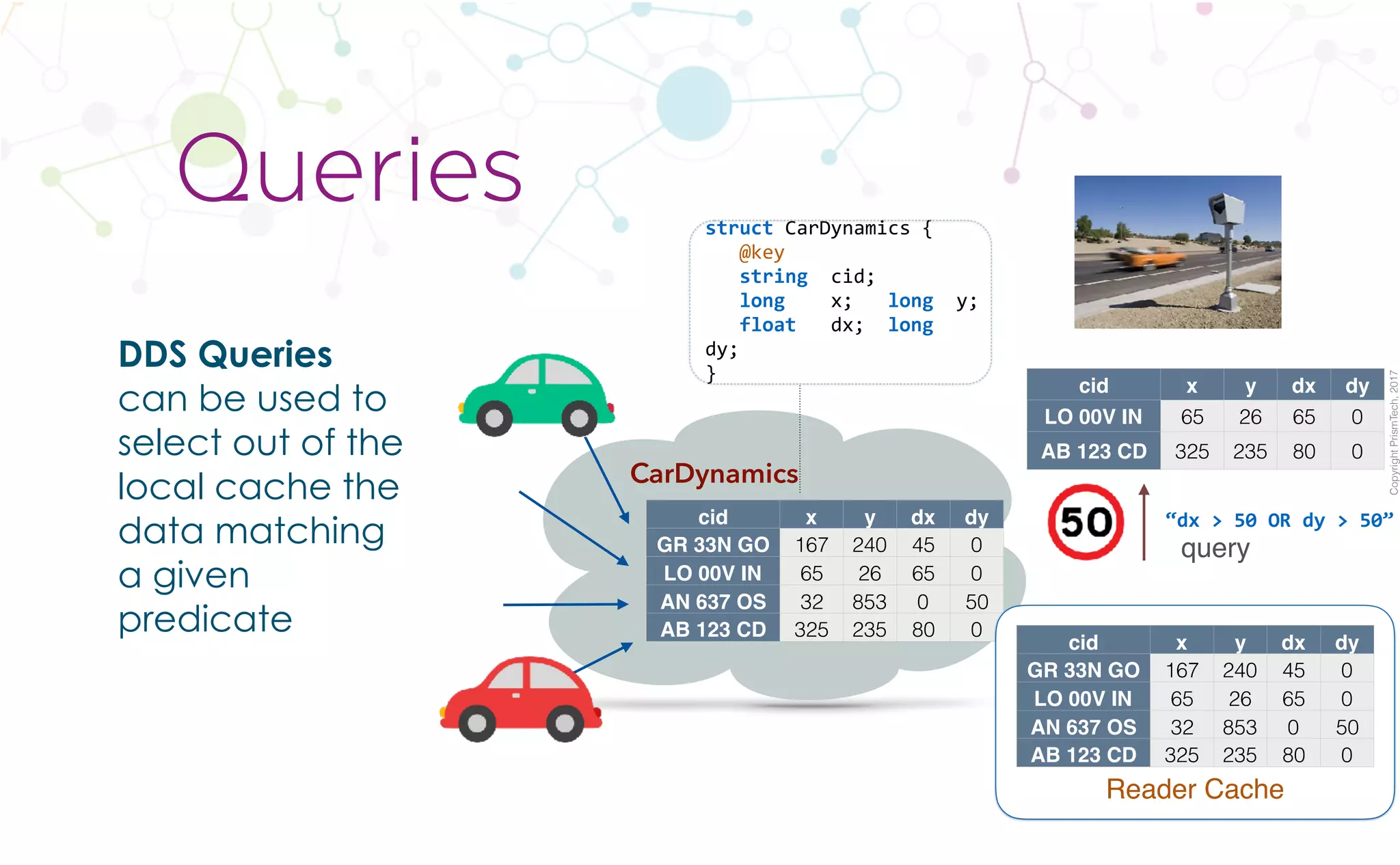
DDS Queries
can be used to
select out of the
local cache the
data matching
a given
predicate
Queries struct	CarDynamics	{	
			@key	
			string		cid;	
			long				x;			long		y;	
			float			dx;		long		
dy;	
}
cid x y dx dy
GR 33N GO 167 240 45 0
LO 00V IN 65 26 65 0
AN 637 OS 32 853 0 50
AB 123 CD 325 235 80 0
CarDynamics
Reader Cache
“dx	>	50	OR	dy	>	50”
cid x y dx dy
GR 33N GO 167 240 45 0
LO 00V IN 65 26 65 0
AN 637 OS 32 853 0 50
AB 123 CD 325 235 80 0
cid x y dx dy
LO 00V IN 65 26 65 0
AB 123 CD 325 235 80 0
query
Stream Durability
CopyrightPrismTech,2017
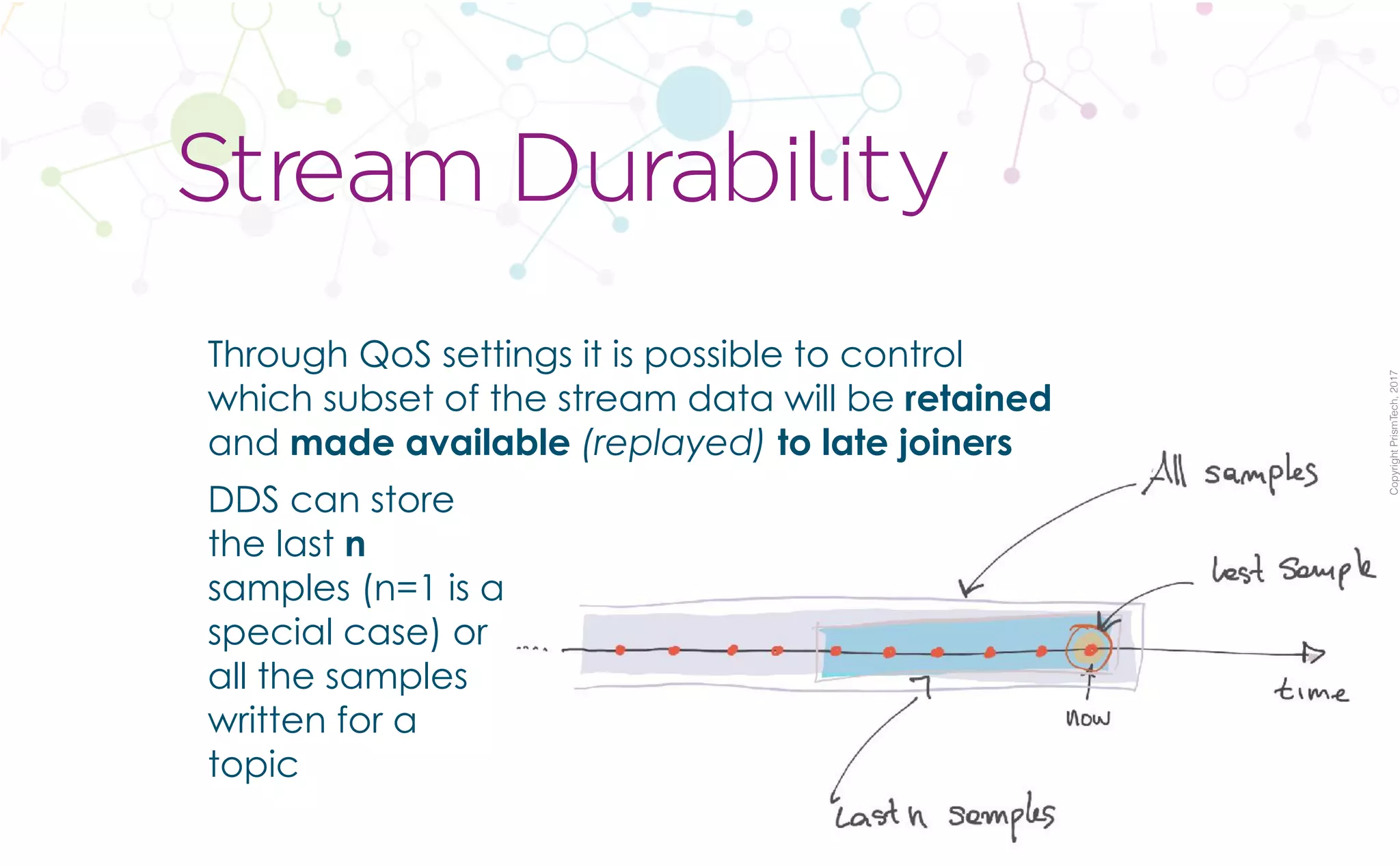
Through QoS settings it is possible to control
which subset of the stream data will be retained
and made available (replayed) to late joiners
Stream Durability
DDS can store
the last n
samples (n=1 is a
special case) or
all the samples
written for a
topic
CopyrightPrismTech,2017
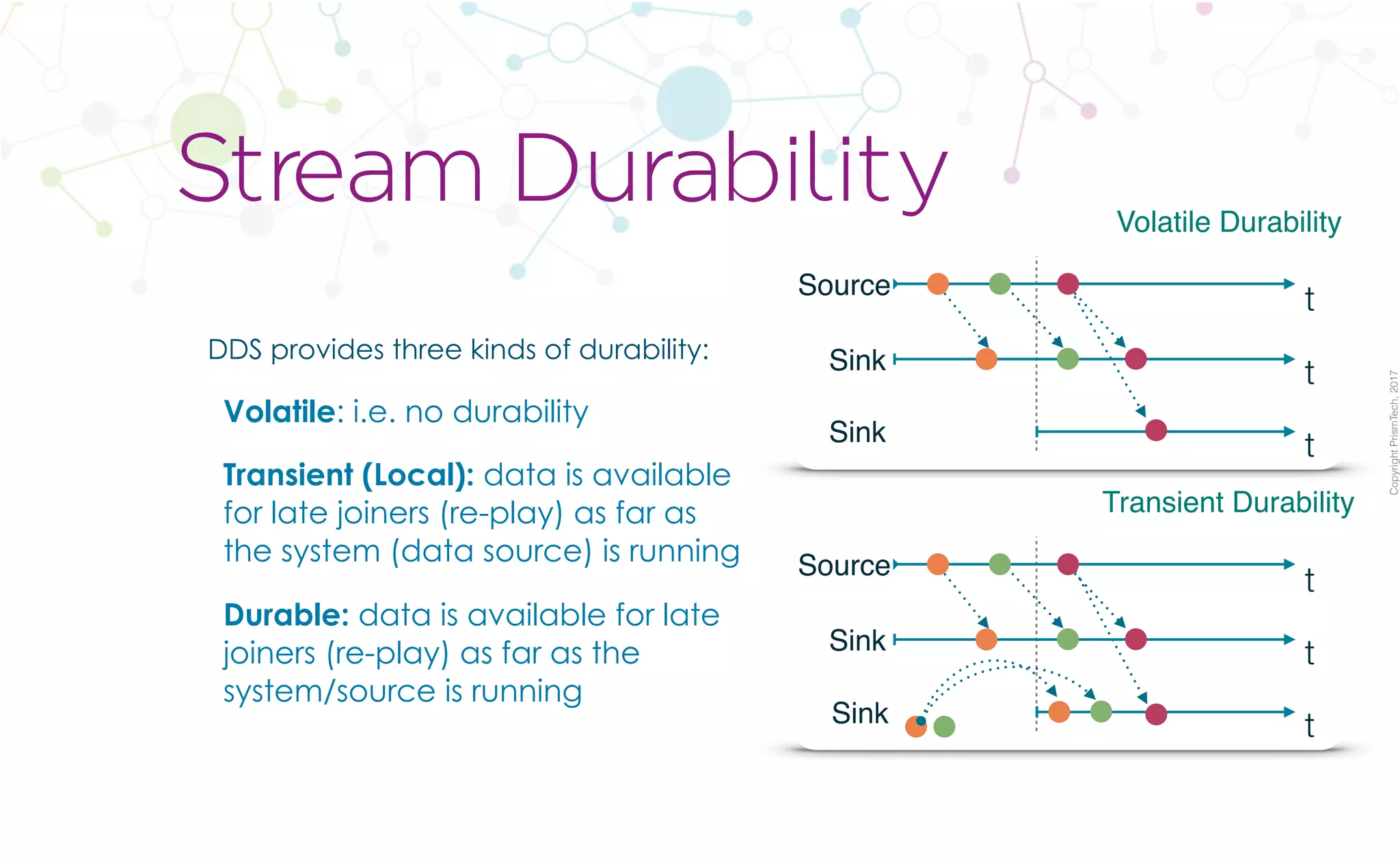
DDS provides three kinds of durability:
Volatile: i.e. no durability
Transient (Local): data is available
for late joiners (re-play) as far as
the system (data source) is running
Durable: data is available for late
joiners (re-play) as far as the
system/source is running
Stream Durability
tSource
t
t
Sink
Sink
Volatile Durability
tSource
t
t
Sink
Sink
Transient Durability
CopyrightPrismTech,2017
DDS Durability is implemented as a high-performance distributed service
that provide control over the number of copies of data that should be
maintained for availability
Recent data is maintained on memory to reduce access latency
In deployments that support IP multicast, the overhead of durability is
practically negligible
Storage back-ends are pluggable, e.g., File System, RDBMS, etc.
Durability Implementation
Stream Reliability
CopyrightPrismTech,2017
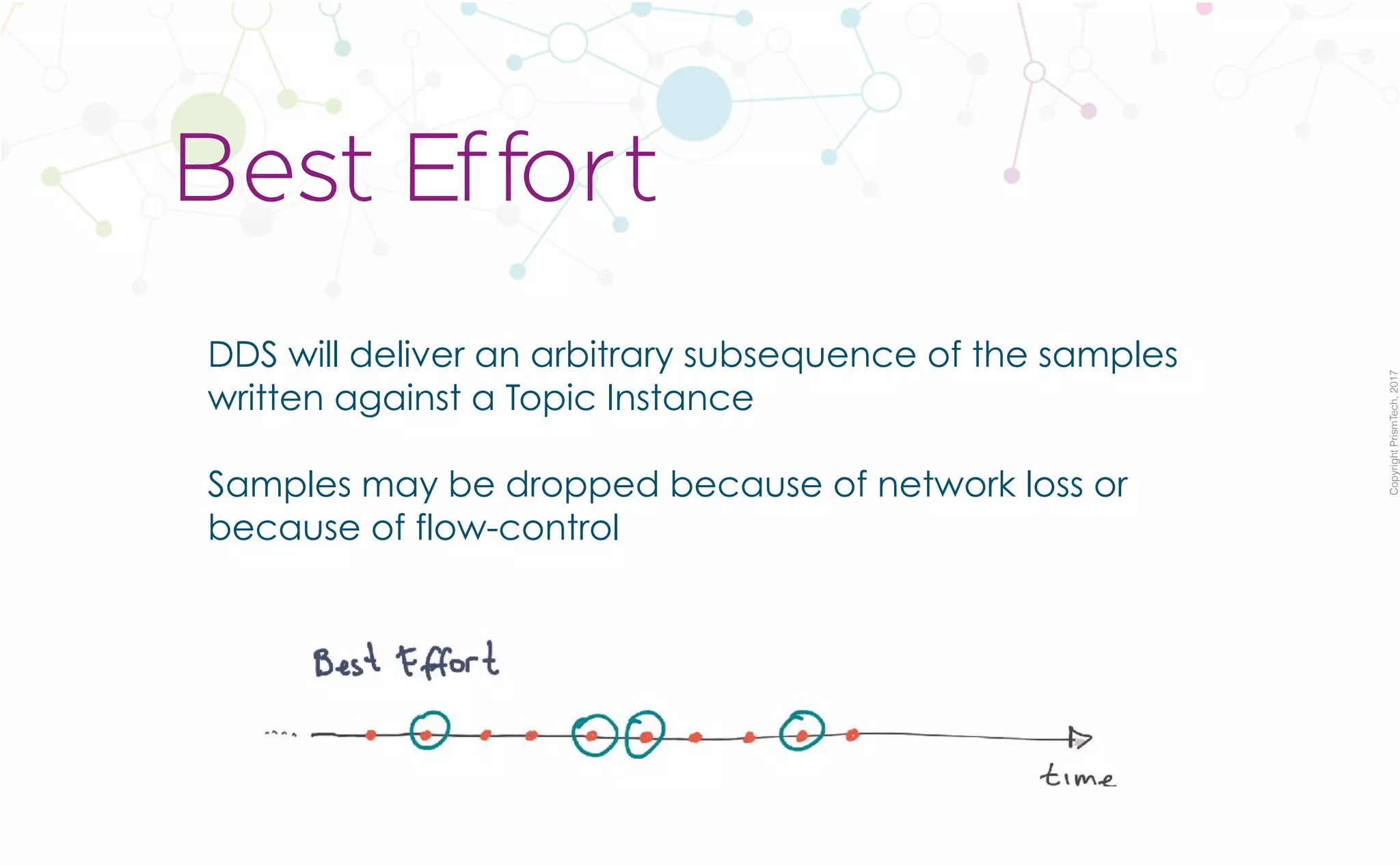
DDS will deliver an arbitrary subsequence of the samples
written against a Topic Instance
Samples may be dropped because of network loss or
because of flow-control
Best Effort
CopyrightPrismTech,2017
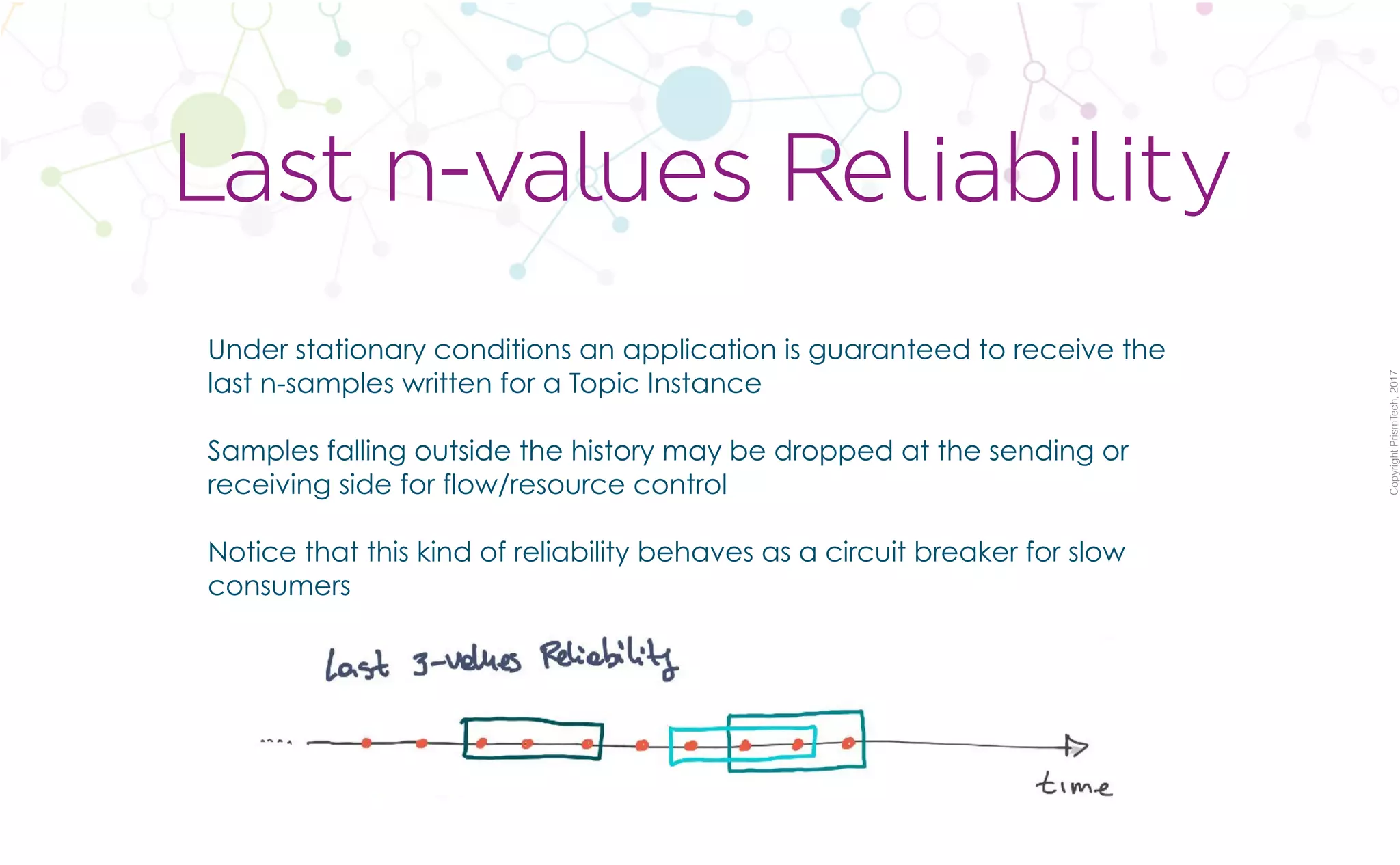
Under stationary conditions an application is guaranteed to receive the
last n-samples written for a Topic Instance
Samples falling outside the history may be dropped at the sending or
receiving side for flow/resource control
Notice that this kind of reliability behaves as a circuit breaker for slow
consumers
Last n-values Reliability
CopyrightPrismTech,2017
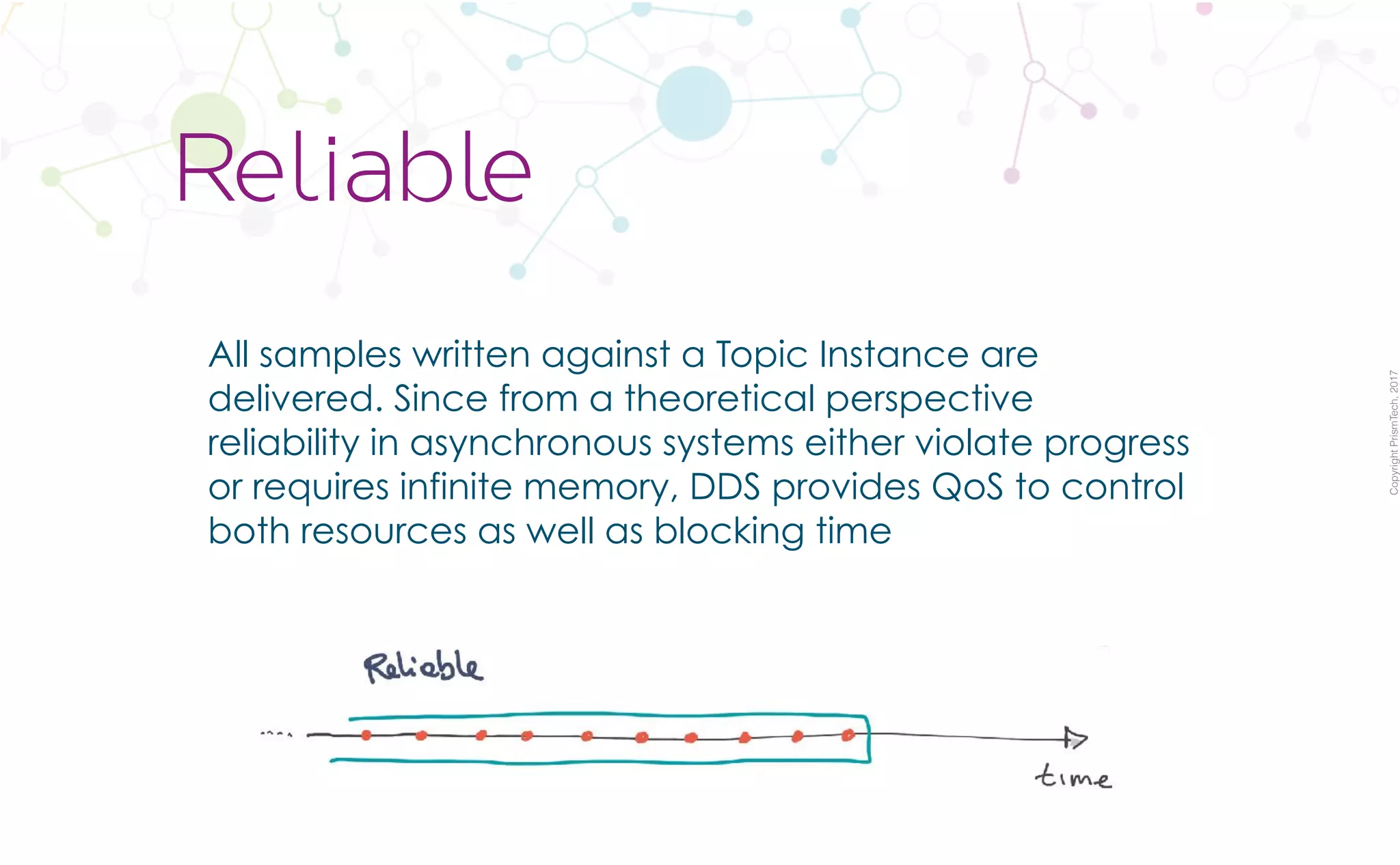
All samples written against a Topic Instance are
delivered. Since from a theoretical perspective
reliability in asynchronous systems either violate progress
or requires infinite memory, DDS provides QoS to control
both resources as well as blocking time
Reliable
Fault-Tolerance
CopyrightPrismTech,2017
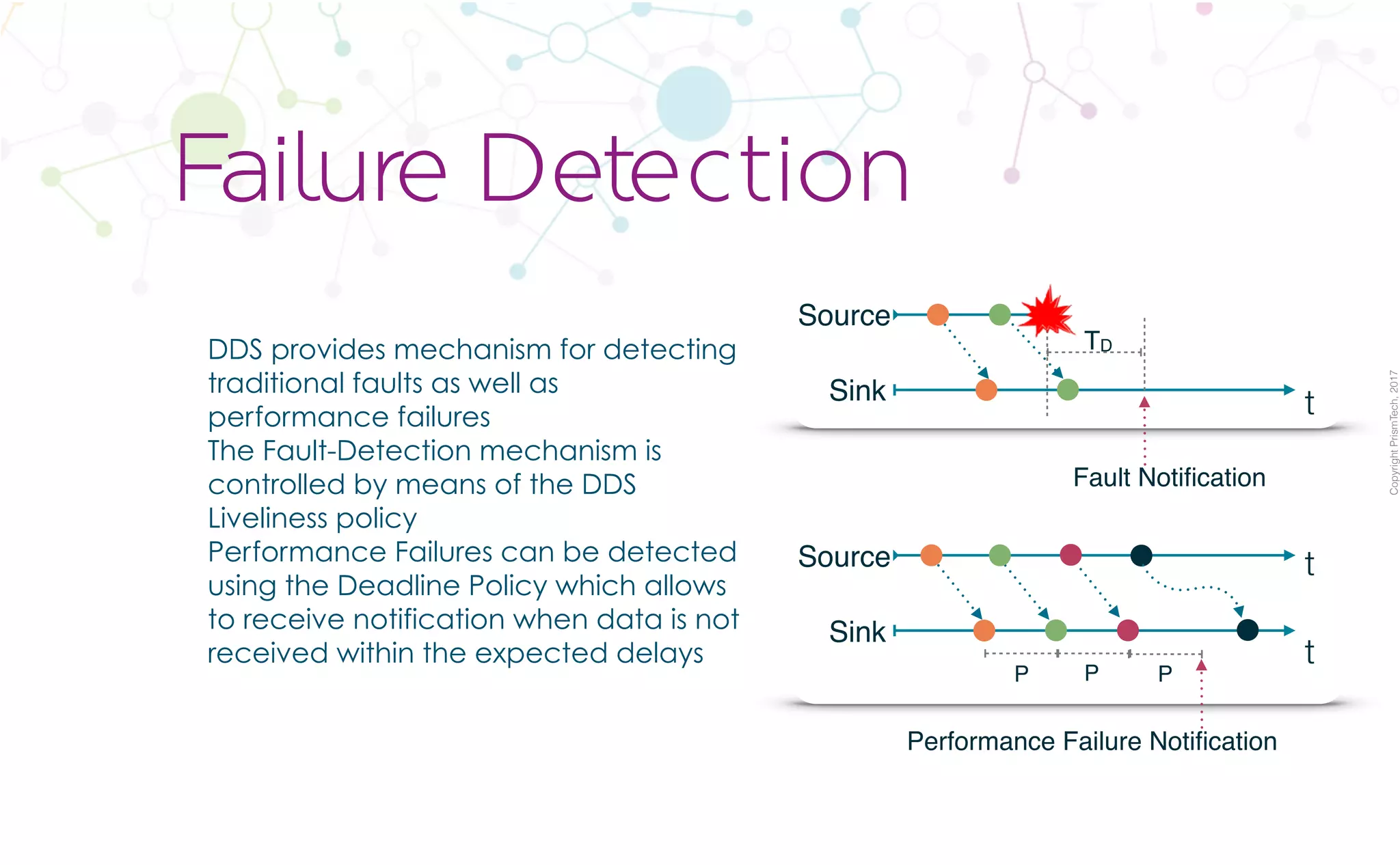
DDS provides mechanism for detecting
traditional faults as well as
performance failures
The Fault-Detection mechanism is
controlled by means of the DDS
Liveliness policy
Performance Failures can be detected
using the Deadline Policy which allows
to receive notification when data is not
received within the expected delays
Failure Detection
Source
tSink
Fault Notification
TD
Source
t
Sink
Performance Failure Notification
P
t
P P
CopyrightPrismTech,2017
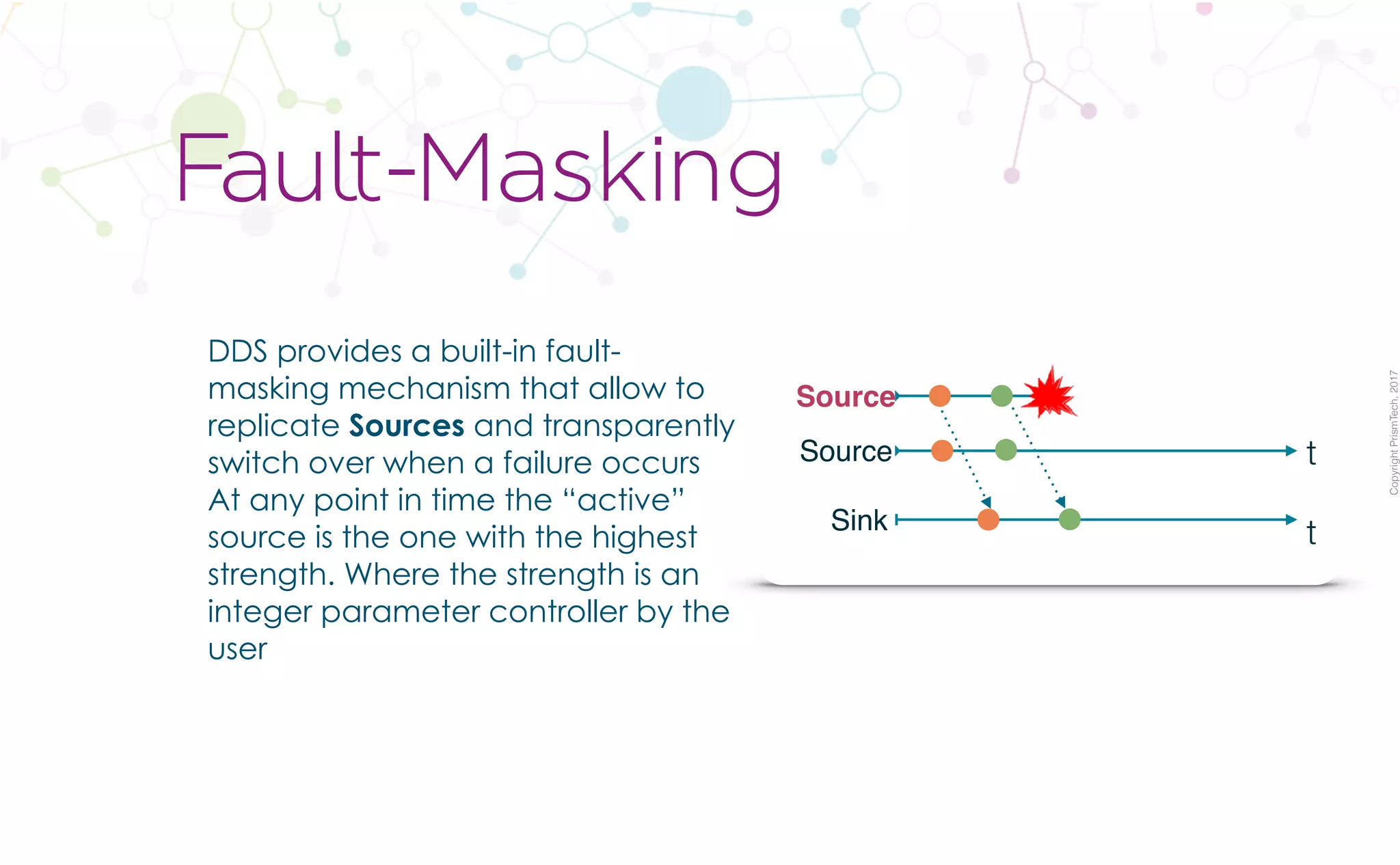
DDS provides a built-in fault-
masking mechanism that allow to
replicate Sources and transparently
switch over when a failure occurs
At any point in time the “active”
source is the one with the highest
strength. Where the strength is an
integer parameter controller by the
user
Fault-Masking
Source
tSink
Source t
A Breath of Code
CopyrightPrismTech,2015
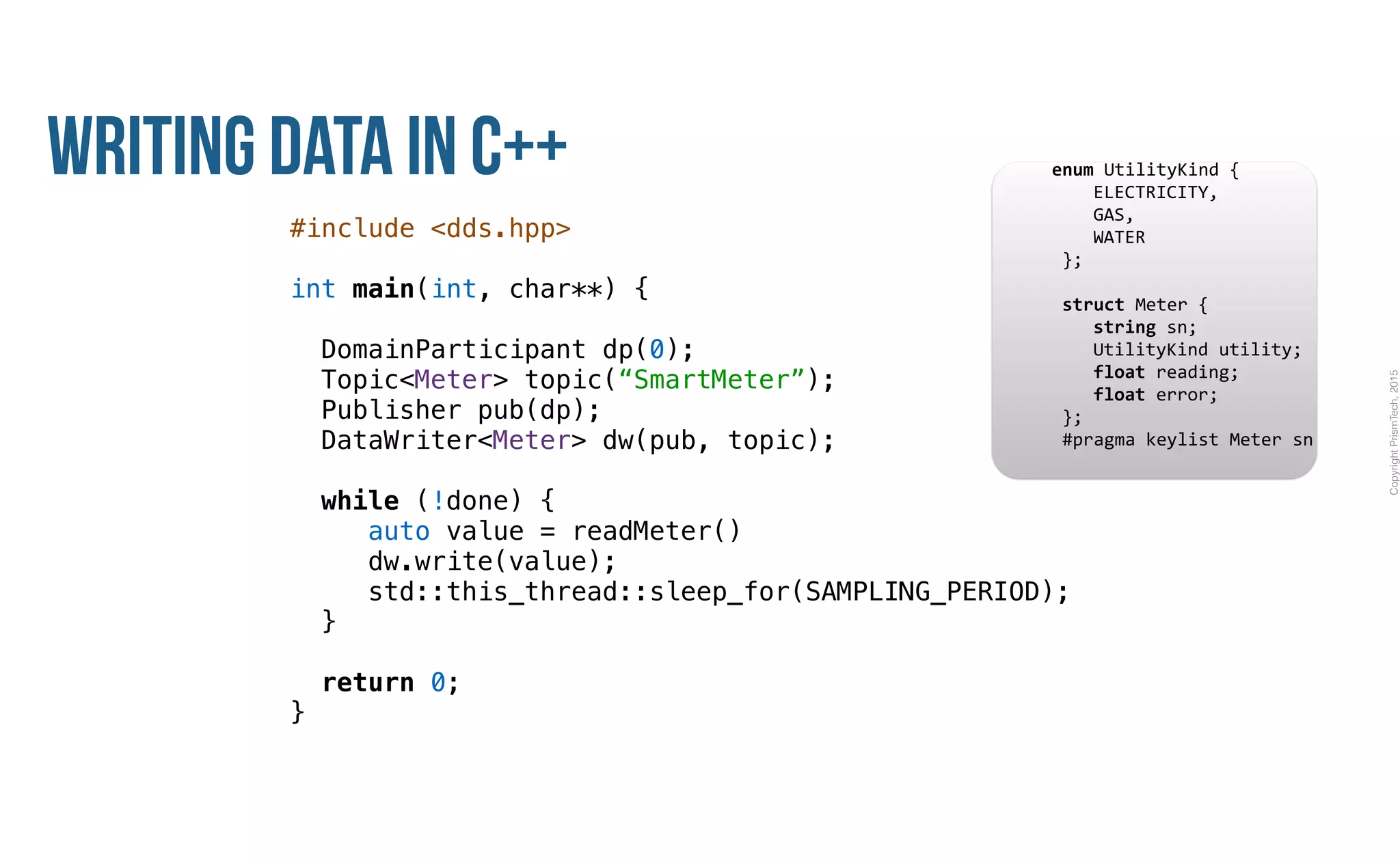
Writing Data in C++
#include <dds.hpp>
int main(int, char**) {
DomainParticipant dp(0);
Topic<Meter> topic(“SmartMeter”);
Publisher pub(dp);
DataWriter<Meter> dw(pub, topic);
while (!done) {
auto value = readMeter()
dw.write(value);
std::this_thread::sleep_for(SAMPLING_PERIOD);
}
return 0;
}
					enum	UtilityKind	{	
	 				ELECTRICITY,	
	 				GAS,	
	 				WATER	
						};	
							
						struct	Meter	{	
	 				string	sn;	
	 				UtilityKind	utility;	
	 				float	reading;	
	 				float	error;	
						};													
						#pragma	keylist	Meter	sn
CopyrightPrismTech,2015
Reading Data in C++
#include <dds.hpp>
int main(int, char**) {
DomainParticipant dp(0);
Topic<Meter> topic(”SmartMeter”);
Subscriber sub(dp);
DataReader<Meter> dr(dp, topic);
LambdaDataReaderListener<DataReader<Meter>> lst;
lst.data_available = [](DataReader<Meter>& dr) {
auto samples = data.read();
std::for_each(samples.begin(), samples.end(), [](Sample<Meter>& sample) {
std::cout << sample.data() << std::endl;
}
}
dr.listener(lst);
// Print incoming data up to when the user does a Ctrl-C
std::this_thread::join();
return 0;
}
					enum	UtilityKind	{	
	 				ELECTRICITY,	
	 				GAS,	
	 				WATER	
						};	
							
						struct	Meter	{	
	 				string	sn;	
	 				UtilityKind	utility;	
	 				float	reading;	
	 				float	error;	
						};													
						#pragma	keylist	Meter	sn
CopyrightPrismTech,2015
Writing Data in Scala
import dds._

import dds.prelude._

import dds.config.DefaultEntities._

object SmartMeter {


def main(args: Array[String]): Unit = {

val topic = Topic[Meter](“SmartMeter”)

val dw = DataWriter[Meter](topic)
while (!done) {
val meter = readMeter()

dw.write(meter)
Thread.sleep(SAMPLING_PERIOD)
}

}

}
					enum	UtilityKind	{	
	 				ELECTRICITY,	
	 				GAS,	
	 				WATER	
						};	
							
						struct	Meter	{	
	 				string	sn;	
	 				UtilityKind	utility;	
	 				float	reading;	
	 				float	error;	
						};													
						#pragma	keylist	Meter	sn
CopyrightPrismTech,2015
Reading Data in Scala
import dds._

import dds.prelude._

import dds.config.DefaultEntities._

object SmartMeterLog {

def main(args: Array[String]): Unit = {

val topic = Topic[Meter](“SmartMeter”)

val dr = DataReader[Meter](topic)

dr listen {

case DataAvailable(_) => dr.read.foreach(println)

}

}

}
					enum	UtilityKind	{	
	 				ELECTRICITY,	
	 				GAS,	
	 				WATER	
						};	
							
						struct	Meter	{	
	 				string	sn;	
	 				UtilityKind	utility;	
	 				float	reading;	
	 				float	error;	
						};													
						#pragma	keylist	Meter	sn
CopyrightPrismTech,2015
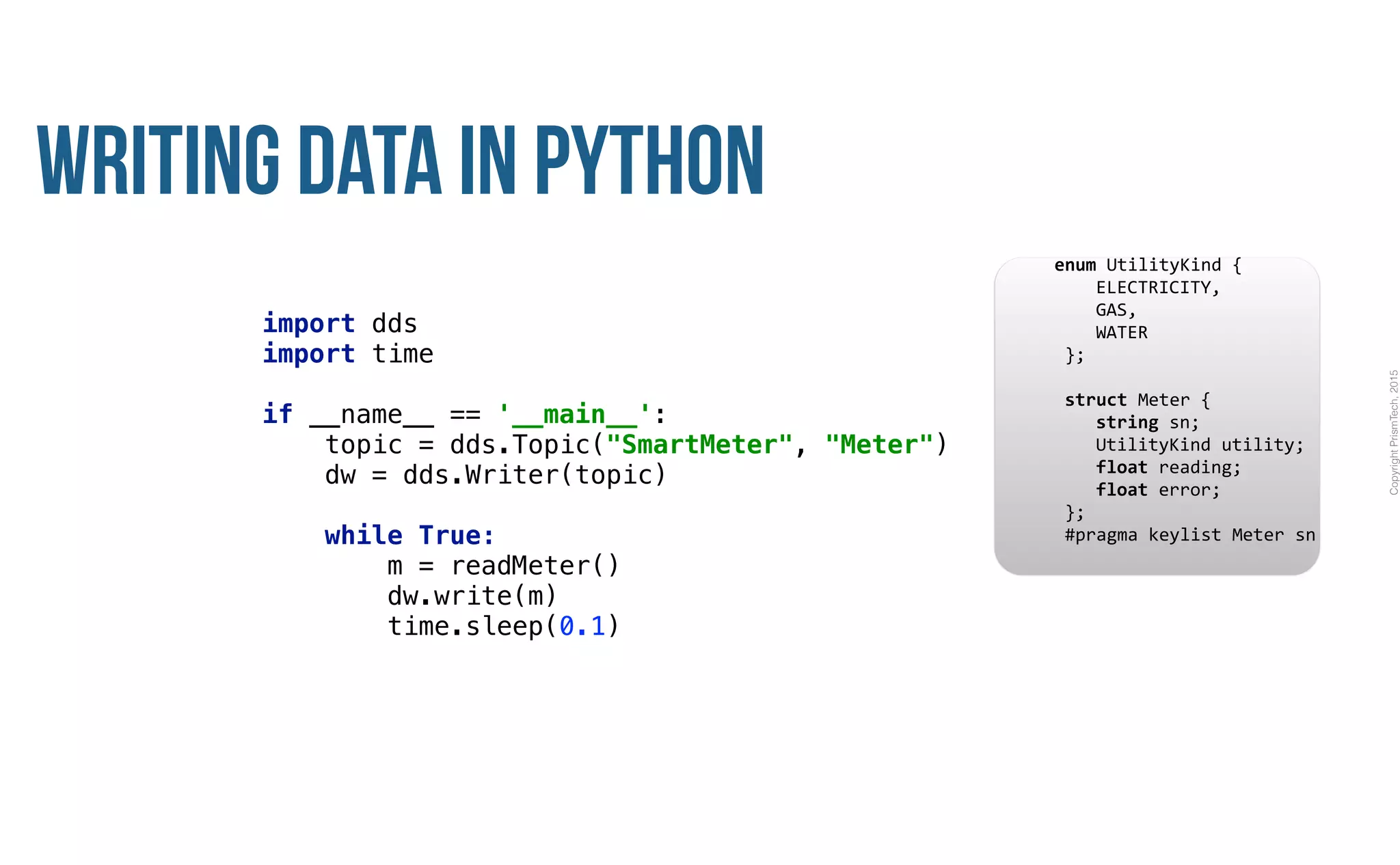
Writing Data in Python
import dds
import time


if __name__ == '__main__':

topic = dds.Topic("SmartMeter", "Meter")

dw = dds.Writer(topic)


while True:

m = readMeter()

dw.write(m)

time.sleep(0.1)
					enum	UtilityKind	{	
	 				ELECTRICITY,	
	 				GAS,	
	 				WATER	
						};	
							
						struct	Meter	{	
	 				string	sn;	
	 				UtilityKind	utility;	
	 				float	reading;	
	 				float	error;	
						};													
						#pragma	keylist	Meter	sn
CopyrightPrismTech,2015
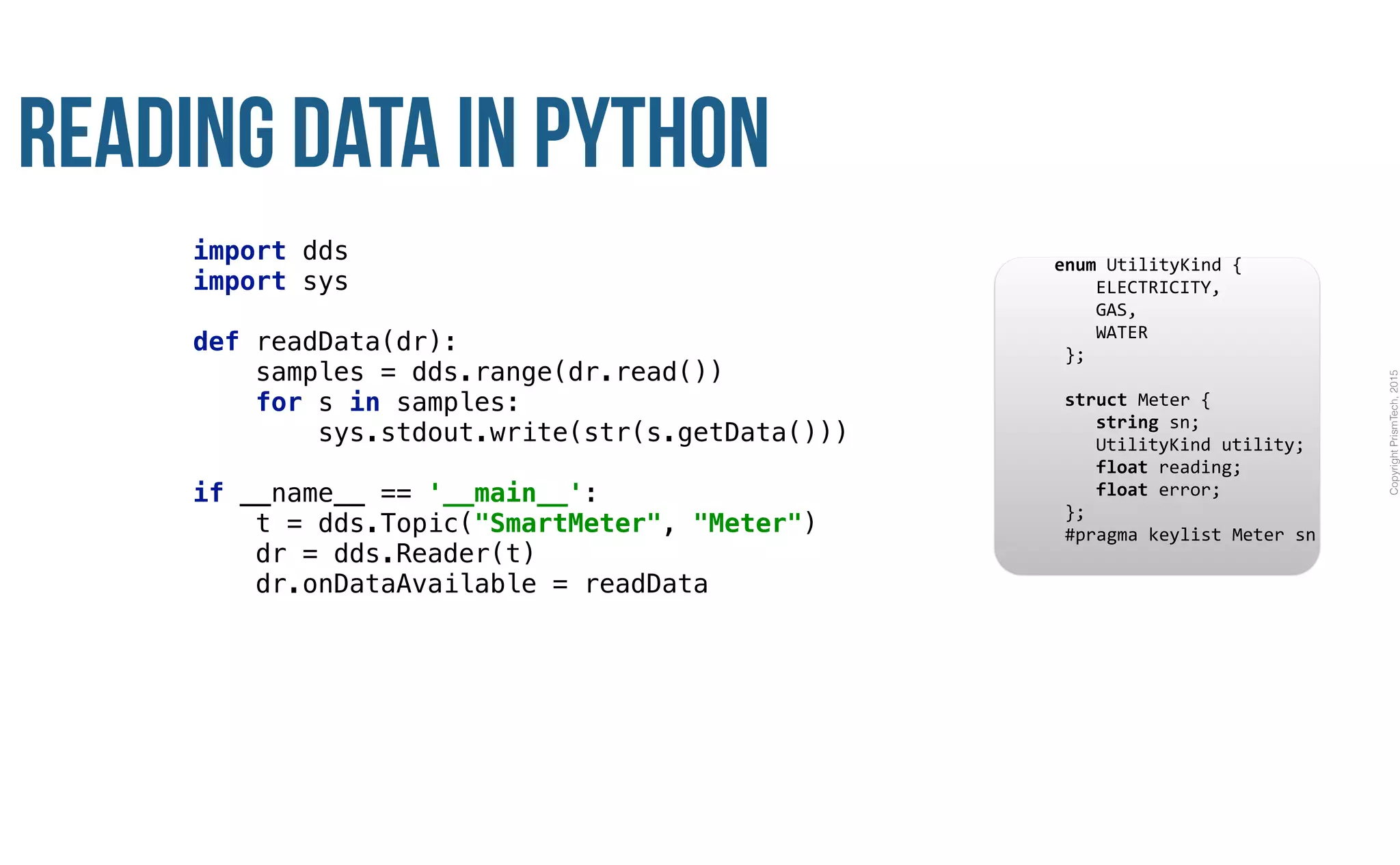
Reading Data in Python
import dds

import sys


def readData(dr): 

samples = dds.range(dr.read())

for s in samples:

sys.stdout.write(str(s.getData()))


if __name__ == '__main__':

t = dds.Topic("SmartMeter", "Meter")

dr = dds.Reader(t)

dr.onDataAvailable = readData
					enum	UtilityKind	{	
	 				ELECTRICITY,	
	 				GAS,	
	 				WATER	
						};	
							
						struct	Meter	{	
	 				string	sn;	
	 				UtilityKind	utility;	
	 				float	reading;	
	 				float	error;	
						};													
						#pragma	keylist	Meter	sn
Security
CopyrightPrismTech,2017
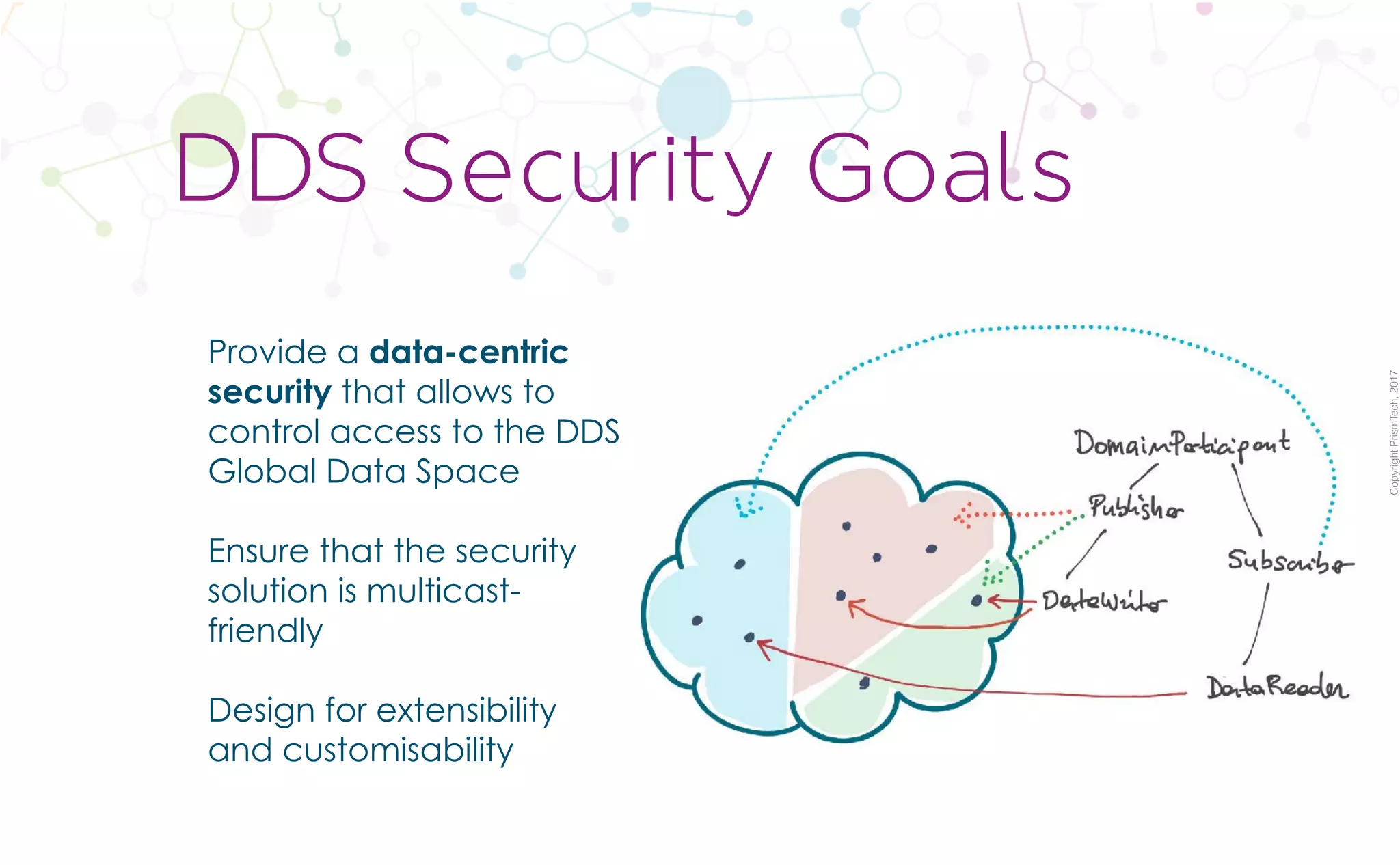
Provide a data-centric
security that allows to
control access to the DDS
Global Data Space
Ensure that the security
solution is multicast-
friendly
Design for extensibility
and customisability
DDS Security Goals
CopyrightPrismTech,2017
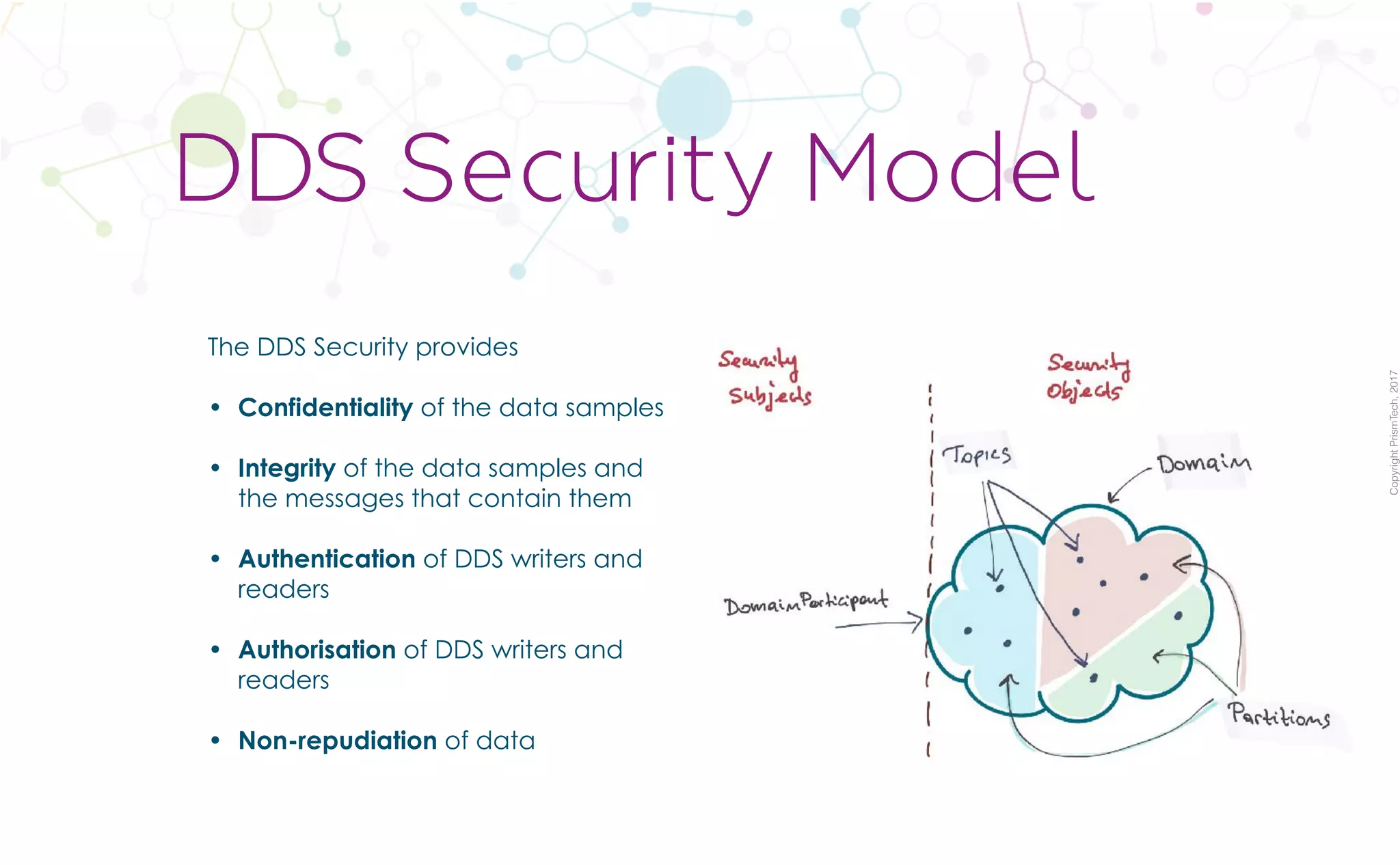
The DDS Security provides
• Confidentiality of the data samples 

• Integrity of the data samples and
the messages that contain them 

• Authentication of DDS writers and
readers 

• Authorisation of DDS writers and
readers 

• Non-repudiation of data 

DDS Security Model
CopyrightPrismTech,2017
The DDS Security standard
has a modular and plug-in
architecture that allows for
pluggable Authentication,
Access Control, Logging,
Cryptography and Data
Tagging
Plug-in Architecture
[See		DDS	Security	Specification	v1.0		p.47]
CopyrightPrismTech,2017
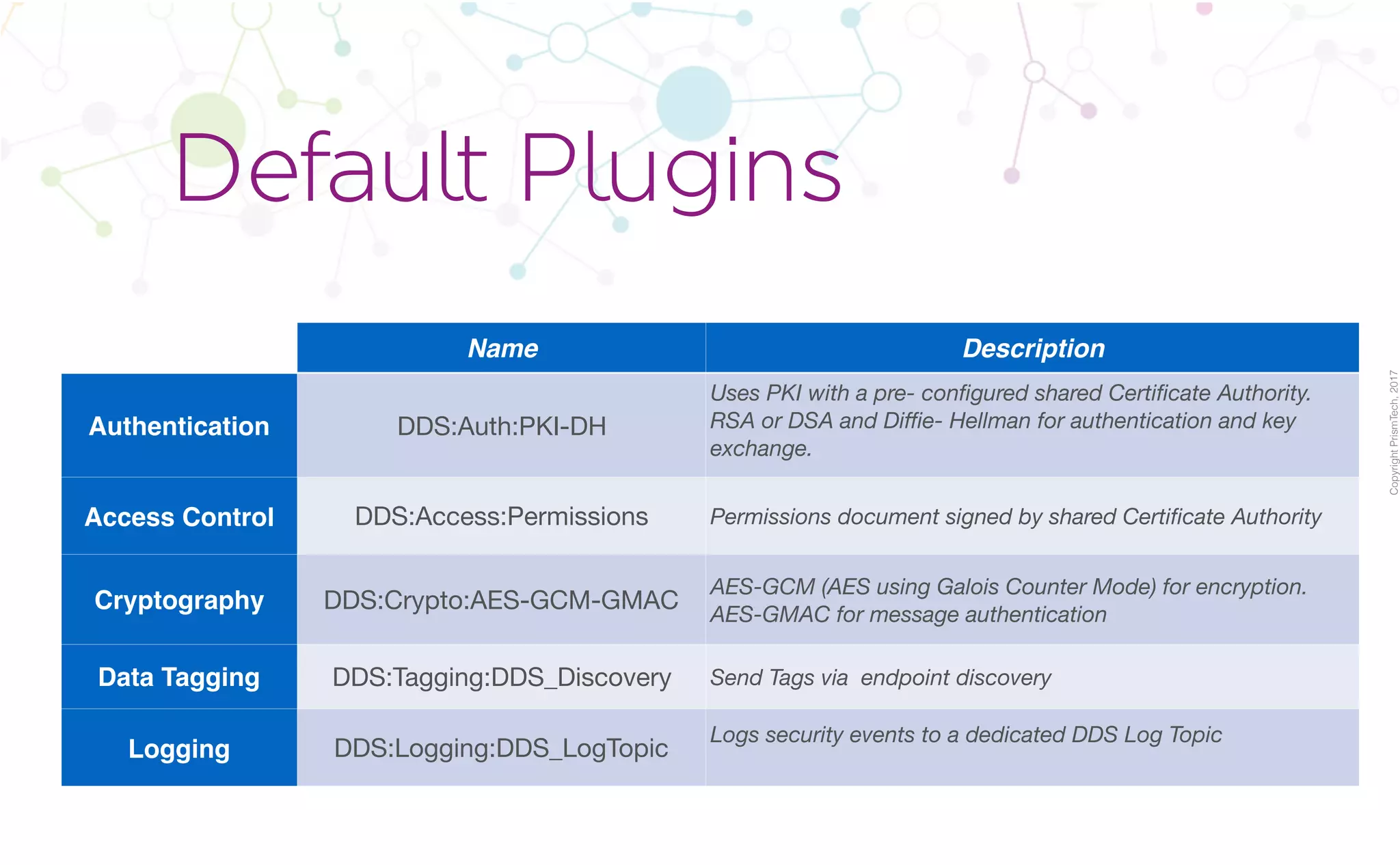
Name Description
Authentication DDS:Auth:PKI-DH
Uses PKI with a pre- configured shared Certificate Authority.
RSA or DSA and Diffie- Hellman for authentication and key
exchange.
Access Control DDS:Access:Permissions Permissions document signed by shared Certificate Authority
Cryptography DDS:Crypto:AES-GCM-GMAC
AES-GCM (AES using Galois Counter Mode) for encryption.
AES-GMAC for message authentication
Data Tagging DDS:Tagging:DDS_Discovery Send Tags via endpoint discovery
Logging DDS:Logging:DDS_LogTopic
Logs security events to a dedicated DDS Log Topic
Default Plugins
CopyrightPrismTech,2017
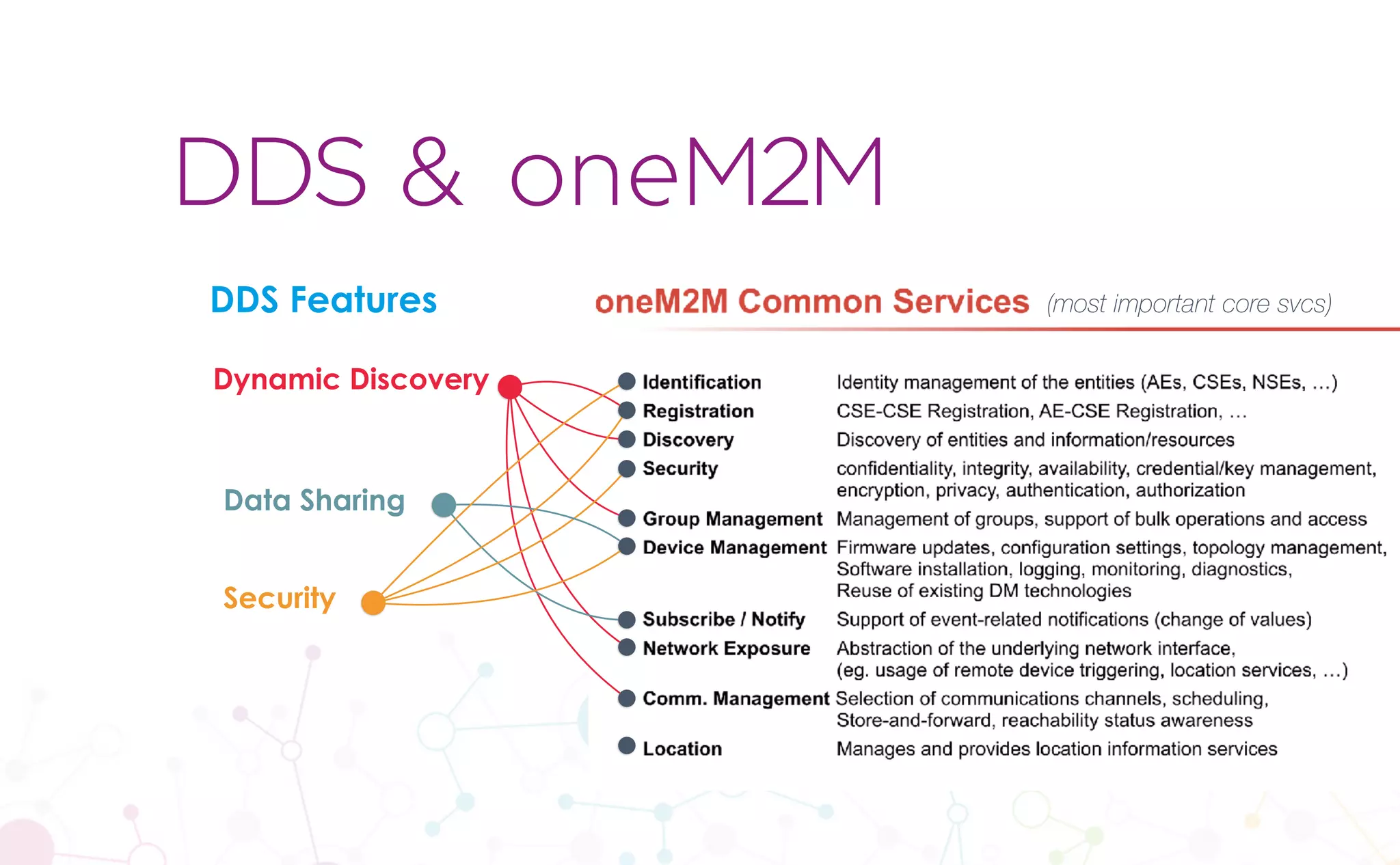
DDS & oneM2M
CopyrightPrismTech,2017
Dynamic Discovery
DDS & oneM2M
DDS Features
Data Sharing
Security
(most important core svcs)
CopyrightPrismTech,2017
Summing Up
CopyrightPrismTech,2017
DDS provides an extremely powerful set of abstractions
and mechanism for data sharing in large scale
distributed systems
DDS appears to be a natural fit for oneM2M and we
would be delighted to help defining the DDS binding
for oneM2M
Concluding Remarks
CopyrightPrismTech,2017

The Data Distribution Service

  • 1.
  • 2.
  • 3.
    DDS DDS is astandard technology for ubiquitous, interoperable, secure, platform independent, and real-time data sharing across network connected devices
  • 4.
    CopyrightPrismTech,2017 DDS Standard Evolution 20042005 2006 2007 2008 2009 2010 2011 2012 2013 2014 2015 ‣ DDS 1.0 ‣ DDSI-RTPS 1.0 ‣ DDS-XTYPES 1.0 ‣ DDS-SECURITY 1.0 ‣ DDS-XTYPES 1.1 ‣ DDSI-RTPS 2.2 ‣ DDS 1.4 ‣ DLRL 1.4 ‣ DDS-RPC 1.0 ‣ DDSI-RTPS 2.0 ‣ DDS 1.2 ‣ DDS-PSM-CXX 1.0 ‣ DDS-PSM-Java 1.0 ‣ DDSI-RTPS 2.1 ‣ DDSI-RTPS 1.0 2016
  • 5.
    CopyrightPrismTech,2017 Defines a highlevel API for programming language, OS and architecture independent data sharing DDS Standards TCP UDP IP 802.3 802.11 DDSI-RTPS L3: Network App App App L2: Data Link L1: Physical L4: Transport L5: Session L6: Presentation User L7: Application Security X-Types DCPS RPC ... 802.1 ... C/C++, Java, .Net, JavaScript, Python, etc. Data Centric Publish Subscribe (DCPS)
  • 6.
    CopyrightPrismTech,2017 Defines a wireprotocol for interoperable implementation of DCPS abstractions. This protocol assumes a best- effort transport layer, i.e., reliability is provided by DDSI. DDS Standards DDS Interoperability Protocol (DDSI-RTPS) TCP UDP IP 802.3 802.11 DDSI-RTPS L3: Network App App App L2: Data Link L1: Physical L4: Transport L5: Session L6: Presentation User L7: Application Security X-Types DCPS RPC ... 802.1 ... C/C++, Java, .Net, JavaScript, Python, etc.
  • 7.
    CopyrightPrismTech,2017 Extends the DDStype system from nominal to structural, thus providing very good support for evolutions and forward compatibility. Defines APIs for dynamically defining and operating over DDS types DDS Standards eXtensible Types (DDS-XTypes) TCP UDP IP 802.3 802.11 DDSI-RTPS L3: Network App App App L2: Data Link L1: Physical L4: Transport L5: Session L6: Presentation User L7: Application Security X-Types DCPS RPC ... 802.1 ... C/C++, Java, .Net, JavaScript, Python, etc.
  • 8.
    CopyrightPrismTech,2017 Defines a data-centric securityarchitecture with pluggable Authentication, Access Control, Crypto and Logging. DDS Standards Security (DDS-Security) TCP UDP IP 802.3 802.11 DDSI-RTPS L3: Network App App App L2: Data Link L1: Physical L4: Transport L5: Session L6: Presentation User L7: Application Security X-Types DCPS RPC ... 802.1 ... C/C++, Java, .Net, JavaScript, Python, etc.
  • 9.
    CopyrightPrismTech,2017 Extends DDS abstractions tosupport distributed service definition and remote operation invocations. DDS Standards Remote Procedure Calls (DDS-RPC) TCP UDP IP 802.3 802.11 DDSI-RTPS L3: Network App App App L2: Data Link L1: Physical L4: Transport L5: Session L6: Presentation User L7: Application Security X-Types DCPS RPC ... 802.1 ... C/C++, Java, .Net, JavaScript, Python, etc.
  • 10.
    CopyrightPrismTech,2017 Upcoming Standards 2004 20052006 2007 2008 2009 2010 2011 2012 2013 2014 2015 ‣ DDS 1.0 ‣ DDSI-RTPS 1.0 ‣ DDS-XTYPES 1.0 ‣ DDS-SECURITY 1.0 ‣ DDS-XTYPES 1.1 ‣ DDSI-RTPS 2.2 ‣ DDS 1.4 ‣ DLRL 1.4 ‣ DDS-RPC 1.0 ‣ DDSI-RTPS 2.0 ‣ DDS 1.2 ‣ DDS-PSM-CXX 1.0 ‣ DDS-PSM-Java 1.0 ‣ DDSI-RTPS 2.1 ‣ DDSI-RTPS 1.0 2016 2017 ‣ DDS-XTYPES 1.2 ‣ DDSI-Security 1.1 ‣ DDS-XRCE (TBC) ‣ OPC-UA/DDS GTW (TBC)
  • 11.
    CopyrightPrismTech,2017 Defines the mostwire/ power/memory efficient protocol in the market to provide DDS connectivity to extremely constrained targets DDS-XRCE eXtremely Resource Constrained Environments DDS (DDS-XRCE) DDS-XRCE XRCE Application L3: Network TCP UDP IP 6LowPAN 802.15.4 NB-IoT3G/4G Unspecified API App App App L2: Data Link L1: Physical L4: Transport L4: Session …
  • 12.
    CopyrightPrismTech,2017 Supports peer-to-peer aswell as broker-based communication Provides reliability and fragmentation above packet- oriented best-effort transports Can leverage multicast DDS-XRCE DDS-XRCE XRCE Application L3: Network TCP UDP IP 6LowPAN 802.15.4 NB-IoT3G/4G Unspecified API App App App L2: Data Link L1: Physical L4: Transport L4: Session …
  • 13.
    CopyrightPrismTech,2017 Current prototype runson 8-bit micro-controllers and takes in 1 KByte of RAM and has wire-overhead of 3-4 bytes for data samples DDS-XRCE DDS-XRCE XRCE Application L3: Network TCP UDP IP 6LowPAN 802.15.4 NB-IoT3G/4G Unspecified API App App App L2: Data Link L1: Physical L4: Transport L4: Session …
  • 14.
  • 15.
    CopyrightPrismTech,2017 The recently released IIC Connectivity Framework revealshow the OMG DDS is the fittest standard for connectivity in IIoT IIC Connectivity
  • 16.
    CopyrightPrismTech,2017 The OpenFog Consortium ReferenceArchitecture identifies the OMG DDS as one for the key Connectivity and Data Management standards Open Fog Reference Architecture
  • 17.
    CopyrightPrismTech,2017 DDS is widelyused for horizontal (east-to-west) communication on the Control and Information Layers But it is applicable for horizontal across any view DDS in IIRA Real-Time Soft Real-Time Interactive DDS DDS
  • 18.
  • 19.
  • 20.
  • 21.
    CopyrightPrismTech,2017 DDS provides applications with aVirtual Global Data Space abstraction DDS Abstraction DDS Global Data Space ... Data Writer Data Writer Data Writer Data Reader Data Reader Data Reader Data Reader Data Writer TopicA QoS TopicB QoS TopicC QoS TopicD QoS
  • 22.
    CopyrightPrismTech,2017 Applications coordinate by autonomously and asynchronously readingand writing data in the Data Space enjoying spatial and temporal decoupling DDS Abstraction DDS Global Data Space ... Data Writer Data Writer Data Writer Data Reader Data Reader Data Reader Data Reader Data Writer TopicA QoS TopicB QoS TopicC QoS TopicD QoS
  • 23.
    CopyrightPrismTech,2017 DDS has built-in dynamicdiscovery that automatically matches interest and establishes data path isolating applications from network topology and connectivity details Dynamic Discovery DDS Global Data Space ... Data Writer Data Writer Data Writer Data Reader Data Reader Data Reader Data Reader Data Writer TopicA QoS TopicB QoS TopicC QoS TopicD QoS
  • 24.
    CopyrightPrismTech,2017 DDS global data space implementationis decentralised and does not suffer of single point of failure or bottleneck Decentralised Data-Space Data Writer Data Writer Data Writer Data Reader Data Reader Data Reader Data Writer TopicA QoS TopicB QoS TopicC QoS TopicD QoS TopicD QoS TopicD QoS TopicA QoS DDS Global Data Space ... Data Writer Data Writer Data Writer Data Reader Data Reader Data Reader Data Reader Data Writer TopicA QoS TopicB QoS TopicC QoS TopicD QoS
  • 25.
    CopyrightPrismTech,2017 Connectivity is dynamically adaptedto chose the most effective way of sharing data Adaptive Connectivity Data Writer Data Writer Data Writer Data Reader Data Reader Data Reader Data Writer TopicA QoS TopicB QoS TopicC QoS TopicD QoS TopicD QoS TopicD QoS TopicA QoS The communication between the DataWriter and matching DataReaders can be peer-to- peer exploiting UDP/IP (Unicast and Multicast)or TCP/IP The communication between the DataWriter and matching DataReaders can be “brokered” but still exploiting UDP/IP (Unicast and Multicast)or TCP/IP
  • 26.
  • 27.
    CopyrightPrismTech,2017 DDS data streamsare defined by means of Topics A Topic represented is by means of a <name, type, qos> Topics DDS Global Data Space ... Data Writer Data Writer Data Writer Data Reader Data Reader Data Reader Data Reader Data Writer TopicA QoS TopicB QoS TopicC QoS TopicD QoS Topic Type Name QoS
  • 28.
    CopyrightPrismTech,2017 Topic may marksome of their associated type attributes as key- fields Each unique key value (tuple of key attributes) identifies a Topic Instance. Each Topic Instance has associated a FIFO ordered stream of samples DDS provides useful instance life- cycle management and samples demultiplexing Topic Instances
  • 29.
    CopyrightPrismTech,2017 DDS information liveswithin a domain A domain can be thought as organised in partitions Samples belonging to a given Topic Instance are read/written from/in one or more partitions Information Scopes
  • 30.
    CopyrightPrismTech,2017 Domain Participants provide accessto a DDS domain Publisher and Subscribers provide access to partitions DataWriter/DataReaders write/read data to/from the set of partitions associated with their Publisher/ Subscriber Writing / Reading Data
  • 31.
  • 32.
    CopyrightPrismTech,2017 DDS Content Filters canbe used to project on the local cache only the Topic data satisfying a given predicate Content Filteringstruct CarDynamics { @key string cid; long x; long y; float dx; long dy; } cid x y dx dy GR 33N GO 167 240 45 0 LO 00V IN 65 26 65 0 AN 637 OS 32 853 0 50 AB 123 CD 325 235 80 0 “dx > 50 OR dy > 50” CarDynamics cid x y dx dy LO 00V IN 65 26 65 0 AB 123 CD 325 235 80 0 Reader Cache
  • 33.
    CopyrightPrismTech,2017 DDS Queries can beused to select out of the local cache the data matching a given predicate Queries struct CarDynamics { @key string cid; long x; long y; float dx; long dy; } cid x y dx dy GR 33N GO 167 240 45 0 LO 00V IN 65 26 65 0 AN 637 OS 32 853 0 50 AB 123 CD 325 235 80 0 CarDynamics Reader Cache “dx > 50 OR dy > 50” cid x y dx dy GR 33N GO 167 240 45 0 LO 00V IN 65 26 65 0 AN 637 OS 32 853 0 50 AB 123 CD 325 235 80 0 cid x y dx dy LO 00V IN 65 26 65 0 AB 123 CD 325 235 80 0 query
  • 34.
  • 35.
    CopyrightPrismTech,2017 Through QoS settingsit is possible to control which subset of the stream data will be retained and made available (replayed) to late joiners Stream Durability DDS can store the last n samples (n=1 is a special case) or all the samples written for a topic
  • 36.
    CopyrightPrismTech,2017 DDS provides threekinds of durability: Volatile: i.e. no durability Transient (Local): data is available for late joiners (re-play) as far as the system (data source) is running Durable: data is available for late joiners (re-play) as far as the system/source is running Stream Durability tSource t t Sink Sink Volatile Durability tSource t t Sink Sink Transient Durability
  • 37.
    CopyrightPrismTech,2017 DDS Durability isimplemented as a high-performance distributed service that provide control over the number of copies of data that should be maintained for availability Recent data is maintained on memory to reduce access latency In deployments that support IP multicast, the overhead of durability is practically negligible Storage back-ends are pluggable, e.g., File System, RDBMS, etc. Durability Implementation
  • 38.
  • 39.
    CopyrightPrismTech,2017 DDS will deliveran arbitrary subsequence of the samples written against a Topic Instance Samples may be dropped because of network loss or because of flow-control Best Effort
  • 40.
    CopyrightPrismTech,2017 Under stationary conditionsan application is guaranteed to receive the last n-samples written for a Topic Instance Samples falling outside the history may be dropped at the sending or receiving side for flow/resource control Notice that this kind of reliability behaves as a circuit breaker for slow consumers Last n-values Reliability
  • 41.
    CopyrightPrismTech,2017 All samples writtenagainst a Topic Instance are delivered. Since from a theoretical perspective reliability in asynchronous systems either violate progress or requires infinite memory, DDS provides QoS to control both resources as well as blocking time Reliable
  • 42.
  • 43.
    CopyrightPrismTech,2017 DDS provides mechanismfor detecting traditional faults as well as performance failures The Fault-Detection mechanism is controlled by means of the DDS Liveliness policy Performance Failures can be detected using the Deadline Policy which allows to receive notification when data is not received within the expected delays Failure Detection Source tSink Fault Notification TD Source t Sink Performance Failure Notification P t P P
  • 44.
    CopyrightPrismTech,2017 DDS provides abuilt-in fault- masking mechanism that allow to replicate Sources and transparently switch over when a failure occurs At any point in time the “active” source is the one with the highest strength. Where the strength is an integer parameter controller by the user Fault-Masking Source tSink Source t
  • 45.
  • 46.
    CopyrightPrismTech,2015 Writing Data inC++ #include <dds.hpp> int main(int, char**) { DomainParticipant dp(0); Topic<Meter> topic(“SmartMeter”); Publisher pub(dp); DataWriter<Meter> dw(pub, topic); while (!done) { auto value = readMeter() dw.write(value); std::this_thread::sleep_for(SAMPLING_PERIOD); } return 0; } enum UtilityKind { ELECTRICITY, GAS, WATER }; struct Meter { string sn; UtilityKind utility; float reading; float error; }; #pragma keylist Meter sn
  • 47.
    CopyrightPrismTech,2015 Reading Data inC++ #include <dds.hpp> int main(int, char**) { DomainParticipant dp(0); Topic<Meter> topic(”SmartMeter”); Subscriber sub(dp); DataReader<Meter> dr(dp, topic); LambdaDataReaderListener<DataReader<Meter>> lst; lst.data_available = [](DataReader<Meter>& dr) { auto samples = data.read(); std::for_each(samples.begin(), samples.end(), [](Sample<Meter>& sample) { std::cout << sample.data() << std::endl; } } dr.listener(lst); // Print incoming data up to when the user does a Ctrl-C std::this_thread::join(); return 0; } enum UtilityKind { ELECTRICITY, GAS, WATER }; struct Meter { string sn; UtilityKind utility; float reading; float error; }; #pragma keylist Meter sn
  • 48.
    CopyrightPrismTech,2015 Writing Data inScala import dds._
 import dds.prelude._
 import dds.config.DefaultEntities._
 object SmartMeter {
 
 def main(args: Array[String]): Unit = {
 val topic = Topic[Meter](“SmartMeter”)
 val dw = DataWriter[Meter](topic) while (!done) { val meter = readMeter()
 dw.write(meter) Thread.sleep(SAMPLING_PERIOD) }
 }
 } enum UtilityKind { ELECTRICITY, GAS, WATER }; struct Meter { string sn; UtilityKind utility; float reading; float error; }; #pragma keylist Meter sn
  • 49.
    CopyrightPrismTech,2015 Reading Data inScala import dds._
 import dds.prelude._
 import dds.config.DefaultEntities._
 object SmartMeterLog {
 def main(args: Array[String]): Unit = {
 val topic = Topic[Meter](“SmartMeter”)
 val dr = DataReader[Meter](topic)
 dr listen {
 case DataAvailable(_) => dr.read.foreach(println)
 }
 }
 } enum UtilityKind { ELECTRICITY, GAS, WATER }; struct Meter { string sn; UtilityKind utility; float reading; float error; }; #pragma keylist Meter sn
  • 50.
    CopyrightPrismTech,2015 Writing Data inPython import dds import time
 
 if __name__ == '__main__':
 topic = dds.Topic("SmartMeter", "Meter")
 dw = dds.Writer(topic)
 
 while True:
 m = readMeter()
 dw.write(m)
 time.sleep(0.1) enum UtilityKind { ELECTRICITY, GAS, WATER }; struct Meter { string sn; UtilityKind utility; float reading; float error; }; #pragma keylist Meter sn
  • 51.
    CopyrightPrismTech,2015 Reading Data inPython import dds
 import sys
 
 def readData(dr): 
 samples = dds.range(dr.read())
 for s in samples:
 sys.stdout.write(str(s.getData()))
 
 if __name__ == '__main__':
 t = dds.Topic("SmartMeter", "Meter")
 dr = dds.Reader(t)
 dr.onDataAvailable = readData enum UtilityKind { ELECTRICITY, GAS, WATER }; struct Meter { string sn; UtilityKind utility; float reading; float error; }; #pragma keylist Meter sn
  • 52.
  • 53.
    CopyrightPrismTech,2017 Provide a data-centric securitythat allows to control access to the DDS Global Data Space Ensure that the security solution is multicast- friendly Design for extensibility and customisability DDS Security Goals
  • 54.
    CopyrightPrismTech,2017 The DDS Securityprovides • Confidentiality of the data samples 
 • Integrity of the data samples and the messages that contain them 
 • Authentication of DDS writers and readers 
 • Authorisation of DDS writers and readers 
 • Non-repudiation of data 
 DDS Security Model
  • 55.
    CopyrightPrismTech,2017 The DDS Securitystandard has a modular and plug-in architecture that allows for pluggable Authentication, Access Control, Logging, Cryptography and Data Tagging Plug-in Architecture [See DDS Security Specification v1.0 p.47]
  • 56.
    CopyrightPrismTech,2017 Name Description Authentication DDS:Auth:PKI-DH UsesPKI with a pre- configured shared Certificate Authority. RSA or DSA and Diffie- Hellman for authentication and key exchange. Access Control DDS:Access:Permissions Permissions document signed by shared Certificate Authority Cryptography DDS:Crypto:AES-GCM-GMAC AES-GCM (AES using Galois Counter Mode) for encryption. AES-GMAC for message authentication Data Tagging DDS:Tagging:DDS_Discovery Send Tags via endpoint discovery Logging DDS:Logging:DDS_LogTopic Logs security events to a dedicated DDS Log Topic Default Plugins
  • 57.
  • 58.
    CopyrightPrismTech,2017 Dynamic Discovery DDS &oneM2M DDS Features Data Sharing Security (most important core svcs)
  • 59.
  • 60.
    CopyrightPrismTech,2017 DDS provides anextremely powerful set of abstractions and mechanism for data sharing in large scale distributed systems DDS appears to be a natural fit for oneM2M and we would be delighted to help defining the DDS binding for oneM2M Concluding Remarks
  • 61.
  • 62.