OpenSplice DDS
                                  Delivering Performance, Openness, and Freedom


Angelo Corsaro, Ph.D.
      Chief Technology Officer


                                 ISO C++ DDS PSM
        OMG DDS SIG Co-Chair
angelo.corsaro@prismtech.com
OpenSplice DDS
Delivering Performance, Openness, and Freedom


                                  Rationale
ISO C++ PSM Motivations

The “Native C++ Language DDS PSM” (CxxDDS) was motivated by
the following reasons:
‣Provide better integration with the C++ programming language
‣Provide a simpler and safer API to facilitate adoption within and
 beyond current user domains
‣Ensure 100% source-code portability across DDS
 implementations

                            © 2010, PrismTech. All Rights Reserved
Integration with C++

The current IDL-derived PSM suffers the following shortcomings:
‣ Limited integration of IDL-derived types with the C++ language
 ‣e.g. char* vs. std::string, Sequence vs. std::vector, etc.
‣ Limited use of features and idioms universally supported by C++
 compilers and widely used by C++ programmers
 ‣e.g. template and template-meta-programming, iterators, etc.


                            © 2010, PrismTech. All Rights Reserved
API Complexity


‣ The current API suffers from accidental complexity mostly induced
 by the limited expressiveness of IDL and the dated IDL2C++
 mapping


                             © 2010, PrismTech. All Rights Reserved
Portability


‣ The current IDL-derived API leaves some types defined as native,
 thus allowing different vendors to use different representations
 ‣e.g. the type of the domainid
‣ The current IDL-derived API does not specifies the DDS interfaces
 as local, yet semantically those are local. This has also been source of
 portability issues


                              © 2010, PrismTech. All Rights Reserved
OpenSplice DDS
Delivering Performance, Openness, and Freedom


                     Submission Overview
                                  Foundations
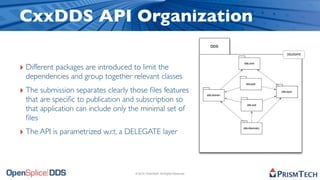
CxxDDS API Organization

‣ Different packages are introduced to limit the
  dependencies and group together relevant classes
‣ The submission separates clearly those files features
  that are specific to publication and subscription so
  that application can include only the minimal set of
  files
‣ The API is parametrized w.r.t. a DELEGATE layer


                                     © 2010, PrismTech. All Rights Reserved
Delegation Layer
‣ The delegation layer, is provided by vendors and used to instantiate the CxxDDS API
  into a concrete API
‣ This standard provide a reference implementation that shows how that can be done.
‣ Under any circumstances, compliant implementation shall not change the CxxDDS
  API, as detailed in Section 8, vendor-specific extensions shall be added only via
  DELEGATEs.
‣ The CxxDDS API provides a standard way of accessing vendor specific extensions
‣ Finally, although the specification allows for vendor-specific extensibility, it should be
  clear that this specification does not encourage nor recommend their use
 Using vendor specific extensions will make application non-source-code-portable to
 other CxxDDS compliant implementations and might also adversely impact on-the-
 wire interoperability.
                                       © 2010, PrismTech. All Rights Reserved
Object Model


The Native C++ Language DDS PSM (CxxDDS) is based
on an object model structured in two different kinds of
object types: reference-types and value-types


                       © 2010, PrismTech. All Rights Reserved
Reference Types

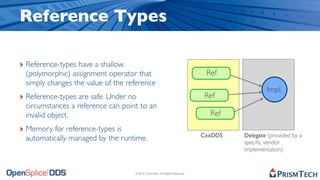
‣ Reference-types have a shallow
 (polymorphic) assignment operator that                                      Ref
 simply changes the value of the reference
                                                                                              Impl.
‣ Reference-types are safe. Under no                                         Ref
 circumstances a reference can point to an
 invalid object.                                                              Ref

‣ Memory for reference-types is
                                                                            CxxDDS   Delegate (provided by a
 automatically managed by the runtime.                                               specific vendor
                                                                                     implementation)


                                   © 2010, PrismTech. All Rights Reserved
Reference Types (cont.)

‣ The semantics for Reference types is defined by the CxxDDS class
 dds::core::Reference.

         namespace dds { namespace core {
            template <typename DELEGATE> class Reference;
         }}

‣ The specification mandates the semantics implied by the Reference class, yet the
 implementation provided as part of this standard is provided to show one possible
 way of implementing this semantics


                                    © 2010, PrismTech. All Rights Reserved
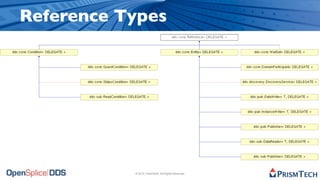
Reference Types


           © 2010, PrismTech. All Rights Reserved
WeakReferences

‣ The CxxDDS also provides safe Weak References implemented by the class
 dds::core::WeakReference
‣ Weak References can be constructed only from strong references
‣ Weak References do not expose other method other than checking wether the
 reference is valid and getting a strong-reference

       namespace dds { namespace core {
       template <typename class R <typename D>>
       class WeakReference;
       }}


                                     © 2010, PrismTech. All Rights Reserved
Value Types

‣ All objects that have a value-type have a deep-copy assignment semantics.
‣ It should also be pointed out that value-types are not “pure-value-types” in the sense
  that they are immutable (as in functional programming languages).
‣ The CxxPSM makes value-types mutable to limit the number of copies as well limit the
  time-overhead necessary to change a value-type (note that for immutable value-types
  the only form of change is to create a new value-type).
‣ Value-types always inherit from the CxxPSM dds::core::Value
The CxxDDS models all DDS entities as reference-types while QoS and Topic samples
are all modeled as value-types.


                                     © 2010, PrismTech. All Rights Reserved
API Extensibility


‣ The CxxPSM allows for QoS to be extended, either by new version of the standard or
 by vendor specific extension without any impact on the public API.
‣ The CxxPSM provides this level of extensibility while also enjoying a very compact
 representation of a QoS which leverages the combination of a DELEGEATE QoS
 implementation along with template getter and setters.


                                    © 2010, PrismTech. All Rights Reserved
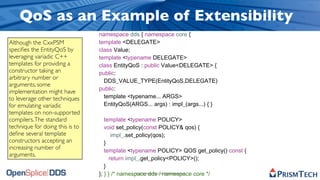
QoS as an Example of Extensibility
Although the CxxPSM
specifies the EntityQoS by
leveraging variadic C++
templates for providing a
constructor taking an
arbitrary number or
arguments, some
implementation might have
to leverage other techniques
for emulating variadic
templates on non-supported
compilers. The standard
technique for doing this is to
define several template
constructors accepting an
increasing number of
arguments.

                                 © 2010, PrismTech. All Rights Reserved
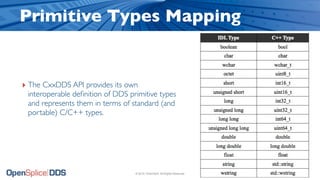
Primitive Types Mapping


‣ The CxxDDS API provides its own
 interoperable definition of DDS primitive types
 and represents them in terms of standard (and
 portable) C/C++ types.


                                  © 2010, PrismTech. All Rights Reserved
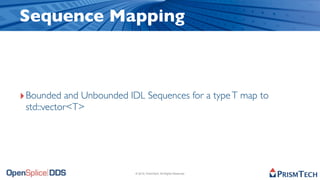
Sequence Mapping


‣ Bounded and Unbounded IDL Sequences for a type T map to
 std::vector<T>


                          © 2010, PrismTech. All Rights Reserved
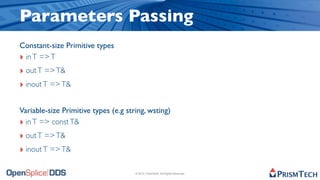
Parameters Passing
Constant-size Primitive types
‣ in T => T
‣ out T => T&
‣ inout T => T&

Variable-size Primitive types (e.g string, wsting)
‣ in T => const T&
‣ out T => T&
‣ inout T => T&

                                      © 2010, PrismTech. All Rights Reserved
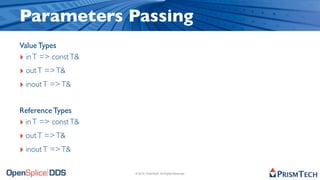
Parameters Passing
Value Types
‣ in T => const T&
‣ out T => T&
‣ inout T => T&

Reference Types
‣ in T => const T&
‣ out T => T&
‣ inout T => T&

                     © 2010, PrismTech. All Rights Reserved
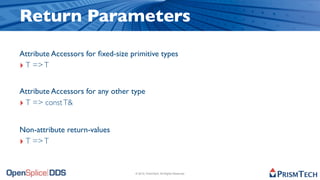
Return Parameters
Attribute Accessors for fixed-size primitive types
‣ T => T

Attribute Accessors for any other type
‣ T => const T&

Non-attribute return-values
‣ T => T


                                   © 2010, PrismTech. All Rights Reserved
OpenSplice DDS
Delivering Performance, Openness, and Freedom


                     Submission Overview
                                 API Overview
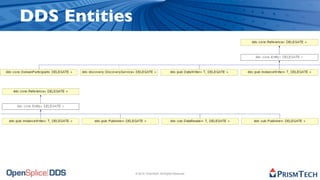
DDS Entities


               © 2010, PrismTech. All Rights Reserved
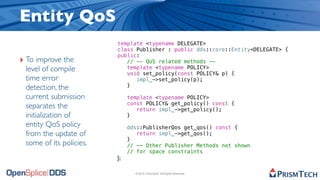
Entity QoS
                         template <typename DELEGATE>
                         class Publisher : public dds::core::Entity<DELEGATE> {
                         public:
‣ To improve the            // -- QoS related methods --
 level of compile           template <typename POLICY>
                            void set_policy(const POLICY& p) {
 time error                    impl_->set_policy(p);
 detection, the             }

 current submission           template <typename POLICY>
                              const POLICY& get_policy() const {
 separates the                   return impl_->get_policy();
 initialization of            }
 entity QoS policy            dds::PublisherQos get_qos() const {
 from the update of              return impl_->get_qos();
                              }
 some of its policies.        // -- Other Publisher Methods not shown
                              // for space constraints
                         };

                                © 2010, PrismTech. All Rights Reserved
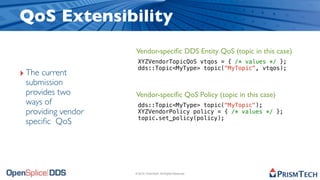
QoS Extensibility
                    Vendor-specific DDS Entity QoS (topic in this case)
                     XYZVendorTopicQoS vtqos = { /* values */ };
                     dds::Topic<MyType> topic("MyTopic", vtqos);
‣ The current
 submission
 provides two       Vendor-specific QoS Policy (topic in this case)
 ways of             dds::Topic<MyType> topic("MyTopic");
 providing vendor    XYZVendorPolicy policy = { /* values */ };
                     topic.set_policy(policy);
 specific QoS


                    © 2010, PrismTech. All Rights Reserved
Reading/Taking Data

The new API simplify and extends the ways in which data can be read/taken
by providing:
‣ std::vector based reads/takes
 ‣ The std::vector API allows for zero copy optimization
‣ Iterators based read/take supporting both:
  ‣ Forward Iterators
  ‣ Back Inserting Iterators


                                            © 2010, PrismTech. All Rights Reserved
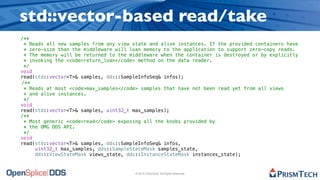
std::vector-based read/take
/**
 * Reads all new samples from any view state and alive instances. If the provided containers have
 * zero-size than the middleware will loan memory to the application to support zero-copy reads.
 * The memory will be returned to the middleware when the container is destroyed or by explicitly
 * invoking the <code>return_loan</code> method on the data reader.
 */
void
read(std::vector<T>& samples, dds::SampleInfoSeq& infos);
/**
 * Reads at most <code>max_samples</code> samples that have not been read yet from all views
 * and alive instances.
 */
void
read(std::vector<T>& samples, uint32_t max_samples);
/**
 * Most generic <code>read</code> exposing all the knobs provided by
 * the OMG DDS API.
 */
void
read(std::vector<T>& samples, dds::SampleInfoSeq& infos,
     uint32_t max_samples, dds::SampleStateMask samples_state,
     dds::ViewStateMask views_state, dds::InstanceStateMask instances_state);


                                        © 2010, PrismTech. All Rights Reserved
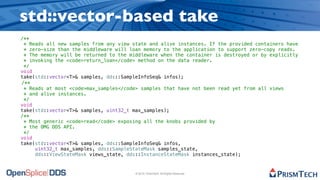
std::vector-based take
/**
 * Reads all new samples from any view state and alive instances. If the provided containers have
 * zero-size than the middleware will loan memory to the application to support zero-copy reads.
 * The memory will be returned to the middleware when the container is destroyed or by explicitly
 * invoking the <code>return_loan</code> method on the data reader.
 */
void
take(std::vector<T>& samples, dds::SampleInfoSeq& infos);
/**
 * Reads at most <code>max_samples</code> samples that have not been read yet from all views
 * and alive instances.
 */
void
take(std::vector<T>& samples, uint32_t max_samples);
/**
 * Most generic <code>read</code> exposing all the knobs provided by
 * the OMG DDS API.
 */
void
take(std::vector<T>& samples, dds::SampleInfoSeq& infos,
     uint32_t max_samples, dds::SampleStateMask samples_state,
     dds::ViewStateMask views_state, dds::InstanceStateMask instances_state);


                                        © 2010, PrismTech. All Rights Reserved
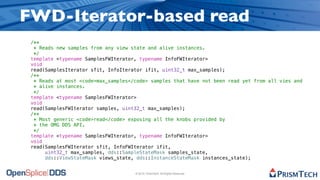
FWD-Iterator-based read
 /**
  * Reads new samples from any view state and alive instances.
  */
 template <typename SamplesFWIterator, typename InfoFWIterator>
 void
 read(SamplesIterator sfit, InfoIterator ifit, uint32_t max_samples);
 /**
  * Reads at most <code>max_samples</code> samples that have not been read yet from all vies and
  * alive instances.
  */
 template <typename SamplesFWIterator>
 void
 read(SamplesFWIterator samples, uint32_t max_samples);
 /**
  * Most generic <code>read</code> exposing all the knobs provided by
  * the OMG DDS API.
  */
 template <typename SamplesFWIterator, typename InfoFWIterator>
 void
 read(SamplesFWIterator sfit, InfoFWIterator ifit,
      uint32_t max_samples, dds::SampleStateMask samples_state,
      dds::ViewStateMask views_state, dds::InstanceStateMask instances_state);


                                     © 2010, PrismTech. All Rights Reserved
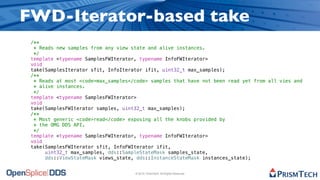
FWD-Iterator-based take
 /**
  * Reads new samples from any view state and alive instances.
  */
 template <typename SamplesFWIterator, typename InfoFWIterator>
 void
 take(SamplesIterator sfit, InfoIterator ifit, uint32_t max_samples);
 /**
  * Reads at most <code>max_samples</code> samples that have not been read yet from all vies and
  * alive instances.
  */
 template <typename SamplesFWIterator>
 void
 take(SamplesFWIterator samples, uint32_t max_samples);
 /**
  * Most generic <code>read</code> exposing all the knobs provided by
  * the OMG DDS API.
  */
 template <typename SamplesFWIterator, typename InfoFWIterator>
 void
 take(SamplesFWIterator sfit, InfoFWIterator ifit,
      uint32_t max_samples, dds::SampleStateMask samples_state,
      dds::ViewStateMask views_state, dds::InstanceStateMask instances_state);


                                     © 2010, PrismTech. All Rights Reserved
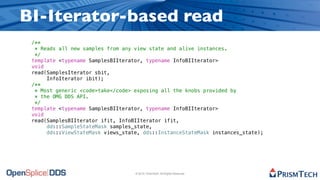
BI-Iterator-based read
 /**
  * Reads all new samples from any view state and alive instances.
  */
 template <typename SamplesBIIterator, typename InfoBIIterator>
 void
 read(SamplesIterator sbit,
      InfoIterator ibit);
 /**
  * Most generic <code>take</code> exposing all the knobs provided by
  * the OMG DDS API.
  */
 template <typename SamplesBIIterator, typename InfoBIIterator>
 void
 read(SamplesBIIterator ifit, InfoBIIterator ifit,
      dds::SampleStateMask samples_state,
      dds::ViewStateMask views_state, dds::InstanceStateMask instances_state);


                                   © 2010, PrismTech. All Rights Reserved
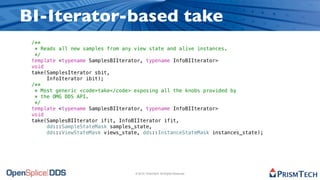
BI-Iterator-based take
 /**
  * Reads all new samples from any view state and alive instances.
  */
 template <typename SamplesBIIterator, typename InfoBIIterator>
 void
 take(SamplesIterator sbit,
      InfoIterator ibit);
 /**
  * Most generic <code>take</code> exposing all the knobs provided by
  * the OMG DDS API.
  */
 template <typename SamplesBIIterator, typename InfoBIIterator>
 void
 take(SamplesBIIterator ifit, InfoBIIterator ifit,
      dds::SampleStateMask samples_state,
      dds::ViewStateMask views_state, dds::InstanceStateMask instances_state);


                                   © 2010, PrismTech. All Rights Reserved
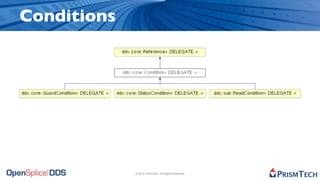
Conditions


             © 2010, PrismTech. All Rights Reserved
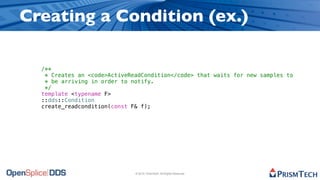
Creating a Condition (ex.)

  /**
   * Creates an <code>ActiveReadCondition</code> that waits for new samples to
   * be arriving in order to notify.
   */
  template <typename F>
  ::dds::Condition
  create_readcondition(const F& f);


                              © 2010, PrismTech. All Rights Reserved
OpenSplice DDS
Delivering Performance, Openness, and Freedom


                     Submission Overview
                          Writing an application
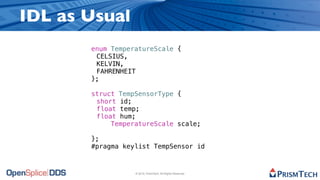
IDL as Usual
       enum TemperatureScale {
       ! CELSIUS,
       ! KELVIN,
       ! FAHRENHEIT
       };
       !
       struct TempSensorType {
       ! short id;
       ! float temp;
       ! float hum;
             TemperatureScale scale;

       };
       #pragma keylist TempSensor id


                  © 2010, PrismTech. All Rights Reserved
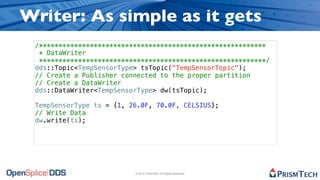
Writer: As simple as it gets
 /**********************************************************
  * DataWriter
  **********************************************************/
 dds::Topic<TempSensorType> tsTopic("TempSensorTopic");
 // Create a Publisher connected to the proper partition
 // Create a DataWriter
 dds::DataWriter<TempSensorType> dw(tsTopic);

 TempSensorType ts = {1, 26.0F, 70.0F, CELSIUS};
 // Write Data
 dw.write(ts);


                          © 2010, PrismTech. All Rights Reserved
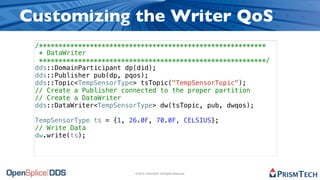
Customizing the Writer QoS
 /**********************************************************
  * DataWriter
  **********************************************************/
 dds::DomainParticipant dp(did);
 dds::Publisher pub(dp, pqos);
 dds::Topic<TempSensorType> tsTopic("TempSensorTopic");
 // Create a Publisher connected to the proper partition
 // Create a DataWriter
 dds::DataWriter<TempSensorType> dw(tsTopic, pub, dwqos);

 TempSensorType ts = {1, 26.0F, 70.0F, CELSIUS};
 // Write Data
 dw.write(ts);


                          © 2010, PrismTech. All Rights Reserved
Data Reader
  /**********************************************************
   * DataReader
   **********************************************************/
  dds::Topic<TempSensorType> tsTopic("TempSensorTopic");
  // Create a DataReader
  dds::DataReader<TempSensorType> dr(tsTopic);

  // If no initial size is provided than the read will read
  // all available samples
  std::vector<TempSensorType> data;
  SampleInfoSeq info; // This is a std::vector too!

  while (true) {
     dr.read(data, info);
     for (int i = 0; i < data.length(); ++i)
        std::cout << data[i] << std::endl;
     sleep(1);

                          © 2010, PrismTech. All Rights Reserved
Data Reader (with FW Iterators)
  /**********************************************************
   * DataReader
   **********************************************************/

  dds::Topic<TempSensorType> tsTopic("TempSensorTopic");
  // Create a DataReader
  dds::DataReader<TempSensorType> dr(tsTopic);

  std::vector<TempSensorType> data(length);
  SampleInfoSeq info(length); // This is a std::vector too!

  while (true) {
     dr.read(data.begin(), info.begin(), length);
     for (int i = 0; i < data.length(); ++i)
        std::cout << data[i] << std::endl;
     sleep(1);
  }

                          © 2010, PrismTech. All Rights Reserved
Data Reader (with BI Iterators)
  /**********************************************************
   * DataReader
   **********************************************************/

  dds::Topic<TempSensorType> tsTopic("TempSensorTopic");
  // Create a DataReader
  dds::DataReader<TempSensorType> dr(tsTopic);

  std::vector<TempSensorType> data;
  SampleInfoSeq info; // This is a std::vector too!
  std::back_insert_iterator<std::vector<TempSensorType>> bid(data);
  std::back_insert_iterator<SampleInfoSeq> bii(info);
  while (true) {
     dr.read(bid, bii);
     for (int i = 0; i < data.length(); ++i)
        std::cout << data[i] << std::endl;
     sleep(1);

                          © 2010, PrismTech. All Rights Reserved
OpenSplice DDS
Delivering Performance, Openness, and Freedom


                     Interoperability with
                IDL2C++ API and CORBA
C++2IDL and CORBA Interop


‣ The new mapping defines implicit conversion methods to create the equivalent C+
 +2IDL type when needed
‣ This allows to pass a new DDS Type to a CORBA call by leveraging automatically
 generated conversions
‣ Conversion can be enabled/disabled via IDL compilers flags


                                   © 2010, PrismTech. All Rights Reserved
OpenSplice DDS
Delivering Performance, Openness, and Freedom


                    Résumé & Next Steps
Résumé


‣ The CxxDDS addresses the goals of the RFP by providing a simpler, safer and well
 integrated C++ API for DDS
‣ The current submission addresses extensibility and portability
‣ Efficiency and determinism is not impacted by the higher level of abstraction


                                    © 2010, PrismTech. All Rights Reserved
Next Steps


‣ Vote a finalized version of this submission on June Meeting


                                    © 2010, PrismTech. All Rights Reserved
Online Resources

 http://www.opensplice.com/
                                                                                  http://www.slideshare.net/angelo.corsaro
 emailto:opensplicedds@prismtech.com


 http://bit.ly/1Sreg                                                              http://twitter.com/acorsaro/


                                                                                  http://opensplice.blogspot.com
 http://www.youtube.com/OpenSpliceTube


                                         © 2009, PrismTech. All Rights Reserved
Thank You...


© 2009, PrismTech. All Rights Reserved

ISO C++ DDS PSM

  • 1.
    OpenSplice DDS Delivering Performance, Openness, and Freedom Angelo Corsaro, Ph.D. Chief Technology Officer ISO C++ DDS PSM OMG DDS SIG Co-Chair angelo.corsaro@prismtech.com
  • 2.
    OpenSplice DDS Delivering Performance,Openness, and Freedom Rationale
  • 3.
    ISO C++ PSMMotivations The “Native C++ Language DDS PSM” (CxxDDS) was motivated by the following reasons: ‣Provide better integration with the C++ programming language ‣Provide a simpler and safer API to facilitate adoption within and beyond current user domains ‣Ensure 100% source-code portability across DDS implementations © 2010, PrismTech. All Rights Reserved
  • 4.
    Integration with C++ Thecurrent IDL-derived PSM suffers the following shortcomings: ‣ Limited integration of IDL-derived types with the C++ language ‣e.g. char* vs. std::string, Sequence vs. std::vector, etc. ‣ Limited use of features and idioms universally supported by C++ compilers and widely used by C++ programmers ‣e.g. template and template-meta-programming, iterators, etc. © 2010, PrismTech. All Rights Reserved
  • 5.
    API Complexity ‣ Thecurrent API suffers from accidental complexity mostly induced by the limited expressiveness of IDL and the dated IDL2C++ mapping © 2010, PrismTech. All Rights Reserved
  • 6.
    Portability ‣ The currentIDL-derived API leaves some types defined as native, thus allowing different vendors to use different representations ‣e.g. the type of the domainid ‣ The current IDL-derived API does not specifies the DDS interfaces as local, yet semantically those are local. This has also been source of portability issues © 2010, PrismTech. All Rights Reserved
  • 7.
    OpenSplice DDS Delivering Performance,Openness, and Freedom Submission Overview Foundations
  • 8.
    CxxDDS API Organization ‣Different packages are introduced to limit the dependencies and group together relevant classes ‣ The submission separates clearly those files features that are specific to publication and subscription so that application can include only the minimal set of files ‣ The API is parametrized w.r.t. a DELEGATE layer © 2010, PrismTech. All Rights Reserved
  • 9.
    Delegation Layer ‣ Thedelegation layer, is provided by vendors and used to instantiate the CxxDDS API into a concrete API ‣ This standard provide a reference implementation that shows how that can be done. ‣ Under any circumstances, compliant implementation shall not change the CxxDDS API, as detailed in Section 8, vendor-specific extensions shall be added only via DELEGATEs. ‣ The CxxDDS API provides a standard way of accessing vendor specific extensions ‣ Finally, although the specification allows for vendor-specific extensibility, it should be clear that this specification does not encourage nor recommend their use Using vendor specific extensions will make application non-source-code-portable to other CxxDDS compliant implementations and might also adversely impact on-the- wire interoperability. © 2010, PrismTech. All Rights Reserved
  • 10.
    Object Model The NativeC++ Language DDS PSM (CxxDDS) is based on an object model structured in two different kinds of object types: reference-types and value-types © 2010, PrismTech. All Rights Reserved
  • 11.
    Reference Types ‣ Reference-typeshave a shallow (polymorphic) assignment operator that Ref simply changes the value of the reference Impl. ‣ Reference-types are safe. Under no Ref circumstances a reference can point to an invalid object. Ref ‣ Memory for reference-types is CxxDDS Delegate (provided by a automatically managed by the runtime. specific vendor implementation) © 2010, PrismTech. All Rights Reserved
  • 12.
    Reference Types (cont.) ‣The semantics for Reference types is defined by the CxxDDS class dds::core::Reference. namespace dds { namespace core { template <typename DELEGATE> class Reference; }} ‣ The specification mandates the semantics implied by the Reference class, yet the implementation provided as part of this standard is provided to show one possible way of implementing this semantics © 2010, PrismTech. All Rights Reserved
  • 13.
    Reference Types © 2010, PrismTech. All Rights Reserved
  • 14.
    WeakReferences ‣ The CxxDDSalso provides safe Weak References implemented by the class dds::core::WeakReference ‣ Weak References can be constructed only from strong references ‣ Weak References do not expose other method other than checking wether the reference is valid and getting a strong-reference namespace dds { namespace core { template <typename class R <typename D>> class WeakReference; }} © 2010, PrismTech. All Rights Reserved
  • 15.
    Value Types ‣ Allobjects that have a value-type have a deep-copy assignment semantics. ‣ It should also be pointed out that value-types are not “pure-value-types” in the sense that they are immutable (as in functional programming languages). ‣ The CxxPSM makes value-types mutable to limit the number of copies as well limit the time-overhead necessary to change a value-type (note that for immutable value-types the only form of change is to create a new value-type). ‣ Value-types always inherit from the CxxPSM dds::core::Value The CxxDDS models all DDS entities as reference-types while QoS and Topic samples are all modeled as value-types. © 2010, PrismTech. All Rights Reserved
  • 16.
    API Extensibility ‣ TheCxxPSM allows for QoS to be extended, either by new version of the standard or by vendor specific extension without any impact on the public API. ‣ The CxxPSM provides this level of extensibility while also enjoying a very compact representation of a QoS which leverages the combination of a DELEGEATE QoS implementation along with template getter and setters. © 2010, PrismTech. All Rights Reserved
  • 17.
    QoS as anExample of Extensibility Although the CxxPSM specifies the EntityQoS by leveraging variadic C++ templates for providing a constructor taking an arbitrary number or arguments, some implementation might have to leverage other techniques for emulating variadic templates on non-supported compilers. The standard technique for doing this is to define several template constructors accepting an increasing number of arguments. © 2010, PrismTech. All Rights Reserved
  • 18.
    Primitive Types Mapping ‣The CxxDDS API provides its own interoperable definition of DDS primitive types and represents them in terms of standard (and portable) C/C++ types. © 2010, PrismTech. All Rights Reserved
  • 19.
    Sequence Mapping ‣ Boundedand Unbounded IDL Sequences for a type T map to std::vector<T> © 2010, PrismTech. All Rights Reserved
  • 20.
    Parameters Passing Constant-size Primitivetypes ‣ in T => T ‣ out T => T& ‣ inout T => T& Variable-size Primitive types (e.g string, wsting) ‣ in T => const T& ‣ out T => T& ‣ inout T => T& © 2010, PrismTech. All Rights Reserved
  • 21.
    Parameters Passing Value Types ‣in T => const T& ‣ out T => T& ‣ inout T => T& Reference Types ‣ in T => const T& ‣ out T => T& ‣ inout T => T& © 2010, PrismTech. All Rights Reserved
  • 22.
    Return Parameters Attribute Accessorsfor fixed-size primitive types ‣ T => T Attribute Accessors for any other type ‣ T => const T& Non-attribute return-values ‣ T => T © 2010, PrismTech. All Rights Reserved
  • 23.
    OpenSplice DDS Delivering Performance,Openness, and Freedom Submission Overview API Overview
  • 24.
    DDS Entities © 2010, PrismTech. All Rights Reserved
  • 25.
    Entity QoS template <typename DELEGATE> class Publisher : public dds::core::Entity<DELEGATE> { public: ‣ To improve the // -- QoS related methods -- level of compile template <typename POLICY> void set_policy(const POLICY& p) { time error impl_->set_policy(p); detection, the } current submission template <typename POLICY> const POLICY& get_policy() const { separates the return impl_->get_policy(); initialization of } entity QoS policy dds::PublisherQos get_qos() const { from the update of return impl_->get_qos(); } some of its policies. // -- Other Publisher Methods not shown // for space constraints }; © 2010, PrismTech. All Rights Reserved
  • 26.
    QoS Extensibility Vendor-specific DDS Entity QoS (topic in this case) XYZVendorTopicQoS vtqos = { /* values */ }; dds::Topic<MyType> topic("MyTopic", vtqos); ‣ The current submission provides two Vendor-specific QoS Policy (topic in this case) ways of dds::Topic<MyType> topic("MyTopic"); providing vendor XYZVendorPolicy policy = { /* values */ }; topic.set_policy(policy); specific QoS © 2010, PrismTech. All Rights Reserved
  • 27.
    Reading/Taking Data The newAPI simplify and extends the ways in which data can be read/taken by providing: ‣ std::vector based reads/takes ‣ The std::vector API allows for zero copy optimization ‣ Iterators based read/take supporting both: ‣ Forward Iterators ‣ Back Inserting Iterators © 2010, PrismTech. All Rights Reserved
  • 28.
    std::vector-based read/take /** *Reads all new samples from any view state and alive instances. If the provided containers have * zero-size than the middleware will loan memory to the application to support zero-copy reads. * The memory will be returned to the middleware when the container is destroyed or by explicitly * invoking the <code>return_loan</code> method on the data reader. */ void read(std::vector<T>& samples, dds::SampleInfoSeq& infos); /** * Reads at most <code>max_samples</code> samples that have not been read yet from all views * and alive instances. */ void read(std::vector<T>& samples, uint32_t max_samples); /** * Most generic <code>read</code> exposing all the knobs provided by * the OMG DDS API. */ void read(std::vector<T>& samples, dds::SampleInfoSeq& infos, uint32_t max_samples, dds::SampleStateMask samples_state, dds::ViewStateMask views_state, dds::InstanceStateMask instances_state); © 2010, PrismTech. All Rights Reserved
  • 29.
    std::vector-based take /** *Reads all new samples from any view state and alive instances. If the provided containers have * zero-size than the middleware will loan memory to the application to support zero-copy reads. * The memory will be returned to the middleware when the container is destroyed or by explicitly * invoking the <code>return_loan</code> method on the data reader. */ void take(std::vector<T>& samples, dds::SampleInfoSeq& infos); /** * Reads at most <code>max_samples</code> samples that have not been read yet from all views * and alive instances. */ void take(std::vector<T>& samples, uint32_t max_samples); /** * Most generic <code>read</code> exposing all the knobs provided by * the OMG DDS API. */ void take(std::vector<T>& samples, dds::SampleInfoSeq& infos, uint32_t max_samples, dds::SampleStateMask samples_state, dds::ViewStateMask views_state, dds::InstanceStateMask instances_state); © 2010, PrismTech. All Rights Reserved
  • 30.
    FWD-Iterator-based read /** * Reads new samples from any view state and alive instances. */ template <typename SamplesFWIterator, typename InfoFWIterator> void read(SamplesIterator sfit, InfoIterator ifit, uint32_t max_samples); /** * Reads at most <code>max_samples</code> samples that have not been read yet from all vies and * alive instances. */ template <typename SamplesFWIterator> void read(SamplesFWIterator samples, uint32_t max_samples); /** * Most generic <code>read</code> exposing all the knobs provided by * the OMG DDS API. */ template <typename SamplesFWIterator, typename InfoFWIterator> void read(SamplesFWIterator sfit, InfoFWIterator ifit, uint32_t max_samples, dds::SampleStateMask samples_state, dds::ViewStateMask views_state, dds::InstanceStateMask instances_state); © 2010, PrismTech. All Rights Reserved
  • 31.
    FWD-Iterator-based take /** * Reads new samples from any view state and alive instances. */ template <typename SamplesFWIterator, typename InfoFWIterator> void take(SamplesIterator sfit, InfoIterator ifit, uint32_t max_samples); /** * Reads at most <code>max_samples</code> samples that have not been read yet from all vies and * alive instances. */ template <typename SamplesFWIterator> void take(SamplesFWIterator samples, uint32_t max_samples); /** * Most generic <code>read</code> exposing all the knobs provided by * the OMG DDS API. */ template <typename SamplesFWIterator, typename InfoFWIterator> void take(SamplesFWIterator sfit, InfoFWIterator ifit, uint32_t max_samples, dds::SampleStateMask samples_state, dds::ViewStateMask views_state, dds::InstanceStateMask instances_state); © 2010, PrismTech. All Rights Reserved
  • 32.
    BI-Iterator-based read /** * Reads all new samples from any view state and alive instances. */ template <typename SamplesBIIterator, typename InfoBIIterator> void read(SamplesIterator sbit, InfoIterator ibit); /** * Most generic <code>take</code> exposing all the knobs provided by * the OMG DDS API. */ template <typename SamplesBIIterator, typename InfoBIIterator> void read(SamplesBIIterator ifit, InfoBIIterator ifit, dds::SampleStateMask samples_state, dds::ViewStateMask views_state, dds::InstanceStateMask instances_state); © 2010, PrismTech. All Rights Reserved
  • 33.
    BI-Iterator-based take /** * Reads all new samples from any view state and alive instances. */ template <typename SamplesBIIterator, typename InfoBIIterator> void take(SamplesIterator sbit, InfoIterator ibit); /** * Most generic <code>take</code> exposing all the knobs provided by * the OMG DDS API. */ template <typename SamplesBIIterator, typename InfoBIIterator> void take(SamplesBIIterator ifit, InfoBIIterator ifit, dds::SampleStateMask samples_state, dds::ViewStateMask views_state, dds::InstanceStateMask instances_state); © 2010, PrismTech. All Rights Reserved
  • 34.
    Conditions © 2010, PrismTech. All Rights Reserved
  • 35.
    Creating a Condition(ex.) /** * Creates an <code>ActiveReadCondition</code> that waits for new samples to * be arriving in order to notify. */ template <typename F> ::dds::Condition create_readcondition(const F& f); © 2010, PrismTech. All Rights Reserved
  • 36.
    OpenSplice DDS Delivering Performance,Openness, and Freedom Submission Overview Writing an application
  • 37.
    IDL as Usual enum TemperatureScale { ! CELSIUS, ! KELVIN, ! FAHRENHEIT }; ! struct TempSensorType { ! short id; ! float temp; ! float hum; TemperatureScale scale; }; #pragma keylist TempSensor id © 2010, PrismTech. All Rights Reserved
  • 38.
    Writer: As simpleas it gets /********************************************************** * DataWriter **********************************************************/ dds::Topic<TempSensorType> tsTopic("TempSensorTopic"); // Create a Publisher connected to the proper partition // Create a DataWriter dds::DataWriter<TempSensorType> dw(tsTopic); TempSensorType ts = {1, 26.0F, 70.0F, CELSIUS}; // Write Data dw.write(ts); © 2010, PrismTech. All Rights Reserved
  • 39.
    Customizing the WriterQoS /********************************************************** * DataWriter **********************************************************/ dds::DomainParticipant dp(did); dds::Publisher pub(dp, pqos); dds::Topic<TempSensorType> tsTopic("TempSensorTopic"); // Create a Publisher connected to the proper partition // Create a DataWriter dds::DataWriter<TempSensorType> dw(tsTopic, pub, dwqos); TempSensorType ts = {1, 26.0F, 70.0F, CELSIUS}; // Write Data dw.write(ts); © 2010, PrismTech. All Rights Reserved
  • 40.
    Data Reader /********************************************************** * DataReader **********************************************************/ dds::Topic<TempSensorType> tsTopic("TempSensorTopic"); // Create a DataReader dds::DataReader<TempSensorType> dr(tsTopic); // If no initial size is provided than the read will read // all available samples std::vector<TempSensorType> data; SampleInfoSeq info; // This is a std::vector too! while (true) { dr.read(data, info); for (int i = 0; i < data.length(); ++i) std::cout << data[i] << std::endl; sleep(1); © 2010, PrismTech. All Rights Reserved
  • 41.
    Data Reader (withFW Iterators) /********************************************************** * DataReader **********************************************************/ dds::Topic<TempSensorType> tsTopic("TempSensorTopic"); // Create a DataReader dds::DataReader<TempSensorType> dr(tsTopic); std::vector<TempSensorType> data(length); SampleInfoSeq info(length); // This is a std::vector too! while (true) { dr.read(data.begin(), info.begin(), length); for (int i = 0; i < data.length(); ++i) std::cout << data[i] << std::endl; sleep(1); } © 2010, PrismTech. All Rights Reserved
  • 42.
    Data Reader (withBI Iterators) /********************************************************** * DataReader **********************************************************/ dds::Topic<TempSensorType> tsTopic("TempSensorTopic"); // Create a DataReader dds::DataReader<TempSensorType> dr(tsTopic); std::vector<TempSensorType> data; SampleInfoSeq info; // This is a std::vector too! std::back_insert_iterator<std::vector<TempSensorType>> bid(data); std::back_insert_iterator<SampleInfoSeq> bii(info); while (true) { dr.read(bid, bii); for (int i = 0; i < data.length(); ++i) std::cout << data[i] << std::endl; sleep(1); © 2010, PrismTech. All Rights Reserved
  • 43.
    OpenSplice DDS Delivering Performance,Openness, and Freedom Interoperability with IDL2C++ API and CORBA
  • 44.
    C++2IDL and CORBAInterop ‣ The new mapping defines implicit conversion methods to create the equivalent C+ +2IDL type when needed ‣ This allows to pass a new DDS Type to a CORBA call by leveraging automatically generated conversions ‣ Conversion can be enabled/disabled via IDL compilers flags © 2010, PrismTech. All Rights Reserved
  • 45.
    OpenSplice DDS Delivering Performance,Openness, and Freedom Résumé & Next Steps
  • 46.
    Résumé ‣ The CxxDDSaddresses the goals of the RFP by providing a simpler, safer and well integrated C++ API for DDS ‣ The current submission addresses extensibility and portability ‣ Efficiency and determinism is not impacted by the higher level of abstraction © 2010, PrismTech. All Rights Reserved
  • 47.
    Next Steps ‣ Votea finalized version of this submission on June Meeting © 2010, PrismTech. All Rights Reserved
  • 48.
    Online Resources http://www.opensplice.com/ http://www.slideshare.net/angelo.corsaro emailto:opensplicedds@prismtech.com http://bit.ly/1Sreg http://twitter.com/acorsaro/ http://opensplice.blogspot.com http://www.youtube.com/OpenSpliceTube © 2009, PrismTech. All Rights Reserved
  • 49.
    Thank You... © 2009,PrismTech. All Rights Reserved