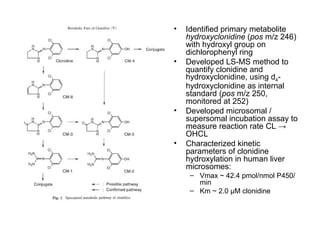
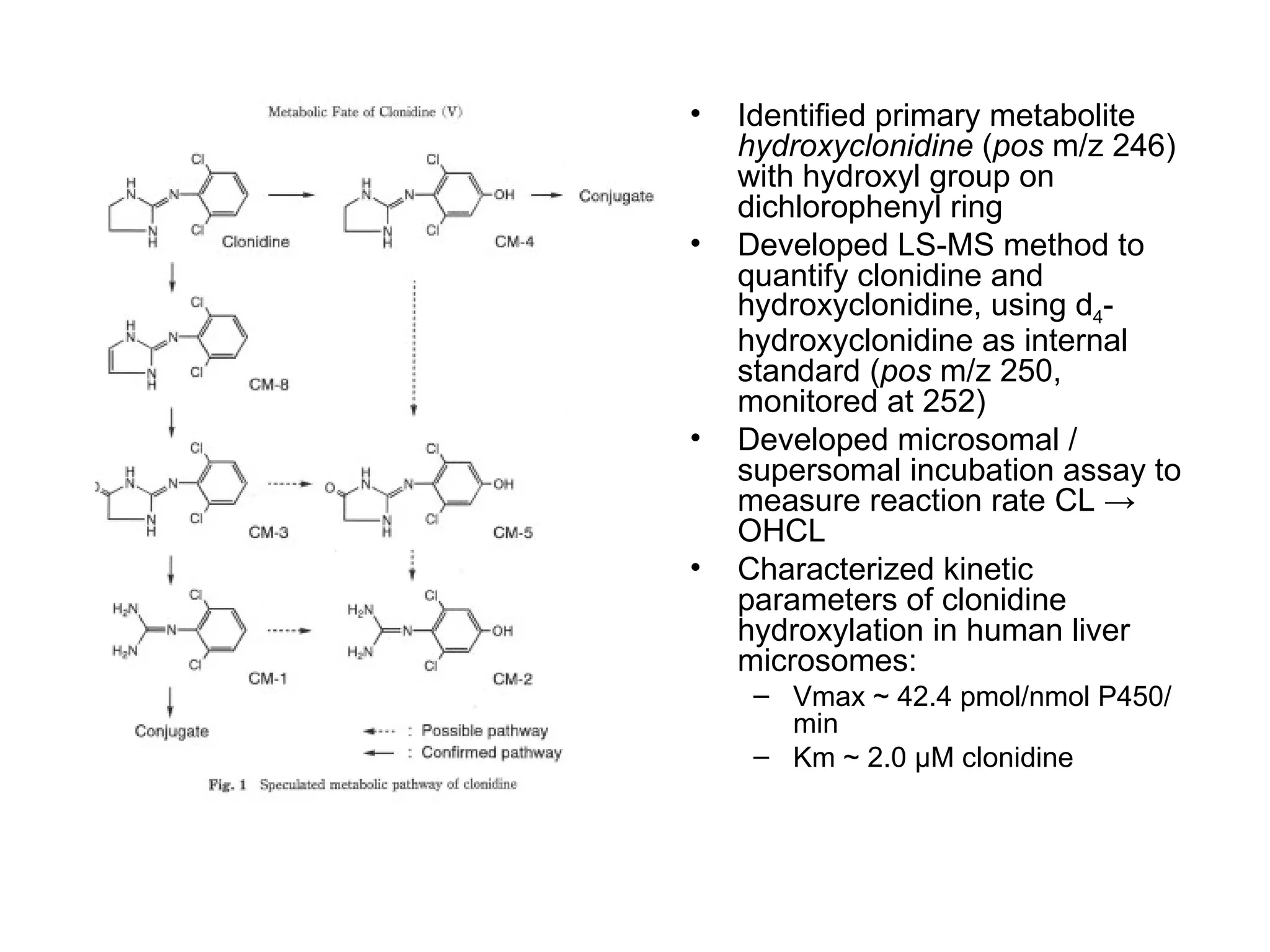
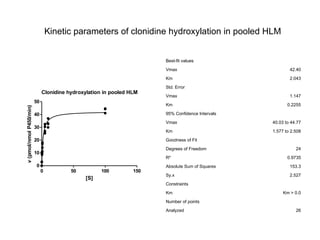
Identified primary metabolite  hydroxyclonidine  ( pos  m/z 246) with hydroxyl group on dichlorophenyl ring Developed LS-MS method to quantify clonidine and hydroxyclonidine, using d 4 -hydroxyclonidine as internal standard ( pos  m/z 250, monitored at 252) Developed microsomal / supersomal incubation assay to measure reaction rate CL  -> OHCL Characterized kinetic parameters of clonidine hydroxylation in human liver microsomes: Vmax ~ 42.4 pmol/nmol P450/min Km ~ 2.0 µM clonidine
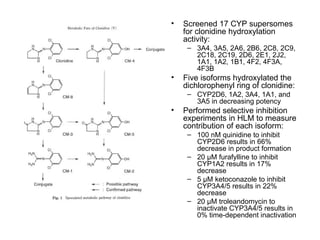
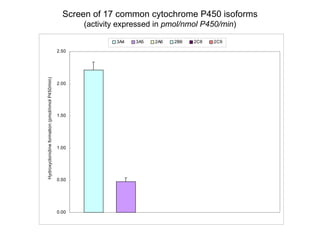
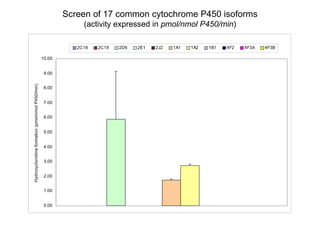
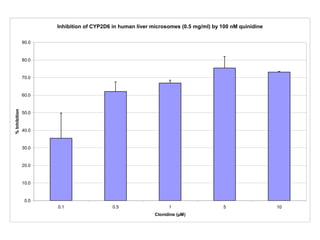
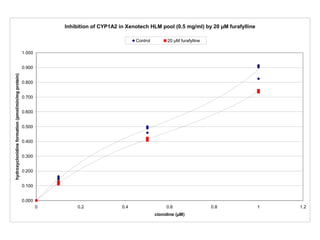
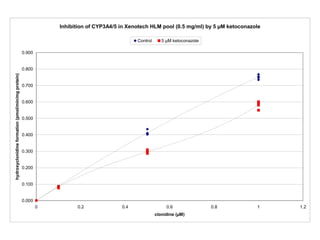
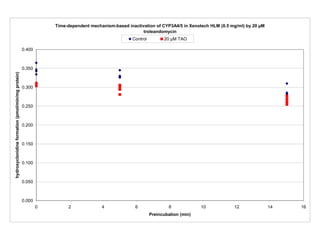
Screened 17 CYP supersomes for clonidine hydroxylation activity: 3A4, 3A5, 2A6, 2B6, 2C8, 2C9, 2C18, 2C19, 2D6, 2E1, 2J2, 1A1, 1A2, 1B1, 4F2, 4F3A, 4F3B Five isoforms hydroxylated the dichlorophenyl ring of clonidine: CYP2D6, 1A2, 3A4, 1A1, and 3A5 in decreasing potency Performed selective inhibition experiments in HLM to measure contribution of each isoform: 100 nM quinidine to inhibit CYP2D6 results in 66% decrease in product formation 20 µM furafylline to inhibit CYP1A2 results in 17% decrease 5 µM ketoconazole to inhibit CYP3A4/5 results in 22% decrease 20 µM troleandomycin to inactivate CYP3A4/5 results in 0% time-dependent inactivation
 
Kinetic parameters of clonidine hydroxylation in pooled HLM 26 Analyzed   Number of points Km > 0.0 Km   Constraints 2.527 Sy.x 153.3 Absolute Sum of Squares 0.9735 R² 24 Degrees of Freedom   Goodness of Fit 1.577 to 2.508 Km 40.03 to 44.77 Vmax   95% Confidence Intervals 0.2255 Km 1.147 Vmax   Std. Error 2.043 Km 42.40 Vmax   Best-fit values
Screen of 17 common cytochrome P450 isoforms (activity expressed in  pmol/nmol P450/min )
 
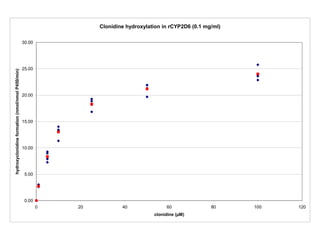
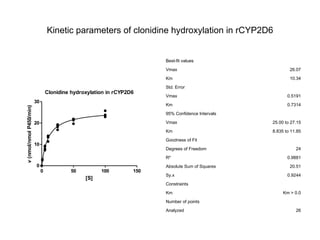
Kinetic parameters of clonidine hydroxylation in rCYP2D6 26 Analyzed   Number of points Km > 0.0 Km   Constraints 0.9244 Sy.x 20.51 Absolute Sum of Squares 0.9881 R² 24 Degrees of Freedom   Goodness of Fit 8.835 to 11.85 Km 25.00 to 27.15 Vmax   95% Confidence Intervals 0.7314 Km 0.5191 Vmax   Std. Error 10.34 Km 26.07 Vmax   Best-fit values


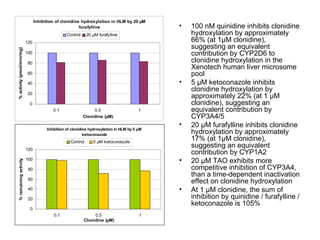
100 nM quinidine inhibits clonidine hydroxylation by approximately 66% (at 1µM clonidine), suggesting an equivalent contribution by CYP2D6 to clonidine hydroxylation in the Xenotech human liver microsome pool 5 µM ketoconazole inhibits clonidine hydroxylation by approximately 22% (at 1 µM clonidine), suggesting an equivalent contribution by CYP3A4/5 20 µM furafylline inhibits clonidine hydroxylation by approximately 17% (at 1µM clonidine), suggesting an equivalent contribution by CYP1A2 20 µM TAO exhibits more competitive inhibition of CYP3A4, than a time-dependent inactivation effect on clonidine hydroxylation At 1 µM clonidine, the sum of inhibition by quinidine / furafylline / ketoconazole is 105%

In Vitro Metabolism of Clonidine in Human Hepatic Microsomes and Cytochrome P450 Isoforms

  • 1.
    Identified primary metabolite hydroxyclonidine ( pos m/z 246) with hydroxyl group on dichlorophenyl ring Developed LS-MS method to quantify clonidine and hydroxyclonidine, using d 4 -hydroxyclonidine as internal standard ( pos m/z 250, monitored at 252) Developed microsomal / supersomal incubation assay to measure reaction rate CL -> OHCL Characterized kinetic parameters of clonidine hydroxylation in human liver microsomes: Vmax ~ 42.4 pmol/nmol P450/min Km ~ 2.0 µM clonidine
  • 2.
    Screened 17 CYPsupersomes for clonidine hydroxylation activity: 3A4, 3A5, 2A6, 2B6, 2C8, 2C9, 2C18, 2C19, 2D6, 2E1, 2J2, 1A1, 1A2, 1B1, 4F2, 4F3A, 4F3B Five isoforms hydroxylated the dichlorophenyl ring of clonidine: CYP2D6, 1A2, 3A4, 1A1, and 3A5 in decreasing potency Performed selective inhibition experiments in HLM to measure contribution of each isoform: 100 nM quinidine to inhibit CYP2D6 results in 66% decrease in product formation 20 µM furafylline to inhibit CYP1A2 results in 17% decrease 5 µM ketoconazole to inhibit CYP3A4/5 results in 22% decrease 20 µM troleandomycin to inactivate CYP3A4/5 results in 0% time-dependent inactivation
  • 3.
  • 4.
    Kinetic parameters ofclonidine hydroxylation in pooled HLM 26 Analyzed   Number of points Km > 0.0 Km   Constraints 2.527 Sy.x 153.3 Absolute Sum of Squares 0.9735 R² 24 Degrees of Freedom   Goodness of Fit 1.577 to 2.508 Km 40.03 to 44.77 Vmax   95% Confidence Intervals 0.2255 Km 1.147 Vmax   Std. Error 2.043 Km 42.40 Vmax   Best-fit values
  • 5.
    Screen of 17common cytochrome P450 isoforms (activity expressed in pmol/nmol P450/min )
  • 6.
    Screen of 17common cytochrome P450 isoforms (activity expressed in pmol/nmol P450/min )
  • 7.
  • 8.
    Kinetic parameters ofclonidine hydroxylation in rCYP2D6 26 Analyzed   Number of points Km > 0.0 Km   Constraints 0.9244 Sy.x 20.51 Absolute Sum of Squares 0.9881 R² 24 Degrees of Freedom   Goodness of Fit 8.835 to 11.85 Km 25.00 to 27.15 Vmax   95% Confidence Intervals 0.7314 Km 0.5191 Vmax   Std. Error 10.34 Km 26.07 Vmax   Best-fit values
  • 9.
  • 10.
  • 11.
  • 12.
  • 13.
  • 14.
    100 nM quinidineinhibits clonidine hydroxylation by approximately 66% (at 1µM clonidine), suggesting an equivalent contribution by CYP2D6 to clonidine hydroxylation in the Xenotech human liver microsome pool 5 µM ketoconazole inhibits clonidine hydroxylation by approximately 22% (at 1 µM clonidine), suggesting an equivalent contribution by CYP3A4/5 20 µM furafylline inhibits clonidine hydroxylation by approximately 17% (at 1µM clonidine), suggesting an equivalent contribution by CYP1A2 20 µM TAO exhibits more competitive inhibition of CYP3A4, than a time-dependent inactivation effect on clonidine hydroxylation At 1 µM clonidine, the sum of inhibition by quinidine / furafylline / ketoconazole is 105%