INTRODUCTION
Telemetry is presentation of measured values at
location remote from site of measurement. Greek
words
doctor
‘Tele’: remote, ‘meter’: measuring. e.g.,
analyzing data of patient from remote
location
Telemetry involves three steps:
a.
b.
c.
converting measured quantity to signal
Transmission of that signal over proper channel
Its reconversion to actual data for recording,
and further
2
displaying(CRT) for graphical
computation
analysis
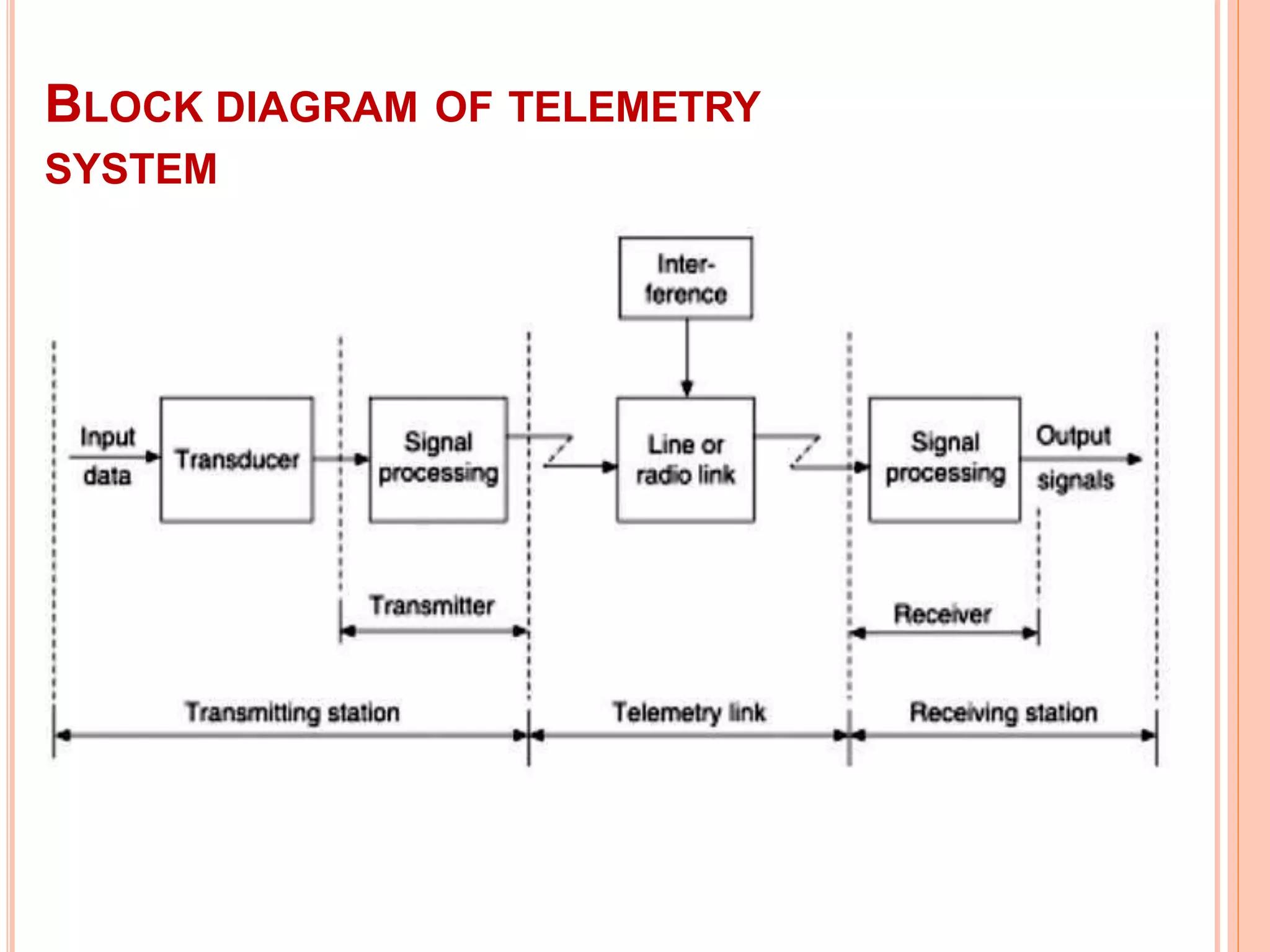
BLOCK DIAGRAM
SYSTEM
OF TELEMETRY
FACTORS INFLUENCING TELEMETRY SYSTEM
DESIGN
Primary criteria for choice and design is accuracy.
System is decided whether transmitted data is in
Analog or Digital domain.
For digital data
and
to be transmitted, error detection,
recognition
accurate.
Selection of
link to avoid
correction capability make system
apt. bandwidth for data channel and data
crosstalk.
Power levels must be low to reduce noise generation
5
TYPES OF TELEMETRY SYSTEMS
Landline
Telephone
Telemetry
Lines and
System:
Electrical
Power
Wires.
Lines,
Distance
ranges from 50m to 1 km e.g., labs, industries.
Types: Current, Voltage & position.
Radio-Frequency System: Radio links from1 km to
50 km at 4MHz. For distance >50 Km Microwave
links are used 890 MHz to 30GHz. Repeaters are
installed after every 30 to 60 km for long distance
transmission.
6
LANDLINE
TELEMETRY SYSTEM
7
It is transmitted at the receiver end.
VOLTAGE TELEMETRY SYSTEM
Measured Variable is transmitted in form of voltage
At transmitting end, Slide wire is connected in series with
battery.
Slide wire is further connected to Bourdon tube for pressure
measurement.
When pressure changes, slider actuates the slider of
potentiometer. Thus , change in Voltage is transmitted to rvr.
8Circuit of Voltage Telemetry System
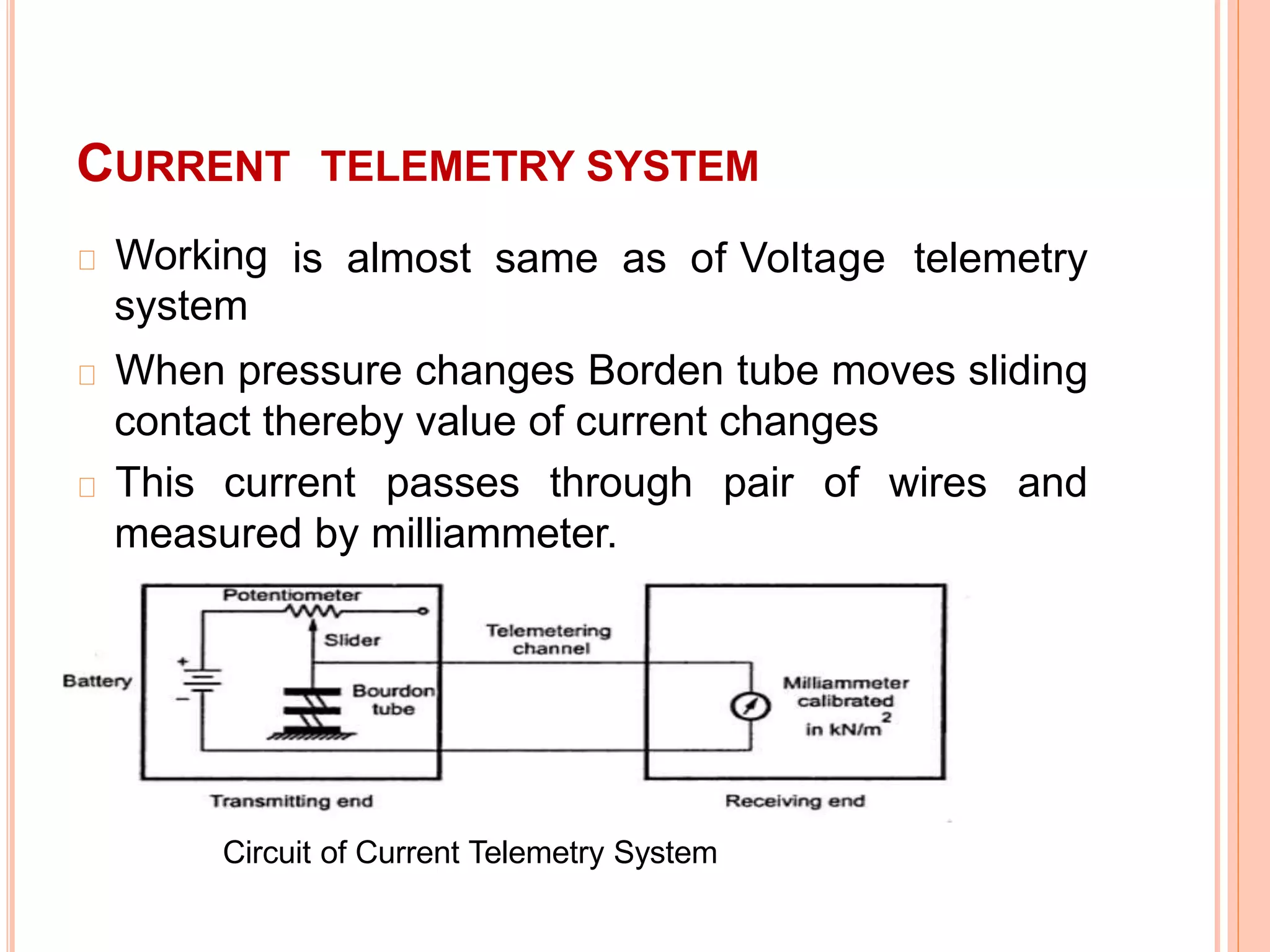
CURRENT
Working
system
TELEMETRY SYSTEM
is almost same as of Voltage telemetry
When pressure changes Borden tube moves sliding
contact thereby value of current changes
This current passes through pair of wires and
measured by milliammeter.
9
Circuit of Current Telemetry System
DEMERITS AND MERITS
Merits:
Effective for short distance measurement
V and I can be easily transmitted
Circuitry required is simple
Wide variety of primary sensing elements
measure reqd. variable.
Demerits:
are available to
is difficult to calibrate.
Need to be protected from EMI, noises and distortions
the channel.
Multiplexing is difficult
Limited frequency response
in
10
R.F. TELEMETRY
SYSTEM
11
R.F. TELEMETRY SYSTEM
No physical link between telemeter transmitter and
receiver.
Link is established through radio links.
Examples : in spacecrafts, rockets and missiles
corrective actions can be taken from stations with
help of R.F. Links
In instrumentation the o/p of transducer is
considered as modulating signal. 12
R.F. TELEMETRY SYSTEM
Modulation schemes:
• When signal is in continuous form: Amplitude Modulation
Is the process in which the amplitude of carrier signal is varied
in accordance with modulating signal.
• When signal is in form of pulses: Pulse modulation
Pulse modulation is a technique of modulating analog signal
and converting it into desired form.
13
FREQUENCY
DIAGRAM:
TELEMETRY SYSTEM BLOCK
THE DISADVANTAGE OF FM TELEMETRY
15
SYSTEM IS CAPACITY OF CHANNELS OFFERED
IS LESS
The output of transducer and signal conditioner modulates the
frequency of a voltage controlled subcarrier oscillator. Many
oscillators, each operating in a dedicated part of the frequency
spectrum ,are mixed for radio transmission . As each voltage
controlled oscillator is assigned with a separate frequency of
separate frequency spectrum, so each signal can be transmitted
without interfering with other signals.
At the receiving station, discriminator is tuned to the frequency of
each subcarrier. Thus when measurement value changes at source ,
the output voltage of discriminator change accordingly.
PULSE TELEMETRY SYSTEM
16
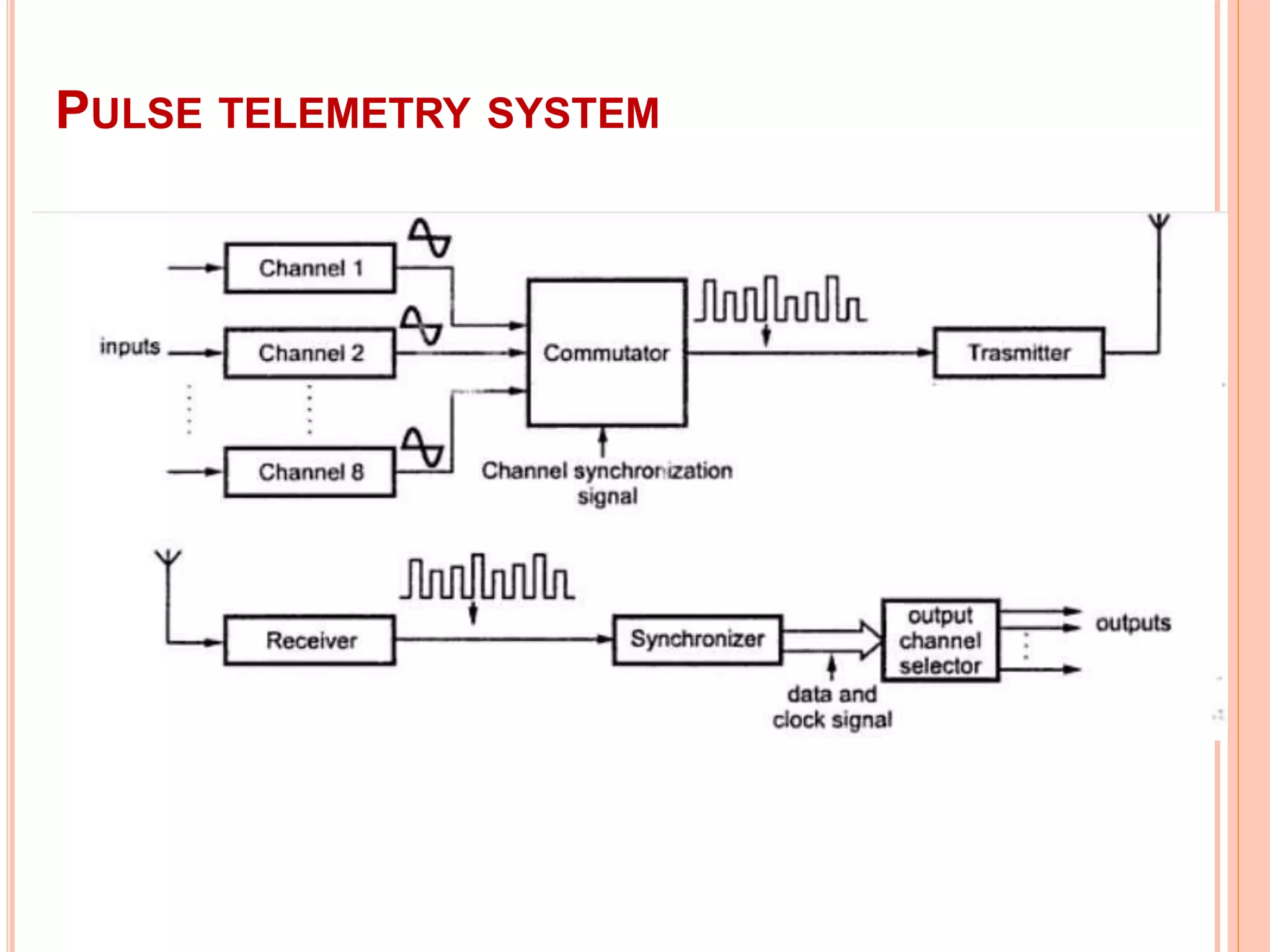
The measured data is represented in the form of binary
weighted codes.
Here encoder is used after the commutator stage
The function of encoder is to accept each PAM sample and
convert it into a binary number and shift the bits of each
number serially. The encoder converts zero amplitude pulse to
the binary number “0”, while the full scale pulse into binary
number say “1023” .Each number is exactly proportional to the
instantaneous amplitude of the signal at the measuring points.
The receiver section is synchronized on the serial data system.
The bit synchronizer and frame synchronizer identify each
sequence of bits and converts it into useful outputs.

Telemetry

  • 1.
    INTRODUCTION Telemetry is presentationof measured values at location remote from site of measurement. Greek words doctor ‘Tele’: remote, ‘meter’: measuring. e.g., analyzing data of patient from remote location Telemetry involves three steps: a. b. c. converting measured quantity to signal Transmission of that signal over proper channel Its reconversion to actual data for recording, and further 2 displaying(CRT) for graphical computation analysis
  • 2.
  • 3.
    FACTORS INFLUENCING TELEMETRYSYSTEM DESIGN Primary criteria for choice and design is accuracy. System is decided whether transmitted data is in Analog or Digital domain. For digital data and to be transmitted, error detection, recognition accurate. Selection of link to avoid correction capability make system apt. bandwidth for data channel and data crosstalk. Power levels must be low to reduce noise generation 5
  • 4.
    TYPES OF TELEMETRYSYSTEMS Landline Telephone Telemetry Lines and System: Electrical Power Wires. Lines, Distance ranges from 50m to 1 km e.g., labs, industries. Types: Current, Voltage & position. Radio-Frequency System: Radio links from1 km to 50 km at 4MHz. For distance >50 Km Microwave links are used 890 MHz to 30GHz. Repeaters are installed after every 30 to 60 km for long distance transmission. 6
  • 5.
  • 6.
    It is transmittedat the receiver end. VOLTAGE TELEMETRY SYSTEM Measured Variable is transmitted in form of voltage At transmitting end, Slide wire is connected in series with battery. Slide wire is further connected to Bourdon tube for pressure measurement. When pressure changes, slider actuates the slider of potentiometer. Thus , change in Voltage is transmitted to rvr. 8Circuit of Voltage Telemetry System
  • 7.
    CURRENT Working system TELEMETRY SYSTEM is almostsame as of Voltage telemetry When pressure changes Borden tube moves sliding contact thereby value of current changes This current passes through pair of wires and measured by milliammeter. 9 Circuit of Current Telemetry System
  • 8.
    DEMERITS AND MERITS Merits: Effectivefor short distance measurement V and I can be easily transmitted Circuitry required is simple Wide variety of primary sensing elements measure reqd. variable. Demerits: are available to is difficult to calibrate. Need to be protected from EMI, noises and distortions the channel. Multiplexing is difficult Limited frequency response in 10
  • 9.
  • 10.
    R.F. TELEMETRY SYSTEM Nophysical link between telemeter transmitter and receiver. Link is established through radio links. Examples : in spacecrafts, rockets and missiles corrective actions can be taken from stations with help of R.F. Links In instrumentation the o/p of transducer is considered as modulating signal. 12
  • 11.
    R.F. TELEMETRY SYSTEM Modulationschemes: • When signal is in continuous form: Amplitude Modulation Is the process in which the amplitude of carrier signal is varied in accordance with modulating signal. • When signal is in form of pulses: Pulse modulation Pulse modulation is a technique of modulating analog signal and converting it into desired form. 13
  • 12.
    FREQUENCY DIAGRAM: TELEMETRY SYSTEM BLOCK THEDISADVANTAGE OF FM TELEMETRY 15 SYSTEM IS CAPACITY OF CHANNELS OFFERED IS LESS
  • 13.
    The output oftransducer and signal conditioner modulates the frequency of a voltage controlled subcarrier oscillator. Many oscillators, each operating in a dedicated part of the frequency spectrum ,are mixed for radio transmission . As each voltage controlled oscillator is assigned with a separate frequency of separate frequency spectrum, so each signal can be transmitted without interfering with other signals. At the receiving station, discriminator is tuned to the frequency of each subcarrier. Thus when measurement value changes at source , the output voltage of discriminator change accordingly.
  • 14.
  • 15.
    The measured datais represented in the form of binary weighted codes. Here encoder is used after the commutator stage The function of encoder is to accept each PAM sample and convert it into a binary number and shift the bits of each number serially. The encoder converts zero amplitude pulse to the binary number “0”, while the full scale pulse into binary number say “1023” .Each number is exactly proportional to the instantaneous amplitude of the signal at the measuring points. The receiver section is synchronized on the serial data system. The bit synchronizer and frame synchronizer identify each sequence of bits and converts it into useful outputs.