Download to read offline
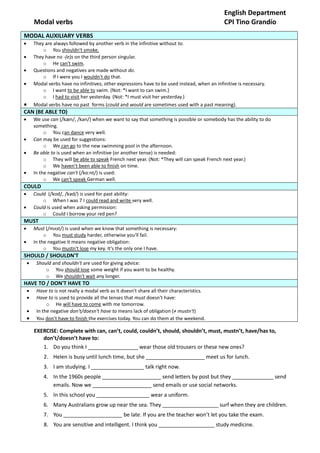

The document discusses modal auxiliary verbs in English. It provides examples of how modal verbs are used and the rules that govern them, such as always being followed by an infinitive verb and having no past tense forms. Specific modal verbs like can, could, must, should, have to are explained in terms of their meanings and uses for ability, permission, obligation, advice and other functions. An exercise is provided asking to complete sentences using the various modal verbs.


