WARD ROUND PARTICIPATION
AMEENA KADAR K A
FIRST SEM M PHARM
PHARMACY PRACTICE
SANJO COLLEGE OF PHARMACEUTICAL STUDIES
CLINICAL PHARMACY SERVICES
MEDICAL WARD ROUNDS
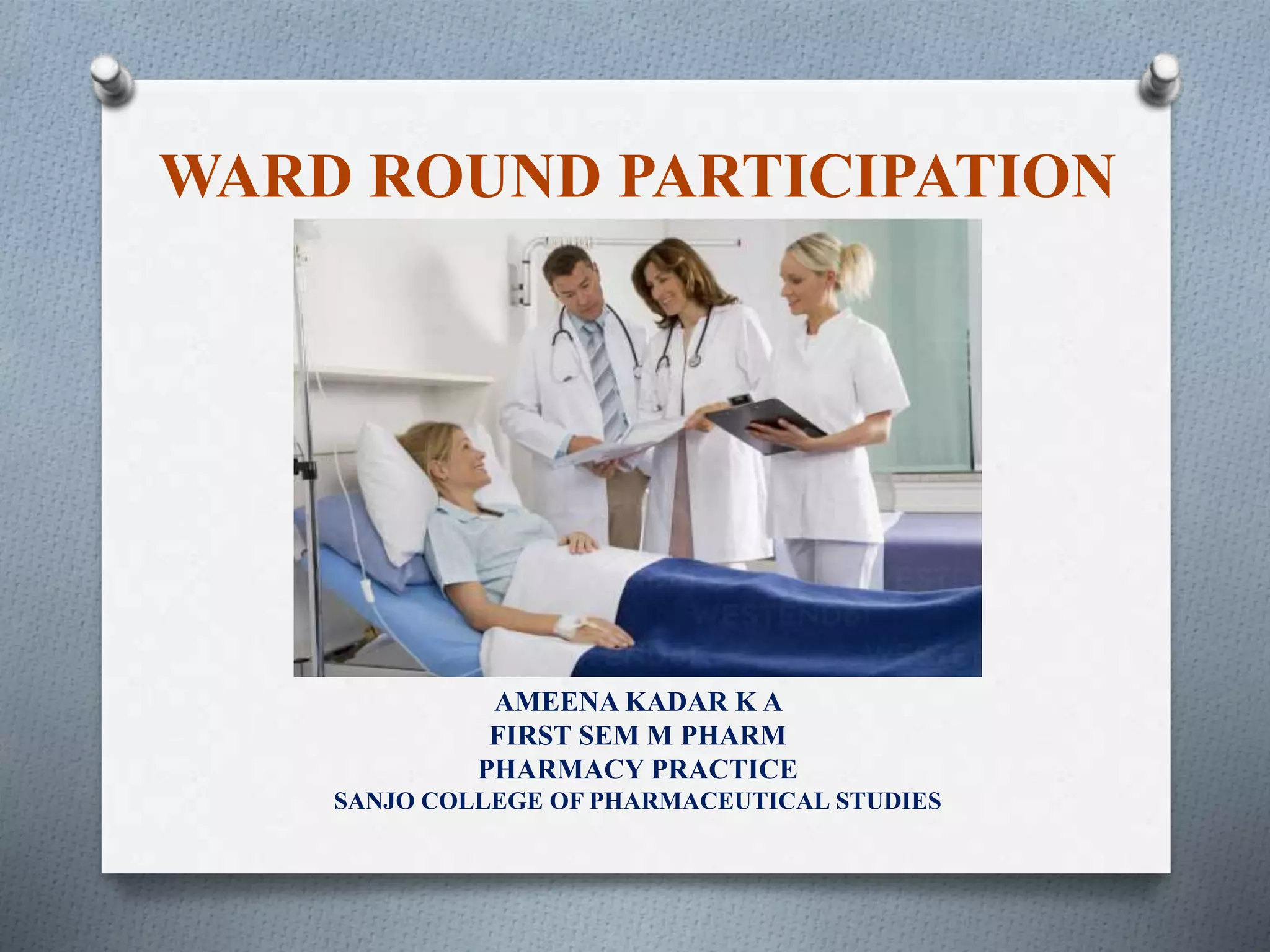
 Ward rounds are the routine clinical rounds where the
healthcare professionals (a doctor with or without a nurse,
pharmacist, or any paramedical staff like technician or
physiotherapist) visit the patients in the ward to assess the
progress of the health condition of the inpatients.
 At least one ward round is conducted every day to review the
progress of each inpatient, although more than one is not
uncommon.
 It is also utilized as bedside teaching skills in a teaching hospital.
Goals and Objectives of Clinical Pharmacists on Ward
Rounds
• Gain an improved understanding of the patient’s clinical status and
progress, current planned investigations and therapeutic goals.
• Provide relevant information on various aspects of the patient’s
drug therapy, such as pharmacology, pharmacokinetics, drug
availability, cost, drug interactions and adverse reactions
• Optimize therapeutic management by influencing drug therapy
selection, implementation, monitoring and follow-up
• Investigate unusual drug orders or doses
• Assimilate additional information about the patient such as
comorbidities, medication compliance or complementary and
alternative medicine (for example herbal remedies) use that might be
relevant to their management
• Detect adverse drug reactions and drug interactions
• Participate in patient discharge planning.
WARD ROUND CLASSIFICATION
1. Pre-ward rounds.
2. Registrar/resident rounds.
3. Professor/chief rounds.
4. Teaching ward rounds.
PRE-ROUNDS
 During these rounds, the interns or medical post-graduate
students in teaching hospitals perform a daily review of patients
in their unit or ward.
 This is largely a learning opportunity to familiarize themselves
with the cases, especially new admissions or transfers, and very
few management decisions are made during these rounds.
 Trainee clinical pharmacists may join the interns or
postgraduates in their pre-rounds and complete the patient
medication and clinical review at this time.
REGISTRAR/RESIDENT ROUNDS
 In teaching hospitals, the registrars and residents, individually or
as a team conduct ward rounds, at least once a day at a fixed
time, usually in the morning.
 In the intensive care unit (ICU), rounds may be conducted several
times a day.
 These rounds are extensive and may also involve clinical
teaching to medical postgraduate students and interns.
 These are useful rounds for clinical pharmacists of all levels too.
PROFESSOR/UNIT CHIEF ROUNDS
 A ward round participation involving PG students, registrars,
residents, and experienced doctors together is known as
professor/chief rounds. It may be conducted daily, weekly, or
monthly.
 These types of ward rounds become extensive and specialized
for discussing complex and complicated problems.
 It may be difficult for clinical pharmacists to join these
consultant rounds due to timing.
TEACHING ROUNDS
 In teaching hospitals, academic medical staff conducts bedside
clinical teaching rounds for residents, medical PG students,
interns, medical UG students, and Pharm D students.
 It is usually extensive rounds and is conducted only a few times
a week.
 A clinical pharmacist can join during such rounds but will have
limited exposure since this kind of ward rounds do not involve
any kind of decision making and interventions.
PRE-WARD ROUND PREPARATION
• Pharmacists need to prepare adequately before participating in
ward rounds.
• Accurate and up to date information on the patient’s health
status, disease management and past medical history is essential
for effective participation in clinical decision making.
• To achieve this a review of the medication chart and case record
should be completed prior to the ward round.
• Pre-ward round participation gives an overview of the drug and
disease related issues that may arise during a ward round.
 Many clinical pharmacists maintain individual patient profiles
which summarize information relevant to the patient’s drug
therapy. This includes:
 Allergies or hypersensitivities
 The reason for admission
 Provisional or final diagnosis
 Past medical history
 Medications on admission
 Relevant social history
 laboratory data
 Other relevant investigations and reports
 Medication compliance
Patient Profile Form
 For all newly admitted patients, it is appropriate to collect a
detailed medication history from the patient or their carers,
which needs to be cross-checked with information collected by
other healthcare professionals.
 Any relevant new information obtained during the medication
history interview which may change patient management (for
example, history of allergy to a medicine) should be brought to
the attention of the appropriate healthcare professionals and
used to update existing patient profiles.
 Pre-ward round preparation allows the pharmacist to be well
informed and organized about the patient.
Practical tips for ward round participation
 Pharmacists should complete their pre-ward round preparation
well ahead of commencement of the round.
 Pharmacist should ensure that all prescriptions are in
accordance with the hospital formulary.
 Clinical pharmacists may wish to carry appropriate references
while working in wards, Eg. BNF, up-to-date clinical
guidelines, Drug Information Books., etc.
 When identifying potential problems such as drug interactions,
adverse reactions and medication errors, pharmacists should be
prepared to suggest alternatives to resolve the problem.
 Pharmacists should avoid the temptation to enter discussions
concerning diagnosis. The one exception to this is where a
patient’s symptoms or signs are possibly drug-related.
Interventions during ward rounds
A pharmacist intervention is defined as any action by a pharmacist
that directly results in a change in patient management or therapy.
Types:
i. Active - Personal visits to influence prescribing
ii. Passive - Drug information services
iii. Reactive - Monitoring prescriptions
The errors identified by the pharmacist included:
o Incomplete orders
o Wrong dose
o Wrong frequency
o Inappropriate choice
o Duplicate therapy.
The main drug-related queries that may arise during ward rounds
relate to:
 Dose and frequency
 choice of medication
 Adverse effects
 Drug interactions
 Formulation
 Duration of therapy
 Actions and uses/pharmacology
 Drug availability/supply
 Identification of patient’s medications on admission
 legal and administrative issues
 Miscellaneous, such as storage conditions
Communication during ward rounds
 Effective communication skills and clinical knowledge are pre-
requisites for effective participation ward rounds.
 Good interpersonal relationships are a key of success.
 Learning of regional language helps the pharmacist to follow
the conversation between the clinicians and the patients.
 It also helps you to interact effectively with the patients.
 Interventions or recommendations made by the pharmacist
should be made in a diplomatic way, which shows respect for the
physician’s clinical acumen and experience, and should not
challenge a medical practitioner’s integrity.
WARD ROUND FOLLOW-UP
 Clinical pharmacists often encounter issues during a ward round
that require some follow-up.
 Some of the outstanding issues that may arise during a ward
round include:
1. Responding to enquiries
2. Communicating information - changes in drug therapy
3. Completing documentation-ADRs identified during the
round may need to be documented on an alert sheet.
4. Altering the patient’s care plan
5. Discussions with patients - the reasons for alteration in
therapy, drug administration or self monitoring techniques
and caution regarding likely adverse effects
REFERENCES
1. A Textbook of Clinical Pharmacy, Essential concepts and
Skills by G Parthasarathy, Karin Nyfort-Hansen, Milap C
Nahata. 2nd Edition. Pg No:211- 221.
2. https://www.14impressions.in/2020/12/goals-
classification-interventions-and.html#point0
HAVE A GOOD DAY!

ward round participation.pptx

  • 1.
    WARD ROUND PARTICIPATION AMEENAKADAR K A FIRST SEM M PHARM PHARMACY PRACTICE SANJO COLLEGE OF PHARMACEUTICAL STUDIES
  • 2.
  • 3.
    MEDICAL WARD ROUNDS Ward rounds are the routine clinical rounds where the healthcare professionals (a doctor with or without a nurse, pharmacist, or any paramedical staff like technician or physiotherapist) visit the patients in the ward to assess the progress of the health condition of the inpatients.  At least one ward round is conducted every day to review the progress of each inpatient, although more than one is not uncommon.  It is also utilized as bedside teaching skills in a teaching hospital.
  • 4.
    Goals and Objectivesof Clinical Pharmacists on Ward Rounds • Gain an improved understanding of the patient’s clinical status and progress, current planned investigations and therapeutic goals. • Provide relevant information on various aspects of the patient’s drug therapy, such as pharmacology, pharmacokinetics, drug availability, cost, drug interactions and adverse reactions • Optimize therapeutic management by influencing drug therapy selection, implementation, monitoring and follow-up • Investigate unusual drug orders or doses
  • 5.
    • Assimilate additionalinformation about the patient such as comorbidities, medication compliance or complementary and alternative medicine (for example herbal remedies) use that might be relevant to their management • Detect adverse drug reactions and drug interactions • Participate in patient discharge planning.
  • 6.
    WARD ROUND CLASSIFICATION 1.Pre-ward rounds. 2. Registrar/resident rounds. 3. Professor/chief rounds. 4. Teaching ward rounds.
  • 7.
    PRE-ROUNDS  During theserounds, the interns or medical post-graduate students in teaching hospitals perform a daily review of patients in their unit or ward.  This is largely a learning opportunity to familiarize themselves with the cases, especially new admissions or transfers, and very few management decisions are made during these rounds.  Trainee clinical pharmacists may join the interns or postgraduates in their pre-rounds and complete the patient medication and clinical review at this time.
  • 8.
    REGISTRAR/RESIDENT ROUNDS  Inteaching hospitals, the registrars and residents, individually or as a team conduct ward rounds, at least once a day at a fixed time, usually in the morning.  In the intensive care unit (ICU), rounds may be conducted several times a day.  These rounds are extensive and may also involve clinical teaching to medical postgraduate students and interns.  These are useful rounds for clinical pharmacists of all levels too.
  • 9.
    PROFESSOR/UNIT CHIEF ROUNDS A ward round participation involving PG students, registrars, residents, and experienced doctors together is known as professor/chief rounds. It may be conducted daily, weekly, or monthly.  These types of ward rounds become extensive and specialized for discussing complex and complicated problems.  It may be difficult for clinical pharmacists to join these consultant rounds due to timing.
  • 10.
    TEACHING ROUNDS  Inteaching hospitals, academic medical staff conducts bedside clinical teaching rounds for residents, medical PG students, interns, medical UG students, and Pharm D students.  It is usually extensive rounds and is conducted only a few times a week.  A clinical pharmacist can join during such rounds but will have limited exposure since this kind of ward rounds do not involve any kind of decision making and interventions.
  • 11.
    PRE-WARD ROUND PREPARATION •Pharmacists need to prepare adequately before participating in ward rounds. • Accurate and up to date information on the patient’s health status, disease management and past medical history is essential for effective participation in clinical decision making. • To achieve this a review of the medication chart and case record should be completed prior to the ward round. • Pre-ward round participation gives an overview of the drug and disease related issues that may arise during a ward round.
  • 12.
     Many clinicalpharmacists maintain individual patient profiles which summarize information relevant to the patient’s drug therapy. This includes:  Allergies or hypersensitivities  The reason for admission  Provisional or final diagnosis  Past medical history  Medications on admission  Relevant social history  laboratory data  Other relevant investigations and reports  Medication compliance
  • 13.
  • 14.
     For allnewly admitted patients, it is appropriate to collect a detailed medication history from the patient or their carers, which needs to be cross-checked with information collected by other healthcare professionals.  Any relevant new information obtained during the medication history interview which may change patient management (for example, history of allergy to a medicine) should be brought to the attention of the appropriate healthcare professionals and used to update existing patient profiles.  Pre-ward round preparation allows the pharmacist to be well informed and organized about the patient.
  • 15.
    Practical tips forward round participation  Pharmacists should complete their pre-ward round preparation well ahead of commencement of the round.  Pharmacist should ensure that all prescriptions are in accordance with the hospital formulary.  Clinical pharmacists may wish to carry appropriate references while working in wards, Eg. BNF, up-to-date clinical guidelines, Drug Information Books., etc.  When identifying potential problems such as drug interactions, adverse reactions and medication errors, pharmacists should be prepared to suggest alternatives to resolve the problem.
  • 16.
     Pharmacists shouldavoid the temptation to enter discussions concerning diagnosis. The one exception to this is where a patient’s symptoms or signs are possibly drug-related. Interventions during ward rounds A pharmacist intervention is defined as any action by a pharmacist that directly results in a change in patient management or therapy. Types: i. Active - Personal visits to influence prescribing ii. Passive - Drug information services iii. Reactive - Monitoring prescriptions
  • 17.
    The errors identifiedby the pharmacist included: o Incomplete orders o Wrong dose o Wrong frequency o Inappropriate choice o Duplicate therapy. The main drug-related queries that may arise during ward rounds relate to:  Dose and frequency  choice of medication  Adverse effects
  • 18.
     Drug interactions Formulation  Duration of therapy  Actions and uses/pharmacology  Drug availability/supply  Identification of patient’s medications on admission  legal and administrative issues  Miscellaneous, such as storage conditions
  • 19.
    Communication during wardrounds  Effective communication skills and clinical knowledge are pre- requisites for effective participation ward rounds.  Good interpersonal relationships are a key of success.  Learning of regional language helps the pharmacist to follow the conversation between the clinicians and the patients.  It also helps you to interact effectively with the patients.  Interventions or recommendations made by the pharmacist should be made in a diplomatic way, which shows respect for the physician’s clinical acumen and experience, and should not challenge a medical practitioner’s integrity.
  • 20.
    WARD ROUND FOLLOW-UP Clinical pharmacists often encounter issues during a ward round that require some follow-up.  Some of the outstanding issues that may arise during a ward round include: 1. Responding to enquiries 2. Communicating information - changes in drug therapy 3. Completing documentation-ADRs identified during the round may need to be documented on an alert sheet. 4. Altering the patient’s care plan 5. Discussions with patients - the reasons for alteration in therapy, drug administration or self monitoring techniques and caution regarding likely adverse effects
  • 21.
    REFERENCES 1. A Textbookof Clinical Pharmacy, Essential concepts and Skills by G Parthasarathy, Karin Nyfort-Hansen, Milap C Nahata. 2nd Edition. Pg No:211- 221. 2. https://www.14impressions.in/2020/12/goals- classification-interventions-and.html#point0
  • 22.