GROUP COALITION IN VIDEO GAMES: HOW GENDER DISCRIMINATION
INFLUENCES HOW WE CHOOSE OUR FACTIONS
HONORS THESIS
Presented to the Honors Committee of
Texas State University
in Partial Fulfillment
of the Requirements
for Graduation in the Honors College
by
Amanda Michelle Jones
San Marcos, Texas
May 2015
GROUP COALITION IN VIDEO GAMES: HOW GENDER DISCRIMINATION
INFLUENCES HOW WE CHOOSE OUR FACTIONS
Thesis Supervisor:
______________________________
Judith A. Easton, Ph.D.
Department of Psychology
Approved:
________________________________
Heather C. Galloway, Ph.D.
Dean, Honors College
Acknowledgements
There are many people who have contributed to the success of this thesis. First I
would like to thank Dr. Heather Galloway and Diann McCabe of the Honors College for
allowing me to take the Honors Thesis course and develop my research. I would like to
thank my advisor, Dr. Judith A. Easton, for working with me for over a year in
developing the method of the thesis. Her advice and editing prowess converted my ideas
into comprehensive research. I would also like to thank Ashley Devereux and Nathan
McGuff for assisting me with data collection. Next, I would like to thank my boyfriend
Jorge Rincon, who supported me through many late nights of writing and editing. I would
also like to thank my brother Shawn A. Jones for introducing me to gaming and playing
with me during our childhood. Lastly, I would like to thank my parents, Nancy and Tony
Lee Jones, for encouraging my aspirations and letting me play video games when I was
younger. I appreciate all of the support I received with this project and for propelling me
towards a prominent career in psychological research.
Table of Contents
Abstract…………………………………………………………………………………....1
Introduction………………………………………………………………………………..2
Method…………………………………………………………………………………...12
Results……………………………………………………………………………………15
Discussion………………………………………………………………………………..20
References………………………………………………………………………………..25
Appendix ………………………………………………………………………………...29
1
Abstract
The present study will examine how gender stereotypes influence video game
players’ choices for a coalition in an online game. Within video games, women are often
conceptualized as sexual objects included for the visual enjoyment of male players. Being
exposed to a typical female video game avatar may cause video game players to view
women as less capable members or leaders of a coalition regardless of the women’s
expertise. To test this, participants in the current study completed a brief questionnaire
about their video game habits, then read a brief overview of the video game industry.
Embedded within the reading material was one of three female gaming avatars: over-
sexualized, average or masculine. Participants were told this is the typical avatar women
choose when gaming. Participants then played an online game with one male and one
female confederate. During the game, participants were twice forced to choose to follow
either the male or female confederate down a forked path. Upon completing the game,
participants indicated why they chose to follow the male or female. Results do not
support the hypothesis. Despite males following the male confederate more often with the
over-sexualized condition versus the average or masculine conditions, females followed
the female confederate regardless of condition. We suggest these findings indicate that
primarily male players are viewing women as less capable leaders when exposed to an
over-sexualized female avatar and using these representations as models for real-world
behavior. This implies that portrayal of women in video games needs to change.
Keywords: video games, avatar, over-sexualized, gender, discrimination
2
Group Coalition in Video Games: How Gender Discrimination
Influences How We Choose Our Factions
Although gaming has experienced phases of popularity during its lifecycle,
research from the Entertainment Software Association (ESA) shows that the computer
and video game industry has experienced massive growth within the past decade. The
growth in the United States alone cannot be ignored. In 2013, 58% of Americans played
video games with each household having at least one gaming console, PC or smartphone
(“Essential”, 2013). The ESA, in their 2014 report titled “Essential Facts about the
Computer and Video Game Industry”, showed a 1% increase in household gaming
population. However, gaming has a growing influence on children. When looking at
families with children 18 or younger, 68% of families believed gaming helps mental
stimulation or education with 55% believed gaming play helps bring the family together
(“Essential”, 2014). This increase can be compared to the rise of televisions appearing in
modern homes in the 1950’s. The rise of video games as a household commodity has the
ability to amplify its reputation as an indispensable technology. As video games are
shown to be indispensable as media, they are valuable outlets to study behavior.
Video games are used to test different aspects of human behavior, such as
cooperation. In one study, participants played a team-player video game to examine
cooperative behavior (Greitmeyer & Cox, 2013). Each group of participants was treated
as a single unit with the group condition being tested against the single-player condition.
The group condition featured two players working together with one vehicle with the
single-player condition featuring the two participants playing separately. Using a racing
game, Mario Kart: Double Dash!!, the participants played the game and then rated how
3
cooperative the content of the game was. Their cooperative behavior was measured by
how many poker chips they would give the other player in a mixed-motive decision. The
amount of chips given determines the level of cooperation a participant felt with their
partner. The participants with teammates had significantly higher rates of cooperation and
cohesion reported leaving more chips for their partner. Single-player participants reported
less cooperative behavior after the game by giving less chips to their gameplay partner.
The study finds evidence that video games can encourage cooperative behavior with
situations that require teamwork. Ewoldsen and associates (2012) looked at how
cooperation and competition are influenced based on a video game’s violent nature. The
pairs of participants that worked together exhibited higher levels of cooperative behavior,
versus pairs who were in direct and indirect competition with each other. Despite the
game, Halo II, having high ratings of gore and violence, those features did not deter
levels of cooperation. In both studies, cohesion is measured using the cooperative nature
of video games. Gaming, either in person or online, can bring coalitions together and
have them work in a cooperative manner. One variable to focus on with looking at
cooperation is gender differences.
While studying human behavior with video games, gender differences are often
singled out. Traditionally, it has been males who have embraced playing video games
more than females. This gender difference is especially prevalent in youth and
adolescence. Homer and colleagues (2012) examined characteristics of preadolescent
gamers. When comparing males and females gamers from 11-15 year olds, males had a
higher average play time overall than girls. Preadolescent boys played an average of 42
hours a week, while girls played about 30 hours on average (Homer et al., 2012). Only
4
males increased average weekly game play the older they got, reporting a 36 hour
increase from ages 10-15. However, females had no significant increase in gameplay as
they got older.
Male and female gamers do not only differ in amount of time spent playing, but
also in cognitive abilities. Subrahmanyam and Greenfield (1994) tested gender
differences in spatial skills based on video game practice. All participants were
administered a spatial skills pre-test on a computer before being randomly placed in
either an experimental or control group. One group played Marble Madness, a game that
requires determining the speed and distance of objects in motion. The other group played
Conjecture, a word game involving puzzles with no spatial skill maneuvering. Overall,
males in both groups made fewer errors than females (Subrahmanyam & Greenfield,
1994). This difference may be attributed to males generally having more gaming
experience. However, both genders in the experimental spatial group performed
significantly higher in the post-test analysis compared to the pre-test. This shows how
gaming practice could close the gender difference gap between performances. Feng,
Spence and Pratt (2007) also examined spatial attention and gender differences, but with
action video games. After all participants performed a mental rotation task to gauge
pretest spatial skills, the control group played Ballance, a 3D puzzle game while the
experimental group played Medal of Honor: Pacific Assault, a 3D first-person shooter.
Females of the experimental group had higher rates of improvement with the post-test,
catching up with the high scores of men in the pre-test. These findings demonstrate how
certain video games could improve spatial navigation and mental rotation, eliminating the
5
gender differences based on video game experience. This gender difference is established
with video games typically being a male dominated industry.
Conventionally, the population of regular gamers have been males in all age
groups. However, in 2013, 45% of video game players were females 18 or older,
outnumbering male gamers 17 or younger. This shows a gap in adolescence in which
male players outnumber female players that diminishes in adulthood. Similar to overall
player demographics, 46% of game purchasers are female (“Essential”, 2013). While the
majority of the gaming population is male, females are gradually forcing equality among
gamer numbers. Despite a balanced population of male and female gamers, men have
more representation in video games. Women’s depictions in gaming, continue to suffer,
lacking proportion to real-world demographics.
When looking at video games and their characters, the gender division appears
unbalanced. For example, Dietz (1998) examined popular games released in 1995 for the
Super Nintendo and the Sega Genesis. Out of 33 games, only 5 (15%) had women
represented as action or hero characters. The most common depiction of women was the
“damsel in distress” archetype. The “damsel” is a typical character for women in games,
where they are a victim and need a male rescuer. In another study, Williams and
colleagues (2009) examined games played on the Sony PlayStation 2, the Nintendo
GameCube and the Microsoft Xbox and evaluated their sales figures. These figures were
used to rate the games and their characters by popularity. Within 68 of the most popular
video games from 2005, only 13.91% of all characters were female. The sex ratio
presented in the evaluated video games does not reflect the actual sex ratio in the United
States, suggesting these games are presenting a skewed version of reality.
6
Not only is the number of female characters in video games not representative of
reality, but the presentation of these are characters are not realistic. Using magazines
from the three major gaming console companies (Sony, Microsoft and Nintendo), Miller
and Summer (2007) examined the characters featured on the covers of the magazines.
Characters were coded based on: identity of main character on covers, role of the
character (protagonist, antagonist or support), whether the character is playable or not,
abilities and physical traits of the character and the skimpiness of the character’s clothing.
Of the 49 games they examined, there was one human female character per every 5.3
human males. Only 26.5% of the games had a playable female character, compared to
51% of the games with playable male characters. Players could choose a character based
on their gender in only 10.2% of the games. Male characters were heroes, villains or
supporting characters more than female characters. Findings further suggested that male
characters were dressed in a way that made them look more powerful and muscular while
females were dressed to look sexy and innocent with revealing clothing. These findings
have been corroborated in a more recent study. Downs and Smith (2009) examined the 60
bestselling games from the Microsoft Xbox, Sony PlayStation 2 and the Nintendo
GameCube to determine rates of characterization, body proportion and nudity based on
gender. Out of a total of 489 characters across all 60 of the games, 70 (14%) were female
but only 8 (12%) of those were primary characters. Their findings indicated that nudity
also differed based on the gender of the character. Only 4% of male characters were
partially or fully nude compared to 43% of females. Of all the characters examined, 25%
of females versus 2% of males had unrealistic body proportions. Another sexualized
aspect of female characters is cleavage and sleeve length. Beasley and Collins’ (2002)
7
found that a majority of female characters were sleeveless with a mid to low neck line to
reveal cleavage. The study reflected how video game creators can use clothing to
emphasis sexuality in women. Findings from a previous study demonstrate that female
characters tend to wear clothing that embody sexualized female tropes. Women portrayed
as a hero wear tight and body conforming clothing, often in bright pink colors (Dietz,
1998). These uneven representations of females in gaming can affect how games appeal
to women.
Some of the most popular video games on the market have a lack of female
characters, such as Call of Duty, Team Fortress 2 and Halo. Previously mentioned studies
suggest that games that have females are likely to be objectified for men. The games
aimed towards girls emphasize another aspect of traditional gender stereotypes. Labeled
“pink games”, these games are often simulators of typical feminine activities, such as
cooking, dressing up, use of makeup, or keeping house. Many of Mattel’s Barbie games
feature activities designed to appeal to young females. One of the most popular “pink
game” genres is the dollhouse genre, in which a player maintains a virtual family and
controls their lives, similar to a plastic doll house (Van Reijmersdal, Jansz & Van Noort,
2013). Research suggests that The Sims is a well-known example. Part of the appeal of
these games is that they lack the male stereotypes of violence and sexual objectification
of females that dominate other games. Adolescent girls completed a questionnaire about
goSupermodel, a game in which players can become a virtual model (Van Reijmersdal,
Jansz & Van Noort, 2013). In the simulation, players can dress how they like, enter in
supermodel competitions and play games involving a supermodel lifestyle. Younger girls
who play the game frequently identify more strongly with the game than older girls who
8
play less frequently (Van Reijmersdal et al., 2013). Because young adults are more prone
to be influenced by media, being exposed to female typecasts can negatively affect them,
discouraging them from pursuing non-feminine activities not found in “pink games”.
These stereotypical occupations can be harmful for women wanting to go beyond them in
the gaming industry.
Video games can affect how women are objectified and reflect on how the video
game industry can treat females. Sexist behaviors are reflected in real life, as there are
specific stereotypes for women carved into the video game industry. These include
cheerleaders, booth babes and Halo hoes. Cheerleaders are women who serve only to
cheer on a male player. Booth babes are women hired to stand by a themed booth or area
in costume trying to sell products and Halo hoes describe women who only play video
games to pick up men at competitions, instead of engaging in the game itself. While these
are stereotypes for women in gaming, a man’s place is typically a professional gamer
(Taylor, Jensen & de Castell, 2009). Being a professional gamer is a rare position for
women. According to the researchers, the harm in these stereotypes is that they endanger
females who have or want a serious career in the gaming industry (Taylor et al., 2009). If
a female is in the audience watching a video game competition on the large screen, others
might assume she is there solely to support a player. Booth babes must be hyper-
feminized. Only women who have accentuated body features are allowed to be booth
babes. This can include a larger bust size, thinner waist and large amounts of make-up.
The Halo hoe label endangers female professionals as others might think they are not
serious about the game itself. Women feel compelled not to compete in gaming
competitions due to being labeled as such, harassed by other male players or ridiculed for
9
engaging in non-traditional gender roles (Taylor et al., 2009). The lone Halo 3 female
player Fatal Fantasy describes her times at competitions as being different from male
players. She travels with close male friends, and is expected by her parents not to
fraternize with males outside of her friends as to secure her safety. She feels a need to
legitimize her gameplay to her parents and friends.
While being a booth babe or cheerleader is typical for women in the gaming
industry, some women move beyond them. However, as a result of this, many of these
women experience backlash from male gamers. Anita Sarkeesian is known for creating
her pro-feminist YouTube videos titled “Tropes vs. Women”. The series points out how
sexist and harmful typical female’s archetypes are in gaming. Because of her feminist
viewpoints, many staunch male gamers violently speak out against her. Some of these
men went as far as threatening to shoot up Utah State University after she was scheduled
to speak there (Collins, 2014). Sarkeesian is not the only women to suffer threats at the
hands of the gaming community. Brianna Wu, a game developer, has also suffered large
numbers of death threats due to her work in the gaming community. She receives daily
threats on Twitter, including one from a man who created a video describing how he
would murder her (Wu, 2015). Violence towards female gamers has developed into an
online movement, known as Gamergate. Gamergate originated as a movement against
unethical video game journalism (Hudson, 2015), but has rapidly evolved into a
movement of male gamers who harass any women associated with the gaming industry.
Two women, Zoe Quinn and Alex Lifschitz, created Crash Override in response to
Gamergate. Crash Override is a network, providing support for anyone who has suffered
harassment (Hudson, 2015). This movement is an example of how stereotypical female
10
roles in games and the objectification of female video game characters negatively
influence the real world behavior of gamers. Players often interpret other games
characters through their physical portrayal in the game.
There are types of video games in which players can create their own video game
character. These homemade characters are called avatars. With the creation of an avatar,
players have the ability to put themselves inside the game. Avatars serve as a visual
representation of one’s self, portraying information to other players. For example, people
who have a female avatar in a game are expected to be female in real life. A popular
example of avatar creation is in the online game World of Warcraft (WoW). Female
players of WoW were more likely to choose character classes that had a support position
(healer and magic caster) over an offensive position (warrior, rogue and hunter)
(DiGuiseppe & Narid, 2007). Audrey Brehm in 2013 continued the discussion of avatar
creation and gender differences in World of Warcraft. Using a questionnaire asking
participants about experiences involving sexism, 294 WoW players (58.2% male and
41.8% female) participated. Based on personal experiences in the game, 63.6% of female
players had experienced sexism while 75.2% of females reported seeing other players
being harassed. Many participants reported female players as being a detriment to overall
game play with women reporting being removed from a group or isolated due to their
gender. The female players are not taken seriously as potential leaders based on their
gender and avatar appearance, regardless of gameplay experience. By combining
women’s lack of realistic representation in gaming with the importance of avatar
appearance influencing negative thoughts and behavior, portrayal of over sexualized
11
females feed into real world sexism. These harmful beliefs of a woman’s place in video
games can influence real world thoughts and behavior.
Sexism against women in video games extends beyond avatar characteristics.
Some video games require vocal collaboration among members of a team. Female team
members who either stayed silent, or only expressed positive comments were more likely
to have friend requests accepted, compared to the request being denied (Ivory, Fox,
Waddell & Ivory, 2014). Ivory and colleagues concluded this fits a gender stereotype of
women gamers as helpers who are compliant with the decisions of male players. Male
gamers received more friend requests when they were hostile or negative in their vocal
communication. This may also confirm a gender stereotype of male video game players
being violent and forward (Ivory et al., 2014). Yao, Mahood and Linz (2010) examined
the short term cognitive effects of seeing a sexually stimulating female in video game on
male players. They randomly assigned male participants to games that had either sexually
explicit content with female objectification or one of two control games which had no
sexual content. Participants who played the sexual game had increased thoughts related to
sex and female objectification after playing compared to the sexual thoughts they had
before playing. They were also faster at recognizing sexual words and descriptions of
women than other types of words and associations, compared to the control group.
Researchers concluded that men, when viewing the skewed images of women, start to
objectify and act negatively towards women, both in real life and in gaming.
In the current study, we examined how exposure to typical female video game
players influenced people’s opinions about women as members of a coalition.
Participants viewed one of three video game avatars: a typical over-sexualized female, an
12
average female, or a masculine female. They then participated in a round of online game
play with a male or female confederate. Twice during the game play, participants had to
make a forced choice to follow either the male confederate or the female confederate. It is
hypothesized that exposure to the over-sexualized female avatar will cause participants to
choose to follow the male confederate more than the female confederate. Exposure to the
average or masculinized avatar should cause participants to choose to follow confederates
randomly, as they have not been primed with the typical female video game stereotype.
Method
Participants
A total of 67 college students (35 women, 32 men) participated in the experiment.
Ages ranged from 18 to 34 (M = 19.98, SD = 2.39). Participants identified as white
(35.8%), Hispanic/Latino (34.3%), African American (20.9%), Asian (3%), Native
American (1%) or as multi-racial (3%). Of the 67 participants, 46% are freshmen, 38.8%
are sophomores, 14.9% are juniors and 19.4% are seniors. In terms of how often
participants play games, 38.8% never play, 44.78% play, 1-10 hours a week, 11.94% play
11-20 hours a week and 4.5% play over 20 hours a week. When asked if they use a
microphone during game play, 26.87% report using one versus 73.13% saying they do
not. Participants were recruited from two locations: the Psychology human subject’s
pool and from two upper-division Psychology elective courses. Depending on where they
were recruited from, participants either received partial course credit or extra credit in
their class. Each participant was randomly assigned to one of three conditions.
Participants were treated in accordance with APA ethical guidelines.
13
Materials
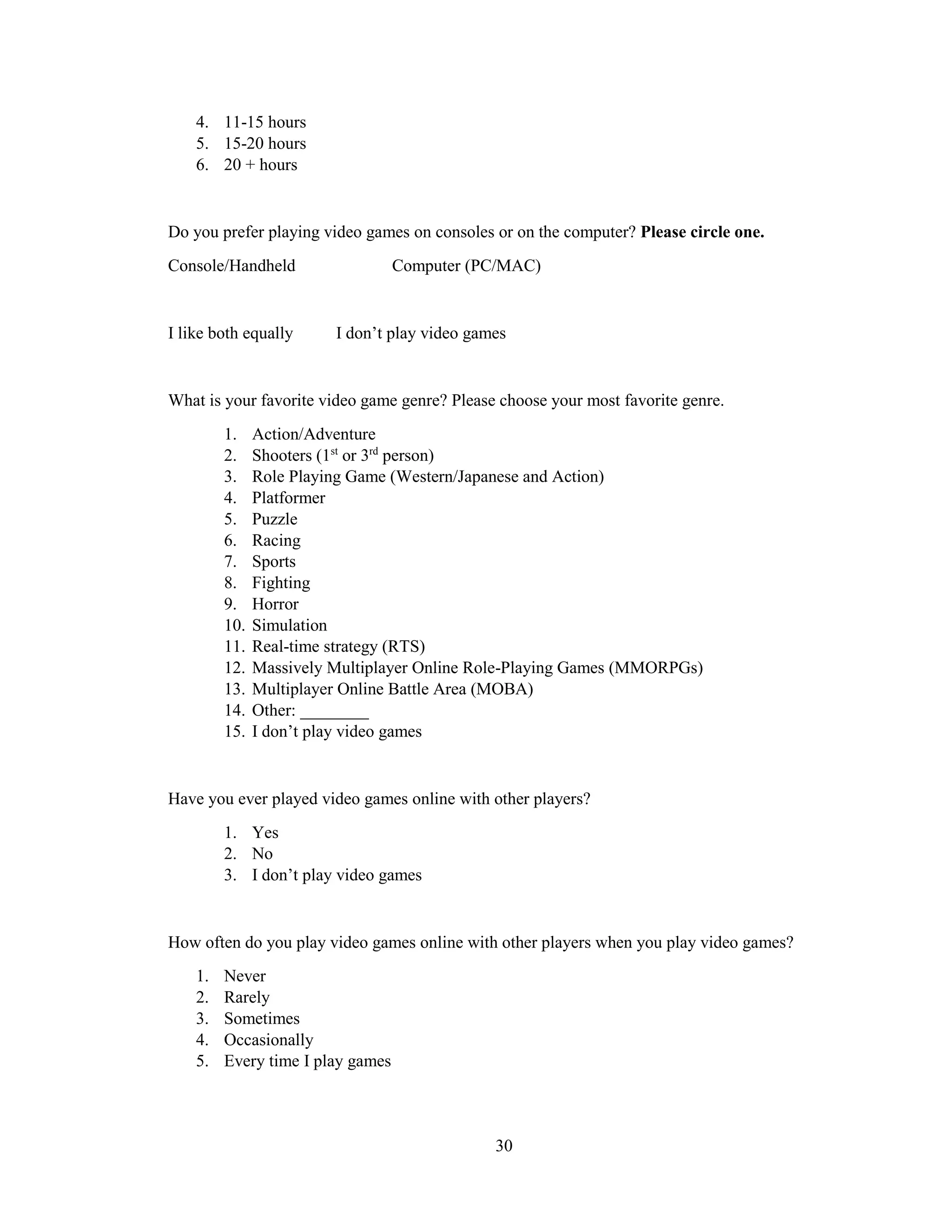
Participants completed a pre-experiment survey that consisted of demographic
information and questions about their video game habits (see Appendix A for full
questionnaire). Questions included: number of hours they play video games per week, if
they prefer playing games on a console or computer and their favorite gaming genre.
Participants were also asked to report any form of discrimination they may have felt
while playing video games. Accompanying this pre-experiment survey was a paragraph
about the growth of the video game industry and how popular role playing games
(RPG’s) are due to character creation (see Appendix B for full paragraph). Attached to
the paragraph was one of three female video game avatars; either an over-sexualized,
average or masculine avatar (see Appendix C for avatars). We compared two sets of
avatars and the more realistic set was chosen for the experiment. Within the realistic set,
we compared for masculinity and sexiness. The masculine avatar (M = 3.59, SD = 1.02)
was perceived as more masculine than the average (M = 2.79, SD = .89) and sexualized
(M = 3.55, SD = .98) avatars. The sexualized avatar (M = 4.00, SD = .99) was perceived
as more sexy than the average (M = 3.50, SD = .98) and masculine (M = 3.45, SD = .93).
There were two confederates obtained for conducting the experiment. The male
confederate was found through a gaming organization at Texas State and volunteered to
help with research. The female confederate volunteered to help with research after being
contacted through a psychology course. Both confederates had experience with first
person shooter video games. Each confederate had their own Xbox 360, headset,
controller, copy of Left 4 Dead 2 and Xbox Live in their homes. They were instructed to
14
lead the participant through the level and go down their respective routes. The
confederates’ confirmed which paths the participants followed after gameplay.
The participants played Left 4 Dead 2 on an Xbox 360. Left 4 Dead 2 is labeled as
a horror first person shooter. Up to four people can play together on online gameplay.
The area chosen for the experiment is called the Parish, with the level being called “The
Park”. The level was chosen due to have a large garden maze, requiring the participant to
choose between two paths. The participants played the game until they reached the end of
the garden maze, taking approximately five minutes. Participants wore a headset in order
to hear the confederates during gameplay. As part of the experimental design, participants
were not allowed to communicate back to the confederates. Participants used a standard
Xbox 360 controller to control their character on the game. The game was displayed on
22 inch high definition flat screen television. Participants played the game live with the
confederates using the Xbox Live online gaming service through Xbox 360.
Participants filled out a post-experiment survey asking them about their gameplay
experience, including which confederates they followed and why (see Appendix D for
full questionnaire).
Procedure
When recruited, participants were told the study was examining gender
differences in navigating 3D spaces in video games. After providing consent to
participate, participants were randomly assigned to one of three conditions: the over-
sexualized, average or masculine avatar. Participants then completed the pre-experiment
survey and read the paragraph on video games with their assigned avatar attached. The
15
researcher then situated them in front of the television, and instructed them to put on the
headset and adjust the size to a comfortable position. The controls of the game, including
how to shoot their weapon, move their character and the camera, were then explained. All
participants played as the same character (Nick) in the game and were instructed which
characters were the confederates (Coach and Rochelle). The researcher instructed the
participants that the confederates were experts at the game and to follow them through
the level to avoid getting lost. The fourth character, Ellis, was set up as a non-playable
character (NPC). Participants were told to ignore Ellis because he was controlled by a
computer. Then the participants started the level. After about two minutes of gameplay,
they were faced with the first fork in the level. The male confederate (the character
Coach) went left while the female confederate (the character Rochelle) went right. Each
confederate encouraged participants to follow them down their respective path. After the
first fork, the confederates met together before separating to go down the second set of
forks in a garden maze. After encouraging the participants again, the male confederate
went down the left path while the female stayed right. At the completion of the garden
maze, the game was paused and returned to the main menu, ending the game playing
portion of the experiment. While participants played the game, the researcher observed
which confederates they followed. The confederates then confirmed which paths were
chosen for accuracy. Participants then completed the post-experiment survey, were
debriefed and thanked for their time.
Results
First, a composite variable was created composed of times a female confederate
was followed. The variable consists of the total number of possibilities to follow the male
16
or female confederate down both pathways. Participants scored a 0 if they followed the
male both times, a 1 if they followed a female once and a 2 if they followed a female
twice. Then the variable was compared to the gender of the participant based separated
into each condition. The hypothesis was that participants exposed to the over-sexualized
avatar would choose to follow the male confederate more often than the female.
Participants exposed to the average or masculine avatar would choose their confederate at
random, producing no significant difference in the mean number of times the female
confederate was followed.
In order to determine if participants would follow the male confederate over the
female confederate when exposed to the over-sexualized female avatar, researchers
conducted an independent samples t-test with a set alpha level of .05. As shown in Figure
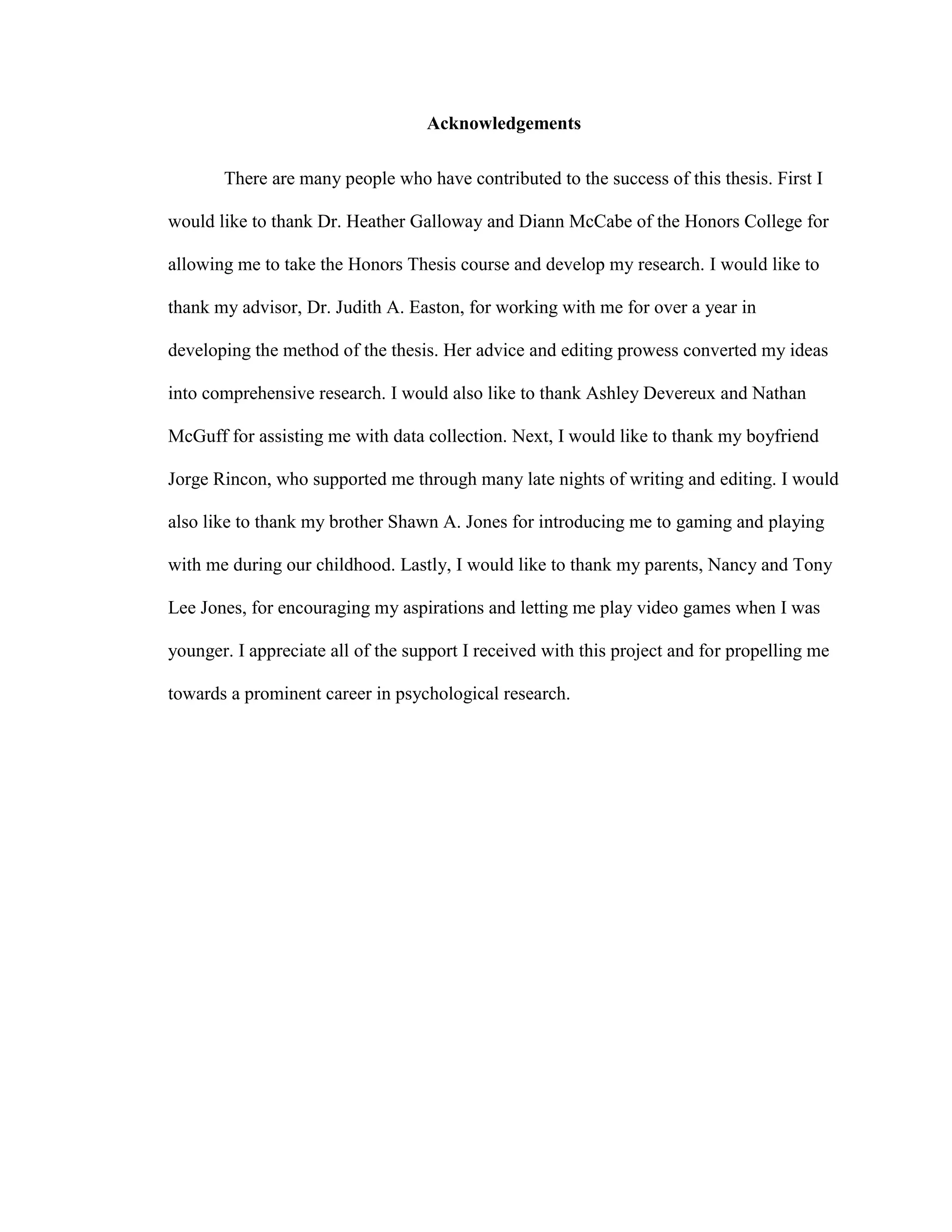
1, the mean rate of following a female confederate down either pathway for males with
the sexualized condition was .73 (SD = .65) and for females was 1.36 (SD = .81).
Because females have a higher than average rate of following females in the over
sexualized condition, t(20) = - 2.04, p = .06, the first part of the hypothesis is not
supported.
17
Figure 1. Mean rate of following females was determined by combining the two paths
and looking at if participants chose a female at least once while exposed to the sexualized
avatar. There were no significant differences between choosing the female confederate
based on the sexualized condition. However, there is a trend towards a gender difference
in which males are much less likely than females to follow the female confederate with
the sexualized avatar condition.
For the second part of the hypothesis, researchers predicted that exposure to the
average or masculinized avatar would cause participants to choose to follow confederates
randomly, producing a null effect. We conducted an independent-samples t-test for the
average avatar condition with a set alpha level of .05. As shown in Figure 2, the mean
rate of following a female confederate down either pathway for males with the average
condition was .9 (SD = .88) and for females was 1.00 (SD = 1.00). Researchers predicted
that participants would choose randomly, t(17) = -.23, p = .82. The finding was not
0.73
1.36
0
0.2
0.4
0.6
0.8
1
1.2
1.4
1.6
Men Women
Mean-RateofFollowing
Female
Gender of Participant
Sexualized Avatar Condition
18
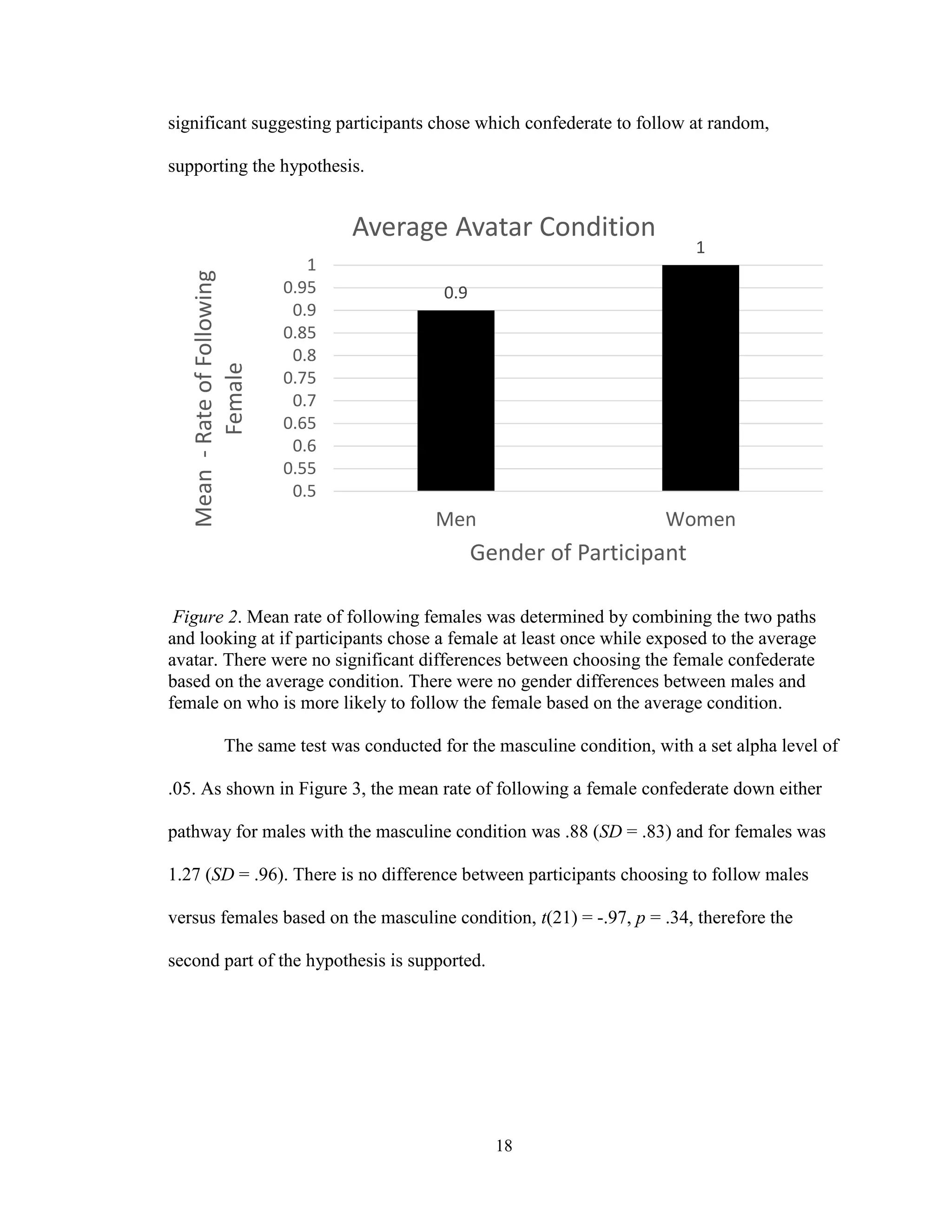
significant suggesting participants chose which confederate to follow at random,
supporting the hypothesis.
Figure 2. Mean rate of following females was determined by combining the two paths
and looking at if participants chose a female at least once while exposed to the average
avatar. There were no significant differences between choosing the female confederate
based on the average condition. There were no gender differences between males and
female on who is more likely to follow the female based on the average condition.
The same test was conducted for the masculine condition, with a set alpha level of
.05. As shown in Figure 3, the mean rate of following a female confederate down either
pathway for males with the masculine condition was .88 (SD = .83) and for females was
1.27 (SD = .96). There is no difference between participants choosing to follow males
versus females based on the masculine condition, t(21) = -.97, p = .34, therefore the
second part of the hypothesis is supported.
0.9
1
0.5
0.55
0.6
0.65
0.7
0.75
0.8
0.85
0.9
0.95
1
Men Women
Mean-RateofFollowing
Female
Gender of Participant
Average Avatar Condition
19
Figure 3. Mean rate of following females was determined by combining the two paths
and looking at if participants chose a female at least once while exposed to the masculine
avatar. There no were significant differences between choosing the female confederate
based on the masculine condition. However, there is a trend towards a gender difference
in which males are much less likely than females to follow the female confederate with
the masculine avatar condition.
Because the independent t-test showed gender differences in following the female
confederate as a trend, researchers conducted a one-way analysis of variance (ANOVA)
comparing the likelihood of following the female confederate, regardless of which avatar
the participant saw. As shown in Figure 4, the mean rate of following females among all
conditions for males was .83 (SD = .76) and for females was 1.23 (SD = .91). There is a
0.88
1.27
0
0.2
0.4
0.6
0.8
1
1.2
1.4
Men Women
Mean-RateofFollowing
Female
Gender of Participant
Masculine Avatar Condition
20
marginally significant difference between males and females in their rates of following
the female condition among all three conditions, F(1, 62) = 3.57, p = .06.
Figure 4. Mean rate of following females was determined by combining the two paths
and looking at the gender difference of following at least one female among all
conditions. There was a marginally significant difference between males and females
choosing to follow the female confederate.
Discussion
The purpose of the current experiment was to examine the effects of sexualized
female avatars on how often participants choose a female to lead their coalition in a video
game. It was hypothesized that when exposed to the over-sexualized avatar, participants,
regardless of gender, would follow the male confederate more often than the female
confederate. It was also hypothesized that when exposed to the average and masculine
avatars, participants would choose to randomly follow either confederate. We
0.83
1.23
0
0.2
0.4
0.6
0.8
1
1.2
1.4
Male Female
Mean-RateofFollowingFemales
Gender of Participant
Gender Difference in Choosing Females
21
hypothesized these choices would be random because participants were not being primed
to view women as less-abled leaders. Results did support this hypothesis in which
confederate choices were random and non-significant. However, the overall hypothesis
was not supported because females tended to follow the female confederate regardless of
avatar condition. Results indicated that when exposed to the sexualized avatar, males
overall followed the male confederate more than the female. However, despite being
exposed to a sexualized avatar, females chose to follow the female confederate at a
higher than average rate. Findings from the current study are similar to previous research
which indicates men tend to objectify women more after being exposed to sexualized
female gaming characters (Yao et al., 2010). Together, these findings suggest that
sexualized female video game characters cause men to have objectifying thoughts
towards women in reality.
The original hypothesis was rejected because females tended to follow the female
confederate despite what avatar they were exposed to. Because of the gender difference
being a prominent trend among the sexualized avatar, we tested the likelihood of
following the female confederate regardless of their condition. Results indicated a
marginally significant difference between males and females. Females were much more
likely to follow the female confederate overall. This finding is supported by Yager,
Diedrichs and Drummond’s (2013) study involving gender preferences for interviews.
Women preferred to have a female interviewer over a male one. Female participants
reported that they could better relate to a female, perceiving them as more caring and
relatable. These reports could translate to the current experiment. Many female
participants reported following the female because of familiarity. Female participants
22
may not have taken into consideration the condition of the avatar when choosing the
confederate based on female preference
In general, the hypothesis for the current study was not supported. While
participants did choose at random after exposure to the masculine and average avatars,
they did not choose to follow the male confederate more after exposure to the sexualized
avatar. Although the proposed gender difference explained above may be the reason the
hypothesis was not supported, there may also be some limitations in the design of the
study that affected the outcome. One such limitation is the small sample size. The sample
size was small enough that it may have lacked statistical power to find an effect if it was
really present. One way to compensate for this limitation in the future is to allow more
time for data collection, allowing more participants to be tested. Another limitation may
have been the similarity in the avatars. Avatars were created to show that slight
differences between their appearances were enough to create differences in who the
participant followed. Although pilot testing indicated that people perceived the avatars as
different from one another, it may be that they are so similar that participants did not
perceive the avatars in the manner they were designed (e.g., they may not have perceived
the sexy avatar as sexy). This may have affected results in which the avatar may not have
impacted which confederates the participants followed, possibly leaving their decision to
chance. To address this potential limitation, the body features on each avatar could be
more exaggerated to fit a more sexualized or masculine archetype. These stylized
characters could be displayed within the video game for a more direct response to how
they affect participants choosing their factions.
23
Findings from the current study indicate that men and women are influenced by
the way women are typically depicted in video games. Given how behavior in video
games may mimic real-world behavior (e.g., Yao et al., 2010), it is important to continue
to examine how sexualized stereotypes of women in games influences the psychology of
video game players. Future research should examine different ways of measuring real-
world behavior. Instead of choosing a coalition leader, participants could choose
teammates based on sexualized stereotypes. Participants would have to choose between a
female or male teammate after being primed by a sexualized avatar, with their interaction
with the teammate being observed.
Additionally, although not relevant to the hypothesis of the current study, open-
ended data from African-American participants indicated they feel marginalized as video
game players and this influences how they approach video games. No research has
examined the relationship between treatment of African-American individuals in video
game coalitions and actual prejudice and discriminatory behavior in the real-world.
Future research should explore this relationship by having participants choose between
following a known African-American confederate and a confederate of a different
ethnicity. Researchers could measure which confederate participants follow and racial
attitudes before and after gameplay.
Based on the current experiment, we found that average and masculine female
video game characters do not influence whether participants choose a male or female
leader. When exposed to over-sexualized female gaming characters, there was a clear
gender difference of males not choosing the female confederate leader. These results
suggest that females presented as sexually stimulating have an effect on real-world
24
behavior in males. Examples of similar real-world behavior are seen with the Gamergate
movement, where women in the gaming industry face abuse from hostile male gamers
(Wu, 2015) (Hudson, 2015). This propels the need for change in the video game industry
as misrepresentation of females has an effect on gamers
25
References
Beasley, B., & Collins, T. S. (2002). Shirts vs. skins: Clothing as an indicator of gender
role stereotyping in video games. Mass Communication and Society, 5(3). 279–
293.
Brehm, A.L. Navigating the feminine in massively multiplayer online games: Gender in
World of Warcraft. Frontiers in Psychology, 4(1). doi: 10.3389/fpsyg.2013.00903
Collins, S. (2014, October 17). Anita Sarkeesian on GamerGate: 'We Have a Problem and
We're Going to Fix This' Retrieved February 21, 2015, from
http://www.rollingstone.com/culture/features/anita-sarkeesian-gamergate-
interview-20141017
Dietz, T.L., (1998). An Examination of violence and gender role portrayals in video
games: Implications for Gender Socializations and Aggressive Behavior. Sex
Roles, 38(5-6). 425-442.
DiGiuseppe, N., & Narid, B. (2007). Real Genders Choose Fantasy Characters: Class
Choice in World of Warcraft. First Monday, 12(5).
Down, E., & Smith, S.L. (2010). Keeping abreast of hypersexuality: A video game
character content analysis. Sex Roles, 62(11-12), 721-733. Doi: 10.1007/s11199-
009-9637-1
“Essential facts about the computer and video game industry.” (2013), URL (consulted
31 March 2014): http://www.theesa.com/facts/pdfs/esa_ef_2013.pdf
26
“Essential facts about the computer and video game industry.” (2014), URL (consulted
31 March 2014): http://www.theesa.com/facts/pdfs/esa_ef_2014.pdf
Ewoldsen, D. R., Eno, C. A., Okdie, B. M., Velez, J. A., Guadagno, R. E., & DeCoster, J.
(2012). Effect of playing violent video games cooperatively or competitively on
subsequent cooperative behavior. Cyberpsychology, Behavior, And Social
Networking, 15(5), 277-280. doi: 10.1089/cyber.2011.0308
Feng, J., Spence, I., & Pratt, J. (2007). Playing an action video game reduces gender
differences in spatial cognition. Psychological Science, 18(10), 850-855. Doi:
10.111/i.1467-9280.2007.01990.x
Greitemeyer, T., & Cox, C. (2013). There’s no ‘I’ in team: Effect of cooperative video
games on cooperative behavior. European Journal of Social Psychology, 43(3),
224-228. Doi: 10.1002/ejsp.1940
Homer, B. D., Hayward, E. O., Frye, J. & Plass, J.L. (2012). Gender and player
characteristics in video game play of preadolescents. Computers in Human
Behavior, 28(5), 1782-1789. Doi:10.1016/j.chb.2012.04.018 (Homer et al., 2012)
Hudson, L. (2015, January 20). Gamergate Target Zoe Quinn Launches Anti-Harassment
Support Network | WIRED. Retrieved February 21, 2015, from
http://www.wired.com/2015/01/gamergate-anti-harassment-network/
Ivory, A.H., Fox, J., Waddell, T.F., & Ivory, J.D. (2014) Sex role stereotyping is hard to
kill: A field experiment measure social responses to user characteristics and
behavior is an online multiplayer first-person shooter game. Computer in Human
Behavior, 35(1), 148-156. Doi: 10.1016/j.chb.2014.02.026
27
Miller, M. K., & Summers, A. (2007). Gender differences in video game characters’
roles, appearances, and attire as portrayed in video game magazines. Sex Roles,
57(9/10), 733-742. doi: 10.1007/s11199-007-9307-0
Salter, A., & Blodgett, B. (2012). Hypermasculinity & Dickwolves: The contentious role
of women in the new gaming public. Journal of Broadcasting & Electronic
Media, 56(3), 401-416. Doi:10.1080/08838151.2012.705199.
Subrahmanyam, K., & Greenfield, P. M. (1994). Effect of video game practice on spatial
skills in girls and boys. Journal of Applied Developmental Psychology 15(1). 13-
32.
Taylor, N., Jenson, J., & de Castell, S. (2009). Cheerleaders/booth/babes/Halo hoes: Pro-
gaming, gender and jobs for the boys. Digital Creativity, 20(4). 239-252.
Van Reijmersdal, E., Jansz, J., Peters, O., & van Noort, Guda. (2013). Why girls go pink:
Game character identification and game-players’ motivations. Computers in
Human Behavior 29(6). 2640-2649
Williams, D., Martins, N., Consalvo, M., & Ivory, James D. The virtual census:
representations of gender, race and age in video games. New Media & Society
11(5), 815-834. Doi: 10.1177/1461444809105354
Wu, B. (2015, February 11). I'm Brianna Wu, and I'm Risking My Life Standing Up to
Gamergate. Retrieved February 21, 2015, from
http://www.huffingtonpost.com/bustle/im-brianna-wu-and-im-risking-my-life-
standing-up-to-gamergate_b_6661530.html
28
Yager, Z., Diedrichs, P.C., & Drummond, M. (2013). Understanding the role of gender in
body image research settings: Participant gender preferences for researchers and
co-participants in interview, focus groups and interventions. Body Image, 10(4),
574-582. doi:10.1016/j.bodyim.2013.06.004
Yao, M. Z., Mahood, C., & Linz, D. (2010). Sexual priming, gender stereotyping, and
likelihood to sexually harass: Examining the cognitive effects of playing a
sexually-explicit video game. Sex Roles, 62(1-2), 77-88. doi: 10.1007/s11199-
009-9695-4
29
Appendix A
Pre-Experiment Survey
Please circle one choice per question
Ethnicity
1. African-American
2. Pacific Islander
3. Native American
4. Hispanic/Latino
5. White/Caucasian
6. Multiple
7. Other: _______
8. I would rather not answer
Age (in years): ___________
Gender
1. Male
2. Female
3. Other
4. I would rather not answer
Classification
1. Freshmen
2. Sophomore
3. Junior
4. Senior
5. Other: ________
Relationship Status
1. Single
2. Casually Dating
3. In a Committed Relationship
4. Engaged
5. Married
6. Divorced
7. Other: __________
8. I would rather not answer
How often do you play video games per week? (Choose one)
1. Never
2. 1-5 hours
3. 6-10 hours
30
4. 11-15 hours
5. 15-20 hours
6. 20 + hours
Do you prefer playing video games on consoles or on the computer? Please circle one.
Console/Handheld Computer (PC/MAC)
I like both equally I don’t play video games
What is your favorite video game genre? Please choose your most favorite genre.
1. Action/Adventure
2. Shooters (1st
or 3rd
person)
3. Role Playing Game (Western/Japanese and Action)
4. Platformer
5. Puzzle
6. Racing
7. Sports
8. Fighting
9. Horror
10. Simulation
11. Real-time strategy (RTS)
12. Massively Multiplayer Online Role-Playing Games (MMORPGs)
13. Multiplayer Online Battle Area (MOBA)
14. Other: ________
15. I don’t play video games
Have you ever played video games online with other players?
1. Yes
2. No
3. I don’t play video games
How often do you play video games online with other players when you play video games?
1. Never
2. Rarely
3. Sometimes
4. Occasionally
5. Every time I play games
31
When playing online video games, do you use a microphone to verbally communicate with other
players?
1. Yes
2. No
Why do you use/not use a microphone when gaming?
______________________________________________________________________________
______________________________________________________________________________
How familiar are you with the game Left 4 Dead 2?
1. I play it on a regular occasion
2. I play it sometimes
3. I have heard of it but never played it
4. I have never heard of this game
How familiar are you with Role Playing Games (RPG’s)?
1. RPG’s are my favorite video game genre
2. I have played some RPG’s before
3. I have heard about the genre and some games associated, but have never played them
4. I have never heard of this genre of games.
Do you feel as though you have been discriminated against while playing video games? (sexual,
racist or ableist harassment, harassment based on skill, etc)
1. Yes
2. No
If you put “yes” for being discriminated, please elaborate on the kind of discrimination you faced.
______________________________________________________________________________
_____________________________________________________________________________
32
Appendix B
Avatar Paragraphs
The video game industry in the fastest growing entertainment industry in the past 10
years. The industry has developed an audience of mass proportions who can all come
together over games. Instances such as these are seen with E3, San Diego Comic Con and
various smaller conventions held all over the United States, Canada and even Europe.
Most households have at least one gaming console with about half of those homes having
two or more of them. We are coming up on a generation where the parents have been
raised on video games and are now able to raise their children on them.
Of all the genres of video games out there, the most popular one is the role
playing game (RPG). In these types of games, players can create their own path in the
story by picking attributes that interest them. A popular device of role playing games is
picking a character class. These classes can influence how one interacts with the story,
fights enemies and what kind of allies are available. Some examples of these classes are
mage, warrior, healer, scout and rogue. Another defining part of RPG’s is character
creation. Here, a player can stylize a character to look how they want them to. These
options come with different hair styles, eye colors, body types and height, to name a few.
Down below is the average character created by a female RPG player.
33
Appendix C
Avatars
The avatar on the far left is rated as “over-sexualized”. The avatar in the middle is rated
as “average” with the avatar on the far right rated as “masculine”.
34
Appendix D
Post-Experiment Survey
Did you think the game that you played was easy or hard? Why?
______________________________________________________________________________
______________________________________________________________________________
When faced with the first fork in the path, did you choose to follow the male player or the female
player? Why?
______________________________________________________________________________
______________________________________________________________________________
When faced with the second fork in the path, did you choose to follow the male player or the
female player? Why?
______________________________________________________________________________
______________________________________________________________________________
Did you switch between who to follow between the first and second path? Why?
______________________________________________________________________________
______________________________________________________________________________
How well do you perceive your ability in playing First Person Shooters?
1. Never play them
2. Very Bad
3. Bad
4. Just Okay
5. Pretty average
6. Good
7. Very Good
8. The Best
35
Do you typically play games like the one you just played (Shooters; Zombie themed; Online)? If
no, did playing the game influence you to try a new type of game?
______________________________________________________________________________
______________________________________________________________________________
What did you think the purpose of this experiment was?
______________________________________________________________________________
______________________________________________________________________________

Undergraduate_Thesis

  • 1.
    GROUP COALITION INVIDEO GAMES: HOW GENDER DISCRIMINATION INFLUENCES HOW WE CHOOSE OUR FACTIONS HONORS THESIS Presented to the Honors Committee of Texas State University in Partial Fulfillment of the Requirements for Graduation in the Honors College by Amanda Michelle Jones San Marcos, Texas May 2015
  • 2.
    GROUP COALITION INVIDEO GAMES: HOW GENDER DISCRIMINATION INFLUENCES HOW WE CHOOSE OUR FACTIONS Thesis Supervisor: ______________________________ Judith A. Easton, Ph.D. Department of Psychology Approved: ________________________________ Heather C. Galloway, Ph.D. Dean, Honors College
  • 3.
    Acknowledgements There are manypeople who have contributed to the success of this thesis. First I would like to thank Dr. Heather Galloway and Diann McCabe of the Honors College for allowing me to take the Honors Thesis course and develop my research. I would like to thank my advisor, Dr. Judith A. Easton, for working with me for over a year in developing the method of the thesis. Her advice and editing prowess converted my ideas into comprehensive research. I would also like to thank Ashley Devereux and Nathan McGuff for assisting me with data collection. Next, I would like to thank my boyfriend Jorge Rincon, who supported me through many late nights of writing and editing. I would also like to thank my brother Shawn A. Jones for introducing me to gaming and playing with me during our childhood. Lastly, I would like to thank my parents, Nancy and Tony Lee Jones, for encouraging my aspirations and letting me play video games when I was younger. I appreciate all of the support I received with this project and for propelling me towards a prominent career in psychological research.
  • 4.
  • 5.
    1 Abstract The present studywill examine how gender stereotypes influence video game players’ choices for a coalition in an online game. Within video games, women are often conceptualized as sexual objects included for the visual enjoyment of male players. Being exposed to a typical female video game avatar may cause video game players to view women as less capable members or leaders of a coalition regardless of the women’s expertise. To test this, participants in the current study completed a brief questionnaire about their video game habits, then read a brief overview of the video game industry. Embedded within the reading material was one of three female gaming avatars: over- sexualized, average or masculine. Participants were told this is the typical avatar women choose when gaming. Participants then played an online game with one male and one female confederate. During the game, participants were twice forced to choose to follow either the male or female confederate down a forked path. Upon completing the game, participants indicated why they chose to follow the male or female. Results do not support the hypothesis. Despite males following the male confederate more often with the over-sexualized condition versus the average or masculine conditions, females followed the female confederate regardless of condition. We suggest these findings indicate that primarily male players are viewing women as less capable leaders when exposed to an over-sexualized female avatar and using these representations as models for real-world behavior. This implies that portrayal of women in video games needs to change. Keywords: video games, avatar, over-sexualized, gender, discrimination
  • 6.
    2 Group Coalition inVideo Games: How Gender Discrimination Influences How We Choose Our Factions Although gaming has experienced phases of popularity during its lifecycle, research from the Entertainment Software Association (ESA) shows that the computer and video game industry has experienced massive growth within the past decade. The growth in the United States alone cannot be ignored. In 2013, 58% of Americans played video games with each household having at least one gaming console, PC or smartphone (“Essential”, 2013). The ESA, in their 2014 report titled “Essential Facts about the Computer and Video Game Industry”, showed a 1% increase in household gaming population. However, gaming has a growing influence on children. When looking at families with children 18 or younger, 68% of families believed gaming helps mental stimulation or education with 55% believed gaming play helps bring the family together (“Essential”, 2014). This increase can be compared to the rise of televisions appearing in modern homes in the 1950’s. The rise of video games as a household commodity has the ability to amplify its reputation as an indispensable technology. As video games are shown to be indispensable as media, they are valuable outlets to study behavior. Video games are used to test different aspects of human behavior, such as cooperation. In one study, participants played a team-player video game to examine cooperative behavior (Greitmeyer & Cox, 2013). Each group of participants was treated as a single unit with the group condition being tested against the single-player condition. The group condition featured two players working together with one vehicle with the single-player condition featuring the two participants playing separately. Using a racing game, Mario Kart: Double Dash!!, the participants played the game and then rated how
  • 7.
    3 cooperative the contentof the game was. Their cooperative behavior was measured by how many poker chips they would give the other player in a mixed-motive decision. The amount of chips given determines the level of cooperation a participant felt with their partner. The participants with teammates had significantly higher rates of cooperation and cohesion reported leaving more chips for their partner. Single-player participants reported less cooperative behavior after the game by giving less chips to their gameplay partner. The study finds evidence that video games can encourage cooperative behavior with situations that require teamwork. Ewoldsen and associates (2012) looked at how cooperation and competition are influenced based on a video game’s violent nature. The pairs of participants that worked together exhibited higher levels of cooperative behavior, versus pairs who were in direct and indirect competition with each other. Despite the game, Halo II, having high ratings of gore and violence, those features did not deter levels of cooperation. In both studies, cohesion is measured using the cooperative nature of video games. Gaming, either in person or online, can bring coalitions together and have them work in a cooperative manner. One variable to focus on with looking at cooperation is gender differences. While studying human behavior with video games, gender differences are often singled out. Traditionally, it has been males who have embraced playing video games more than females. This gender difference is especially prevalent in youth and adolescence. Homer and colleagues (2012) examined characteristics of preadolescent gamers. When comparing males and females gamers from 11-15 year olds, males had a higher average play time overall than girls. Preadolescent boys played an average of 42 hours a week, while girls played about 30 hours on average (Homer et al., 2012). Only
  • 8.
    4 males increased averageweekly game play the older they got, reporting a 36 hour increase from ages 10-15. However, females had no significant increase in gameplay as they got older. Male and female gamers do not only differ in amount of time spent playing, but also in cognitive abilities. Subrahmanyam and Greenfield (1994) tested gender differences in spatial skills based on video game practice. All participants were administered a spatial skills pre-test on a computer before being randomly placed in either an experimental or control group. One group played Marble Madness, a game that requires determining the speed and distance of objects in motion. The other group played Conjecture, a word game involving puzzles with no spatial skill maneuvering. Overall, males in both groups made fewer errors than females (Subrahmanyam & Greenfield, 1994). This difference may be attributed to males generally having more gaming experience. However, both genders in the experimental spatial group performed significantly higher in the post-test analysis compared to the pre-test. This shows how gaming practice could close the gender difference gap between performances. Feng, Spence and Pratt (2007) also examined spatial attention and gender differences, but with action video games. After all participants performed a mental rotation task to gauge pretest spatial skills, the control group played Ballance, a 3D puzzle game while the experimental group played Medal of Honor: Pacific Assault, a 3D first-person shooter. Females of the experimental group had higher rates of improvement with the post-test, catching up with the high scores of men in the pre-test. These findings demonstrate how certain video games could improve spatial navigation and mental rotation, eliminating the
  • 9.
    5 gender differences basedon video game experience. This gender difference is established with video games typically being a male dominated industry. Conventionally, the population of regular gamers have been males in all age groups. However, in 2013, 45% of video game players were females 18 or older, outnumbering male gamers 17 or younger. This shows a gap in adolescence in which male players outnumber female players that diminishes in adulthood. Similar to overall player demographics, 46% of game purchasers are female (“Essential”, 2013). While the majority of the gaming population is male, females are gradually forcing equality among gamer numbers. Despite a balanced population of male and female gamers, men have more representation in video games. Women’s depictions in gaming, continue to suffer, lacking proportion to real-world demographics. When looking at video games and their characters, the gender division appears unbalanced. For example, Dietz (1998) examined popular games released in 1995 for the Super Nintendo and the Sega Genesis. Out of 33 games, only 5 (15%) had women represented as action or hero characters. The most common depiction of women was the “damsel in distress” archetype. The “damsel” is a typical character for women in games, where they are a victim and need a male rescuer. In another study, Williams and colleagues (2009) examined games played on the Sony PlayStation 2, the Nintendo GameCube and the Microsoft Xbox and evaluated their sales figures. These figures were used to rate the games and their characters by popularity. Within 68 of the most popular video games from 2005, only 13.91% of all characters were female. The sex ratio presented in the evaluated video games does not reflect the actual sex ratio in the United States, suggesting these games are presenting a skewed version of reality.
  • 10.
    6 Not only isthe number of female characters in video games not representative of reality, but the presentation of these are characters are not realistic. Using magazines from the three major gaming console companies (Sony, Microsoft and Nintendo), Miller and Summer (2007) examined the characters featured on the covers of the magazines. Characters were coded based on: identity of main character on covers, role of the character (protagonist, antagonist or support), whether the character is playable or not, abilities and physical traits of the character and the skimpiness of the character’s clothing. Of the 49 games they examined, there was one human female character per every 5.3 human males. Only 26.5% of the games had a playable female character, compared to 51% of the games with playable male characters. Players could choose a character based on their gender in only 10.2% of the games. Male characters were heroes, villains or supporting characters more than female characters. Findings further suggested that male characters were dressed in a way that made them look more powerful and muscular while females were dressed to look sexy and innocent with revealing clothing. These findings have been corroborated in a more recent study. Downs and Smith (2009) examined the 60 bestselling games from the Microsoft Xbox, Sony PlayStation 2 and the Nintendo GameCube to determine rates of characterization, body proportion and nudity based on gender. Out of a total of 489 characters across all 60 of the games, 70 (14%) were female but only 8 (12%) of those were primary characters. Their findings indicated that nudity also differed based on the gender of the character. Only 4% of male characters were partially or fully nude compared to 43% of females. Of all the characters examined, 25% of females versus 2% of males had unrealistic body proportions. Another sexualized aspect of female characters is cleavage and sleeve length. Beasley and Collins’ (2002)
  • 11.
    7 found that amajority of female characters were sleeveless with a mid to low neck line to reveal cleavage. The study reflected how video game creators can use clothing to emphasis sexuality in women. Findings from a previous study demonstrate that female characters tend to wear clothing that embody sexualized female tropes. Women portrayed as a hero wear tight and body conforming clothing, often in bright pink colors (Dietz, 1998). These uneven representations of females in gaming can affect how games appeal to women. Some of the most popular video games on the market have a lack of female characters, such as Call of Duty, Team Fortress 2 and Halo. Previously mentioned studies suggest that games that have females are likely to be objectified for men. The games aimed towards girls emphasize another aspect of traditional gender stereotypes. Labeled “pink games”, these games are often simulators of typical feminine activities, such as cooking, dressing up, use of makeup, or keeping house. Many of Mattel’s Barbie games feature activities designed to appeal to young females. One of the most popular “pink game” genres is the dollhouse genre, in which a player maintains a virtual family and controls their lives, similar to a plastic doll house (Van Reijmersdal, Jansz & Van Noort, 2013). Research suggests that The Sims is a well-known example. Part of the appeal of these games is that they lack the male stereotypes of violence and sexual objectification of females that dominate other games. Adolescent girls completed a questionnaire about goSupermodel, a game in which players can become a virtual model (Van Reijmersdal, Jansz & Van Noort, 2013). In the simulation, players can dress how they like, enter in supermodel competitions and play games involving a supermodel lifestyle. Younger girls who play the game frequently identify more strongly with the game than older girls who
  • 12.
    8 play less frequently(Van Reijmersdal et al., 2013). Because young adults are more prone to be influenced by media, being exposed to female typecasts can negatively affect them, discouraging them from pursuing non-feminine activities not found in “pink games”. These stereotypical occupations can be harmful for women wanting to go beyond them in the gaming industry. Video games can affect how women are objectified and reflect on how the video game industry can treat females. Sexist behaviors are reflected in real life, as there are specific stereotypes for women carved into the video game industry. These include cheerleaders, booth babes and Halo hoes. Cheerleaders are women who serve only to cheer on a male player. Booth babes are women hired to stand by a themed booth or area in costume trying to sell products and Halo hoes describe women who only play video games to pick up men at competitions, instead of engaging in the game itself. While these are stereotypes for women in gaming, a man’s place is typically a professional gamer (Taylor, Jensen & de Castell, 2009). Being a professional gamer is a rare position for women. According to the researchers, the harm in these stereotypes is that they endanger females who have or want a serious career in the gaming industry (Taylor et al., 2009). If a female is in the audience watching a video game competition on the large screen, others might assume she is there solely to support a player. Booth babes must be hyper- feminized. Only women who have accentuated body features are allowed to be booth babes. This can include a larger bust size, thinner waist and large amounts of make-up. The Halo hoe label endangers female professionals as others might think they are not serious about the game itself. Women feel compelled not to compete in gaming competitions due to being labeled as such, harassed by other male players or ridiculed for
  • 13.
    9 engaging in non-traditionalgender roles (Taylor et al., 2009). The lone Halo 3 female player Fatal Fantasy describes her times at competitions as being different from male players. She travels with close male friends, and is expected by her parents not to fraternize with males outside of her friends as to secure her safety. She feels a need to legitimize her gameplay to her parents and friends. While being a booth babe or cheerleader is typical for women in the gaming industry, some women move beyond them. However, as a result of this, many of these women experience backlash from male gamers. Anita Sarkeesian is known for creating her pro-feminist YouTube videos titled “Tropes vs. Women”. The series points out how sexist and harmful typical female’s archetypes are in gaming. Because of her feminist viewpoints, many staunch male gamers violently speak out against her. Some of these men went as far as threatening to shoot up Utah State University after she was scheduled to speak there (Collins, 2014). Sarkeesian is not the only women to suffer threats at the hands of the gaming community. Brianna Wu, a game developer, has also suffered large numbers of death threats due to her work in the gaming community. She receives daily threats on Twitter, including one from a man who created a video describing how he would murder her (Wu, 2015). Violence towards female gamers has developed into an online movement, known as Gamergate. Gamergate originated as a movement against unethical video game journalism (Hudson, 2015), but has rapidly evolved into a movement of male gamers who harass any women associated with the gaming industry. Two women, Zoe Quinn and Alex Lifschitz, created Crash Override in response to Gamergate. Crash Override is a network, providing support for anyone who has suffered harassment (Hudson, 2015). This movement is an example of how stereotypical female
  • 14.
    10 roles in gamesand the objectification of female video game characters negatively influence the real world behavior of gamers. Players often interpret other games characters through their physical portrayal in the game. There are types of video games in which players can create their own video game character. These homemade characters are called avatars. With the creation of an avatar, players have the ability to put themselves inside the game. Avatars serve as a visual representation of one’s self, portraying information to other players. For example, people who have a female avatar in a game are expected to be female in real life. A popular example of avatar creation is in the online game World of Warcraft (WoW). Female players of WoW were more likely to choose character classes that had a support position (healer and magic caster) over an offensive position (warrior, rogue and hunter) (DiGuiseppe & Narid, 2007). Audrey Brehm in 2013 continued the discussion of avatar creation and gender differences in World of Warcraft. Using a questionnaire asking participants about experiences involving sexism, 294 WoW players (58.2% male and 41.8% female) participated. Based on personal experiences in the game, 63.6% of female players had experienced sexism while 75.2% of females reported seeing other players being harassed. Many participants reported female players as being a detriment to overall game play with women reporting being removed from a group or isolated due to their gender. The female players are not taken seriously as potential leaders based on their gender and avatar appearance, regardless of gameplay experience. By combining women’s lack of realistic representation in gaming with the importance of avatar appearance influencing negative thoughts and behavior, portrayal of over sexualized
  • 15.
    11 females feed intoreal world sexism. These harmful beliefs of a woman’s place in video games can influence real world thoughts and behavior. Sexism against women in video games extends beyond avatar characteristics. Some video games require vocal collaboration among members of a team. Female team members who either stayed silent, or only expressed positive comments were more likely to have friend requests accepted, compared to the request being denied (Ivory, Fox, Waddell & Ivory, 2014). Ivory and colleagues concluded this fits a gender stereotype of women gamers as helpers who are compliant with the decisions of male players. Male gamers received more friend requests when they were hostile or negative in their vocal communication. This may also confirm a gender stereotype of male video game players being violent and forward (Ivory et al., 2014). Yao, Mahood and Linz (2010) examined the short term cognitive effects of seeing a sexually stimulating female in video game on male players. They randomly assigned male participants to games that had either sexually explicit content with female objectification or one of two control games which had no sexual content. Participants who played the sexual game had increased thoughts related to sex and female objectification after playing compared to the sexual thoughts they had before playing. They were also faster at recognizing sexual words and descriptions of women than other types of words and associations, compared to the control group. Researchers concluded that men, when viewing the skewed images of women, start to objectify and act negatively towards women, both in real life and in gaming. In the current study, we examined how exposure to typical female video game players influenced people’s opinions about women as members of a coalition. Participants viewed one of three video game avatars: a typical over-sexualized female, an
  • 16.
    12 average female, ora masculine female. They then participated in a round of online game play with a male or female confederate. Twice during the game play, participants had to make a forced choice to follow either the male confederate or the female confederate. It is hypothesized that exposure to the over-sexualized female avatar will cause participants to choose to follow the male confederate more than the female confederate. Exposure to the average or masculinized avatar should cause participants to choose to follow confederates randomly, as they have not been primed with the typical female video game stereotype. Method Participants A total of 67 college students (35 women, 32 men) participated in the experiment. Ages ranged from 18 to 34 (M = 19.98, SD = 2.39). Participants identified as white (35.8%), Hispanic/Latino (34.3%), African American (20.9%), Asian (3%), Native American (1%) or as multi-racial (3%). Of the 67 participants, 46% are freshmen, 38.8% are sophomores, 14.9% are juniors and 19.4% are seniors. In terms of how often participants play games, 38.8% never play, 44.78% play, 1-10 hours a week, 11.94% play 11-20 hours a week and 4.5% play over 20 hours a week. When asked if they use a microphone during game play, 26.87% report using one versus 73.13% saying they do not. Participants were recruited from two locations: the Psychology human subject’s pool and from two upper-division Psychology elective courses. Depending on where they were recruited from, participants either received partial course credit or extra credit in their class. Each participant was randomly assigned to one of three conditions. Participants were treated in accordance with APA ethical guidelines.
  • 17.
    13 Materials Participants completed apre-experiment survey that consisted of demographic information and questions about their video game habits (see Appendix A for full questionnaire). Questions included: number of hours they play video games per week, if they prefer playing games on a console or computer and their favorite gaming genre. Participants were also asked to report any form of discrimination they may have felt while playing video games. Accompanying this pre-experiment survey was a paragraph about the growth of the video game industry and how popular role playing games (RPG’s) are due to character creation (see Appendix B for full paragraph). Attached to the paragraph was one of three female video game avatars; either an over-sexualized, average or masculine avatar (see Appendix C for avatars). We compared two sets of avatars and the more realistic set was chosen for the experiment. Within the realistic set, we compared for masculinity and sexiness. The masculine avatar (M = 3.59, SD = 1.02) was perceived as more masculine than the average (M = 2.79, SD = .89) and sexualized (M = 3.55, SD = .98) avatars. The sexualized avatar (M = 4.00, SD = .99) was perceived as more sexy than the average (M = 3.50, SD = .98) and masculine (M = 3.45, SD = .93). There were two confederates obtained for conducting the experiment. The male confederate was found through a gaming organization at Texas State and volunteered to help with research. The female confederate volunteered to help with research after being contacted through a psychology course. Both confederates had experience with first person shooter video games. Each confederate had their own Xbox 360, headset, controller, copy of Left 4 Dead 2 and Xbox Live in their homes. They were instructed to
  • 18.
    14 lead the participantthrough the level and go down their respective routes. The confederates’ confirmed which paths the participants followed after gameplay. The participants played Left 4 Dead 2 on an Xbox 360. Left 4 Dead 2 is labeled as a horror first person shooter. Up to four people can play together on online gameplay. The area chosen for the experiment is called the Parish, with the level being called “The Park”. The level was chosen due to have a large garden maze, requiring the participant to choose between two paths. The participants played the game until they reached the end of the garden maze, taking approximately five minutes. Participants wore a headset in order to hear the confederates during gameplay. As part of the experimental design, participants were not allowed to communicate back to the confederates. Participants used a standard Xbox 360 controller to control their character on the game. The game was displayed on 22 inch high definition flat screen television. Participants played the game live with the confederates using the Xbox Live online gaming service through Xbox 360. Participants filled out a post-experiment survey asking them about their gameplay experience, including which confederates they followed and why (see Appendix D for full questionnaire). Procedure When recruited, participants were told the study was examining gender differences in navigating 3D spaces in video games. After providing consent to participate, participants were randomly assigned to one of three conditions: the over- sexualized, average or masculine avatar. Participants then completed the pre-experiment survey and read the paragraph on video games with their assigned avatar attached. The
  • 19.
    15 researcher then situatedthem in front of the television, and instructed them to put on the headset and adjust the size to a comfortable position. The controls of the game, including how to shoot their weapon, move their character and the camera, were then explained. All participants played as the same character (Nick) in the game and were instructed which characters were the confederates (Coach and Rochelle). The researcher instructed the participants that the confederates were experts at the game and to follow them through the level to avoid getting lost. The fourth character, Ellis, was set up as a non-playable character (NPC). Participants were told to ignore Ellis because he was controlled by a computer. Then the participants started the level. After about two minutes of gameplay, they were faced with the first fork in the level. The male confederate (the character Coach) went left while the female confederate (the character Rochelle) went right. Each confederate encouraged participants to follow them down their respective path. After the first fork, the confederates met together before separating to go down the second set of forks in a garden maze. After encouraging the participants again, the male confederate went down the left path while the female stayed right. At the completion of the garden maze, the game was paused and returned to the main menu, ending the game playing portion of the experiment. While participants played the game, the researcher observed which confederates they followed. The confederates then confirmed which paths were chosen for accuracy. Participants then completed the post-experiment survey, were debriefed and thanked for their time. Results First, a composite variable was created composed of times a female confederate was followed. The variable consists of the total number of possibilities to follow the male
  • 20.
    16 or female confederatedown both pathways. Participants scored a 0 if they followed the male both times, a 1 if they followed a female once and a 2 if they followed a female twice. Then the variable was compared to the gender of the participant based separated into each condition. The hypothesis was that participants exposed to the over-sexualized avatar would choose to follow the male confederate more often than the female. Participants exposed to the average or masculine avatar would choose their confederate at random, producing no significant difference in the mean number of times the female confederate was followed. In order to determine if participants would follow the male confederate over the female confederate when exposed to the over-sexualized female avatar, researchers conducted an independent samples t-test with a set alpha level of .05. As shown in Figure 1, the mean rate of following a female confederate down either pathway for males with the sexualized condition was .73 (SD = .65) and for females was 1.36 (SD = .81). Because females have a higher than average rate of following females in the over sexualized condition, t(20) = - 2.04, p = .06, the first part of the hypothesis is not supported.
  • 21.
    17 Figure 1. Meanrate of following females was determined by combining the two paths and looking at if participants chose a female at least once while exposed to the sexualized avatar. There were no significant differences between choosing the female confederate based on the sexualized condition. However, there is a trend towards a gender difference in which males are much less likely than females to follow the female confederate with the sexualized avatar condition. For the second part of the hypothesis, researchers predicted that exposure to the average or masculinized avatar would cause participants to choose to follow confederates randomly, producing a null effect. We conducted an independent-samples t-test for the average avatar condition with a set alpha level of .05. As shown in Figure 2, the mean rate of following a female confederate down either pathway for males with the average condition was .9 (SD = .88) and for females was 1.00 (SD = 1.00). Researchers predicted that participants would choose randomly, t(17) = -.23, p = .82. The finding was not 0.73 1.36 0 0.2 0.4 0.6 0.8 1 1.2 1.4 1.6 Men Women Mean-RateofFollowing Female Gender of Participant Sexualized Avatar Condition
  • 22.
    18 significant suggesting participantschose which confederate to follow at random, supporting the hypothesis. Figure 2. Mean rate of following females was determined by combining the two paths and looking at if participants chose a female at least once while exposed to the average avatar. There were no significant differences between choosing the female confederate based on the average condition. There were no gender differences between males and female on who is more likely to follow the female based on the average condition. The same test was conducted for the masculine condition, with a set alpha level of .05. As shown in Figure 3, the mean rate of following a female confederate down either pathway for males with the masculine condition was .88 (SD = .83) and for females was 1.27 (SD = .96). There is no difference between participants choosing to follow males versus females based on the masculine condition, t(21) = -.97, p = .34, therefore the second part of the hypothesis is supported. 0.9 1 0.5 0.55 0.6 0.65 0.7 0.75 0.8 0.85 0.9 0.95 1 Men Women Mean-RateofFollowing Female Gender of Participant Average Avatar Condition
  • 23.
    19 Figure 3. Meanrate of following females was determined by combining the two paths and looking at if participants chose a female at least once while exposed to the masculine avatar. There no were significant differences between choosing the female confederate based on the masculine condition. However, there is a trend towards a gender difference in which males are much less likely than females to follow the female confederate with the masculine avatar condition. Because the independent t-test showed gender differences in following the female confederate as a trend, researchers conducted a one-way analysis of variance (ANOVA) comparing the likelihood of following the female confederate, regardless of which avatar the participant saw. As shown in Figure 4, the mean rate of following females among all conditions for males was .83 (SD = .76) and for females was 1.23 (SD = .91). There is a 0.88 1.27 0 0.2 0.4 0.6 0.8 1 1.2 1.4 Men Women Mean-RateofFollowing Female Gender of Participant Masculine Avatar Condition
  • 24.
    20 marginally significant differencebetween males and females in their rates of following the female condition among all three conditions, F(1, 62) = 3.57, p = .06. Figure 4. Mean rate of following females was determined by combining the two paths and looking at the gender difference of following at least one female among all conditions. There was a marginally significant difference between males and females choosing to follow the female confederate. Discussion The purpose of the current experiment was to examine the effects of sexualized female avatars on how often participants choose a female to lead their coalition in a video game. It was hypothesized that when exposed to the over-sexualized avatar, participants, regardless of gender, would follow the male confederate more often than the female confederate. It was also hypothesized that when exposed to the average and masculine avatars, participants would choose to randomly follow either confederate. We 0.83 1.23 0 0.2 0.4 0.6 0.8 1 1.2 1.4 Male Female Mean-RateofFollowingFemales Gender of Participant Gender Difference in Choosing Females
  • 25.
    21 hypothesized these choiceswould be random because participants were not being primed to view women as less-abled leaders. Results did support this hypothesis in which confederate choices were random and non-significant. However, the overall hypothesis was not supported because females tended to follow the female confederate regardless of avatar condition. Results indicated that when exposed to the sexualized avatar, males overall followed the male confederate more than the female. However, despite being exposed to a sexualized avatar, females chose to follow the female confederate at a higher than average rate. Findings from the current study are similar to previous research which indicates men tend to objectify women more after being exposed to sexualized female gaming characters (Yao et al., 2010). Together, these findings suggest that sexualized female video game characters cause men to have objectifying thoughts towards women in reality. The original hypothesis was rejected because females tended to follow the female confederate despite what avatar they were exposed to. Because of the gender difference being a prominent trend among the sexualized avatar, we tested the likelihood of following the female confederate regardless of their condition. Results indicated a marginally significant difference between males and females. Females were much more likely to follow the female confederate overall. This finding is supported by Yager, Diedrichs and Drummond’s (2013) study involving gender preferences for interviews. Women preferred to have a female interviewer over a male one. Female participants reported that they could better relate to a female, perceiving them as more caring and relatable. These reports could translate to the current experiment. Many female participants reported following the female because of familiarity. Female participants
  • 26.
    22 may not havetaken into consideration the condition of the avatar when choosing the confederate based on female preference In general, the hypothesis for the current study was not supported. While participants did choose at random after exposure to the masculine and average avatars, they did not choose to follow the male confederate more after exposure to the sexualized avatar. Although the proposed gender difference explained above may be the reason the hypothesis was not supported, there may also be some limitations in the design of the study that affected the outcome. One such limitation is the small sample size. The sample size was small enough that it may have lacked statistical power to find an effect if it was really present. One way to compensate for this limitation in the future is to allow more time for data collection, allowing more participants to be tested. Another limitation may have been the similarity in the avatars. Avatars were created to show that slight differences between their appearances were enough to create differences in who the participant followed. Although pilot testing indicated that people perceived the avatars as different from one another, it may be that they are so similar that participants did not perceive the avatars in the manner they were designed (e.g., they may not have perceived the sexy avatar as sexy). This may have affected results in which the avatar may not have impacted which confederates the participants followed, possibly leaving their decision to chance. To address this potential limitation, the body features on each avatar could be more exaggerated to fit a more sexualized or masculine archetype. These stylized characters could be displayed within the video game for a more direct response to how they affect participants choosing their factions.
  • 27.
    23 Findings from thecurrent study indicate that men and women are influenced by the way women are typically depicted in video games. Given how behavior in video games may mimic real-world behavior (e.g., Yao et al., 2010), it is important to continue to examine how sexualized stereotypes of women in games influences the psychology of video game players. Future research should examine different ways of measuring real- world behavior. Instead of choosing a coalition leader, participants could choose teammates based on sexualized stereotypes. Participants would have to choose between a female or male teammate after being primed by a sexualized avatar, with their interaction with the teammate being observed. Additionally, although not relevant to the hypothesis of the current study, open- ended data from African-American participants indicated they feel marginalized as video game players and this influences how they approach video games. No research has examined the relationship between treatment of African-American individuals in video game coalitions and actual prejudice and discriminatory behavior in the real-world. Future research should explore this relationship by having participants choose between following a known African-American confederate and a confederate of a different ethnicity. Researchers could measure which confederate participants follow and racial attitudes before and after gameplay. Based on the current experiment, we found that average and masculine female video game characters do not influence whether participants choose a male or female leader. When exposed to over-sexualized female gaming characters, there was a clear gender difference of males not choosing the female confederate leader. These results suggest that females presented as sexually stimulating have an effect on real-world
  • 28.
    24 behavior in males.Examples of similar real-world behavior are seen with the Gamergate movement, where women in the gaming industry face abuse from hostile male gamers (Wu, 2015) (Hudson, 2015). This propels the need for change in the video game industry as misrepresentation of females has an effect on gamers
  • 29.
    25 References Beasley, B., &Collins, T. S. (2002). Shirts vs. skins: Clothing as an indicator of gender role stereotyping in video games. Mass Communication and Society, 5(3). 279– 293. Brehm, A.L. Navigating the feminine in massively multiplayer online games: Gender in World of Warcraft. Frontiers in Psychology, 4(1). doi: 10.3389/fpsyg.2013.00903 Collins, S. (2014, October 17). Anita Sarkeesian on GamerGate: 'We Have a Problem and We're Going to Fix This' Retrieved February 21, 2015, from http://www.rollingstone.com/culture/features/anita-sarkeesian-gamergate- interview-20141017 Dietz, T.L., (1998). An Examination of violence and gender role portrayals in video games: Implications for Gender Socializations and Aggressive Behavior. Sex Roles, 38(5-6). 425-442. DiGiuseppe, N., & Narid, B. (2007). Real Genders Choose Fantasy Characters: Class Choice in World of Warcraft. First Monday, 12(5). Down, E., & Smith, S.L. (2010). Keeping abreast of hypersexuality: A video game character content analysis. Sex Roles, 62(11-12), 721-733. Doi: 10.1007/s11199- 009-9637-1 “Essential facts about the computer and video game industry.” (2013), URL (consulted 31 March 2014): http://www.theesa.com/facts/pdfs/esa_ef_2013.pdf
  • 30.
    26 “Essential facts aboutthe computer and video game industry.” (2014), URL (consulted 31 March 2014): http://www.theesa.com/facts/pdfs/esa_ef_2014.pdf Ewoldsen, D. R., Eno, C. A., Okdie, B. M., Velez, J. A., Guadagno, R. E., & DeCoster, J. (2012). Effect of playing violent video games cooperatively or competitively on subsequent cooperative behavior. Cyberpsychology, Behavior, And Social Networking, 15(5), 277-280. doi: 10.1089/cyber.2011.0308 Feng, J., Spence, I., & Pratt, J. (2007). Playing an action video game reduces gender differences in spatial cognition. Psychological Science, 18(10), 850-855. Doi: 10.111/i.1467-9280.2007.01990.x Greitemeyer, T., & Cox, C. (2013). There’s no ‘I’ in team: Effect of cooperative video games on cooperative behavior. European Journal of Social Psychology, 43(3), 224-228. Doi: 10.1002/ejsp.1940 Homer, B. D., Hayward, E. O., Frye, J. & Plass, J.L. (2012). Gender and player characteristics in video game play of preadolescents. Computers in Human Behavior, 28(5), 1782-1789. Doi:10.1016/j.chb.2012.04.018 (Homer et al., 2012) Hudson, L. (2015, January 20). Gamergate Target Zoe Quinn Launches Anti-Harassment Support Network | WIRED. Retrieved February 21, 2015, from http://www.wired.com/2015/01/gamergate-anti-harassment-network/ Ivory, A.H., Fox, J., Waddell, T.F., & Ivory, J.D. (2014) Sex role stereotyping is hard to kill: A field experiment measure social responses to user characteristics and behavior is an online multiplayer first-person shooter game. Computer in Human Behavior, 35(1), 148-156. Doi: 10.1016/j.chb.2014.02.026
  • 31.
    27 Miller, M. K.,& Summers, A. (2007). Gender differences in video game characters’ roles, appearances, and attire as portrayed in video game magazines. Sex Roles, 57(9/10), 733-742. doi: 10.1007/s11199-007-9307-0 Salter, A., & Blodgett, B. (2012). Hypermasculinity & Dickwolves: The contentious role of women in the new gaming public. Journal of Broadcasting & Electronic Media, 56(3), 401-416. Doi:10.1080/08838151.2012.705199. Subrahmanyam, K., & Greenfield, P. M. (1994). Effect of video game practice on spatial skills in girls and boys. Journal of Applied Developmental Psychology 15(1). 13- 32. Taylor, N., Jenson, J., & de Castell, S. (2009). Cheerleaders/booth/babes/Halo hoes: Pro- gaming, gender and jobs for the boys. Digital Creativity, 20(4). 239-252. Van Reijmersdal, E., Jansz, J., Peters, O., & van Noort, Guda. (2013). Why girls go pink: Game character identification and game-players’ motivations. Computers in Human Behavior 29(6). 2640-2649 Williams, D., Martins, N., Consalvo, M., & Ivory, James D. The virtual census: representations of gender, race and age in video games. New Media & Society 11(5), 815-834. Doi: 10.1177/1461444809105354 Wu, B. (2015, February 11). I'm Brianna Wu, and I'm Risking My Life Standing Up to Gamergate. Retrieved February 21, 2015, from http://www.huffingtonpost.com/bustle/im-brianna-wu-and-im-risking-my-life- standing-up-to-gamergate_b_6661530.html
  • 32.
    28 Yager, Z., Diedrichs,P.C., & Drummond, M. (2013). Understanding the role of gender in body image research settings: Participant gender preferences for researchers and co-participants in interview, focus groups and interventions. Body Image, 10(4), 574-582. doi:10.1016/j.bodyim.2013.06.004 Yao, M. Z., Mahood, C., & Linz, D. (2010). Sexual priming, gender stereotyping, and likelihood to sexually harass: Examining the cognitive effects of playing a sexually-explicit video game. Sex Roles, 62(1-2), 77-88. doi: 10.1007/s11199- 009-9695-4
  • 33.
    29 Appendix A Pre-Experiment Survey Pleasecircle one choice per question Ethnicity 1. African-American 2. Pacific Islander 3. Native American 4. Hispanic/Latino 5. White/Caucasian 6. Multiple 7. Other: _______ 8. I would rather not answer Age (in years): ___________ Gender 1. Male 2. Female 3. Other 4. I would rather not answer Classification 1. Freshmen 2. Sophomore 3. Junior 4. Senior 5. Other: ________ Relationship Status 1. Single 2. Casually Dating 3. In a Committed Relationship 4. Engaged 5. Married 6. Divorced 7. Other: __________ 8. I would rather not answer How often do you play video games per week? (Choose one) 1. Never 2. 1-5 hours 3. 6-10 hours
  • 34.
    30 4. 11-15 hours 5.15-20 hours 6. 20 + hours Do you prefer playing video games on consoles or on the computer? Please circle one. Console/Handheld Computer (PC/MAC) I like both equally I don’t play video games What is your favorite video game genre? Please choose your most favorite genre. 1. Action/Adventure 2. Shooters (1st or 3rd person) 3. Role Playing Game (Western/Japanese and Action) 4. Platformer 5. Puzzle 6. Racing 7. Sports 8. Fighting 9. Horror 10. Simulation 11. Real-time strategy (RTS) 12. Massively Multiplayer Online Role-Playing Games (MMORPGs) 13. Multiplayer Online Battle Area (MOBA) 14. Other: ________ 15. I don’t play video games Have you ever played video games online with other players? 1. Yes 2. No 3. I don’t play video games How often do you play video games online with other players when you play video games? 1. Never 2. Rarely 3. Sometimes 4. Occasionally 5. Every time I play games
  • 35.
    31 When playing onlinevideo games, do you use a microphone to verbally communicate with other players? 1. Yes 2. No Why do you use/not use a microphone when gaming? ______________________________________________________________________________ ______________________________________________________________________________ How familiar are you with the game Left 4 Dead 2? 1. I play it on a regular occasion 2. I play it sometimes 3. I have heard of it but never played it 4. I have never heard of this game How familiar are you with Role Playing Games (RPG’s)? 1. RPG’s are my favorite video game genre 2. I have played some RPG’s before 3. I have heard about the genre and some games associated, but have never played them 4. I have never heard of this genre of games. Do you feel as though you have been discriminated against while playing video games? (sexual, racist or ableist harassment, harassment based on skill, etc) 1. Yes 2. No If you put “yes” for being discriminated, please elaborate on the kind of discrimination you faced. ______________________________________________________________________________ _____________________________________________________________________________
  • 36.
    32 Appendix B Avatar Paragraphs Thevideo game industry in the fastest growing entertainment industry in the past 10 years. The industry has developed an audience of mass proportions who can all come together over games. Instances such as these are seen with E3, San Diego Comic Con and various smaller conventions held all over the United States, Canada and even Europe. Most households have at least one gaming console with about half of those homes having two or more of them. We are coming up on a generation where the parents have been raised on video games and are now able to raise their children on them. Of all the genres of video games out there, the most popular one is the role playing game (RPG). In these types of games, players can create their own path in the story by picking attributes that interest them. A popular device of role playing games is picking a character class. These classes can influence how one interacts with the story, fights enemies and what kind of allies are available. Some examples of these classes are mage, warrior, healer, scout and rogue. Another defining part of RPG’s is character creation. Here, a player can stylize a character to look how they want them to. These options come with different hair styles, eye colors, body types and height, to name a few. Down below is the average character created by a female RPG player.
  • 37.
    33 Appendix C Avatars The avataron the far left is rated as “over-sexualized”. The avatar in the middle is rated as “average” with the avatar on the far right rated as “masculine”.
  • 38.
    34 Appendix D Post-Experiment Survey Didyou think the game that you played was easy or hard? Why? ______________________________________________________________________________ ______________________________________________________________________________ When faced with the first fork in the path, did you choose to follow the male player or the female player? Why? ______________________________________________________________________________ ______________________________________________________________________________ When faced with the second fork in the path, did you choose to follow the male player or the female player? Why? ______________________________________________________________________________ ______________________________________________________________________________ Did you switch between who to follow between the first and second path? Why? ______________________________________________________________________________ ______________________________________________________________________________ How well do you perceive your ability in playing First Person Shooters? 1. Never play them 2. Very Bad 3. Bad 4. Just Okay 5. Pretty average 6. Good 7. Very Good 8. The Best
  • 39.
    35 Do you typicallyplay games like the one you just played (Shooters; Zombie themed; Online)? If no, did playing the game influence you to try a new type of game? ______________________________________________________________________________ ______________________________________________________________________________ What did you think the purpose of this experiment was? ______________________________________________________________________________ ______________________________________________________________________________