Violence in Video Games
Which came first the chicken
or the egg?
Which comes first?
“Can aggressive and violent behavior be attributed to
violence in video games?”
“Or do those who play already have violent tendencies
which draw them to violent games?”
Source: http://www.video-game-addiction.org/violence.html
History
“Video games made their appearance in the 1970s, it wasn't
until systems like the Sony PlayStation were released in the
1980s that violence became an issue.”
Source: http://www.video-game-addiction.org/violence.html
History
Improved graphics that mimicked real life caused an interest
in video games and aggressive behavior.
Source: http://www.video-game-addiction.org/violence.html
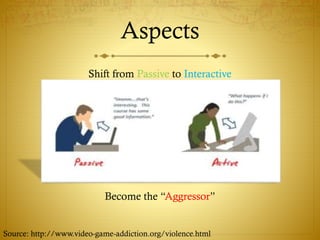
Aspects
Shift from Passive to Interactive
Become the “Aggressor”
Source: http://www.video-game-addiction.org/violence.html
Aspects
Known to affect the person’s though patterns (short term)
Source: http://www.video-game-addiction.org/violence.html
Aspects
Rewards for violence rather than punishment.
Source: http://www.video-game-addiction.org/violence.html
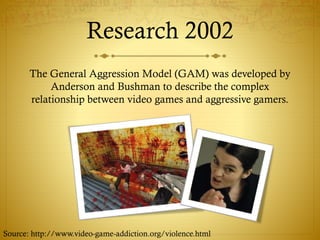
Research 2002
The General Aggression Model (GAM) was developed by
Anderson and Bushman to describe the complex
relationship between video games and aggressive gamers.
Source: http://www.video-game-addiction.org/violence.html
GAM
Three internal facets
Thoughts
Feelings
Physiological responses
Source: http://www.video-game-addiction.org/violence.html
Research shows the Short
Term
 ‘Change the way gamers interpret and respond to
aggressive acts.’
 ‘Even those who aren't predisposed to aggression
respond with increased hostility after playing a violent
video game.’
 ‘The game becomes what's called a "situational variable"
which changes the perception of and reaction to
aggressive behavior.’
Source: http://www.video-game-addiction.org/violence.html
Reality Bytes: Eight Myths
About Video Games Debunked
Peoples perceptions (Frenzy) vs. Reality
Source: http://www.pbs.org/kcts/videogamerevolution/impact/myths.html
Reality Bytes: Eight Myths
About Video Games Debunked
1. The availability of video games has led to an epidemic
of youth violence.
 ‘The rate of juvenile violent crime in the United States is
at a 30-year low’
 ‘People serving time for violent crimes typically consume
less media before committing their crimes than the
average person in the general population’
Source: http://www.pbs.org/kcts/videogamerevolution/impact/myths.html
Reality Bytes: Eight Myths
About Video Games Debunked
1. The availability of video games has led to an epidemic
of youth violence.
 ‘It's true that young offenders who have committed
school shootings in America have also been game
players’
 ‘But young people in general are more likely to be
gamers — 90 percent of boys and 40 percent of girls
play. The overwhelming majority of kids who play do
NOT commit antisocial acts. ’
Source: http://www.pbs.org/kcts/videogamerevolution/impact/myths.html
Reality Bytes: Eight Myths
About Video Games Debunked
1. The availability of video games has led to an epidemic of
youth violence.
 ‘The strongest risk factors for school shootings centered on
mental stability and the quality of home life, not media
exposure.’
 ‘The moral panic over violent video games is doubly harmful.
It has led adult authorities to be more suspicious and hostile
to many kids who already feel cut off from the system. It also
misdirects energy away from eliminating the actual causes of
youth violence and allows problems to continue to fester.’
Source: http://www.pbs.org/kcts/videogamerevolution/impact/myths.html
Reality Bytes: Eight Myths
About Video Games Debunked
2. Scientific evidence links violent game play with youth aggression.
 ‘Claims like this are based on the work of researchers who represent
one relatively narrow school of research, "media effects." This
research includes some 300 studies of media violence. But most of
those studies are inconclusive and many have been criticized on
methodological grounds.’
 ‘In these studies, media images are removed from any narrative
context. Subjects are asked to engage with content that they would
not normally consume and may not understand. Finally, the
laboratory context is radically different from the environments
where games would normally be played.’
Source: http://www.pbs.org/kcts/videogamerevolution/impact/myths.html
Reality Bytes: Eight Myths
About Video Games Debunked
2. Scientific evidence links violent game play with youth
aggression.
 ‘Most studies found a correlation, not a causal relationship,
which means the research could simply show that aggressive
people like aggressive entertainment. That's why the vague
term "links" is used here. If there is a consensus emerging
around this research, it is that violent video games may be one
risk factor - when coupled with other more immediate, real-
world influences — which can contribute to anti-social
behavior. But no research has found that video games are a
primary factor or that violent video game play could turn an
otherwise normal person into a killer.’
Source: http://www.pbs.org/kcts/videogamerevolution/impact/myths.html
Reality Bytes: Eight Myths
About Video Games Debunked
8. Video game play is desensitizing.
 ‘Game designer and play theorist Eric Zimmerman
describes the ways we understand play as distinctive
from reality as entering the "magic circle." The same
action — say, sweeping a floor — may take on different
meanings in play (as in playing house) than in reality
(housework).’
Source: http://www.pbs.org/kcts/videogamerevolution/impact/myths.html
Reality Bytes: Eight Myths
About Video Games Debunked
8. Video game play is desensitizing.
 ‘Play allows kids to express feelings and impulses that
have to be carefully held in check in their real-world
interactions. Media reformers argue that playing violent
video games can cause a lack of empathy for real-world
victims. Yet, a child who responds to a video game the
same way he or she responds to a real-world tragedy
could be showing symptoms of being severely
emotionally disturbed.’
Source: http://www.pbs.org/kcts/videogamerevolution/impact/myths.html
Reality Bytes: Eight Myths
About Video Games Debunked
8. Video game play is desensitizing.
 ‘The kid who is punching a toy designed for this purpose
is still within the "magic circle" of play and understands
her actions on those terms. Such research shows us only
that violent play leads to more violent play.’
Source: http://www.pbs.org/kcts/videogamerevolution/impact/myths.html

Violence in video games

  • 1.
  • 2.
    Which came firstthe chicken or the egg? Which comes first? “Can aggressive and violent behavior be attributed to violence in video games?” “Or do those who play already have violent tendencies which draw them to violent games?” Source: http://www.video-game-addiction.org/violence.html
  • 3.
    History “Video games madetheir appearance in the 1970s, it wasn't until systems like the Sony PlayStation were released in the 1980s that violence became an issue.” Source: http://www.video-game-addiction.org/violence.html
  • 4.
    History Improved graphics thatmimicked real life caused an interest in video games and aggressive behavior. Source: http://www.video-game-addiction.org/violence.html
  • 5.
    Aspects Shift from Passiveto Interactive Become the “Aggressor” Source: http://www.video-game-addiction.org/violence.html
  • 6.
    Aspects Known to affectthe person’s though patterns (short term) Source: http://www.video-game-addiction.org/violence.html
  • 7.
    Aspects Rewards for violencerather than punishment. Source: http://www.video-game-addiction.org/violence.html
  • 8.
    Research 2002 The GeneralAggression Model (GAM) was developed by Anderson and Bushman to describe the complex relationship between video games and aggressive gamers. Source: http://www.video-game-addiction.org/violence.html
  • 9.
    GAM Three internal facets Thoughts Feelings Physiologicalresponses Source: http://www.video-game-addiction.org/violence.html
  • 10.
    Research shows theShort Term  ‘Change the way gamers interpret and respond to aggressive acts.’  ‘Even those who aren't predisposed to aggression respond with increased hostility after playing a violent video game.’  ‘The game becomes what's called a "situational variable" which changes the perception of and reaction to aggressive behavior.’ Source: http://www.video-game-addiction.org/violence.html
  • 11.
    Reality Bytes: EightMyths About Video Games Debunked Peoples perceptions (Frenzy) vs. Reality Source: http://www.pbs.org/kcts/videogamerevolution/impact/myths.html
  • 12.
    Reality Bytes: EightMyths About Video Games Debunked 1. The availability of video games has led to an epidemic of youth violence.  ‘The rate of juvenile violent crime in the United States is at a 30-year low’  ‘People serving time for violent crimes typically consume less media before committing their crimes than the average person in the general population’ Source: http://www.pbs.org/kcts/videogamerevolution/impact/myths.html
  • 13.
    Reality Bytes: EightMyths About Video Games Debunked 1. The availability of video games has led to an epidemic of youth violence.  ‘It's true that young offenders who have committed school shootings in America have also been game players’  ‘But young people in general are more likely to be gamers — 90 percent of boys and 40 percent of girls play. The overwhelming majority of kids who play do NOT commit antisocial acts. ’ Source: http://www.pbs.org/kcts/videogamerevolution/impact/myths.html
  • 14.
    Reality Bytes: EightMyths About Video Games Debunked 1. The availability of video games has led to an epidemic of youth violence.  ‘The strongest risk factors for school shootings centered on mental stability and the quality of home life, not media exposure.’  ‘The moral panic over violent video games is doubly harmful. It has led adult authorities to be more suspicious and hostile to many kids who already feel cut off from the system. It also misdirects energy away from eliminating the actual causes of youth violence and allows problems to continue to fester.’ Source: http://www.pbs.org/kcts/videogamerevolution/impact/myths.html
  • 15.
    Reality Bytes: EightMyths About Video Games Debunked 2. Scientific evidence links violent game play with youth aggression.  ‘Claims like this are based on the work of researchers who represent one relatively narrow school of research, "media effects." This research includes some 300 studies of media violence. But most of those studies are inconclusive and many have been criticized on methodological grounds.’  ‘In these studies, media images are removed from any narrative context. Subjects are asked to engage with content that they would not normally consume and may not understand. Finally, the laboratory context is radically different from the environments where games would normally be played.’ Source: http://www.pbs.org/kcts/videogamerevolution/impact/myths.html
  • 16.
    Reality Bytes: EightMyths About Video Games Debunked 2. Scientific evidence links violent game play with youth aggression.  ‘Most studies found a correlation, not a causal relationship, which means the research could simply show that aggressive people like aggressive entertainment. That's why the vague term "links" is used here. If there is a consensus emerging around this research, it is that violent video games may be one risk factor - when coupled with other more immediate, real- world influences — which can contribute to anti-social behavior. But no research has found that video games are a primary factor or that violent video game play could turn an otherwise normal person into a killer.’ Source: http://www.pbs.org/kcts/videogamerevolution/impact/myths.html
  • 17.
    Reality Bytes: EightMyths About Video Games Debunked 8. Video game play is desensitizing.  ‘Game designer and play theorist Eric Zimmerman describes the ways we understand play as distinctive from reality as entering the "magic circle." The same action — say, sweeping a floor — may take on different meanings in play (as in playing house) than in reality (housework).’ Source: http://www.pbs.org/kcts/videogamerevolution/impact/myths.html
  • 18.
    Reality Bytes: EightMyths About Video Games Debunked 8. Video game play is desensitizing.  ‘Play allows kids to express feelings and impulses that have to be carefully held in check in their real-world interactions. Media reformers argue that playing violent video games can cause a lack of empathy for real-world victims. Yet, a child who responds to a video game the same way he or she responds to a real-world tragedy could be showing symptoms of being severely emotionally disturbed.’ Source: http://www.pbs.org/kcts/videogamerevolution/impact/myths.html
  • 19.
    Reality Bytes: EightMyths About Video Games Debunked 8. Video game play is desensitizing.  ‘The kid who is punching a toy designed for this purpose is still within the "magic circle" of play and understands her actions on those terms. Such research shows us only that violent play leads to more violent play.’ Source: http://www.pbs.org/kcts/videogamerevolution/impact/myths.html