The Victorian Literature
Assignment
Name: Alisha Vaghasiya
M.A. Sem: 2
Paper No. (6) Victorian Literature
Assignment Topic: write a note
on major writers of Victorian age
(1) Alfred Tennyson and (2)
Robert Browning
*Biography.
*works
*features of poetry
Introduction
Victorian age is regarded as a very important period
of English Literature. In this age all forms of literature
developed like poetry, novel, essay etc. many writers gave
their unique contribution in making this age important. Among
them Alfred Tennyson and Robert Browning is regarded as
major poets of this age. So let’s study them in detail.
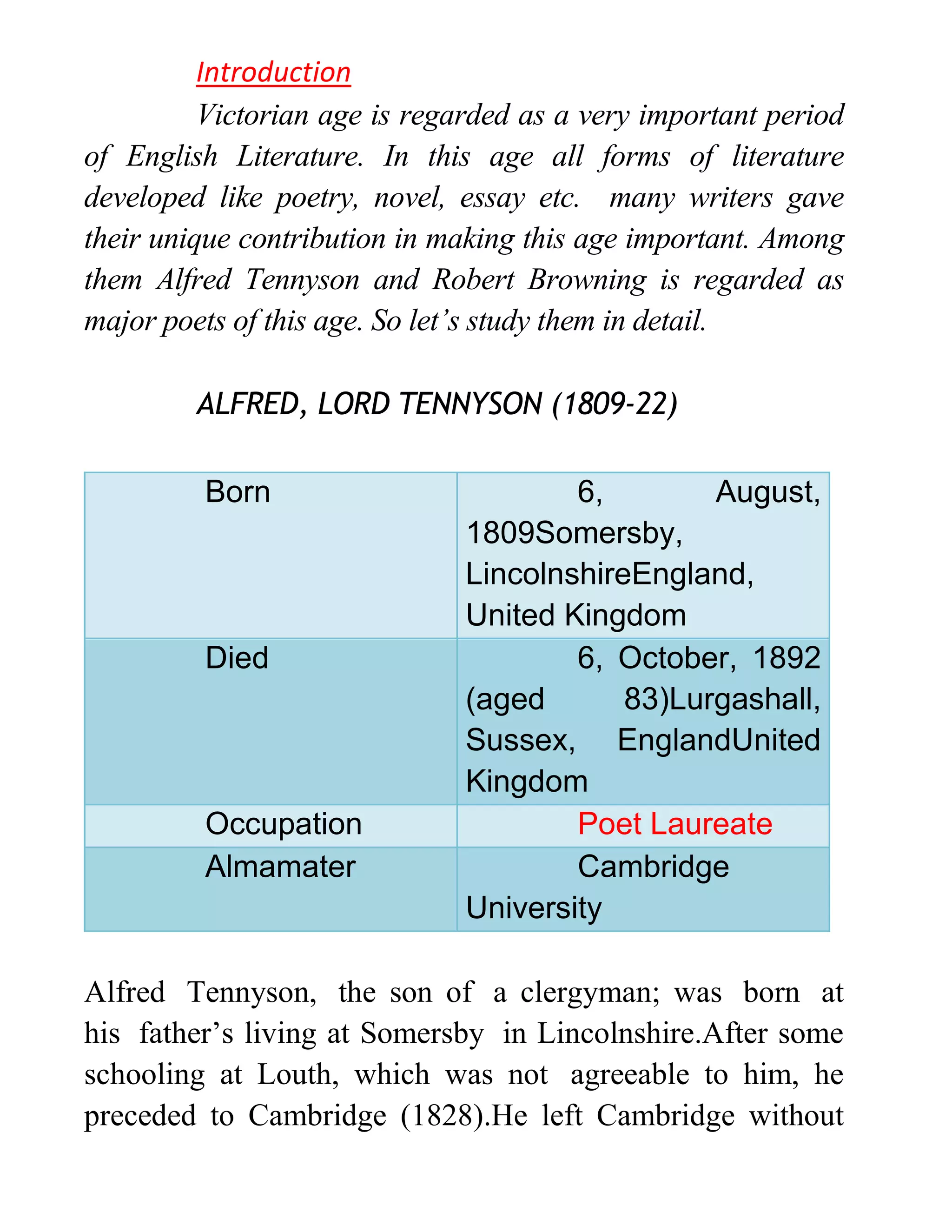
ALFRED, LORD TENNYSON (1809-22)
Born 6, August,
1809Somersby,
LincolnshireEngland,
United Kingdom
Died 6, October, 1892
(aged 83)Lurgashall,
Sussex, EnglandUnited
Kingdom
Occupation Poet Laureate
Almamater Cambridge
University
Alfred Tennyson, the son of a clergyman; was born at
his father’s living at Somersby in Lincolnshire.After some
schooling at Louth, which was not agreeable to him, he
preceded to Cambridge (1828).He left Cambridge without
taking a degree, but before doing so he published a small
volume of mediocre verse. He died at Aldworth, near
Harlmere, in surrey, and was buried in Westminster Abbey.
His poetry:-
When he was seventeen years old Tennyson
collaborated with his brother Charles in ‘ Poems by Two
Brothers’, (1827). The volume is a slight one, but in the light
of his later work we can already discern a little of the
Tennysonian metrical aptitude and descriptive power.
His poem ‘chiefly Lyrical’ (1830) published while
he was an undergraduate, are yet immature, put in pieces
like ’Isabel’, and ‘Madeline’ the pictorial effect and the
sumptuous imagery of his mature style are already
conspicuous.
His famous works
‘Nothing will Die’
from poems, Chiefly Lyrical’ (1830)
‘The window- a song cycle with Arthur Sullivan’
‘Harold’ (1876)
‘All things will Die’
‘The Dying Swan’
‘The Karken’
‘Mariana’
‘From Poems’ (1833)
‘Lady Clara vere de Vera’ (1832)
‘The Lotos- Easters’
‘The Lady of Shallot’
‘St. Simeon stylites’ (1833)
‘from poems (1842)
‘Locksley Hall’
‘Tithonus ’
‘Vision of sin’‘The two voices’(1834)
‘Ulysses’ (1833)
‘ From the Princess: A medley’ (1847)
‘The Princess’
‘Godiva’
‘tears, Idle Tears’
‘ The Eagle’ (1851)
‘In Memoriam A .H.H.’ (1849)
‘Ring out, wild Bells’ (1850)
‘Now sleeps the crimson petal- it later appeared as
a song in the film “Vanity Fair”
“Enoch Arden”
‘From Enoch Arden and other poems’ (1862-
64)‘Flower in the crannied wall’ (1869)
“Idylls of the King”
‘Becket’
‘ Crossing the Bar’ (1889)
‘Locksley Hall sixty years after’ (1886)
‘The Foresters’
‘From Maud: A Monodrama (1855-56)
‘Kapiolani (published after his death by Hallam
Tennyson
‘Maud and Other Poems’ (1855) was received with
amazement by the public. The chief poem is called a
‘Monodrama’.
The only poem of any length is ‘Enoch
Arden’.Among the shorter poems, ‘ Locksley Hall sixty
Years After’(1886), and ‘The Death of Enone’ are sad
echoes of the sumptuous imaginings of the year preceding
1842.
At the university he was a wholly conventional
person, and the only mark he made was to win the
chancellors Medal for a poem on Timbuctoo.
He was appointed Poet Laureate (1850) in
succession to Wordsworth.
Then inn 1842 he produced two volumes of poetry
that set him once and for all among the greater poet of his
day.
‘The Princess’ (1847) is a serio –comic attempt to
handle the theme that was then known as ‘ the new women’.
The poem is inn blank verse, but interspersed are several
singularly beautiful lyrics. The humour is heavy.
‘In Memoriam’ (1850) caused a great stir
when it first appeared. It is a very long series of meditations
upon the death of Arthur Henry Hallam. The poem is
adorned with many beautiful sketches of English Scenery,
and the metre – now called ‘In Memoriam Metre- which is
quite rare, is deftly managed.
Queen Mary (1875)
Harold (1876)
Becket (1844)
His excellent craftsmanship is also apparent in his
handling of English metres , in which he is a tireless
experimenter.
C. His pictorial Quality:-
Such passages reveal Tennyson at his best. They show care
of observation and a studious loveliness of epithet; but they
lack the intense insight, the ringing and romantic note, of
best effort of Keats.
E. This extracts sufficiently revealed the qualities of his
style. In particular he is an adept at coining phrases-“ Jewels
five word long” as he himself aptly expressed it, and he is
almost invariably happy in his choice of epithet.
F: his reputation has already declined from the idolatry in
which he was held when he was alive. To his
contemporaries he was a demigod, but younger men strongly
assailed his patent literary mannerism. Consequently for 25
years of his death his reputation suffered considerably.
His volume of ‘poems’ (1833), which is often
referred to as poems , because, in spite of its official title, in
appeared in December of the earlier year, is of a different
quality
It contains such notable poems as ‘ The Lady of
Shallot’, Enone’, ‘ The lotos- Easters’ and ‘The Palace of
Art’, in which we see the Tennysonian technique of
perfection.
His Plays
Tennyson’s dramas occupied his later years. he
wrote three Historical plays.
‘The Falcon’ is a comedy based on a story from
Boccaccio.‘The Cup’ (1881) is based on story from
Plutarch.‘The Foresters’ (1892), dealing with the familiar
Robin hood theme, was produced in America.
His Poetical Characteristics:-
a. His choice of subject:- Tennyson’s earliest instincts, as
seen in the volumes of 1830, 1833 and 1842 led him to
the lyric and legendary narrative as his principal
themes, and these he handled with a skill and artistry
which he rarely surpassed.
b. His craftsmanship:- No one can deny the great care
and skill shown in Tennyson’s work.
c. Tennyson’s Lyrical quality is somewhat uneven. The
slightest of his pieces, like ‘The Splendour Falls’, are
musical and attractive, but on the whole his nature was
too self conscious. Once or twice, as in the wonderful
Break, break, break and Crossing the Bar, he touches
real greatness.
Myriads of rivulets hurrying thro’ the lawn,The
moan of doves in immemorial elms,And murmuring of
innumerable bees.
-The Princess
The silk star- broider’d coverlid
Unto her limbs itself doth mould
Languidly ever; and, amid
Her full black ringlets downward rolled,
Glows forth each softly- shadowed arm
With bracelets of the diamond bright:
Her constant beauty doth inform
Stillness with love, and day with light.
-The Day Dream
Till now the doubtful dusk reveal’d
The knolls once more where, couched at ease,
The white kine glimmered, and the trees
Laid their dark arms about the field:
And sucked from out the distant gloom
A breeze began to tremble o’er
The large leaves of the sycamore,
And fluctuate all the still perfume.
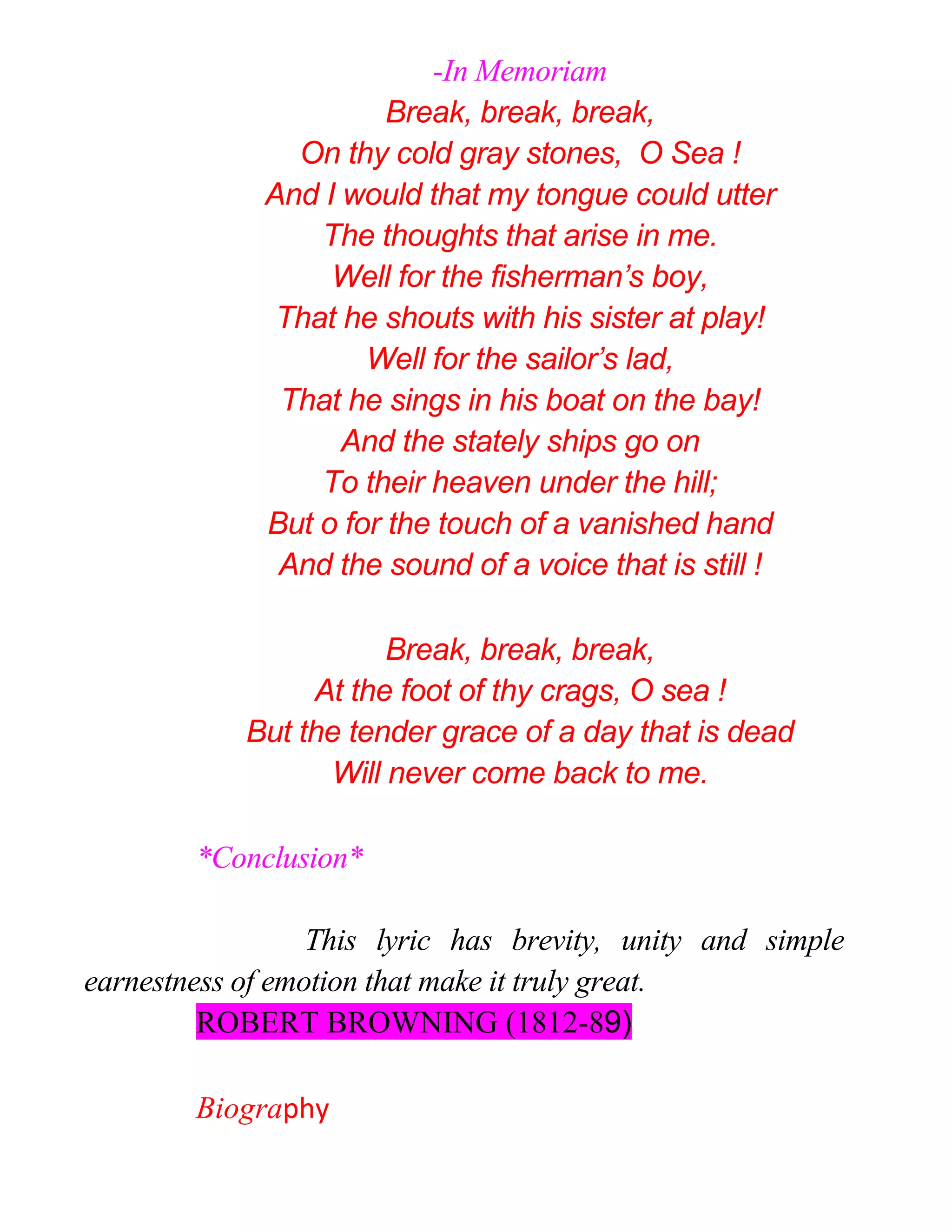
-In Memoriam
Break, break, break,
On thy cold gray stones, O Sea !
And I would that my tongue could utter
The thoughts that arise in me.
Well for the fisherman’s boy,
That he shouts with his sister at play!
Well for the sailor’s lad,
That he sings in his boat on the bay!
And the stately ships go on
To their heaven under the hill;
But o for the touch of a vanished hand
And the sound of a voice that is still !
Break, break, break,
At the foot of thy crags, O sea !
But the tender grace of a day that is dead
Will never come back to me.
*Conclusion*
This lyric has brevity, unity and simple
earnestness of emotion that make it truly great.
ROBERT BROWNING (1812-89)
Biography
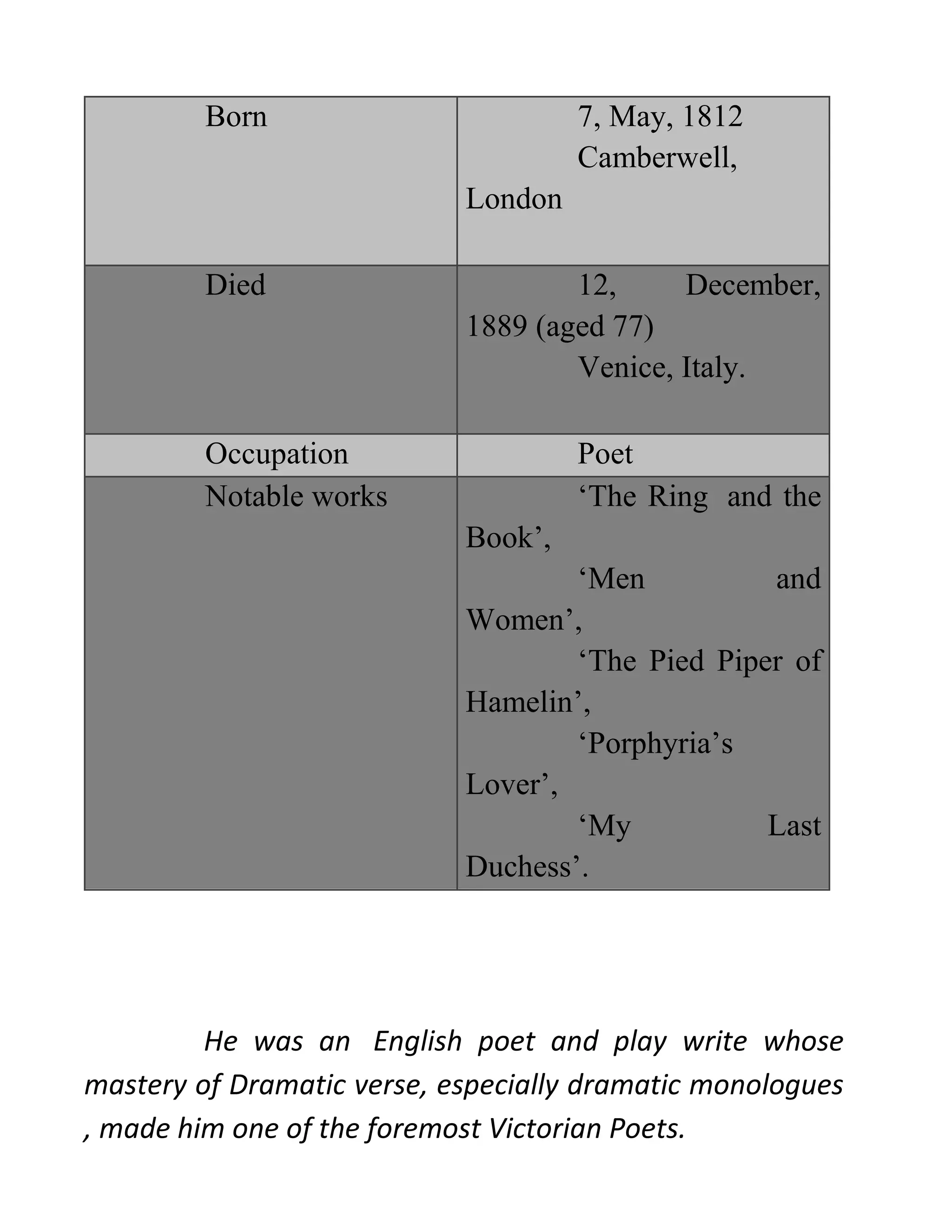
Born 7, May, 1812
Camberwell,
London
Died 12, December,
1889 (aged 77)
Venice, Italy.
Occupation Poet
Notable works ‘The Ring and the
Book’,
‘Men and
Women’,
‘The Pied Piper of
Hamelin’,
‘Porphyria’s
Lover’,
‘My Last
Duchess’.
He was an English poet and play write whose
mastery of Dramatic verse, especially dramatic monologues
, made him one of the foremost Victorian Poets.
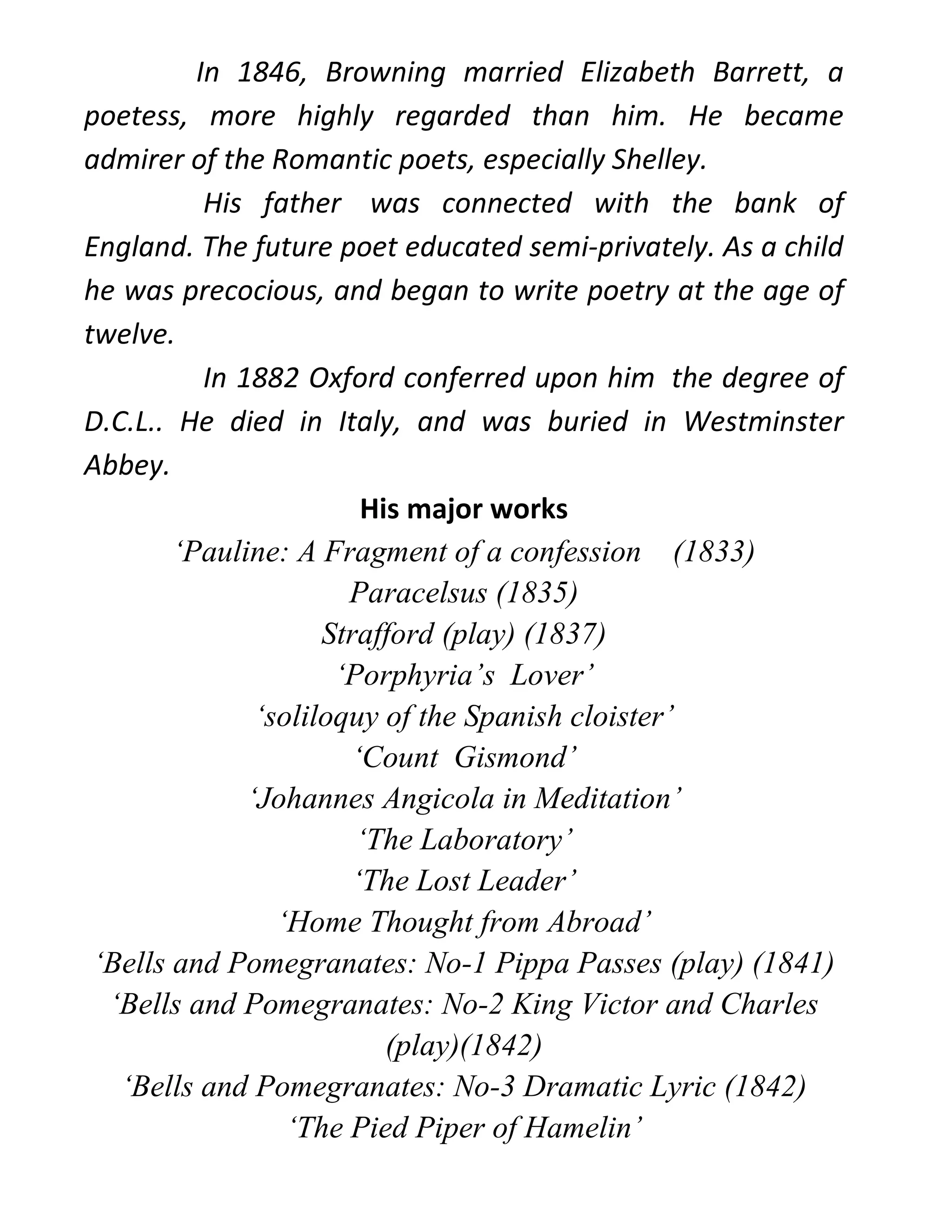
In 1846, Browning married Elizabeth Barrett, a
poetess, more highly regarded than him. He became
admirer of the Romantic poets, especially Shelley.
His father was connected with the bank of
England. The future poet educated semi-privately. As a child
he was precocious, and began to write poetry at the age of
twelve.
In 1882 Oxford conferred upon him the degree of
D.C.L.. He died in Italy, and was buried in Westminster
Abbey.
His major works
‘Pauline: A Fragment of a confession (1833)
Paracelsus (1835)
Strafford (play) (1837)
‘Porphyria’s Lover’
‘soliloquy of the Spanish cloister’
‘Count Gismond’
‘Johannes Angicola in Meditation’
‘The Laboratory’
‘The Lost Leader’
‘Home Thought from Abroad’
‘Bells and Pomegranates: No-1 Pippa Passes (play) (1841)
‘Bells and Pomegranates: No-2 King Victor and Charles
(play)(1842)
‘Bells and Pomegranates: No-3 Dramatic Lyric (1842)
‘The Pied Piper of Hamelin’
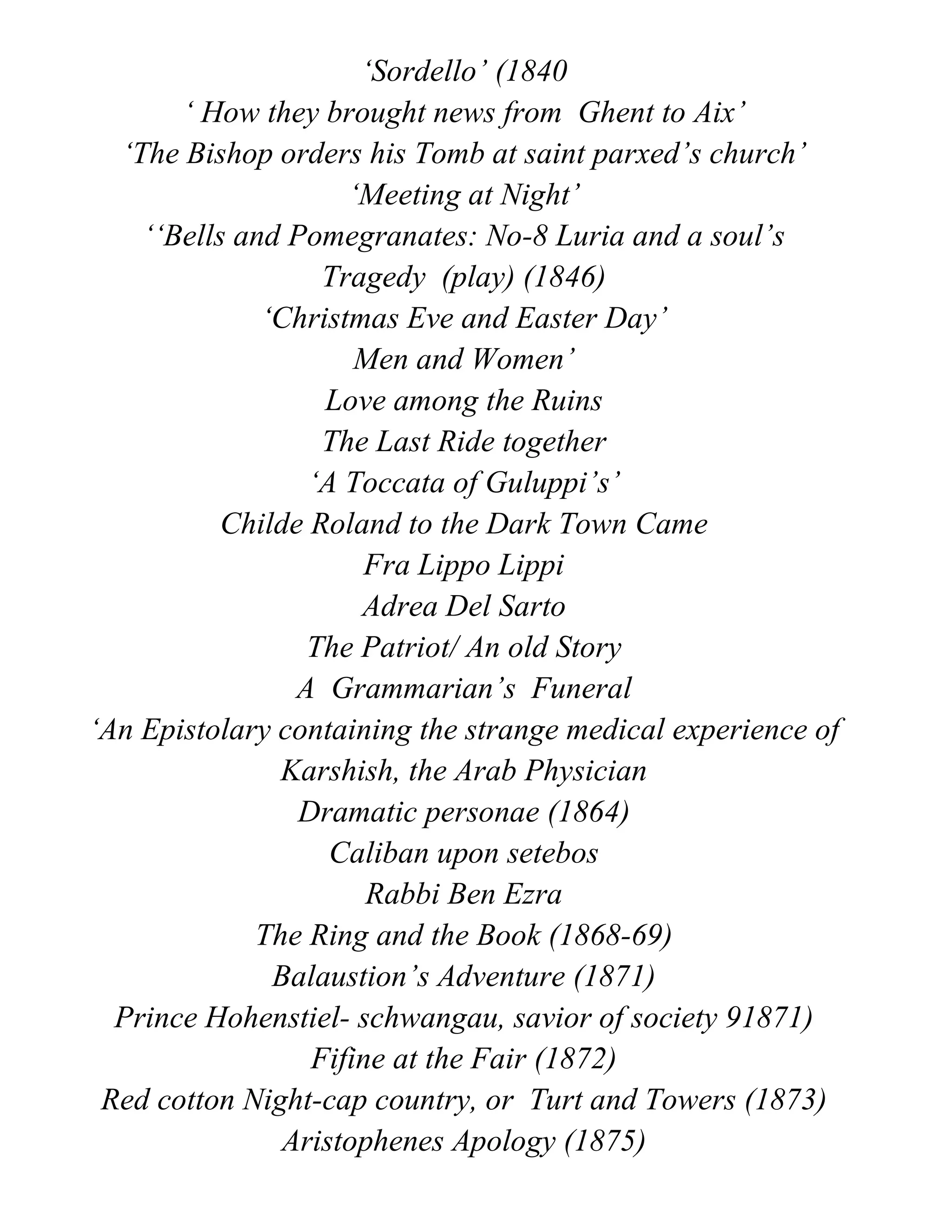
‘Sordello’ (1840
‘ How they brought news from Ghent to Aix’
‘The Bishop orders his Tomb at saint parxed’s church’
‘Meeting at Night’
‘‘Bells and Pomegranates: No-8 Luria and a soul’s
Tragedy (play) (1846)
‘Christmas Eve and Easter Day’
Men and Women’
Love among the Ruins
The Last Ride together
‘A Toccata of Guluppi’s’
Childe Roland to the Dark Town Came
Fra Lippo Lippi
Adrea Del Sarto
The Patriot/ An old Story
A Grammarian’s Funeral
‘An Epistolary containing the strange medical experience of
Karshish, the Arab Physician
Dramatic personae (1864)
Caliban upon setebos
Rabbi Ben Ezra
The Ring and the Book (1868-69)
Balaustion’s Adventure (1871)
Prince Hohenstiel- schwangau, savior of society 91871)
Fifine at the Fair (1872)
Red cotton Night-cap country, or Turt and Towers (1873)
Aristophenes Apology (1875)
The Inn Album (1875)
Pacchiarotta, and how he worked in Distemper (1876)
The Agamemnon of Aeschylus (1877)
The years at the spring
‘Prospice’
Jocoseria (1833)
Feristah’s fancies (1844)
Asolando (1889)
Dramatic Idylls (1879)
Dramatic Idylls: second series (1880)
La saisiaz and the two poets of croisic (1878)
Parleying with certain people of importance in their day
(1887)
His poems and plays:-
His first work of any importance is ‘Pauline’ (1833),
an introspective poem, which shows very strongly the
influence of Shelley, whom, at this period, Browning held in
great reverence.
Paracelsus (1835), the story of the hero’s unquenchable
thirst for that breadth of knowledge which is beyond the
grasping of the man, brings to the fore Browning’s pre-
dominant idea that a life without love must be a failure,
and that god is working all things to do an end beyond
human divining.
His next work was the play Strafford (1837).
Sordello( 1840), an attempt to decide the relationship
between art and life, is Browning’s most obscure work.
Collection of lyrical and narrative poems include
six plays
‘Pippa passes’ (1841),‘King Victor and King
Charles’((1842),‘The return of the Druses’ (1843),‘A Blot on
the scutheon’ (1843),‘Colombe’s Birthday’(1844),‘Lyria;
and a soul’s Tragedy’ (1846).Dramatic Lyrics (1842) and
Dramatic Romances and Lyrics (1845) shows this faculty
being directed into the channel in which it was to achieve
perfection- that of dramatic monologue.
In later volumes appeared ‘The Italian in England’,
“The Bishop Orders his tomb at saint Parxed’s’, and ‘PIctor
Ignotus’, among many others.
Of the love lyrics on this period ‘Meeting at Night’ is
typical:
The grey sea and the long black land;
And the yellow half-moon large and low;
And the startled little waves that leap
In fiery ringlets from their sleep,
As I gain in cove with pushing prow,
And quench its speed in the slushy sand.
Then a mile of warm sea-scented beach:
Three fields t cross till a farm appears;
A tape at the pane, the quick sharp scratch
And blue spurt of a lighted match,
And a voice less loud, thro’ its joys and fears;
Than the two hearts beating each to each !
Browning produced some of his best work in ‘Men
and Women’ (1855), which with the exception of the
dedicatory one word more, addressed to his wife, consist
entirely of dramatic monologues. Here are to be found ‘Fra
Lippo Lippi’, ‘An Epistle containing strange medical
experience of Karshish’, ‘Cleon’, ‘Andrea Del Sarto’, most
of them are written in blank verse.
His other works are ‘Caliban Upon Setebos’, ‘A Death in the
Desert’, ‘Rabbi Ben Ezra’ and ‘Abt Vogler’.
‘The Ring and the Book’ is the story murderer of
the young wife, Pompilia, by her worthless husband, in the
year 1698, and the same story is told by different people ,
and continues for twelve books.
The remaining years of Browning’s life saw the
production of numerous further volumes of verses.
Features of his poetry
A. Choice of subject:- his theme divide
broadly into three groups, philosophical, religious and
love. His central belief was that “god’s task to make the
heavenly period perfect for the earthern”.
B. His style
C. Descriptive power:- in this respect
Browning differs widely from Tennyson, who slowly
creates a lovely image by careful massing of detail.
Browning cares less for beautyof description for its own
sake.
D. His reputation:- his fame now chiefly
rests on those four volumes, published between 1842
and 1864, which contain his love lyric and dramatic
monologues. No more is needed to place him among the
truly great.
So, after studying all this points we can say that Alfred
Tennyson and Robert Browning were truly great figures
of Victorian age.

Paper 6 assignment

  • 1.
    The Victorian Literature Assignment Name:Alisha Vaghasiya M.A. Sem: 2 Paper No. (6) Victorian Literature Assignment Topic: write a note on major writers of Victorian age (1) Alfred Tennyson and (2) Robert Browning *Biography. *works *features of poetry
  • 2.
    Introduction Victorian age isregarded as a very important period of English Literature. In this age all forms of literature developed like poetry, novel, essay etc. many writers gave their unique contribution in making this age important. Among them Alfred Tennyson and Robert Browning is regarded as major poets of this age. So let’s study them in detail. ALFRED, LORD TENNYSON (1809-22) Born 6, August, 1809Somersby, LincolnshireEngland, United Kingdom Died 6, October, 1892 (aged 83)Lurgashall, Sussex, EnglandUnited Kingdom Occupation Poet Laureate Almamater Cambridge University Alfred Tennyson, the son of a clergyman; was born at his father’s living at Somersby in Lincolnshire.After some schooling at Louth, which was not agreeable to him, he preceded to Cambridge (1828).He left Cambridge without
  • 3.
    taking a degree,but before doing so he published a small volume of mediocre verse. He died at Aldworth, near Harlmere, in surrey, and was buried in Westminster Abbey. His poetry:- When he was seventeen years old Tennyson collaborated with his brother Charles in ‘ Poems by Two Brothers’, (1827). The volume is a slight one, but in the light of his later work we can already discern a little of the Tennysonian metrical aptitude and descriptive power. His poem ‘chiefly Lyrical’ (1830) published while he was an undergraduate, are yet immature, put in pieces like ’Isabel’, and ‘Madeline’ the pictorial effect and the sumptuous imagery of his mature style are already conspicuous. His famous works ‘Nothing will Die’ from poems, Chiefly Lyrical’ (1830) ‘The window- a song cycle with Arthur Sullivan’ ‘Harold’ (1876) ‘All things will Die’ ‘The Dying Swan’ ‘The Karken’ ‘Mariana’ ‘From Poems’ (1833)
  • 4.
    ‘Lady Clara verede Vera’ (1832) ‘The Lotos- Easters’ ‘The Lady of Shallot’ ‘St. Simeon stylites’ (1833) ‘from poems (1842) ‘Locksley Hall’ ‘Tithonus ’ ‘Vision of sin’‘The two voices’(1834) ‘Ulysses’ (1833) ‘ From the Princess: A medley’ (1847) ‘The Princess’ ‘Godiva’ ‘tears, Idle Tears’ ‘ The Eagle’ (1851) ‘In Memoriam A .H.H.’ (1849) ‘Ring out, wild Bells’ (1850) ‘Now sleeps the crimson petal- it later appeared as a song in the film “Vanity Fair” “Enoch Arden” ‘From Enoch Arden and other poems’ (1862- 64)‘Flower in the crannied wall’ (1869) “Idylls of the King” ‘Becket’ ‘ Crossing the Bar’ (1889) ‘Locksley Hall sixty years after’ (1886) ‘The Foresters’ ‘From Maud: A Monodrama (1855-56)
  • 5.
    ‘Kapiolani (published afterhis death by Hallam Tennyson ‘Maud and Other Poems’ (1855) was received with amazement by the public. The chief poem is called a ‘Monodrama’. The only poem of any length is ‘Enoch Arden’.Among the shorter poems, ‘ Locksley Hall sixty Years After’(1886), and ‘The Death of Enone’ are sad echoes of the sumptuous imaginings of the year preceding 1842. At the university he was a wholly conventional person, and the only mark he made was to win the chancellors Medal for a poem on Timbuctoo. He was appointed Poet Laureate (1850) in succession to Wordsworth. Then inn 1842 he produced two volumes of poetry that set him once and for all among the greater poet of his day. ‘The Princess’ (1847) is a serio –comic attempt to handle the theme that was then known as ‘ the new women’. The poem is inn blank verse, but interspersed are several singularly beautiful lyrics. The humour is heavy. ‘In Memoriam’ (1850) caused a great stir when it first appeared. It is a very long series of meditations upon the death of Arthur Henry Hallam. The poem is adorned with many beautiful sketches of English Scenery, and the metre – now called ‘In Memoriam Metre- which is
  • 6.
    quite rare, isdeftly managed. Queen Mary (1875) Harold (1876) Becket (1844) His excellent craftsmanship is also apparent in his handling of English metres , in which he is a tireless experimenter. C. His pictorial Quality:- Such passages reveal Tennyson at his best. They show care of observation and a studious loveliness of epithet; but they lack the intense insight, the ringing and romantic note, of best effort of Keats. E. This extracts sufficiently revealed the qualities of his style. In particular he is an adept at coining phrases-“ Jewels five word long” as he himself aptly expressed it, and he is almost invariably happy in his choice of epithet. F: his reputation has already declined from the idolatry in which he was held when he was alive. To his contemporaries he was a demigod, but younger men strongly assailed his patent literary mannerism. Consequently for 25 years of his death his reputation suffered considerably. His volume of ‘poems’ (1833), which is often referred to as poems , because, in spite of its official title, in appeared in December of the earlier year, is of a different quality It contains such notable poems as ‘ The Lady of
  • 7.
    Shallot’, Enone’, ‘The lotos- Easters’ and ‘The Palace of Art’, in which we see the Tennysonian technique of perfection. His Plays Tennyson’s dramas occupied his later years. he wrote three Historical plays. ‘The Falcon’ is a comedy based on a story from Boccaccio.‘The Cup’ (1881) is based on story from Plutarch.‘The Foresters’ (1892), dealing with the familiar Robin hood theme, was produced in America. His Poetical Characteristics:- a. His choice of subject:- Tennyson’s earliest instincts, as seen in the volumes of 1830, 1833 and 1842 led him to the lyric and legendary narrative as his principal themes, and these he handled with a skill and artistry which he rarely surpassed. b. His craftsmanship:- No one can deny the great care and skill shown in Tennyson’s work. c. Tennyson’s Lyrical quality is somewhat uneven. The slightest of his pieces, like ‘The Splendour Falls’, are musical and attractive, but on the whole his nature was too self conscious. Once or twice, as in the wonderful
  • 8.
    Break, break, breakand Crossing the Bar, he touches real greatness. Myriads of rivulets hurrying thro’ the lawn,The moan of doves in immemorial elms,And murmuring of innumerable bees. -The Princess The silk star- broider’d coverlid Unto her limbs itself doth mould Languidly ever; and, amid Her full black ringlets downward rolled, Glows forth each softly- shadowed arm With bracelets of the diamond bright: Her constant beauty doth inform Stillness with love, and day with light. -The Day Dream Till now the doubtful dusk reveal’d The knolls once more where, couched at ease, The white kine glimmered, and the trees Laid their dark arms about the field: And sucked from out the distant gloom A breeze began to tremble o’er The large leaves of the sycamore, And fluctuate all the still perfume.
  • 9.
    -In Memoriam Break, break,break, On thy cold gray stones, O Sea ! And I would that my tongue could utter The thoughts that arise in me. Well for the fisherman’s boy, That he shouts with his sister at play! Well for the sailor’s lad, That he sings in his boat on the bay! And the stately ships go on To their heaven under the hill; But o for the touch of a vanished hand And the sound of a voice that is still ! Break, break, break, At the foot of thy crags, O sea ! But the tender grace of a day that is dead Will never come back to me. *Conclusion* This lyric has brevity, unity and simple earnestness of emotion that make it truly great. ROBERT BROWNING (1812-89) Biography
  • 10.
    Born 7, May,1812 Camberwell, London Died 12, December, 1889 (aged 77) Venice, Italy. Occupation Poet Notable works ‘The Ring and the Book’, ‘Men and Women’, ‘The Pied Piper of Hamelin’, ‘Porphyria’s Lover’, ‘My Last Duchess’. He was an English poet and play write whose mastery of Dramatic verse, especially dramatic monologues , made him one of the foremost Victorian Poets.
  • 11.
    In 1846, Browningmarried Elizabeth Barrett, a poetess, more highly regarded than him. He became admirer of the Romantic poets, especially Shelley. His father was connected with the bank of England. The future poet educated semi-privately. As a child he was precocious, and began to write poetry at the age of twelve. In 1882 Oxford conferred upon him the degree of D.C.L.. He died in Italy, and was buried in Westminster Abbey. His major works ‘Pauline: A Fragment of a confession (1833) Paracelsus (1835) Strafford (play) (1837) ‘Porphyria’s Lover’ ‘soliloquy of the Spanish cloister’ ‘Count Gismond’ ‘Johannes Angicola in Meditation’ ‘The Laboratory’ ‘The Lost Leader’ ‘Home Thought from Abroad’ ‘Bells and Pomegranates: No-1 Pippa Passes (play) (1841) ‘Bells and Pomegranates: No-2 King Victor and Charles (play)(1842) ‘Bells and Pomegranates: No-3 Dramatic Lyric (1842) ‘The Pied Piper of Hamelin’
  • 12.
    ‘Sordello’ (1840 ‘ Howthey brought news from Ghent to Aix’ ‘The Bishop orders his Tomb at saint parxed’s church’ ‘Meeting at Night’ ‘‘Bells and Pomegranates: No-8 Luria and a soul’s Tragedy (play) (1846) ‘Christmas Eve and Easter Day’ Men and Women’ Love among the Ruins The Last Ride together ‘A Toccata of Guluppi’s’ Childe Roland to the Dark Town Came Fra Lippo Lippi Adrea Del Sarto The Patriot/ An old Story A Grammarian’s Funeral ‘An Epistolary containing the strange medical experience of Karshish, the Arab Physician Dramatic personae (1864) Caliban upon setebos Rabbi Ben Ezra The Ring and the Book (1868-69) Balaustion’s Adventure (1871) Prince Hohenstiel- schwangau, savior of society 91871) Fifine at the Fair (1872) Red cotton Night-cap country, or Turt and Towers (1873) Aristophenes Apology (1875)
  • 13.
    The Inn Album(1875) Pacchiarotta, and how he worked in Distemper (1876) The Agamemnon of Aeschylus (1877) The years at the spring ‘Prospice’ Jocoseria (1833) Feristah’s fancies (1844) Asolando (1889) Dramatic Idylls (1879) Dramatic Idylls: second series (1880) La saisiaz and the two poets of croisic (1878) Parleying with certain people of importance in their day (1887) His poems and plays:- His first work of any importance is ‘Pauline’ (1833), an introspective poem, which shows very strongly the influence of Shelley, whom, at this period, Browning held in great reverence. Paracelsus (1835), the story of the hero’s unquenchable thirst for that breadth of knowledge which is beyond the grasping of the man, brings to the fore Browning’s pre- dominant idea that a life without love must be a failure, and that god is working all things to do an end beyond human divining.
  • 14.
    His next workwas the play Strafford (1837). Sordello( 1840), an attempt to decide the relationship between art and life, is Browning’s most obscure work. Collection of lyrical and narrative poems include six plays ‘Pippa passes’ (1841),‘King Victor and King Charles’((1842),‘The return of the Druses’ (1843),‘A Blot on the scutheon’ (1843),‘Colombe’s Birthday’(1844),‘Lyria; and a soul’s Tragedy’ (1846).Dramatic Lyrics (1842) and Dramatic Romances and Lyrics (1845) shows this faculty being directed into the channel in which it was to achieve perfection- that of dramatic monologue. In later volumes appeared ‘The Italian in England’, “The Bishop Orders his tomb at saint Parxed’s’, and ‘PIctor Ignotus’, among many others. Of the love lyrics on this period ‘Meeting at Night’ is typical: The grey sea and the long black land; And the yellow half-moon large and low; And the startled little waves that leap In fiery ringlets from their sleep, As I gain in cove with pushing prow, And quench its speed in the slushy sand.
  • 15.
    Then a mileof warm sea-scented beach: Three fields t cross till a farm appears; A tape at the pane, the quick sharp scratch And blue spurt of a lighted match, And a voice less loud, thro’ its joys and fears; Than the two hearts beating each to each ! Browning produced some of his best work in ‘Men and Women’ (1855), which with the exception of the dedicatory one word more, addressed to his wife, consist entirely of dramatic monologues. Here are to be found ‘Fra Lippo Lippi’, ‘An Epistle containing strange medical experience of Karshish’, ‘Cleon’, ‘Andrea Del Sarto’, most of them are written in blank verse. His other works are ‘Caliban Upon Setebos’, ‘A Death in the Desert’, ‘Rabbi Ben Ezra’ and ‘Abt Vogler’. ‘The Ring and the Book’ is the story murderer of the young wife, Pompilia, by her worthless husband, in the year 1698, and the same story is told by different people , and continues for twelve books. The remaining years of Browning’s life saw the production of numerous further volumes of verses. Features of his poetry
  • 16.
    A. Choice ofsubject:- his theme divide broadly into three groups, philosophical, religious and love. His central belief was that “god’s task to make the heavenly period perfect for the earthern”. B. His style C. Descriptive power:- in this respect Browning differs widely from Tennyson, who slowly creates a lovely image by careful massing of detail. Browning cares less for beautyof description for its own sake. D. His reputation:- his fame now chiefly rests on those four volumes, published between 1842 and 1864, which contain his love lyric and dramatic monologues. No more is needed to place him among the truly great. So, after studying all this points we can say that Alfred Tennyson and Robert Browning were truly great figures of Victorian age.