The assessment of management of
stable COPD: An update
Alexandru Corlateanu
Department of Respiratory Medicine, State University of
Medicine and Pharmacy "Nicolae Testemitanu",
Chisinau, Moldova
1
Conflict of interest
Received honorariums for educational
activities and lectures from GSK
2
3
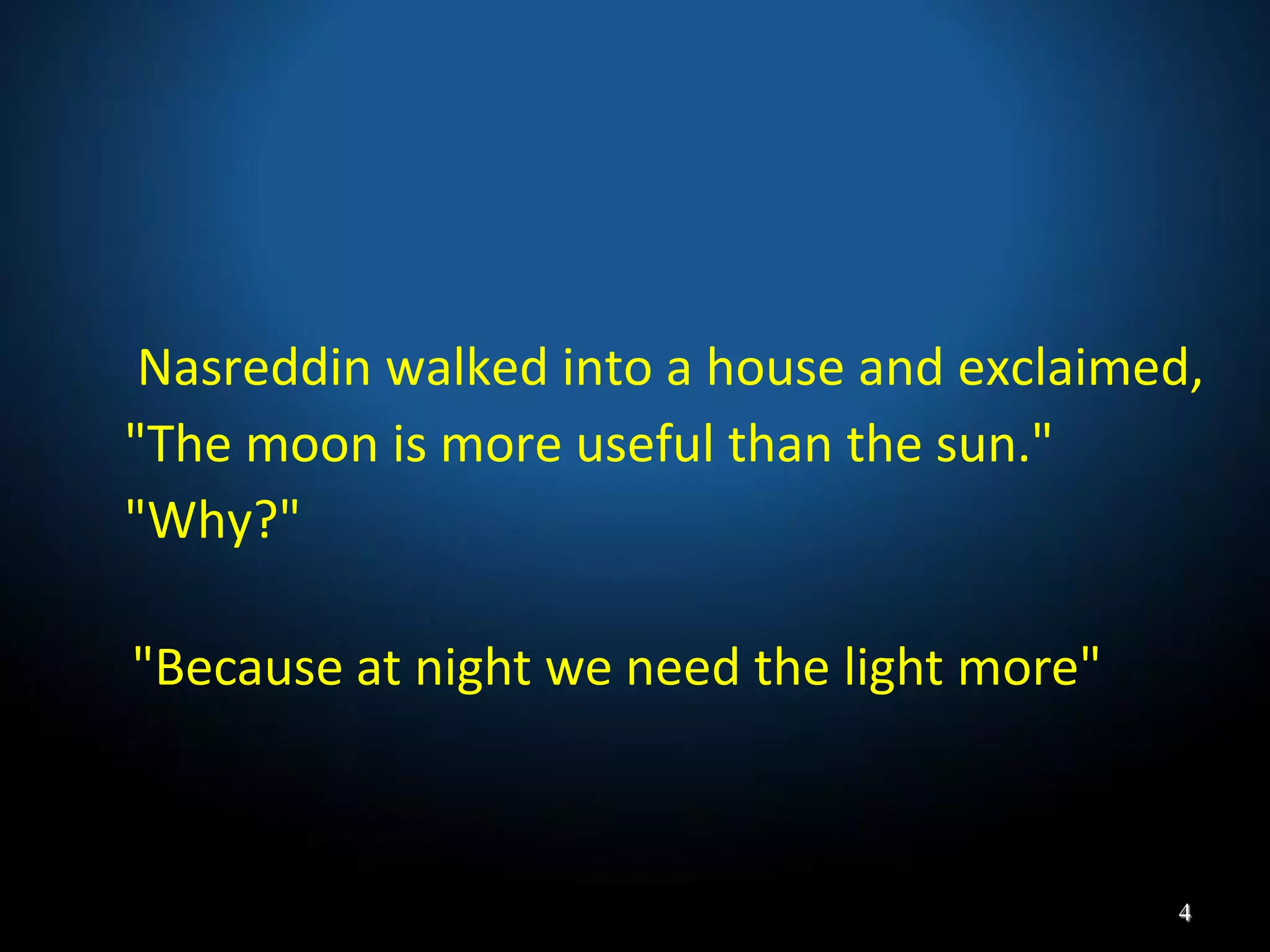
Nasreddin Hodja on
Outcomes of COPD management
Nasreddin walked into a house and exclaimed,
"The moon is more useful than the sun."
"Why?"
"Because at night we need the light more"
4
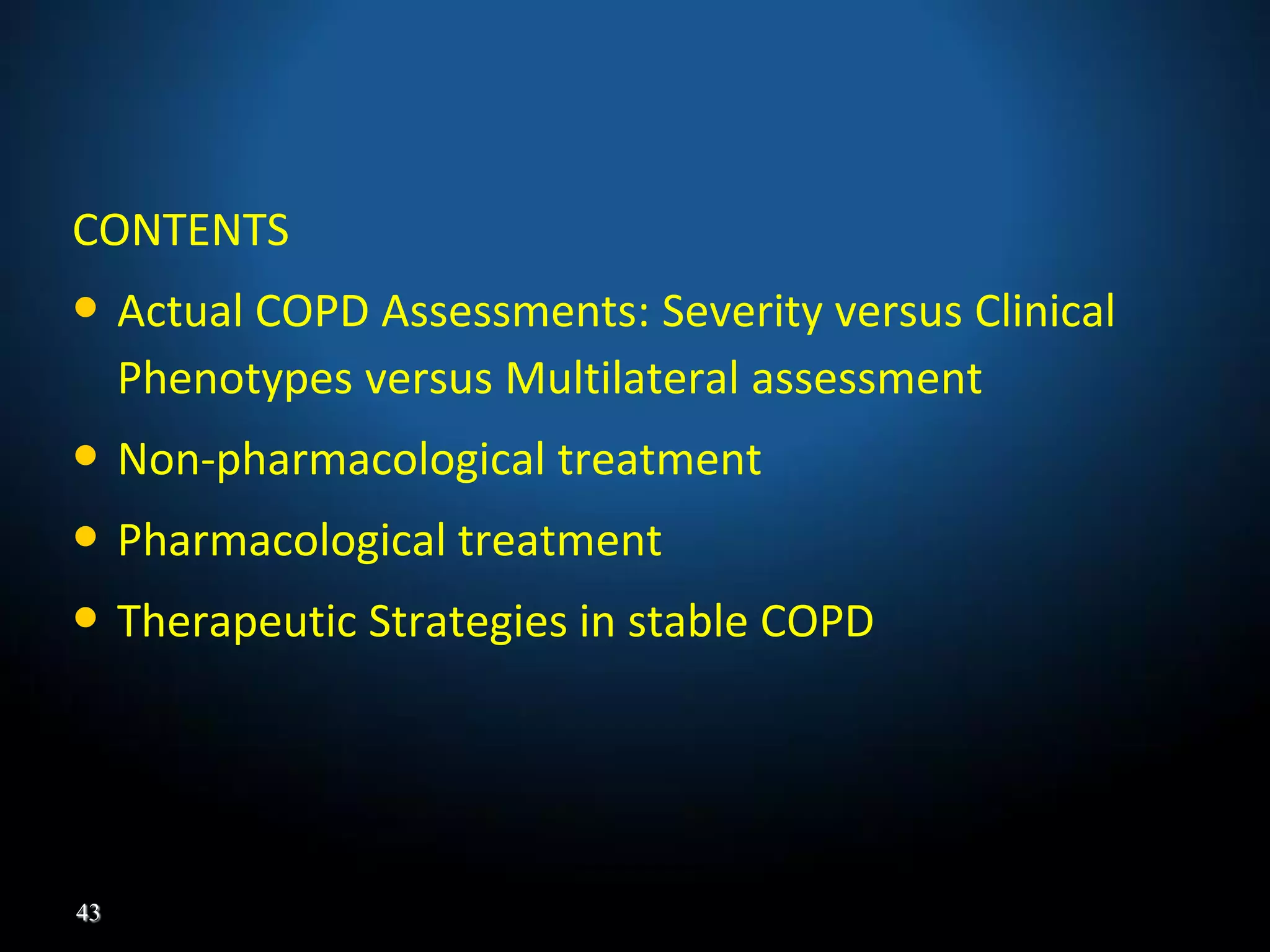
CONTENTS
• Actual COPD Assessments: Severity versus Clinical
Phenotypes versus Multilateral assessment
• Non-pharmacological treatment
• Pharmacological treatment
• Therapeutic Strategies in stable COPD
5
6
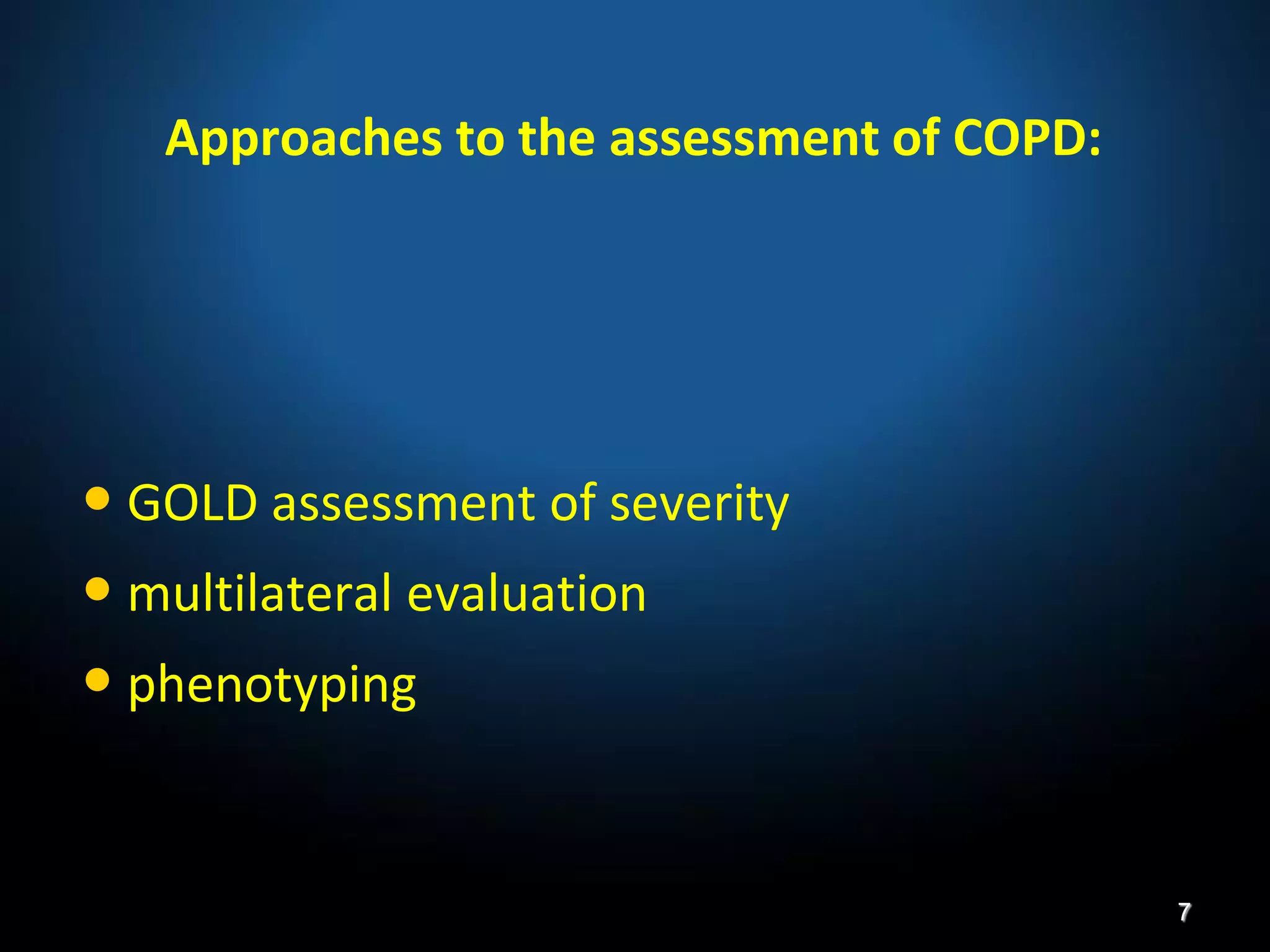
Approaches to the assessment of COPD:
• GOLD assessment of severity
• multilateral evaluation
• phenotyping
7
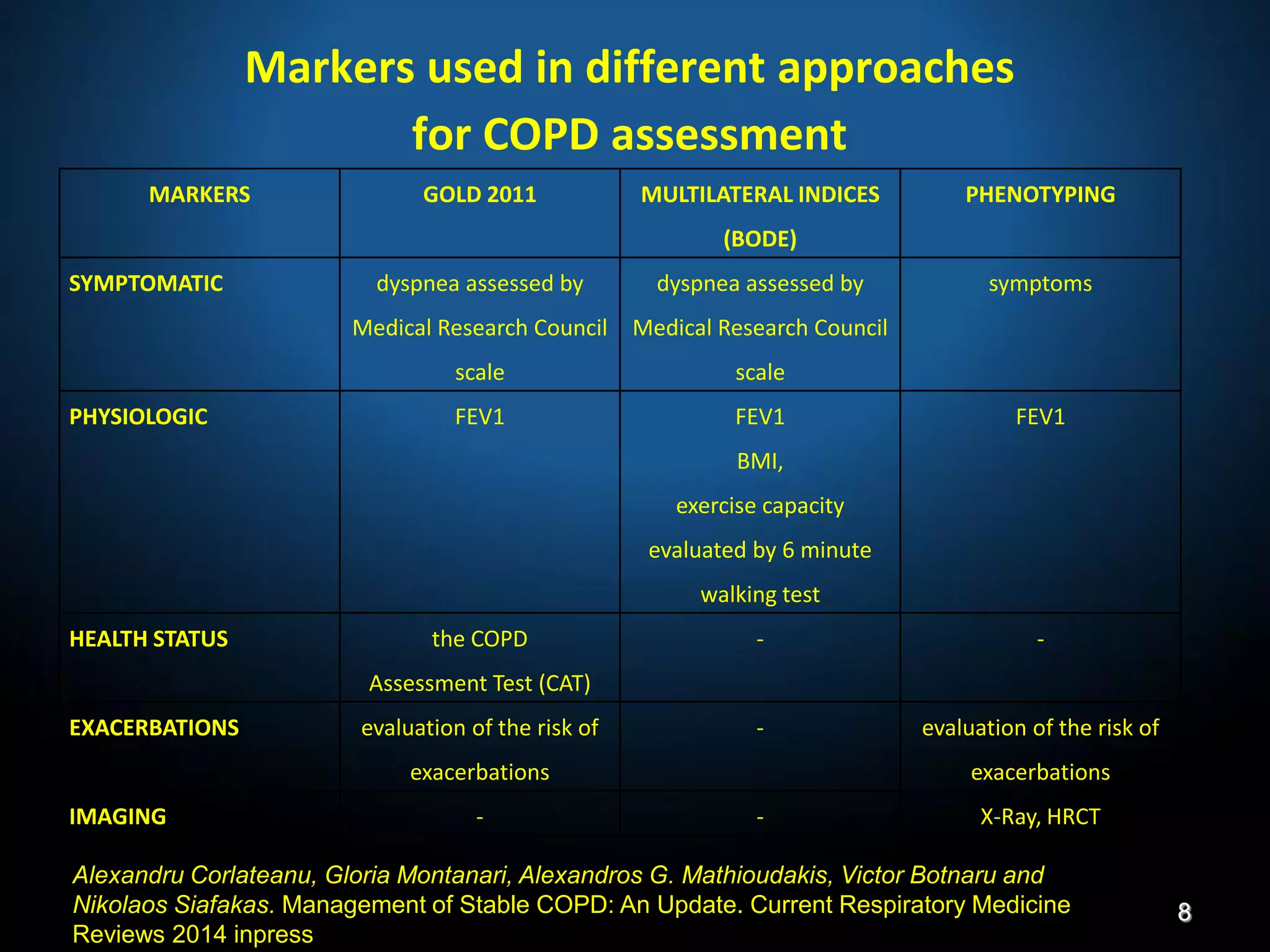
Markers used in different approaches
for COPD assessment
MARKERS GOLD 2011 MULTILATERAL INDICES
(BODE)
PHENOTYPING
SYMPTOMATIC dyspnea assessed by
Medical Research Council
scale
dyspnea assessed by
Medical Research Council
scale
symptoms
PHYSIOLOGIC FEV1 FEV1
BMI,
exercise capacity
evaluated by 6 minute
walking test
FEV1
HEALTH STATUS the COPD
Assessment Test (CAT)
- -
EXACERBATIONS evaluation of the risk of
exacerbations
- evaluation of the risk of
exacerbations
IMAGING - - X-Ray, HRCT
Alexandru Corlateanu, Gloria Montanari, Alexandros G. Mathioudakis, Victor Botnaru and
Nikolaos Siafakas. Management of Stable COPD: An Update. Current Respiratory Medicine
Reviews 2014 inpress
8
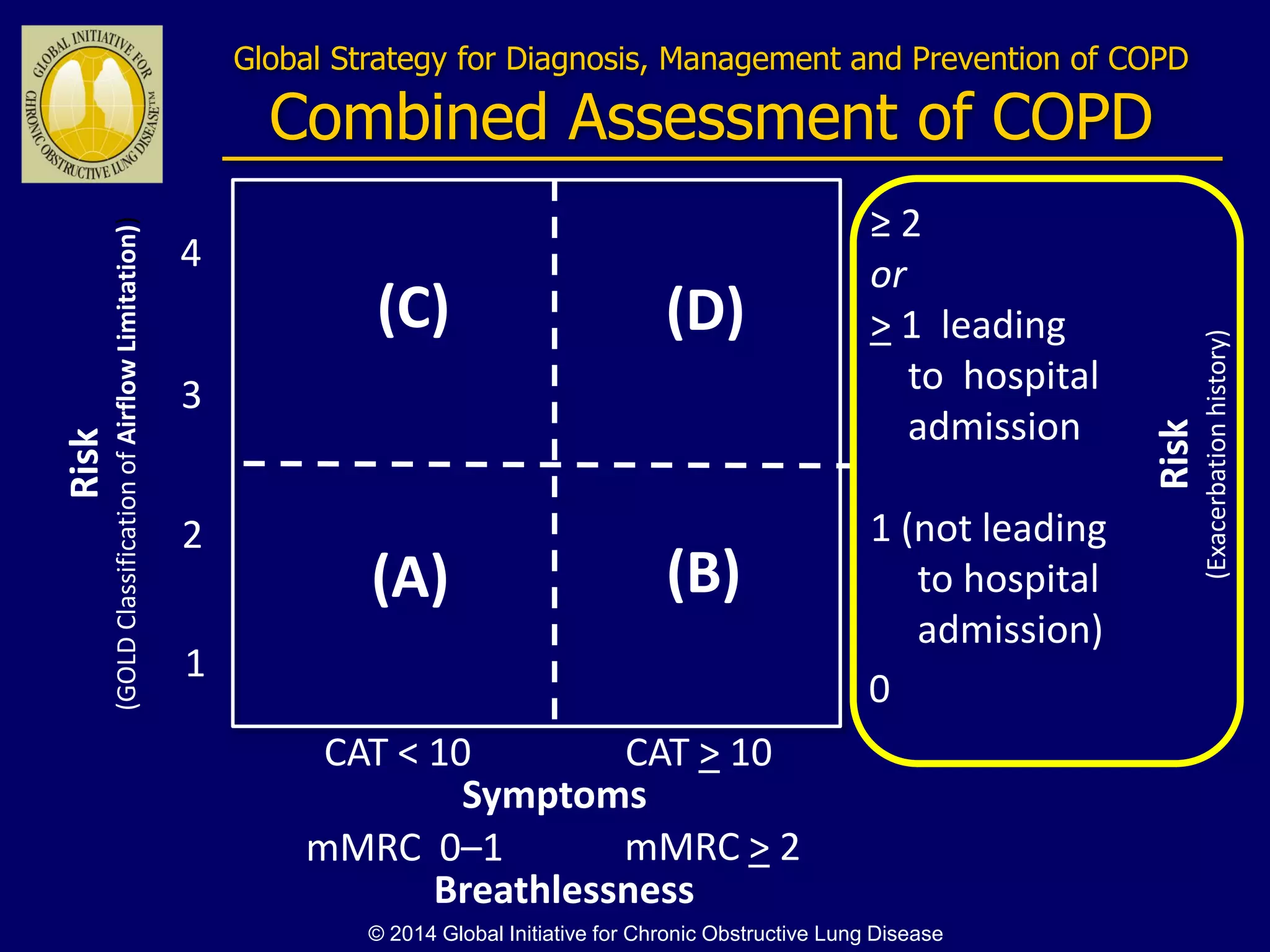
Global Strategy for Diagnosis, Management and Prevention of COPD
Combined Assessment of COPD
© 2014 Global Initiative for Chronic Obstructive Lung Disease
Risk
(GOLDClassificationofAirflowLimitation))
Risk
(Exacerbationhistory)
≥ 2
or
> 1 leading
to hospital
admission
1 (not leading
to hospital
admission)
0
Symptoms
(C) (D)
(A) (B)
CAT < 10
4
3
2
1
CAT > 10
Breathlessness
mMRC 0–1 mMRC > 2
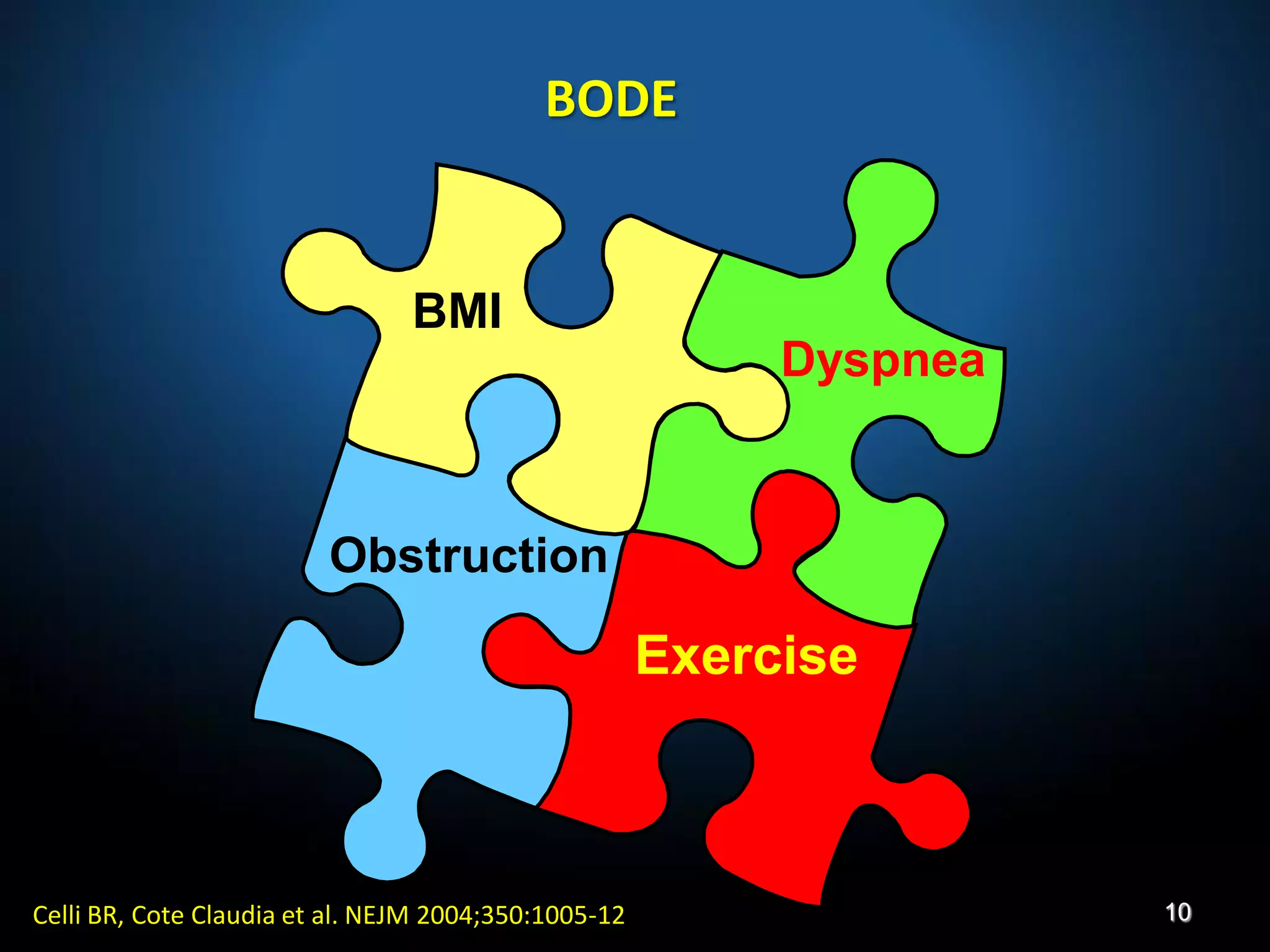
BMI
Obstruction
Dyspnea
Exercise
BODE
Celli BR, Cote Claudia et al. NEJM 2004;350:1005-12 10
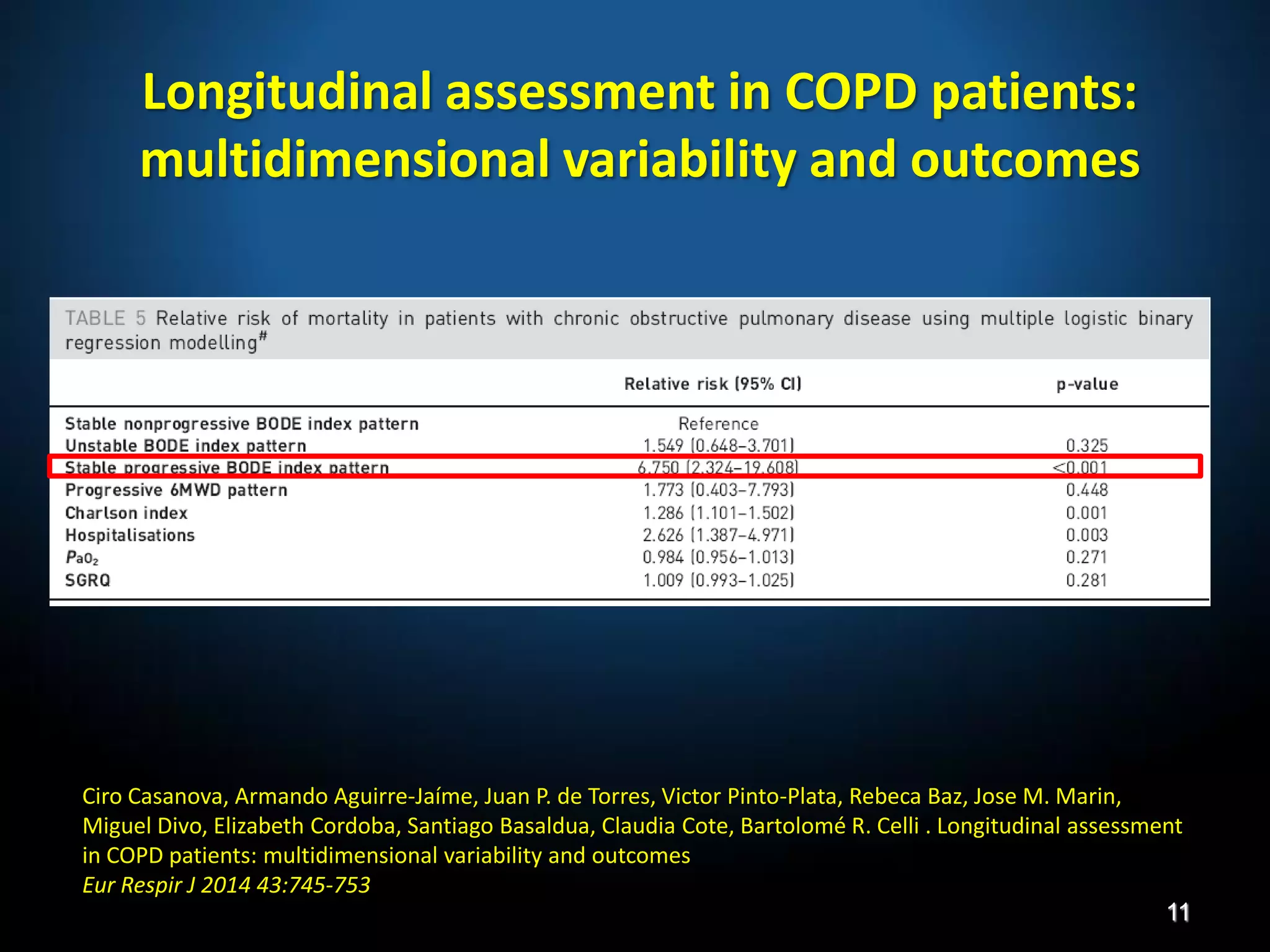
Ciro Casanova, Armando Aguirre-Jaíme, Juan P. de Torres, Victor Pinto-Plata, Rebeca Baz, Jose M. Marin,
Miguel Divo, Elizabeth Cordoba, Santiago Basaldua, Claudia Cote, Bartolomé R. Celli . Longitudinal assessment
in COPD patients: multidimensional variability and outcomes
Eur Respir J 2014 43:745-753
Longitudinal assessment in COPD patients:
multidimensional variability and outcomes
11
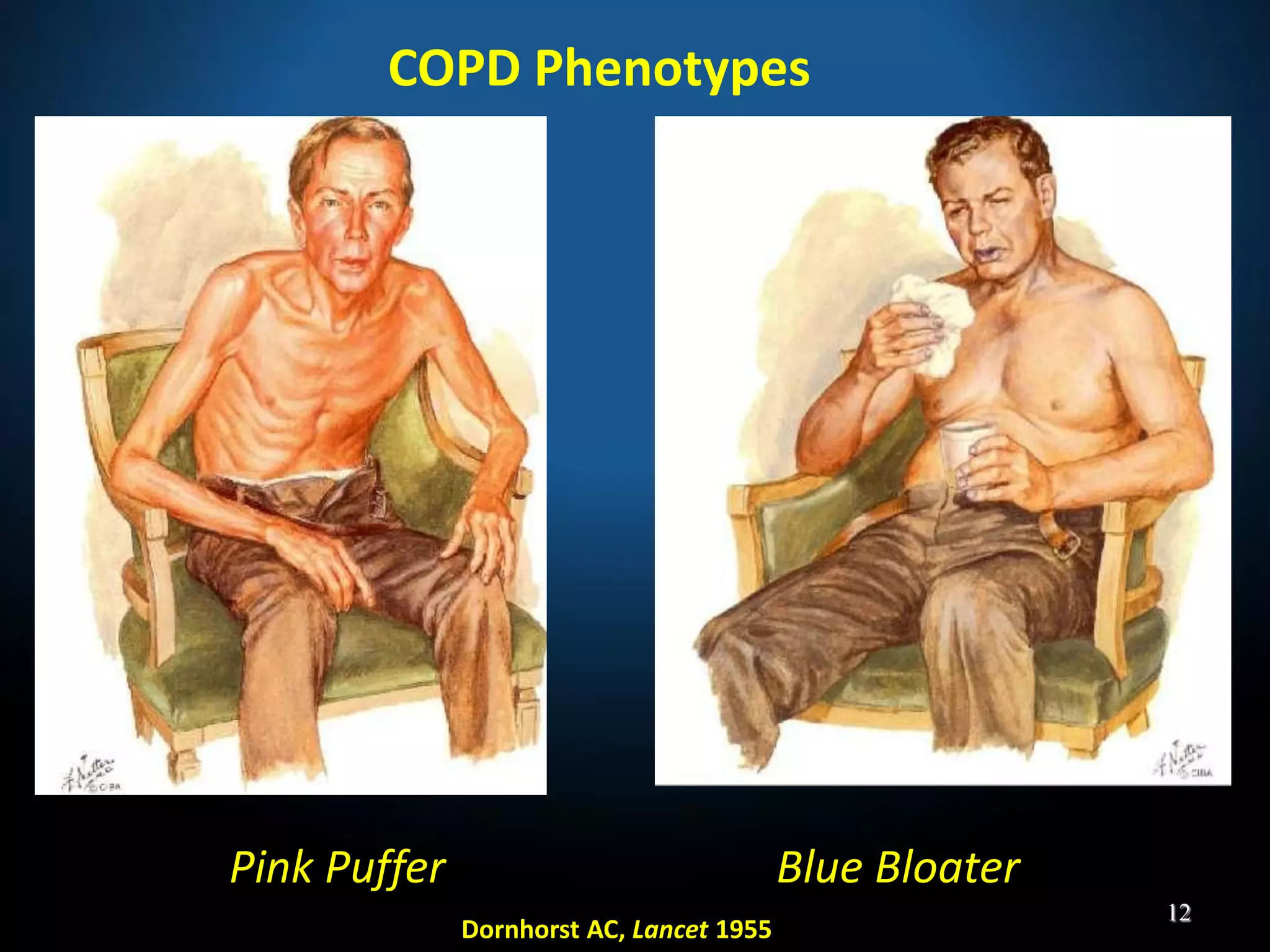
Pink Puffer Blue Bloater
COPD Phenotypes
Dornhorst AC, Lancet 1955
12
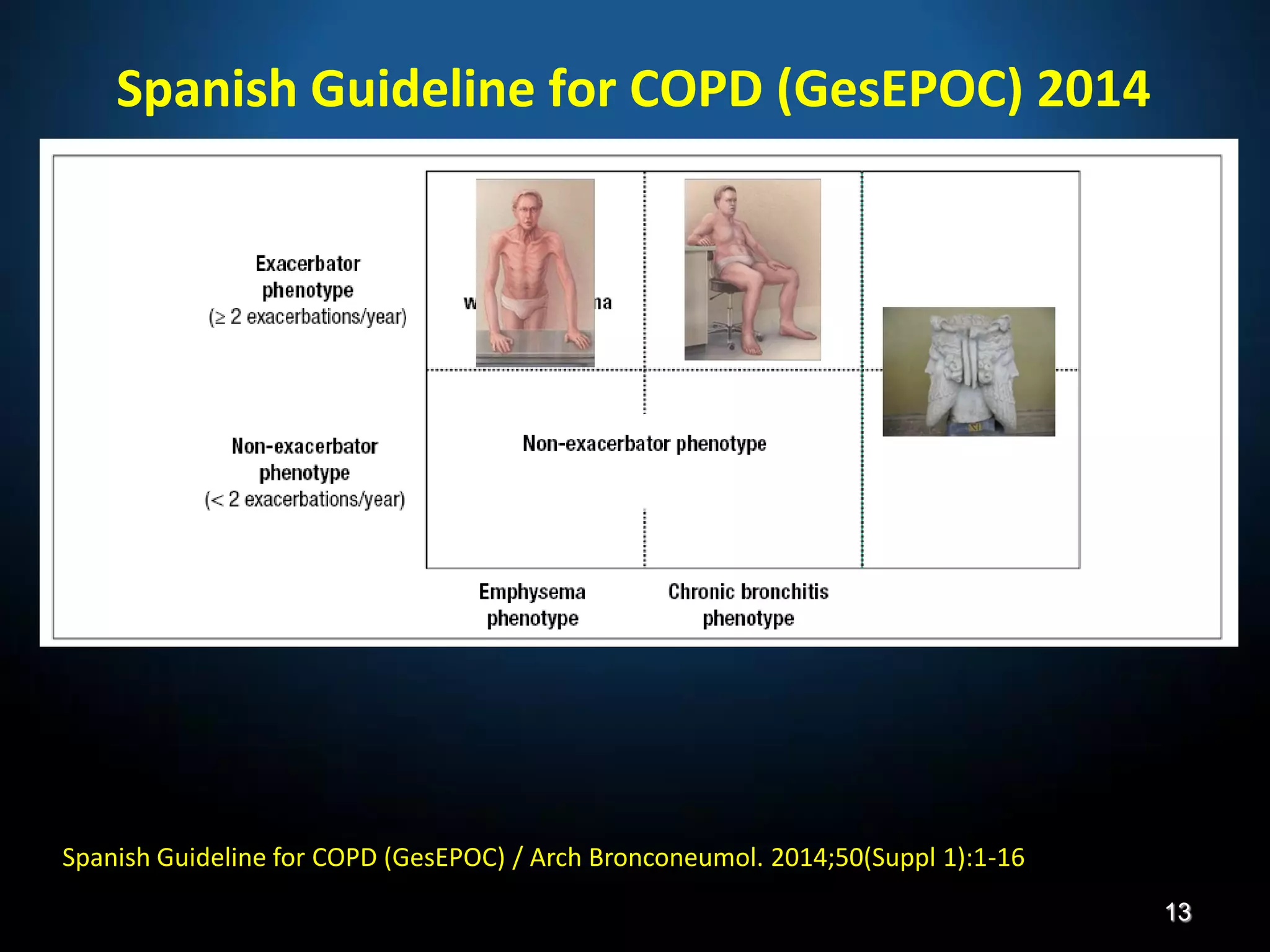
Spanish Guideline for COPD (GesEPOC) 2014
Spanish Guideline for COPD (GesEPOC) / Arch Bronconeumol. 2014;50(Suppl 1):1-16
13
CONTENTS
• Actual COPD Assessments: Severity versus Clinical
Phenotypes versus Multilateral assessment
• Non-pharmacological treatment
• Pharmacological treatment
• Therapeutic Strategies in stable COPD
14
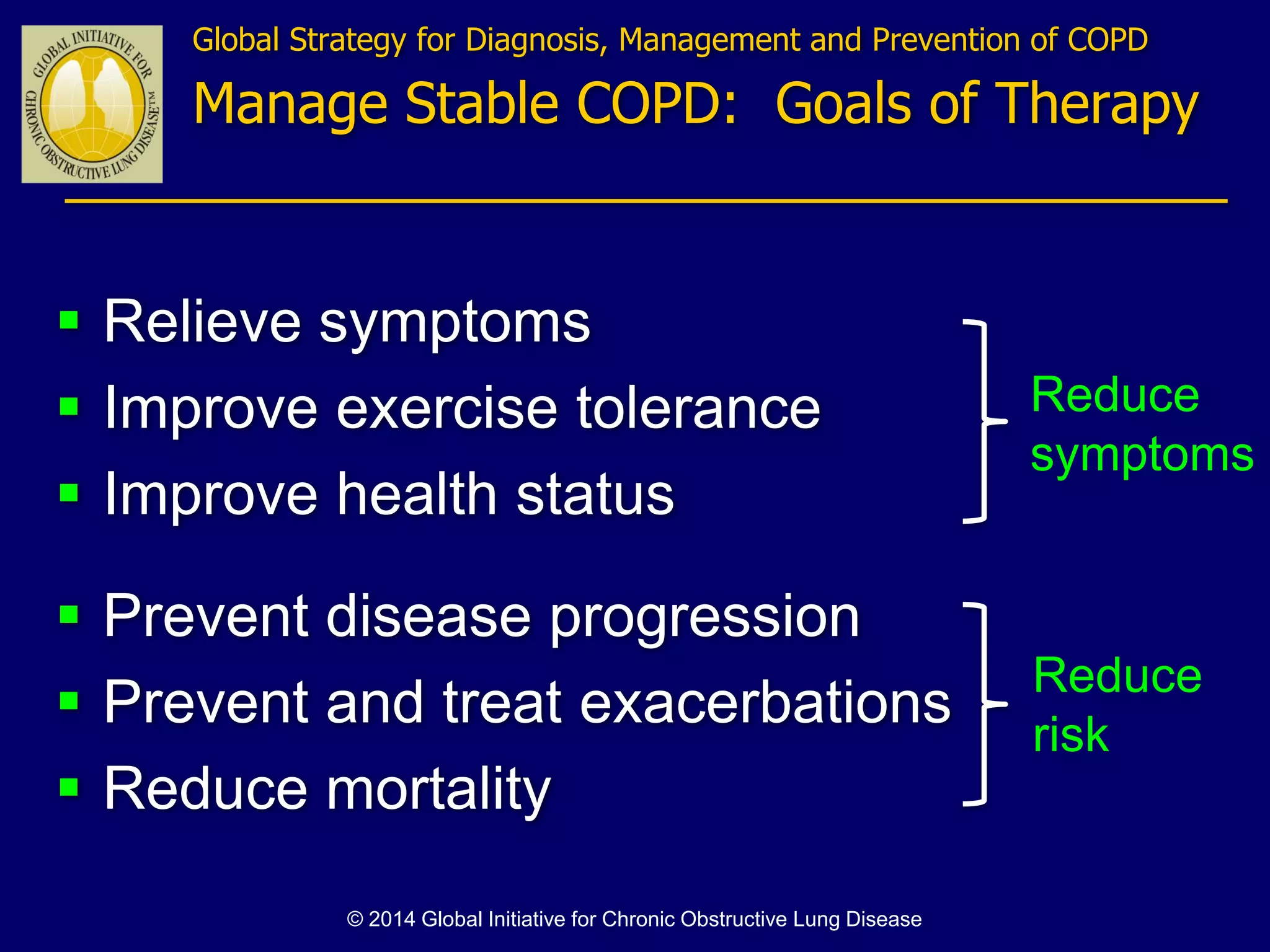
 Relieve symptoms
 Improve exercise tolerance
 Improve health status
 Prevent disease progression
 Prevent and treat exacerbations
 Reduce mortality
Reduce
symptoms
Reduce
risk
Global Strategy for Diagnosis, Management and Prevention of COPD
Manage Stable COPD: Goals of Therapy
© 2014 Global Initiative for Chronic Obstructive Lung Disease
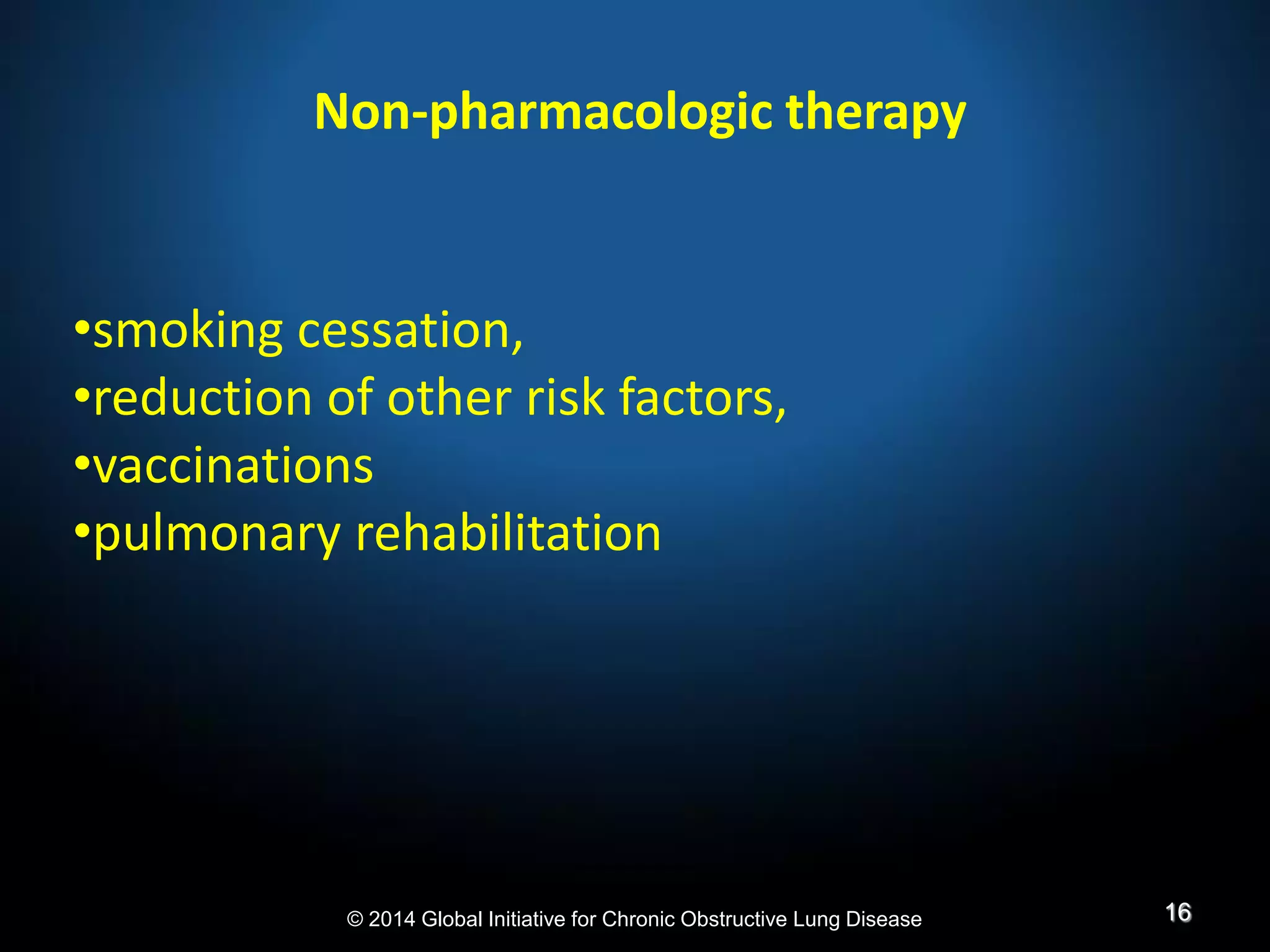
Non-pharmacologic therapy
•smoking cessation,
•reduction of other risk factors,
•vaccinations
•pulmonary rehabilitation
16© 2014 Global Initiative for Chronic Obstructive Lung Disease
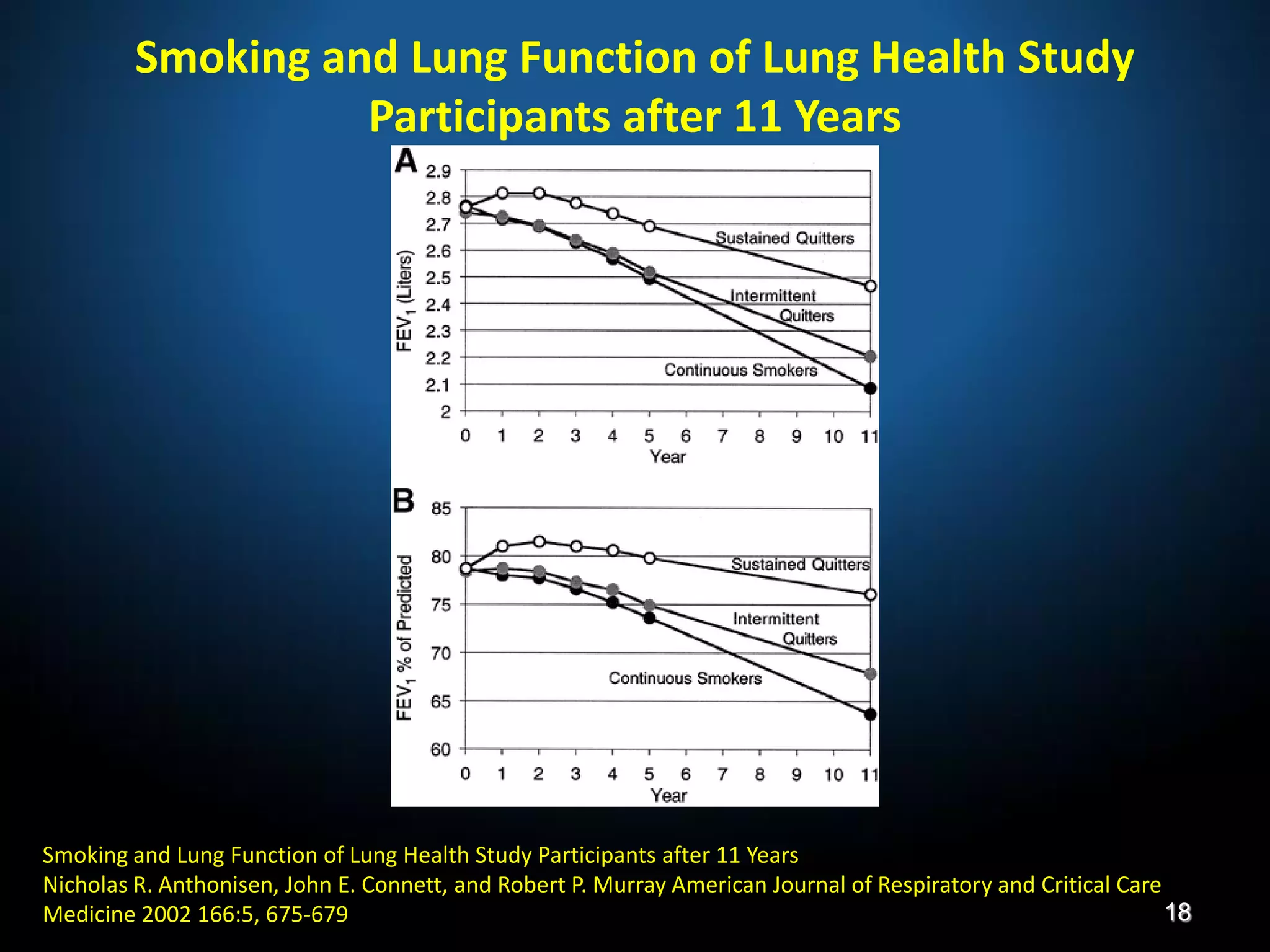
Smoking cessation should be considered the most
important intervention for all COPD patients who smoke
regardless of the level of disease severity
17
Smoking and Lung Function of Lung Health Study Participants after 11 Years
Nicholas R. Anthonisen, John E. Connett, and Robert P. Murray American Journal of Respiratory and Critical Care
Medicine 2002 166:5, 675-679 18
Smoking and Lung Function of Lung Health Study
Participants after 11 Years
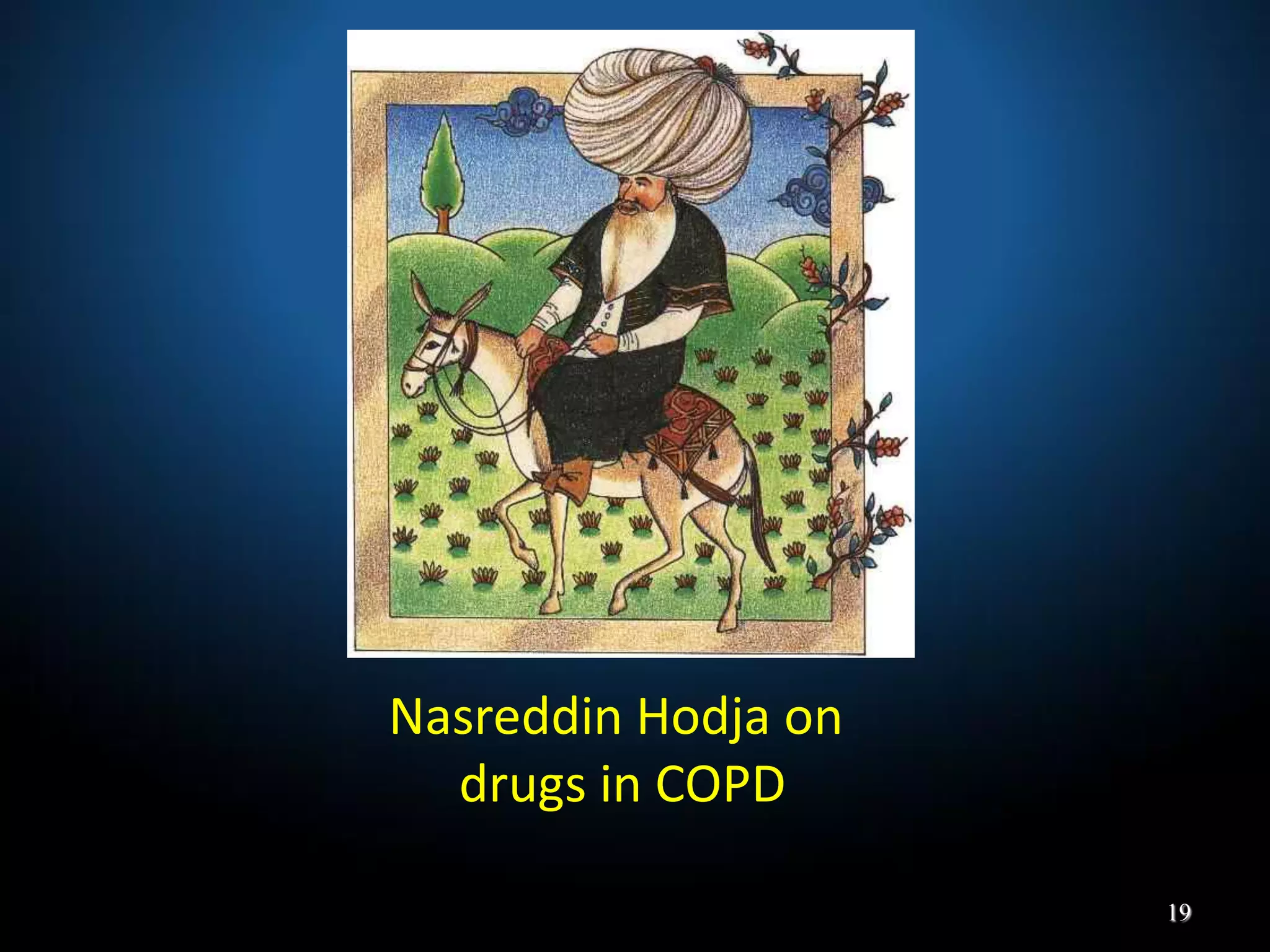
Nasreddin Hodja on
drugs in COPD
19
Some children saw Nasreddin coming from the vineyard with
two baskets full of grapes loaded on his donkey. They gathered
around him and asked him to give them a taste. Nasreddin
picked up a bunch of grapes and gave each child a grape. "You
have so much, but you gave us so little," the children whined.
20
"There is no difference whether you have a basketful or a
small piece. They all taste the same," Nasreddin answered,
and continued on his way.
Long-acting Bronchodilators
Long-acting β2-agonists
21
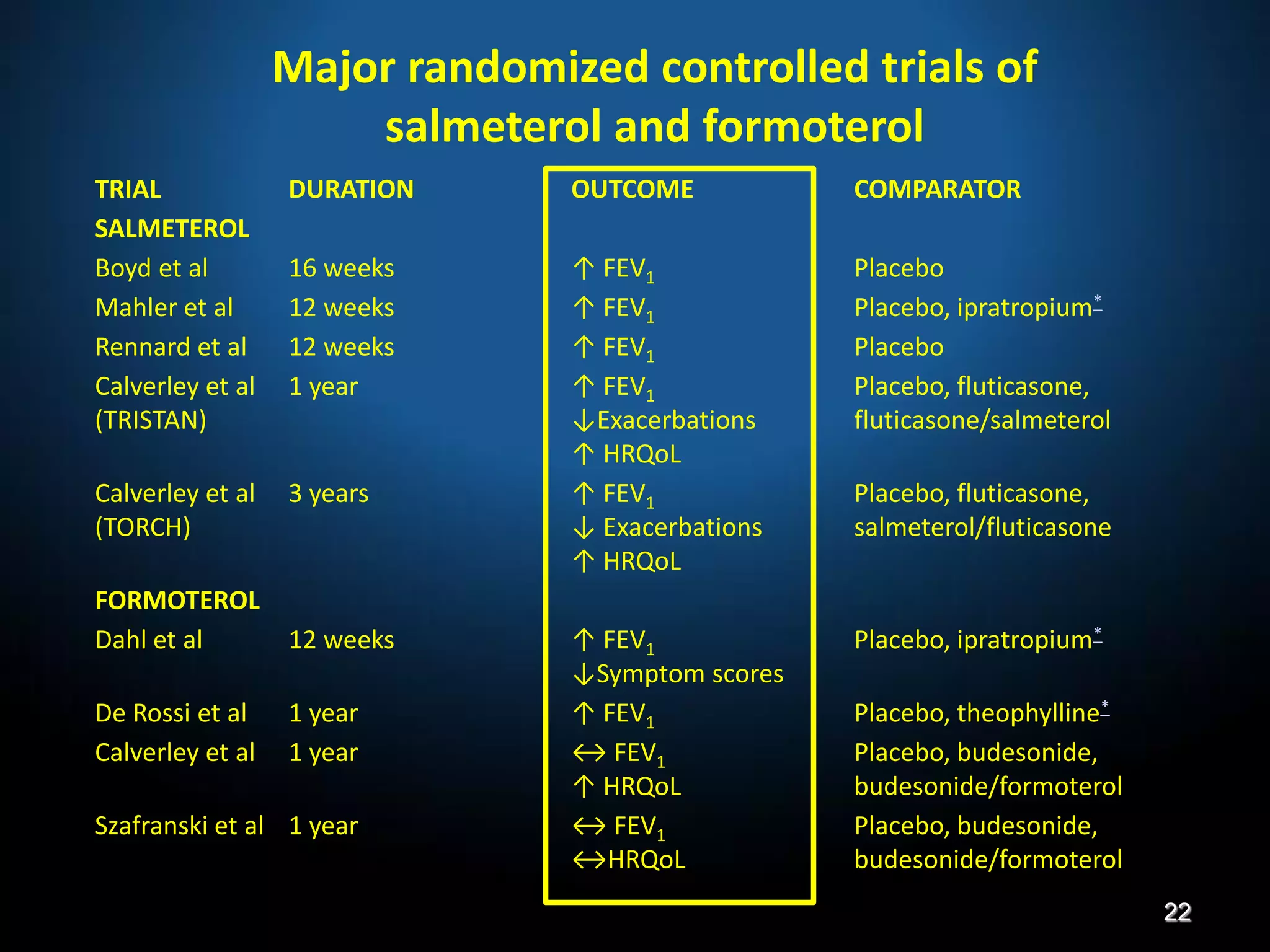
TRIAL DURATION OUTCOME COMPARATOR
SALMETEROL
Boyd et al 16 weeks ↑ FEV1 Placebo
Mahler et al 12 weeks ↑ FEV1 Placebo, ipratropium*
Rennard et al 12 weeks ↑ FEV1 Placebo
Calverley et al
(TRISTAN)
1 year ↑ FEV1
↓Exacerbations
↑ HRQoL
Placebo, fluticasone,
fluticasone/salmeterol
Calverley et al
(TORCH)
3 years ↑ FEV1
↓ Exacerbations
↑ HRQoL
Placebo, fluticasone,
salmeterol/fluticasone
FORMOTEROL
Dahl et al 12 weeks ↑ FEV1
↓Symptom scores
Placebo, ipratropium*
De Rossi et al 1 year ↑ FEV1 Placebo, theophylline*
Calverley et al 1 year ↔ FEV1
↑ HRQoL
Placebo, budesonide,
budesonide/formoterol
Szafranski et al 1 year ↔ FEV1
↔HRQoL
Placebo, budesonide,
budesonide/formoterol
Major randomized controlled trials of
salmeterol and formoterol
22
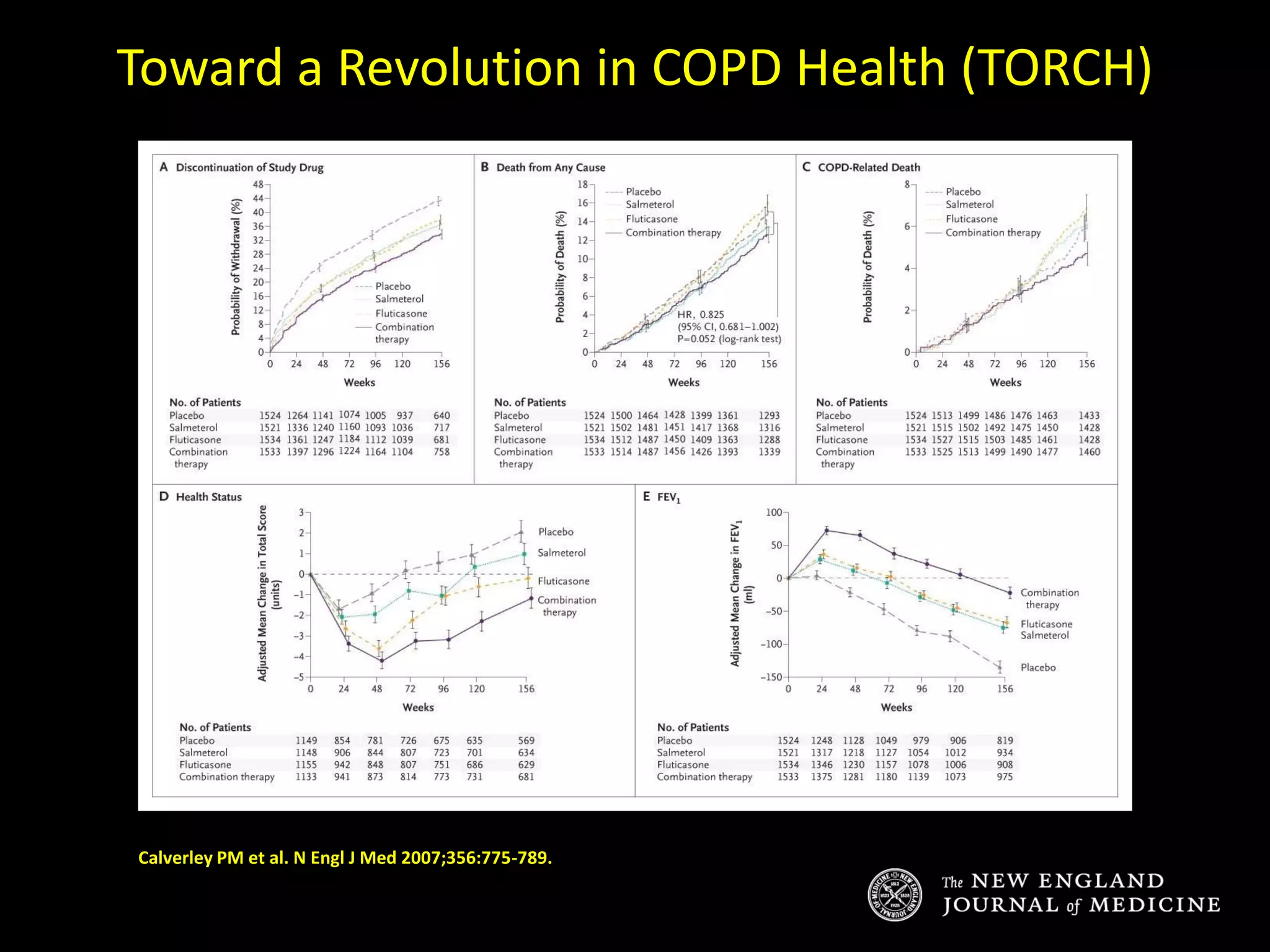
Toward a Revolution in COPD Health (TORCH)
Calverley PM et al. N Engl J Med 2007;356:775-789.
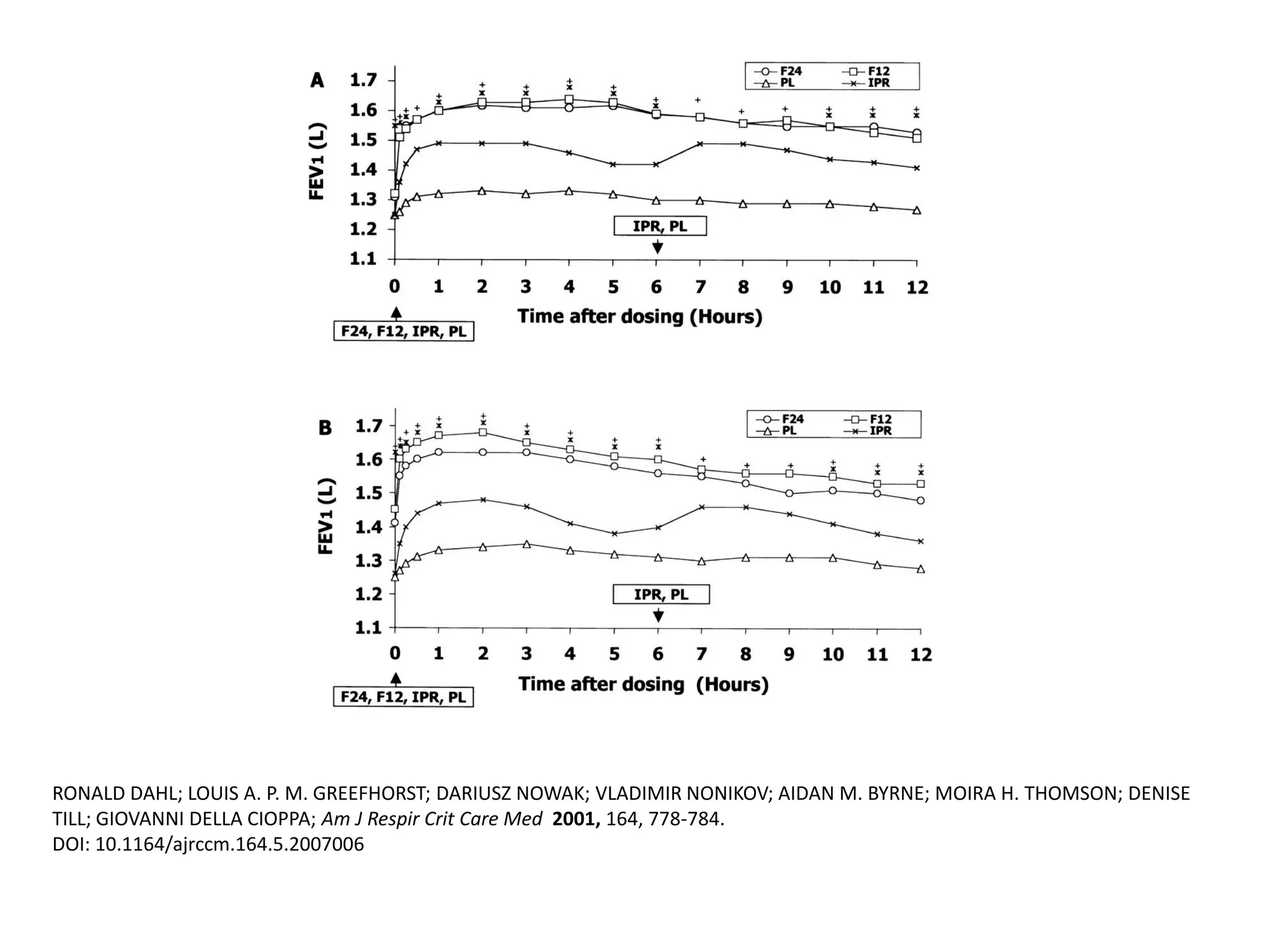
RONALD DAHL; LOUIS A. P. M. GREEFHORST; DARIUSZ NOWAK; VLADIMIR NONIKOV; AIDAN M. BYRNE; MOIRA H. THOMSON; DENISE
TILL; GIOVANNI DELLA CIOPPA; Am J Respir Crit Care Med 2001, 164, 778-784.
DOI: 10.1164/ajrccm.164.5.2007006
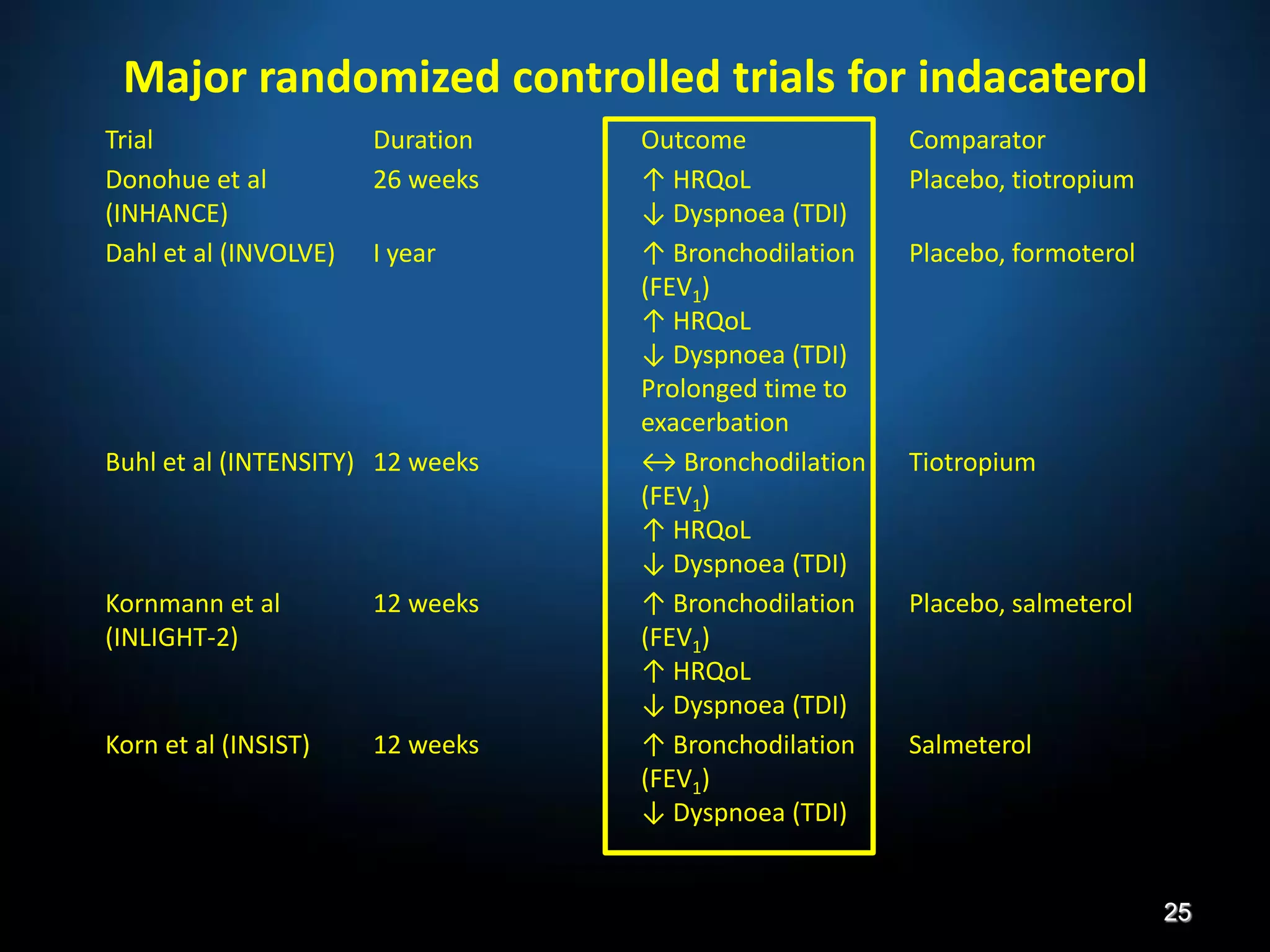
Trial Duration Outcome Comparator
Donohue et al
(INHANCE)
26 weeks ↑ HRQoL
↓ Dyspnoea (TDI)
Placebo, tiotropium
Dahl et al (INVOLVE) I year ↑ Bronchodilation
(FEV1)
↑ HRQoL
↓ Dyspnoea (TDI)
Prolonged time to
exacerbation
Placebo, formoterol
Buhl et al (INTENSITY) 12 weeks ↔ Bronchodilation
(FEV1)
↑ HRQoL
↓ Dyspnoea (TDI)
Tiotropium
Kornmann et al
(INLIGHT-2)
12 weeks ↑ Bronchodilation
(FEV1)
↑ HRQoL
↓ Dyspnoea (TDI)
Placebo, salmeterol
Korn et al (INSIST) 12 weeks ↑ Bronchodilation
(FEV1)
↓ Dyspnoea (TDI)
Salmeterol
Major randomized controlled trials for indacaterol
25
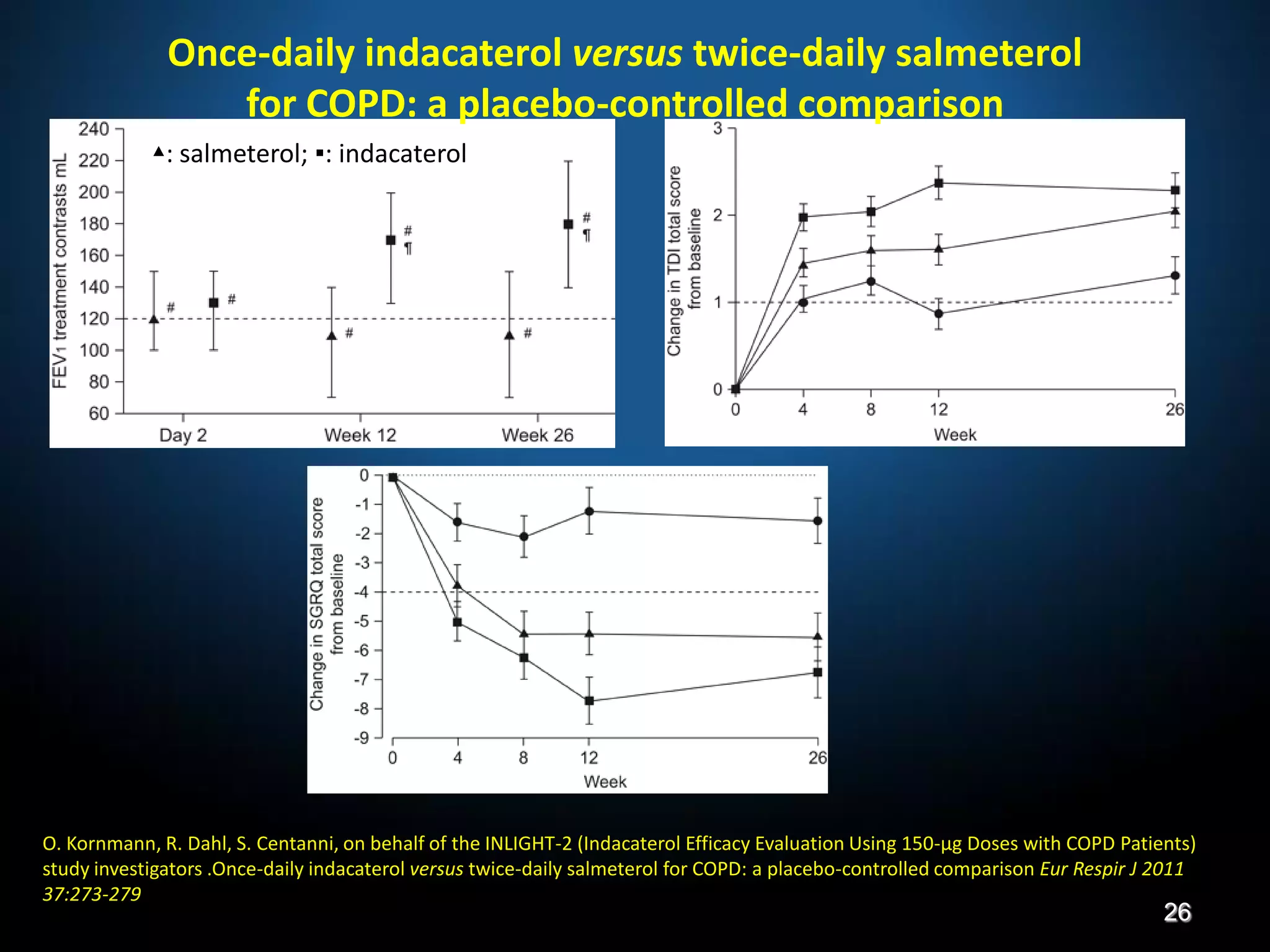
Once-daily indacaterol versus twice-daily salmeterol
for COPD: a placebo-controlled comparison
O. Kornmann, R. Dahl, S. Centanni, on behalf of the INLIGHT-2 (Indacaterol Efficacy Evaluation Using 150-μg Doses with COPD Patients)
study investigators .Once-daily indacaterol versus twice-daily salmeterol for COPD: a placebo-controlled comparison Eur Respir J 2011
37:273-279
26
▴: salmeterol; ▪: indacaterol
Long-acting Bronchodilators
Long-acting muscarinic antagonists
27
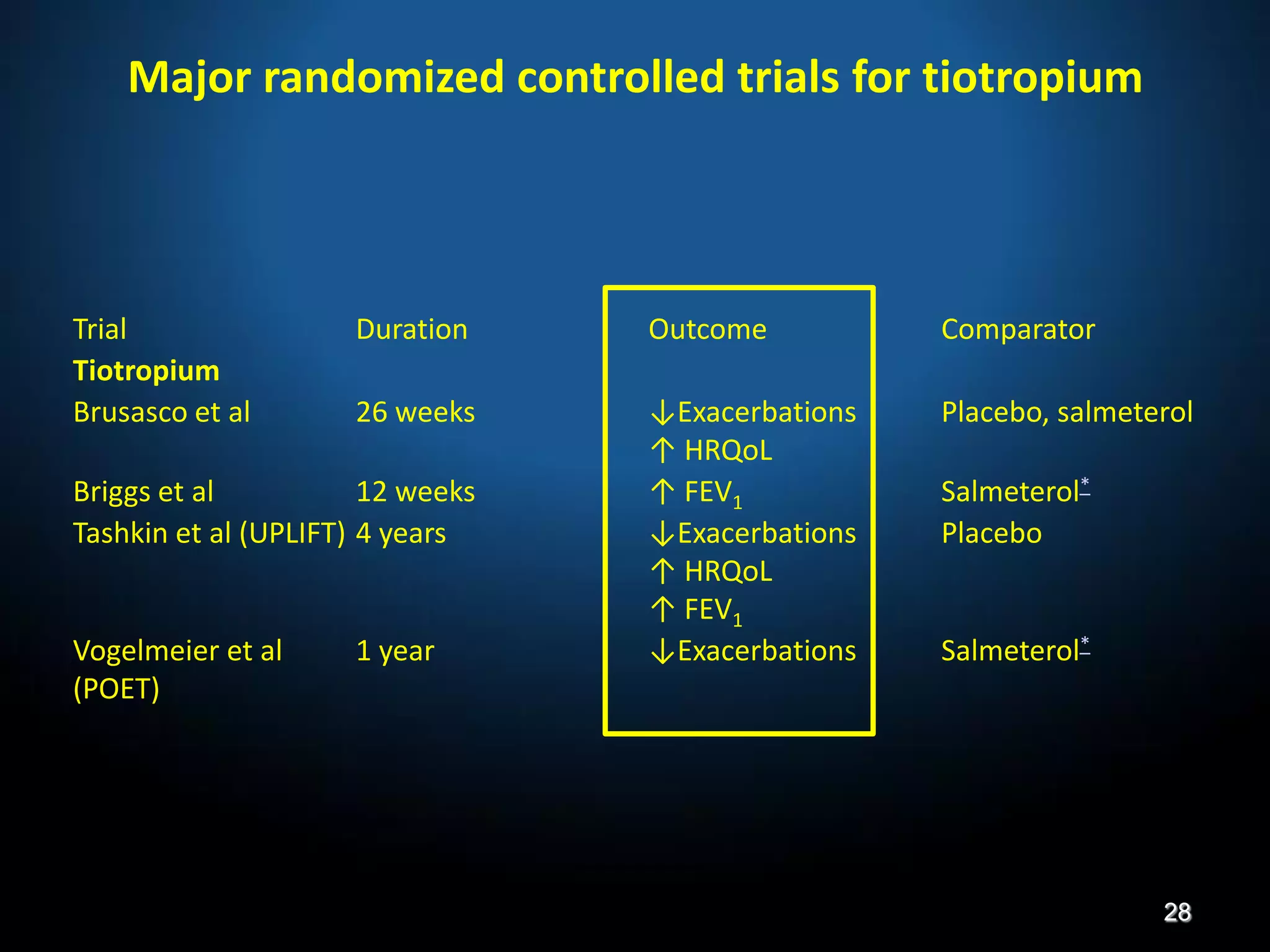
Trial Duration Outcome Comparator
Tiotropium
Brusasco et al 26 weeks ↓Exacerbations
↑ HRQoL
Placebo, salmeterol
Briggs et al 12 weeks ↑ FEV1 Salmeterol*
Tashkin et al (UPLIFT) 4 years ↓Exacerbations
↑ HRQoL
↑ FEV1
Placebo
Vogelmeier et al
(POET)
1 year ↓Exacerbations Salmeterol*
Major randomized controlled trials for tiotropium
28
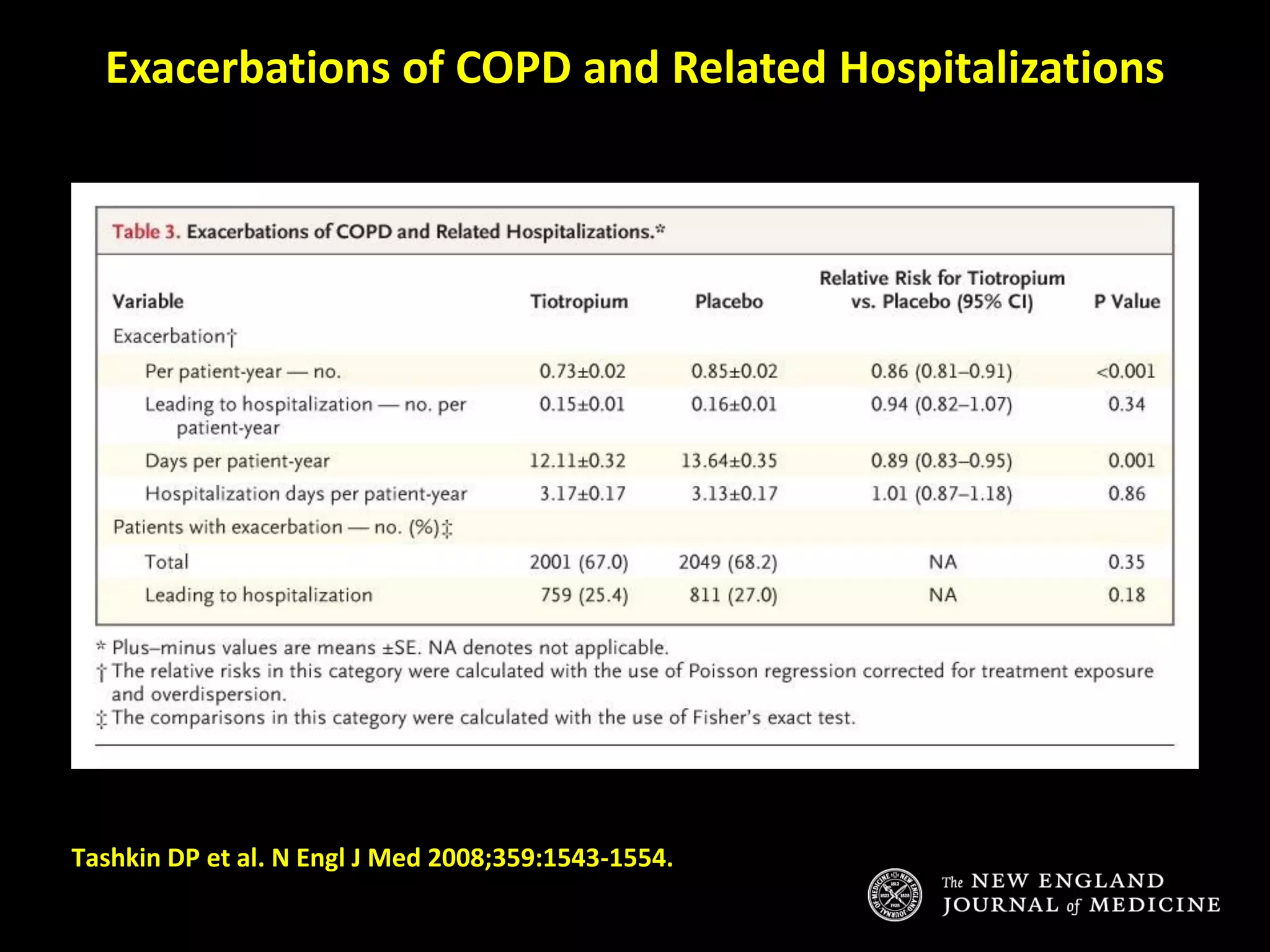
Exacerbations of COPD and Related Hospitalizations
Tashkin DP et al. N Engl J Med 2008;359:1543-1554.
Aclidinium
Jones et al(ACCLAIM
I and II)
1 year ↑ Trough FEV1
↑ HRQoL
Placebo
Jones et al(ATTAIN) 6 months ↑ FEV1
↑ HRQoL
↓ Dyspnoea (TDI)
Placebo
Kerwin et al
(ACCORD)
12 weeks ↑ FEV1
↑ HRQoL
↓ Dyspnoea (TDI)
Placebo
Fuhr et al 15 days per
treatment
Similar to ACCORD v
placebo
↑ Morning FEV1 v
tiotropium
Placebo, tiotropium
Major randomized controlled trials for aclidinium
30
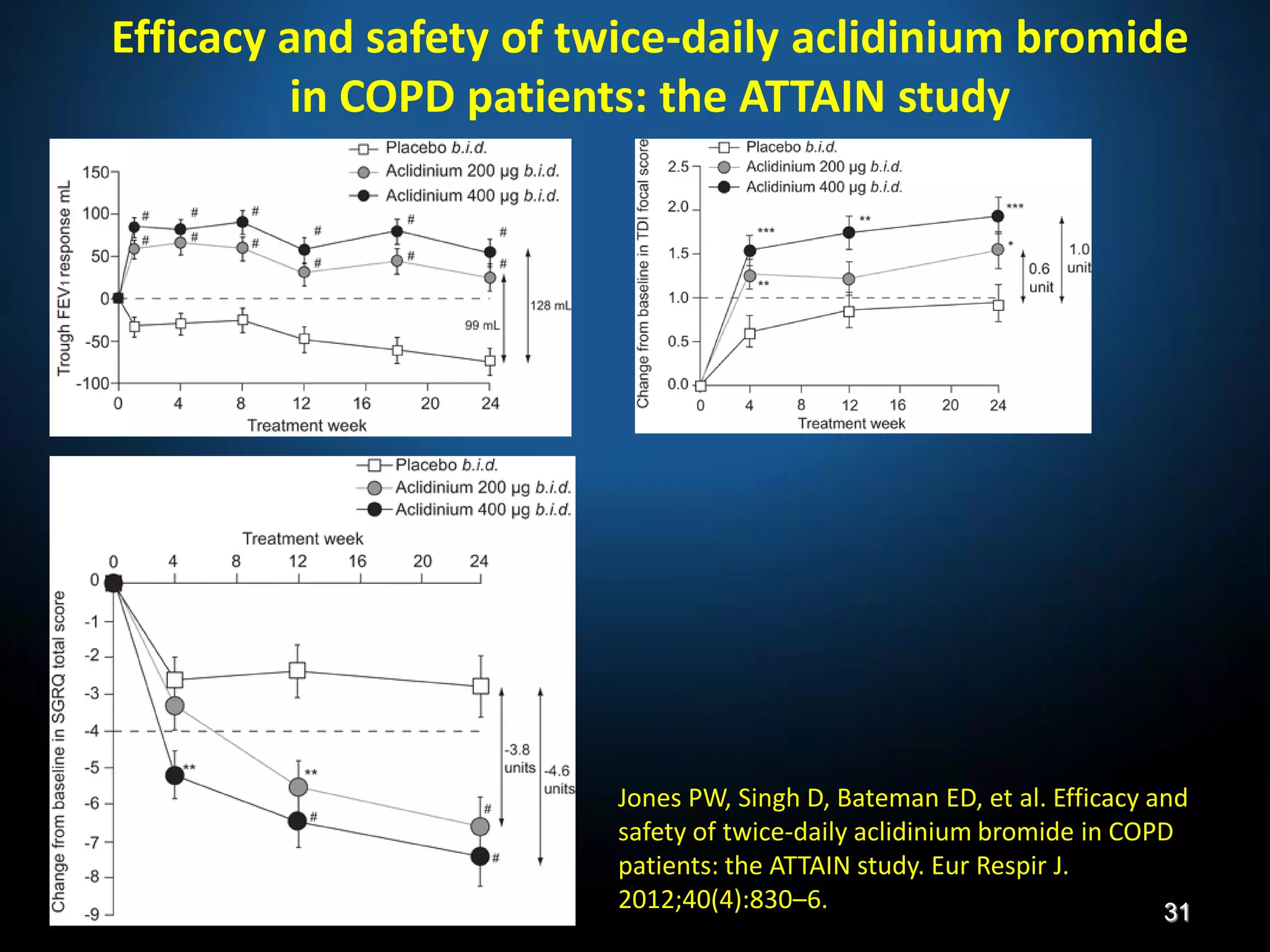
Efficacy and safety of twice-daily aclidinium bromide
in COPD patients: the ATTAIN study
Jones PW, Singh D, Bateman ED, et al. Efficacy and
safety of twice-daily aclidinium bromide in COPD
patients: the ATTAIN study. Eur Respir J.
2012;40(4):830–6. 31
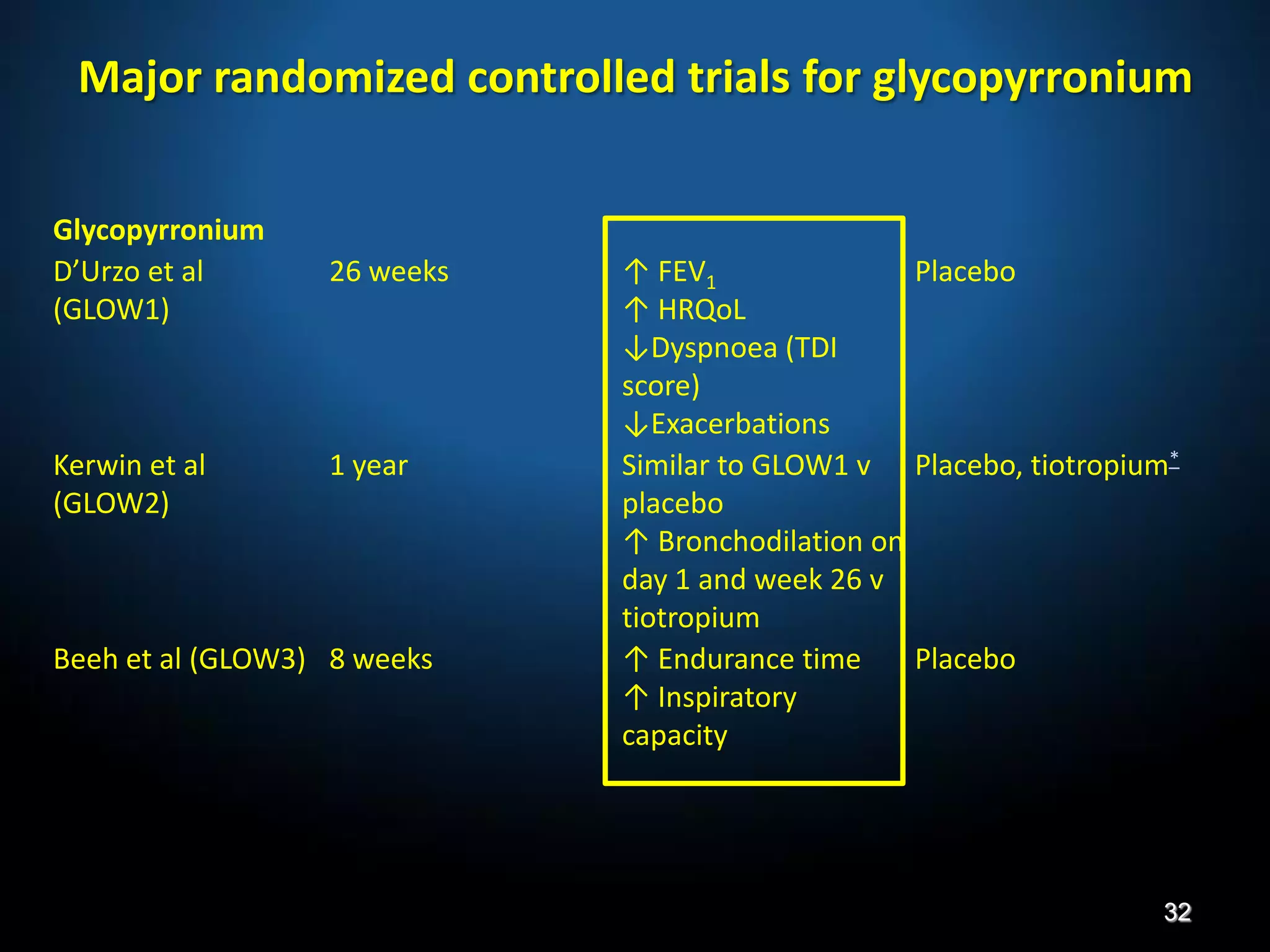
Glycopyrronium
D’Urzo et al
(GLOW1)
26 weeks ↑ FEV1
↑ HRQoL
↓Dyspnoea (TDI
score)
↓Exacerbations
Placebo
Kerwin et al
(GLOW2)
1 year Similar to GLOW1 v
placebo
↑ Bronchodilation on
day 1 and week 26 v
tiotropium
Placebo, tiotropium*
Beeh et al (GLOW3) 8 weeks ↑ Endurance time
↑ Inspiratory
capacity
Placebo
Major randomized controlled trials for glycopyrronium
32
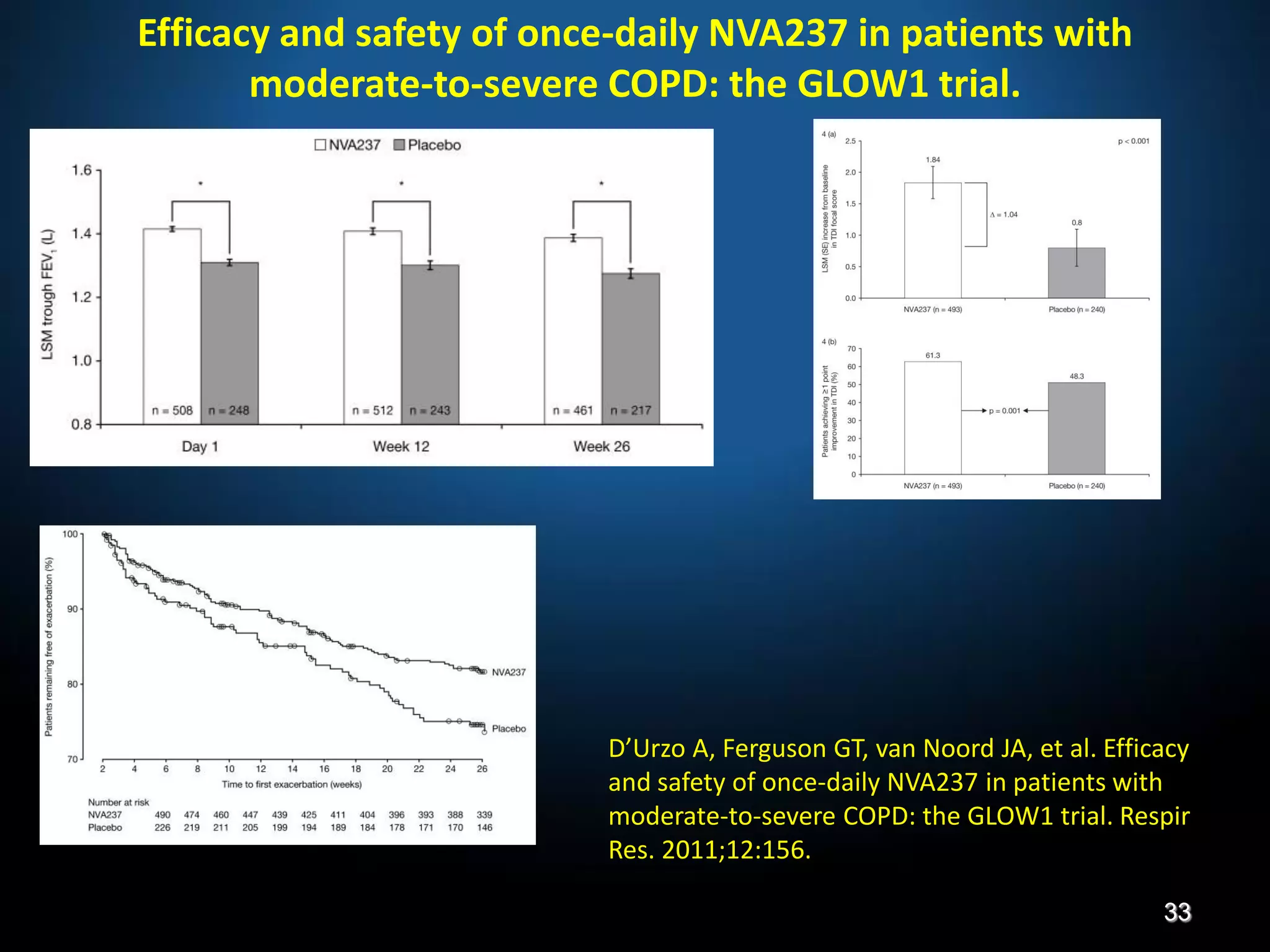
Efficacy and safety of once-daily NVA237 in patients with
moderate-to-severe COPD: the GLOW1 trial.
D’Urzo A, Ferguson GT, van Noord JA, et al. Efficacy
and safety of once-daily NVA237 in patients with
moderate-to-severe COPD: the GLOW1 trial. Respir
Res. 2011;12:156.
33
Inhaled Corticosteroids
34
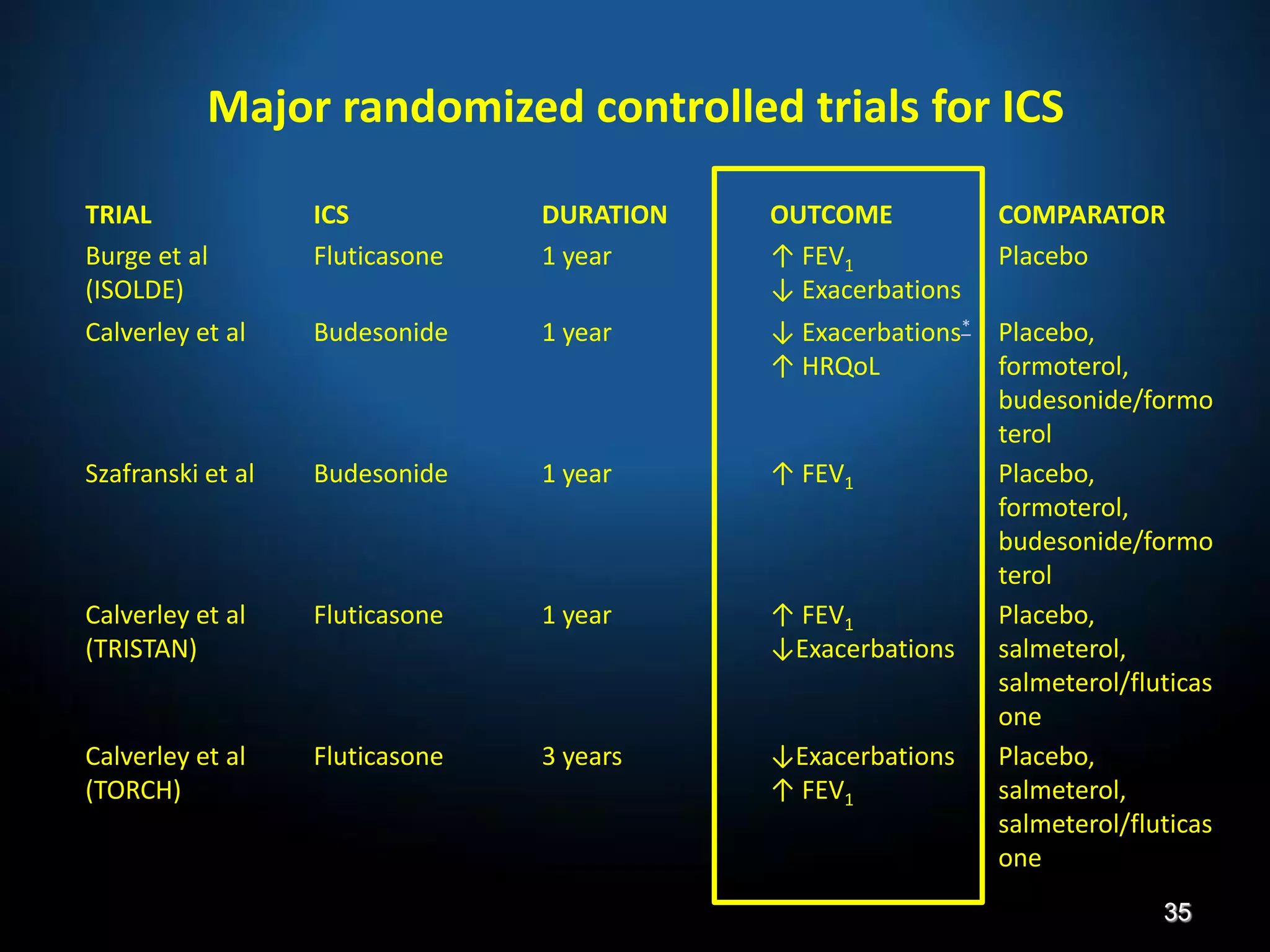
TRIAL ICS DURATION OUTCOME COMPARATOR
Burge et al
(ISOLDE)
Fluticasone 1 year ↑ FEV1
↓ Exacerbations
Placebo
Calverley et al Budesonide 1 year ↓ Exacerbations*
↑ HRQoL
Placebo,
formoterol,
budesonide/formo
terol
Szafranski et al Budesonide 1 year ↑ FEV1 Placebo,
formoterol,
budesonide/formo
terol
Calverley et al
(TRISTAN)
Fluticasone 1 year ↑ FEV1
↓Exacerbations
Placebo,
salmeterol,
salmeterol/fluticas
one
Calverley et al
(TORCH)
Fluticasone 3 years ↓Exacerbations
↑ FEV1
Placebo,
salmeterol,
salmeterol/fluticas
one
Major randomized controlled trials for ICS
35
36
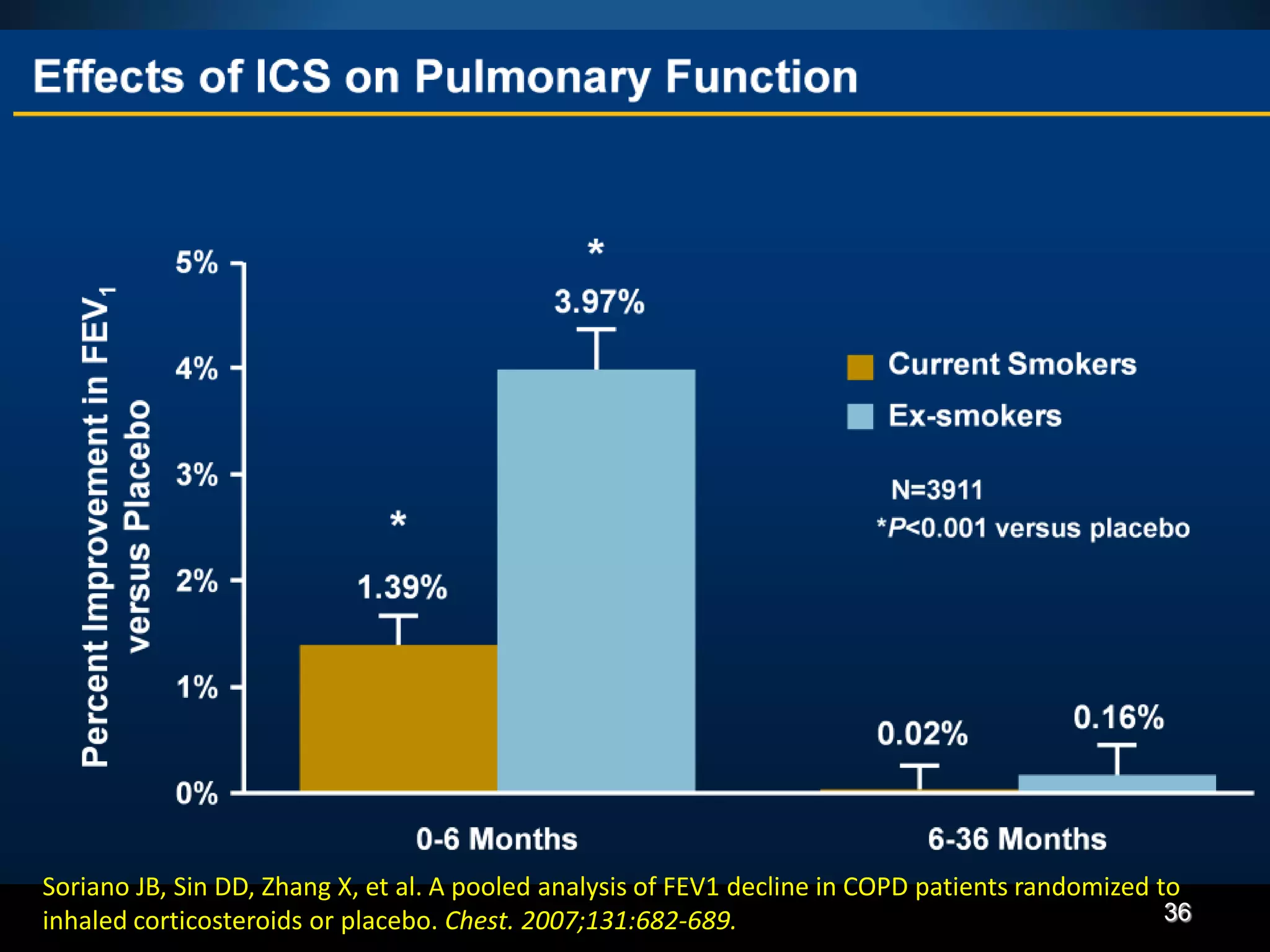
Soriano JB, Sin DD, Zhang X, et al. A pooled analysis of FEV1 decline in COPD patients randomized to
inhaled corticosteroids or placebo. Chest. 2007;131:682-689.
Bronchodilators plus inhaled glucocorticoids
37
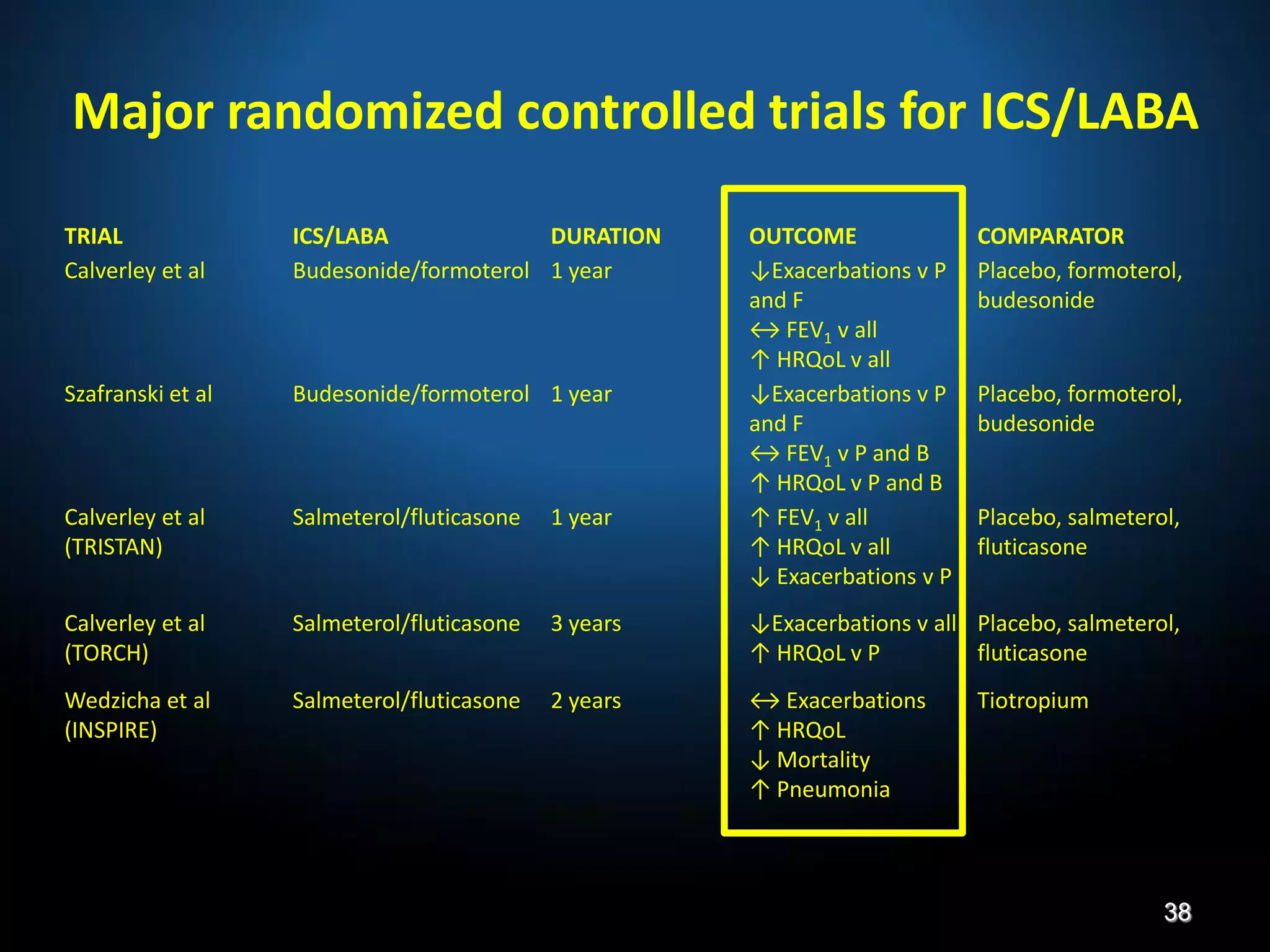
TRIAL ICS/LABA DURATION OUTCOME COMPARATOR
Calverley et al Budesonide/formoterol 1 year ↓Exacerbations v P
and F
↔ FEV1 v all
↑ HRQoL v all
Placebo, formoterol,
budesonide
Szafranski et al Budesonide/formoterol 1 year ↓Exacerbations v P
and F
↔ FEV1 v P and B
↑ HRQoL v P and B
Placebo, formoterol,
budesonide
Calverley et al
(TRISTAN)
Salmeterol/fluticasone 1 year ↑ FEV1 v all
↑ HRQoL v all
↓ Exacerbations v P
Placebo, salmeterol,
fluticasone
Calverley et al
(TORCH)
Salmeterol/fluticasone 3 years ↓Exacerbations v all
↑ HRQoL v P
Placebo, salmeterol,
fluticasone
Wedzicha et al
(INSPIRE)
Salmeterol/fluticasone 2 years ↔ Exacerbations
↑ HRQoL
↓ Mortality
↑ Pneumonia
Tiotropium
Major randomized controlled trials for ICS/LABA
38
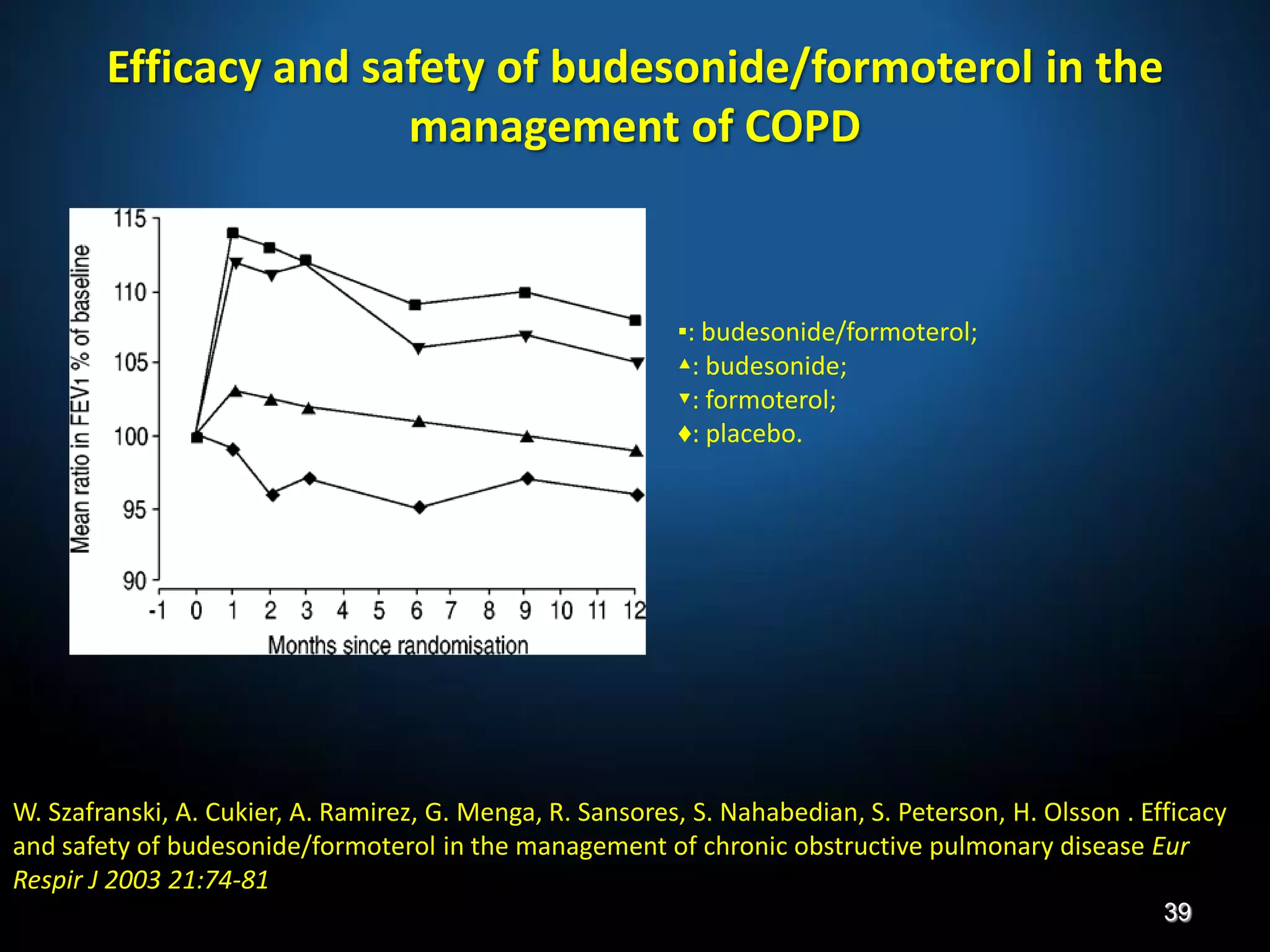
Efficacy and safety of budesonide/formoterol in the
management of COPD
39
▪: budesonide/formoterol;
▴: budesonide;
▾: formoterol;
♦: placebo.
W. Szafranski, A. Cukier, A. Ramirez, G. Menga, R. Sansores, S. Nahabedian, S. Peterson, H. Olsson . Efficacy
and safety of budesonide/formoterol in the management of chronic obstructive pulmonary disease Eur
Respir J 2003 21:74-81
Inhibitors of the Phosphodiesterase 4 inhibitors
40
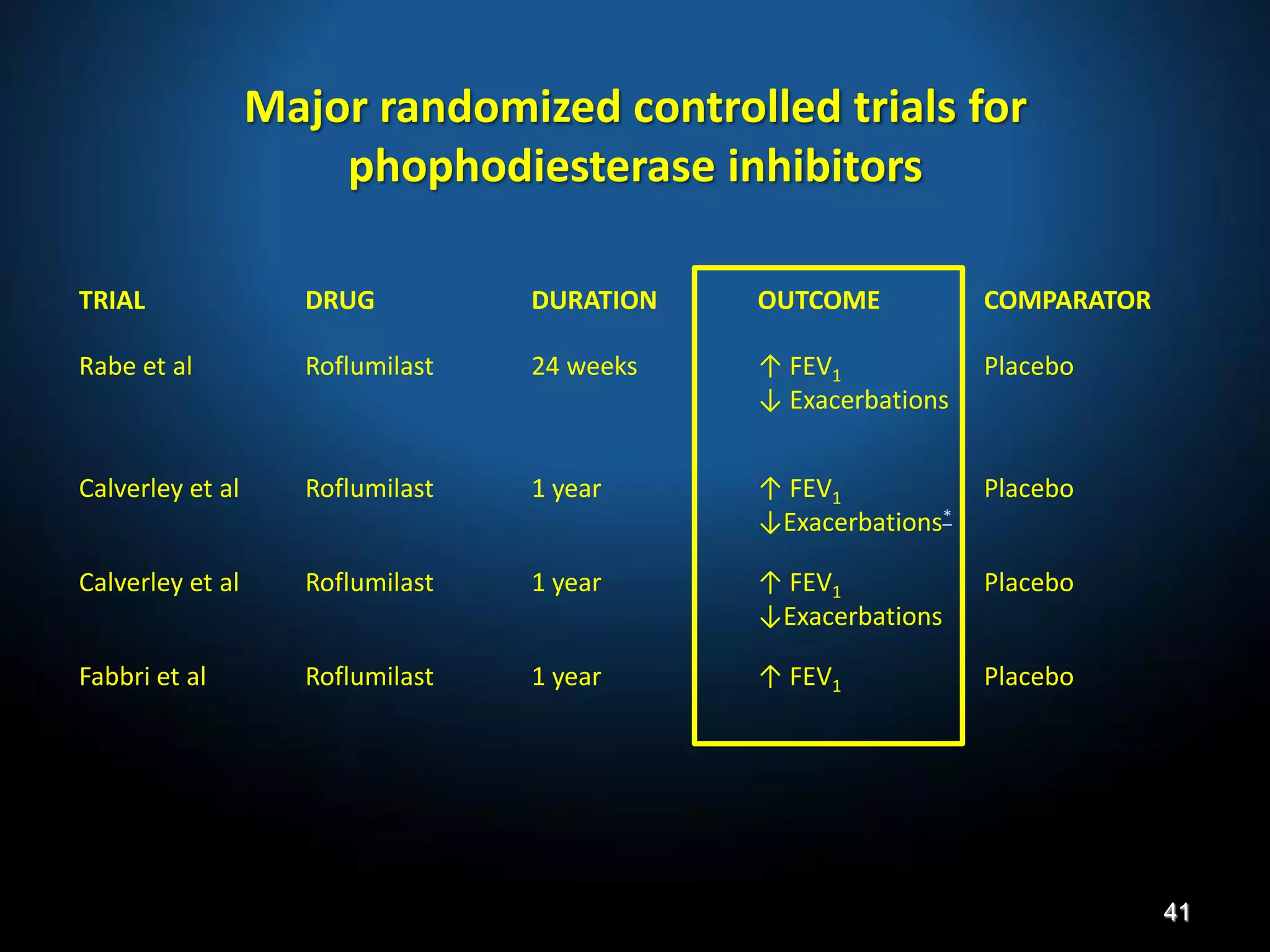
Major randomized controlled trials for
phophodiesterase inhibitors
TRIAL DRUG DURATION OUTCOME COMPARATOR
Rabe et al Roflumilast 24 weeks ↑ FEV1
↓ Exacerbations
Placebo
Calverley et al Roflumilast 1 year ↑ FEV1
↓Exacerbations*
Placebo
Calverley et al Roflumilast 1 year ↑ FEV1
↓Exacerbations
Placebo
Fabbri et al Roflumilast 1 year ↑ FEV1 Placebo
41
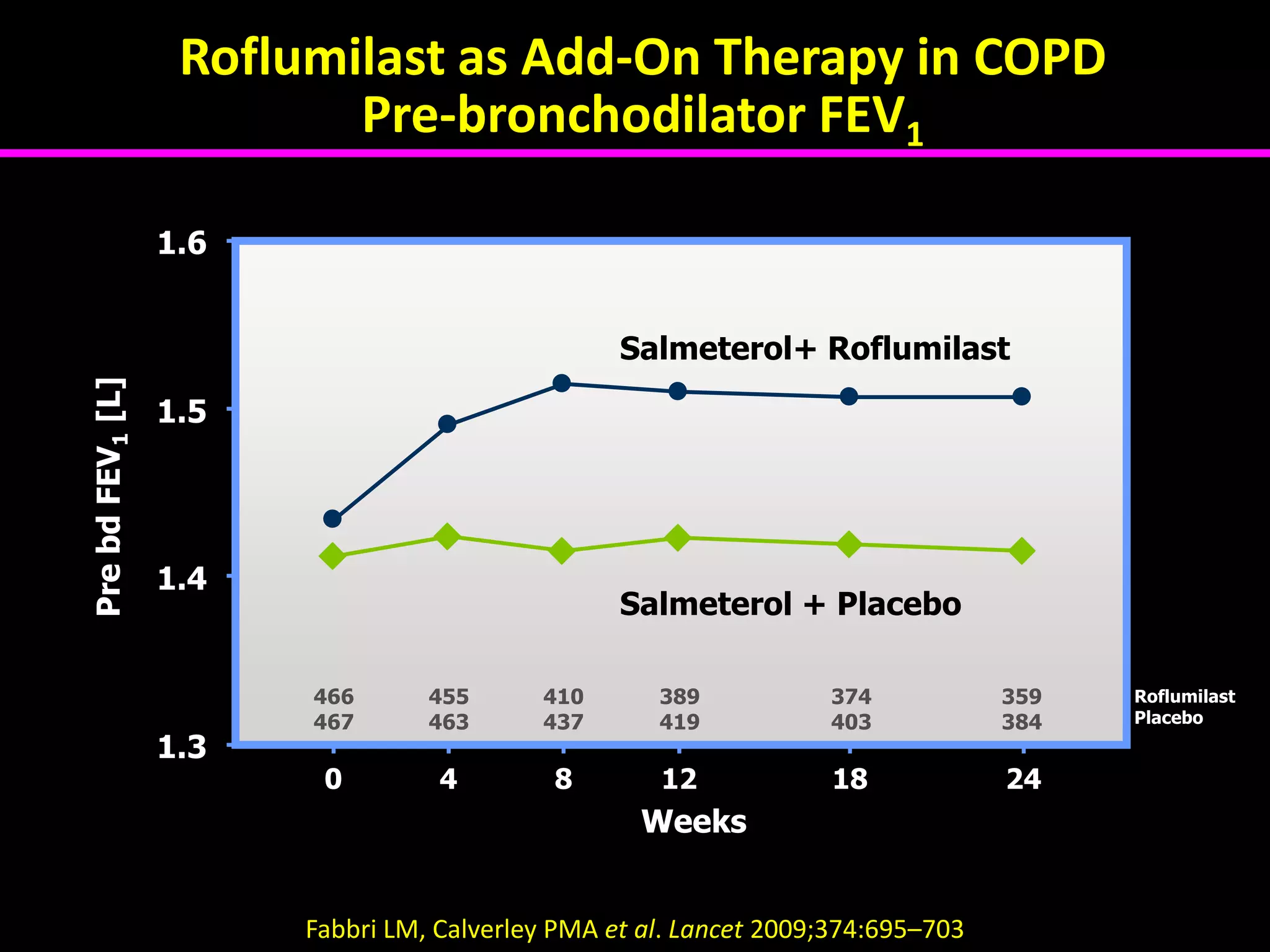
Roflumilast
Placebo
1.3
1.4
1.5
1.6
466
467
455
463
410
437
389
419
374
403
359
384
0 8 244 12 18
Weeks
Salmeterol + Placebo
Salmeterol+ Roflumilast
Roflumilast as Add-On Therapy in COPD
Pre-bronchodilator FEV1
Fabbri LM, Calverley PMA et al. Lancet 2009;374:695–703
CONTENTS
• Actual COPD Assessments: Severity versus Clinical
Phenotypes versus Multilateral assessment
• Non-pharmacological treatment
• Pharmacological treatment
• Therapeutic Strategies in stable COPD
43
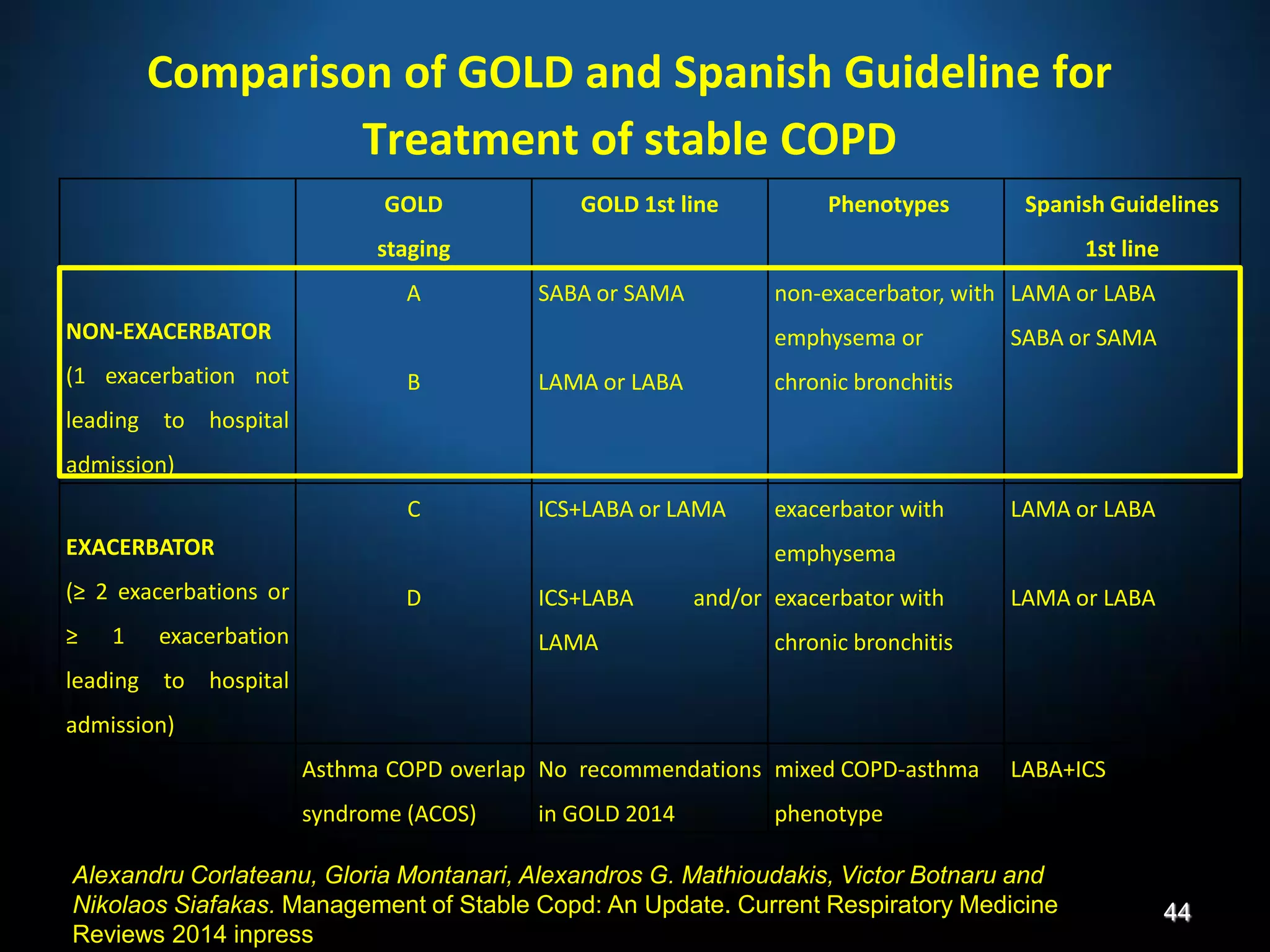
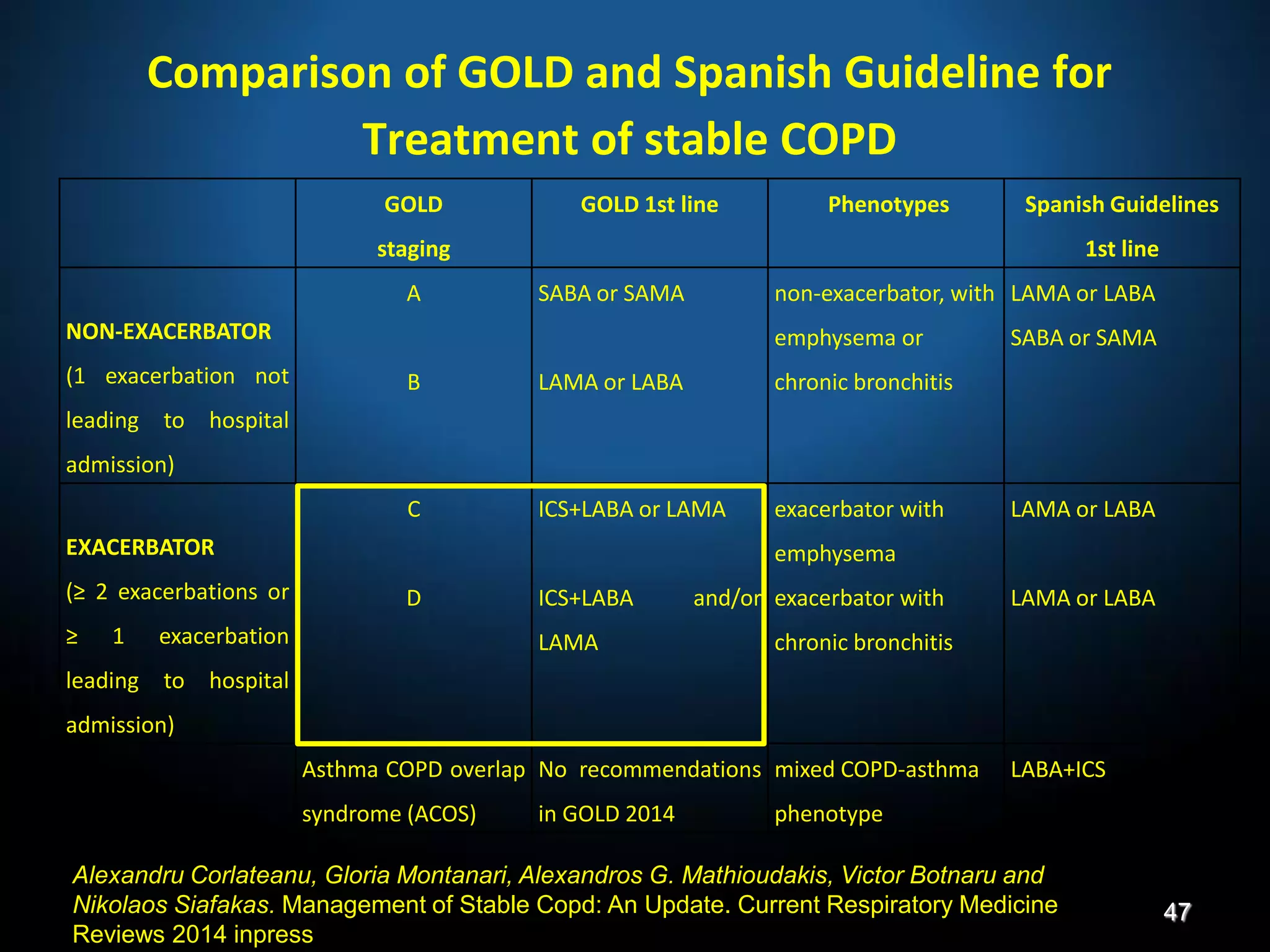
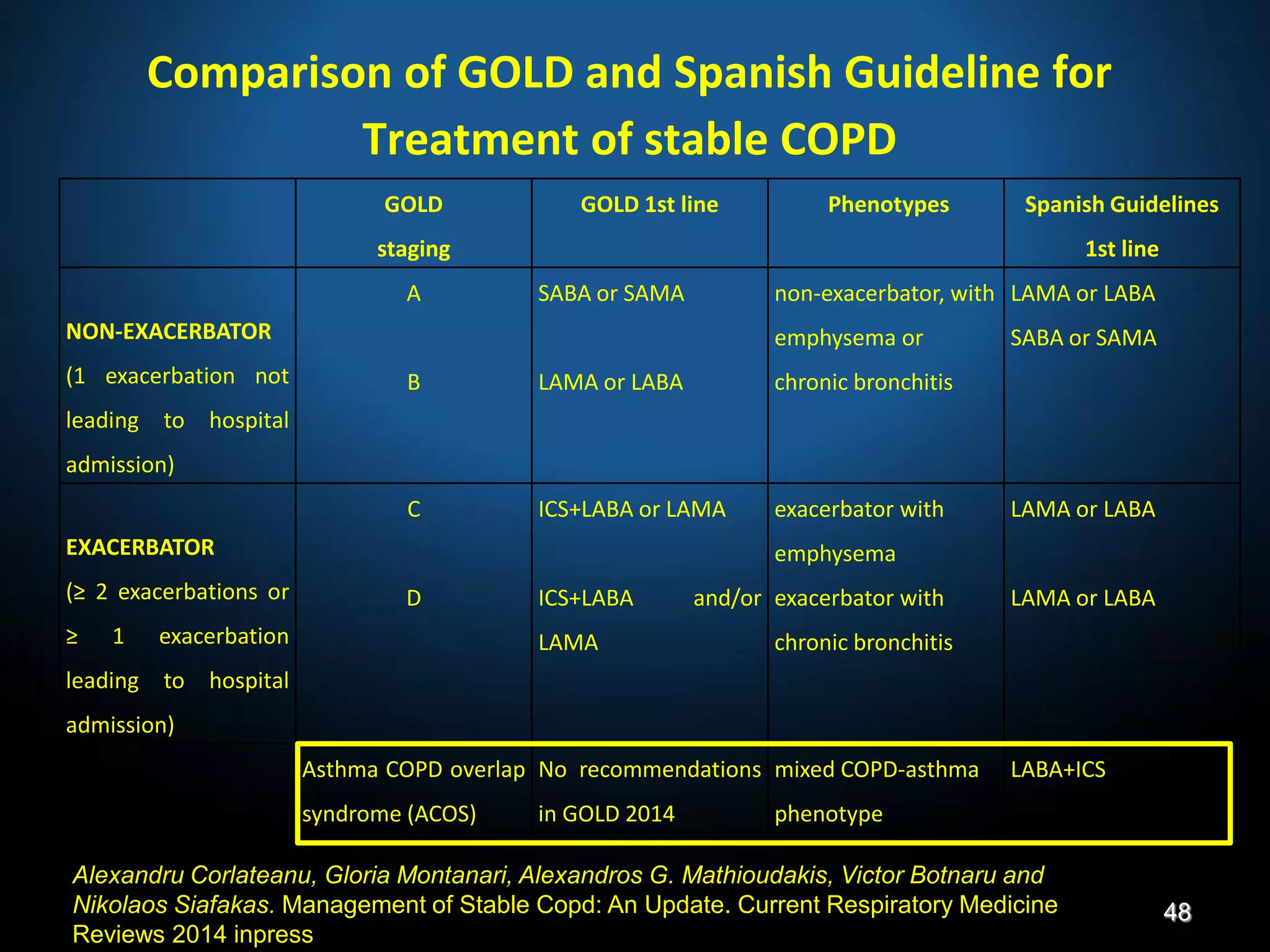
Comparison of GOLD and Spanish Guideline for
Treatment of stable COPD
GOLD
staging
GOLD 1st line Phenotypes Spanish Guidelines
1st line
NON-EXACERBATOR
(1 exacerbation not
leading to hospital
admission)
A
B
SABA or SAMA
LAMA or LABA
non-exacerbator, with
emphysema or
chronic bronchitis
LAMA or LABA
SABA or SAMA
EXACERBATOR
(≥ 2 exacerbations or
≥ 1 exacerbation
leading to hospital
admission)
C
D
ICS+LABA or LAMA
ICS+LABA and/or
LAMA
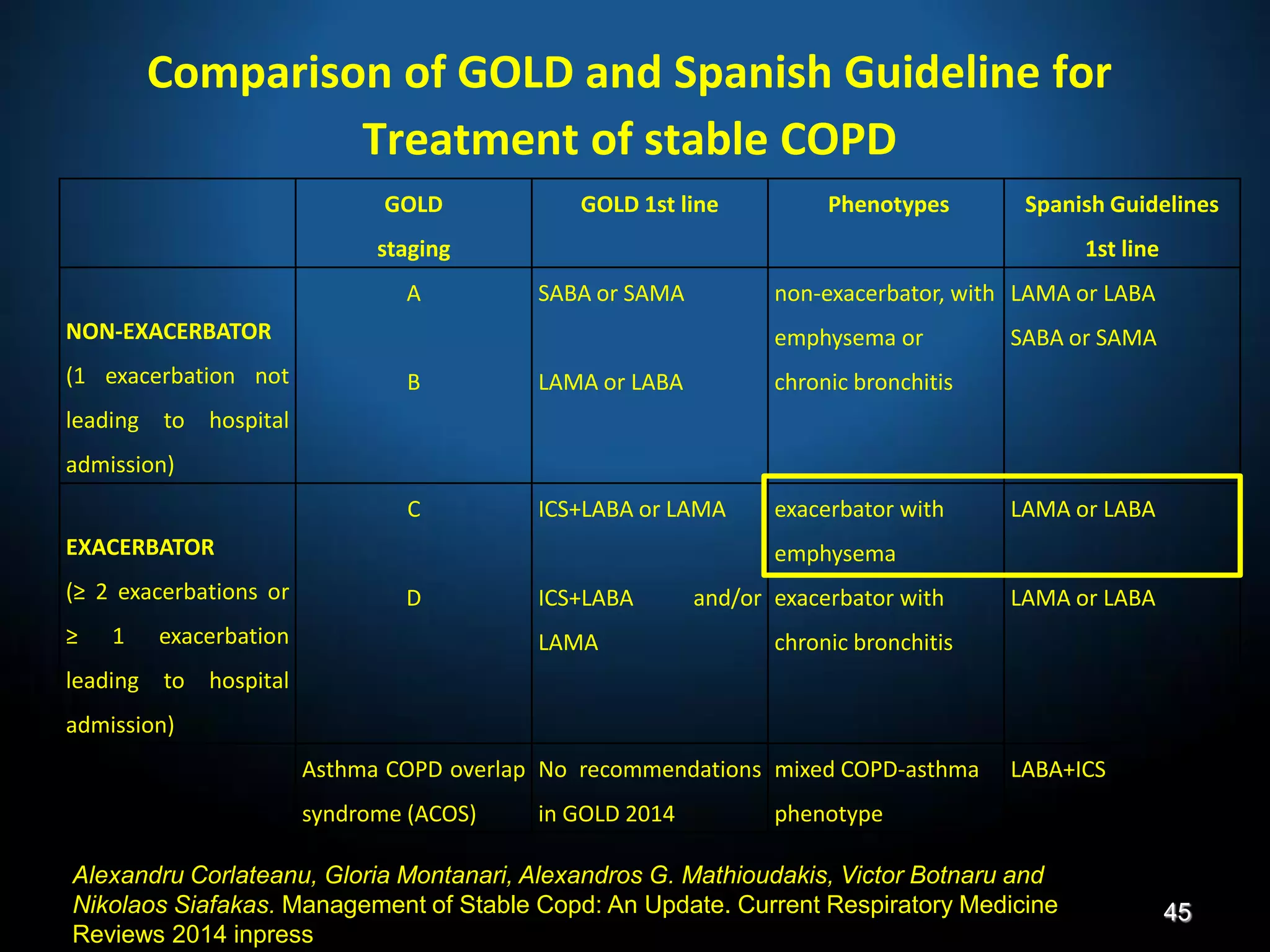
exacerbator with
emphysema
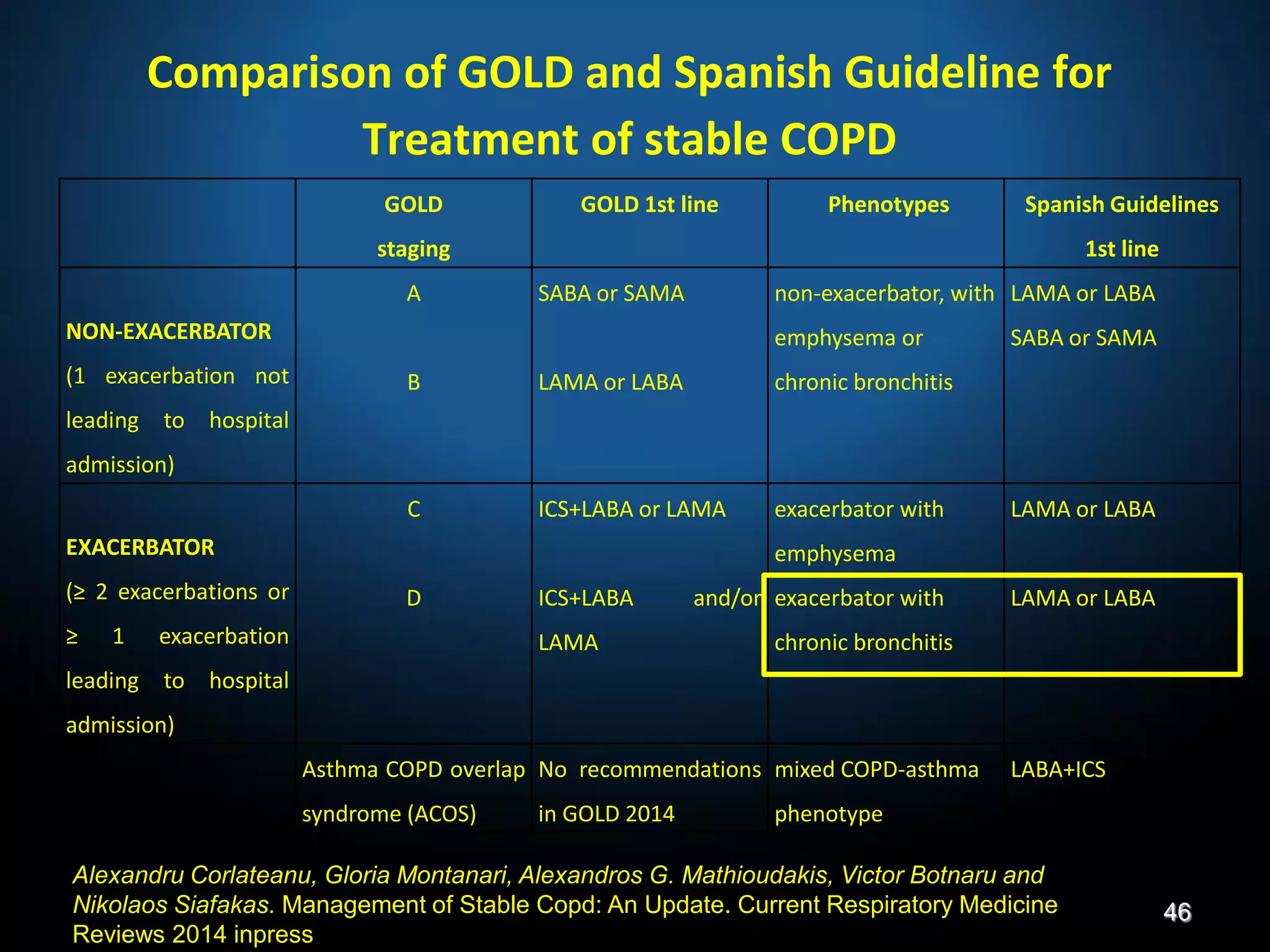
exacerbator with
chronic bronchitis
LAMA or LABA
LAMA or LABA
Asthma COPD overlap
syndrome (ACOS)
No recommendations
in GOLD 2014
mixed COPD-asthma
phenotype
LABA+ICS
Alexandru Corlateanu, Gloria Montanari, Alexandros G. Mathioudakis, Victor Botnaru and
Nikolaos Siafakas. Management of Stable Copd: An Update. Current Respiratory Medicine
Reviews 2014 inpress
44
Comparison of GOLD and Spanish Guideline for
Treatment of stable COPD
GOLD
staging
GOLD 1st line Phenotypes Spanish Guidelines
1st line
NON-EXACERBATOR
(1 exacerbation not
leading to hospital
admission)
A
B
SABA or SAMA
LAMA or LABA
non-exacerbator, with
emphysema or
chronic bronchitis
LAMA or LABA
SABA or SAMA
EXACERBATOR
(≥ 2 exacerbations or
≥ 1 exacerbation
leading to hospital
admission)
C
D
ICS+LABA or LAMA
ICS+LABA and/or
LAMA
exacerbator with
emphysema
exacerbator with
chronic bronchitis
LAMA or LABA
LAMA or LABA
Asthma COPD overlap
syndrome (ACOS)
No recommendations
in GOLD 2014
mixed COPD-asthma
phenotype
LABA+ICS
Alexandru Corlateanu, Gloria Montanari, Alexandros G. Mathioudakis, Victor Botnaru and
Nikolaos Siafakas. Management of Stable Copd: An Update. Current Respiratory Medicine
Reviews 2014 inpress
45
Comparison of GOLD and Spanish Guideline for
Treatment of stable COPD
GOLD
staging
GOLD 1st line Phenotypes Spanish Guidelines
1st line
NON-EXACERBATOR
(1 exacerbation not
leading to hospital
admission)
A
B
SABA or SAMA
LAMA or LABA
non-exacerbator, with
emphysema or
chronic bronchitis
LAMA or LABA
SABA or SAMA
EXACERBATOR
(≥ 2 exacerbations or
≥ 1 exacerbation
leading to hospital
admission)
C
D
ICS+LABA or LAMA
ICS+LABA and/or
LAMA
exacerbator with
emphysema
exacerbator with
chronic bronchitis
LAMA or LABA
LAMA or LABA
Asthma COPD overlap
syndrome (ACOS)
No recommendations
in GOLD 2014
mixed COPD-asthma
phenotype
LABA+ICS
Alexandru Corlateanu, Gloria Montanari, Alexandros G. Mathioudakis, Victor Botnaru and
Nikolaos Siafakas. Management of Stable Copd: An Update. Current Respiratory Medicine
Reviews 2014 inpress
46
Comparison of GOLD and Spanish Guideline for
Treatment of stable COPD
GOLD
staging
GOLD 1st line Phenotypes Spanish Guidelines
1st line
NON-EXACERBATOR
(1 exacerbation not
leading to hospital
admission)
A
B
SABA or SAMA
LAMA or LABA
non-exacerbator, with
emphysema or
chronic bronchitis
LAMA or LABA
SABA or SAMA
EXACERBATOR
(≥ 2 exacerbations or
≥ 1 exacerbation
leading to hospital
admission)
C
D
ICS+LABA or LAMA
ICS+LABA and/or
LAMA
exacerbator with
emphysema
exacerbator with
chronic bronchitis
LAMA or LABA
LAMA or LABA
Asthma COPD overlap
syndrome (ACOS)
No recommendations
in GOLD 2014
mixed COPD-asthma
phenotype
LABA+ICS
Alexandru Corlateanu, Gloria Montanari, Alexandros G. Mathioudakis, Victor Botnaru and
Nikolaos Siafakas. Management of Stable Copd: An Update. Current Respiratory Medicine
Reviews 2014 inpress
47
Comparison of GOLD and Spanish Guideline for
Treatment of stable COPD
GOLD
staging
GOLD 1st line Phenotypes Spanish Guidelines
1st line
NON-EXACERBATOR
(1 exacerbation not
leading to hospital
admission)
A
B
SABA or SAMA
LAMA or LABA
non-exacerbator, with
emphysema or
chronic bronchitis
LAMA or LABA
SABA or SAMA
EXACERBATOR
(≥ 2 exacerbations or
≥ 1 exacerbation
leading to hospital
admission)
C
D
ICS+LABA or LAMA
ICS+LABA and/or
LAMA
exacerbator with
emphysema
exacerbator with
chronic bronchitis
LAMA or LABA
LAMA or LABA
Asthma COPD overlap
syndrome (ACOS)
No recommendations
in GOLD 2014
mixed COPD-asthma
phenotype
LABA+ICS
Alexandru Corlateanu, Gloria Montanari, Alexandros G. Mathioudakis, Victor Botnaru and
Nikolaos Siafakas. Management of Stable Copd: An Update. Current Respiratory Medicine
Reviews 2014 inpress
48
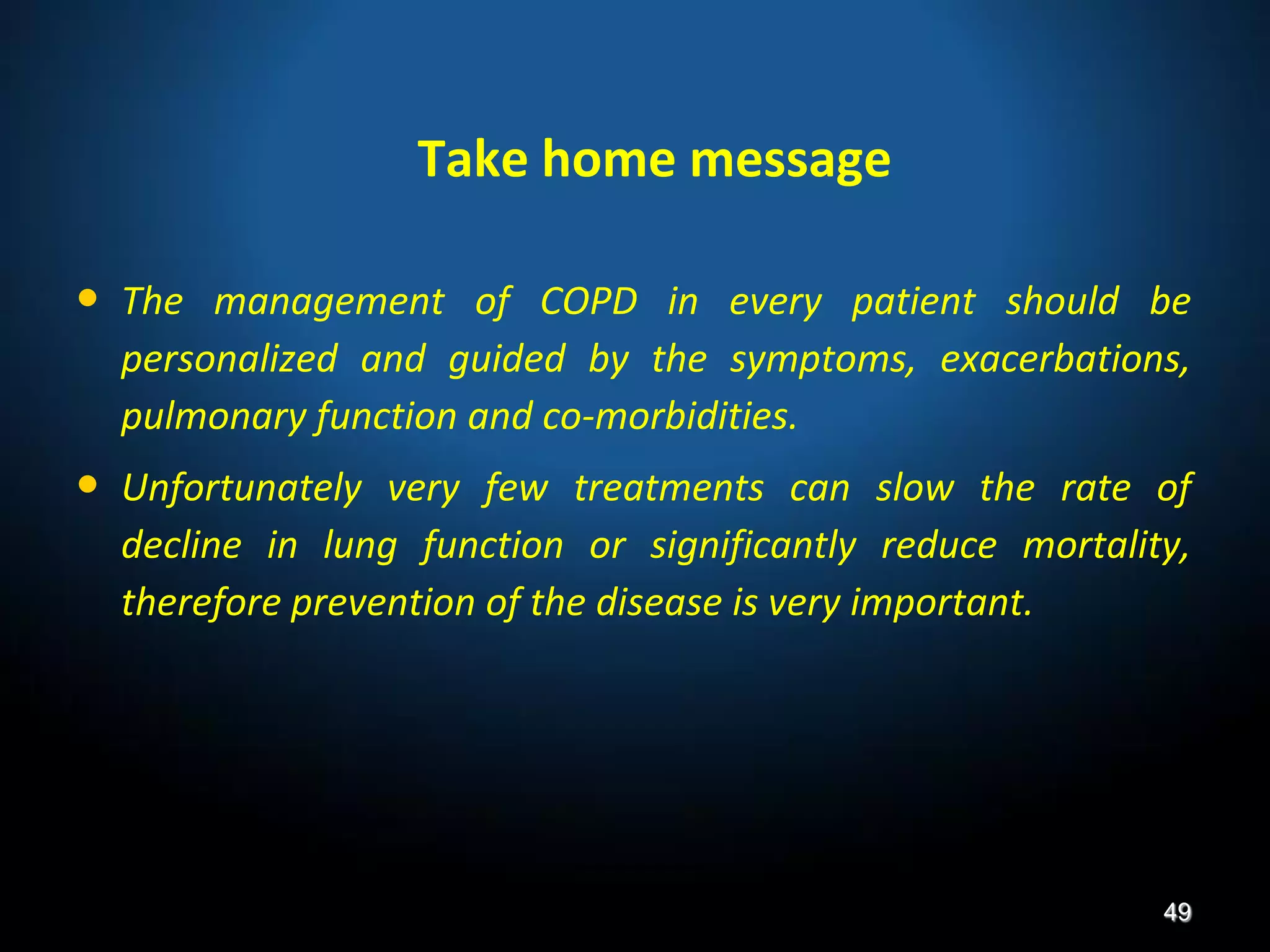
• The management of COPD in every patient should be
personalized and guided by the symptoms, exacerbations,
pulmonary function and co-morbidities.
• Unfortunately very few treatments can slow the rate of
decline in lung function or significantly reduce mortality,
therefore prevention of the disease is very important.
49
Take home message
50

The assessment of management of stable COPD: an update 2014 by Corlateanu for COPD Istanbul 2014

  • 1.
    The assessment ofmanagement of stable COPD: An update Alexandru Corlateanu Department of Respiratory Medicine, State University of Medicine and Pharmacy "Nicolae Testemitanu", Chisinau, Moldova 1
  • 2.
    Conflict of interest Receivedhonorariums for educational activities and lectures from GSK 2
  • 3.
  • 4.
    Nasreddin walked intoa house and exclaimed, "The moon is more useful than the sun." "Why?" "Because at night we need the light more" 4
  • 5.
    CONTENTS • Actual COPDAssessments: Severity versus Clinical Phenotypes versus Multilateral assessment • Non-pharmacological treatment • Pharmacological treatment • Therapeutic Strategies in stable COPD 5
  • 6.
  • 7.
    Approaches to theassessment of COPD: • GOLD assessment of severity • multilateral evaluation • phenotyping 7
  • 8.
    Markers used indifferent approaches for COPD assessment MARKERS GOLD 2011 MULTILATERAL INDICES (BODE) PHENOTYPING SYMPTOMATIC dyspnea assessed by Medical Research Council scale dyspnea assessed by Medical Research Council scale symptoms PHYSIOLOGIC FEV1 FEV1 BMI, exercise capacity evaluated by 6 minute walking test FEV1 HEALTH STATUS the COPD Assessment Test (CAT) - - EXACERBATIONS evaluation of the risk of exacerbations - evaluation of the risk of exacerbations IMAGING - - X-Ray, HRCT Alexandru Corlateanu, Gloria Montanari, Alexandros G. Mathioudakis, Victor Botnaru and Nikolaos Siafakas. Management of Stable COPD: An Update. Current Respiratory Medicine Reviews 2014 inpress 8
  • 9.
    Global Strategy forDiagnosis, Management and Prevention of COPD Combined Assessment of COPD © 2014 Global Initiative for Chronic Obstructive Lung Disease Risk (GOLDClassificationofAirflowLimitation)) Risk (Exacerbationhistory) ≥ 2 or > 1 leading to hospital admission 1 (not leading to hospital admission) 0 Symptoms (C) (D) (A) (B) CAT < 10 4 3 2 1 CAT > 10 Breathlessness mMRC 0–1 mMRC > 2
  • 10.
    BMI Obstruction Dyspnea Exercise BODE Celli BR, CoteClaudia et al. NEJM 2004;350:1005-12 10
  • 11.
    Ciro Casanova, ArmandoAguirre-Jaíme, Juan P. de Torres, Victor Pinto-Plata, Rebeca Baz, Jose M. Marin, Miguel Divo, Elizabeth Cordoba, Santiago Basaldua, Claudia Cote, Bartolomé R. Celli . Longitudinal assessment in COPD patients: multidimensional variability and outcomes Eur Respir J 2014 43:745-753 Longitudinal assessment in COPD patients: multidimensional variability and outcomes 11
  • 12.
    Pink Puffer BlueBloater COPD Phenotypes Dornhorst AC, Lancet 1955 12
  • 13.
    Spanish Guideline forCOPD (GesEPOC) 2014 Spanish Guideline for COPD (GesEPOC) / Arch Bronconeumol. 2014;50(Suppl 1):1-16 13
  • 14.
    CONTENTS • Actual COPDAssessments: Severity versus Clinical Phenotypes versus Multilateral assessment • Non-pharmacological treatment • Pharmacological treatment • Therapeutic Strategies in stable COPD 14
  • 15.
     Relieve symptoms Improve exercise tolerance  Improve health status  Prevent disease progression  Prevent and treat exacerbations  Reduce mortality Reduce symptoms Reduce risk Global Strategy for Diagnosis, Management and Prevention of COPD Manage Stable COPD: Goals of Therapy © 2014 Global Initiative for Chronic Obstructive Lung Disease
  • 16.
    Non-pharmacologic therapy •smoking cessation, •reductionof other risk factors, •vaccinations •pulmonary rehabilitation 16© 2014 Global Initiative for Chronic Obstructive Lung Disease
  • 17.
    Smoking cessation shouldbe considered the most important intervention for all COPD patients who smoke regardless of the level of disease severity 17
  • 18.
    Smoking and LungFunction of Lung Health Study Participants after 11 Years Nicholas R. Anthonisen, John E. Connett, and Robert P. Murray American Journal of Respiratory and Critical Care Medicine 2002 166:5, 675-679 18 Smoking and Lung Function of Lung Health Study Participants after 11 Years
  • 19.
  • 20.
    Some children sawNasreddin coming from the vineyard with two baskets full of grapes loaded on his donkey. They gathered around him and asked him to give them a taste. Nasreddin picked up a bunch of grapes and gave each child a grape. "You have so much, but you gave us so little," the children whined. 20 "There is no difference whether you have a basketful or a small piece. They all taste the same," Nasreddin answered, and continued on his way.
  • 21.
  • 22.
    TRIAL DURATION OUTCOMECOMPARATOR SALMETEROL Boyd et al 16 weeks ↑ FEV1 Placebo Mahler et al 12 weeks ↑ FEV1 Placebo, ipratropium* Rennard et al 12 weeks ↑ FEV1 Placebo Calverley et al (TRISTAN) 1 year ↑ FEV1 ↓Exacerbations ↑ HRQoL Placebo, fluticasone, fluticasone/salmeterol Calverley et al (TORCH) 3 years ↑ FEV1 ↓ Exacerbations ↑ HRQoL Placebo, fluticasone, salmeterol/fluticasone FORMOTEROL Dahl et al 12 weeks ↑ FEV1 ↓Symptom scores Placebo, ipratropium* De Rossi et al 1 year ↑ FEV1 Placebo, theophylline* Calverley et al 1 year ↔ FEV1 ↑ HRQoL Placebo, budesonide, budesonide/formoterol Szafranski et al 1 year ↔ FEV1 ↔HRQoL Placebo, budesonide, budesonide/formoterol Major randomized controlled trials of salmeterol and formoterol 22
  • 23.
    Toward a Revolutionin COPD Health (TORCH) Calverley PM et al. N Engl J Med 2007;356:775-789.
  • 24.
    RONALD DAHL; LOUISA. P. M. GREEFHORST; DARIUSZ NOWAK; VLADIMIR NONIKOV; AIDAN M. BYRNE; MOIRA H. THOMSON; DENISE TILL; GIOVANNI DELLA CIOPPA; Am J Respir Crit Care Med 2001, 164, 778-784. DOI: 10.1164/ajrccm.164.5.2007006
  • 25.
    Trial Duration OutcomeComparator Donohue et al (INHANCE) 26 weeks ↑ HRQoL ↓ Dyspnoea (TDI) Placebo, tiotropium Dahl et al (INVOLVE) I year ↑ Bronchodilation (FEV1) ↑ HRQoL ↓ Dyspnoea (TDI) Prolonged time to exacerbation Placebo, formoterol Buhl et al (INTENSITY) 12 weeks ↔ Bronchodilation (FEV1) ↑ HRQoL ↓ Dyspnoea (TDI) Tiotropium Kornmann et al (INLIGHT-2) 12 weeks ↑ Bronchodilation (FEV1) ↑ HRQoL ↓ Dyspnoea (TDI) Placebo, salmeterol Korn et al (INSIST) 12 weeks ↑ Bronchodilation (FEV1) ↓ Dyspnoea (TDI) Salmeterol Major randomized controlled trials for indacaterol 25
  • 26.
    Once-daily indacaterol versustwice-daily salmeterol for COPD: a placebo-controlled comparison O. Kornmann, R. Dahl, S. Centanni, on behalf of the INLIGHT-2 (Indacaterol Efficacy Evaluation Using 150-μg Doses with COPD Patients) study investigators .Once-daily indacaterol versus twice-daily salmeterol for COPD: a placebo-controlled comparison Eur Respir J 2011 37:273-279 26 ▴: salmeterol; ▪: indacaterol
  • 27.
  • 28.
    Trial Duration OutcomeComparator Tiotropium Brusasco et al 26 weeks ↓Exacerbations ↑ HRQoL Placebo, salmeterol Briggs et al 12 weeks ↑ FEV1 Salmeterol* Tashkin et al (UPLIFT) 4 years ↓Exacerbations ↑ HRQoL ↑ FEV1 Placebo Vogelmeier et al (POET) 1 year ↓Exacerbations Salmeterol* Major randomized controlled trials for tiotropium 28
  • 29.
    Exacerbations of COPDand Related Hospitalizations Tashkin DP et al. N Engl J Med 2008;359:1543-1554.
  • 30.
    Aclidinium Jones et al(ACCLAIM Iand II) 1 year ↑ Trough FEV1 ↑ HRQoL Placebo Jones et al(ATTAIN) 6 months ↑ FEV1 ↑ HRQoL ↓ Dyspnoea (TDI) Placebo Kerwin et al (ACCORD) 12 weeks ↑ FEV1 ↑ HRQoL ↓ Dyspnoea (TDI) Placebo Fuhr et al 15 days per treatment Similar to ACCORD v placebo ↑ Morning FEV1 v tiotropium Placebo, tiotropium Major randomized controlled trials for aclidinium 30
  • 31.
    Efficacy and safetyof twice-daily aclidinium bromide in COPD patients: the ATTAIN study Jones PW, Singh D, Bateman ED, et al. Efficacy and safety of twice-daily aclidinium bromide in COPD patients: the ATTAIN study. Eur Respir J. 2012;40(4):830–6. 31
  • 32.
    Glycopyrronium D’Urzo et al (GLOW1) 26weeks ↑ FEV1 ↑ HRQoL ↓Dyspnoea (TDI score) ↓Exacerbations Placebo Kerwin et al (GLOW2) 1 year Similar to GLOW1 v placebo ↑ Bronchodilation on day 1 and week 26 v tiotropium Placebo, tiotropium* Beeh et al (GLOW3) 8 weeks ↑ Endurance time ↑ Inspiratory capacity Placebo Major randomized controlled trials for glycopyrronium 32
  • 33.
    Efficacy and safetyof once-daily NVA237 in patients with moderate-to-severe COPD: the GLOW1 trial. D’Urzo A, Ferguson GT, van Noord JA, et al. Efficacy and safety of once-daily NVA237 in patients with moderate-to-severe COPD: the GLOW1 trial. Respir Res. 2011;12:156. 33
  • 34.
  • 35.
    TRIAL ICS DURATIONOUTCOME COMPARATOR Burge et al (ISOLDE) Fluticasone 1 year ↑ FEV1 ↓ Exacerbations Placebo Calverley et al Budesonide 1 year ↓ Exacerbations* ↑ HRQoL Placebo, formoterol, budesonide/formo terol Szafranski et al Budesonide 1 year ↑ FEV1 Placebo, formoterol, budesonide/formo terol Calverley et al (TRISTAN) Fluticasone 1 year ↑ FEV1 ↓Exacerbations Placebo, salmeterol, salmeterol/fluticas one Calverley et al (TORCH) Fluticasone 3 years ↓Exacerbations ↑ FEV1 Placebo, salmeterol, salmeterol/fluticas one Major randomized controlled trials for ICS 35
  • 36.
    36 Soriano JB, SinDD, Zhang X, et al. A pooled analysis of FEV1 decline in COPD patients randomized to inhaled corticosteroids or placebo. Chest. 2007;131:682-689.
  • 37.
    Bronchodilators plus inhaledglucocorticoids 37
  • 38.
    TRIAL ICS/LABA DURATIONOUTCOME COMPARATOR Calverley et al Budesonide/formoterol 1 year ↓Exacerbations v P and F ↔ FEV1 v all ↑ HRQoL v all Placebo, formoterol, budesonide Szafranski et al Budesonide/formoterol 1 year ↓Exacerbations v P and F ↔ FEV1 v P and B ↑ HRQoL v P and B Placebo, formoterol, budesonide Calverley et al (TRISTAN) Salmeterol/fluticasone 1 year ↑ FEV1 v all ↑ HRQoL v all ↓ Exacerbations v P Placebo, salmeterol, fluticasone Calverley et al (TORCH) Salmeterol/fluticasone 3 years ↓Exacerbations v all ↑ HRQoL v P Placebo, salmeterol, fluticasone Wedzicha et al (INSPIRE) Salmeterol/fluticasone 2 years ↔ Exacerbations ↑ HRQoL ↓ Mortality ↑ Pneumonia Tiotropium Major randomized controlled trials for ICS/LABA 38
  • 39.
    Efficacy and safetyof budesonide/formoterol in the management of COPD 39 ▪: budesonide/formoterol; ▴: budesonide; ▾: formoterol; ♦: placebo. W. Szafranski, A. Cukier, A. Ramirez, G. Menga, R. Sansores, S. Nahabedian, S. Peterson, H. Olsson . Efficacy and safety of budesonide/formoterol in the management of chronic obstructive pulmonary disease Eur Respir J 2003 21:74-81
  • 40.
    Inhibitors of thePhosphodiesterase 4 inhibitors 40
  • 41.
    Major randomized controlledtrials for phophodiesterase inhibitors TRIAL DRUG DURATION OUTCOME COMPARATOR Rabe et al Roflumilast 24 weeks ↑ FEV1 ↓ Exacerbations Placebo Calverley et al Roflumilast 1 year ↑ FEV1 ↓Exacerbations* Placebo Calverley et al Roflumilast 1 year ↑ FEV1 ↓Exacerbations Placebo Fabbri et al Roflumilast 1 year ↑ FEV1 Placebo 41
  • 42.
    Roflumilast Placebo 1.3 1.4 1.5 1.6 466 467 455 463 410 437 389 419 374 403 359 384 0 8 24412 18 Weeks Salmeterol + Placebo Salmeterol+ Roflumilast Roflumilast as Add-On Therapy in COPD Pre-bronchodilator FEV1 Fabbri LM, Calverley PMA et al. Lancet 2009;374:695–703
  • 43.
    CONTENTS • Actual COPDAssessments: Severity versus Clinical Phenotypes versus Multilateral assessment • Non-pharmacological treatment • Pharmacological treatment • Therapeutic Strategies in stable COPD 43
  • 44.
    Comparison of GOLDand Spanish Guideline for Treatment of stable COPD GOLD staging GOLD 1st line Phenotypes Spanish Guidelines 1st line NON-EXACERBATOR (1 exacerbation not leading to hospital admission) A B SABA or SAMA LAMA or LABA non-exacerbator, with emphysema or chronic bronchitis LAMA or LABA SABA or SAMA EXACERBATOR (≥ 2 exacerbations or ≥ 1 exacerbation leading to hospital admission) C D ICS+LABA or LAMA ICS+LABA and/or LAMA exacerbator with emphysema exacerbator with chronic bronchitis LAMA or LABA LAMA or LABA Asthma COPD overlap syndrome (ACOS) No recommendations in GOLD 2014 mixed COPD-asthma phenotype LABA+ICS Alexandru Corlateanu, Gloria Montanari, Alexandros G. Mathioudakis, Victor Botnaru and Nikolaos Siafakas. Management of Stable Copd: An Update. Current Respiratory Medicine Reviews 2014 inpress 44
  • 45.
    Comparison of GOLDand Spanish Guideline for Treatment of stable COPD GOLD staging GOLD 1st line Phenotypes Spanish Guidelines 1st line NON-EXACERBATOR (1 exacerbation not leading to hospital admission) A B SABA or SAMA LAMA or LABA non-exacerbator, with emphysema or chronic bronchitis LAMA or LABA SABA or SAMA EXACERBATOR (≥ 2 exacerbations or ≥ 1 exacerbation leading to hospital admission) C D ICS+LABA or LAMA ICS+LABA and/or LAMA exacerbator with emphysema exacerbator with chronic bronchitis LAMA or LABA LAMA or LABA Asthma COPD overlap syndrome (ACOS) No recommendations in GOLD 2014 mixed COPD-asthma phenotype LABA+ICS Alexandru Corlateanu, Gloria Montanari, Alexandros G. Mathioudakis, Victor Botnaru and Nikolaos Siafakas. Management of Stable Copd: An Update. Current Respiratory Medicine Reviews 2014 inpress 45
  • 46.
    Comparison of GOLDand Spanish Guideline for Treatment of stable COPD GOLD staging GOLD 1st line Phenotypes Spanish Guidelines 1st line NON-EXACERBATOR (1 exacerbation not leading to hospital admission) A B SABA or SAMA LAMA or LABA non-exacerbator, with emphysema or chronic bronchitis LAMA or LABA SABA or SAMA EXACERBATOR (≥ 2 exacerbations or ≥ 1 exacerbation leading to hospital admission) C D ICS+LABA or LAMA ICS+LABA and/or LAMA exacerbator with emphysema exacerbator with chronic bronchitis LAMA or LABA LAMA or LABA Asthma COPD overlap syndrome (ACOS) No recommendations in GOLD 2014 mixed COPD-asthma phenotype LABA+ICS Alexandru Corlateanu, Gloria Montanari, Alexandros G. Mathioudakis, Victor Botnaru and Nikolaos Siafakas. Management of Stable Copd: An Update. Current Respiratory Medicine Reviews 2014 inpress 46
  • 47.
    Comparison of GOLDand Spanish Guideline for Treatment of stable COPD GOLD staging GOLD 1st line Phenotypes Spanish Guidelines 1st line NON-EXACERBATOR (1 exacerbation not leading to hospital admission) A B SABA or SAMA LAMA or LABA non-exacerbator, with emphysema or chronic bronchitis LAMA or LABA SABA or SAMA EXACERBATOR (≥ 2 exacerbations or ≥ 1 exacerbation leading to hospital admission) C D ICS+LABA or LAMA ICS+LABA and/or LAMA exacerbator with emphysema exacerbator with chronic bronchitis LAMA or LABA LAMA or LABA Asthma COPD overlap syndrome (ACOS) No recommendations in GOLD 2014 mixed COPD-asthma phenotype LABA+ICS Alexandru Corlateanu, Gloria Montanari, Alexandros G. Mathioudakis, Victor Botnaru and Nikolaos Siafakas. Management of Stable Copd: An Update. Current Respiratory Medicine Reviews 2014 inpress 47
  • 48.
    Comparison of GOLDand Spanish Guideline for Treatment of stable COPD GOLD staging GOLD 1st line Phenotypes Spanish Guidelines 1st line NON-EXACERBATOR (1 exacerbation not leading to hospital admission) A B SABA or SAMA LAMA or LABA non-exacerbator, with emphysema or chronic bronchitis LAMA or LABA SABA or SAMA EXACERBATOR (≥ 2 exacerbations or ≥ 1 exacerbation leading to hospital admission) C D ICS+LABA or LAMA ICS+LABA and/or LAMA exacerbator with emphysema exacerbator with chronic bronchitis LAMA or LABA LAMA or LABA Asthma COPD overlap syndrome (ACOS) No recommendations in GOLD 2014 mixed COPD-asthma phenotype LABA+ICS Alexandru Corlateanu, Gloria Montanari, Alexandros G. Mathioudakis, Victor Botnaru and Nikolaos Siafakas. Management of Stable Copd: An Update. Current Respiratory Medicine Reviews 2014 inpress 48
  • 49.
    • The managementof COPD in every patient should be personalized and guided by the symptoms, exacerbations, pulmonary function and co-morbidities. • Unfortunately very few treatments can slow the rate of decline in lung function or significantly reduce mortality, therefore prevention of the disease is very important. 49 Take home message
  • 50.