
COPD: A Common Disease -
missed and misdiagnosed
Surinder K. Jindal
(Ex-Professor & Head, Pulm Med, PGIMER, Chandigarh)
Medical Director, Jindal Clinics, Sec 20 D, Chandigarh
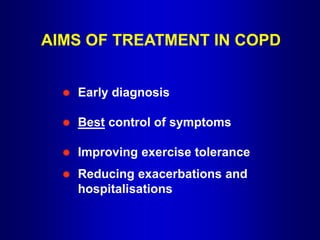
AIMS OF TREATMENT IN COPD
 Early diagnosis
 Best control of symptoms
 Improving exercise tolerance
 Reducing exacerbations and
hospitalisations
COPD treatment according to
GOLD
• Avoid risk factors  Avoid risk factors
+
 Bronchodilator prn
 Avoid risk factors
 Bronchodilator prn
+
 Regular
bronchodilator
 Consider ICS
 Rehabilitation
 Avoid risk factors
 Bronchodilator prn
 Regular
bronchodilator
 Consider ICS
 Rehabilitation
+
 Oxygen
 Surgery
At Risk
Mild
Moderate
Severe
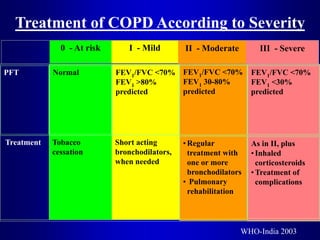
PFT Normal FEV1/FVC <70%
FEV1 >80%
predicted
FEV1/FVC <70%
FEV1 30-80%
predicted
FEV1/FVC <70%
FEV1 <30%
predicted
Treatment Tobacco
cessation
Short acting
bronchodilators,
when needed
•Regular
treatment with
one or more
bronchodilators
• Pulmonary
rehabilitation
As in II, plus
•Inhaled
corticosteroids
•Treatment of
complications
0 - At risk I - Mild II - Moderate III - Severe
Treatment of COPD According to Severity
WHO-India 2003
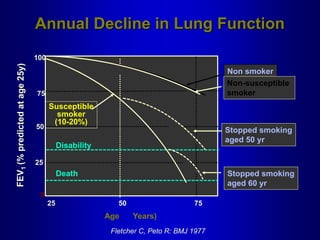
Fletcher C, Peto R: BMJ 1977
Annual Decline in Lung Function
100
75
50
25
0
25 50 75
Age Years)
Stopped smoking
aged 60 yr
Stopped smoking
aged 50 yr
Susceptible
smoker
(10-20%)
Death
Disability
Non smoker
Non-susceptible
smoker
Bronchodilators are the
cornerstone of current drug
therapy for COPD
GOLD
Guidelines 2003
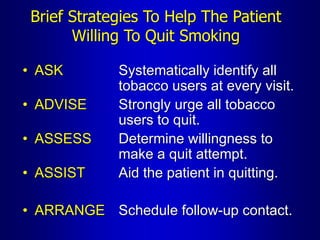
Brief Strategies To Help The Patient
Willing To Quit Smoking
• ASK Systematically identify all
tobacco users at every visit.
• ADVISE Strongly urge all tobacco
users to quit.
• ASSESS Determine willingness to
make a quit attempt.
• ASSIST Aid the patient in quitting.
• ARRANGE Schedule follow-up contact.
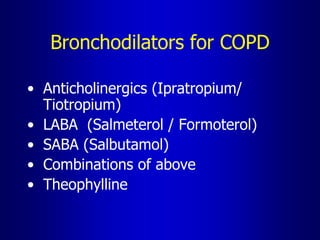
Bronchodilators for COPD
• Anticholinergics (Ipratropium/
Tiotropium)
• LABA (Salmeterol / Formoterol)
• SABA (Salbutamol)
• Combinations of above
• Theophylline
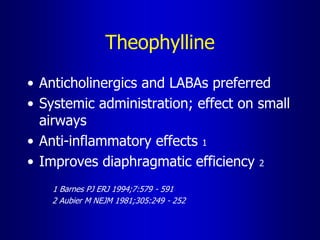
Theophylline
• Anticholinergics and LABAs preferred
• Systemic administration; effect on small
airways
• Anti-inflammatory effects 1
• Improves diaphragmatic efficiency 2
1 Barnes PJ ERJ 1994;7:579 - 591
2 Aubier M NEJM 1981;305:249 - 252
LABAs
(Salmeterol / Formoterol)
• Have replaced the short-acting drugs
like salbutamol in maintenance therapy
• Effective and long-acting
bronchodilators
• Additive effect with anti-cholinergics
• Can be combined in the same inhaler
with steroid in severe cases
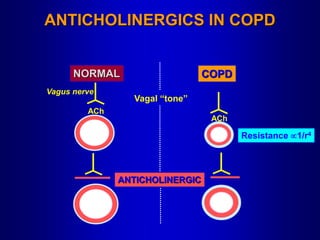
Vagal “tone”
Vagus nerve
ACh
NORMAL
ANTICHOLINERGIC
Resistance 1/r4
ACh
COPD
ANTICHOLINERGICS IN COPD
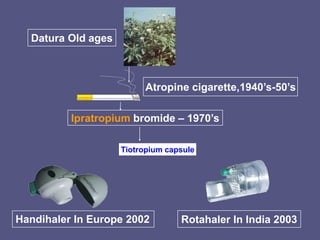
Atropine cigarette,1940’s-50’s
Rotahaler In India 2003
Handihaler In Europe 2002
Tiotropium capsule
Ipratropium bromide – 1970’s
Datura Old ages
Tiotropium Bromide
• 18 mcg/dose
• Single daily dose
• Selective anticholinergic M3 receptor
blocker
• First-choice bronchodilator for COPD
today
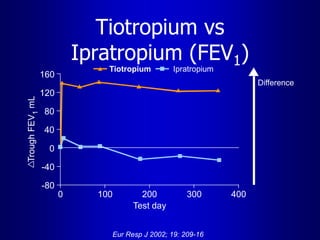
Tiotropium vs
Ipratropium (FEV1)
Eur Resp J 2002; 19: 209-16
160
-80
-40
0
40
80
120
0 100 200 300 400
Test day
T
rough
FEV
mL
1
Difference
Tiotropium Ipratropium
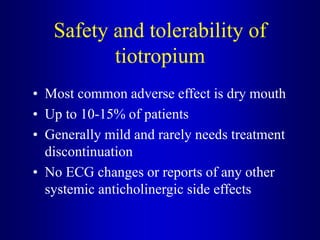
Safety and tolerability of
tiotropium
• Most common adverse effect is dry mouth
• Up to 10-15% of patients
• Generally mild and rarely needs treatment
discontinuation
• No ECG changes or reports of any other
systemic anticholinergic side effects
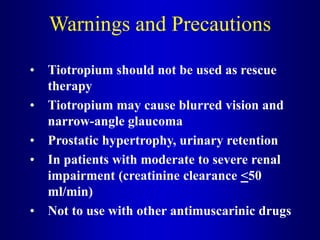
Warnings and Precautions
• Tiotropium should not be used as rescue
therapy
• Tiotropium may cause blurred vision and
narrow-angle glaucoma
• Prostatic hypertrophy, urinary retention
• In patients with moderate to severe renal
impairment (creatinine clearance <50
ml/min)
• Not to use with other antimuscarinic drugs
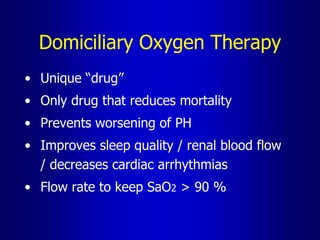
Domiciliary Oxygen Therapy
• Unique “drug”
• Only drug that reduces mortality
• Prevents worsening of PH
• Improves sleep quality / renal blood flow
/ decreases cardiac arrhythmias
• Flow rate to keep SaO2 > 90 %
Inhaled steroids in COPD
• Steroids are beneficial in acute
exacerbation
• Optimal dose unknown but duration
should be no more than 2 weeks
• ? Inhaled steroids beneficial in
symptomatic patients with moderate
to severe lung disease.
• Role of inhaled steroids not
completely known in COPD
Long-term Oxygen Therapy (LTOT)
• Should not be regarded as something
to give “when all has failed”
• Not addictive
• Does not limit mobility around the
house
How do you give oxygen ?
• Oxygen cylinders
• Oxygen concentrators
• Portable oxygen cylinders ( liquid
oxygen esp.)
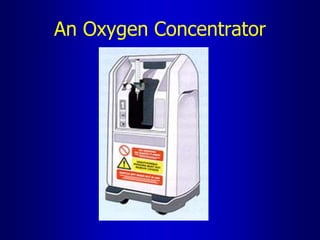
An Oxygen Concentrator
Vaccination
• Pneumococcal:
• 43% decrease in hospitalisations
• 29 % decrease in death from all
causes
(2nd dose after 5 years ?)
• Influenza: recommended annually ;
additive benefit
Pulmonary rehabilitation
Very important
• Postural drainage for associated
bronchiectasis
• Breathing exercises :
Pursed-lip breathing
Diaphragmatic breathing
Limb exercises
GOLD Guidelines: Not
Recommended for Chronic
Treatment of COPD
 Mucolytics
 Cromones
 Antibiotics
 Antitussives
When to refer to a specialist ?
• Uncertain diagnosis
• Patient requests a second opinion
• Onset of cor pulmonale
• Assessment for home oxygen therapy
• Assessment for home nebuliser use
• Bullous lung disaese ( surgery )
• Assessment for rehab./LVRS/transplant
• COPD below 40 years (α1-AT def.)
Conclusion
• Suspect and diagnose early
• Smoking cessation
• Maximum bronchodilation
• Consider ICS or ICS-LABA for all severe
cases
• More Spirometry
• Don’t forget Oxygen and Physio
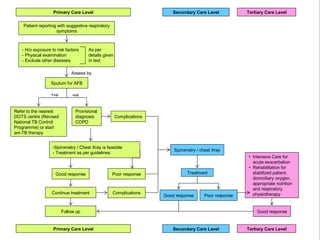
Patient reporting with suggestive respiratory
symptoms
- H/o exposure to risk factors
- Physical examination
- Exclude other diseases
As per
details given
in text
Sputum for AFB
Refer to the nearest
DOTS centre (Revised
National TB Control
Programme) or start
ani-TB therapy
Provisional
diagnosis
COPD
Complications
-Spirometry / Chest Xray is feasible
- Treatment as per guidelines
Good response Poor response
Continue treatment
Follow up
Spirometry / chest Xray
Treatment
Good response Poor response
• Intensive Care for
acute exacerbation
• Rehabilitation for
stabilized patient;
domiciliary oxygen,
appropriate nutrition
and respiratory
physiotherapy
Good response
Secondary Care Level Tertiary Care Level
+ve -ve
Assess by
Complications
Primary Care Level Secondary Care Level
Primary Care Level
Tertiary Care Level
COPD Treatment.ppt

COPD Treatment.ppt

  • 1.
    COPD: A CommonDisease - missed and misdiagnosed Surinder K. Jindal (Ex-Professor & Head, Pulm Med, PGIMER, Chandigarh) Medical Director, Jindal Clinics, Sec 20 D, Chandigarh
  • 2.
    AIMS OF TREATMENTIN COPD  Early diagnosis  Best control of symptoms  Improving exercise tolerance  Reducing exacerbations and hospitalisations
  • 3.
    COPD treatment accordingto GOLD • Avoid risk factors  Avoid risk factors +  Bronchodilator prn  Avoid risk factors  Bronchodilator prn +  Regular bronchodilator  Consider ICS  Rehabilitation  Avoid risk factors  Bronchodilator prn  Regular bronchodilator  Consider ICS  Rehabilitation +  Oxygen  Surgery At Risk Mild Moderate Severe
  • 4.
    PFT Normal FEV1/FVC<70% FEV1 >80% predicted FEV1/FVC <70% FEV1 30-80% predicted FEV1/FVC <70% FEV1 <30% predicted Treatment Tobacco cessation Short acting bronchodilators, when needed •Regular treatment with one or more bronchodilators • Pulmonary rehabilitation As in II, plus •Inhaled corticosteroids •Treatment of complications 0 - At risk I - Mild II - Moderate III - Severe Treatment of COPD According to Severity WHO-India 2003
  • 5.
    Fletcher C, PetoR: BMJ 1977 Annual Decline in Lung Function 100 75 50 25 0 25 50 75 Age Years) Stopped smoking aged 60 yr Stopped smoking aged 50 yr Susceptible smoker (10-20%) Death Disability Non smoker Non-susceptible smoker
  • 6.
    Bronchodilators are the cornerstoneof current drug therapy for COPD GOLD Guidelines 2003
  • 7.
    Brief Strategies ToHelp The Patient Willing To Quit Smoking • ASK Systematically identify all tobacco users at every visit. • ADVISE Strongly urge all tobacco users to quit. • ASSESS Determine willingness to make a quit attempt. • ASSIST Aid the patient in quitting. • ARRANGE Schedule follow-up contact.
  • 8.
    Bronchodilators for COPD •Anticholinergics (Ipratropium/ Tiotropium) • LABA (Salmeterol / Formoterol) • SABA (Salbutamol) • Combinations of above • Theophylline
  • 9.
    Theophylline • Anticholinergics andLABAs preferred • Systemic administration; effect on small airways • Anti-inflammatory effects 1 • Improves diaphragmatic efficiency 2 1 Barnes PJ ERJ 1994;7:579 - 591 2 Aubier M NEJM 1981;305:249 - 252
  • 10.
    LABAs (Salmeterol / Formoterol) •Have replaced the short-acting drugs like salbutamol in maintenance therapy • Effective and long-acting bronchodilators • Additive effect with anti-cholinergics • Can be combined in the same inhaler with steroid in severe cases
  • 11.
  • 12.
    Atropine cigarette,1940’s-50’s Rotahaler InIndia 2003 Handihaler In Europe 2002 Tiotropium capsule Ipratropium bromide – 1970’s Datura Old ages
  • 13.
    Tiotropium Bromide • 18mcg/dose • Single daily dose • Selective anticholinergic M3 receptor blocker • First-choice bronchodilator for COPD today
  • 14.
    Tiotropium vs Ipratropium (FEV1) EurResp J 2002; 19: 209-16 160 -80 -40 0 40 80 120 0 100 200 300 400 Test day T rough FEV mL 1 Difference Tiotropium Ipratropium
  • 15.
    Safety and tolerabilityof tiotropium • Most common adverse effect is dry mouth • Up to 10-15% of patients • Generally mild and rarely needs treatment discontinuation • No ECG changes or reports of any other systemic anticholinergic side effects
  • 16.
    Warnings and Precautions •Tiotropium should not be used as rescue therapy • Tiotropium may cause blurred vision and narrow-angle glaucoma • Prostatic hypertrophy, urinary retention • In patients with moderate to severe renal impairment (creatinine clearance <50 ml/min) • Not to use with other antimuscarinic drugs
  • 17.
    Domiciliary Oxygen Therapy •Unique “drug” • Only drug that reduces mortality • Prevents worsening of PH • Improves sleep quality / renal blood flow / decreases cardiac arrhythmias • Flow rate to keep SaO2 > 90 %
  • 18.
    Inhaled steroids inCOPD • Steroids are beneficial in acute exacerbation • Optimal dose unknown but duration should be no more than 2 weeks • ? Inhaled steroids beneficial in symptomatic patients with moderate to severe lung disease. • Role of inhaled steroids not completely known in COPD
  • 19.
    Long-term Oxygen Therapy(LTOT) • Should not be regarded as something to give “when all has failed” • Not addictive • Does not limit mobility around the house
  • 20.
    How do yougive oxygen ? • Oxygen cylinders • Oxygen concentrators • Portable oxygen cylinders ( liquid oxygen esp.)
  • 21.
  • 22.
    Vaccination • Pneumococcal: • 43%decrease in hospitalisations • 29 % decrease in death from all causes (2nd dose after 5 years ?) • Influenza: recommended annually ; additive benefit
  • 23.
    Pulmonary rehabilitation Very important •Postural drainage for associated bronchiectasis • Breathing exercises : Pursed-lip breathing Diaphragmatic breathing Limb exercises
  • 24.
    GOLD Guidelines: Not Recommendedfor Chronic Treatment of COPD  Mucolytics  Cromones  Antibiotics  Antitussives
  • 25.
    When to referto a specialist ? • Uncertain diagnosis • Patient requests a second opinion • Onset of cor pulmonale • Assessment for home oxygen therapy • Assessment for home nebuliser use • Bullous lung disaese ( surgery ) • Assessment for rehab./LVRS/transplant • COPD below 40 years (α1-AT def.)
  • 26.
    Conclusion • Suspect anddiagnose early • Smoking cessation • Maximum bronchodilation • Consider ICS or ICS-LABA for all severe cases • More Spirometry • Don’t forget Oxygen and Physio
  • 27.
    Patient reporting withsuggestive respiratory symptoms - H/o exposure to risk factors - Physical examination - Exclude other diseases As per details given in text Sputum for AFB Refer to the nearest DOTS centre (Revised National TB Control Programme) or start ani-TB therapy Provisional diagnosis COPD Complications -Spirometry / Chest Xray is feasible - Treatment as per guidelines Good response Poor response Continue treatment Follow up Spirometry / chest Xray Treatment Good response Poor response • Intensive Care for acute exacerbation • Rehabilitation for stabilized patient; domiciliary oxygen, appropriate nutrition and respiratory physiotherapy Good response Secondary Care Level Tertiary Care Level +ve -ve Assess by Complications Primary Care Level Secondary Care Level Primary Care Level Tertiary Care Level