RAMAKRISHNA
MISSION
VIVEKANANDA
UNIVERSITY
Guide- ATANU DEB
(Ph.D. Scholar, RKMVU)
Presented by-
AKASHDEEP NAYEK
ARINDAM BANERJEE
MANISH KUMAR
TANBIR MOHSIN
SAHEB MONDAL
SOURAV PATHAK
Outline..
O Introduction
O Objectives of DRDAs
O DRDA guidelines
O Funding pattern
O Governance and organisational structure
O Administration of DRDA
O Duties of DRDAs
O Roles and Responsibilities
O Major developmental schemes
O Wings of DRDA
Introduction..
O It is an institution that acts as a delivery
agency to support and facilitate the
development process.
O DRDAs are established for effective
implementation of anti-poverty programmes in
rural areas at district level.
O DRDA administration was introduced from 1st
April,1999.
Continue..
O The DRDA Guidelines of 1999 primarily
define:
i. the role of DRDA as a Supporting and
Facilitating Organization and being a catalyst
in the development process,
ii. the need for developing a greater
understanding of processes necessary for
poverty eradication as well as developing
capacity.
DRDA guidelines..
 DRDAs are not the implementing agencies,
but can be very effective in enhancing quality
of implementation through overseeing the
implementation of different programs and
ensuring that necessary linkages are
provided.
 DRDA is a supporting and facilitation
organization and needs to play an effective
role as a catalyst in development process.
 It will need to build synergies among different
agencies for most effective results.
Continue..
 DRDA is visualized as a specialized and
professional agency. It will continue to watch over
implementation of RD program to ensure effective
utilization of funds intended for anti-poverty
programs, as well as develop a greater
understanding of the process necessary for
poverty alleviation/reduction.
 The role of DRDA thus will be distinct from all other
agencies, including Zilla Parishad.
Objectives..
The primary objectives of DRDA are to-
O Effective manage of the anti-poverty
programmes.
O Co-ordinate effectively with other agencies
and departments like PRIs, banks and
other financial institutions, the NGOs and
other technical institutions to gather
support and resources required for poverty
elimination at the district level.
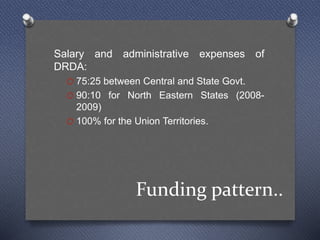
Funding pattern..
Salary and administrative expenses of
DRDA:
O 75:25 between Central and State Govt.
O 90:10 for North Eastern States (2008-
2009)
O 100% for the Union Territories.
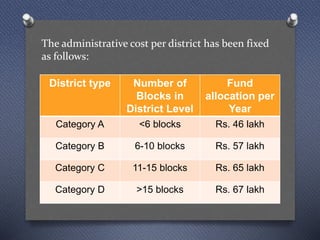
The administrative cost per district has been fixed
as follows:
District type Number of
Blocks in
District Level
Fund
allocation per
Year
Category A <6 blocks Rs. 46 lakh
Category B 6-10 blocks Rs. 57 lakh
Category C 11-15 blocks Rs. 65 lakh
Category D >15 blocks Rs. 67 lakh
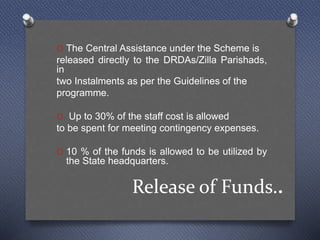
Release of Funds..
O The Central Assistance under the Scheme is
released directly to the DRDAs/Zilla Parishads,
in
two Instalments as per the Guidelines of the
programme.
O Up to 30% of the staff cost is allowed
to be spent for meeting contingency expenses.
O 10 % of the funds is allowed to be utilized by
the State headquarters.
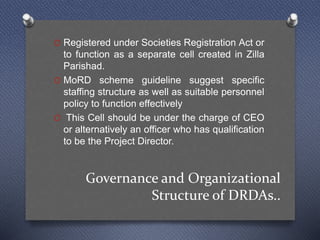
Governance and Organizational
Structure of DRDAs..
O Registered under Societies Registration Act or
to function as a separate cell created in Zilla
Parishad.
O MoRD scheme guideline suggest specific
staffing structure as well as suitable personnel
policy to function effectively
O This Cell should be under the charge of CEO
or alternatively an officer who has qualification
to be the Project Director.
Continue..
Indian States(29)
23 states
Have DRDAs
6 states [KARNATAKA,
RJ, MP, CH, WB,
KERALA]
Functioning through
PRI
Continue..
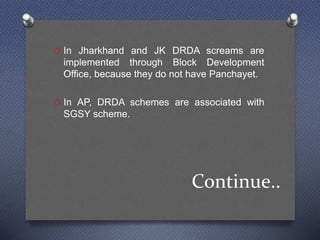
O In Jharkhand and JK DRDA screams are
implemented through Block Development
Office, because they do not have Panchayet.
O In AP, DRDA schemes are associated with
SGSY scheme.
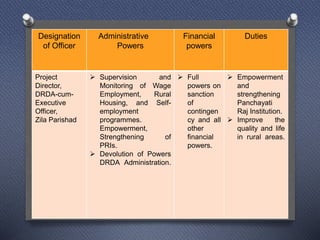
Designation
of Officer
Administrative
Powers
Financial
powers
Duties
Project
Director,
DRDA-cum-
Executive
Officer,
Zila Parishad
 Supervision and
Monitoring of Wage
Employment, Rural
Housing, and Self-
employment
programmes.
Empowerment,
Strengthening of
PRIs.
 Devolution of Powers
DRDA Administration.
 Full
powers on
sanction
of
contingen
cy and all
other
financial
powers.
 Empowerment
and
strengthening
Panchayati
Raj Institution.
 Improve the
quality and life
in rural areas.
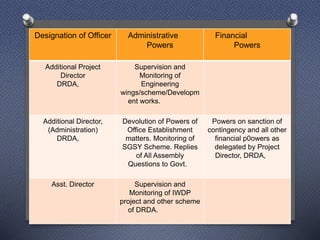
Designation of Officer Administrative
Powers
Financial
Powers
Additional Project
Director
DRDA,
Supervision and
Monitoring of
Engineering
wings/scheme/Developm
ent works.
Additional Director,
(Administration)
DRDA,
Devolution of Powers of
Office Establishment
matters. Monitoring of
SGSY Scheme. Replies
of All Assembly
Questions to Govt.
Powers on sanction of
contingency and all other
financial p0owers as
delegated by Project
Director, DRDA,
Asst. Director Supervision and
Monitoring of IWDP
project and other scheme
of DRDA.
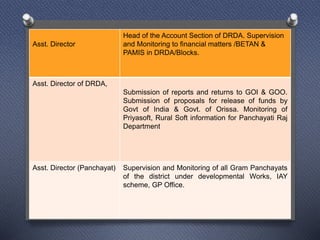
Asst. Director
Head of the Account Section of DRDA. Supervision
and Monitoring to financial matters /BETAN &
PAMIS in DRDA/Blocks.
Asst. Director of DRDA,
Submission of reports and returns to GOI & GOO.
Submission of proposals for release of funds by
Govt of India & Govt. of Orissa. Monitoring of
Priyasoft, Rural Soft information for Panchayati Raj
Department
Asst. Director (Panchayat) Supervision and Monitoring of all Gram Panchayats
of the district under developmental Works, IAY
scheme, GP Office.
Administration of DRDA..
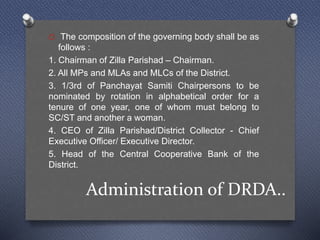
O The composition of the governing body shall be as
follows :
1. Chairman of Zilla Parishad – Chairman.
2. All MPs and MLAs and MLCs of the District.
3. 1/3rd of Panchayat Samiti Chairpersons to be
nominated by rotation in alphabetical order for a
tenure of one year, one of whom must belong to
SC/ST and another a woman.
4. CEO of Zilla Parishad/District Collector - Chief
Executive Officer/ Executive Director.
5. Head of the Central Cooperative Bank of the
District.
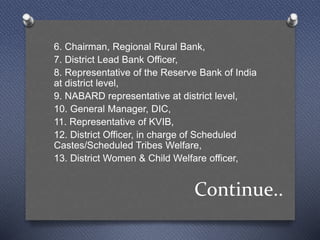
Continue..
6. Chairman, Regional Rural Bank,
7. District Lead Bank Officer,
8. Representative of the Reserve Bank of India
at district level,
9. NABARD representative at district level,
10. General Manager, DIC,
11. Representative of KVIB,
12. District Officer, in charge of Scheduled
Castes/Scheduled Tribes Welfare,
13. District Women & Child Welfare officer,
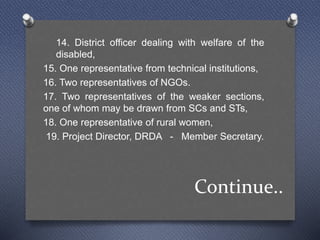
Continue..
14. District officer dealing with welfare of the
disabled,
15. One representative from technical institutions,
16. Two representatives of NGOs.
17. Two representatives of the weaker sections,
one of whom may be drawn from SCs and STs,
18. One representative of rural women,
19. Project Director, DRDA - Member Secretary.
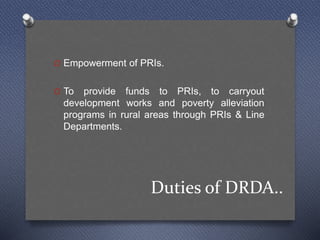
Duties of DRDA..
O Empowerment of PRIs.
O To provide funds to PRIs, to carryout
development works and poverty alleviation
programs in rural areas through PRIs & Line
Departments.
Functions..
O To enhance quality of implementation through
overseeing the implementation of different
programmes and ensuring that necessary
linkages are provided.
O It play an effective role as a catalyst in
development process.
O It works for poverty alleviation through
implementation of several RD programmes.
Continue..
O It builts synergies among different agencies
for most effective results.
O The role of DRDA thus will be distinct from all
other agencies, including Zilla Parishad.
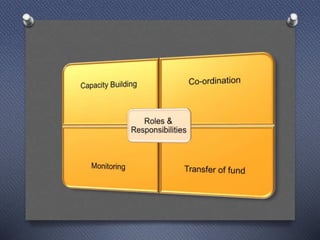
Roles & Responsibilities..
Capacity Building-
a. To watch over and ensure effective
utilisation of funds for anti poverty
programmes.
b. To develop an understanding of the
processes necessary for poverty eradication.
Continue..
Co-ordination-
a. DRDA must be professional and should be
able to interact effectively with various other
agencies.
b. They co-ordinate with the line department, the
PRI’s, Banks and other financial institutions.
c. To facilitate in the formation of the community
based organisations..
Continue..
Monitoring-
a. It monitors the implementation through
obtaining periodic reports as well as
making frequent field visits.
b. It verifies whether the beneficiaries are
receiving the benefits under different
programmes.
Continue..
Transfer of fund-
a. All funds are transferred for all the
schemes in a district through DRDA.
b. TO ensure that the accounts are properly
maintained in respect of funds allocated
to the banks or the implementing
agencies.
Continue..
Other functions-
a. It co ordinate and oversee the conduct of
BPL census and such other surveys that
are required time to time.
b. Deals with the anti poverty programmes
of the MoRD.
c. To formulate policy guidelines for DRDAs.
d. Release of funds under DRDA
administration scheme.
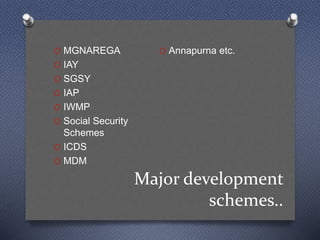
Major development
schemes..
O MGNAREGA
O IAY
O SGSY
O IAP
O IWMP
O Social Security
Schemes
O ICDS
O MDM
O Annapurna etc.
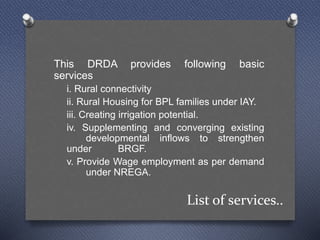
List of services..
This DRDA provides following basic
services
i. Rural connectivity
ii. Rural Housing for BPL families under IAY.
iii. Creating irrigation potential.
iv. Supplementing and converging existing
developmental inflows to strengthen
under BRGF.
v. Provide Wage employment as per demand
under NREGA.
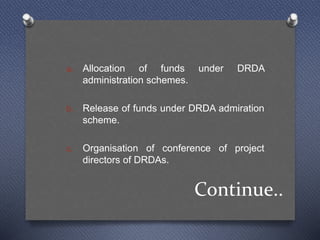
Continue..
a. Allocation of funds under DRDA
administration schemes.
b. Release of funds under DRDA admiration
scheme.
c. Organisation of conference of project
directors of DRDAs.
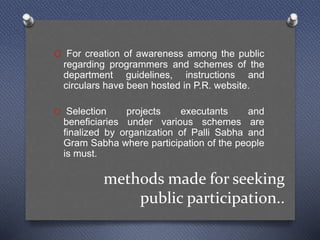
methods made for seeking
public participation..
O For creation of awareness among the public
regarding programmers and schemes of the
department guidelines, instructions and
circulars have been hosted in P.R. website.
O Selection projects executants and
beneficiaries under various schemes are
finalized by organization of Palli Sabha and
Gram Sabha where participation of the people
is must.
Wings of DRDA..
1. Self-employment wing.
2. Women’s wing.
3. Wage employment wing
4. Accounts wing.
5. Monitoring and evaluation wing
1. Self-employment wing
 Is headed by a project officer and has APOs
in the field of planning, social mobilization,
credit and technology.
 The APO (credit), who is from the commertial
banking sector , co-ordinates with the banks
in all matters relating to credit , credit
including the interface between the bankers
and the beneficiaries /beneficiary groups ,
loan disbursementes as well as loan recovery.
Continue..
 The APO(social Mobilization) looks after
group formation , capacity building ,
monitoring of groups , choice of activities for
groups , release of revolving funds and co-
ordination.
 The APO (technology) looks after issues
concerning technology up gradation as well
as transfer of technology.
2. Women’s wing
 In order to ensure that women receive
adequate attention in all the anti- poverty
programs , a women's cell is set up in each
DRDA.
 The women wing is headed by an assistance
project officer , who will function under the
overall coordination of the project officer of the
self-employment wing.
Continue..
O This cell establishes necessary synergy with
departments such as women & children
development, education and health
departments to ensure that women not only
receive their due share in the anti-poverty
programs but are also able to receive benefits
of other programs.
3. Wage employment wing
 the central concern of the DRDA in the wage-employment
programmes is related to planning , monitoring and vigilance
by a technical wing.
 The DRDA does not concern itself with the actual
implementation and execution of works which is done by the
line departments / engineers or the PRI.
 The wage employment wing is headed by a project officer
assisted by a small complement of staff .
4. Accounts wing
 The DRDAs have the commercial accounting system.
 They are to publish an annual report along with the
balance sheet.
 For IAY, one accountant at the district level should be
available to monitor the progress of the programme
and the accounts.
 One of the accounts officer performs the role of
internal auditor.
5. Monitor and evaluation
wing
 This is a separate monitoring and evaluation wing
headed by a project economist and functioning
directly under the supervision of the project director.
 It monitors the process of all the programs.
 it carries out evaluation/impact studies regularly by
independent institutions/experts including NGOs.
Continue..
 The cost of such studie is met from the
respective programme funds.
 This wing also monitors issues regarding to
poverty in the districts.

DRDA Basic strategy.

  • 1.
    RAMAKRISHNA MISSION VIVEKANANDA UNIVERSITY Guide- ATANU DEB (Ph.D.Scholar, RKMVU) Presented by- AKASHDEEP NAYEK ARINDAM BANERJEE MANISH KUMAR TANBIR MOHSIN SAHEB MONDAL SOURAV PATHAK
  • 2.
    Outline.. O Introduction O Objectivesof DRDAs O DRDA guidelines O Funding pattern O Governance and organisational structure O Administration of DRDA O Duties of DRDAs O Roles and Responsibilities O Major developmental schemes O Wings of DRDA
  • 3.
    Introduction.. O It isan institution that acts as a delivery agency to support and facilitate the development process. O DRDAs are established for effective implementation of anti-poverty programmes in rural areas at district level. O DRDA administration was introduced from 1st April,1999.
  • 4.
    Continue.. O The DRDAGuidelines of 1999 primarily define: i. the role of DRDA as a Supporting and Facilitating Organization and being a catalyst in the development process, ii. the need for developing a greater understanding of processes necessary for poverty eradication as well as developing capacity.
  • 5.
    DRDA guidelines..  DRDAsare not the implementing agencies, but can be very effective in enhancing quality of implementation through overseeing the implementation of different programs and ensuring that necessary linkages are provided.  DRDA is a supporting and facilitation organization and needs to play an effective role as a catalyst in development process.  It will need to build synergies among different agencies for most effective results.
  • 6.
    Continue..  DRDA isvisualized as a specialized and professional agency. It will continue to watch over implementation of RD program to ensure effective utilization of funds intended for anti-poverty programs, as well as develop a greater understanding of the process necessary for poverty alleviation/reduction.  The role of DRDA thus will be distinct from all other agencies, including Zilla Parishad.
  • 7.
    Objectives.. The primary objectivesof DRDA are to- O Effective manage of the anti-poverty programmes. O Co-ordinate effectively with other agencies and departments like PRIs, banks and other financial institutions, the NGOs and other technical institutions to gather support and resources required for poverty elimination at the district level.
  • 8.
    Funding pattern.. Salary andadministrative expenses of DRDA: O 75:25 between Central and State Govt. O 90:10 for North Eastern States (2008- 2009) O 100% for the Union Territories.
  • 9.
    The administrative costper district has been fixed as follows: District type Number of Blocks in District Level Fund allocation per Year Category A <6 blocks Rs. 46 lakh Category B 6-10 blocks Rs. 57 lakh Category C 11-15 blocks Rs. 65 lakh Category D >15 blocks Rs. 67 lakh
  • 10.
    Release of Funds.. OThe Central Assistance under the Scheme is released directly to the DRDAs/Zilla Parishads, in two Instalments as per the Guidelines of the programme. O Up to 30% of the staff cost is allowed to be spent for meeting contingency expenses. O 10 % of the funds is allowed to be utilized by the State headquarters.
  • 11.
    Governance and Organizational Structureof DRDAs.. O Registered under Societies Registration Act or to function as a separate cell created in Zilla Parishad. O MoRD scheme guideline suggest specific staffing structure as well as suitable personnel policy to function effectively O This Cell should be under the charge of CEO or alternatively an officer who has qualification to be the Project Director.
  • 12.
    Continue.. Indian States(29) 23 states HaveDRDAs 6 states [KARNATAKA, RJ, MP, CH, WB, KERALA] Functioning through PRI
  • 13.
    Continue.. O In Jharkhandand JK DRDA screams are implemented through Block Development Office, because they do not have Panchayet. O In AP, DRDA schemes are associated with SGSY scheme.
  • 14.
    Designation of Officer Administrative Powers Financial powers Duties Project Director, DRDA-cum- Executive Officer, Zila Parishad Supervision and Monitoring of Wage Employment, Rural Housing, and Self- employment programmes. Empowerment, Strengthening of PRIs.  Devolution of Powers DRDA Administration.  Full powers on sanction of contingen cy and all other financial powers.  Empowerment and strengthening Panchayati Raj Institution.  Improve the quality and life in rural areas.
  • 15.
    Designation of OfficerAdministrative Powers Financial Powers Additional Project Director DRDA, Supervision and Monitoring of Engineering wings/scheme/Developm ent works. Additional Director, (Administration) DRDA, Devolution of Powers of Office Establishment matters. Monitoring of SGSY Scheme. Replies of All Assembly Questions to Govt. Powers on sanction of contingency and all other financial p0owers as delegated by Project Director, DRDA, Asst. Director Supervision and Monitoring of IWDP project and other scheme of DRDA.
  • 16.
    Asst. Director Head ofthe Account Section of DRDA. Supervision and Monitoring to financial matters /BETAN & PAMIS in DRDA/Blocks. Asst. Director of DRDA, Submission of reports and returns to GOI & GOO. Submission of proposals for release of funds by Govt of India & Govt. of Orissa. Monitoring of Priyasoft, Rural Soft information for Panchayati Raj Department Asst. Director (Panchayat) Supervision and Monitoring of all Gram Panchayats of the district under developmental Works, IAY scheme, GP Office.
  • 17.
    Administration of DRDA.. OThe composition of the governing body shall be as follows : 1. Chairman of Zilla Parishad – Chairman. 2. All MPs and MLAs and MLCs of the District. 3. 1/3rd of Panchayat Samiti Chairpersons to be nominated by rotation in alphabetical order for a tenure of one year, one of whom must belong to SC/ST and another a woman. 4. CEO of Zilla Parishad/District Collector - Chief Executive Officer/ Executive Director. 5. Head of the Central Cooperative Bank of the District.
  • 18.
    Continue.. 6. Chairman, RegionalRural Bank, 7. District Lead Bank Officer, 8. Representative of the Reserve Bank of India at district level, 9. NABARD representative at district level, 10. General Manager, DIC, 11. Representative of KVIB, 12. District Officer, in charge of Scheduled Castes/Scheduled Tribes Welfare, 13. District Women & Child Welfare officer,
  • 19.
    Continue.. 14. District officerdealing with welfare of the disabled, 15. One representative from technical institutions, 16. Two representatives of NGOs. 17. Two representatives of the weaker sections, one of whom may be drawn from SCs and STs, 18. One representative of rural women, 19. Project Director, DRDA - Member Secretary.
  • 20.
    Duties of DRDA.. OEmpowerment of PRIs. O To provide funds to PRIs, to carryout development works and poverty alleviation programs in rural areas through PRIs & Line Departments.
  • 21.
    Functions.. O To enhancequality of implementation through overseeing the implementation of different programmes and ensuring that necessary linkages are provided. O It play an effective role as a catalyst in development process. O It works for poverty alleviation through implementation of several RD programmes.
  • 22.
    Continue.. O It builtssynergies among different agencies for most effective results. O The role of DRDA thus will be distinct from all other agencies, including Zilla Parishad.
  • 24.
    Roles & Responsibilities.. CapacityBuilding- a. To watch over and ensure effective utilisation of funds for anti poverty programmes. b. To develop an understanding of the processes necessary for poverty eradication.
  • 25.
    Continue.. Co-ordination- a. DRDA mustbe professional and should be able to interact effectively with various other agencies. b. They co-ordinate with the line department, the PRI’s, Banks and other financial institutions. c. To facilitate in the formation of the community based organisations..
  • 26.
    Continue.. Monitoring- a. It monitorsthe implementation through obtaining periodic reports as well as making frequent field visits. b. It verifies whether the beneficiaries are receiving the benefits under different programmes.
  • 27.
    Continue.. Transfer of fund- a.All funds are transferred for all the schemes in a district through DRDA. b. TO ensure that the accounts are properly maintained in respect of funds allocated to the banks or the implementing agencies.
  • 28.
    Continue.. Other functions- a. Itco ordinate and oversee the conduct of BPL census and such other surveys that are required time to time. b. Deals with the anti poverty programmes of the MoRD. c. To formulate policy guidelines for DRDAs. d. Release of funds under DRDA administration scheme.
  • 29.
    Major development schemes.. O MGNAREGA OIAY O SGSY O IAP O IWMP O Social Security Schemes O ICDS O MDM O Annapurna etc.
  • 30.
    List of services.. ThisDRDA provides following basic services i. Rural connectivity ii. Rural Housing for BPL families under IAY. iii. Creating irrigation potential. iv. Supplementing and converging existing developmental inflows to strengthen under BRGF. v. Provide Wage employment as per demand under NREGA.
  • 31.
    Continue.. a. Allocation offunds under DRDA administration schemes. b. Release of funds under DRDA admiration scheme. c. Organisation of conference of project directors of DRDAs.
  • 32.
    methods made forseeking public participation.. O For creation of awareness among the public regarding programmers and schemes of the department guidelines, instructions and circulars have been hosted in P.R. website. O Selection projects executants and beneficiaries under various schemes are finalized by organization of Palli Sabha and Gram Sabha where participation of the people is must.
  • 33.
    Wings of DRDA.. 1.Self-employment wing. 2. Women’s wing. 3. Wage employment wing 4. Accounts wing. 5. Monitoring and evaluation wing
  • 34.
    1. Self-employment wing Is headed by a project officer and has APOs in the field of planning, social mobilization, credit and technology.  The APO (credit), who is from the commertial banking sector , co-ordinates with the banks in all matters relating to credit , credit including the interface between the bankers and the beneficiaries /beneficiary groups , loan disbursementes as well as loan recovery.
  • 35.
    Continue..  The APO(socialMobilization) looks after group formation , capacity building , monitoring of groups , choice of activities for groups , release of revolving funds and co- ordination.  The APO (technology) looks after issues concerning technology up gradation as well as transfer of technology.
  • 36.
    2. Women’s wing In order to ensure that women receive adequate attention in all the anti- poverty programs , a women's cell is set up in each DRDA.  The women wing is headed by an assistance project officer , who will function under the overall coordination of the project officer of the self-employment wing.
  • 37.
    Continue.. O This cellestablishes necessary synergy with departments such as women & children development, education and health departments to ensure that women not only receive their due share in the anti-poverty programs but are also able to receive benefits of other programs.
  • 38.
    3. Wage employmentwing  the central concern of the DRDA in the wage-employment programmes is related to planning , monitoring and vigilance by a technical wing.  The DRDA does not concern itself with the actual implementation and execution of works which is done by the line departments / engineers or the PRI.  The wage employment wing is headed by a project officer assisted by a small complement of staff .
  • 39.
    4. Accounts wing The DRDAs have the commercial accounting system.  They are to publish an annual report along with the balance sheet.  For IAY, one accountant at the district level should be available to monitor the progress of the programme and the accounts.  One of the accounts officer performs the role of internal auditor.
  • 40.
    5. Monitor andevaluation wing  This is a separate monitoring and evaluation wing headed by a project economist and functioning directly under the supervision of the project director.  It monitors the process of all the programs.  it carries out evaluation/impact studies regularly by independent institutions/experts including NGOs.
  • 41.
    Continue..  The costof such studie is met from the respective programme funds.  This wing also monitors issues regarding to poverty in the districts.