

farming
Primary sector
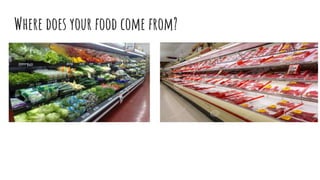
Where does your food come from?
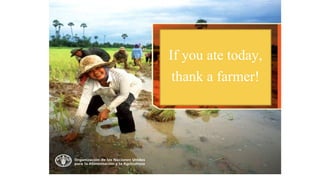
If you ate today,
thank a farmer!
WHAT IS FARMING?
What is FARMING?
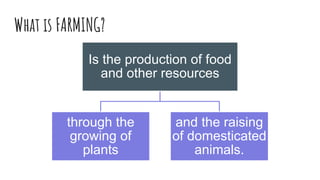
Is the production of food
and other resources
through the
growing of
plants
and the raising
of domesticated
animals.
FARMING AS A SYSTEM
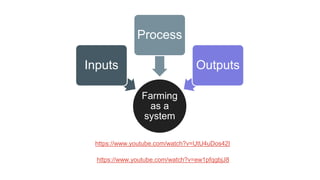
Farming
as a
system
Inputs
Process
Outputs
https://www.youtube.com/watch?v=UtU4uDos42I
https://www.youtube.com/watch?v=ew1pfqgbjJ8
INPUTS: PHYSICAL FACTORS
Natural things that are either found on a farm or
are added to a farm.
PHISICAL FACTORS
RELIEF
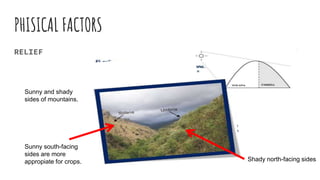
Sunny and shady
sides of mountains.
Sunny south-facing
sides are more
appropiate for crops. Shady north-facing sides
PHISICAL FACTORS
RELIEF
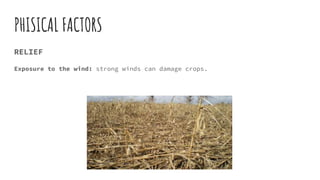
Exposure to the wind: strong winds can damage crops.
PHISICAL FACTORS
RELIEF
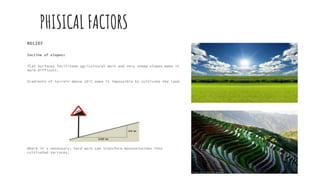
Incline of slopes:
flat surfaces facilitate agricultural work and very steep slopes make it
more difficult.
Gradients of terrain above 10ºC make it impossible to cultivate the land.
Where it´s necessary, hard work can transform mountainsides into
cultivated terraces.
RELIEF
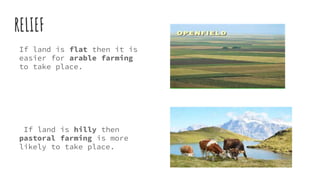
If land is flat then it is
easier for arable farming
to take place.
If land is hilly then
pastoral farming is more
likely to take place.
PHISICAL FACTORS
RELIEF
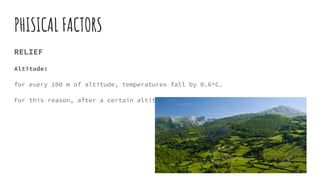
Altitude:
for every 100 m of altitude, temperatures fall by 0.6ºC.
For this reason, after a certain altitude, cultivation is no longer possible.
PHISICAL FACTORS
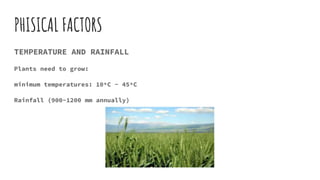
TEMPERATURE AND RAINFALL
Plants need to grow:
minimum temperatures: 10ºC - 45ºC
Rainfall (900-1200 mm annually)
PHISICAL FACTORS
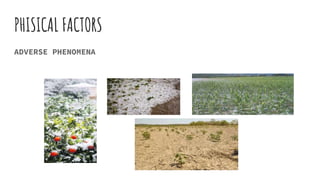
ADVERSE PHENOMENA
PHISICAL FACTORS
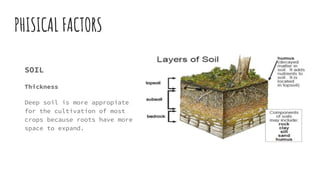
SOIL
Thickness
Deep soil is more appropiate
for the cultivation of most
crops because roots have more
space to expand.
PHISICAL FACTORS
SOIL
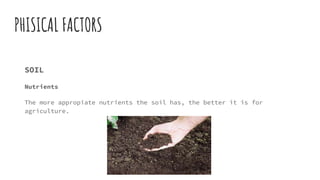
Nutrients
The more appropiate nutrients the soil has, the better it is for
agriculture.
PHYSICAL FACTORS
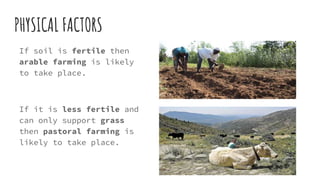
If soil is fertile then
arable farming is likely
to take place.
If it is less fertile and
can only support grass
then pastoral farming is
likely to take place.
PHISICAL FACTORS
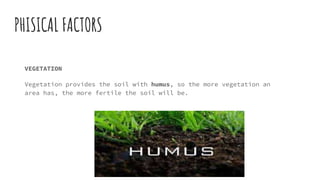
VEGETATION
Vegetation provides the soil with humus, so the more vegetation an
area has, the more fertile the soil will be.
STRUCTURE OF
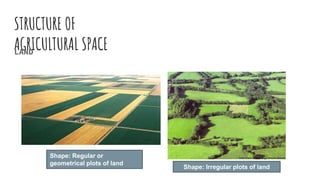
AGRICULTURAL SPACELAND
Shape: Regular or
geometrical plots of land
Shape: Irregular plots of land
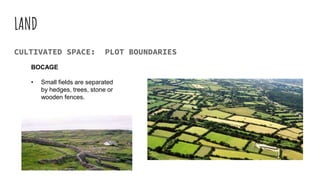
LAND
CULTIVATED SPACE: PLOT BOUNDARIES
BOCAGE
• Small fields are separated
by hedges, trees, stone or
wooden fences.
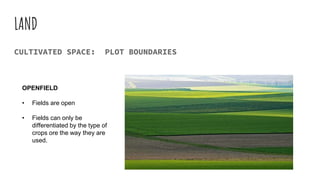
LAND
CULTIVATED SPACE: PLOT BOUNDARIES
OPENFIELD
• Fields are open
• Fields can only be
differentiated by the type of
crops ore the way they are
used.
INPUTS: HUMAN FACTORS
Things that are built or made by humans and added
to a farm.
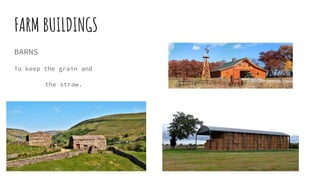
FARM BUILDINGS
BARNS
To keep the grain and
the straw.
FARM BUILDINGS
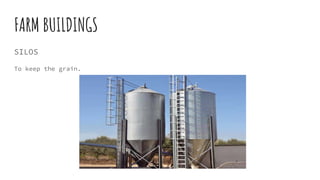
SILOS
To keep the grain.
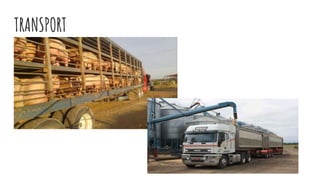
TRANSPORT
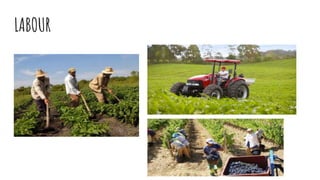
LABOUR
SUBSIDIES and POLICIES
AGRICULTURAL POLICY
Measures and actions taken by:
National government
International institutions
These measures affect crop agriculture and livestock farming.
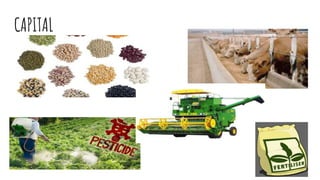
CAPITAL
PROCESSES
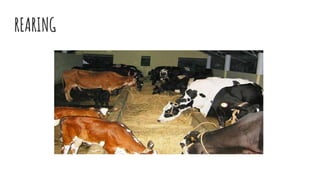
REARING
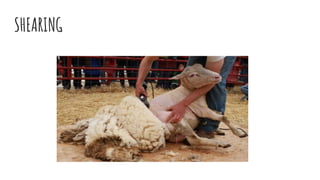
SHEARING
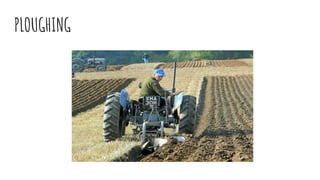
PLOUGHING
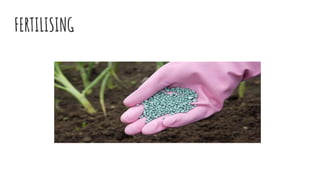
FERTILISING
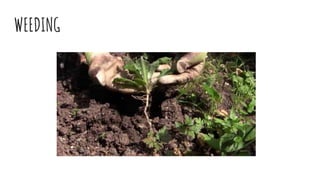
WEEDING
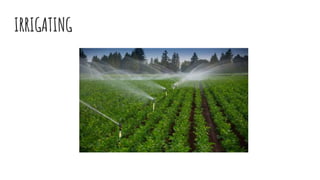
IRRIGATING
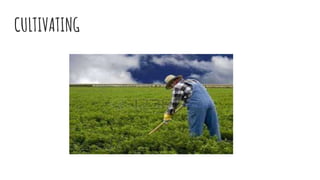
CULTIVATING
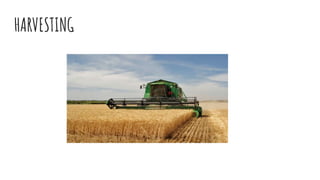
HARVESTING
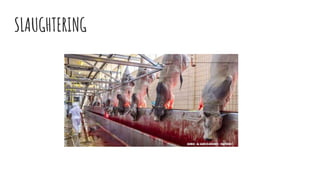
SLAUGHTERING
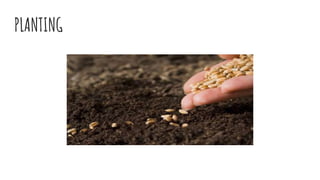
PLANTING
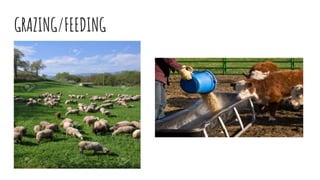
GRAZING/FEEDING
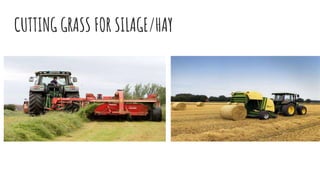
CUTTING GRASS FOR SILAGE/HAY
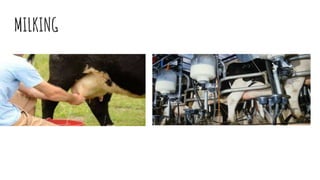
MILKING
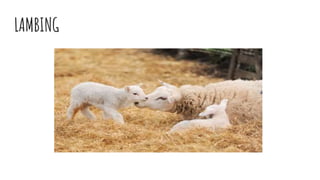
LAMBING
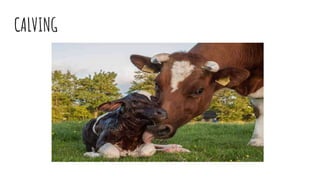
CALVING
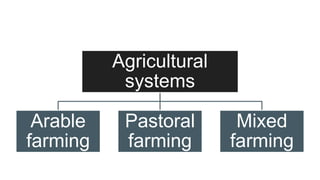
AGRICULTURAL SYSTEMS
Agricultural
systems
Arable
farming
Pastoral
farming
Mixed
farming
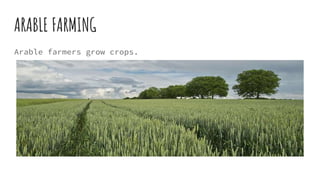
ARABLE FARMING
Arable farmers grow crops.
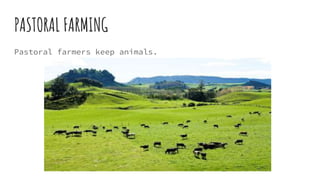
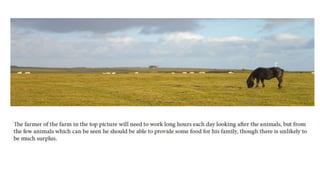
PASTORAL FARMING
Pastoral farmers keep animals.
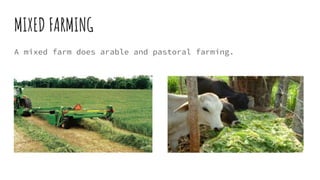
MIXED FARMING
A mixed farm does arable and pastoral farming.
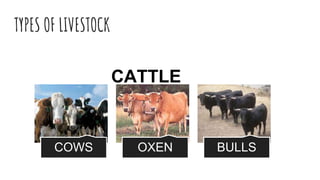
TYPES OF LIVESTOCK
COWS OXEN BULLS
CATTLE
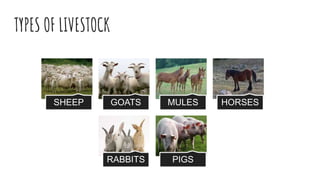
TYPES OF LIVESTOCK
SHEEP GOATS MULES HORSES
RABBITS PIGS
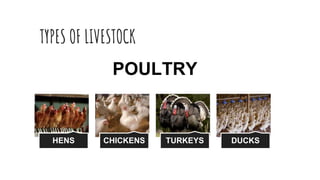
TYPES OF LIVESTOCK
HENS CHICKENS TURKEYS DUCKS
POULTRY
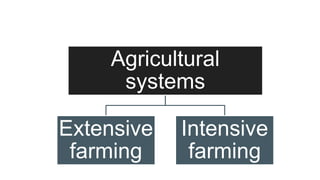
Agricultural
systems
Extensive
farming
Intensive
farming
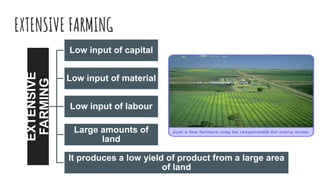
EXTENSIVE FARMINGEXTENSIVE
FARMING Low input of capital
Low input of material
Low input of labour
Large amounts of
land
It produces a low yield of product from a large area
of land
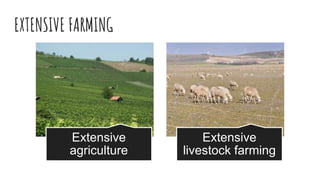
EXTENSIVE FARMING
Extensive
agriculture
Extensive
livestock farming
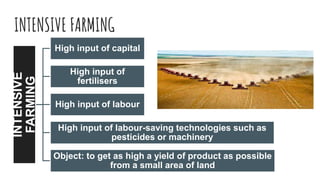
INTENSIVE FARMING
INTENSIVE
FARMING
High input of capital
High input of
fertilisers
High input of labour
High input of labour-saving technologies such as
pesticides or machinery
Object: to get as high a yield of product as possible
from a small area of land
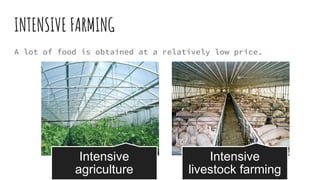
INTENSIVE FARMING
A lot of food is obtained at a relatively low price.
Intensive
agriculture
Intensive
livestock farming
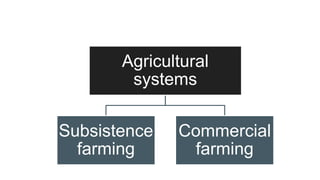
Agricultural
systems
Subsistence
farming
Commercial
farming
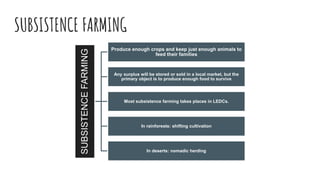
SUBSISTENCE FARMING
SUBSISTENCEFARMING
Produce enough crops and keep just enough animals to
feed their families
Any surplus will be stored or sold in a local market, but the
primary object is to produce enough food to survive
Most subsistence farming takes places in LEDCs.
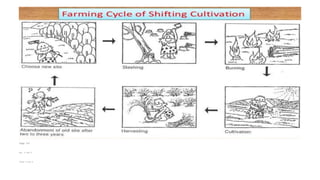
In rainforests: shifting cultivation
In deserts: nomadic herding
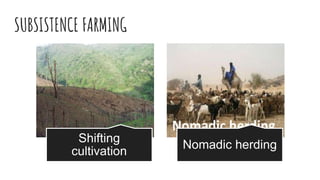
SUBSISTENCE FARMING
Shifting
cultivation
Nomadic herding
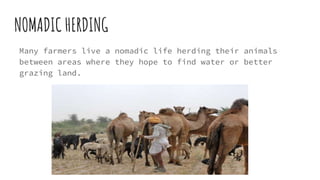
NOMADIC HERDING
Many farmers live a nomadic life herding their animals
between areas where they hope to find water or better
grazing land.
Page 147
Doc. D and E
Tasks 4 and 5
SUBSISTENCE AGRICULTURE
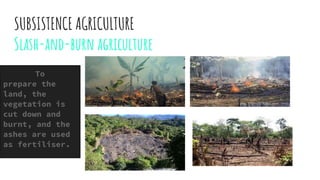
Slash-and-burn agriculture
To
prepare the
land, the
vegetation is
cut down and
burnt, and the
ashes are used
as fertiliser.
SUBSISTENCE AGRICULTURE
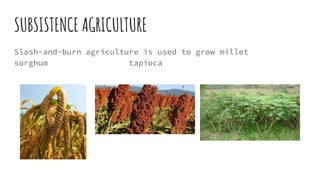
Slash-and-burn agriculture is used to grow millet
sorghum tapioca
SUBSISTENCE AGRICULTURE
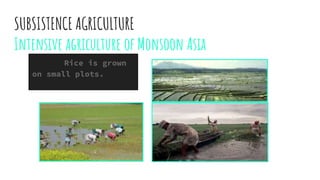
Intensive agriculture of Monsoon Asia
Rice is grown
on small plots.
0
2
4
6
8
10
12
14
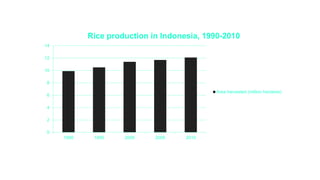
1990 1995 2000 2005 2010
Rice production in Indonesia, 1990-2010
Area harvested (million hectares)
0
1
2
3
4
5
6
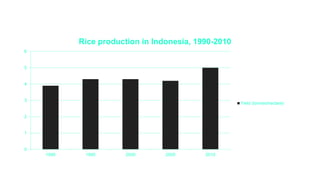
1990 1995 2000 2005 2010
Rice production in Indonesia, 1990-2010
Yield (tonnes/hectare)
0
10
20
30
40
50
60
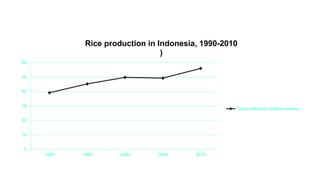
1990 1995 2000 2005 2010
Rice production in Indonesia, 1990-2010
)
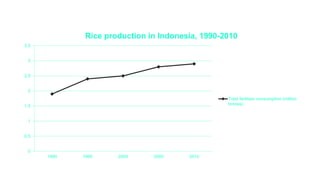
Total production (million tonnes)
0
0.5
1
1.5
2
2.5
3
3.5
1990 1995 2000 2005 2010
Rice production in Indonesia, 1990-2010
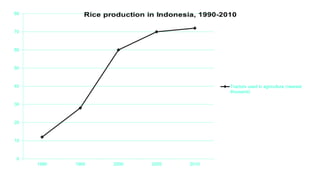
Total fertiliser consumption (million
tonnes)
0
10
20
30
40
50
60
70
80
1990 1995 2000 2005 2010
Tractors used in agriculture (nearest
thousand)
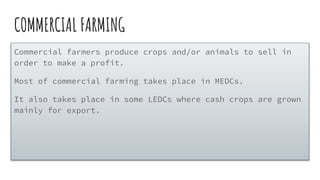
COMMERCIAL FARMING
Commercial farmers produce crops and/or animals to sell in
order to make a profit.
Most of commercial farming takes place in MEDCs.
It also takes place in some LEDCs where cash crops are grown
mainly for export.
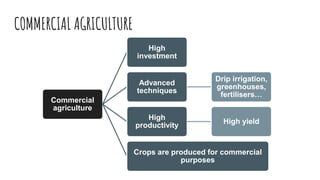
COMMERCIAL AGRICULTURE
Commercial
agriculture
High
investment
Advanced
techniques
Drip irrigation,
greenhouses,
fertilisers…
High
productivity
High yield
Crops are produced for commercial
purposes
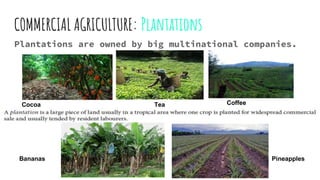
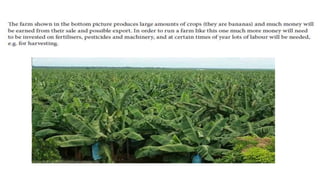
COMMERCIAL AGRICULTURE: Plantations
Plantations are owned by big multinational companies.
Cocoa
Bananas Pineapples
Tea Coffee
CASE STUDY
AN EXAMPLE OF COMMERCIAL AGRICULTURE
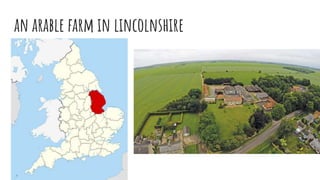
AN ARABLE FARM IN LINCOLNSHIRE, UK
an arable farm in lincolnshire
THE EUROPEAN
UNION AND THE
COMMON
AGRICULTURAL
POLICY
THE EUROPEAN UNION
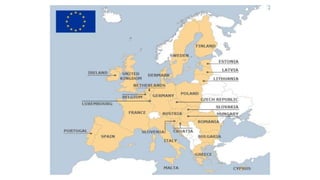
This is an organisation of 28 countries and over 500 million
people that trade with each other as a common market.
In 2017 the U.K. is going to leave the European Union (E.U)
after a referendum in their country in 2016 (Brexit).
the european union
The E.U. is a group of European countries that have joined
together to create an area for free trade of goods and
services as well as movement of people.
- This means that the exports of goods and services among
the E.U. members don´t have to pay a customs duty when
crossing the borders.
- This means, as well, that the citizens of the E.U. can
travel to other member states withour passport. Moreover,
they can cross the borders without being stopped at
Customs
the european union
The common trading, economic and social policies intend to be
beneficial to all member countries.
the european union
Each member country must contribute some money to a central
fund to belong to the EU.
This money is available to farmers as grants and subsidies
(see Glossary).
These were used to produce the food required by the whole of
the EU.
the european union and the common agricultural policy
The EU has developed the Common Agricultural Policy (CAP):
- Strategies for the control and develpment of farming that
have been adopted by all members of the EU.
- These strategies are for commercial farming:
- Farmers whose main aim is to grow crops or keep livestock to sell for
a profit.
the european union and the common agricultural policy
Under the CAP, farmers can produce what they want but only
get grants and subsidies if they meet the EU production
targets.
the european union and the common agricultural policy
In the past decade EU funding for agriculture has changed.
Grants and subsidies are still available but they have been
partly replaced by direct payments.
- These are EU payments which are given directly to farmers
who meet certain requirements of the EU for growing crops,
keeping livestock or looking after the countryside:
- farm size
- environmental protection
- animal welfare
the european union and the common agricultural policy
- Farmers can grow what they like depending on market
conditions.
- Other payments are given for conservation measures such
as keeping hedges for wildlife and keeping footpaths
open.
the european union and the common agricultural policy
- Consequences of CAP:
- It has affected the inputs, processes and outputs on the farm.
- It has influenced the farmer´s choices.
- It has changed the appearance of the rural environment in the UK.
COMMENTARIES OF PICTURES
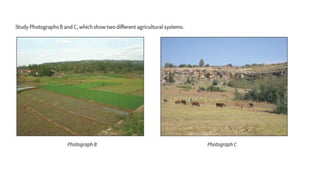
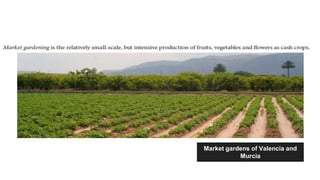
Market gardens of Valencia and
Murcia

Primary sector farming