UNIVERSITY OF THE ARMED FORCES-ESPE
AT A DISTANCE EDUCATION MODE
ESTIMATION OF COSTS
SARA ABIGAIL SALAZAR LOOR
LCDO. MIGUEL VINICIOPONCE MEDINA, PHD.
2017-2018
ESTIMATION OF COSTS
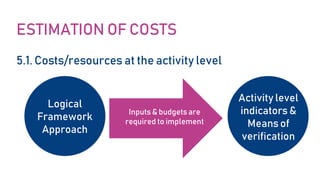
5.1. Costs/resources at the activity level
Logical
Framework
Approach
Activity level
indicators &
Means of
verification
Inputs & budgets are
required to implement
Indicators Costs
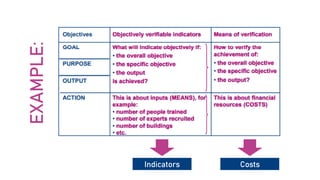
EXAMPLE:
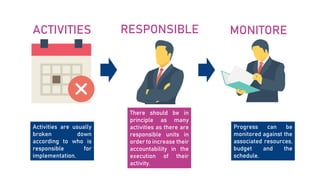
Activities are usually
broken down
according to who is
responsible for
implementation.
ACTIVITIES RESPONSIBLE MONITORE
Progress can be
monitored against the
associated resources,
budget and the
schedule.
There should be in
principle as many
activities as there are
responsible units in
order to increase their
accountability in the
execution of their
activity.
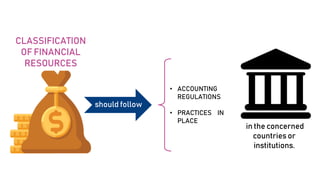
• ACCOUNTING
REGULATIONS
• PRACTICES IN
PLACE
CLASSIFICATION
OF FINANCIAL
RESOURCES
should follow
in the concerned
countries or
institutions.
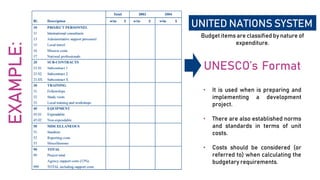
Budget items are classified by nature of
expenditure.
EXAMPLE: UNITED NATIONS SYSTEM
• It is used when is preparing and
implementing a development
project.
• There are also established norms
and standards in terms of unit
costs.
• Costs should be considered (or
referred to) when calculating the
budgetary requirements.
UNESCO’s Format
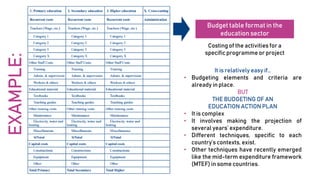
It is relatively easy if…
• Budgeting elements and criteria are
already in place.
BUT
THE BUDGETING OF AN
EDUCATION ACTION PLAN
• It is complex
• It involves making the projection of
several years’ expenditure.
• Different techniques, specific to each
country’s contexts, exist.
• Other techniques have recently emerged
like the mid-term expenditure framework
(MTEF) in some countries.
Budget table format in the
education sector
EXAMPLE:
Costing of the activities for a
specific programme or project
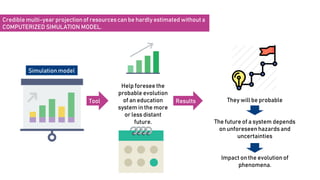
Credible multi-year projection of resources can be hardly estimated without a
COMPUTERIZED SIMULATION MODEL.
They will be probable
The future of a system depends
on unforeseen hazards and
uncertainties
Impact on the evolution of
phenomena.
Simulation model
Tool
Help foresee the
probable evolution
of an education
system in the more
or less distant
future.
Results
Implementation
of the
development
programme
advances.
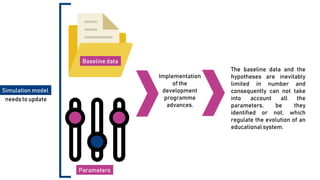
Simulation model
needs to update
The baseline data and the
hypotheses are inevitably
limited in number and
consequently can not take
into account all the
parameters, be they
identified or not, which
regulate the evolution of an
educational system.
Baseline data
Parameters
Purpose and use of the simulation techniques
• Design of policy options
• Formulation of an education development plan
• Evaluation of the required multiyear educational
expenditure.
SIMULATION TECHNIQUES
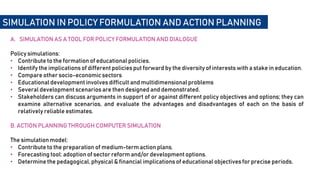
A. SIMULATION AS A TOOL FOR POLICY FORMULATION AND DIALOGUE
Policy simulations:
• Contribute to the formation of educational policies.
• Identify the implications of different policies put forward by the diversity of interests with a stake in education.
• Compare other socio-economic sectors
• Educational development involves difficult and multidimensionalproblems
• Several development scenarios are then designed and demonstrated.
• Stakeholders can discuss arguments in support of or against different policy objectives and options; they can
examine alternative scenarios, and evaluate the advantages and disadvantages of each on the basis of
relatively reliable estimates.
B. ACTION PLANNING THROUGH COMPUTER SIMULATION
The simulation model:
• Contribute to the preparation of medium-term action plans.
• Forecasting tool: adoption of sector reform and/or development options.
• Determine the pedagogical, physical & financial implications of educational objectives for precise periods.
SIMULATION IN POLICY FORMULATION AND ACTION PLANNING
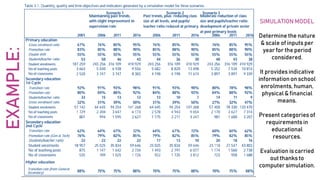
EXAMPLE: SIMULATION MODEL
Determine the nature
& scale of inputs per
year for the period
considered.
It provides indicative
information on school
enrolments, human,
physical & financial
means.
Present categories of
requirements in
educational
resources.
Evaluation is carried
out thanks to
computer simulation.
EXAMPLE: SIMULATION MODELS
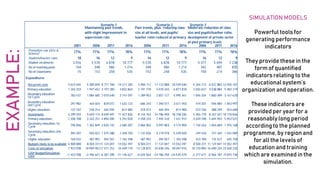
Powerful tools for
generating performance
indicators
They provide these in the
form of quantified
indicators relating to the
educational system’s
organization and operation.
These indicators are
provided per year for a
reasonably long period
according to the planned
programme, by region and
for all the levels of
education and training
which are examined in the
simulation.
• Simulation model
estimates of future needs
for these books and
indication of the
requirements for the
production and the
distribution of these
materials.
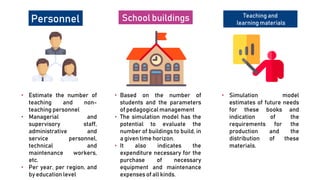
Personnel School buildings Teaching and
learning materials
• Estimate the number of
teaching and non-
teaching personnel
• Managerial and
supervisory staff,
administrative and
service personnel,
technical and
maintenance workers,
etc.
• Per year, per region, and
by education level
• Based on the number of
students and the parameters
of pedagogical management
• The simulation model has the
potential to evaluate the
number of buildings to build, in
a given time horizon.
• It also indicates the
expenditure necessary for the
purchase of necessary
equipment and maintenance
expenses of all kinds.
5.2. Budgeting through simulation techniques
SIMULATION MODELLING
• Benefits from the medium term expenditure frameworks (MTEFs)
MTEF
• Ensure the consistency of the budgetary allocations with overall fiscal objectives and domestic
resources
• Improve the realism of sector budgets.
• It is important in many developing countries where a large gap between stated policies and actual
domestic resources often leads to ad hoc budget cuts in plan implementation.
MTEF budget & education simulation model
• Anticipate their use by budget category
• Order of priority
• Contribute to fine-tuning the sector expenditure framework in consistency with overall macro-
economic and fiscal perspectives.
Consider significant parameters
which have an impact on the
cost of education:
Inflation, salary increases and
the cost of educational goods
and services.
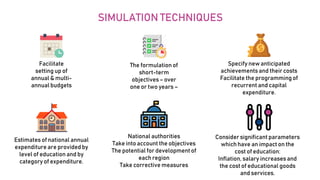
SIMULATION TECHNIQUES
Facilitate
setting up of
annual & multi-
annual budgets
Specify new anticipated
achievements and their costs
Facilitate the programming of
recurrent and capital
expenditure.
The formulation of
short-term
objectives – over
one or two years –
Estimates of national annual
expenditure are provided by
level of education and by
category of expenditure.
National authorities
Take into account the objectives
The potential for development of
each region
Take corrective measures
THANK YOU FOR
YOUR ATTENTION

CHAPTER V. ESTIMATION OF COSTS

  • 1.
    UNIVERSITY OF THEARMED FORCES-ESPE AT A DISTANCE EDUCATION MODE ESTIMATION OF COSTS SARA ABIGAIL SALAZAR LOOR LCDO. MIGUEL VINICIOPONCE MEDINA, PHD. 2017-2018
  • 2.
    ESTIMATION OF COSTS 5.1.Costs/resources at the activity level Logical Framework Approach Activity level indicators & Means of verification Inputs & budgets are required to implement
  • 3.
  • 4.
    Activities are usually brokendown according to who is responsible for implementation. ACTIVITIES RESPONSIBLE MONITORE Progress can be monitored against the associated resources, budget and the schedule. There should be in principle as many activities as there are responsible units in order to increase their accountability in the execution of their activity.
  • 5.
    • ACCOUNTING REGULATIONS • PRACTICESIN PLACE CLASSIFICATION OF FINANCIAL RESOURCES should follow in the concerned countries or institutions.
  • 6.
    Budget items areclassified by nature of expenditure. EXAMPLE: UNITED NATIONS SYSTEM • It is used when is preparing and implementing a development project. • There are also established norms and standards in terms of unit costs. • Costs should be considered (or referred to) when calculating the budgetary requirements. UNESCO’s Format
  • 7.
    It is relativelyeasy if… • Budgeting elements and criteria are already in place. BUT THE BUDGETING OF AN EDUCATION ACTION PLAN • It is complex • It involves making the projection of several years’ expenditure. • Different techniques, specific to each country’s contexts, exist. • Other techniques have recently emerged like the mid-term expenditure framework (MTEF) in some countries. Budget table format in the education sector EXAMPLE: Costing of the activities for a specific programme or project
  • 8.
    Credible multi-year projectionof resources can be hardly estimated without a COMPUTERIZED SIMULATION MODEL. They will be probable The future of a system depends on unforeseen hazards and uncertainties Impact on the evolution of phenomena. Simulation model Tool Help foresee the probable evolution of an education system in the more or less distant future. Results
  • 9.
    Implementation of the development programme advances. Simulation model needsto update The baseline data and the hypotheses are inevitably limited in number and consequently can not take into account all the parameters, be they identified or not, which regulate the evolution of an educational system. Baseline data Parameters
  • 10.
    Purpose and useof the simulation techniques • Design of policy options • Formulation of an education development plan • Evaluation of the required multiyear educational expenditure. SIMULATION TECHNIQUES
  • 11.
    A. SIMULATION ASA TOOL FOR POLICY FORMULATION AND DIALOGUE Policy simulations: • Contribute to the formation of educational policies. • Identify the implications of different policies put forward by the diversity of interests with a stake in education. • Compare other socio-economic sectors • Educational development involves difficult and multidimensionalproblems • Several development scenarios are then designed and demonstrated. • Stakeholders can discuss arguments in support of or against different policy objectives and options; they can examine alternative scenarios, and evaluate the advantages and disadvantages of each on the basis of relatively reliable estimates. B. ACTION PLANNING THROUGH COMPUTER SIMULATION The simulation model: • Contribute to the preparation of medium-term action plans. • Forecasting tool: adoption of sector reform and/or development options. • Determine the pedagogical, physical & financial implications of educational objectives for precise periods. SIMULATION IN POLICY FORMULATION AND ACTION PLANNING
  • 12.
    EXAMPLE: SIMULATION MODEL Determinethe nature & scale of inputs per year for the period considered. It provides indicative information on school enrolments, human, physical & financial means. Present categories of requirements in educational resources. Evaluation is carried out thanks to computer simulation.
  • 13.
    EXAMPLE: SIMULATION MODELS Powerfultools for generating performance indicators They provide these in the form of quantified indicators relating to the educational system’s organization and operation. These indicators are provided per year for a reasonably long period according to the planned programme, by region and for all the levels of education and training which are examined in the simulation.
  • 14.
    • Simulation model estimatesof future needs for these books and indication of the requirements for the production and the distribution of these materials. Personnel School buildings Teaching and learning materials • Estimate the number of teaching and non- teaching personnel • Managerial and supervisory staff, administrative and service personnel, technical and maintenance workers, etc. • Per year, per region, and by education level • Based on the number of students and the parameters of pedagogical management • The simulation model has the potential to evaluate the number of buildings to build, in a given time horizon. • It also indicates the expenditure necessary for the purchase of necessary equipment and maintenance expenses of all kinds.
  • 15.
    5.2. Budgeting throughsimulation techniques SIMULATION MODELLING • Benefits from the medium term expenditure frameworks (MTEFs) MTEF • Ensure the consistency of the budgetary allocations with overall fiscal objectives and domestic resources • Improve the realism of sector budgets. • It is important in many developing countries where a large gap between stated policies and actual domestic resources often leads to ad hoc budget cuts in plan implementation. MTEF budget & education simulation model • Anticipate their use by budget category • Order of priority • Contribute to fine-tuning the sector expenditure framework in consistency with overall macro- economic and fiscal perspectives.
  • 16.
    Consider significant parameters whichhave an impact on the cost of education: Inflation, salary increases and the cost of educational goods and services. SIMULATION TECHNIQUES Facilitate setting up of annual & multi- annual budgets Specify new anticipated achievements and their costs Facilitate the programming of recurrent and capital expenditure. The formulation of short-term objectives – over one or two years – Estimates of national annual expenditure are provided by level of education and by category of expenditure. National authorities Take into account the objectives The potential for development of each region Take corrective measures
  • 17.