University of the Armed Forces ESPE
Interactive Activity
Group N°2
Members:
Andrea Estefanía Carrera Gallardo
Karina Lizeth Chancusig Villagómez
CHAPTER II. Sector Analysis
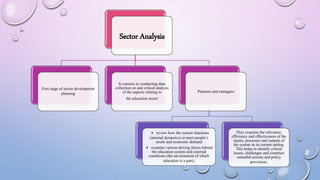
Sector Analysis
First stage of sector development
planning
It consists in conducting data
collection on and critical analysis
of the aspects relating to
the education sector
Planners and managers
4 review how the system functions
(internal dynamics) to meet people’s
needs and economic demand
4 examine various driving forces behind
the education system and external
conditions (the environment of which
education is a part),
They examine the relevance,
efficiency and effectiveness of the
inputs, processes and outputs of
the system in its current setting.
This helps to identify critical
issues, challenges and construct
remedial actions and policy
provisions.
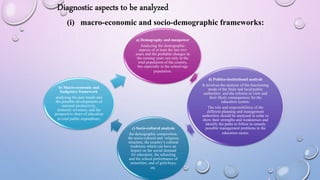
(i) macro-economic and socio-demographic frameworks:
a) Demography and manpower
Analyzing the demographic
aspects of at least the last two
years and the probable changes in
the coming years not only in the
total population of the country,
but especially in the school-age
population.
d) Politico-institutional analysis
It involves the analysis of the functioning
mode of the State and local/public
authorities and the reforms in view and
their likely consequences for the
education system.
The role and responsibilities of the
different planning and management
authorities should be analyzed in order to
show their strengths and weaknesses and
identify the paths to follow to remedy
possible management problems in the
education sector.
c) Socio-cultural analysis
the demographic composition,
the socio-cultural and religious
structure, the country’s cultural
traditions which can have an
impact on the social demand
for education, the schooling
and the school performance of
minorities, and of girls/boys,
etc.
b) Macro-economic and
budgetary framework
analyzing the past trends and
the possible developments of
national productivity,
domestic revenues, and the
prospective share of education
in total public expenditure.
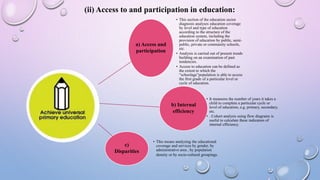
a) Access and
participation
• This section of the education sector
diagnosis analyses education coverage
by level and type of education
according to the structure of the
education system, including the
provision of education by public, semi-
public, private or community schools,
etc.
• Analysis is carried out of present trends
building on an examination of past
tendencies.
• Access to education can be defined as
the extent to which the
“schoolage”population is able to access
the first grade of a particular level or
cycle of education.
b) Internal
efficiency
• It measures the number of years it takes a
child to complete a particular cycle or
level of education, e.g. primary, secondary,
etc.
• . Cohort analysis using flow diagrams is
useful to calculate these indicators of
internal efficiency.
c)
Disparities
• This means analyzing the educational
coverage and services by gender, by
administrative area , by population
density or by socio-cultural groupings.
(ii) Access to and participation in education:
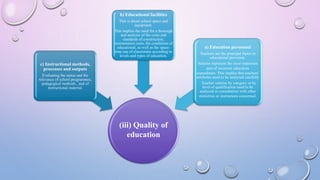
(iii) Quality of
education
c) Instructional methods,
processes and outputs
Evaluating the status and the
relevance of school programmes,
pedagogical methods , and of
instructional material.
b) Educational facilities
This is about school space and
equipment.
This implies the need for a thorough
and analysis of the costs and
standards of construction,
maintenance costs, the conditions of
educational, as well as the space-
time use of classrooms according to
levels and types of education.
a) Education personnel
Teachers are the principal factor in
educational provision.
Salaries represent the most important
part of recurrent education
expenditure. This implies that teachers’
attributes need to be analyzed carefully
. Teacher salaries by category or by
level of qualification need to be
analyzed in consultation with other
ministries or institutions concerned.
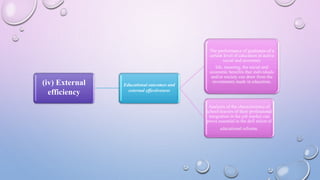
(iv) External
efficiency
Educational outcomes and
external effectiveness
The performance of graduates of a
certain level of education in active
social and economic
life, meaning, the social and
economic benefits that individuals
and/or society can draw from the
investments made in education.
Analysis of the characteristics of
school-leavers of their professional
integration in the job market can
prove essential in the defi nition of
educational reforms.
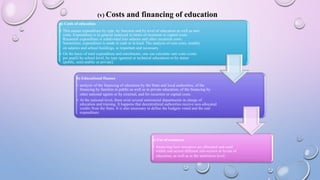
(v) Costs and financing of education
a) Costs of education
• This means expenditure by type, by function and by level of education as well as unit
costs. Expenditure is in general analyzed in terms of recurrent or capital costs.
Recurrent expenditure is subdivided into salaries and other recurrent costs.
Sometimes, expenditure is made in cash or in kind. The analysis of unit costs, notably
on salaries and school buildings, is important and necessary.
• On the basis of total expenditure and enrolments, one can calculate unit costs (costs
per pupil) by school level, by type (general or technical education) or by status
(public, semi-public or private).
b) Educational finance
• analysis of the financing of education by the State and local authorities, of the
financing by families in public as well as in private education, of the financing by
other national agents or by external, and for recurrent or capital costs.
• At the national level, there exist several ministerial departments in charge of
education and training. It happens that decentralized authorities receive non-allocated
credits from the State. It is also necessary to define the budgets voted and the real
expenditure.
c) Use of resources
• Analyzing how resources are allocated and used
within and across different sub-sectors or levels of
education, as well as at the institution level.
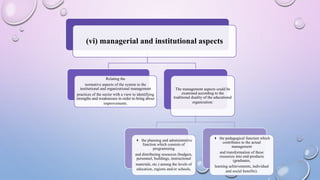
(vi) managerial and institutional aspects
Relating the
normative aspects of the system to the
institutional and organizational management
practices of the sector with a view to identifying
strengths and weaknesses in order to bring about
improvements.
The management aspects could be
examined according to the
traditional duality of the educational
organization:
4 the planning and administrative
function which consists of
programming
and distributing resources (budgets,
personnel, buildings, instructional
materials, etc.) among the levels of
education, regions and/or schools,
4 the pedagogical function which
contributes to the actual
management
and transformation of these
resources into end-products
(graduates,
learning achievements, individual
and social benefits).
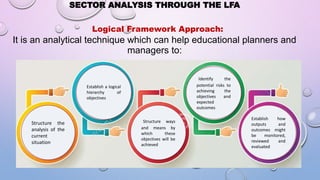
Structure the
analysis of the
current
situation
Establish a logical
hierarchy of
objectives
Structure ways
and means by
which these
objectives will be
achieved
Identify the
potential risks to
achieving the
objectives and
expected
outcomes
Establish how
outputs and
outcomes might
be monitored,
reviewed and
evaluated
SECTOR ANALYSIS THROUGH THE LFA
Logical Framework Approach:
It is an analytical technique which can help educational planners and
managers to:
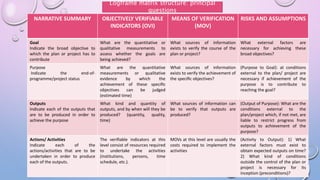
NARRATIVE SUMMARY OBJECTIVELY VERIFIABLE
INDICATORS (OVI)
MEANS OF VERIFICATION
(MOV)
RISKS AND ASSUMPTIONS
Goal
Indicate the broad objective to
which the plan or project has to
contribute
What are the quantitative or
qualitative measurements to
assess whether the goals are
being achieved?
What sources of information
exists to verify the course of the
plan or project?
What external factors are
necessary for achieving these
broad objectives?
Purpose
Indicate the end-of-
programme/project status
What are the quantitative
measurements or qualitative
evidence by which the
achievement of these specific
objectives can be judged
(estimated time)
What sources of information
exists to verify the achievement of
the specific objectives?
(Purpose to Goal): at conditions
external to the plan/ project are
necessary if achievement of the
purpose is to contribute to
reaching the goal?
Outputs
Indicate each of the outputs that
are to be produced in order to
achieve the purpose
What kind and quantity of
outputs, and by when will they be
produced? (quantity, quality,
time)
What sources of information can
be to verify that outputs are
produced?
(Output of Purpose): What are the
conditions external to the
plan/project which, if not met, are
liable to restrict progress from
outputs to achievement of the
purpose?
Actions/ Activities
Indicate each of the
actions/activities that are to be
undertaken in order to produce
each of the outputs.
The verifiable indicators at this
level consist of resources required
to undertake the activities
(institutions, persons, time
schedule, etc.).
MOVs at this level are usually the
costs required to implement the
activities
(Activity to Output): 1) What
external factors must exist to
obtain expected outputs on time?
2) What kind of conditions
outside the control of the plan or
project is necessary for its
inception (preconditions)?
Logframe matrix structure: principal
questions
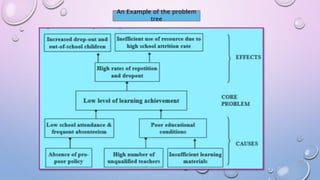
PROBLEM ANALYSIS
A principal tool used in problem analysis is
the “problem tree”.
The root causes are
those placed at the very
bottom of this tree: one
will have to act on these
root causes in order to
improve them and
therefore they will be
subject to activities to
carry out.
The key purpose of this
analysis is to identify
the “root causes” and,
not just the effects and
symptoms of the
problem.
Identify all existing
problems and placing
them according to their
level – causes and
effects – around a core
problem.
It allows identifying
what the problems are
and establishing the
cause and effect
relationships between
these problems.
S
I
T
U
A
T
I
O
N
A
N
A
L
Y
S
I
S
An Example of the problem
tree
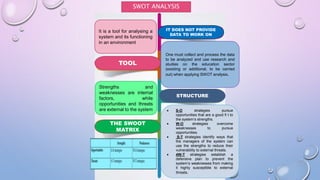
TOOL
It is a tool for analysing a
system and its functioning
in an environment
THE SWOOT
MATRIX
Strengths and
weaknesses are internal
factors, while
opportunities and threats
are external to the system
IT DOES NOT PROVIDE
DATA TO WORK ON
One must collect and process the data
to be analyzed and use research and
studies on the education sector
(existing or additional, to be carried
out) when applying SWOT analysis.
STRUCTURE
 S-O strategies pursue
opportunities that are a good fi t to
the system’s strengths.
 W-O strategies overcome
weaknesses to pursue
opportunities.
 S-T strategies identify ways that
the managers of the system can
use the strengths to reduce their
vulnerability to external threats.
 4W-T strategies establish a
defensive plan to prevent the
system’s weaknesses from making
it highly susceptible to external
threats.
SWOT ANALYSIS
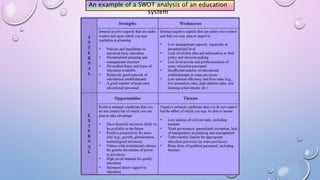
An example of a SWOT analysis of an education
system
STAKEHOLDER
ANALYSIS
Stakeholders can be as
individuals, groups and/or
institutions having an interest in
a project or a plan.
Stakeholder analysis consists
in asking the following two
questions: “Whose problem?”
and, if a strategy is proposed:
“Who will benefit?”
They can:
• Be positively or negatively
affected by the impact of
the plan or the project
• Influence the success or
the failure of the project or
the plan.
A stakeholder analysis aims: • To identify the likely impacts of policies,
plans / programmes, and projects.
• To assess the existing or potential conflicts
of interest.
• To take account of the impacts and
various interests when designing policy
options, implementation strategies and
development actions
The main steps in stakeholder
analysis involve identifying:
• The main stakeholders (e.g. local, regional
and/or national levels).
• Winners and losers, those with interests,
rights, resources and abilities to take part
or influence the course of a programme.
• The extent of cooperation or conflict in the
relationship between stakeholders.
Stakeholder Analysis Matrix
The first step is to identify all the
individuals, groups, and institutions
that will affect or be affected by a
change, then to list them in the column
under “Stakeholder” and to rate their
interests, roles and appropriate
strategies.Stakeholder analysis can be used to generate knowledge
about relevant actors so as to understand their behavior,
intentions, interrelations, agendas, interests and the
influence or resources they have.

Interactive activity 2 logical framework chapter 2

  • 1.
    University of theArmed Forces ESPE Interactive Activity Group N°2 Members: Andrea Estefanía Carrera Gallardo Karina Lizeth Chancusig Villagómez CHAPTER II. Sector Analysis
  • 2.
    Sector Analysis First stageof sector development planning It consists in conducting data collection on and critical analysis of the aspects relating to the education sector Planners and managers 4 review how the system functions (internal dynamics) to meet people’s needs and economic demand 4 examine various driving forces behind the education system and external conditions (the environment of which education is a part), They examine the relevance, efficiency and effectiveness of the inputs, processes and outputs of the system in its current setting. This helps to identify critical issues, challenges and construct remedial actions and policy provisions.
  • 3.
    (i) macro-economic andsocio-demographic frameworks: a) Demography and manpower Analyzing the demographic aspects of at least the last two years and the probable changes in the coming years not only in the total population of the country, but especially in the school-age population. d) Politico-institutional analysis It involves the analysis of the functioning mode of the State and local/public authorities and the reforms in view and their likely consequences for the education system. The role and responsibilities of the different planning and management authorities should be analyzed in order to show their strengths and weaknesses and identify the paths to follow to remedy possible management problems in the education sector. c) Socio-cultural analysis the demographic composition, the socio-cultural and religious structure, the country’s cultural traditions which can have an impact on the social demand for education, the schooling and the school performance of minorities, and of girls/boys, etc. b) Macro-economic and budgetary framework analyzing the past trends and the possible developments of national productivity, domestic revenues, and the prospective share of education in total public expenditure.
  • 4.
    a) Access and participation •This section of the education sector diagnosis analyses education coverage by level and type of education according to the structure of the education system, including the provision of education by public, semi- public, private or community schools, etc. • Analysis is carried out of present trends building on an examination of past tendencies. • Access to education can be defined as the extent to which the “schoolage”population is able to access the first grade of a particular level or cycle of education. b) Internal efficiency • It measures the number of years it takes a child to complete a particular cycle or level of education, e.g. primary, secondary, etc. • . Cohort analysis using flow diagrams is useful to calculate these indicators of internal efficiency. c) Disparities • This means analyzing the educational coverage and services by gender, by administrative area , by population density or by socio-cultural groupings. (ii) Access to and participation in education:
  • 5.
    (iii) Quality of education c)Instructional methods, processes and outputs Evaluating the status and the relevance of school programmes, pedagogical methods , and of instructional material. b) Educational facilities This is about school space and equipment. This implies the need for a thorough and analysis of the costs and standards of construction, maintenance costs, the conditions of educational, as well as the space- time use of classrooms according to levels and types of education. a) Education personnel Teachers are the principal factor in educational provision. Salaries represent the most important part of recurrent education expenditure. This implies that teachers’ attributes need to be analyzed carefully . Teacher salaries by category or by level of qualification need to be analyzed in consultation with other ministries or institutions concerned.
  • 6.
    (iv) External efficiency Educational outcomesand external effectiveness The performance of graduates of a certain level of education in active social and economic life, meaning, the social and economic benefits that individuals and/or society can draw from the investments made in education. Analysis of the characteristics of school-leavers of their professional integration in the job market can prove essential in the defi nition of educational reforms.
  • 7.
    (v) Costs andfinancing of education a) Costs of education • This means expenditure by type, by function and by level of education as well as unit costs. Expenditure is in general analyzed in terms of recurrent or capital costs. Recurrent expenditure is subdivided into salaries and other recurrent costs. Sometimes, expenditure is made in cash or in kind. The analysis of unit costs, notably on salaries and school buildings, is important and necessary. • On the basis of total expenditure and enrolments, one can calculate unit costs (costs per pupil) by school level, by type (general or technical education) or by status (public, semi-public or private). b) Educational finance • analysis of the financing of education by the State and local authorities, of the financing by families in public as well as in private education, of the financing by other national agents or by external, and for recurrent or capital costs. • At the national level, there exist several ministerial departments in charge of education and training. It happens that decentralized authorities receive non-allocated credits from the State. It is also necessary to define the budgets voted and the real expenditure. c) Use of resources • Analyzing how resources are allocated and used within and across different sub-sectors or levels of education, as well as at the institution level.
  • 8.
    (vi) managerial andinstitutional aspects Relating the normative aspects of the system to the institutional and organizational management practices of the sector with a view to identifying strengths and weaknesses in order to bring about improvements. The management aspects could be examined according to the traditional duality of the educational organization: 4 the planning and administrative function which consists of programming and distributing resources (budgets, personnel, buildings, instructional materials, etc.) among the levels of education, regions and/or schools, 4 the pedagogical function which contributes to the actual management and transformation of these resources into end-products (graduates, learning achievements, individual and social benefits).
  • 9.
    Structure the analysis ofthe current situation Establish a logical hierarchy of objectives Structure ways and means by which these objectives will be achieved Identify the potential risks to achieving the objectives and expected outcomes Establish how outputs and outcomes might be monitored, reviewed and evaluated SECTOR ANALYSIS THROUGH THE LFA Logical Framework Approach: It is an analytical technique which can help educational planners and managers to:
  • 10.
    NARRATIVE SUMMARY OBJECTIVELYVERIFIABLE INDICATORS (OVI) MEANS OF VERIFICATION (MOV) RISKS AND ASSUMPTIONS Goal Indicate the broad objective to which the plan or project has to contribute What are the quantitative or qualitative measurements to assess whether the goals are being achieved? What sources of information exists to verify the course of the plan or project? What external factors are necessary for achieving these broad objectives? Purpose Indicate the end-of- programme/project status What are the quantitative measurements or qualitative evidence by which the achievement of these specific objectives can be judged (estimated time) What sources of information exists to verify the achievement of the specific objectives? (Purpose to Goal): at conditions external to the plan/ project are necessary if achievement of the purpose is to contribute to reaching the goal? Outputs Indicate each of the outputs that are to be produced in order to achieve the purpose What kind and quantity of outputs, and by when will they be produced? (quantity, quality, time) What sources of information can be to verify that outputs are produced? (Output of Purpose): What are the conditions external to the plan/project which, if not met, are liable to restrict progress from outputs to achievement of the purpose? Actions/ Activities Indicate each of the actions/activities that are to be undertaken in order to produce each of the outputs. The verifiable indicators at this level consist of resources required to undertake the activities (institutions, persons, time schedule, etc.). MOVs at this level are usually the costs required to implement the activities (Activity to Output): 1) What external factors must exist to obtain expected outputs on time? 2) What kind of conditions outside the control of the plan or project is necessary for its inception (preconditions)? Logframe matrix structure: principal questions
  • 11.
    PROBLEM ANALYSIS A principaltool used in problem analysis is the “problem tree”. The root causes are those placed at the very bottom of this tree: one will have to act on these root causes in order to improve them and therefore they will be subject to activities to carry out. The key purpose of this analysis is to identify the “root causes” and, not just the effects and symptoms of the problem. Identify all existing problems and placing them according to their level – causes and effects – around a core problem. It allows identifying what the problems are and establishing the cause and effect relationships between these problems. S I T U A T I O N A N A L Y S I S
  • 12.
    An Example ofthe problem tree
  • 13.
    TOOL It is atool for analysing a system and its functioning in an environment THE SWOOT MATRIX Strengths and weaknesses are internal factors, while opportunities and threats are external to the system IT DOES NOT PROVIDE DATA TO WORK ON One must collect and process the data to be analyzed and use research and studies on the education sector (existing or additional, to be carried out) when applying SWOT analysis. STRUCTURE  S-O strategies pursue opportunities that are a good fi t to the system’s strengths.  W-O strategies overcome weaknesses to pursue opportunities.  S-T strategies identify ways that the managers of the system can use the strengths to reduce their vulnerability to external threats.  4W-T strategies establish a defensive plan to prevent the system’s weaknesses from making it highly susceptible to external threats. SWOT ANALYSIS
  • 14.
    An example ofa SWOT analysis of an education system
  • 15.
    STAKEHOLDER ANALYSIS Stakeholders can beas individuals, groups and/or institutions having an interest in a project or a plan. Stakeholder analysis consists in asking the following two questions: “Whose problem?” and, if a strategy is proposed: “Who will benefit?” They can: • Be positively or negatively affected by the impact of the plan or the project • Influence the success or the failure of the project or the plan. A stakeholder analysis aims: • To identify the likely impacts of policies, plans / programmes, and projects. • To assess the existing or potential conflicts of interest. • To take account of the impacts and various interests when designing policy options, implementation strategies and development actions The main steps in stakeholder analysis involve identifying: • The main stakeholders (e.g. local, regional and/or national levels). • Winners and losers, those with interests, rights, resources and abilities to take part or influence the course of a programme. • The extent of cooperation or conflict in the relationship between stakeholders. Stakeholder Analysis Matrix The first step is to identify all the individuals, groups, and institutions that will affect or be affected by a change, then to list them in the column under “Stakeholder” and to rate their interests, roles and appropriate strategies.Stakeholder analysis can be used to generate knowledge about relevant actors so as to understand their behavior, intentions, interrelations, agendas, interests and the influence or resources they have.