ANKYLOSIS OF
TEMPOROMANDIBULAR
JOINT
ANATOMY
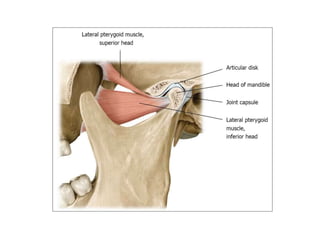
The TMJ is a diarthrodial, ginglymus, synovial
joint that is capable of both rotational and
translatory movements.
It is formed by the articulation of the glenoid
fossa of the temporal bone and the head of the
condyle.
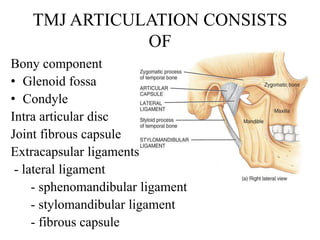
TMJ ARTICULATION CONSISTS
OF
Bony component
• Glenoid fossa
• Condyle
Intra articular disc
Joint fibrous capsule
Extracapsular ligaments
- lateral ligament
- sphenomandibular ligament
- stylomandibular ligament
- fibrous capsule
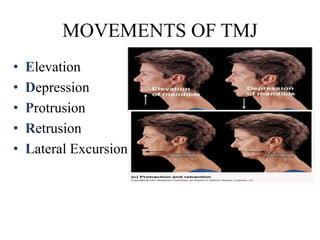
MOVEMENTS OF TMJ
• Elevation
• Depression
• Protrusion
• Retrusion
• Lateral Excursion
ANKYLOSIS OF TMJ
• Ankylosis is a Greek word that literally means
a “stiff joint”.
• It refers to partial or complete inability to
open the mouth which results in functional or
growth deformities of the mandible.
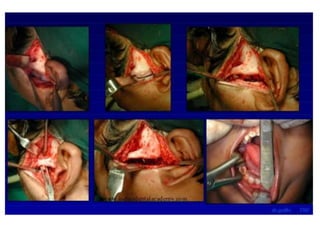
• Ankylosis may range from a simple fibrous
restriction of jaw movement to a bone
formation within the joint restricting
movement completely
ETIOLOGY
• TRAUMA
- Forcep delivery
- Intracapsular fractures
- Congenital
• INFECTION AND INFLAMMATION
- Otitis media
- Parotitis
- Mastoiditis
• SYSTEMIC CAUSES
- Scarlet fever
- Meningitis
- Small pox
• OTHERS
- Post surgery
- Malignancies
- Trismus
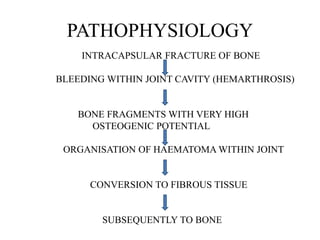
PATHOPHYSIOLOGY
INTRACAPSULAR FRACTURE OF BONE
BLEEDING WITHIN JOINT CAVITY (HEMARTHROSIS)
BONE FRAGMENTS WITH VERY HIGH
OSTEOGENIC POTENTIAL
ORGANISATION OF HAEMATOMA WITHIN JOINT
CONVERSION TO FIBROUS TISSUE
SUBSEQUENTLY TO BONE
CLASSIFICATION OF TMJ
• Based on the type of tissue causing the ankylosis:
- Fibrous ankylosis
- Bony ankylosis
• Based on the side involved:
- Unilateral
- Bilateral
• Based on the severity of the ankylosis:
- Partial
- Complete
• Based on the type of etiology for trismus:
- Pseudoankylosis
- True ankylosis
KAZANJIAN CLASSIFICATION
• Intra articular or true ankylosis
• Extra articular or false ankylosis
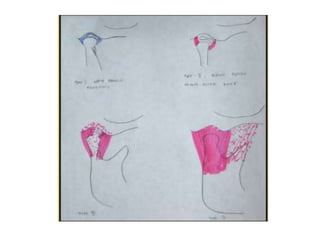
SAWHNEY’S GRADING OF
ANKYLOSIS
• TYPE 1: Flattening or deformity of the condyle with
little joint space seen on the radiograph. Extensive fibrous
adhesions seen during operations.
• TYPE 2: Bony fusion of the outer edges of the articular
surfaces with no fusion in the deeper areas of the joint.
• TYPE 3: A bridge of bone is seen between ramus of the
mandible and zygomatic arch.
• TYPE 4: Entire joint is replaced by a mass of bone.
DIAGNOSIS
• History
• Clinical examination
• Investigation
HISTORY
• Accurate history is important to differentiate the
conditions of pseudoankylosis & true ankylosis.
• History of the trauma either directly to the joint or
indirectly to the chin.
• Duration of trismus should be asked.
• Extracapsular causes such as an untreated
zygomatic arch fracture should be ruled out.
• History of ear infection in childhood.
• History of forceps delivery of the child.
CLINICAL EXAMINATION
• Restricted mouth opening, patient will
complain of difficulty in mastication
• Protrusive movements are absent on involved
side
• Partial mobility or complete immobility of the
condyle is noticed on palpation
UNILATERAL ANKYLOSIS
• Facial asymmetry
• Affected side appears normal
• Opposite side appears flat
• Chin deviated to ankylosed side
• Deep antegonial notch on ankylosed side
• Reduced condylar movements on affected side
• Class II malocclusion on affected side
• Decreased mouth opening
• Posterior cross bite
• Poor oral hygiene
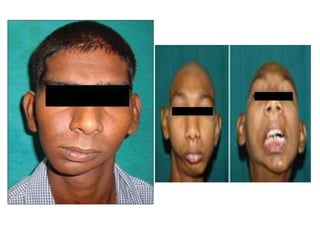
BILATERAL ANKYLOSIS
• Bird face
• Trismus
• Class II malocclusion
• Deep antegonial notch
• Poor oral hygiene
• Crowding of teeth
• Protrusion of upper anterior teeth
• Anterior open bite
• No condylar movements palpable
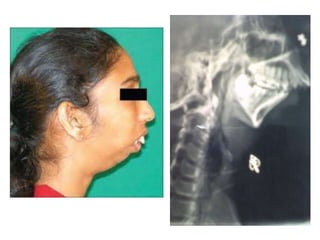
INVESTIGATIONS
 Radiographic finding- are important in arriving at a final
diagnosis
– Orthopantomograph- will show both the joints picture which can be
compared in unilateral cases.
– Lateral oblique view- will give anteroposterior dimension of the
condylar mass. Elongation of coronoid process can be seen.
– Cephalometric radiograph- is taken to evaluate the associated
skeletal deformities
– Posteroanterior radiograph- will reveal the medio lateral extent of
the bony mass. It will also highlight the asymmetry in unilateral cases
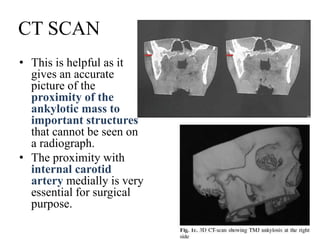
– CT scan- very helpful guide for surgery. Relation to the medial cranial
fossa, the anteroposterior width, mediolateral depth can be assessed.
Any presence of fractured condylar head on the medial aspect of ramus
can be located
CT SCAN
• This is helpful as it
gives an accurate
picture of the
proximity of the
ankylotic mass to
important structures
that cannot be seen on
a radiograph.
• The proximity with
internal carotid
artery medially is very
essential for surgical
purpose.
SEQUELAE OF AN UNTREATED
ANKYLOSIS
• Facial deformity
• Speech difficulty due to decreased mouth
opening, maloccluded teeth and tongue position.
• Nutritional deficiency
• Respiratory distress
• Malnutrition
• Malocclusion
• Poor oral hygiene
MANAGEMENT OF T.M.J.
ANKYLOSIS
BASICALLY THREE TYPES:
• Condylectomy
• Gap Arthroplasty
• Interpositional Arthroplasty
PREOPERATIVE EVALUATION OF
THE PATIENT
• A detailed surgical profile of the patient with
ankylosis.
• Preanasthetic evaluation with specific
importance to adequacy of mouth opening for
intubation.
• Temporal shave for procedure involving
temporal muscle/ fascia grafts.
ANASTHETIA FOR AN
ANKYLOSIS PATIENT:
ALTERNATIVE METHODS ARE USED
SUCH AS:
• Blind nasal/ awake nasal intubation
• Use of fiberoptic intubation
• Retrograde intubation
• In case where all these methods are not
possible, a temporal elective tracheostomy is
planned.
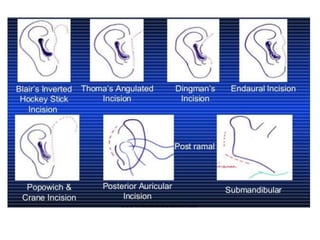
APPROACHES TO THE T.M.J.
1. Preauricular incision
2. Postauricular incision
3. Hemicoronal
4. Submandibular incision
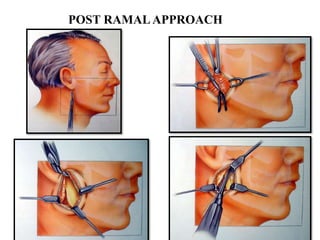
5. Post ramal
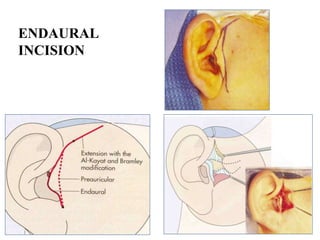
6. Endaural incision
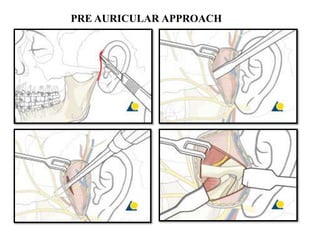
PRE AURICULAR APPROACH
POST RAMALAPPROACH
ENDAURAL
INCISION
CONDYLECTOMY
• Done in case of ankylosis where anatomic
features of the joint are not completely changed
as in case of fibrous or partial ankylosis.
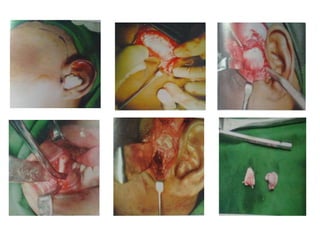
• An incision is placed and the condylar region is
exposed.
• A horizontal cut is made at the region of the neck
of the condyle.
• The head of the condyle is sectioned at the level
of the neck and carefully separated.
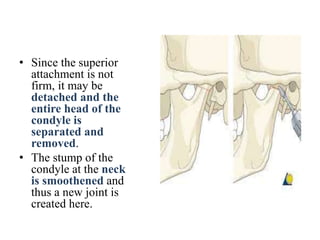
• Since the superior
attachment is not
firm, it may be
detached and the
entire head of the
condyle is
separated and
removed.
• The stump of the
condyle at the neck
is smoothened and
thus a new joint is
created here.
COMPLICATIONS
• Loss of vertical height of the ramus.
• In case of bilateral condylectomy, it may create
an anterior open bite.
• In unilateral cases, there may be deviation of
the jaw on opening.
GAP ARTHROPLASTY
• Gap Arthroplasty involves creation of an anatomical
gap in the ankylosed segment to form an artificial joint
space.
• Commonly done in cases of complete ankylosis.
• A gap in the bone is created to separate the ramus from
the ankylosed mass in the glenoid fossa.
• 2 horizontal bony cuts are made in the most superior
aspect of the ramus and the wedge of the bone between
these 2 cuts is removed.
• Care should be taken while removing the bone from the
medial aspect as it is close to the maxillary artery and
carotid canal.
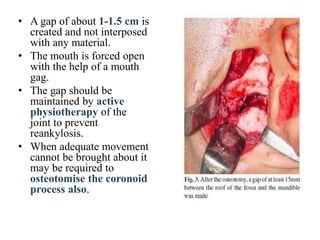
• A gap of about 1-1.5 cm is
created and not interposed
with any material.
• The mouth is forced open
with the help of a mouth
gag.
• The gap should be
maintained by active
physiotherapy of the
joint to prevent
reankylosis.
• When adequate movement
cannot be brought about it
may be required to
osteotomise the coronoid
process also.
COMPLICATIONS
• It is difficult to remove the actual extent of the
ankylotic mass as it is not properly assessed
medially.
• Chances of creating excessive gap and
reducing vertical height of ramus.
• Anterior open bite due to excessive bone
removal.
• Reankylosis due to bony contact between the
cut ends.
INTERPOSITIONAL
ARTHROPLASTY
• When gap arthroplasty is done to release
ankylosis, there are chances of contact between
the bone ends to form a reankylosis.
• So an interpositional material is to be placed in
between them to avoid contact and minimize
chances of reankylosis.
• Materials which can be used are either alloplastic
or autogenous materials.
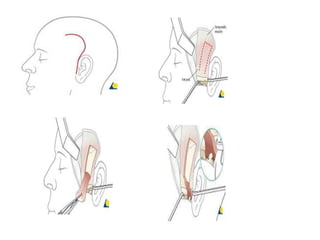
• Procedure involves creating a gap and then
inserting an interpositional material and
stabilizing it.
MATERIALS USED FOR
INTERPOSITIONAL ARTHROPLASTY
• ALLOPLASTIC MATERIALS:
Non-Metallic - Silastic Metallic - Tantalum plate
- Acrylic - Stainless Steel
- Teflon - Titanium
- Ceramic - Gold
• AUTOGENOUS MATERIALS:
- Costochondral graft
- Metatarsal graft
- Sternoclavicular joint
- Auricular cartilage
- Temporalis muscle or Fascia or both
- Fascia lata
- Dermis graft
COMPLICATIONS
• Foreign body reaction with alloplastic
materials placed in surgical gap.
• Difficulty in suturing from the medial aspect.
• Complications associated with second
surgical site in case of autogenous graft.
• Other complications as in gap arthroplasty.
KABAN’S PROTOCOL
• Aggressive total excision of the ankylotic segment in
condylar region.
• Coronoidectomy on affected side to avoid temporalis
muscle restriction.
• Lining with temporalis muscle or fascia or disc.
• If step 1,2,3 don’t create enough opening,
coronoidectomy of opposite side is done.
• Reconstruction of ramus with costochondral junction
• Creation of open bite to permit settling of graft for 3-6
months.
• Aggressive physiotherapy.
POST OPERATIVE
PHYSIOTHERAPY
• Very important.
• Encourage the patient to start active exercise of the jaw
as soon as it can be tolerated.
• Initially: pressure with finger or simple finger
exercises to gently force the mouth open.
• Later: stick, tongue blade, mouth gag can be used for
forceful mouth opening.
• Medications can be given to relieve pain and enable
movements.
• Heat application to the region prior to exercise permits
easy movement to relieve muscle spasm.
CAUSES OF RECURRENCE OF
ANKYLOSIS
• Improper or inadequate surgical resection.
• Fracture of costochondral graft.
• Improper graft fixation.
• Inadequate physiotherapy.
• Increased osteogenic potential of the resected
segments.
Tmj ankylosis

Tmj ankylosis

  • 1.
  • 2.
    ANATOMY The TMJ isa diarthrodial, ginglymus, synovial joint that is capable of both rotational and translatory movements. It is formed by the articulation of the glenoid fossa of the temporal bone and the head of the condyle.
  • 3.
    TMJ ARTICULATION CONSISTS OF Bonycomponent • Glenoid fossa • Condyle Intra articular disc Joint fibrous capsule Extracapsular ligaments - lateral ligament - sphenomandibular ligament - stylomandibular ligament - fibrous capsule
  • 5.
    MOVEMENTS OF TMJ •Elevation • Depression • Protrusion • Retrusion • Lateral Excursion
  • 6.
    ANKYLOSIS OF TMJ •Ankylosis is a Greek word that literally means a “stiff joint”. • It refers to partial or complete inability to open the mouth which results in functional or growth deformities of the mandible. • Ankylosis may range from a simple fibrous restriction of jaw movement to a bone formation within the joint restricting movement completely
  • 7.
    ETIOLOGY • TRAUMA - Forcepdelivery - Intracapsular fractures - Congenital • INFECTION AND INFLAMMATION - Otitis media - Parotitis - Mastoiditis • SYSTEMIC CAUSES - Scarlet fever - Meningitis - Small pox • OTHERS - Post surgery - Malignancies - Trismus
  • 8.
    PATHOPHYSIOLOGY INTRACAPSULAR FRACTURE OFBONE BLEEDING WITHIN JOINT CAVITY (HEMARTHROSIS) BONE FRAGMENTS WITH VERY HIGH OSTEOGENIC POTENTIAL ORGANISATION OF HAEMATOMA WITHIN JOINT CONVERSION TO FIBROUS TISSUE SUBSEQUENTLY TO BONE
  • 9.
    CLASSIFICATION OF TMJ •Based on the type of tissue causing the ankylosis: - Fibrous ankylosis - Bony ankylosis • Based on the side involved: - Unilateral - Bilateral • Based on the severity of the ankylosis: - Partial - Complete • Based on the type of etiology for trismus: - Pseudoankylosis - True ankylosis
  • 10.
    KAZANJIAN CLASSIFICATION • Intraarticular or true ankylosis • Extra articular or false ankylosis
  • 11.
    SAWHNEY’S GRADING OF ANKYLOSIS •TYPE 1: Flattening or deformity of the condyle with little joint space seen on the radiograph. Extensive fibrous adhesions seen during operations. • TYPE 2: Bony fusion of the outer edges of the articular surfaces with no fusion in the deeper areas of the joint. • TYPE 3: A bridge of bone is seen between ramus of the mandible and zygomatic arch. • TYPE 4: Entire joint is replaced by a mass of bone.
  • 13.
    DIAGNOSIS • History • Clinicalexamination • Investigation
  • 14.
    HISTORY • Accurate historyis important to differentiate the conditions of pseudoankylosis & true ankylosis. • History of the trauma either directly to the joint or indirectly to the chin. • Duration of trismus should be asked. • Extracapsular causes such as an untreated zygomatic arch fracture should be ruled out. • History of ear infection in childhood. • History of forceps delivery of the child.
  • 15.
    CLINICAL EXAMINATION • Restrictedmouth opening, patient will complain of difficulty in mastication • Protrusive movements are absent on involved side • Partial mobility or complete immobility of the condyle is noticed on palpation
  • 16.
    UNILATERAL ANKYLOSIS • Facialasymmetry • Affected side appears normal • Opposite side appears flat • Chin deviated to ankylosed side • Deep antegonial notch on ankylosed side • Reduced condylar movements on affected side • Class II malocclusion on affected side • Decreased mouth opening • Posterior cross bite • Poor oral hygiene
  • 18.
    BILATERAL ANKYLOSIS • Birdface • Trismus • Class II malocclusion • Deep antegonial notch • Poor oral hygiene • Crowding of teeth • Protrusion of upper anterior teeth • Anterior open bite • No condylar movements palpable
  • 20.
    INVESTIGATIONS  Radiographic finding-are important in arriving at a final diagnosis – Orthopantomograph- will show both the joints picture which can be compared in unilateral cases. – Lateral oblique view- will give anteroposterior dimension of the condylar mass. Elongation of coronoid process can be seen. – Cephalometric radiograph- is taken to evaluate the associated skeletal deformities – Posteroanterior radiograph- will reveal the medio lateral extent of the bony mass. It will also highlight the asymmetry in unilateral cases – CT scan- very helpful guide for surgery. Relation to the medial cranial fossa, the anteroposterior width, mediolateral depth can be assessed. Any presence of fractured condylar head on the medial aspect of ramus can be located
  • 21.
    CT SCAN • Thisis helpful as it gives an accurate picture of the proximity of the ankylotic mass to important structures that cannot be seen on a radiograph. • The proximity with internal carotid artery medially is very essential for surgical purpose.
  • 22.
    SEQUELAE OF ANUNTREATED ANKYLOSIS • Facial deformity • Speech difficulty due to decreased mouth opening, maloccluded teeth and tongue position. • Nutritional deficiency • Respiratory distress • Malnutrition • Malocclusion • Poor oral hygiene
  • 23.
    MANAGEMENT OF T.M.J. ANKYLOSIS BASICALLYTHREE TYPES: • Condylectomy • Gap Arthroplasty • Interpositional Arthroplasty
  • 24.
    PREOPERATIVE EVALUATION OF THEPATIENT • A detailed surgical profile of the patient with ankylosis. • Preanasthetic evaluation with specific importance to adequacy of mouth opening for intubation. • Temporal shave for procedure involving temporal muscle/ fascia grafts.
  • 25.
    ANASTHETIA FOR AN ANKYLOSISPATIENT: ALTERNATIVE METHODS ARE USED SUCH AS: • Blind nasal/ awake nasal intubation • Use of fiberoptic intubation • Retrograde intubation • In case where all these methods are not possible, a temporal elective tracheostomy is planned.
  • 26.
    APPROACHES TO THET.M.J. 1. Preauricular incision 2. Postauricular incision 3. Hemicoronal 4. Submandibular incision 5. Post ramal 6. Endaural incision
  • 28.
  • 29.
  • 30.
  • 31.
    CONDYLECTOMY • Done incase of ankylosis where anatomic features of the joint are not completely changed as in case of fibrous or partial ankylosis. • An incision is placed and the condylar region is exposed. • A horizontal cut is made at the region of the neck of the condyle. • The head of the condyle is sectioned at the level of the neck and carefully separated.
  • 32.
    • Since thesuperior attachment is not firm, it may be detached and the entire head of the condyle is separated and removed. • The stump of the condyle at the neck is smoothened and thus a new joint is created here.
  • 34.
    COMPLICATIONS • Loss ofvertical height of the ramus. • In case of bilateral condylectomy, it may create an anterior open bite. • In unilateral cases, there may be deviation of the jaw on opening.
  • 35.
    GAP ARTHROPLASTY • GapArthroplasty involves creation of an anatomical gap in the ankylosed segment to form an artificial joint space. • Commonly done in cases of complete ankylosis. • A gap in the bone is created to separate the ramus from the ankylosed mass in the glenoid fossa. • 2 horizontal bony cuts are made in the most superior aspect of the ramus and the wedge of the bone between these 2 cuts is removed. • Care should be taken while removing the bone from the medial aspect as it is close to the maxillary artery and carotid canal.
  • 36.
    • A gapof about 1-1.5 cm is created and not interposed with any material. • The mouth is forced open with the help of a mouth gag. • The gap should be maintained by active physiotherapy of the joint to prevent reankylosis. • When adequate movement cannot be brought about it may be required to osteotomise the coronoid process also.
  • 38.
    COMPLICATIONS • It isdifficult to remove the actual extent of the ankylotic mass as it is not properly assessed medially. • Chances of creating excessive gap and reducing vertical height of ramus. • Anterior open bite due to excessive bone removal. • Reankylosis due to bony contact between the cut ends.
  • 39.
    INTERPOSITIONAL ARTHROPLASTY • When gaparthroplasty is done to release ankylosis, there are chances of contact between the bone ends to form a reankylosis. • So an interpositional material is to be placed in between them to avoid contact and minimize chances of reankylosis. • Materials which can be used are either alloplastic or autogenous materials. • Procedure involves creating a gap and then inserting an interpositional material and stabilizing it.
  • 41.
    MATERIALS USED FOR INTERPOSITIONALARTHROPLASTY • ALLOPLASTIC MATERIALS: Non-Metallic - Silastic Metallic - Tantalum plate - Acrylic - Stainless Steel - Teflon - Titanium - Ceramic - Gold • AUTOGENOUS MATERIALS: - Costochondral graft - Metatarsal graft - Sternoclavicular joint - Auricular cartilage - Temporalis muscle or Fascia or both - Fascia lata - Dermis graft
  • 42.
    COMPLICATIONS • Foreign bodyreaction with alloplastic materials placed in surgical gap. • Difficulty in suturing from the medial aspect. • Complications associated with second surgical site in case of autogenous graft. • Other complications as in gap arthroplasty.
  • 43.
    KABAN’S PROTOCOL • Aggressivetotal excision of the ankylotic segment in condylar region. • Coronoidectomy on affected side to avoid temporalis muscle restriction. • Lining with temporalis muscle or fascia or disc. • If step 1,2,3 don’t create enough opening, coronoidectomy of opposite side is done. • Reconstruction of ramus with costochondral junction • Creation of open bite to permit settling of graft for 3-6 months. • Aggressive physiotherapy.
  • 44.
    POST OPERATIVE PHYSIOTHERAPY • Veryimportant. • Encourage the patient to start active exercise of the jaw as soon as it can be tolerated. • Initially: pressure with finger or simple finger exercises to gently force the mouth open. • Later: stick, tongue blade, mouth gag can be used for forceful mouth opening. • Medications can be given to relieve pain and enable movements. • Heat application to the region prior to exercise permits easy movement to relieve muscle spasm.
  • 45.
    CAUSES OF RECURRENCEOF ANKYLOSIS • Improper or inadequate surgical resection. • Fracture of costochondral graft. • Improper graft fixation. • Inadequate physiotherapy. • Increased osteogenic potential of the resected segments.