Chapter 10


    Planning the
Service Environment
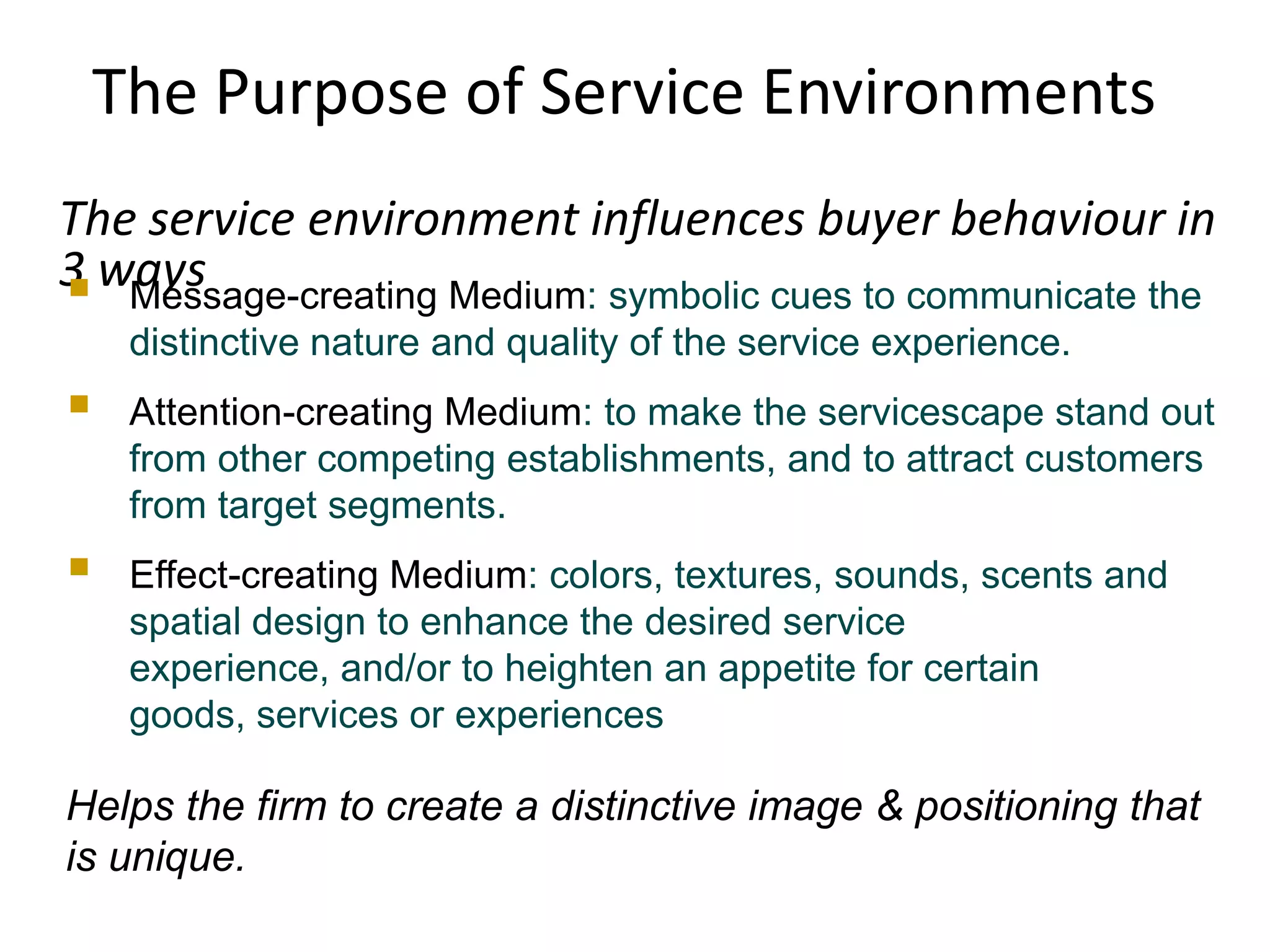
The Purpose of Service Environments
The service environment influences buyer behaviour in
3 ways
 Message-creating Medium: symbolic cues to communicate the
    distinctive nature and quality of the service experience.
   Attention-creating Medium: to make the servicescape stand out
    from other competing establishments, and to attract customers
    from target segments.
   Effect-creating Medium: colors, textures, sounds, scents and
    spatial design to enhance the desired service
    experience, and/or to heighten an appetite for certain
    goods, services or experiences

Helps the firm to create a distinctive image & positioning that
is unique.
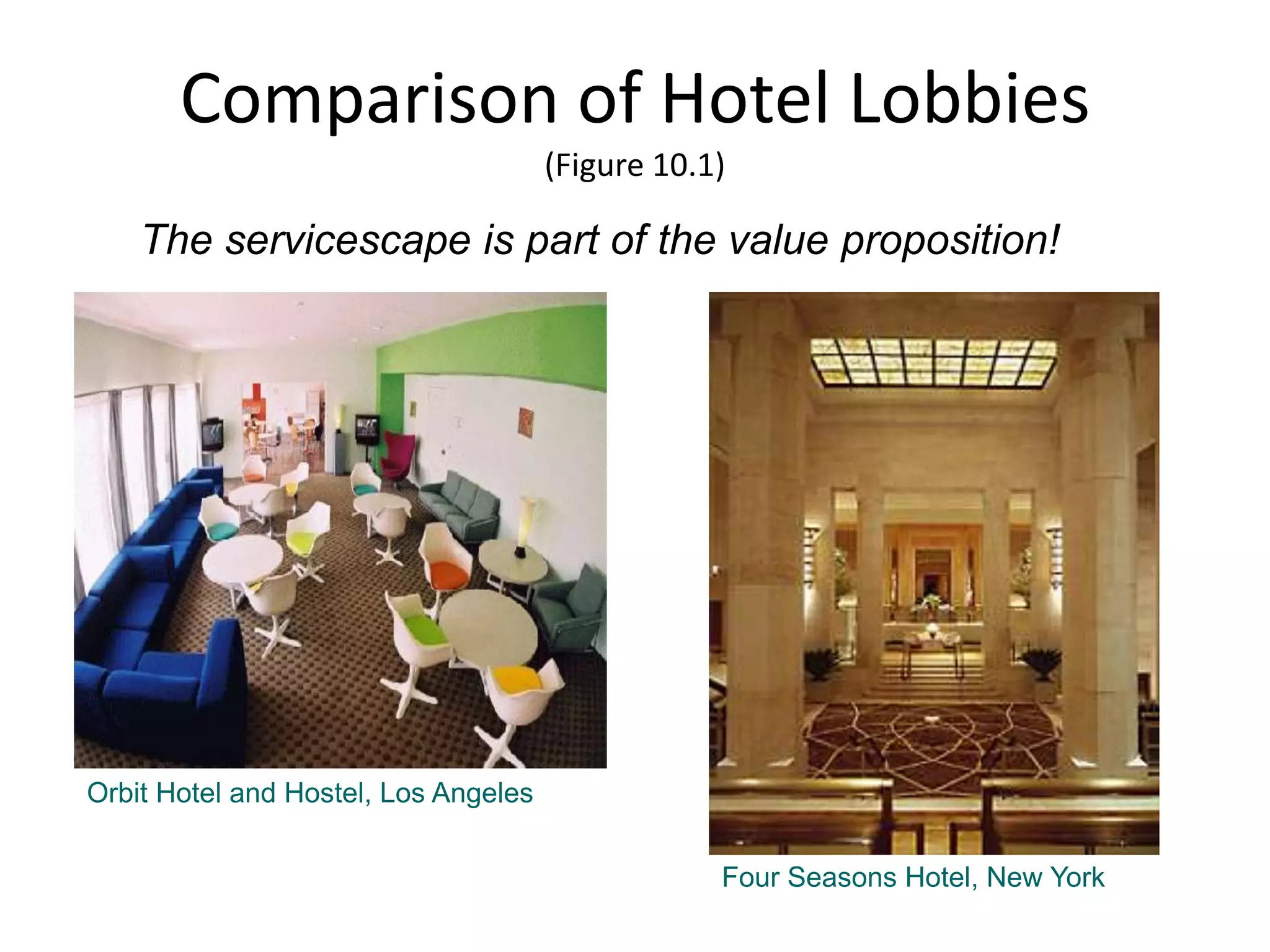
Comparison of Hotel Lobbies
                                      (Figure 10.1)

    The servicescape is part of the value proposition!


Orbit Hotel and Hostel, Los Angeles

                                                  Four Seasons Hotel, New York
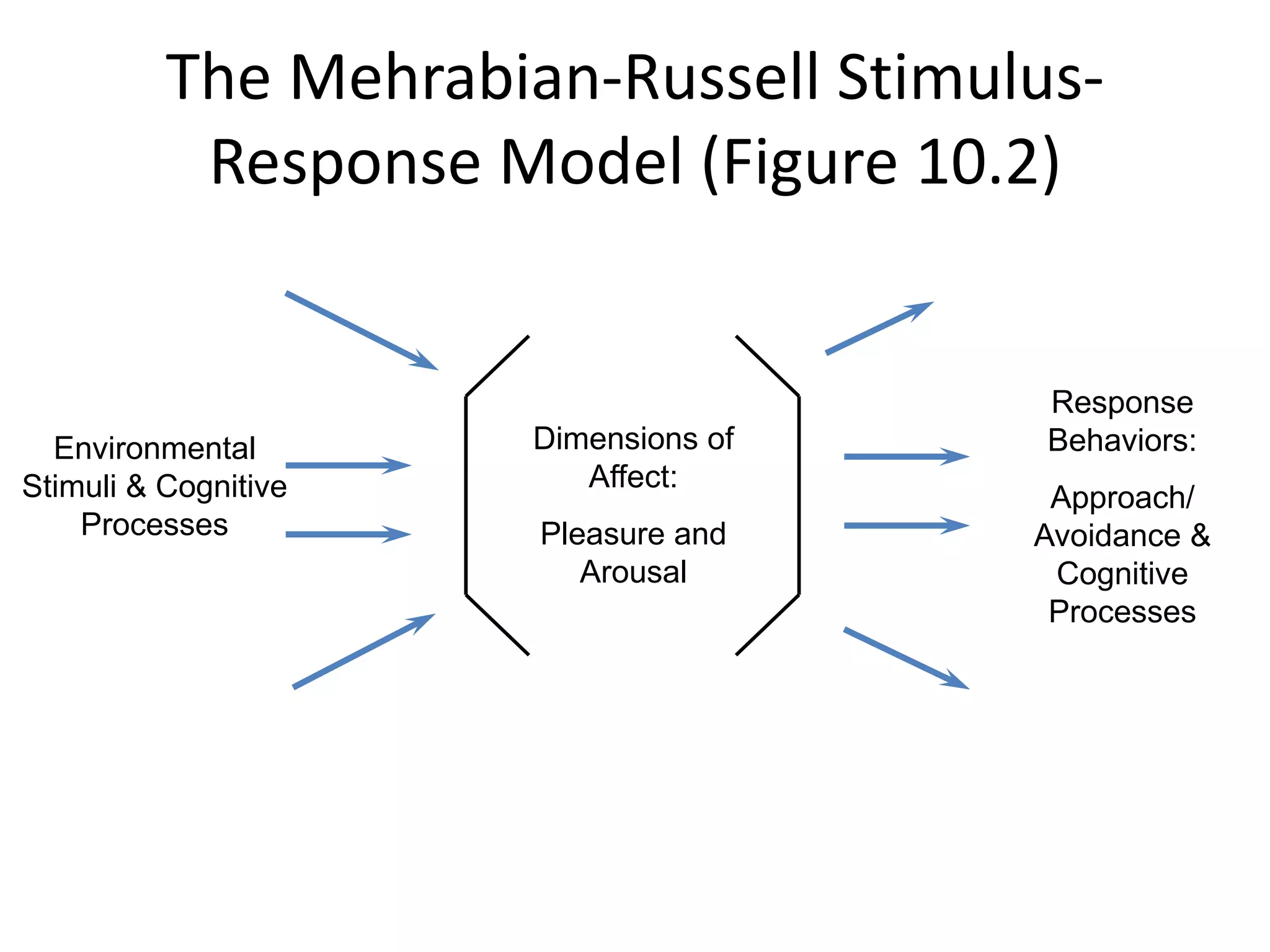
The Mehrabian-Russell Stimulus-
           Response Model (Figure 10.2)


                                       Response
  Environmental       Dimensions of    Behaviors:
Stimuli & Cognitive      Affect:
                                       Approach/
    Processes         Pleasure and    Avoidance &
                         Arousal       Cognitive
                                       Processes
The Mehrabian-Russell Stimulus-
          Response Model
• Simple and fundamental model of how people
  respond to environments
• Peoples’ conscious and unconscious perceptions
  and interpretation of the environment influence
  how they feel in that environment
• Feelings, rather than perceptions or thoughts drive
  behavior
• Typical outcome variable is ‘approach’ or
  ‘avoidance’ of an environment, but other possible
  outcomes can be added to the model as well
The Russell Model of Affect
                      Arousing

        Distressing
                                 Exciting


Unpleasant                                  Pleasant


             Boring              Relaxing


                       Sleepy
The Russell Model of Affect
• Emotional responses to environments can be
  described along two main dimensions, pleasure
  and arousal.
• Pleasure is subjective depending on how much the
  individual likes or dislikes the environment
• Arousal quality of an environment is dependent on
  its “information load”, i.e., its degree of
  –   Novelty (unexpected, surprising, new, familiar) and
  –   Complexity (number of elements, extent of motion or
      change)
Drivers of Affect
• Affect can be caused by perceptions and cognitive
  processes of any degree of complexity.
• Simple Cognitive Processes, Perception of Stimuli
   – tangible cues (of service quality)
   – consumer satisfaction

• Complex Cognitive Processes
   – affective charged schemata processing
   – attribution processes
The more complex a cognitive process becomes, the more
powerful its potential impact on affect.However, most service
encounters are routine. Simple processes can determine affect.
Behavioral Consequence of Affect
• Basically, pleasant environments result in
  approach, and unpleasant environments result in
  avoidance
• Arousal acts as an amplifier of the basic effect of
  pleasure on behavior
• If the environment is pleasant, increasing arousal
  can lead to excitement and stronger positive
  consumer response. If the environment is
  unpleasant, increasing arousal level will move
  consumers into the Distressing region
• Feelings during the service encounter is also an
  important driver of customer loyalty
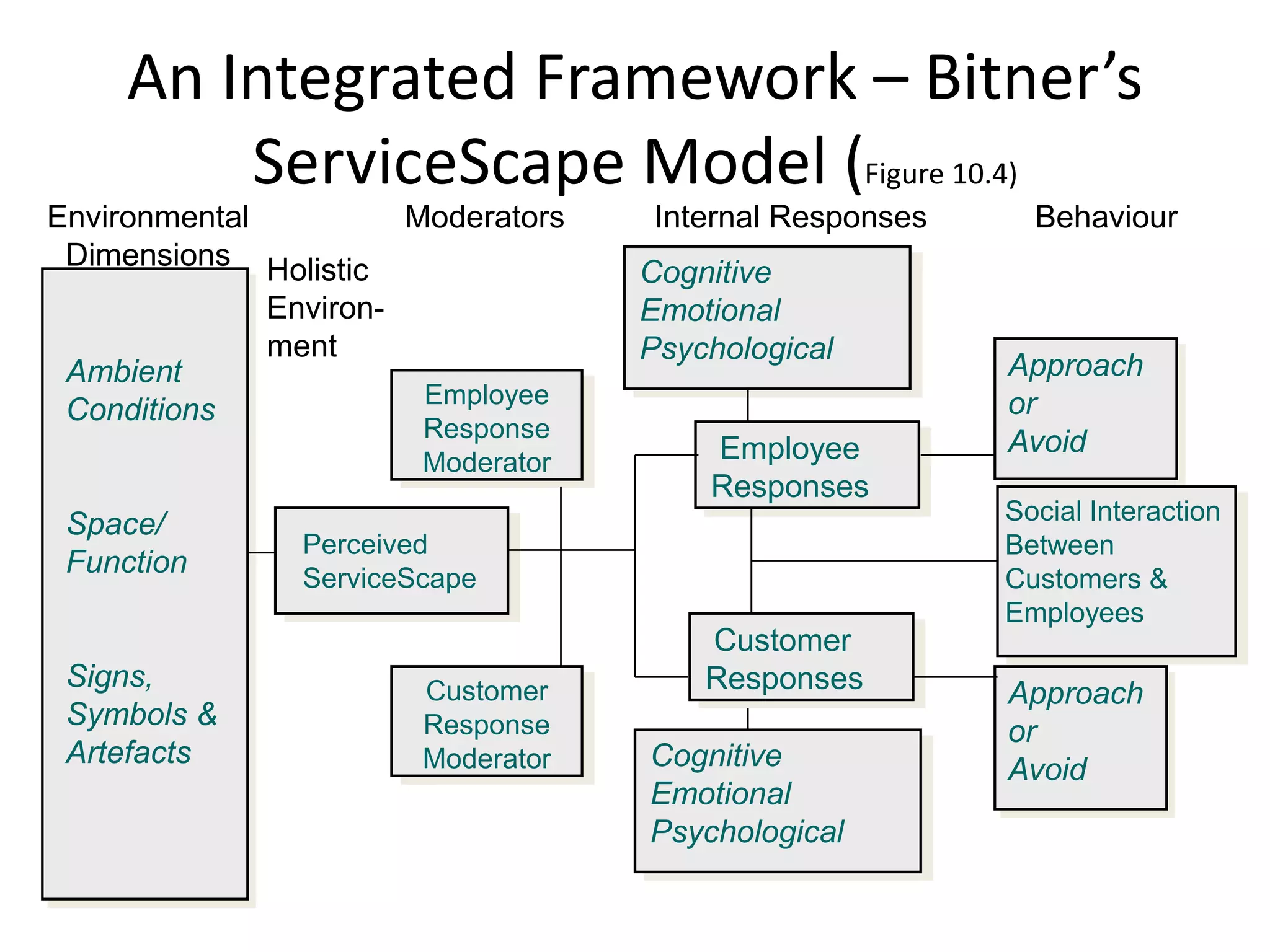
An Integrated Framework – Bitner’s
         ServiceScape Model (Figure 10.4)
Environmental          Moderators    Internal Responses     Behaviour
 Dimensions Holistic
                                    Cognitive
              Environ-              Emotional
              ment                  Psychological
 Ambient                                                  Approach
                        Employee                          or
 Conditions
                        Response                          Avoid
                        Moderator       Employee
                                        Responses
 Space/                                                   Social Interaction
                Perceived                                 Between
 Function       ServiceScape                              Customers &
                                                          Employees
                                        Customer
 Signs,                 Customer        Responses         Approach
 Symbols &              Response                          or
 Artefacts              Moderator   Cognitive             Avoid
                                    Emotional
                                    Psychological
An Integrated Framework – Bitner’s
     ServiceScape Model(con’t)
• Identifies the main dimensions in a service
  environment and views them holistically
• Customer and employee responses classified
  under, cognitive, emotional and psychological
  which would in turn lead to overt behavior
  towards the environment
• Key to effective design is how well each
  individual dimension fits together with
  everything else
Dimensions of the Service
              Environment
Service environments are complex and have many design
elements. The main dimensions in the servicescape model
includes:

• Ambient Conditions
   – Music (e.g, fast tempo and high volume increase arousal levels)

   – Scent (strong impact on mood, affect and evaluative
     responses, purchase intention and in-store behavior)

   – Color (e.g, warm colors associated with elated mood states and
     arousal but also increase anxiety, cool colors reduce arousal but
     can elicit peacefulness and calm)
Dimensions of the Service
          Environment (con’t)
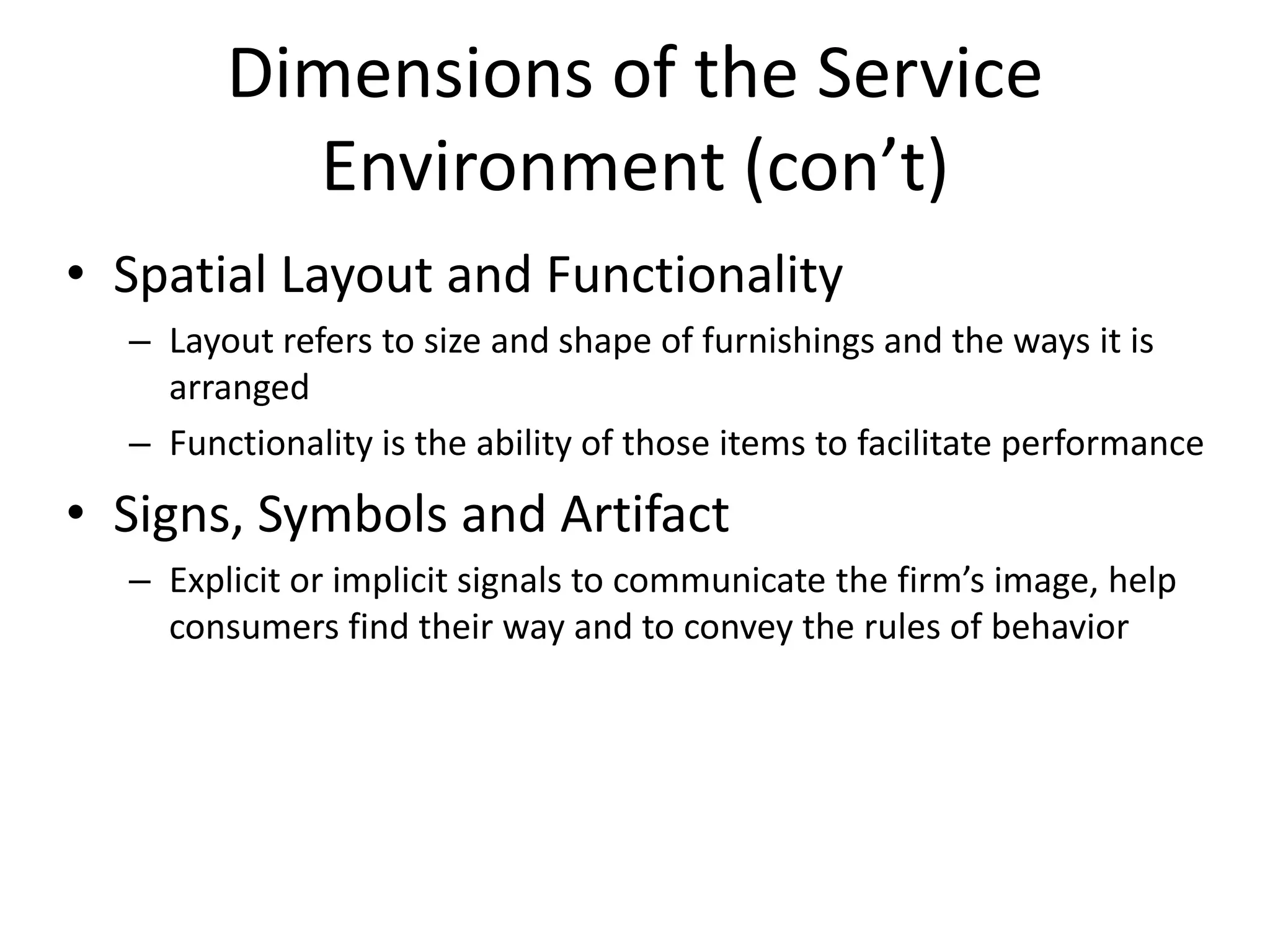
• Spatial Layout and Functionality
  – Layout refers to size and shape of furnishings and the ways it is
    arranged
  – Functionality is the ability of those items to facilitate performance
• Signs, Symbols and Artifact
  – Explicit or implicit signals to communicate the firm’s image, help
    consumers find their way and to convey the rules of behavior
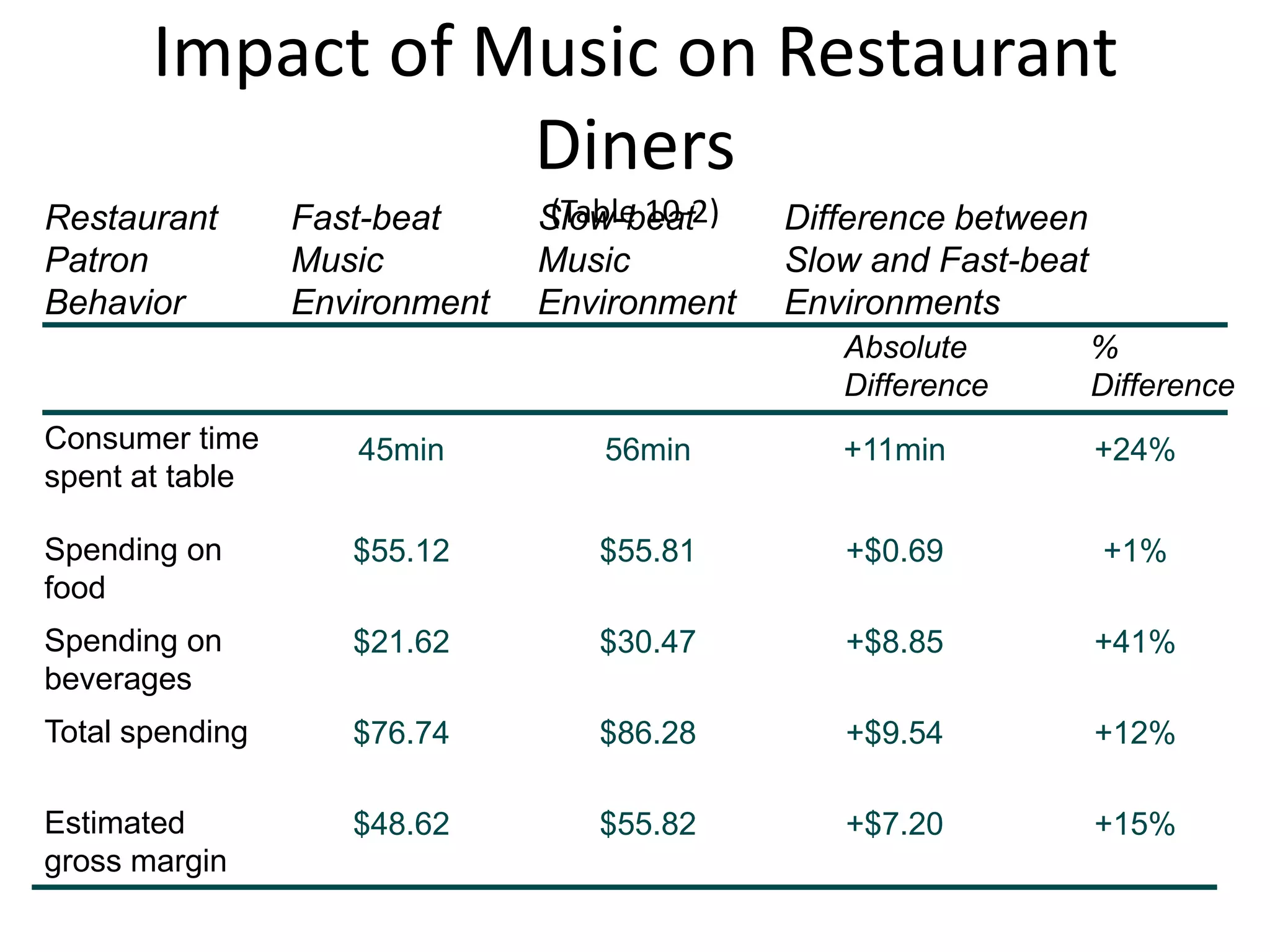
Impact of Music on Restaurant
                  Diners
Restaurant       Fast-beat      (Table 10-2)
                               Slow-beat       Difference between
Patron           Music         Music           Slow and Fast-beat
Behavior         Environment   Environment     Environments
                                                  Absolute          %
                                                  Difference        Difference
Consumer time       45min          56min          +11min            +24%
spent at table

Spending on         $55.12         $55.81         +$0.69            +1%
food
Spending on         $21.62         $30.47         +$8.85            +41%
beverages
Total spending      $76.74         $86.28         +$9.54            +12%

Estimated           $48.62         $55.82         +$7.20            +15%
gross margin
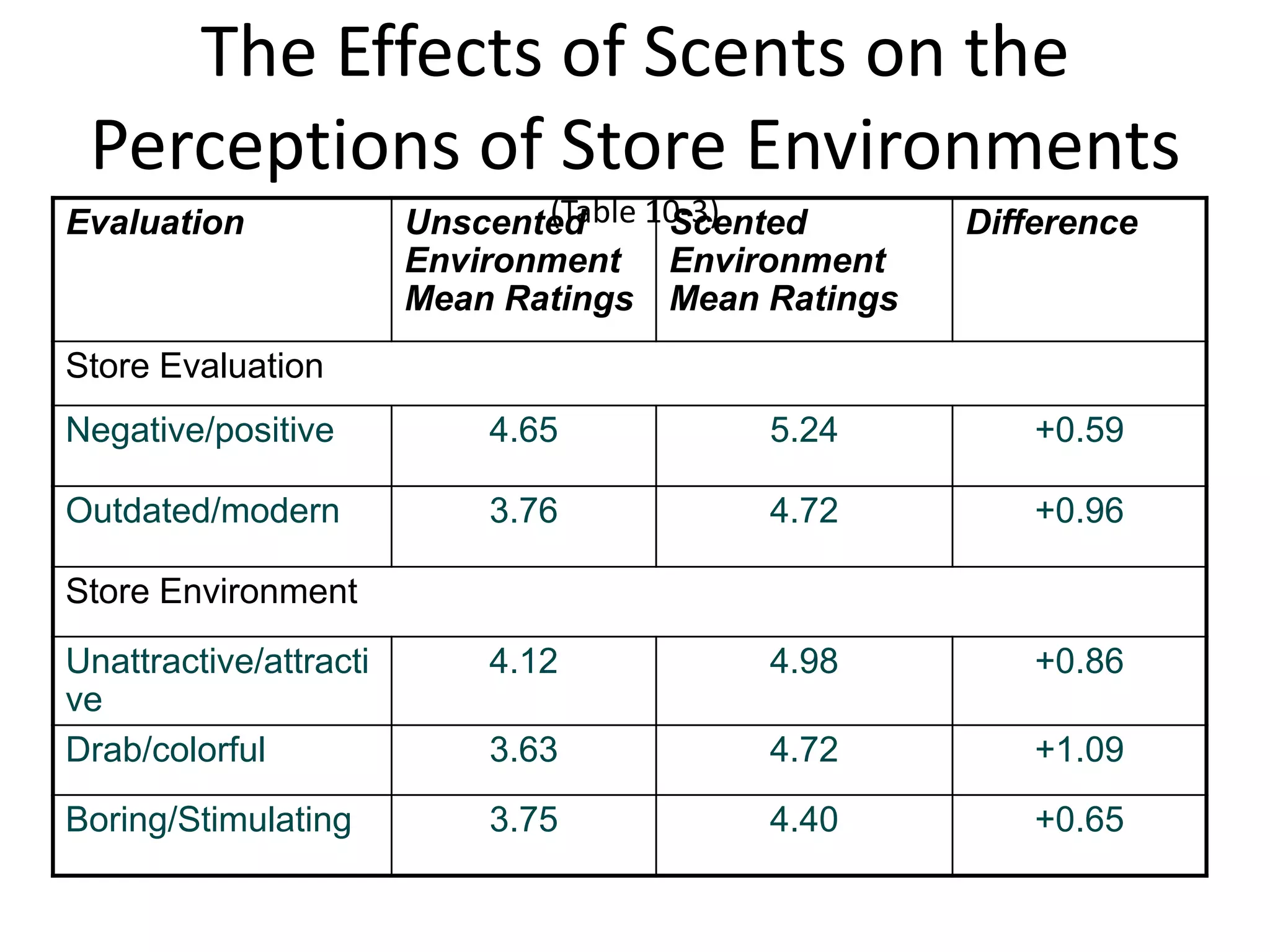
The Effects of Scents on the
 Perceptions of Store Environments
Evaluation                     (Table 10-3)
                        Unscented      Scented      Difference
                        Environment Environment
                        Mean Ratings Mean Ratings
Store Evaluation
Negative/positive           4.65          5.24          +0.59

Outdated/modern             3.76          4.72          +0.96

Store Environment
Unattractive/attracti       4.12          4.98          +0.86
ve
Drab/colorful               3.63          4.72          +1.09
Boring/Stimulating          3.75          4.40          +0.65
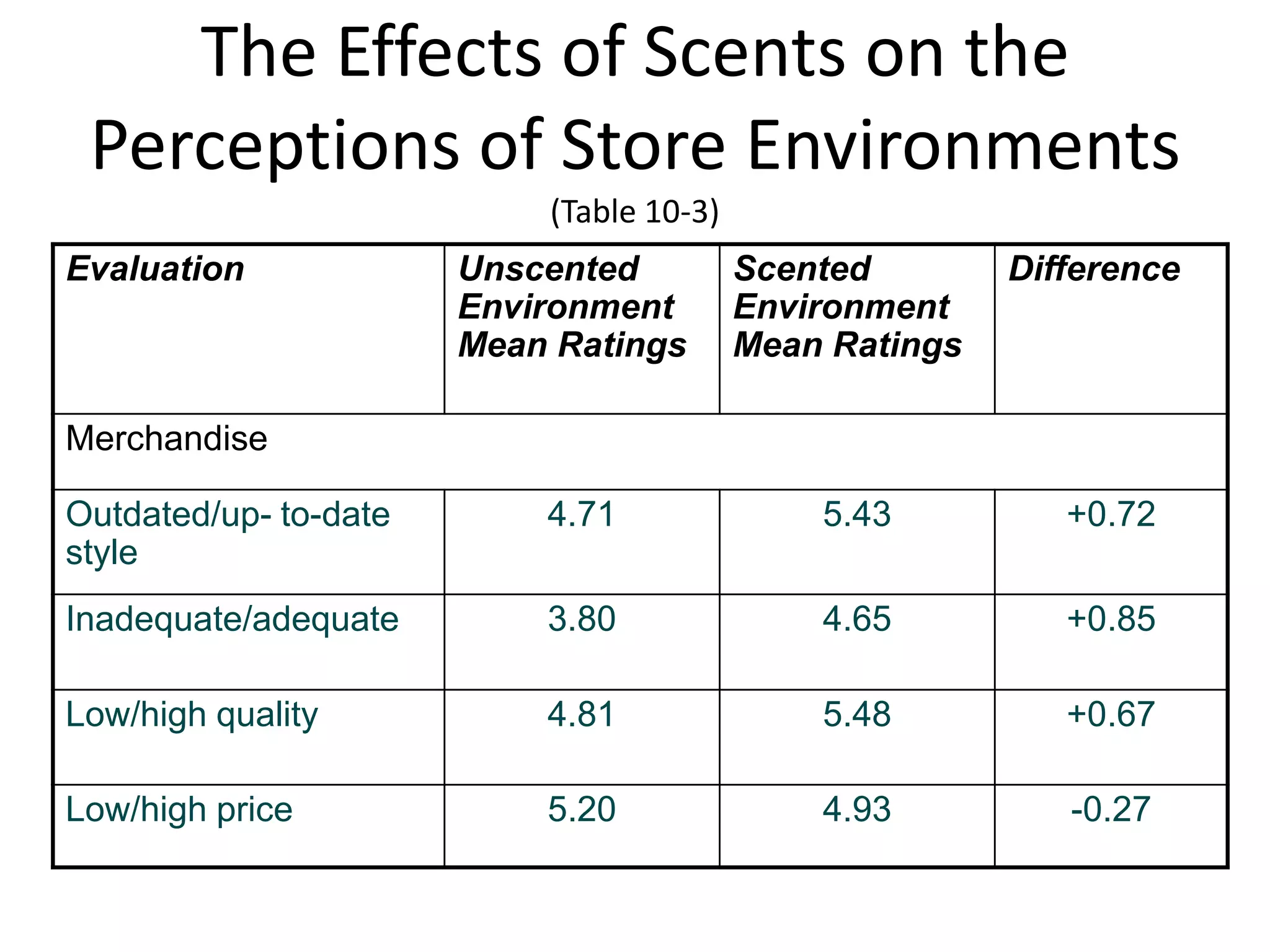
The Effects of Scents on the
 Perceptions of Store Environments
                           (Table 10-3)
Evaluation             Unscented          Scented        Difference
                       Environment        Environment
                       Mean Ratings       Mean Ratings

Merchandise

Outdated/up- to-date       4.71               5.43          +0.72
style
Inadequate/adequate        3.80               4.65          +0.85

Low/high quality           4.81               5.48          +0.67

Low/high price             5.20               4.93          -0.27
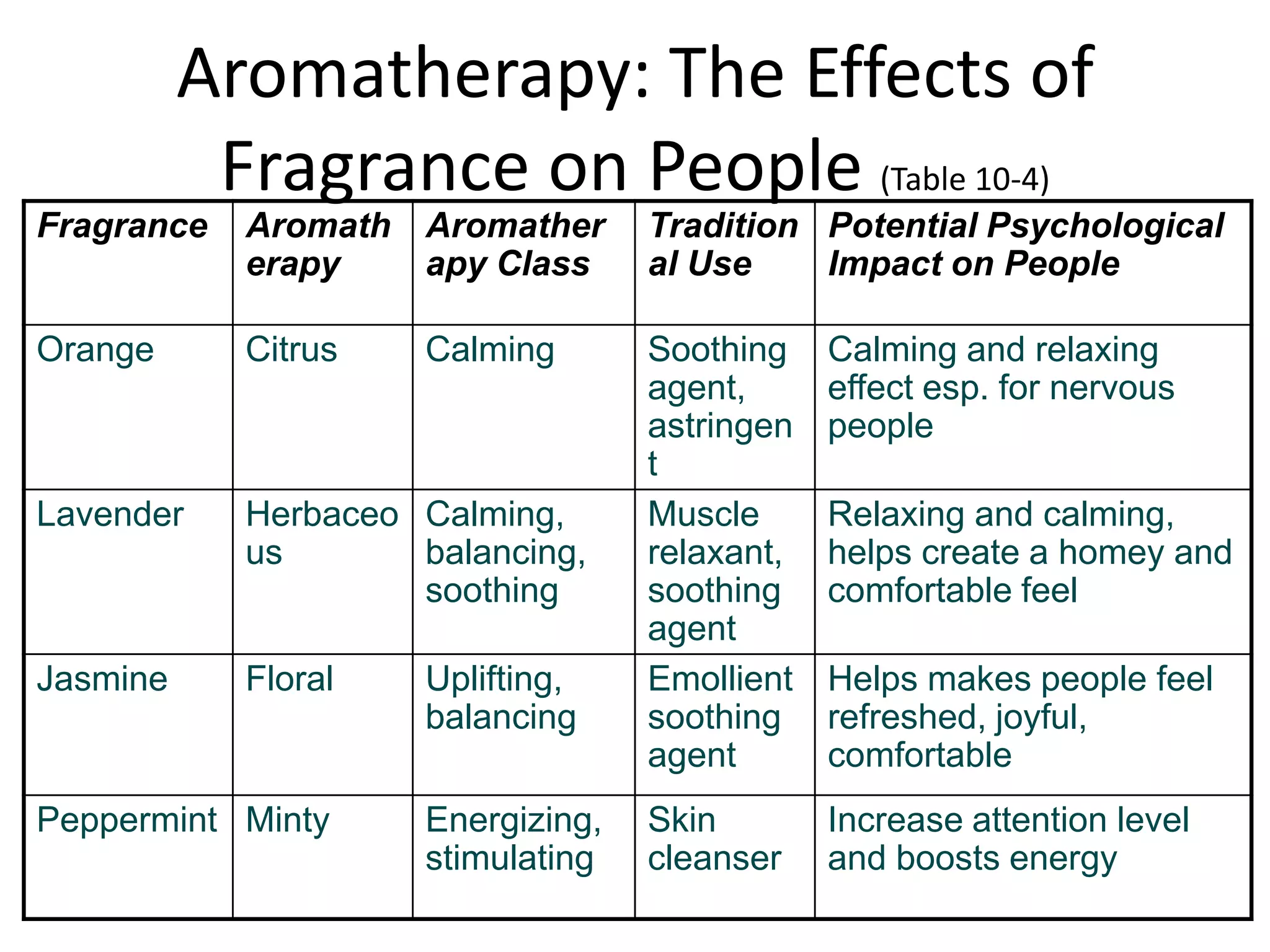
Aromatherapy: The Effects of
           Fragrance on People (Table 10-4)
Fragrance   Aromath Aromather       Tradition Potential Psychological
            erapy   apy Class       al Use    Impact on People

Orange      Citrus    Calming       Soothing    Calming and relaxing
                                    agent,      effect esp. for nervous
                                    astringen   people
                                    t
Lavender    Herbaceo Calming,       Muscle      Relaxing and calming,
            us       balancing,     relaxant,   helps create a homey and
                     soothing       soothing    comfortable feel
                                    agent
Jasmine     Floral    Uplifting,    Emollient   Helps makes people feel
                      balancing     soothing    refreshed, joyful,
                                    agent       comfortable
Peppermint Minty      Energizing,   Skin        Increase attention level
                      stimulating   cleanser    and boosts energy
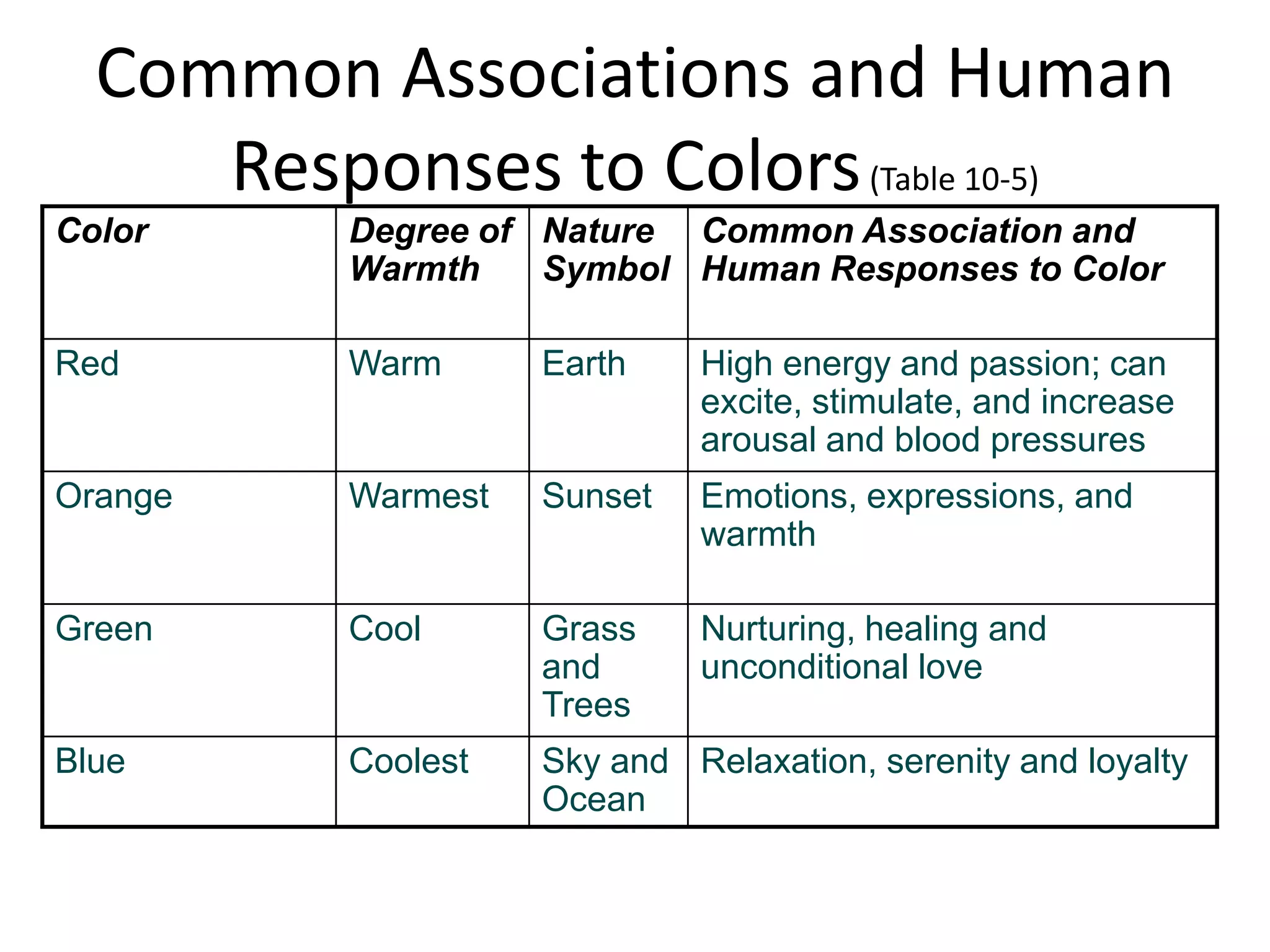
Common Associations and Human
     Responses to Colors (Table 10-5)
Color     Degree of Nature Common Association and
          Warmth    Symbol Human Responses to Color

Red       Warm      Earth    High energy and passion; can
                             excite, stimulate, and increase
                             arousal and blood pressures
Orange    Warmest   Sunset   Emotions, expressions, and
                             warmth

Green     Cool      Grass    Nurturing, healing and
                    and      unconditional love
                    Trees
Blue      Coolest   Sky and Relaxation, serenity and loyalty
                    Ocean
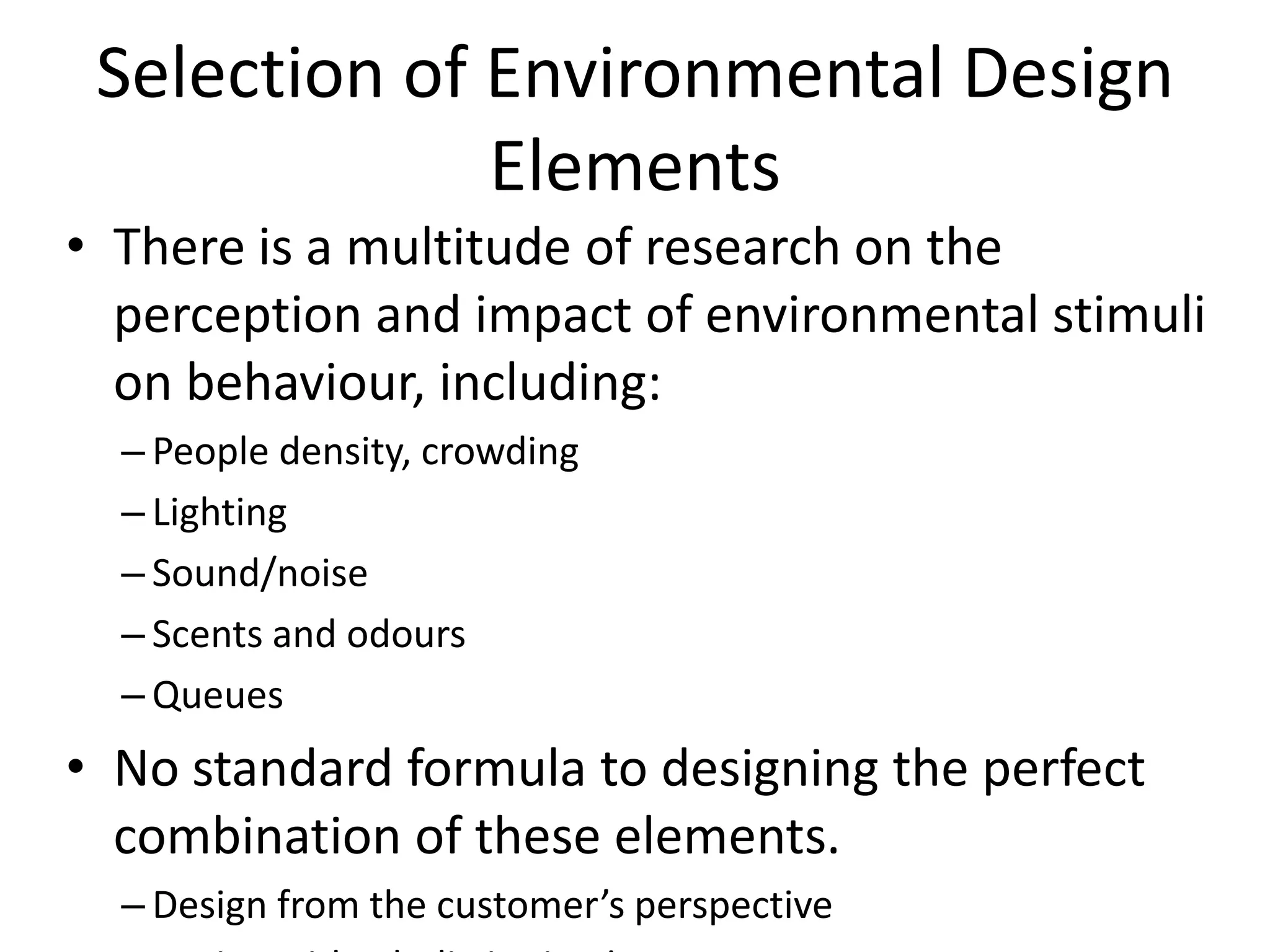
Selection of Environmental Design
              Elements
• There is a multitude of research on the
  perception and impact of environmental stimuli
  on behaviour, including:
  – People density, crowding
  – Lighting
  – Sound/noise
  – Scents and odours
  – Queues
• No standard formula to designing the perfect
  combination of these elements.
  – Design from the customer’s perspective
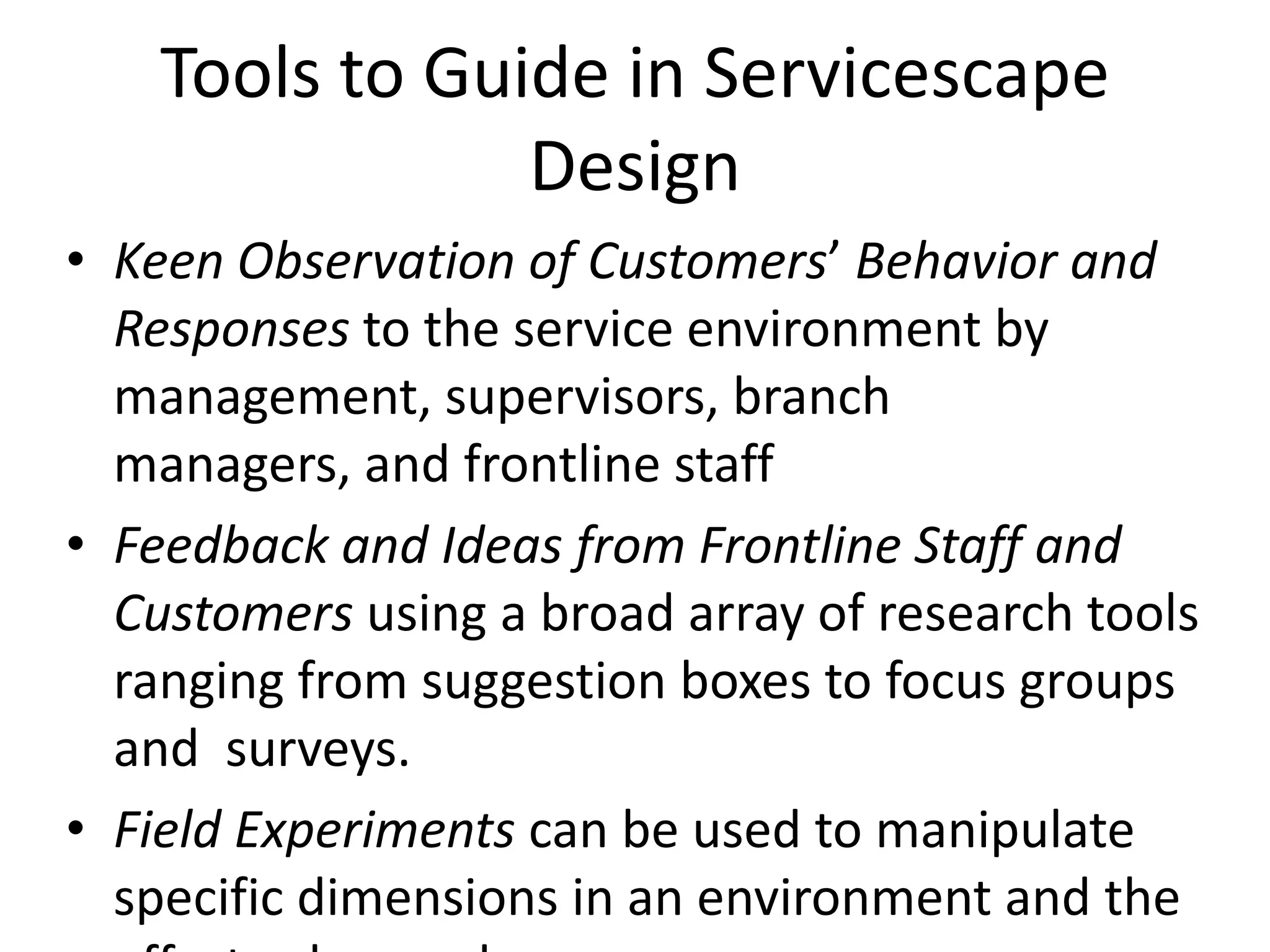
Tools to Guide in Servicescape
                Design
• Keen Observation of Customers’ Behavior and
  Responses to the service environment by
  management, supervisors, branch
  managers, and frontline staff
• Feedback and Ideas from Frontline Staff and
  Customers using a broad array of research tools
  ranging from suggestion boxes to focus groups
  and surveys.
• Field Experiments can be used to manipulate
  specific dimensions in an environment and the

Utsav Mahendra : Planning the Service Environment

  • 1.
    Chapter 10 Planning the Service Environment
  • 2.
    The Purpose ofService Environments The service environment influences buyer behaviour in 3 ways  Message-creating Medium: symbolic cues to communicate the distinctive nature and quality of the service experience.  Attention-creating Medium: to make the servicescape stand out from other competing establishments, and to attract customers from target segments.  Effect-creating Medium: colors, textures, sounds, scents and spatial design to enhance the desired service experience, and/or to heighten an appetite for certain goods, services or experiences Helps the firm to create a distinctive image & positioning that is unique.
  • 3.
    Comparison of HotelLobbies (Figure 10.1) The servicescape is part of the value proposition! Orbit Hotel and Hostel, Los Angeles Four Seasons Hotel, New York
  • 4.
    The Mehrabian-Russell Stimulus- Response Model (Figure 10.2) Response Environmental Dimensions of Behaviors: Stimuli & Cognitive Affect: Approach/ Processes Pleasure and Avoidance & Arousal Cognitive Processes
  • 5.
    The Mehrabian-Russell Stimulus- Response Model • Simple and fundamental model of how people respond to environments • Peoples’ conscious and unconscious perceptions and interpretation of the environment influence how they feel in that environment • Feelings, rather than perceptions or thoughts drive behavior • Typical outcome variable is ‘approach’ or ‘avoidance’ of an environment, but other possible outcomes can be added to the model as well
  • 6.
    The Russell Modelof Affect Arousing Distressing Exciting Unpleasant Pleasant Boring Relaxing Sleepy
  • 7.
    The Russell Modelof Affect • Emotional responses to environments can be described along two main dimensions, pleasure and arousal. • Pleasure is subjective depending on how much the individual likes or dislikes the environment • Arousal quality of an environment is dependent on its “information load”, i.e., its degree of – Novelty (unexpected, surprising, new, familiar) and – Complexity (number of elements, extent of motion or change)
  • 8.
    Drivers of Affect •Affect can be caused by perceptions and cognitive processes of any degree of complexity. • Simple Cognitive Processes, Perception of Stimuli – tangible cues (of service quality) – consumer satisfaction • Complex Cognitive Processes – affective charged schemata processing – attribution processes The more complex a cognitive process becomes, the more powerful its potential impact on affect.However, most service encounters are routine. Simple processes can determine affect.
  • 9.
    Behavioral Consequence ofAffect • Basically, pleasant environments result in approach, and unpleasant environments result in avoidance • Arousal acts as an amplifier of the basic effect of pleasure on behavior • If the environment is pleasant, increasing arousal can lead to excitement and stronger positive consumer response. If the environment is unpleasant, increasing arousal level will move consumers into the Distressing region • Feelings during the service encounter is also an important driver of customer loyalty
  • 10.
    An Integrated Framework– Bitner’s ServiceScape Model (Figure 10.4) Environmental Moderators Internal Responses Behaviour Dimensions Holistic Cognitive Environ- Emotional ment Psychological Ambient Approach Employee or Conditions Response Avoid Moderator Employee Responses Space/ Social Interaction Perceived Between Function ServiceScape Customers & Employees Customer Signs, Customer Responses Approach Symbols & Response or Artefacts Moderator Cognitive Avoid Emotional Psychological
  • 11.
    An Integrated Framework– Bitner’s ServiceScape Model(con’t) • Identifies the main dimensions in a service environment and views them holistically • Customer and employee responses classified under, cognitive, emotional and psychological which would in turn lead to overt behavior towards the environment • Key to effective design is how well each individual dimension fits together with everything else
  • 12.
    Dimensions of theService Environment Service environments are complex and have many design elements. The main dimensions in the servicescape model includes: • Ambient Conditions – Music (e.g, fast tempo and high volume increase arousal levels) – Scent (strong impact on mood, affect and evaluative responses, purchase intention and in-store behavior) – Color (e.g, warm colors associated with elated mood states and arousal but also increase anxiety, cool colors reduce arousal but can elicit peacefulness and calm)
  • 13.
    Dimensions of theService Environment (con’t) • Spatial Layout and Functionality – Layout refers to size and shape of furnishings and the ways it is arranged – Functionality is the ability of those items to facilitate performance • Signs, Symbols and Artifact – Explicit or implicit signals to communicate the firm’s image, help consumers find their way and to convey the rules of behavior
  • 14.
    Impact of Musicon Restaurant Diners Restaurant Fast-beat (Table 10-2) Slow-beat Difference between Patron Music Music Slow and Fast-beat Behavior Environment Environment Environments Absolute % Difference Difference Consumer time 45min 56min +11min +24% spent at table Spending on $55.12 $55.81 +$0.69 +1% food Spending on $21.62 $30.47 +$8.85 +41% beverages Total spending $76.74 $86.28 +$9.54 +12% Estimated $48.62 $55.82 +$7.20 +15% gross margin
  • 15.
    The Effects ofScents on the Perceptions of Store Environments Evaluation (Table 10-3) Unscented Scented Difference Environment Environment Mean Ratings Mean Ratings Store Evaluation Negative/positive 4.65 5.24 +0.59 Outdated/modern 3.76 4.72 +0.96 Store Environment Unattractive/attracti 4.12 4.98 +0.86 ve Drab/colorful 3.63 4.72 +1.09 Boring/Stimulating 3.75 4.40 +0.65
  • 16.
    The Effects ofScents on the Perceptions of Store Environments (Table 10-3) Evaluation Unscented Scented Difference Environment Environment Mean Ratings Mean Ratings Merchandise Outdated/up- to-date 4.71 5.43 +0.72 style Inadequate/adequate 3.80 4.65 +0.85 Low/high quality 4.81 5.48 +0.67 Low/high price 5.20 4.93 -0.27
  • 17.
    Aromatherapy: The Effectsof Fragrance on People (Table 10-4) Fragrance Aromath Aromather Tradition Potential Psychological erapy apy Class al Use Impact on People Orange Citrus Calming Soothing Calming and relaxing agent, effect esp. for nervous astringen people t Lavender Herbaceo Calming, Muscle Relaxing and calming, us balancing, relaxant, helps create a homey and soothing soothing comfortable feel agent Jasmine Floral Uplifting, Emollient Helps makes people feel balancing soothing refreshed, joyful, agent comfortable Peppermint Minty Energizing, Skin Increase attention level stimulating cleanser and boosts energy
  • 18.
    Common Associations andHuman Responses to Colors (Table 10-5) Color Degree of Nature Common Association and Warmth Symbol Human Responses to Color Red Warm Earth High energy and passion; can excite, stimulate, and increase arousal and blood pressures Orange Warmest Sunset Emotions, expressions, and warmth Green Cool Grass Nurturing, healing and and unconditional love Trees Blue Coolest Sky and Relaxation, serenity and loyalty Ocean
  • 19.
    Selection of EnvironmentalDesign Elements • There is a multitude of research on the perception and impact of environmental stimuli on behaviour, including: – People density, crowding – Lighting – Sound/noise – Scents and odours – Queues • No standard formula to designing the perfect combination of these elements. – Design from the customer’s perspective
  • 20.
    Tools to Guidein Servicescape Design • Keen Observation of Customers’ Behavior and Responses to the service environment by management, supervisors, branch managers, and frontline staff • Feedback and Ideas from Frontline Staff and Customers using a broad array of research tools ranging from suggestion boxes to focus groups and surveys. • Field Experiments can be used to manipulate specific dimensions in an environment and the