DISCRETE MATHEMATICS AND its APPLICATIONSDISCRETE MATHEMATICS AND its APPLICATIONS
TREESTREES
CHAPTER4TREES
CONTENTCONTENT
4.1 Introduction to Trees
4.2 Application of Trees
4.3 Tree Traversal
4.4 Trees and Sorting (Data structure)
4.5 Spanning Trees
4.6 Minimum Spanning
Trees
4.1 INTRODUCTION TO TREES4.1 INTRODUCTION TO TREES
• Define and recognize a tree
• Define and recognize a rooted tree
• Define and recognize a m-ary tree
CHAPTER4TREES
4.1INTRODUCTIONTOTREES
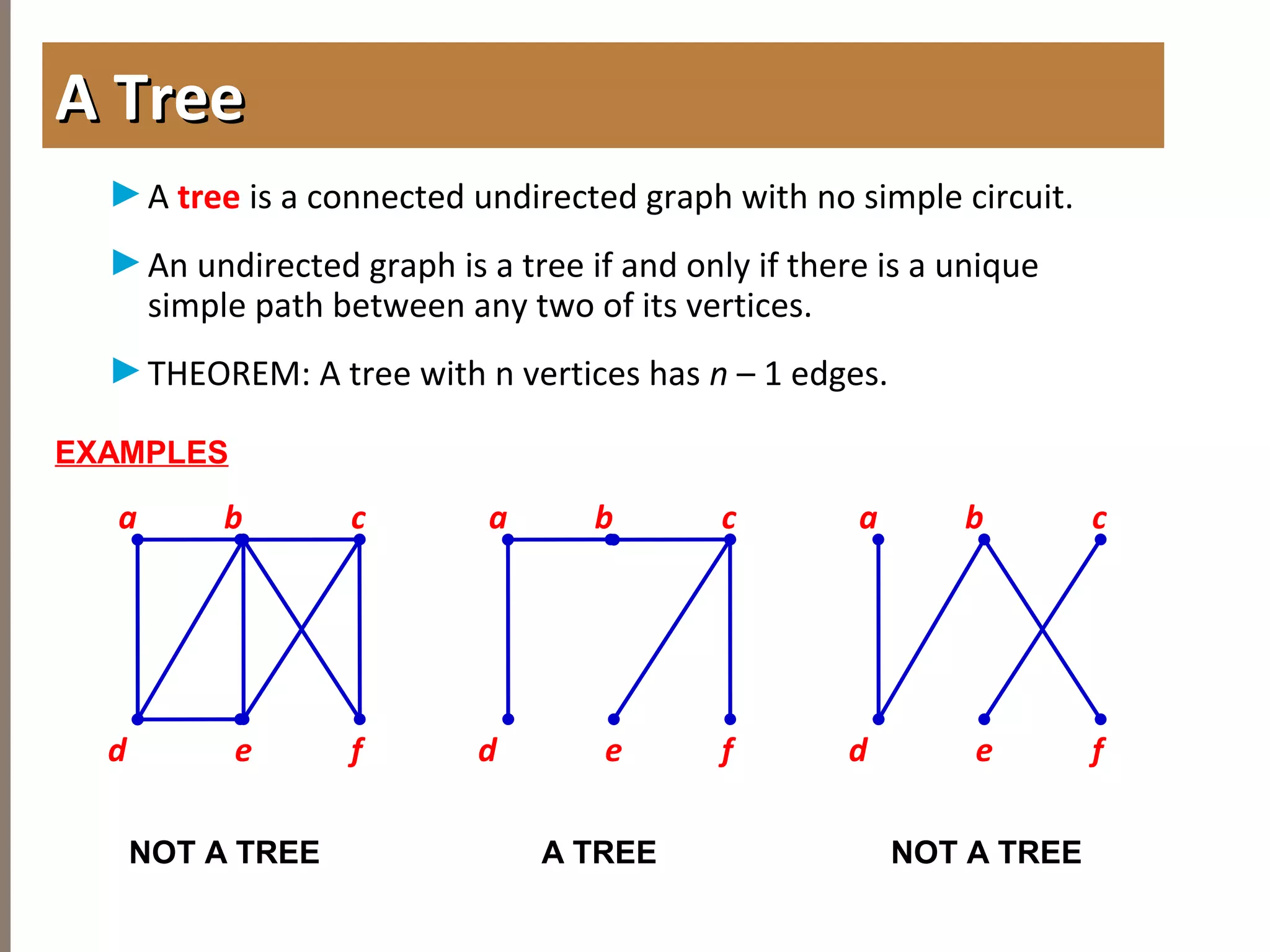
►A tree is a connected undirected graph with no simple circuit.
►An undirected graph is a tree if and only if there is a unique
simple path between any two of its vertices.
►THEOREM: A tree with n vertices has n – 1 edges.
A TreeA Tree
a b c
d e f
a b c
d e f
a b c
d e f
NOT A TREE NOT A TREEA TREE
EXAMPLES
4.1INTRODUCTIONTOTREES
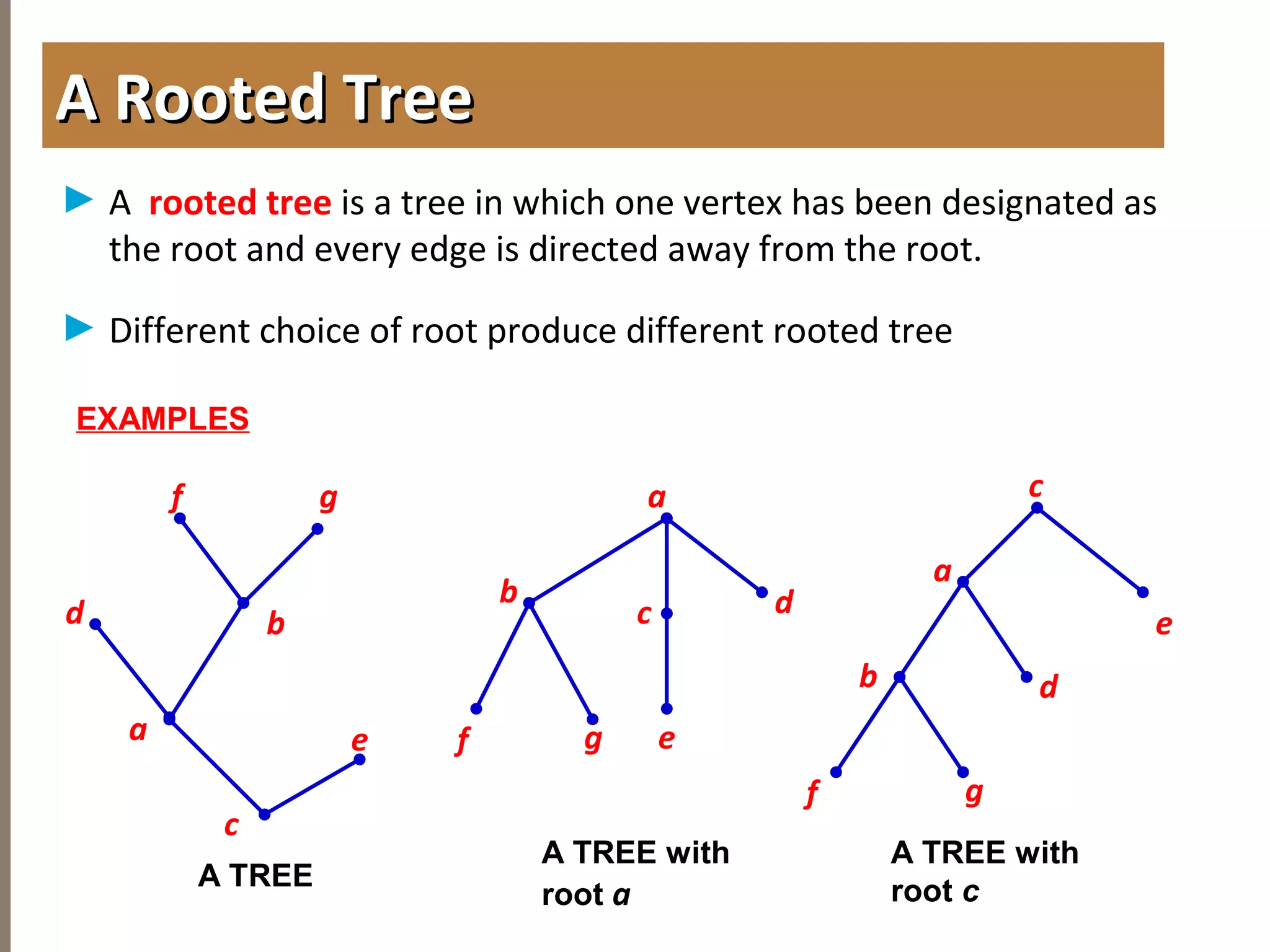
► A rooted tree is a tree in which one vertex has been designated as
the root and every edge is directed away from the root.
► Different choice of root produce different rooted tree
A Rooted TreeA Rooted Tree
a
b
c
d
e
f a
b
c d
ef
a
b
c
d
e
f
A TREE
A TREE with
root c
A TREE with
root a
EXAMPLES
g
g
g
4.1INTRODUCTIONTOTREES
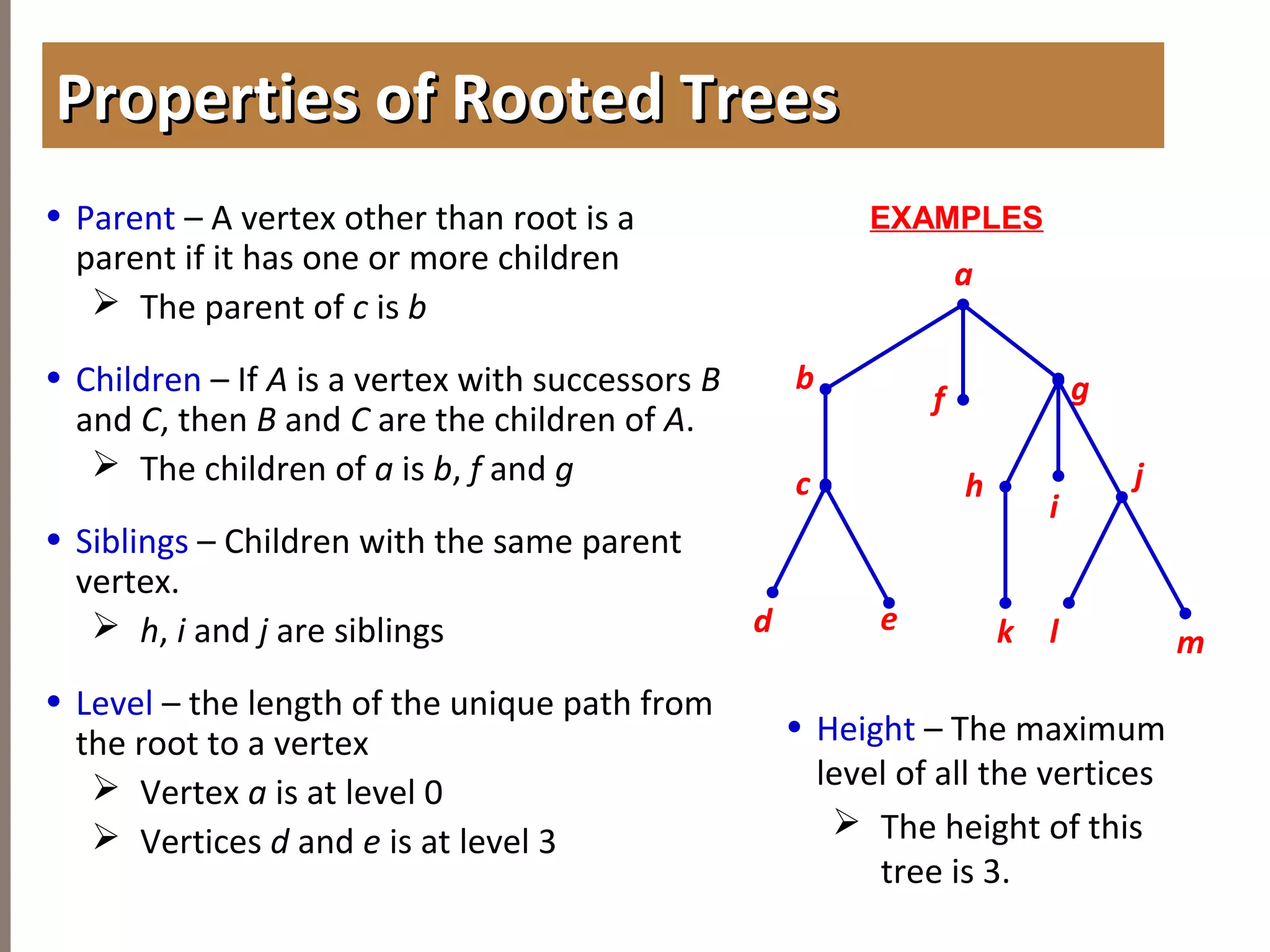
• Parent – A vertex other than root is a
parent if it has one or more children
 The parent of c is b
• Children – If A is a vertex with successors B
and C, then B and C are the children of A.
 The children of a is b, f and g
• Siblings – Children with the same parent
vertex.
 h, i and j are siblings
• Level – the length of the unique path from
the root to a vertex
 Vertex a is at level 0
 Vertices d and e is at level 3
Properties of Rooted TreesProperties of Rooted Trees
a
b
f g
h
d
EXAMPLES
e
i
jc
k l m
• Height – The maximum
level of all the vertices
 The height of this
tree is 3.
4.1INTRODUCTIONTOTREES
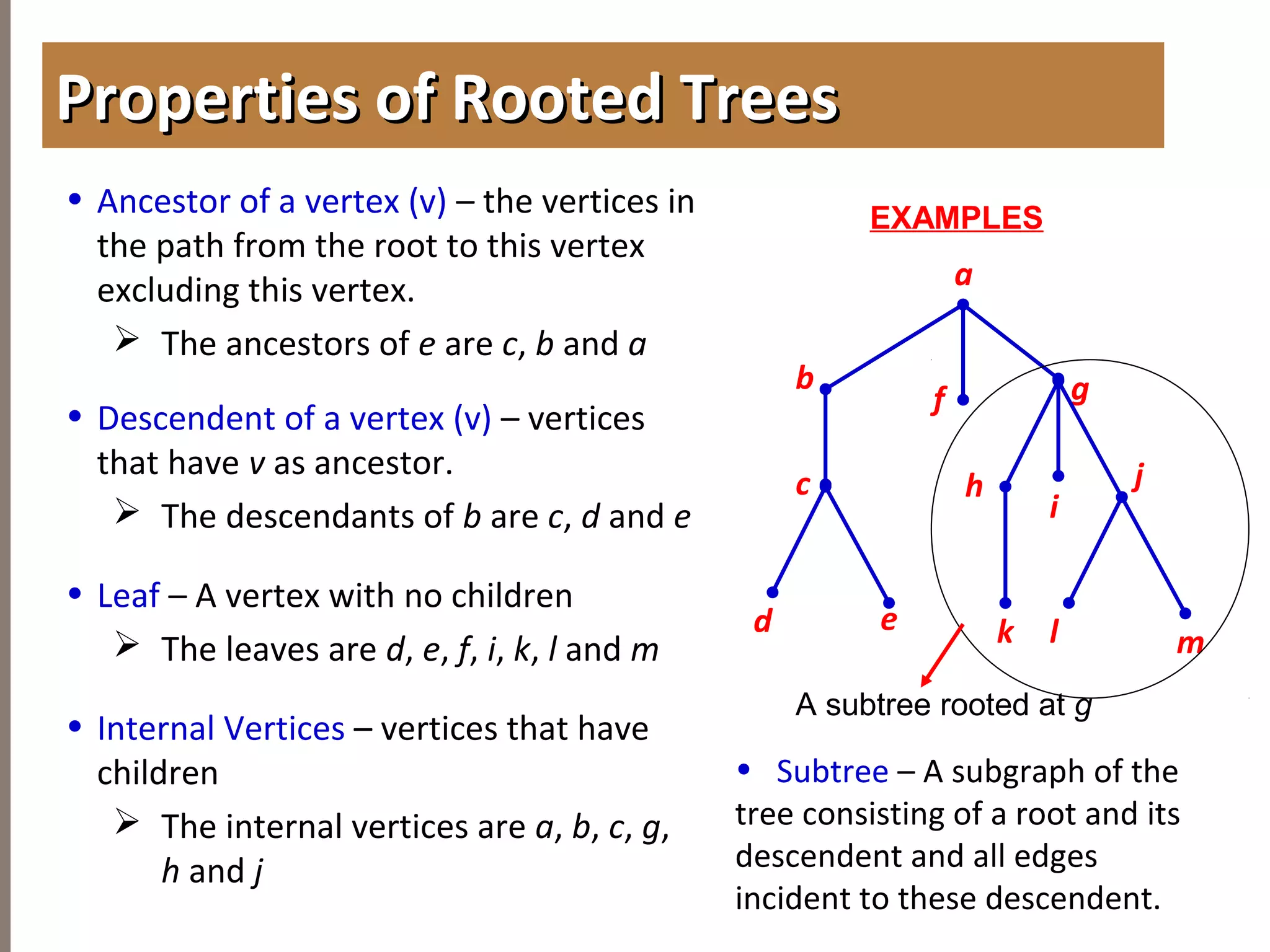
• Ancestor of a vertex (v) – the vertices in
the path from the root to this vertex
excluding this vertex.
 The ancestors of e are c, b and a
• Descendent of a vertex (v) – vertices
that have v as ancestor.
 The descendants of b are c, d and e
• Leaf – A vertex with no children
 The leaves are d, e, f, i, k, l and m
• Internal Vertices – vertices that have
children
 The internal vertices are a, b, c, g,
h and j
Properties of Rooted TreesProperties of Rooted Trees
a
b
f g
h
d
EXAMPLES
e
i
jc
k l m
A subtree rooted at g
• Subtree – A subgraph of the
tree consisting of a root and its
descendent and all edges
incident to these descendent.
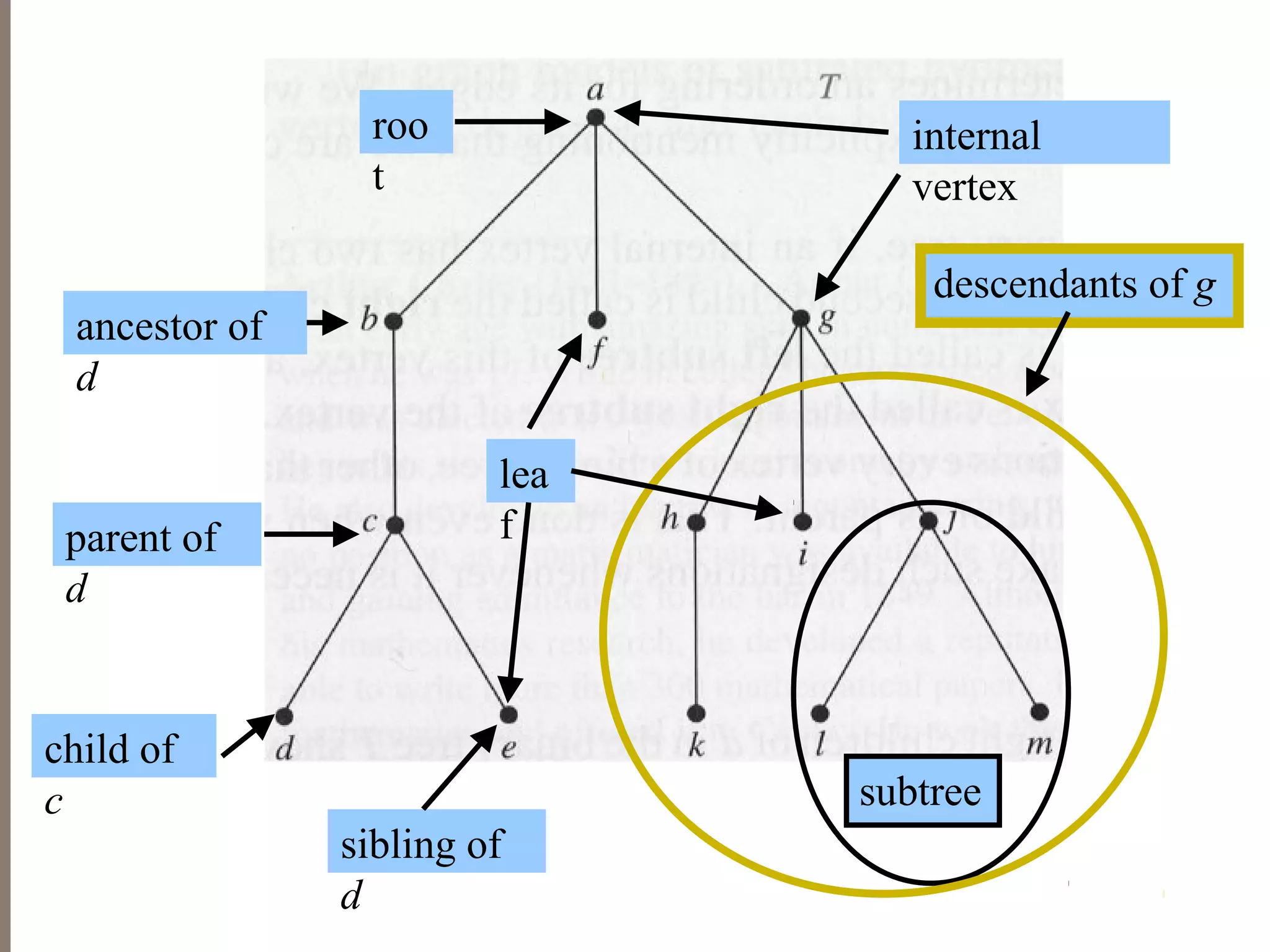
parent of
d
child of
c
sibling of
d
ancestor of
d
descendants of g
lea
f
internal
vertex
subtree
roo
t
4.1INTRODUCTIONTOTREES
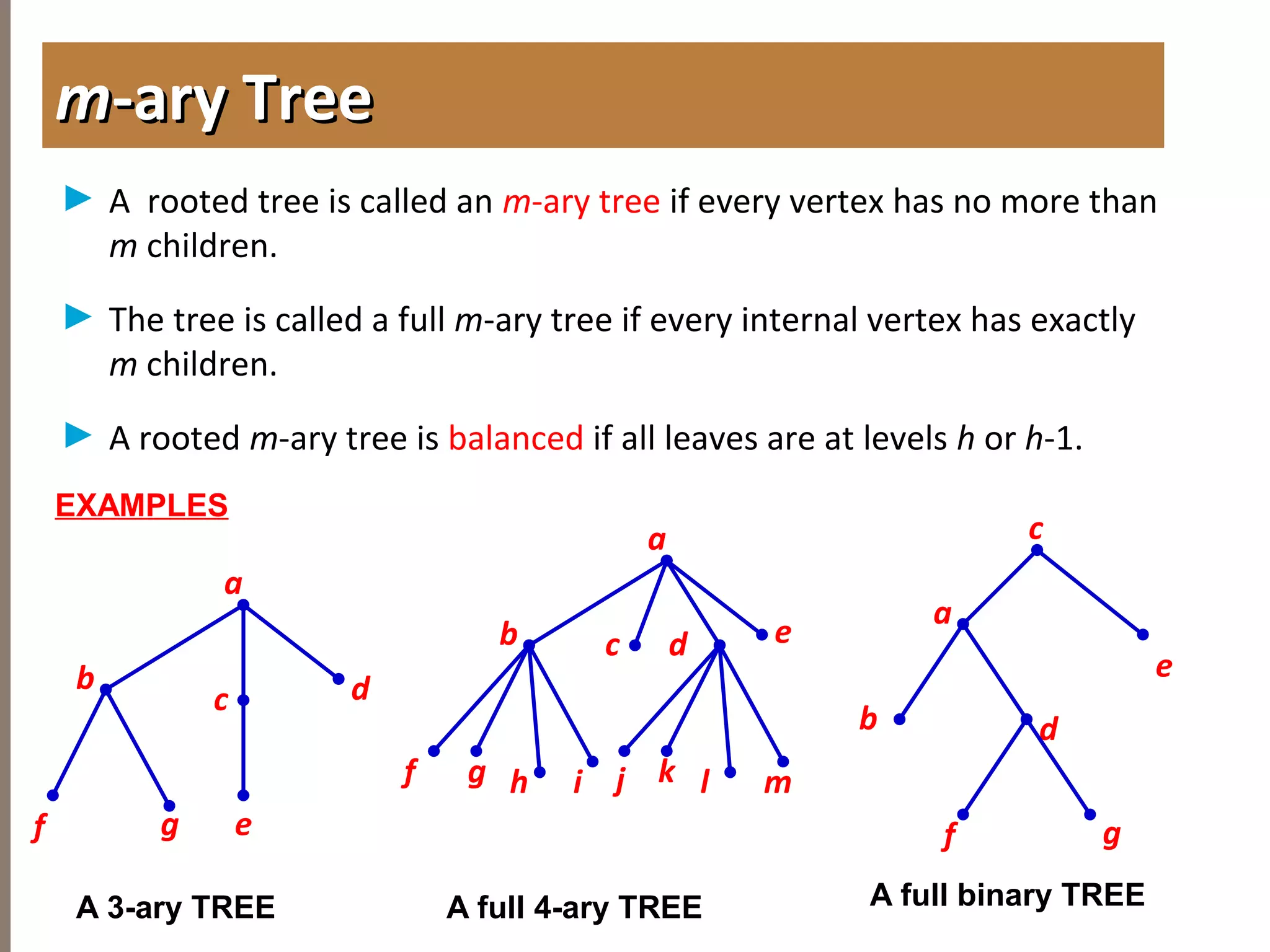
► A rooted tree is called an m-ary tree if every vertex has no more than
m children.
► The tree is called a full m-ary tree if every internal vertex has exactly
m children.
► A rooted m-ary tree is balanced if all leaves are at levels h or h-1.
mm-ary Tree-ary Tree
a
b c d
f
a
b
c
d
e
f
A full binary TREEA 3-ary TREE
EXAMPLES
g
g
a
b
c d
ef g
A full 4-ary TREE
e
h i j k l m
4.1INTRODUCTIONTOTREES
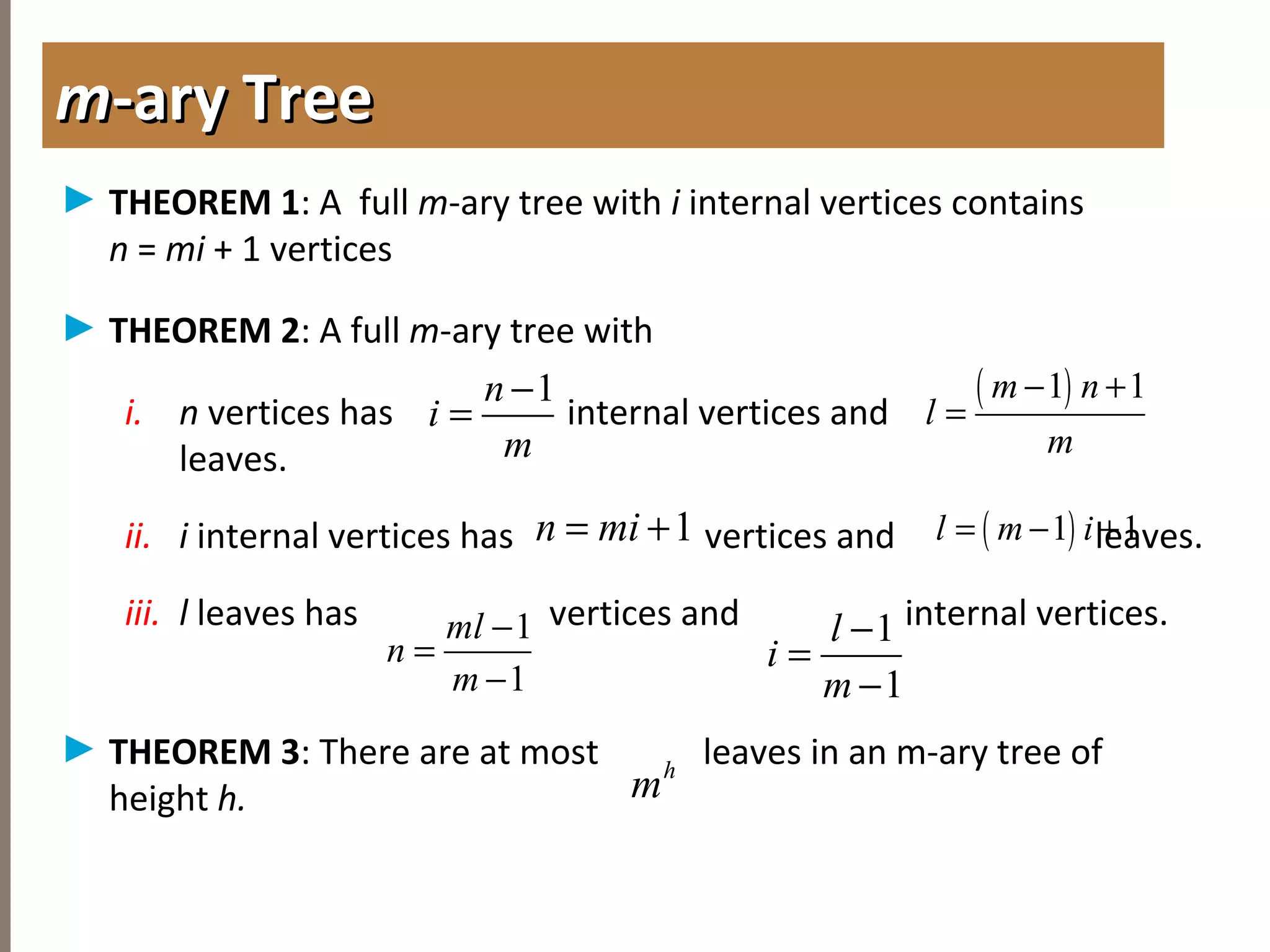
► THEOREM 1: A full m-ary tree with i internal vertices contains
n = mi + 1 vertices
► THEOREM 2: A full m-ary tree with
i. n vertices has internal vertices and
leaves.
ii. i internal vertices has vertices and leaves.
iii. l leaves has vertices and internal vertices.
► THEOREM 3: There are at most leaves in an m-ary tree of
height h.
mm-ary Tree-ary Tree
1n
i
m
−
=
( )1 1m n
l
m
− +
=
1n mi= + ( )1 1l m i= − +
1
1
ml
n
m
−
=
−
1
1
l
i
m
−
=
−
h
m
4.24.2 APPLICATION OF TREESAPPLICATION OF TREES
• Introduce Binary Search Trees
• Introduce Decision Trees
• Introduce Game Trees
CHAPTER4TREES
4.2APPLICATIONOFTREES
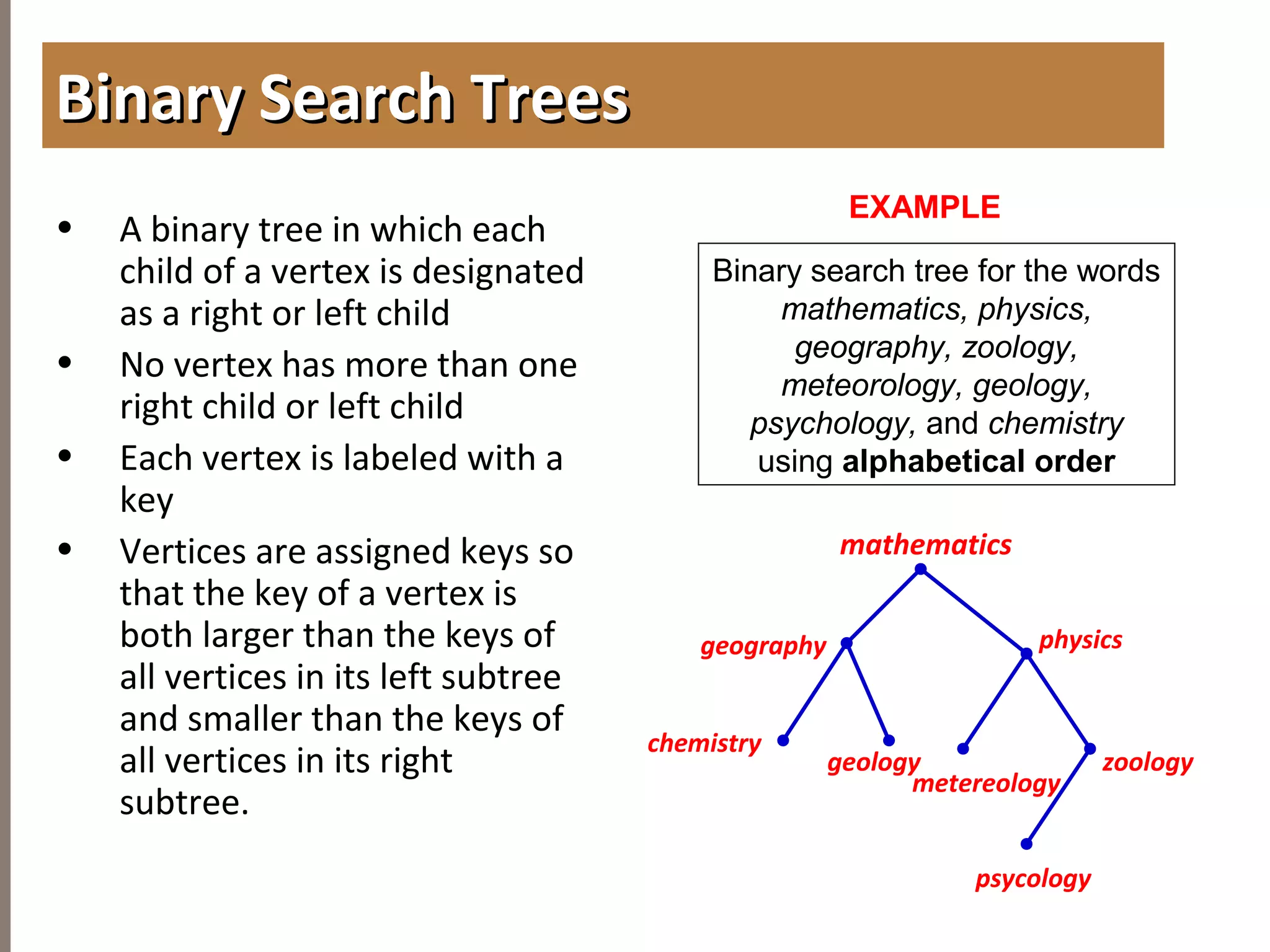
• A binary tree in which each
child of a vertex is designated
as a right or left child
• No vertex has more than one
right child or left child
• Each vertex is labeled with a
key
• Vertices are assigned keys so
that the key of a vertex is
both larger than the keys of
all vertices in its left subtree
and smaller than the keys of
all vertices in its right
subtree.
Binary Search TreesBinary Search Trees
EXAMPLE
Binary search tree for the words
mathematics, physics,
geography, zoology,
meteorology, geology,
psychology, and chemistry
using alphabetical order
geography
chemistry
mathematics
geology
physics
metereology
zoology
psycology
4.2APPLICATIONOFTREES
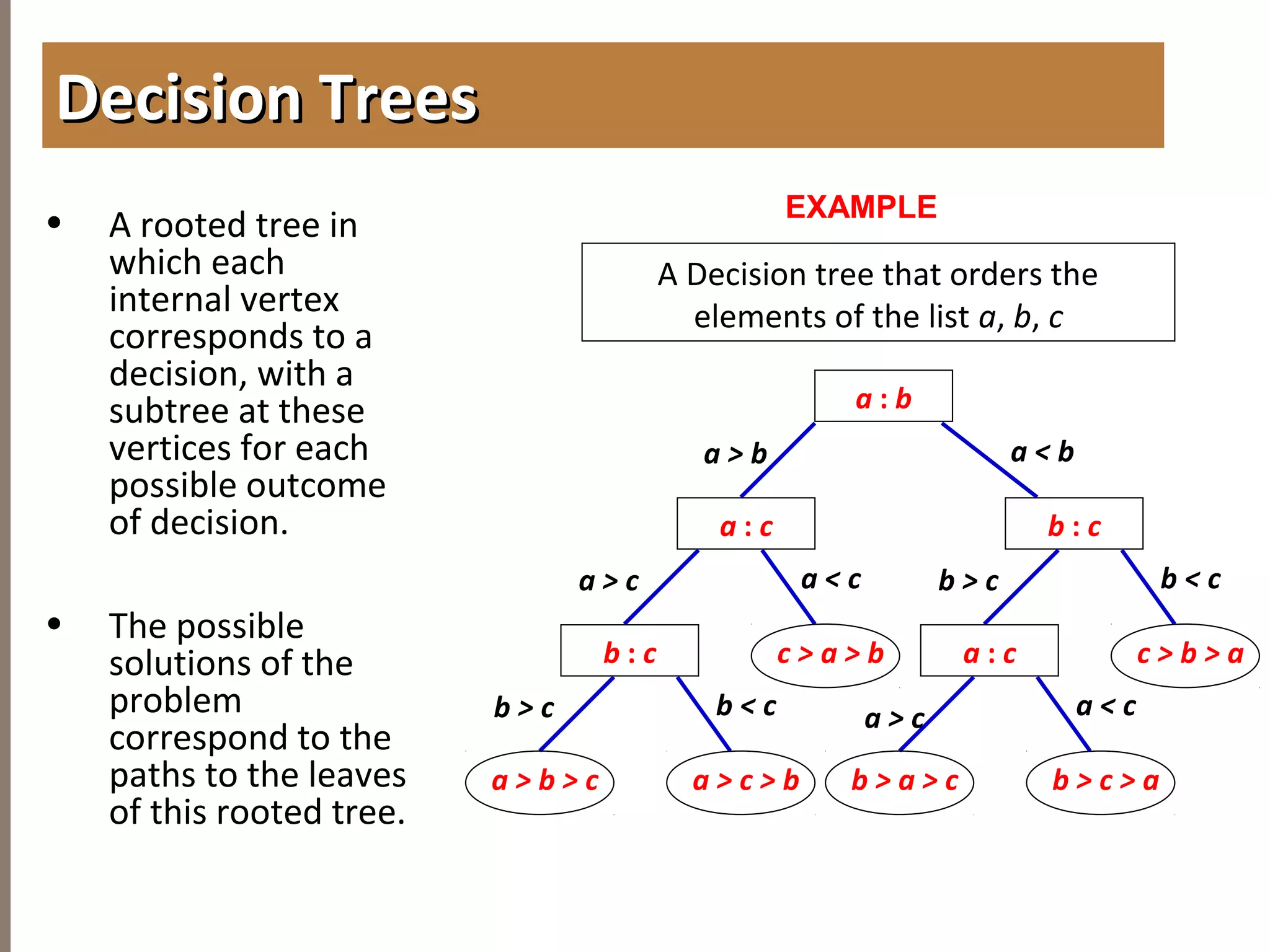
• A rooted tree in
which each
internal vertex
corresponds to a
decision, with a
subtree at these
vertices for each
possible outcome
of decision.
• The possible
solutions of the
problem
correspond to the
paths to the leaves
of this rooted tree.
Decision TreesDecision Trees
EXAMPLE
A Decision tree that orders the
elements of the list a, b, c
a : b
a : c b : c
b : c c > a > b
a > b a < b
a > c a < c
a : c c > b > a
b > c b < c
a > c > b
b > c b < c
a > b > c b > c > a
a > c a < c
b > a > c
4.2APPLICATIONOFTREES
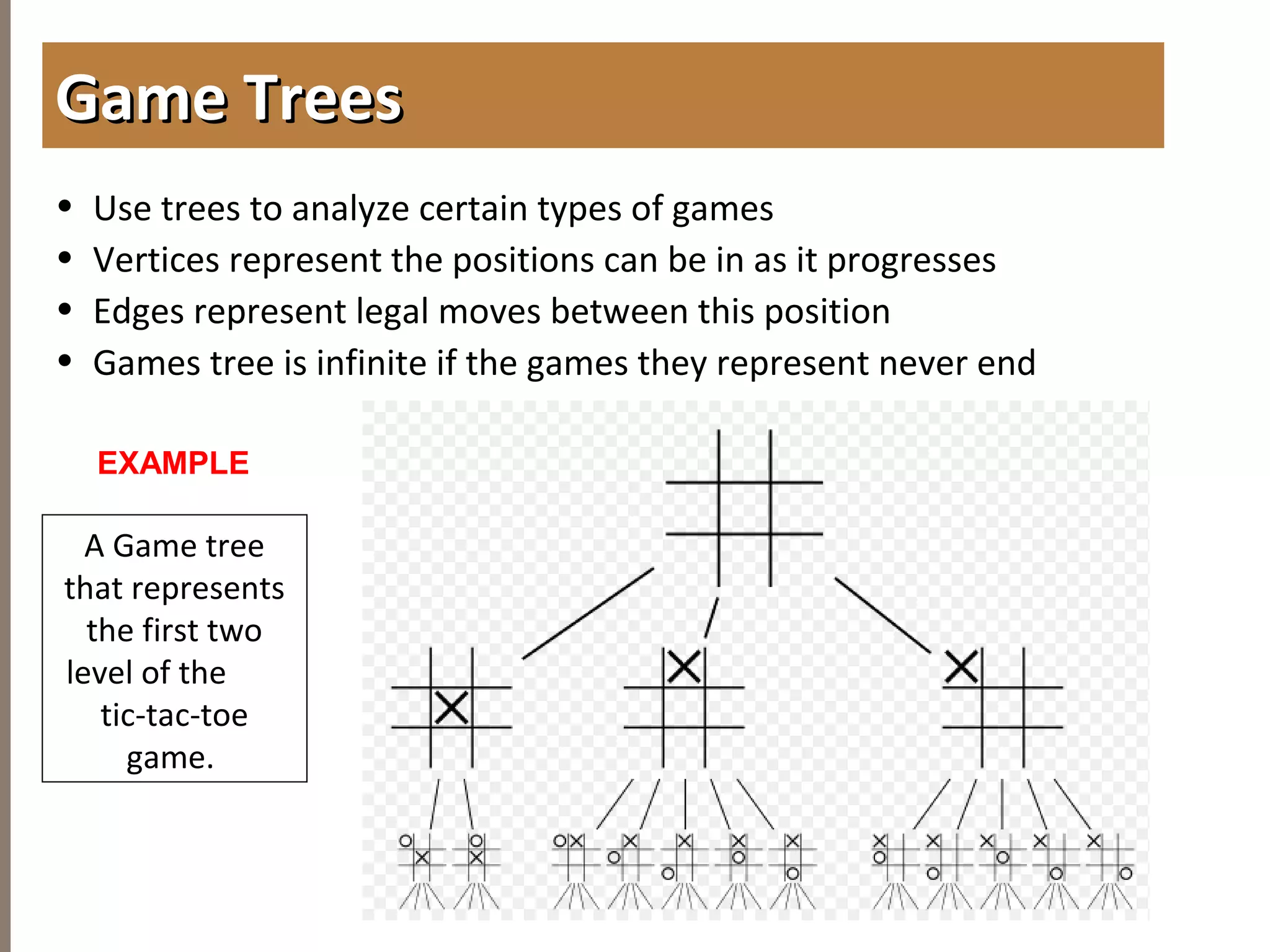
• Use trees to analyze certain types of games
• Vertices represent the positions can be in as it progresses
• Edges represent legal moves between this position
• Games tree is infinite if the games they represent never end
Game TreesGame Trees
EXAMPLE
A Game tree
that represents
the first two
level of the
tic-tac-toe
game.
4.34.3 TREE TRAVERSALTREE TRAVERSAL
• Determine preorder traversal, inorder
traversal and postorder traversal of an
ordered rooted tree.
• Determine the infix, prefix, and postfix form
of an expression.
CHAPTER4TREES
4.3TREETRAVERSAL
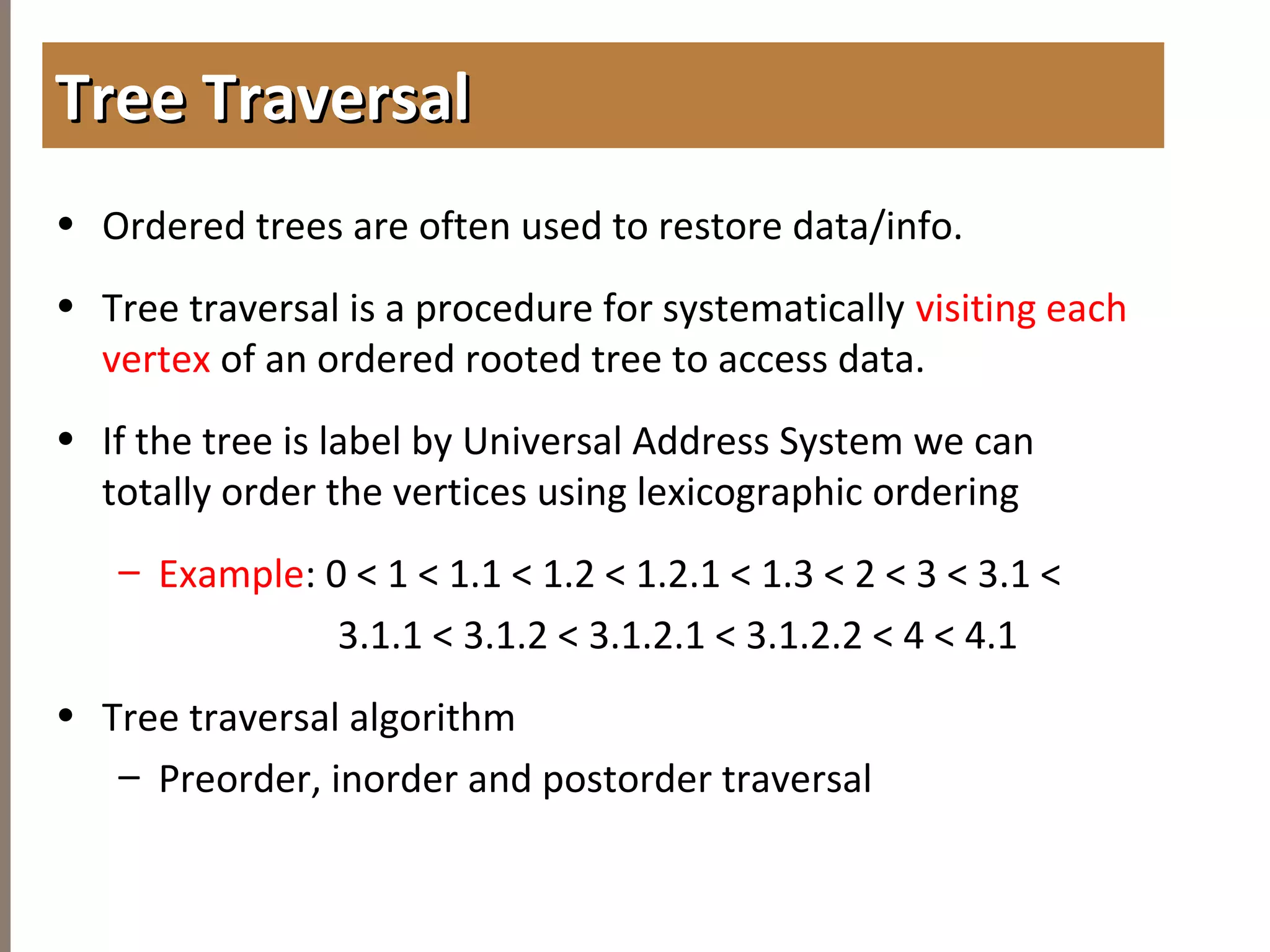
• Ordered trees are often used to restore data/info.
• Tree traversal is a procedure for systematically visiting each
vertex of an ordered rooted tree to access data.
• If the tree is label by Universal Address System we can
totally order the vertices using lexicographic ordering
– Example: 0 < 1 < 1.1 < 1.2 < 1.2.1 < 1.3 < 2 < 3 < 3.1 <
3.1.1 < 3.1.2 < 3.1.2.1 < 3.1.2.2 < 4 < 4.1
• Tree traversal algorithm
– Preorder, inorder and postorder traversal
Tree TraversalTree Traversal
4.3TREETRAVERSAL
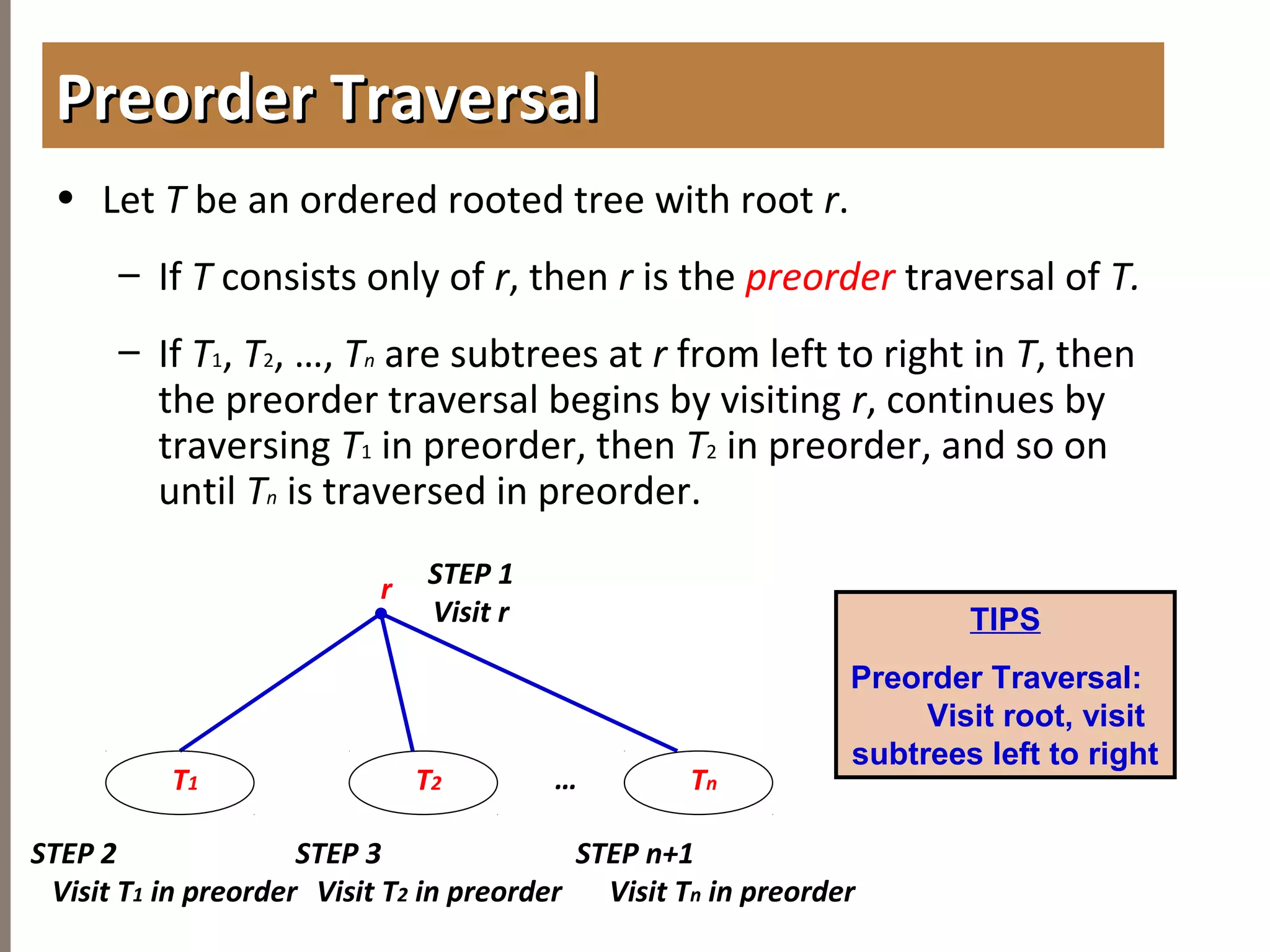
• Let T be an ordered rooted tree with root r.
– If T consists only of r, then r is the preorder traversal of T.
– If T1, T2, …, Tn are subtrees at r from left to right in T, then
the preorder traversal begins by visiting r, continues by
traversing T1 in preorder, then T2 in preorder, and so on
until Tn is traversed in preorder.
Preorder TraversalPreorder Traversal
Tn
r STEP 1
Visit r
T2 …
STEP 2
Visit T1 in preorder
T1
STEP n+1
Visit Tn in preorder
STEP 3
Visit T2 in preorder
TIPS
Preorder Traversal:
Visit root, visit
subtrees left to right
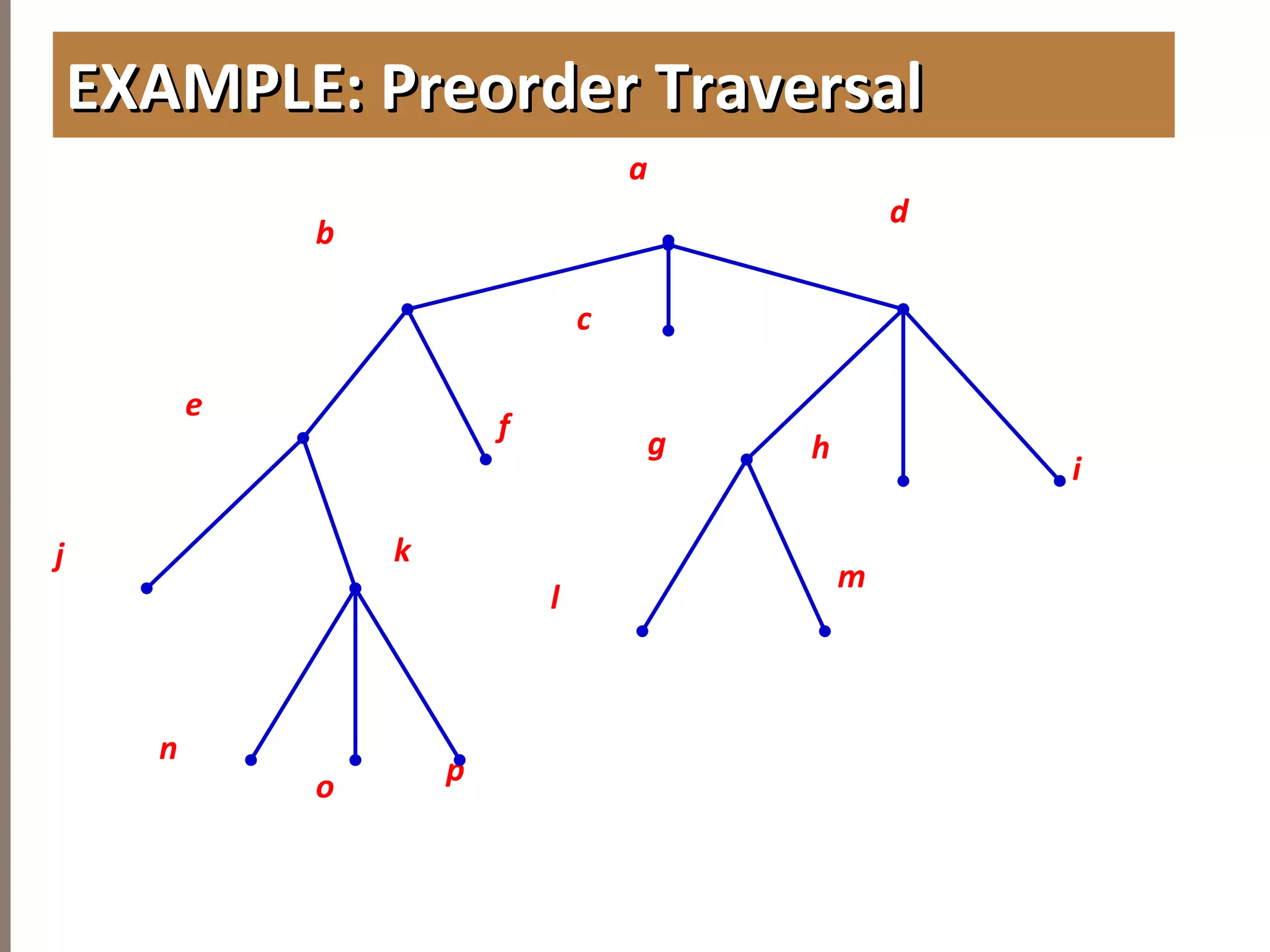
EXAMPLE: Preorder TraversalEXAMPLE: Preorder Traversal
b
c
d
h
j k
i
n
p
e
l
m
a
o
f g
4.3TREETRAVERSAL
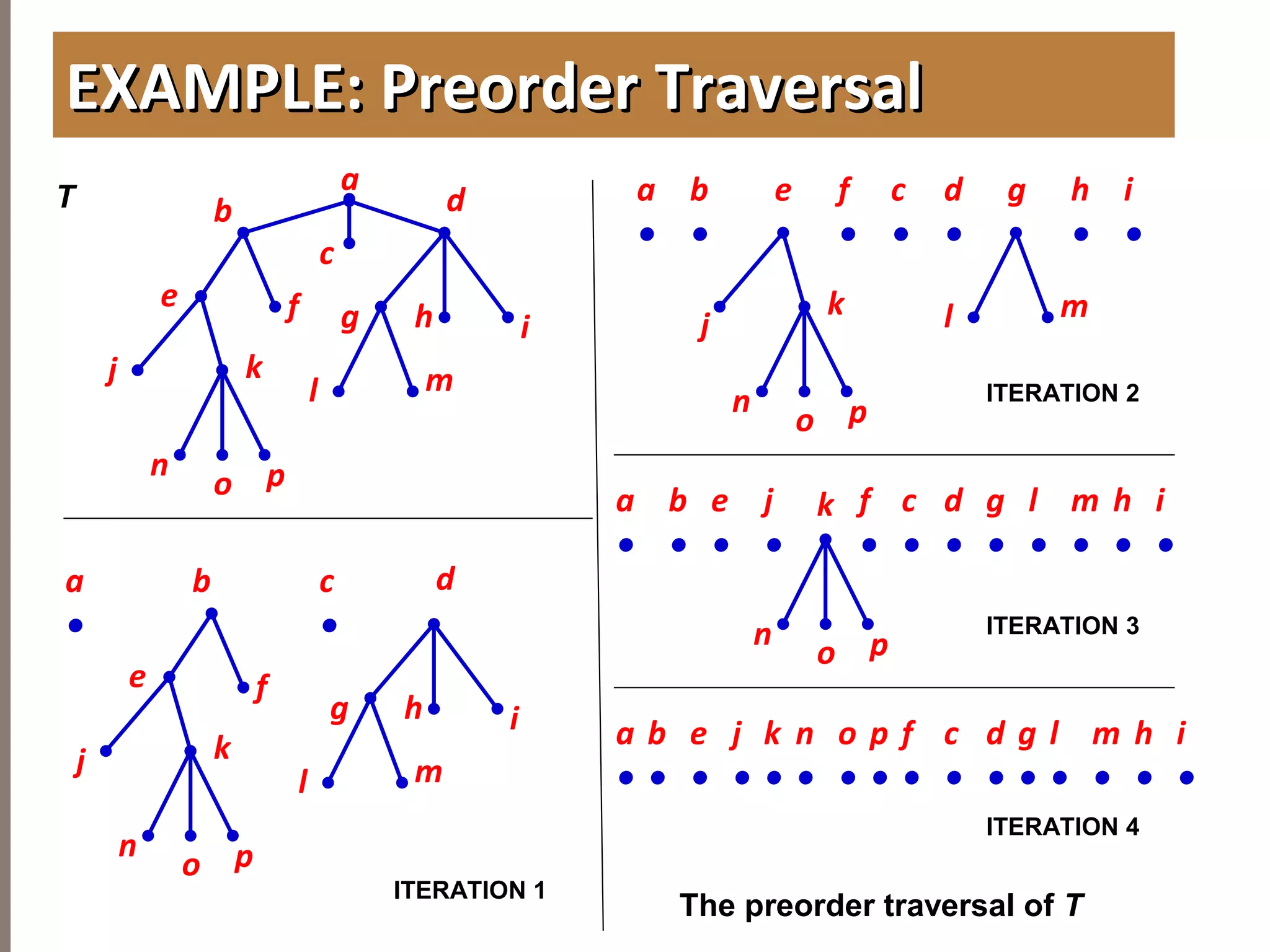
EXAMPLE: Preorder TraversalEXAMPLE: Preorder Traversal
b
c
d
h
j k
i
n p
e
g
l m
a
o
f
b d
h
j k
i
n p
e
g
l m
a
•
o
f
c
•
j
k
n po
g
l m
ea
•
c
•
b
•
d
•
f
•
h
•
i
•
a
•
c
•
b
•
d
•
f
•
h
•
i
•
e
•
j
•
k
n po
l
•
m
•
a
•
b
•
e
•
j
•
k
•
n
•
o
•
p
•
c
•
d
•
h
•
i
•
l
•
m
•
f
•
The preorder traversal of T
T
ITERATION 1
ITERATION 2
ITERATION 3
ITERATION 4
g
•
g
•
4.3TREETRAVERSAL
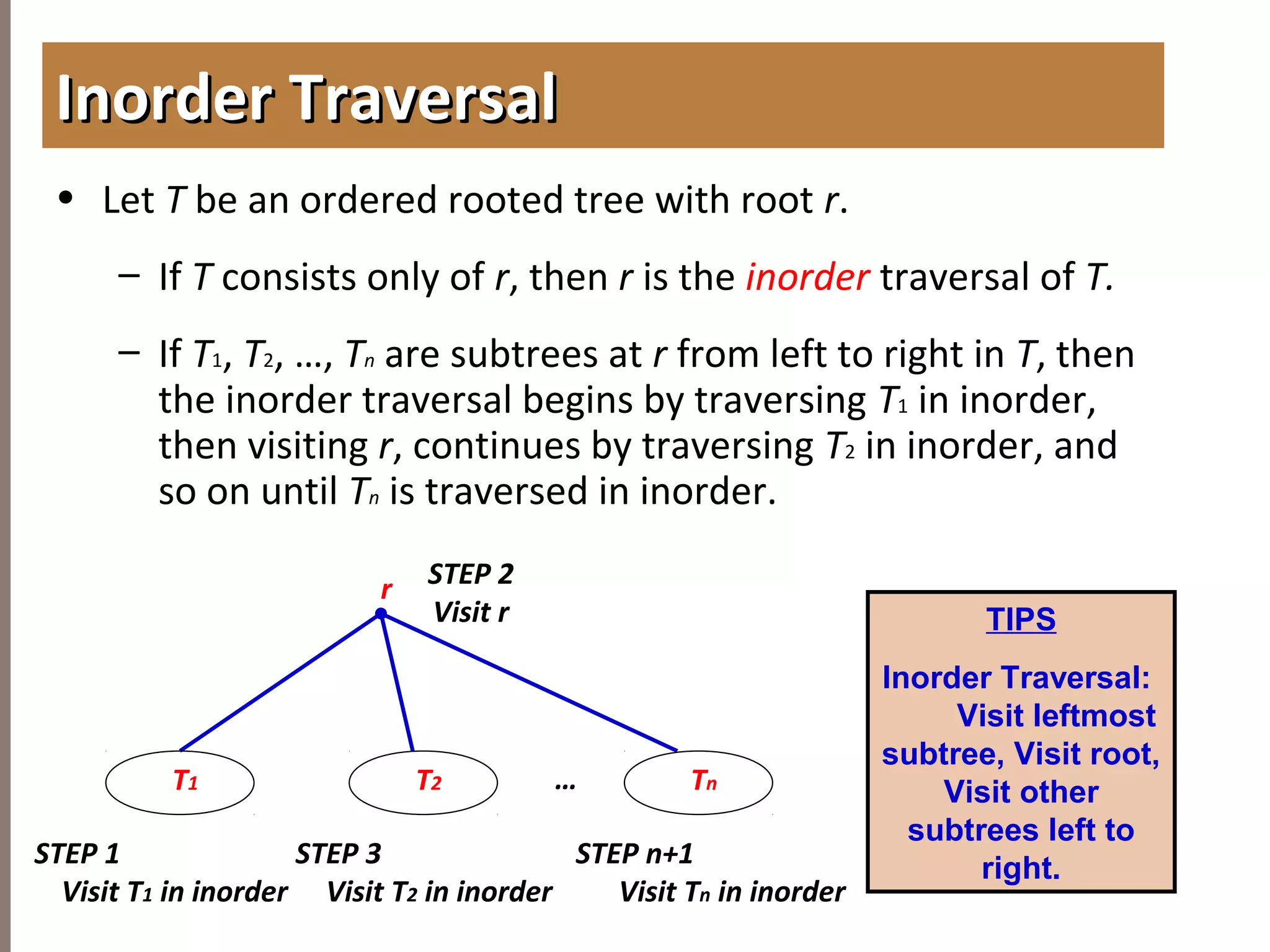
• Let T be an ordered rooted tree with root r.
– If T consists only of r, then r is the inorder traversal of T.
– If T1, T2, …, Tn are subtrees at r from left to right in T, then
the inorder traversal begins by traversing T1 in inorder,
then visiting r, continues by traversing T2 in inorder, and
so on until Tn is traversed in inorder.
Inorder TraversalInorder Traversal
Tn
r STEP 2
Visit r
T2 …
STEP 1
Visit T1 in inorder
T1
STEP n+1
Visit Tn in inorder
STEP 3
Visit T2 in inorder
TIPS
Inorder Traversal:
Visit leftmost
subtree, Visit root,
Visit other
subtrees left to
right.
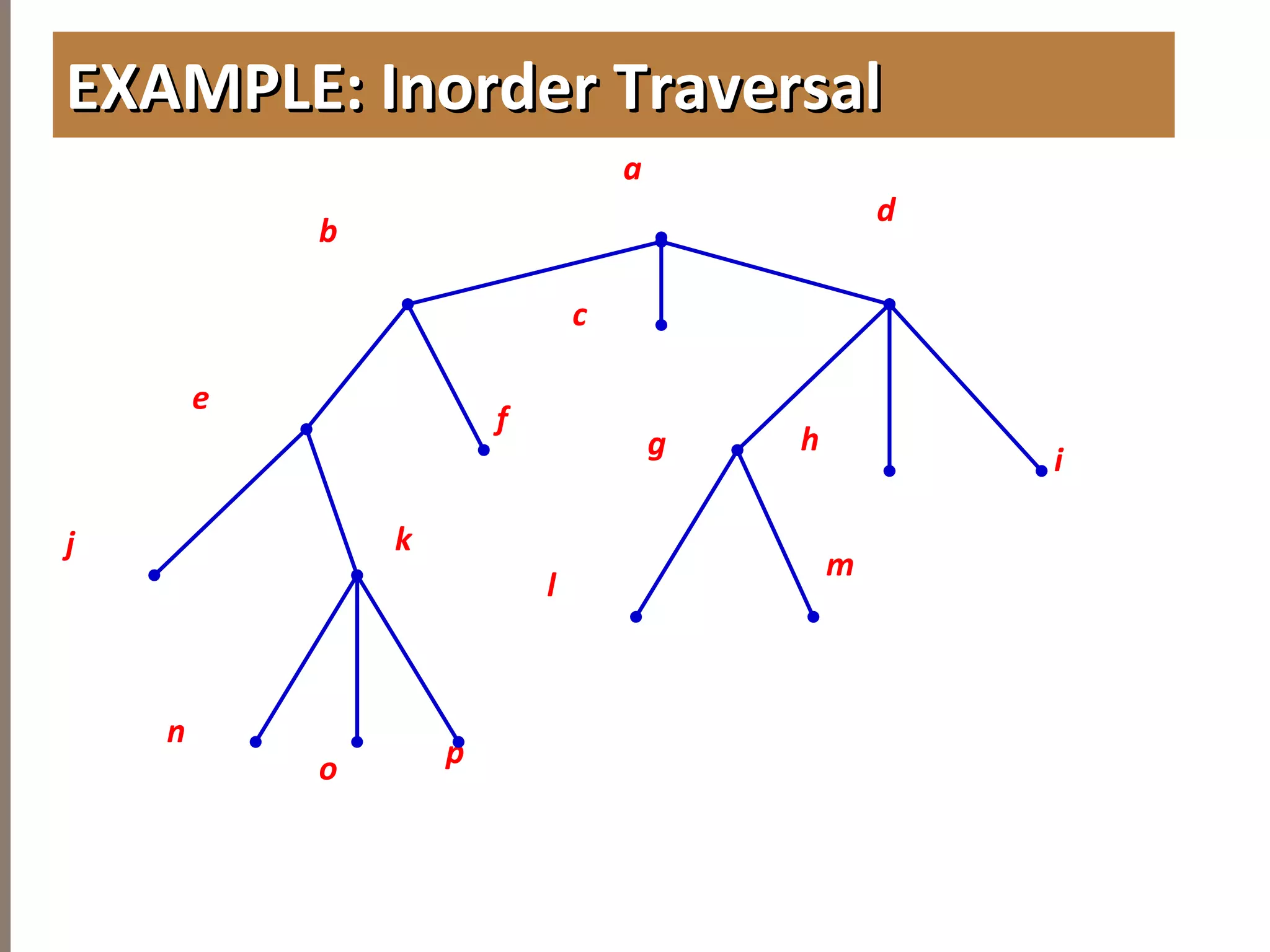
EXAMPLE: Inorder TraversalEXAMPLE: Inorder Traversal
b
c
d
h
j k
i
n
p
e
l
m
a
o
f
g
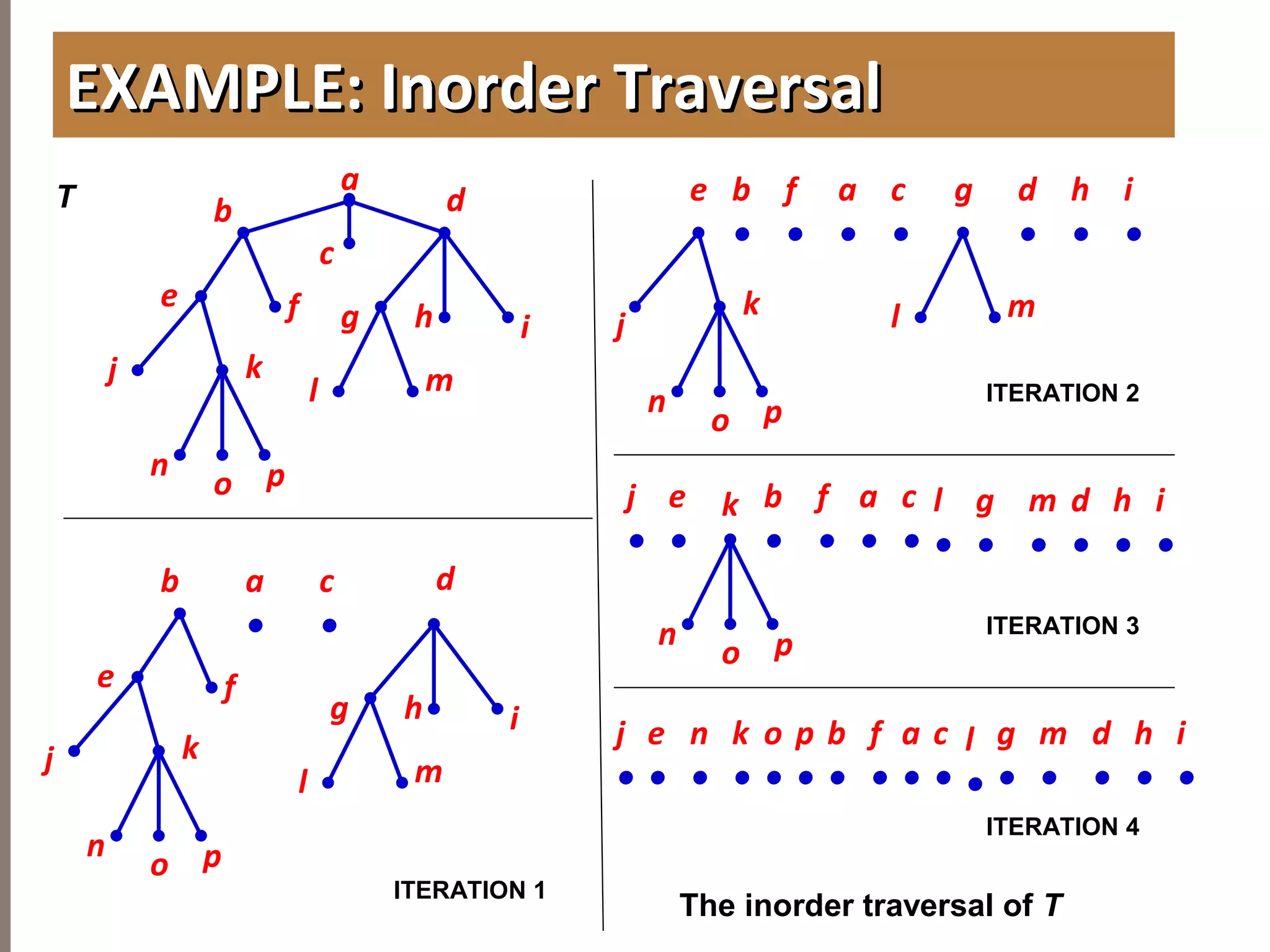
4.3TREETRAVERSAL
EXAMPLE: Inorder TraversalEXAMPLE: Inorder Traversal
b
c
d
h
j k
i
n p
e
g
l m
a
o
f
b d
h
j k
i
n p
e
g
l m
a
•
o
f
c
•
j
k
n po
g
l m
e f
•
c
•
b
•
d
•
a
•
h
•
i
•
a
•
l
•
b
•
g
•
f
•
h
•
i
•
e
•
j
•
k
n po
m
•
d
•
j
•
e
•
n
•
k
•
o
•
p
•
f
•
a
•
g
•
m
•
h
•
i
•
d
•
b
•
l
•
The inorder traversal of T
T
ITERATION 1
ITERATION 2
ITERATION 3
ITERATION 4
c
•
c
•
4.3TREETRAVERSAL
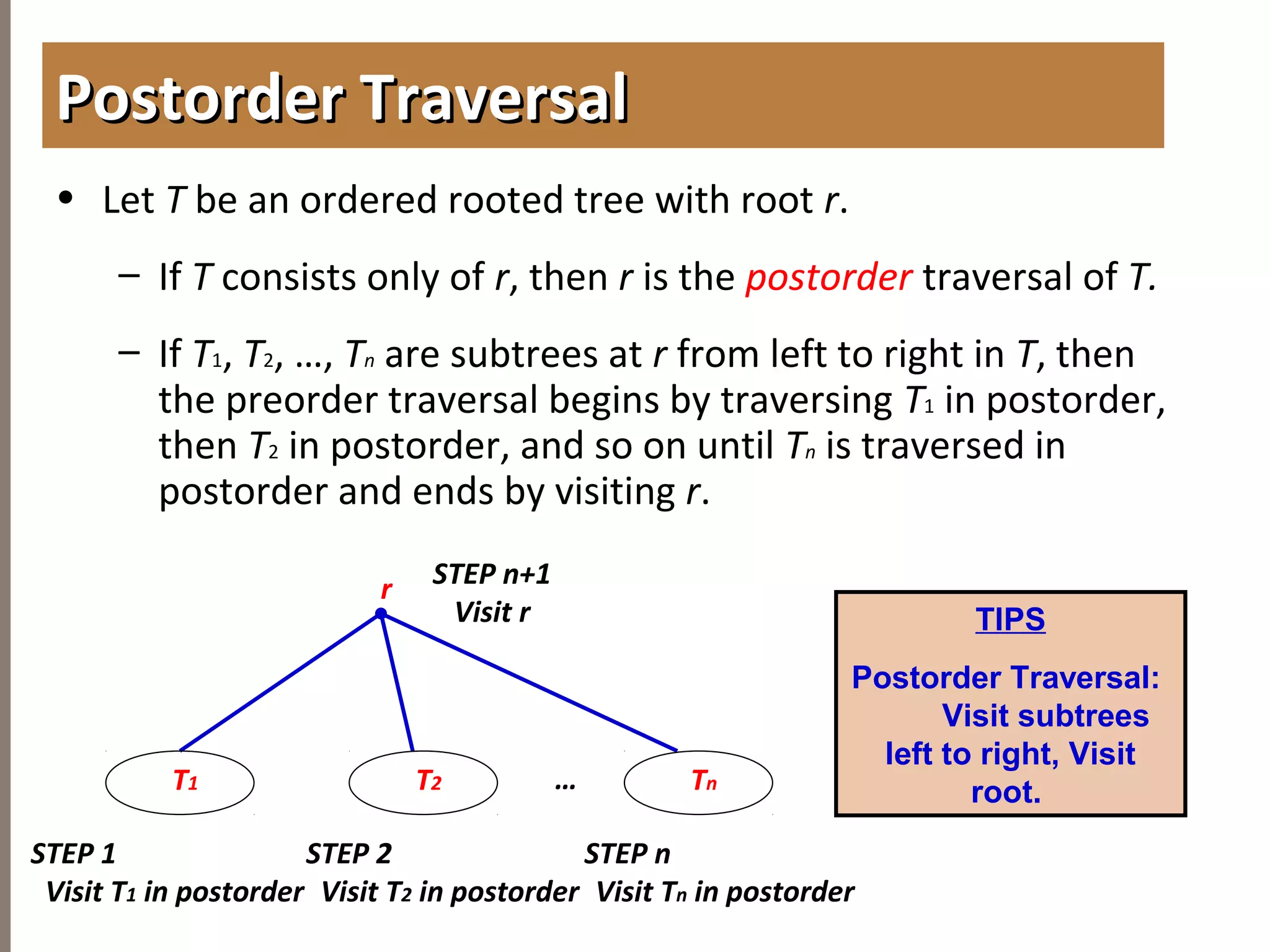
• Let T be an ordered rooted tree with root r.
– If T consists only of r, then r is the postorder traversal of T.
– If T1, T2, …, Tn are subtrees at r from left to right in T, then
the preorder traversal begins by traversing T1 in postorder,
then T2 in postorder, and so on until Tn is traversed in
postorder and ends by visiting r.
Postorder TraversalPostorder Traversal
Tn
r STEP n+1
Visit r
T2 …
STEP 1
Visit T1 in postorder
T1
STEP n
Visit Tn in postorder
STEP 2
Visit T2 in postorder
TIPS
Postorder Traversal:
Visit subtrees
left to right, Visit
root.
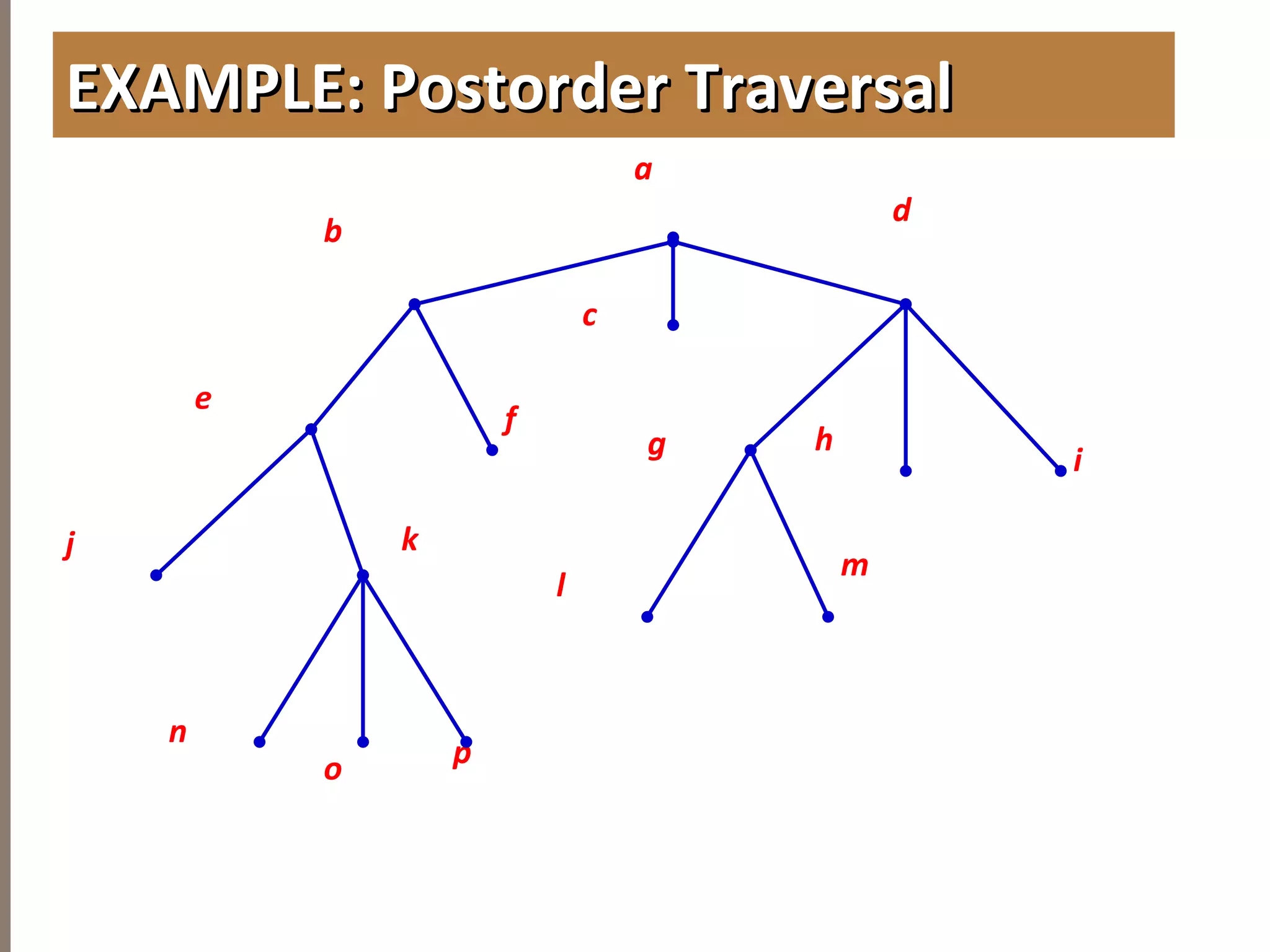
b
c
d
h
j k
i
n
p
e
l
m
a
o
f
EXAMPLE: Postorder TraversalEXAMPLE: Postorder Traversal
g
4.3TREETRAVERSAL
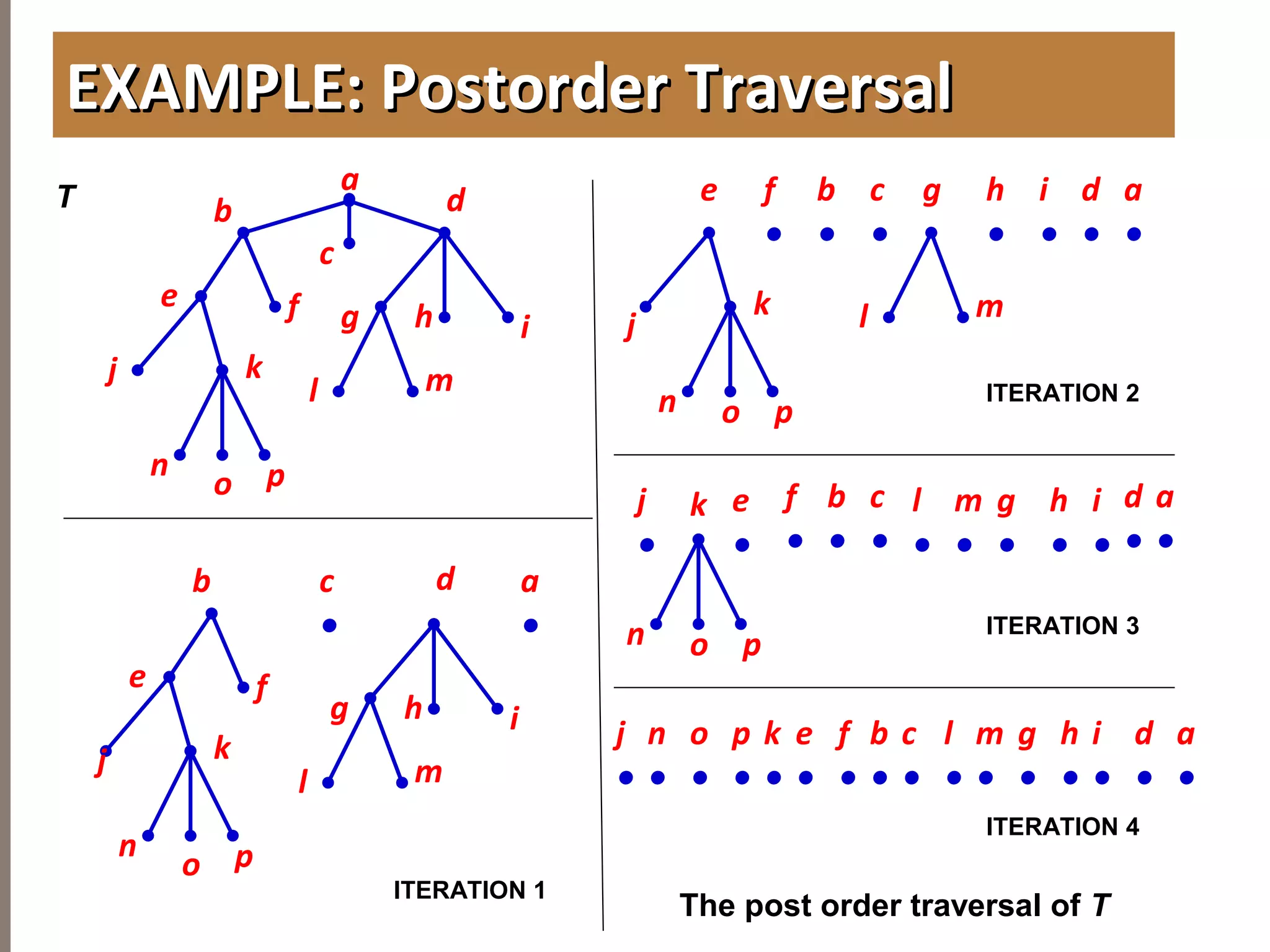
EXAMPLE: Postorder TraversalEXAMPLE: Postorder Traversal
b
c
d
h
j k
i
n p
e
g
l m
a
o
f
b d
h
j k
i
n p
e
g
l m
a
•
o
f
c
•
j
k
n po
g
l m
e a
•
c
•
b
•
d
•
f
•
h
•
i
•
a
•
c
•
b
•
d
•
f
•
h
•
i
•
e
•
j
•
k
n po
l
•
m
•
j
•
n
•
o
•
p
•
k
•
e
•
f
•
b
•
l
•
m
•
d
•
a
•
h
•
i
•
c
•
The post order traversal of T
T
ITERATION 1
ITERATION 2
ITERATION 3
ITERATION 4
g
•
g
•
4.3TREETRAVERSAL
• We can represent complicated expression (propositions,
sets, arithmetic) using ordered rooted trees.
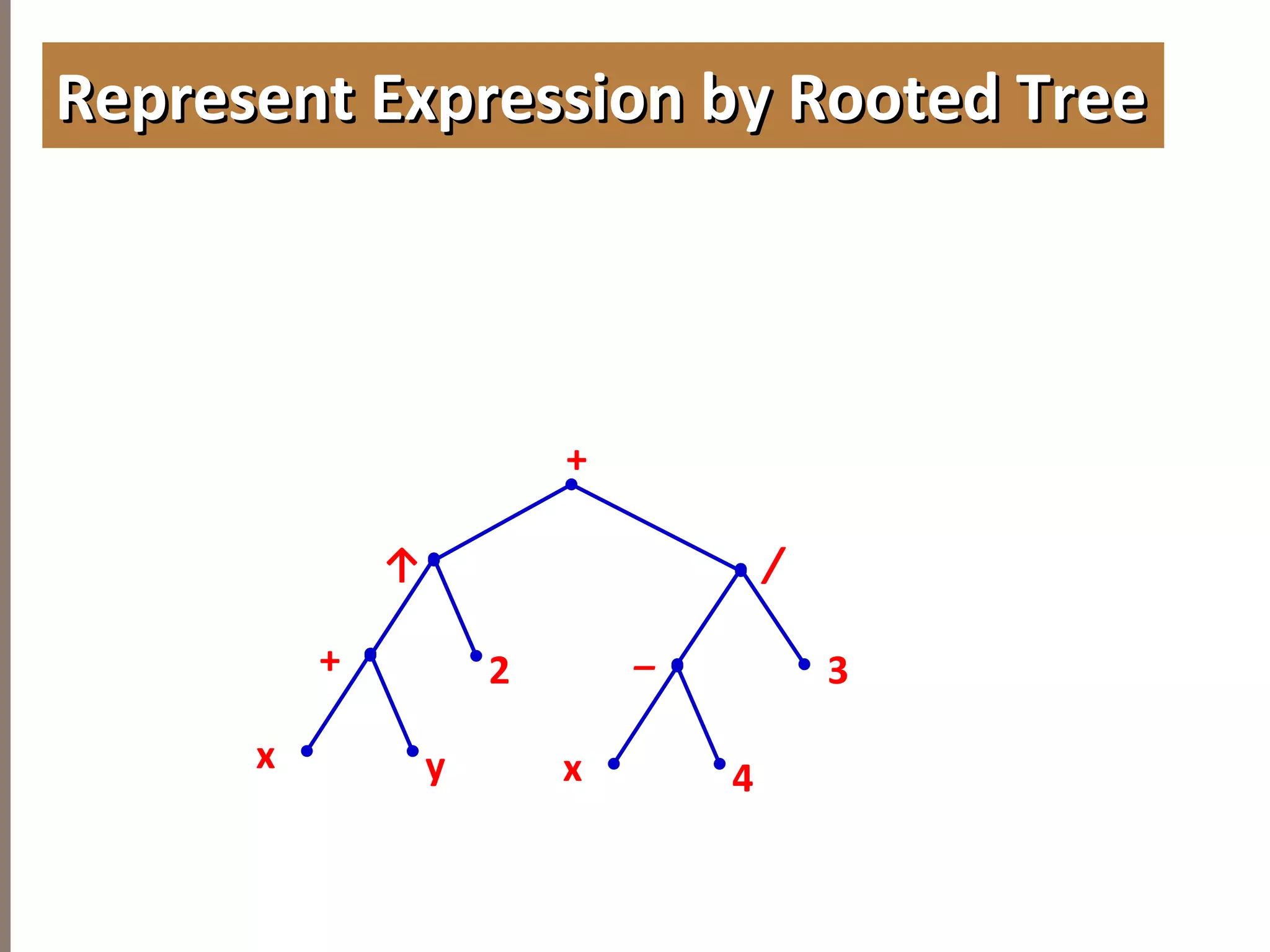
• EXAMPLE: A binary tree representing ((x+y)↑2)+((x-4)/3)
Represent Expression by Rooted TreeRepresent Expression by Rooted Tree
↑
+
+
2
/
_
3
x y x 4
Represent Expression by Rooted TreeRepresent Expression by Rooted Tree
4.3TREETRAVERSAL
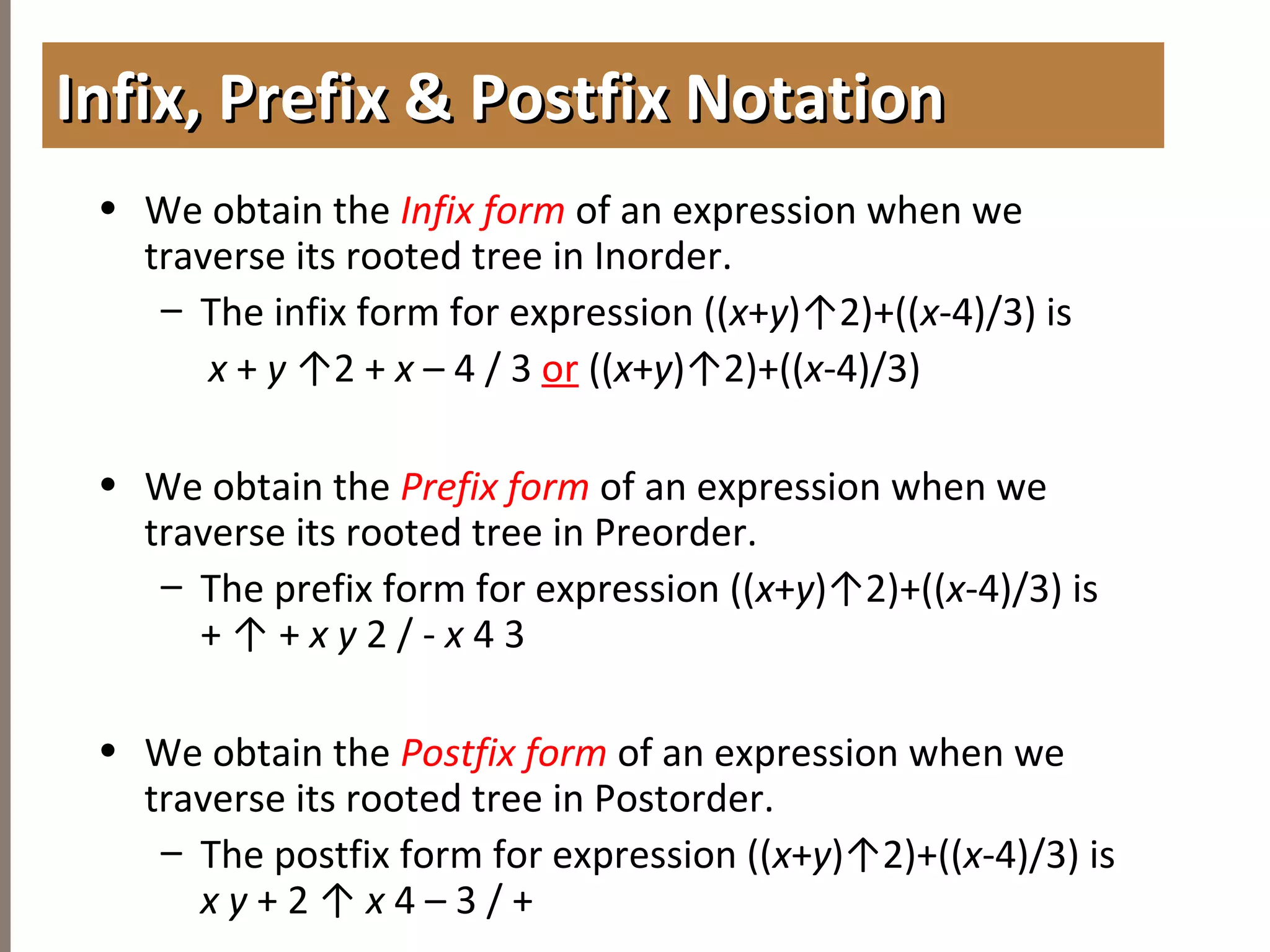
• We obtain the Infix form of an expression when we
traverse its rooted tree in Inorder.
– The infix form for expression ((x+y)↑2)+((x-4)/3) is
x + y ↑2 + x – 4 / 3 or ((x+y)↑2)+((x-4)/3)
• We obtain the Prefix form of an expression when we
traverse its rooted tree in Preorder.
– The prefix form for expression ((x+y)↑2)+((x-4)/3) is
+ ↑ + x y 2 / - x 4 3
• We obtain the Postfix form of an expression when we
traverse its rooted tree in Postorder.
– The postfix form for expression ((x+y)↑2)+((x-4)/3) is
x y + 2 ↑ x 4 – 3 / +
Infix, Prefix & Postfix NotationInfix, Prefix & Postfix Notation
4.3TREETRAVERSAL
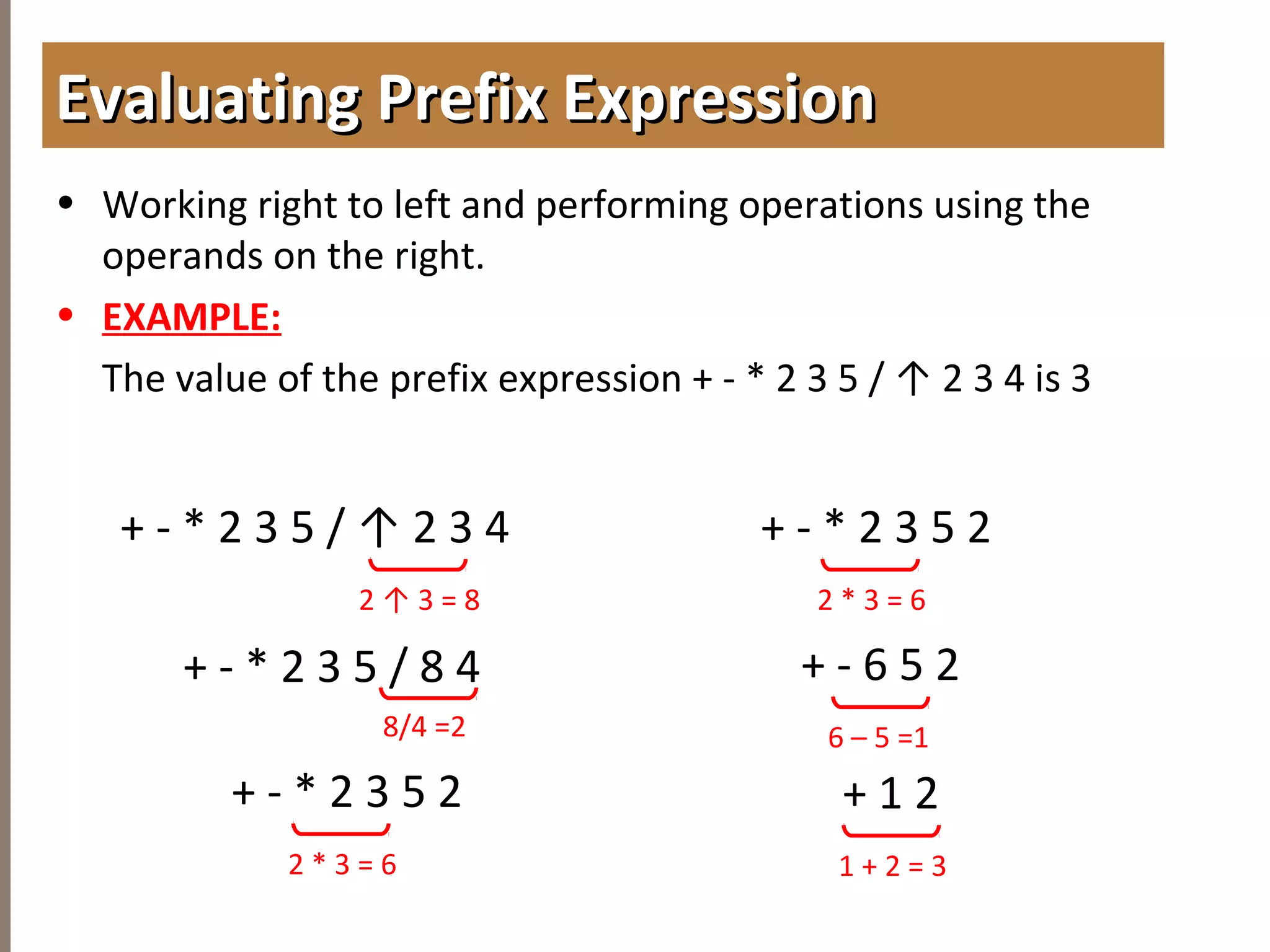
• Working right to left and performing operations using the
operands on the right.
• EXAMPLE:
The value of the prefix expression + - * 2 3 5 / ↑ 2 3 4 is 3
Evaluating Prefix ExpressionEvaluating Prefix Expression
+ - * 2 3 5 / ↑ 2 3 4
2 ↑ 3 = 8
+ - * 2 3 5 / 8 4
8/4 =2
+ - * 2 3 5 2
2 * 3 = 6
+ - * 2 3 5 2
2 * 3 = 6
+ - 6 5 2
6 – 5 =1
+ 1 2
1 + 2 = 3
4.3TREETRAVERSAL
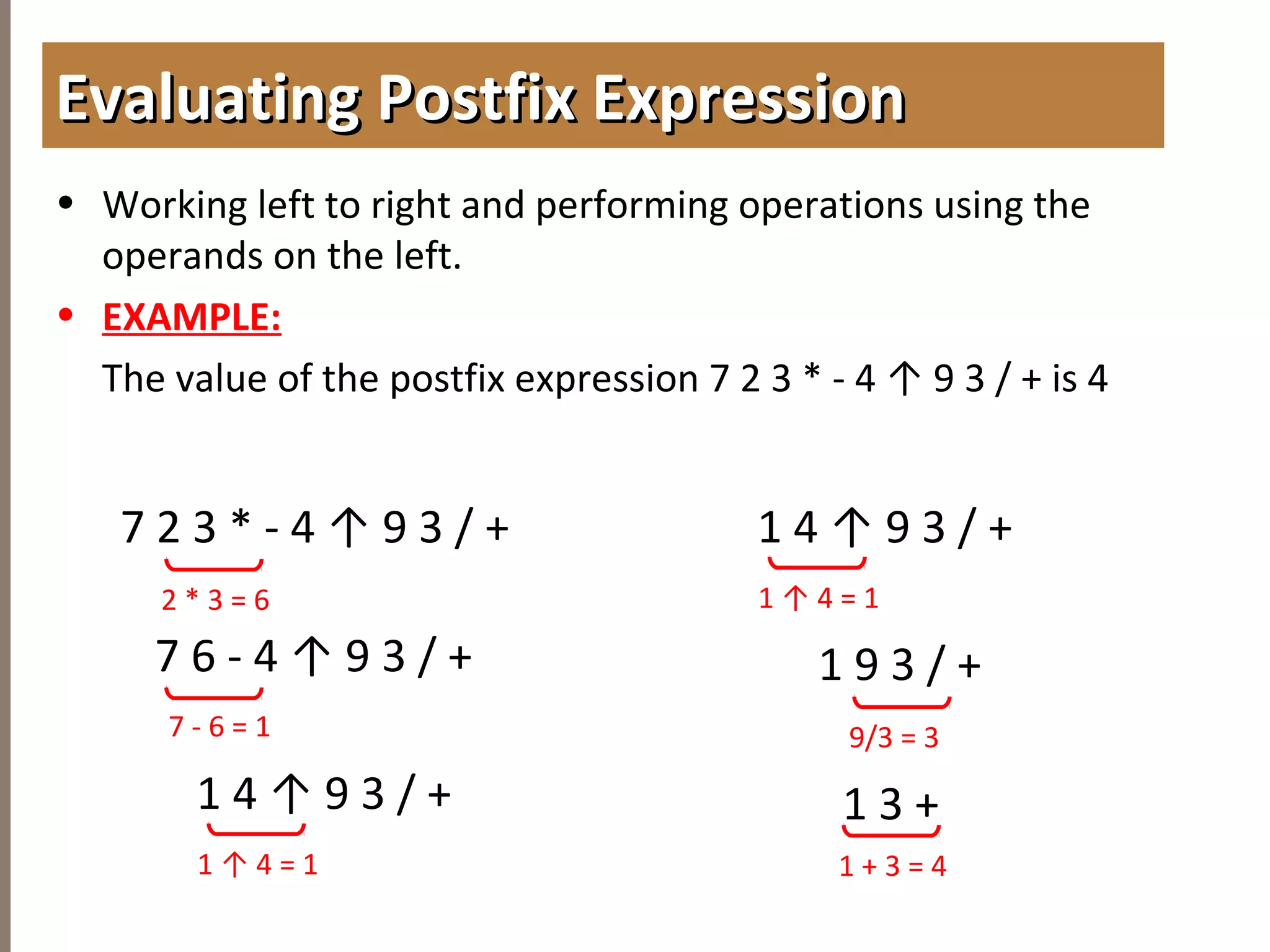
• Working left to right and performing operations using the
operands on the left.
• EXAMPLE:
The value of the postfix expression 7 2 3 * - 4 ↑ 9 3 / + is 4
Evaluating Postfix ExpressionEvaluating Postfix Expression
7 2 3 * - 4 ↑ 9 3 / +
2 * 3 = 6
7 - 6 = 1
1 ↑ 4 = 1
9/3 = 3
1 + 3 = 4
7 6 - 4 ↑ 9 3 / +
1 4 ↑ 9 3 / +
1 ↑ 4 = 1
1 4 ↑ 9 3 / +
1 9 3 / +
1 3 +
4.54.5 SPANNING TREESSPANNING TREES
• Find spanning trees of a simple graph
CHAPTER4TREES
4.5SPANNINGTREES
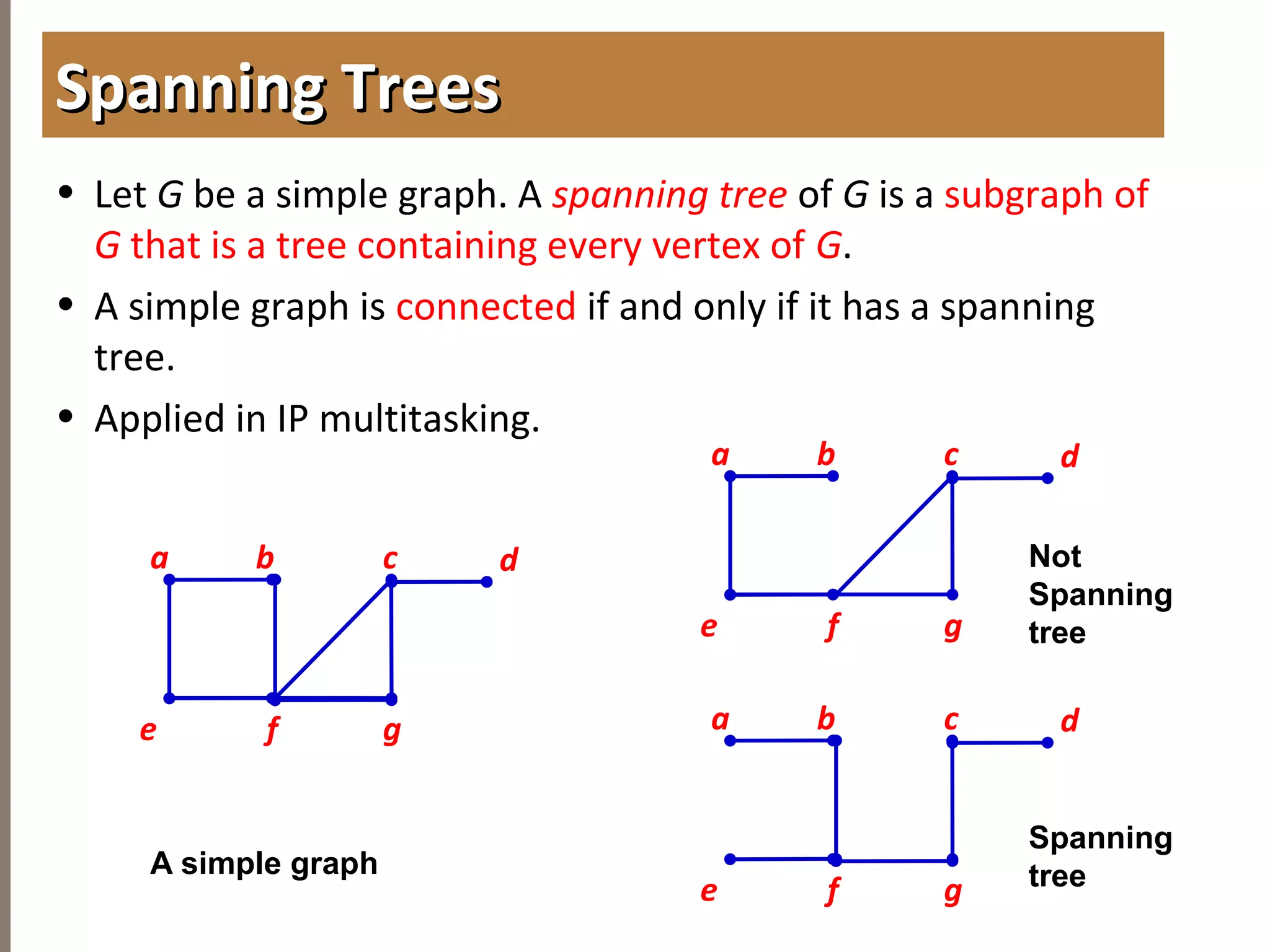
• Let G be a simple graph. A spanning tree of G is a subgraph of
G that is a tree containing every vertex of G.
• A simple graph is connected if and only if it has a spanning
tree.
• Applied in IP multitasking.
Spanning TreesSpanning Trees
a b c
e f g
d
a b c
e f g
d
a b c
e f g
d
A simple graph
Not
Spanning
tree
Spanning
tree
4.64.6 MINIMUM SPANNING TREESMINIMUM SPANNING TREES
• Find minimum spanning tree using Prim’s
algorithm
• Find minimum spanning tree using
Kruskal’s algorithm
CHAPTER4TREES
4.6MINIMUMSPANNINGTREES
• A minimum spanning tree in a connected weighted graph is
a spanning tree that has the smallest possible sum of
weights of it edges.
• Two algorithms can be used:
– Prim’s Algorithm
• Robert Prim, 1957
– Kruskal’s Algorithm
• Joseph Kruskal, 1956
Minimum Spanning TreesMinimum Spanning Trees
4.6MINIMUMSPANNINGTREES
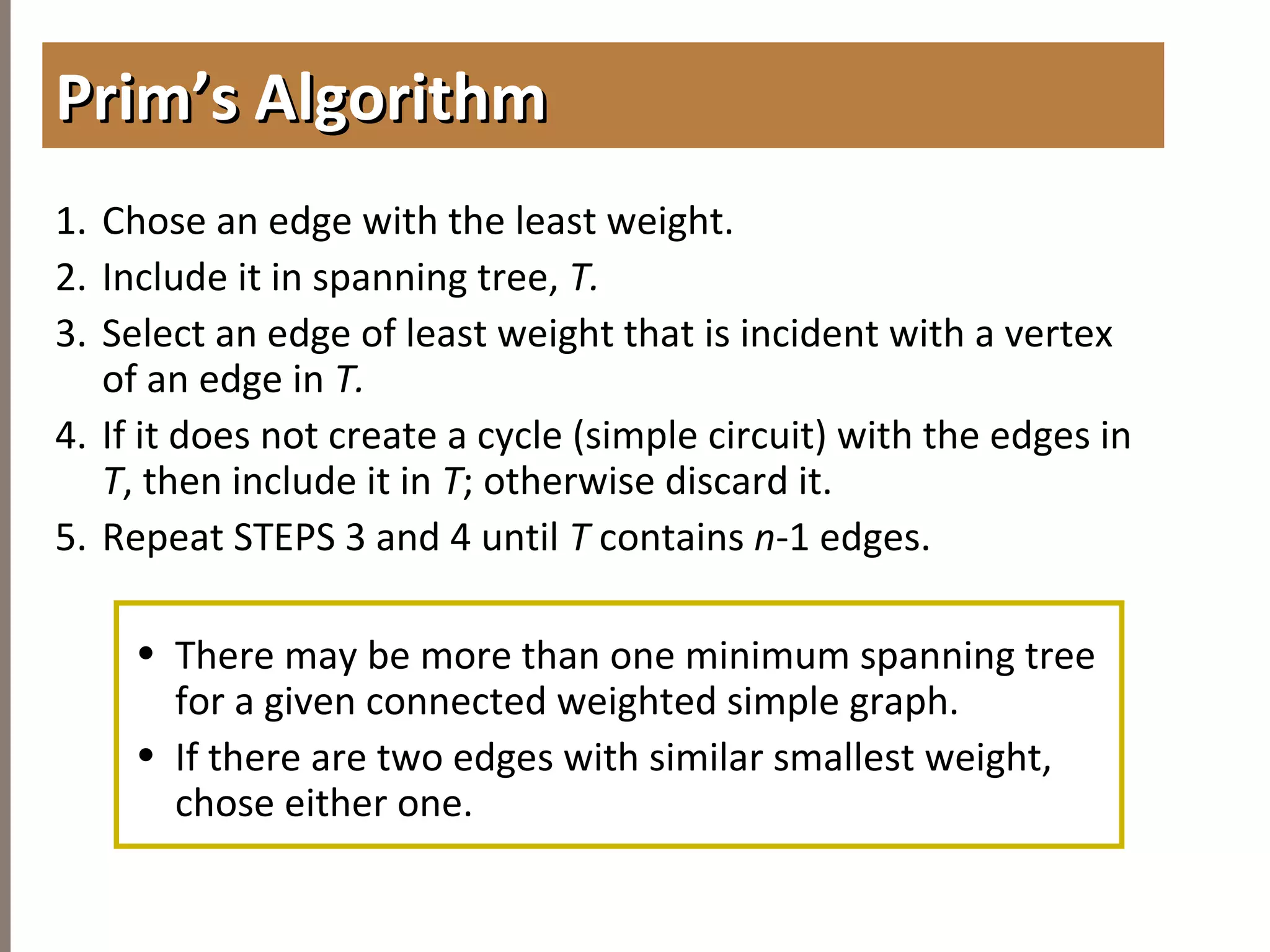
1. Chose an edge with the least weight.
2. Include it in spanning tree, T.
3. Select an edge of least weight that is incident with a vertex
of an edge in T.
4. If it does not create a cycle (simple circuit) with the edges in
T, then include it in T; otherwise discard it.
5. Repeat STEPS 3 and 4 until T contains n-1 edges.
• There may be more than one minimum spanning tree
for a given connected weighted simple graph.
• If there are two edges with similar smallest weight,
chose either one.
Prim’s AlgorithmPrim’s Algorithm
4.6MINIMUMSPANNINGTREES
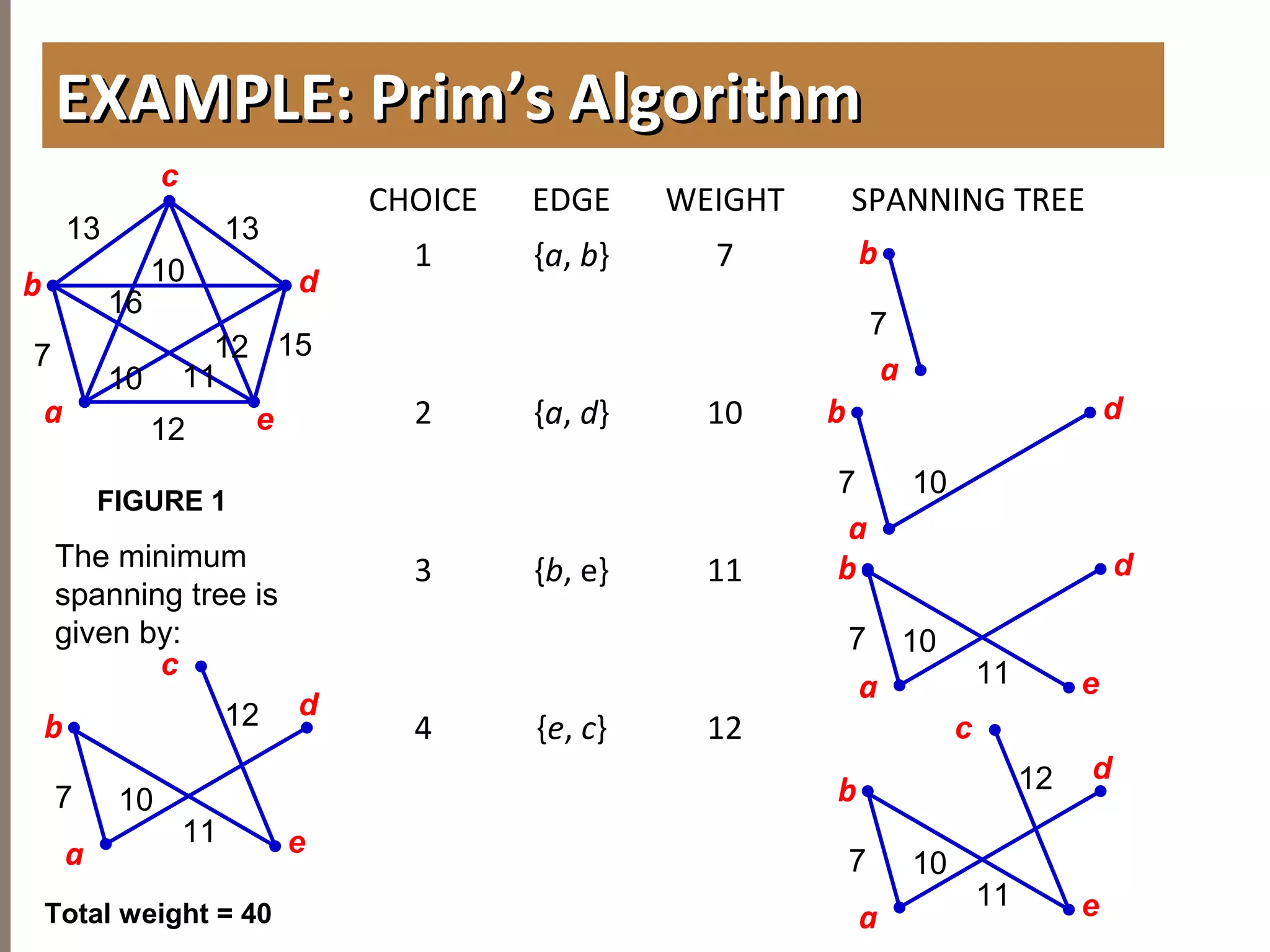
EXAMPLE: Prim’s AlgorithmEXAMPLE: Prim’s Algorithm
CHOICE EDGE WEIGHT SPANNING TREE
1 {a, b} 7
2 {a, d} 10
3 {b, e} 11
4 {e, c} 12
db
c
a e
7
13
10
16
13
12
12
FIGURE 1
10 11
b
a
7
db
a
7 10
15
d
b
a
7 10
db
a
7 10
e11
e11
c
12
The minimum
spanning tree is
given by:
d
b
a
7 10
e11
c
12
Total weight = 40
4.6MINIMUMSPANNINGTREES
1. Arrange the edges in G in increasing order.
2. Chose an edge with the minimum weight.
3. Include it in spanning tree, T.
4. Add an edge of least weight to T.
5. If it does not create a cycle (simple circuit) with the edges in
T, then include it in T; otherwise discard it.
6. Repeat STEPS 4 and 5 until T contains n-1 edges.
• There may be more than one minimum spanning tree
for a given connected weighted simple graph.
• If there are two edges with similar smallest weight,
chose either one.
Kruskal’s AlgorithmKruskal’s Algorithm
4.6MINIMUMSPANNINGTREES
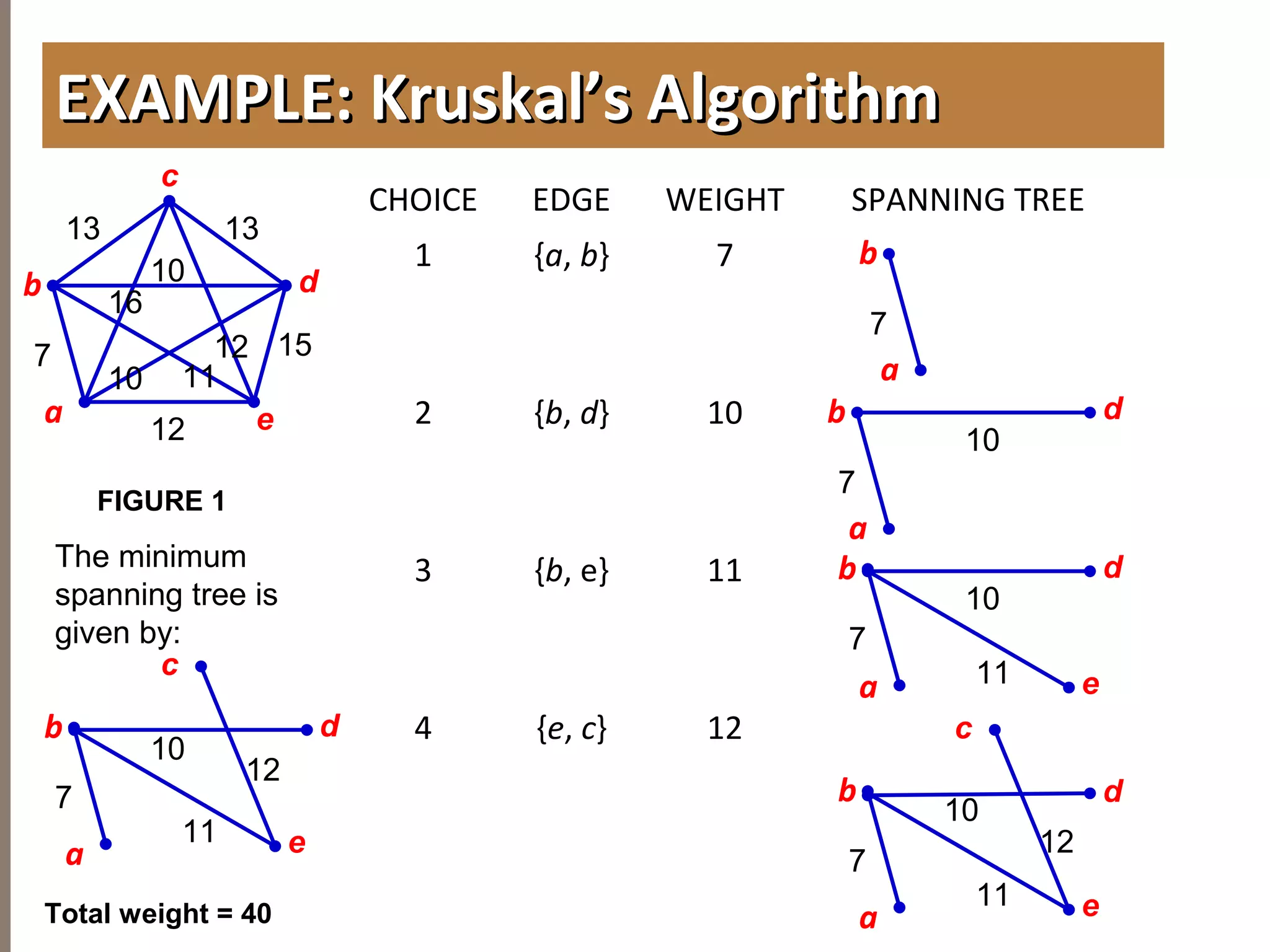
EXAMPLE: Kruskal’s AlgorithmEXAMPLE: Kruskal’s Algorithm
CHOICE EDGE WEIGHT SPANNING TREE
1 {a, b} 7
2 {b, d} 10
3 {b, e} 11
4 {e, c} 12
db
c
a e
7
13
10
16
13
12
12
FIGURE 1
10 11
b
a
7
b
a
7
10
15
b
a
7
10
b
a
7
10
e11
e11
c
12
The minimum
spanning tree is
given by:
b
a
7
10
e11
c
12
Total weight = 40
d
d
d
d
CHAPTER4TREES
SUMMARYSUMMARY
• Tree is a connected undirected graph with no simple circuits
• Trees have been employed to solve problems in a wide variety
of disciplines.

Trees

  • 1.
    DISCRETE MATHEMATICS ANDits APPLICATIONSDISCRETE MATHEMATICS AND its APPLICATIONS TREESTREES
  • 2.
    CHAPTER4TREES CONTENTCONTENT 4.1 Introduction toTrees 4.2 Application of Trees 4.3 Tree Traversal 4.4 Trees and Sorting (Data structure) 4.5 Spanning Trees 4.6 Minimum Spanning Trees
  • 3.
    4.1 INTRODUCTION TOTREES4.1 INTRODUCTION TO TREES • Define and recognize a tree • Define and recognize a rooted tree • Define and recognize a m-ary tree CHAPTER4TREES
  • 4.
    4.1INTRODUCTIONTOTREES ►A tree isa connected undirected graph with no simple circuit. ►An undirected graph is a tree if and only if there is a unique simple path between any two of its vertices. ►THEOREM: A tree with n vertices has n – 1 edges. A TreeA Tree a b c d e f a b c d e f a b c d e f NOT A TREE NOT A TREEA TREE EXAMPLES
  • 5.
    4.1INTRODUCTIONTOTREES ► A rootedtree is a tree in which one vertex has been designated as the root and every edge is directed away from the root. ► Different choice of root produce different rooted tree A Rooted TreeA Rooted Tree a b c d e f a b c d ef a b c d e f A TREE A TREE with root c A TREE with root a EXAMPLES g g g
  • 6.
    4.1INTRODUCTIONTOTREES • Parent –A vertex other than root is a parent if it has one or more children  The parent of c is b • Children – If A is a vertex with successors B and C, then B and C are the children of A.  The children of a is b, f and g • Siblings – Children with the same parent vertex.  h, i and j are siblings • Level – the length of the unique path from the root to a vertex  Vertex a is at level 0  Vertices d and e is at level 3 Properties of Rooted TreesProperties of Rooted Trees a b f g h d EXAMPLES e i jc k l m • Height – The maximum level of all the vertices  The height of this tree is 3.
  • 7.
    4.1INTRODUCTIONTOTREES • Ancestor ofa vertex (v) – the vertices in the path from the root to this vertex excluding this vertex.  The ancestors of e are c, b and a • Descendent of a vertex (v) – vertices that have v as ancestor.  The descendants of b are c, d and e • Leaf – A vertex with no children  The leaves are d, e, f, i, k, l and m • Internal Vertices – vertices that have children  The internal vertices are a, b, c, g, h and j Properties of Rooted TreesProperties of Rooted Trees a b f g h d EXAMPLES e i jc k l m A subtree rooted at g • Subtree – A subgraph of the tree consisting of a root and its descendent and all edges incident to these descendent.
  • 8.
    parent of d child of c siblingof d ancestor of d descendants of g lea f internal vertex subtree roo t
  • 9.
    4.1INTRODUCTIONTOTREES ► A rootedtree is called an m-ary tree if every vertex has no more than m children. ► The tree is called a full m-ary tree if every internal vertex has exactly m children. ► A rooted m-ary tree is balanced if all leaves are at levels h or h-1. mm-ary Tree-ary Tree a b c d f a b c d e f A full binary TREEA 3-ary TREE EXAMPLES g g a b c d ef g A full 4-ary TREE e h i j k l m
  • 10.
    4.1INTRODUCTIONTOTREES ► THEOREM 1:A full m-ary tree with i internal vertices contains n = mi + 1 vertices ► THEOREM 2: A full m-ary tree with i. n vertices has internal vertices and leaves. ii. i internal vertices has vertices and leaves. iii. l leaves has vertices and internal vertices. ► THEOREM 3: There are at most leaves in an m-ary tree of height h. mm-ary Tree-ary Tree 1n i m − = ( )1 1m n l m − + = 1n mi= + ( )1 1l m i= − + 1 1 ml n m − = − 1 1 l i m − = − h m
  • 11.
    4.24.2 APPLICATION OFTREESAPPLICATION OF TREES • Introduce Binary Search Trees • Introduce Decision Trees • Introduce Game Trees CHAPTER4TREES
  • 12.
    4.2APPLICATIONOFTREES • A binarytree in which each child of a vertex is designated as a right or left child • No vertex has more than one right child or left child • Each vertex is labeled with a key • Vertices are assigned keys so that the key of a vertex is both larger than the keys of all vertices in its left subtree and smaller than the keys of all vertices in its right subtree. Binary Search TreesBinary Search Trees EXAMPLE Binary search tree for the words mathematics, physics, geography, zoology, meteorology, geology, psychology, and chemistry using alphabetical order geography chemistry mathematics geology physics metereology zoology psycology
  • 13.
    4.2APPLICATIONOFTREES • A rootedtree in which each internal vertex corresponds to a decision, with a subtree at these vertices for each possible outcome of decision. • The possible solutions of the problem correspond to the paths to the leaves of this rooted tree. Decision TreesDecision Trees EXAMPLE A Decision tree that orders the elements of the list a, b, c a : b a : c b : c b : c c > a > b a > b a < b a > c a < c a : c c > b > a b > c b < c a > c > b b > c b < c a > b > c b > c > a a > c a < c b > a > c
  • 15.
    4.2APPLICATIONOFTREES • Use treesto analyze certain types of games • Vertices represent the positions can be in as it progresses • Edges represent legal moves between this position • Games tree is infinite if the games they represent never end Game TreesGame Trees EXAMPLE A Game tree that represents the first two level of the tic-tac-toe game.
  • 16.
    4.34.3 TREE TRAVERSALTREETRAVERSAL • Determine preorder traversal, inorder traversal and postorder traversal of an ordered rooted tree. • Determine the infix, prefix, and postfix form of an expression. CHAPTER4TREES
  • 17.
    4.3TREETRAVERSAL • Ordered treesare often used to restore data/info. • Tree traversal is a procedure for systematically visiting each vertex of an ordered rooted tree to access data. • If the tree is label by Universal Address System we can totally order the vertices using lexicographic ordering – Example: 0 < 1 < 1.1 < 1.2 < 1.2.1 < 1.3 < 2 < 3 < 3.1 < 3.1.1 < 3.1.2 < 3.1.2.1 < 3.1.2.2 < 4 < 4.1 • Tree traversal algorithm – Preorder, inorder and postorder traversal Tree TraversalTree Traversal
  • 18.
    4.3TREETRAVERSAL • Let Tbe an ordered rooted tree with root r. – If T consists only of r, then r is the preorder traversal of T. – If T1, T2, …, Tn are subtrees at r from left to right in T, then the preorder traversal begins by visiting r, continues by traversing T1 in preorder, then T2 in preorder, and so on until Tn is traversed in preorder. Preorder TraversalPreorder Traversal Tn r STEP 1 Visit r T2 … STEP 2 Visit T1 in preorder T1 STEP n+1 Visit Tn in preorder STEP 3 Visit T2 in preorder TIPS Preorder Traversal: Visit root, visit subtrees left to right
  • 19.
    EXAMPLE: Preorder TraversalEXAMPLE:Preorder Traversal b c d h j k i n p e l m a o f g
  • 20.
    4.3TREETRAVERSAL EXAMPLE: Preorder TraversalEXAMPLE:Preorder Traversal b c d h j k i n p e g l m a o f b d h j k i n p e g l m a • o f c • j k n po g l m ea • c • b • d • f • h • i • a • c • b • d • f • h • i • e • j • k n po l • m • a • b • e • j • k • n • o • p • c • d • h • i • l • m • f • The preorder traversal of T T ITERATION 1 ITERATION 2 ITERATION 3 ITERATION 4 g • g •
  • 21.
    4.3TREETRAVERSAL • Let Tbe an ordered rooted tree with root r. – If T consists only of r, then r is the inorder traversal of T. – If T1, T2, …, Tn are subtrees at r from left to right in T, then the inorder traversal begins by traversing T1 in inorder, then visiting r, continues by traversing T2 in inorder, and so on until Tn is traversed in inorder. Inorder TraversalInorder Traversal Tn r STEP 2 Visit r T2 … STEP 1 Visit T1 in inorder T1 STEP n+1 Visit Tn in inorder STEP 3 Visit T2 in inorder TIPS Inorder Traversal: Visit leftmost subtree, Visit root, Visit other subtrees left to right.
  • 22.
    EXAMPLE: Inorder TraversalEXAMPLE:Inorder Traversal b c d h j k i n p e l m a o f g
  • 23.
    4.3TREETRAVERSAL EXAMPLE: Inorder TraversalEXAMPLE:Inorder Traversal b c d h j k i n p e g l m a o f b d h j k i n p e g l m a • o f c • j k n po g l m e f • c • b • d • a • h • i • a • l • b • g • f • h • i • e • j • k n po m • d • j • e • n • k • o • p • f • a • g • m • h • i • d • b • l • The inorder traversal of T T ITERATION 1 ITERATION 2 ITERATION 3 ITERATION 4 c • c •
  • 24.
    4.3TREETRAVERSAL • Let Tbe an ordered rooted tree with root r. – If T consists only of r, then r is the postorder traversal of T. – If T1, T2, …, Tn are subtrees at r from left to right in T, then the preorder traversal begins by traversing T1 in postorder, then T2 in postorder, and so on until Tn is traversed in postorder and ends by visiting r. Postorder TraversalPostorder Traversal Tn r STEP n+1 Visit r T2 … STEP 1 Visit T1 in postorder T1 STEP n Visit Tn in postorder STEP 2 Visit T2 in postorder TIPS Postorder Traversal: Visit subtrees left to right, Visit root.
  • 25.
    b c d h j k i n p e l m a o f EXAMPLE: PostorderTraversalEXAMPLE: Postorder Traversal g
  • 26.
    4.3TREETRAVERSAL EXAMPLE: Postorder TraversalEXAMPLE:Postorder Traversal b c d h j k i n p e g l m a o f b d h j k i n p e g l m a • o f c • j k n po g l m e a • c • b • d • f • h • i • a • c • b • d • f • h • i • e • j • k n po l • m • j • n • o • p • k • e • f • b • l • m • d • a • h • i • c • The post order traversal of T T ITERATION 1 ITERATION 2 ITERATION 3 ITERATION 4 g • g •
  • 27.
    4.3TREETRAVERSAL • We canrepresent complicated expression (propositions, sets, arithmetic) using ordered rooted trees. • EXAMPLE: A binary tree representing ((x+y)↑2)+((x-4)/3) Represent Expression by Rooted TreeRepresent Expression by Rooted Tree
  • 28.
    ↑ + + 2 / _ 3 x y x4 Represent Expression by Rooted TreeRepresent Expression by Rooted Tree
  • 29.
    4.3TREETRAVERSAL • We obtainthe Infix form of an expression when we traverse its rooted tree in Inorder. – The infix form for expression ((x+y)↑2)+((x-4)/3) is x + y ↑2 + x – 4 / 3 or ((x+y)↑2)+((x-4)/3) • We obtain the Prefix form of an expression when we traverse its rooted tree in Preorder. – The prefix form for expression ((x+y)↑2)+((x-4)/3) is + ↑ + x y 2 / - x 4 3 • We obtain the Postfix form of an expression when we traverse its rooted tree in Postorder. – The postfix form for expression ((x+y)↑2)+((x-4)/3) is x y + 2 ↑ x 4 – 3 / + Infix, Prefix & Postfix NotationInfix, Prefix & Postfix Notation
  • 30.
    4.3TREETRAVERSAL • Working rightto left and performing operations using the operands on the right. • EXAMPLE: The value of the prefix expression + - * 2 3 5 / ↑ 2 3 4 is 3 Evaluating Prefix ExpressionEvaluating Prefix Expression + - * 2 3 5 / ↑ 2 3 4 2 ↑ 3 = 8 + - * 2 3 5 / 8 4 8/4 =2 + - * 2 3 5 2 2 * 3 = 6 + - * 2 3 5 2 2 * 3 = 6 + - 6 5 2 6 – 5 =1 + 1 2 1 + 2 = 3
  • 31.
    4.3TREETRAVERSAL • Working leftto right and performing operations using the operands on the left. • EXAMPLE: The value of the postfix expression 7 2 3 * - 4 ↑ 9 3 / + is 4 Evaluating Postfix ExpressionEvaluating Postfix Expression 7 2 3 * - 4 ↑ 9 3 / + 2 * 3 = 6 7 - 6 = 1 1 ↑ 4 = 1 9/3 = 3 1 + 3 = 4 7 6 - 4 ↑ 9 3 / + 1 4 ↑ 9 3 / + 1 ↑ 4 = 1 1 4 ↑ 9 3 / + 1 9 3 / + 1 3 +
  • 32.
    4.54.5 SPANNING TREESSPANNINGTREES • Find spanning trees of a simple graph CHAPTER4TREES
  • 33.
    4.5SPANNINGTREES • Let Gbe a simple graph. A spanning tree of G is a subgraph of G that is a tree containing every vertex of G. • A simple graph is connected if and only if it has a spanning tree. • Applied in IP multitasking. Spanning TreesSpanning Trees a b c e f g d a b c e f g d a b c e f g d A simple graph Not Spanning tree Spanning tree
  • 34.
    4.64.6 MINIMUM SPANNINGTREESMINIMUM SPANNING TREES • Find minimum spanning tree using Prim’s algorithm • Find minimum spanning tree using Kruskal’s algorithm CHAPTER4TREES
  • 35.
    4.6MINIMUMSPANNINGTREES • A minimumspanning tree in a connected weighted graph is a spanning tree that has the smallest possible sum of weights of it edges. • Two algorithms can be used: – Prim’s Algorithm • Robert Prim, 1957 – Kruskal’s Algorithm • Joseph Kruskal, 1956 Minimum Spanning TreesMinimum Spanning Trees
  • 36.
    4.6MINIMUMSPANNINGTREES 1. Chose anedge with the least weight. 2. Include it in spanning tree, T. 3. Select an edge of least weight that is incident with a vertex of an edge in T. 4. If it does not create a cycle (simple circuit) with the edges in T, then include it in T; otherwise discard it. 5. Repeat STEPS 3 and 4 until T contains n-1 edges. • There may be more than one minimum spanning tree for a given connected weighted simple graph. • If there are two edges with similar smallest weight, chose either one. Prim’s AlgorithmPrim’s Algorithm
  • 37.
    4.6MINIMUMSPANNINGTREES EXAMPLE: Prim’s AlgorithmEXAMPLE:Prim’s Algorithm CHOICE EDGE WEIGHT SPANNING TREE 1 {a, b} 7 2 {a, d} 10 3 {b, e} 11 4 {e, c} 12 db c a e 7 13 10 16 13 12 12 FIGURE 1 10 11 b a 7 db a 7 10 15 d b a 7 10 db a 7 10 e11 e11 c 12 The minimum spanning tree is given by: d b a 7 10 e11 c 12 Total weight = 40
  • 38.
    4.6MINIMUMSPANNINGTREES 1. Arrange theedges in G in increasing order. 2. Chose an edge with the minimum weight. 3. Include it in spanning tree, T. 4. Add an edge of least weight to T. 5. If it does not create a cycle (simple circuit) with the edges in T, then include it in T; otherwise discard it. 6. Repeat STEPS 4 and 5 until T contains n-1 edges. • There may be more than one minimum spanning tree for a given connected weighted simple graph. • If there are two edges with similar smallest weight, chose either one. Kruskal’s AlgorithmKruskal’s Algorithm
  • 39.
    4.6MINIMUMSPANNINGTREES EXAMPLE: Kruskal’s AlgorithmEXAMPLE:Kruskal’s Algorithm CHOICE EDGE WEIGHT SPANNING TREE 1 {a, b} 7 2 {b, d} 10 3 {b, e} 11 4 {e, c} 12 db c a e 7 13 10 16 13 12 12 FIGURE 1 10 11 b a 7 b a 7 10 15 b a 7 10 b a 7 10 e11 e11 c 12 The minimum spanning tree is given by: b a 7 10 e11 c 12 Total weight = 40 d d d d
  • 40.
    CHAPTER4TREES SUMMARYSUMMARY • Tree isa connected undirected graph with no simple circuits • Trees have been employed to solve problems in a wide variety of disciplines.