
Language Technology Enhanced Learning Fridolin Wild The Open University, UK Gaston Burek University of Tübingen Adriana Berlanga Open University, NL
Workshop Outline 1 | Deep Introduction    Latent-Semantic Analysis (LSA) 2 | Quick Introduction   Working with R 3 | Experiment   Simple Content-Based Feedback 4 | Experiment   Topic Proxy #
Latent-Semantic Analysis LSA
Latent Semantic Analysis Assumption: language utterances  do  have  a semantic structure However, this structure is obscured by word usage (noise, synonymy, polysemy, …) Proposed LSA Solution:  map doc-term matrix  using conceptual indices  derived statistically (truncated  SVD )  and make similarity comparisons  using e.g.  angles
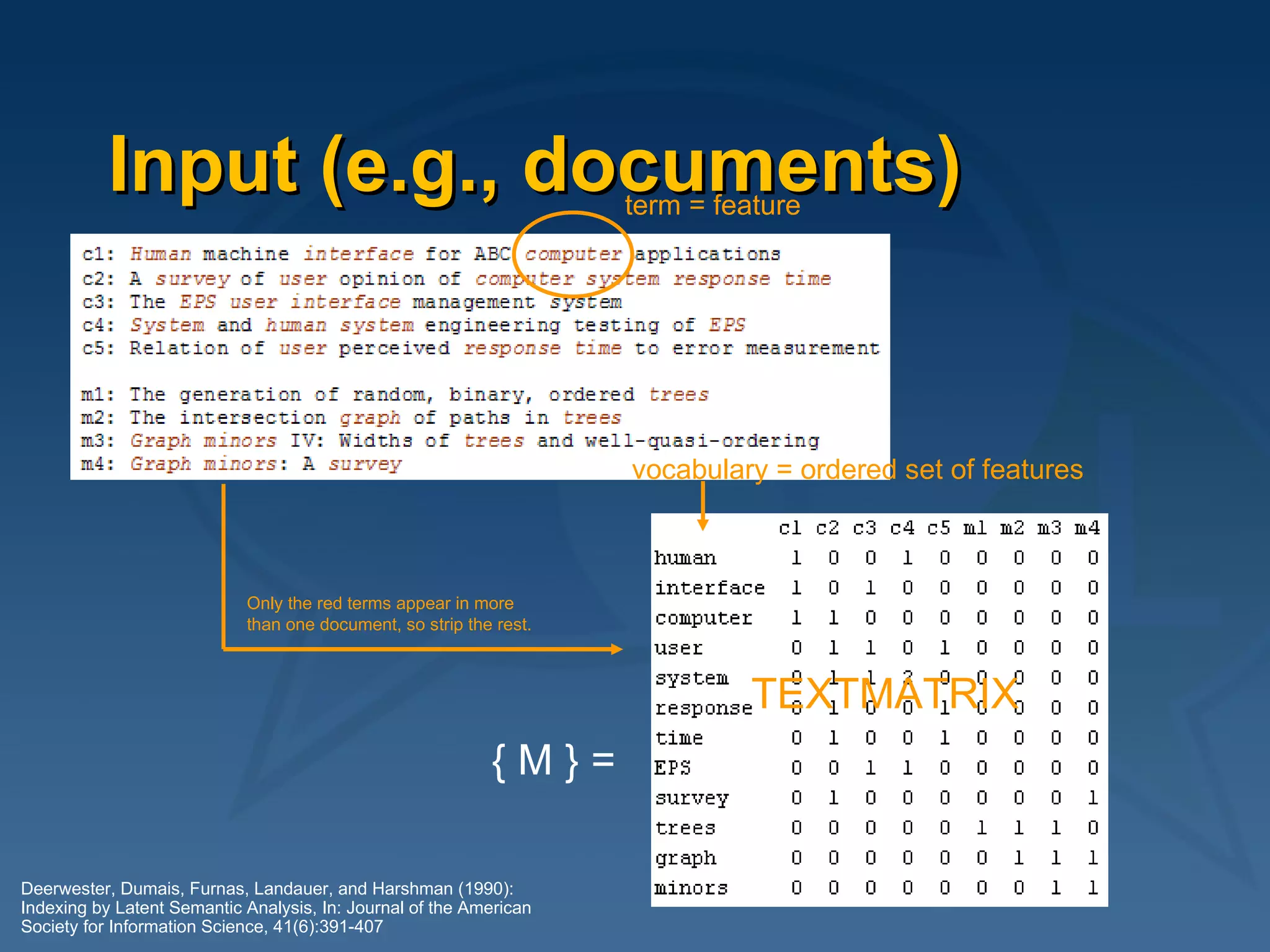
Input (e.g., documents) { M } =  Deerwester, Dumais, Furnas, Landauer, and Harshman (1990):  Indexing by Latent Semantic Analysis, In: Journal of the American  Society for Information Science, 41(6):391-407 Only the red terms appear in more  than one document, so strip the rest. term = feature vocabulary = ordered set of features TEXTMATRIX
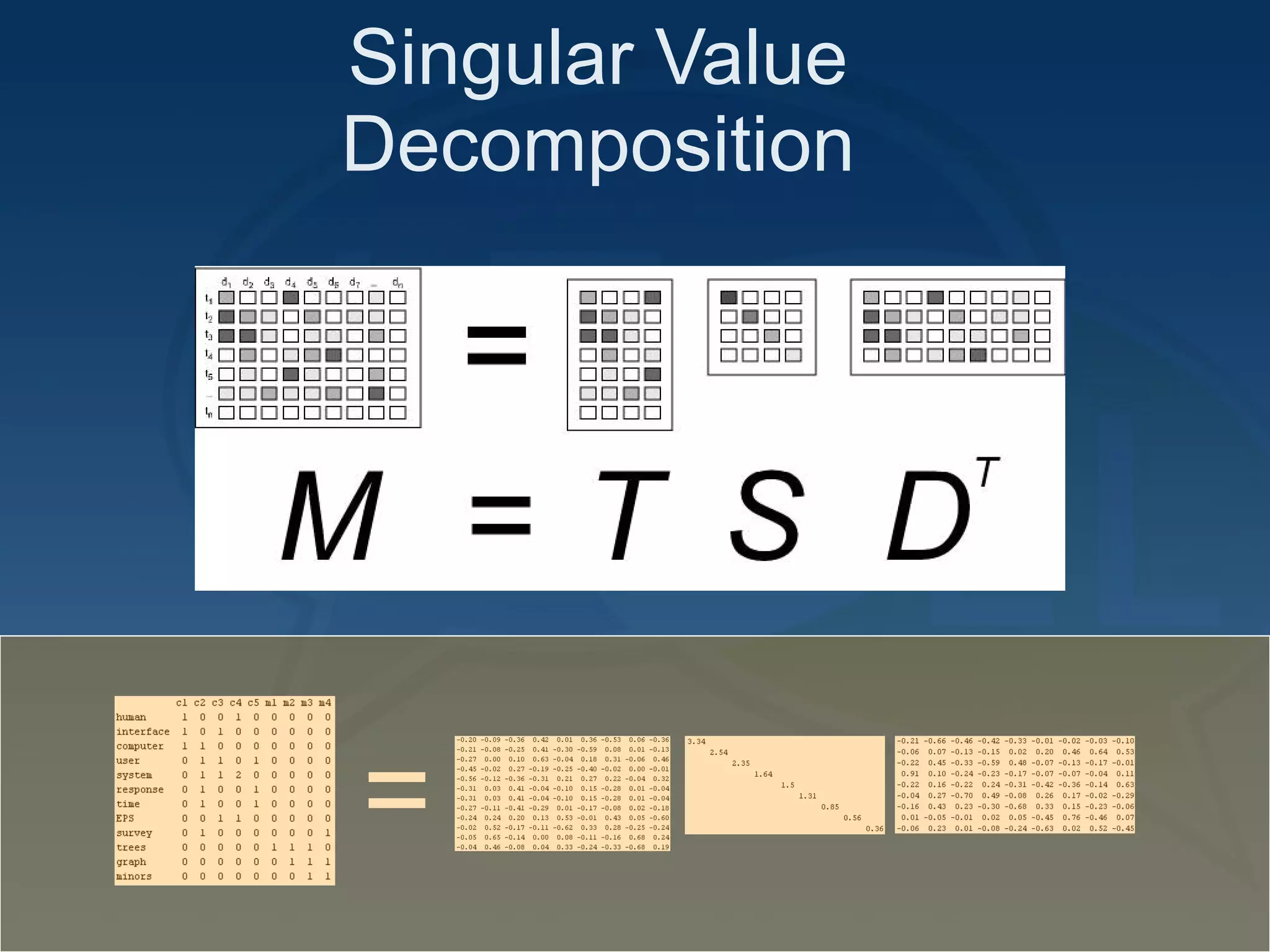
Singular Value Decomposition =
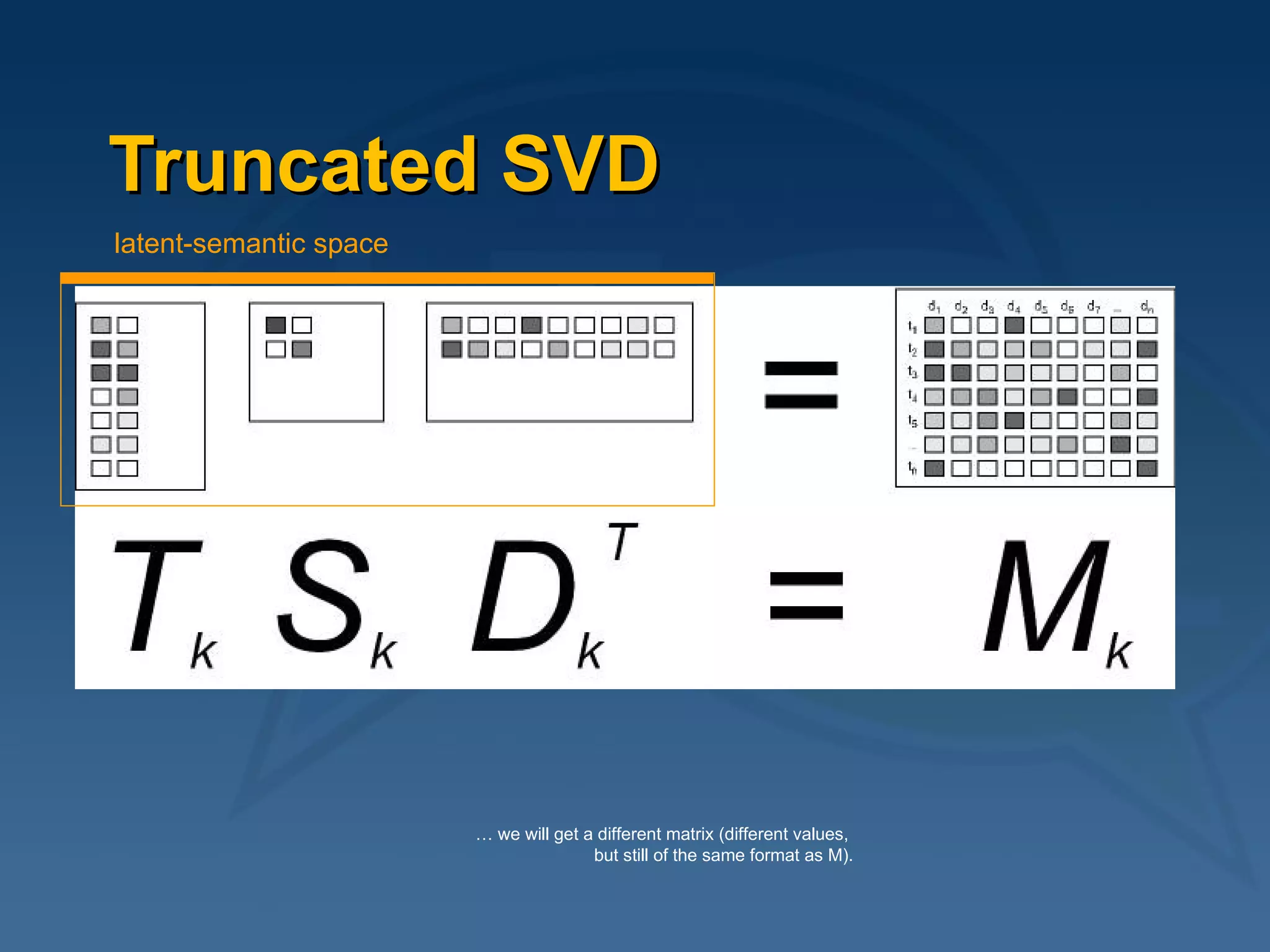
Truncated SVD …  we will get a different matrix (different values,  but still of the same format as M). latent-semantic space
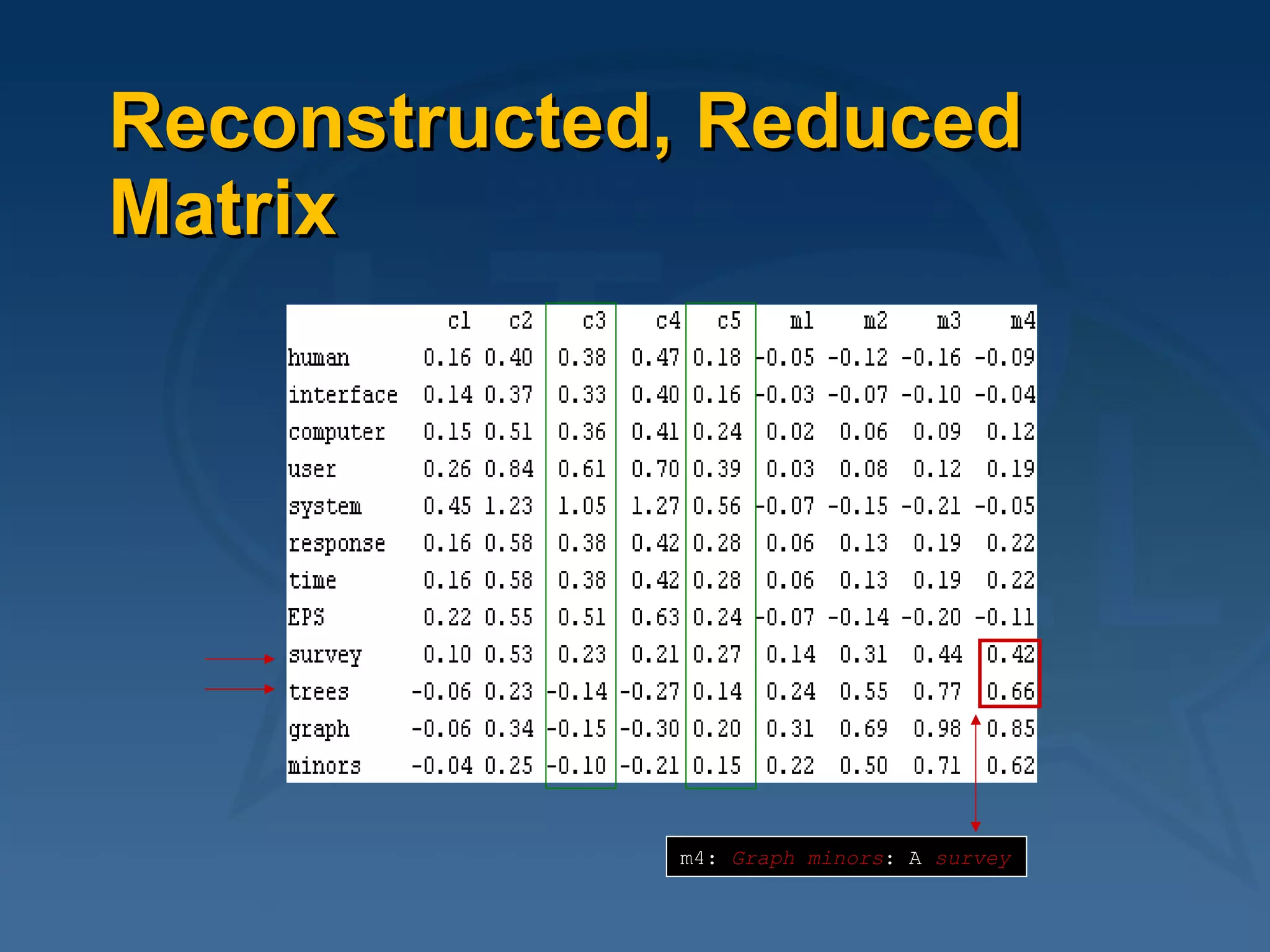
Reconstructed, Reduced Matrix m4:  Graph   minors : A  survey
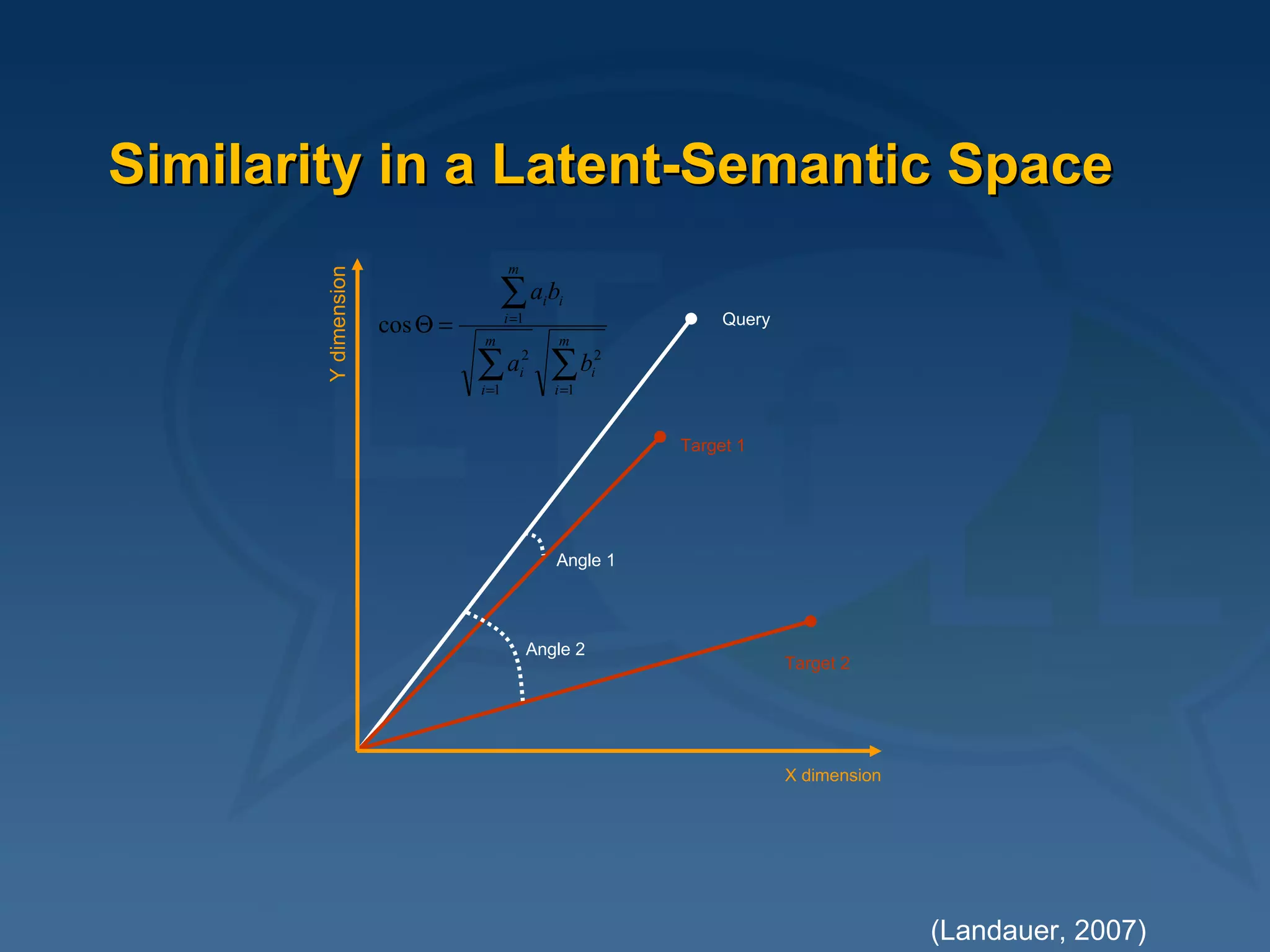
Similarity in a Latent-Semantic Space (Landauer, 2007) Query Target 1 Target 2 Angle 2 Angle 1 Y dimension X dimension
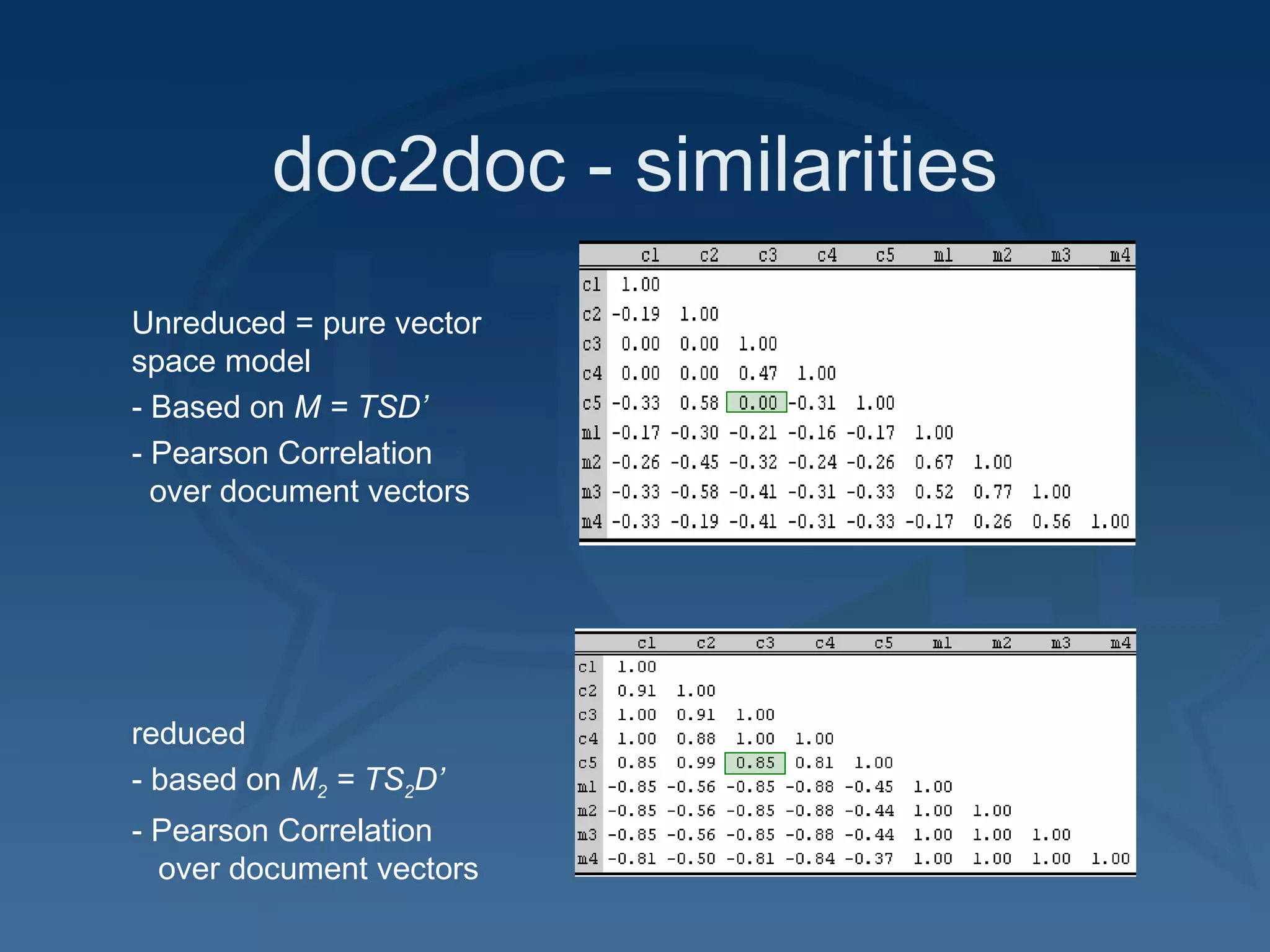
doc2doc - similarities Unreduced = pure vector space model - Based on  M = TSD’ - Pearson Correlation   over document vectors reduced - based on  M 2  = TS 2 D’ - Pearson Correlation    over document vectors
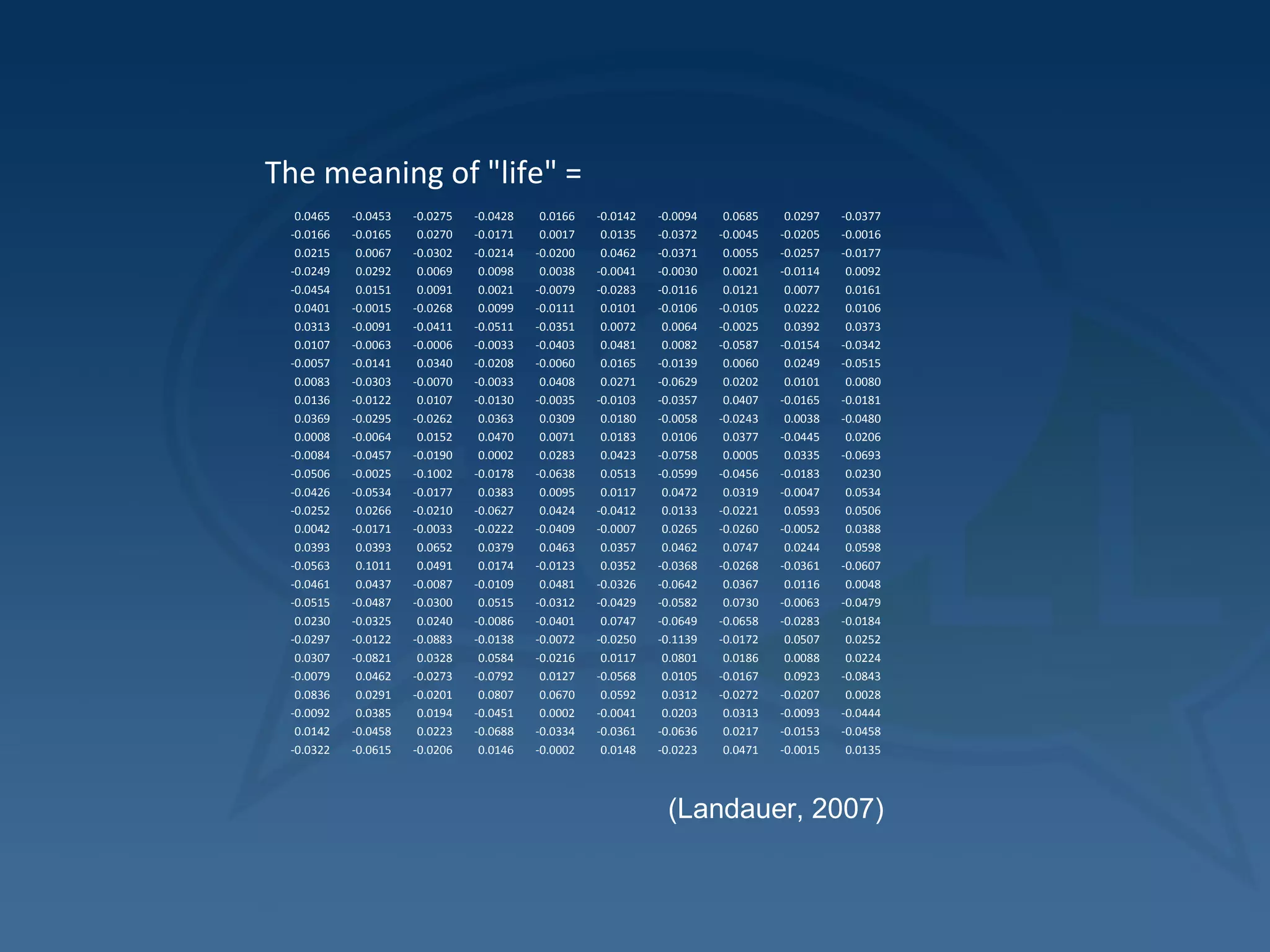
(Landauer, 2007)
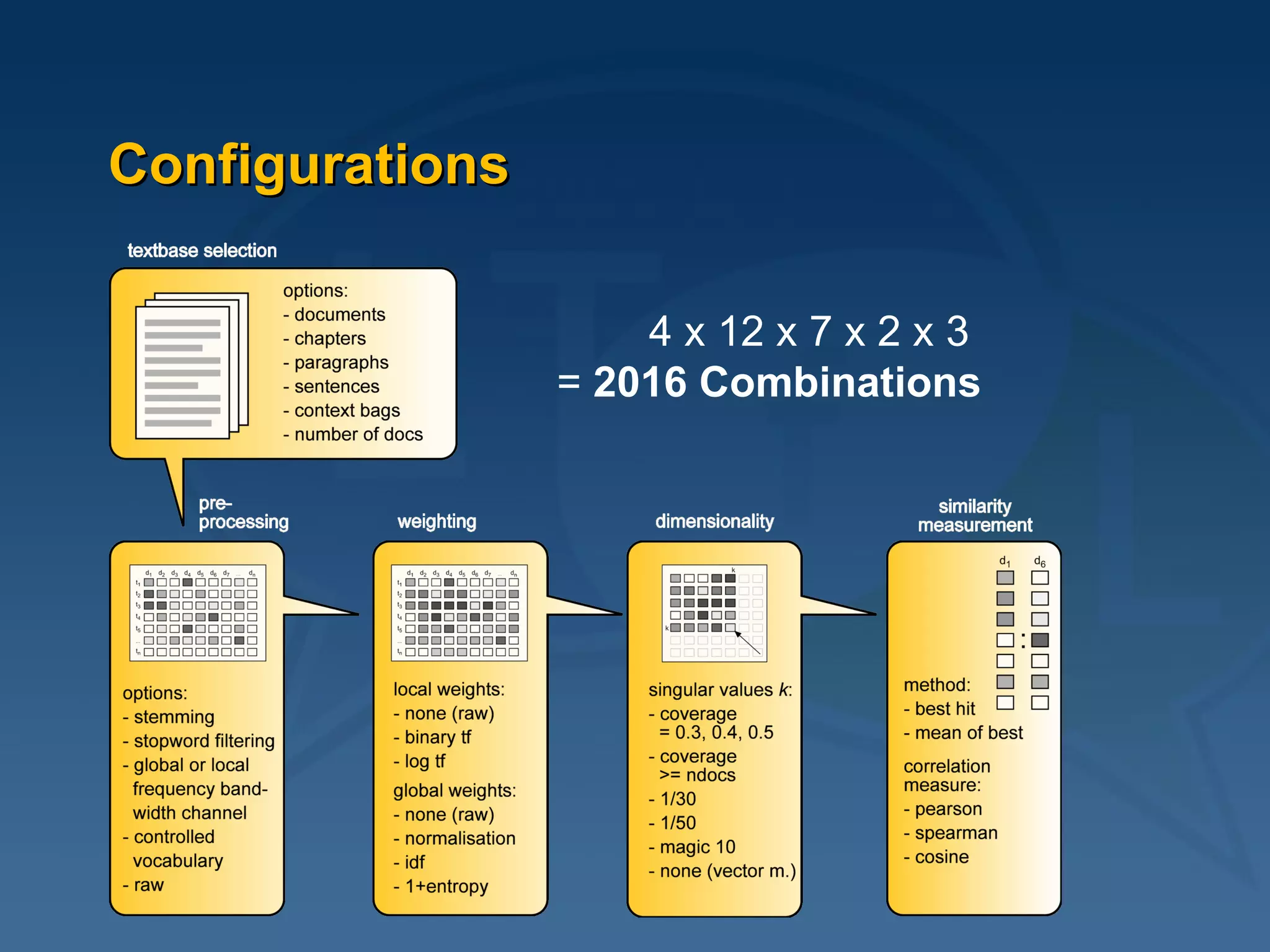
Configurations 4 x 12 x 7 x 2 x 3  =  2016 Combinations
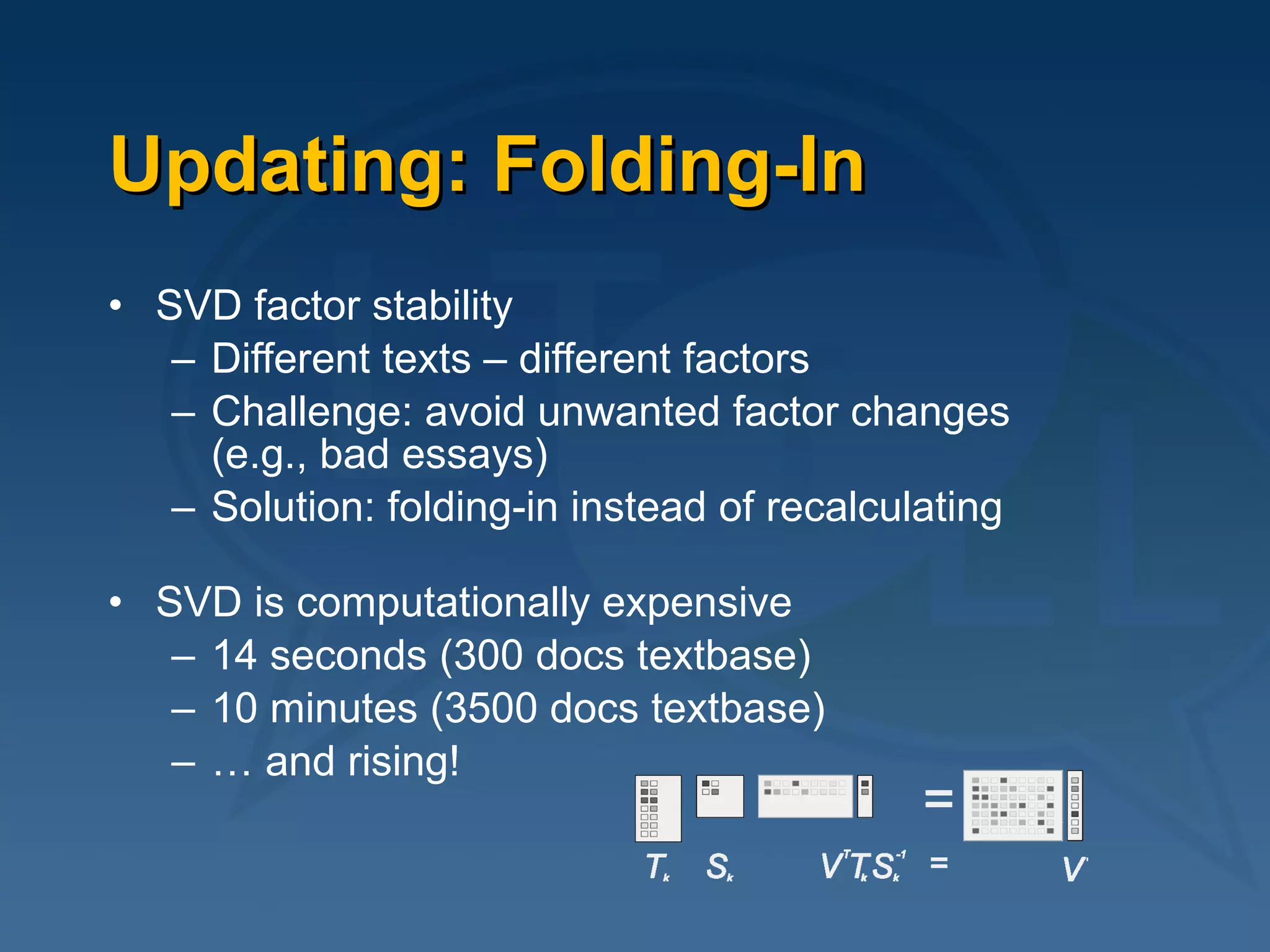
Updating: Folding-In SVD factor stability Different texts – different factors Challenge: avoid unwanted factor changes  (e.g., bad essays) Solution: folding-in instead of recalculating SVD is computationally expensive 14 seconds (300 docs textbase)  10 minutes (3500 docs textbase) …  and rising!
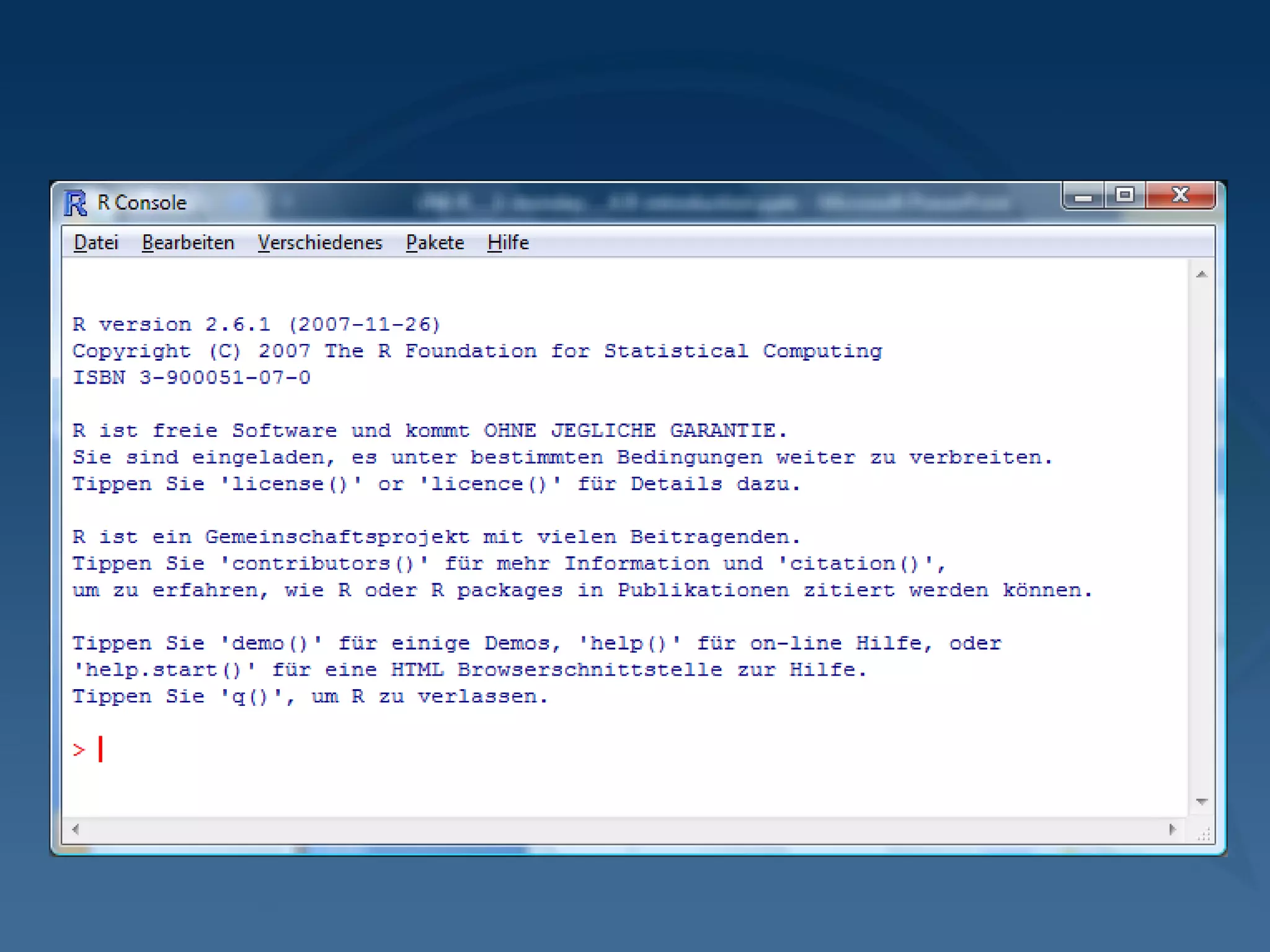
The Statistical Language  and Environment R R
 
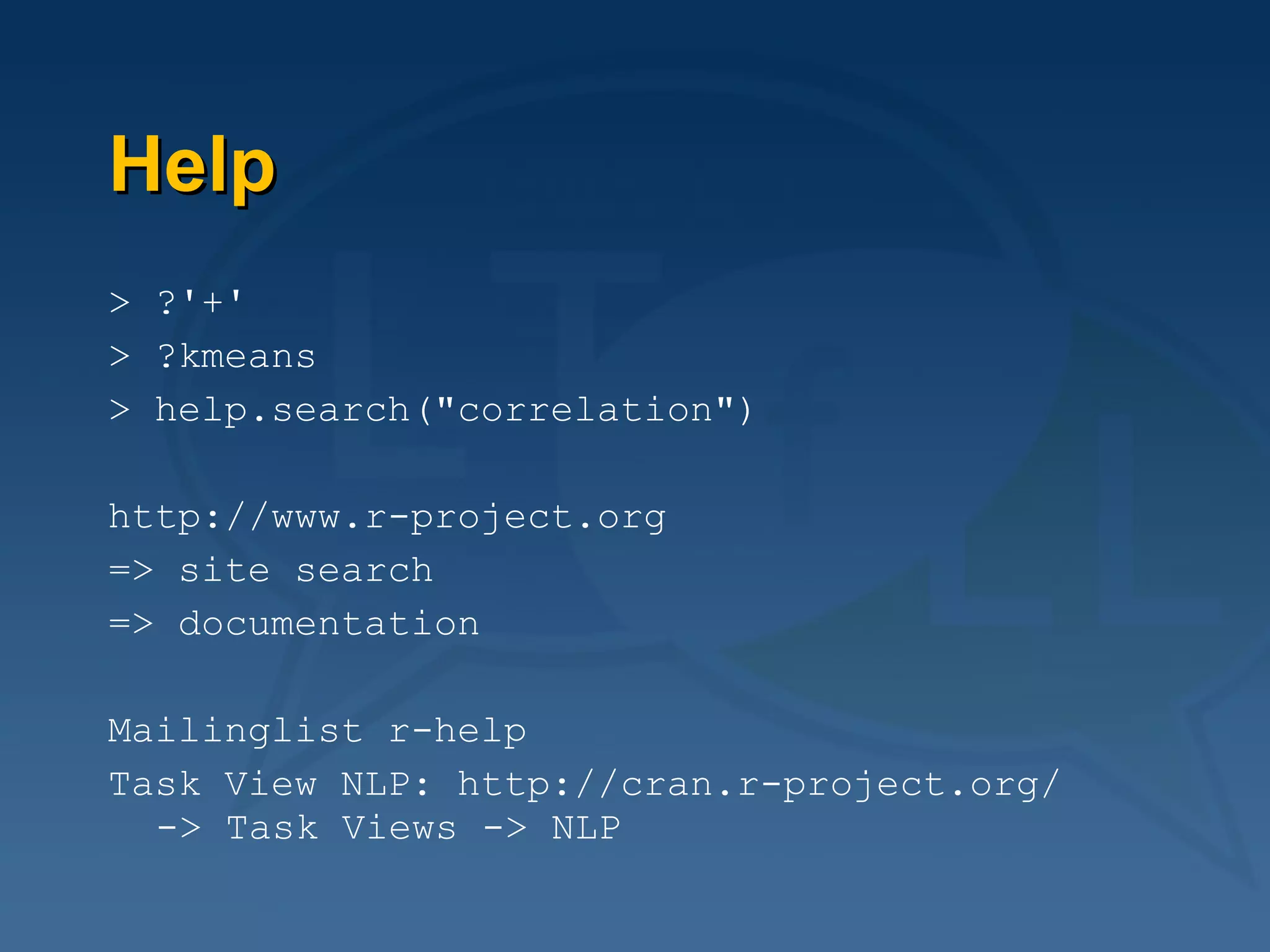
Help > ?'+' > ?kmeans > help.search("correlation") http://www.r-project.org  => site search => documentation Mailinglist r-help Task View NLP: http://cran.r-project.org/  -> Task Views -> NLP
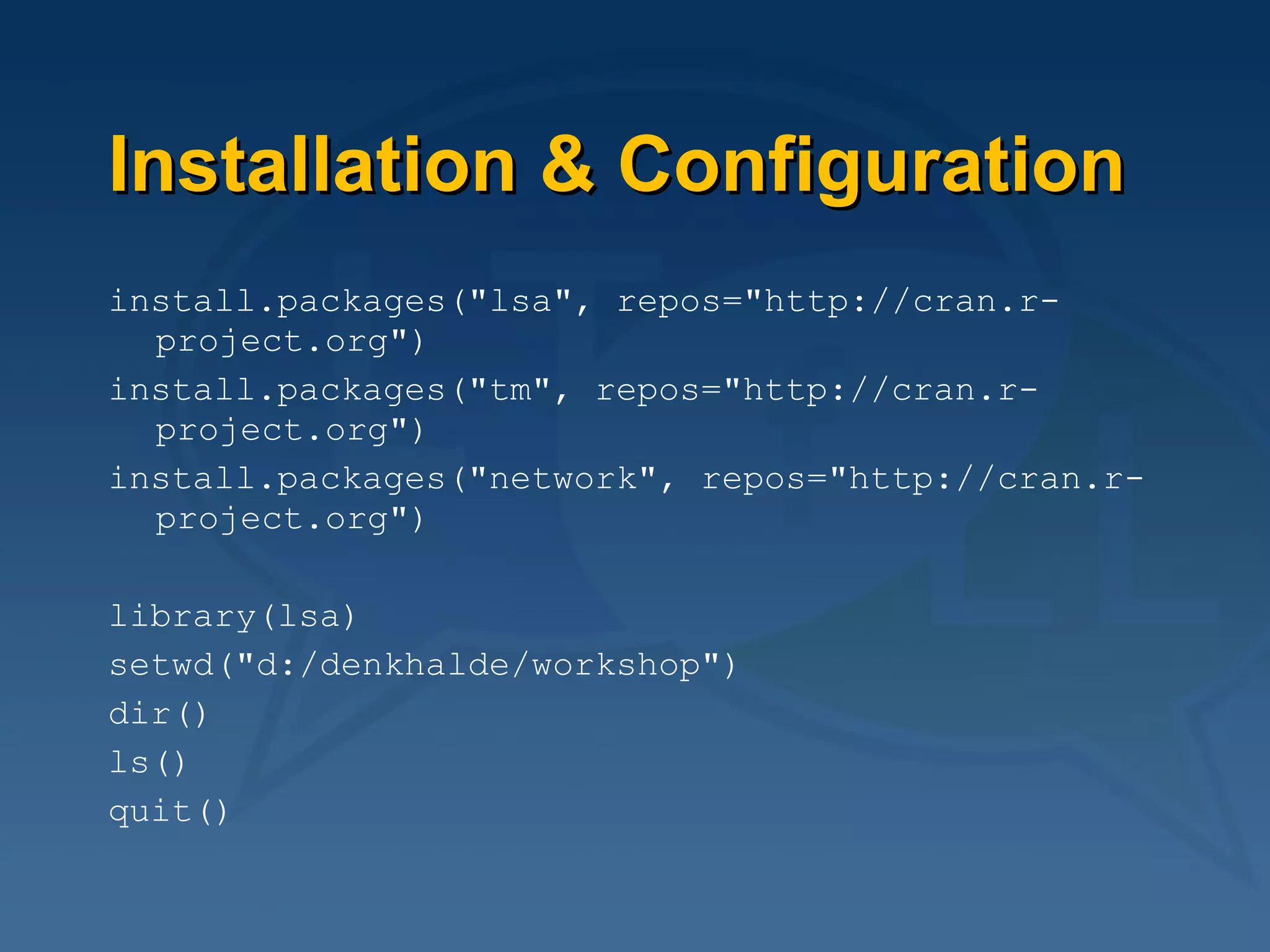
Installation & Configuration install.packages("lsa", repos="http://cran.r-project.org") install.packages("tm", repos="http://cran.r-project.org") install.packages("network", repos="http://cran.r-project.org") library(lsa) setwd("d:/denkhalde/workshop") dir() ls() quit()
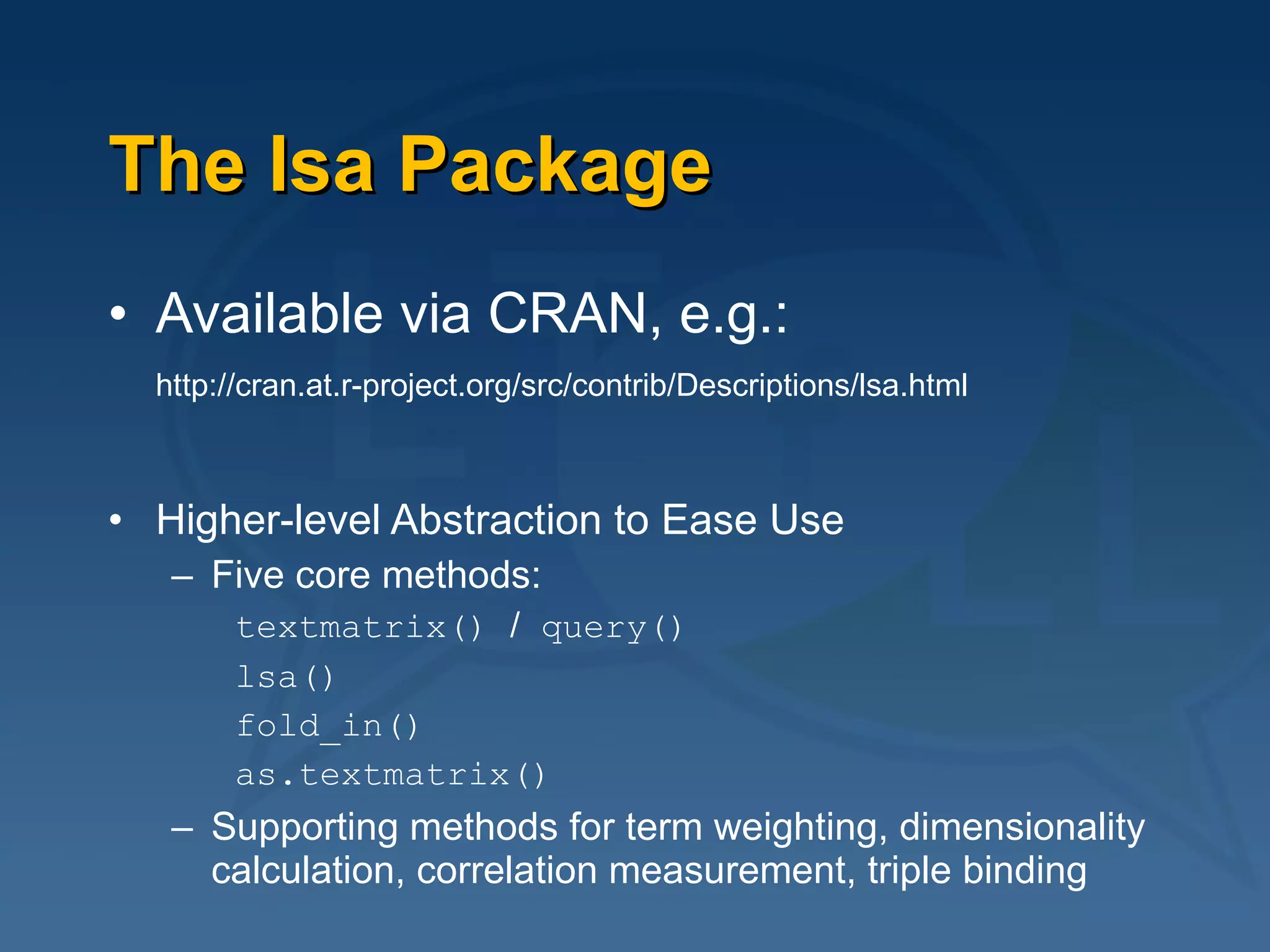
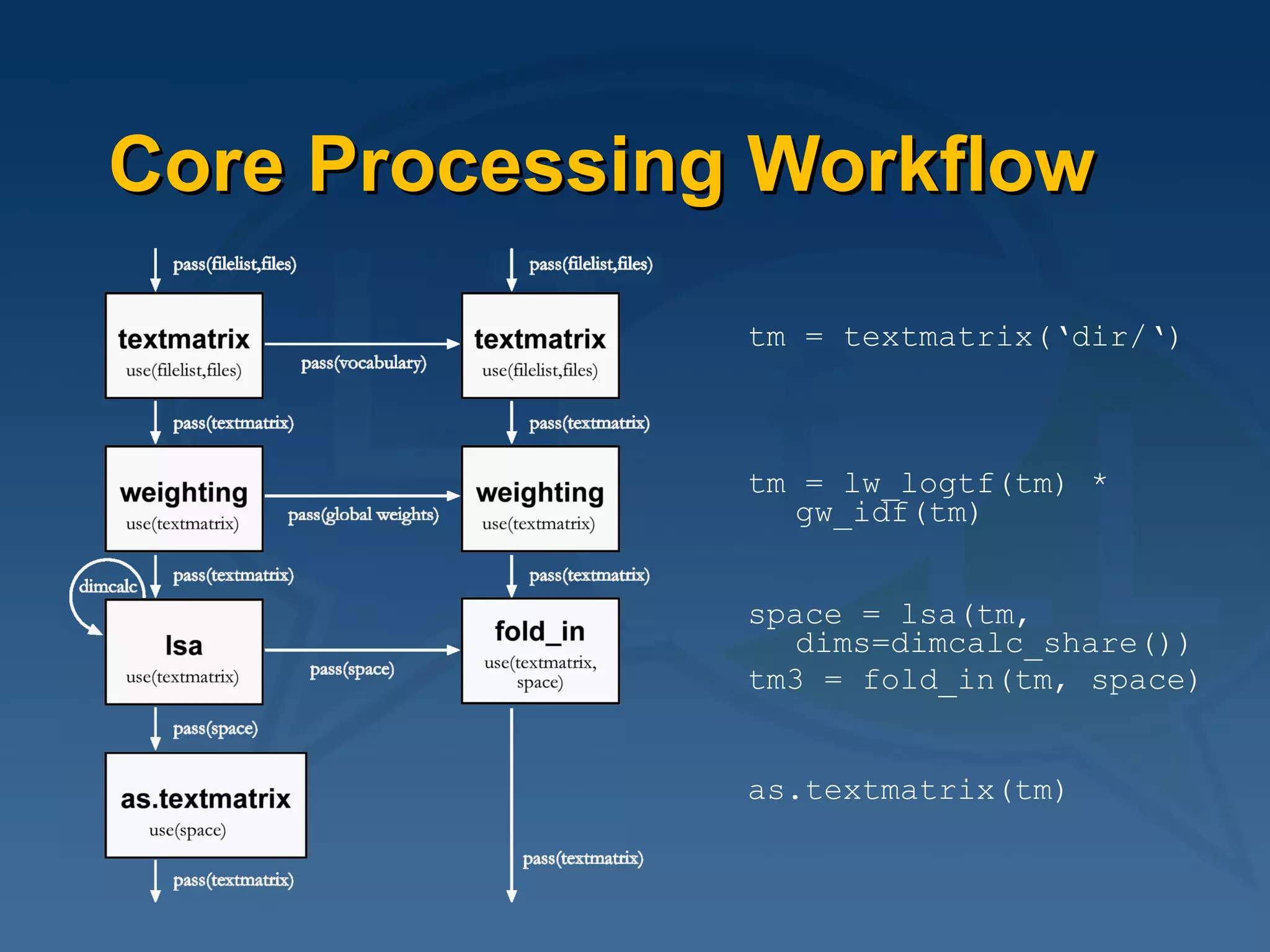
The lsa Package Available via CRAN, e.g.: http://cran.at.r-project.org/src/contrib/Descriptions/lsa.html   Higher-level Abstraction to Ease Use Five core methods: textmatrix()  /  query() lsa() fold_in() as.textmatrix() Supporting methods for term weighting, dimensionality calculation, correlation measurement, triple binding
Core Processing Workflow tm = textmatrix(‘dir/‘) tm = lw_logtf(tm) * gw_idf(tm) space = lsa(tm, dims=dimcalc_share()) tm3 = fold_in(tm, space) as.textmatrix(tm)
A Simple Evaluation of Students Writings Feedback
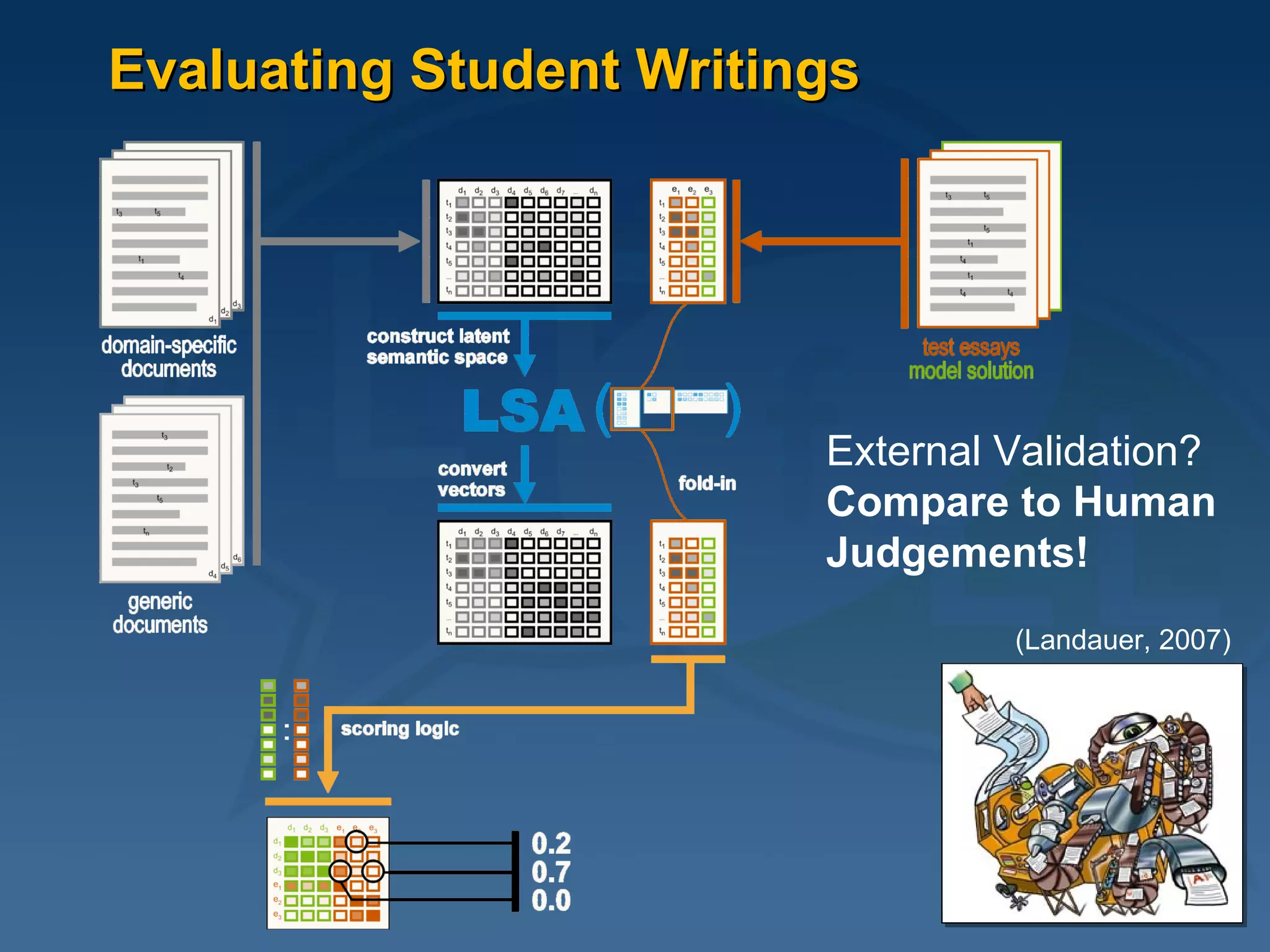
Evaluating Student Writings External Validation? Compare to Human Judgements! (Landauer, 2007)
How to do it... library( "lsa“ )   # load package # load training texts trm = textmatrix( "trainingtexts/“ ) trm = lw_bintf( trm ) * gw_idf( trm ) # weighting space = lsa( trm ) # create an LSA space # fold-in essays to be tested (including gold standard text) tem = textmatrix( "testessays/", vocabulary=rownames(trm) ) tem = lw_bintf( tem ) * gw_idf( trm ) # weighting tem_red = fold_in( tem, space ) # score an essay by comparing with  # gold standard text (very simple method!) cor( tem_red[,"goldstandard.txt"], tem_red[,"E1.txt"] ) => 0.7
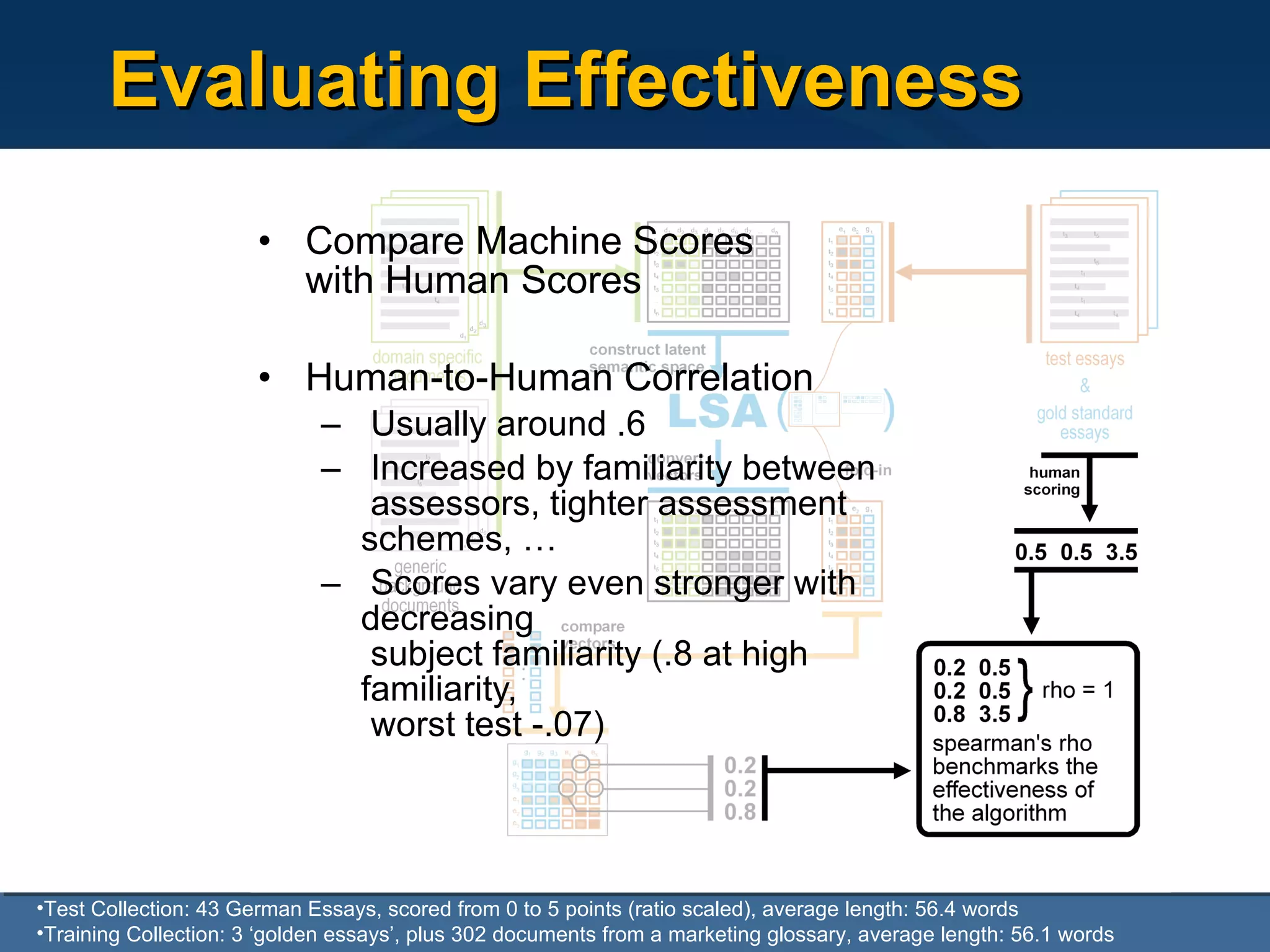
Evaluating Effectiveness Compare Machine Scores  with Human Scores Human-to-Human Correlation Usually around .6 Increased by familiarity between   assessors, tighter assessment schemes, … Scores vary even stronger with decreasing   subject familiarity (.8 at high familiarity,   worst test -.07) Test Collection: 43 German Essays, scored from 0 to 5 points (ratio scaled), average length: 56.4 words Training Collection: 3 ‘golden essays’, plus 302 documents from a marketing glossary, average length: 56.1 words
(Positive) Evaluation Results LSA machine scores: Spearman's rank correlation rho data:  humanscores[names(machinescores), ] and machinescores  S = 914.5772, p-value =  0.0001049 alternative hypothesis: true rho is not equal to 0  sample estimates: rho  0.687324  Pure vector space model: Spearman's rank correlation rho data:  humanscores[names(machinescores), ] and machinescores  S = 1616.007, p-value =  0.02188 alternative hypothesis: true rho is not equal to 0  sample estimates: rho  0.4475188
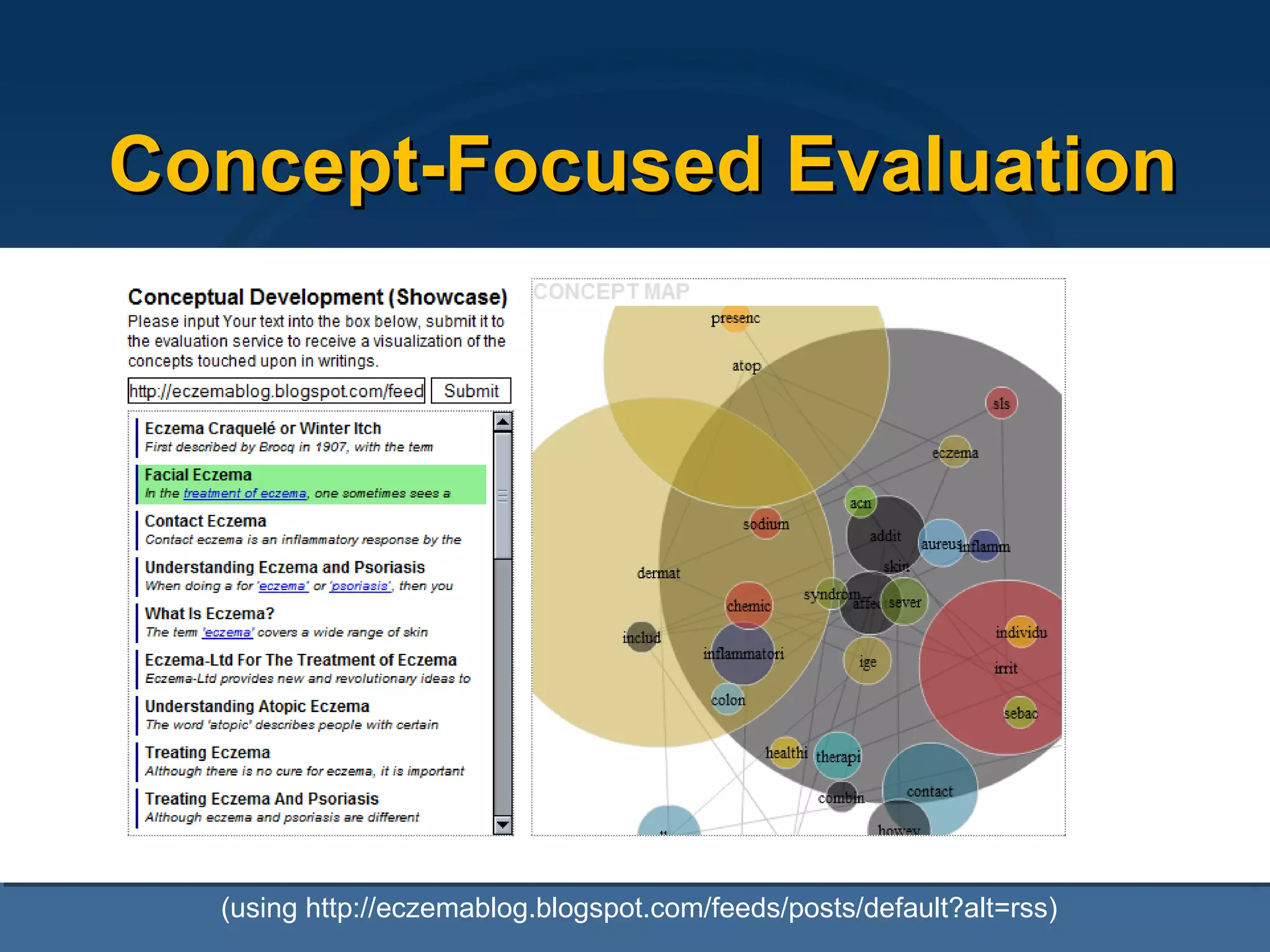
Concept-Focused Evaluation (using http://eczemablog.blogspot.com/feeds/posts/default?alt=rss)
Visualising Lexical Semantics Topic Proxy
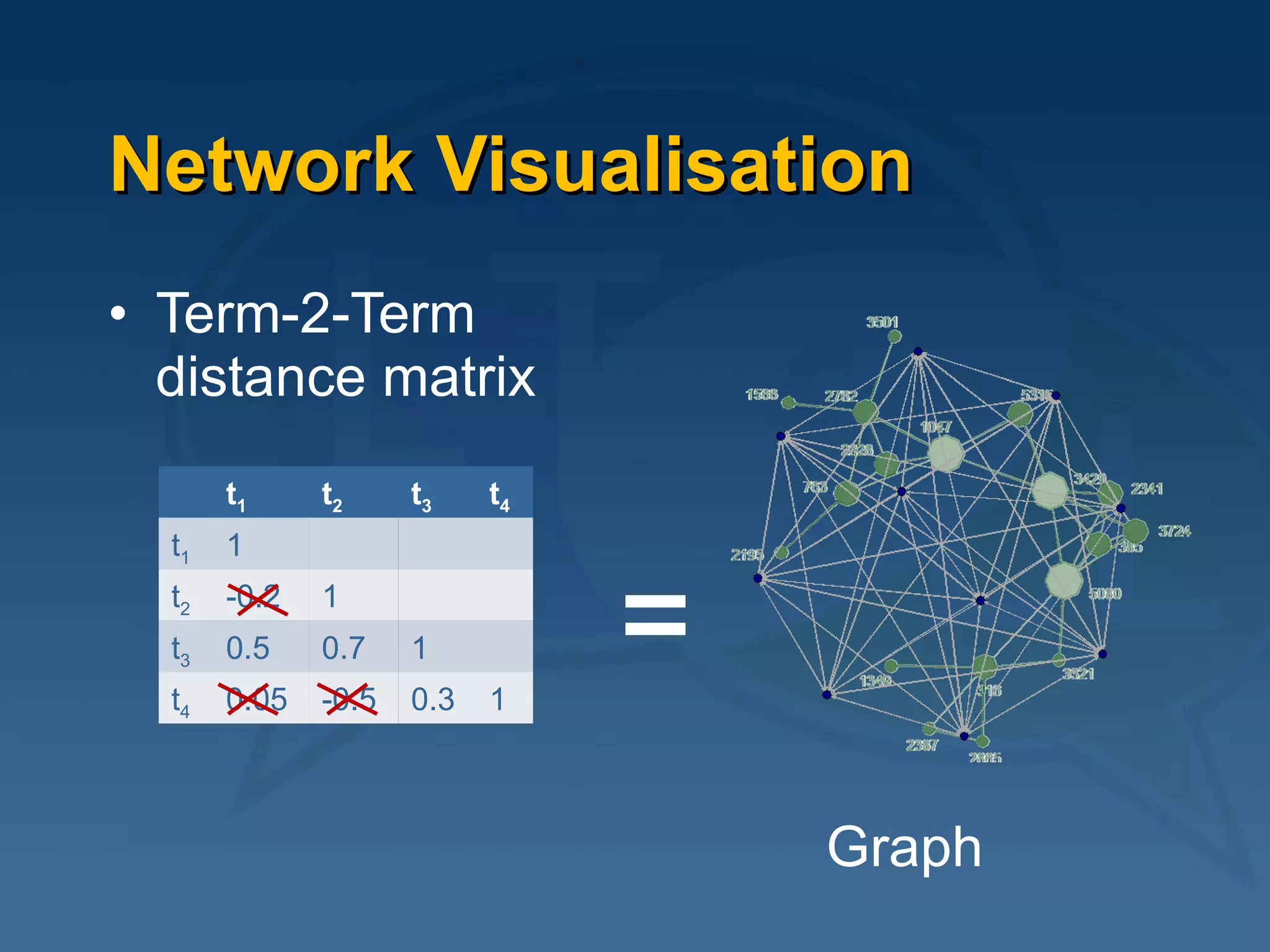
Network Visualisation Term-2-Term  distance matrix = = Graph t 1 t 2 t 3 t 4 t 1 1 t 2 -0.2 1 t 3 0.5 0.7 1 t 4 0.05 -0.5 0.3 1
Classical Landauer Example tl = landauerSpace$tk %*% diag(landauerSpace$sk) dl = landauerSpace$dk %*% diag(landauerSpace$sk) dtl = rbind(tl,dl) s = cosine(t(dtl)) s[which(s<0.8)] = 0 plot( network(s), displaylabels=T,  vertex.col = c(rep(2,12), rep(3,9)) )
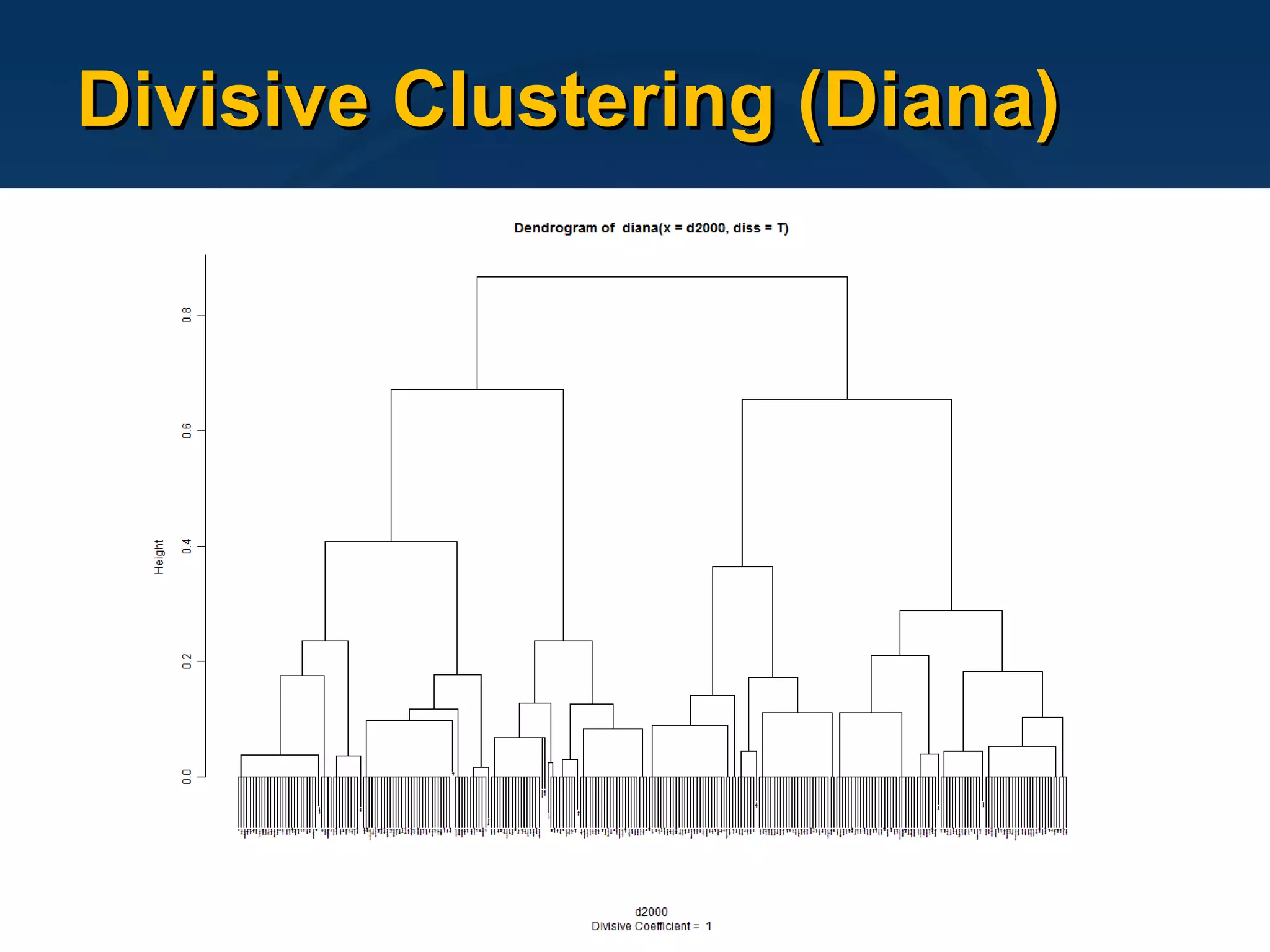
Divisive Clustering (Diana)
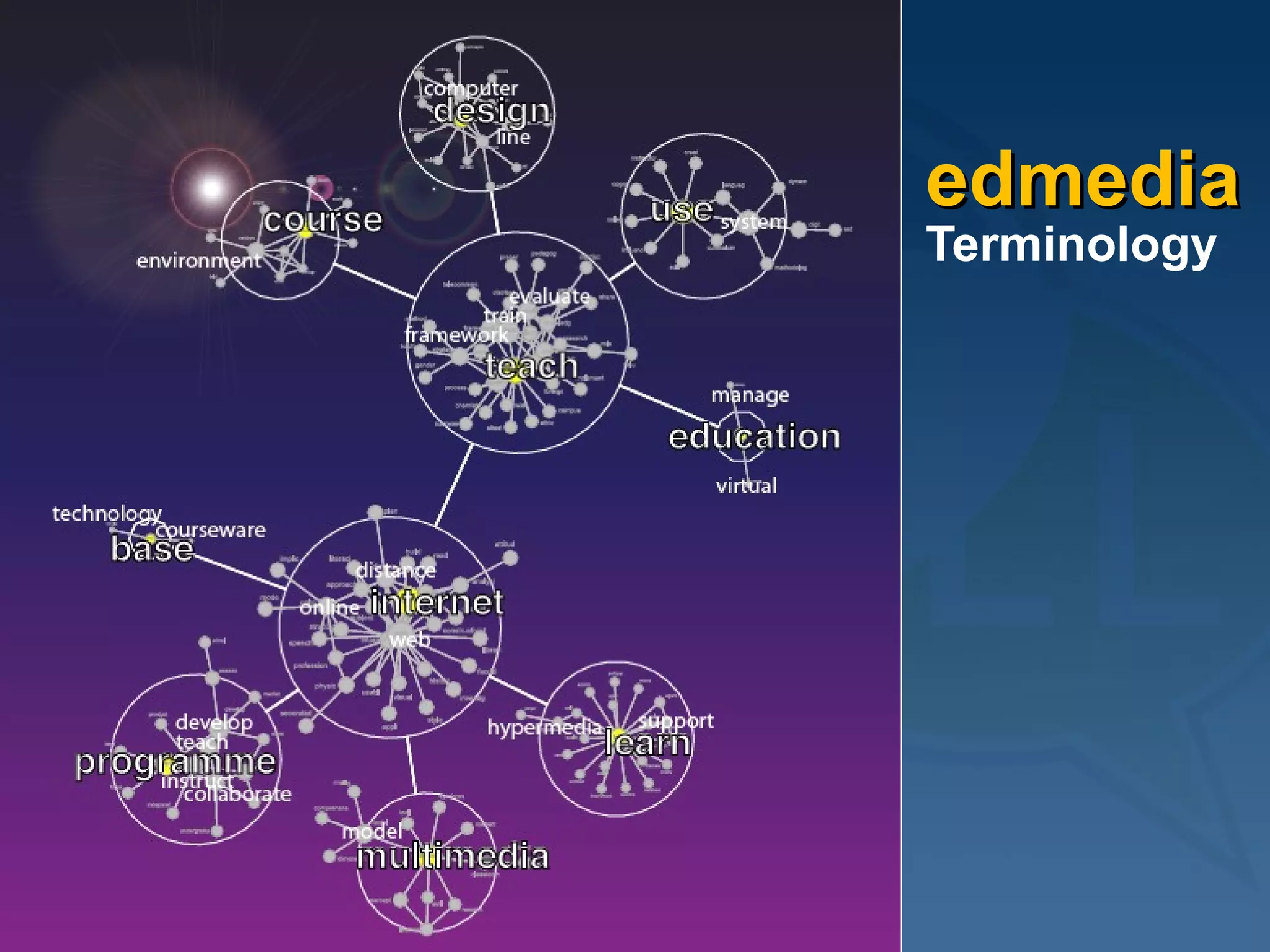
edmedia Terminology
Code Sample d2000 = cosine(t(dtm2000)) dianac2000 = diana(d2000, diss=T) clustersc2000 = cutree(as.hclust(dianac2000), h=0.2) plot(dianac2000, which.plot=2, cex=.1)  # dendrogramme winc = clustersc2000[which(clustersc2000==1)]  # filter for cluster 1 wincn = names(winc) d = d2000[wincn,wincn] d[which(d<0)] == 0 btw = betweenness(d, cmode=&quot;undirected&quot;)  # for nodes size calc btwmax = colnames(d)[which(btw==max(btw))] btwcex = (btw/max(btw))+1 plot(network(d), displayisolates=F, displaylabels=T, boxed.labels=F, edge.col=&quot;gray&quot;,  main=paste(&quot;cluster&quot;,i), usearrows=F, vertex.border=&quot;darkgray&quot;, label.col=&quot;darkgray&quot;, vertex.cex=btwcex*3, vertex.col=8-(colnames(d) %in% btwmax))
Permutating Permutation
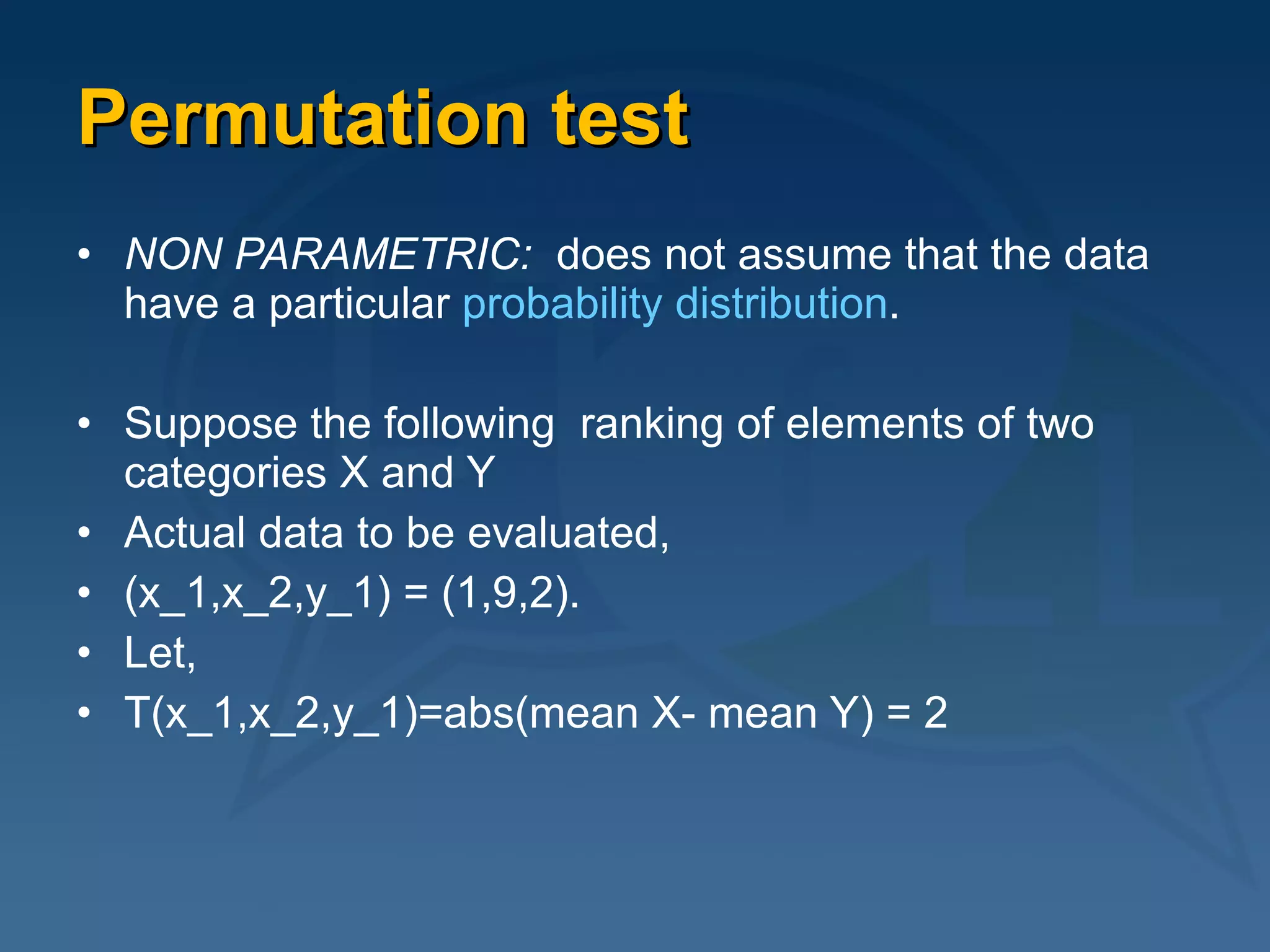
Permutation test NON PARAMETRIC:  does not assume that the data have a particular  probability distribution .   Suppose the following  ranking of elements of two categories X and Y Actual data to be evaluated, (x_1,x_2,y_1) = (1,9,2).  Let, T(x_1,x_2,y_1)=abs(mean X- mean Y) = 2
Permutation Usually, it is not practical to evaluate all N! permutatioons.  We can approximate the p-value by sampling randomly from the set of permutations.
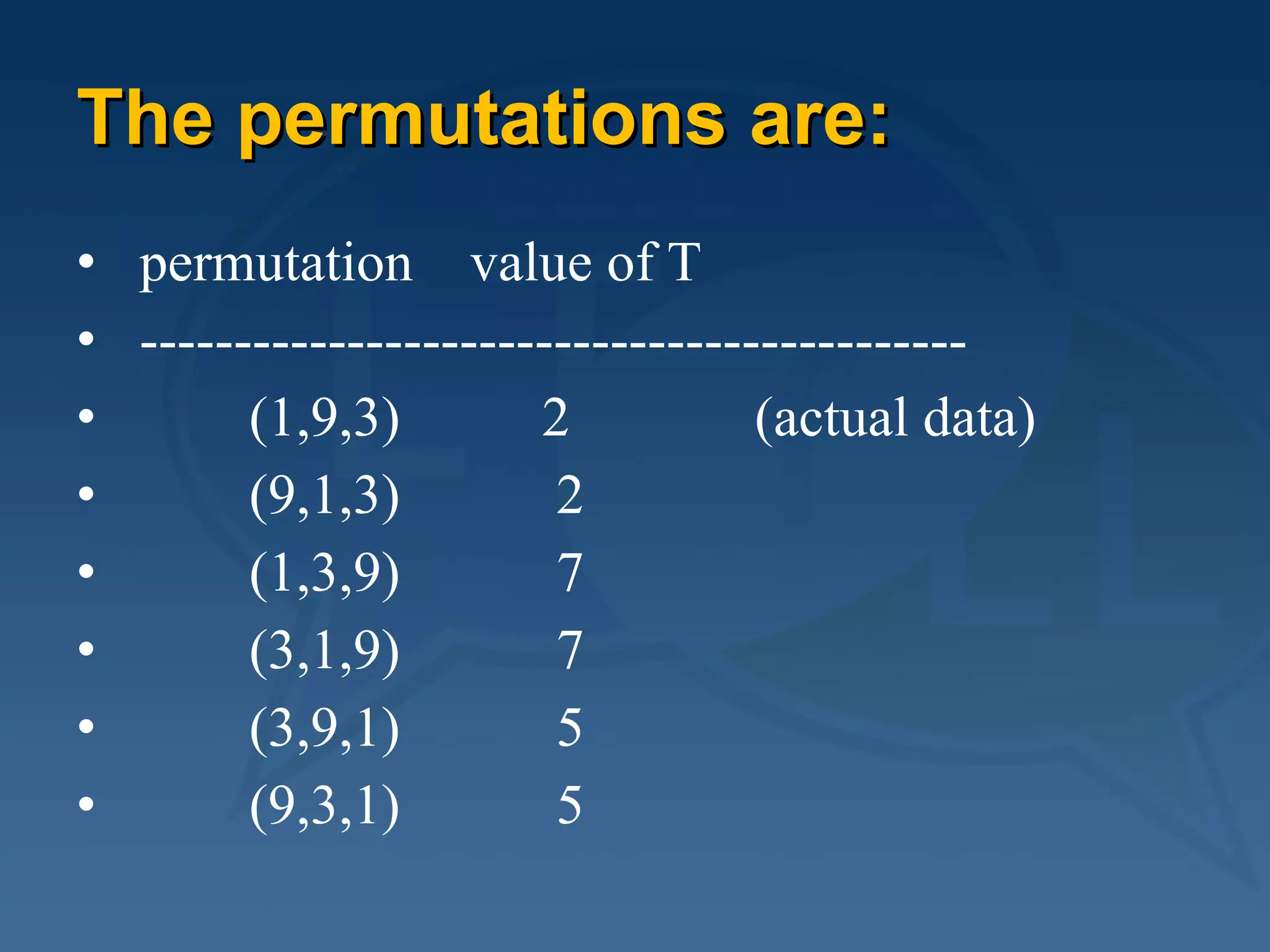
The permutations are: permutation    value of T         --------------------------------------------          (1,9,3)          2             (actual data)          (9,1,3)           2                       (1,3,9)           7                       (3,1,9)           7                       (3,9,1)           5                      (9,3,1)           5            
Some results Students discussions on safe prescribing: Classified according expected learning outcomes related subtopics topics: A=7, B=12, C=53, D=4, E=40, F=7 Graded: poor, fair, good, excelent Methodology used: LSA Bag of words/Maximal Repeated Phrases Permutation test
Challenging Questions Discussion
Questions Dangers of using  Language Technology? Ontologies = Neat? NLP = Nasty? Other possible application areas? Corpus Collection? What is good effectiveness? When can we say that an algorithm works well? Other aspects not evaluated…
Questions? #eof.

Language Technology Enhanced Learning

  • 1.
    Language Technology EnhancedLearning Fridolin Wild The Open University, UK Gaston Burek University of Tübingen Adriana Berlanga Open University, NL
  • 2.
    Workshop Outline 1| Deep Introduction Latent-Semantic Analysis (LSA) 2 | Quick Introduction Working with R 3 | Experiment Simple Content-Based Feedback 4 | Experiment Topic Proxy #
  • 3.
  • 4.
    Latent Semantic AnalysisAssumption: language utterances do have a semantic structure However, this structure is obscured by word usage (noise, synonymy, polysemy, …) Proposed LSA Solution: map doc-term matrix using conceptual indices derived statistically (truncated SVD ) and make similarity comparisons using e.g. angles
  • 5.
    Input (e.g., documents){ M } = Deerwester, Dumais, Furnas, Landauer, and Harshman (1990): Indexing by Latent Semantic Analysis, In: Journal of the American Society for Information Science, 41(6):391-407 Only the red terms appear in more than one document, so strip the rest. term = feature vocabulary = ordered set of features TEXTMATRIX
  • 6.
  • 7.
    Truncated SVD … we will get a different matrix (different values, but still of the same format as M). latent-semantic space
  • 8.
    Reconstructed, Reduced Matrixm4: Graph minors : A survey
  • 9.
    Similarity in aLatent-Semantic Space (Landauer, 2007) Query Target 1 Target 2 Angle 2 Angle 1 Y dimension X dimension
  • 10.
    doc2doc - similaritiesUnreduced = pure vector space model - Based on M = TSD’ - Pearson Correlation over document vectors reduced - based on M 2 = TS 2 D’ - Pearson Correlation over document vectors
  • 11.
  • 12.
    Configurations 4 x12 x 7 x 2 x 3 = 2016 Combinations
  • 13.
    Updating: Folding-In SVDfactor stability Different texts – different factors Challenge: avoid unwanted factor changes (e.g., bad essays) Solution: folding-in instead of recalculating SVD is computationally expensive 14 seconds (300 docs textbase) 10 minutes (3500 docs textbase) … and rising!
  • 14.
    The Statistical Language and Environment R R
  • 15.
  • 16.
    Help > ?'+'> ?kmeans > help.search(&quot;correlation&quot;) http://www.r-project.org => site search => documentation Mailinglist r-help Task View NLP: http://cran.r-project.org/ -> Task Views -> NLP
  • 17.
    Installation & Configurationinstall.packages(&quot;lsa&quot;, repos=&quot;http://cran.r-project.org&quot;) install.packages(&quot;tm&quot;, repos=&quot;http://cran.r-project.org&quot;) install.packages(&quot;network&quot;, repos=&quot;http://cran.r-project.org&quot;) library(lsa) setwd(&quot;d:/denkhalde/workshop&quot;) dir() ls() quit()
  • 18.
    The lsa PackageAvailable via CRAN, e.g.: http://cran.at.r-project.org/src/contrib/Descriptions/lsa.html Higher-level Abstraction to Ease Use Five core methods: textmatrix() / query() lsa() fold_in() as.textmatrix() Supporting methods for term weighting, dimensionality calculation, correlation measurement, triple binding
  • 19.
    Core Processing Workflowtm = textmatrix(‘dir/‘) tm = lw_logtf(tm) * gw_idf(tm) space = lsa(tm, dims=dimcalc_share()) tm3 = fold_in(tm, space) as.textmatrix(tm)
  • 20.
    A Simple Evaluationof Students Writings Feedback
  • 21.
    Evaluating Student WritingsExternal Validation? Compare to Human Judgements! (Landauer, 2007)
  • 22.
    How to doit... library( &quot;lsa“ ) # load package # load training texts trm = textmatrix( &quot;trainingtexts/“ ) trm = lw_bintf( trm ) * gw_idf( trm ) # weighting space = lsa( trm ) # create an LSA space # fold-in essays to be tested (including gold standard text) tem = textmatrix( &quot;testessays/&quot;, vocabulary=rownames(trm) ) tem = lw_bintf( tem ) * gw_idf( trm ) # weighting tem_red = fold_in( tem, space ) # score an essay by comparing with # gold standard text (very simple method!) cor( tem_red[,&quot;goldstandard.txt&quot;], tem_red[,&quot;E1.txt&quot;] ) => 0.7
  • 23.
    Evaluating Effectiveness CompareMachine Scores with Human Scores Human-to-Human Correlation Usually around .6 Increased by familiarity between assessors, tighter assessment schemes, … Scores vary even stronger with decreasing subject familiarity (.8 at high familiarity, worst test -.07) Test Collection: 43 German Essays, scored from 0 to 5 points (ratio scaled), average length: 56.4 words Training Collection: 3 ‘golden essays’, plus 302 documents from a marketing glossary, average length: 56.1 words
  • 24.
    (Positive) Evaluation ResultsLSA machine scores: Spearman's rank correlation rho data: humanscores[names(machinescores), ] and machinescores S = 914.5772, p-value = 0.0001049 alternative hypothesis: true rho is not equal to 0 sample estimates: rho 0.687324 Pure vector space model: Spearman's rank correlation rho data: humanscores[names(machinescores), ] and machinescores S = 1616.007, p-value = 0.02188 alternative hypothesis: true rho is not equal to 0 sample estimates: rho 0.4475188
  • 25.
    Concept-Focused Evaluation (usinghttp://eczemablog.blogspot.com/feeds/posts/default?alt=rss)
  • 26.
  • 27.
    Network Visualisation Term-2-Term distance matrix = = Graph t 1 t 2 t 3 t 4 t 1 1 t 2 -0.2 1 t 3 0.5 0.7 1 t 4 0.05 -0.5 0.3 1
  • 28.
    Classical Landauer Exampletl = landauerSpace$tk %*% diag(landauerSpace$sk) dl = landauerSpace$dk %*% diag(landauerSpace$sk) dtl = rbind(tl,dl) s = cosine(t(dtl)) s[which(s<0.8)] = 0 plot( network(s), displaylabels=T, vertex.col = c(rep(2,12), rep(3,9)) )
  • 29.
  • 30.
  • 31.
    Code Sample d2000= cosine(t(dtm2000)) dianac2000 = diana(d2000, diss=T) clustersc2000 = cutree(as.hclust(dianac2000), h=0.2) plot(dianac2000, which.plot=2, cex=.1) # dendrogramme winc = clustersc2000[which(clustersc2000==1)] # filter for cluster 1 wincn = names(winc) d = d2000[wincn,wincn] d[which(d<0)] == 0 btw = betweenness(d, cmode=&quot;undirected&quot;) # for nodes size calc btwmax = colnames(d)[which(btw==max(btw))] btwcex = (btw/max(btw))+1 plot(network(d), displayisolates=F, displaylabels=T, boxed.labels=F, edge.col=&quot;gray&quot;, main=paste(&quot;cluster&quot;,i), usearrows=F, vertex.border=&quot;darkgray&quot;, label.col=&quot;darkgray&quot;, vertex.cex=btwcex*3, vertex.col=8-(colnames(d) %in% btwmax))
  • 32.
  • 33.
    Permutation test NONPARAMETRIC: does not assume that the data have a particular probability distribution . Suppose the following ranking of elements of two categories X and Y Actual data to be evaluated, (x_1,x_2,y_1) = (1,9,2). Let, T(x_1,x_2,y_1)=abs(mean X- mean Y) = 2
  • 34.
    Permutation Usually, itis not practical to evaluate all N! permutatioons. We can approximate the p-value by sampling randomly from the set of permutations.
  • 35.
    The permutations are:permutation    value of T         --------------------------------------------         (1,9,3)         2             (actual data)         (9,1,3)           2                     (1,3,9)           7                     (3,1,9)           7                     (3,9,1)           5                     (9,3,1)           5            
  • 36.
    Some results Studentsdiscussions on safe prescribing: Classified according expected learning outcomes related subtopics topics: A=7, B=12, C=53, D=4, E=40, F=7 Graded: poor, fair, good, excelent Methodology used: LSA Bag of words/Maximal Repeated Phrases Permutation test
  • 37.
  • 38.
    Questions Dangers ofusing Language Technology? Ontologies = Neat? NLP = Nasty? Other possible application areas? Corpus Collection? What is good effectiveness? When can we say that an algorithm works well? Other aspects not evaluated…
  • 39.