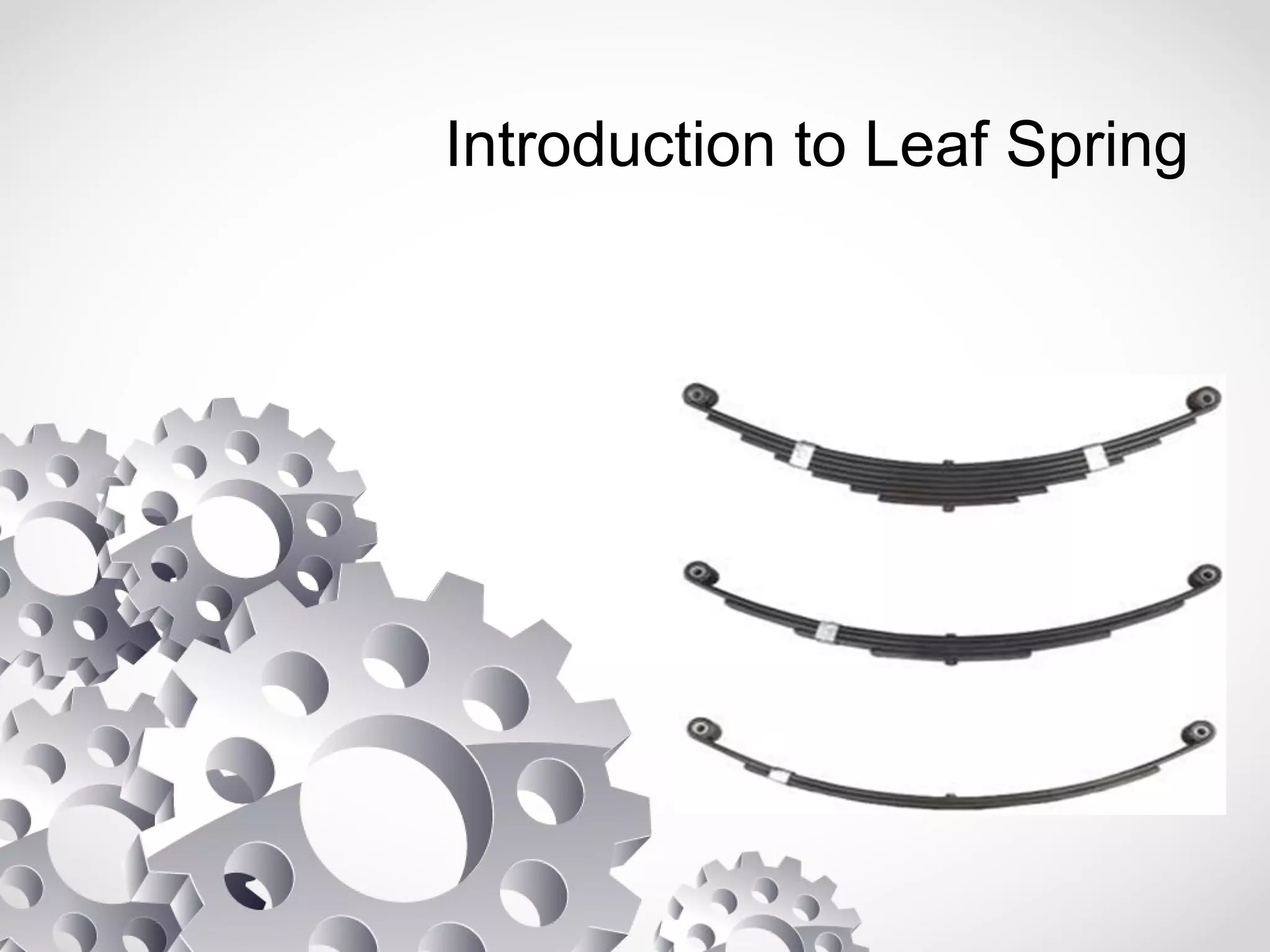
Introduction to Leaf Spring
Invention of Leaf Spring
• Leaf spring was invented by
Obadiah Elliot of London in 18th
century. He simply piled one steel
plate on top of another, pinned
them together and shackled each
end to a carriage, it was the first
ever leaf spring used on a vehicle.
Leaf Spring
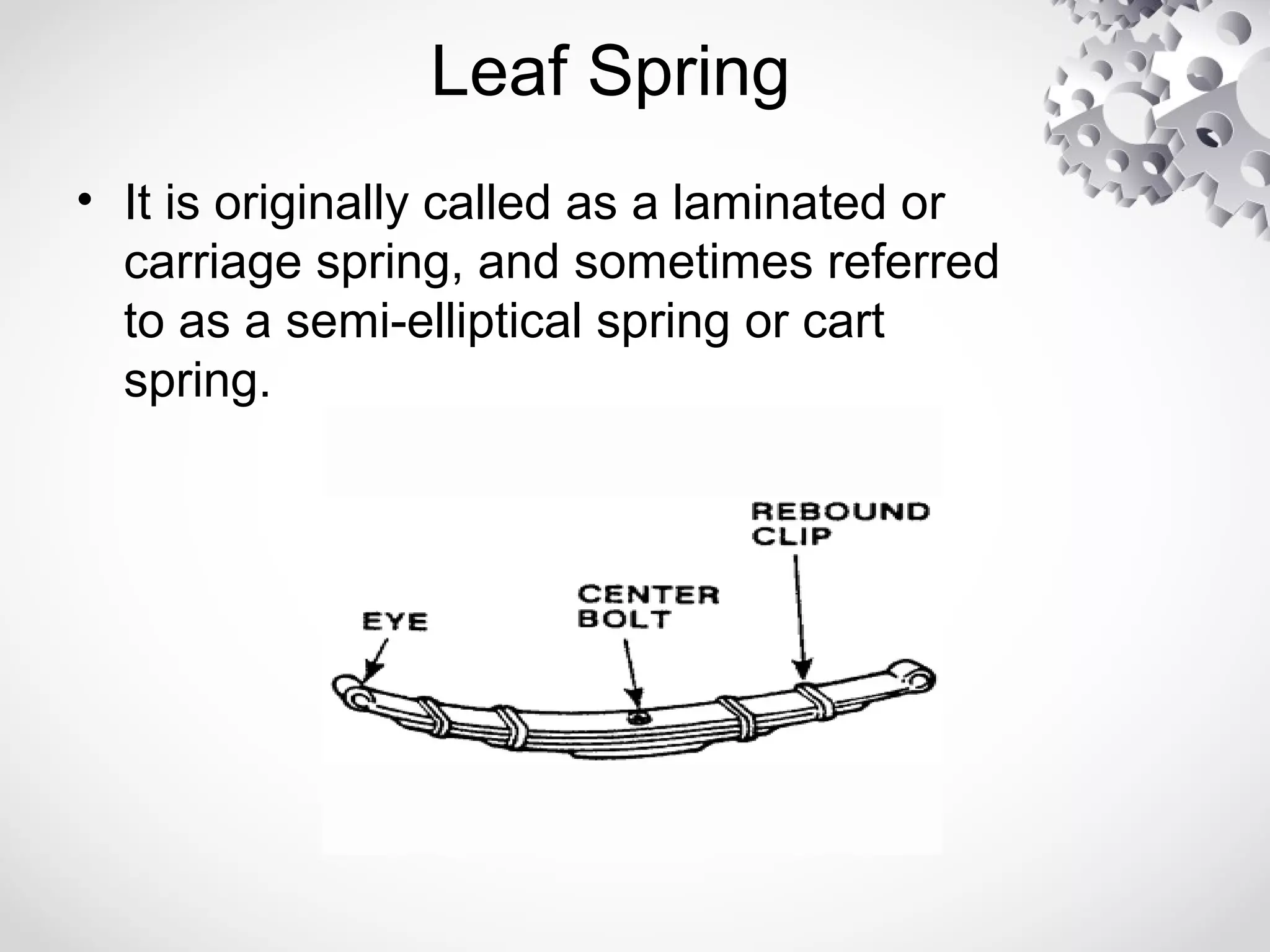
• It is originally called as a laminated or
carriage spring, and sometimes referred
to as a semi-elliptical spring or cart
spring.
Principle of Leaf Spring
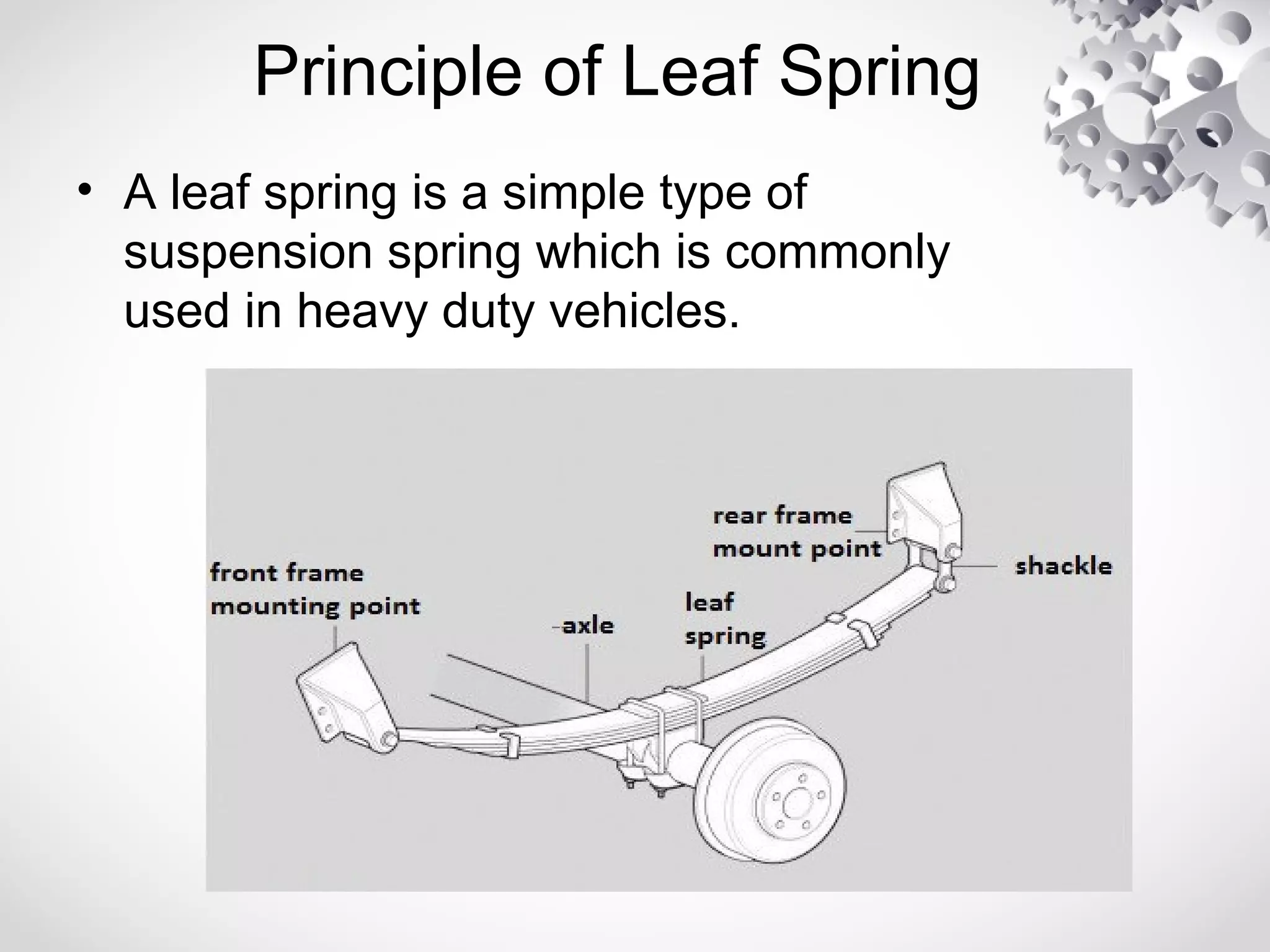
• A leaf spring is a simple type of
suspension spring which is commonly
used in heavy duty vehicles.
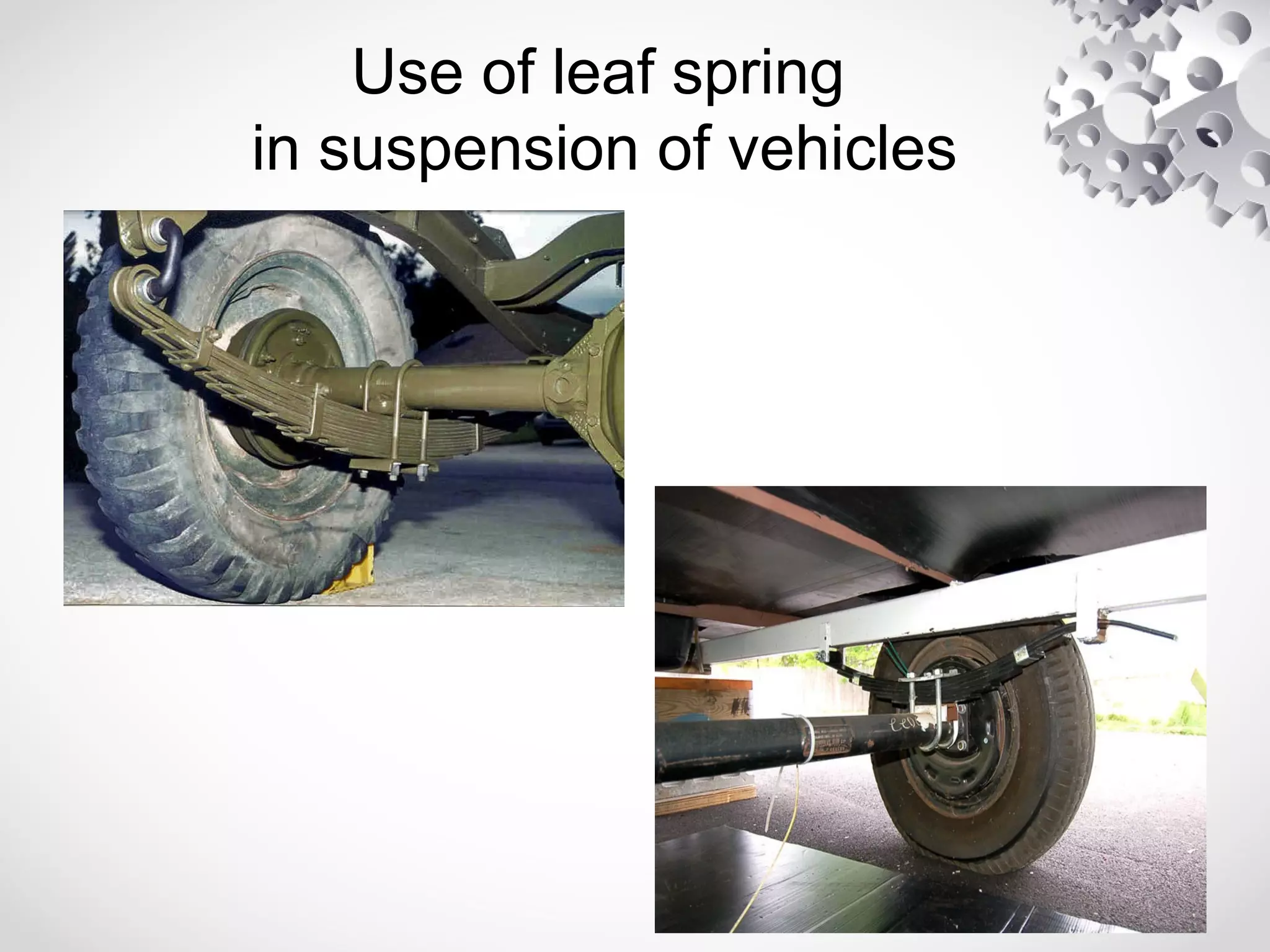
Use of leaf spring
in suspension of vehicles
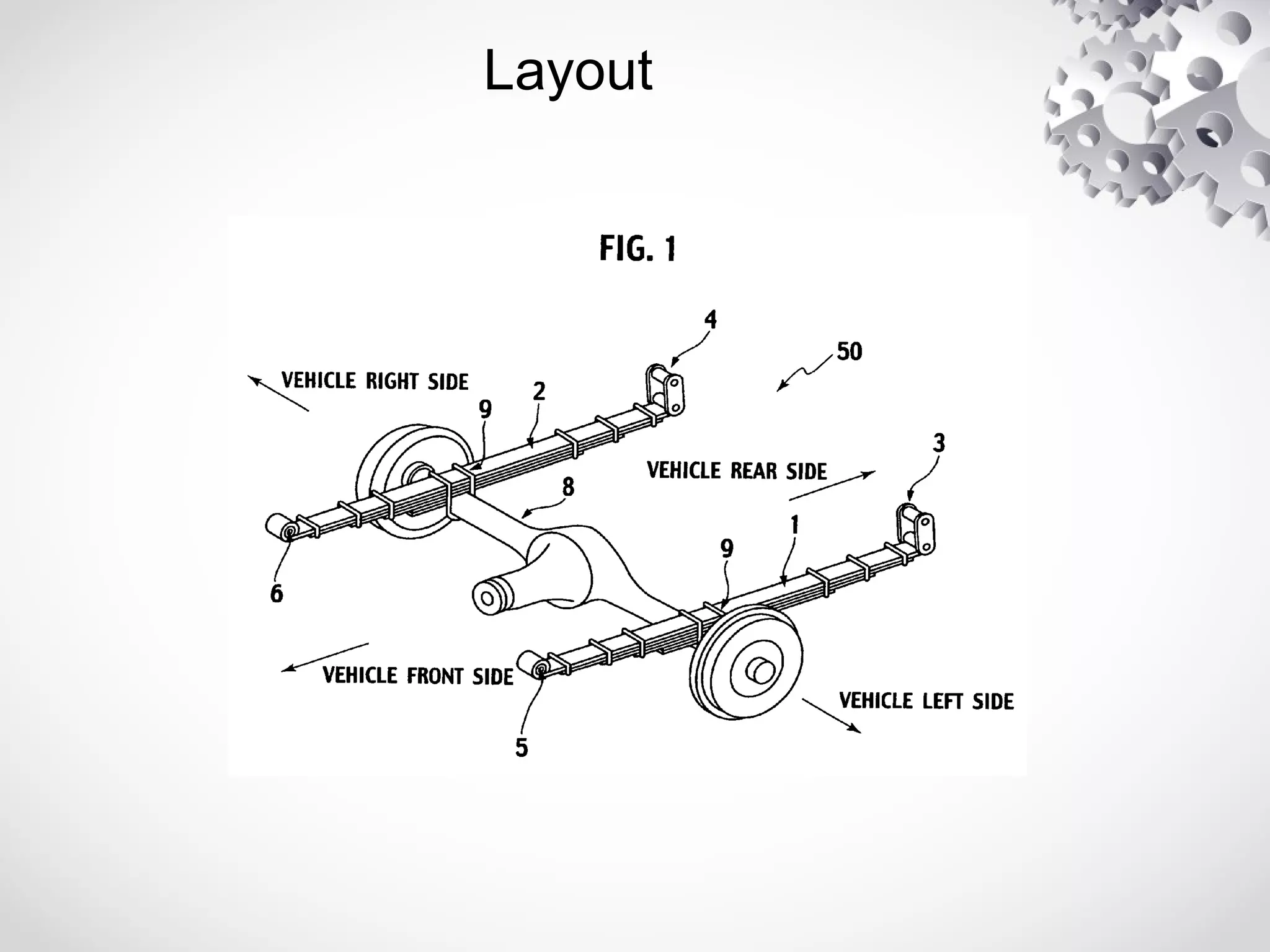
Layout
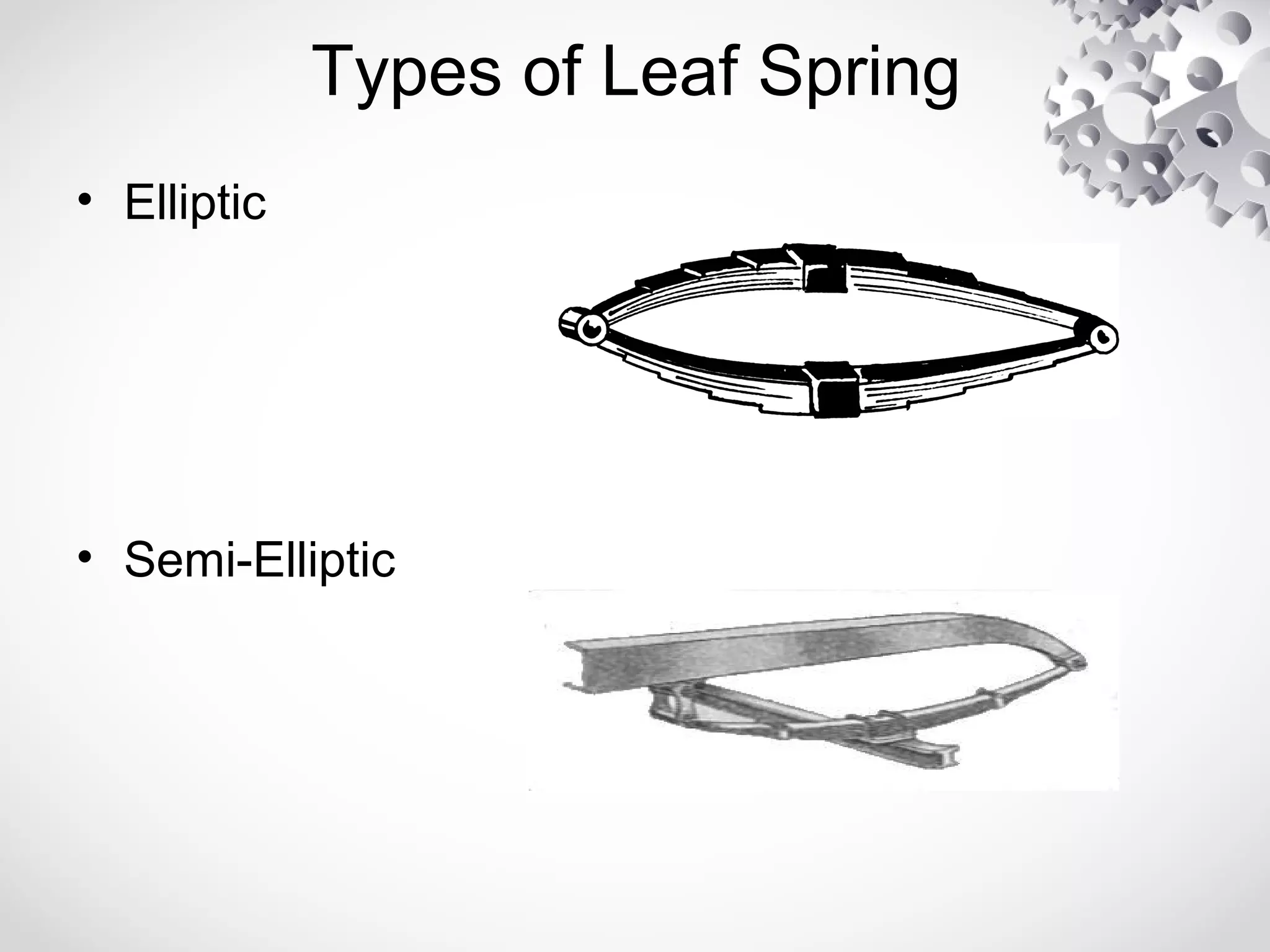
Types of Leaf Spring
• Elliptic
• Semi-Elliptic
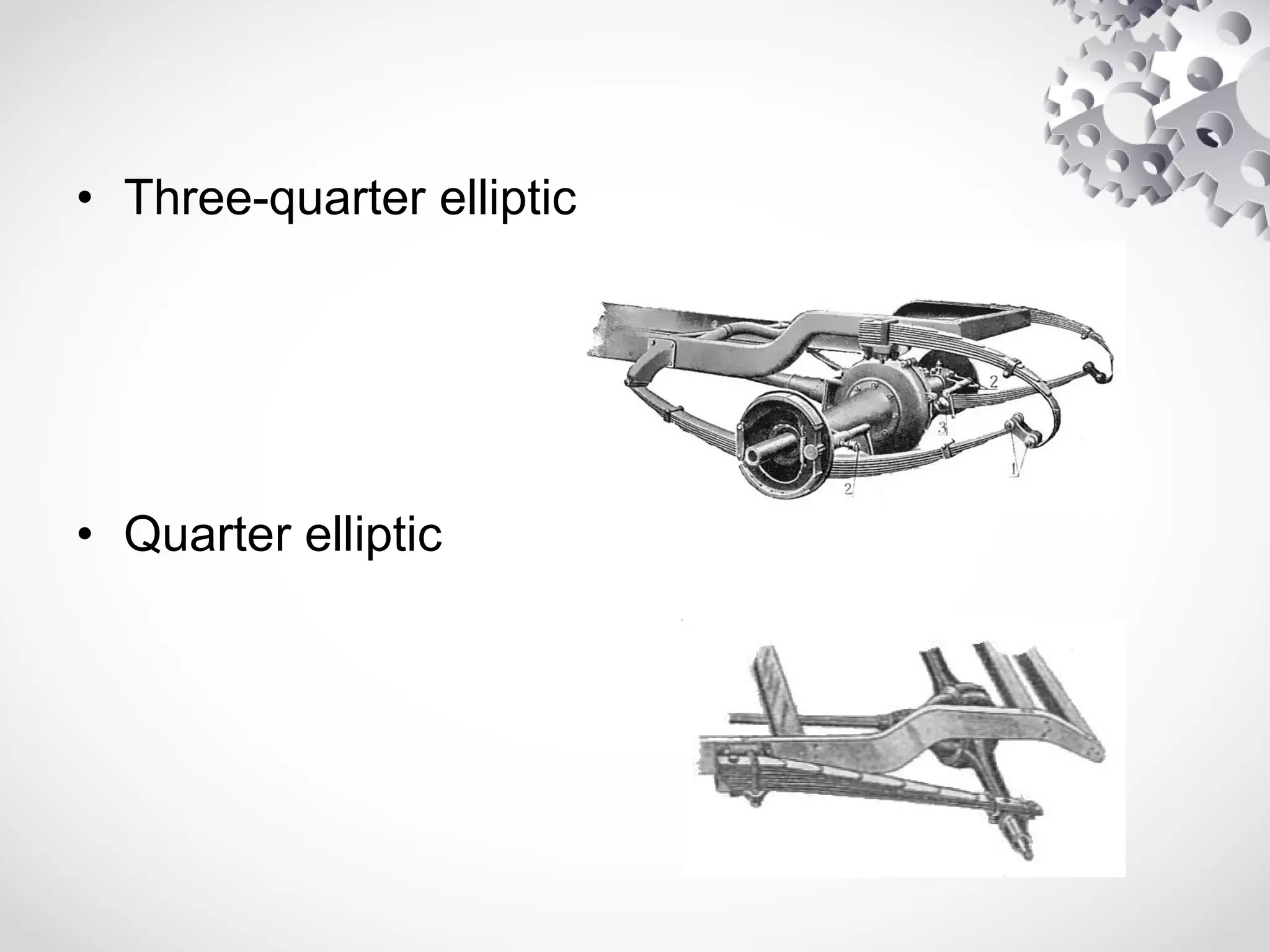
• Three-quarter elliptic
• Quarter elliptic
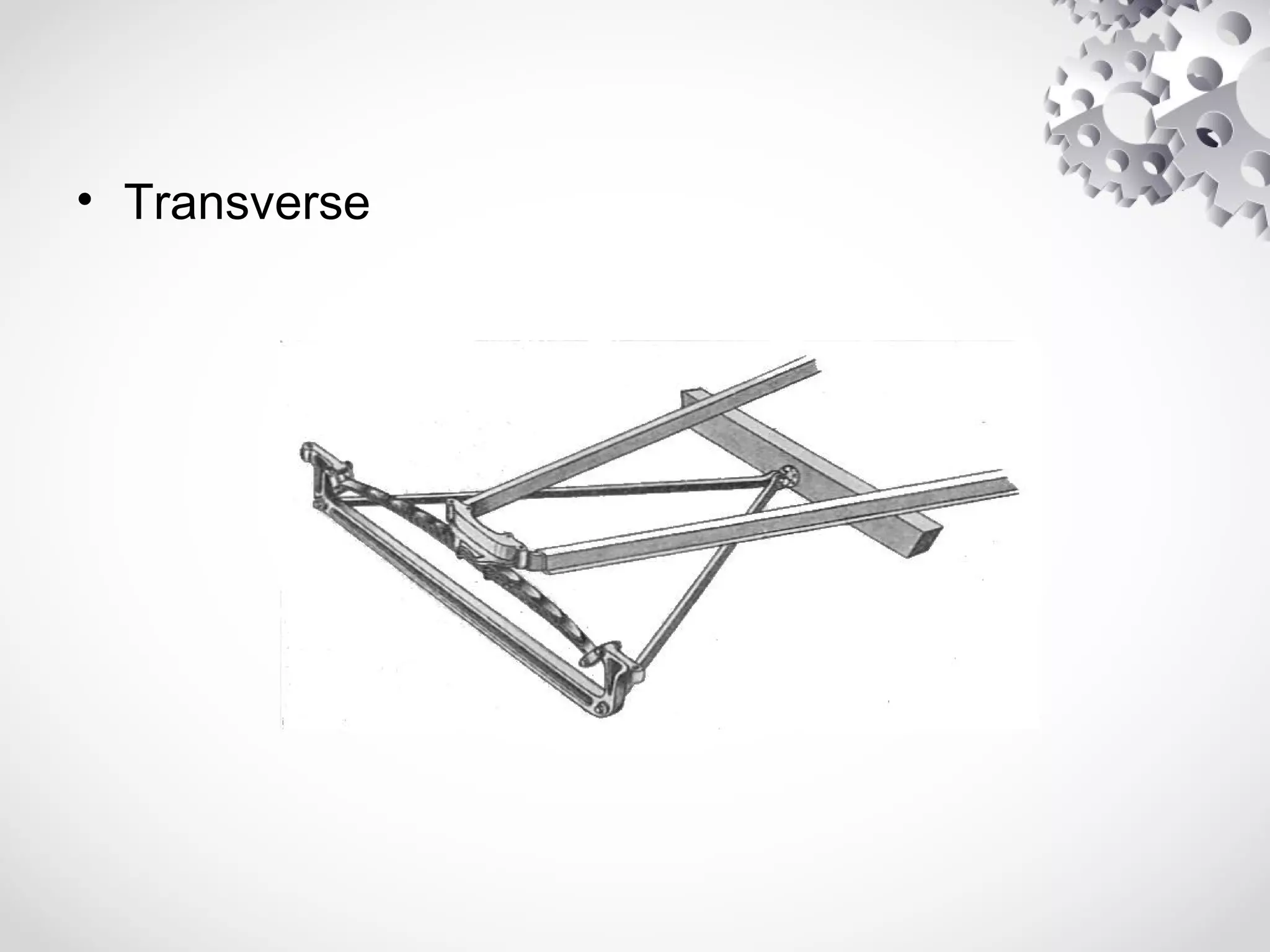
• Transverse
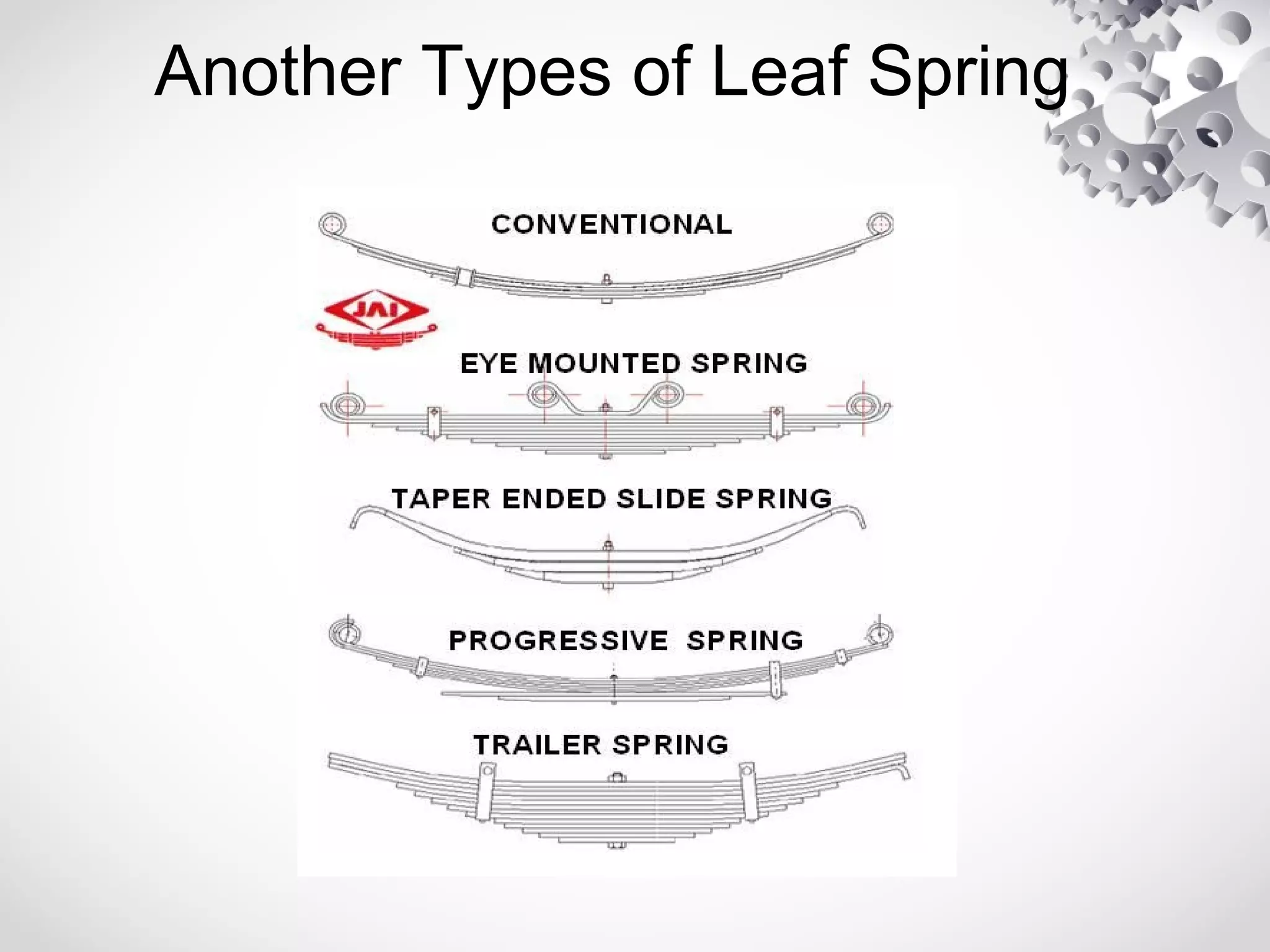
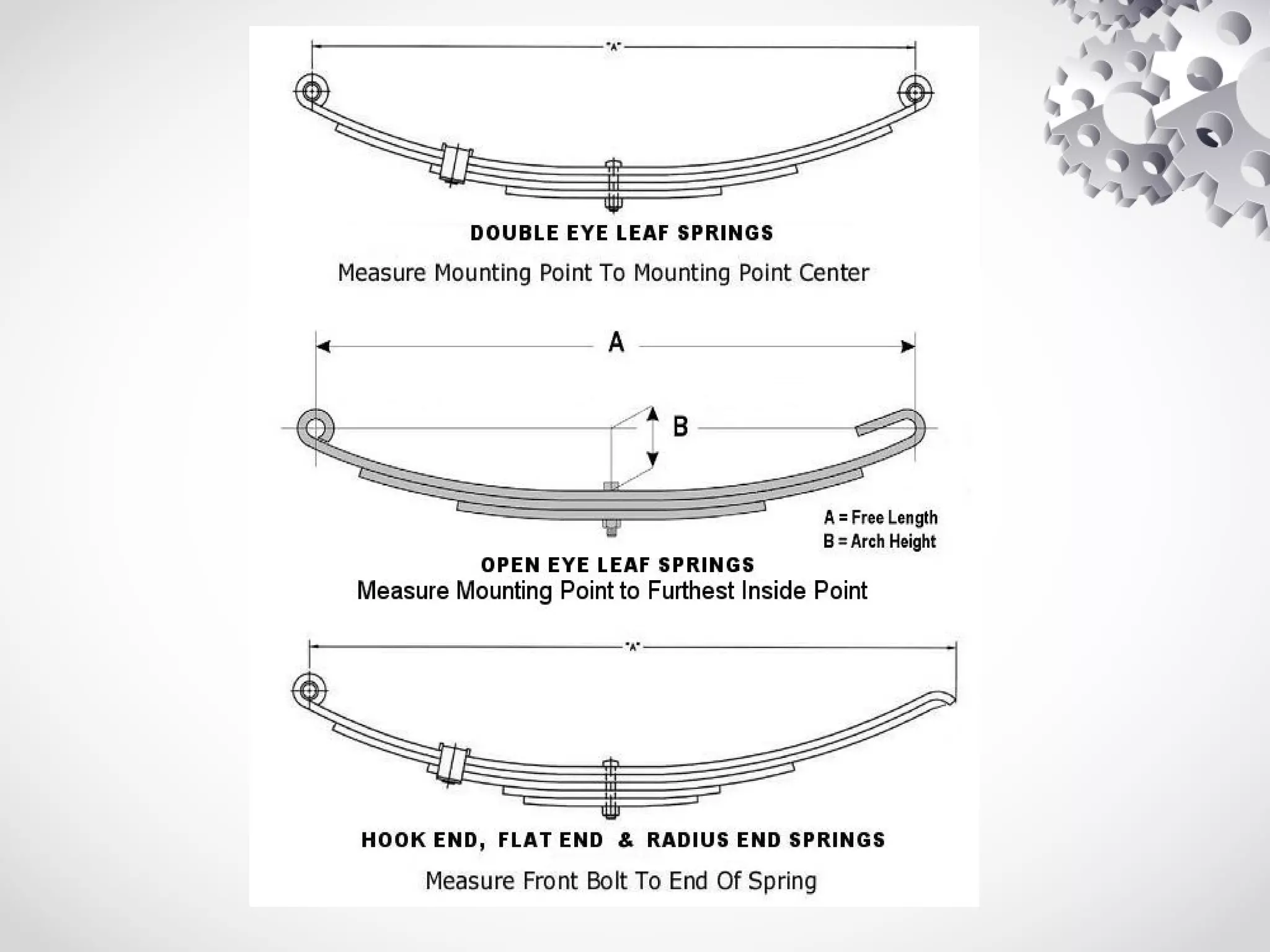
Another Types of Leaf Spring
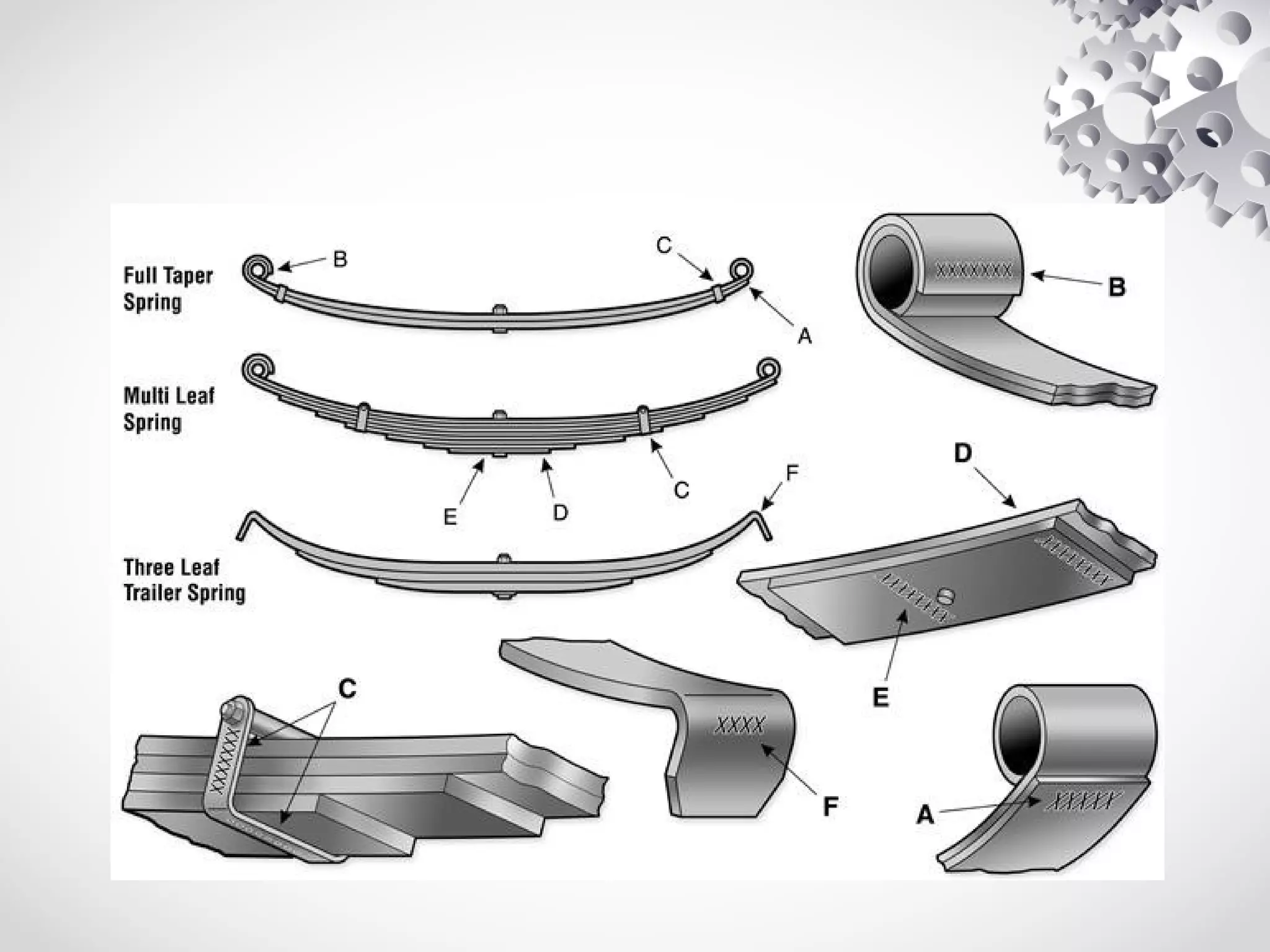
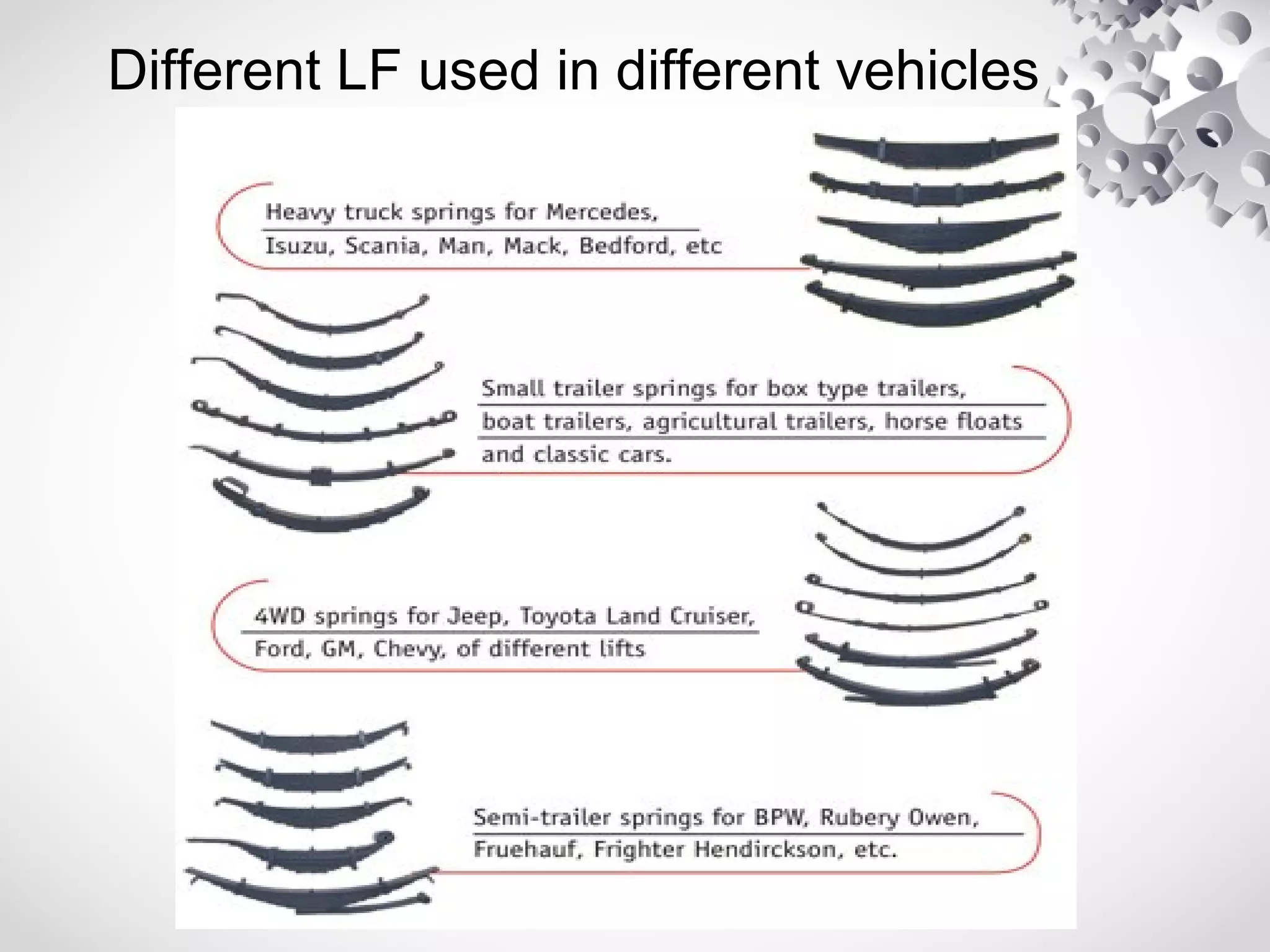
Different LF used in different vehicles
Construction of Leaf Spring
• Leaf springs used in automobiles is of
semi-elliptical type.
• It is built up of number of plates (known as
leaf),which are reducing in lengths.
• The longest leaf is called as main leaf or
master leaf & other leaves are called as
graduated leaves.
• The spring is clamped to the axle by
means of U-bolts.
• Rebound clips are used to hold the leaves
together.
• Central clamp is used to fix the position of
leaf spring to the wheel axle.
Characteristics of Leaf Spring
• Leaf spring acts as a linkage for holding the axle in
position and thus separate linkage are not necessary. It
makes the construction of the suspension simple and
strong.
• As the positioning of the axle is carried out by the leaf
springs so it makes it disadvantageous to use soft
springs i.e. a spring with low spring constant.
• Therefore, this type of suspension does not provide good
riding comfort. The inter-leaf friction between the leaf
springs affects the riding comfort.
• Acceleration and braking torque cause wind-up and
vibration. Also wind-up causes rear-end squat and nose-
diving.
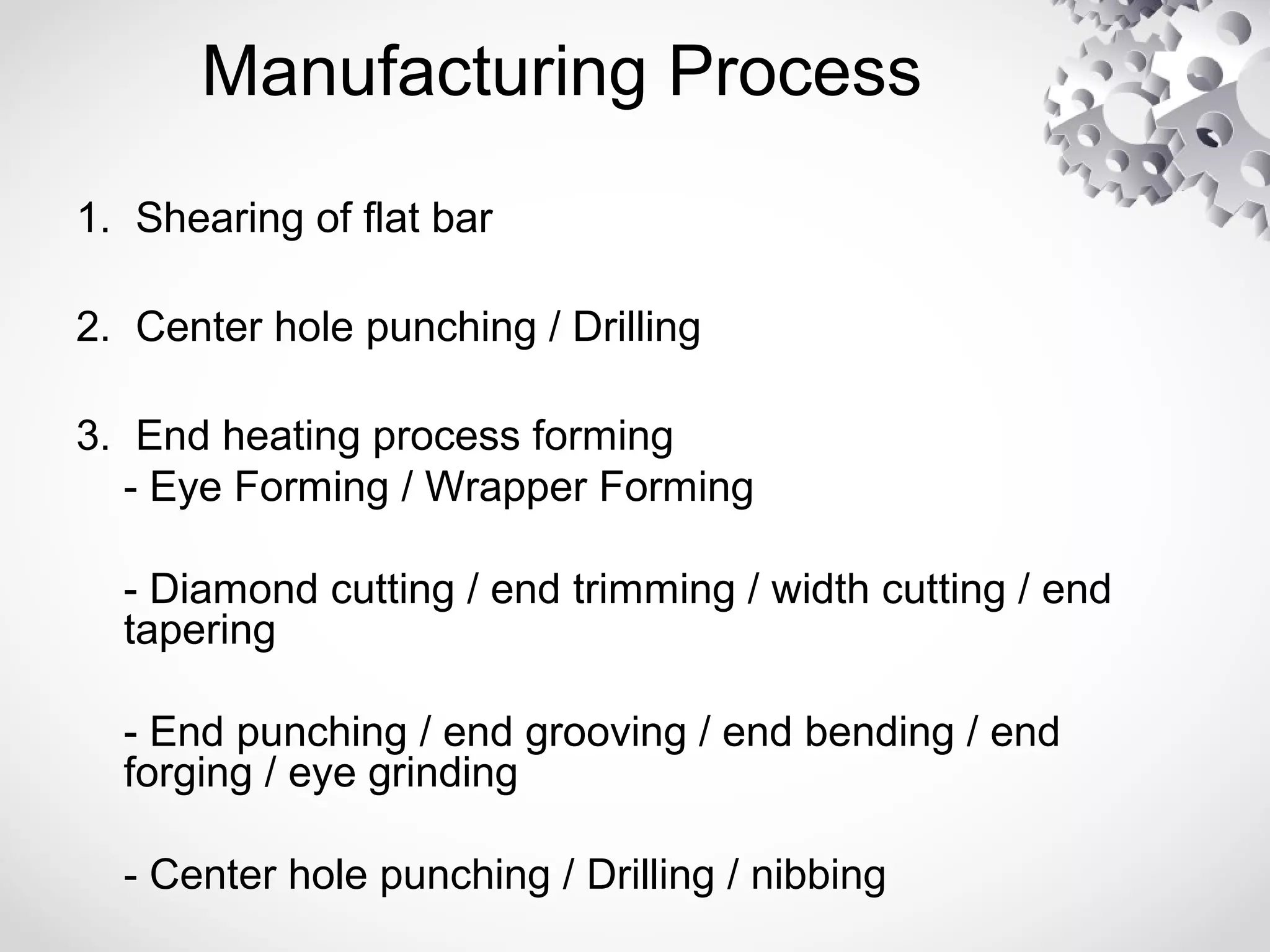
Manufacturing Process
1. Shearing of flat bar
2. Center hole punching / Drilling
3. End heating process forming
- Eye Forming / Wrapper Forming
- Diamond cutting / end trimming / width cutting / end
tapering
- End punching / end grooving / end bending / end
forging / eye grinding
- Center hole punching / Drilling / nibbing
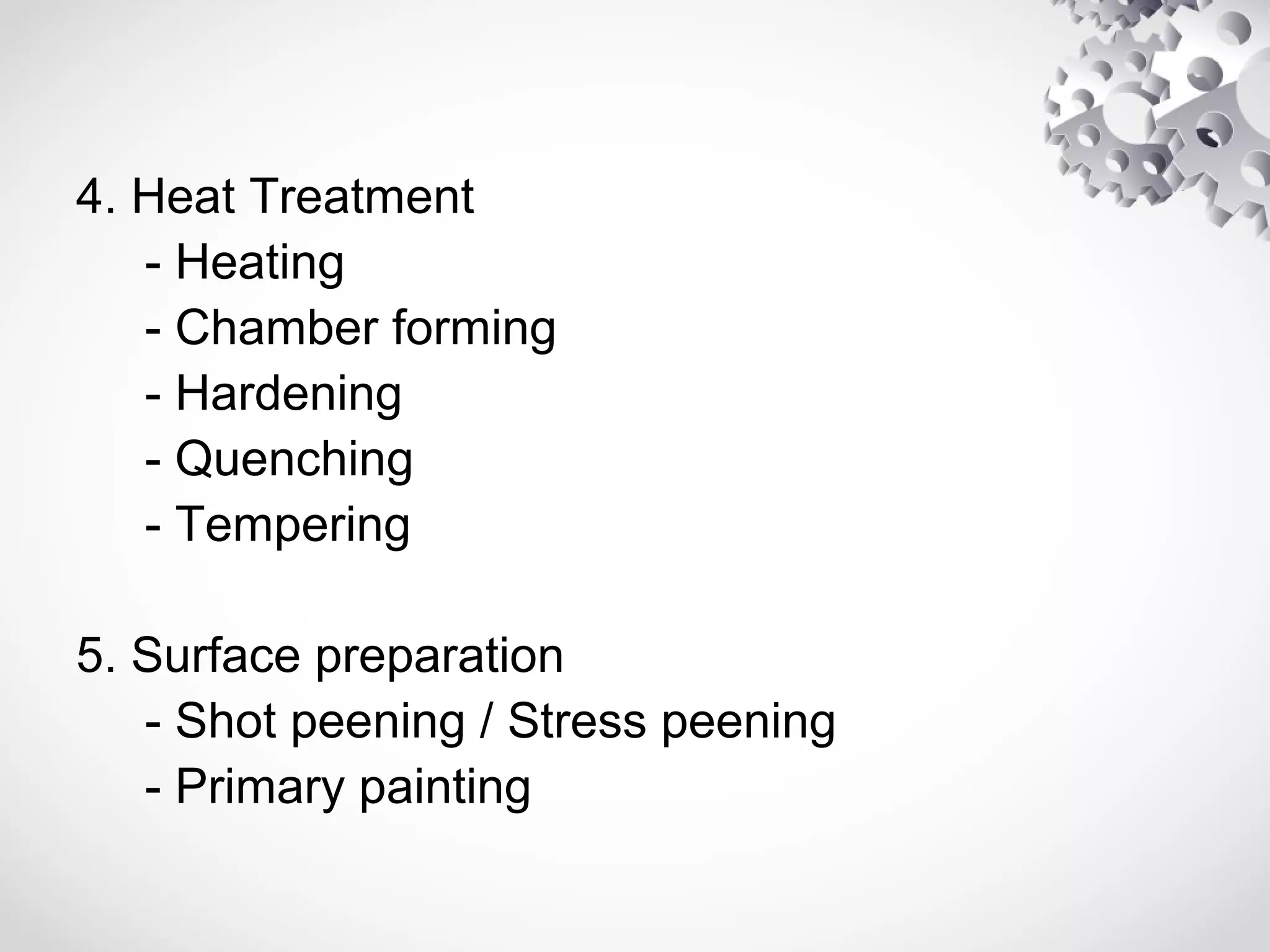
4. Heat Treatment
- Heating
- Chamber forming
- Hardening
- Quenching
- Tempering
5. Surface preparation
- Shot peening / Stress peening
- Primary painting
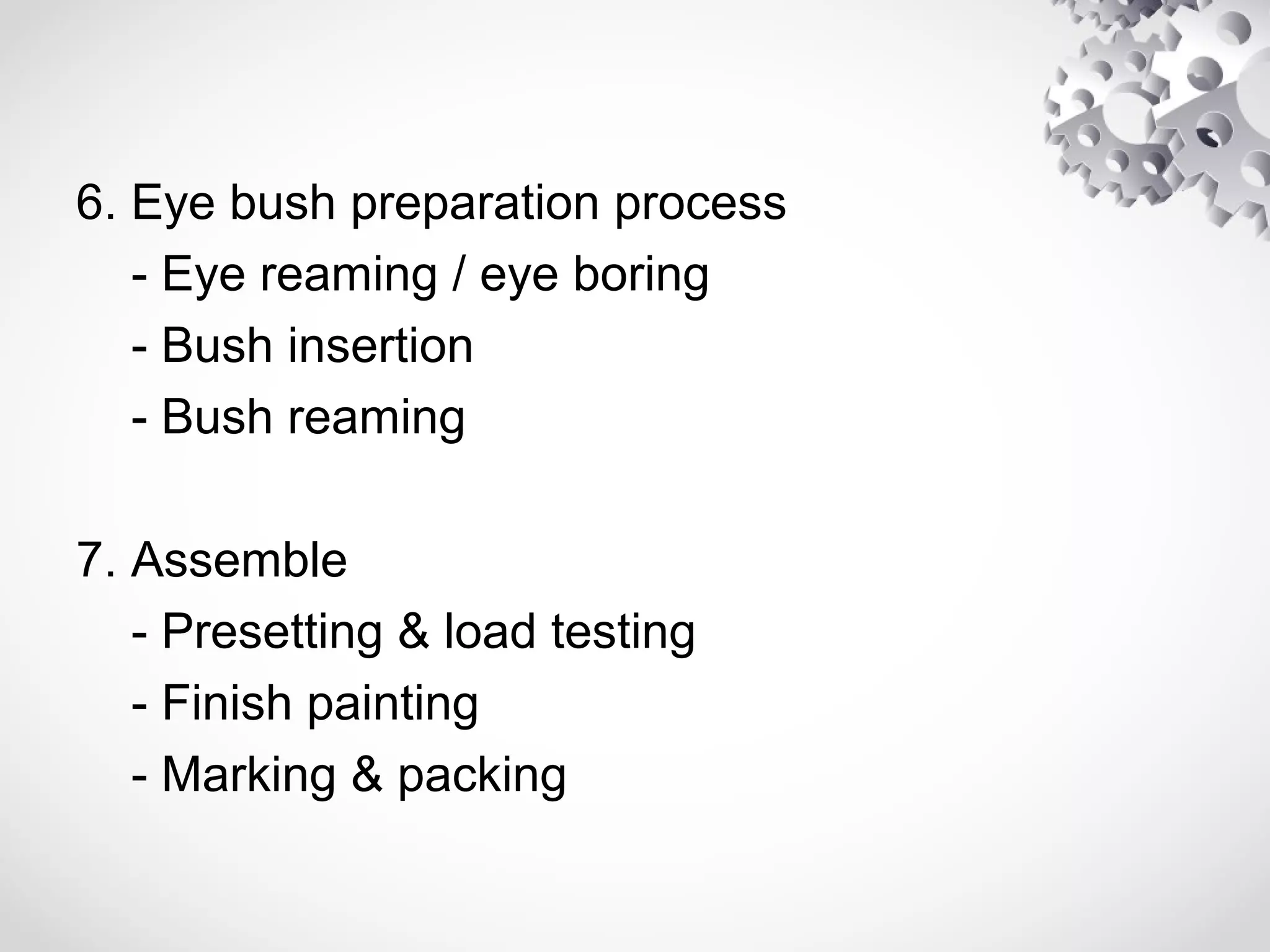
6. Eye bush preparation process
- Eye reaming / eye boring
- Bush insertion
- Bush reaming
7. Assemble
- Presetting & load testing
- Finish painting
- Marking & packing
Manufacturing video of leaf spring
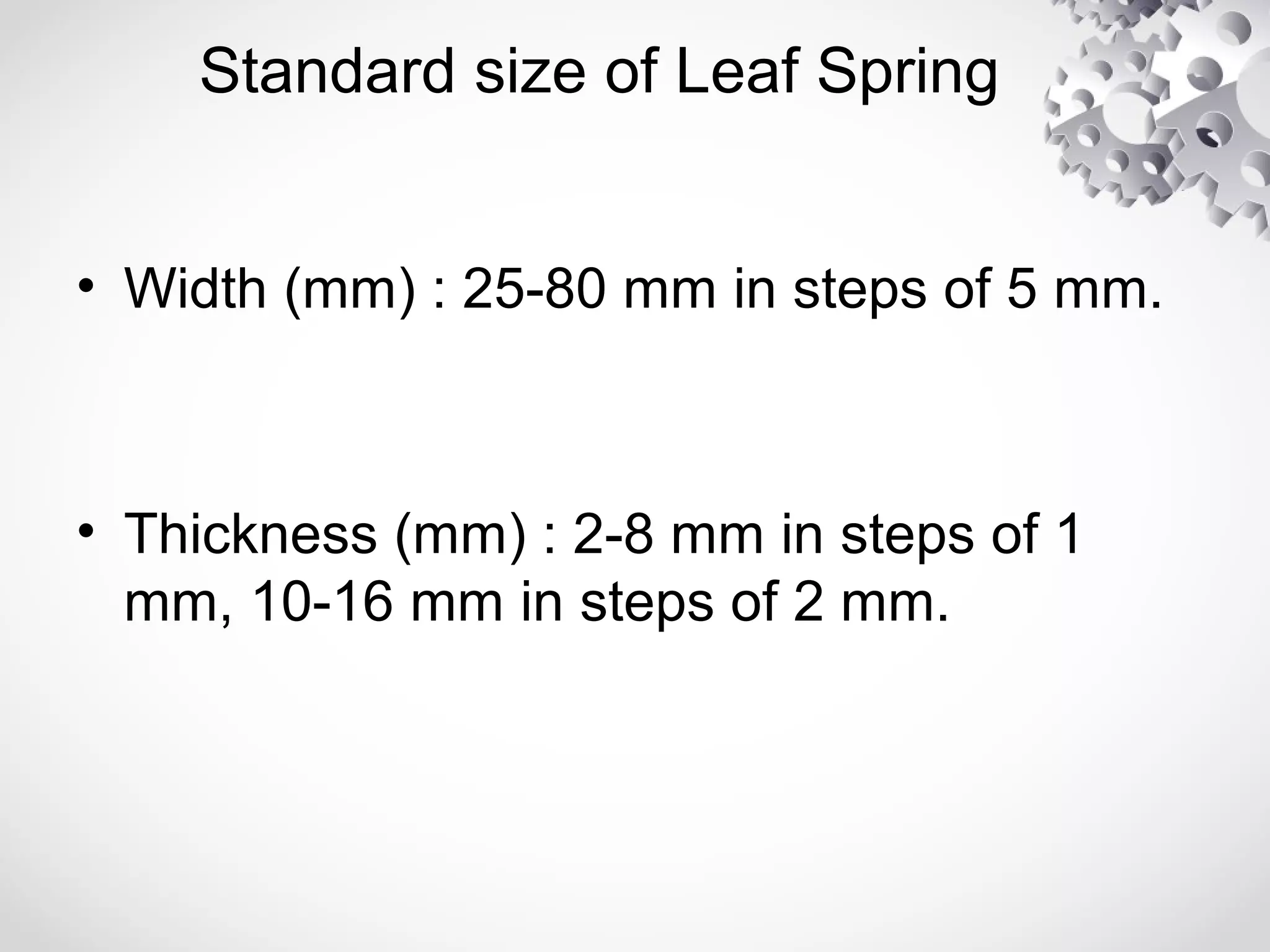
Standard size of Leaf Spring
• Width (mm) : 25-80 mm in steps of 5 mm.
• Thickness (mm) : 2-8 mm in steps of 1
mm, 10-16 mm in steps of 2 mm.
Material used for Leaf Spring
• The material used for leaf springs is
usually a plain carbon steel having 0.90 to
1.0 % carbon.
• According to indian standards the
recommended materials are :
- For automobiles : 50 Cr1 , 50 Cr1 V23 ,
55 Si2 Mn90 used in hardened &
tempered state.
- For rail road springs : C55 (Water
hardened) , C75 (Oil hardened) , 40Si
2Mn 90 (Water hardened) & 55Si Mn90
(Oil hardened)
Name of the two reference company
that can be visited
• R.M. Engineering
Address:Plot No. 83, Maruti Industrial
Area, Char Bhuja Marbal, Bhaiya
Transport Street Behind Ashish
Engineering, Gondal Road, Rajkot -
360004, Gujarat, India
• Rajkot Spring Works
Address:Lilavanti Chamber, Dhebarbhai
Road, Opposite S.T. Bus Stand, Rajkot -
360001, Gujarat, India
•Presentation made by,
- Jay Harsora
- Kunal Taviya
- Falgun Patel
Thank
You

Introduction to leaf spring

  • 1.
  • 2.
    Invention of LeafSpring • Leaf spring was invented by Obadiah Elliot of London in 18th century. He simply piled one steel plate on top of another, pinned them together and shackled each end to a carriage, it was the first ever leaf spring used on a vehicle.
  • 3.
    Leaf Spring • Itis originally called as a laminated or carriage spring, and sometimes referred to as a semi-elliptical spring or cart spring.
  • 4.
    Principle of LeafSpring • A leaf spring is a simple type of suspension spring which is commonly used in heavy duty vehicles.
  • 5.
    Use of leafspring in suspension of vehicles
  • 6.
  • 7.
    Types of LeafSpring • Elliptic • Semi-Elliptic
  • 8.
  • 9.
  • 10.
    Another Types ofLeaf Spring
  • 13.
    Different LF usedin different vehicles
  • 14.
    Construction of LeafSpring • Leaf springs used in automobiles is of semi-elliptical type. • It is built up of number of plates (known as leaf),which are reducing in lengths. • The longest leaf is called as main leaf or master leaf & other leaves are called as graduated leaves. • The spring is clamped to the axle by means of U-bolts. • Rebound clips are used to hold the leaves together.
  • 15.
    • Central clampis used to fix the position of leaf spring to the wheel axle.
  • 16.
    Characteristics of LeafSpring • Leaf spring acts as a linkage for holding the axle in position and thus separate linkage are not necessary. It makes the construction of the suspension simple and strong. • As the positioning of the axle is carried out by the leaf springs so it makes it disadvantageous to use soft springs i.e. a spring with low spring constant. • Therefore, this type of suspension does not provide good riding comfort. The inter-leaf friction between the leaf springs affects the riding comfort. • Acceleration and braking torque cause wind-up and vibration. Also wind-up causes rear-end squat and nose- diving.
  • 17.
    Manufacturing Process 1. Shearingof flat bar 2. Center hole punching / Drilling 3. End heating process forming - Eye Forming / Wrapper Forming - Diamond cutting / end trimming / width cutting / end tapering - End punching / end grooving / end bending / end forging / eye grinding - Center hole punching / Drilling / nibbing
  • 18.
    4. Heat Treatment -Heating - Chamber forming - Hardening - Quenching - Tempering 5. Surface preparation - Shot peening / Stress peening - Primary painting
  • 19.
    6. Eye bushpreparation process - Eye reaming / eye boring - Bush insertion - Bush reaming 7. Assemble - Presetting & load testing - Finish painting - Marking & packing
  • 20.
  • 21.
    Standard size ofLeaf Spring • Width (mm) : 25-80 mm in steps of 5 mm. • Thickness (mm) : 2-8 mm in steps of 1 mm, 10-16 mm in steps of 2 mm.
  • 22.
    Material used forLeaf Spring • The material used for leaf springs is usually a plain carbon steel having 0.90 to 1.0 % carbon. • According to indian standards the recommended materials are : - For automobiles : 50 Cr1 , 50 Cr1 V23 , 55 Si2 Mn90 used in hardened & tempered state.
  • 23.
    - For railroad springs : C55 (Water hardened) , C75 (Oil hardened) , 40Si 2Mn 90 (Water hardened) & 55Si Mn90 (Oil hardened)
  • 24.
    Name of thetwo reference company that can be visited • R.M. Engineering Address:Plot No. 83, Maruti Industrial Area, Char Bhuja Marbal, Bhaiya Transport Street Behind Ashish Engineering, Gondal Road, Rajkot - 360004, Gujarat, India
  • 25.
    • Rajkot SpringWorks Address:Lilavanti Chamber, Dhebarbhai Road, Opposite S.T. Bus Stand, Rajkot - 360001, Gujarat, India
  • 26.
    •Presentation made by, -Jay Harsora - Kunal Taviya - Falgun Patel
  • 27.