FOVEATED	
  RAY	
  TRACING	
  FOR	
  VR	
  	
  
ON	
  MULTIPLE	
  GPUS	
  
TAKAHIRO	
  HARADA,	
  AMD	
  
12/2014	
  
2	
   |	
  DEC	
  3,	
  2014	


INTRO	
  
y  Ray	
  Tracing	
  +	
  Foveated	
  rendering	
  +	
  VR	
  +	
  MulGple	
  GPUs	
  ==	
  A	
  lot	
  of	
  GPU	
  compute!!	
  
y  Compute	
  fills	
  a	
  texture	
  
y  Use	
  GL/CL	
  interop	
  to	
  display	
  
3	
   |	
  DEC	
  3,	
  2014	


GPU	
  RAY	
  TRACING	
  
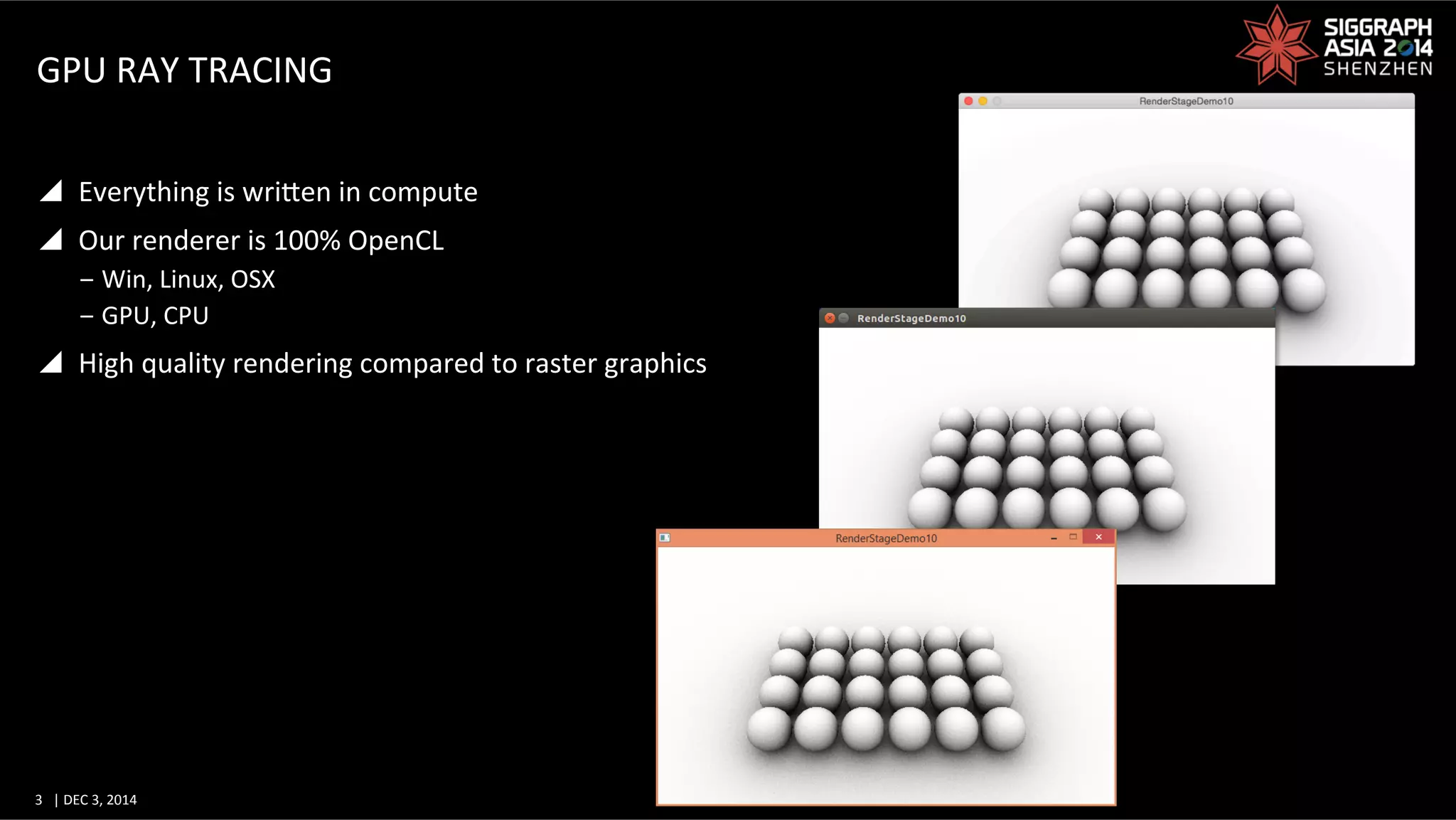
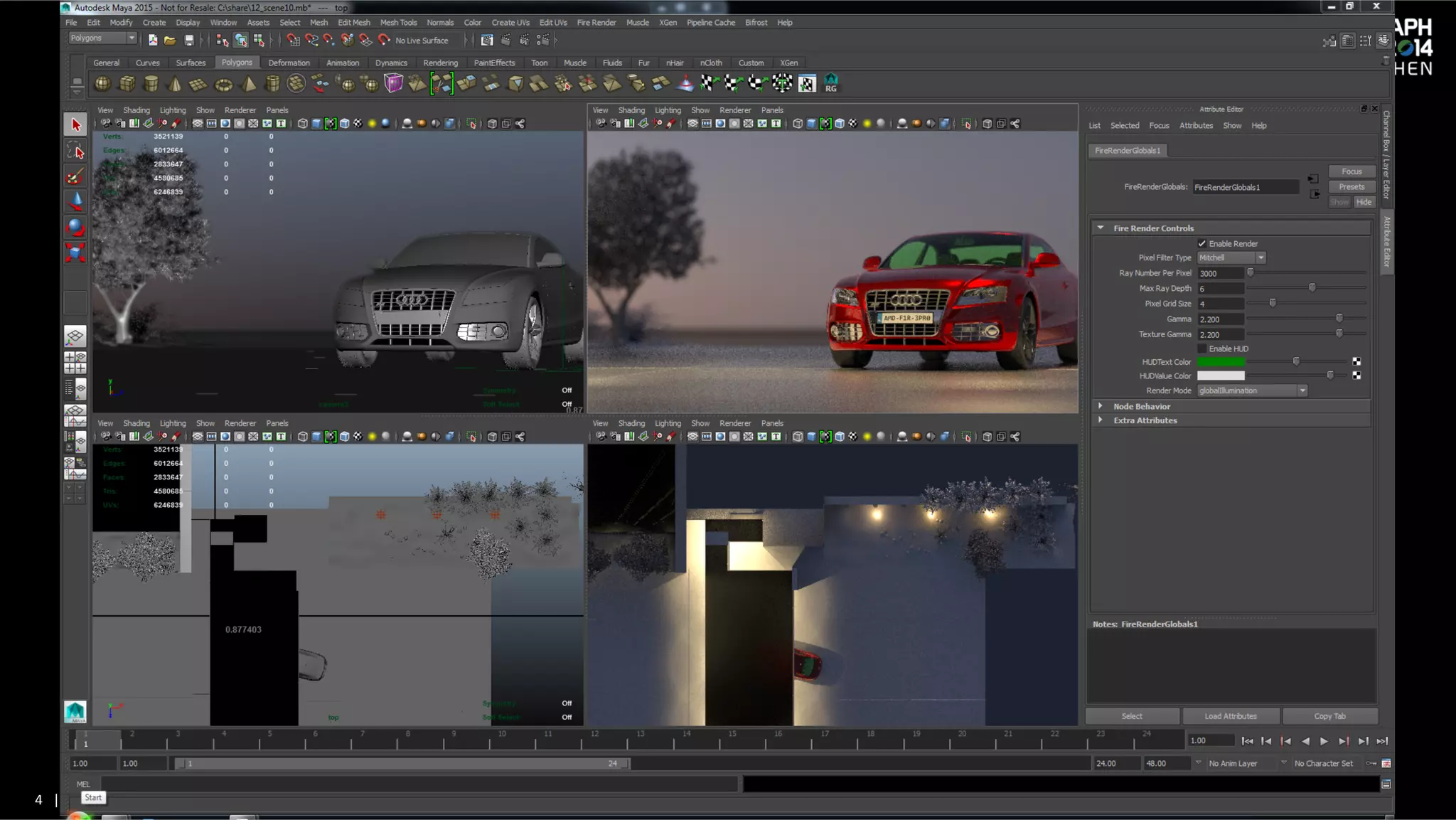
y  Everything	
  is	
  wriWen	
  in	
  compute	
  
y  Our	
  renderer	
  is	
  100%	
  OpenCL	
  
‒ Win,	
  Linux,	
  OSX	
  
‒ GPU,	
  CPU	
  
y  High	
  quality	
  rendering	
  compared	
  to	
  raster	
  graphics	
  
4	
   |	
  DEC	
  3,	
  2014	


5	
   |	
  DEC	
  3,	
  2014	


GPU	
  RAY	
  TRACING	
  
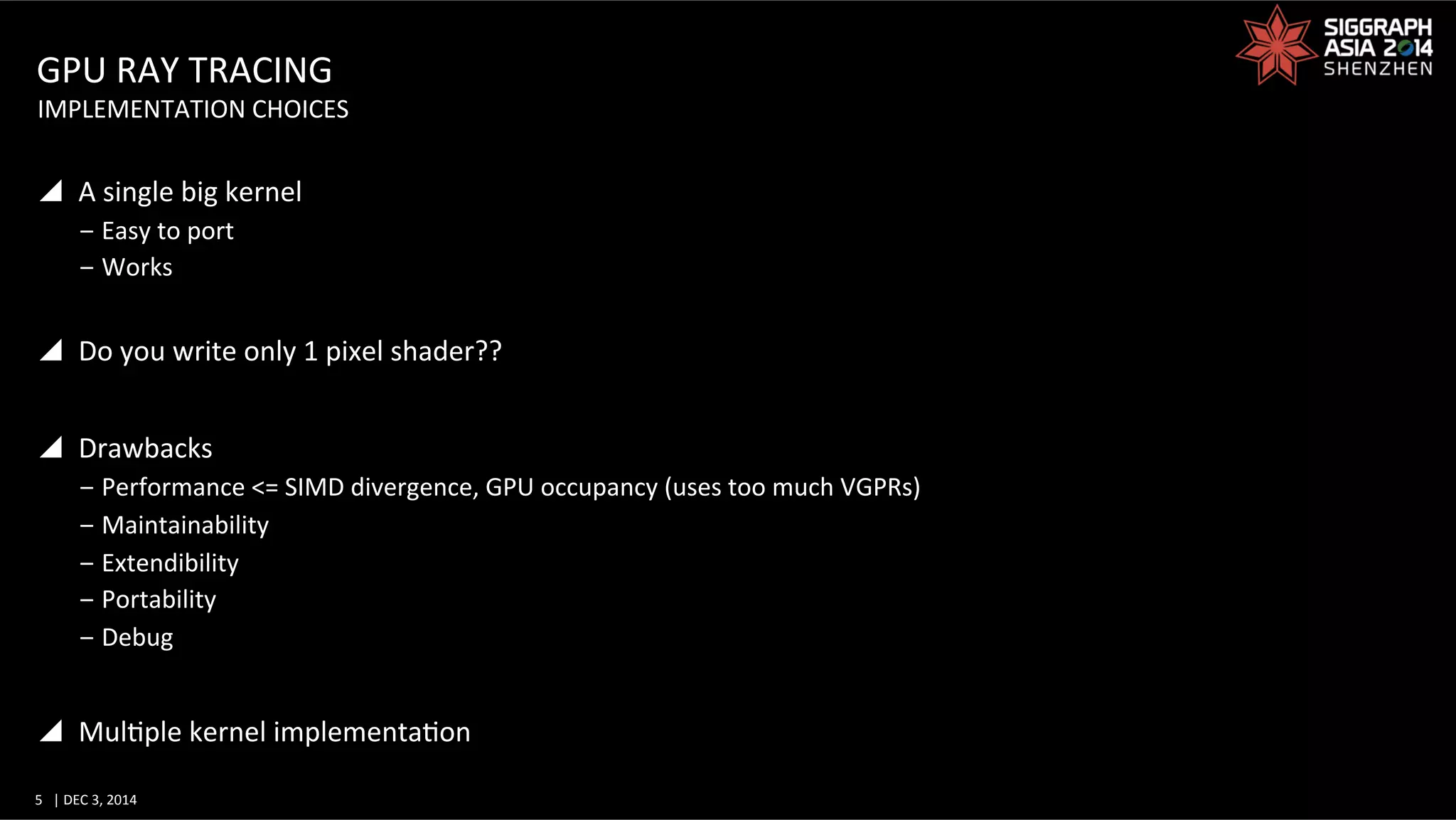
y  A	
  single	
  big	
  kernel	
  
‒ Easy	
  to	
  port	
  
‒ Works	
  
y  Do	
  you	
  write	
  only	
  1	
  pixel	
  shader??	
  
y  Drawbacks	
  
‒ Performance	
  <=	
  SIMD	
  divergence,	
  GPU	
  occupancy	
  (uses	
  too	
  much	
  VGPRs)	
  
‒ Maintainability	
  
‒ Extendibility	
  
‒ Portability	
  
‒ Debug	
  
y  MulGple	
  kernel	
  implementaGon	
  
IMPLEMENTATION	
  CHOICES	
  
6	
   |	
  DEC	
  3,	
  2014	


HOW	
  MANY	
  WGS	
  CAN	
  WE	
  EXECUTE	
  PER	
  SIMD	
  (AMD	
  GPU)	
  
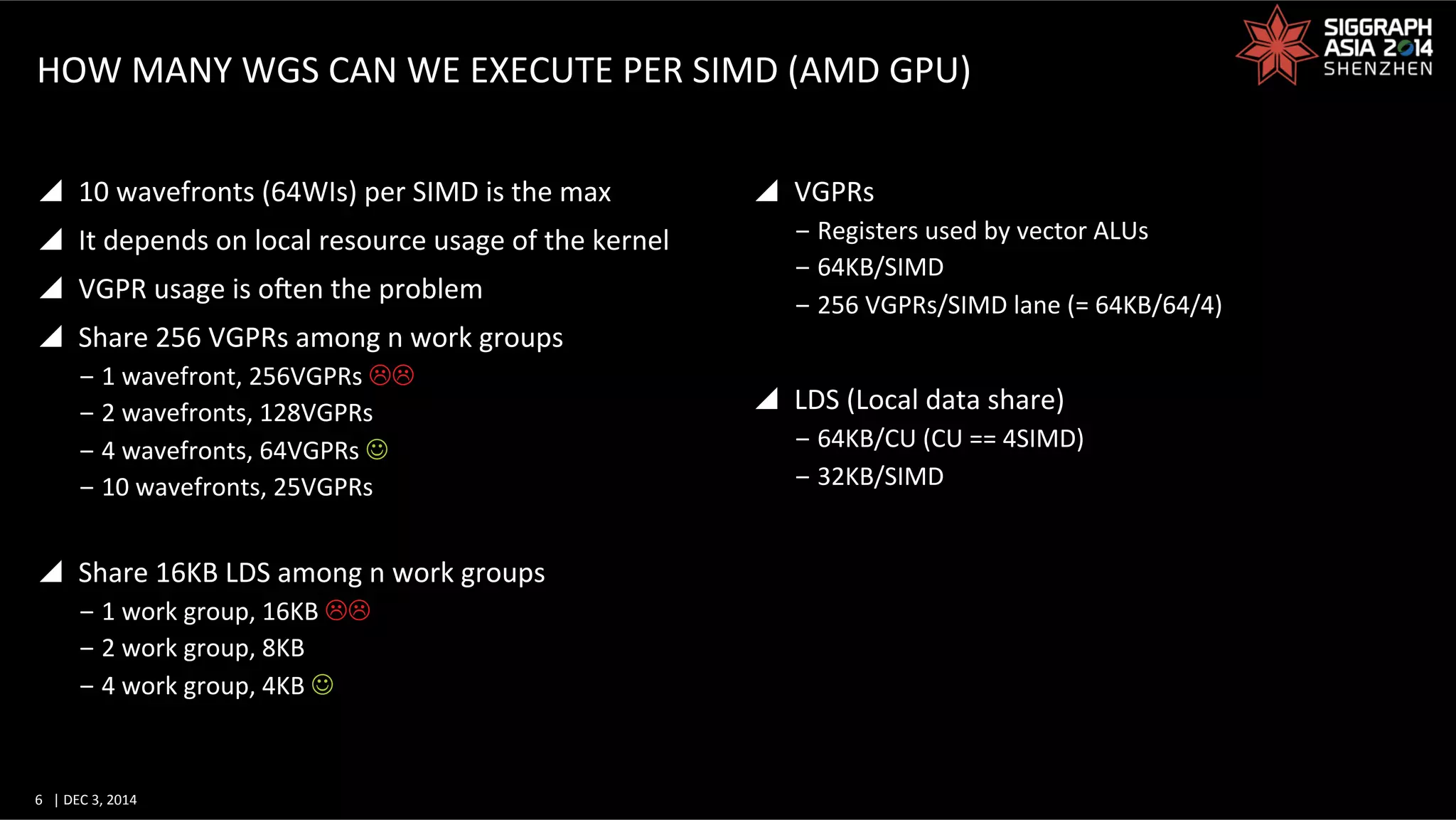
y  10	
  wavefronts	
  (64WIs)	
  per	
  SIMD	
  is	
  the	
  max	
  
y  It	
  depends	
  on	
  local	
  resource	
  usage	
  of	
  the	
  kernel	
  
y  VGPR	
  usage	
  is	
  ofen	
  the	
  problem	
  
y  Share	
  256	
  VGPRs	
  among	
  n	
  work	
  groups	
  
‒ 1	
  wavefront,	
  256VGPRs	
  LL	
  
‒ 2	
  wavefronts,	
  128VGPRs	
  
‒ 4	
  wavefronts,	
  64VGPRs	
  J	
  
‒ 10	
  wavefronts,	
  25VGPRs	
  
y  Share	
  16KB	
  LDS	
  among	
  n	
  work	
  groups	
  
‒ 1	
  work	
  group,	
  16KB	
  LL	
  
‒ 2	
  work	
  group,	
  8KB	
  
‒ 4	
  work	
  group,	
  4KB	
  J	
  
y  VGPRs	
  
‒ Registers	
  used	
  by	
  vector	
  ALUs	
  
‒ 64KB/SIMD	
  
‒ 256	
  VGPRs/SIMD	
  lane	
  (=	
  64KB/64/4)	
  
y  LDS	
  (Local	
  data	
  share)	
  
‒ 64KB/CU	
  (CU	
  ==	
  4SIMD)	
  
‒ 32KB/SIMD	
  
7	
   |	
  DEC	
  3,	
  2014	


GPU	
  RAY	
  TRACING	
  
	
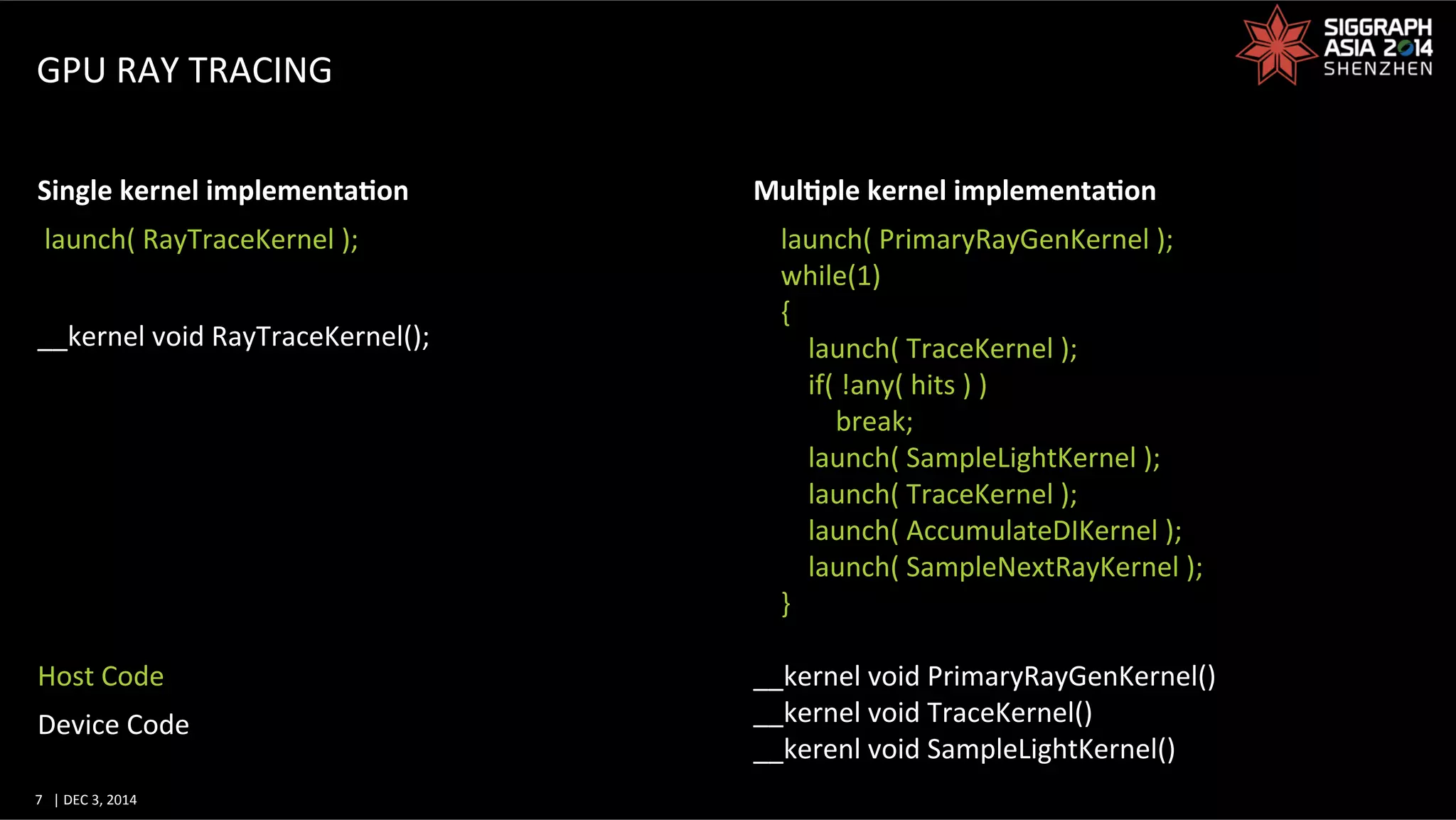
  launch(	
  RayTraceKernel	
  );	


__kernel	
  void	
  RayTraceKernel();	


Host	
  Code	
  
Device	
  Code	


  launch(	
  PrimaryRayGenKernel	
  );	


  while(1)	


  {	


  launch(	
  TraceKernel	
  );	


  if(	
  !any(	
  hits	
  )	
  )	


  break;	


  launch(	
  SampleLightKernel	
  );	


  launch(	
  TraceKernel	
  );	


  launch(	
  AccumulateDIKernel	
  );	


  launch(	
  SampleNextRayKernel	
  );	


  }	


__kernel	
  void	
  PrimaryRayGenKernel()	
  
__kernel	
  void	
  TraceKernel()	
  
__kerenl	
  void	
  SampleLightKernel()	


Single	
  kernel	
  implementa?on	
   Mul?ple	
  kernel	
  implementa?on	
  
8	
   |	
  DEC	
  3,	
  2014	


RAY	
  TRACING	
  +	
  VR	
  
y  Ray	
  tracing	
  is	
  flexible	
  
y  Raster	
  graphics,	
  single	
  proj	
  matrix	
  
y  Can	
  cast	
  rays	
  to	
  arbitrary	
  direcGon	
  
y  Easy	
  to	
  set	
  up	
  VR	
  
y  But	
  performance	
  isn’t	
  good	
  enough	
  
y  ComputaGon	
  cost	
  
‒ Scene	
  complexity	
  
‒ #	
  of	
  samples	
  (rays)	
  
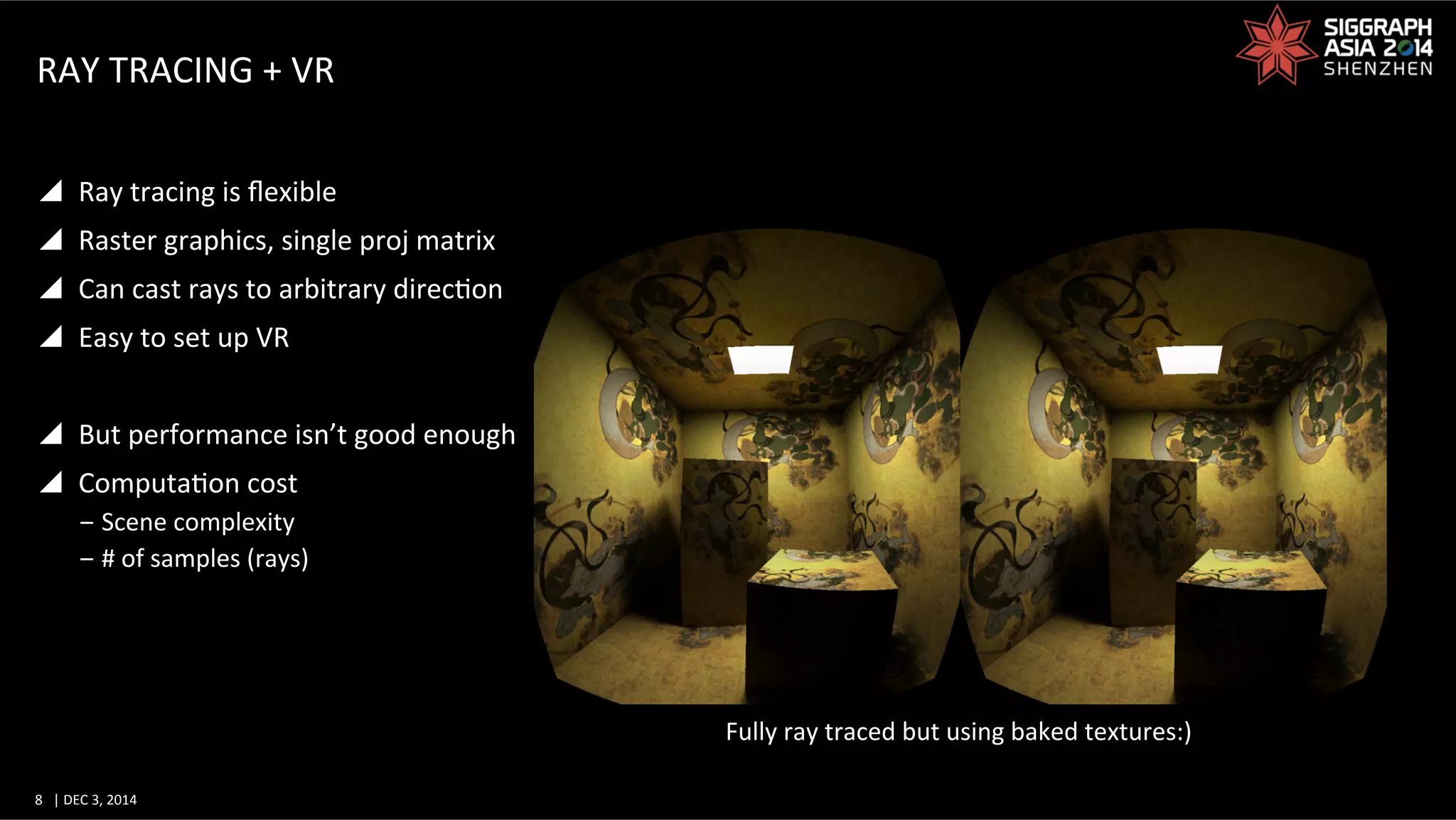
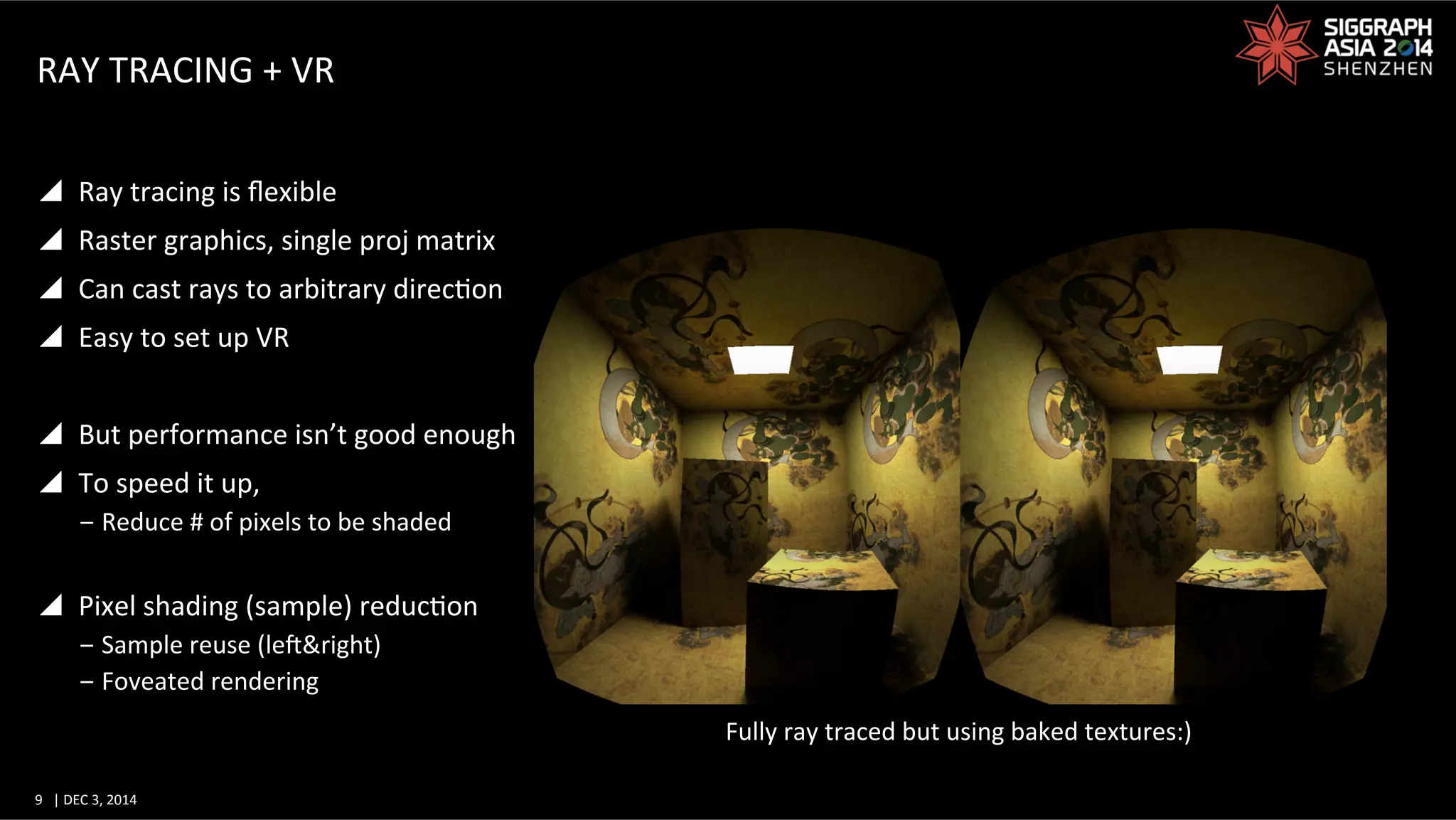
Fully	
  ray	
  traced	
  but	
  using	
  baked	
  textures:)	
  
9	
   |	
  DEC	
  3,	
  2014	


RAY	
  TRACING	
  +	
  VR	
  
y  Ray	
  tracing	
  is	
  flexible	
  
y  Raster	
  graphics,	
  single	
  proj	
  matrix	
  
y  Can	
  cast	
  rays	
  to	
  arbitrary	
  direcGon	
  
y  Easy	
  to	
  set	
  up	
  VR	
  
y  But	
  performance	
  isn’t	
  good	
  enough	
  
y  To	
  speed	
  it	
  up,	
  	
  
‒ Reduce	
  #	
  of	
  pixels	
  to	
  be	
  shaded	
  
y  Pixel	
  shading	
  (sample)	
  reducGon	
  
‒ Sample	
  reuse	
  (lef&right)	
  
‒ Foveated	
  rendering	
  
Fully	
  ray	
  traced	
  but	
  using	
  baked	
  textures:)	
  
10	
   |	
  DEC	
  3,	
  2014	


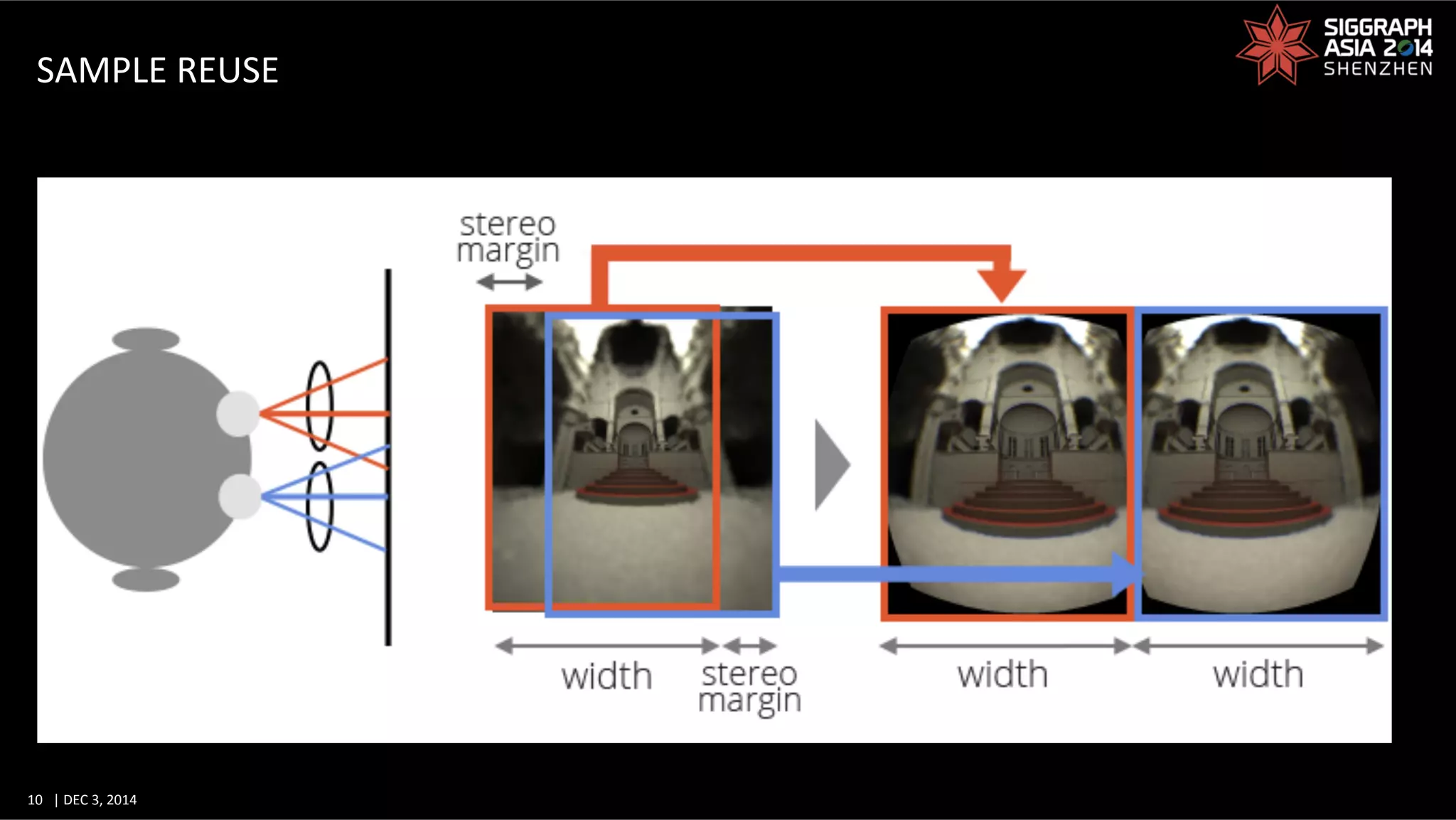
SAMPLE	
  REUSE	
  
11	
   |	
  DEC	
  3,	
  2014	


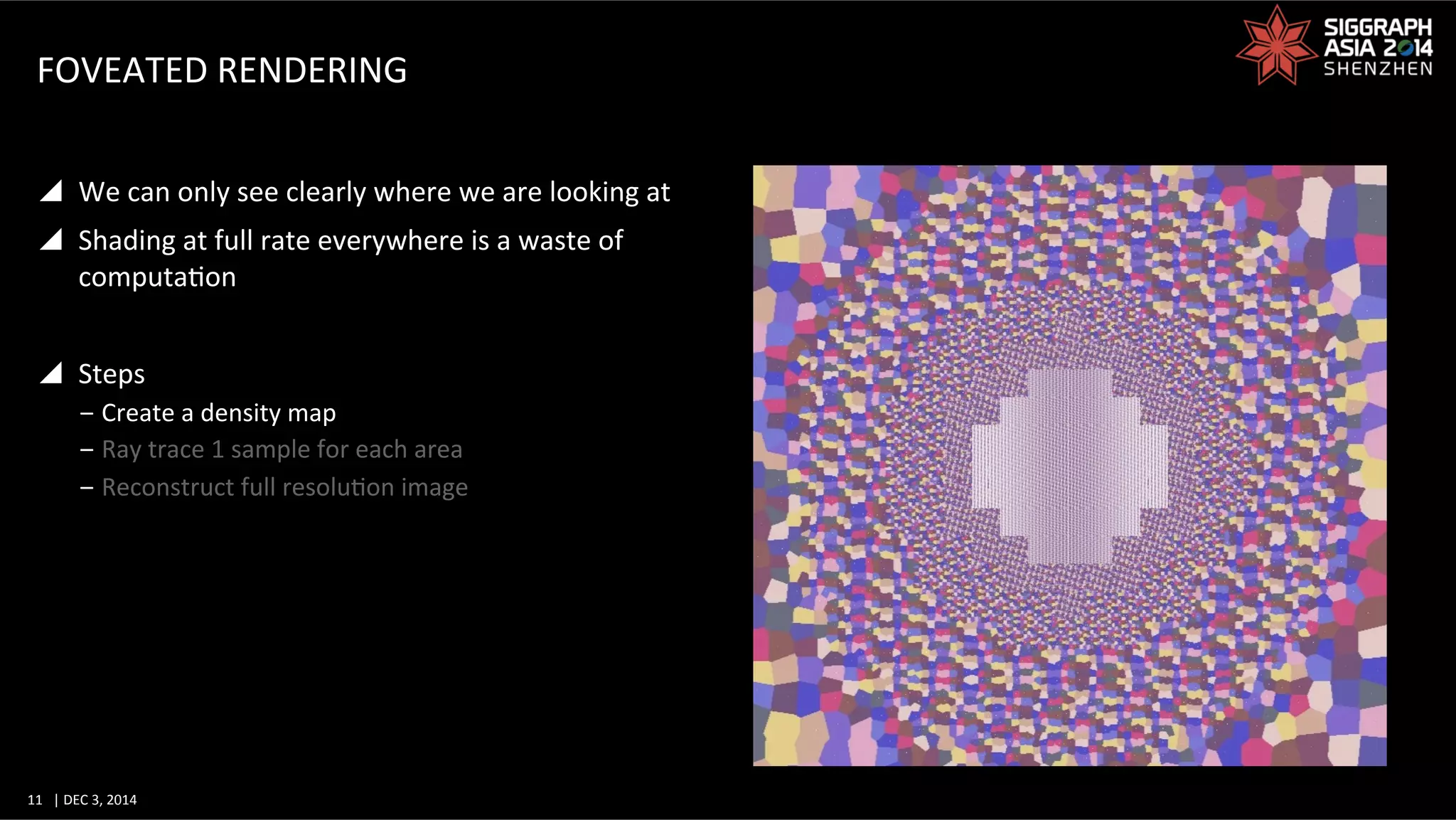
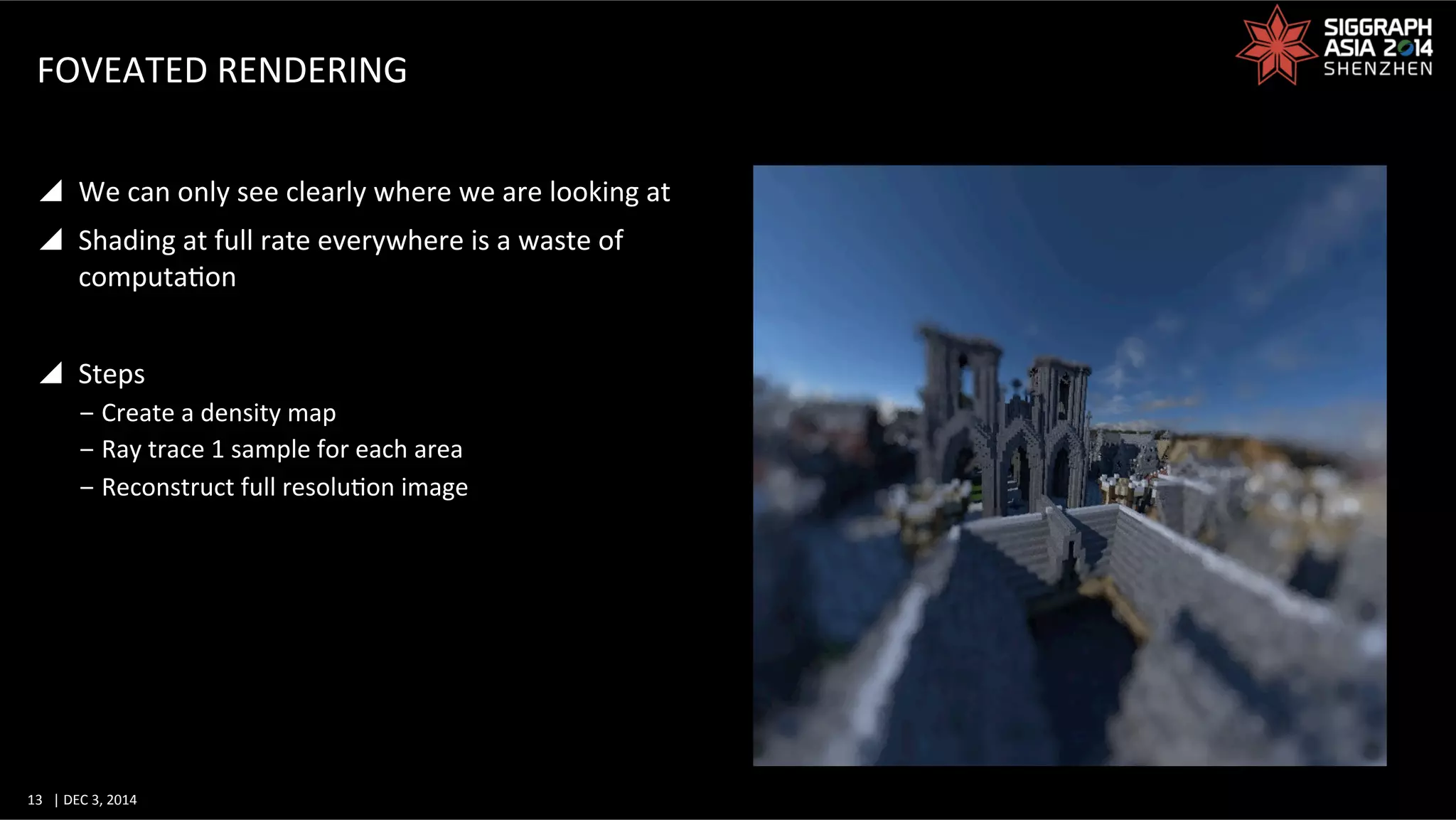
FOVEATED	
  RENDERING	
  
y  We	
  can	
  only	
  see	
  clearly	
  where	
  we	
  are	
  looking	
  at	
  
y  Shading	
  at	
  full	
  rate	
  everywhere	
  is	
  a	
  waste	
  of	
  
computaGon	
  
y  Steps	
  
‒ Create	
  a	
  density	
  map	
  
‒ Ray	
  trace	
  1	
  sample	
  for	
  each	
  area	
  
‒ Reconstruct	
  full	
  resoluGon	
  image	
  
12	
   |	
  DEC	
  3,	
  2014	


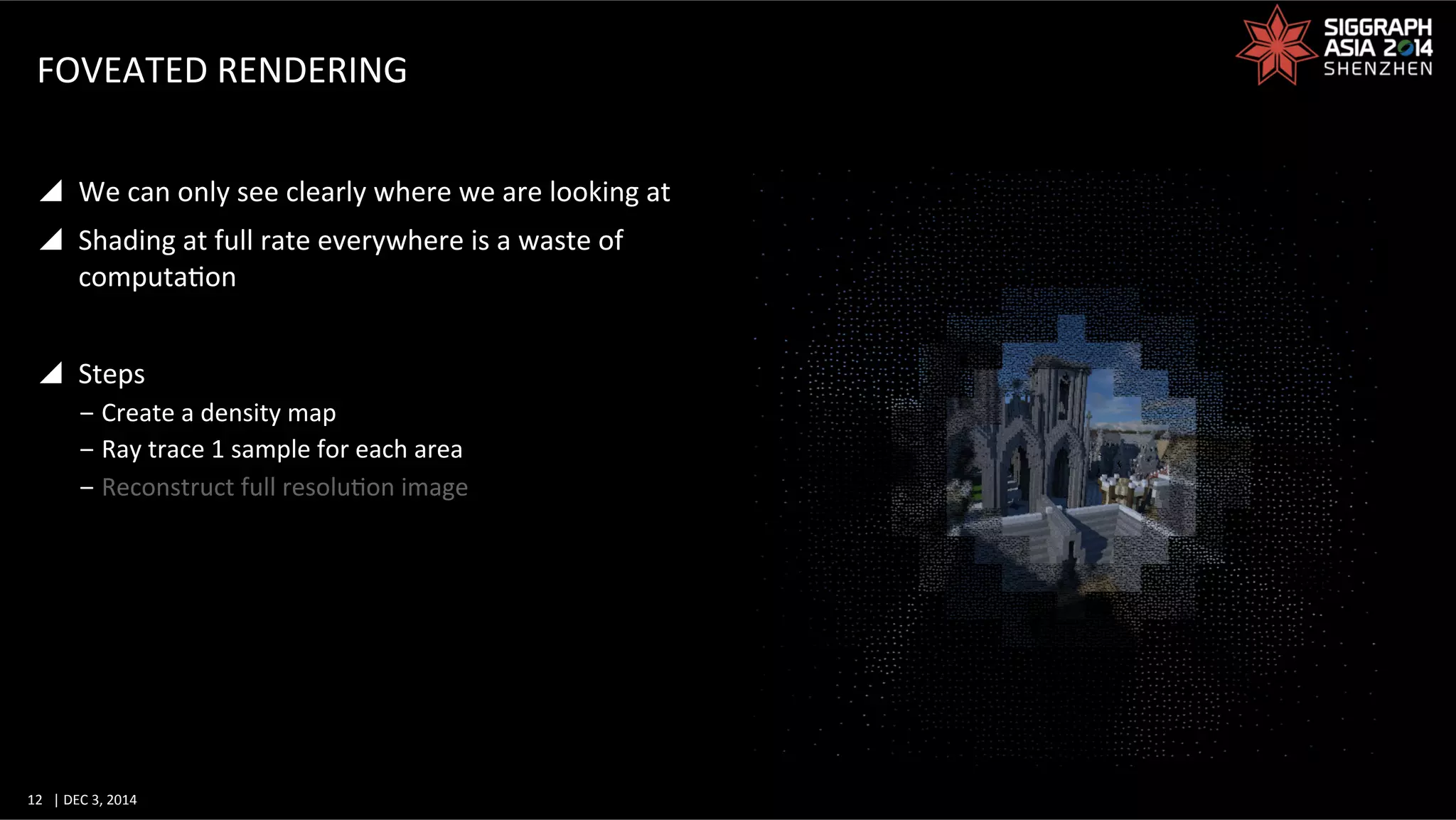
FOVEATED	
  RENDERING	
  
y  We	
  can	
  only	
  see	
  clearly	
  where	
  we	
  are	
  looking	
  at	
  
y  Shading	
  at	
  full	
  rate	
  everywhere	
  is	
  a	
  waste	
  of	
  
computaGon	
  
y  Steps	
  
‒ Create	
  a	
  density	
  map	
  
‒ Ray	
  trace	
  1	
  sample	
  for	
  each	
  area	
  
‒ Reconstruct	
  full	
  resoluGon	
  image	
  
13	
   |	
  DEC	
  3,	
  2014	


FOVEATED	
  RENDERING	
  
y  We	
  can	
  only	
  see	
  clearly	
  where	
  we	
  are	
  looking	
  at	
  
y  Shading	
  at	
  full	
  rate	
  everywhere	
  is	
  a	
  waste	
  of	
  
computaGon	
  
y  Steps	
  
‒ Create	
  a	
  density	
  map	
  
‒ Ray	
  trace	
  1	
  sample	
  for	
  each	
  area	
  
‒ Reconstruct	
  full	
  resoluGon	
  image	
  
IMPLEMENTATION	
  DETAIL	
  
15	
   |	
  DEC	
  3,	
  2014	


1.	
  DENSITY	
  MAP	
  DATA	
  STRUCTURE	
  
y  2	
  data	
  structures	
  are	
  precomputed	
  
y  Array<float2>	
  samples(	
  M	
  )	
  
‒ Sample	
  posiGon	
  
‒ Normalized	
  coordinate	
  (x,	
  y)	
  
y  Array<NeighborInfo>	
  neighborInfo(	
  N	
  )	
  
‒ For	
  frame	
  reconstrucGon	
  
‒ Sample	
  id[k]	
  
‒ Sample	
  weight[k]	
  
y  #	
  of	
  pixels	
  :	
  N	
  
y  #	
  of	
  samples:	
  M	
  
16	
   |	
  DEC	
  3,	
  2014	


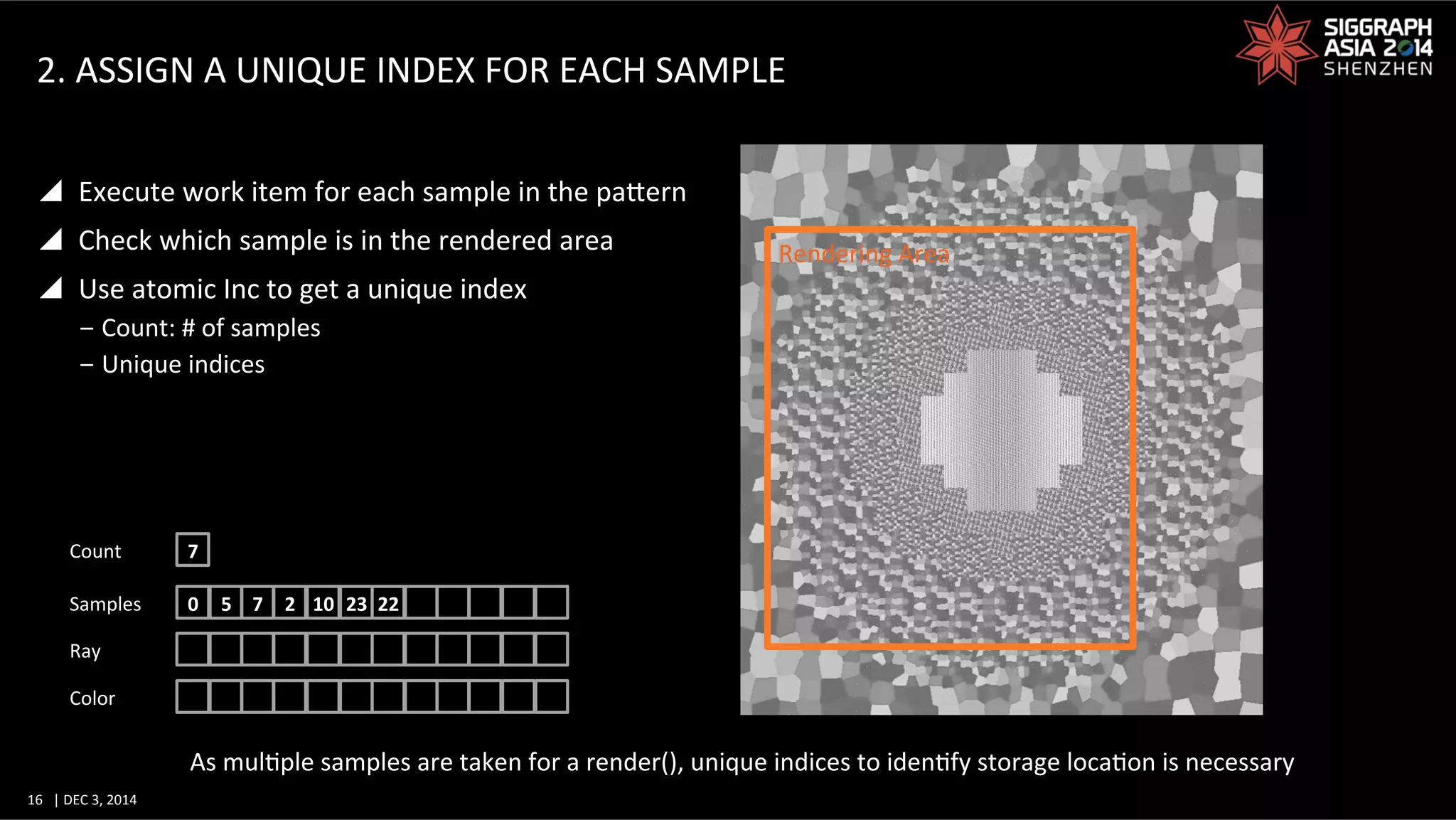
2.	
  ASSIGN	
  A	
  UNIQUE	
  INDEX	
  FOR	
  EACH	
  SAMPLE	
  
y  Execute	
  work	
  item	
  for	
  each	
  sample	
  in	
  the	
  paWern	
  
y  Check	
  which	
  sample	
  is	
  in	
  the	
  rendered	
  area	
  
y  Use	
  atomic	
  Inc	
  to	
  get	
  a	
  unique	
  index	
  
‒ Count:	
  #	
  of	
  samples	
  
‒ Unique	
  indices	
  
As	
  mulGple	
  samples	
  are	
  taken	
  for	
  a	
  render(),	
  unique	
  indices	
  to	
  idenGfy	
  storage	
  locaGon	
  is	
  necessary	
  
0	
   5	
   7	
   2	
   10	
   23	
  Samples	
  
Ray	
  
Color	
  
22	
  
7	
  Count	
  
Rendering	
  Area	
  
17	
   |	
  DEC	
  3,	
  2014	


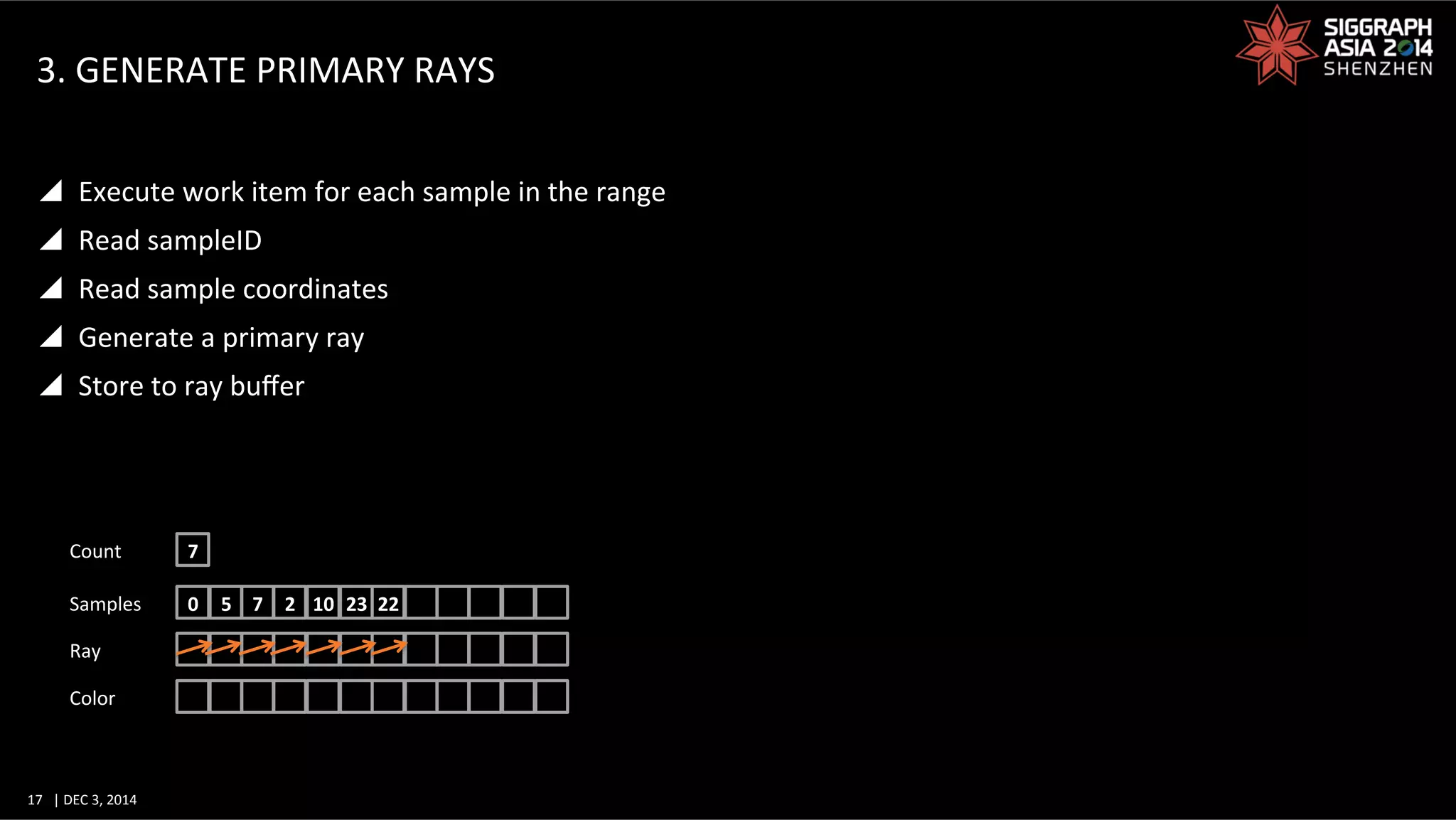
3.	
  GENERATE	
  PRIMARY	
  RAYS	
  
y  Execute	
  work	
  item	
  for	
  each	
  sample	
  in	
  the	
  range	
  
y  Read	
  sampleID	
  
y  Read	
  sample	
  coordinates	
  
y  Generate	
  a	
  primary	
  ray	
  
y  Store	
  to	
  ray	
  buffer	
  
0	
   5	
   7	
   2	
   10	
   23	
  Samples	
  
Ray	
  
Color	
  
22	
  
7	
  Count	
  
18	
   |	
  DEC	
  3,	
  2014	


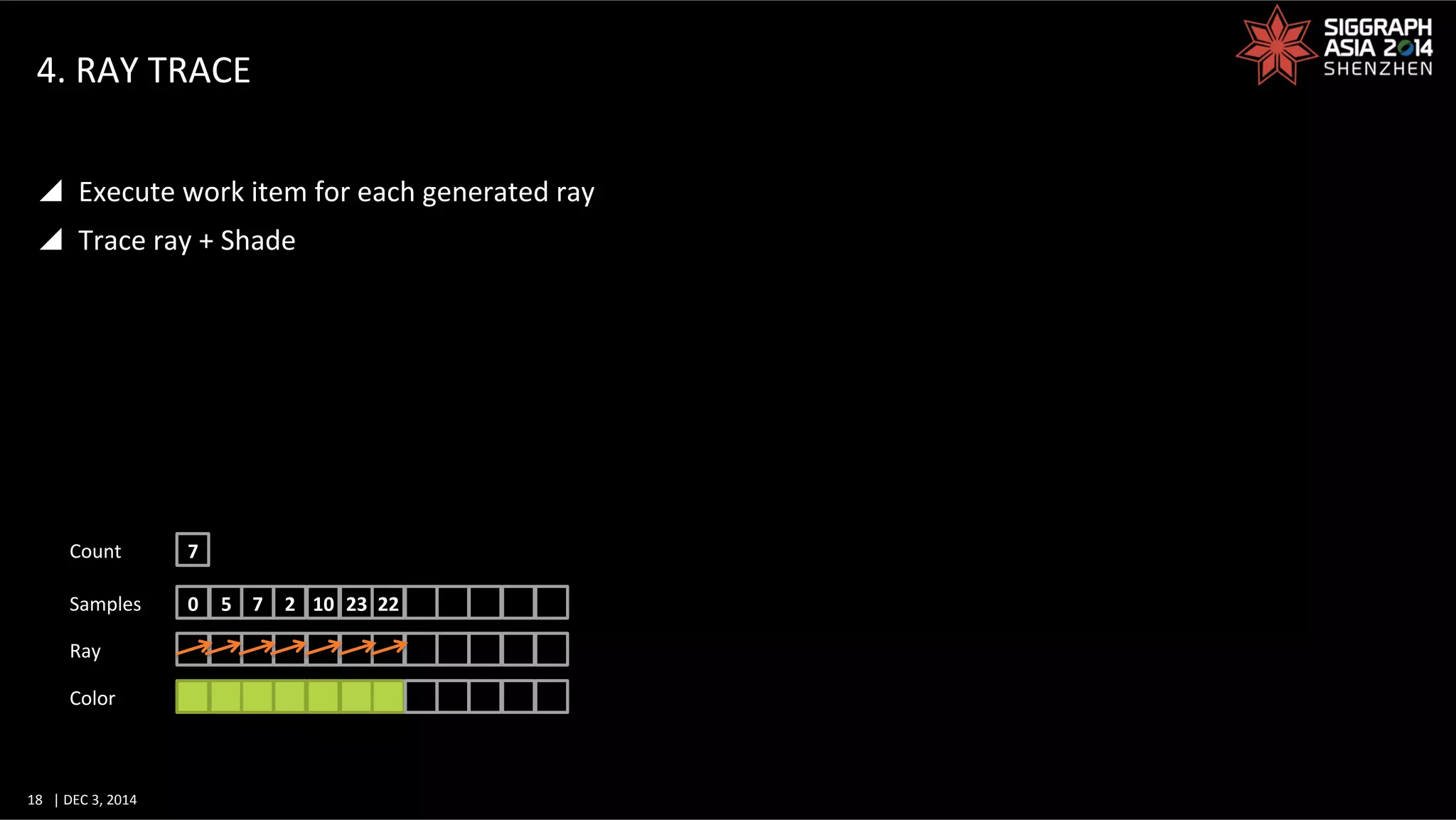
4.	
  RAY	
  TRACE	
  
y  Execute	
  work	
  item	
  for	
  each	
  generated	
  ray	
  
y  Trace	
  ray	
  +	
  Shade	
  
0	
   5	
   7	
   2	
   10	
   23	
  Samples	
  
Ray	
  
Color	
  
22	
  
7	
  Count	
  
19	
   |	
  DEC	
  3,	
  2014	


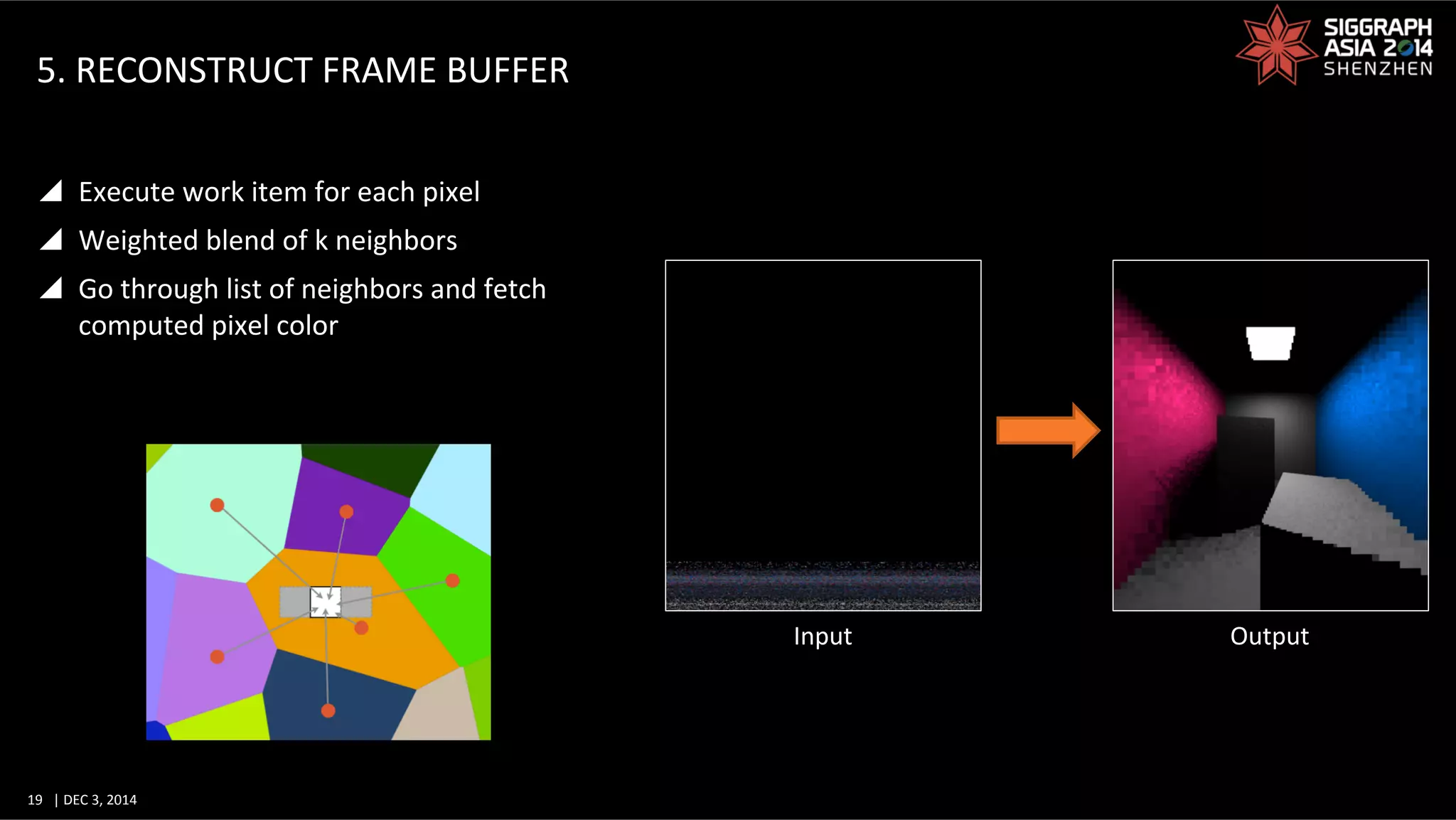
5.	
  RECONSTRUCT	
  FRAME	
  BUFFER	
  
y  Execute	
  work	
  item	
  for	
  each	
  pixel	
  
y  Weighted	
  blend	
  of	
  k	
  neighbors	
  
y  Go	
  through	
  list	
  of	
  neighbors	
  and	
  fetch	
  
computed	
  pixel	
  color	
  
Input	
   Output	
  
20	
   |	
  DEC	
  3,	
  2014	


6.	
  APPLY	
  DISTORTION	
  AND	
  RENDER	
  LR	
  
y  Render	
  to	
  LR	
  
y  Execute	
  work	
  item	
  for	
  each	
  pixel	
  in	
  the	
  frame	
  buffer	
  
y  Check	
  if	
  it	
  is	
  L	
  or	
  R	
  
y  Look	
  up	
  pixel	
  value	
  
y  ChromaGc	
  separaGon	
  
y  Barrel	
  distorGon	
  
21	
   |	
  DEC	
  3,	
  2014	


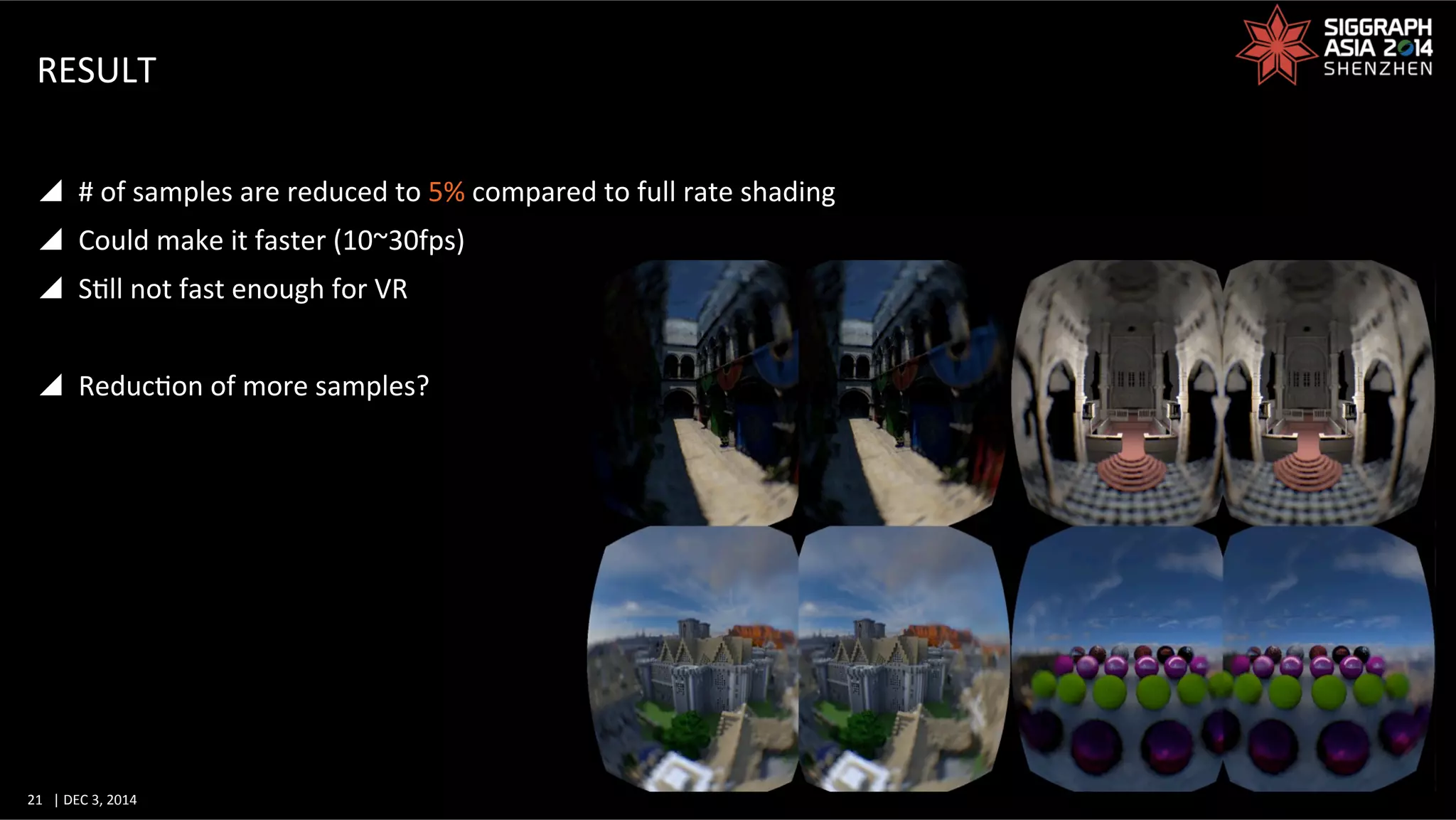
RESULT	
  
y  #	
  of	
  samples	
  are	
  reduced	
  to	
  5%	
  compared	
  to	
  full	
  rate	
  shading	
  
y  Could	
  make	
  it	
  faster	
  (10~30fps)	
  
y  SGll	
  not	
  fast	
  enough	
  for	
  VR	
  
y  ReducGon	
  of	
  more	
  samples?	
  
USING	
  MULTIPLE	
  GPUS	
  
FOR	
  LATENCY	
  CRITICAL	
  APPLICATION	
  
23	
   |	
  DEC	
  3,	
  2014	


HOW	
  TO	
  USE	
  MULTIPLE	
  GPUS	
  
y  Alternate	
  frame	
  rendering	
  
‒ Assign	
  a	
  frame	
  rendering	
  for	
  a	
  GPU	
  
‒ Time	
  to	
  finish	
  a	
  frame	
  doesn’t	
  change	
  
y  Frame	
  split	
  
‒ Split	
  a	
  frame	
  and	
  all	
  GPUs	
  work	
  on	
  the	
  frame	
  
‒ Can	
  reduce	
  the	
  Gme	
  to	
  finish	
  a	
  frame	
  
y  Frame	
  split	
  is	
  beWer	
  for	
  our	
  purpose	
  
24	
   |	
  DEC	
  3,	
  2014	


CHALLENGE	
  OF	
  FRAME	
  SPLIT	
  
y  Load	
  balancing	
  issue	
  
y  A	
  GPU	
  finishes	
  immediately,	
  another	
  might	
  keep	
  running	
  forever	
  
y  Workload	
  of	
  each	
  pixel	
  can	
  be	
  different	
  
y  Foveated	
  rendering	
  makes	
  it	
  worse	
  
‒ Shading	
  point	
  density	
  is	
  not	
  uniform	
  on	
  the	
  screen	
  
25	
   |	
  DEC	
  3,	
  2014	


SEMI	
  STATIC	
  LOAD	
  BALANCING	
  
y  Load	
  balancing	
  once	
  for	
  each	
  frame	
  rendering	
  step	
  
y  Use	
  staGsGcs	
  from	
  previous	
  frame	
  to	
  load	
  balance	
  
y  Start	
  from	
  even	
  split	
  
y  At	
  each	
  frame	
  
‒ Render	
  the	
  assigned	
  area	
  
‒ Each	
  GPU	
  reports	
  #	
  of	
  samples	
  processed	
  and	
  Gme	
  to	
  complete	
  the	
  work	
  
‒ Compute	
  processing	
  speed	
  for	
  GPU	
  i,	
  
‒  p_i	
  =	
  n_i/t_i	
  
‒ If	
  we	
  use	
  the	
  perfect	
  load	
  balancing,	
  Gme	
  to	
  finish	
  the	
  work	
  is	
  	
  
‒  t	
  =	
  sum	
  n_i	
  /	
  sum	
  p_i	
  
‒ The	
  work	
  for	
  GPU	
  i	
  can	
  process	
  at	
  t	
  is	
  
‒  	
  n_i	
  =	
  t	
  p_i	
  
‒ Compute	
  next	
  frame	
  split	
  from	
  the	
  CDF	
  of	
  sample	
  distribuGon	
  
Area	
  
n0	
  
n1	
  
n2	
  
n3	
  
A0	
   A1	
   A2	
   A3	
  
#	
  of	
  Samples	
  
26	
   |	
  DEC	
  3,	
  2014	


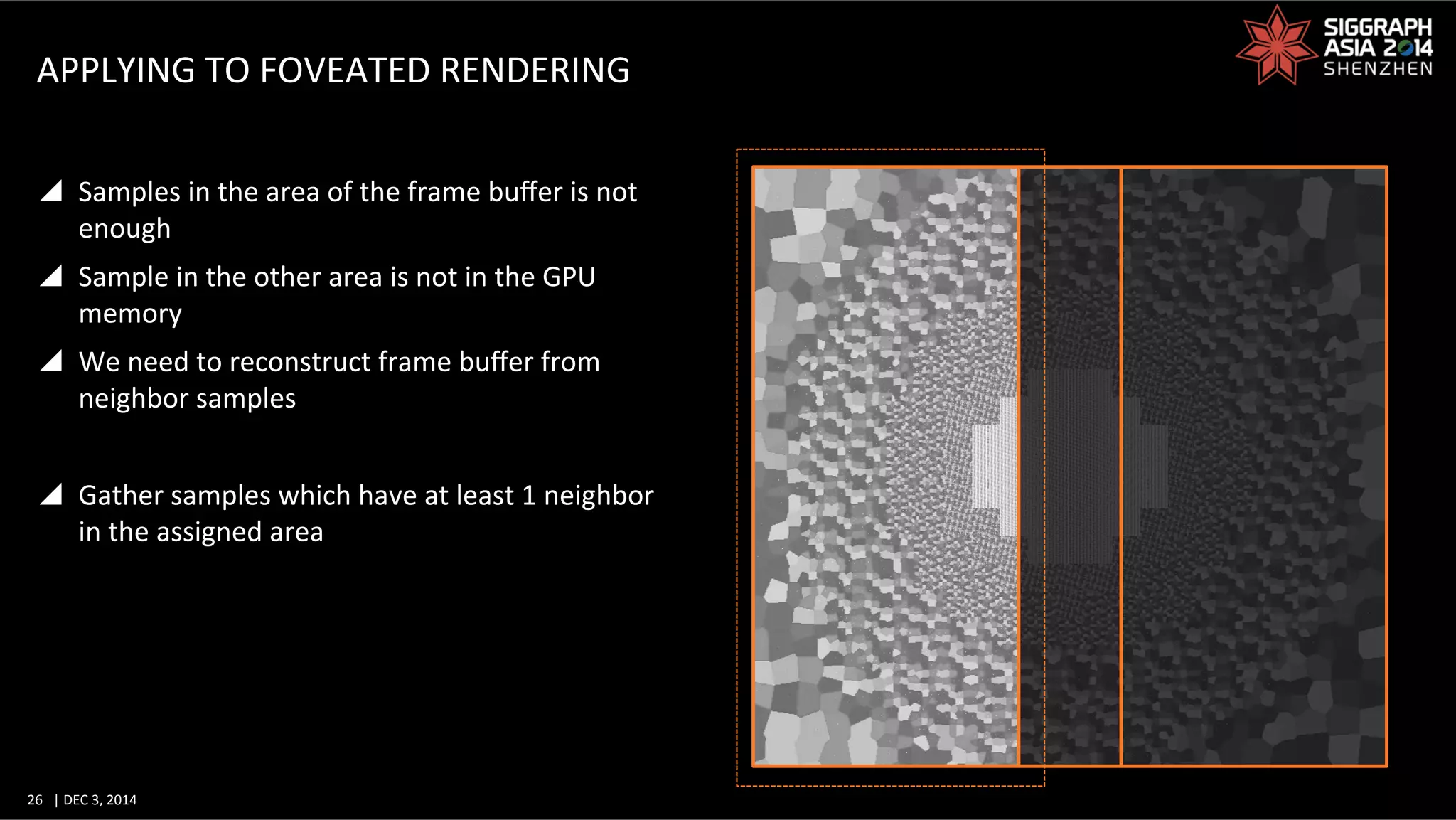
APPLYING	
  TO	
  FOVEATED	
  RENDERING	
  
y  Samples	
  in	
  the	
  area	
  of	
  the	
  frame	
  buffer	
  is	
  not	
  
enough	
  
y  Sample	
  in	
  the	
  other	
  area	
  is	
  not	
  in	
  the	
  GPU	
  
memory	
  
y  We	
  need	
  to	
  reconstruct	
  frame	
  buffer	
  from	
  
neighbor	
  samples	
  
y  Gather	
  samples	
  which	
  have	
  at	
  least	
  1	
  neighbor	
  
in	
  the	
  assigned	
  area	
  
27	
   |	
  DEC	
  3,	
  2014	


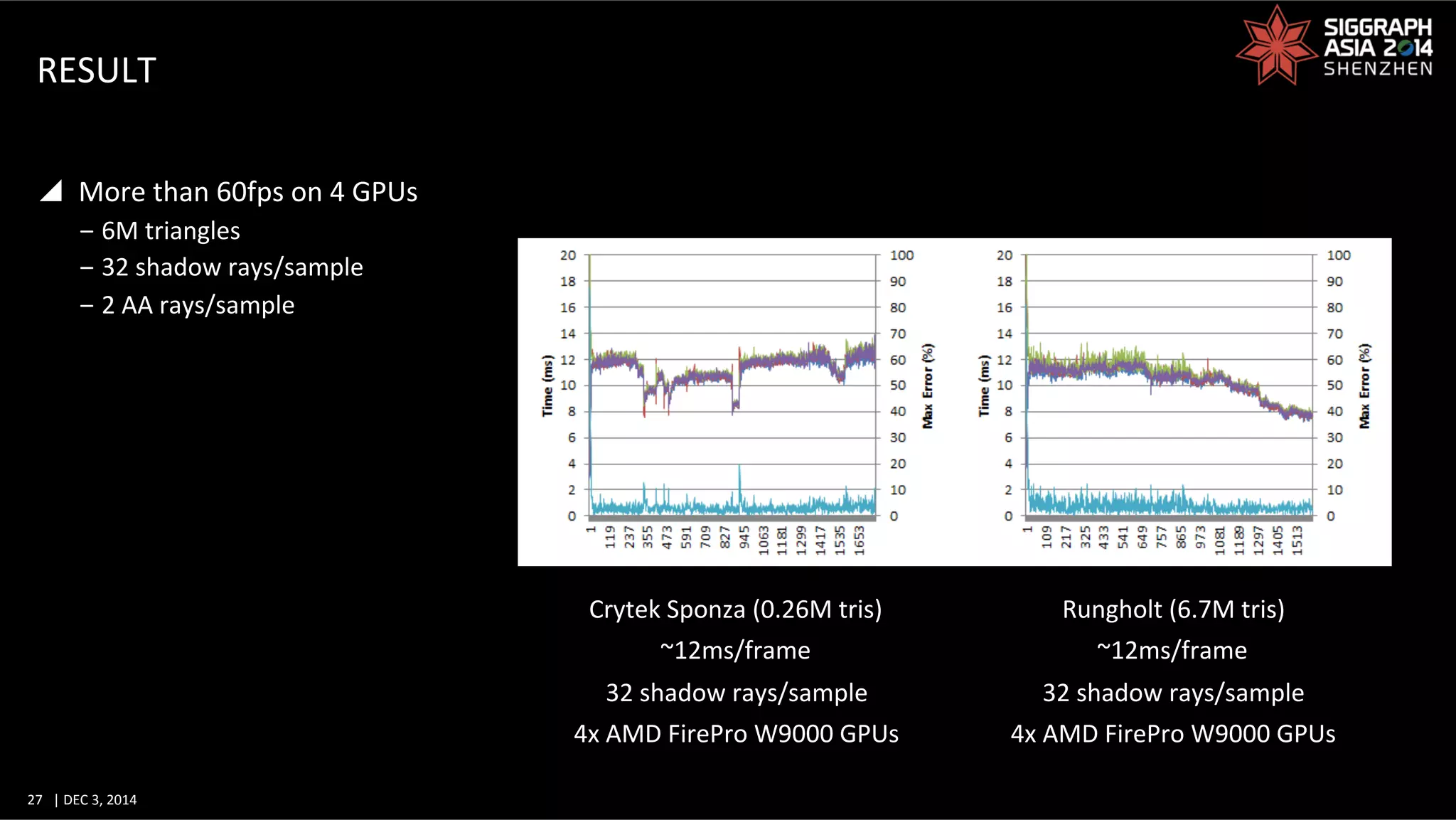
RESULT	
  
y  More	
  than	
  60fps	
  on	
  4	
  GPUs	
  
‒ 6M	
  triangles	
  
‒ 32	
  shadow	
  rays/sample	
  
‒ 2	
  AA	
  rays/sample	
  	
  
Crytek	
  Sponza	
  (0.26M	
  tris)	
  
~12ms/frame	
  
32	
  shadow	
  rays/sample	
  
4x	
  AMD	
  FirePro	
  W9000	
  GPUs	
  
Rungholt	
  (6.7M	
  tris)	
  
~12ms/frame	
  
32	
  shadow	
  rays/sample	
  
4x	
  AMD	
  FirePro	
  W9000	
  GPUs	
  
28	
   |	
  DEC	
  3,	
  2014	


CLOSING	
  THE	
  TALK	
  
y  Showed	
  an	
  example	
  of	
  rendering	
  pipeline	
  100%	
  wriWen	
  in	
  GPU	
  compute	
  
y  Showed	
  how	
  to	
  extend	
  a	
  ray	
  tracer	
  for	
  VR	
  
y  Showed	
  a	
  fully	
  manual	
  usage	
  of	
  mulGple	
  GPU	
  
‒ ó	
  Fully	
  automaGc	
  by	
  driver	
  (Crossfire)	
  
29	
   |	
  DEC	
  3,	
  2014	


CLOSING	
  THE	
  TALK	
  
y  Foveated	
  Real-­‐Time	
  Ray	
  Tracing	
  for	
  Virtual	
  Reality	
  Headset	
  
y  Ray	
  Tracing	
  Irregularly	
  Distributed	
  Samples	
  on	
  MulGple	
  GPUs	
  
y  hWp://research.lighWransport.com/foveated-­‐real-­‐Gme-­‐ray-­‐tracing-­‐for-­‐virtual-­‐reality-­‐headset/index.html	
  
y  Thanks	
  to	
  Masahiro	
  Fujita@Light	
  Transport	
  Entertainment	
  Inc.	
  

Foveated Ray Tracing for VR on Multiple GPUs

  • 1.
    FOVEATED  RAY  TRACING  FOR  VR     ON  MULTIPLE  GPUS   TAKAHIRO  HARADA,  AMD   12/2014  
  • 2.
    2   |  DEC  3,  2014         INTRO   y  Ray  Tracing  +  Foveated  rendering  +  VR  +  MulGple  GPUs  ==  A  lot  of  GPU  compute!!   y  Compute  fills  a  texture   y  Use  GL/CL  interop  to  display  
  • 3.
    3   |  DEC  3,  2014         GPU  RAY  TRACING   y  Everything  is  wriWen  in  compute   y  Our  renderer  is  100%  OpenCL   ‒ Win,  Linux,  OSX   ‒ GPU,  CPU   y  High  quality  rendering  compared  to  raster  graphics  
  • 4.
    4   |  DEC  3,  2014        
  • 5.
    5   |  DEC  3,  2014         GPU  RAY  TRACING   y  A  single  big  kernel   ‒ Easy  to  port   ‒ Works   y  Do  you  write  only  1  pixel  shader??   y  Drawbacks   ‒ Performance  <=  SIMD  divergence,  GPU  occupancy  (uses  too  much  VGPRs)   ‒ Maintainability   ‒ Extendibility   ‒ Portability   ‒ Debug   y  MulGple  kernel  implementaGon   IMPLEMENTATION  CHOICES  
  • 6.
    6   |  DEC  3,  2014         HOW  MANY  WGS  CAN  WE  EXECUTE  PER  SIMD  (AMD  GPU)   y  10  wavefronts  (64WIs)  per  SIMD  is  the  max   y  It  depends  on  local  resource  usage  of  the  kernel   y  VGPR  usage  is  ofen  the  problem   y  Share  256  VGPRs  among  n  work  groups   ‒ 1  wavefront,  256VGPRs  LL   ‒ 2  wavefronts,  128VGPRs   ‒ 4  wavefronts,  64VGPRs  J   ‒ 10  wavefronts,  25VGPRs   y  Share  16KB  LDS  among  n  work  groups   ‒ 1  work  group,  16KB  LL   ‒ 2  work  group,  8KB   ‒ 4  work  group,  4KB  J   y  VGPRs   ‒ Registers  used  by  vector  ALUs   ‒ 64KB/SIMD   ‒ 256  VGPRs/SIMD  lane  (=  64KB/64/4)   y  LDS  (Local  data  share)   ‒ 64KB/CU  (CU  ==  4SIMD)   ‒ 32KB/SIMD  
  • 7.
    7   |  DEC  3,  2014         GPU  RAY  TRACING    launch(  RayTraceKernel  );     __kernel  void  RayTraceKernel();               Host  Code   Device  Code          launch(  PrimaryRayGenKernel  );          while(1)          {                  launch(  TraceKernel  );                  if(  !any(  hits  )  )                          break;                  launch(  SampleLightKernel  );                  launch(  TraceKernel  );                  launch(  AccumulateDIKernel  );                  launch(  SampleNextRayKernel  );          }     __kernel  void  PrimaryRayGenKernel()   __kernel  void  TraceKernel()   __kerenl  void  SampleLightKernel()     Single  kernel  implementa?on   Mul?ple  kernel  implementa?on  
  • 8.
    8   |  DEC  3,  2014         RAY  TRACING  +  VR   y  Ray  tracing  is  flexible   y  Raster  graphics,  single  proj  matrix   y  Can  cast  rays  to  arbitrary  direcGon   y  Easy  to  set  up  VR   y  But  performance  isn’t  good  enough   y  ComputaGon  cost   ‒ Scene  complexity   ‒ #  of  samples  (rays)   Fully  ray  traced  but  using  baked  textures:)  
  • 9.
    9   |  DEC  3,  2014         RAY  TRACING  +  VR   y  Ray  tracing  is  flexible   y  Raster  graphics,  single  proj  matrix   y  Can  cast  rays  to  arbitrary  direcGon   y  Easy  to  set  up  VR   y  But  performance  isn’t  good  enough   y  To  speed  it  up,     ‒ Reduce  #  of  pixels  to  be  shaded   y  Pixel  shading  (sample)  reducGon   ‒ Sample  reuse  (lef&right)   ‒ Foveated  rendering   Fully  ray  traced  but  using  baked  textures:)  
  • 10.
    10   |  DEC  3,  2014         SAMPLE  REUSE  
  • 11.
    11   |  DEC  3,  2014         FOVEATED  RENDERING   y  We  can  only  see  clearly  where  we  are  looking  at   y  Shading  at  full  rate  everywhere  is  a  waste  of   computaGon   y  Steps   ‒ Create  a  density  map   ‒ Ray  trace  1  sample  for  each  area   ‒ Reconstruct  full  resoluGon  image  
  • 12.
    12   |  DEC  3,  2014         FOVEATED  RENDERING   y  We  can  only  see  clearly  where  we  are  looking  at   y  Shading  at  full  rate  everywhere  is  a  waste  of   computaGon   y  Steps   ‒ Create  a  density  map   ‒ Ray  trace  1  sample  for  each  area   ‒ Reconstruct  full  resoluGon  image  
  • 13.
    13   |  DEC  3,  2014         FOVEATED  RENDERING   y  We  can  only  see  clearly  where  we  are  looking  at   y  Shading  at  full  rate  everywhere  is  a  waste  of   computaGon   y  Steps   ‒ Create  a  density  map   ‒ Ray  trace  1  sample  for  each  area   ‒ Reconstruct  full  resoluGon  image  
  • 14.
  • 15.
    15   |  DEC  3,  2014         1.  DENSITY  MAP  DATA  STRUCTURE   y  2  data  structures  are  precomputed   y  Array<float2>  samples(  M  )   ‒ Sample  posiGon   ‒ Normalized  coordinate  (x,  y)   y  Array<NeighborInfo>  neighborInfo(  N  )   ‒ For  frame  reconstrucGon   ‒ Sample  id[k]   ‒ Sample  weight[k]   y  #  of  pixels  :  N   y  #  of  samples:  M  
  • 16.
    16   |  DEC  3,  2014         2.  ASSIGN  A  UNIQUE  INDEX  FOR  EACH  SAMPLE   y  Execute  work  item  for  each  sample  in  the  paWern   y  Check  which  sample  is  in  the  rendered  area   y  Use  atomic  Inc  to  get  a  unique  index   ‒ Count:  #  of  samples   ‒ Unique  indices   As  mulGple  samples  are  taken  for  a  render(),  unique  indices  to  idenGfy  storage  locaGon  is  necessary   0   5   7   2   10   23  Samples   Ray   Color   22   7  Count   Rendering  Area  
  • 17.
    17   |  DEC  3,  2014         3.  GENERATE  PRIMARY  RAYS   y  Execute  work  item  for  each  sample  in  the  range   y  Read  sampleID   y  Read  sample  coordinates   y  Generate  a  primary  ray   y  Store  to  ray  buffer   0   5   7   2   10   23  Samples   Ray   Color   22   7  Count  
  • 18.
    18   |  DEC  3,  2014         4.  RAY  TRACE   y  Execute  work  item  for  each  generated  ray   y  Trace  ray  +  Shade   0   5   7   2   10   23  Samples   Ray   Color   22   7  Count  
  • 19.
    19   |  DEC  3,  2014         5.  RECONSTRUCT  FRAME  BUFFER   y  Execute  work  item  for  each  pixel   y  Weighted  blend  of  k  neighbors   y  Go  through  list  of  neighbors  and  fetch   computed  pixel  color   Input   Output  
  • 20.
    20   |  DEC  3,  2014         6.  APPLY  DISTORTION  AND  RENDER  LR   y  Render  to  LR   y  Execute  work  item  for  each  pixel  in  the  frame  buffer   y  Check  if  it  is  L  or  R   y  Look  up  pixel  value   y  ChromaGc  separaGon   y  Barrel  distorGon  
  • 21.
    21   |  DEC  3,  2014         RESULT   y  #  of  samples  are  reduced  to  5%  compared  to  full  rate  shading   y  Could  make  it  faster  (10~30fps)   y  SGll  not  fast  enough  for  VR   y  ReducGon  of  more  samples?  
  • 22.
    USING  MULTIPLE  GPUS   FOR  LATENCY  CRITICAL  APPLICATION  
  • 23.
    23   |  DEC  3,  2014         HOW  TO  USE  MULTIPLE  GPUS   y  Alternate  frame  rendering   ‒ Assign  a  frame  rendering  for  a  GPU   ‒ Time  to  finish  a  frame  doesn’t  change   y  Frame  split   ‒ Split  a  frame  and  all  GPUs  work  on  the  frame   ‒ Can  reduce  the  Gme  to  finish  a  frame   y  Frame  split  is  beWer  for  our  purpose  
  • 24.
    24   |  DEC  3,  2014         CHALLENGE  OF  FRAME  SPLIT   y  Load  balancing  issue   y  A  GPU  finishes  immediately,  another  might  keep  running  forever   y  Workload  of  each  pixel  can  be  different   y  Foveated  rendering  makes  it  worse   ‒ Shading  point  density  is  not  uniform  on  the  screen  
  • 25.
    25   |  DEC  3,  2014         SEMI  STATIC  LOAD  BALANCING   y  Load  balancing  once  for  each  frame  rendering  step   y  Use  staGsGcs  from  previous  frame  to  load  balance   y  Start  from  even  split   y  At  each  frame   ‒ Render  the  assigned  area   ‒ Each  GPU  reports  #  of  samples  processed  and  Gme  to  complete  the  work   ‒ Compute  processing  speed  for  GPU  i,   ‒  p_i  =  n_i/t_i   ‒ If  we  use  the  perfect  load  balancing,  Gme  to  finish  the  work  is     ‒  t  =  sum  n_i  /  sum  p_i   ‒ The  work  for  GPU  i  can  process  at  t  is   ‒   n_i  =  t  p_i   ‒ Compute  next  frame  split  from  the  CDF  of  sample  distribuGon   Area   n0   n1   n2   n3   A0   A1   A2   A3   #  of  Samples  
  • 26.
    26   |  DEC  3,  2014         APPLYING  TO  FOVEATED  RENDERING   y  Samples  in  the  area  of  the  frame  buffer  is  not   enough   y  Sample  in  the  other  area  is  not  in  the  GPU   memory   y  We  need  to  reconstruct  frame  buffer  from   neighbor  samples   y  Gather  samples  which  have  at  least  1  neighbor   in  the  assigned  area  
  • 27.
    27   |  DEC  3,  2014         RESULT   y  More  than  60fps  on  4  GPUs   ‒ 6M  triangles   ‒ 32  shadow  rays/sample   ‒ 2  AA  rays/sample     Crytek  Sponza  (0.26M  tris)   ~12ms/frame   32  shadow  rays/sample   4x  AMD  FirePro  W9000  GPUs   Rungholt  (6.7M  tris)   ~12ms/frame   32  shadow  rays/sample   4x  AMD  FirePro  W9000  GPUs  
  • 28.
    28   |  DEC  3,  2014         CLOSING  THE  TALK   y  Showed  an  example  of  rendering  pipeline  100%  wriWen  in  GPU  compute   y  Showed  how  to  extend  a  ray  tracer  for  VR   y  Showed  a  fully  manual  usage  of  mulGple  GPU   ‒ ó  Fully  automaGc  by  driver  (Crossfire)  
  • 29.
    29   |  DEC  3,  2014         CLOSING  THE  TALK   y  Foveated  Real-­‐Time  Ray  Tracing  for  Virtual  Reality  Headset   y  Ray  Tracing  Irregularly  Distributed  Samples  on  MulGple  GPUs   y  hWp://research.lighWransport.com/foveated-­‐real-­‐Gme-­‐ray-­‐tracing-­‐for-­‐virtual-­‐reality-­‐headset/index.html   y  Thanks  to  Masahiro  Fujita@Light  Transport  Entertainment  Inc.