FUNCTIONAL MATRIX HYPOTHESIS- REVISITED
PRESENTED BY
SUSNA PAUL
CONTENTS
• FUNCTIONAL MATRIX THEORY- ORIGINAL
• FUNCTIONAL MATRIX HYPOTHESIS- REVISITED
 ROLE OF MECHANOTRANSDUCTION
 ROLE OF AN OSSEOUS CONNECTED CELLULAR NETWORK
 GENOMIC THESIS
 EPIGENETIC ANTITHESIS & RESOLVING SYNTHESIS
• REFERENCES
FUNCTIONAL MATRIX THEORY(1960s)
• The concept of this theory was introduced first by Vander Klaaw
(1948-52).
• Melvin L. Moss developed the functional matrix hypothesis.
The craniofacial skeleton develops initially and later grows in direct
response to the extrinsic epigenetic environment..
BONES DO NOT GROW ,THEY ARE GROWN
DEFINITION
The origin, form, position, growth and maintenance of all
skeletal tissues and organs are always secondary,
compensatory and necessary responses to chronologically
and morphologically prior events or processes that occur in
specifically related nonskeletal tissues, organs or
functioning spaces (functional matrices).
Explanation
The FMH considers the head, not the skull as a composite area of
individual encapsulate areas..
Totality of skeletal structure+ soft tissue+ functioning space
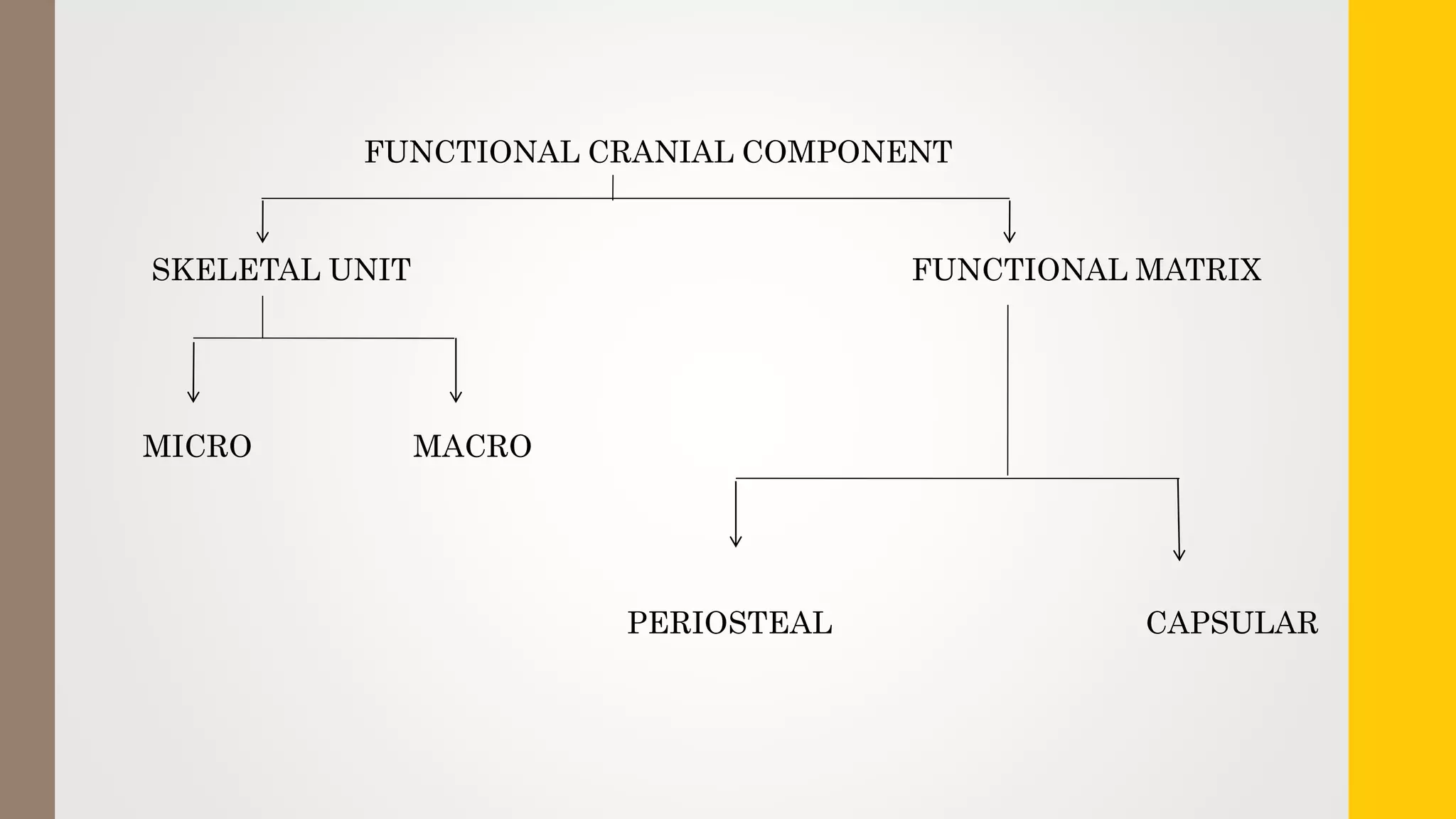
Functional Cranial Component
FUNCTIONAL CRANIAL COMPONENT
SKELETAL UNIT FUNCTIONAL MATRIX
MICRO MACRO
PERIOSTEAL CAPSULAR
SKELETAL UNIT
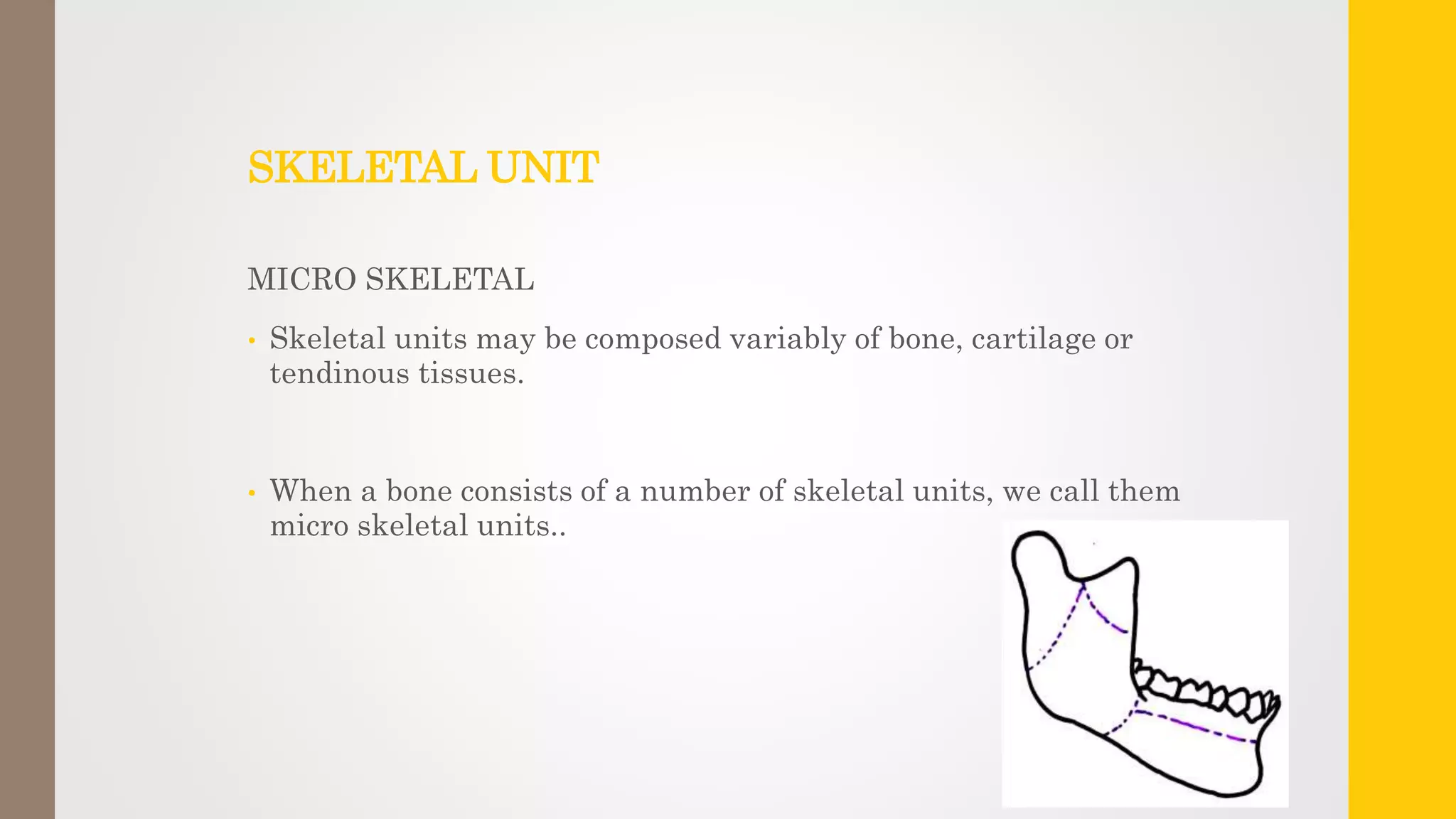
MICRO SKELETAL
• Skeletal units may be composed variably of bone, cartilage or
tendinous tissues.
• When a bone consists of a number of skeletal units, we call them
micro skeletal units..
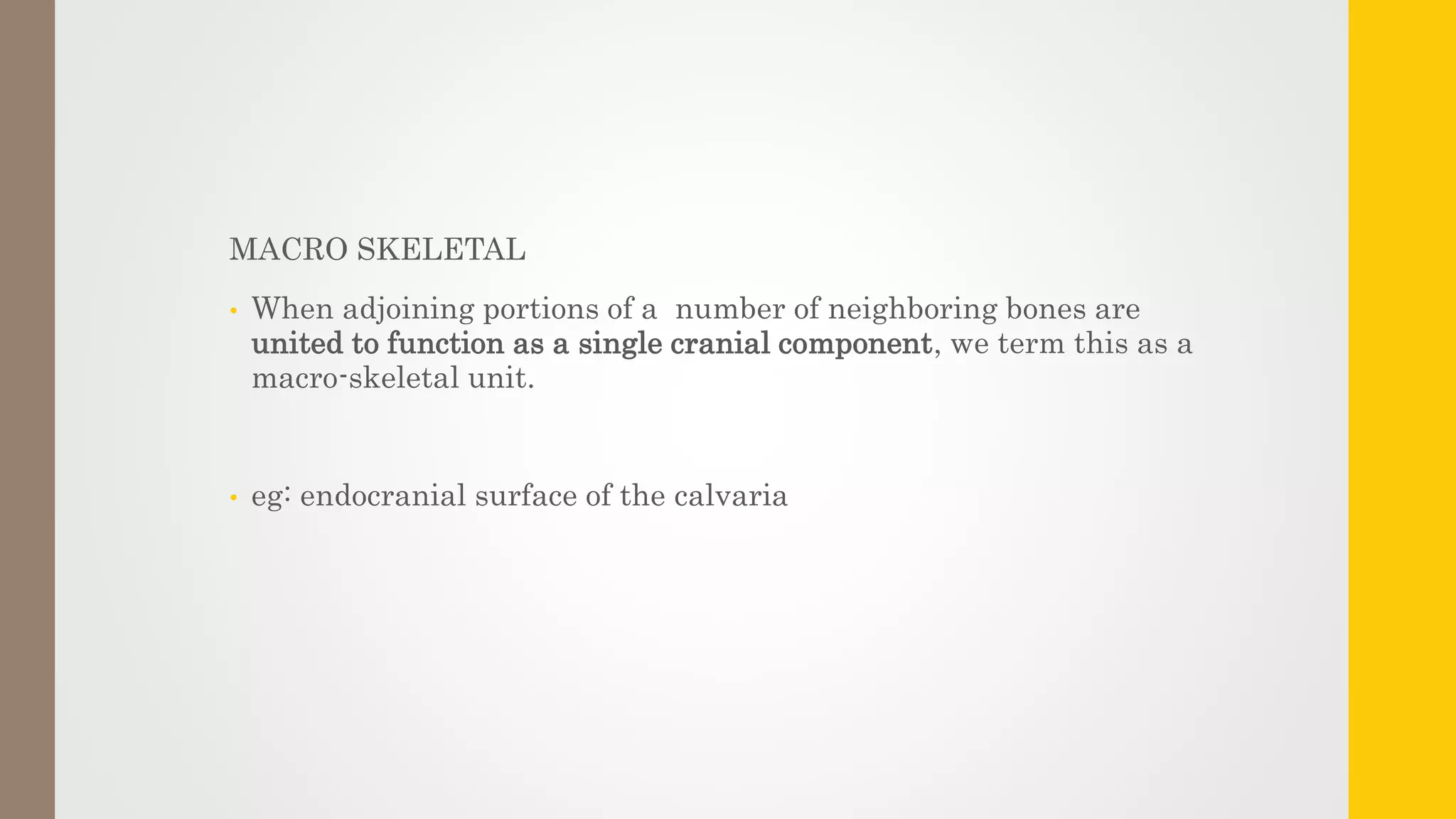
MACRO SKELETAL
• When adjoining portions of a number of neighboring bones are
united to function as a single cranial component, we term this as a
macro-skeletal unit.
• eg: endocranial surface of the calvaria
THE FUNCTIONAL MATRIX
THE PERIOSTEAL MATRIX
This corresponds to the immediate local environment, which acts
directly..
Egs: muscles, blood vessels, nerves, glands, teeth..
• The periosteal matrices stimulation causes direct growth of the
microskeletal units.
• Effect on the size and/or shape of the skeletal unit by osseous deposition
and resorption.
TRANSFORMATION
THE CAPSULAR MATRIX
Defined as the organ and spaces that occupy a broader anatomical complex.
Each capsule is an envelope - contain a series of FCC - skeletal unit and the related
functional matrices..
Sandwiched between two covering layers
OROFACIAL CAPSULE
In this, the cover consists of skin and mucous membrane.
The orofacial capsule surrounds and protects the orofacial functional
matrix..
The volumetric expansion of the orophoryngeal functioning spaces
Increase in the size of the capsule
The whole of the included and enclosed functional components, are
translated to a new position in space.
NEUROCRANIAL CAPSULE
• In this, the cover consists of skin and duramater.
• The neuro-cranial capsule surrounds and protects the neurocranial functional
matrix..
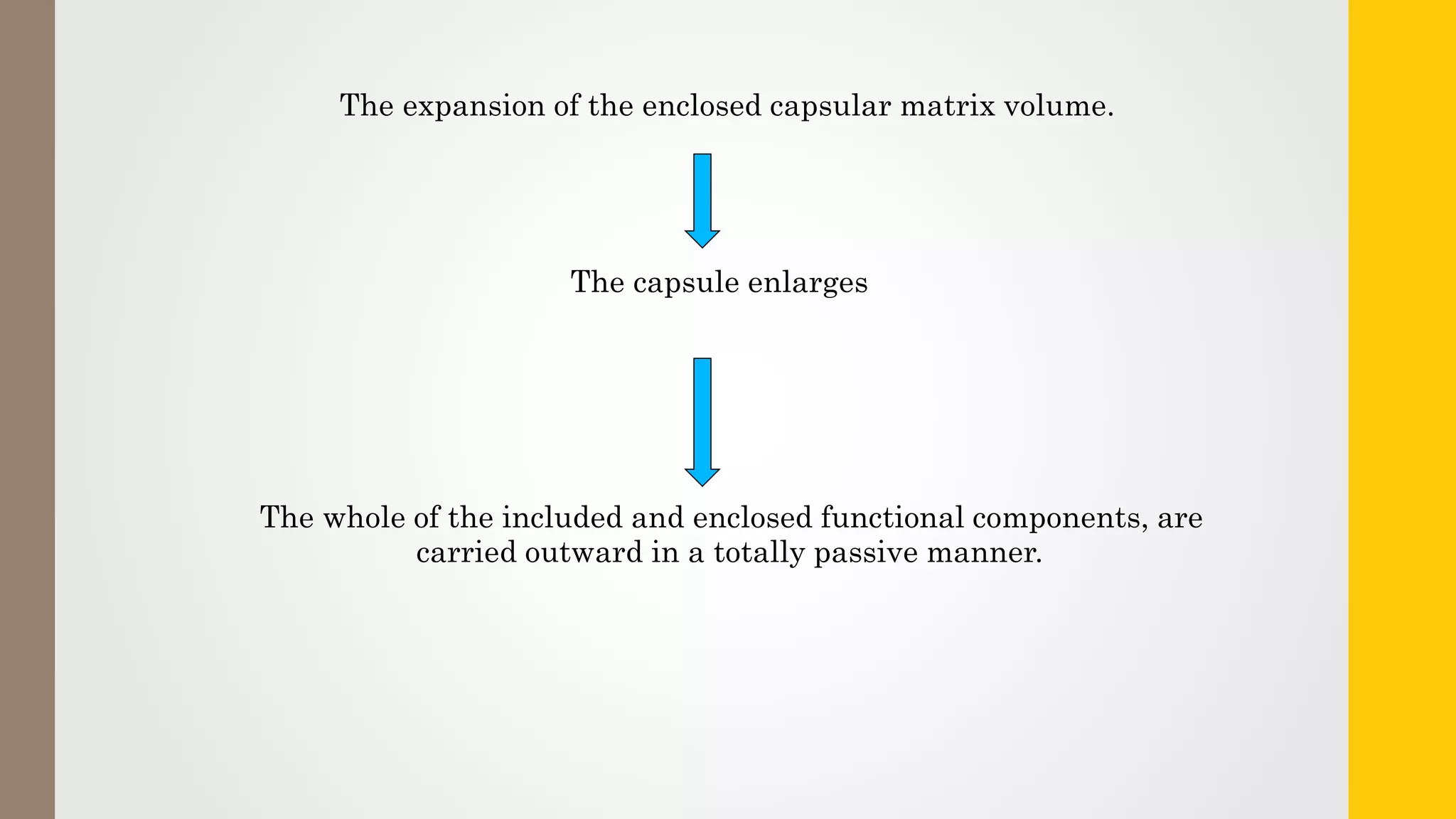
The expansion of the enclosed capsular matrix volume.
The capsule enlarges
The whole of the included and enclosed functional components, are
carried outward in a totally passive manner.
• Thus the capsular matrices acts indirectly on the macroskeletal units and
are carried outward in a passive manner.
• The location in space of the skeletal unit is changed, not by osseous
deposition and resorption.
TRANSLATION
FUNCTIONAL CRANIAL
COMPLEX
GROWTH
TRANSLATION
TRANSFORMATION
CAPSULAR
MATRIX
PERIOSTEAL
MATRIX
MACROSKELETON
MICROSKELETON
SKELETAL UNITFUNCTIONAL
MATRIX
CONSTRAINTS OF THE FMH
1. Methodologic constraint:
Macroscopic measurements which use the techniques of point mechanics
and arbitrary reference frames.
Roentgenographic cephalometry permitted only method specific
descriptions that cannot be structurally detailed. This constraint was
removed..
2. Hierarchical constraint:
This version’s descriptions did not extend “downward” to processes at
the cellular, subcellular or molecular structural domains or extend
“upwards” to the multicellular process by which bone tissues respond
to lower level signals.
1.Mechanotransduction occurs in single bone cells.
2.Bone cells are computational elements that function multicellularly as a
connected cellular network.
.
MECHANO TRANSDUCTION
All vital cells are irritable and respond to alterations in their external
environment.
1. Mechanoreception
2. Mechanotransduction
Osseous Mechanotransduction
1.Unlike other mechanosensory cells ,bone cell are not specialized for such
stimuli
2.These cells shows aneural transmission of signals.
3. Bone loading stimulus evoke three adaptational responses.
4. The changes brought about by stimuli are confined to a single bone to which
the signal is transduced.
Translates the information content of a periosteal functional matrix
stimulus into a skeletal unit cell signal
MECHANOTRANSDUCTION
Ionic / electrical
Mechanical
Stretch Activated channel
Activation of plasma membrane stretch activated ion channels
Intra cellular electric events
Electromechanical
Involves the osteocytic plasma membrane.
it contains voltage activated ion channels and transmembrane ion
flow..
Electrokinetic
Bound and unbound electrical charges, associated with the bone fluids.
Electrical effects in the fluid filled bone are electrokinetic i.e. streaming
potential.
MECHANICAL PROCESS
This is an alternate means by which functional matrix may regulate
the lower cell bone cell.
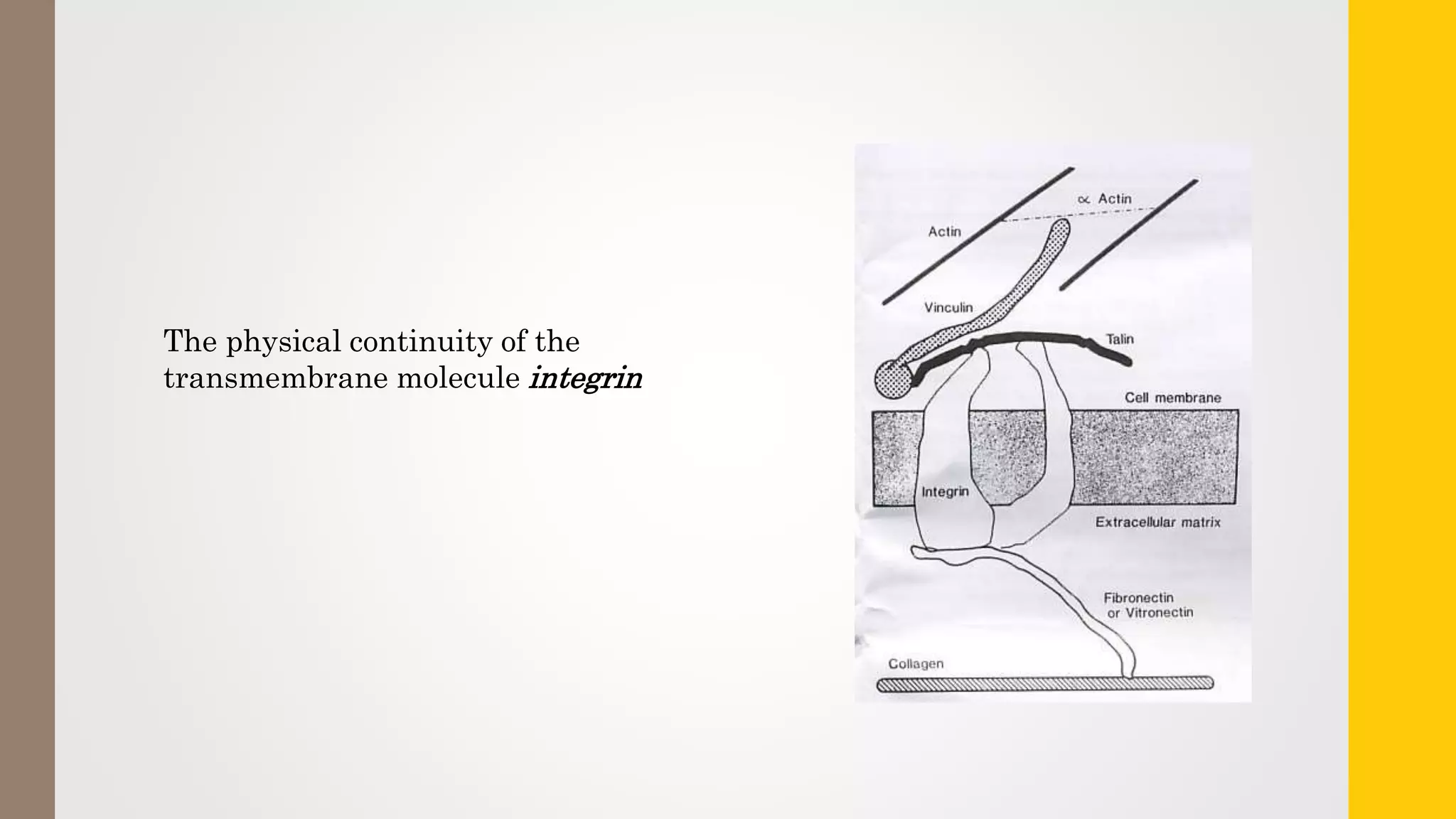
The physical continuity of the
transmembrane molecule integrin
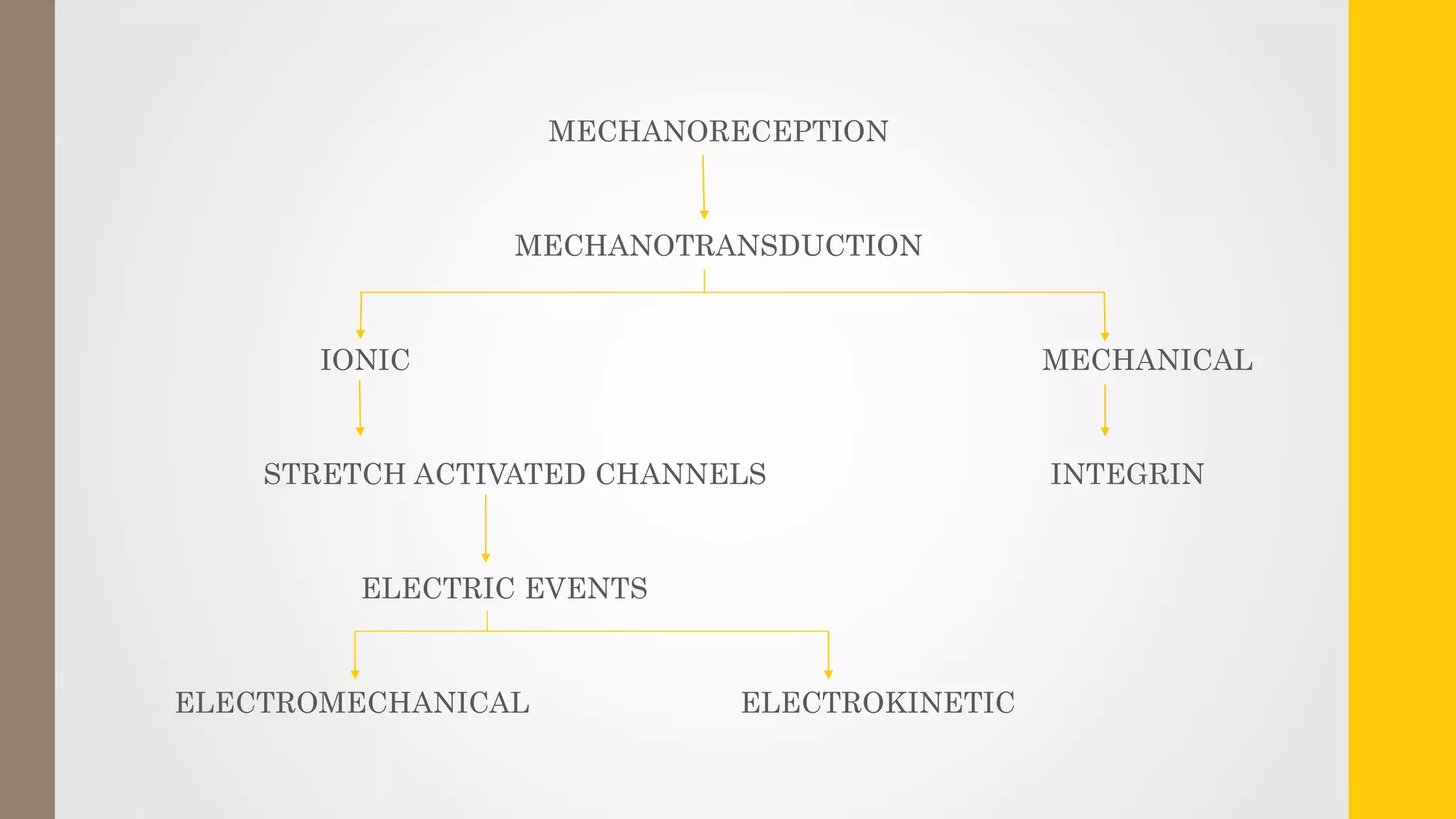
MECHANORECEPTION
MECHANOTRANSDUCTION
IONIC MECHANICAL
STRETCH ACTIVATED CHANNELS INTEGRIN
ELECTRIC EVENTS
ELECTROMECHANICAL ELECTROKINETIC
CONNECTED CELLULAR NETWORK
All bone cells, expect osteoclasts are extensively interconnected by gap junctions.
Present laterally and vertically.
.
Superficial osteoblast Superficial osteoblast
Periosteal and endosteal
osteoblasts
Periosteal and endosteal
osteoblasts
Preosteoblastic cellPreosteoblastic cell
CONNECTED CELLULAR NETWORK
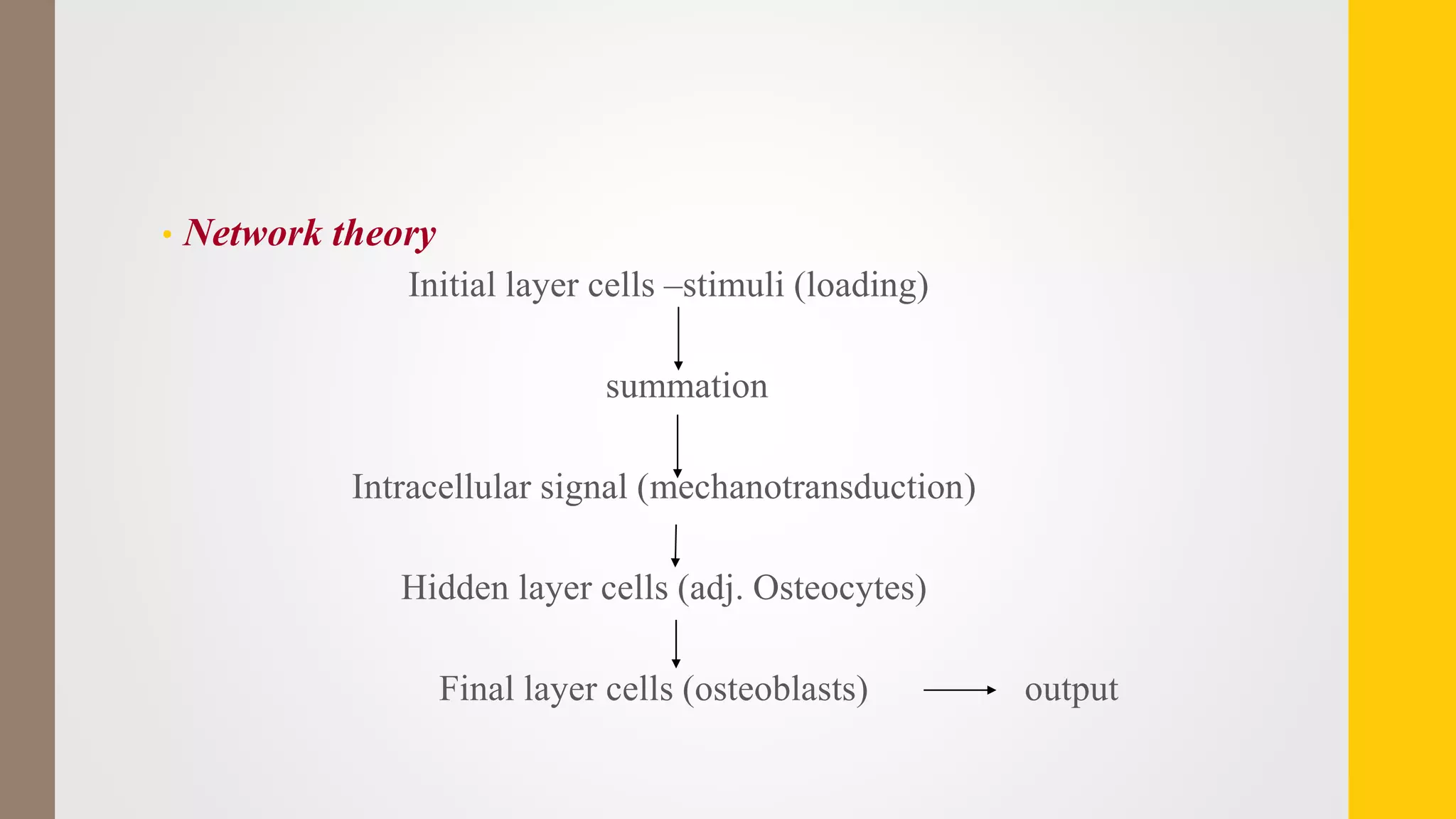
• Network theory
Initial layer cells –stimuli (loading)
summation
Intracellular signal (mechanotransduction)
Hidden layer cells (adj. Osteocytes)
Final layer cells (osteoblasts) output
The CCNs show oscillation, i.e. reciprocal signaling (feedback) between
layers.
Gap junctions are electrical synapses that permit bi-directional signal
traffic
ionic transport through the bone cell plasma membrane
intercellular transmission are computed by the operation of an
osseous connected cellular network
bone responses
• explanatory chain extending from the
epigenetic event of skeletal muscle contraction, hierarchically downward (through the
cellular and molecular levels to the bone cell genome and then)
upwards again through histologic levels to the event of gross bone form adaptational
changes.
The revised FMH consist of the presentation of, a thesis and an
anti-thesis and of a resolving synthesis.
GENOMIC THESIS
• The genomic thesis holds that the genome, from the moment of fertilization, contains
all the information necessary to regulate..
• Genomic thesis claims that prenatal cranio facial development is controlled
by two inter related processes:
1. Initial regulatory (Homeobox) gene activity.
2 Activity of the regulatory molecular groups: growth factor families and
steroid/thyroid family.
EPIGENETIC ANTITHESIS
The genomic thesis passes directly from molecules to morphogenesis:
directly from DNA molecules to adult morphology, ignoring the roles of the
many epigenetic processes and mechanism.
The epigenetic antithesis detailing the processes and mechanisms seeking
to clarify the casual chain between genome & phenotype.
• Process  Series of action or operation that had towards a particular
result.
• Mechanism  Fundamental physical or chemical process(es) involved in,
or responsible for an action, reaction or other nailed phenomenon
Epigenetics refers to the entire series of interactions among cells and cell
products, which leads to morphogenesis and differentiation..
A RESOLVING SYNTHESIS
• Morphogenesis is regulated (controlled, caused) by the activity of
both genomic and epigenetic processes and mechanisms.
REFERENCES
• The functional matrix revisited.1. The role of mechanotransduction. AJODO –1997
; 112 :8-11.
• The functional matrix revisted 2. The role of an osseous connected cellular network
AJODO -1997; 112:221-6
• The functional matrix revisited.3 .The genomic thesis AJODO-1997;112:338-42
• The functional matrix revisited.4 .The epigenetic antithesis AJODO-1997;112:410-7
Functional matrix Hypothesis- Revisited

Functional matrix Hypothesis- Revisited

  • 1.
    FUNCTIONAL MATRIX HYPOTHESIS-REVISITED PRESENTED BY SUSNA PAUL
  • 2.
    CONTENTS • FUNCTIONAL MATRIXTHEORY- ORIGINAL • FUNCTIONAL MATRIX HYPOTHESIS- REVISITED  ROLE OF MECHANOTRANSDUCTION  ROLE OF AN OSSEOUS CONNECTED CELLULAR NETWORK  GENOMIC THESIS  EPIGENETIC ANTITHESIS & RESOLVING SYNTHESIS • REFERENCES
  • 3.
    FUNCTIONAL MATRIX THEORY(1960s) •The concept of this theory was introduced first by Vander Klaaw (1948-52). • Melvin L. Moss developed the functional matrix hypothesis.
  • 4.
    The craniofacial skeletondevelops initially and later grows in direct response to the extrinsic epigenetic environment.. BONES DO NOT GROW ,THEY ARE GROWN
  • 5.
    DEFINITION The origin, form,position, growth and maintenance of all skeletal tissues and organs are always secondary, compensatory and necessary responses to chronologically and morphologically prior events or processes that occur in specifically related nonskeletal tissues, organs or functioning spaces (functional matrices).
  • 6.
    Explanation The FMH considersthe head, not the skull as a composite area of individual encapsulate areas.. Totality of skeletal structure+ soft tissue+ functioning space Functional Cranial Component
  • 7.
    FUNCTIONAL CRANIAL COMPONENT SKELETALUNIT FUNCTIONAL MATRIX MICRO MACRO PERIOSTEAL CAPSULAR
  • 8.
    SKELETAL UNIT MICRO SKELETAL •Skeletal units may be composed variably of bone, cartilage or tendinous tissues. • When a bone consists of a number of skeletal units, we call them micro skeletal units..
  • 9.
    MACRO SKELETAL • Whenadjoining portions of a number of neighboring bones are united to function as a single cranial component, we term this as a macro-skeletal unit. • eg: endocranial surface of the calvaria
  • 10.
    THE FUNCTIONAL MATRIX THEPERIOSTEAL MATRIX This corresponds to the immediate local environment, which acts directly.. Egs: muscles, blood vessels, nerves, glands, teeth..
  • 11.
    • The periostealmatrices stimulation causes direct growth of the microskeletal units. • Effect on the size and/or shape of the skeletal unit by osseous deposition and resorption. TRANSFORMATION
  • 12.
    THE CAPSULAR MATRIX Definedas the organ and spaces that occupy a broader anatomical complex. Each capsule is an envelope - contain a series of FCC - skeletal unit and the related functional matrices.. Sandwiched between two covering layers
  • 13.
    OROFACIAL CAPSULE In this,the cover consists of skin and mucous membrane. The orofacial capsule surrounds and protects the orofacial functional matrix..
  • 14.
    The volumetric expansionof the orophoryngeal functioning spaces Increase in the size of the capsule The whole of the included and enclosed functional components, are translated to a new position in space.
  • 15.
    NEUROCRANIAL CAPSULE • Inthis, the cover consists of skin and duramater. • The neuro-cranial capsule surrounds and protects the neurocranial functional matrix..
  • 16.
    The expansion ofthe enclosed capsular matrix volume. The capsule enlarges The whole of the included and enclosed functional components, are carried outward in a totally passive manner.
  • 17.
    • Thus thecapsular matrices acts indirectly on the macroskeletal units and are carried outward in a passive manner. • The location in space of the skeletal unit is changed, not by osseous deposition and resorption. TRANSLATION
  • 18.
  • 19.
    CONSTRAINTS OF THEFMH 1. Methodologic constraint: Macroscopic measurements which use the techniques of point mechanics and arbitrary reference frames. Roentgenographic cephalometry permitted only method specific descriptions that cannot be structurally detailed. This constraint was removed..
  • 20.
    2. Hierarchical constraint: Thisversion’s descriptions did not extend “downward” to processes at the cellular, subcellular or molecular structural domains or extend “upwards” to the multicellular process by which bone tissues respond to lower level signals.
  • 21.
    1.Mechanotransduction occurs insingle bone cells. 2.Bone cells are computational elements that function multicellularly as a connected cellular network. .
  • 22.
    MECHANO TRANSDUCTION All vitalcells are irritable and respond to alterations in their external environment. 1. Mechanoreception 2. Mechanotransduction
  • 23.
  • 24.
    1.Unlike other mechanosensorycells ,bone cell are not specialized for such stimuli 2.These cells shows aneural transmission of signals. 3. Bone loading stimulus evoke three adaptational responses. 4. The changes brought about by stimuli are confined to a single bone to which the signal is transduced.
  • 25.
    Translates the informationcontent of a periosteal functional matrix stimulus into a skeletal unit cell signal
  • 26.
  • 27.
    Stretch Activated channel Activationof plasma membrane stretch activated ion channels Intra cellular electric events
  • 28.
    Electromechanical Involves the osteocyticplasma membrane. it contains voltage activated ion channels and transmembrane ion flow..
  • 29.
    Electrokinetic Bound and unboundelectrical charges, associated with the bone fluids. Electrical effects in the fluid filled bone are electrokinetic i.e. streaming potential.
  • 30.
    MECHANICAL PROCESS This isan alternate means by which functional matrix may regulate the lower cell bone cell.
  • 31.
    The physical continuityof the transmembrane molecule integrin
  • 32.
    MECHANORECEPTION MECHANOTRANSDUCTION IONIC MECHANICAL STRETCH ACTIVATEDCHANNELS INTEGRIN ELECTRIC EVENTS ELECTROMECHANICAL ELECTROKINETIC
  • 33.
    CONNECTED CELLULAR NETWORK Allbone cells, expect osteoclasts are extensively interconnected by gap junctions. Present laterally and vertically. . Superficial osteoblast Superficial osteoblast Periosteal and endosteal osteoblasts Periosteal and endosteal osteoblasts Preosteoblastic cellPreosteoblastic cell CONNECTED CELLULAR NETWORK
  • 34.
    • Network theory Initiallayer cells –stimuli (loading) summation Intracellular signal (mechanotransduction) Hidden layer cells (adj. Osteocytes) Final layer cells (osteoblasts) output
  • 35.
    The CCNs showoscillation, i.e. reciprocal signaling (feedback) between layers. Gap junctions are electrical synapses that permit bi-directional signal traffic
  • 36.
    ionic transport throughthe bone cell plasma membrane intercellular transmission are computed by the operation of an osseous connected cellular network bone responses
  • 38.
    • explanatory chainextending from the epigenetic event of skeletal muscle contraction, hierarchically downward (through the cellular and molecular levels to the bone cell genome and then) upwards again through histologic levels to the event of gross bone form adaptational changes.
  • 39.
    The revised FMHconsist of the presentation of, a thesis and an anti-thesis and of a resolving synthesis.
  • 40.
    GENOMIC THESIS • Thegenomic thesis holds that the genome, from the moment of fertilization, contains all the information necessary to regulate..
  • 41.
    • Genomic thesisclaims that prenatal cranio facial development is controlled by two inter related processes: 1. Initial regulatory (Homeobox) gene activity. 2 Activity of the regulatory molecular groups: growth factor families and steroid/thyroid family.
  • 42.
    EPIGENETIC ANTITHESIS The genomicthesis passes directly from molecules to morphogenesis: directly from DNA molecules to adult morphology, ignoring the roles of the many epigenetic processes and mechanism.
  • 43.
    The epigenetic antithesisdetailing the processes and mechanisms seeking to clarify the casual chain between genome & phenotype. • Process  Series of action or operation that had towards a particular result. • Mechanism  Fundamental physical or chemical process(es) involved in, or responsible for an action, reaction or other nailed phenomenon
  • 44.
    Epigenetics refers tothe entire series of interactions among cells and cell products, which leads to morphogenesis and differentiation..
  • 45.
    A RESOLVING SYNTHESIS •Morphogenesis is regulated (controlled, caused) by the activity of both genomic and epigenetic processes and mechanisms.
  • 46.
    REFERENCES • The functionalmatrix revisited.1. The role of mechanotransduction. AJODO –1997 ; 112 :8-11. • The functional matrix revisted 2. The role of an osseous connected cellular network AJODO -1997; 112:221-6 • The functional matrix revisited.3 .The genomic thesis AJODO-1997;112:338-42 • The functional matrix revisited.4 .The epigenetic antithesis AJODO-1997;112:410-7