


Good Morning
THEORIES OF
GROWTH AND
DEVELOPMENT
Dr Roni R Kuttickal
CONTENTS
⊷Introduction to Growth & Development
⊷Theories of growth and development
 Bone remodelling theory
 Genetic theory
 Scotts cartilaginous theory
 Sutural dominance theory
 Functional matrix theory
 FMT – revisited
 Von Limborghs theory
⊷ Other theories related to craniofacial growth
 Cybernetics
 Neurotropism
 Enlow’s expanding V priciple
⊷Conclusion
3
INDRODUCTION
Growth and development is a set
of extraordinarly complex
programs that occur during the
transformation of a being from an
embriyo into matured organism
Growth
⊷ Growth refers to increase in
size or number
5
Development
⊷ Development refers to all the
naturally occurring
unidirectional changes in the
life of an individual from its
existence as a single cell to its
elaboration as a
multifunctional unit
terminating in death.
6
Growth centre
⊷ A location at
which
independent
growth occurs.
⊷ Controlled
genetically
Growth site
⊷ A location at
which growth
occurs as a
response to a
stimuli
7
Growth centres
⊷ Growth centre is a site of endochondral
ossification with tissue separating force,
contributing to increase in skeletal mass
8
⊷ Maxilla
Prenatal
Postnatal
⊷ septo ethimoidal
cartilage
⊷ Mandible
Prenatal
9
Growth sites
⊷ regions of periosteal or sutural bone
formation and modelling resorption
adaptive to environmental influences.
10
Growth sites
⊷ Maxilla
⊷ Spheno occipital
synchondrosis
⊷ lateral cranial
base.
⊷ Maxillary
tuberocity
⊷ Midpalatine
suture
⊷ Alveolar ridge
⊷ Mandible
⊷ Symphysis
⊷ Para symphysis
⊷ Alveolar ridge
⊷ Posterior ramal
border
11
Bone
remodeling
theory
Brash 1930
12
Bone remodelling
theory
Principal tenats
⊷ 1) Appositional growth
⊷ 2) Hunterian Growth
⊷ 3) Calvarialgrowth
13
⊷ Schematic Representation Of
The Remodeling Theory Using
Cranial Vault As Model
14
Remodeling theory postulated
that all of craniofacial skeletal
growth occurs exclusively by
bone remodeling. ie by
selective addition and
resorption of bone at its
surfaces
Thus sutures & cartilages of
craniofacial skeleton have little
or no role in the growth
15
It did not explain the role
of sutures, cranial base
synchondroses,
mandibular condyle or its
cartilage
Demerits
16
Genetic
theory
Allan G Brodie 1941
17
Genetic theory
⊷ The persistent pattern of
facial configuration is under
genetic control and genes
determine the overall
growth control
18
Application of this theory ignored
treatment of the bones of the face and
focused on a more plastic
dentoalveolar region
The Genetic theory simply states
that genes determine all Although
called a theory, it was assumed than
proven
Demerits
19
Suture
dominance
theory
Sicher and Weinman 1941
20
Sutural theory
Controlling factors
Intrinsic genetic
factors(major)
Local environmental
factors(minor)
Intrinsic genetic
factors(major)
Local environmental
factors(minor)
Growth process
Chondrocranial
growth
Desmocranial growth
21
⊷ This theory states that sutures are
the primary determinant of the
craniofacial growth.
⊷ Expansion forces at the sutures lead
to expansion of bone and thus
growth of craniofacial skeleton.
22
Examples
⊷ Growth of cranial vault
24
Frontal suture
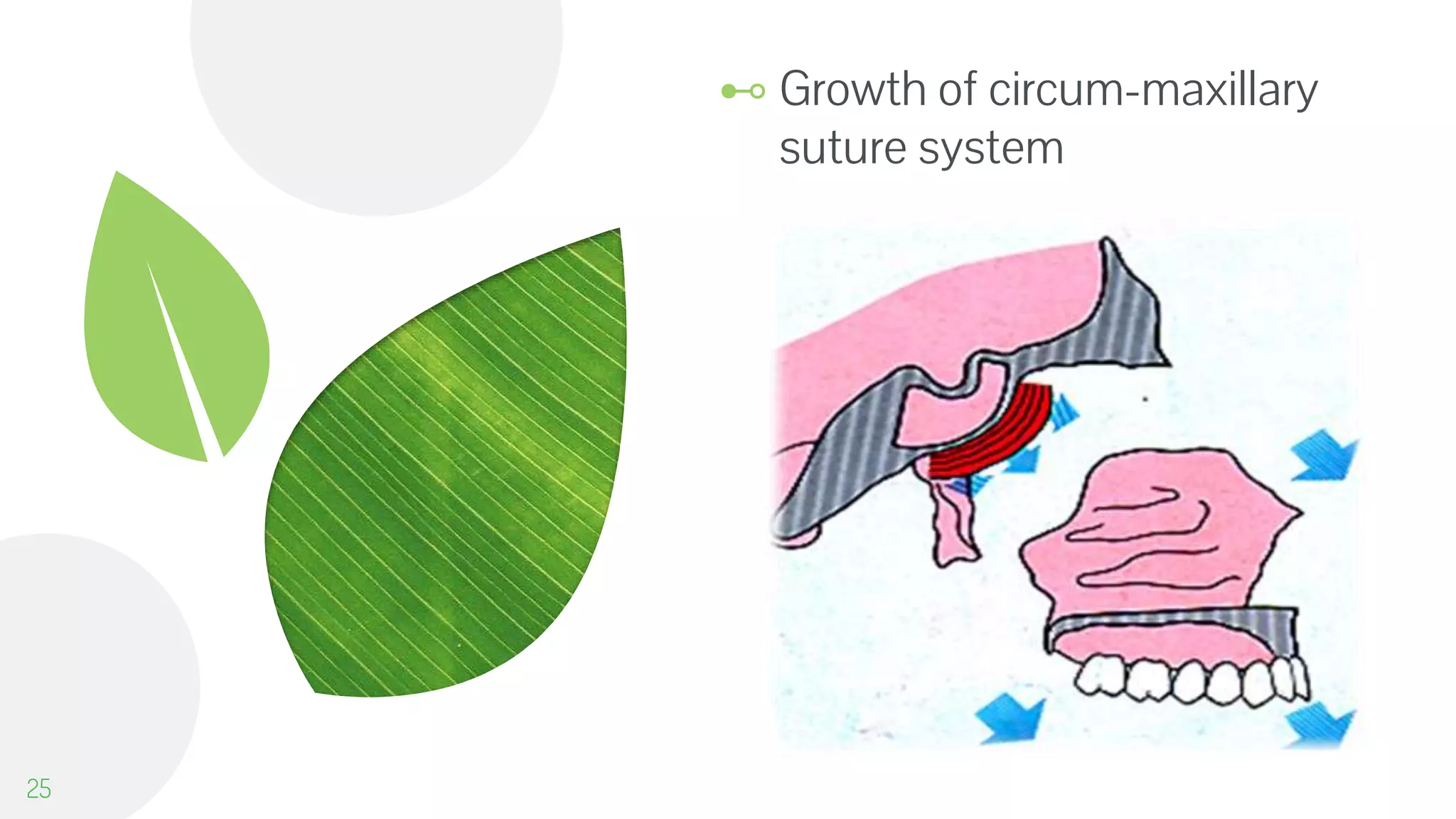
⊷ Growth of circum-maxillary
suture system
25
⊷ Mandibule perceived as a
long bone grows downwards
and forwards
26
⊷ Translatory growth of bones continue normally even in
absence of sutures
⊷ In untreated cleft palate - suture is not present growth still
takes place.
⊷ Auto transplants of sutures fail to grow in cultural medium
though provided with same environment and conditions
⊷ The shape and growth within sutures is dependent on
external stimuli.
⊷ Sutural growth -- halted by mechanical stresses applied
across the sutures
Demerits
27
Cartilaginous
Theory
James H Scott 1950
28
Cartilaginous Theory
⊷ Proponents of this theory
state that cartilage is
responsible for the growth,
and bone just replaces it.
29
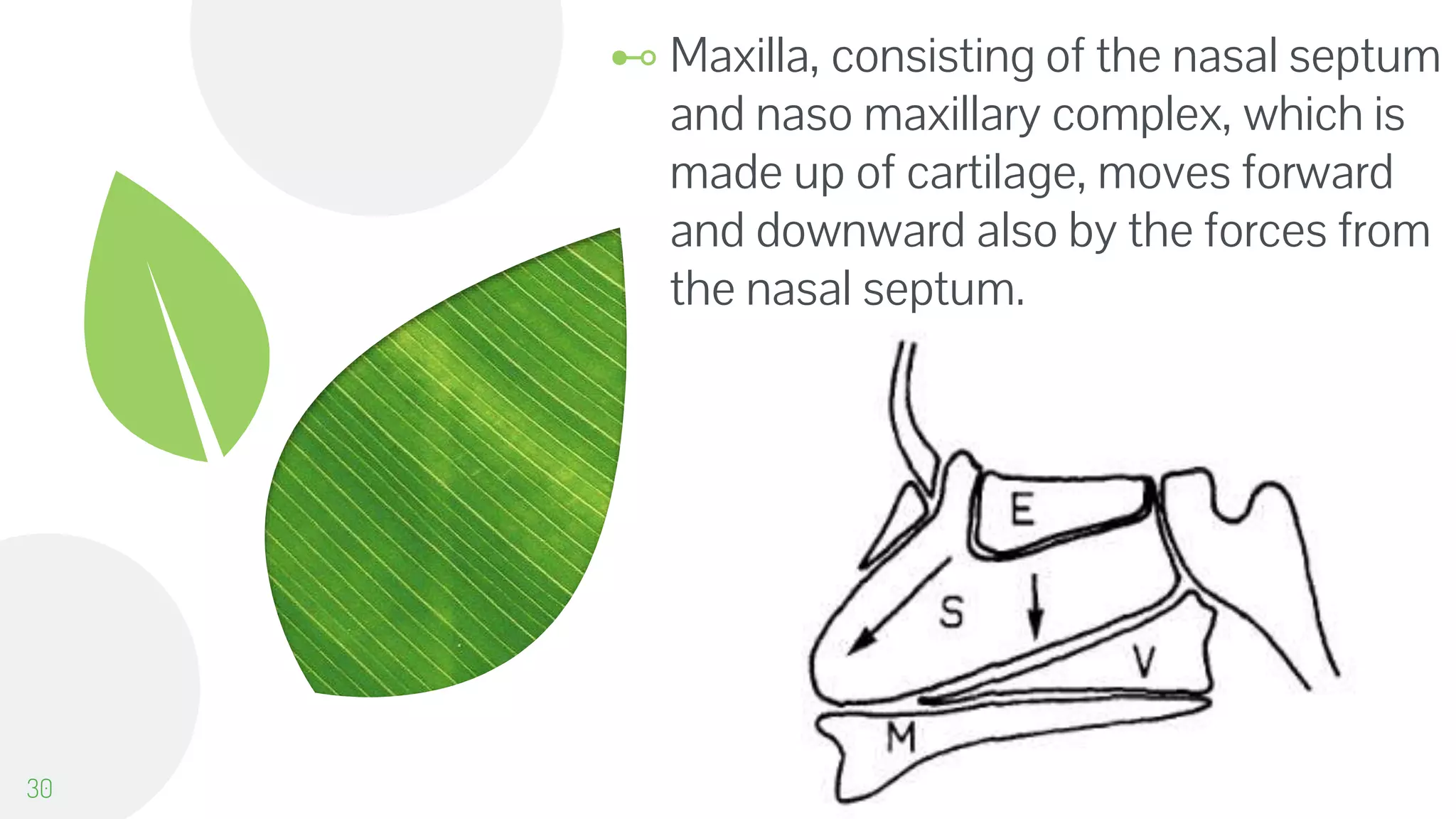
⊷ Maxilla, consisting of the nasal septum
and naso maxillary complex, which is
made up of cartilage, moves forward
and downward also by the forces from
the nasal septum.
30
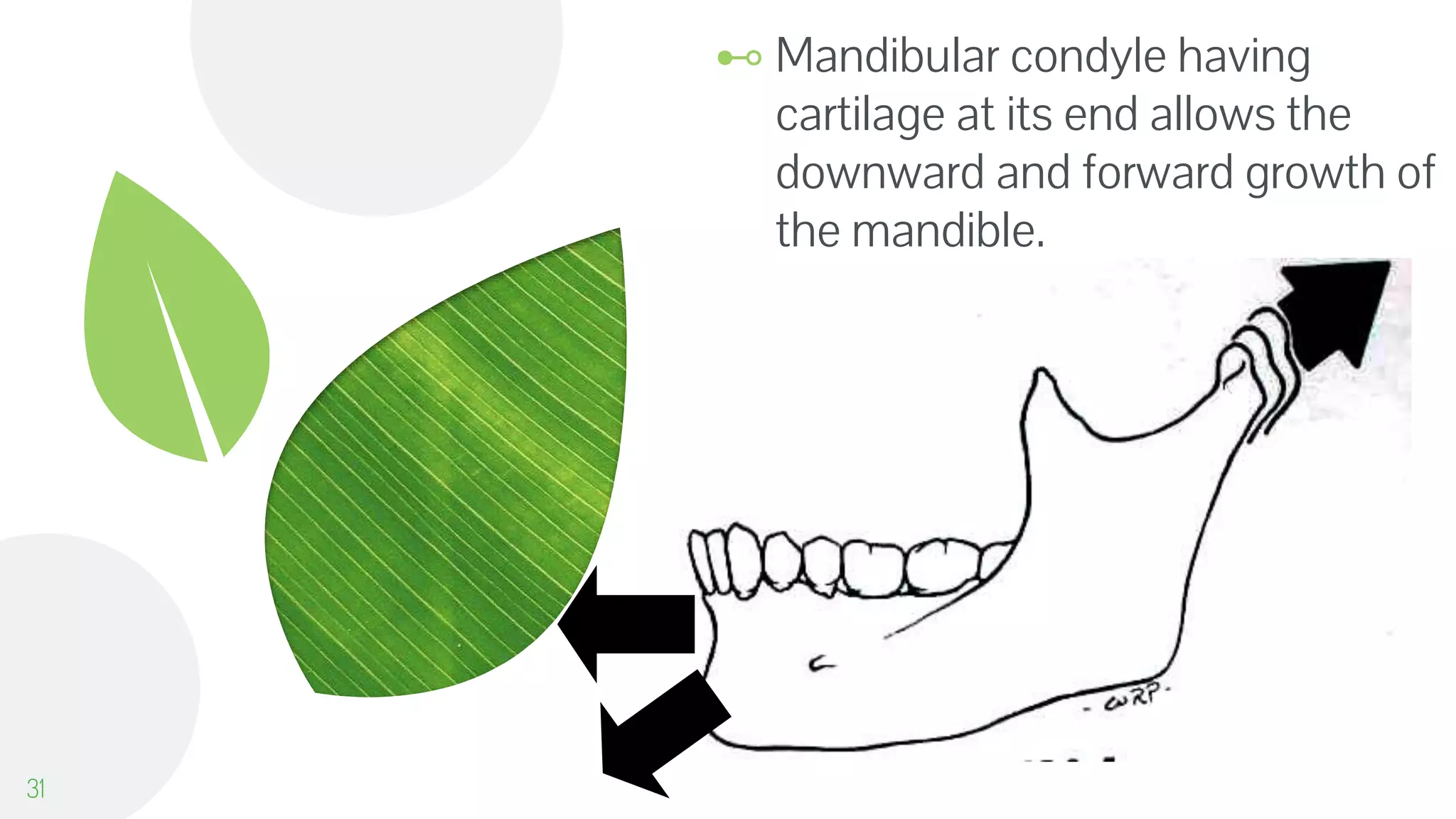
⊷ Mandibular condyle having
cartilage at its end allows the
downward and forward growth of
the mandible.
31
Two approaches to test
1) cartilage was transplanted into
the in vitro cultures
Result: cartilage grew as nearly
as it did in vivo
32
2) the cartilage was removed
from the nasal septum
33
⊷The deformities can be due to
interference of blood supply
associated with surgery.
⊷Condyle regenerates after a trauma
which otherwise should have ended in
growth deformities.
Demerits
34
Functional
matrix
hypothesis
Melvin moss 1962
35
The functional matrix theory claims
that origin ,growth , form , position
and maintenance of all skeletal
tissue are secondary
compensatory and obligatory
responses to temporary and
operationally prior events or
processes that occur in
specifically related non skeletal
tissues, organs or functioning
spaces .
36
Components
HEAD
Functional matrix
2)Capsular matrix
Skeletal unit
Micro-skeleton
Macro skeleton
37
1)Periosteal
Matrix
Growth
Transformation
+
Transilation
Functional Cranial Component
⊷ Each FCC is composed of 2 parts
⊶ Functional matrix
⊶ Skeletal Unit
⊷ Functional matrix
which carries out function. Refers to all soft
tissue & spaces that perform a given
function
⊷ Skeletal Unit
role is to protect &or support its specific
functional matrix. Refers to bony structure
that support functional matrix38
⊷ Composed of –-- bone, cartilage and tendinous tissue
⊷ Subdivided into
⊷ MICROSKELETAL UNIT
bones consisting of a number of small skeletal units
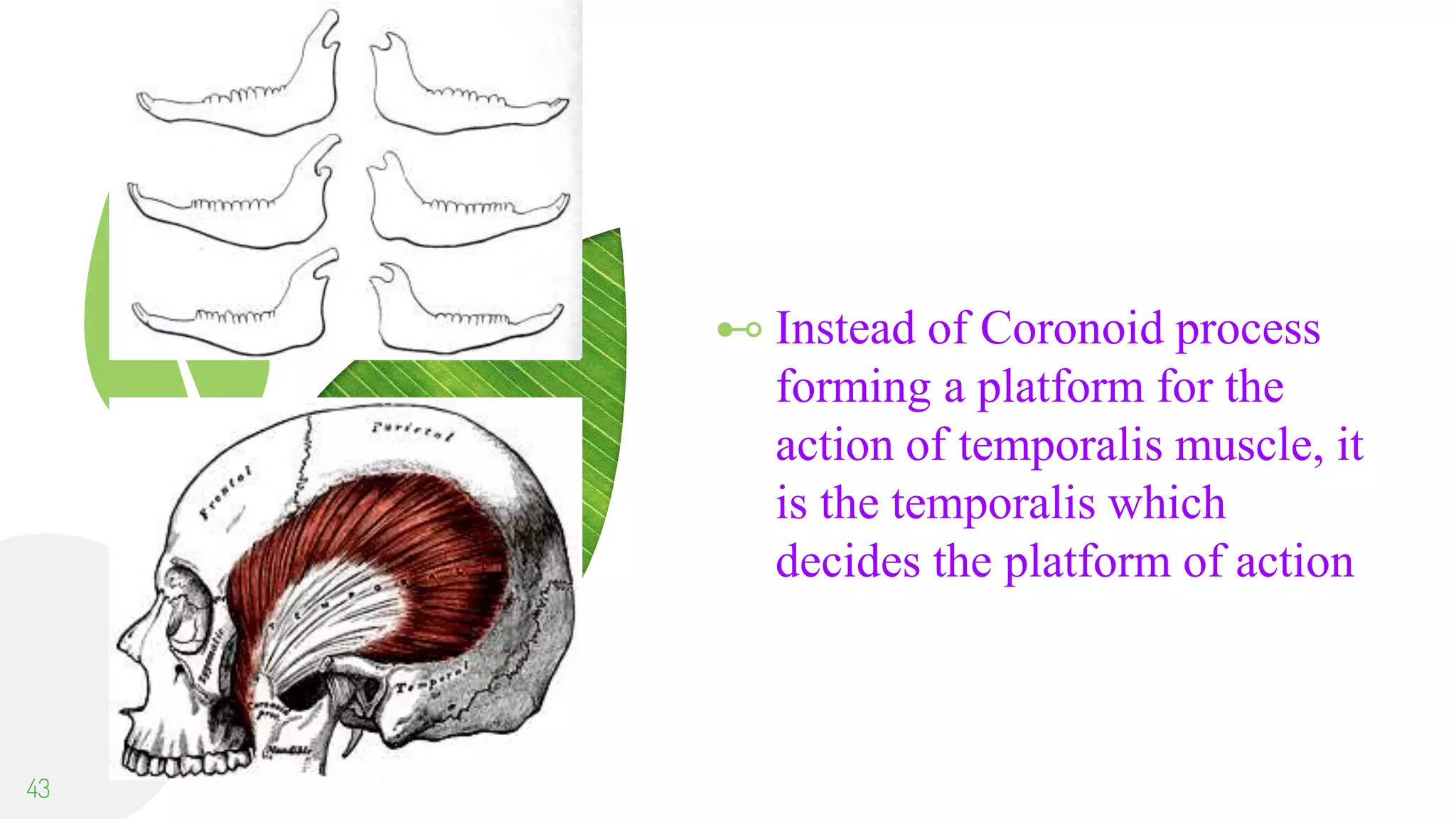
Coronoid-- temporalis
Angular--Masseter and medial pterygoid
Alveolar-- Presence and position of teeth
39
Skeletal Unit
⊷ MACROSKELETAL UNIT
When adjoining bones
unite to function as a single
component
40
Functional Matrix
⊷ which carries out function
⊷ Not only includes “soft tissues” i.e. muscles,
glands, nerves, vessels, fat, etc but also teeth
⊷ Inclusive – functioning spaces
⊷ The functional matrices are of two basic types:
⊶ Periosteal matrices
⊶ Capsular matrices
41
Periosteal Matrices
⊷ Corresponds to immediate local environment
⊶ Typically muscles, blood vessels, and nerves
⊷ Affects deposition and resorption of adjacent bony
tissue, ----- controls remodeling and the size and
shape of a bone.
⊷ Example --– coronoid process and temporalis muscle
⊷ Removal, denervation, postinfectively --- decrease
in size or total disappearance
⊷ Similarly hypertrophy or hyperactivity - alteration of
size & shape of coronoid process
42
⊷ Instead of Coronoid process
forming a platform for the
action of temporalis muscle, it
is the temporalis which
decides the platform of action
43
Capsular Matrix
⊷ Defined as organ & spaces that occupy a broader
anatomic complex
⊷ Include --- Brain, globe of eye, and spaces such
as nasopharynx. Oropharynx
⊷ As capsular matrix expand, all the bones grow to
maintain physiologic space
⊷ Changes in size & shape of macroskeletal unit is
by expansion of capsular matrix
44
⊷ Four cranial capsules are
⊶ Neurocranial capsule
⊶ Orofacial capsule
⊶ Otic capsule
⊶ Orbital capsule
45
Clinical Implications
Periosteal matrix
(teeth)
Capsular matrix
(dento facial Orthopedics)
Micro skeletal unit
(alveolar bone)
Macroskeletal unit (jaw)
46
47
⊷ Examples to support this
theory
⊷ Growth of cranial vault is
directly a response of
growth of brain.
⊷ Enlarged or small eye will
correspondingly change the
size of orbit.
48
Demerits
⊷ In hydrocephalic patients the size
of brain is small but the cranial
vault is bigger.
49
50
Functional Matrix Hypothesis could not describe
How extrinsic, epigenetic functional matrix
stimuli are transduced into regulatory signals by
individual bone cells
or
How individual cells communicate to produce
co-ordinated multicellular responses
Functional matrix
hypothesis
Revisited
1997
51
⊸ Role of mechanotransduction
⊸ Role of an osseous connected
cellular network
⊸ Genomic thesis
⊸ The epigenetic antithesis
52
Mechanotransuduction
⊷ All vital cells are irritable & respond to
alternations to external environment
⊷ Mechanosensing is a process which
enables cells to sense by using :
Mechanoreception
Mechanotransduction
⊷ Mechanoelectric & Mechanochemical53
Role of Connected cellular network
 All bone cells are interconnected
→Gap junction
 Gap junction connects
 Osteons to interstitial regions
 Superfcial osteoblasts-
periosteal and endosteal
osteoblast
55
PFM stimuli
Intercellular signals(transduction)
Multicellular level (hidden layer, final layer)
Output
Bone adaptation
56
Genomic thesis
⊷ Genes make us, body and mind
Dawkins ( The selfish gene)
⊷ Only 10% of genome is related to
ontogenesis
⊷ Regulate metabolic and respiratory
activity of all cells
• Regulate specific activity of special cell
⊷ (neurons, osteoblasts)57
Housekeeping
Genes
Structural
Genes
Orthodontic implications
⊷ Defect in the regulatory activity of
genes or gene expression governing
the size of the teeth and jaws
⊷ Malocclusion and dentofacial
deformities
58
Epigenetic anti thesis
⊷ Mechanical forces
⊷ Epigenetic signals
⊷ Dental papilla cells
⊷ Control of genetic expression
of differential tooth form
59
Revisited FMH Offers an
explanatory chain extending
from the epigenetic event of
skeletal muscle contraction,
down through the cellular and
molecular levels
Morphogenesis is regulated by both
genomic and epigenetic processes,
mechanisms
60
Van
limborg’s
Concept
1970
61
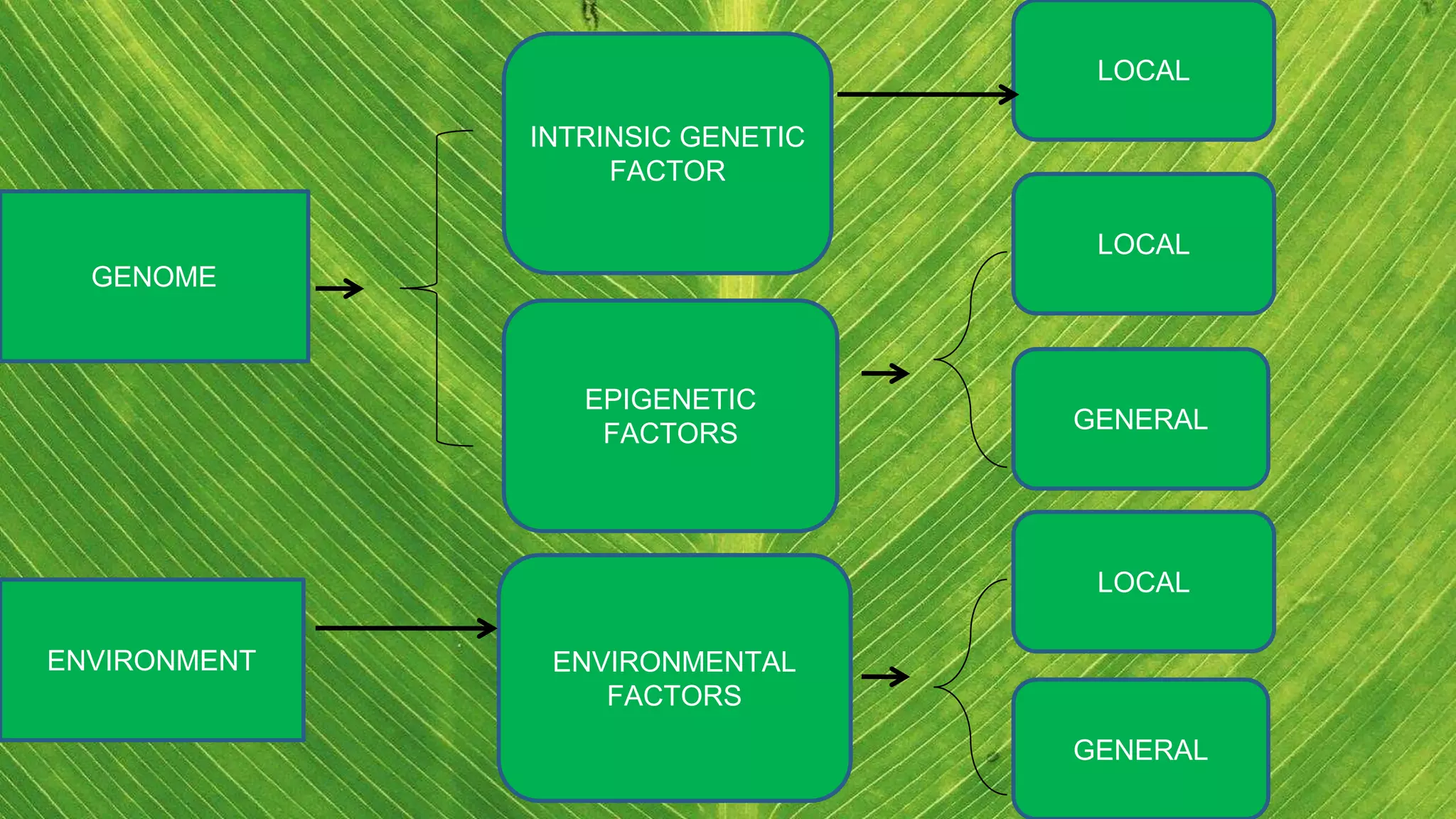
GENOME
ENVIRONMENT
INTRINSIC GENETIC
FACTOR
EPIGENETIC
FACTORS
LOCAL
ENVIRONMENTAL
FACTORS
GENERAL
LOCAL
LOCAL
GENERAL
⊷ Intrinsic genetic factors -- inside cells --
determine the potentialities of the cells
⊷ Epigenetic factors -- genetically
determined expression outside cells
⊷ Local epigenetic factors – indirectly by
intermediary action on associated
structures.
E.g.: brain, eyes.
⊷ General epigenetic factors --genetic
factors determining growth from distant
structures.
E.g.: Sex hormones, growth hormone, etc.
63
⊷ Local environmental factors --
non-genetic factors from local
external environment
E.g.: Habits, muscle force, etc.
⊷ General environmental factors -
- general non-genetic
influences
E.g.:oxygen, nutrition etc.
64
Van Limborg summarize his theory
as
⊷ Chondro-cranial growth is mainly
controlled by intrinsic genetic
factor.
⊷ Desmo –cranial growth
controlled by intrinsic genetic
factor
⊷ Cartilaginous part of skull is the
growth center.
65
⊷ Sutural growth is controlled by
influence from skull cartilage.
⊷ Periosteal growth depends upon
growth of adjacent structures.
⊷ Sutures and periosteal growth is
governed by non-genetic
environmental factors.
66
Servo system
Theory
PETROVIC, STUTZMAN ,1974
67
⊷ Using the language of
cybernetics, Petrovic
reasons that it is the
interaction of series of
casual changes of
feedback mechanisms
which determine the
growth of cranio-facial
regions.
68
Principle
When provided an input (
stimulus ), the input is
processed & an output is
produced
Output may/maynot be
relayed to Input by transfer
function
69
INPUT
OUTPUT
PROCESS
70
70
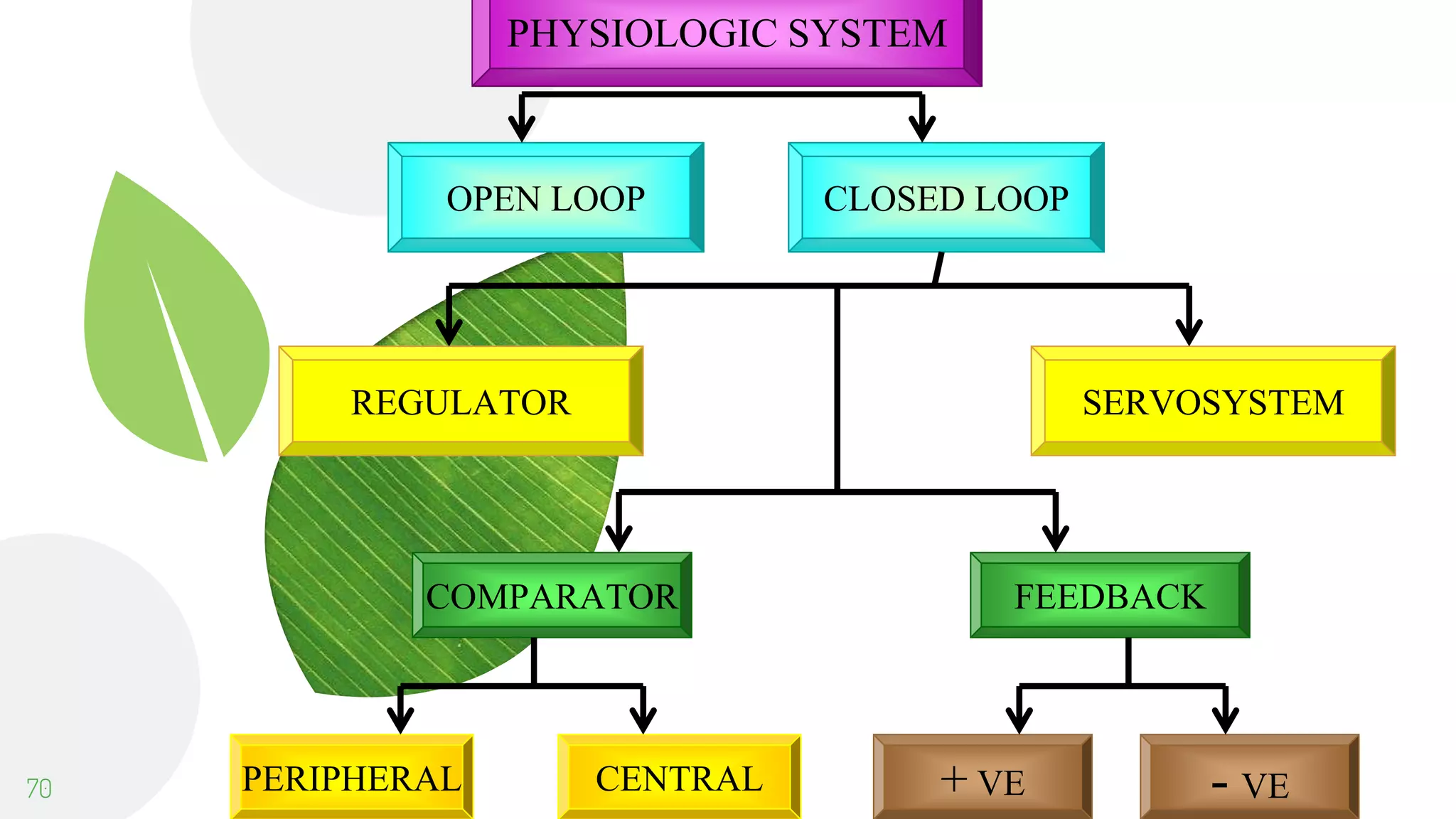
PHYSIOLOGIC SYSTEM
OPEN LOOP CLOSED LOOP
REGULATOR SERVOSYSTEM
COMPARATOR FEEDBACK
PERIPHERAL - VECENTRAL + VE
Drawbacks
⊷ Lot of importance on condyle — if Fracture ?
Growth should seize ---- Studies show this does not
happen
⊷ Importance of hormones: Do not have large role to play
⊷ Peripheral comparator (occlusion disharmony)
⊶ discrepancies may be overcome by Dentoalveolar
changes rather than growth of mand
71
Neurotrophim
BEHRENT, MOSS ,1976
72
⊷ Nervous system apart from
conducting afferent and
efferent is also concerned
with the integrity of body and
controls skeletal growth by
transmission of substances
through its axons -
73
Neurotrophism Act
⊶ Directly
⊶ Indirectly
Theoretically
⊷ Direct effect on osteogenesis is possible -----
not demonstrated
⊷ Indirectly ---- act by the inducing & affecting
soft-tissue growth & function, which in turn
would control or modify skeletal growth
74
75
Function by transport of neurosecretory material along nerve tracts
3 Mechanics
1. Neuro-epithelial trophism
⊶ Epithelial mitosis and synthesis is
neurotrophically controlled.
⊶ Eg : taste buds is dependent on intact
innervation
76
2. Neuro-visceral trophism
⊶ Salivary gland, fat tissues
are partly tropically
regulated.
77
⊷ Neuro –muscular trophism
Innervation is required at the
myoblast stage of differentiation.
78
Enlows
Principles
Donald Enlow 1984
79
Expanding V principle
⊷ Growth movements &
enlargements of bones occur
towards the wide ends of the ‘V’ as
a result of differential deposition &
selective resorption of bone
⊷ Bone deposition occurs on the
inner side of the ‘V’ and bone
resorption on the outer surface.
80
Counterpart Principle
⊷ This principle states that
growth of any facial or
cranial part relates
specifically to other structural
and geometric counterparts
in face and cranium
81
A.C.F
N.M.C
Max
Mand
Ramus
M.C.F
NMC
Conclusion
⊷ Initially all the attempts to understand
the concept of growth were at simple
genetic level.
⊷ Now we are beginning to recognize the
problems that are involved with them
and the concepts of growth has
changed and has been re –evaluated
82
References⊷ Contemporary Orthodontics---- Proffit
⊷ The primary role of functional matrices in facial growth – AJO-DO 1969 Jun
⊷ Genetics and orthodontics: digging secrets of the past-verma VK, Panda S,
Sachan A,
⊷ Enlow, D. H. (1984-01-01). "The "V" principle". American Journal of Orthodontics.
85 (1): 96.
⊷ ’ function matrix theory—Revisited Review Article Orthodontic Waves,
Stephanos Kyrkanides, , Todd Moore, , Jen-nie H. Miller, , Ross H. Tallents,
⊷ Growth Mechanisms and regulation theories : A summary Dr.Hani Alhebshi ..
⊷ Darwin's multicellularity: from neurotrophic theories and cell competition to
fitness fingerprints EduardoMorenoChristaRhiner
⊷ Cranial growth centers: Facts or fallacies K Koski - 1968
83
Thank you
84

Theories of growth and development

  • 1.
  • 2.
  • 3.
    CONTENTS ⊷Introduction to Growth& Development ⊷Theories of growth and development  Bone remodelling theory  Genetic theory  Scotts cartilaginous theory  Sutural dominance theory  Functional matrix theory  FMT – revisited  Von Limborghs theory ⊷ Other theories related to craniofacial growth  Cybernetics  Neurotropism  Enlow’s expanding V priciple ⊷Conclusion 3
  • 4.
    INDRODUCTION Growth and developmentis a set of extraordinarly complex programs that occur during the transformation of a being from an embriyo into matured organism
  • 5.
    Growth ⊷ Growth refersto increase in size or number 5
  • 6.
    Development ⊷ Development refersto all the naturally occurring unidirectional changes in the life of an individual from its existence as a single cell to its elaboration as a multifunctional unit terminating in death. 6
  • 7.
    Growth centre ⊷ Alocation at which independent growth occurs. ⊷ Controlled genetically Growth site ⊷ A location at which growth occurs as a response to a stimuli 7
  • 8.
    Growth centres ⊷ Growthcentre is a site of endochondral ossification with tissue separating force, contributing to increase in skeletal mass 8
  • 9.
    ⊷ Maxilla Prenatal Postnatal ⊷ septoethimoidal cartilage ⊷ Mandible Prenatal 9
  • 10.
    Growth sites ⊷ regionsof periosteal or sutural bone formation and modelling resorption adaptive to environmental influences. 10
  • 11.
    Growth sites ⊷ Maxilla ⊷Spheno occipital synchondrosis ⊷ lateral cranial base. ⊷ Maxillary tuberocity ⊷ Midpalatine suture ⊷ Alveolar ridge ⊷ Mandible ⊷ Symphysis ⊷ Para symphysis ⊷ Alveolar ridge ⊷ Posterior ramal border 11
  • 12.
  • 13.
    Bone remodelling theory Principal tenats ⊷1) Appositional growth ⊷ 2) Hunterian Growth ⊷ 3) Calvarialgrowth 13
  • 14.
    ⊷ Schematic RepresentationOf The Remodeling Theory Using Cranial Vault As Model 14
  • 15.
    Remodeling theory postulated thatall of craniofacial skeletal growth occurs exclusively by bone remodeling. ie by selective addition and resorption of bone at its surfaces Thus sutures & cartilages of craniofacial skeleton have little or no role in the growth 15
  • 16.
    It did notexplain the role of sutures, cranial base synchondroses, mandibular condyle or its cartilage Demerits 16
  • 17.
  • 18.
    Genetic theory ⊷ Thepersistent pattern of facial configuration is under genetic control and genes determine the overall growth control 18
  • 19.
    Application of thistheory ignored treatment of the bones of the face and focused on a more plastic dentoalveolar region The Genetic theory simply states that genes determine all Although called a theory, it was assumed than proven Demerits 19
  • 20.
  • 21.
    Sutural theory Controlling factors Intrinsicgenetic factors(major) Local environmental factors(minor) Intrinsic genetic factors(major) Local environmental factors(minor) Growth process Chondrocranial growth Desmocranial growth 21
  • 22.
    ⊷ This theorystates that sutures are the primary determinant of the craniofacial growth. ⊷ Expansion forces at the sutures lead to expansion of bone and thus growth of craniofacial skeleton. 22
  • 23.
    Examples ⊷ Growth ofcranial vault 24 Frontal suture
  • 24.
    ⊷ Growth ofcircum-maxillary suture system 25
  • 25.
    ⊷ Mandibule perceivedas a long bone grows downwards and forwards 26
  • 26.
    ⊷ Translatory growthof bones continue normally even in absence of sutures ⊷ In untreated cleft palate - suture is not present growth still takes place. ⊷ Auto transplants of sutures fail to grow in cultural medium though provided with same environment and conditions ⊷ The shape and growth within sutures is dependent on external stimuli. ⊷ Sutural growth -- halted by mechanical stresses applied across the sutures Demerits 27
  • 27.
  • 28.
    Cartilaginous Theory ⊷ Proponentsof this theory state that cartilage is responsible for the growth, and bone just replaces it. 29
  • 29.
    ⊷ Maxilla, consistingof the nasal septum and naso maxillary complex, which is made up of cartilage, moves forward and downward also by the forces from the nasal septum. 30
  • 30.
    ⊷ Mandibular condylehaving cartilage at its end allows the downward and forward growth of the mandible. 31
  • 31.
    Two approaches totest 1) cartilage was transplanted into the in vitro cultures Result: cartilage grew as nearly as it did in vivo 32
  • 32.
    2) the cartilagewas removed from the nasal septum 33
  • 33.
    ⊷The deformities canbe due to interference of blood supply associated with surgery. ⊷Condyle regenerates after a trauma which otherwise should have ended in growth deformities. Demerits 34
  • 34.
  • 35.
    The functional matrixtheory claims that origin ,growth , form , position and maintenance of all skeletal tissue are secondary compensatory and obligatory responses to temporary and operationally prior events or processes that occur in specifically related non skeletal tissues, organs or functioning spaces . 36
  • 36.
    Components HEAD Functional matrix 2)Capsular matrix Skeletalunit Micro-skeleton Macro skeleton 37 1)Periosteal Matrix Growth Transformation + Transilation Functional Cranial Component
  • 37.
    ⊷ Each FCCis composed of 2 parts ⊶ Functional matrix ⊶ Skeletal Unit ⊷ Functional matrix which carries out function. Refers to all soft tissue & spaces that perform a given function ⊷ Skeletal Unit role is to protect &or support its specific functional matrix. Refers to bony structure that support functional matrix38
  • 38.
    ⊷ Composed of–-- bone, cartilage and tendinous tissue ⊷ Subdivided into ⊷ MICROSKELETAL UNIT bones consisting of a number of small skeletal units Coronoid-- temporalis Angular--Masseter and medial pterygoid Alveolar-- Presence and position of teeth 39 Skeletal Unit
  • 39.
    ⊷ MACROSKELETAL UNIT Whenadjoining bones unite to function as a single component 40
  • 40.
    Functional Matrix ⊷ whichcarries out function ⊷ Not only includes “soft tissues” i.e. muscles, glands, nerves, vessels, fat, etc but also teeth ⊷ Inclusive – functioning spaces ⊷ The functional matrices are of two basic types: ⊶ Periosteal matrices ⊶ Capsular matrices 41
  • 41.
    Periosteal Matrices ⊷ Correspondsto immediate local environment ⊶ Typically muscles, blood vessels, and nerves ⊷ Affects deposition and resorption of adjacent bony tissue, ----- controls remodeling and the size and shape of a bone. ⊷ Example --– coronoid process and temporalis muscle ⊷ Removal, denervation, postinfectively --- decrease in size or total disappearance ⊷ Similarly hypertrophy or hyperactivity - alteration of size & shape of coronoid process 42
  • 42.
    ⊷ Instead ofCoronoid process forming a platform for the action of temporalis muscle, it is the temporalis which decides the platform of action 43
  • 43.
    Capsular Matrix ⊷ Definedas organ & spaces that occupy a broader anatomic complex ⊷ Include --- Brain, globe of eye, and spaces such as nasopharynx. Oropharynx ⊷ As capsular matrix expand, all the bones grow to maintain physiologic space ⊷ Changes in size & shape of macroskeletal unit is by expansion of capsular matrix 44
  • 44.
    ⊷ Four cranialcapsules are ⊶ Neurocranial capsule ⊶ Orofacial capsule ⊶ Otic capsule ⊶ Orbital capsule 45
  • 45.
    Clinical Implications Periosteal matrix (teeth) Capsularmatrix (dento facial Orthopedics) Micro skeletal unit (alveolar bone) Macroskeletal unit (jaw) 46
  • 46.
  • 47.
    ⊷ Examples tosupport this theory ⊷ Growth of cranial vault is directly a response of growth of brain. ⊷ Enlarged or small eye will correspondingly change the size of orbit. 48
  • 48.
    Demerits ⊷ In hydrocephalicpatients the size of brain is small but the cranial vault is bigger. 49
  • 49.
    50 Functional Matrix Hypothesiscould not describe How extrinsic, epigenetic functional matrix stimuli are transduced into regulatory signals by individual bone cells or How individual cells communicate to produce co-ordinated multicellular responses
  • 50.
  • 51.
    ⊸ Role ofmechanotransduction ⊸ Role of an osseous connected cellular network ⊸ Genomic thesis ⊸ The epigenetic antithesis 52
  • 52.
    Mechanotransuduction ⊷ All vitalcells are irritable & respond to alternations to external environment ⊷ Mechanosensing is a process which enables cells to sense by using : Mechanoreception Mechanotransduction ⊷ Mechanoelectric & Mechanochemical53
  • 53.
    Role of Connectedcellular network  All bone cells are interconnected →Gap junction  Gap junction connects  Osteons to interstitial regions  Superfcial osteoblasts- periosteal and endosteal osteoblast 55
  • 54.
    PFM stimuli Intercellular signals(transduction) Multicellularlevel (hidden layer, final layer) Output Bone adaptation 56
  • 55.
    Genomic thesis ⊷ Genesmake us, body and mind Dawkins ( The selfish gene) ⊷ Only 10% of genome is related to ontogenesis ⊷ Regulate metabolic and respiratory activity of all cells • Regulate specific activity of special cell ⊷ (neurons, osteoblasts)57 Housekeeping Genes Structural Genes
  • 56.
    Orthodontic implications ⊷ Defectin the regulatory activity of genes or gene expression governing the size of the teeth and jaws ⊷ Malocclusion and dentofacial deformities 58
  • 57.
    Epigenetic anti thesis ⊷Mechanical forces ⊷ Epigenetic signals ⊷ Dental papilla cells ⊷ Control of genetic expression of differential tooth form 59
  • 58.
    Revisited FMH Offersan explanatory chain extending from the epigenetic event of skeletal muscle contraction, down through the cellular and molecular levels Morphogenesis is regulated by both genomic and epigenetic processes, mechanisms 60
  • 59.
  • 60.
  • 61.
    ⊷ Intrinsic geneticfactors -- inside cells -- determine the potentialities of the cells ⊷ Epigenetic factors -- genetically determined expression outside cells ⊷ Local epigenetic factors – indirectly by intermediary action on associated structures. E.g.: brain, eyes. ⊷ General epigenetic factors --genetic factors determining growth from distant structures. E.g.: Sex hormones, growth hormone, etc. 63
  • 62.
    ⊷ Local environmentalfactors -- non-genetic factors from local external environment E.g.: Habits, muscle force, etc. ⊷ General environmental factors - - general non-genetic influences E.g.:oxygen, nutrition etc. 64
  • 63.
    Van Limborg summarizehis theory as ⊷ Chondro-cranial growth is mainly controlled by intrinsic genetic factor. ⊷ Desmo –cranial growth controlled by intrinsic genetic factor ⊷ Cartilaginous part of skull is the growth center. 65
  • 64.
    ⊷ Sutural growthis controlled by influence from skull cartilage. ⊷ Periosteal growth depends upon growth of adjacent structures. ⊷ Sutures and periosteal growth is governed by non-genetic environmental factors. 66
  • 65.
  • 66.
    ⊷ Using thelanguage of cybernetics, Petrovic reasons that it is the interaction of series of casual changes of feedback mechanisms which determine the growth of cranio-facial regions. 68
  • 67.
    Principle When provided aninput ( stimulus ), the input is processed & an output is produced Output may/maynot be relayed to Input by transfer function 69 INPUT OUTPUT PROCESS
  • 68.
    70 70 PHYSIOLOGIC SYSTEM OPEN LOOPCLOSED LOOP REGULATOR SERVOSYSTEM COMPARATOR FEEDBACK PERIPHERAL - VECENTRAL + VE
  • 69.
    Drawbacks ⊷ Lot ofimportance on condyle — if Fracture ? Growth should seize ---- Studies show this does not happen ⊷ Importance of hormones: Do not have large role to play ⊷ Peripheral comparator (occlusion disharmony) ⊶ discrepancies may be overcome by Dentoalveolar changes rather than growth of mand 71
  • 70.
  • 71.
    ⊷ Nervous systemapart from conducting afferent and efferent is also concerned with the integrity of body and controls skeletal growth by transmission of substances through its axons - 73
  • 72.
    Neurotrophism Act ⊶ Directly ⊶Indirectly Theoretically ⊷ Direct effect on osteogenesis is possible ----- not demonstrated ⊷ Indirectly ---- act by the inducing & affecting soft-tissue growth & function, which in turn would control or modify skeletal growth 74
  • 73.
    75 Function by transportof neurosecretory material along nerve tracts
  • 74.
    3 Mechanics 1. Neuro-epithelialtrophism ⊶ Epithelial mitosis and synthesis is neurotrophically controlled. ⊶ Eg : taste buds is dependent on intact innervation 76
  • 75.
    2. Neuro-visceral trophism ⊶Salivary gland, fat tissues are partly tropically regulated. 77
  • 76.
    ⊷ Neuro –musculartrophism Innervation is required at the myoblast stage of differentiation. 78
  • 77.
  • 78.
    Expanding V principle ⊷Growth movements & enlargements of bones occur towards the wide ends of the ‘V’ as a result of differential deposition & selective resorption of bone ⊷ Bone deposition occurs on the inner side of the ‘V’ and bone resorption on the outer surface. 80
  • 79.
    Counterpart Principle ⊷ Thisprinciple states that growth of any facial or cranial part relates specifically to other structural and geometric counterparts in face and cranium 81 A.C.F N.M.C Max Mand Ramus M.C.F NMC
  • 80.
    Conclusion ⊷ Initially allthe attempts to understand the concept of growth were at simple genetic level. ⊷ Now we are beginning to recognize the problems that are involved with them and the concepts of growth has changed and has been re –evaluated 82
  • 81.
    References⊷ Contemporary Orthodontics----Proffit ⊷ The primary role of functional matrices in facial growth – AJO-DO 1969 Jun ⊷ Genetics and orthodontics: digging secrets of the past-verma VK, Panda S, Sachan A, ⊷ Enlow, D. H. (1984-01-01). "The "V" principle". American Journal of Orthodontics. 85 (1): 96. ⊷ ’ function matrix theory—Revisited Review Article Orthodontic Waves, Stephanos Kyrkanides, , Todd Moore, , Jen-nie H. Miller, , Ross H. Tallents, ⊷ Growth Mechanisms and regulation theories : A summary Dr.Hani Alhebshi .. ⊷ Darwin's multicellularity: from neurotrophic theories and cell competition to fitness fingerprints EduardoMorenoChristaRhiner ⊷ Cranial growth centers: Facts or fallacies K Koski - 1968 83
  • 82.

Editor's Notes

  • #6  This have been alreadt taken by dr ann. Profitt in 1986 In simple terms growth is an increase in size for example in my case I was an embryo who grew into 4 kg baby …and right now is big 82 kgs who has to be pushed around to get things done Stewart(1982)- developmental increase in mass Moyer(1988)-change in the amount of living substance j.S Huxley – the self multiplication of living substance Krogman – increase in size,change in proportion and progressive complexity Todd – an increase in size
  • #7 Moyers in 1988 Development simply can be explained like this when we were born we had our food made for us , but us we grew older we wanted to try making our own food nd would get angry if our mom tried to help us even if we made a mess , as we grow older and developed we came to an understanding that life was more easier when our moms made it.
  • #8 Before we go into the theories certain terminologies has to be understood
  • #10 Septo ethimoidal junction of nasel cartilage According to profitt there is no Cranial growth centers: Facts or fallacies K Koski - ‎1968
  • #11 Baume
  • #12 growth occurs as a response to a stimulaius
  • #14 1) bone grows by apposition at surfaces; 2)growth ofmaxilla and mandible is characterized by deposition at posterior surface 3) calvarialgrowth occurs via ectocranial deposition and endocranial resorption.
  • #16 Which is false
  • #17 Role of sutures, cranial base synchondroses, mand condylar cartilage If these sites of bone growth are not essential for craniofacial growth Why are they present ?
  • #19 By the end of first half of 20thcentury, Brodie(1941) gave his Genetic Theoryof craniofacialgrowth, Mendelian genetics .Thus the primary role of orthodontist was to treat a malocclusion by moving teeth into a more harmonious position relative to the facial type; facial growth could not be affected by orthodontic treatment. This theory states that genes such as Homeobox, Sonic hedgehog, Transcription factor and IHH (protein) play an important role in craniofacial development.
  • #20 . If orthodontists be-lieved that they could not alter facial growth, the best they could do would be o strive for an acceptable dental alignment. Treatment with twin block or face mask will be of not have came into existance
  • #21 Sicher & Weinmann prominent Anatomists 1940’s
  • #22 According to sicher the growth of the skull tissue is controlled by its own genetic potential All bone forming elements like cartilages ,periosteum and sutres are growth centres But its called suture dominance because connective tissue proliferation and its replacement is the major event
  • #23 This theory was popularized by Sicher in 1941 which states. Sicher theorized that tissues such as periosteum, Cartilage and sutures are growth centers just like epiphysis of the long bone that allow the bone to form. He said that growth of maxilla happens at expansion of the circummaxillary sutures which push maxilla down and forward. Evidence says that sutures are growth sites that respond intrinsically to signals
  • #25  Cranial vault increases in size via the primary growth of bone that happens at the suture proliferative growth by sutural C.T that forces the bones of the vault away from each other sutural growth for determination of adult form
  • #26 Proliferation of sutural C.T in circum-maxillary suture system - surrounding the max skeletal complex : forces mid face to grow down & forward
  • #27 mand condyle cartilage = epiphyseal plates of long bone Grows away from cranial base
  • #28 Difference in skull size in micro and macro cephaly are not in accordance with suture size Experimental studies involving vital dyes & surgical manipulation of cranial sutures in animal model demonstrated that, although sutures were sites of craniofacial skeletal growth, they played no determining role in growth
  • #29 James H. Scott was not convinced with the Sutural Theory . Nasel septum theory
  • #30 This theory was popularized by Scott in 1950s and states that cartilage determines the craniofacial growth.
  • #31 Principal that cartilage is pressure adapted tissue and growth of the cartilage in nasel septum provides a force that displace maxilla downward and forward Bones in both maxilla and mandible respond to their respective cartilaginous growth centers And sutural growth s=is passive and secondary to cartilagenous growth
  • #32 Bones in both maxilla and mandible respond to their respective cartilaginous growth centers
  • #33 To test this theory, two approaches were taken by researchers in past. or the cartilage was transplanted into the cultures to see the effects on the growth. When the cartilage was transplanted into the in vitro cultures, it was found that the cartilage from nasal septum grew as nearly as it did in vivo.. Therefore, cartilage at condyle, cranial base synchondroses and nasal septum can act as growth centers.
  • #34 Resulted in mid face deformities in rabits Midfacial deformities also were seen in syndromes due to improper development of nasal septum.
  • #35 Mid-face deformities could be due to surgery itself and the accompanying interference of the blood supply to that area. Studies showed that condylar process would regenerate to approximately its original size after trauma to the mandible which otherwise should have shown severe growth disturbances
  • #36 Melvin Moss dual trained Dentist-Anatomist -was based on work of vander klaauw “ Neither bone nor cartilage were determinant for the growth of craniofacial skeleton, it would appear that control would have to lie in adjacent soft tissue”
  • #37 He came into the scene “ Neither bone nor cartilage were determinant for the growth of craniofacial skeleton, it would appear that control would have to lie in adjacent soft tissue”
  • #38 head –many function –resp ,neural ,ingestion,hearing etc , Each function is carried out by tissues and spaces in head The tissue and spaces together FCC * 2 ( total tissue associated with a fn) FM : carries out function , SU : provides biomech role of support 2 distinct types PM : influence bone through periosteum eg temparalis , teeth , blood vessels nerves glands.- influence one part of bone Hence it effects micro skeleton CM : capsule that surrounds masses and spaces EG neural mass in scalp, orbit supporting eyes and its mass,oro nasel and pharyngeal Volumetric expansion of this space cause growth of macro skelton
  • #39 Functional cranial component i
  • #43 Periosteal Matrices: A periosteal functional matrix affects deposition and resorption of adjacent bony tissue, therefore the matrix controls remodeling and the size and shape of a bone. These are non-skeletal functioning units adjacent to the skeletal unit. Produce secondary – compensatory transformation Inserted variably Removal or denervation of Temporalis Functional hypertrophy or hyperactivity
  • #46 Neural capsusle : scalp- 5 layers skin,connective tisse, aponeurosi , loose areolar , periosteum bone: outer inner and middle 2 layers of dura matter Surrounds and protects oronasopharyngeal space. Surrounded by skin and mucous membrane on either side.
  • #47 Orthodonic correction by intra/extra oral appliance Force application tends to alter functional Matrix Altertion of perosteal and capsular matrix cause change
  • #48 RPE – widening of sutures Cleft patient repositioning alter macro Condylectomy – alters ancylosis , restores fn Inclined planes – holds mandible to stimulate growth of condyles Activator –condyles Frankels.. Periosteal matrix lip pad, shields, Distraction osteo genesis – Amod Class 2 elastics,head gear , face mask , shin cup , Relapse after surgery—causes Alterations in state of equilibrium of matrix ,Failure of matrix adaptation Altered muscle fibre length and position Treatment concept Reattach muscles to specific regions rather than permitting spontaneous reattachment
  • #51 Constraints in the initial version . . . Methodological Hierarchical
  • #52 CURRENT CONCEPT OF FUNCTIONAL MATRIX THEORY/RE-VISITATION -1997 Moss dicribes the relative roles of genomic and environmental processes and mechanisms that cause and control craniofacial growth and development , concluded both are necessary. Neither genetic nor epigenetic actors alone are sufficient, and only their integrated activities provide the necessary and sufficient cause of growth and development. Moss further considered genetic factors as intrinsic and prior causes and epigenetic as extrinsic and proximate
  • #53 CURRENT CONCEPT OF FUNCTIONAL MATRIX THEORY/RE-VISITATION -1997 and resolving synthesis
  • #54  ROLE OF . It is the process in which the macrocellular exrtrinsic stimuli are converted to cellular level signals There are several mechanotransductive processes, for example, mechanoelectrical and mechanochemical. Whichever are used, bone adaptation requires the subsequent intercellular transmission of the transduced signals. 2. All bone cells are interconnected through Gap junction .
  • #57 Initial layer cells (loading);stimuli Hidden layer cells (osteocytes) Final layer cells (osteoblasts) output output determines the site, rate, direction, magnitude and duration of specific adaptive response i.e deposition, resorption or maintenance of the skeletal tissue”.
  • #58 the development of an individual organism its anatomical or behavioural feature from the earliest stage to maturity.
  • #60 The other side of the coin Epigenetic processes and mechanisms has the capability of regulating the genomic activity
  • #61 Where the original Functional Matrix Hypothesis offered only verbal descriptions of periosteal matrix function and skeletal unit response, Their integrated activities provide the necessary and sufficient causes for growth and development
  • #62 VAN LIMBORG’S CONCEPT(VAN LIMBORG, 1970) According to him all the previous theories were not complete and acceptable but each had some elements of significance that cannot be denied.
  • #63 This made him postulate Van Limborg’s multifactorial theory. This theory suggested five factors that control growth.
  • #64 Intrinsic genetic factors : within cells ( cell differentiation ). Epigenetic factors : factors that are determined genetically but effective outside the cells and tissues. Local epigenetic : eg. Embryonic induction infuences. General epigenetic : eg, sex and growth hormones.
  • #65 Environmental factors : Local : eg ,muscular force. General : eg , food , oxygen supply.
  • #66 the primary skull of vertebrates, composed of cartilage, embryonic mesenchymal cells that develop into the cranium.
  • #67 General pigenetic Local epigenetic environmetal
  • #68 CYBERNETICS/SERVO-SYSTEM THEORY Theory of communication /science dealing with comparitive study of operations of complex computers of human nervous system.
  • #69 1st thing is terminator Cybernetics is the study of communication and control within and between humans, machines, organizations and society
  • #70 Command : Signal established independent of feedback system. It affects the behavior of the control system without being effected by the consequences of the behavior. E.g Secretion of growth hormone or testosterone is not modulated by variation in craniofacial growth.
  • #71 Open –Output has no effect on the input Closed - Specific rel maintained bet input & output The Regulator- In this system the main input is a constant. Any disturbances in the input will cause the comparator to initiate a “Regulatory feed back” system, which will restore the input to its normal state. E.g. Temperature changes in the body. The Servosystem or follow up system- In this system the main input is not a constant but varies across time and the output is adjusted in accordance with the input. Central Comparator Performance judging elements then transmit signal to the central comparator which sends a signal to various components which ultimately BRINGS ABOUT AN OUTPUT
  • #72 Change in mandible position must happen but its not happening
  • #73 NEUROTROPHISM (BEHRENT ,MOSS 1976)
  • #74  nervous system apart from conducting afferent and efferent is also concerned with the integrity of body . Nerve control of skeletal growth by transmission of substances through its axons is called as neurotrophism. There are three different types of neurtrophic mechanisms:
  • #77 Neuro-epithelial trophism Epithelial mitosis and synthesis is neurotrophically controlled. Normal epithelial growth is controlled by release of neurotrophic substances from nerve synapse. Presence of taste buds is dependent on intact innervation.
  • #78 Neuro-visceral trophism Salivary gland, fat tissues are partly tropically regulated.
  • #79 Neuro –muscular trophism Innervation is required at the myoblast stage of differentiation.
  • #80 Most basic and useful concept of growth.
  • #81  Many facial and cranial bones have a V shaped pattern of growth and the expansion of these occurs along the ends of V as a result of bone resorption and deposition.
  • #82 Enlow’s Counterpart Principle Balanced growth = Regional and corresponding counterparts enlarge to same extent Nasomaxillary complex ---- Ant cranial fossa Middle cranial fossa ---- Breadth of ramus Maxillary ---- Mandibular arches Max tuberosity ---- Lingual tuberosity
  • #83 It is a well known concept that growth is stronghly influenced by genetic factors but we must not rule out the role environment on the same. Until recently explanation of growth control process were regarded as more or less complete, with theories underlying them secure.