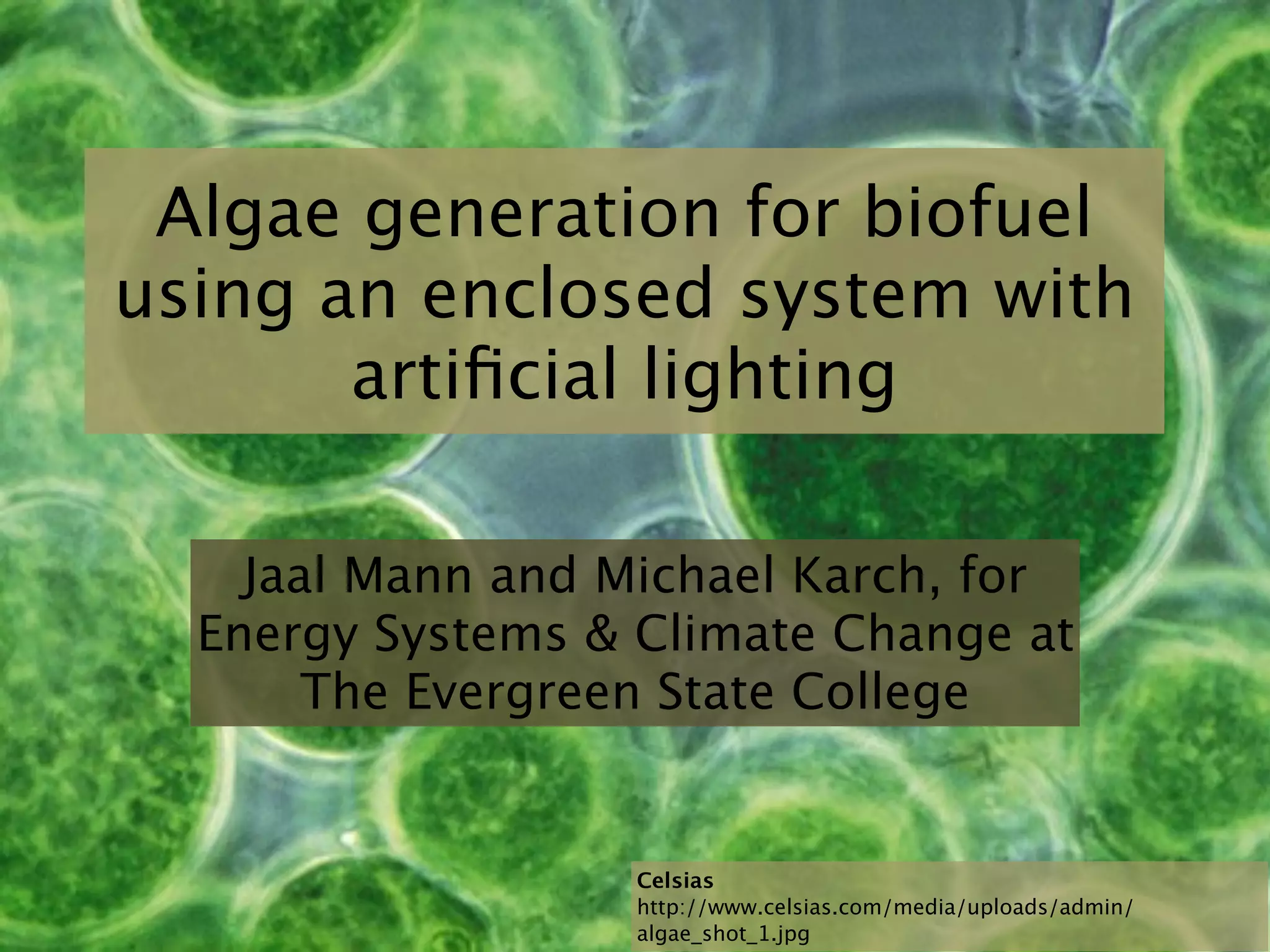
Algae generation for biofuel
using an enclosed system with
       artificial lighting

    Jaal Mann and Michael Karch, for
  Energy Systems & Climate Change at
       The Evergreen State College


                   Celsias
                   http://www.celsias.com/media/uploads/admin/
                   algae_shot_1.jpg
Fossil fuels are not sustainable


• Dwindling petroleum reserves
Fossil fuels are not sustainable


• Dwindling petroleum reserves
• CO2-caused global climate change
Fossil fuels are not sustainable


• Dwindling petroleum reserves
• CO2-caused global climate change


Sustainable alternatives to fossil fuel are
                  needed
Biofuels as a sustainable
alternative to fossil fuel
Biofuels as a sustainable
      alternative to fossil fuel


• Carbon neutral
Biofuels as a sustainable
      alternative to fossil fuel


• Carbon neutral
• Renewable
Biofuels as a sustainable
      alternative to fossil fuel


• Carbon neutral
• Renewable
• Cheaper than fossil fuel
Types of biofuel


• Traditional food-crop based
  -corn
  -sugar cane
  -soybean
Types of biofuel


• Non-food biomass based
  -oil palm
  -switch grass
  -algae
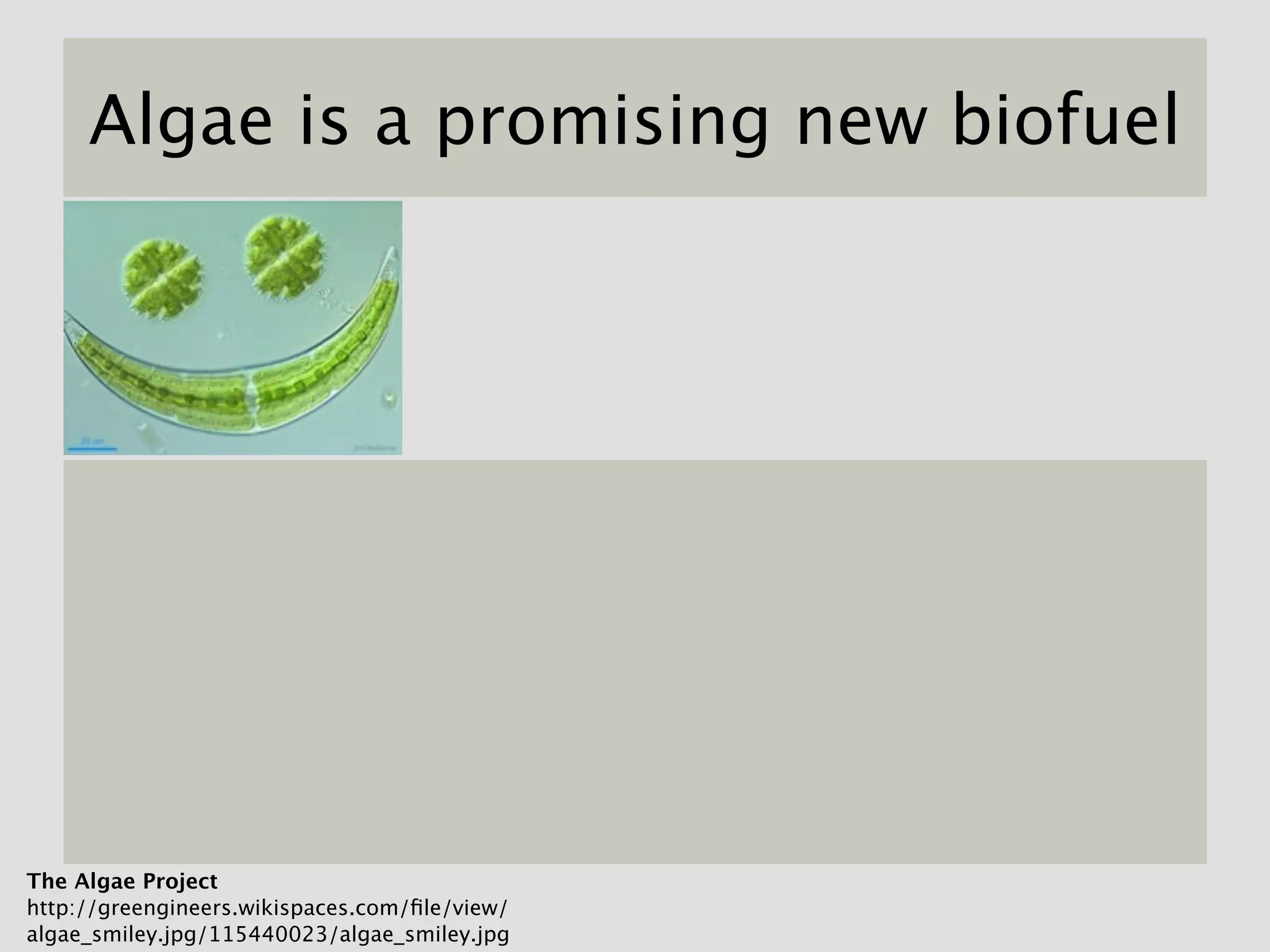
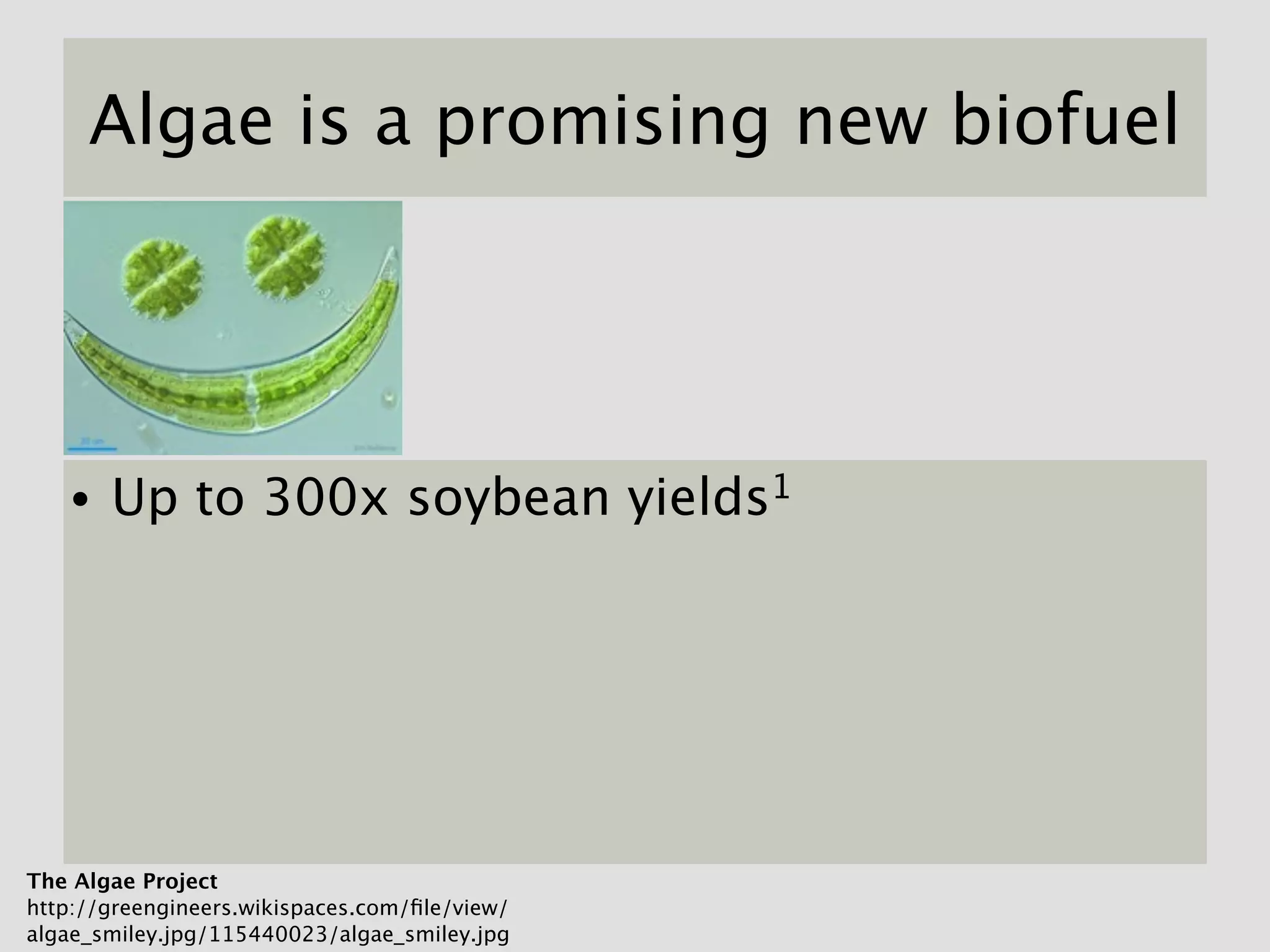
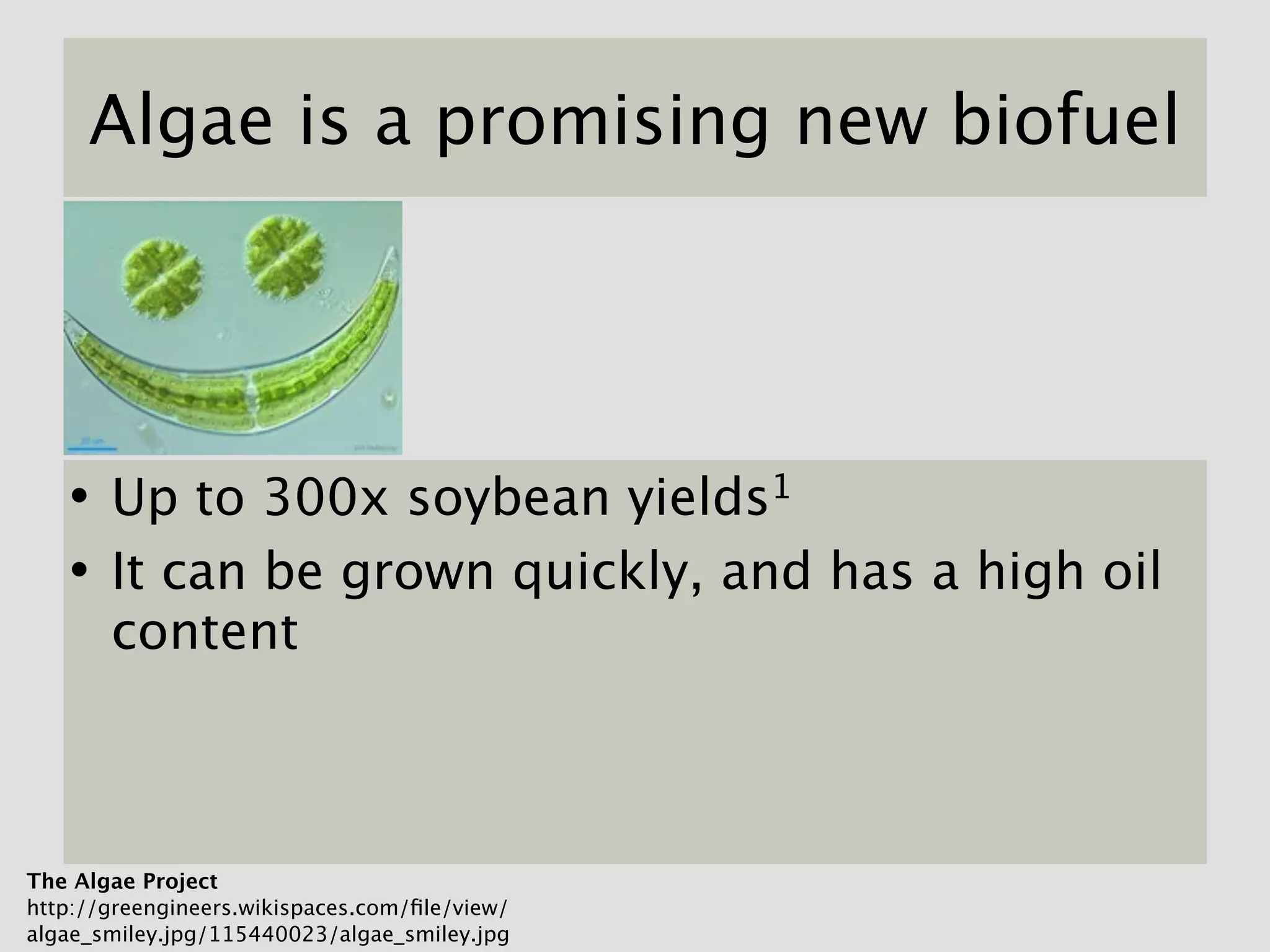
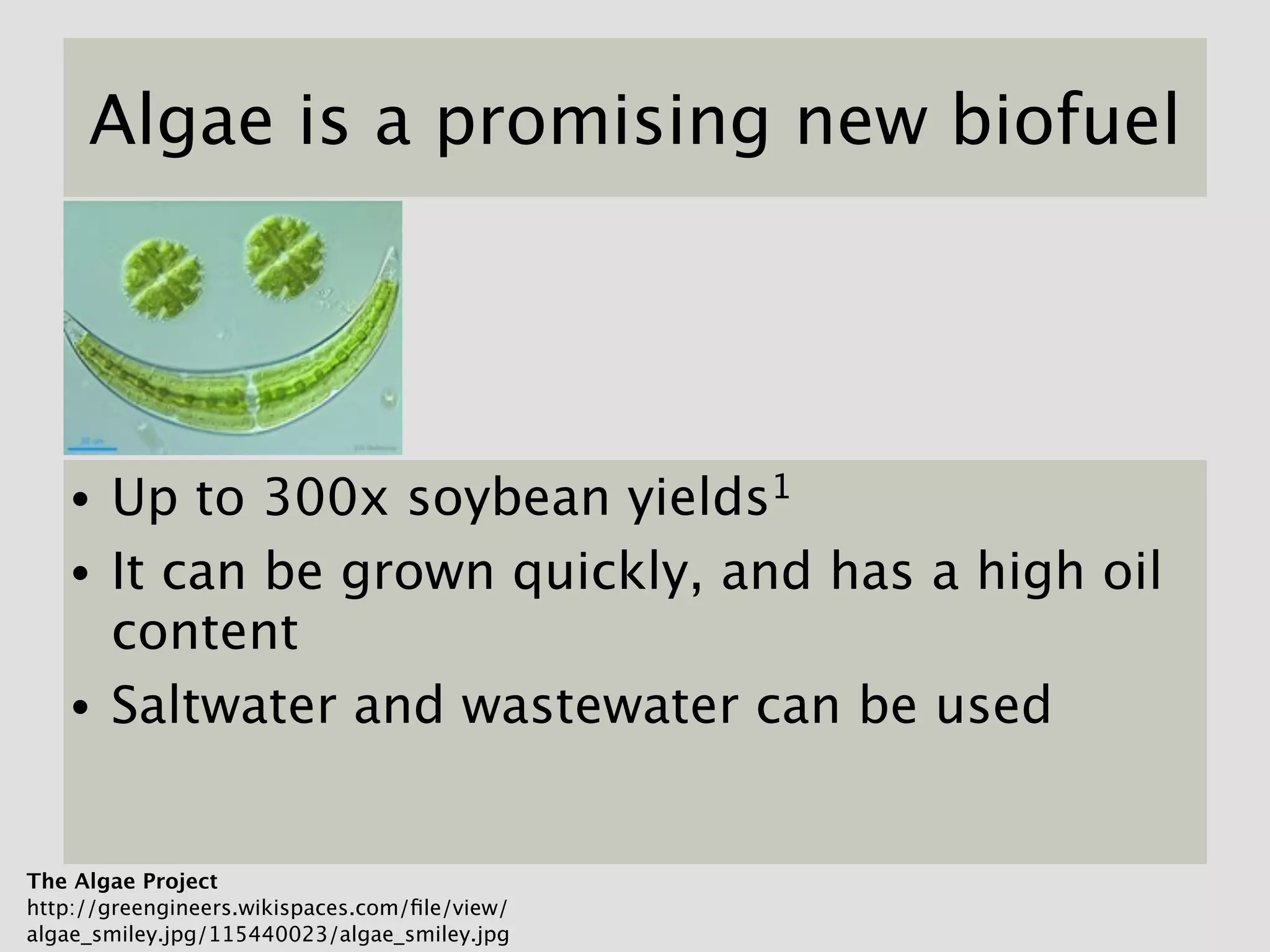
Algae is a promising new biofuel


The Algae Project
http://greengineers.wikispaces.com/file/view/
algae_smiley.jpg/115440023/algae_smiley.jpg
Algae is a promising new biofuel


   •   Up to 300x soybean yields1


The Algae Project
http://greengineers.wikispaces.com/file/view/
algae_smiley.jpg/115440023/algae_smiley.jpg
Algae is a promising new biofuel


   • Up to 300x soybean yields1
   • It can be grown quickly, and has a high oil
       content


The Algae Project
http://greengineers.wikispaces.com/file/view/
algae_smiley.jpg/115440023/algae_smiley.jpg
Algae is a promising new biofuel


   •   Up to 300x soybean yields1
   •   It can be grown quickly, and has a high oil
       content
   •   Saltwater and wastewater can be used


The Algae Project
http://greengineers.wikispaces.com/file/view/
algae_smiley.jpg/115440023/algae_smiley.jpg
How is algae traditionally
         grown?
How is algae traditionally
           grown?


• Open ponds
How is algae traditionally
           grown?


• Open ponds
• Raceway ponds
How is algae traditionally
            grown?


• Open ponds
• Raceway ponds
• Artificial light bioreactors
How is algae traditionally
          grown?


Can algae be grown in an enclosed artificial
light system cost-effectively and more
quickly than traditional methods?
What could make our enclosed
 artificial light system more
           efficient?
What could make our enclosed
  artificial light system more
            efficient?

• Cheap, clean hydro-electricity
What could make our enclosed
  artificial light system more
            efficient?

• Cheap, clean hydro-electricity
• 24/7/365 growing period
What could make our enclosed
  artificial light system more
            efficient?

• Cheap, clean hydro-electricity
• 24/7/365 growing period
• Efficient (9W usage) optimum-
  wavelength LEDs
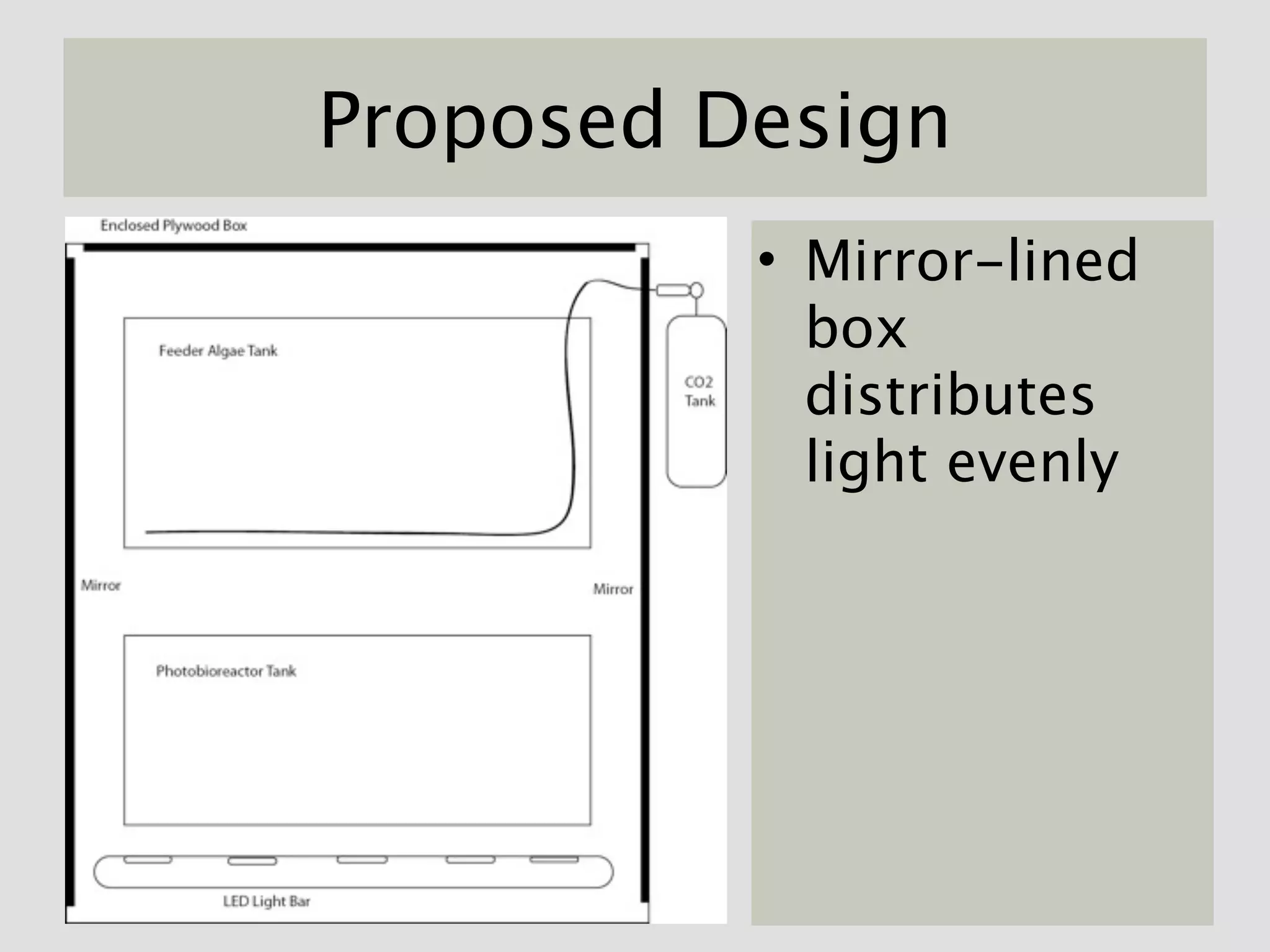
Proposed Design
          • Mirror-lined
            box
            distributes
            light evenly
Proposed Design
          • Mirror-lined
            box
            distributes
            light evenly
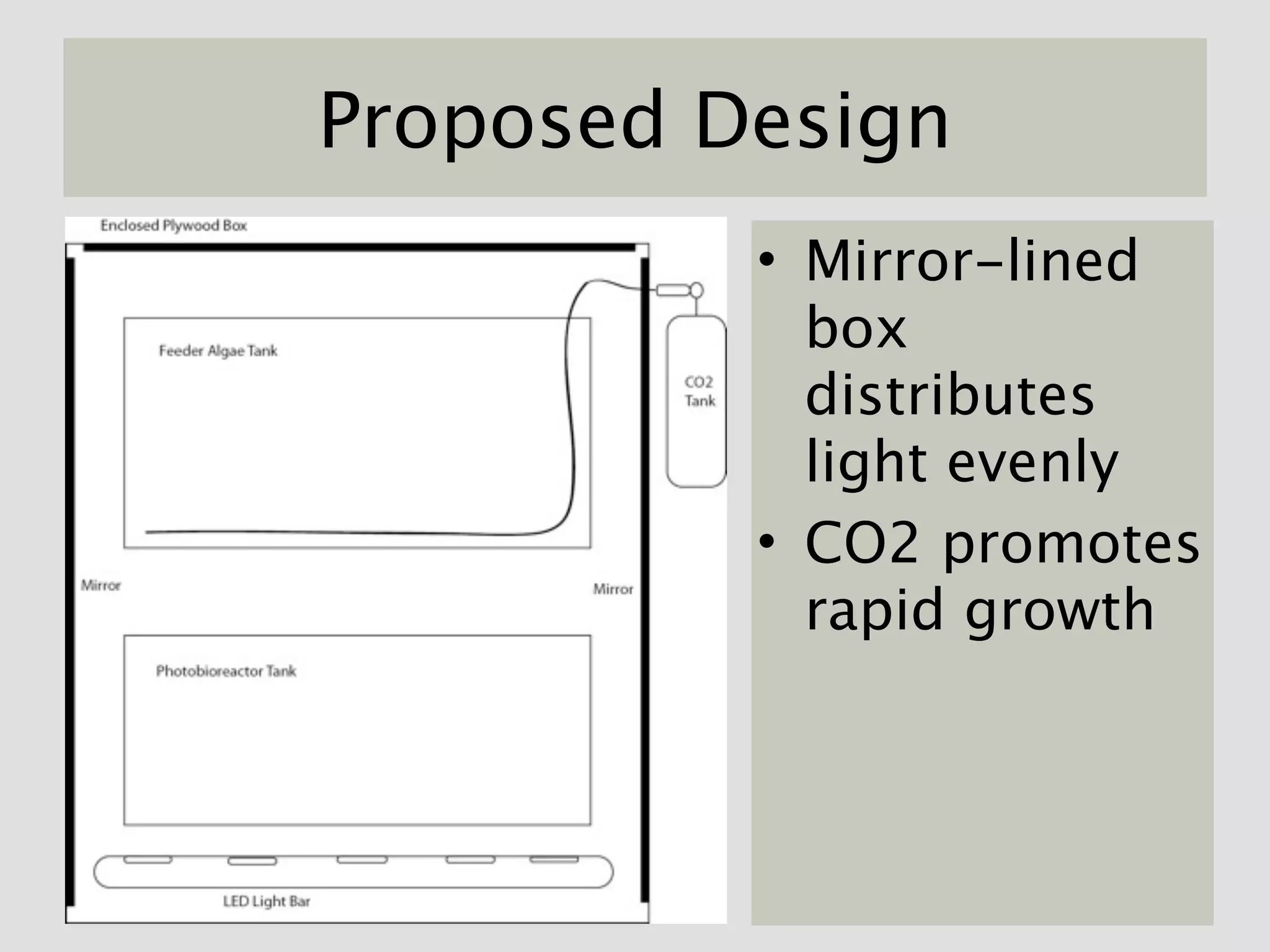
          • CO2 promotes
            rapid growth
Proposed Design
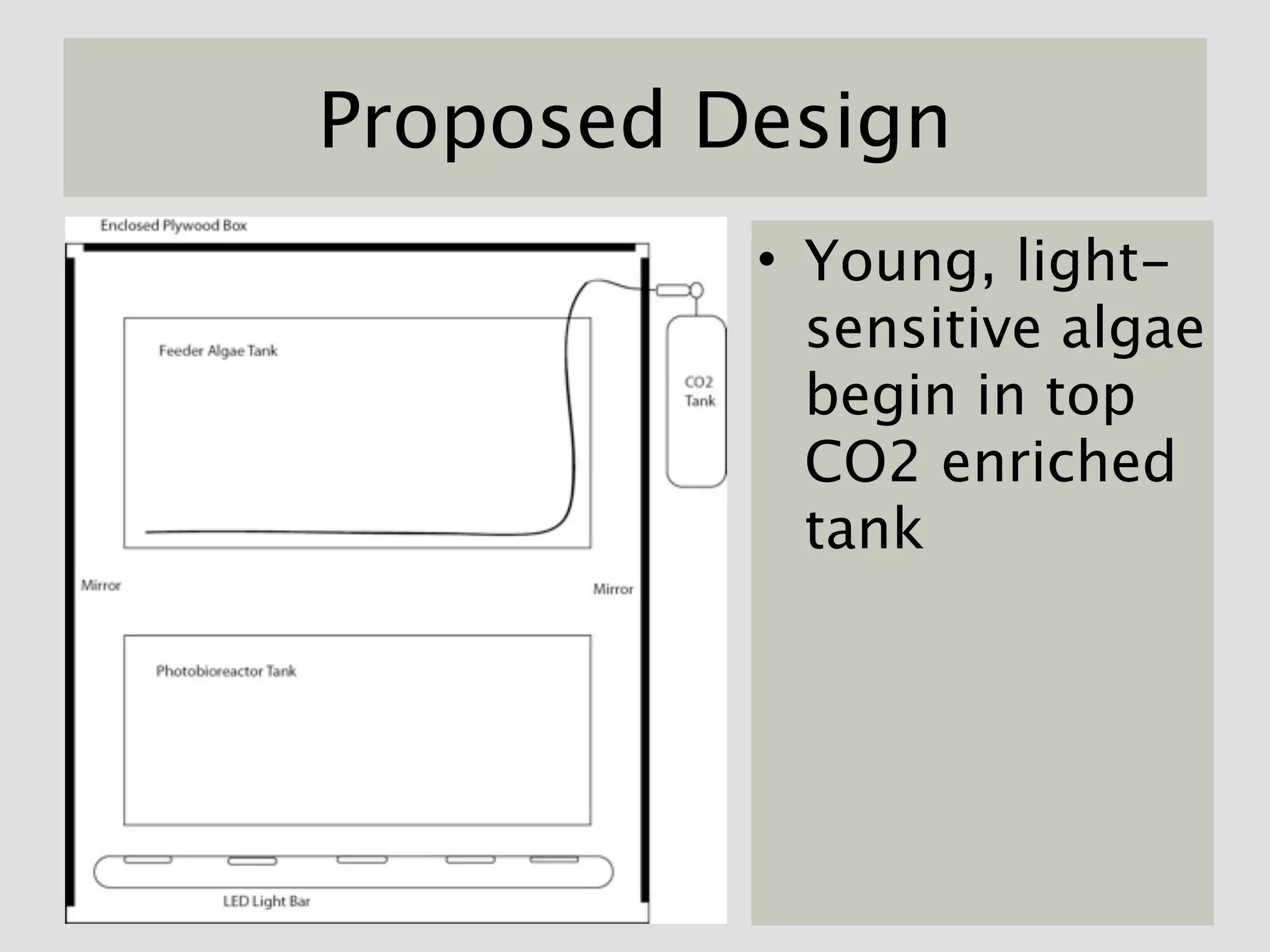
          • Young, light-
            sensitive algae
            begin in top
            CO2 enriched
            tank
Proposed Design
          • Young, light-
            sensitive algae
            begin in top
            CO2 enriched
            tank
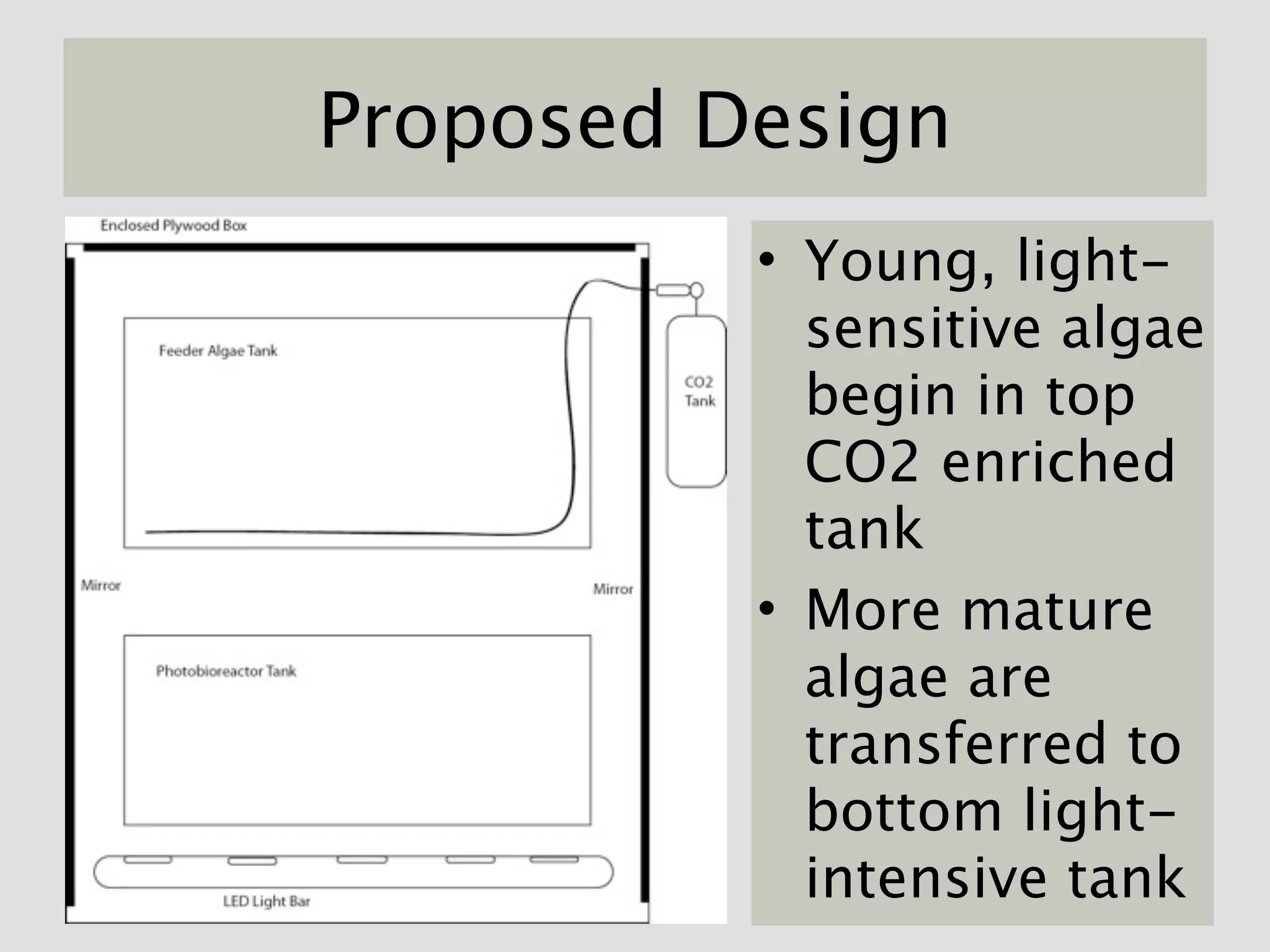
          • More mature
            algae are
            transferred to
            bottom light-
            intensive tank
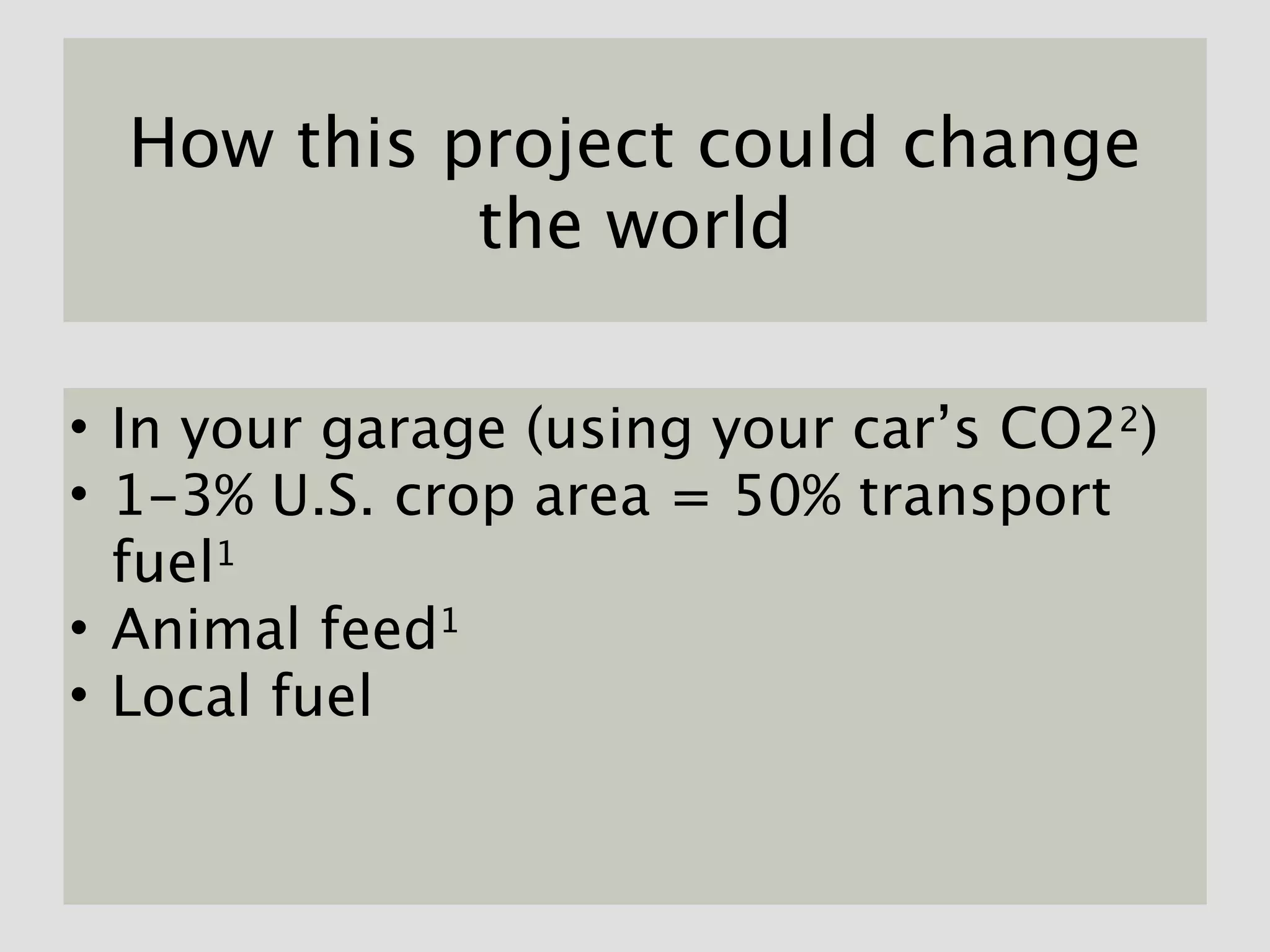
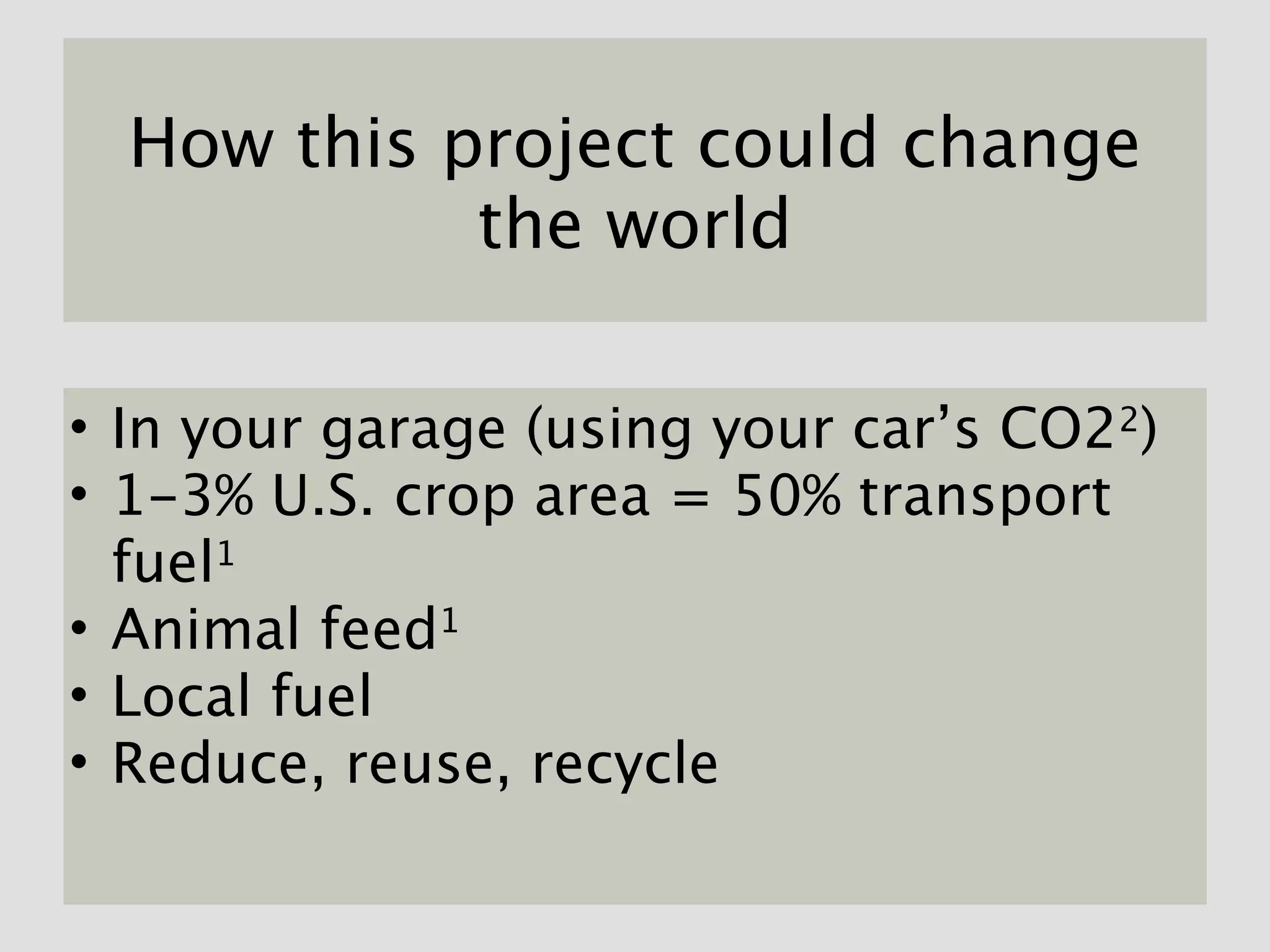
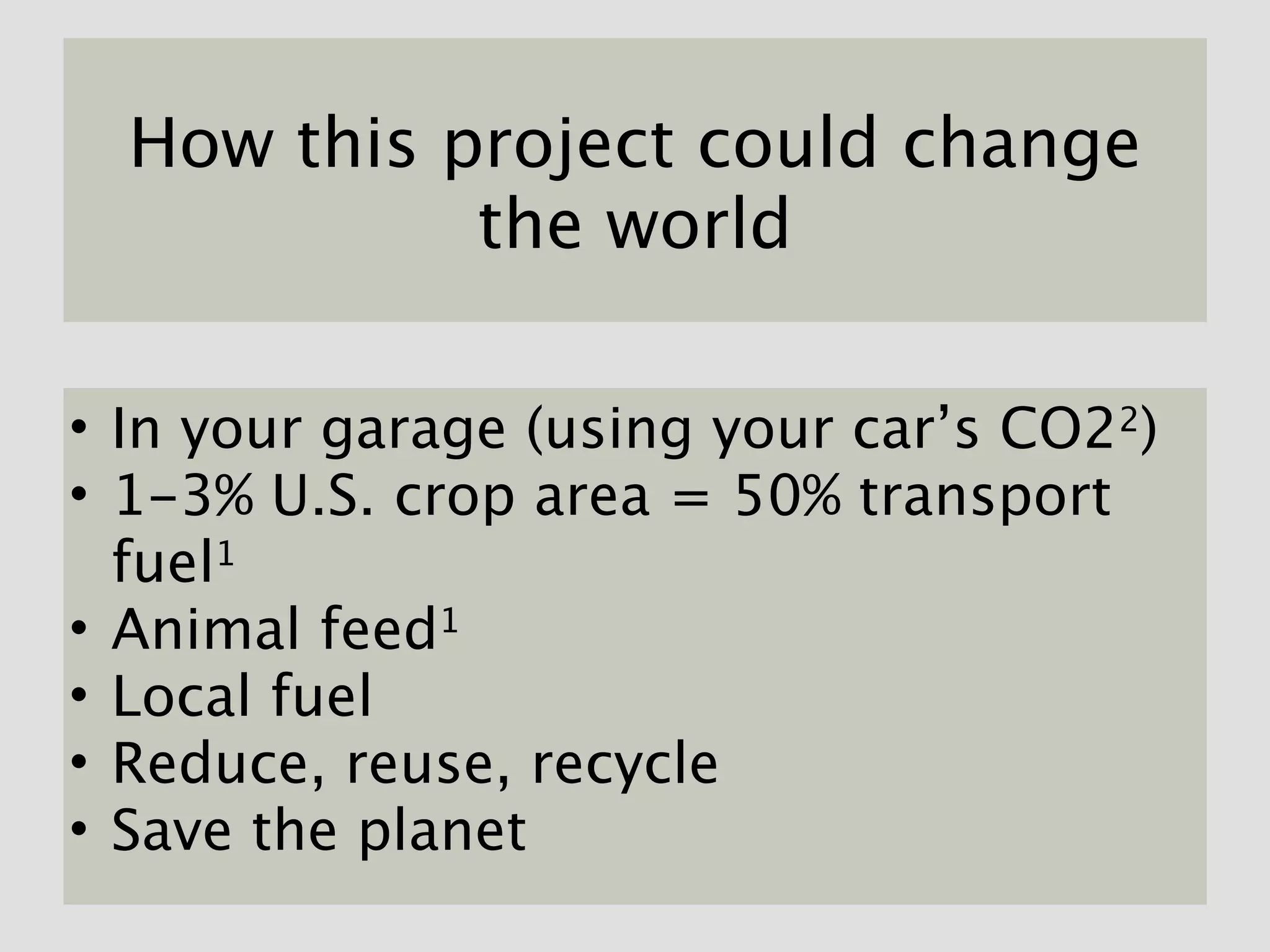
How this project could change
          the world
How this project could change
            the world

• In your garage (using your car’s CO22)
How this project could change
            the world

• In your garage (using your car’s CO22)
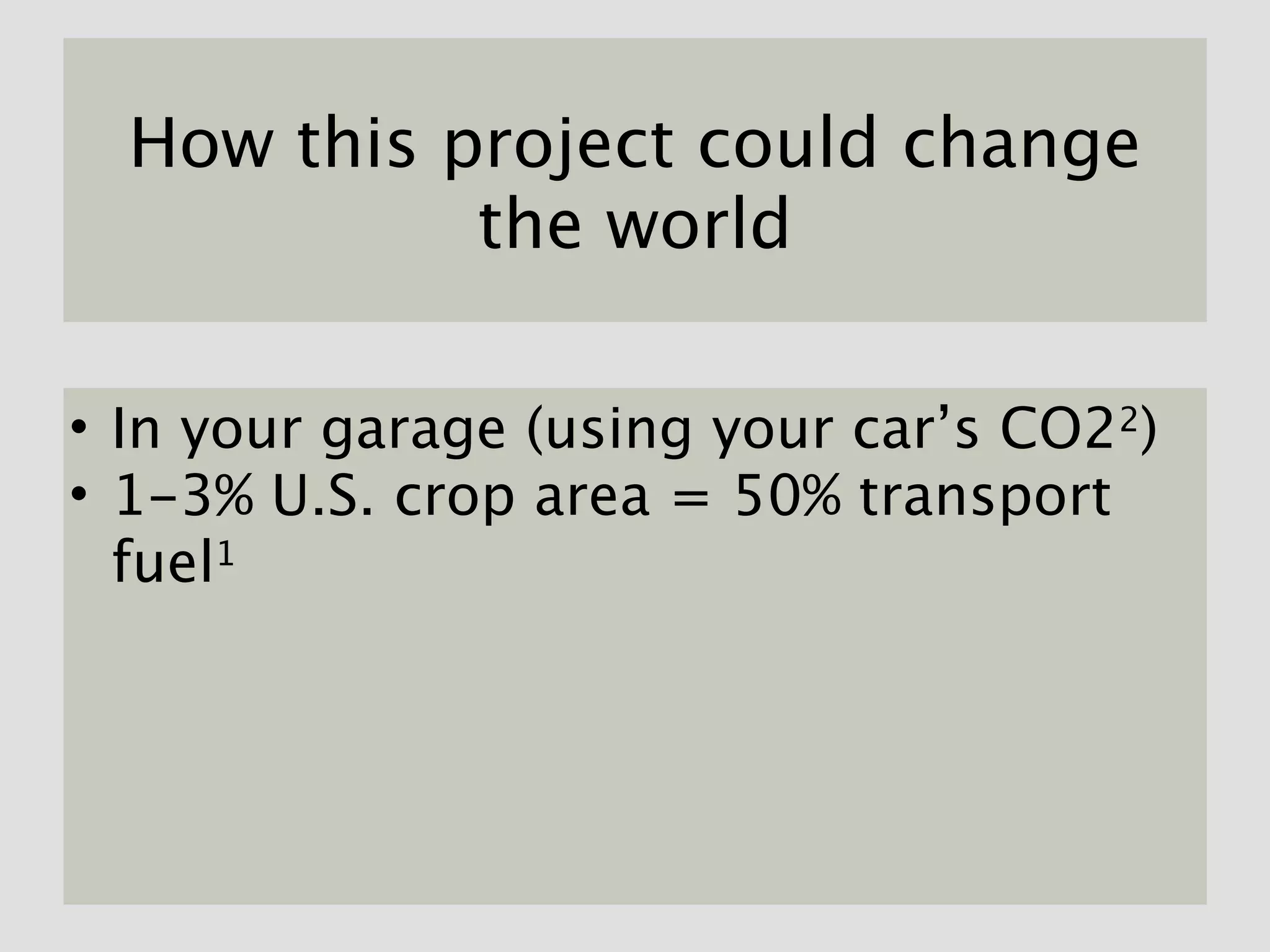
• 1-3% U.S. crop area = 50% transport
  fuel1
How this project could change
            the world

• In your garage (using your car’s CO22)
• 1-3% U.S. crop area = 50% transport
  fuel1
• Animal feed1
How this project could change
            the world

• In your garage (using your car’s CO22)
• 1-3% U.S. crop area = 50% transport
  fuel1
• Animal feed1
• Local fuel
How this project could change
            the world

• In your garage (using your car’s CO22)
• 1-3% U.S. crop area = 50% transport
  fuel1
• Animal feed1
• Local fuel
• Reduce, reuse, recycle
How this project could change
            the world

• In your garage (using your car’s CO22)
• 1-3% U.S. crop area = 50% transport
  fuel1
• Animal feed1
• Local fuel
• Reduce, reuse, recycle
• Save the planet
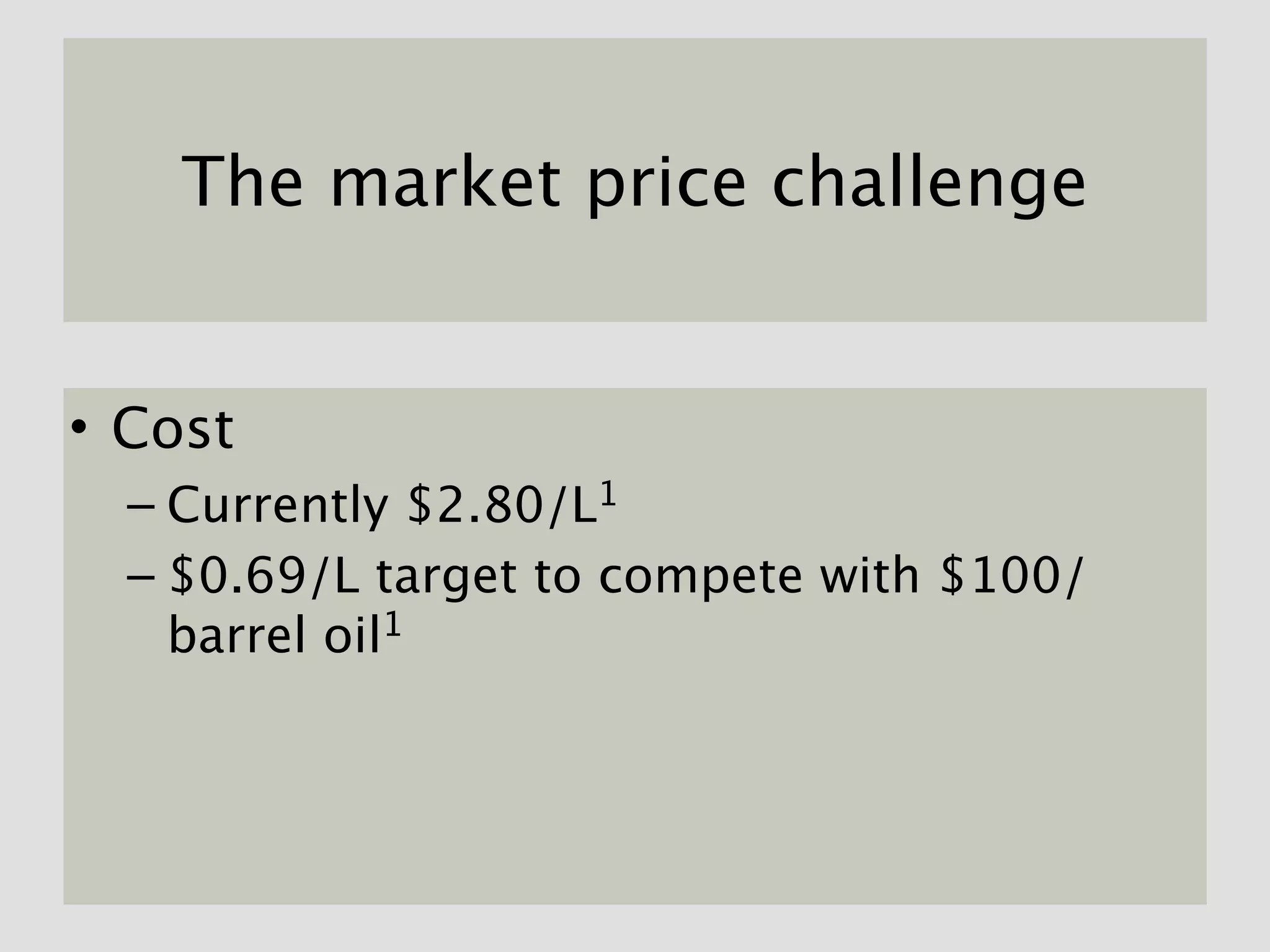
The market price challenge


• Cost
  – Currently $2.80/L1
The market price challenge


• Cost
  – Currently $2.80/L1
  – $0.69/L target to compete with $100/
    barrel oil1
Possible outcomes and their
 implications for the future

 If our system is cost-effective:
Possible outcomes and their
    implications for the future

     If our system is cost-effective:

• Larger scale operations
Possible outcomes and their
    implications for the future

     If our system is cost-effective:

• Larger scale operations
  -maximize yields
Possible outcomes and their
     implications for the future

     If our system is cost-effective:

• Larger scale operations
  -maximize yields
  -harvest most efficiently
Possible outcomes and their
    implications for the future

     If our system is cost-effective:

• Larger scale operations
  -maximize yields
  -harvest most efficiently
  -ideal system construction
Possible outcomes and their
 implications for the future

If our system is not cost-effective:
Possible outcomes and their
    implications for the future

   If our system is not cost-effective:

• Research different methods
Possible outcomes and their
    implications for the future

   If our system is not cost-effective:

• Research different methods
  -optimizing raceway ponds
Possible outcomes and their
    implications for the future

   If our system is not cost-effective:

• Research different methods
  -optimizing raceway ponds
  -alternative bioreactors
Possible outcomes and their
    implications for the future

   If our system is not cost-effective:

• Research different methods
  -optimizing raceway ponds
  -alternative bioreactors
  -other energy sources
Possible outcomes and their
 implications for the future

 If our results are inconclusive:
Possible outcomes and their
    implications for the future

     If our results are inconclusive:

• Future research into our method
Possible outcomes and their
    implications for the future

     If our results are inconclusive:

• Future research into our method
  -increasing sample size
Possible outcomes and their
    implications for the future

     If our results are inconclusive:

• Future research into our method
  -increasing sample size
  -eliminating bias
Possible outcomes and their
    implications for the future

     If our results are inconclusive:

• Future research into our method
  -increasing sample size
  -eliminating bias
  -repeat studies
Sources

• 1: Chisti Yusuf, “Biodiesel from microalgae,” Biotechnology Advances 25, no.
  3 (May): 294-306. <http://www.sciencedirect.com/science/article/pii/
  S0734975007000262>
• 2: Michael Szabo, "From Wales, a box to make biofuel from car fumes,"
  Reuters. July 2007. <http://uk.reuters.com/article/2007/07/19/uk-wales-
  greenbox-business-feature-pictu-idUKL1847347220070719>
• Diesel engine sound: hanstimm, http://www.freesound.org/people/
  hanstimm/sounds/7803/
• Car passing sound: Pingel, http://www.freesound.org/people/Pingel/
  sounds/3184/
• Bubble sound: lonemonk, http://www.freesound.org/people/
  lonemonk/sounds/108745/
• Rain sound: RHumphries, http://www.freesound.org/people/
  RHumphries/sounds/2521/

Algae generation for biofuel using an enclosed system

  • 1.
    Algae generation forbiofuel using an enclosed system with artificial lighting Jaal Mann and Michael Karch, for Energy Systems & Climate Change at The Evergreen State College Celsias http://www.celsias.com/media/uploads/admin/ algae_shot_1.jpg
  • 2.
    Fossil fuels arenot sustainable
  • 3.
    Fossil fuels arenot sustainable • Dwindling petroleum reserves
  • 4.
    Fossil fuels arenot sustainable • Dwindling petroleum reserves • CO2-caused global climate change
  • 5.
    Fossil fuels arenot sustainable • Dwindling petroleum reserves • CO2-caused global climate change Sustainable alternatives to fossil fuel are needed
  • 6.
    Biofuels as asustainable alternative to fossil fuel
  • 7.
    Biofuels as asustainable alternative to fossil fuel • Carbon neutral
  • 8.
    Biofuels as asustainable alternative to fossil fuel • Carbon neutral • Renewable
  • 9.
    Biofuels as asustainable alternative to fossil fuel • Carbon neutral • Renewable • Cheaper than fossil fuel
  • 10.
    Types of biofuel •Traditional food-crop based -corn -sugar cane -soybean
  • 11.
    Types of biofuel •Non-food biomass based -oil palm -switch grass -algae
  • 12.
    Algae is apromising new biofuel The Algae Project http://greengineers.wikispaces.com/file/view/ algae_smiley.jpg/115440023/algae_smiley.jpg
  • 13.
    Algae is apromising new biofuel • Up to 300x soybean yields1 The Algae Project http://greengineers.wikispaces.com/file/view/ algae_smiley.jpg/115440023/algae_smiley.jpg
  • 14.
    Algae is apromising new biofuel • Up to 300x soybean yields1 • It can be grown quickly, and has a high oil content The Algae Project http://greengineers.wikispaces.com/file/view/ algae_smiley.jpg/115440023/algae_smiley.jpg
  • 15.
    Algae is apromising new biofuel • Up to 300x soybean yields1 • It can be grown quickly, and has a high oil content • Saltwater and wastewater can be used The Algae Project http://greengineers.wikispaces.com/file/view/ algae_smiley.jpg/115440023/algae_smiley.jpg
  • 16.
    How is algaetraditionally grown?
  • 17.
    How is algaetraditionally grown? • Open ponds
  • 18.
    How is algaetraditionally grown? • Open ponds • Raceway ponds
  • 19.
    How is algaetraditionally grown? • Open ponds • Raceway ponds • Artificial light bioreactors
  • 20.
    How is algaetraditionally grown? Can algae be grown in an enclosed artificial light system cost-effectively and more quickly than traditional methods?
  • 21.
    What could makeour enclosed artificial light system more efficient?
  • 22.
    What could makeour enclosed artificial light system more efficient? • Cheap, clean hydro-electricity
  • 23.
    What could makeour enclosed artificial light system more efficient? • Cheap, clean hydro-electricity • 24/7/365 growing period
  • 24.
    What could makeour enclosed artificial light system more efficient? • Cheap, clean hydro-electricity • 24/7/365 growing period • Efficient (9W usage) optimum- wavelength LEDs
  • 25.
    Proposed Design • Mirror-lined box distributes light evenly
  • 26.
    Proposed Design • Mirror-lined box distributes light evenly • CO2 promotes rapid growth
  • 27.
    Proposed Design • Young, light- sensitive algae begin in top CO2 enriched tank
  • 28.
    Proposed Design • Young, light- sensitive algae begin in top CO2 enriched tank • More mature algae are transferred to bottom light- intensive tank
  • 29.
    How this projectcould change the world
  • 30.
    How this projectcould change the world • In your garage (using your car’s CO22)
  • 31.
    How this projectcould change the world • In your garage (using your car’s CO22) • 1-3% U.S. crop area = 50% transport fuel1
  • 32.
    How this projectcould change the world • In your garage (using your car’s CO22) • 1-3% U.S. crop area = 50% transport fuel1 • Animal feed1
  • 33.
    How this projectcould change the world • In your garage (using your car’s CO22) • 1-3% U.S. crop area = 50% transport fuel1 • Animal feed1 • Local fuel
  • 34.
    How this projectcould change the world • In your garage (using your car’s CO22) • 1-3% U.S. crop area = 50% transport fuel1 • Animal feed1 • Local fuel • Reduce, reuse, recycle
  • 35.
    How this projectcould change the world • In your garage (using your car’s CO22) • 1-3% U.S. crop area = 50% transport fuel1 • Animal feed1 • Local fuel • Reduce, reuse, recycle • Save the planet
  • 36.
    The market pricechallenge • Cost – Currently $2.80/L1
  • 37.
    The market pricechallenge • Cost – Currently $2.80/L1 – $0.69/L target to compete with $100/ barrel oil1
  • 38.
    Possible outcomes andtheir implications for the future If our system is cost-effective:
  • 39.
    Possible outcomes andtheir implications for the future If our system is cost-effective: • Larger scale operations
  • 40.
    Possible outcomes andtheir implications for the future If our system is cost-effective: • Larger scale operations -maximize yields
  • 41.
    Possible outcomes andtheir implications for the future If our system is cost-effective: • Larger scale operations -maximize yields -harvest most efficiently
  • 42.
    Possible outcomes andtheir implications for the future If our system is cost-effective: • Larger scale operations -maximize yields -harvest most efficiently -ideal system construction
  • 43.
    Possible outcomes andtheir implications for the future If our system is not cost-effective:
  • 44.
    Possible outcomes andtheir implications for the future If our system is not cost-effective: • Research different methods
  • 45.
    Possible outcomes andtheir implications for the future If our system is not cost-effective: • Research different methods -optimizing raceway ponds
  • 46.
    Possible outcomes andtheir implications for the future If our system is not cost-effective: • Research different methods -optimizing raceway ponds -alternative bioreactors
  • 47.
    Possible outcomes andtheir implications for the future If our system is not cost-effective: • Research different methods -optimizing raceway ponds -alternative bioreactors -other energy sources
  • 48.
    Possible outcomes andtheir implications for the future If our results are inconclusive:
  • 49.
    Possible outcomes andtheir implications for the future If our results are inconclusive: • Future research into our method
  • 50.
    Possible outcomes andtheir implications for the future If our results are inconclusive: • Future research into our method -increasing sample size
  • 51.
    Possible outcomes andtheir implications for the future If our results are inconclusive: • Future research into our method -increasing sample size -eliminating bias
  • 52.
    Possible outcomes andtheir implications for the future If our results are inconclusive: • Future research into our method -increasing sample size -eliminating bias -repeat studies
  • 53.
    Sources • 1: ChistiYusuf, “Biodiesel from microalgae,” Biotechnology Advances 25, no. 3 (May): 294-306. <http://www.sciencedirect.com/science/article/pii/ S0734975007000262> • 2: Michael Szabo, "From Wales, a box to make biofuel from car fumes," Reuters. July 2007. <http://uk.reuters.com/article/2007/07/19/uk-wales- greenbox-business-feature-pictu-idUKL1847347220070719> • Diesel engine sound: hanstimm, http://www.freesound.org/people/ hanstimm/sounds/7803/ • Car passing sound: Pingel, http://www.freesound.org/people/Pingel/ sounds/3184/ • Bubble sound: lonemonk, http://www.freesound.org/people/ lonemonk/sounds/108745/ • Rain sound: RHumphries, http://www.freesound.org/people/ RHumphries/sounds/2521/