History, Rationale, and Remaining WorkThe RDA Vocabularies
A brief historyA structural tour, including:Rationale and decision makingUse of domains and rangesPotential for extensionMoving towards completionWhat we’ve learnedSetting the Stage10/22/102DC-2010
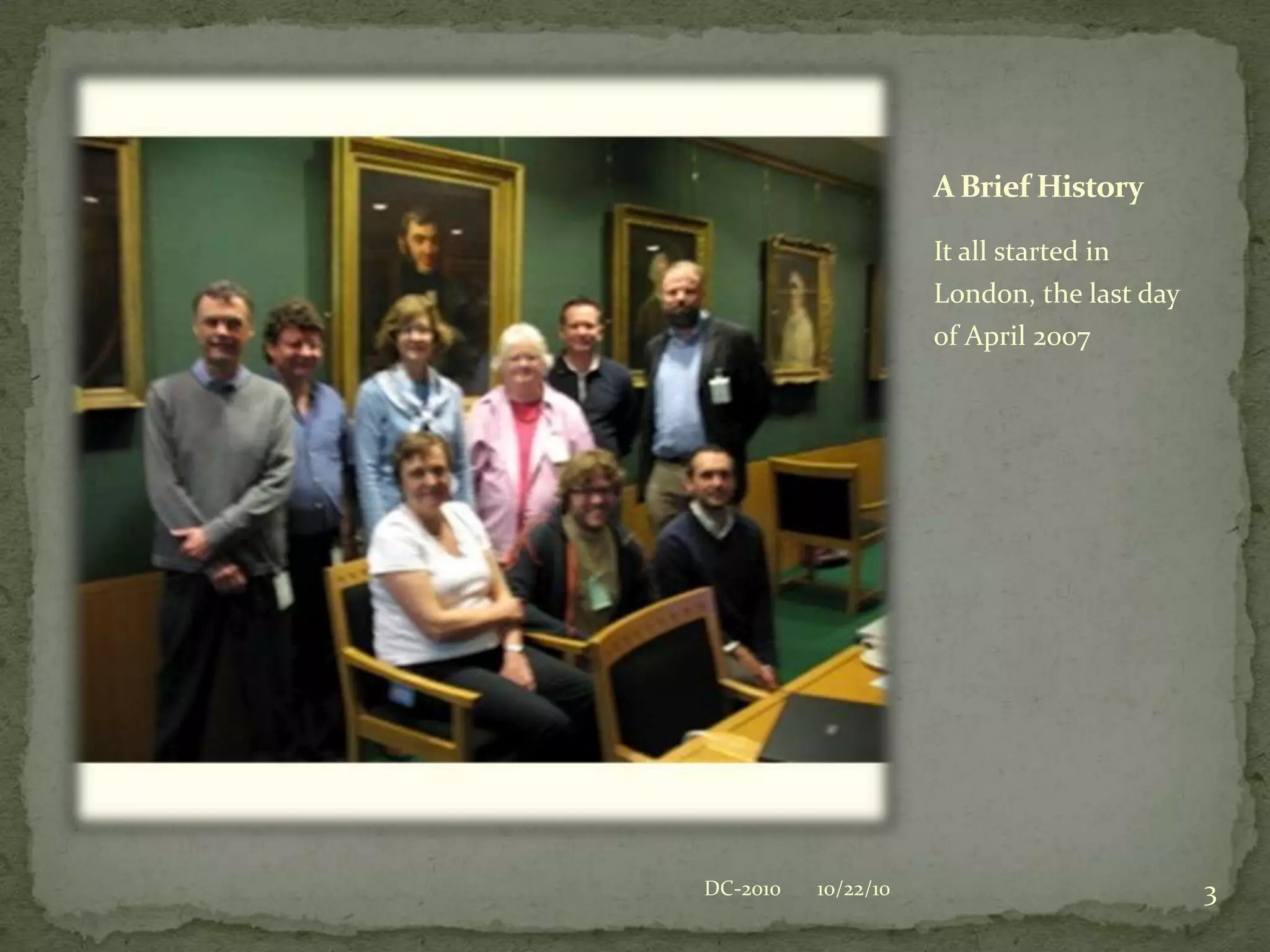
A Brief HistoryIt all started in London, the last day of April 200710/22/103DC-2010
The participants agreed that DCMI and the Joint Steering Committee for the Development of RDA should work together to:Develop an RDA Element VocabularyExpose RDA Value VocabulariesDevelop an RDA Application Profile, based on FRBR and FRADThe first two are largely complete; the third is started4What Was Accomplished10/22/10DC-2010
Property and value vocabularies registered on the Open Metadata Registry (formerly the NSDL Registry): http://metadataregistry.org/rdabrowse.htmUsed RDF Schema (RDFS), Simple Knowledge Organisation System (SKOS) and Web Ontology Language (OWL)Registry provides human and machine usable interfacesAll vocabularies have change history and versioning capabilitiesStructure: Rationale & Decisions10/22/105DC-2010
We used the Semantic Web as our “mental model”
Wanted to create a “bridge” between XML and RDF to support innovation in the library community as a whole, not just those at the cutting edge or the trailing edge
We registered the FRBR entities as classes in a ‘FRBR in RDA’ vocabulary, to enable specific relationships between RDA properties and FRBR
IFLA has followed suit using the Open Metadata Registry to add the ‘official’ FRBR entities, FRAD, and ISBD (more from Gordon about that)
This provides exciting opportunities to relate all the vocabularies together10/22/106DC-2010The General Strategy
Started with the Entity Relationship Diagrams produced by ALA PublishingThe latest iterations are available on the RDA Toolkit Site (http://www.rdatoolkit.org/background) ERDs are organized in three groups: core, enhanced, specialThese were developed and iterated with no change management strategy, so each new iteration had to be checked carefully to spot changesERDs built with a very XML view of the worldOur Methodology10/22/107DC-2010
We think of the ‘generalized’ RDA properties as the real RDA vocabulary The ‘bounded’ properties should be seen as the first pass at an Application ProfileExtensions can be built more usefully from the generalized propertiesMapping will be cleaner using the generalized properties (since most properties mapped to or mapped from will not be based on FRBR)Generalized properties much more acceptable to non-library implementers (not often using FRBR)The Basic ‘WHY’?10/22/108DC-2010
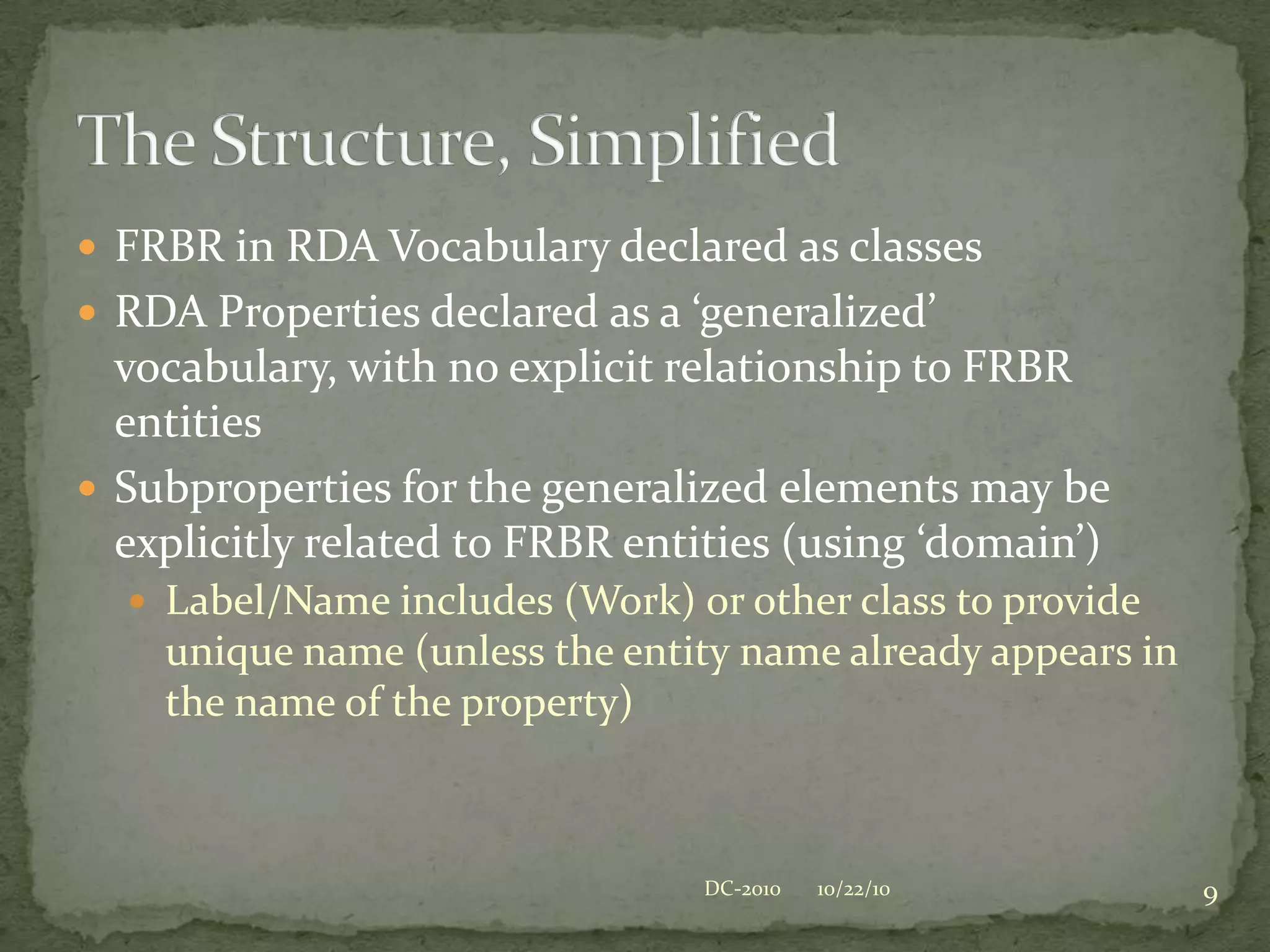
FRBR in RDA Vocabulary declared as classesRDA Properties declared as a ‘generalized’ vocabulary, with no explicit relationship to FRBR entitiesSubproperties for the generalized elements may be explicitly related to FRBR entities (using ‘domain’)Label/Name includes (Work) or other class to provide unique name (unless the entity name already appears in the name of the property)The Structure, Simplified10/22/109DC-2010
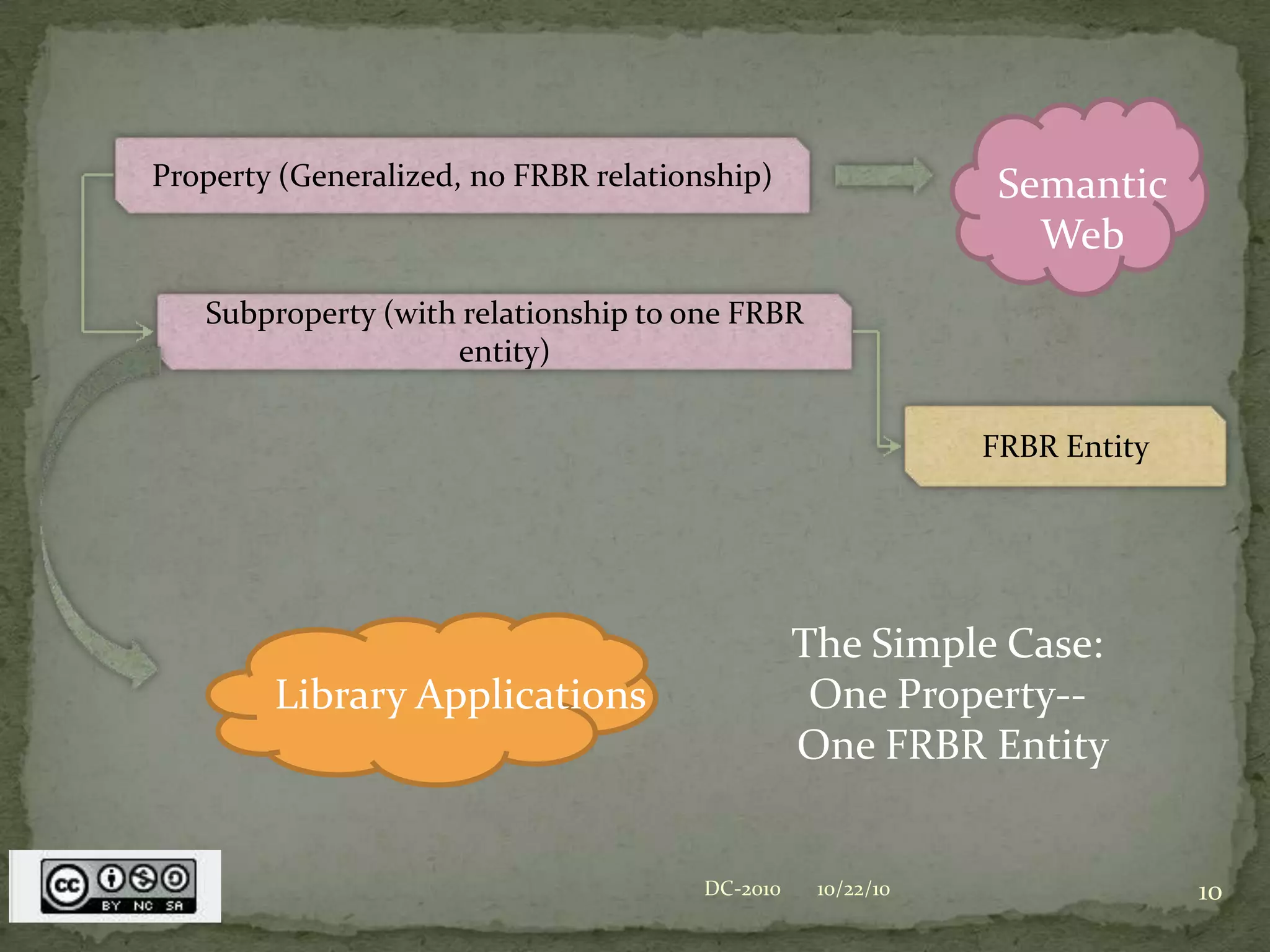
Property (Generalized, no FRBR relationship)SemanticWebSubproperty (with relationship to one FRBR entity)FRBR EntityThe Simple Case: One Property-- One FRBR EntityLibrary Applications10/22/1010DC-2010
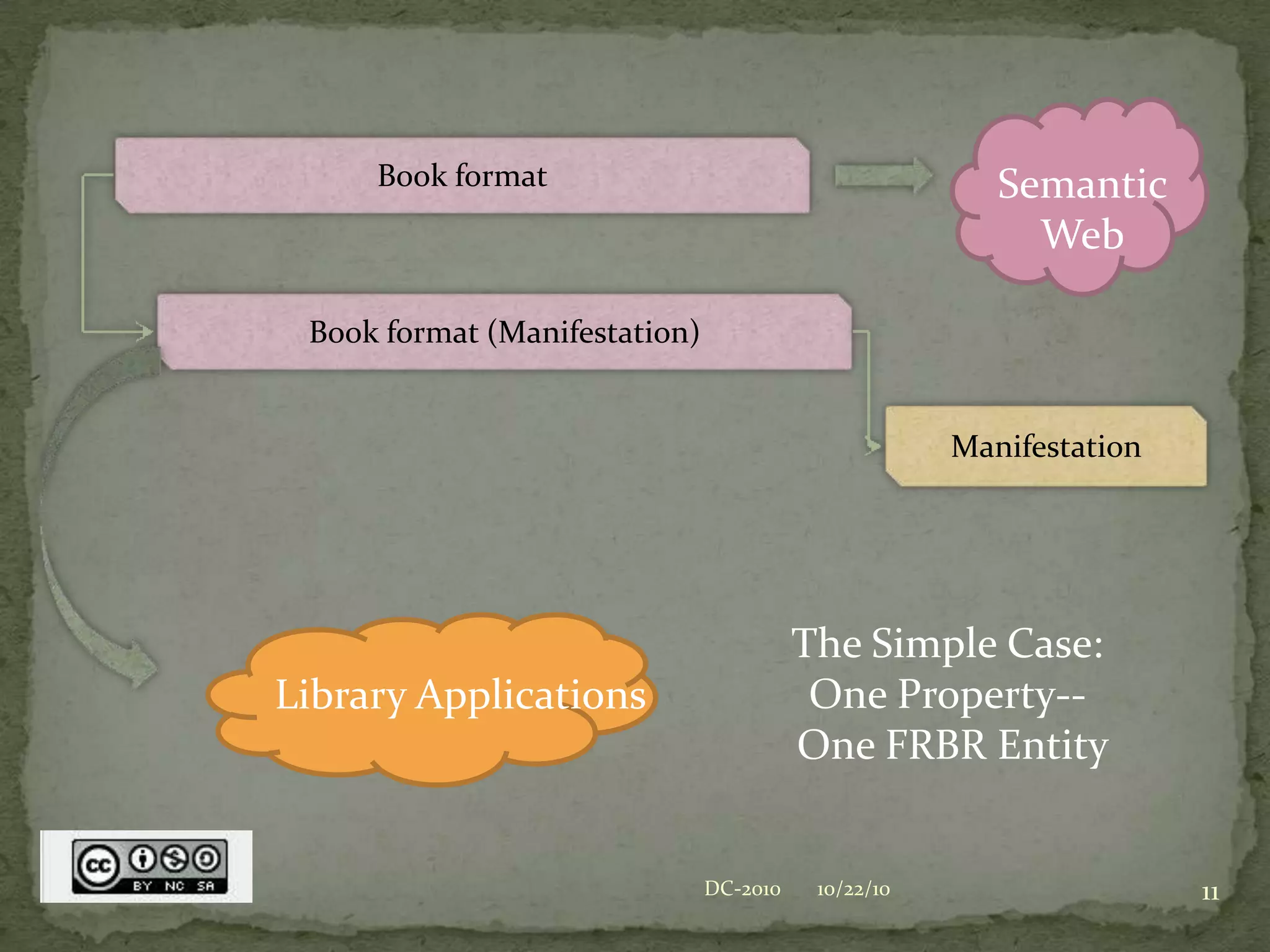
Book formatSemanticWebBook format (Manifestation)ManifestationThe Simple Case: One Property-- One FRBR EntityLibrary Applications10/22/1011DC-2010
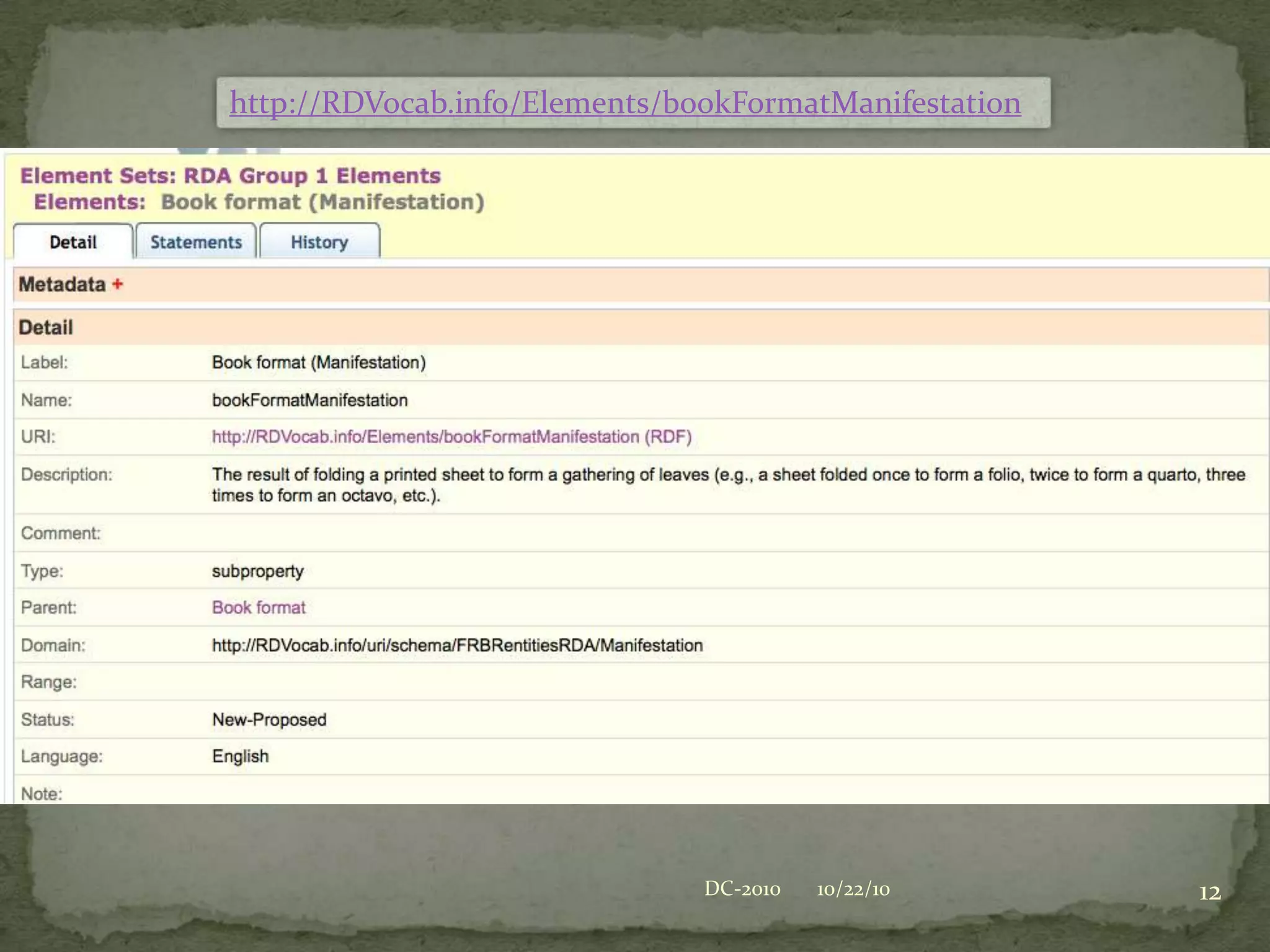
10/22/10DC-201012http://RDVocab.info/Elements/bookFormatManifestation
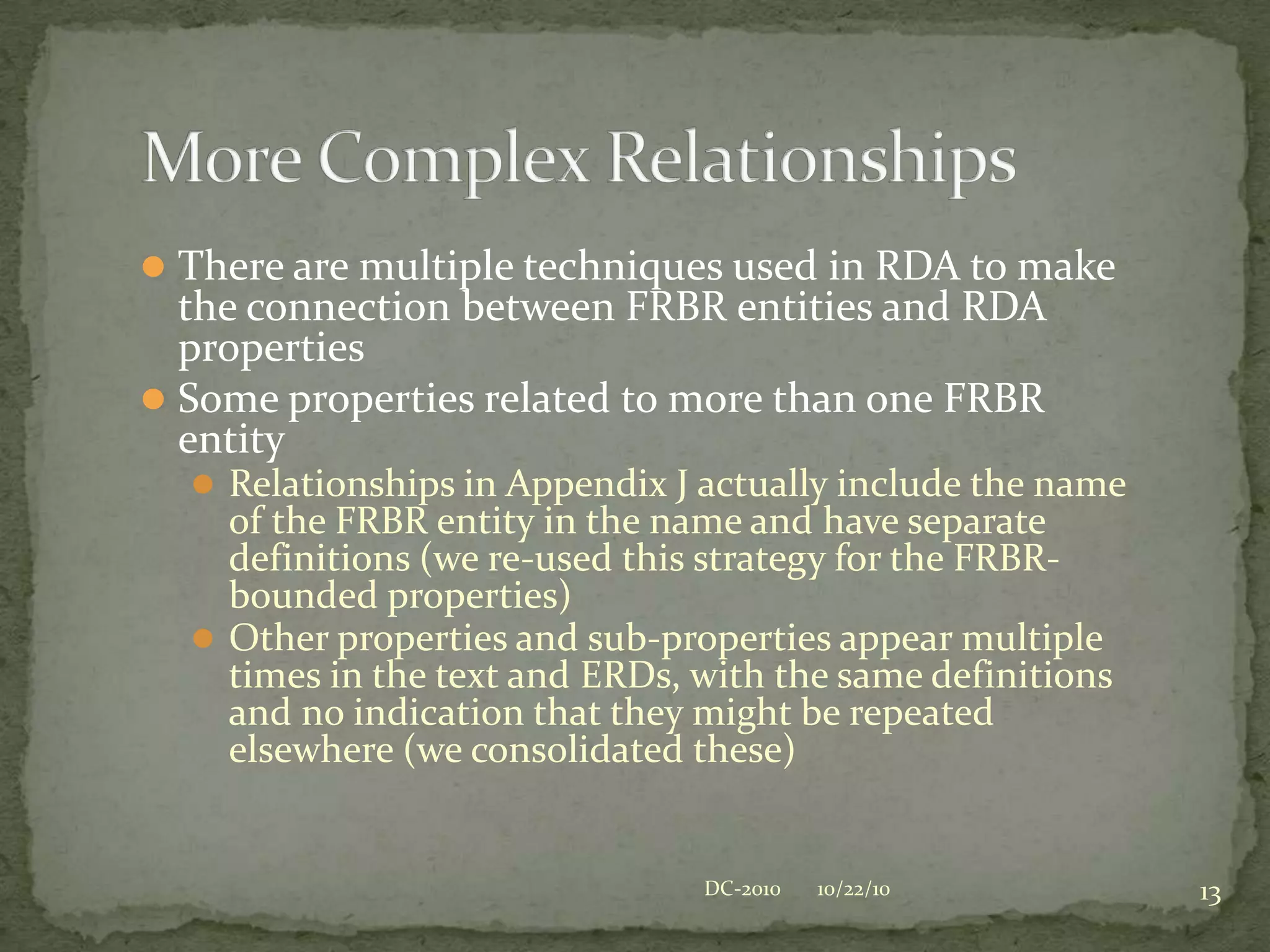
There are multiple techniques used in RDA to make the connection between FRBR entities and RDA properties
Some properties related to more than one FRBR entity
Relationships in Appendix J actually include the name of the FRBR entity in the name and have separate definitions (we re-used this strategy for the FRBR-bounded properties)
Other properties and sub-properties appear multiple times in the text and ERDs, with the same definitions and no indication that they might be repeated elsewhere (we consolidated these)10/22/1013DC-2010More Complex Relationships
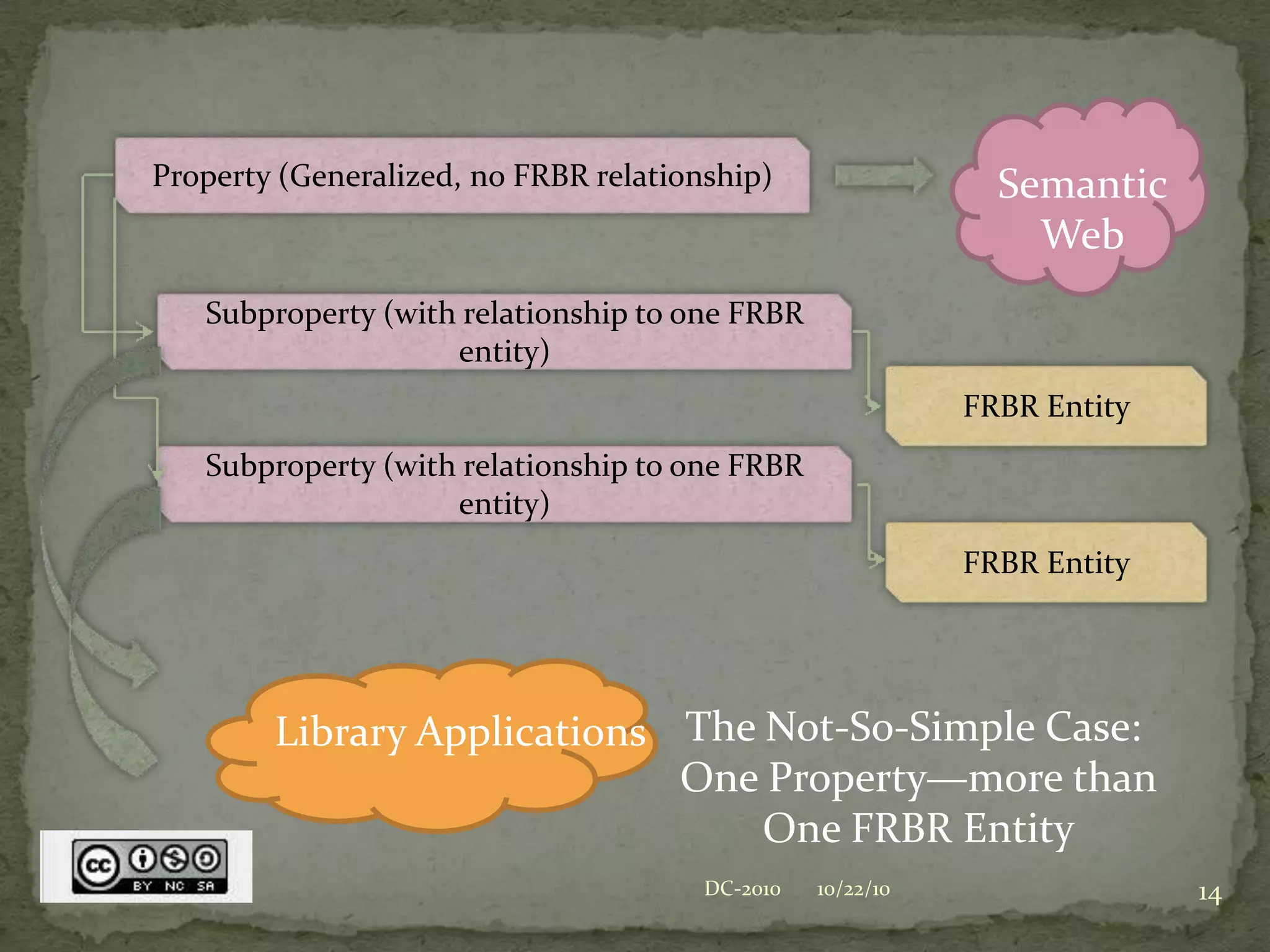
Property (Generalized, no FRBR relationship)SemanticWebSubproperty (with relationship to one FRBR entity)FRBR EntitySubproperty (with relationship to one FRBR entity)FRBR EntityThe Not-So-Simple Case: One Property—more thanOne FRBR EntityLibrary Applications10/22/1014DC-2010
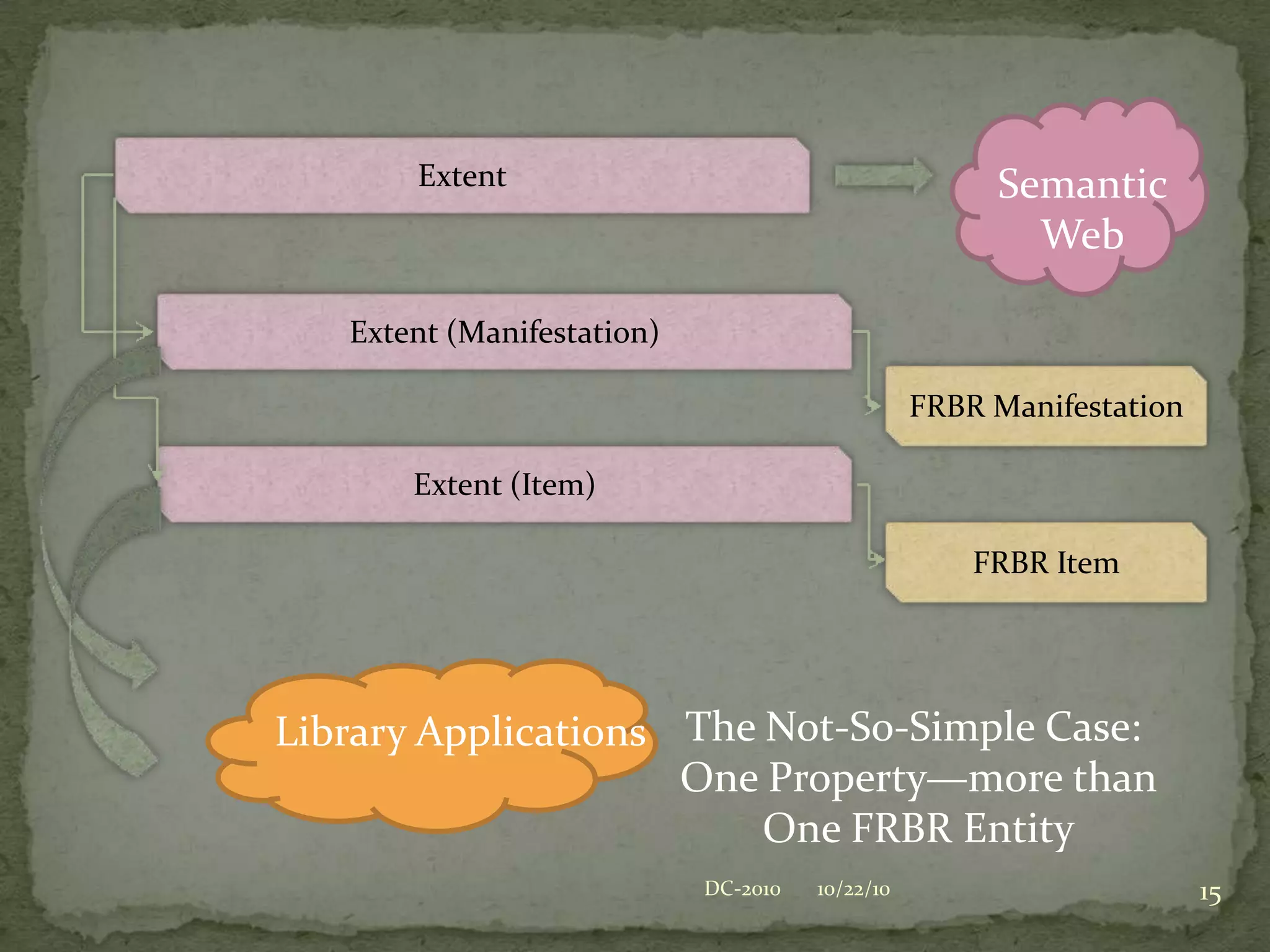
ExtentSemanticWebExtent (Manifestation)FRBR ManifestationExtent (Item)FRBR ItemThe Not-So-Simple Case: One Property—more thanOne FRBR EntityLibrary Applications10/22/1015DC-2010
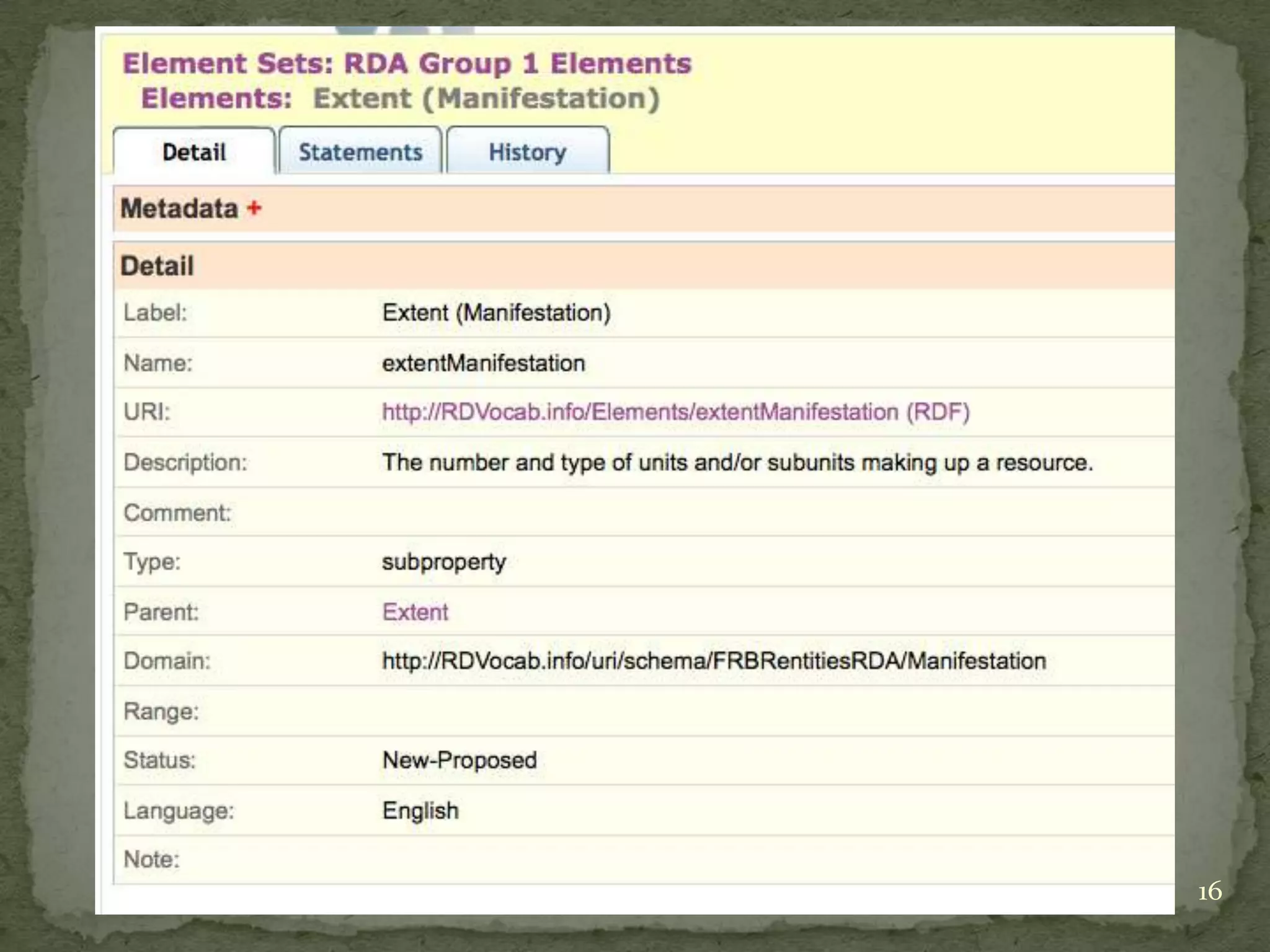
10/22/10DC-201016
In 2005, the DC Usage Board worked with LC to build a formal representation of the MARC Relators so that these terms could be used with DCThese have been superseded by the ‘new’ id.loc.info version, without the relationships to DC terms (has been pushback on this decision!)
This work provided a template for the registration of the role terms in RDA (in Appendix  I) and, by extension, the other RDA relationships
Role and relationship properties are registered at the same level as elements, rather than as attributes (as MARC does with relators, and RDA does in its XML)10/22/1017DC-2010Roles: Attributes or Properties?
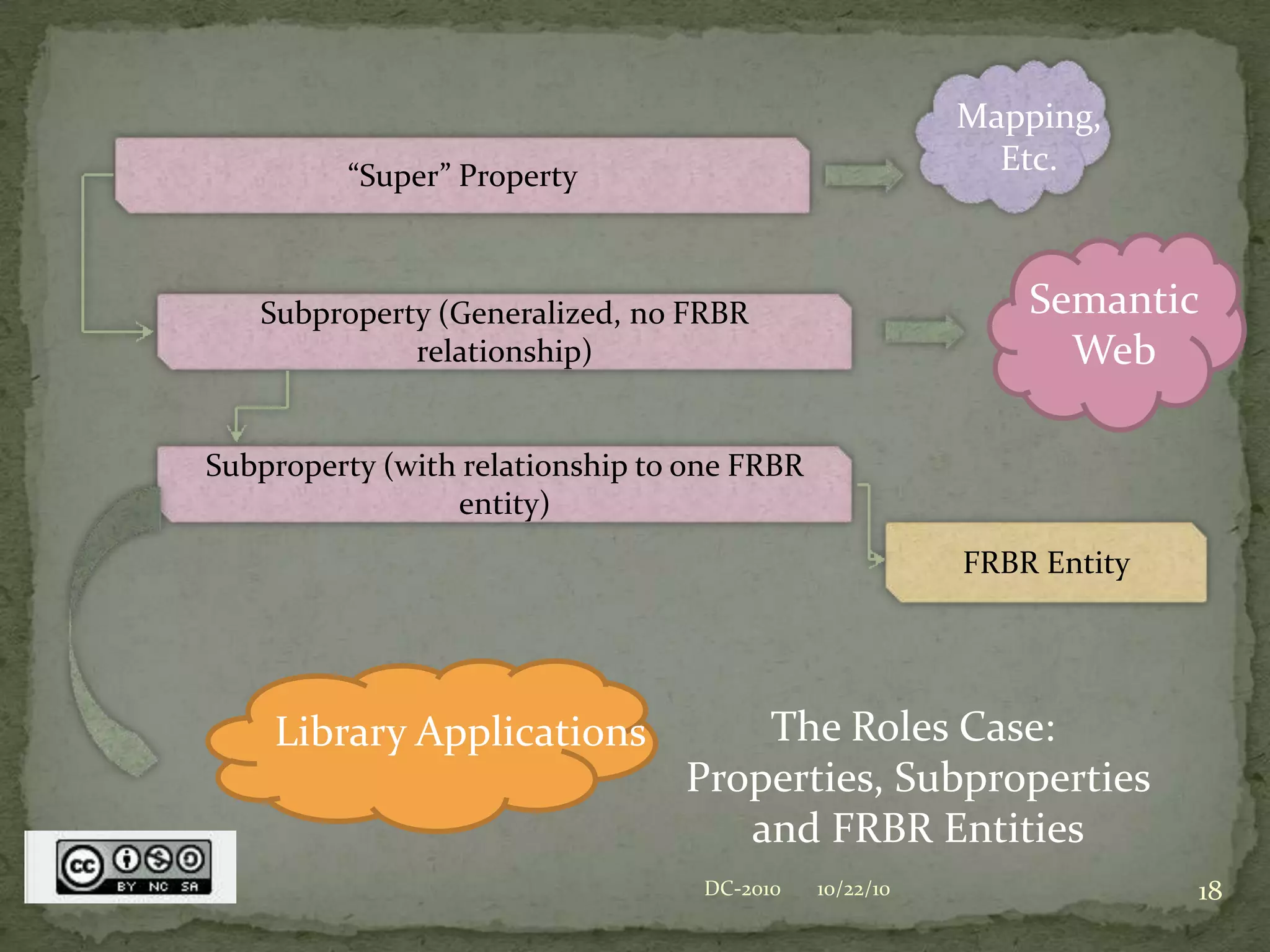
Mapping,Etc.“Super” Property SemanticWebSubproperty (Generalized, no FRBR relationship)Subproperty (with relationship to one FRBR entity)FRBR EntityThe Roles Case: Properties, Subpropertiesand FRBR EntitiesLibrary Applications10/22/1018DC-2010
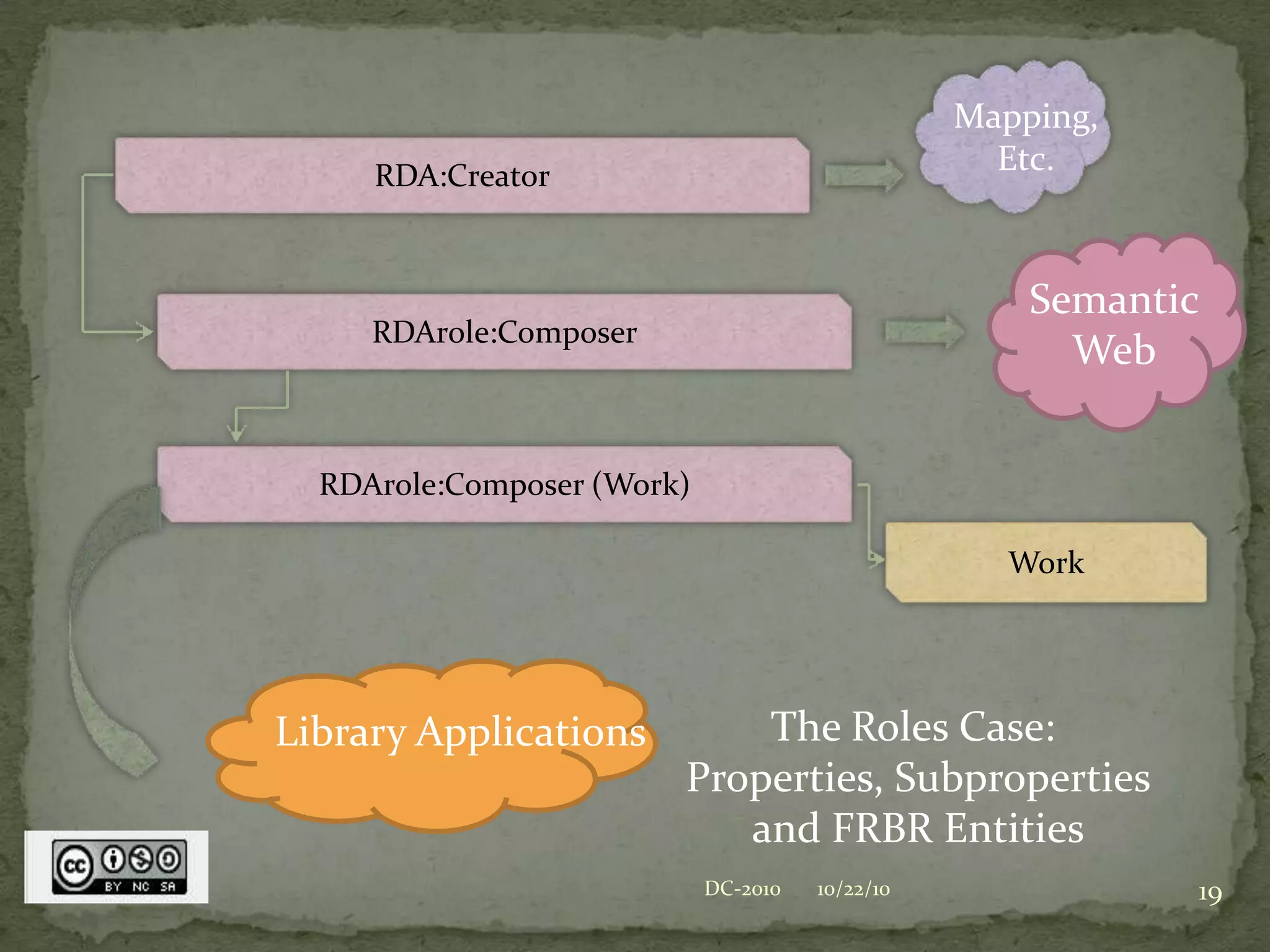
Mapping,Etc.RDA:CreatorSemanticWebRDArole:ComposerRDArole:Composer (Work)WorkThe Roles Case: Properties, Subpropertiesand FRBR EntitiesLibrary Applications10/22/1019DC-2010
RDA sets up Publication, Distribution, Manufacture and Production statements very much the way they have been done since catalog card days:
Assumed aggregation of Place, Name and Date are obvious leftovers from catalog cards, and are not necessary to enable indexing or display of those elements together if libraries want to do that
We viewed those aggregations as ‘Syntax Encoding Schemes’ and built in ways to accommodate them within the bounded properties
Those using the generalized properties (outside libraries, usually) need not be constrained by these traditional aggregations of properties10/22/1020DC-2010Aggregated Statements
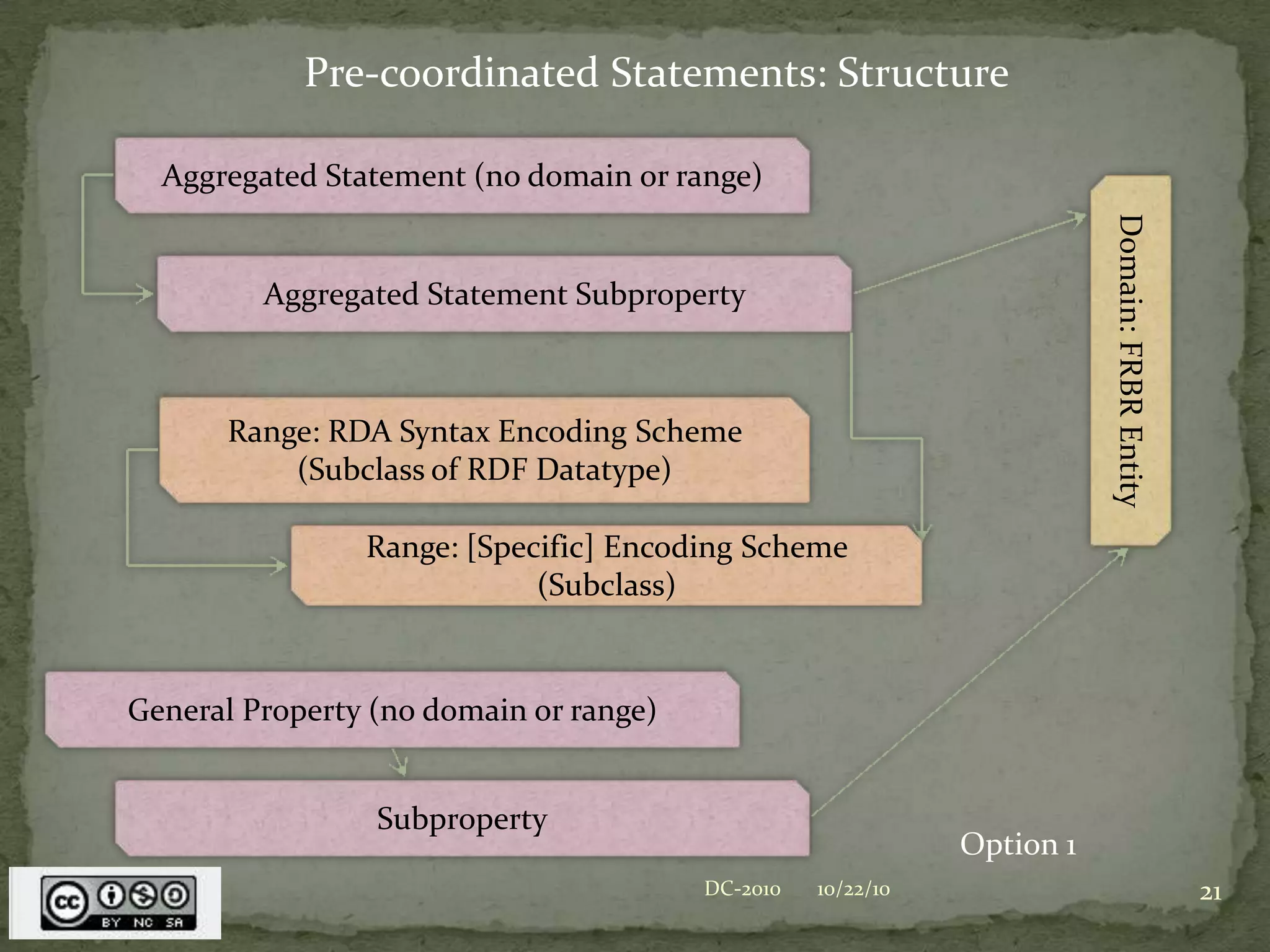
Pre-coordinated Statements: StructureAggregated Statement (no domain or range)Aggregated Statement SubpropertyDomain: FRBR EntityRange: RDA Syntax Encoding Scheme (Subclass of RDF Datatype)Range: [Specific] Encoding Scheme (Subclass)General Property (no domain or range)SubpropertyOption 110/22/1021DC-2010
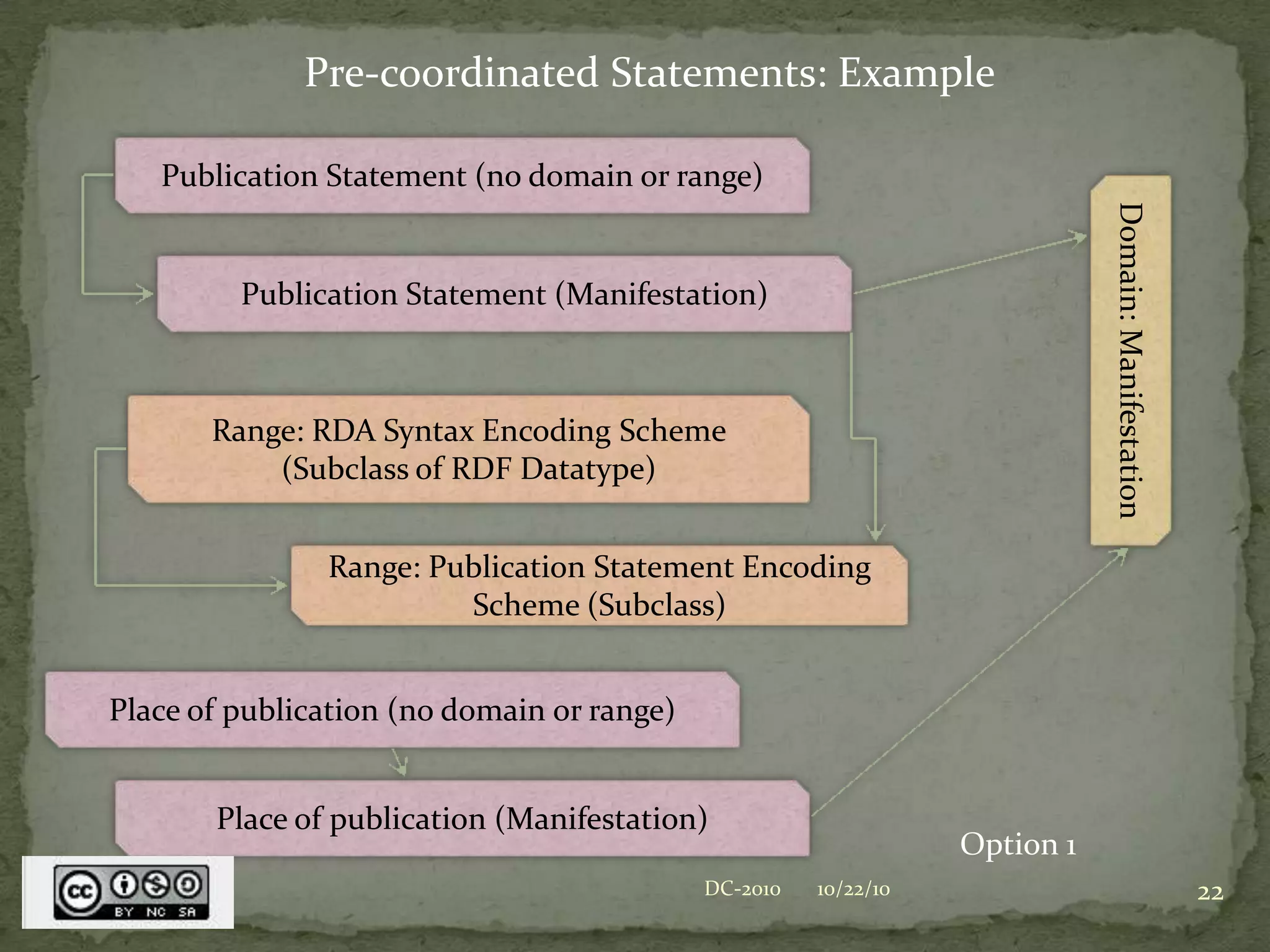
Pre-coordinated Statements: ExamplePublication Statement (no domain or range)Publication Statement (Manifestation)Domain: ManifestationRange: RDA Syntax Encoding Scheme (Subclass of RDF Datatype)Range: Publication Statement Encoding Scheme (Subclass)Place of publication (no domain or range)Place of publication (Manifestation)Option 110/22/1022DC-2010
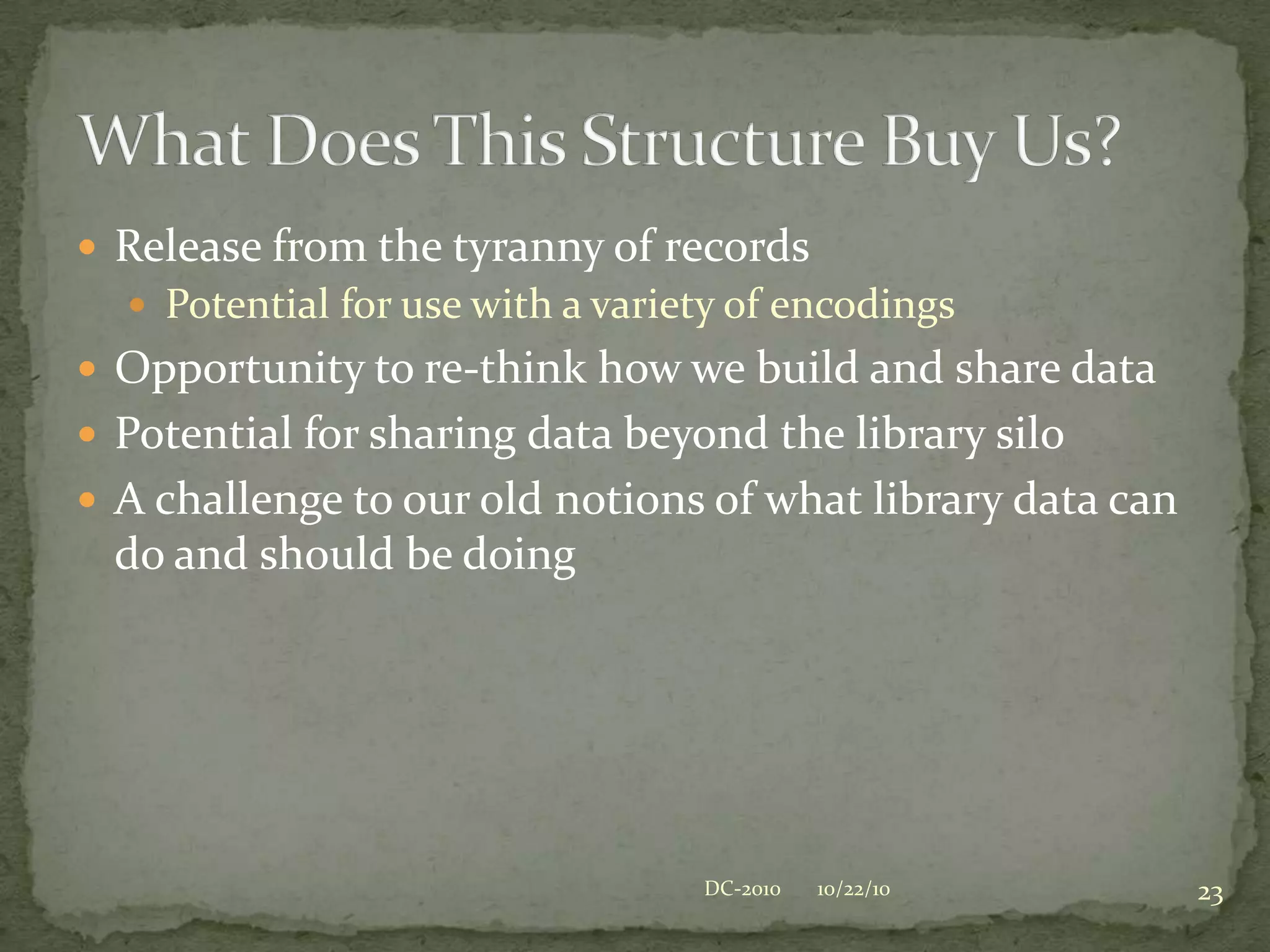
Release from the tyranny of recordsPotential for use with a variety of encodingsOpportunity to re-think how we build and share dataPotential for sharing data beyond the library siloA challenge to our old notions of what library data can do and should be doingWhat Does This Structure Buy Us?10/22/1023DC-2010
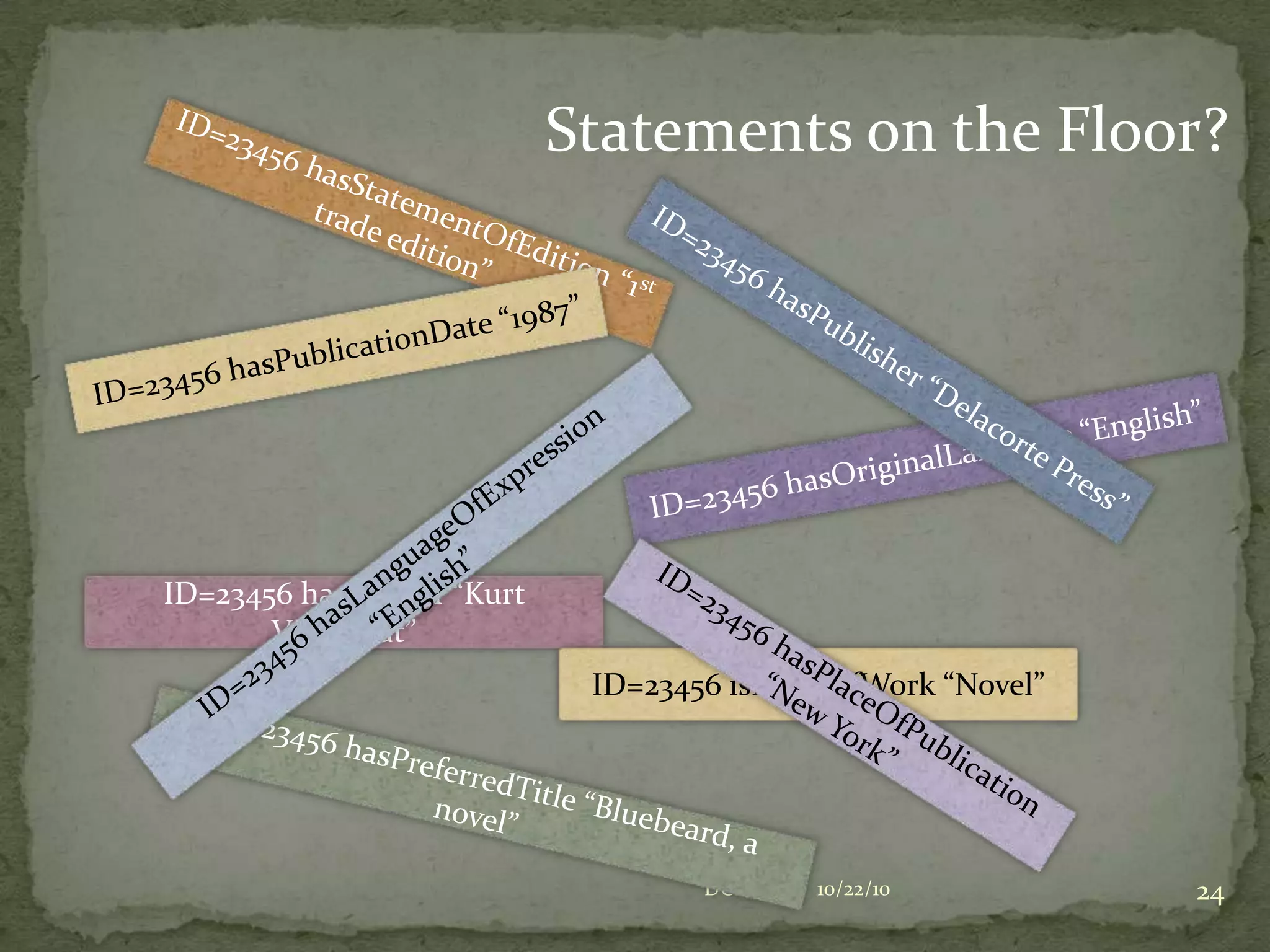
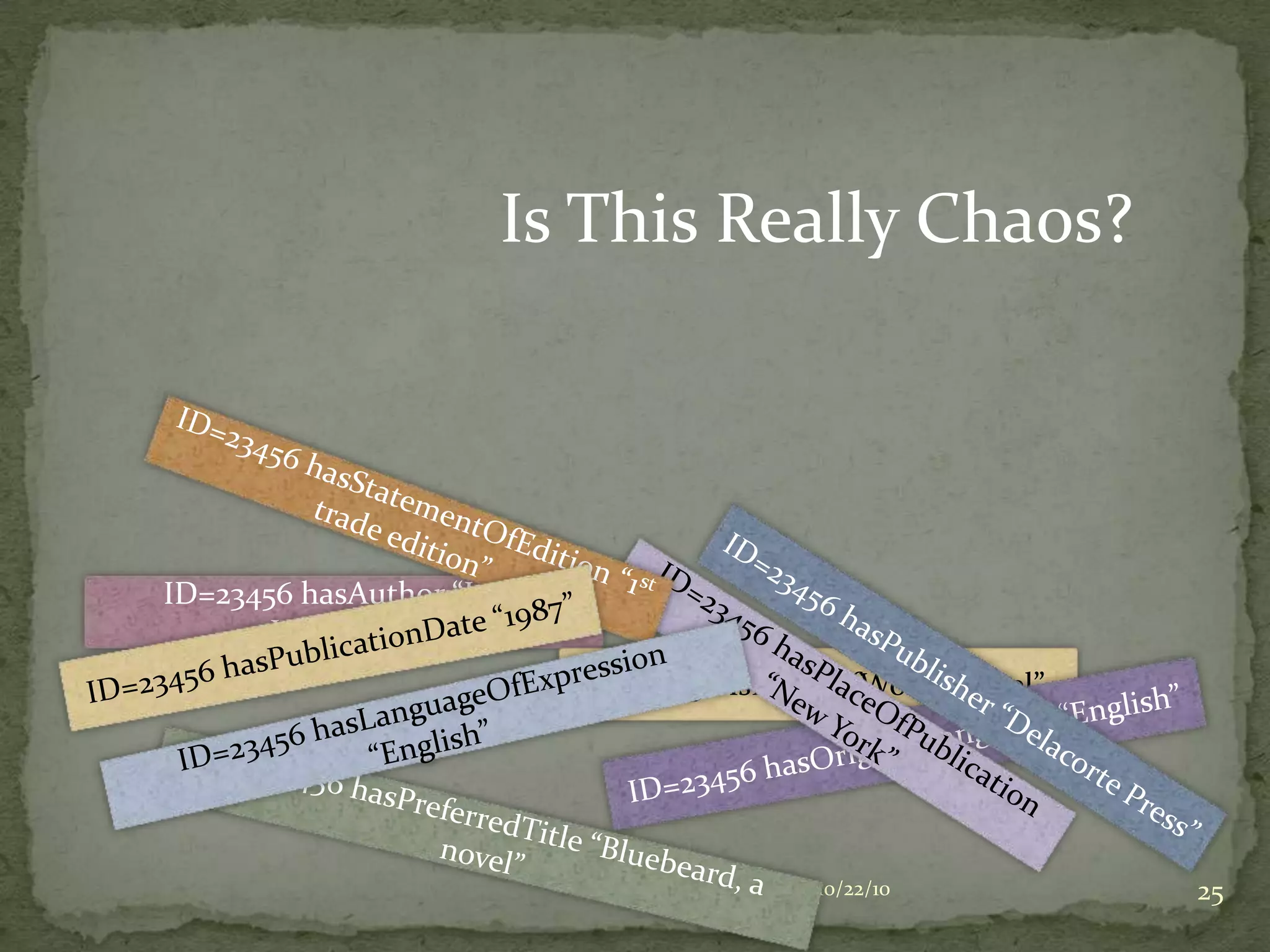
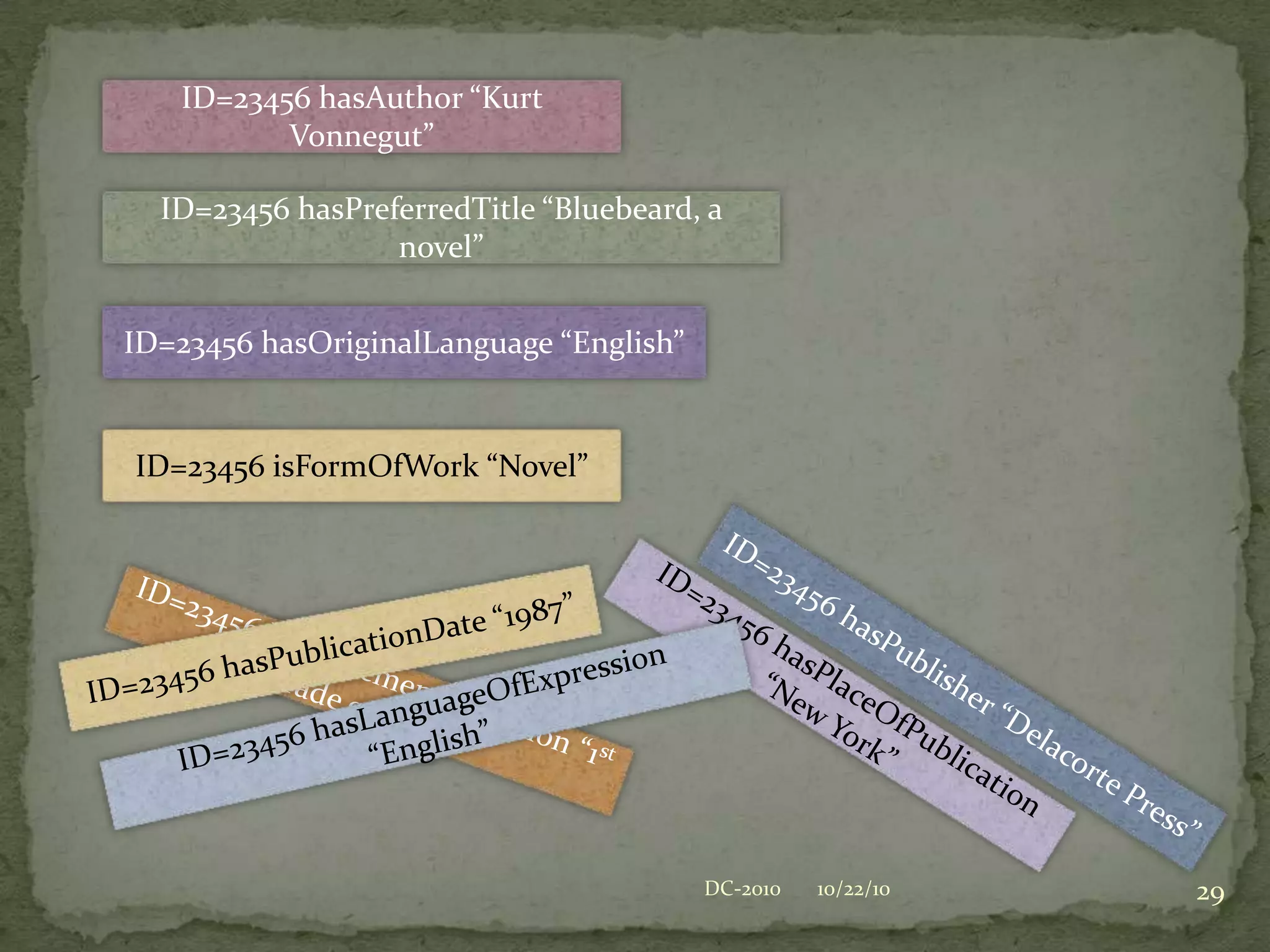
10/22/10DC-201024Statements on the Floor?ID=23456 hasStatementOfEdition “1st trade edition”ID=23456 hasPublicationDate “1987”ID=23456 hasPublisher “Delacorte Press”ID=23456 hasOriginalLanguage “English”ID=23456 hasLanguageOfExpression “English”ID=23456 hasAuthor “Kurt Vonnegut”ID=23456 isFormOfWork “Novel”ID=23456 hasPlaceOfPublication “New York”ID=23456 hasPreferredTitle “Bluebeard, a novel”
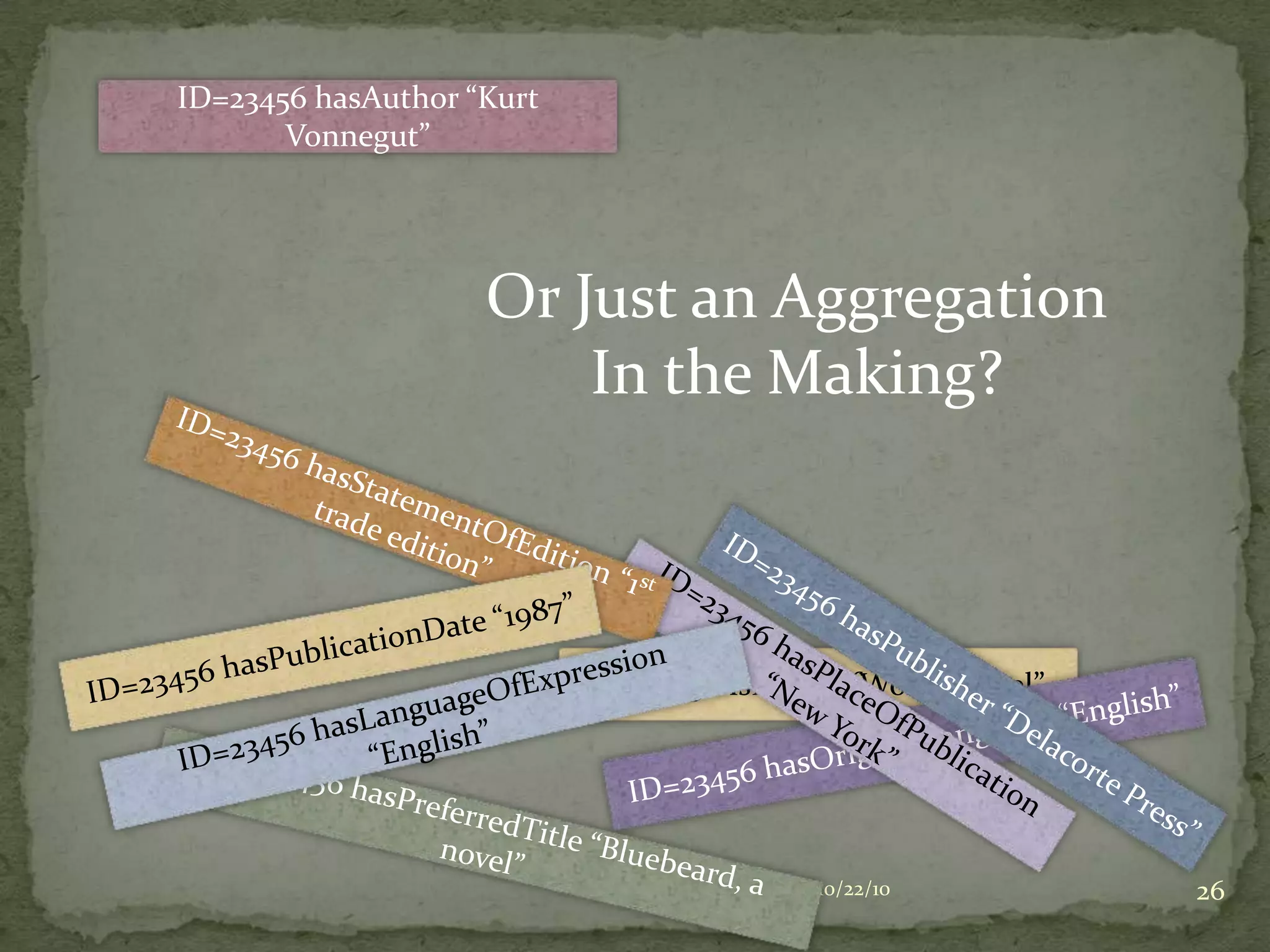
10/22/10DC-201025Is This Really Chaos?ID=23456 hasStatementOfEdition “1st trade edition”ID=23456 hasAuthor “Kurt Vonnegut”ID=23456 hasPublicationDate “1987”ID=23456 isFormOfWork “Novel”ID=23456 hasPublisher “Delacorte Press”ID=23456 hasPlaceOfPublication “New York”ID=23456 hasLanguageOfExpression “English”ID=23456 hasOriginalLanguage “English”ID=23456 hasPreferredTitle “Bluebeard, a novel”
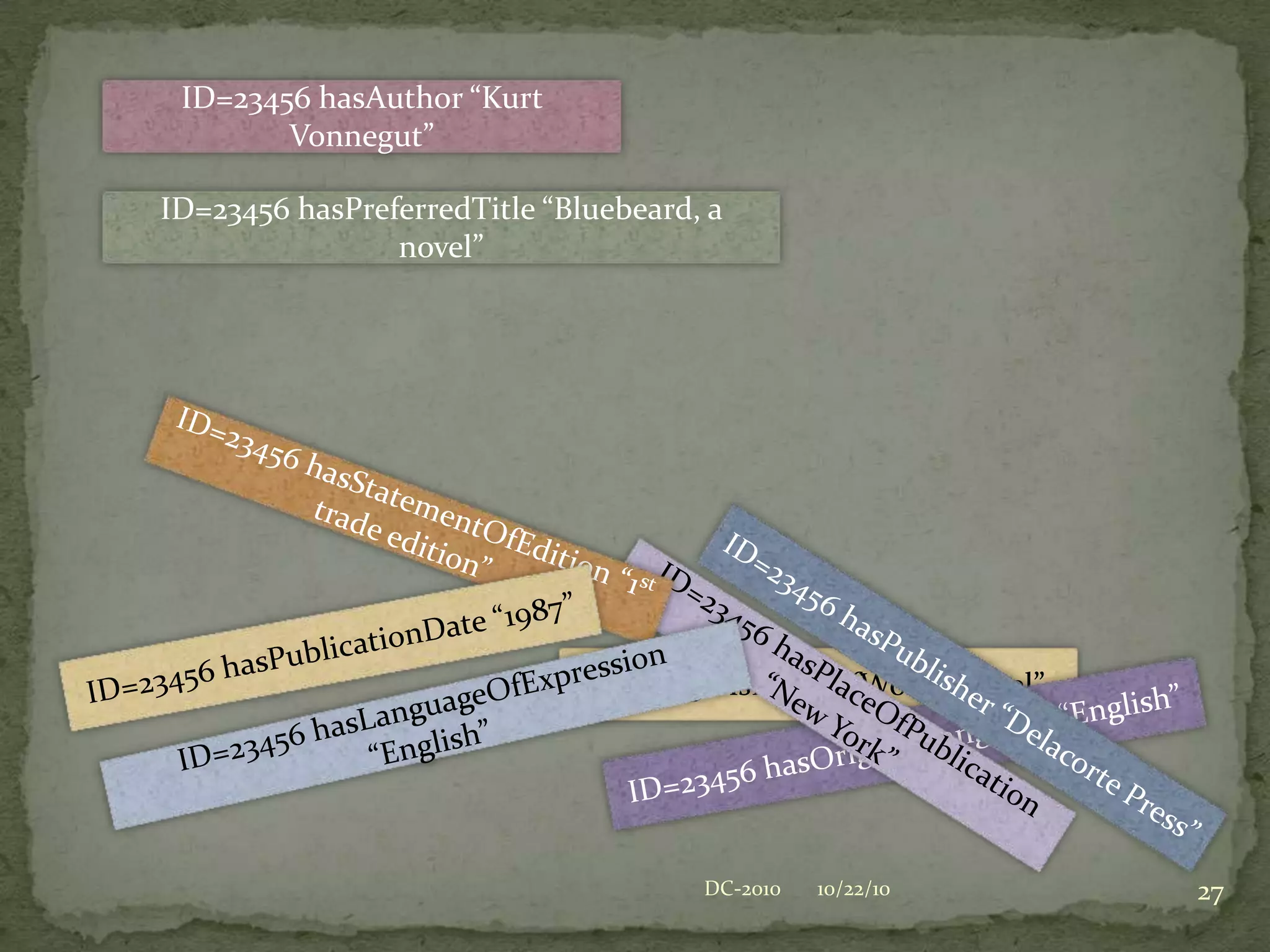
10/22/10DC-201026ID=23456 hasAuthor “Kurt Vonnegut”Or Just an AggregationIn the Making?ID=23456 hasStatementOfEdition “1st trade edition”ID=23456 hasPublicationDate “1987”ID=23456 isFormOfWork “Novel”ID=23456 hasPublisher “Delacorte Press”ID=23456 hasPlaceOfPublication “New York”ID=23456 hasLanguageOfExpression “English”ID=23456 hasOriginalLanguage “English”ID=23456 hasPreferredTitle “Bluebeard, a novel”
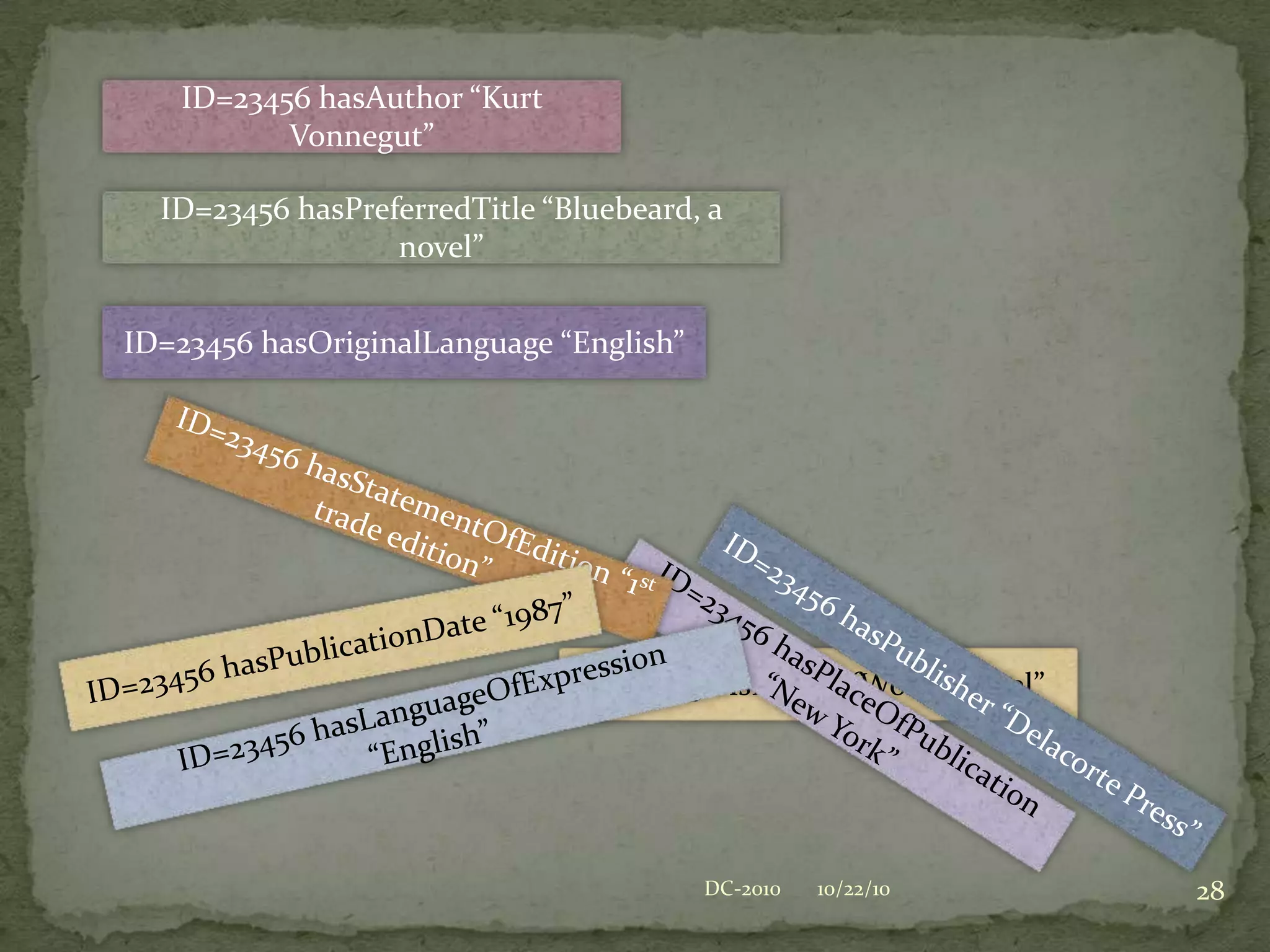
10/22/10DC-201027ID=23456 hasAuthor “Kurt Vonnegut”ID=23456 hasPreferredTitle “Bluebeard, a novel”ID=23456 hasStatementOfEdition “1st trade edition”ID=23456 hasPublicationDate “1987”ID=23456 isFormOfWork “Novel”ID=23456 hasPublisher “Delacorte Press”ID=23456 hasPlaceOfPublication “New York”ID=23456 hasLanguageOfExpression “English”ID=23456 hasOriginalLanguage “English”
10/22/10DC-201028ID=23456 hasAuthor “Kurt Vonnegut”ID=23456 hasPreferredTitle “Bluebeard, a novel”ID=23456 hasOriginalLanguage “English”ID=23456 hasStatementOfEdition “1st trade edition”ID=23456 hasPublicationDate “1987”ID=23456 isFormOfWork “Novel”ID=23456 hasPublisher “Delacorte Press”ID=23456 hasPlaceOfPublication “New York”ID=23456 hasLanguageOfExpression “English”
10/22/10DC-201029ID=23456 hasAuthor “Kurt Vonnegut”ID=23456 hasPreferredTitle “Bluebeard, a novel”ID=23456 hasOriginalLanguage “English”ID=23456 isFormOfWork “Novel”ID=23456 hasPublicationDate “1987”ID=23456 hasPublisher “Delacorte Press”ID=23456 hasStatementOfEdition “1st trade edition”ID=23456 hasPlaceOfPublication “New York”ID=23456 hasLanguageOfExpression “English”
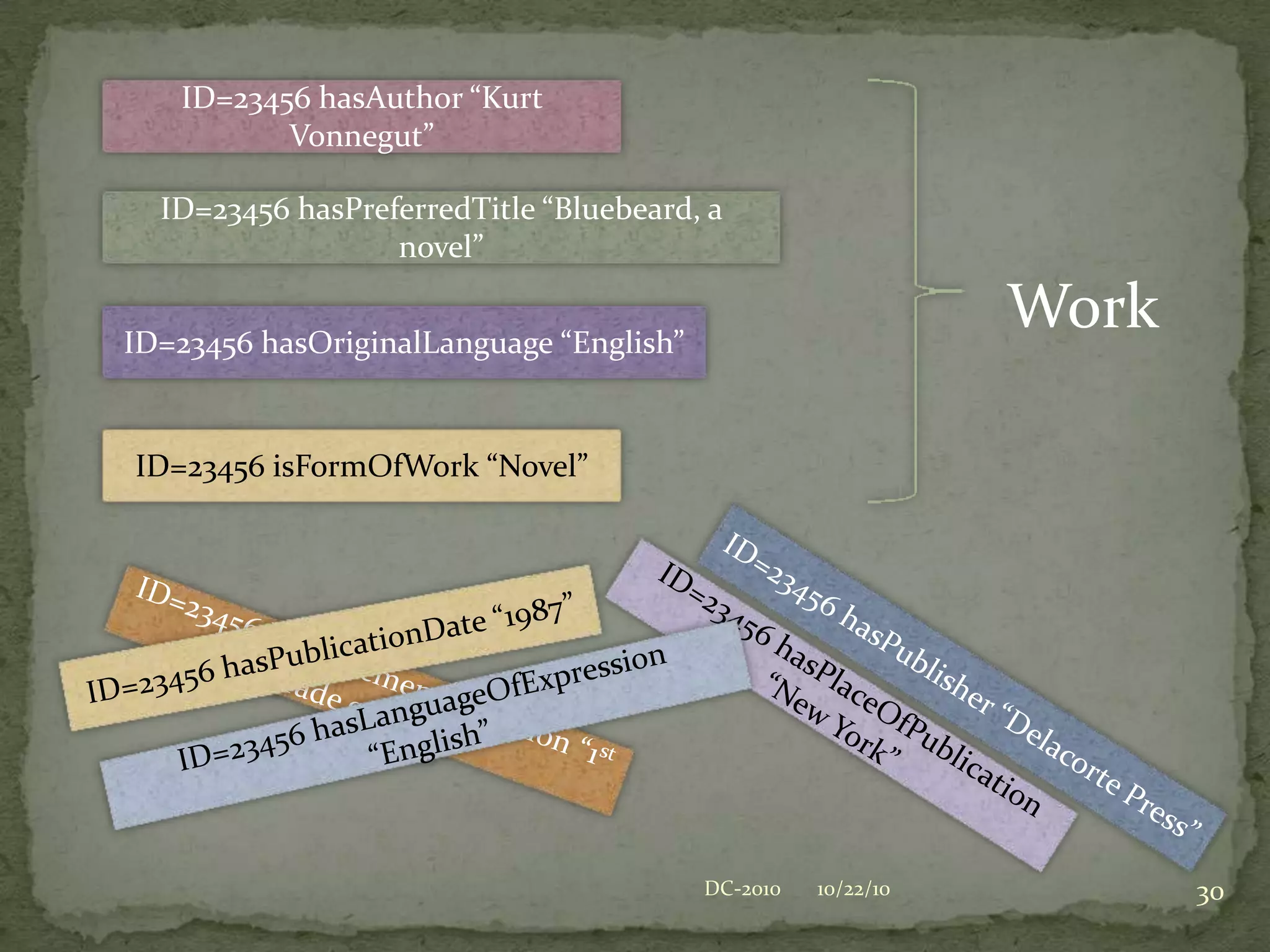
10/22/10DC-201030ID=23456 hasAuthor “Kurt Vonnegut”ID=23456 hasPreferredTitle “Bluebeard, a novel”WorkID=23456 hasOriginalLanguage “English”ID=23456 isFormOfWork “Novel”ID=23456 hasPublicationDate “1987”ID=23456 hasPublisher “Delacorte Press”ID=23456 hasStatementOfEdition “1st trade edition”ID=23456 hasPlaceOfPublication “New York”ID=23456 hasLanguageOfExpression “English”
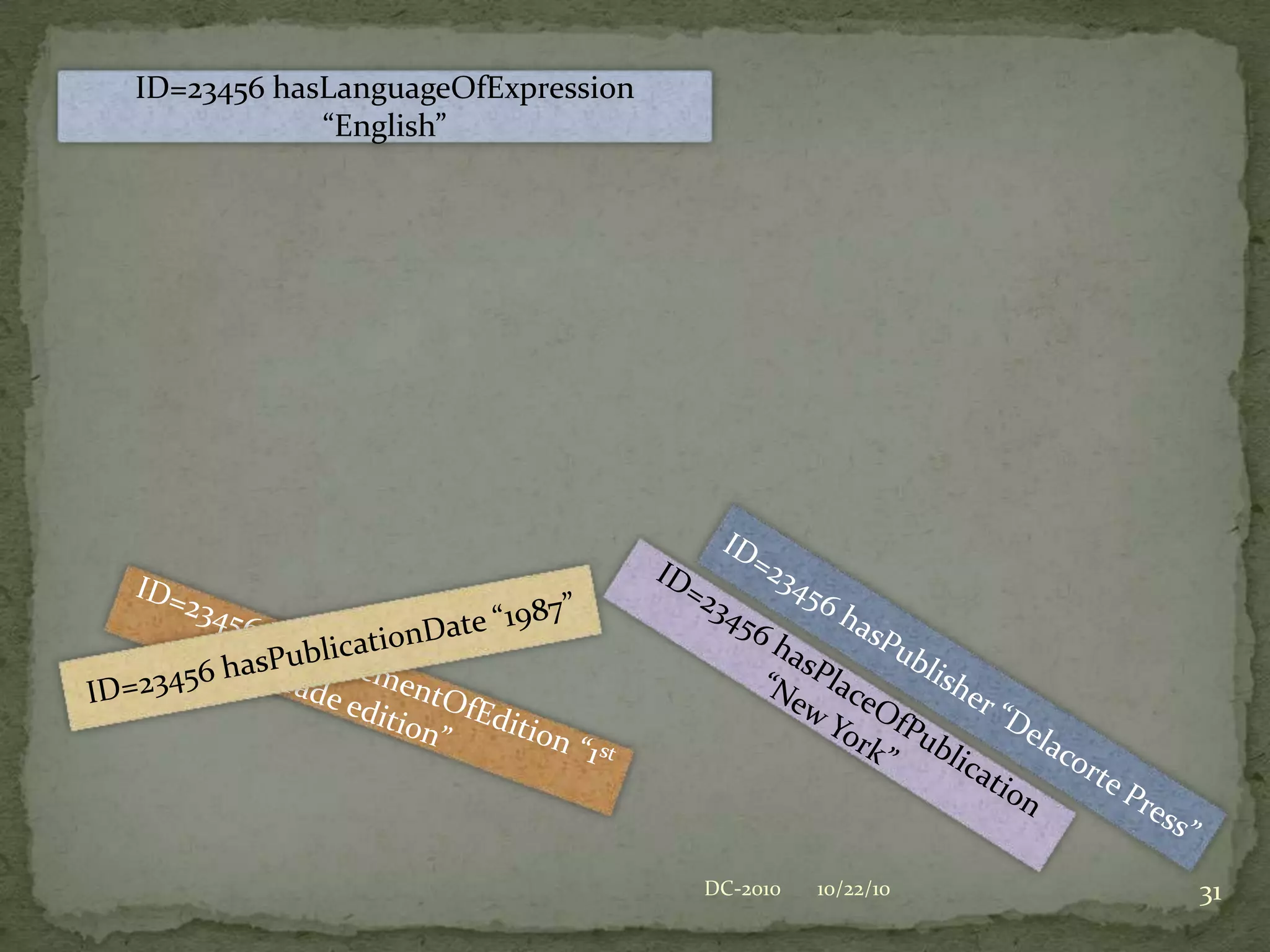
10/22/10DC-201031ID=23456 hasLanguageOfExpression “English”ID=23456 hasPublicationDate “1987”ID=23456 hasPublisher “Delacorte Press”ID=23456 hasStatementOfEdition “1st trade edition”ID=23456 hasPlaceOfPublication “New York”
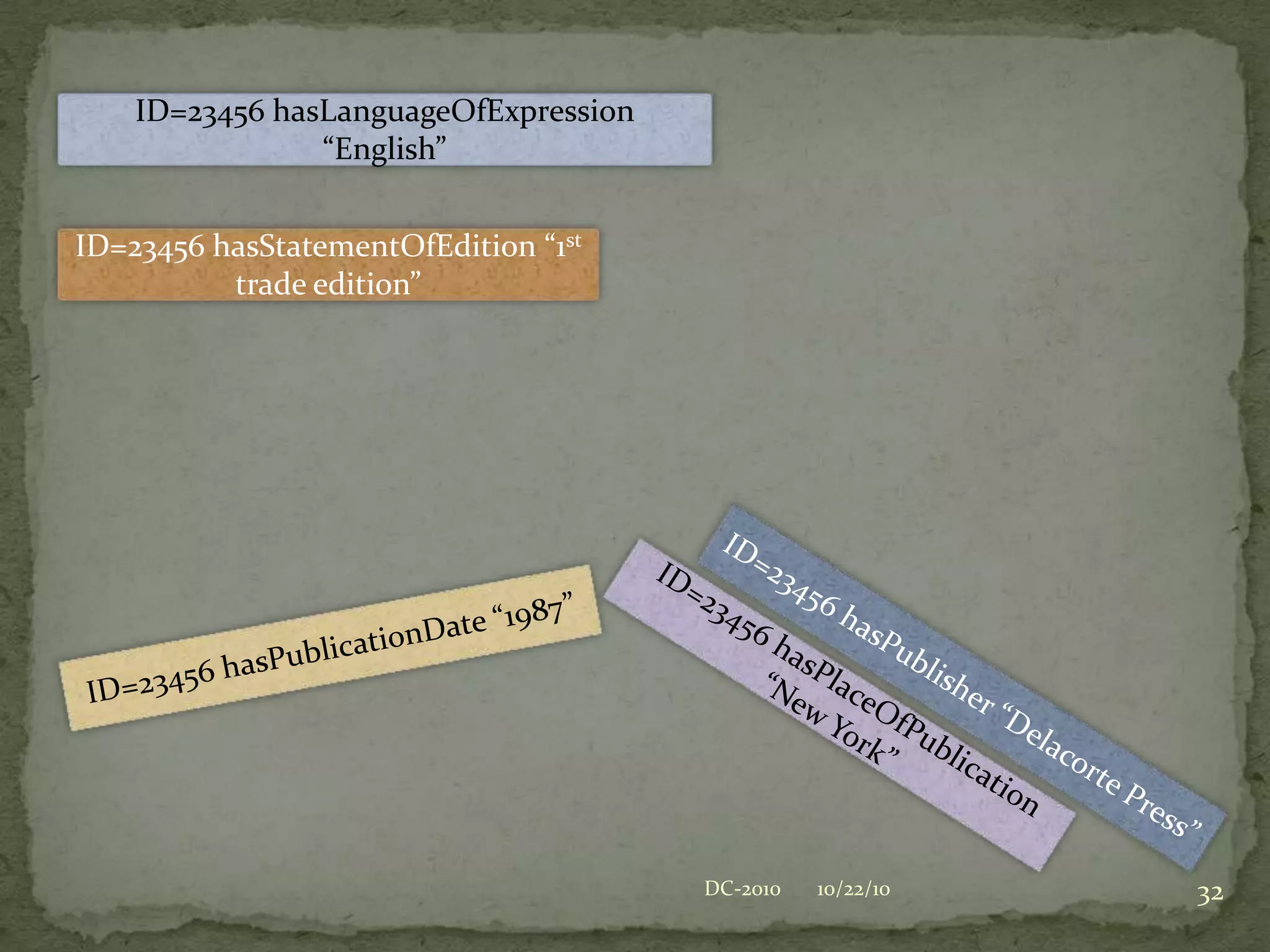
10/22/10DC-201032ID=23456 hasLanguageOfExpression “English”ID=23456 hasStatementOfEdition “1st trade edition”ID=23456 hasPublicationDate “1987”ID=23456 hasPublisher “Delacorte Press”ID=23456 hasPlaceOfPublication “New York”
10/22/10DC-201033ID=23456 hasLanguageOfExpression “English”ExpressionID=23456 hasStatementOfEdition “1st trade edition”ID=23456 hasPublicationDate “1987”ID=23456 hasPublisher “Delacorte Press”ID=23456 hasPlaceOfPublication “New York”
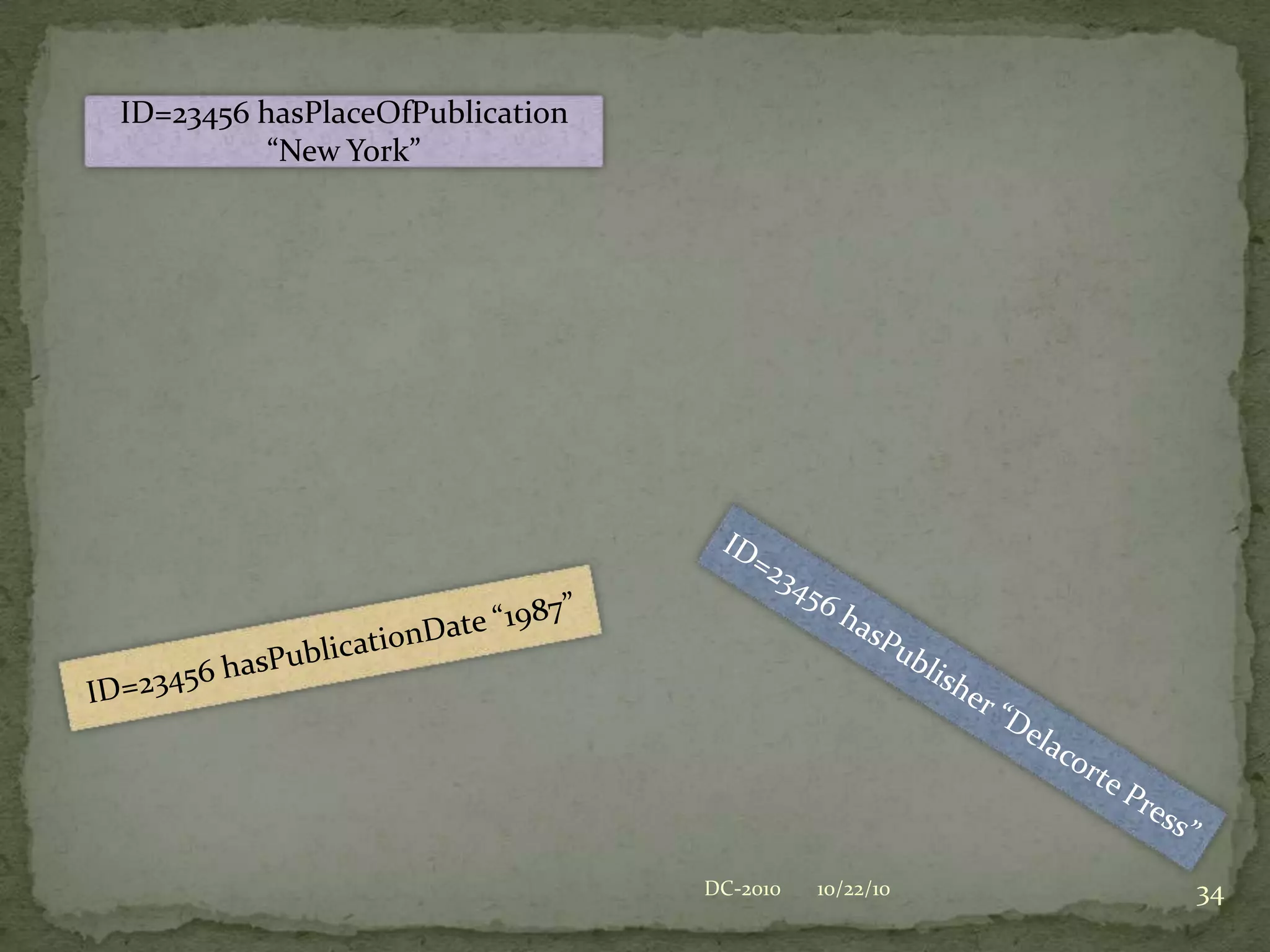
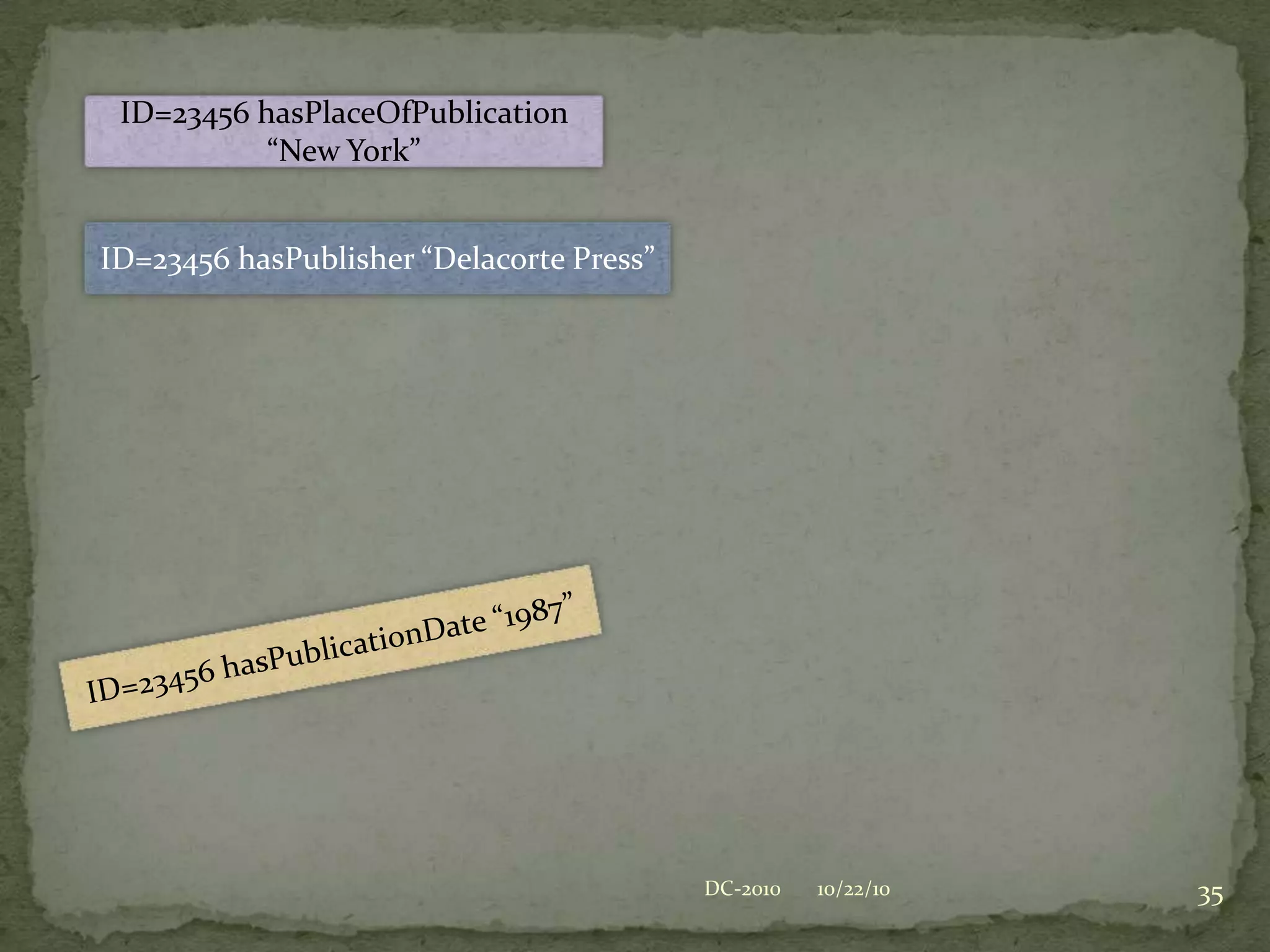
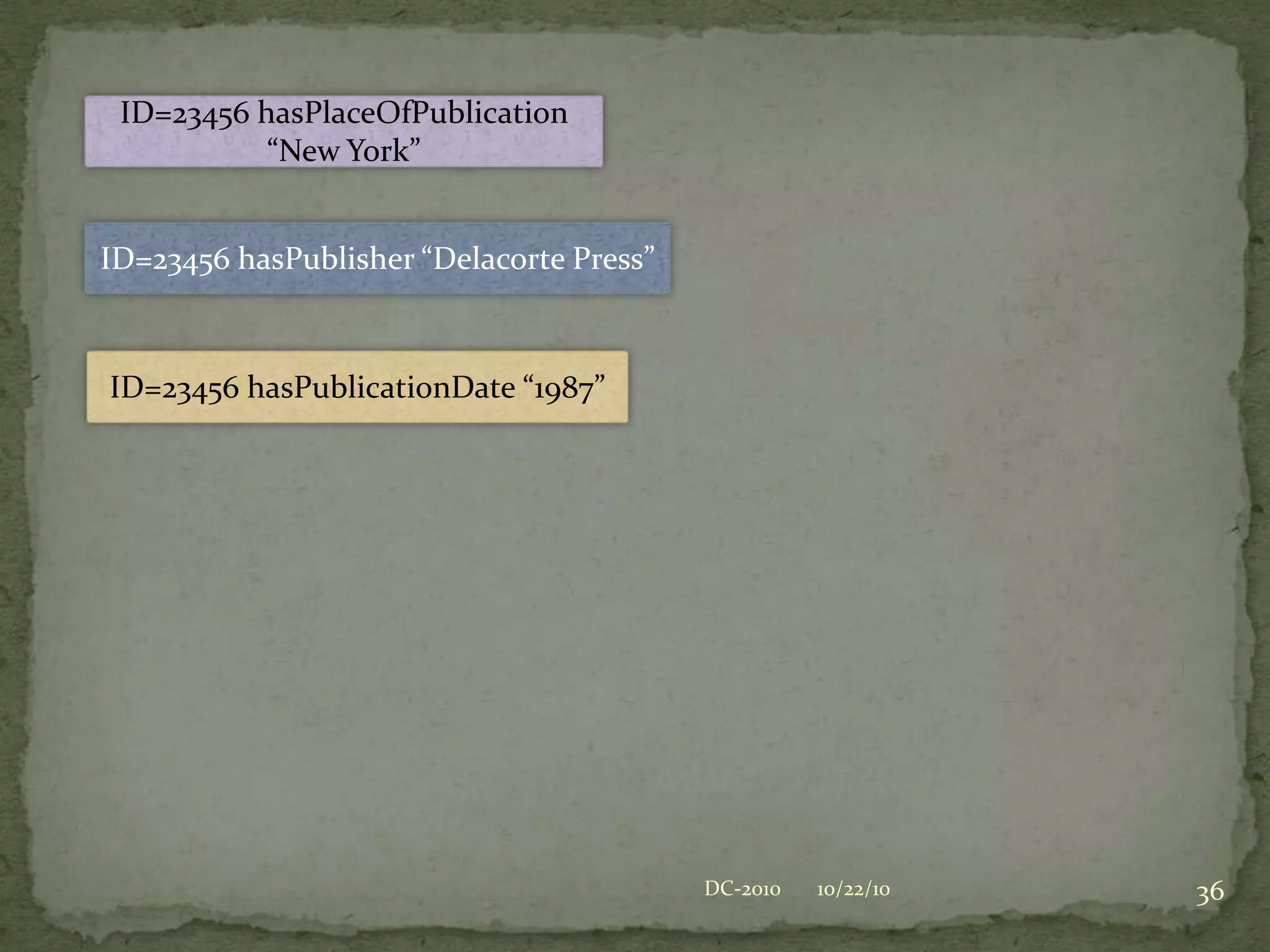
10/22/10DC-201034ID=23456 hasPlaceOfPublication “New York”ID=23456 hasPublicationDate “1987”ID=23456 hasPublisher “Delacorte Press”
10/22/10DC-201035ID=23456 hasPlaceOfPublication “New York”ID=23456 hasPublisher “Delacorte Press”ID=23456 hasPublicationDate “1987”
10/22/10DC-201036ID=23456 hasPlaceOfPublication “New York”ID=23456 hasPublisher “Delacorte Press”ID=23456 hasPublicationDate “1987”
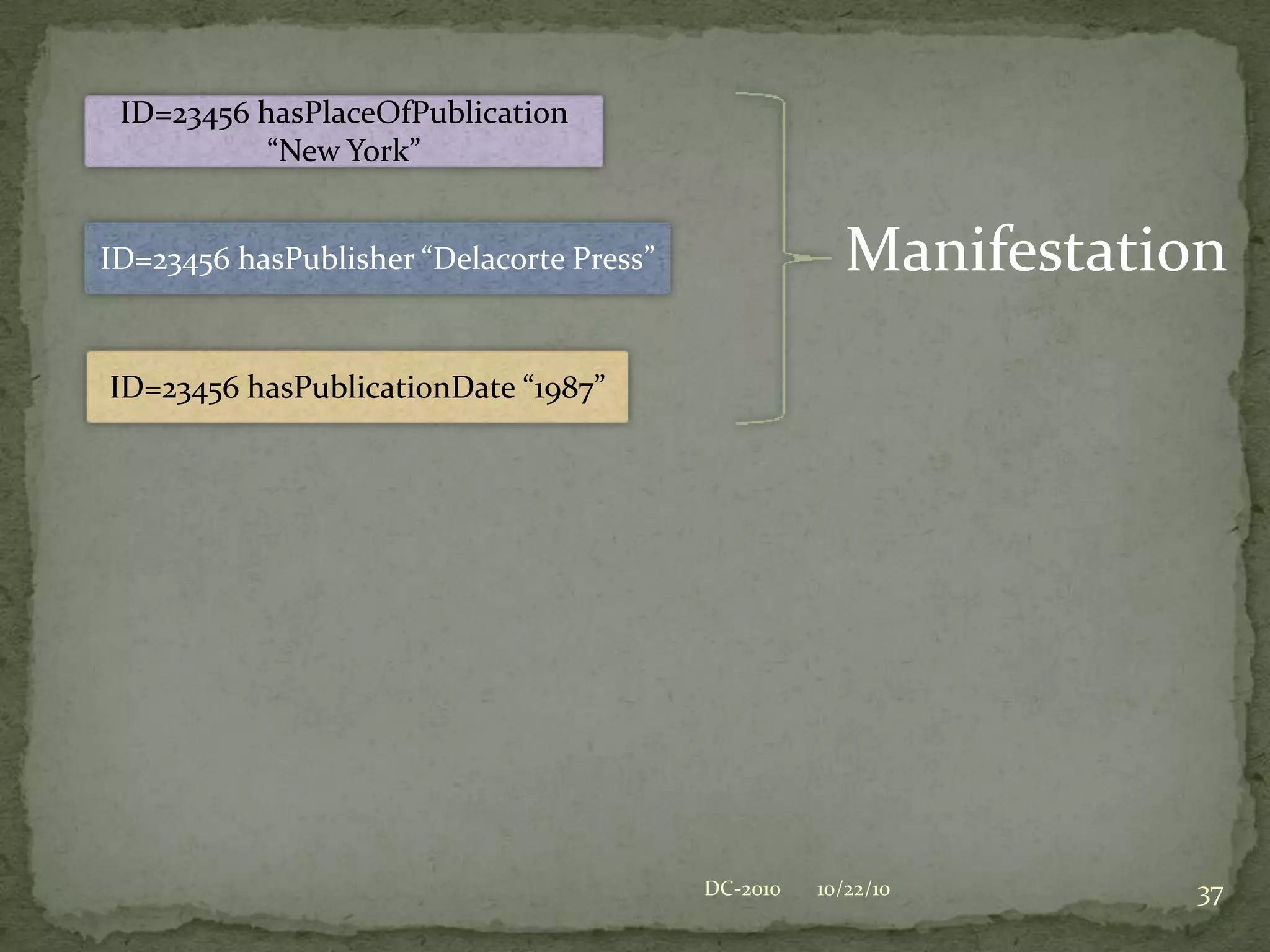
10/22/10DC-201037ID=23456 hasPlaceOfPublication “New York”ManifestationID=23456 hasPublisher “Delacorte Press”ID=23456 hasPublicationDate “1987”
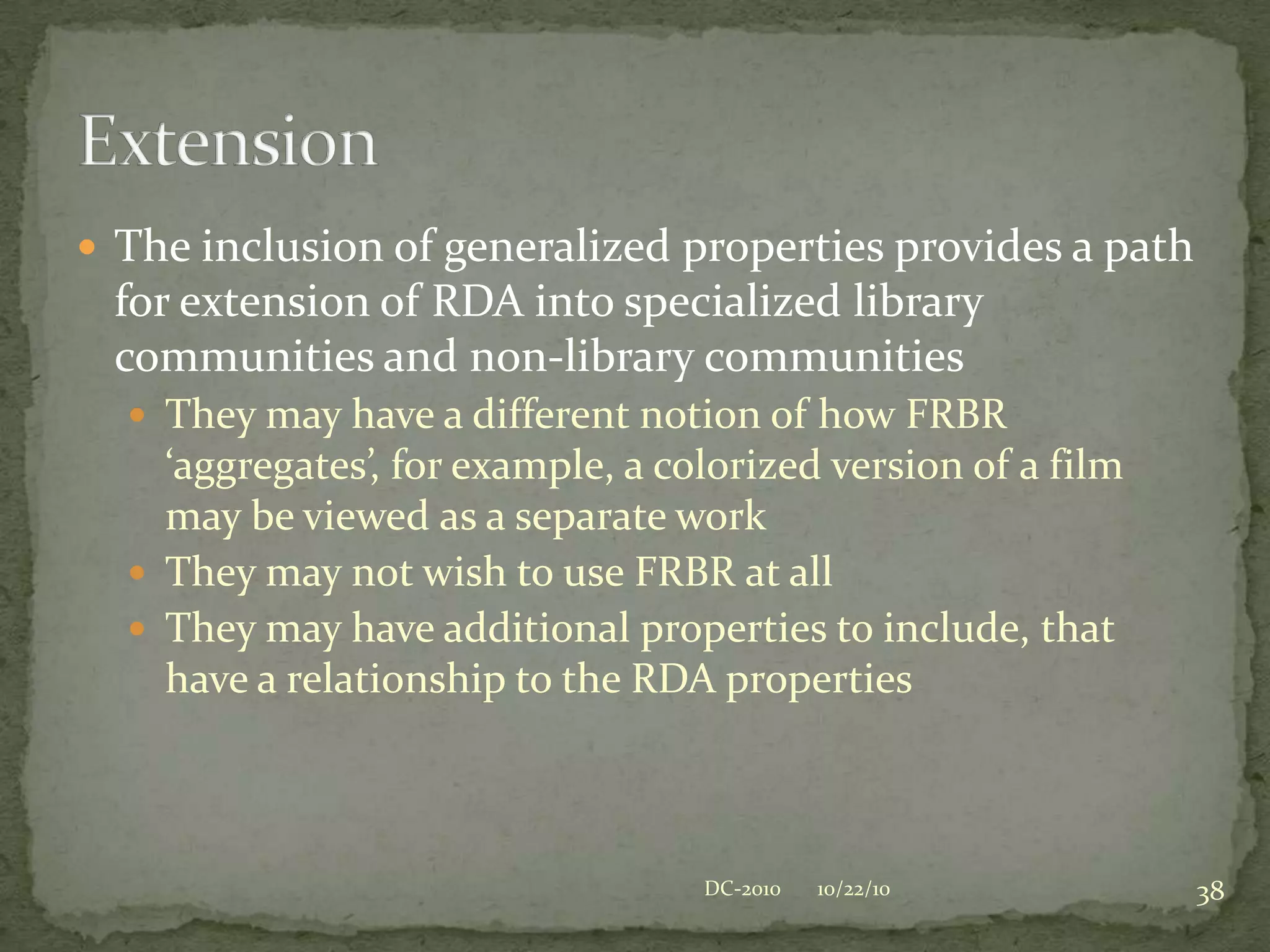
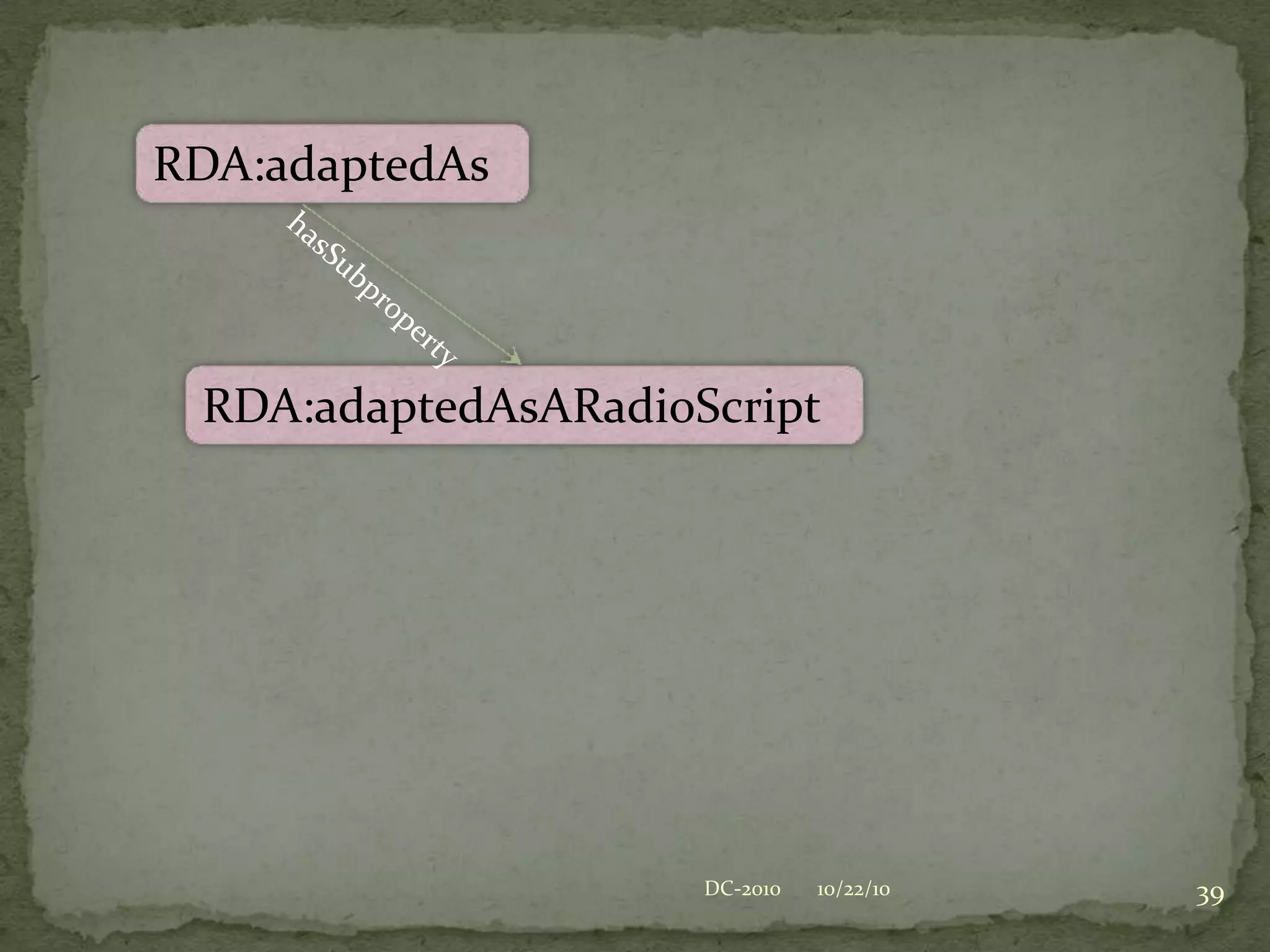
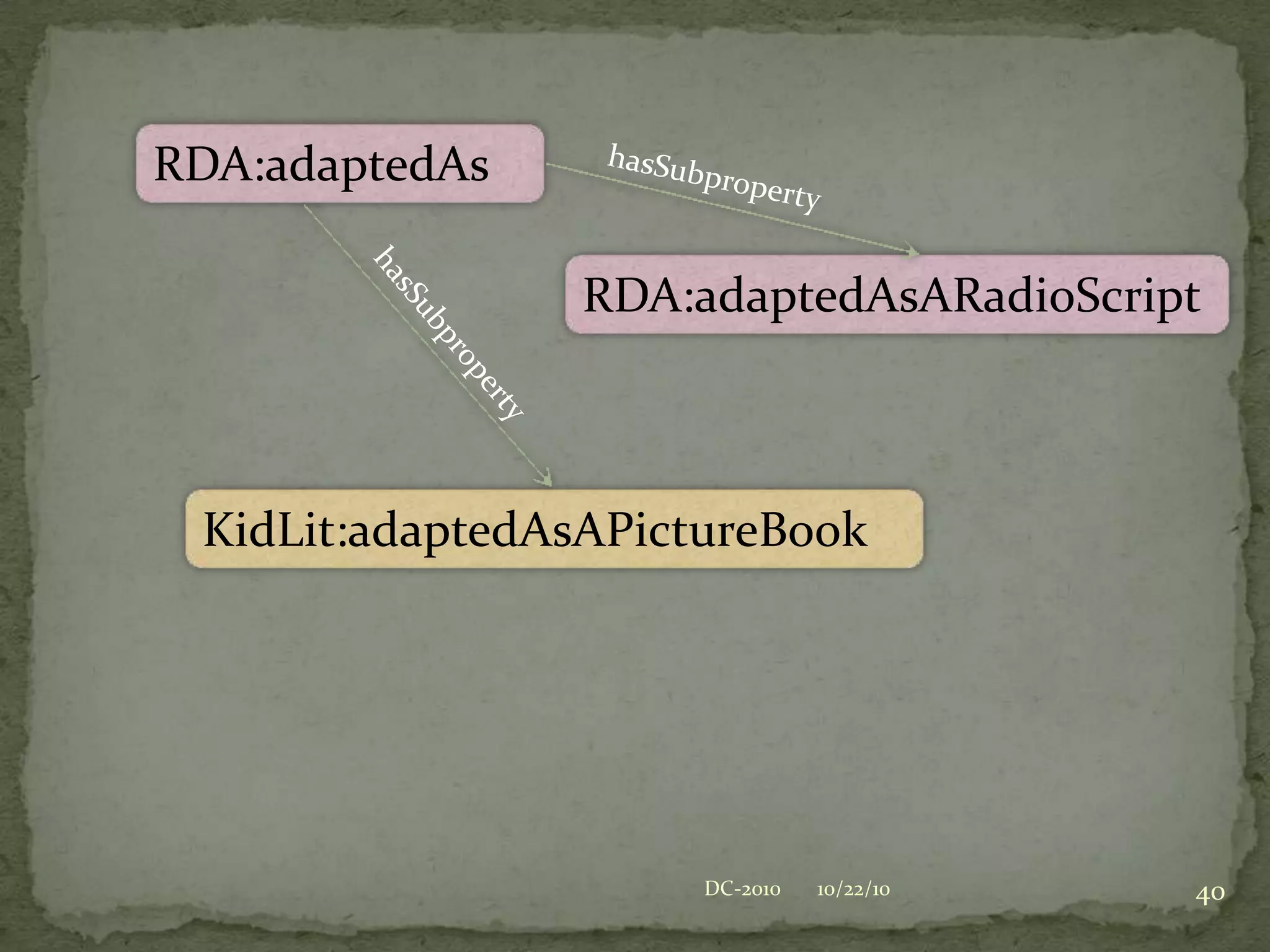
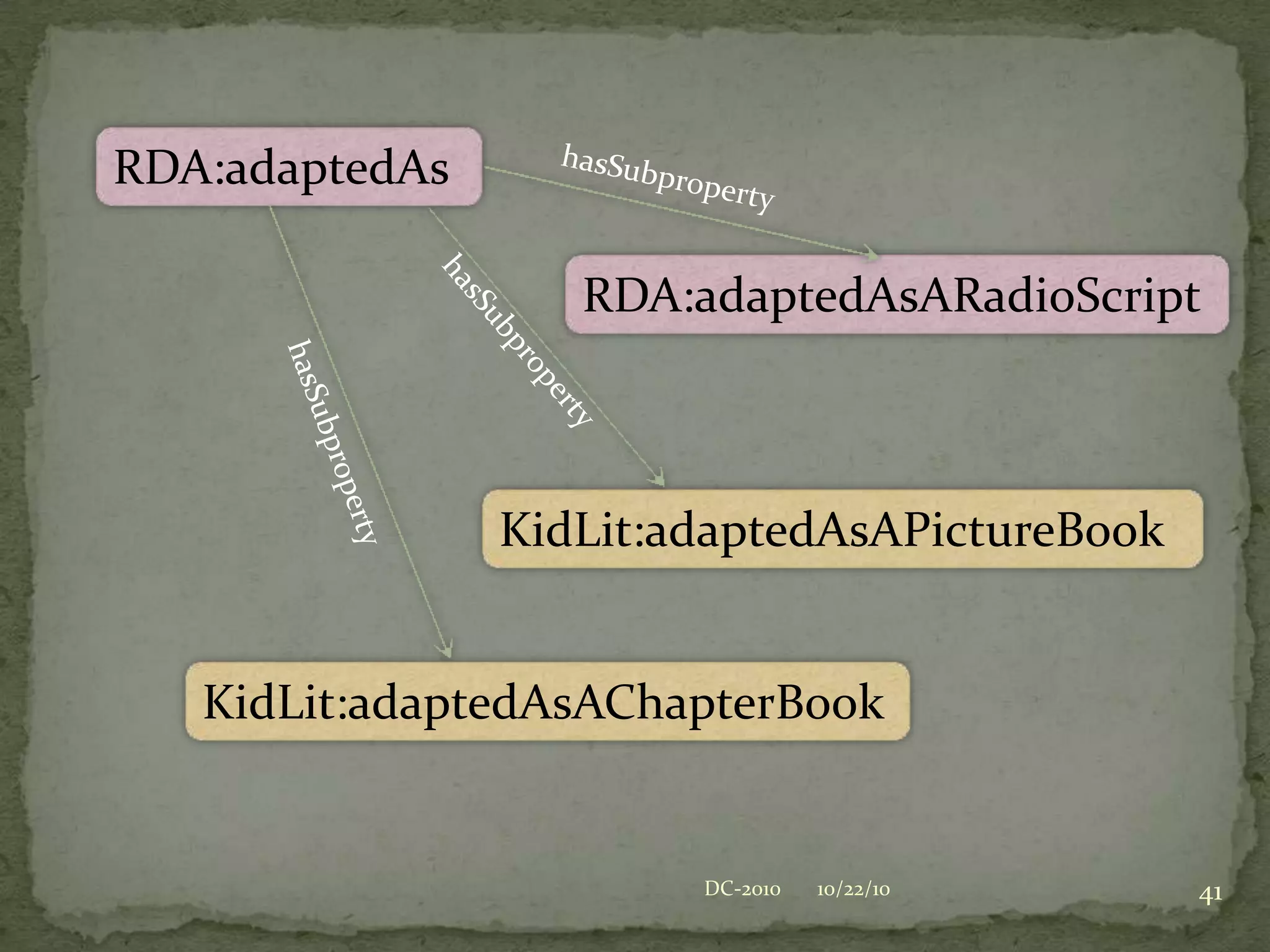
The inclusion of generalized properties provides a path for extension of RDA into specialized library communities and non-library communitiesThey may have a different notion of how FRBR ‘aggregates’, for example, a colorized version of a film may be viewed as a separate workThey may not wish to use FRBR at allThey may have additional properties to include, that have a relationship to the RDA propertiesExtension 10/22/1038DC-2010
RDA:adaptedAshasSubpropertyRDA:adaptedAsARadioScript10/22/1039DC-2010
RDA:adaptedAshasSubpropertyRDA:adaptedAsARadioScripthasSubpropertyKidLit:adaptedAsAPictureBook10/22/1040DC-2010
RDA:adaptedAshasSubpropertyRDA:adaptedAsARadioScripthasSubpropertyhasSubpropertyKidLit:adaptedAsAPictureBookKidLit:adaptedAsAChapterBook10/22/1041DC-2010
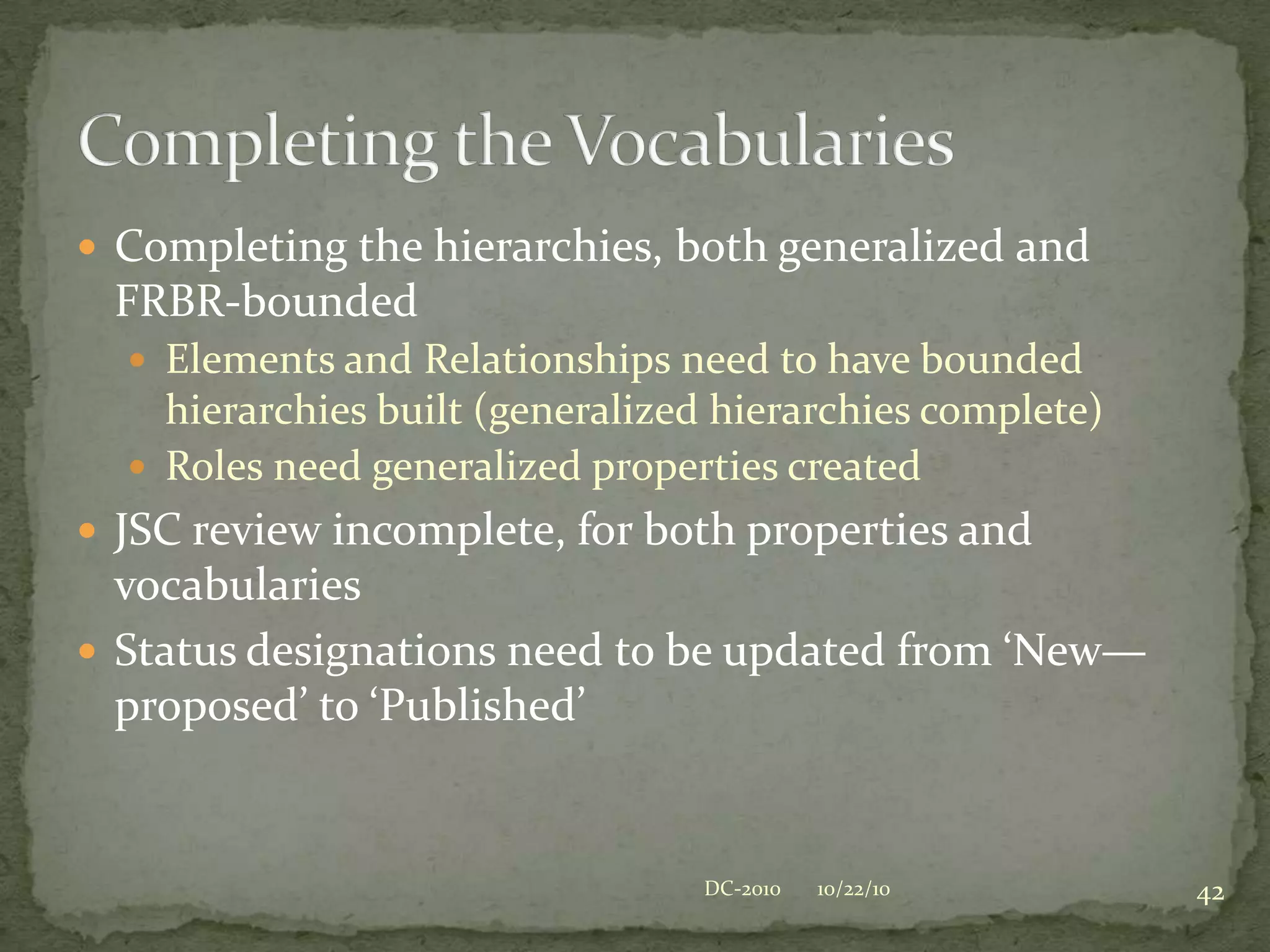
Completing the hierarchies, both generalized and FRBR-boundedElements and Relationships need to have bounded hierarchies built (generalized hierarchies complete)Roles need generalized properties createdJSC review incomplete, for both properties and vocabulariesStatus designations need to be updated from ‘New—proposed’ to ‘Published’Completing the Vocabularies10/22/1042DC-2010
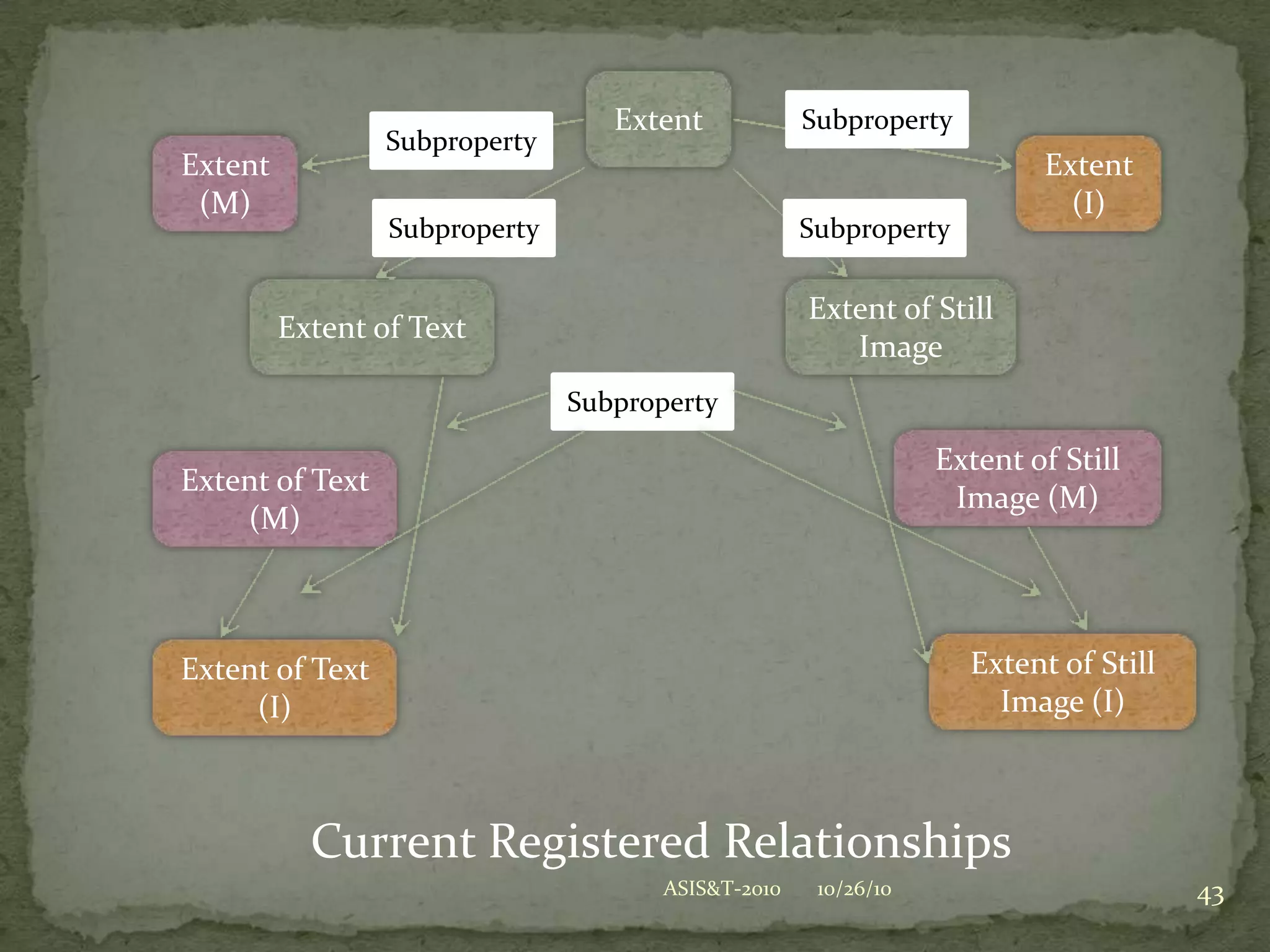
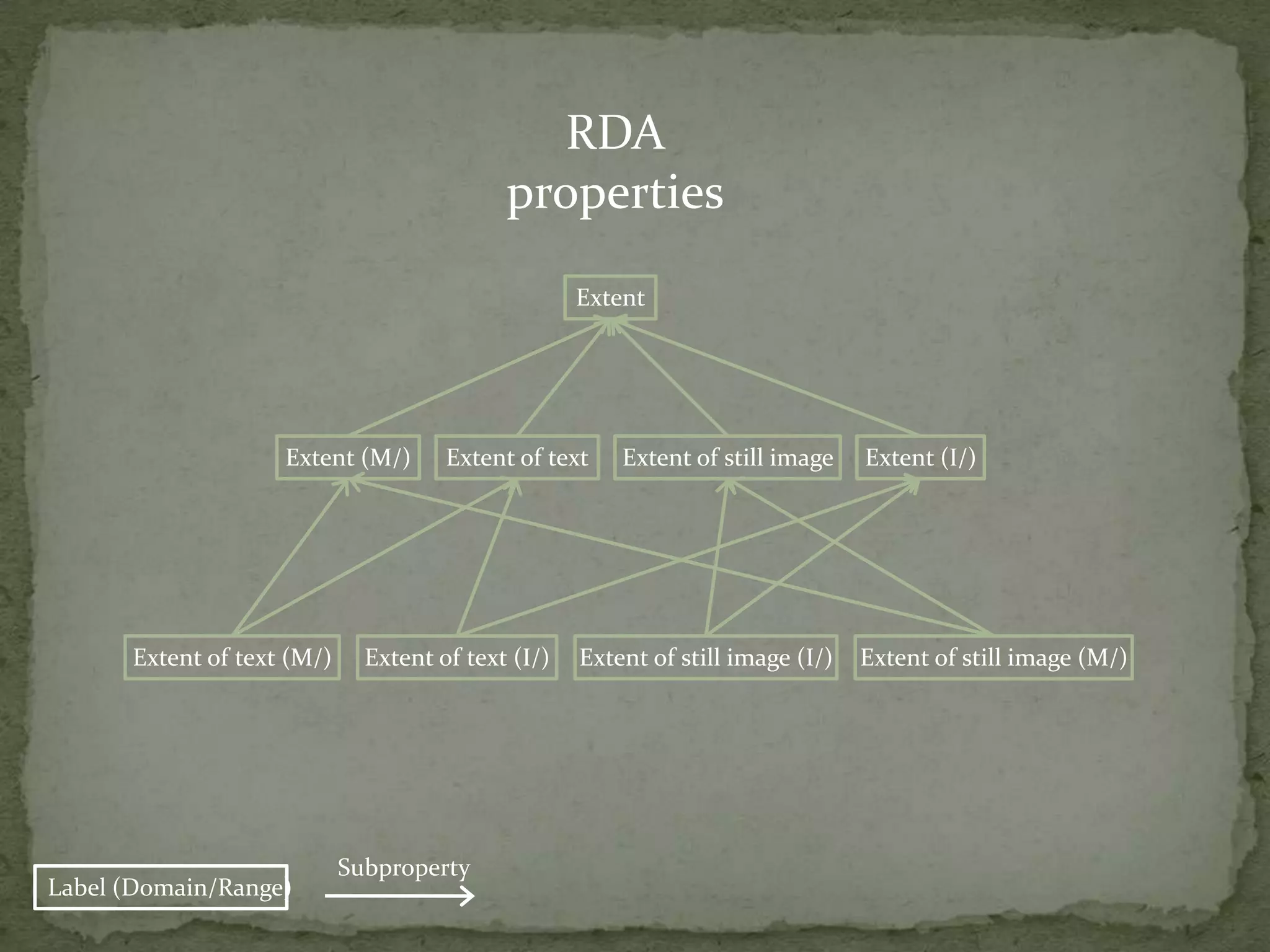
ExtentSubpropertySubpropertyExtent (I)Extent (M)SubpropertySubpropertyExtent of TextExtent of Still ImageSubpropertyExtent of Still Image (M)Extent of Text (M)Extent of Still Image (I)Extent of Text (I)Current Registered Relationships10/26/1043ASIS&T-2010
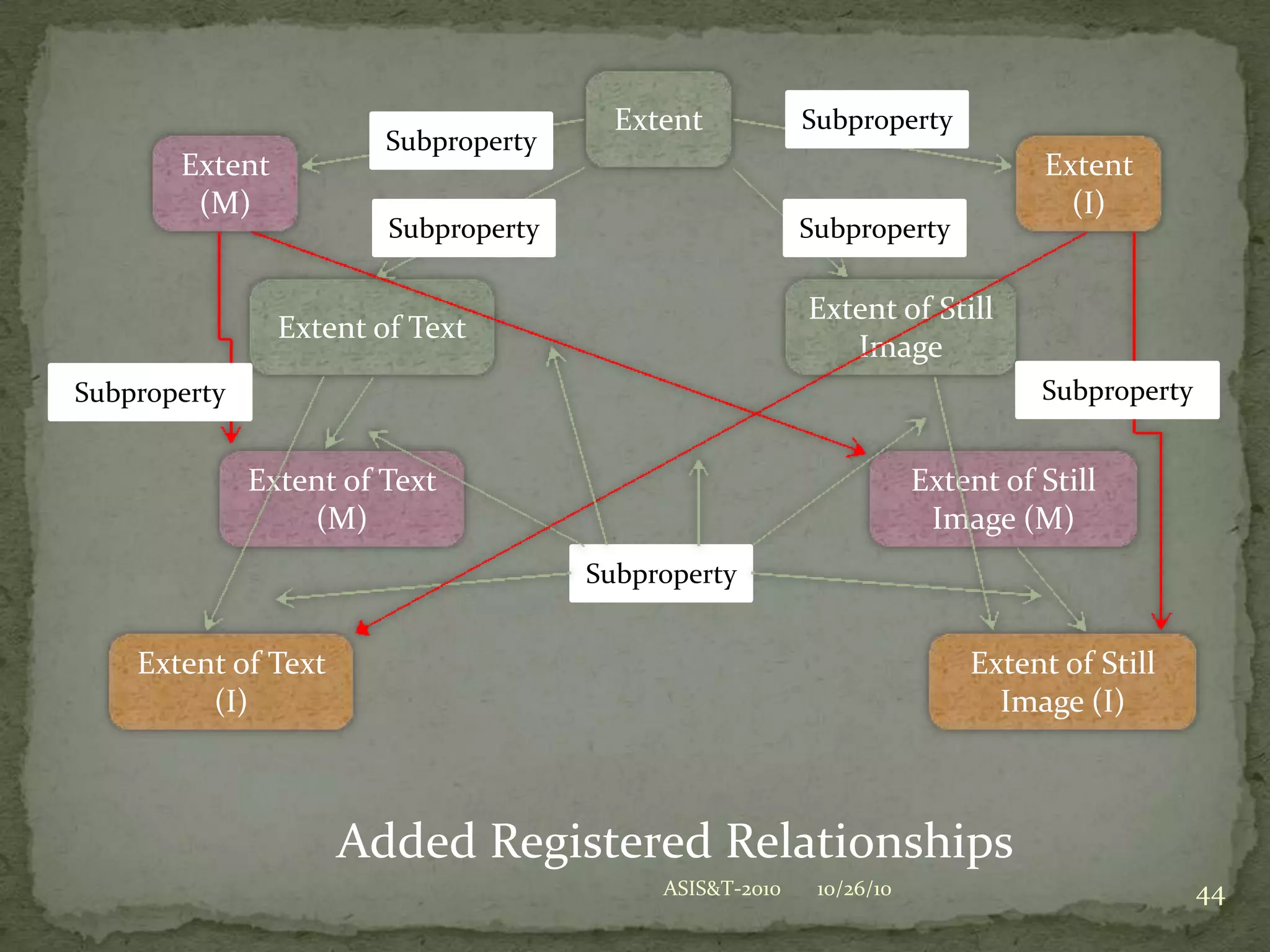
ExtentSubpropertySubpropertyExtent (I)Extent (M)SubpropertySubpropertyExtent of TextExtent of Still ImageSubpropertySubpropertyExtent of Text (M)Extent of Still Image (M)SubpropertyExtent of Text (I)Extent of Still Image (I)Added Registered Relationships10/26/1044ASIS&T-2010
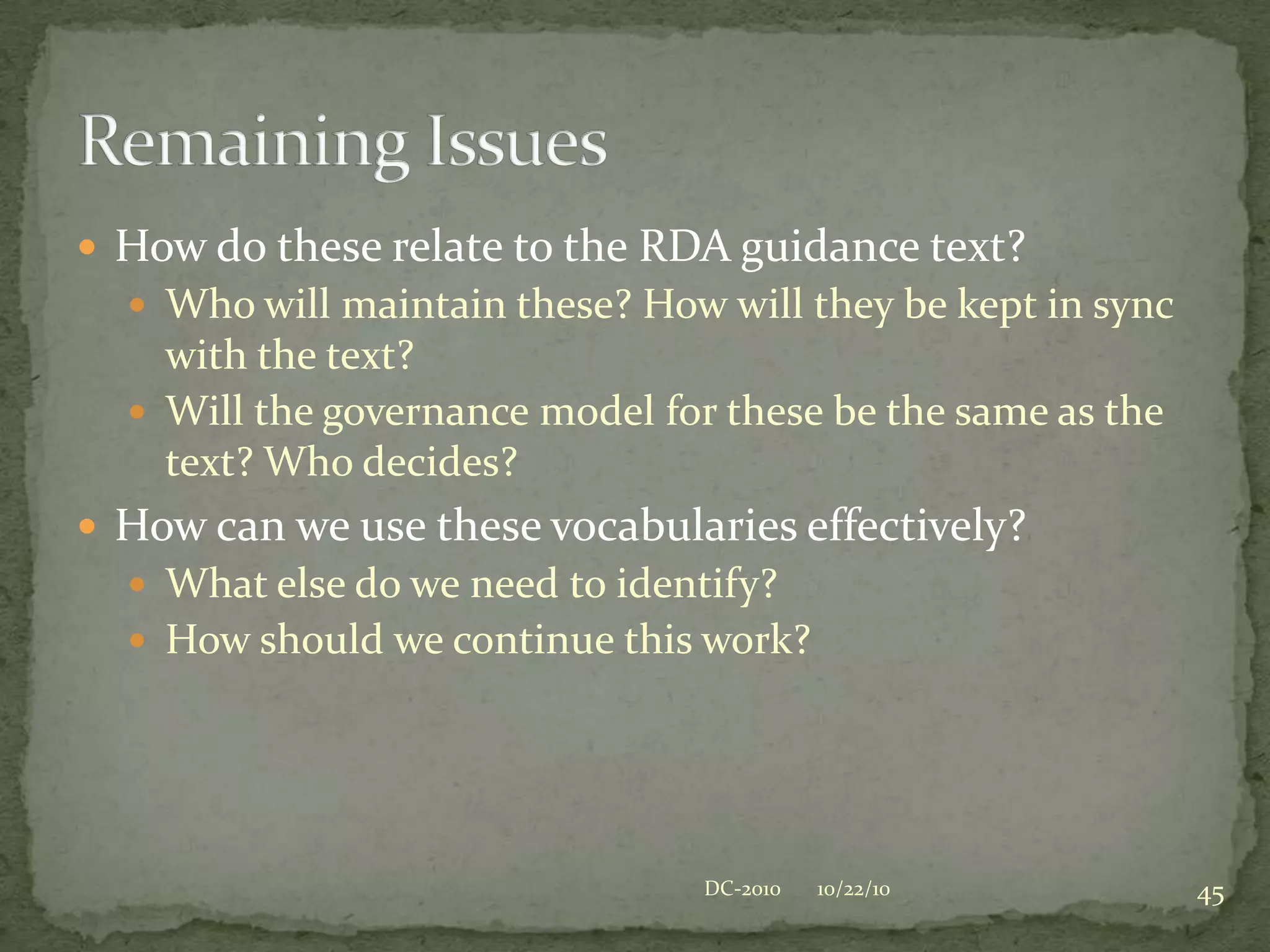
How do these relate to the RDA guidance text?Who will maintain these? How will they be kept in sync with the text?  Will the governance model for these be the same as the text? Who decides?How can we use these vocabularies effectively?What else do we need to identify?How should we continue this work?Remaining Issues10/22/1045DC-2010
We wrote about the decisions we made for RDA in DLib:	http://dlib.org/dlib/january10/hillmann/01hillmann.htmlNeed to continue to disclose what we’ve learned and work on building best practices documentation in this environmentWhat We’ve Learned10/22/1046DC-2010
Important related workGordon Dunsire
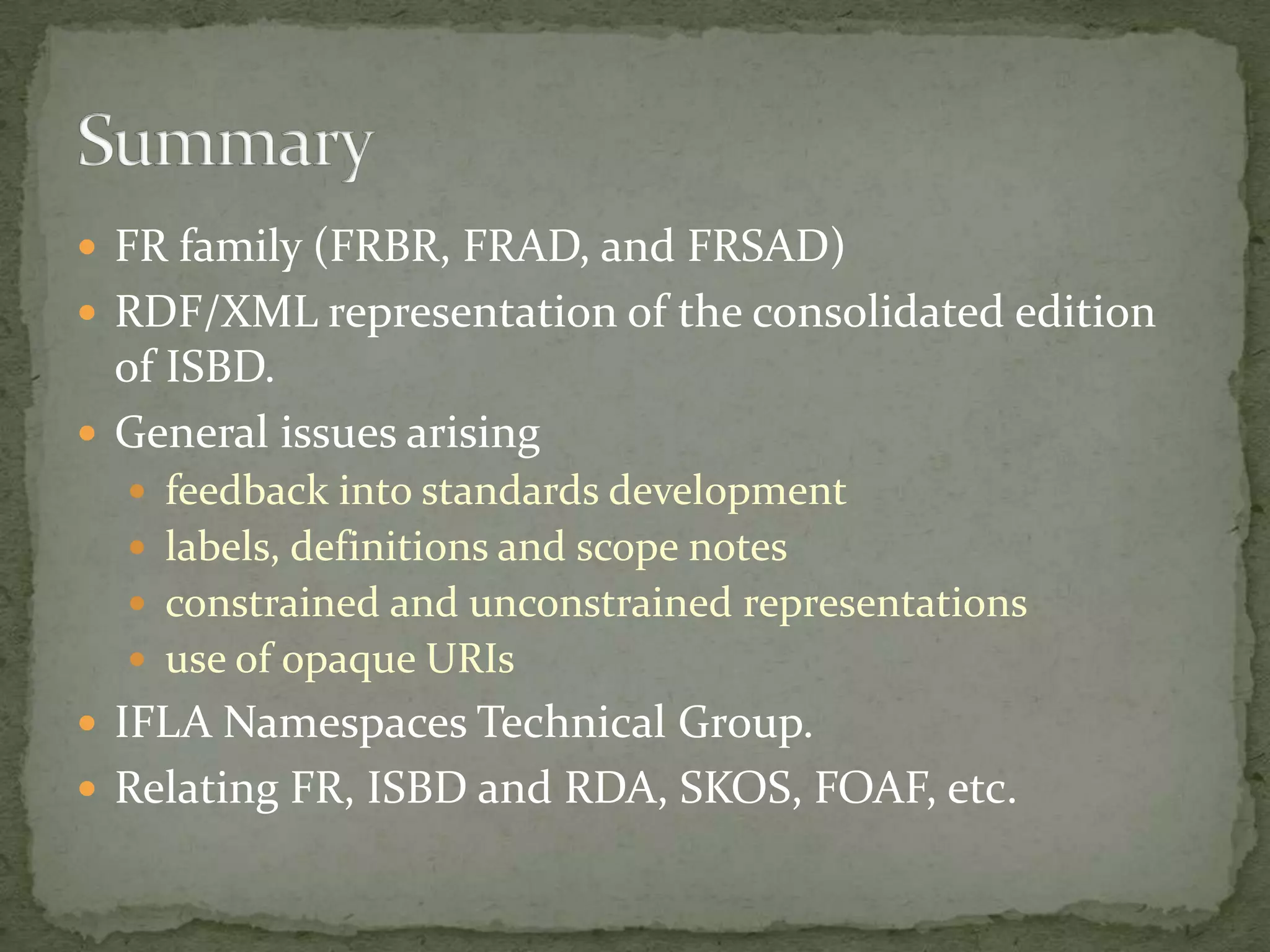
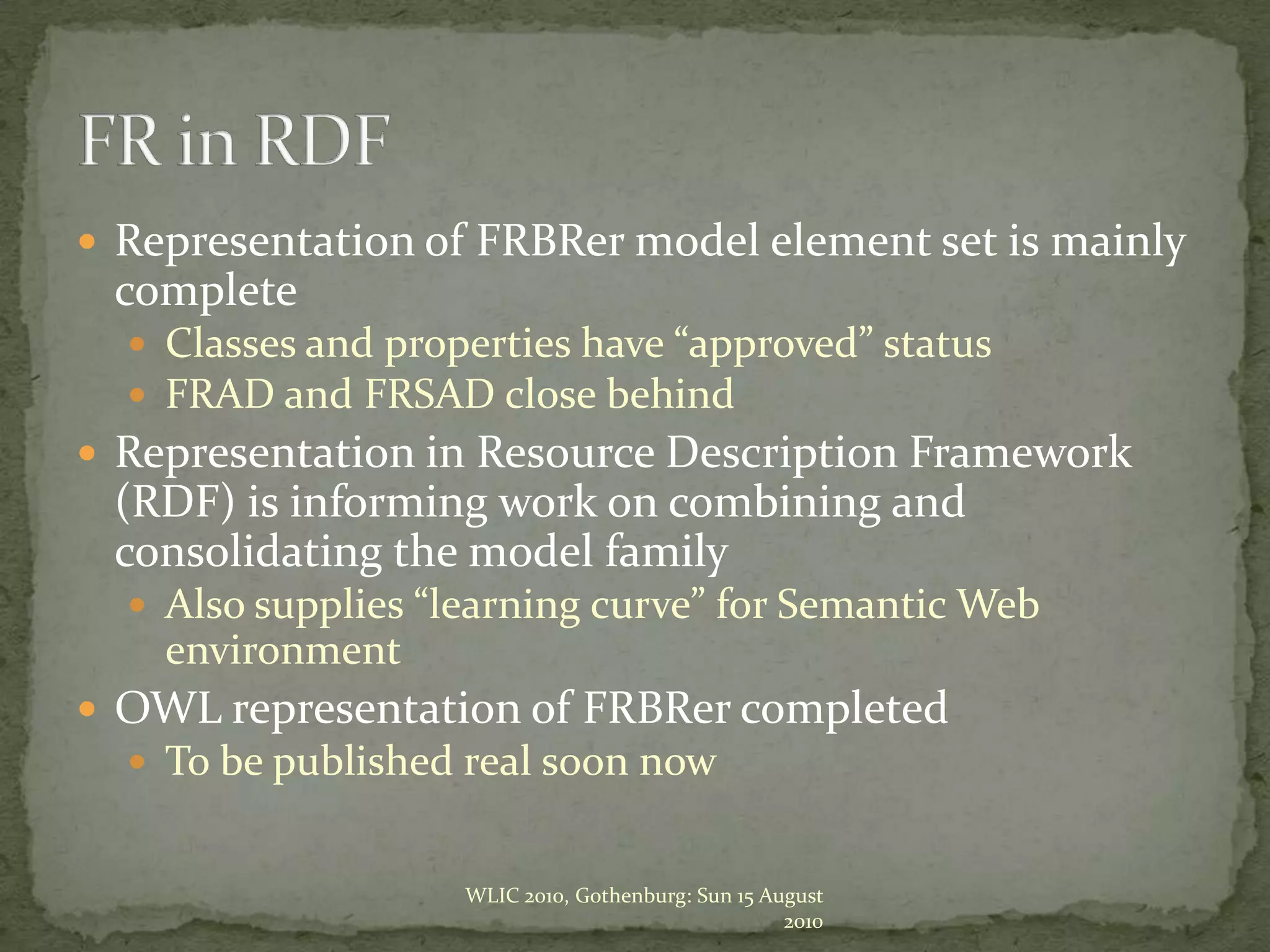
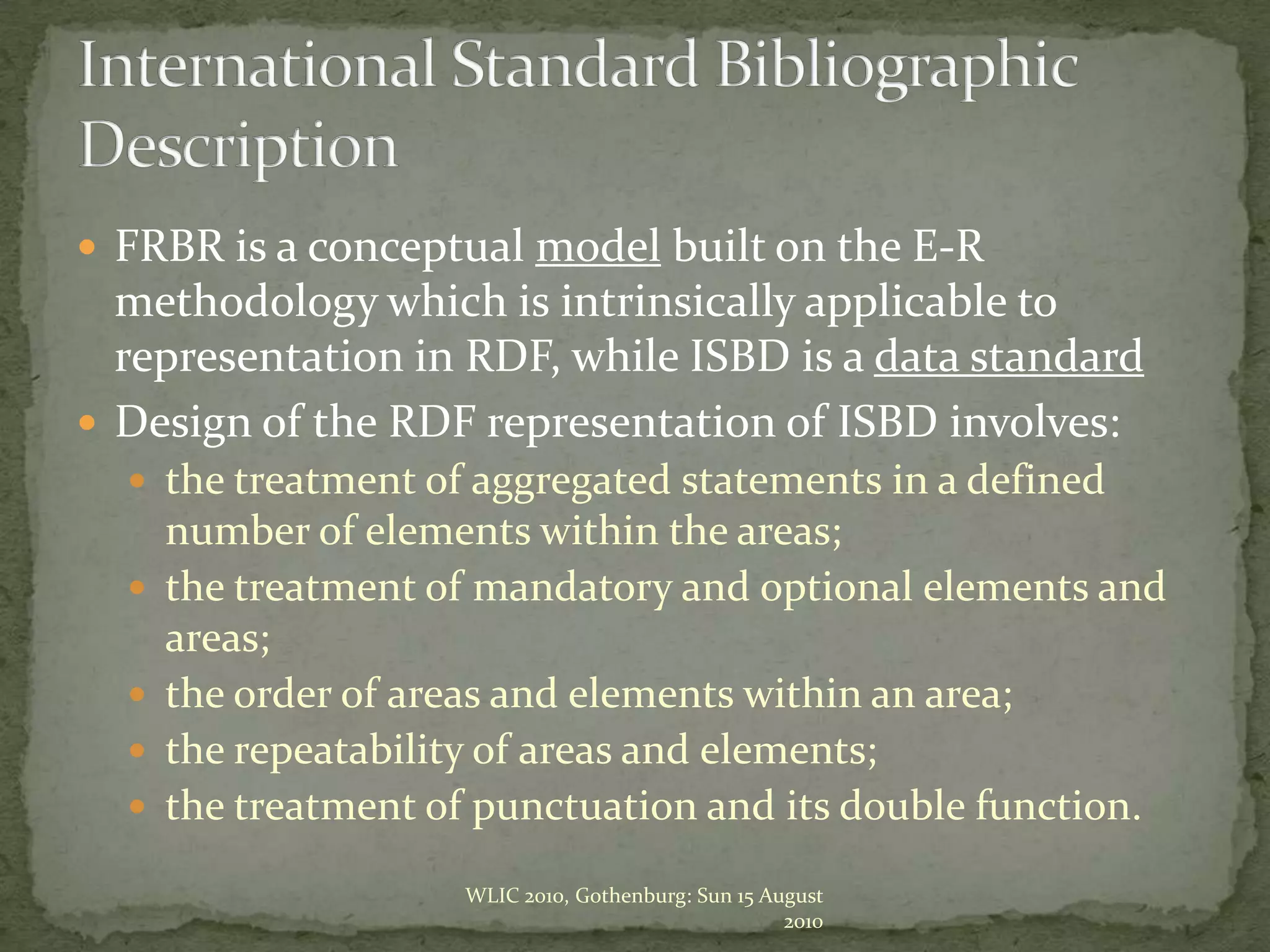
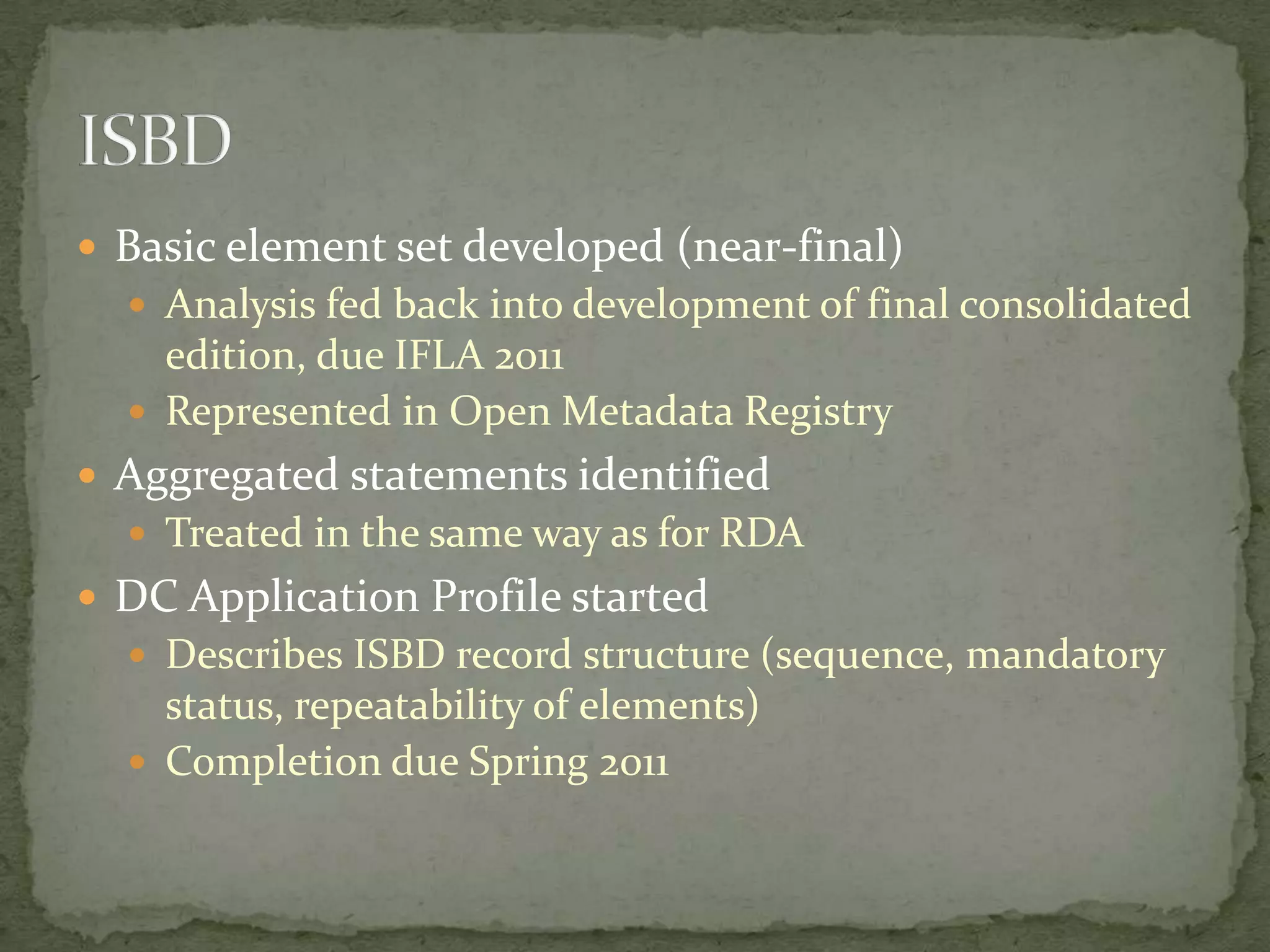
SummaryFR family (FRBR, FRAD, and FRSAD)RDF/XML representation of the consolidated edition of ISBD.General issues arisingfeedback into standards developmentlabels, definitions and scope notesconstrained and unconstrained representationsuse of opaque URIsIFLA Namespaces Technical Group.Relating FR, ISBD and RDA, SKOS, FOAF, etc.
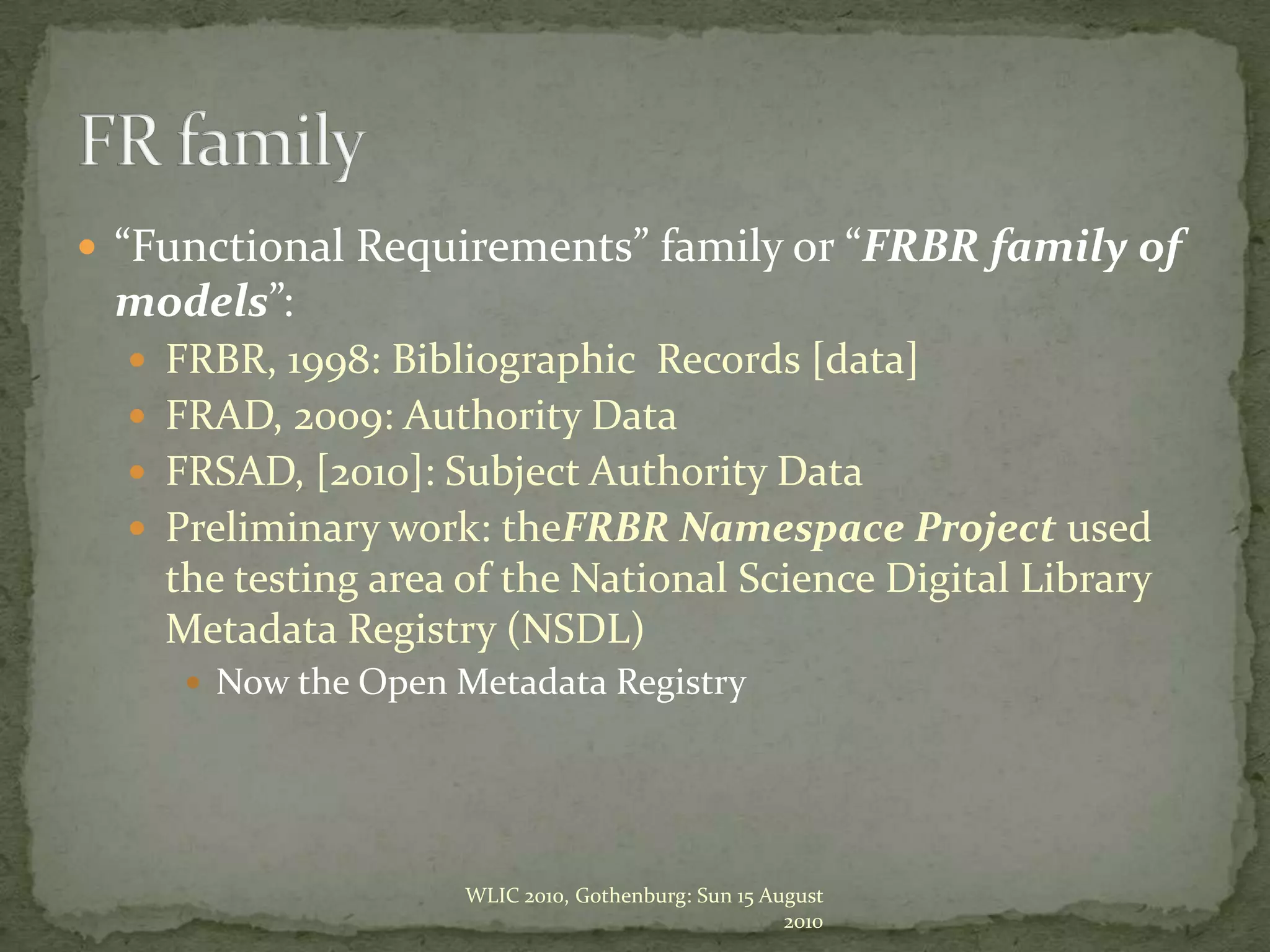
FR family“Functional Requirements” family or “FRBR family of models”:FRBR, 1998: Bibliographic  Records [data]FRAD, 2009: Authority DataFRSAD, [2010]: Subject Authority DataPreliminary work: theFRBR Namespace Project used the testing area of the National Science Digital Library Metadata Registry (NSDL)Now the Open Metadata RegistryWLIC 2010, Gothenburg: Sun 15 August 2010
FR namespacesFRBR Review Group decided to declare separate namespaces for FR componentsLength of time since FRBR publicationDependence of FRAD on FRBR, and FRSAD on FRADMight lead to change of earlier semanticsPrevent delay in RDF representation while ... Consolidated model in development Not until after IFLA 2011 (Puerto Rico)

DCMI/RDA Task Group Report, DC-2010 Pittsburgh

  • 1.
    History, Rationale, andRemaining WorkThe RDA Vocabularies
  • 2.
    A brief historyAstructural tour, including:Rationale and decision makingUse of domains and rangesPotential for extensionMoving towards completionWhat we’ve learnedSetting the Stage10/22/102DC-2010
  • 3.
    A Brief HistoryItall started in London, the last day of April 200710/22/103DC-2010
  • 4.
    The participants agreedthat DCMI and the Joint Steering Committee for the Development of RDA should work together to:Develop an RDA Element VocabularyExpose RDA Value VocabulariesDevelop an RDA Application Profile, based on FRBR and FRADThe first two are largely complete; the third is started4What Was Accomplished10/22/10DC-2010
  • 5.
    Property and valuevocabularies registered on the Open Metadata Registry (formerly the NSDL Registry): http://metadataregistry.org/rdabrowse.htmUsed RDF Schema (RDFS), Simple Knowledge Organisation System (SKOS) and Web Ontology Language (OWL)Registry provides human and machine usable interfacesAll vocabularies have change history and versioning capabilitiesStructure: Rationale & Decisions10/22/105DC-2010
  • 6.
    We used theSemantic Web as our “mental model”
  • 7.
    Wanted to createa “bridge” between XML and RDF to support innovation in the library community as a whole, not just those at the cutting edge or the trailing edge
  • 8.
    We registered theFRBR entities as classes in a ‘FRBR in RDA’ vocabulary, to enable specific relationships between RDA properties and FRBR
  • 9.
    IFLA has followedsuit using the Open Metadata Registry to add the ‘official’ FRBR entities, FRAD, and ISBD (more from Gordon about that)
  • 10.
    This provides excitingopportunities to relate all the vocabularies together10/22/106DC-2010The General Strategy
  • 11.
    Started with theEntity Relationship Diagrams produced by ALA PublishingThe latest iterations are available on the RDA Toolkit Site (http://www.rdatoolkit.org/background) ERDs are organized in three groups: core, enhanced, specialThese were developed and iterated with no change management strategy, so each new iteration had to be checked carefully to spot changesERDs built with a very XML view of the worldOur Methodology10/22/107DC-2010
  • 12.
    We think ofthe ‘generalized’ RDA properties as the real RDA vocabulary The ‘bounded’ properties should be seen as the first pass at an Application ProfileExtensions can be built more usefully from the generalized propertiesMapping will be cleaner using the generalized properties (since most properties mapped to or mapped from will not be based on FRBR)Generalized properties much more acceptable to non-library implementers (not often using FRBR)The Basic ‘WHY’?10/22/108DC-2010
  • 13.
    FRBR in RDAVocabulary declared as classesRDA Properties declared as a ‘generalized’ vocabulary, with no explicit relationship to FRBR entitiesSubproperties for the generalized elements may be explicitly related to FRBR entities (using ‘domain’)Label/Name includes (Work) or other class to provide unique name (unless the entity name already appears in the name of the property)The Structure, Simplified10/22/109DC-2010
  • 14.
    Property (Generalized, noFRBR relationship)SemanticWebSubproperty (with relationship to one FRBR entity)FRBR EntityThe Simple Case: One Property-- One FRBR EntityLibrary Applications10/22/1010DC-2010
  • 15.
    Book formatSemanticWebBook format(Manifestation)ManifestationThe Simple Case: One Property-- One FRBR EntityLibrary Applications10/22/1011DC-2010
  • 16.
  • 17.
    There are multipletechniques used in RDA to make the connection between FRBR entities and RDA properties
  • 18.
    Some properties relatedto more than one FRBR entity
  • 19.
    Relationships in AppendixJ actually include the name of the FRBR entity in the name and have separate definitions (we re-used this strategy for the FRBR-bounded properties)
  • 20.
    Other properties andsub-properties appear multiple times in the text and ERDs, with the same definitions and no indication that they might be repeated elsewhere (we consolidated these)10/22/1013DC-2010More Complex Relationships
  • 21.
    Property (Generalized, noFRBR relationship)SemanticWebSubproperty (with relationship to one FRBR entity)FRBR EntitySubproperty (with relationship to one FRBR entity)FRBR EntityThe Not-So-Simple Case: One Property—more thanOne FRBR EntityLibrary Applications10/22/1014DC-2010
  • 22.
    ExtentSemanticWebExtent (Manifestation)FRBR ManifestationExtent(Item)FRBR ItemThe Not-So-Simple Case: One Property—more thanOne FRBR EntityLibrary Applications10/22/1015DC-2010
  • 23.
  • 24.
    In 2005, theDC Usage Board worked with LC to build a formal representation of the MARC Relators so that these terms could be used with DCThese have been superseded by the ‘new’ id.loc.info version, without the relationships to DC terms (has been pushback on this decision!)
  • 25.
    This work provideda template for the registration of the role terms in RDA (in Appendix I) and, by extension, the other RDA relationships
  • 26.
    Role and relationshipproperties are registered at the same level as elements, rather than as attributes (as MARC does with relators, and RDA does in its XML)10/22/1017DC-2010Roles: Attributes or Properties?
  • 27.
    Mapping,Etc.“Super” Property SemanticWebSubproperty(Generalized, no FRBR relationship)Subproperty (with relationship to one FRBR entity)FRBR EntityThe Roles Case: Properties, Subpropertiesand FRBR EntitiesLibrary Applications10/22/1018DC-2010
  • 28.
    Mapping,Etc.RDA:CreatorSemanticWebRDArole:ComposerRDArole:Composer (Work)WorkThe RolesCase: Properties, Subpropertiesand FRBR EntitiesLibrary Applications10/22/1019DC-2010
  • 29.
    RDA sets upPublication, Distribution, Manufacture and Production statements very much the way they have been done since catalog card days:
  • 30.
    Assumed aggregation ofPlace, Name and Date are obvious leftovers from catalog cards, and are not necessary to enable indexing or display of those elements together if libraries want to do that
  • 31.
    We viewed thoseaggregations as ‘Syntax Encoding Schemes’ and built in ways to accommodate them within the bounded properties
  • 32.
    Those using thegeneralized properties (outside libraries, usually) need not be constrained by these traditional aggregations of properties10/22/1020DC-2010Aggregated Statements
  • 33.
    Pre-coordinated Statements: StructureAggregatedStatement (no domain or range)Aggregated Statement SubpropertyDomain: FRBR EntityRange: RDA Syntax Encoding Scheme (Subclass of RDF Datatype)Range: [Specific] Encoding Scheme (Subclass)General Property (no domain or range)SubpropertyOption 110/22/1021DC-2010
  • 34.
    Pre-coordinated Statements: ExamplePublicationStatement (no domain or range)Publication Statement (Manifestation)Domain: ManifestationRange: RDA Syntax Encoding Scheme (Subclass of RDF Datatype)Range: Publication Statement Encoding Scheme (Subclass)Place of publication (no domain or range)Place of publication (Manifestation)Option 110/22/1022DC-2010
  • 35.
    Release from thetyranny of recordsPotential for use with a variety of encodingsOpportunity to re-think how we build and share dataPotential for sharing data beyond the library siloA challenge to our old notions of what library data can do and should be doingWhat Does This Structure Buy Us?10/22/1023DC-2010
  • 36.
    10/22/10DC-201024Statements on theFloor?ID=23456 hasStatementOfEdition “1st trade edition”ID=23456 hasPublicationDate “1987”ID=23456 hasPublisher “Delacorte Press”ID=23456 hasOriginalLanguage “English”ID=23456 hasLanguageOfExpression “English”ID=23456 hasAuthor “Kurt Vonnegut”ID=23456 isFormOfWork “Novel”ID=23456 hasPlaceOfPublication “New York”ID=23456 hasPreferredTitle “Bluebeard, a novel”
  • 37.
    10/22/10DC-201025Is This ReallyChaos?ID=23456 hasStatementOfEdition “1st trade edition”ID=23456 hasAuthor “Kurt Vonnegut”ID=23456 hasPublicationDate “1987”ID=23456 isFormOfWork “Novel”ID=23456 hasPublisher “Delacorte Press”ID=23456 hasPlaceOfPublication “New York”ID=23456 hasLanguageOfExpression “English”ID=23456 hasOriginalLanguage “English”ID=23456 hasPreferredTitle “Bluebeard, a novel”
  • 38.
    10/22/10DC-201026ID=23456 hasAuthor “KurtVonnegut”Or Just an AggregationIn the Making?ID=23456 hasStatementOfEdition “1st trade edition”ID=23456 hasPublicationDate “1987”ID=23456 isFormOfWork “Novel”ID=23456 hasPublisher “Delacorte Press”ID=23456 hasPlaceOfPublication “New York”ID=23456 hasLanguageOfExpression “English”ID=23456 hasOriginalLanguage “English”ID=23456 hasPreferredTitle “Bluebeard, a novel”
  • 39.
    10/22/10DC-201027ID=23456 hasAuthor “KurtVonnegut”ID=23456 hasPreferredTitle “Bluebeard, a novel”ID=23456 hasStatementOfEdition “1st trade edition”ID=23456 hasPublicationDate “1987”ID=23456 isFormOfWork “Novel”ID=23456 hasPublisher “Delacorte Press”ID=23456 hasPlaceOfPublication “New York”ID=23456 hasLanguageOfExpression “English”ID=23456 hasOriginalLanguage “English”
  • 40.
    10/22/10DC-201028ID=23456 hasAuthor “KurtVonnegut”ID=23456 hasPreferredTitle “Bluebeard, a novel”ID=23456 hasOriginalLanguage “English”ID=23456 hasStatementOfEdition “1st trade edition”ID=23456 hasPublicationDate “1987”ID=23456 isFormOfWork “Novel”ID=23456 hasPublisher “Delacorte Press”ID=23456 hasPlaceOfPublication “New York”ID=23456 hasLanguageOfExpression “English”
  • 41.
    10/22/10DC-201029ID=23456 hasAuthor “KurtVonnegut”ID=23456 hasPreferredTitle “Bluebeard, a novel”ID=23456 hasOriginalLanguage “English”ID=23456 isFormOfWork “Novel”ID=23456 hasPublicationDate “1987”ID=23456 hasPublisher “Delacorte Press”ID=23456 hasStatementOfEdition “1st trade edition”ID=23456 hasPlaceOfPublication “New York”ID=23456 hasLanguageOfExpression “English”
  • 42.
    10/22/10DC-201030ID=23456 hasAuthor “KurtVonnegut”ID=23456 hasPreferredTitle “Bluebeard, a novel”WorkID=23456 hasOriginalLanguage “English”ID=23456 isFormOfWork “Novel”ID=23456 hasPublicationDate “1987”ID=23456 hasPublisher “Delacorte Press”ID=23456 hasStatementOfEdition “1st trade edition”ID=23456 hasPlaceOfPublication “New York”ID=23456 hasLanguageOfExpression “English”
  • 43.
    10/22/10DC-201031ID=23456 hasLanguageOfExpression “English”ID=23456hasPublicationDate “1987”ID=23456 hasPublisher “Delacorte Press”ID=23456 hasStatementOfEdition “1st trade edition”ID=23456 hasPlaceOfPublication “New York”
  • 44.
    10/22/10DC-201032ID=23456 hasLanguageOfExpression “English”ID=23456hasStatementOfEdition “1st trade edition”ID=23456 hasPublicationDate “1987”ID=23456 hasPublisher “Delacorte Press”ID=23456 hasPlaceOfPublication “New York”
  • 45.
    10/22/10DC-201033ID=23456 hasLanguageOfExpression “English”ExpressionID=23456hasStatementOfEdition “1st trade edition”ID=23456 hasPublicationDate “1987”ID=23456 hasPublisher “Delacorte Press”ID=23456 hasPlaceOfPublication “New York”
  • 46.
    10/22/10DC-201034ID=23456 hasPlaceOfPublication “NewYork”ID=23456 hasPublicationDate “1987”ID=23456 hasPublisher “Delacorte Press”
  • 47.
    10/22/10DC-201035ID=23456 hasPlaceOfPublication “NewYork”ID=23456 hasPublisher “Delacorte Press”ID=23456 hasPublicationDate “1987”
  • 48.
    10/22/10DC-201036ID=23456 hasPlaceOfPublication “NewYork”ID=23456 hasPublisher “Delacorte Press”ID=23456 hasPublicationDate “1987”
  • 49.
    10/22/10DC-201037ID=23456 hasPlaceOfPublication “NewYork”ManifestationID=23456 hasPublisher “Delacorte Press”ID=23456 hasPublicationDate “1987”
  • 50.
    The inclusion ofgeneralized properties provides a path for extension of RDA into specialized library communities and non-library communitiesThey may have a different notion of how FRBR ‘aggregates’, for example, a colorized version of a film may be viewed as a separate workThey may not wish to use FRBR at allThey may have additional properties to include, that have a relationship to the RDA propertiesExtension 10/22/1038DC-2010
  • 51.
  • 52.
  • 53.
  • 54.
    Completing the hierarchies,both generalized and FRBR-boundedElements and Relationships need to have bounded hierarchies built (generalized hierarchies complete)Roles need generalized properties createdJSC review incomplete, for both properties and vocabulariesStatus designations need to be updated from ‘New—proposed’ to ‘Published’Completing the Vocabularies10/22/1042DC-2010
  • 55.
    ExtentSubpropertySubpropertyExtent (I)Extent (M)SubpropertySubpropertyExtentof TextExtent of Still ImageSubpropertyExtent of Still Image (M)Extent of Text (M)Extent of Still Image (I)Extent of Text (I)Current Registered Relationships10/26/1043ASIS&T-2010
  • 56.
    ExtentSubpropertySubpropertyExtent (I)Extent (M)SubpropertySubpropertyExtentof TextExtent of Still ImageSubpropertySubpropertyExtent of Text (M)Extent of Still Image (M)SubpropertyExtent of Text (I)Extent of Still Image (I)Added Registered Relationships10/26/1044ASIS&T-2010
  • 57.
    How do theserelate to the RDA guidance text?Who will maintain these? How will they be kept in sync with the text? Will the governance model for these be the same as the text? Who decides?How can we use these vocabularies effectively?What else do we need to identify?How should we continue this work?Remaining Issues10/22/1045DC-2010
  • 58.
    We wrote aboutthe decisions we made for RDA in DLib: http://dlib.org/dlib/january10/hillmann/01hillmann.htmlNeed to continue to disclose what we’ve learned and work on building best practices documentation in this environmentWhat We’ve Learned10/22/1046DC-2010
  • 59.
  • 60.
    SummaryFR family (FRBR,FRAD, and FRSAD)RDF/XML representation of the consolidated edition of ISBD.General issues arisingfeedback into standards developmentlabels, definitions and scope notesconstrained and unconstrained representationsuse of opaque URIsIFLA Namespaces Technical Group.Relating FR, ISBD and RDA, SKOS, FOAF, etc.
  • 61.
    FR family“Functional Requirements”family or “FRBR family of models”:FRBR, 1998: Bibliographic Records [data]FRAD, 2009: Authority DataFRSAD, [2010]: Subject Authority DataPreliminary work: theFRBR Namespace Project used the testing area of the National Science Digital Library Metadata Registry (NSDL)Now the Open Metadata RegistryWLIC 2010, Gothenburg: Sun 15 August 2010
  • 62.
    FR namespacesFRBR ReviewGroup decided to declare separate namespaces for FR componentsLength of time since FRBR publicationDependence of FRAD on FRBR, and FRSAD on FRADMight lead to change of earlier semanticsPrevent delay in RDF representation while ... Consolidated model in development Not until after IFLA 2011 (Puerto Rico)
  • 63.
    FR in RDFRepresentationof FRBRer model element set is mainly completeClasses and properties have “approved” statusFRAD and FRSAD close behindRepresentation in Resource Description Framework (RDF) is informing work on combining and consolidating the model familyAlso supplies “learning curve” for Semantic Web environmentOWL representation of FRBRer completedTo be published real soon nowWLIC 2010, Gothenburg: Sun 15 August 2010
  • 64.
    International Standard BibliographicDescriptionFRBR is a conceptual model built on the E-R methodology which is intrinsically applicable to representation in RDF, while ISBD is a data standardDesign of the RDF representation of ISBD involves:the treatment of aggregated statements in a defined number of elements within the areas;the treatment of mandatory and optional elements and areas;the order of areas and elements within an area;the repeatability of areas and elements;the treatment of punctuation and its double function.WLIC 2010, Gothenburg: Sun 15 August 2010
  • 65.
    ISBDBasic element setdeveloped (near-final)Analysis fed back into development of final consolidated edition, due IFLA 2011Represented in Open Metadata RegistryAggregated statements identifiedTreated in the same way as for RDADC Application Profile startedDescribes ISBD record structure (sequence, mandatory status, repeatability of elements)Completion due Spring 2011
  • 66.
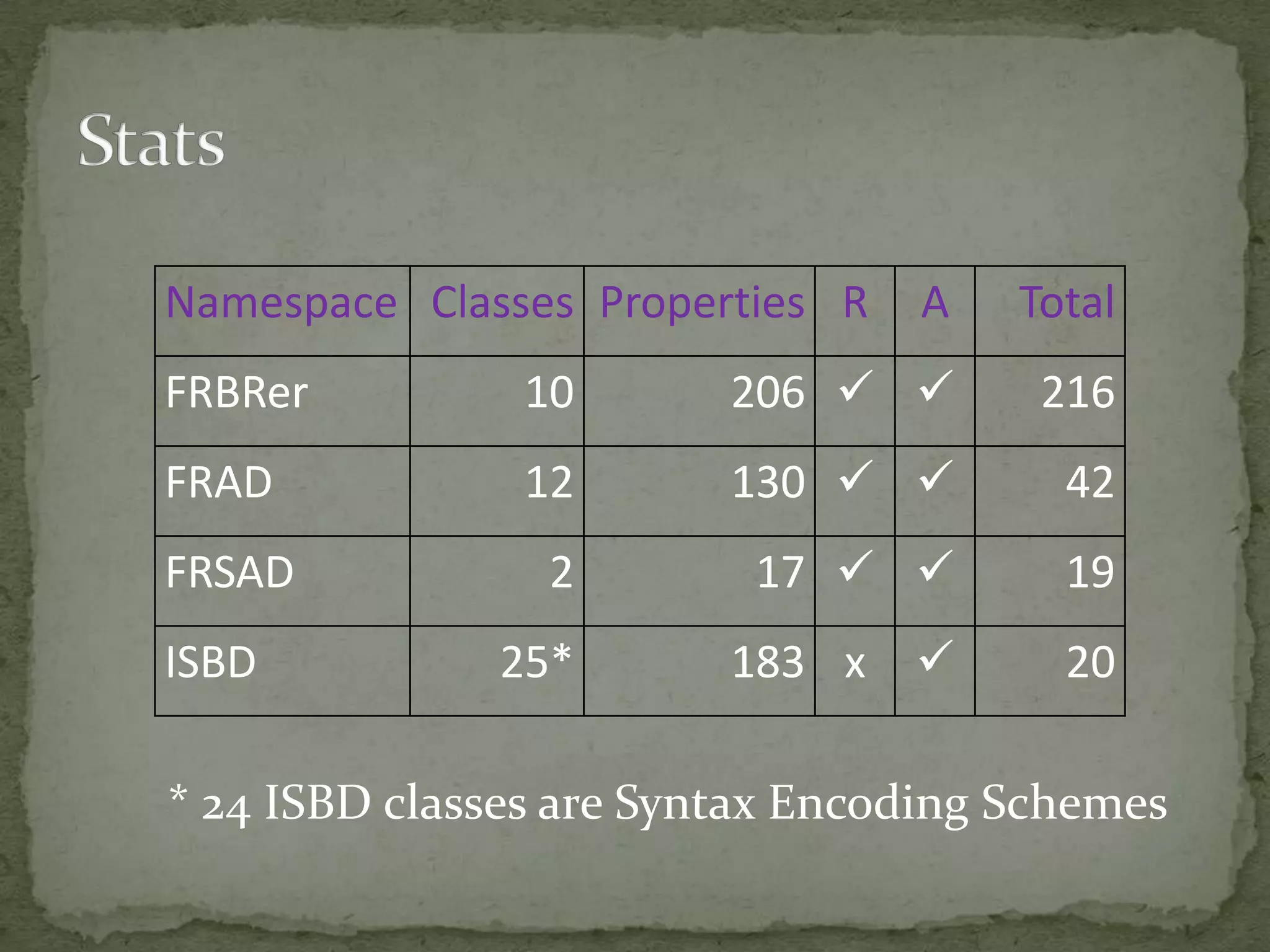
    Stats* 24 ISBDclasses are Syntax Encoding Schemes
  • 67.
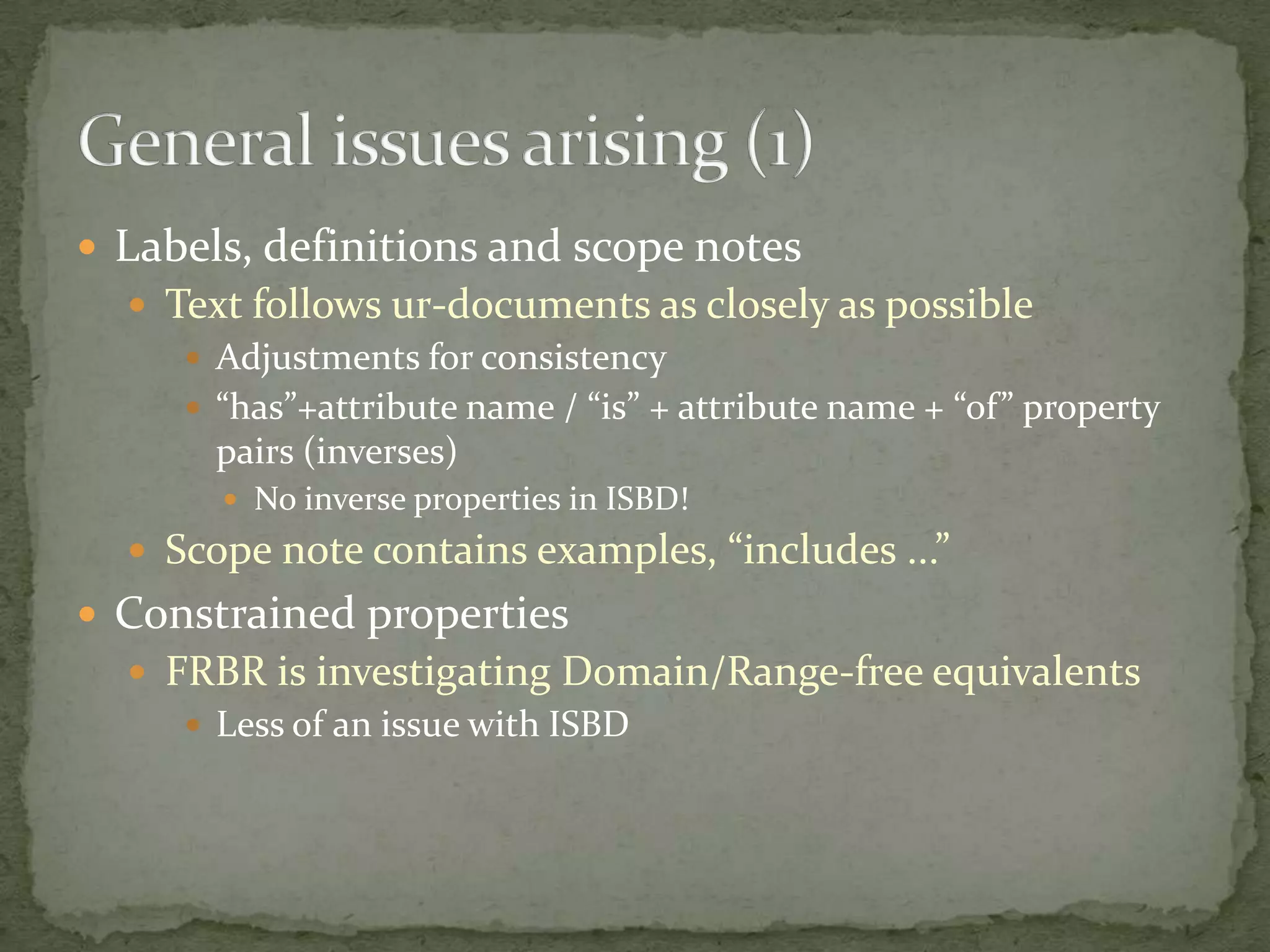
    General issues arising(1)Labels, definitions and scope notesText follows ur-documents as closely as possibleAdjustments for consistency“has”+attribute name / “is” + attribute name + “of” property pairs (inverses)No inverse properties in ISBD!Scope note contains examples, “includes ...”Constrained propertiesFRBR is investigating Domain/Range-free equivalentsLess of an issue with ISBD
  • 68.
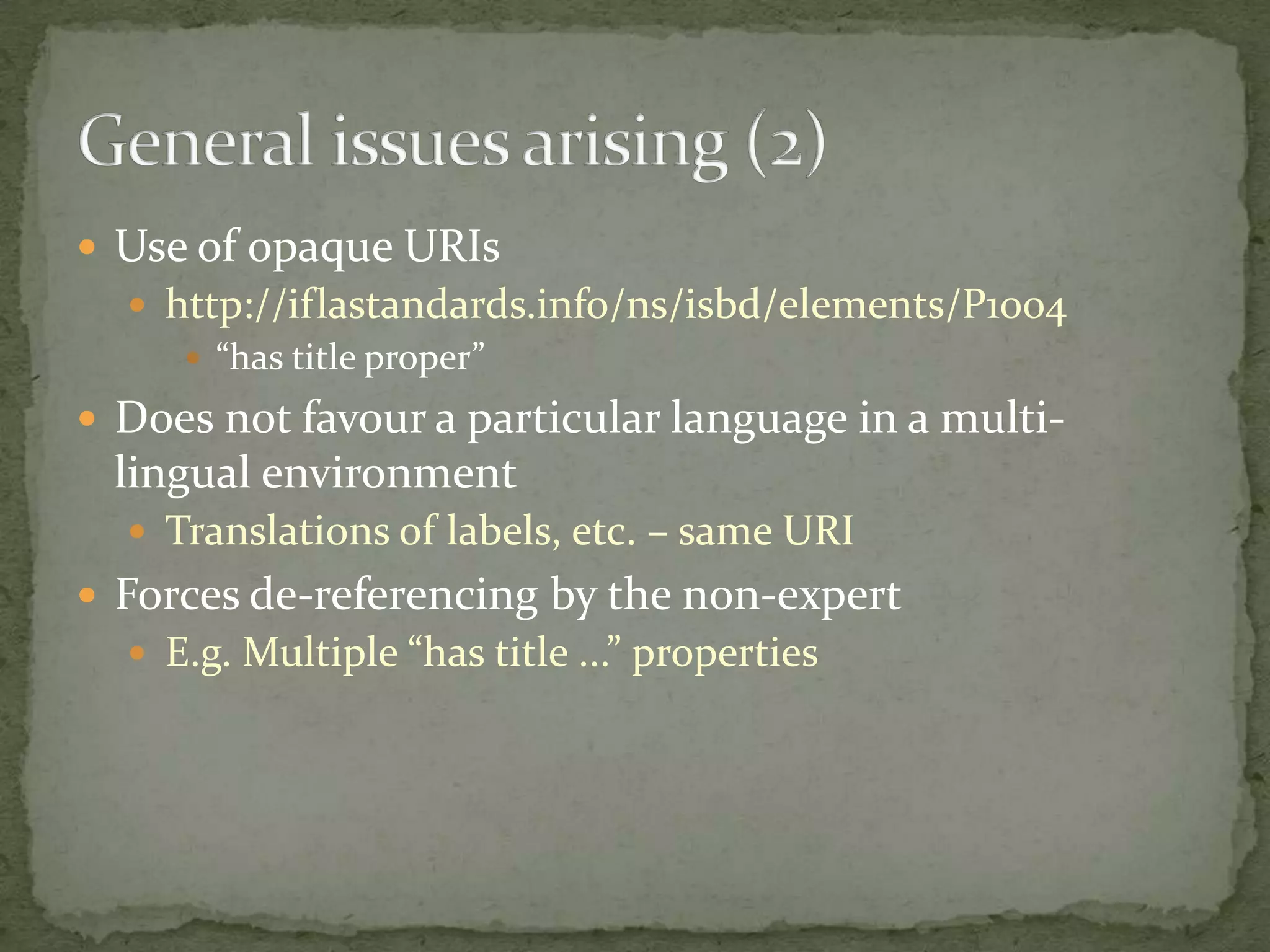
    General issues arising(2)Use of opaque URIshttp://iflastandards.info/ns/isbd/elements/P1004“has title proper”Does not favour a particular language in a multi-lingual environmentTranslations of labels, etc. – same URIForces de-referencing by the non-expertE.g. Multiple “has title ...” properties
  • 69.
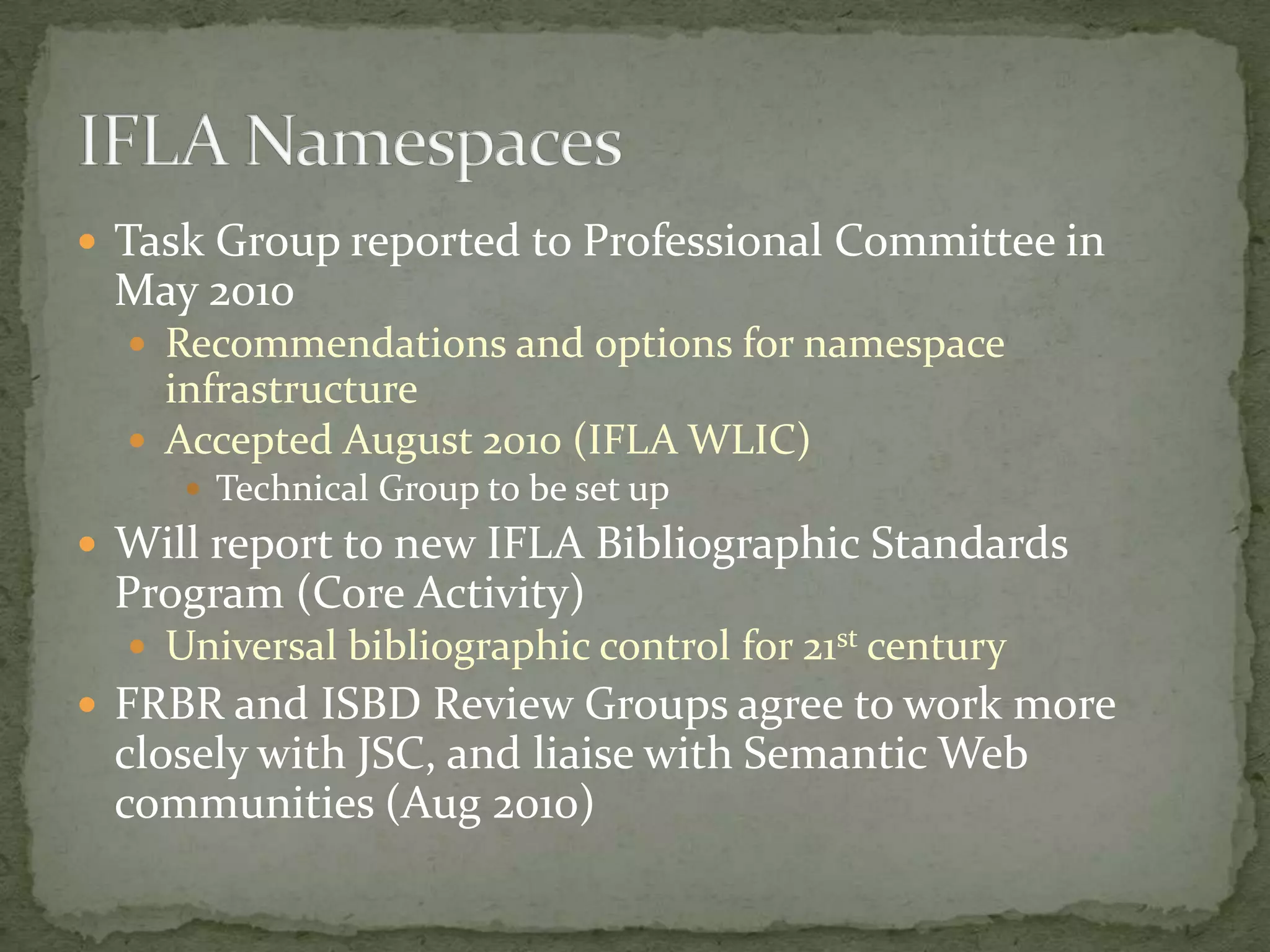
    IFLA NamespacesTask Groupreported to Professional Committee in May 2010Recommendations and options for namespace infrastructureAccepted August 2010 (IFLA WLIC)Technical Group to be set upWill report to new IFLA Bibliographic Standards Program (Core Activity)Universal bibliographic control for 21st centuryFRBR and ISBD Review Groups agree to work more closely with JSC, and liaise with Semantic Web communities (Aug 2010)
  • 70.
    RDA propertiesExtentExtent oftextExtent of still imageExtent (M/)Extent (I/)Extent of text (I/)Extent of still image (I/)Extent of text (M/)Extent of still image (M/)SubpropertyLabel (Domain/Range)
  • 71.
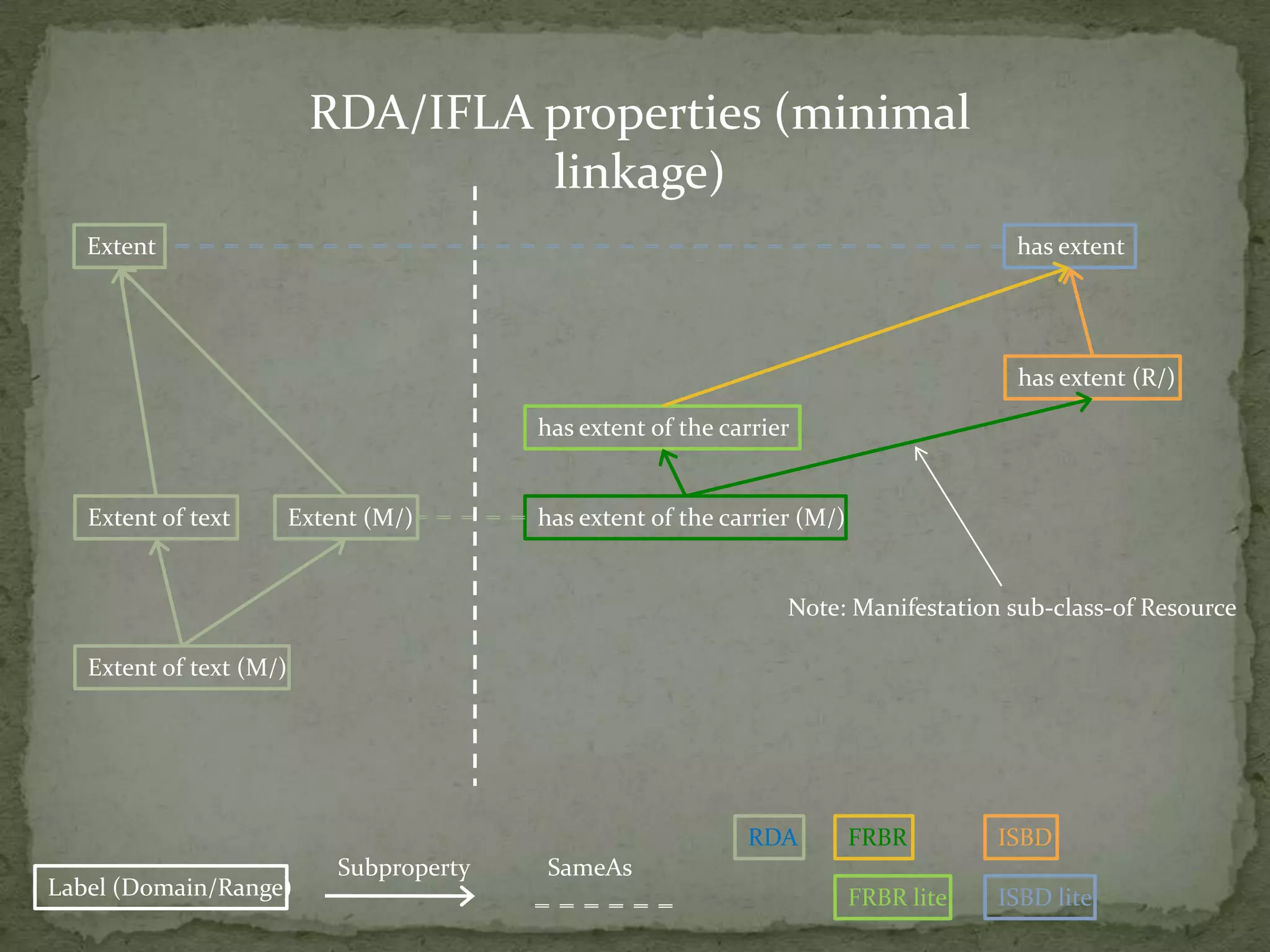
    RDA/IFLA properties (minimallinkage)Extenthas extenthas extent (R/)has extent of the carrierExtent of textExtent (M/)has extent of the carrier (M/)Note: Manifestation sub-class-of ResourceExtent of text (M/)SameAsRDAFRBRISBDSubpropertyLabel (Domain/Range)FRBR liteISBD lite
  • 72.
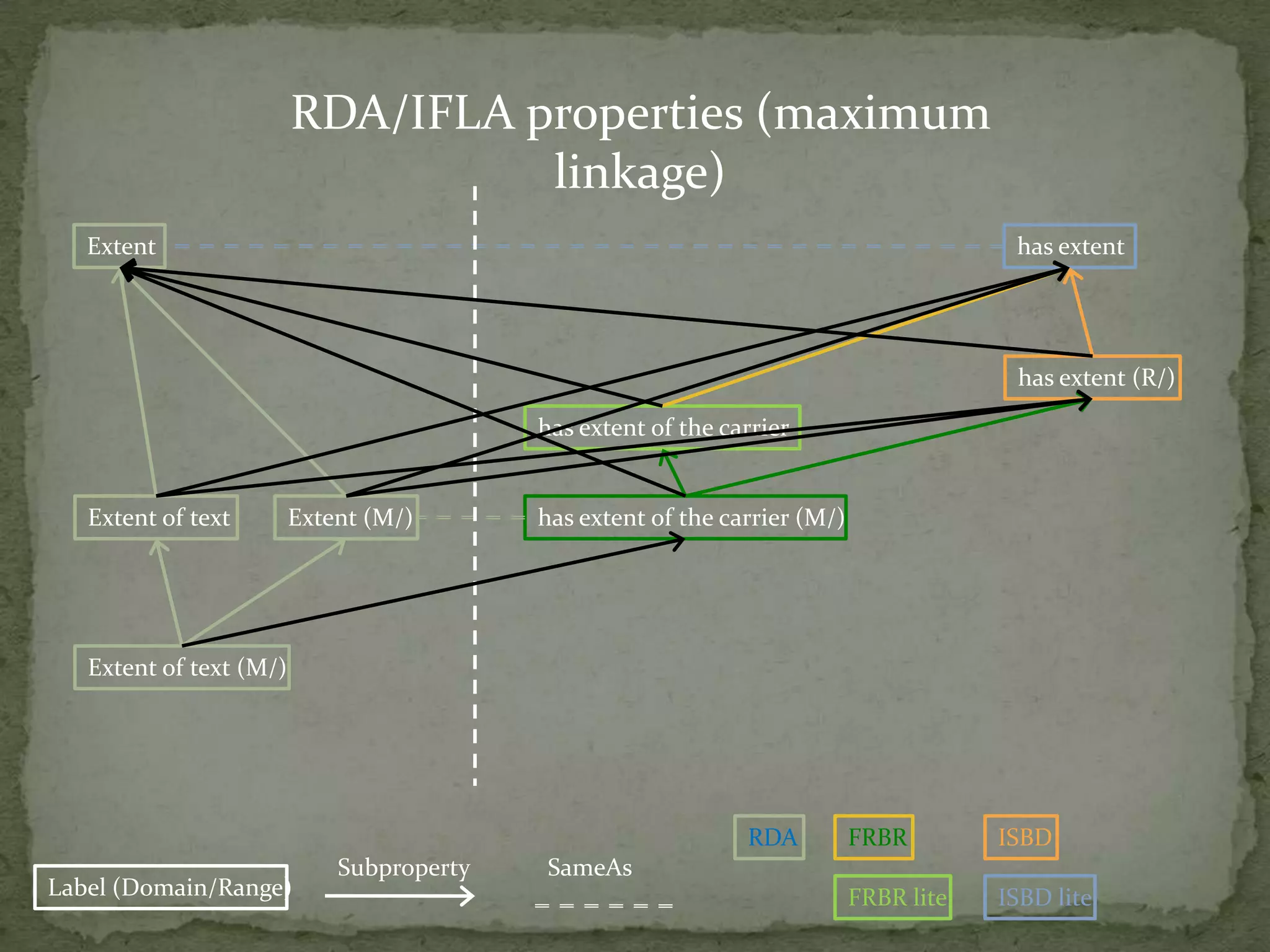
    RDA/IFLA properties (maximumlinkage)Extenthas extenthas extent (R/)has extent of the carrierExtent of textExtent (M/)has extent of the carrier (M/)Extent of text (M/)SameAsRDAFRBRISBDSubpropertyLabel (Domain/Range)FRBR liteISBD lite
  • 73.
    RDA/IFLA/other properties (minimallinkage)formatExtent (/S)Extenthas extenthas extent of the carrierhas extent (R/)Extent of textExtent (M/)has extent of the carrier (M/)numPages (D/l)numVolumes (C/l)Extent of text (M/)Note: Document sub-class-of ResourceSameAsLabel (Domain/Range)RDAFRBRISBDDCTBIBOSubpropertyFRBR liteISBD liteDCClasses: Manifestation, Resource, Collection, Document, SizeOrDuration, literal
  • 74.
    DCMI/RDA Task GroupWiki: http://dublincore.org/dcmirdataskgroup/RDA Vocabularies: http://metadataregistry.org/rdabrowse.htmDiane: metadata.maven@gmail.comGordon: gordon@gordondunsire.comPlease join us and participate!Links and Contact Info10/22/1062DC-2010