Infrastructure for Use
RDA Infrastructure Beyond the
Guidelines
“What’s an RDA
Record?”
Diane I. Hillmann
RDA UPDATE
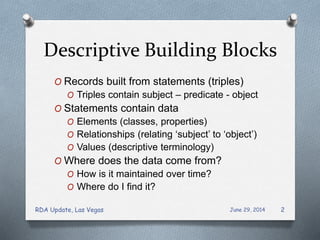
Descriptive Building Blocks
O Records built from statements (triples)
O Triples contain subject – predicate - object
O Statements contain data
O Elements (classes, properties)
O Relationships (relating ‘subject’ to ‘object’)
O Values (descriptive terminology)
O Where does the data come from?
O How is it maintained over time?
O Where do I find it?
June 29, 2014RDA Update, Las Vegas 2
OFirst, a Review of Important Definitions:
O Class = A set of similar things
O Domain = Infers that the thing being described is a
member of a particular class (‘The subject is a
________’)
O Range = The object is inferred to be a member of a
specific class
O Constrained = Contains a domain and/or range
O Unconstrained = Not constrained by a domain or range
O CURIE = Syntax for Compact URIs (superset of XML
prefixes)
How Does RDA Support
• Applications like RIMMF?
• Users making choices about local usage?
• Mapping services (and the maps
themselves)?
• Vendors trying to build systems using
RDA?
Around that corner …
O RDA Registry [http://www.RDAregistry.info]
O Uses OMR, GitHub for easier (and more
automated) maintenance and
documentation
O Contains a comprehensive set of URIs for
many purposes
O Canonical URI, lexical (multi-lingual)
aliases
O Version and release control
O Outputs in many 'flavors' for the use of
many applications
June 29, 2014RDA Update, Las Vegas 6
The New Map
June 29, 2014RDA Update, Las Vegas 7
Documentation on Elements
O Basic information
on elements:
O Suggested
prefix
O Example URIs
O Changelog
feed
June 29, 2014RDA Update, Las Vegas 9
Available Downloads
O HTML build from
JSON--LD
O OMR UI used for
updating
O Download choices
updated with every
change to element
sets
June 29, 2014RDA Update, Las Vegas 10
The Important Bits
“Cool URIs don’t
change”
—Tim Berners-Lee
Flickr photo by Ludovic Hirlimann
URI strategy
O One URI was more than enough, or so
we used to think. We’ve set up multiples
for RDA —Why?
ODevelopers generally want something
they can read easily without a lookup
OVocabulary creators want stability and
maintenance processes that don’t
require a lot of URI changes
OMachines don’t care one way or the
other
June 29, 2014RDA Update, Las Vegas 13
Lexical Aliases
O URIs based entirely on labels are not a
good long term strategy for a standard still
developing
O Terminology changes, and labels change
too
O Always redirected after changes
O RDA is an international standard
intended to be available in multiple
languages
O RDA tends to have lots of long element
names, not always ideal for labels
June 29, 2014RDA Update, Las Vegas 14
Canonical URIs
O Fixed, stable, always maintained (even as a
redirect)
O Based on numbers or letters and numbers
O Assigned automatically, so no typos
O Language independent (Multiple
languages can be accommodated using
the same canonical URI)
O Change of element itself only necessary if
the definition changes significantly
June 29, 2014RDA Update, Las Vegas 15
What’s Next?
O Installing more background processes
to simplify and stabilize operations (and
continue to limit requirements for human
effort )
O Expanding and improving download
options
O More languages
O Improved synchronization with the
Toolkit
June 29, 2014RDA Update, Las Vegas 16
AND ...
O Application Profiles (finally?)
O Reflecting the intentions and choices of the
data providers
O Formatted to allow machine-to-machine
interaction (as well as documentation for
humans)
O Enabling [some] validation processes on
usage, constraints and values
O Interoperability without prior agreement
June 29, 2014RDA Update, Las Vegas 17
We Welcome Feedback!
O On the RDA-L discussion list
O Email to individuals (see the RDA Registry
home page for addresses)
O Feedback button on every OMR page
O Issues page on the GitHub Project page:
https://github.com/RDARegistry/RDA-
Vocabularies/issues
June 29, 2014RDA Update, Las Vegas 18

What is an RDA Record?

  • 1.
    Infrastructure for Use RDAInfrastructure Beyond the Guidelines “What’s an RDA Record?” Diane I. Hillmann RDA UPDATE
  • 2.
    Descriptive Building Blocks ORecords built from statements (triples) O Triples contain subject – predicate - object O Statements contain data O Elements (classes, properties) O Relationships (relating ‘subject’ to ‘object’) O Values (descriptive terminology) O Where does the data come from? O How is it maintained over time? O Where do I find it? June 29, 2014RDA Update, Las Vegas 2
  • 3.
    OFirst, a Reviewof Important Definitions: O Class = A set of similar things O Domain = Infers that the thing being described is a member of a particular class (‘The subject is a ________’) O Range = The object is inferred to be a member of a specific class O Constrained = Contains a domain and/or range O Unconstrained = Not constrained by a domain or range O CURIE = Syntax for Compact URIs (superset of XML prefixes)
  • 4.
    How Does RDASupport • Applications like RIMMF? • Users making choices about local usage? • Mapping services (and the maps themselves)? • Vendors trying to build systems using RDA?
  • 6.
    Around that corner… O RDA Registry [http://www.RDAregistry.info] O Uses OMR, GitHub for easier (and more automated) maintenance and documentation O Contains a comprehensive set of URIs for many purposes O Canonical URI, lexical (multi-lingual) aliases O Version and release control O Outputs in many 'flavors' for the use of many applications June 29, 2014RDA Update, Las Vegas 6
  • 7.
    The New Map June29, 2014RDA Update, Las Vegas 7
  • 9.
    Documentation on Elements OBasic information on elements: O Suggested prefix O Example URIs O Changelog feed June 29, 2014RDA Update, Las Vegas 9
  • 10.
    Available Downloads O HTMLbuild from JSON--LD O OMR UI used for updating O Download choices updated with every change to element sets June 29, 2014RDA Update, Las Vegas 10
  • 11.
  • 12.
    “Cool URIs don’t change” —TimBerners-Lee Flickr photo by Ludovic Hirlimann
  • 13.
    URI strategy O OneURI was more than enough, or so we used to think. We’ve set up multiples for RDA —Why? ODevelopers generally want something they can read easily without a lookup OVocabulary creators want stability and maintenance processes that don’t require a lot of URI changes OMachines don’t care one way or the other June 29, 2014RDA Update, Las Vegas 13
  • 14.
    Lexical Aliases O URIsbased entirely on labels are not a good long term strategy for a standard still developing O Terminology changes, and labels change too O Always redirected after changes O RDA is an international standard intended to be available in multiple languages O RDA tends to have lots of long element names, not always ideal for labels June 29, 2014RDA Update, Las Vegas 14
  • 15.
    Canonical URIs O Fixed,stable, always maintained (even as a redirect) O Based on numbers or letters and numbers O Assigned automatically, so no typos O Language independent (Multiple languages can be accommodated using the same canonical URI) O Change of element itself only necessary if the definition changes significantly June 29, 2014RDA Update, Las Vegas 15
  • 16.
    What’s Next? O Installingmore background processes to simplify and stabilize operations (and continue to limit requirements for human effort ) O Expanding and improving download options O More languages O Improved synchronization with the Toolkit June 29, 2014RDA Update, Las Vegas 16
  • 17.
    AND ... O ApplicationProfiles (finally?) O Reflecting the intentions and choices of the data providers O Formatted to allow machine-to-machine interaction (as well as documentation for humans) O Enabling [some] validation processes on usage, constraints and values O Interoperability without prior agreement June 29, 2014RDA Update, Las Vegas 17
  • 18.
    We Welcome Feedback! OOn the RDA-L discussion list O Email to individuals (see the RDA Registry home page for addresses) O Feedback button on every OMR page O Issues page on the GitHub Project page: https://github.com/RDARegistry/RDA- Vocabularies/issues June 29, 2014RDA Update, Las Vegas 18

Editor's Notes

  • #3 RDA Maintainers are using a formal methodology to the RDA standards in the RDA Registry. I a world of change, some stability.
  • #11 We’ll likely expand this list as technical preferences shift. More ‘how much do you want?’ options coming too.
  • #13 Note that this photo is of a glacier, presumably melting, so not as immutable as we would like.
  • #15  URIs in English only assumes that everyone reads English, and that’s not true.
  • #16 RDA has a commitment to maintaining the standard as an International one.