RDA: thinking globally, acting
globally
Gordon Dunsire
Presented at International Developments in Library
Linked Data: Think Globally, Act Globally – Part Two: an
ALCTS Program,
ALA Annual, Las Vegas, USA, 28 Jun 2014
Overview
Failure of top-down approach
RDA tools
Case: intended audience
Mapping the focus of description
Top-down, bottom-up issues
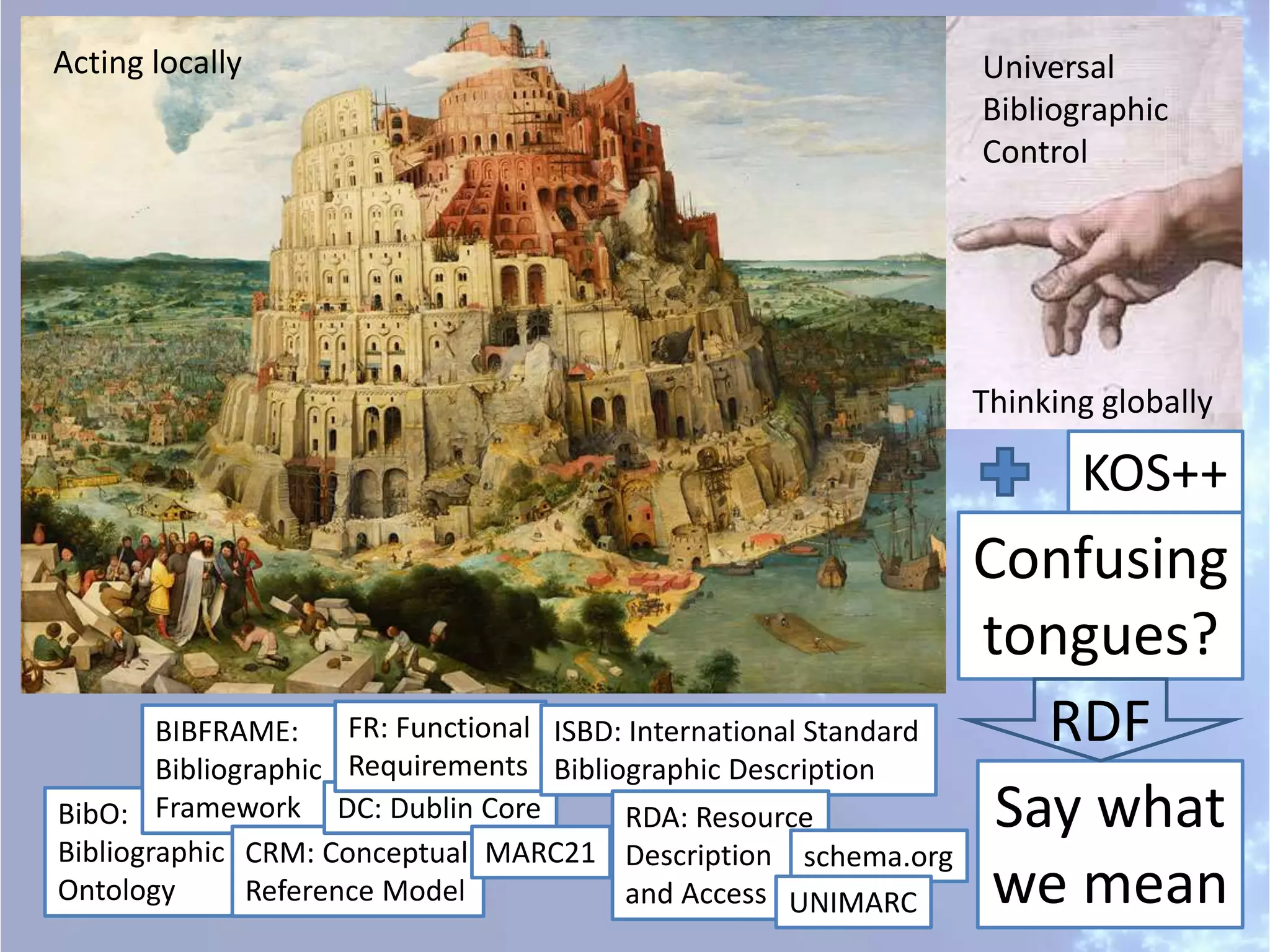
BibO:
Bibliographic
Ontology
Confusing
tongues?
BIBFRAME:
Bibliographic
Framework Say what
we mean
CRM: Conceptual
Reference Model
DC: Dublin Core
FR: Functional
Requirements
ISBD: International Standard
Bibliographic Description
MARC21
RDA: Resource
Description
and Access
schema.org
UNIMARC
KOS++
Universal
Bibliographic
Control
RDF
Thinking globally
Acting locally
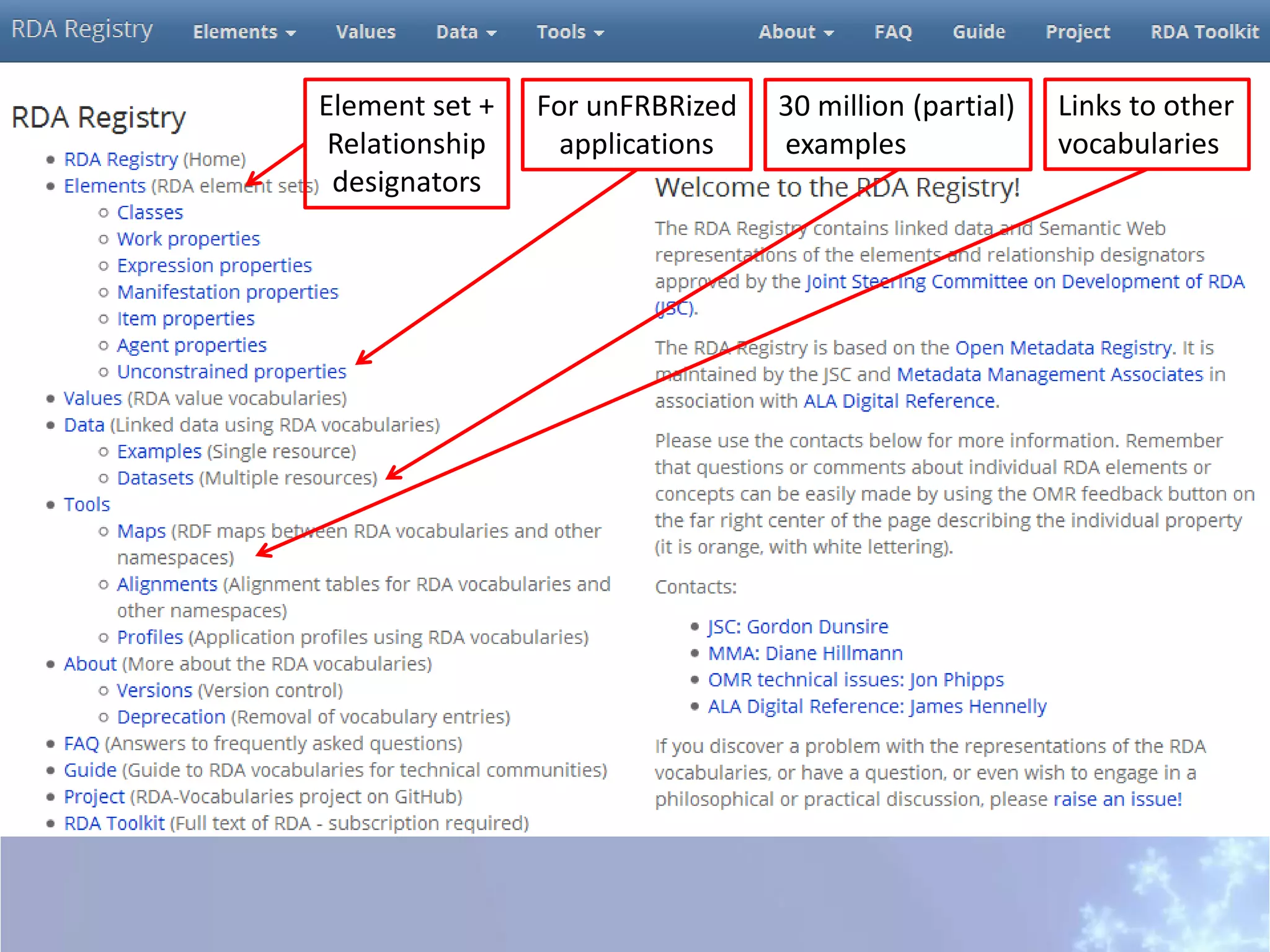
For unFRBRized
applications
30 million (partial)
examples
Links to other
vocabularies
Element set +
Relationship
designators
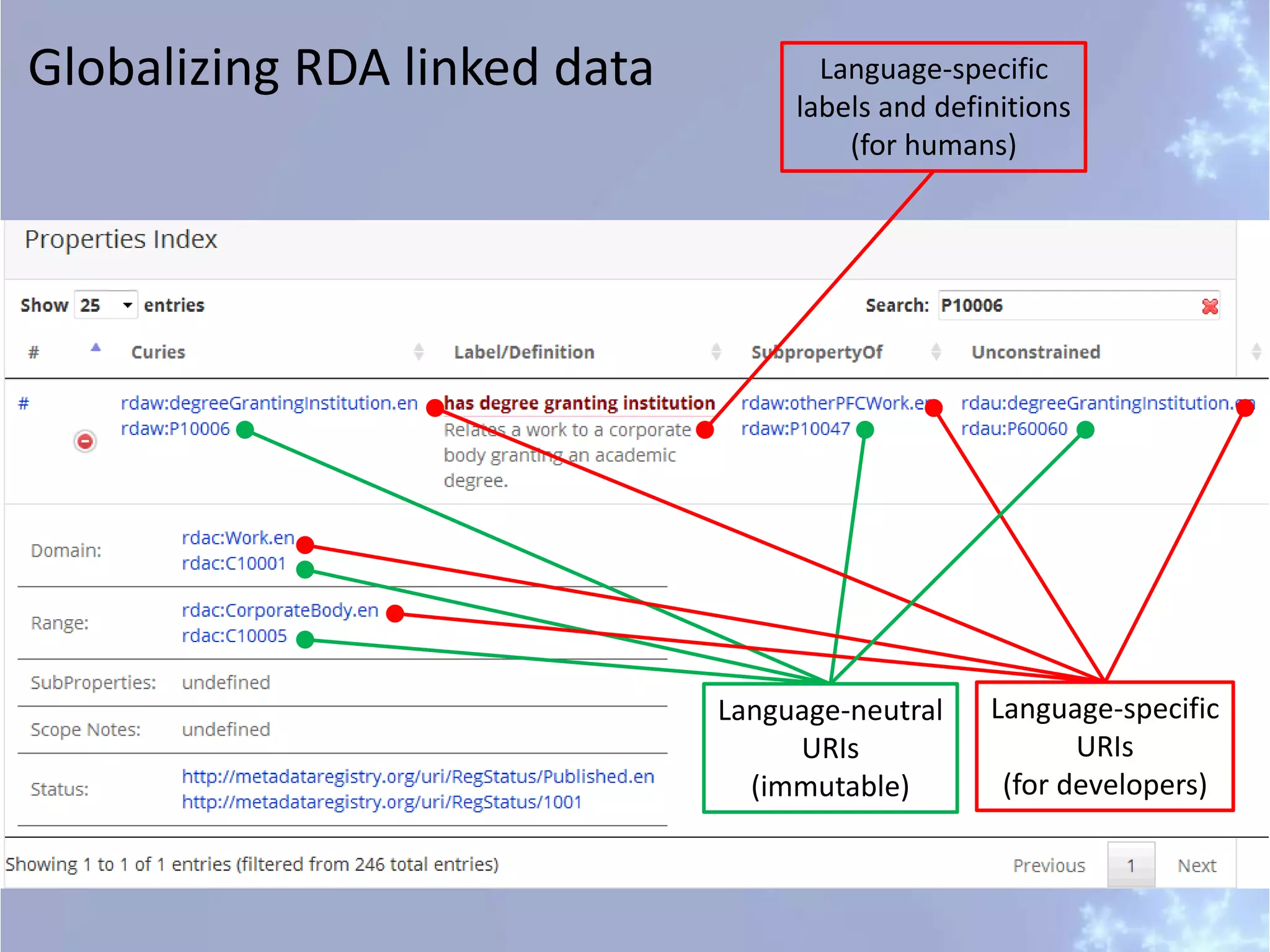
Globalizing RDA linked data
Language-neutral
URIs
(immutable)
Language-specific
URIs
(for developers)
Language-specific
labels and definitions
(for humans)
Unconstrained
versions
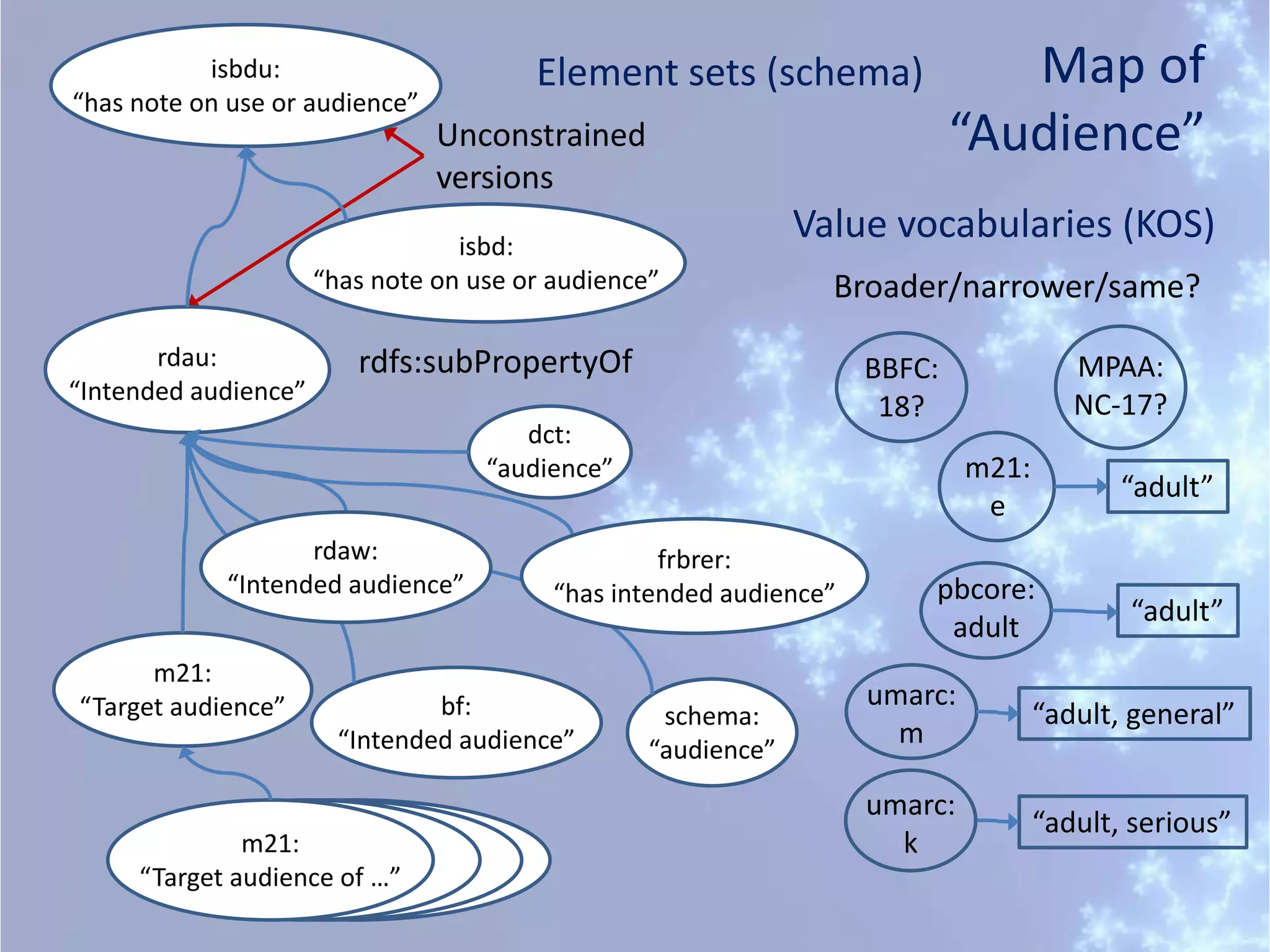
Map of
“Audience”
umarc:
m
“adult, general”
“adult, serious”
pbcore:
adult
“adult”
m21:
e
“adult”
MPAA:
NC-17?
BBFC:
18?
Element sets (schema)
Value vocabularies (KOS)
Broader/narrower/same?
m21:
“Target audience of …”
m21:
“Target audience” schema:
“audience”
dct:
“audience”
rdau:
“Intended audience”
isbd:
“has note on use or audience”
isbdu:
“has note on use or audience”
rdfs:subPropertyOf
umarc:
k
bf:
“Intended audience”
frbrer:
“has intended audience”
rdaw:
“Intended audience”
isbd:
Resource
bf:
Work
bf:
Instance
rda:
Work
rda:
Expression
rda:
Manifestation
rda:
Item
isbd:P1193 (has work aspect )
isbd:P1190
(has expression aspect )
isbd:P1192
(has manifestation aspect )
isbd:P1191 (has item aspect )
rdae:P20231 (has work expressed)
rdai:P40049 (has manifestation exemplified)
rdam:P30139
(has expression
manifested)
bf:
instanceOf
bf:
expressionOf
marc21:
Resource
?
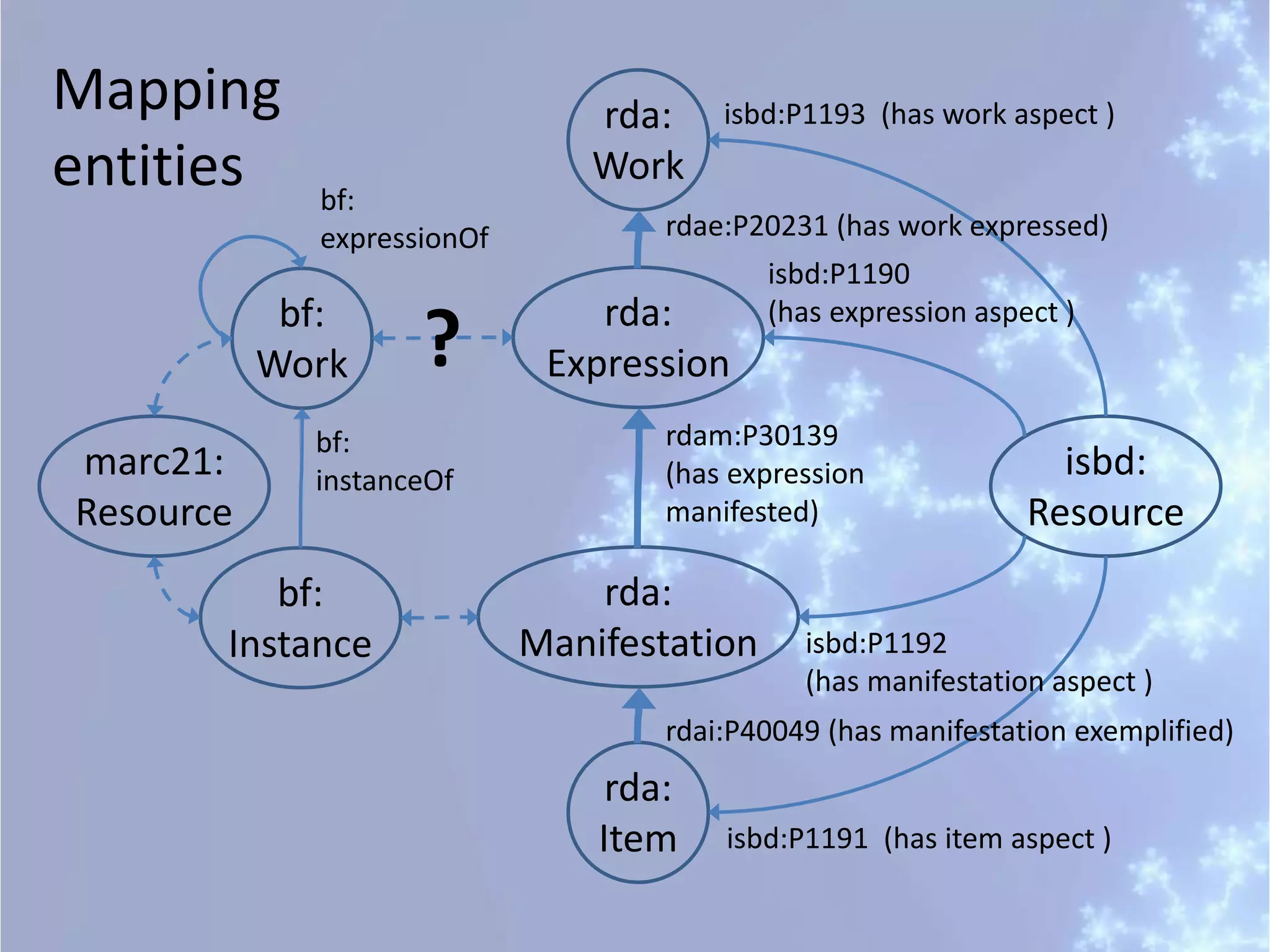
Mapping
entities
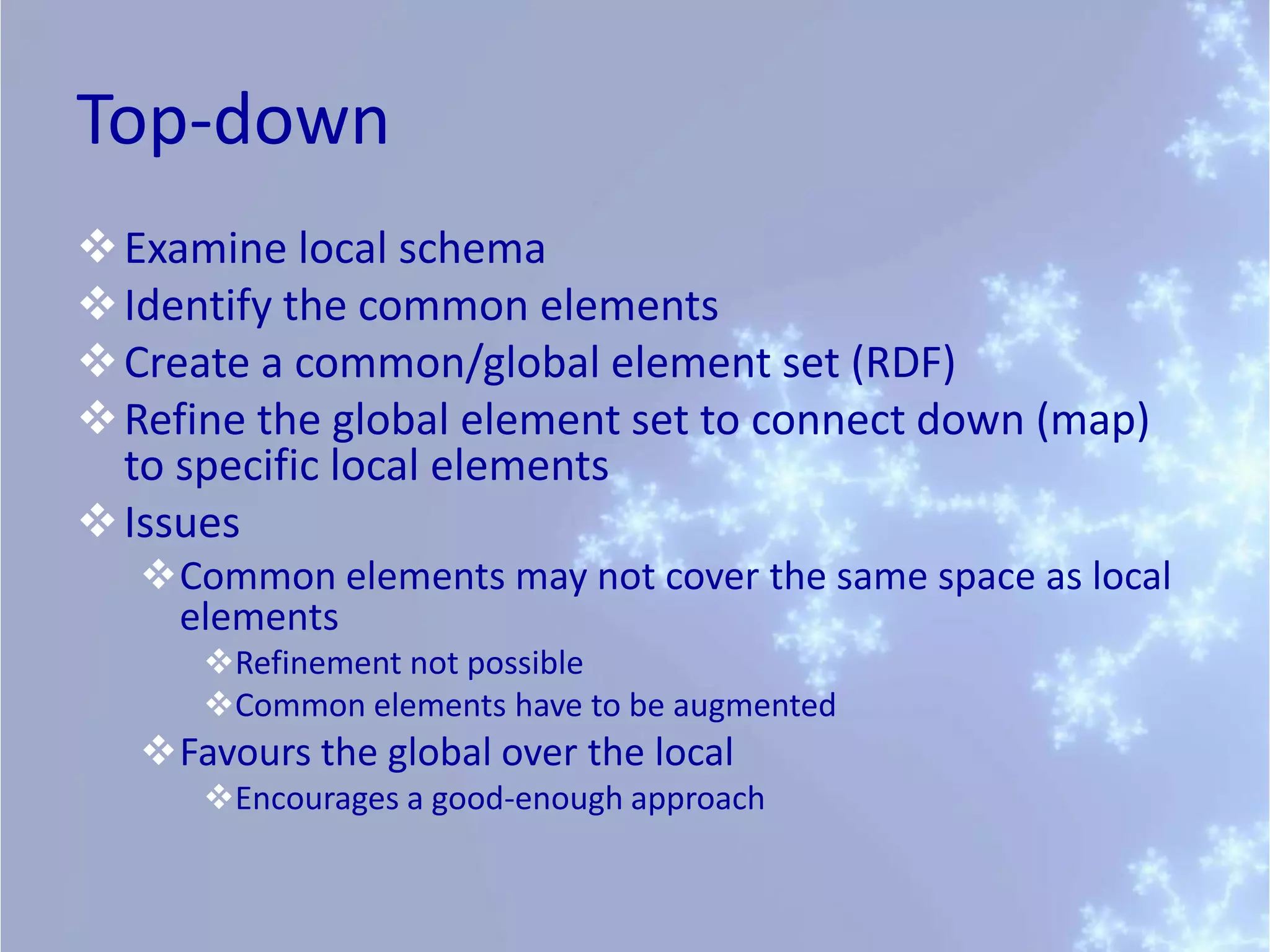
Top-down
Examine local schema
Identify the common elements
Create a common/global element set (RDF)
Refine the global element set to connect down (map)
to specific local elements
Issues
Common elements may not cover the same space as local
elements
Refinement not possible
Common elements have to be augmented
Favours the global over the local
Encourages a good-enough approach
Bottom-up
Publish the local schema(s) in RDF
Map local elements from different schema to
lowest common (dumber) elements – add new
elements if necessary
Continue until all local schema have been
mapped
Issues
Multiplicity of RDF element sets
Frequent overlap and redundancy
Local management resources
Thank you!
jscchair@rdatoolkit.org
rdaregistry.info
Published RDA element sets
rdvocab.info
Published RDA value vocabularies
https://github.com/RDARegistry/RDA-
Vocabularies
Project: versions, issues, feedback

RDA: thinking globally, acting globally

  • 1.
    RDA: thinking globally,acting globally Gordon Dunsire Presented at International Developments in Library Linked Data: Think Globally, Act Globally – Part Two: an ALCTS Program, ALA Annual, Las Vegas, USA, 28 Jun 2014
  • 2.
    Overview Failure of top-downapproach RDA tools Case: intended audience Mapping the focus of description Top-down, bottom-up issues
  • 3.
    BibO: Bibliographic Ontology Confusing tongues? BIBFRAME: Bibliographic Framework Say what wemean CRM: Conceptual Reference Model DC: Dublin Core FR: Functional Requirements ISBD: International Standard Bibliographic Description MARC21 RDA: Resource Description and Access schema.org UNIMARC KOS++ Universal Bibliographic Control RDF Thinking globally Acting locally
  • 4.
    For unFRBRized applications 30 million(partial) examples Links to other vocabularies Element set + Relationship designators
  • 5.
    Globalizing RDA linkeddata Language-neutral URIs (immutable) Language-specific URIs (for developers) Language-specific labels and definitions (for humans)
  • 6.
    Unconstrained versions Map of “Audience” umarc: m “adult, general” “adult,serious” pbcore: adult “adult” m21: e “adult” MPAA: NC-17? BBFC: 18? Element sets (schema) Value vocabularies (KOS) Broader/narrower/same? m21: “Target audience of …” m21: “Target audience” schema: “audience” dct: “audience” rdau: “Intended audience” isbd: “has note on use or audience” isbdu: “has note on use or audience” rdfs:subPropertyOf umarc: k bf: “Intended audience” frbrer: “has intended audience” rdaw: “Intended audience”
  • 7.
    isbd: Resource bf: Work bf: Instance rda: Work rda: Expression rda: Manifestation rda: Item isbd:P1193 (has workaspect ) isbd:P1190 (has expression aspect ) isbd:P1192 (has manifestation aspect ) isbd:P1191 (has item aspect ) rdae:P20231 (has work expressed) rdai:P40049 (has manifestation exemplified) rdam:P30139 (has expression manifested) bf: instanceOf bf: expressionOf marc21: Resource ? Mapping entities
  • 8.
    Top-down Examine local schema Identifythe common elements Create a common/global element set (RDF) Refine the global element set to connect down (map) to specific local elements Issues Common elements may not cover the same space as local elements Refinement not possible Common elements have to be augmented Favours the global over the local Encourages a good-enough approach
  • 9.
    Bottom-up Publish the localschema(s) in RDF Map local elements from different schema to lowest common (dumber) elements – add new elements if necessary Continue until all local schema have been mapped Issues Multiplicity of RDF element sets Frequent overlap and redundancy Local management resources
  • 10.
    Thank you! jscchair@rdatoolkit.org rdaregistry.info Published RDAelement sets rdvocab.info Published RDA value vocabularies https://github.com/RDARegistry/RDA- Vocabularies Project: versions, issues, feedback

Editor's Notes

  • #8 The relationships between entities from different data models that focus on essentially the same thing, a bibliographic resource, are not straightforward. * RDA provides relationship properties for the WEMI/IMEW stack – only the direction of the cardinality constraints is shown for clarity. * The ISBD and FRBR Review Groups have agreed to provide properties to relate the single ISBD entity Resource with the FRBR WEMI entities. These were added to the ISBD namespace with “New-proposed” status in 2013. * BIBFRAME provides relationship properties to link BIBFRAME Work and Instance entities. * BIBFRAME also provides a property to “connect Works under FRBR/RDA rules”; that is, to link two BIBFRAME works. * Where does MARC 21 fit in? Can we assume that the domain of MARC is a single entity similar to, if not the same as, ISBD’s Resource? That is certainly the case with UNIMARC. What are the relationships between the BIBFRAME entities and Resource? * What should the relationships between BIBFRAME and RDA entities look like? It seems only necessary to related a BIBFRAME Work to an RDA Expression, because the constraint locks it to a single RDA Work. That is, a BIBFRAME Work is directly related to RDA Expression, not an RDA Work.