
A step-by-step introduction to describing the 
resources swirling around Jane Austin 
University of Hawaii, December 2014
Why RIMMF? 
 
 Well constructed for FRBR-based description 
 Data structure comes from RDA Registry 
 Links to RDA Toolkit throughout data building 
process 
 Useful visualization of groups of records 
 RDF export 
 Improves discussion of issues with RDA 
 Step-by-step illustration of adding a record [next] 
Playing with Jane, Hawaii, 12/2014 2
Playing with Jane, Hawaii, 12/2014 3
Playing with Jane, Hawaii, 12/2014 4
Playing with Jane, Hawaii, 12/2014 5
Playing with Jane, Hawaii, 12/2014 6
Playing with Jane, Hawaii, 12/2014 7
Playing with Jane, Hawaii, 12/2014 8
Playing with Jane, Hawaii, 12/2014 9
Playing with Jane, Hawaii, 12/2014 10
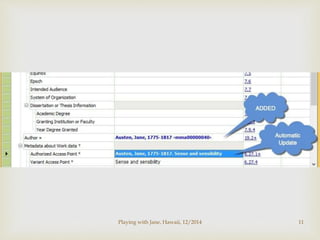
Playing with Jane, Hawaii, 12/2014 11
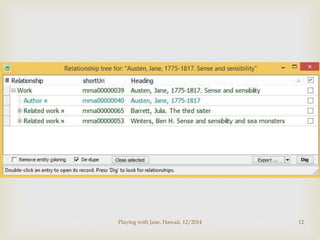
Playing with Jane, Hawaii, 12/2014 12
Issues for Discussion 
 
 Record sharing 
 Identification 
 RDF 
 Data Aggregation 
 Looking more clearly at workflow and maintenance 
 Provenance: who, what when, [where?] 
Playing with Jane, Hawaii, 12/2014 13
Substituting a Cache for 
a Database 
 
 Supports multiple streams of data 
 Allows detailed provenance to be carried over time 
 Separates services from data storage 
 Allows more extensive automation (and 
orchestration of services) 
 Focuses valuable human effort where it’s needed: 
analysis, design and implementation of 
improvement services 
Playing with Jane, Hawaii, 12/2014 14
Workflow 
 
 Obtain data (possibly as ‘records’) 
 Store data as statements in cache 
 Evaluate data by source or collection 
 Improve data using specific services, as determined 
by evaluation 
 Publish improved data 
 [Rinse, repeat] 
Playing with Jane, Hawaii, 12/2014 15
Developing Automated 
Interaction 
 
 Rule: Use humans for things requiring human 
understanding and decision making 
 Use machines for everything else 
 A manual process for something a machine can do as 
well or better is a failure 
 Improvement services can be granular, invoked in 
prescribed order, and report results for later use 
 Continuous improvement necessary to respond to 
continuous change 
Playing with Jane, Hawaii, 12/2014 16
Data Maintenance 
 
• Improved data returns as statements to the data cache, 
with provenance attached 
• Statement strategy avoids overwriting of new data over 
‘improved’ data 
 Each new statement adds to what is known about a 
described resource 
 Statements can be cherry picked and exposed to others in 
statements or records, in ‘flavors’ or as a ‘everything we 
have’ 
Playing with Jane, Hawaii, 12/2014 17
Contact Information 
Diane Hillmann 
metadata.maven@gmail.com 
Links: 
http://RDARegistry.info 
http://marc21rdf.info 
http://managemetadata.com/blog 
/ 
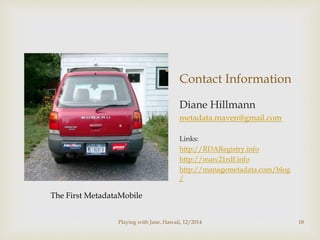
The First MetadataMobile 
Playing with Jane, Hawaii, 12/2014 18

Playing with Jane

  • 1.
    A step-by-step introductionto describing the resources swirling around Jane Austin University of Hawaii, December 2014
  • 2.
    Why RIMMF?   Well constructed for FRBR-based description  Data structure comes from RDA Registry  Links to RDA Toolkit throughout data building process  Useful visualization of groups of records  RDF export  Improves discussion of issues with RDA  Step-by-step illustration of adding a record [next] Playing with Jane, Hawaii, 12/2014 2
  • 3.
    Playing with Jane,Hawaii, 12/2014 3
  • 4.
    Playing with Jane,Hawaii, 12/2014 4
  • 5.
    Playing with Jane,Hawaii, 12/2014 5
  • 6.
    Playing with Jane,Hawaii, 12/2014 6
  • 7.
    Playing with Jane,Hawaii, 12/2014 7
  • 8.
    Playing with Jane,Hawaii, 12/2014 8
  • 9.
    Playing with Jane,Hawaii, 12/2014 9
  • 10.
    Playing with Jane,Hawaii, 12/2014 10
  • 11.
    Playing with Jane,Hawaii, 12/2014 11
  • 12.
    Playing with Jane,Hawaii, 12/2014 12
  • 13.
    Issues for Discussion   Record sharing  Identification  RDF  Data Aggregation  Looking more clearly at workflow and maintenance  Provenance: who, what when, [where?] Playing with Jane, Hawaii, 12/2014 13
  • 14.
    Substituting a Cachefor a Database   Supports multiple streams of data  Allows detailed provenance to be carried over time  Separates services from data storage  Allows more extensive automation (and orchestration of services)  Focuses valuable human effort where it’s needed: analysis, design and implementation of improvement services Playing with Jane, Hawaii, 12/2014 14
  • 15.
    Workflow  Obtain data (possibly as ‘records’)  Store data as statements in cache  Evaluate data by source or collection  Improve data using specific services, as determined by evaluation  Publish improved data  [Rinse, repeat] Playing with Jane, Hawaii, 12/2014 15
  • 16.
    Developing Automated Interaction   Rule: Use humans for things requiring human understanding and decision making  Use machines for everything else  A manual process for something a machine can do as well or better is a failure  Improvement services can be granular, invoked in prescribed order, and report results for later use  Continuous improvement necessary to respond to continuous change Playing with Jane, Hawaii, 12/2014 16
  • 17.
    Data Maintenance  • Improved data returns as statements to the data cache, with provenance attached • Statement strategy avoids overwriting of new data over ‘improved’ data  Each new statement adds to what is known about a described resource  Statements can be cherry picked and exposed to others in statements or records, in ‘flavors’ or as a ‘everything we have’ Playing with Jane, Hawaii, 12/2014 17
  • 18.
    Contact Information DianeHillmann metadata.maven@gmail.com Links: http://RDARegistry.info http://marc21rdf.info http://managemetadata.com/blog / The First MetadataMobile Playing with Jane, Hawaii, 12/2014 18

Editor's Notes

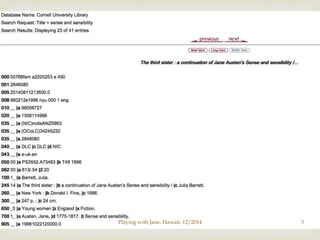
  • #4 Handling a related resource: first found in Cornell’s Voyager catalog. The available exports don’t include the MARC UTF-8 option.
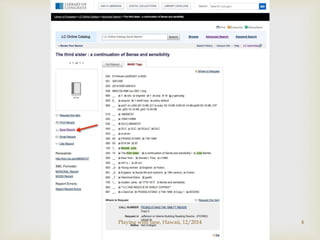
  • #5 LOC’s catalog allows a ‘save record’ option that enables export to RIMMF.
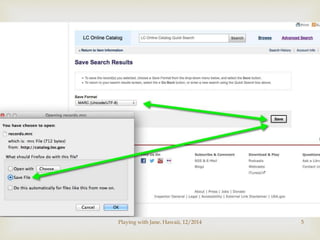
  • #6 The save file option (this is a Mac, remember!) is handled by saving the file to a specified location.
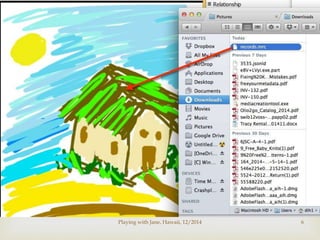
  • #7 In the downloads folder, the record shows up with a generic name. That record is dropped atop the RIMMF page.
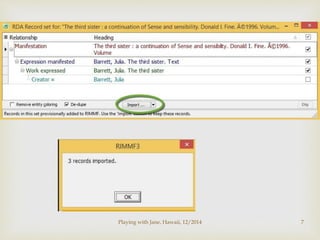
  • #8 RIMMF will show an r-tree set of records created from that action. Press the ‘import’ button and RIMMF will import the record to the local file.
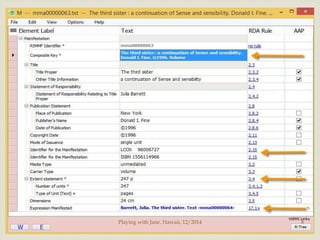
  • #9 Arrows: (1) Click on the box and the odd character will disappear. The change to the composite key will flow through the related records. (2) Note how the LCCN and ISBN are handled. (3) Note that the extent ‘statement’ is drawn from the MARC record, and then parsed into the number of units and type of units for better machine readability. (4) Note that the link to the expression is added automatically.
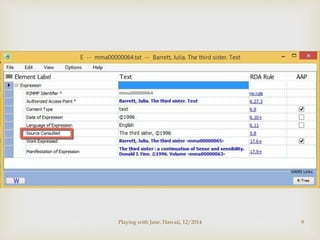
  • #10 Source consulted is not particularly helpful (it is really metadata about metadata), and JSC is considering how to handle it in the WEMI context.
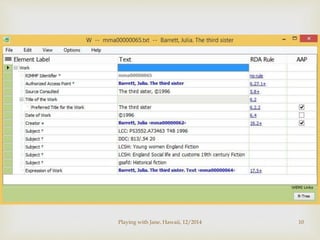
  • #11 The work aggregation also includes ‘source consulted’ –feel free to delete. Note that JSC is considering the issue of subjects, no conclusion yet.
  • #12 Author is added to the related sense and sensibility record—automated process cascades that through the related elements.
  • #13 RIMMF adds the related works (two here) to the r-tree for the S&S work.
  • #14 This slide and those following reflect some issues with RDF data in a RIMMF context, as well as general issues and relevant questions.