©2005 Neil Squire Society Updated: February 17, 2005
Brought to you by the
Neil Squire Society
Work SimplificationWork Simplification
&&
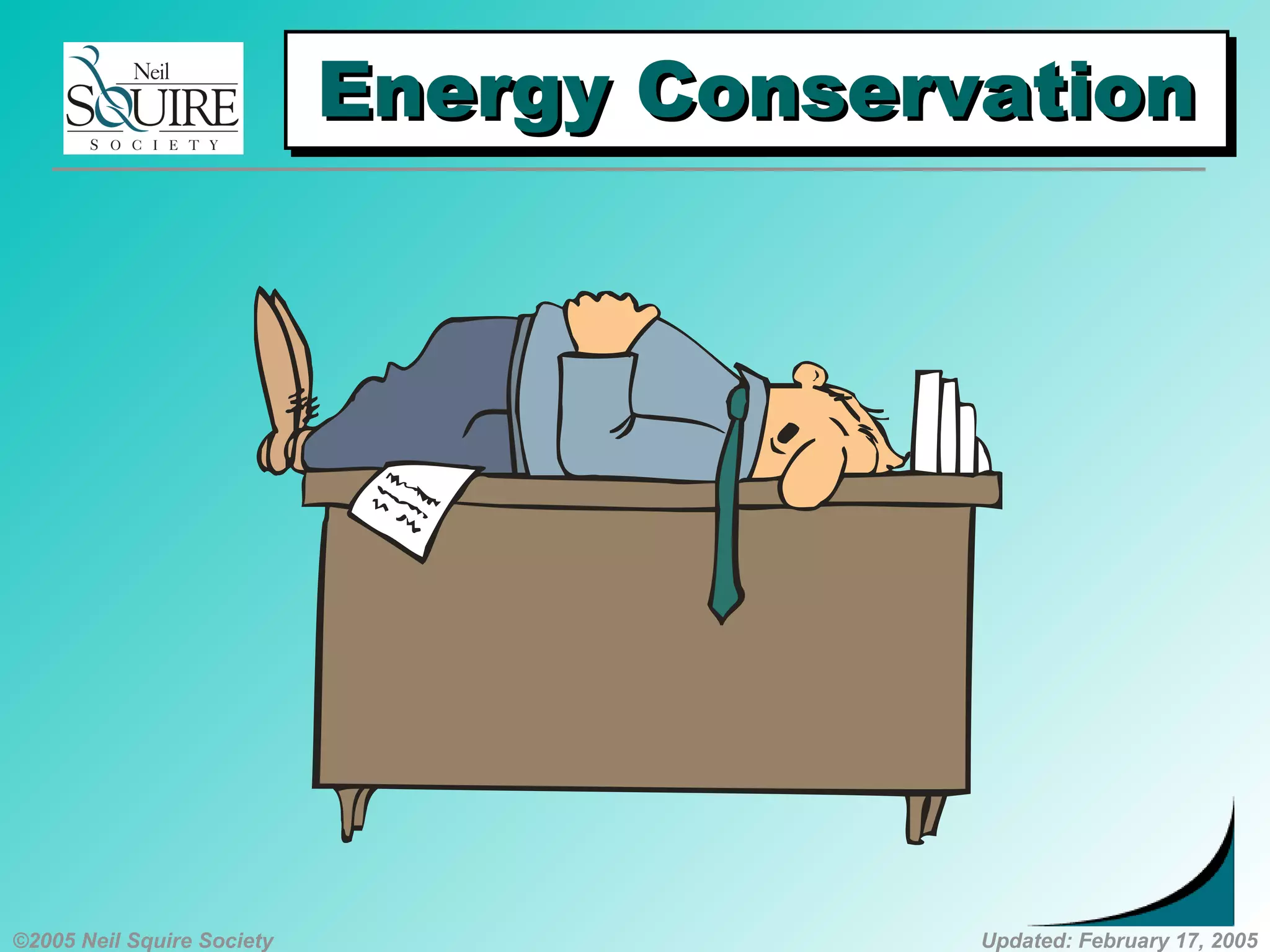
Energy ConservationEnergy Conservation
©2005 Neil Squire Society Updated: February 17, 2005
Session AgendaSession Agenda
In this presentation we will coverIn this presentation we will cover
the following topics:the following topics:
What is “Work Simplification”?What is “Work Simplification”?
What is “Energy Conservation”?What is “Energy Conservation”?
How can this help me?How can this help me?
Ideas for around the houseIdeas for around the house
Workspace ConsiderationsWorkspace Considerations
What is “Work Simplification”?What is “Work Simplification”?
What is “Energy Conservation”?What is “Energy Conservation”?
How can this help me?How can this help me?
Ideas for around the houseIdeas for around the house
Workspace ConsiderationsWorkspace Considerations
©2005 Neil Squire Society Updated: February 17, 2005
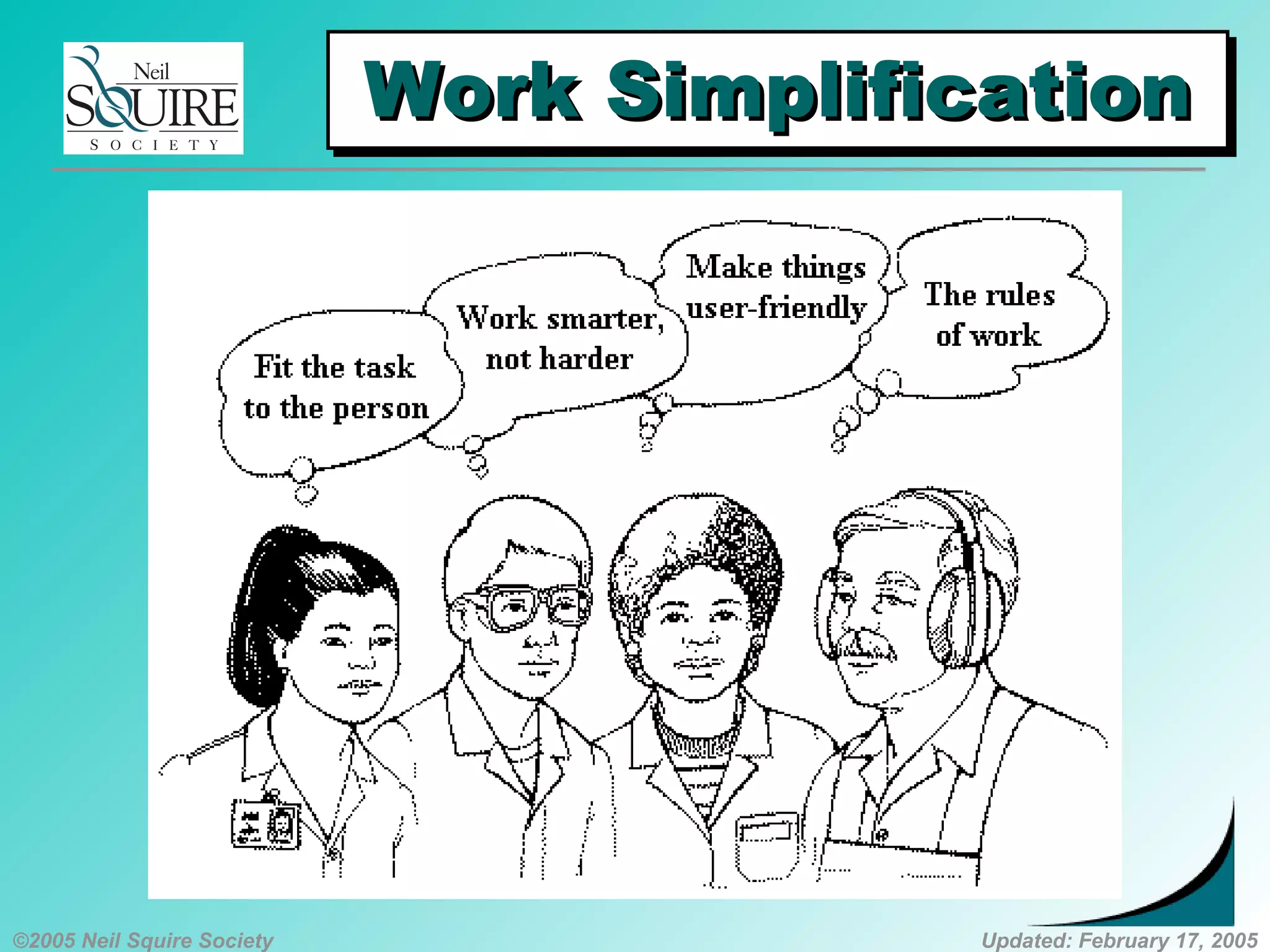
Work SimplificationWork SimplificationWork SimplificationWork Simplification
©2005 Neil Squire Society Updated: February 17, 2005
Work SimplificationWork SimplificationWork SimplificationWork Simplification
©2005 Neil Squire Society Updated: February 17, 2005
Work SimplificationWork SimplificationWork SimplificationWork Simplification
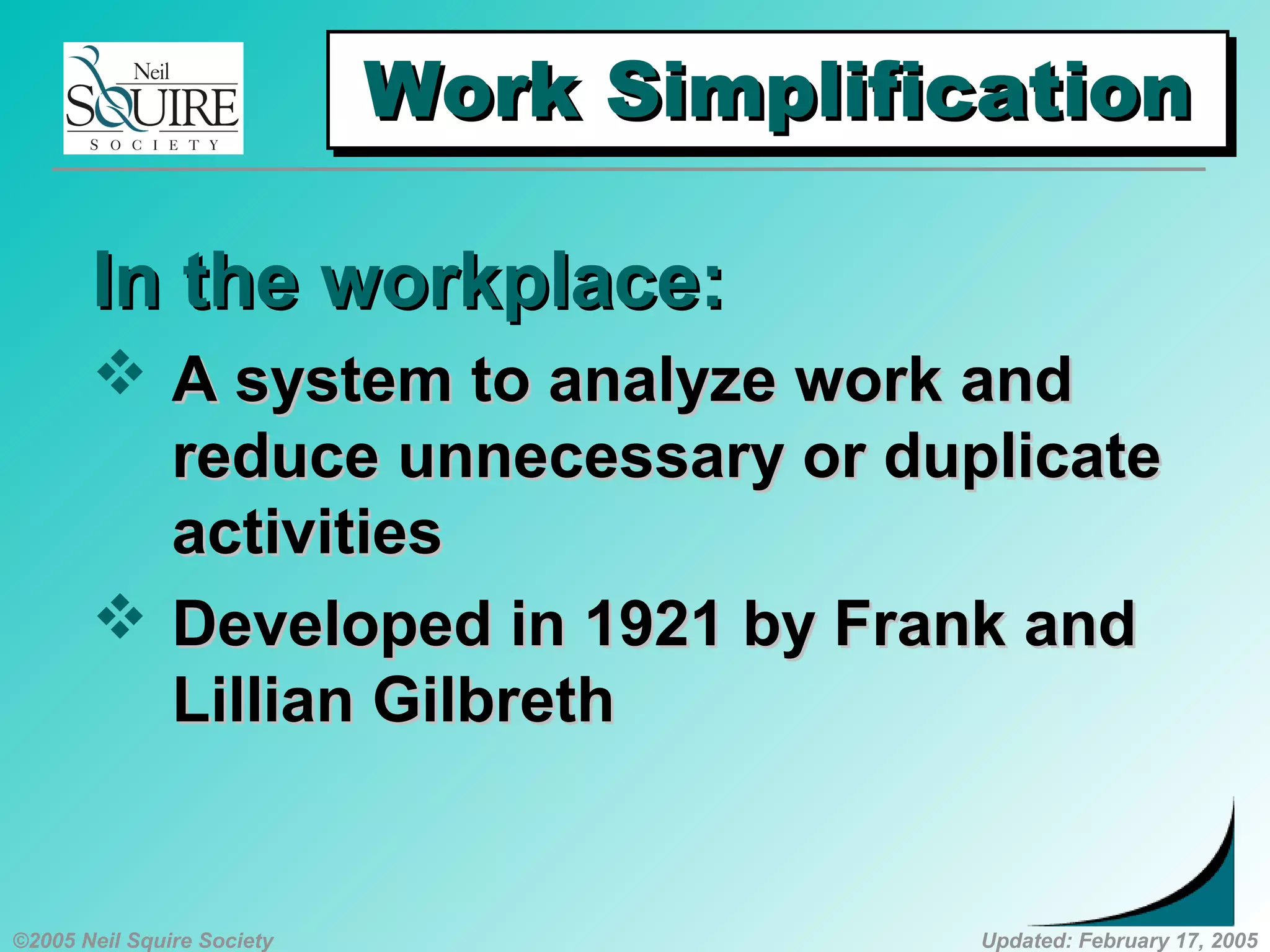
In the workplace:In the workplace:
 A system to analyze work andA system to analyze work and
reduce unnecessary or duplicatereduce unnecessary or duplicate
activitiesactivities
 Developed in 1921 by Frank andDeveloped in 1921 by Frank and
Lillian GilbrethLillian Gilbreth
©2005 Neil Squire Society Updated: February 17, 2005
Work SimplificationWork SimplificationWork SimplificationWork Simplification
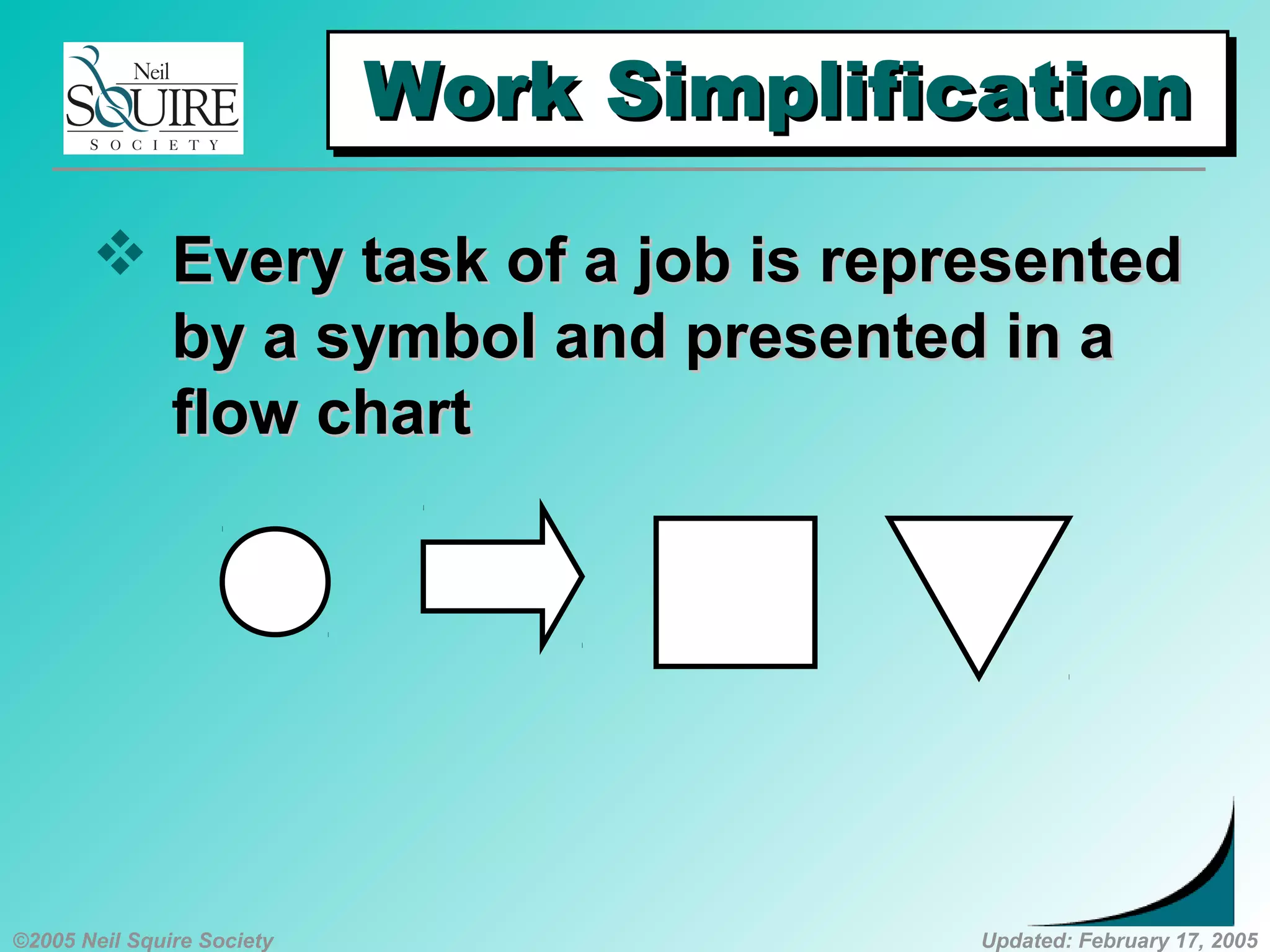
 Every task of a job is representedEvery task of a job is represented
by a symbol and presented in aby a symbol and presented in a
flow chartflow chart
©2005 Neil Squire Society Updated: February 17, 2005
Work SimplificationWork SimplificationWork SimplificationWork Simplification
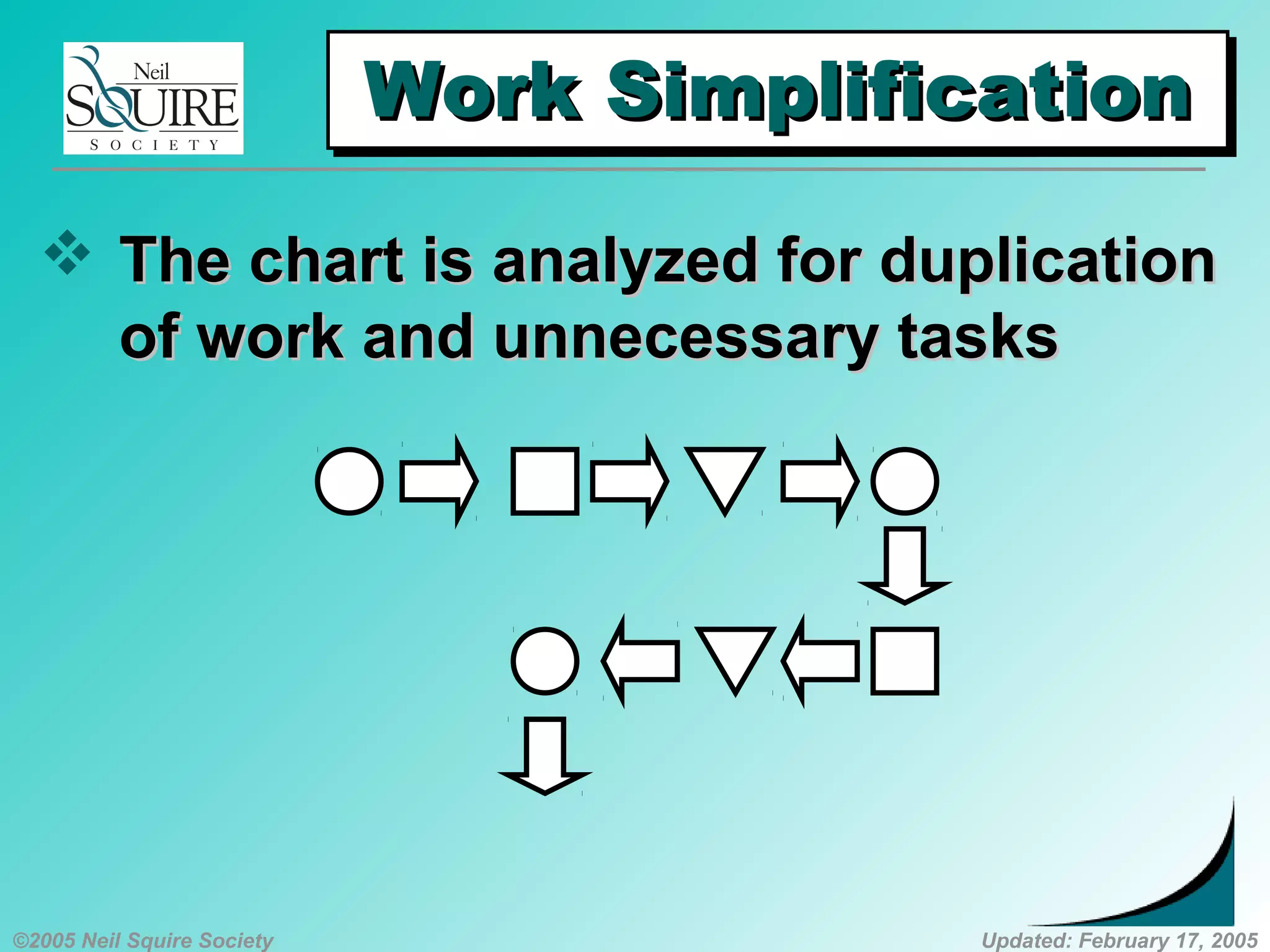
 The chart is analyzed for duplicationThe chart is analyzed for duplication
of work and unnecessary tasksof work and unnecessary tasks
©2005 Neil Squire Society Updated: February 17, 2005
Work SimplificationWork SimplificationWork SimplificationWork Simplification
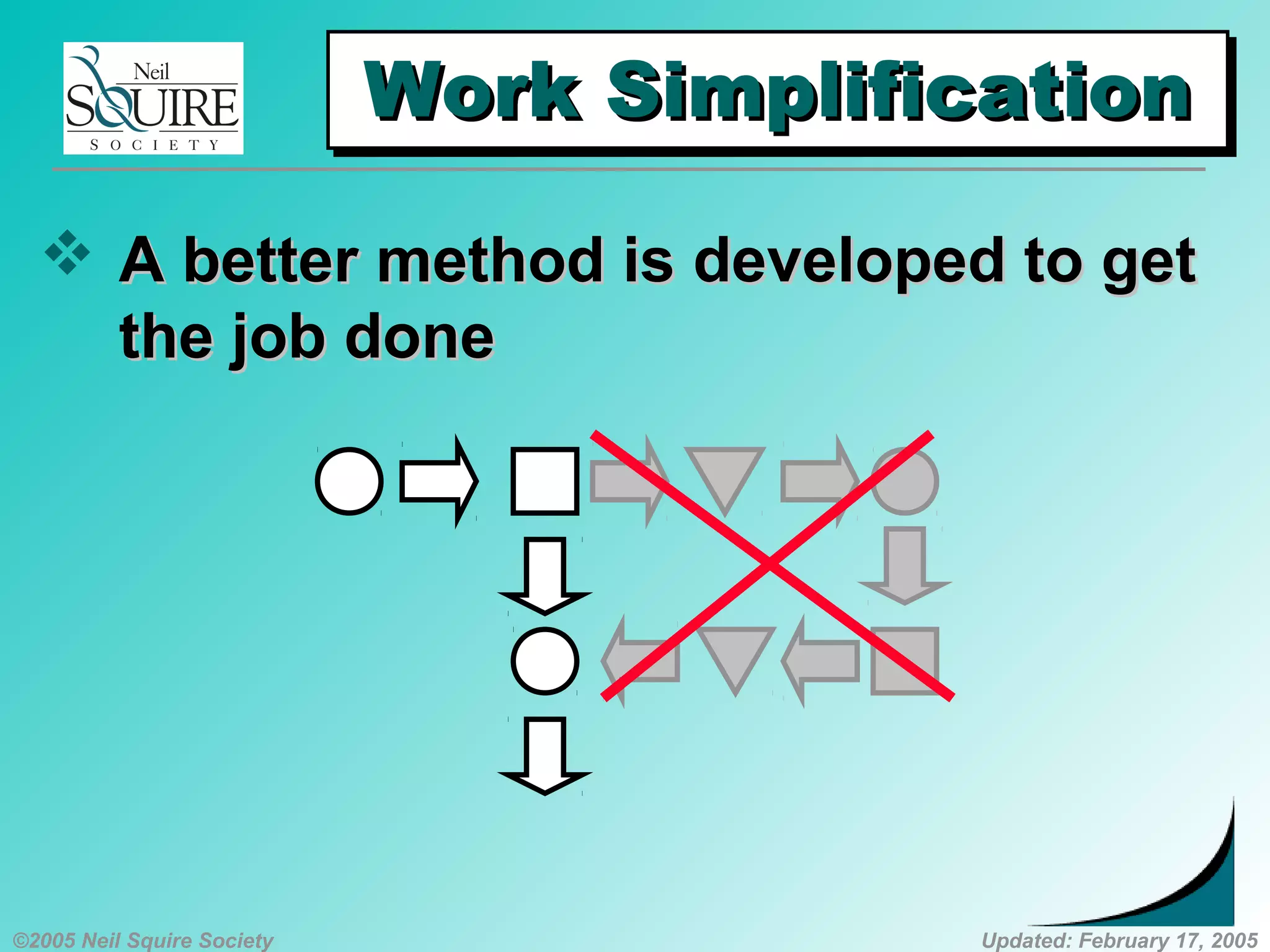
 A better method is developed to getA better method is developed to get
the job donethe job done
©2005 Neil Squire Society Updated: February 17, 2005
Work SimplificationWork SimplificationWork SimplificationWork Simplification
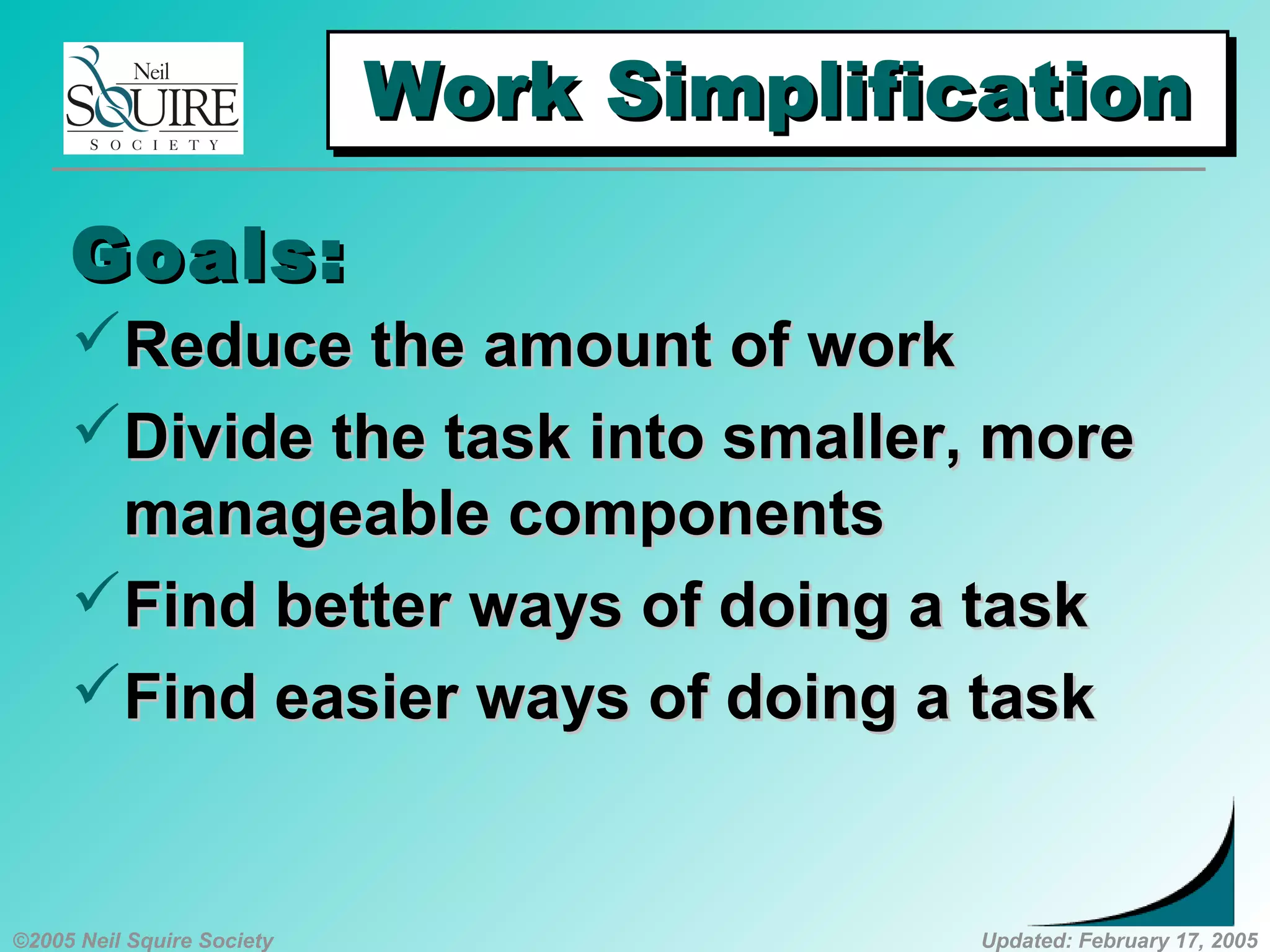
Reduce the amount of workReduce the amount of work
Divide the task into smaller, moreDivide the task into smaller, more
manageable componentsmanageable components
Find better ways of doing a taskFind better ways of doing a task
Find easier ways of doing a taskFind easier ways of doing a task
Goals:Goals:
©2005 Neil Squire Society Updated: February 17, 2005
Energy ConservationEnergy ConservationEnergy ConservationEnergy Conservation
©2005 Neil Squire Society Updated: February 17, 2005
Energy ConservationEnergy ConservationEnergy ConservationEnergy Conservation
©2005 Neil Squire Society Updated: February 17, 2005
Energy ConservationEnergy ConservationEnergy ConservationEnergy Conservation
 Recognize your energy limitsRecognize your energy limits
©2005 Neil Squire Society Updated: February 17, 2005
Energy ConservationEnergy ConservationEnergy ConservationEnergy Conservation
 Recognize your energy limitsRecognize your energy limits
Be realistic about what you canBe realistic about what you can
accomplishaccomplish
Don’t abuse your good daysDon’t abuse your good days
Take frequent rest breaksTake frequent rest breaks
Be realistic about what you canBe realistic about what you can
accomplishaccomplish
Don’t abuse your good daysDon’t abuse your good days
Take frequent rest breaksTake frequent rest breaks
©2005 Neil Squire Society Updated: February 17, 2005
Energy ConservationEnergy ConservationEnergy ConservationEnergy Conservation
 Reduce your physical stressReduce your physical stress
©2005 Neil Squire Society Updated: February 17, 2005
Energy ConservationEnergy ConservationEnergy ConservationEnergy Conservation
 Reduce your physical stressReduce your physical stress
Prioritize your “To Do” listPrioritize your “To Do” list
““Let go” of unnecessary workLet go” of unnecessary work
Eat healthily and exerciseEat healthily and exercise
Don’t over-stretch or strainDon’t over-stretch or strain
Take breaksTake breaks
Prioritize your “To Do” listPrioritize your “To Do” list
““Let go” of unnecessary workLet go” of unnecessary work
Eat healthily and exerciseEat healthily and exercise
Don’t over-stretch or strainDon’t over-stretch or strain
Take breaksTake breaks
©2005 Neil Squire Society Updated: February 17, 2005
Energy ConservationEnergy ConservationEnergy ConservationEnergy Conservation
 Work efficientlyWork efficiently
©2005 Neil Squire Society Updated: February 17, 2005
Energy ConservationEnergy ConservationEnergy ConservationEnergy Conservation
 Work efficientlyWork efficiently
Use ergonomic principles in allUse ergonomic principles in all
your activities, not justyour activities, not just
computer workcomputer work
Have all required materialsHave all required materials
within easy reachwithin easy reach
Think safetyThink safety
Use ergonomic principles in allUse ergonomic principles in all
your activities, not justyour activities, not just
computer workcomputer work
Have all required materialsHave all required materials
within easy reachwithin easy reach
Think safetyThink safety
©2005 Neil Squire Society Updated: February 17, 2005
Energy ConservationEnergy ConservationEnergy ConservationEnergy Conservation
 Pace yourselfPace yourself
©2005 Neil Squire Society Updated: February 17, 2005
Energy ConservationEnergy ConservationEnergy ConservationEnergy Conservation
 Pace yourselfPace yourself
Know what speed is best for youKnow what speed is best for you
Use pulse rate and shortness ofUse pulse rate and shortness of
breath as guidelinesbreath as guidelines
Plan your day to match yourPlan your day to match your
energy levelsenergy levels
Know what speed is best for youKnow what speed is best for you
Use pulse rate and shortness ofUse pulse rate and shortness of
breath as guidelinesbreath as guidelines
Plan your day to match yourPlan your day to match your
energy levelsenergy levels
©2005 Neil Squire Society Updated: February 17, 2005
Energy ConservationEnergy ConservationEnergy ConservationEnergy Conservation
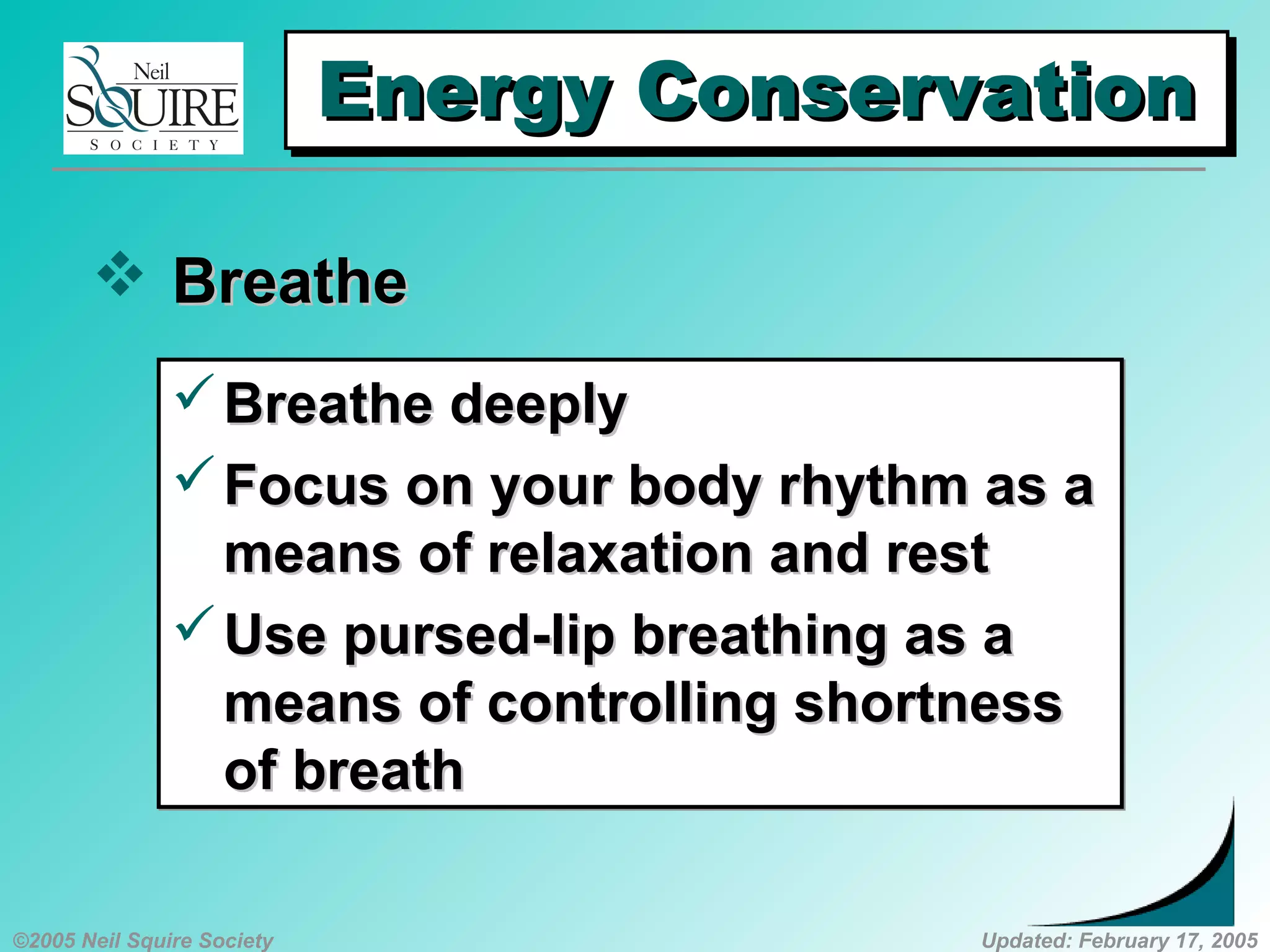
 BreatheBreathe
©2005 Neil Squire Society Updated: February 17, 2005
Energy ConservationEnergy ConservationEnergy ConservationEnergy Conservation
 BreatheBreathe
Breathe deeplyBreathe deeply
Focus on your body rhythm as aFocus on your body rhythm as a
means of relaxation and restmeans of relaxation and rest
Use pursed-lip breathing as aUse pursed-lip breathing as a
means of controlling shortnessmeans of controlling shortness
of breathof breath
Breathe deeplyBreathe deeply
Focus on your body rhythm as aFocus on your body rhythm as a
means of relaxation and restmeans of relaxation and rest
Use pursed-lip breathing as aUse pursed-lip breathing as a
means of controlling shortnessmeans of controlling shortness
of breathof breath
©2005 Neil Squire Society Updated: February 17, 2005
Energy ConservationEnergy ConservationEnergy ConservationEnergy Conservation
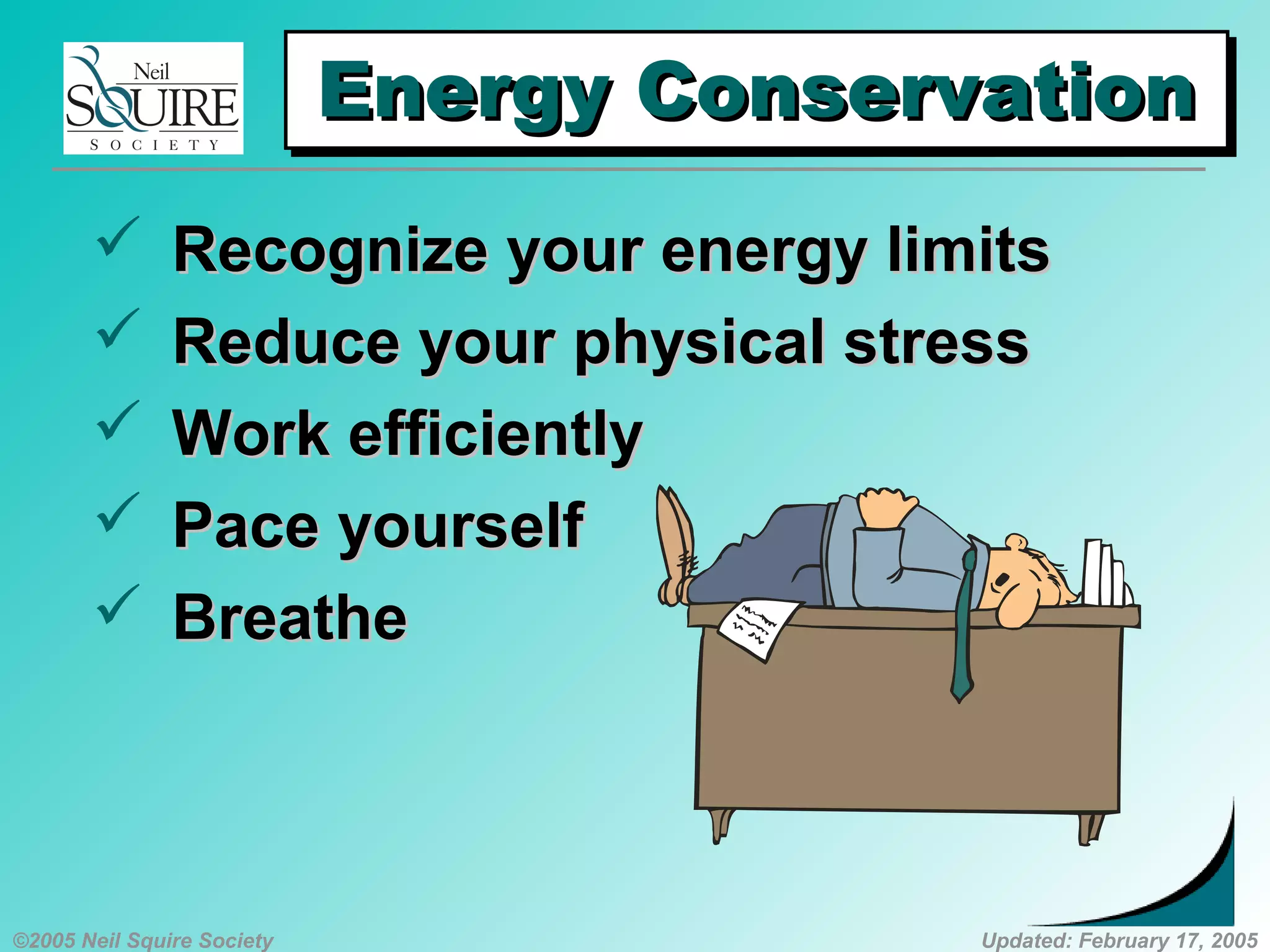
 Recognize your energy limitsRecognize your energy limits
 Reduce your physical stressReduce your physical stress
 Work efficientlyWork efficiently
 Pace yourselfPace yourself
 BreatheBreathe
©2005 Neil Squire Society Updated: February 17, 2005
CombineCombine
Work SimplificationWork Simplification
&&
Energy ConservationEnergy Conservation
Work SimplificationWork Simplification
&&
Energy ConservationEnergy Conservation
©2005 Neil Squire Society Updated: February 17, 2005
Work SimplificationWork Simplification &&
Energy ConservationEnergy Conservation
Work SimplificationWork Simplification &&
Energy ConservationEnergy Conservation
 Reduce the amount of workReduce the amount of work andand
recognize your energy limitsrecognize your energy limits
©2005 Neil Squire Society Updated: February 17, 2005
Work SimplificationWork Simplification &&
Energy ConservationEnergy Conservation
Work SimplificationWork Simplification &&
Energy ConservationEnergy Conservation
 Reduce the amount of workReduce the amount of work andand
recognize your energy limitsrecognize your energy limits
Eliminate unnecessary tasksEliminate unnecessary tasks
Combine or eliminate steps of a taskCombine or eliminate steps of a task
Delegate tasksDelegate tasks
Use professional services for someUse professional services for some
taskstasks
Eliminate unnecessary tasksEliminate unnecessary tasks
Combine or eliminate steps of a taskCombine or eliminate steps of a task
Delegate tasksDelegate tasks
Use professional services for someUse professional services for some
taskstasks
©2005 Neil Squire Society Updated: February 17, 2005
 Find better ways of doing a taskFind better ways of doing a task
andand work efficientlywork efficiently
Work SimplificationWork Simplification &&
Energy ConservationEnergy Conservation
Work SimplificationWork Simplification &&
Energy ConservationEnergy Conservation
©2005 Neil Squire Society Updated: February 17, 2005
 Find better ways of doing a taskFind better ways of doing a task
andand work efficientlywork efficiently
Organize your work areasOrganize your work areas
Store frequently used items withinStore frequently used items within
easy reach of the work areaeasy reach of the work area
Gather all items needed beforeGather all items needed before
beginning a taskbeginning a task
Think ergonomicsThink ergonomics
Organize your work areasOrganize your work areas
Store frequently used items withinStore frequently used items within
easy reach of the work areaeasy reach of the work area
Gather all items needed beforeGather all items needed before
beginning a taskbeginning a task
Think ergonomicsThink ergonomics
Work SimplificationWork Simplification &&
Energy ConservationEnergy Conservation
Work SimplificationWork Simplification &&
Energy ConservationEnergy Conservation
©2005 Neil Squire Society Updated: February 17, 2005
 Break a job into smaller tasksBreak a job into smaller tasks andand
pace yourselfpace yourself
… continued
Work SimplificationWork Simplification &&
Energy ConservationEnergy Conservation
Work SimplificationWork Simplification &&
Energy ConservationEnergy Conservation
©2005 Neil Squire Society Updated: February 17, 2005
 Break a job into smaller tasksBreak a job into smaller tasks andand
pace yourselfpace yourself
Work at a steady, moderate paceWork at a steady, moderate pace
Plan frequent, short rest breaksPlan frequent, short rest breaks
rather than one long breakrather than one long break
Alternate active and quiet tasksAlternate active and quiet tasks
RestRest beforebefore becoming fatiguedbecoming fatigued
Work at a steady, moderate paceWork at a steady, moderate pace
Plan frequent, short rest breaksPlan frequent, short rest breaks
rather than one long breakrather than one long break
Alternate active and quiet tasksAlternate active and quiet tasks
RestRest beforebefore becoming fatiguedbecoming fatigued
… continued
Work SimplificationWork Simplification &&
Energy ConservationEnergy Conservation
Work SimplificationWork Simplification &&
Energy ConservationEnergy Conservation
©2005 Neil Squire Society Updated: February 17, 2005
 Break a job into smaller tasksBreak a job into smaller tasks andand
pace yourselfpace yourself
Arrange tasks so that the moreArrange tasks so that the more
physical work is done when yourphysical work is done when your
energy level is highestenergy level is highest
Distribute heavy tasks overDistribute heavy tasks over
several daysseveral days
Alternate light and heavy tasksAlternate light and heavy tasks
Arrange tasks so that the moreArrange tasks so that the more
physical work is done when yourphysical work is done when your
energy level is highestenergy level is highest
Distribute heavy tasks overDistribute heavy tasks over
several daysseveral days
Alternate light and heavy tasksAlternate light and heavy tasks
Work SimplificationWork Simplification &&
Energy ConservationEnergy Conservation
Work SimplificationWork Simplification &&
Energy ConservationEnergy Conservation
©2005 Neil Squire Society Updated: February 17, 2005
 Find easier ways of doing a taskFind easier ways of doing a task
andand decrease your physical stressdecrease your physical stress
Work SimplificationWork Simplification &&
Energy ConservationEnergy Conservation
Work SimplificationWork Simplification &&
Energy ConservationEnergy Conservation
©2005 Neil Squire Society Updated: February 17, 2005
 Find easier ways of doing a taskFind easier ways of doing a task
andand decrease your physical stressdecrease your physical stress
Sit to perform tasksSit to perform tasks
Keep your back straightKeep your back straight
Slide or push objects instead of liftingSlide or push objects instead of lifting
Use a cart or basket to carry itemsUse a cart or basket to carry items
Avoid over-stretching, twisting,Avoid over-stretching, twisting,
stooping, or strainingstooping, or straining
Sit to perform tasksSit to perform tasks
Keep your back straightKeep your back straight
Slide or push objects instead of liftingSlide or push objects instead of lifting
Use a cart or basket to carry itemsUse a cart or basket to carry items
Avoid over-stretching, twisting,Avoid over-stretching, twisting,
stooping, or strainingstooping, or straining
Work SimplificationWork Simplification &&
Energy ConservationEnergy Conservation
Work SimplificationWork Simplification &&
Energy ConservationEnergy Conservation
©2005 Neil Squire Society Updated: February 17, 2005
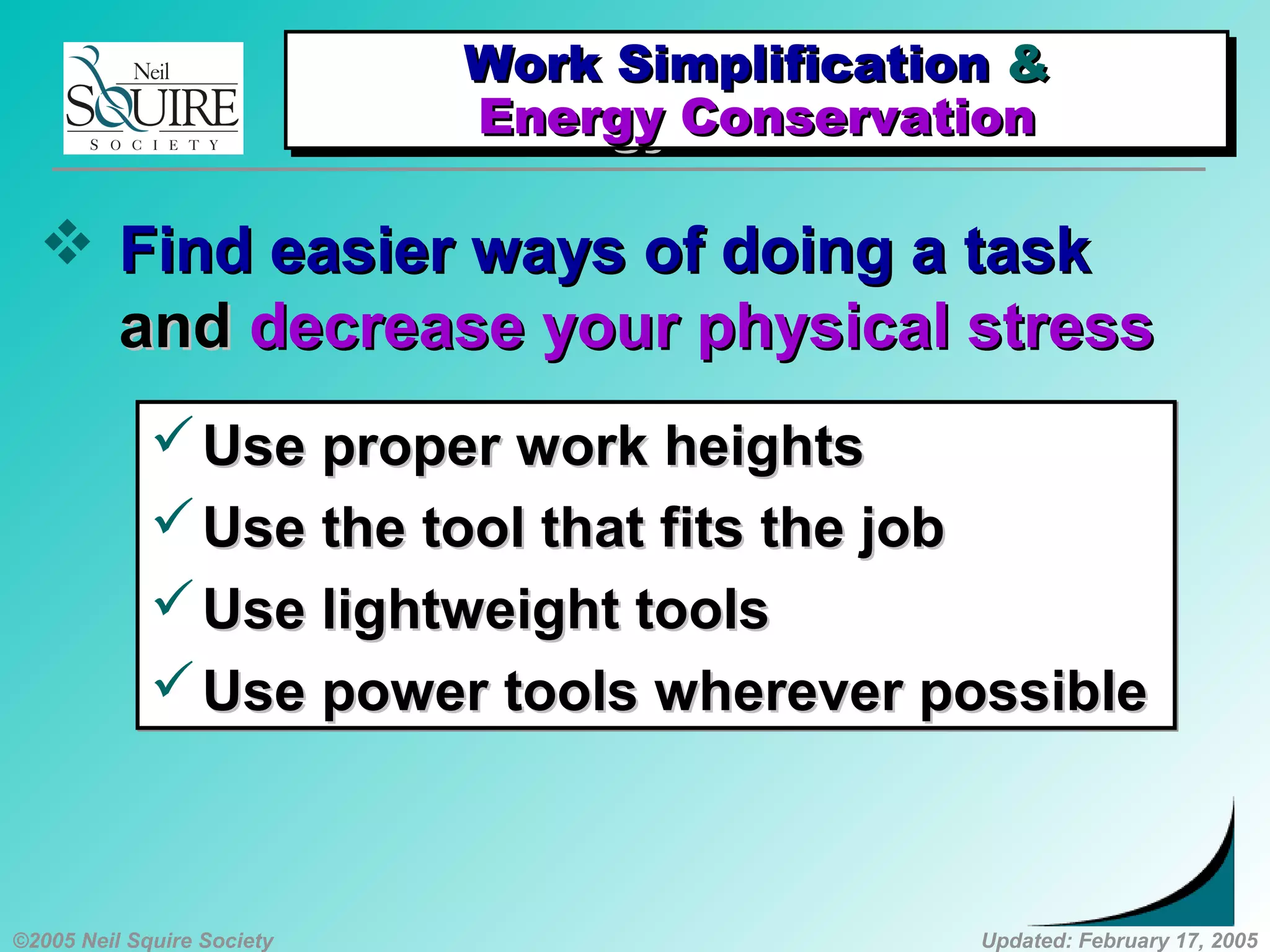
 Find easier ways of doing a taskFind easier ways of doing a task
andand decrease your physical stressdecrease your physical stress
Use proper work heightsUse proper work heights
Use the tool that fits the jobUse the tool that fits the job
Use lightweight toolsUse lightweight tools
Use power tools wherever possibleUse power tools wherever possible
Use proper work heightsUse proper work heights
Use the tool that fits the jobUse the tool that fits the job
Use lightweight toolsUse lightweight tools
Use power tools wherever possibleUse power tools wherever possible
Work SimplificationWork Simplification &&
Energy ConservationEnergy Conservation
Work SimplificationWork Simplification &&
Energy ConservationEnergy Conservation
©2005 Neil Squire Society Updated: February 17, 2005
How can thisHow can this
help me?help me?
How can thisHow can this
help me?help me?
©2005 Neil Squire Society Updated: February 17, 2005
Case StudyCase Study
Anna:Anna:
 Hired as a part-timeHired as a part-time
accountantaccountant
 Needs attendant care inNeeds attendant care in
morning and at nightmorning and at night
 Active social lifeActive social life
 Limited energyLimited energy
(max. 8 hours per day)(max. 8 hours per day)
©2005 Neil Squire Society Updated: February 17, 2005
Case StudyCase Study
Anna:Anna: Recognize her energy limitsRecognize her energy limits
 20 hours work per20 hours work per
week - maximumweek - maximum
 Some of her work canSome of her work can
be done from homebe done from home
 Schedule that matchesSchedule that matches
her energy levelsher energy levels
 Consider personal care and transitConsider personal care and transit
time when setting scheduletime when setting schedule
©2005 Neil Squire Society Updated: February 17, 2005
Case StudyCase Study
Anna:Anna: Reduce the amount of work at homeReduce the amount of work at home
 Delegate householdDelegate household
choreschores
 Change or increaseChange or increase
attendant hoursattendant hours
 ““Let go” of unnecessaryLet go” of unnecessary
taskstasks
©2005 Neil Squire Society Updated: February 17, 2005
Case StudyCase Study
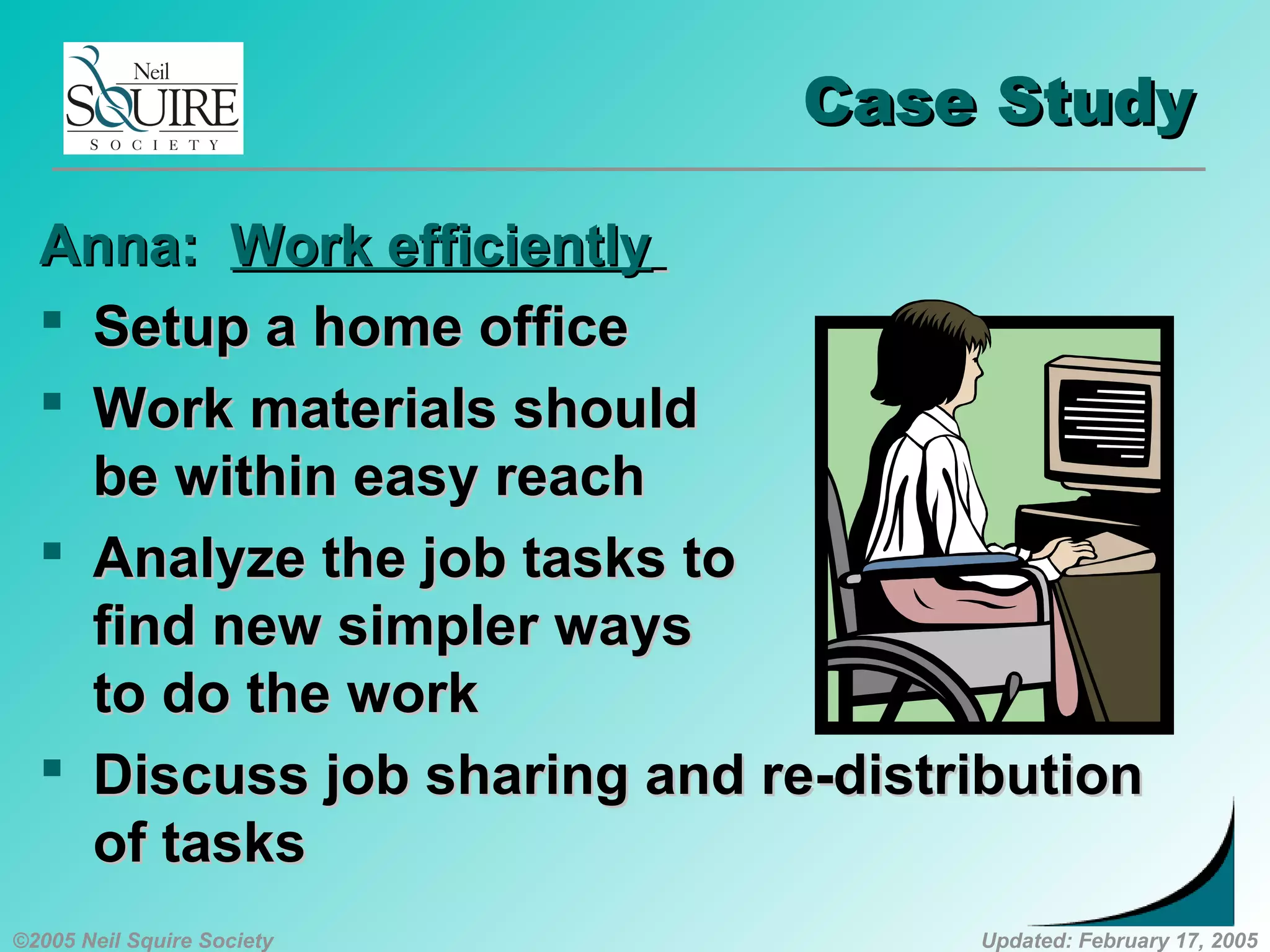
Anna:Anna: Work efficientlyWork efficiently
 Setup a home officeSetup a home office
 Work materials shouldWork materials should
be within easy reachbe within easy reach
 Analyze the job tasks toAnalyze the job tasks to
find new simpler waysfind new simpler ways
to do the workto do the work
 Discuss job sharing and re-distributionDiscuss job sharing and re-distribution
of tasksof tasks
©2005 Neil Squire Society Updated: February 17, 2005
Case StudyCase Study
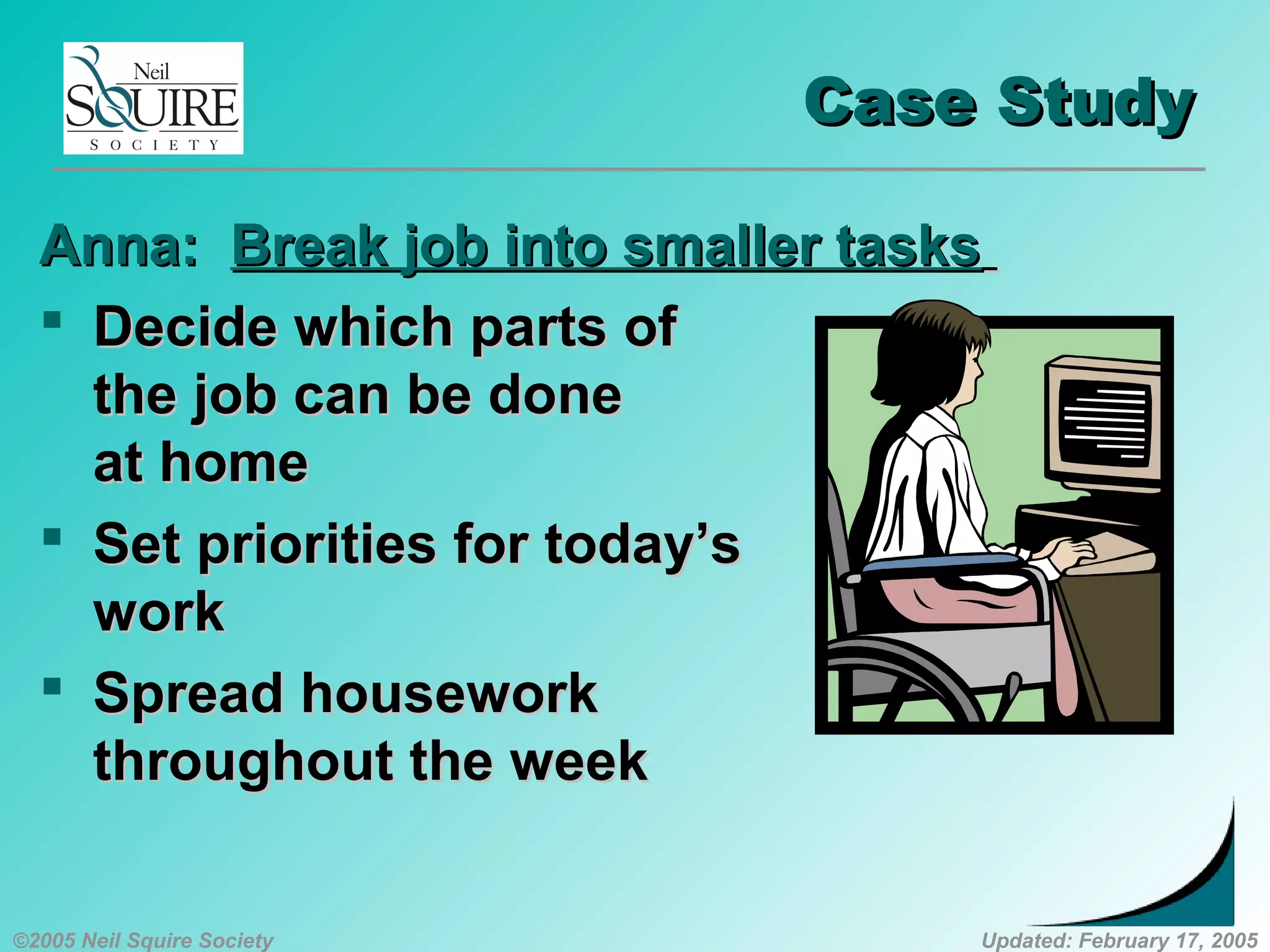
Anna:Anna: Break job into smaller tasksBreak job into smaller tasks
 Decide which parts ofDecide which parts of
the job can be donethe job can be done
at homeat home
 Set priorities for today’sSet priorities for today’s
workwork
 Spread houseworkSpread housework
throughout the weekthroughout the week
©2005 Neil Squire Society Updated: February 17, 2005
Case StudyCase Study
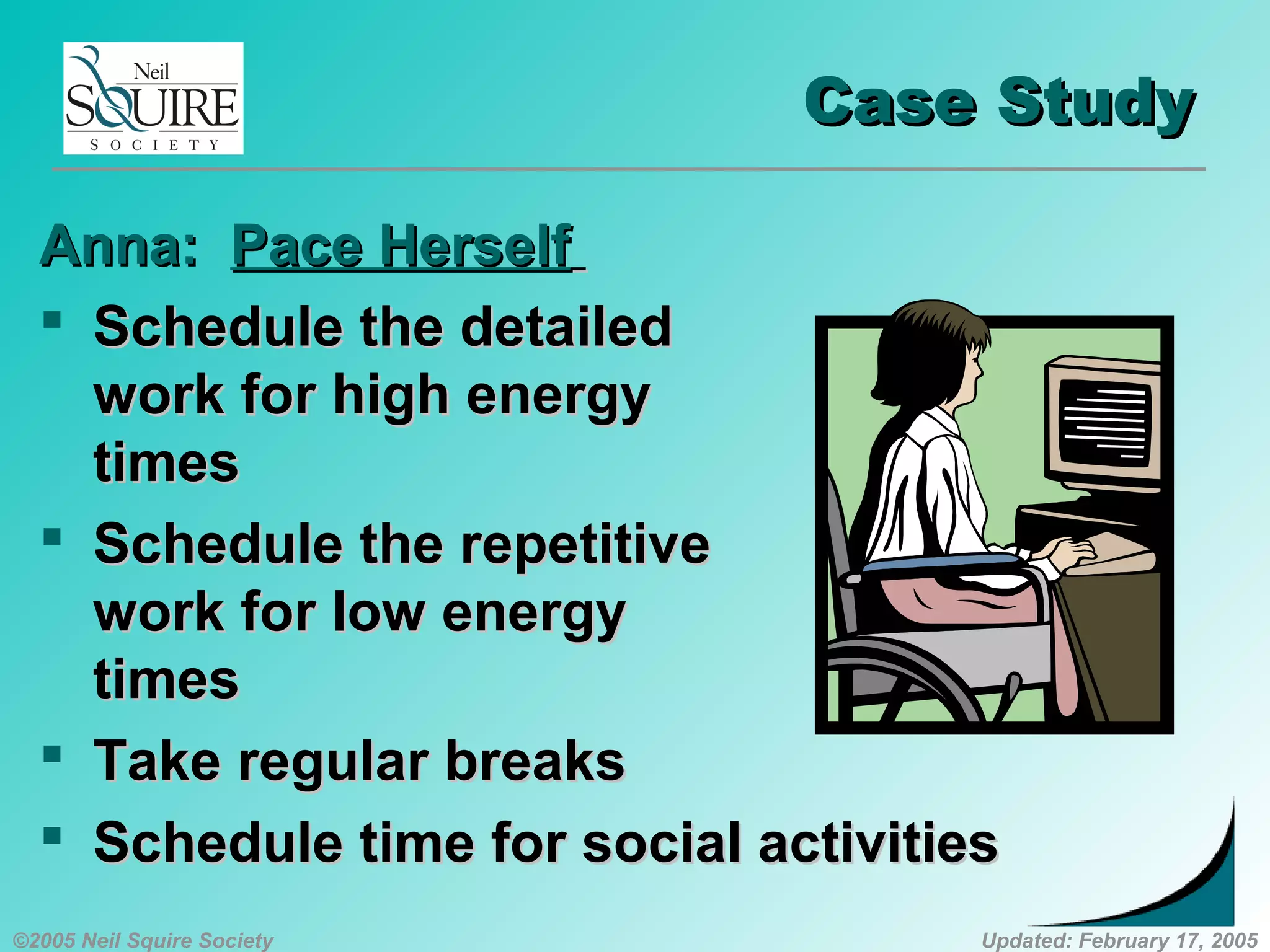
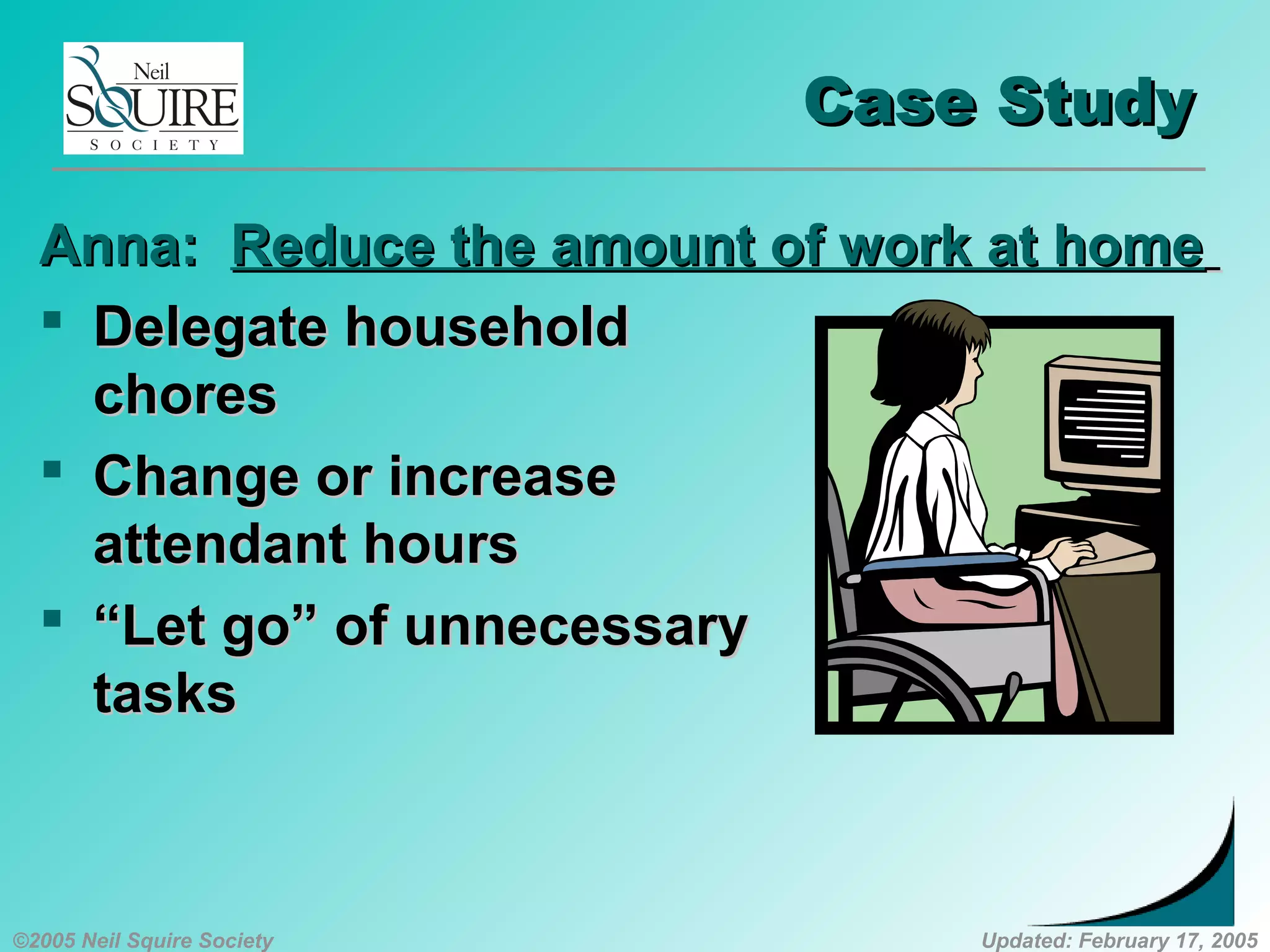
Anna:Anna: Pace HerselfPace Herself
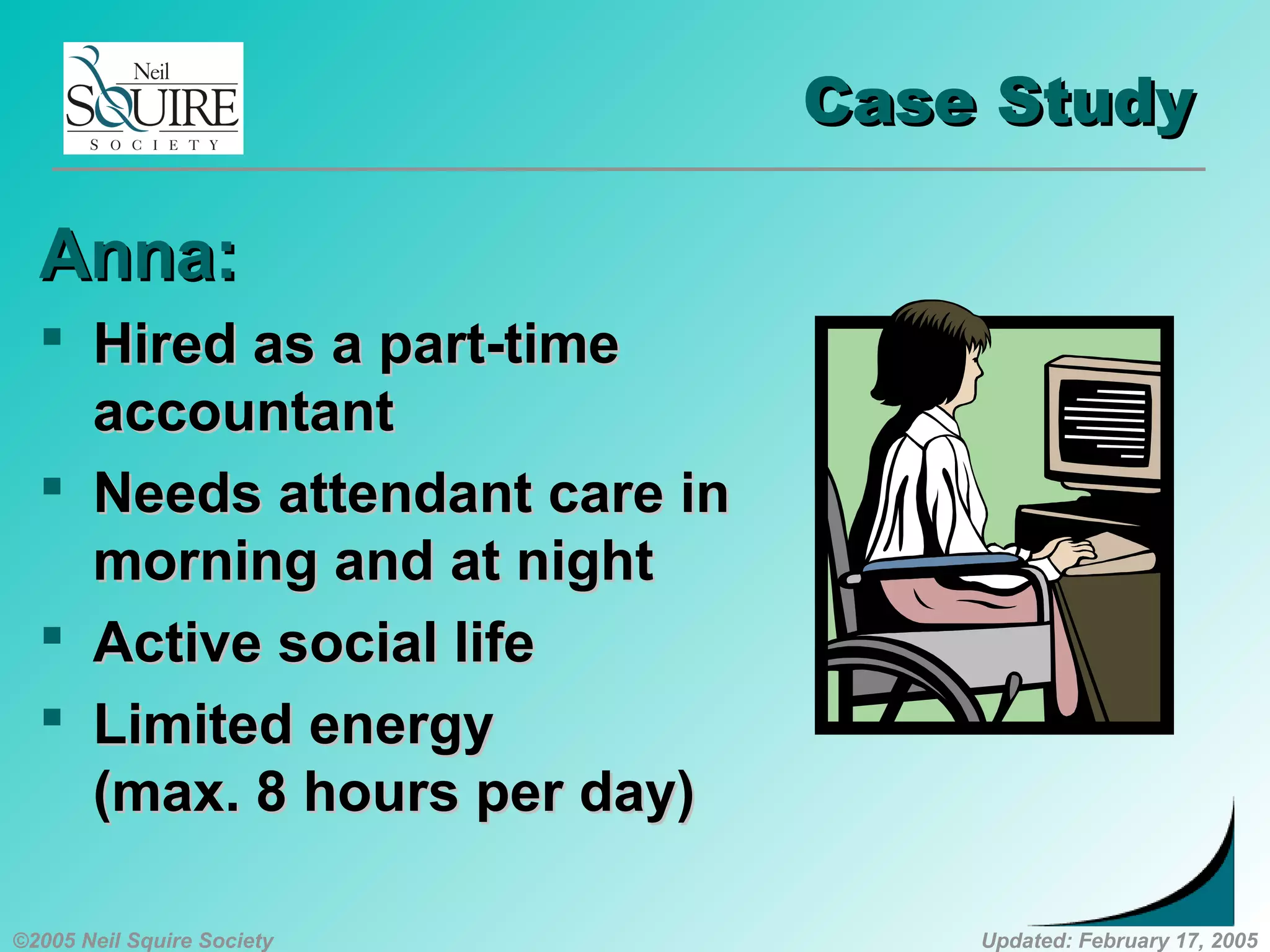
 Schedule the detailedSchedule the detailed
work for high energywork for high energy
timestimes
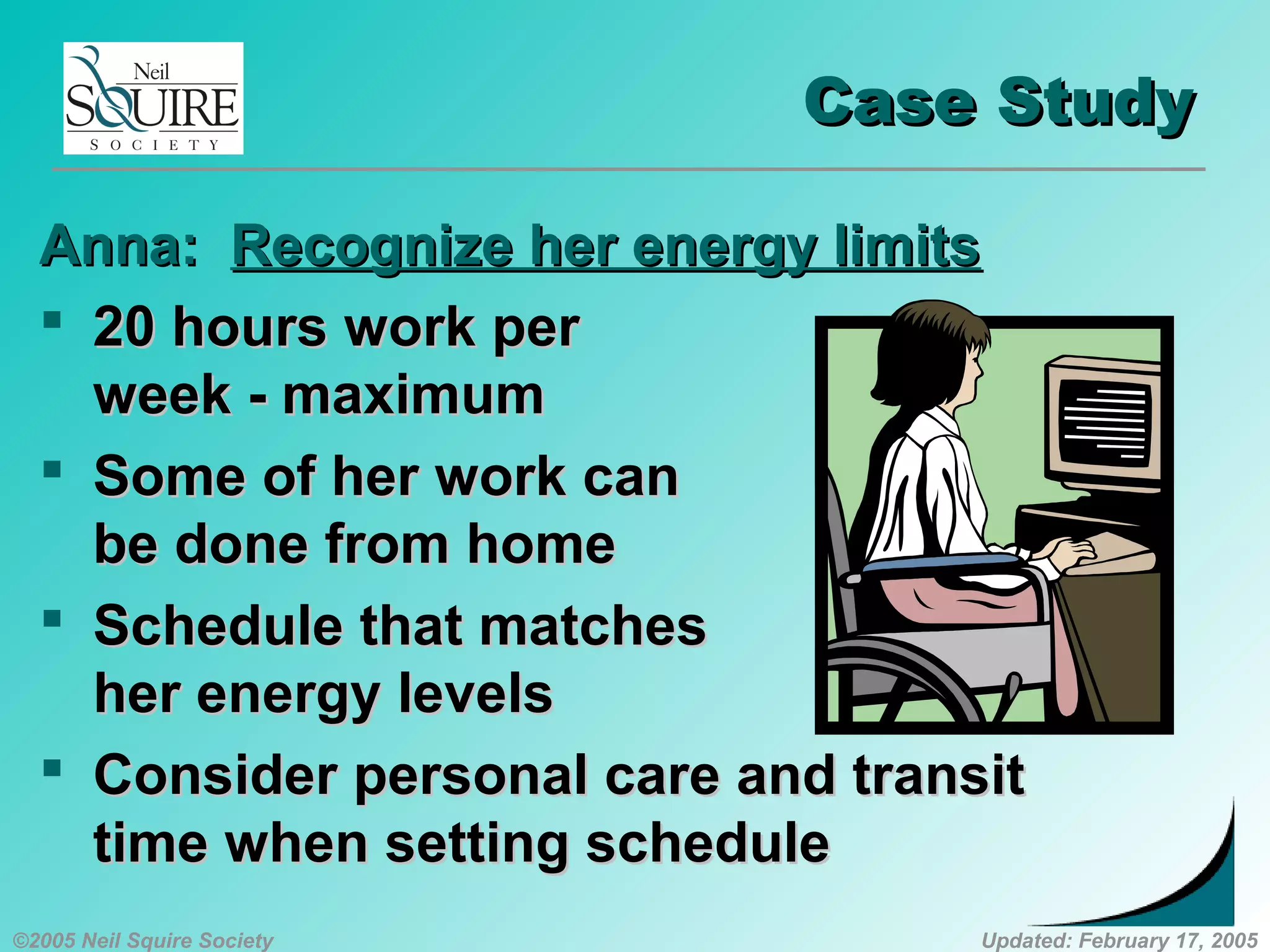
 Schedule the repetitiveSchedule the repetitive
work for low energywork for low energy
timestimes
 Take regular breaksTake regular breaks
 Schedule time for social activitiesSchedule time for social activities
©2005 Neil Squire Society Updated: February 17, 2005
Case StudyCase Study
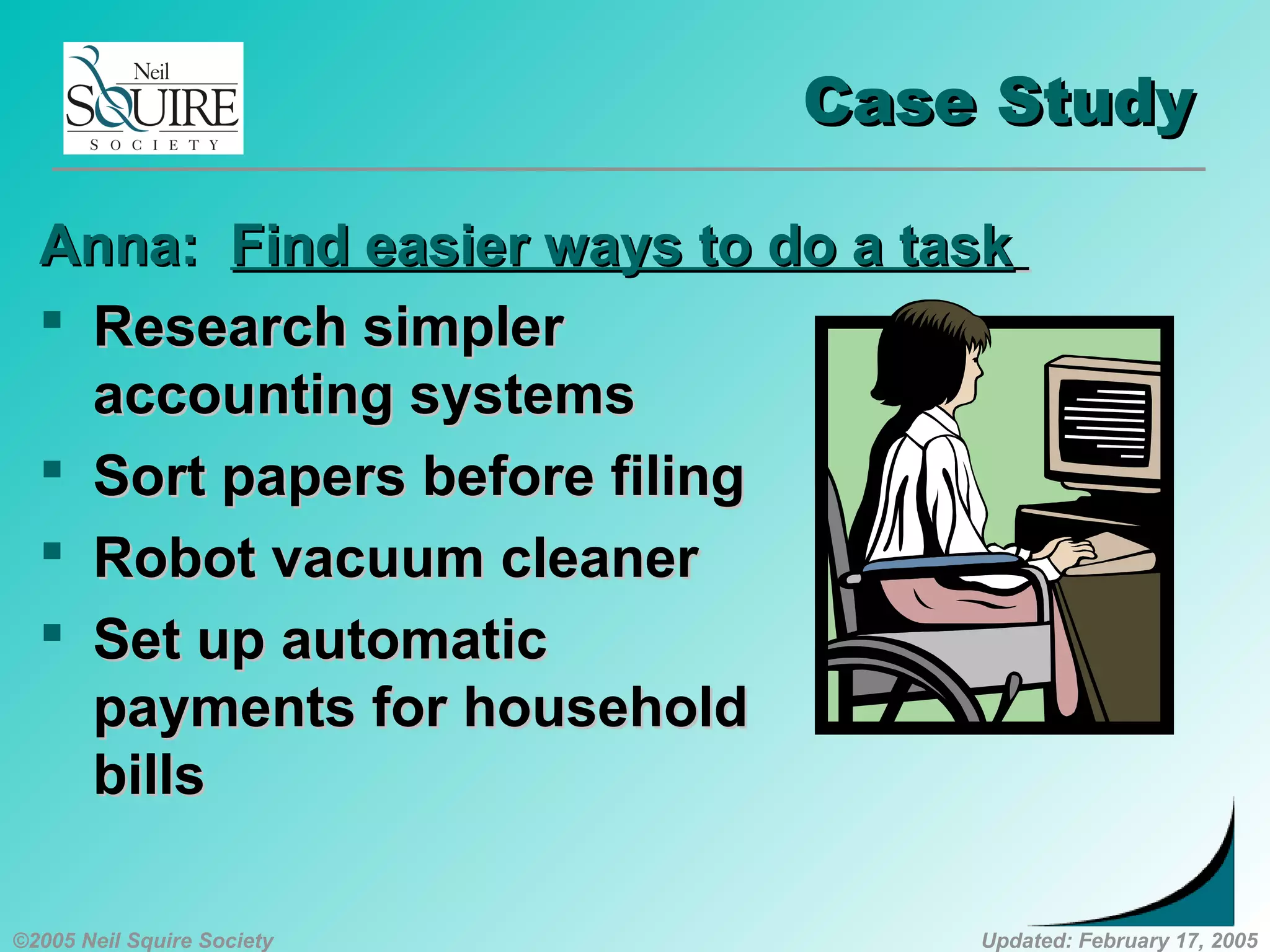
Anna:Anna: Find easier ways to do a taskFind easier ways to do a task
 Research simplerResearch simpler
accounting systemsaccounting systems
 Sort papers before filingSort papers before filing
 Robot vacuum cleanerRobot vacuum cleaner
 Set up automaticSet up automatic
payments for householdpayments for household
billsbills
©2005 Neil Squire Society Updated: February 17, 2005
Case StudyCase Study
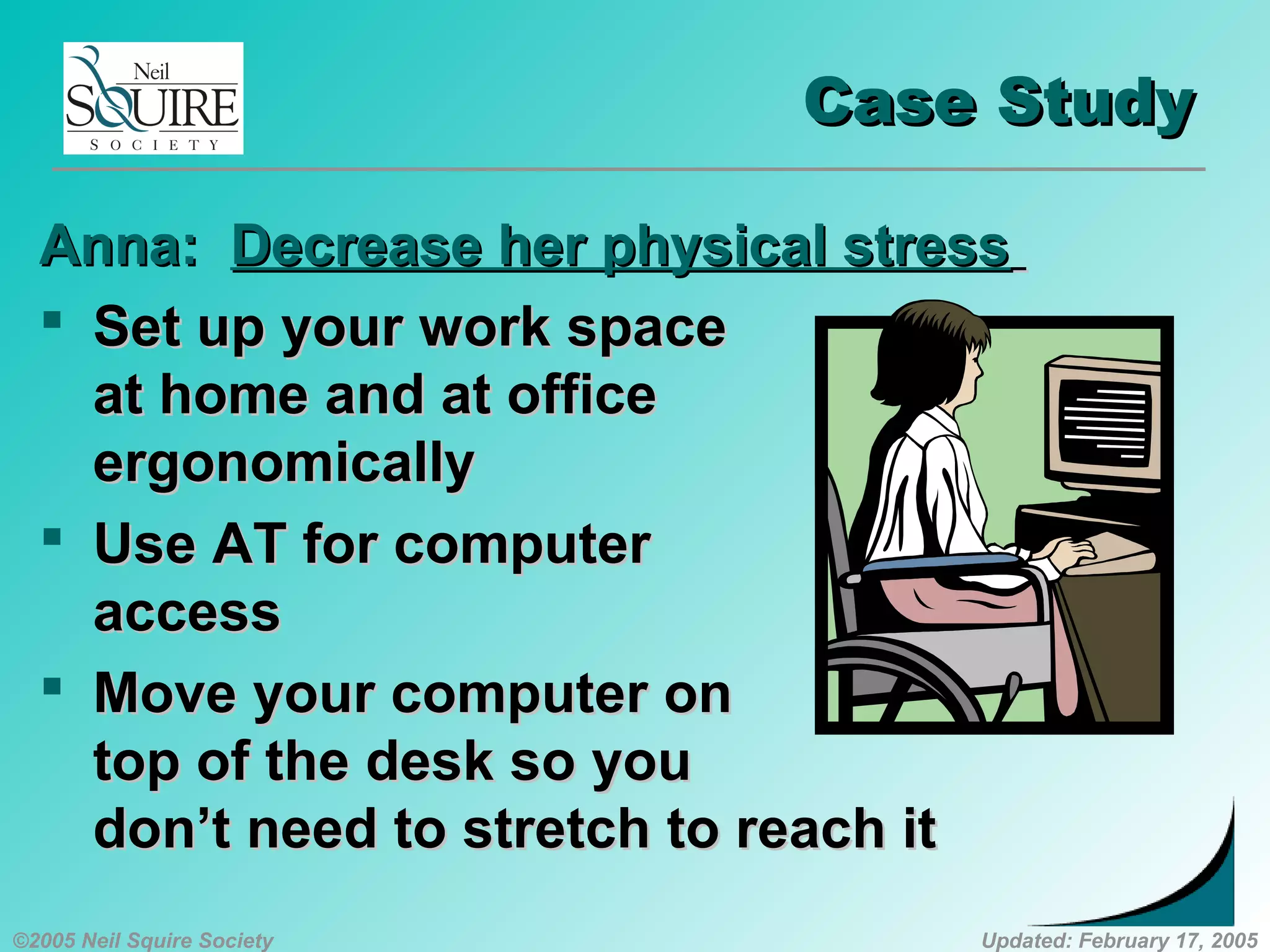
Anna:Anna: Decrease her physical stressDecrease her physical stress
 Set up your work spaceSet up your work space
at home and at officeat home and at office
ergonomicallyergonomically
 Use AT for computerUse AT for computer
accessaccess
 Move your computer onMove your computer on
top of the desk so youtop of the desk so you
don’t need to stretch to reach itdon’t need to stretch to reach it
©2005 Neil Squire Society Updated: February 17, 2005
Case StudyCase Study
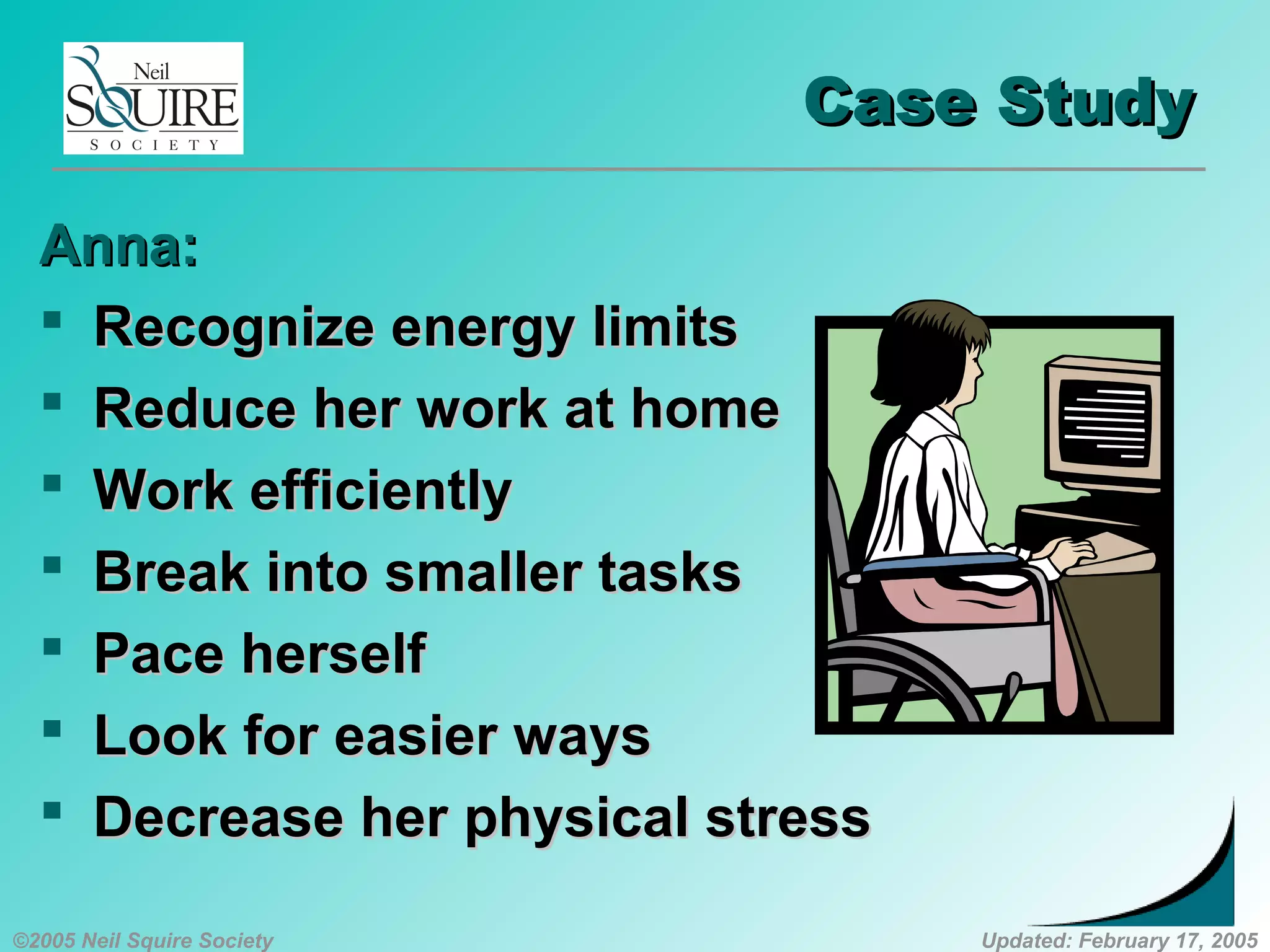
Anna:Anna:
 Recognize energy limitsRecognize energy limits
 Reduce her work at homeReduce her work at home
 Work efficientlyWork efficiently
 Break into smaller tasksBreak into smaller tasks
 Pace herselfPace herself
 Look for easier waysLook for easier ways
 Decrease her physical stressDecrease her physical stress
©2005 Neil Squire Society Updated: February 17, 2005
Ideas forIdeas for
Around the HouseAround the House
Ideas forIdeas for
Around the HouseAround the House
©2005 Neil Squire Society Updated: February 17, 2005
KitchenKitchenKitchenKitchen
©2005 Neil Squire Society Updated: February 17, 2005
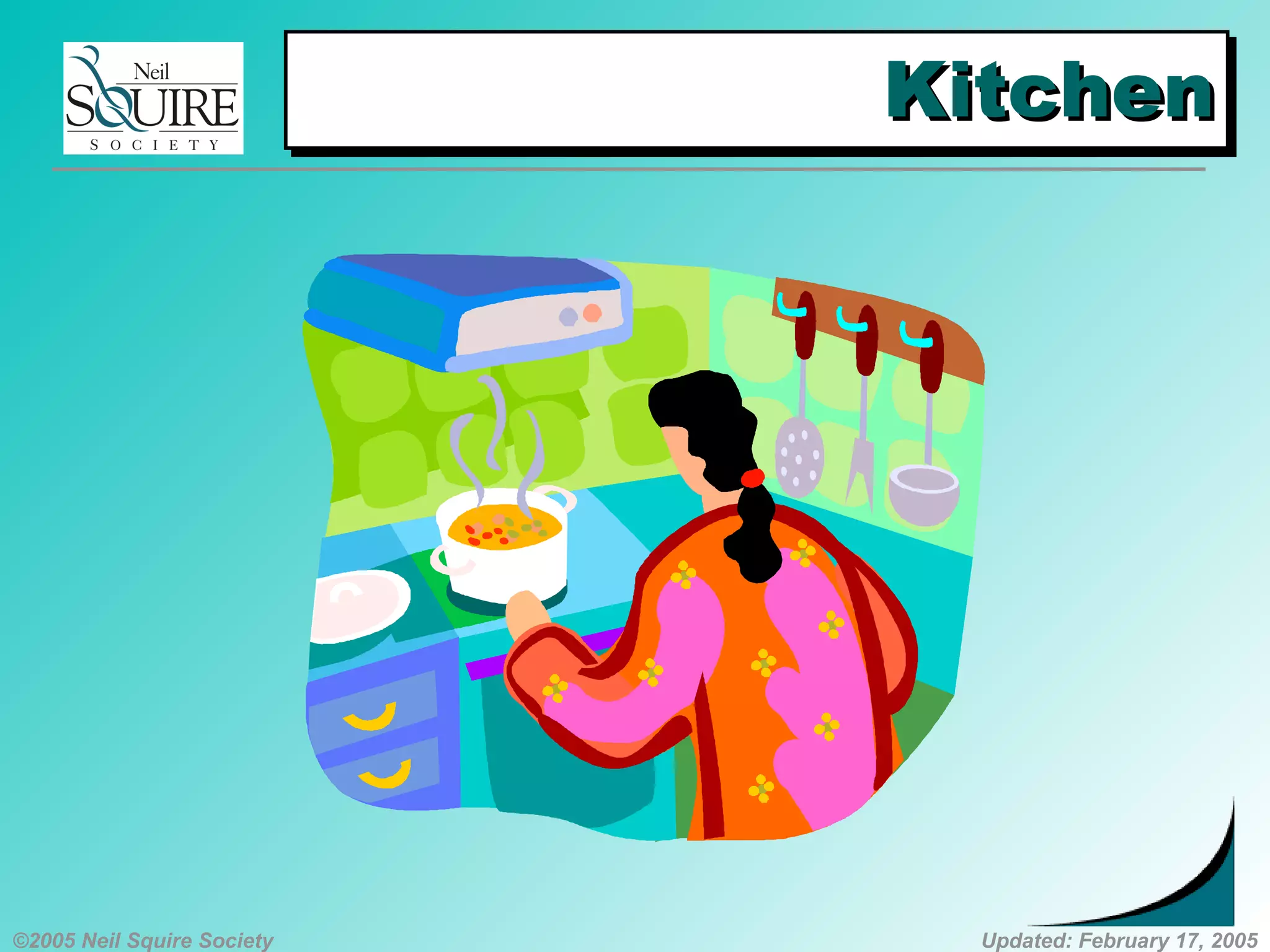
KitchenKitchenKitchenKitchen
 SSit on a stool at a table or pull-out cuttingit on a stool at a table or pull-out cutting
board when preparing foodboard when preparing food
©2005 Neil Squire Society Updated: February 17, 2005
KitchenKitchenKitchenKitchen
 SSit on a stool at a table or pull-out cuttingit on a stool at a table or pull-out cutting
board when preparing foodboard when preparing food
 SSlide, don’t lift, heavy pots across alide, don’t lift, heavy pots across a
countercounter
©2005 Neil Squire Society Updated: February 17, 2005
KitchenKitchenKitchenKitchen
 SSit on a stool at a table or pull-out cuttingit on a stool at a table or pull-out cutting
board when preparing foodboard when preparing food
 SSlide, don’t lift, heavy pots across alide, don’t lift, heavy pots across a
countercounter
 AArrange storage so that frequently usedrrange storage so that frequently used
items are the most accessibleitems are the most accessible
©2005 Neil Squire Society Updated: February 17, 2005
KitchenKitchenKitchenKitchen
 SSit on a stool at a table or pull-out cuttingit on a stool at a table or pull-out cutting
board when preparing foodboard when preparing food
 SSlide, don’t lift, heavy pots across alide, don’t lift, heavy pots across a
countercounter
 AArrange storage so that frequently usedrrange storage so that frequently used
items are the most accessibleitems are the most accessible
 SStack similar items togethertack similar items together
©2005 Neil Squire Society Updated: February 17, 2005
KitchenKitchenKitchenKitchen
 SSit on a stool at a table or pull-out cuttingit on a stool at a table or pull-out cutting
board when preparing foodboard when preparing food
 SSlide, don’t lift, heavy pots across alide, don’t lift, heavy pots across a
countercounter
 AArrange storage so that frequently usedrrange storage so that frequently used
items are the most accessibleitems are the most accessible
 Stack similar items togetherStack similar items together
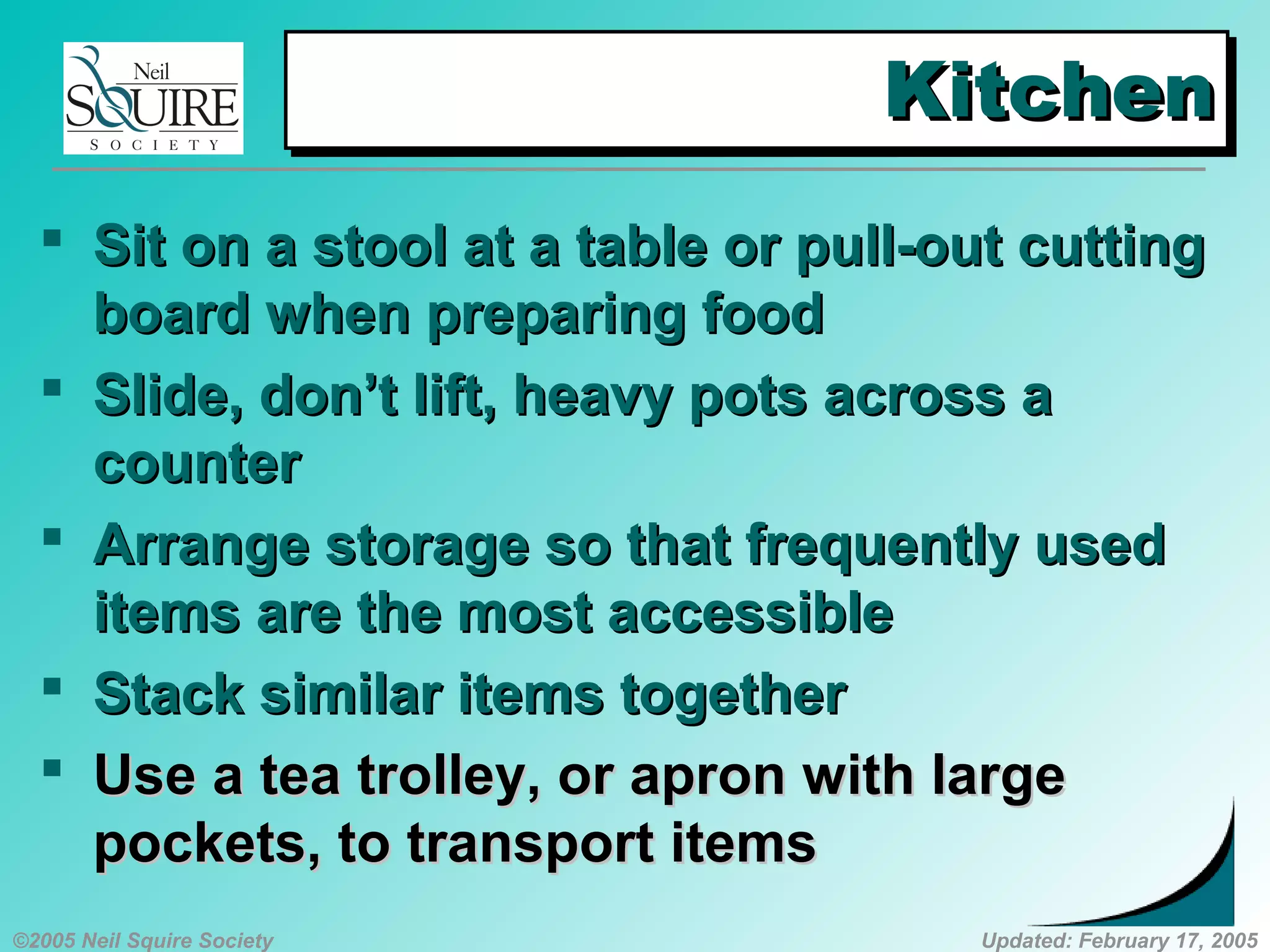
 UUsese aa tea trolley, or apron with largetea trolley, or apron with large
pockets, to transport itemspockets, to transport items
©2005 Neil Squire Society Updated: February 17, 2005
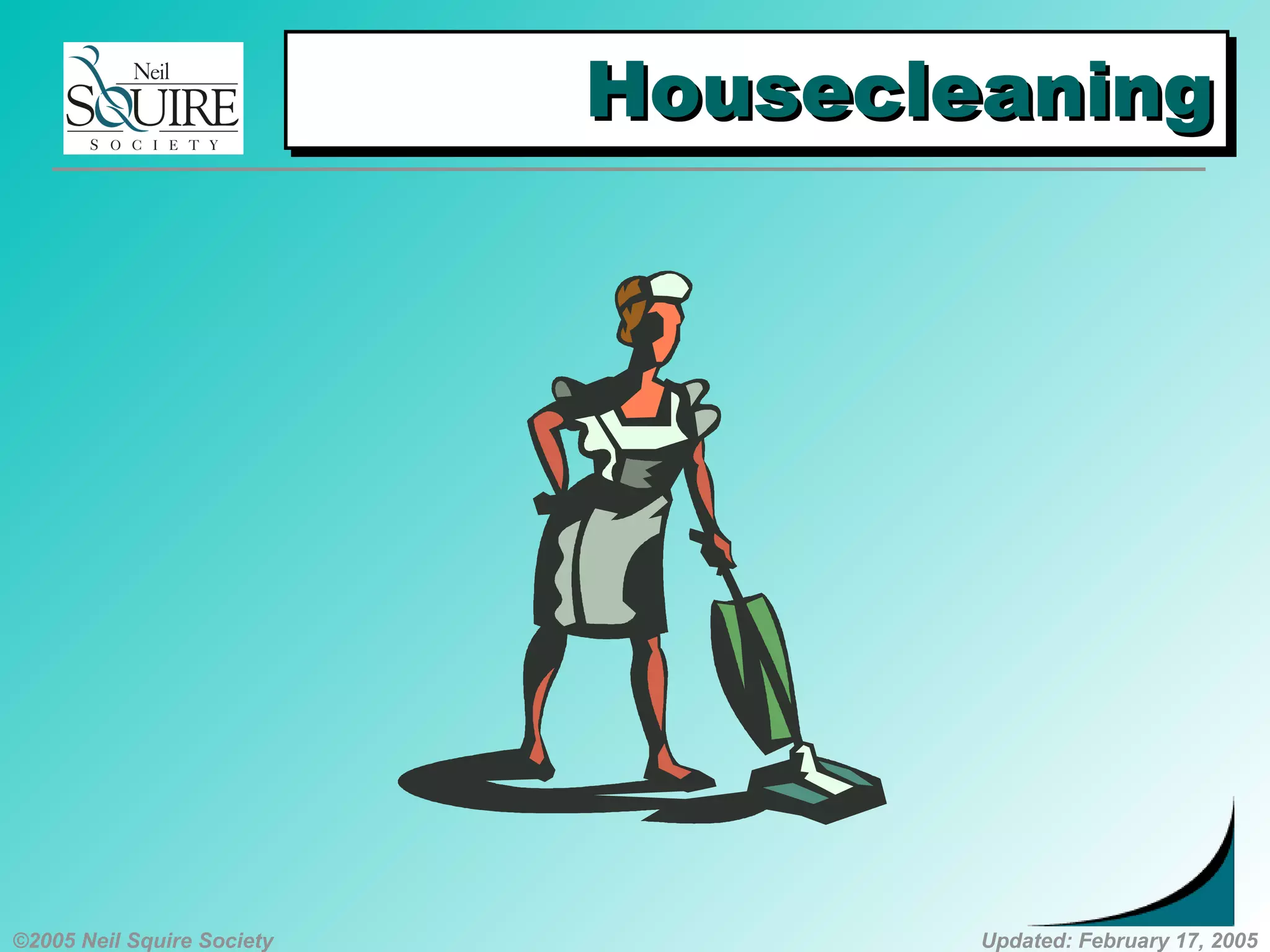
HousecleaningHousecleaningHousecleaningHousecleaning
©2005 Neil Squire Society Updated: February 17, 2005
HousecleaningHousecleaningHousecleaningHousecleaning
 UUse long-handled aids to minimizese long-handled aids to minimize
bendingbending
©2005 Neil Squire Society Updated: February 17, 2005
HousecleaningHousecleaningHousecleaningHousecleaning
 UUse long-handled aids to minimizese long-handled aids to minimize
bendingbending
 PPut furniture on castors so it is easy tout furniture on castors so it is easy to
pushpush
©2005 Neil Squire Society Updated: February 17, 2005
HousecleaningHousecleaningHousecleaningHousecleaning
 UUse long-handled aids to minimizese long-handled aids to minimize
bendingbending
 PPut furniture on castors so it is easy tout furniture on castors so it is easy to
pushpush
 PPut cleaning bucket on wheeledut cleaning bucket on wheeled
platformplatform
©2005 Neil Squire Society Updated: February 17, 2005
HousecleaningHousecleaningHousecleaningHousecleaning
 UUse long-handled aids to minimizese long-handled aids to minimize
bendingbending
 PPut furniture on castors so it is easy tout furniture on castors so it is easy to
pushpush
 PPut cleaning bucket on wheeledut cleaning bucket on wheeled
platformplatform
 FFillill bucketsbuckets with a pitcherwith a pitcher
©2005 Neil Squire Society Updated: February 17, 2005
HousecleaningHousecleaningHousecleaningHousecleaning
 UUse long-handled aids to minimizese long-handled aids to minimize
bendingbending
 PPut furniture on castors so it is easy tout furniture on castors so it is easy to
pushpush
 PPut cleaning bucket on wheeledut cleaning bucket on wheeled
platformplatform
 FFillill bucketsbuckets with a pitcherwith a pitcher
 TTipip bucketsbuckets to emptyto empty
©2005 Neil Squire Society Updated: February 17, 2005
WorkspaceWorkspace
ConsiderationsConsiderations
WorkspaceWorkspace
ConsiderationsConsiderations
©2005 Neil Squire Society Updated: February 17, 2005
Reach EnvelopeReach EnvelopeReach EnvelopeReach Envelope
©2005 Neil Squire Society Updated: February 17, 2005
Reach EnvelopeReach EnvelopeReach EnvelopeReach Envelope
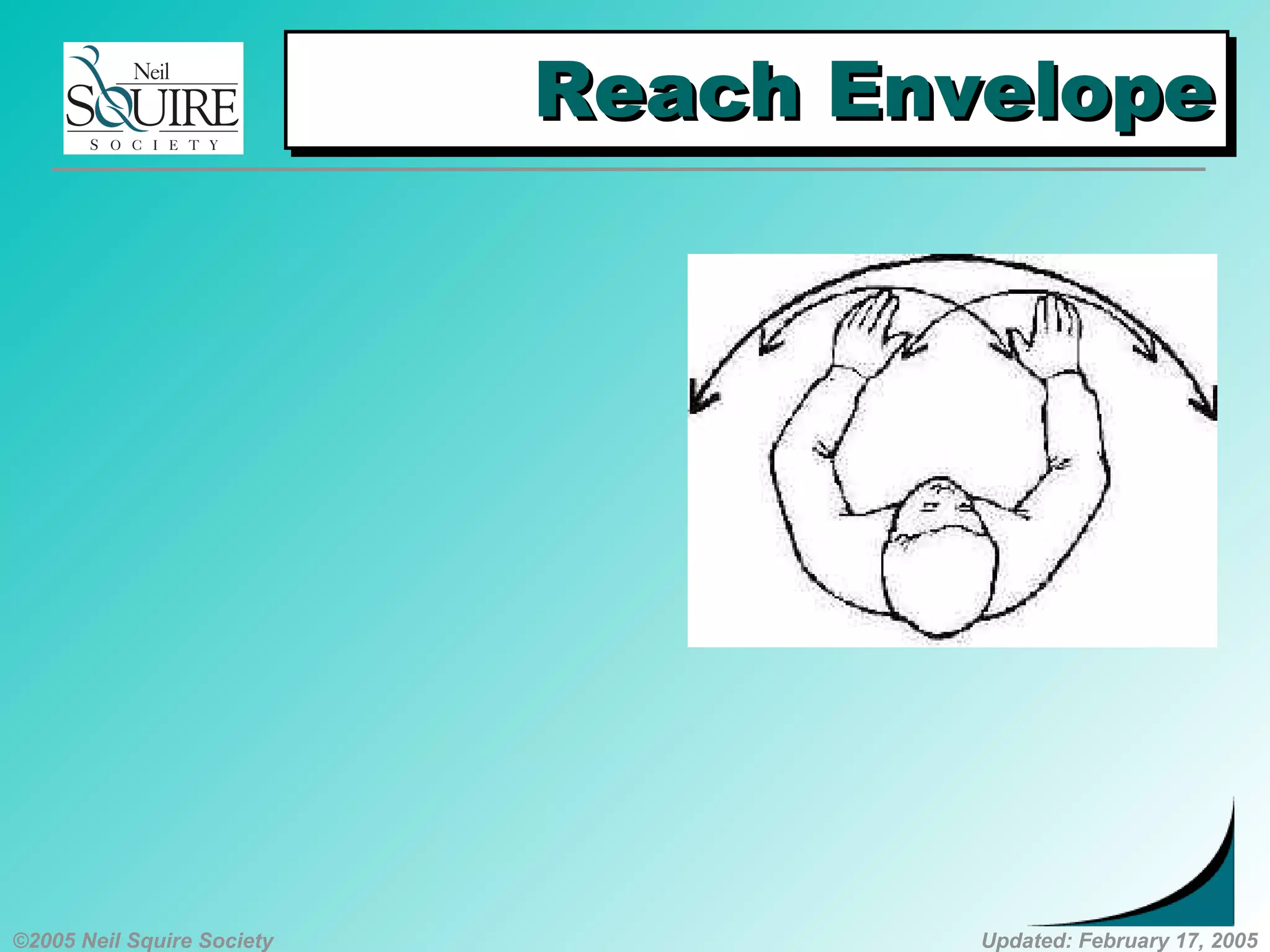
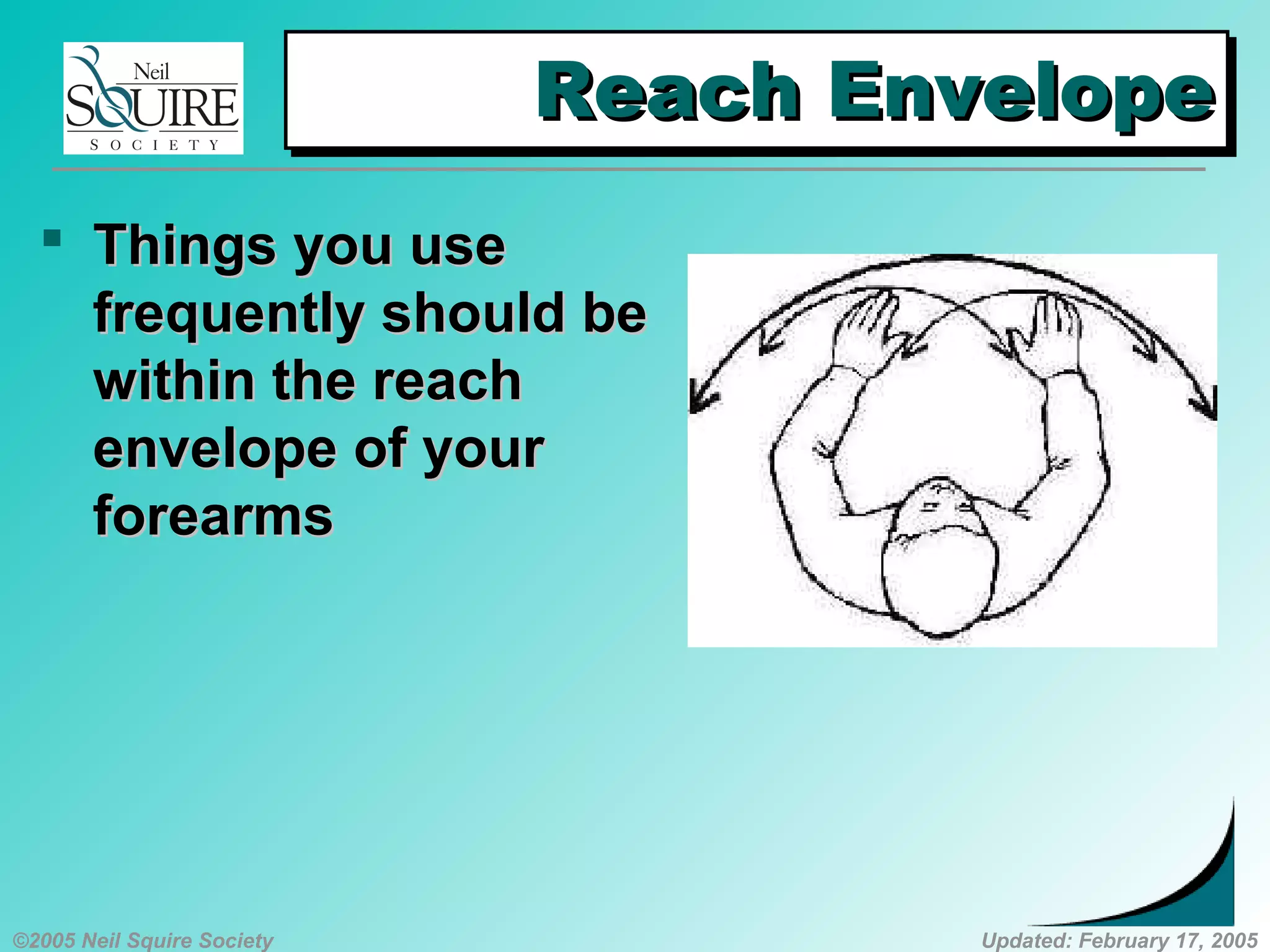
 TThings you usehings you use
frequently should befrequently should be
within the reachwithin the reach
envelope of yourenvelope of your
forearmsforearms
©2005 Neil Squire Society Updated: February 17, 2005
Reach EnvelopeReach EnvelopeReach EnvelopeReach Envelope
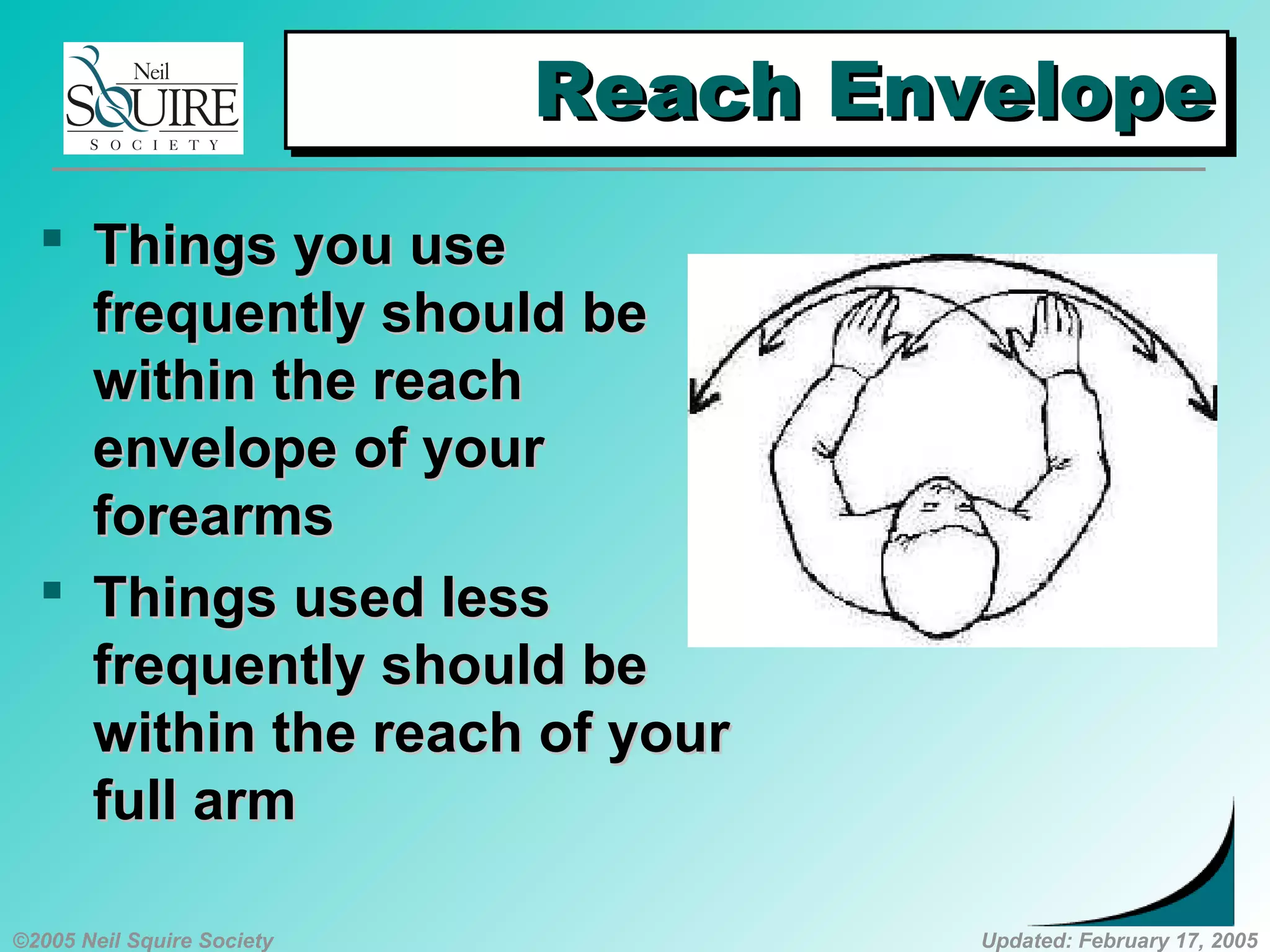
 TThings you usehings you use
frequently should befrequently should be
within the reachwithin the reach
envelope of yourenvelope of your
forearmsforearms
 TThings used lesshings used less
frequently should befrequently should be
within the reach of yourwithin the reach of your
full armfull arm
©2005 Neil Squire Society Updated: February 17, 2005
Reach EnvelopeReach EnvelopeReach EnvelopeReach Envelope
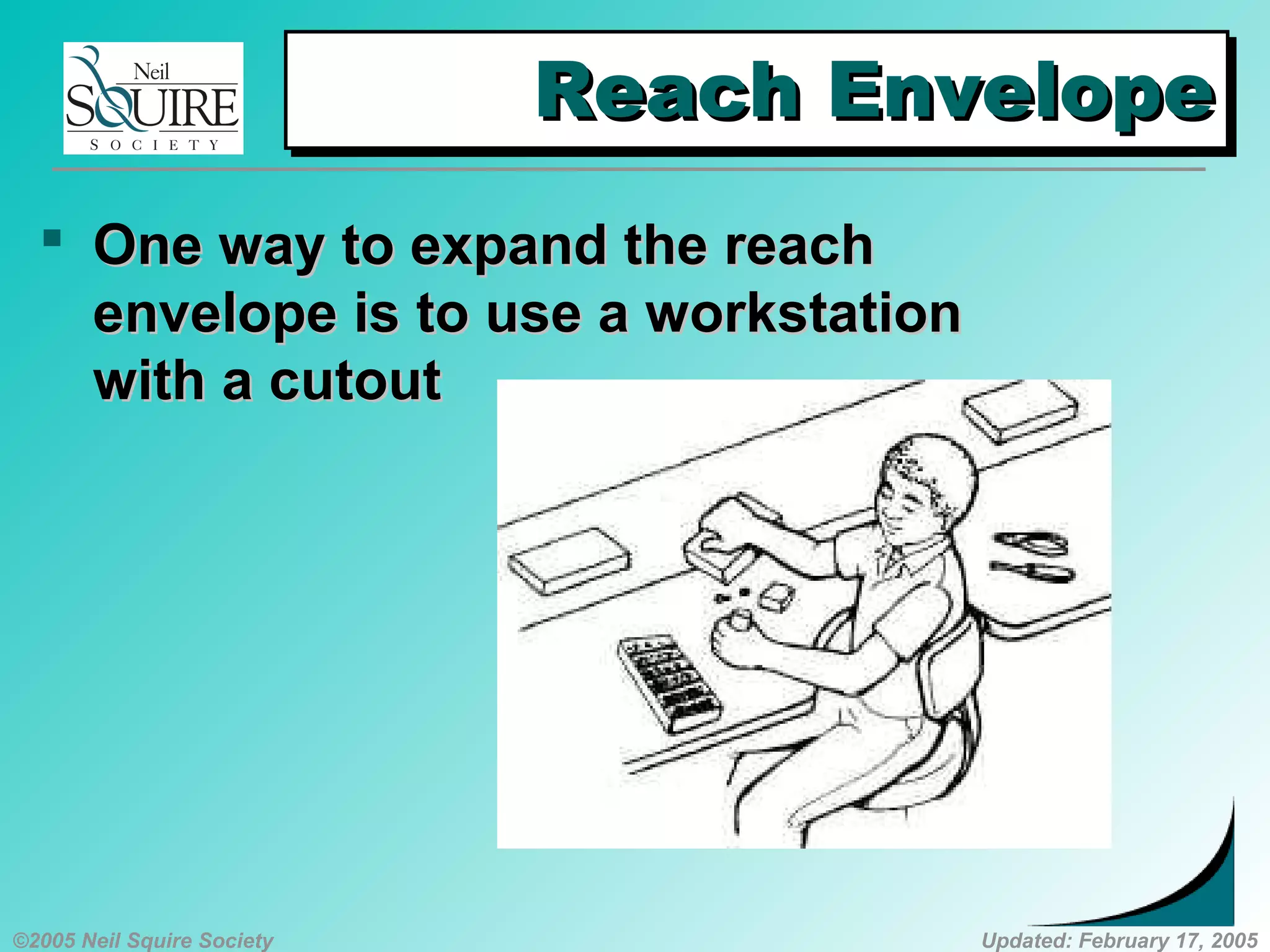
 OneOne way to expand the reachway to expand the reach
envelope is to use a workstationenvelope is to use a workstation
with a cutoutwith a cutout
©2005 Neil Squire Society Updated: February 17, 2005
StandingStandingStandingStanding
©2005 Neil Squire Society Updated: February 17, 2005
StandingStandingStandingStanding
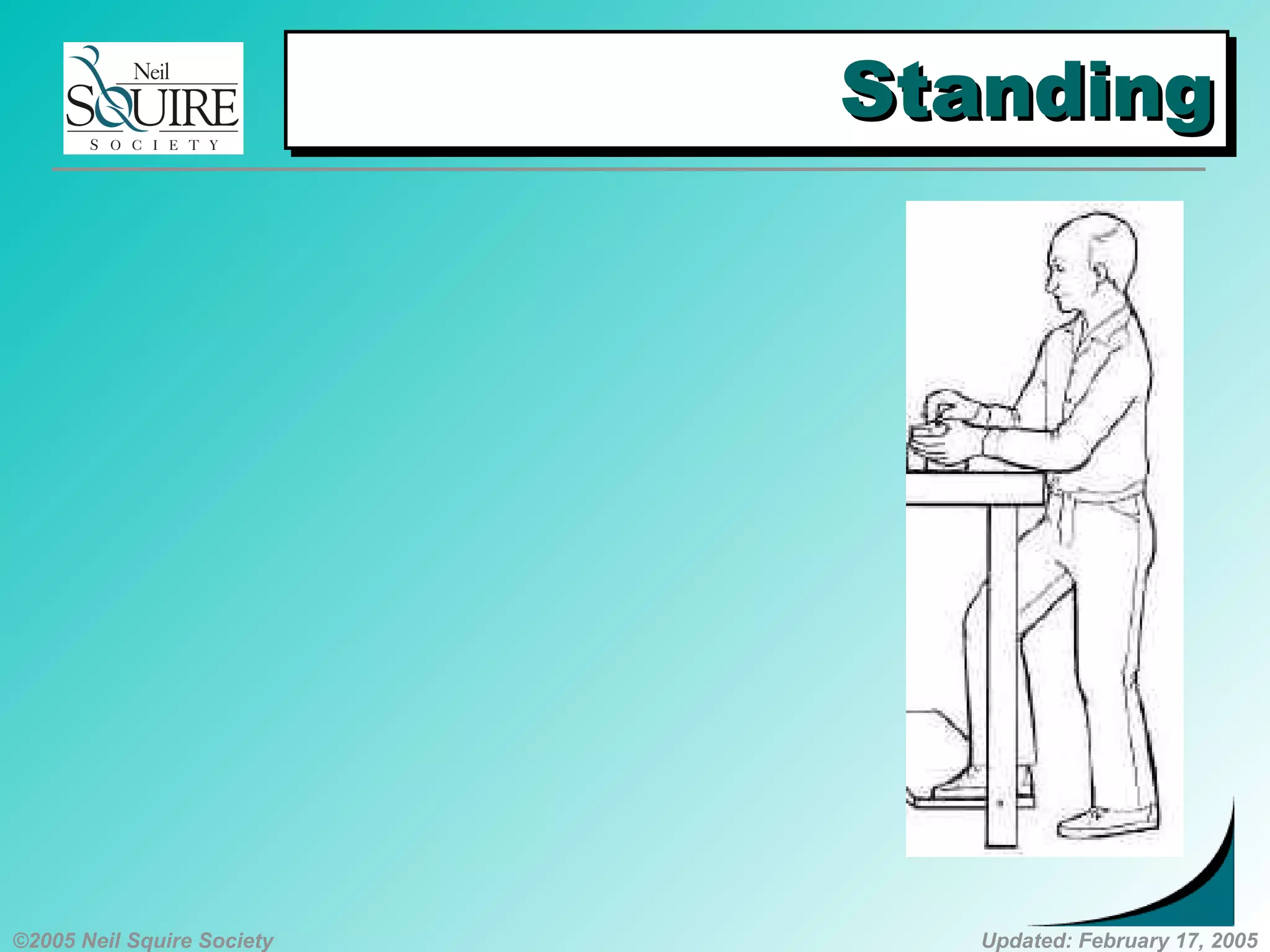
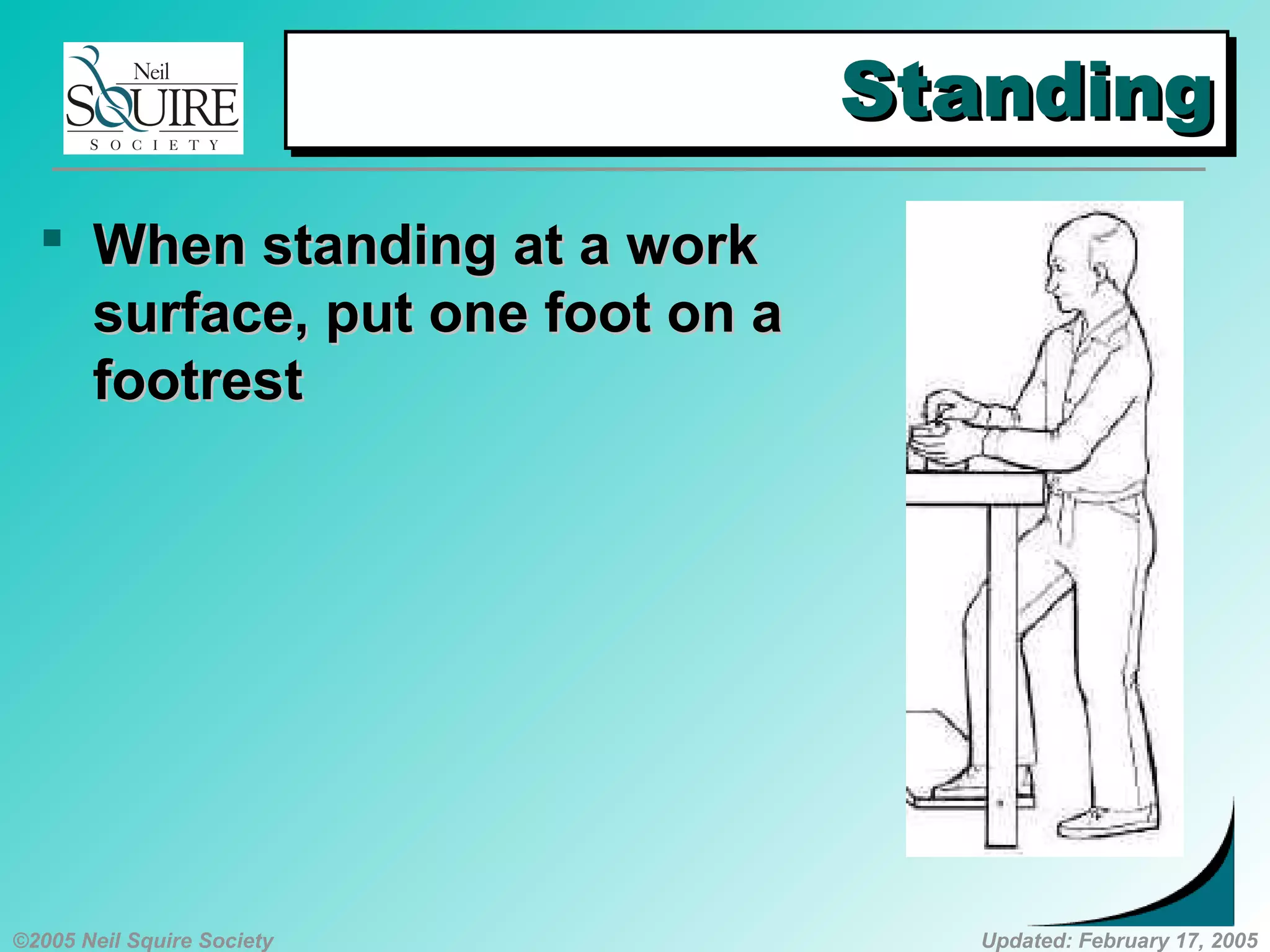
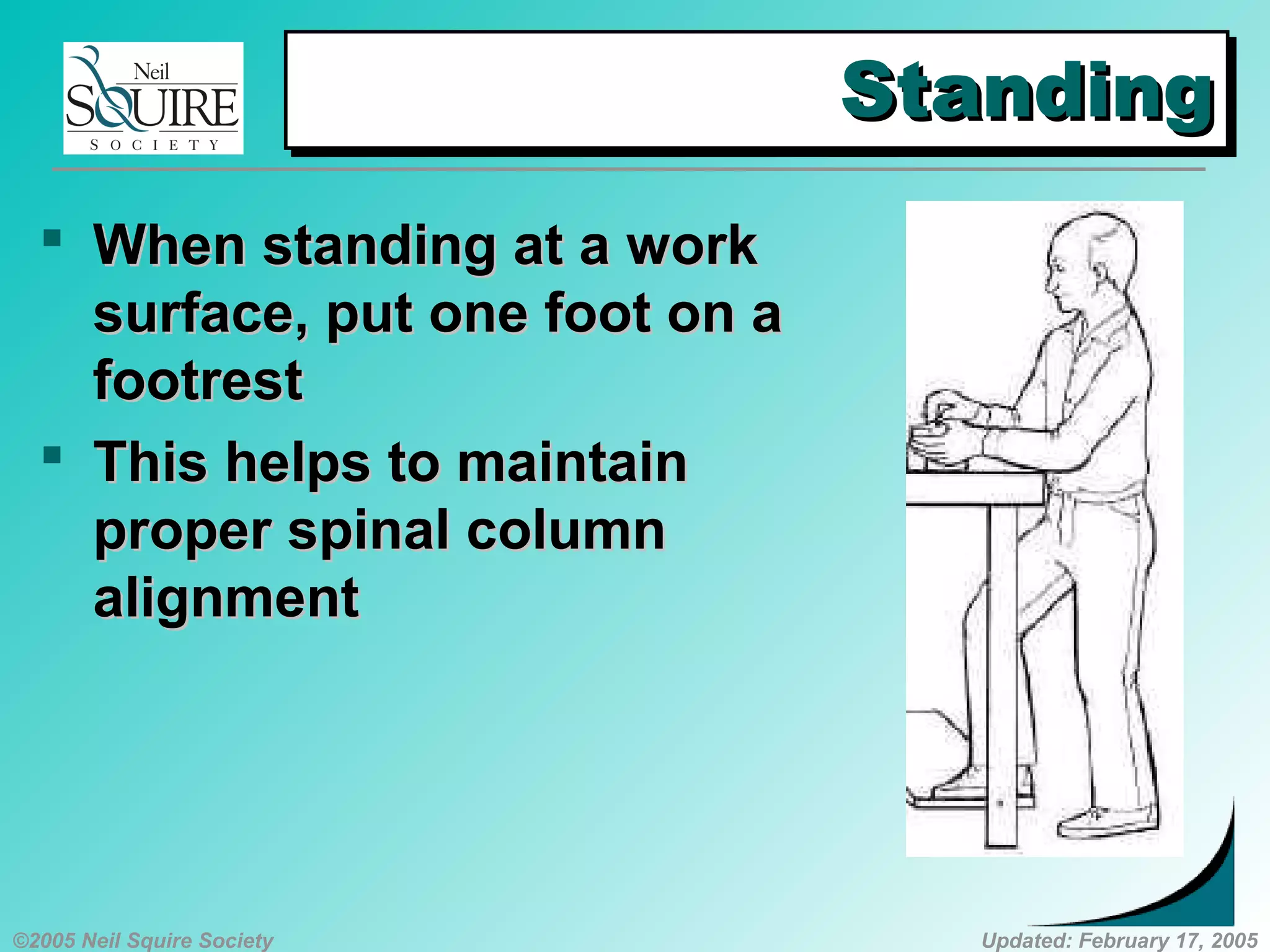
 WhenWhen standing at a workstanding at a work
surface, put one foot on asurface, put one foot on a
footrestfootrest
©2005 Neil Squire Society Updated: February 17, 2005
StandingStandingStandingStanding
 WhenWhen standing at a workstanding at a work
surface, put one foot on asurface, put one foot on a
footrestfootrest
 ThisThis helps to maintainhelps to maintain
proper spinal columnproper spinal column
alignmentalignment
©2005 Neil Squire Society Updated: February 17, 2005
Reaching into ContainersReaching into ContainersReaching into ContainersReaching into Containers
©2005 Neil Squire Society Updated: February 17, 2005
Reaching into ContainersReaching into ContainersReaching into ContainersReaching into Containers
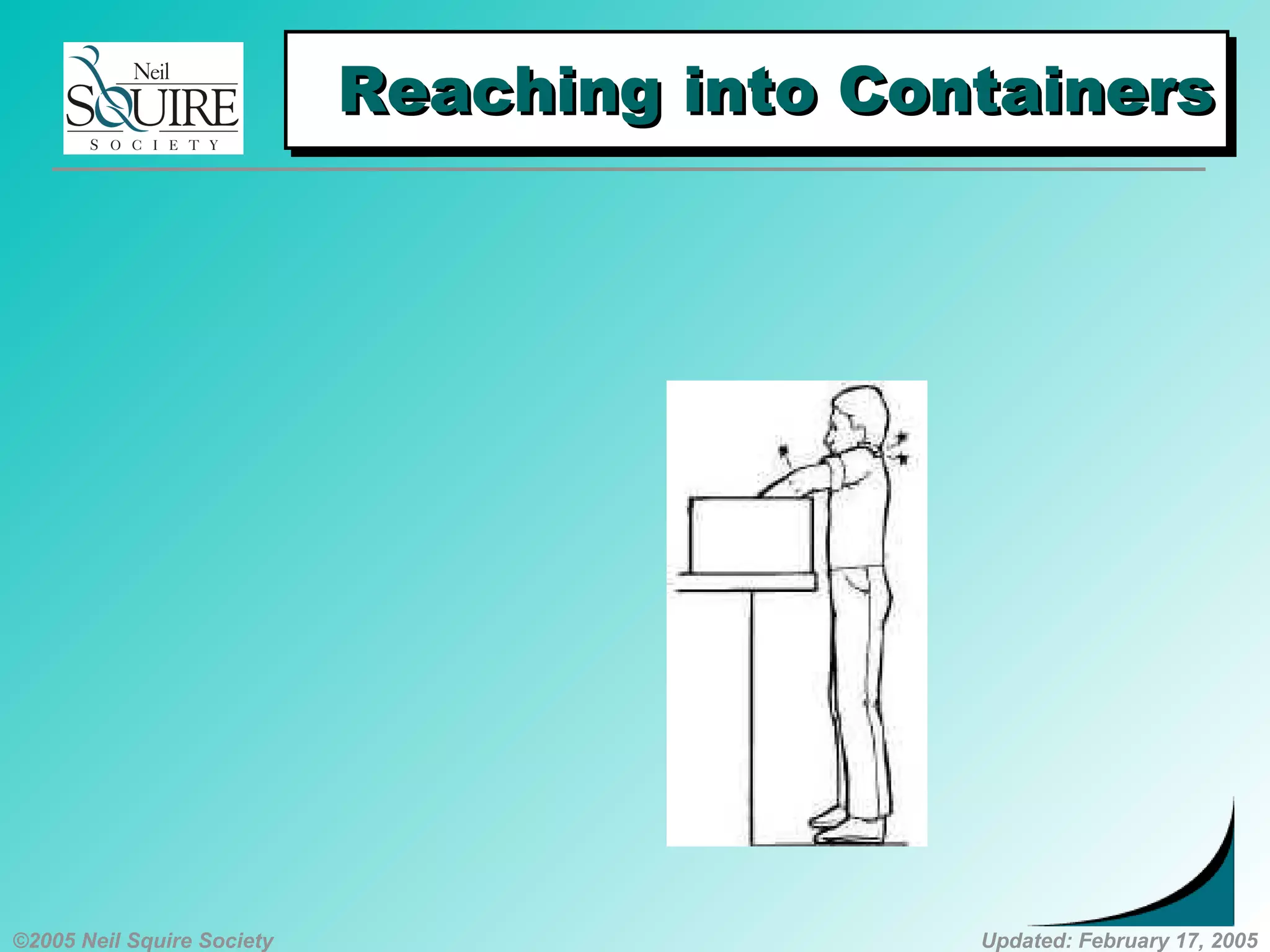
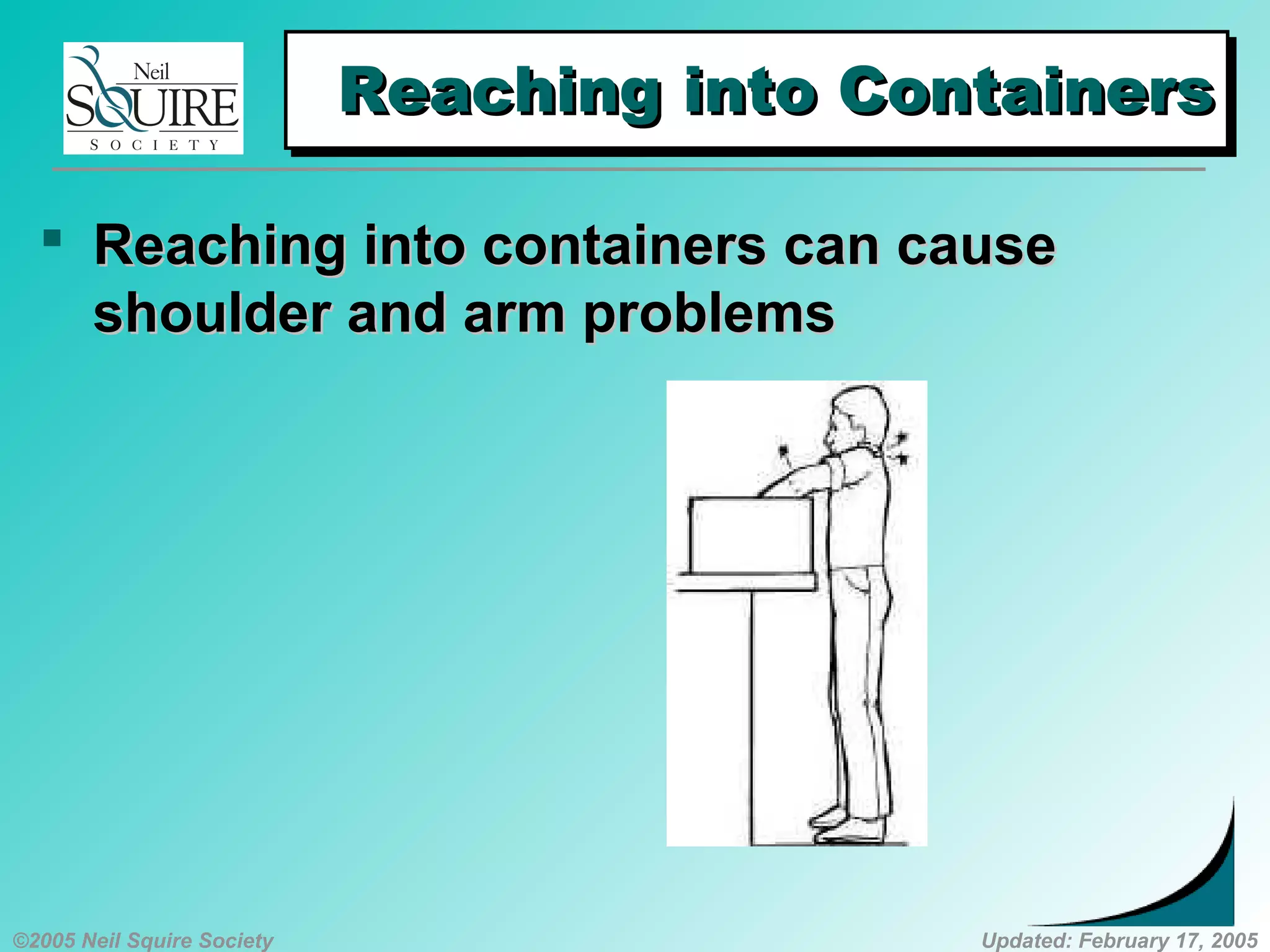
 ReachingReaching into containers can causeinto containers can cause
shoulder and arm problemsshoulder and arm problems
©2005 Neil Squire Society Updated: February 17, 2005
Reaching into ContainersReaching into ContainersReaching into ContainersReaching into Containers
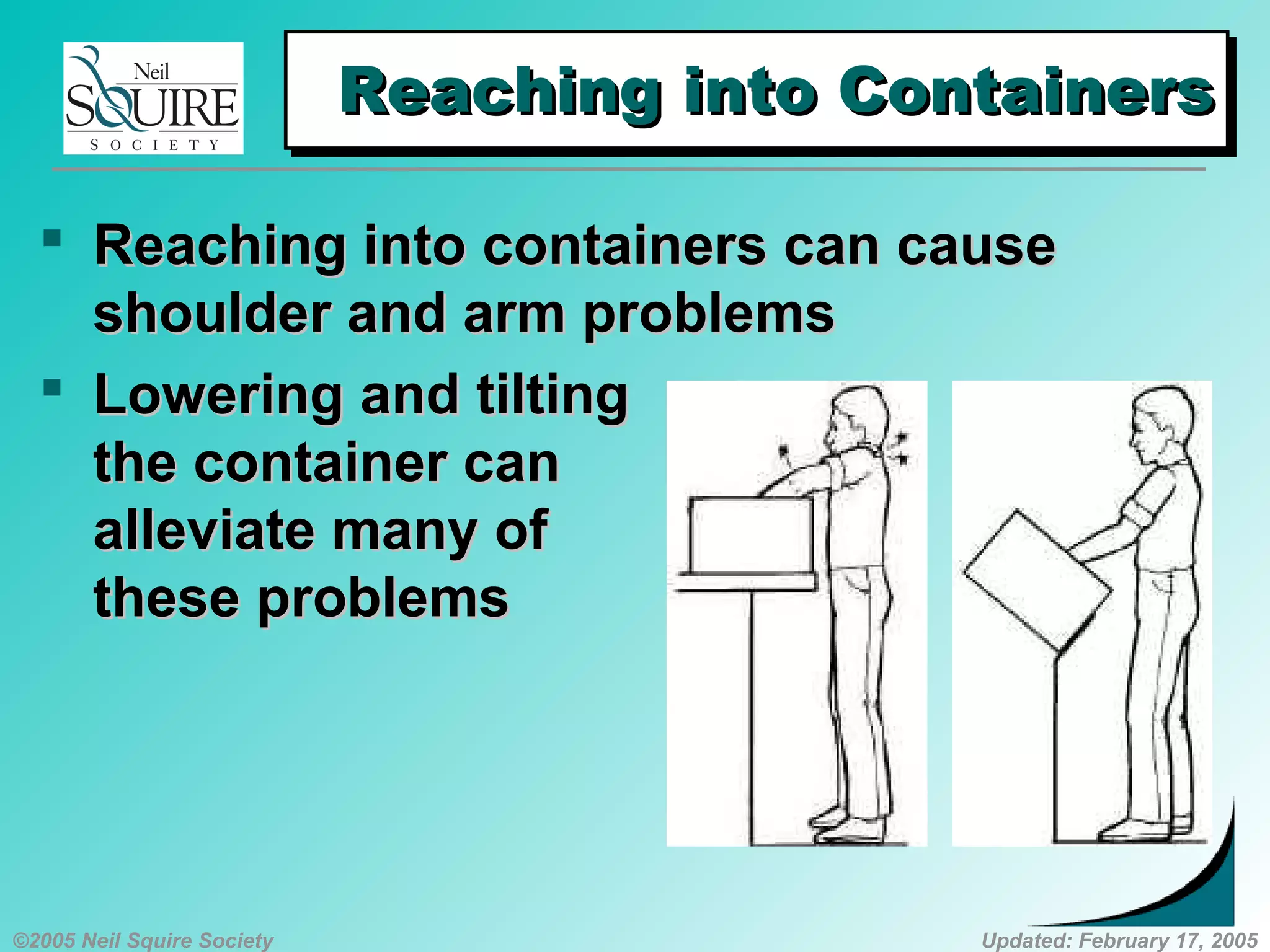
 ReachingReaching into containers can causeinto containers can cause
shoulder and arm problemsshoulder and arm problems
 LoweringLowering and tiltingand tilting
the container canthe container can
alleviate many ofalleviate many of
these problemsthese problems
©2005 Neil Squire Society Updated: February 17, 2005
CarryingCarryingCarryingCarrying
©2005 Neil Squire Society Updated: February 17, 2005
CarryingCarryingCarryingCarrying
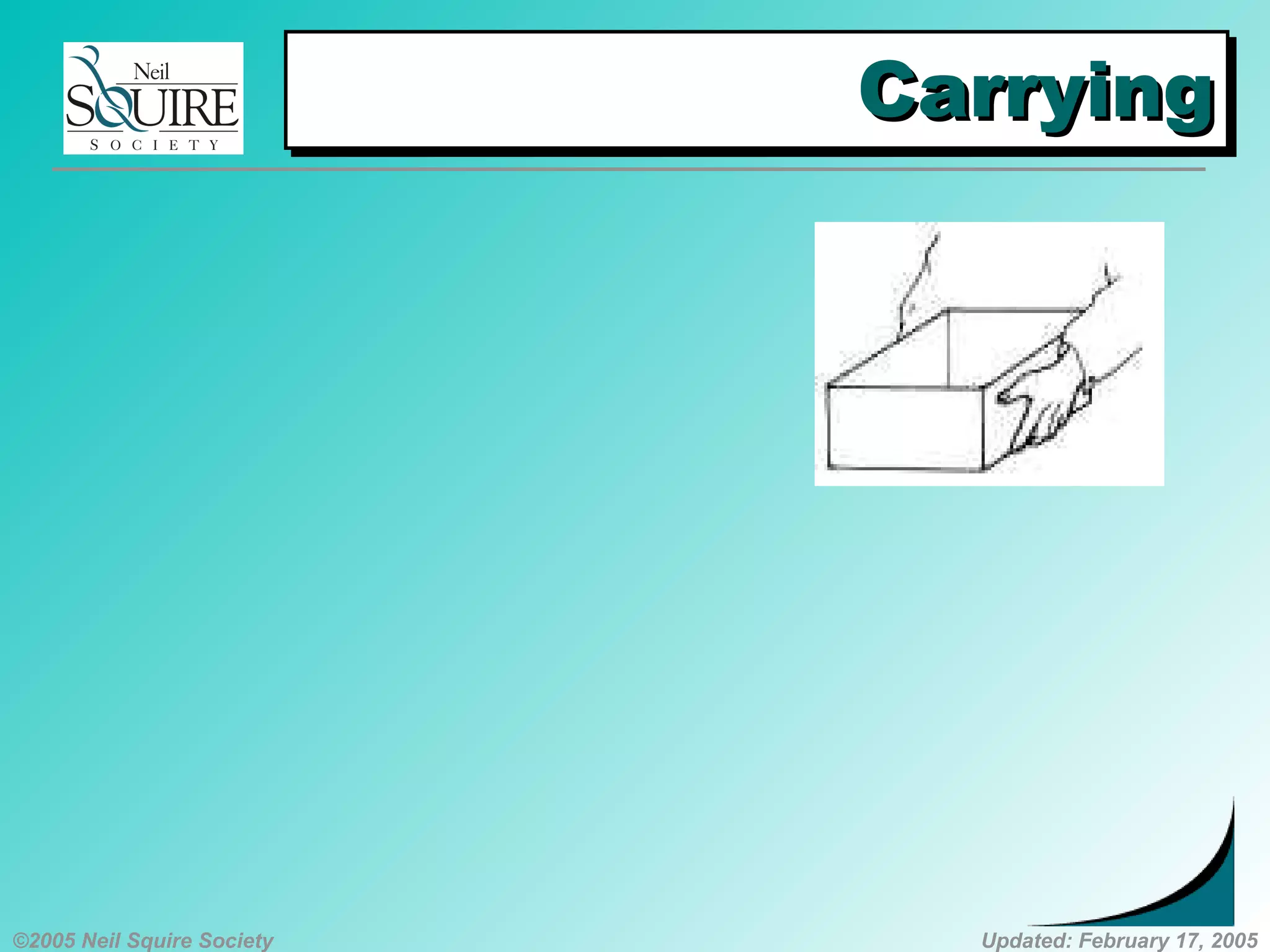
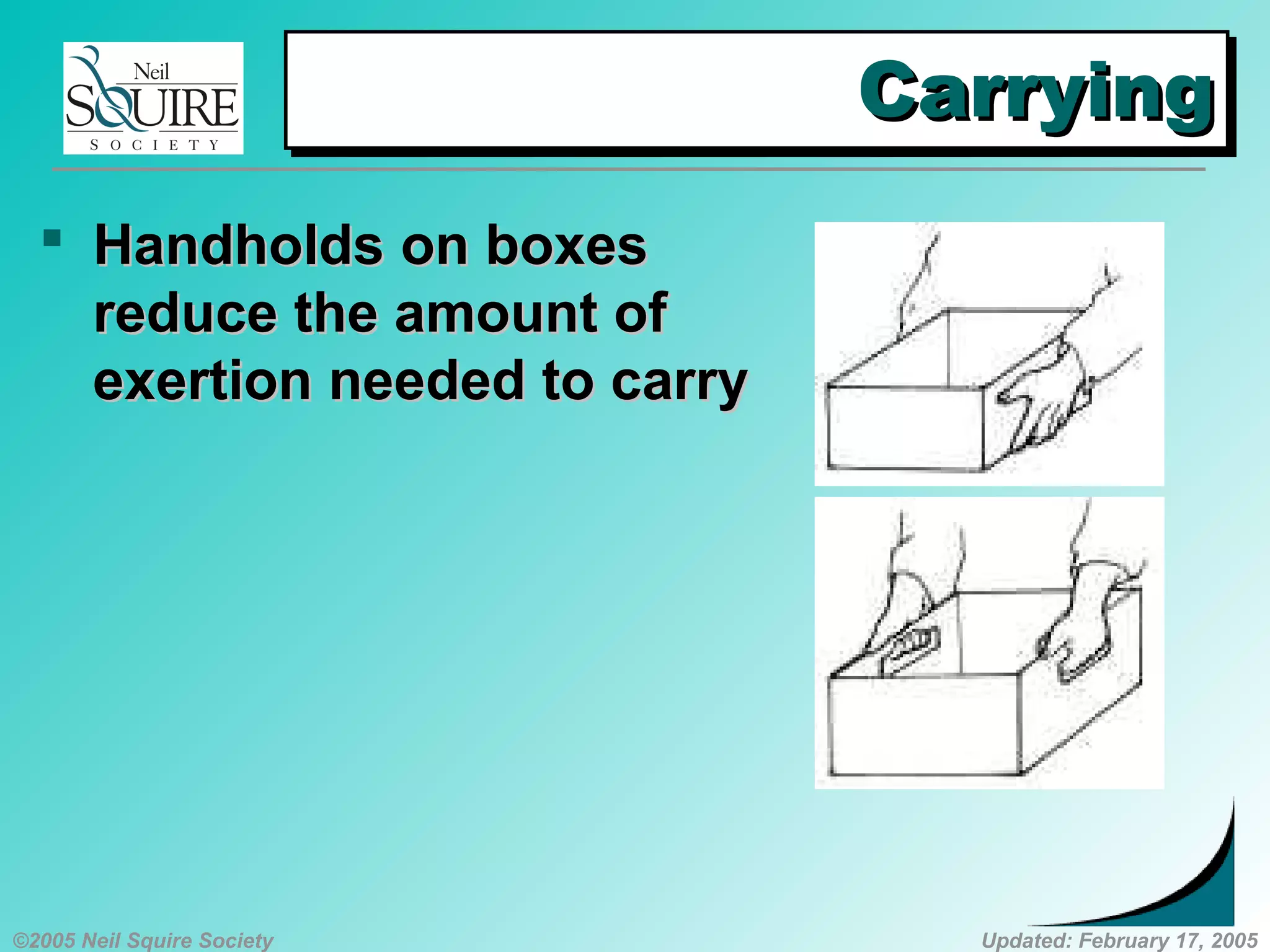
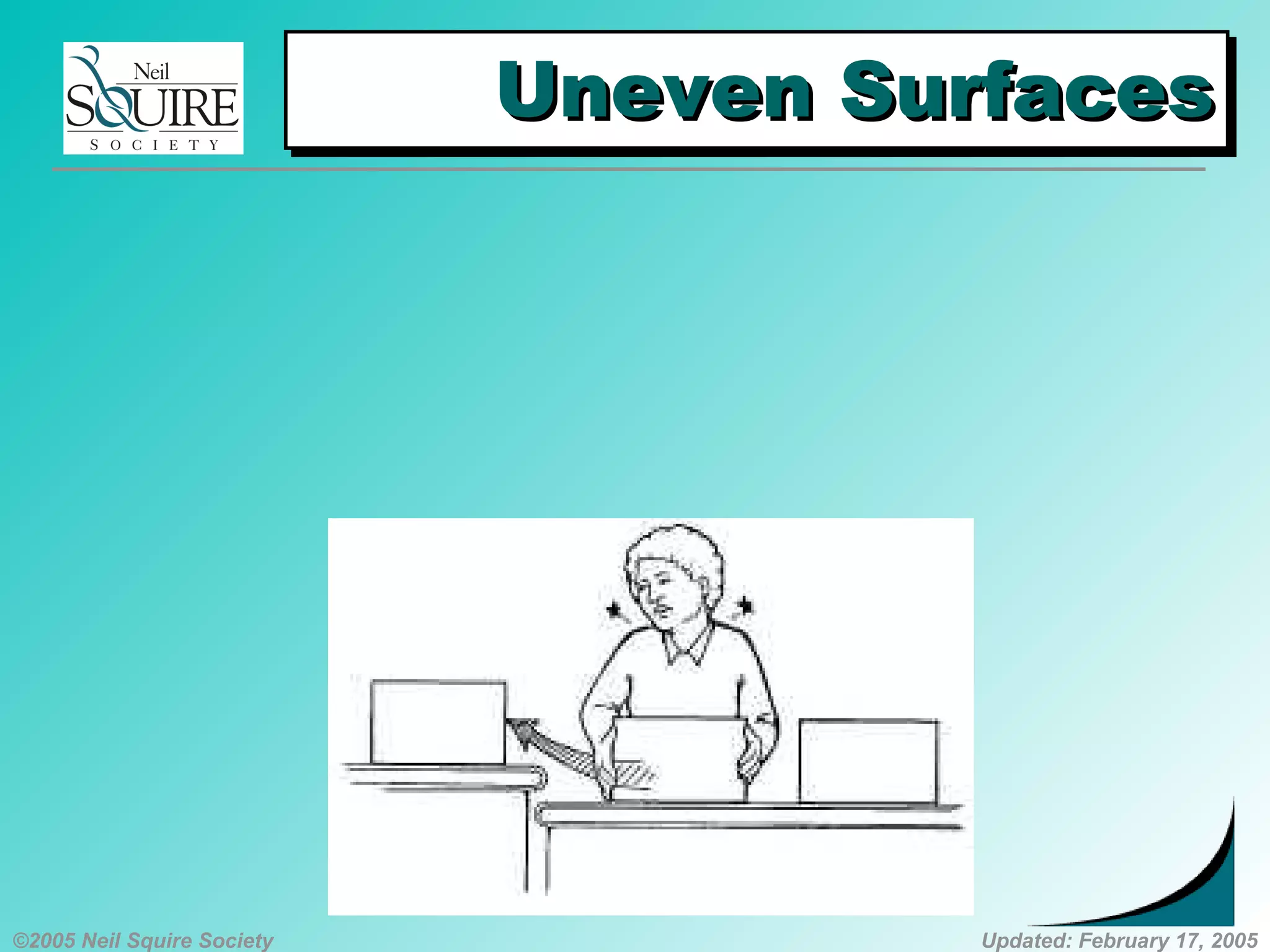
 HandholdsHandholds on boxeson boxes
reduce the amount ofreduce the amount of
exertion needed to carryexertion needed to carry
©2005 Neil Squire Society Updated: February 17, 2005
CarryingCarryingCarryingCarrying
 HandholdsHandholds on boxeson boxes
reduce the amount ofreduce the amount of
exertion needed to carryexertion needed to carry
 CarryCarry the item close tothe item close to
your body to reduceyour body to reduce
postural stressespostural stresses
©2005 Neil Squire Society Updated: February 17, 2005
Uneven SurfacesUneven SurfacesUneven SurfacesUneven Surfaces
©2005 Neil Squire Society Updated: February 17, 2005
Uneven SurfacesUneven SurfacesUneven SurfacesUneven Surfaces
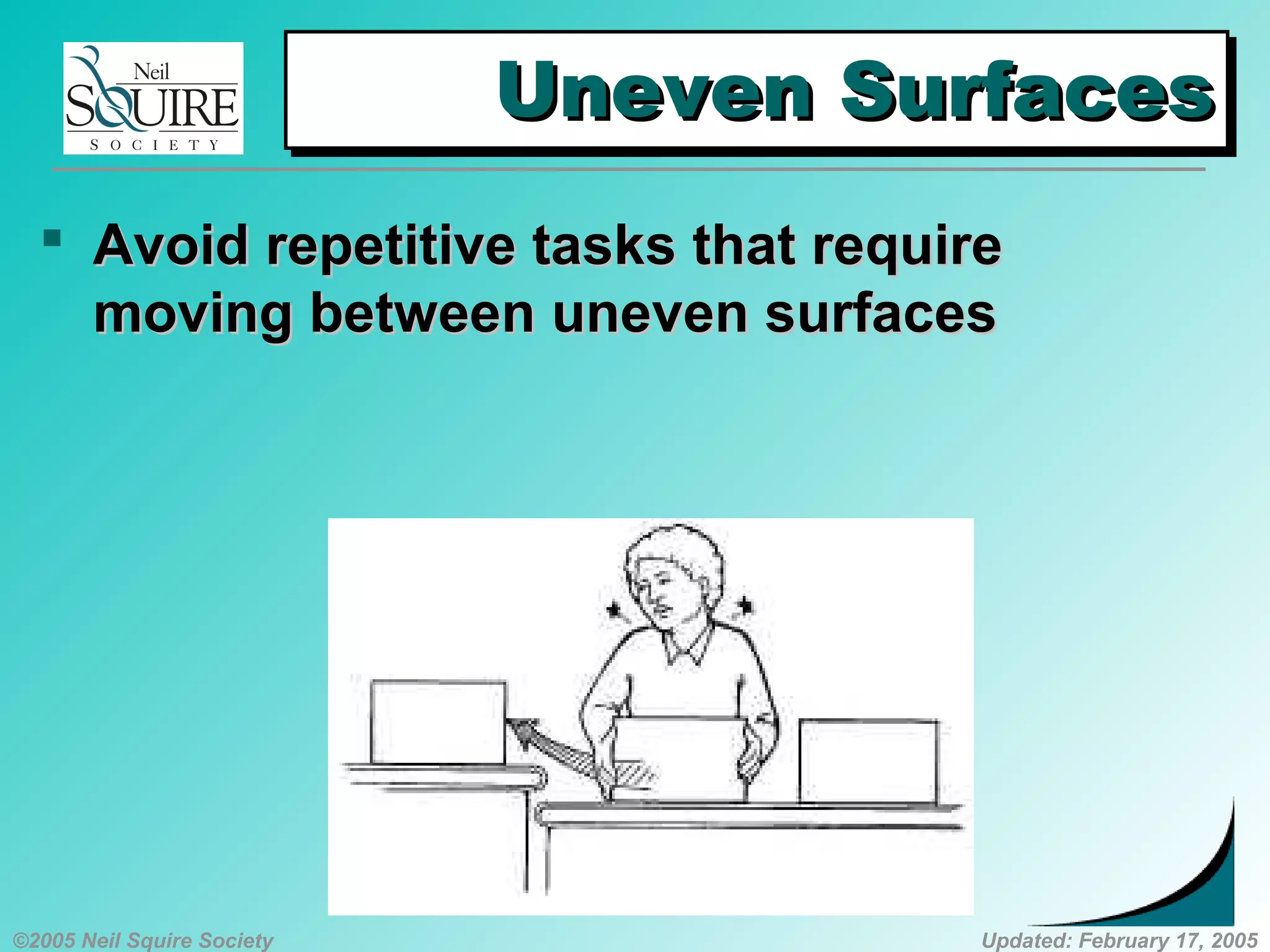
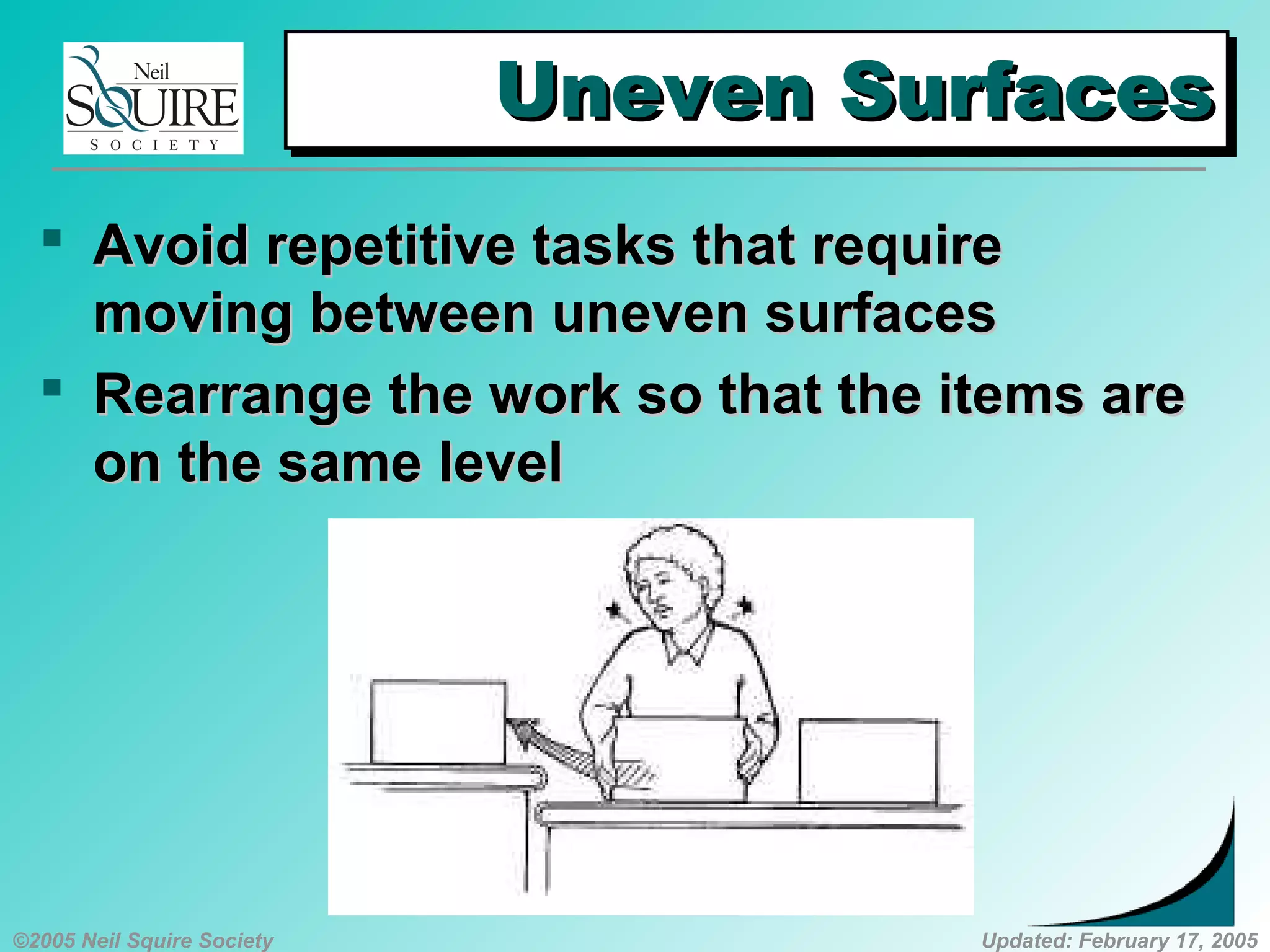
 AvoidAvoid repetitive tasks that requirerepetitive tasks that require
moving between uneven surfacesmoving between uneven surfaces
©2005 Neil Squire Society Updated: February 17, 2005
Uneven SurfacesUneven SurfacesUneven SurfacesUneven Surfaces
 AvoidAvoid repetitive tasks that requirerepetitive tasks that require
moving between uneven surfacesmoving between uneven surfaces
 RearrangeRearrange the work so that the items arethe work so that the items are
on the same levelon the same level
©2005 Neil Squire Society Updated: February 17, 2005
PositioningPositioningPositioningPositioning
©2005 Neil Squire Society Updated: February 17, 2005
PositioningPositioningPositioningPositioning
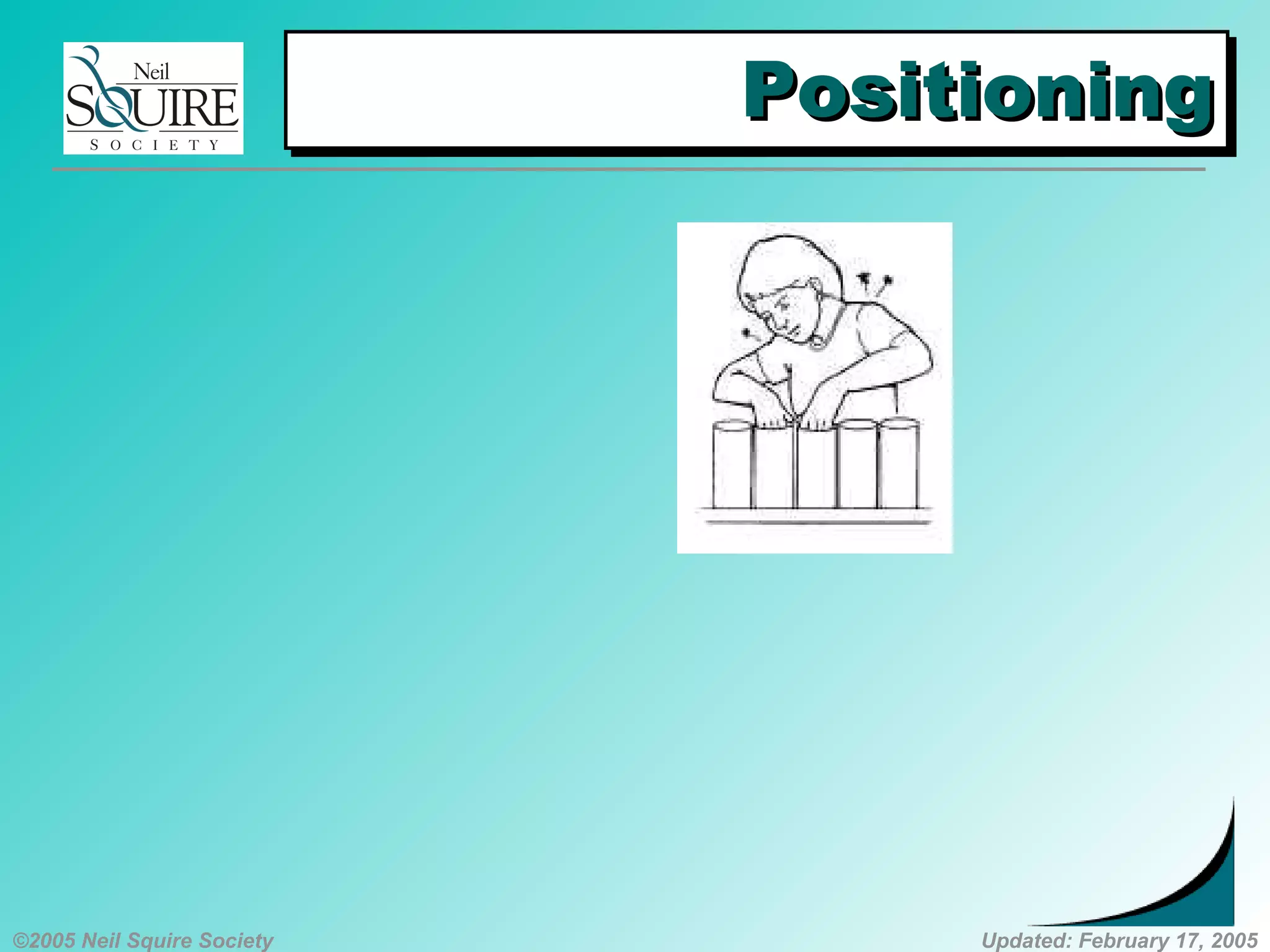
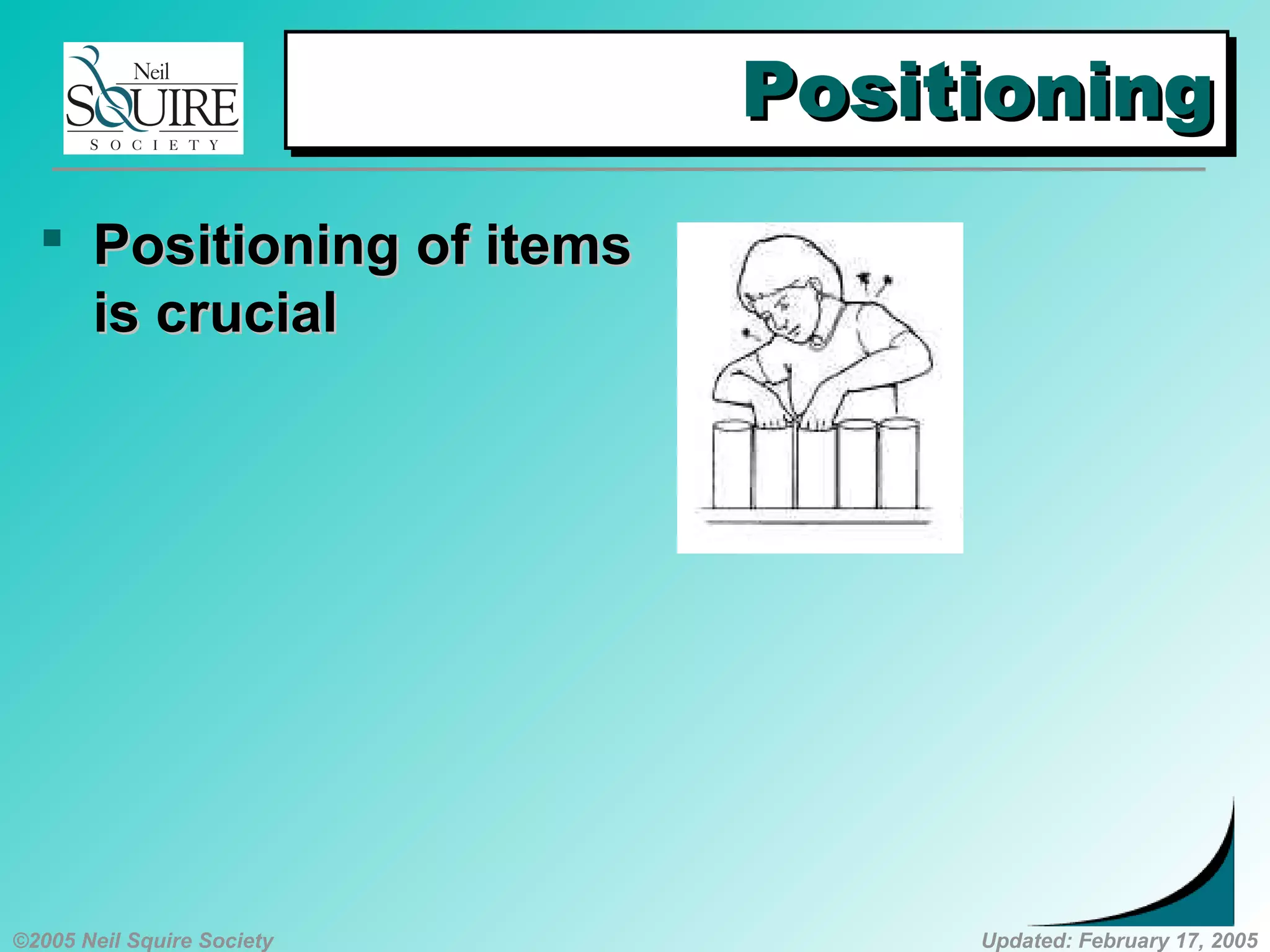
 PositioningPositioning of itemsof items
is crucialis crucial
©2005 Neil Squire Society Updated: February 17, 2005
PositioningPositioningPositioningPositioning
 PositioningPositioning of itemsof items
is crucialis crucial
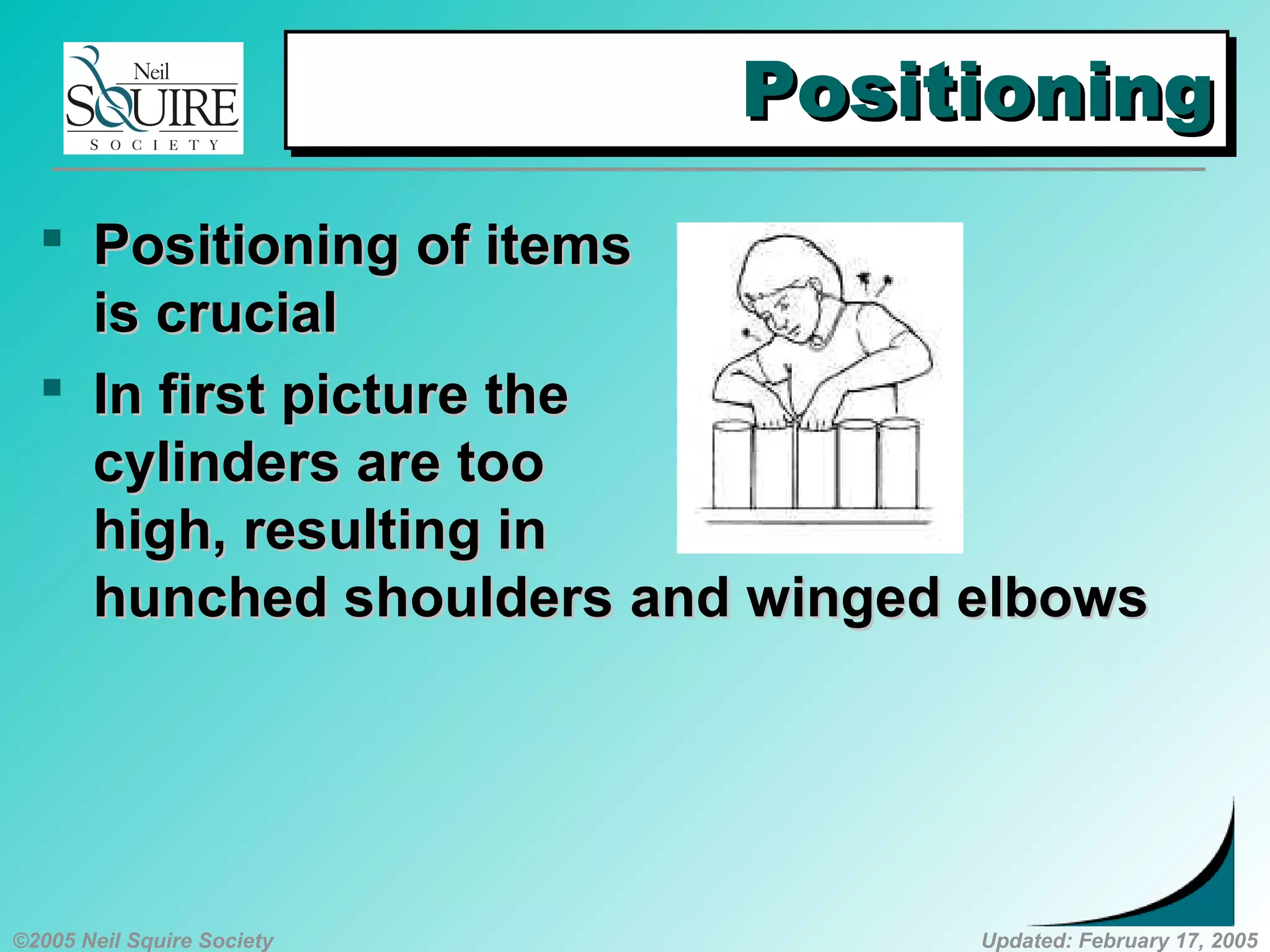
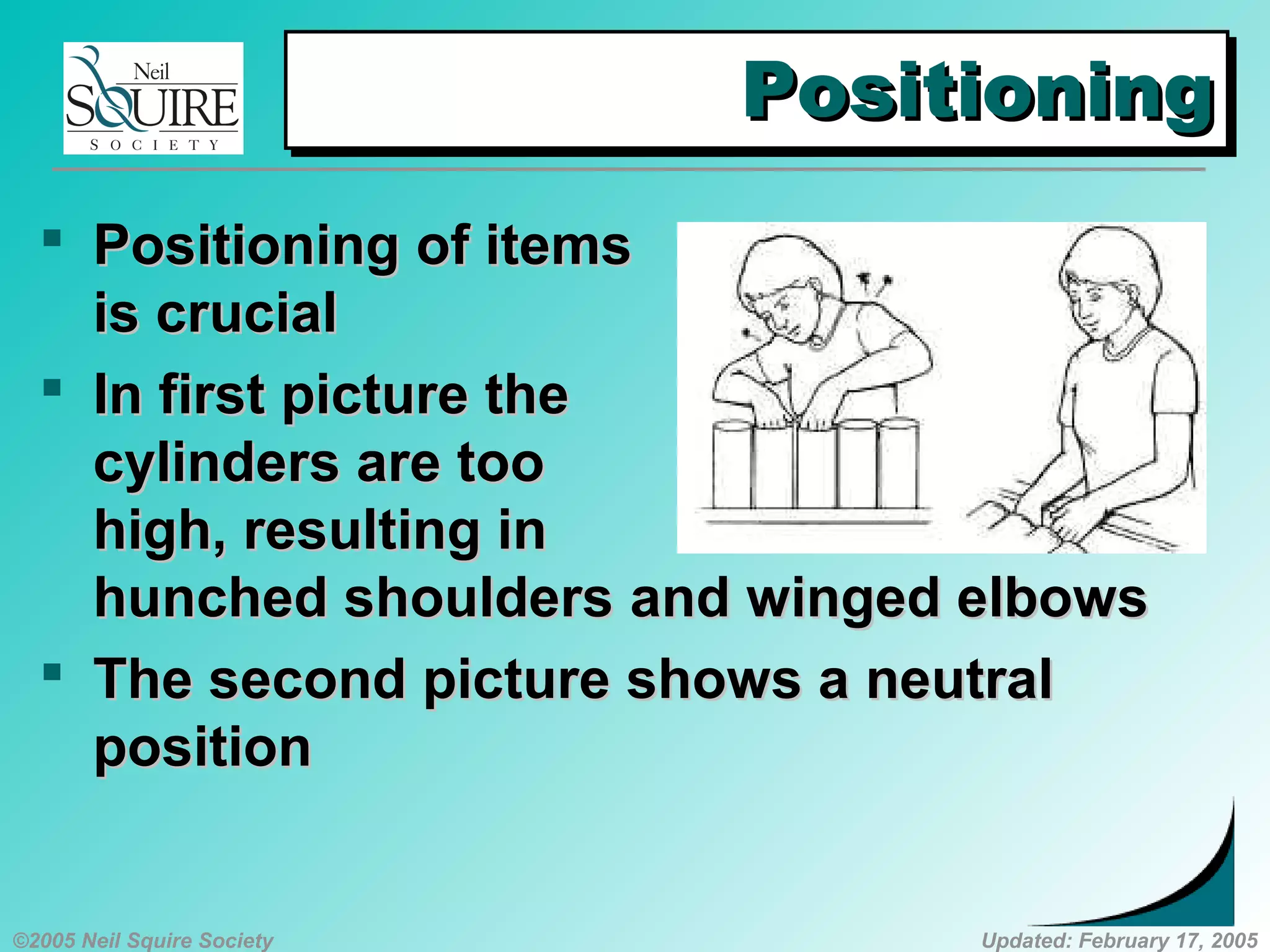
 InIn first picture thefirst picture the
cylinders are toocylinders are too
high, resulting inhigh, resulting in
hunched shouldershunched shoulders andand winged elbowswinged elbows
©2005 Neil Squire Society Updated: February 17, 2005
PositioningPositioningPositioningPositioning
 PositioningPositioning of itemsof items
is crucialis crucial
 InIn first picture thefirst picture the
cylinders are toocylinders are too
high, resulting inhigh, resulting in
hunched shouldershunched shoulders andand winged elbowswinged elbows
 The sThe second picture shows a neutralecond picture shows a neutral
positionposition
©2005 Neil Squire Society Updated: February 17, 2005
Static LoadStatic LoadStatic LoadStatic Load
©2005 Neil Squire Society Updated: February 17, 2005
Static LoadStatic LoadStatic LoadStatic Load
 HoldingHolding something in the same positionsomething in the same position
for a long timefor a long time
©2005 Neil Squire Society Updated: February 17, 2005
Static LoadStatic LoadStatic LoadStatic Load
 HoldingHolding something in the same positionsomething in the same position
for a long timefor a long time
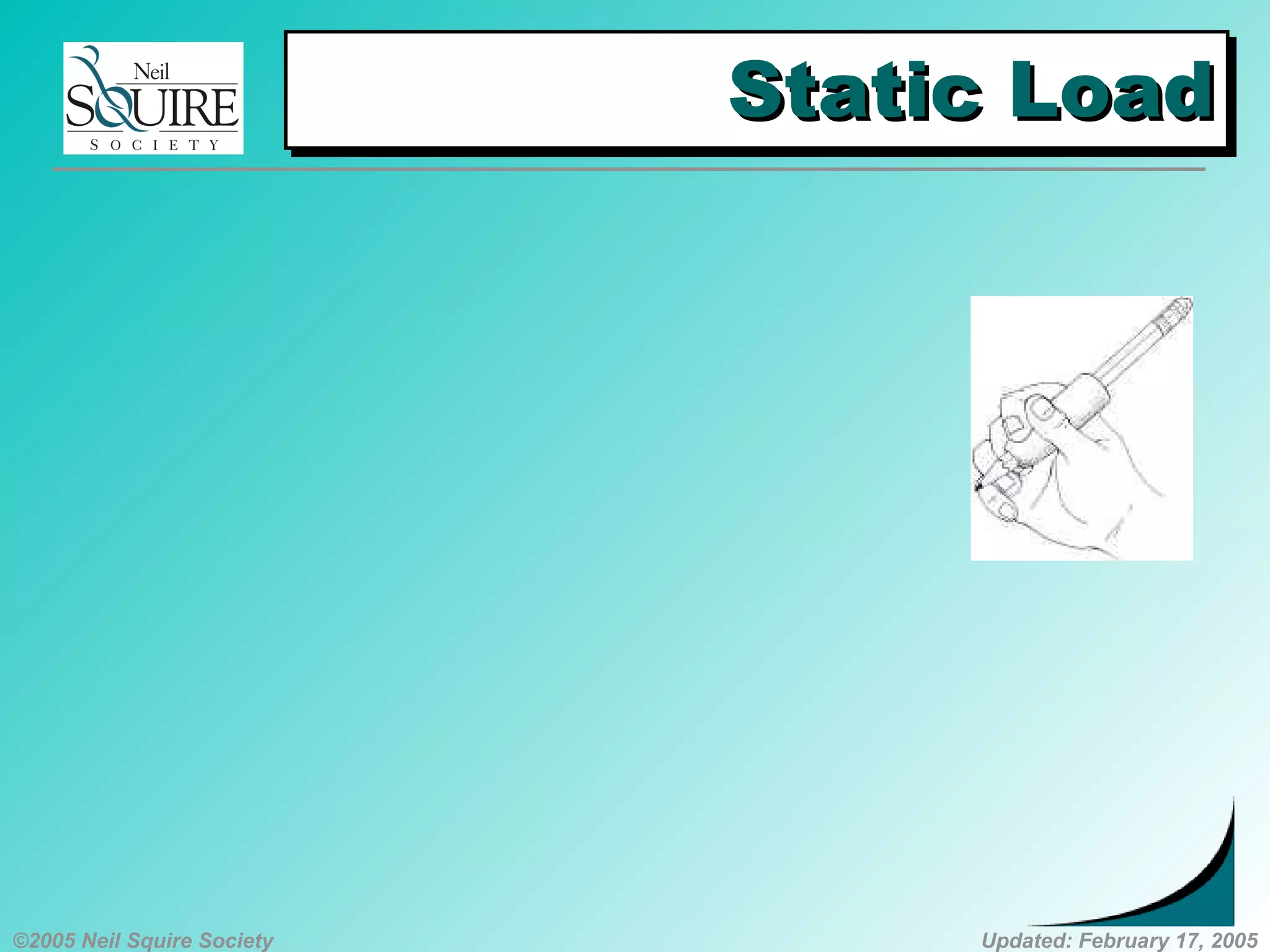
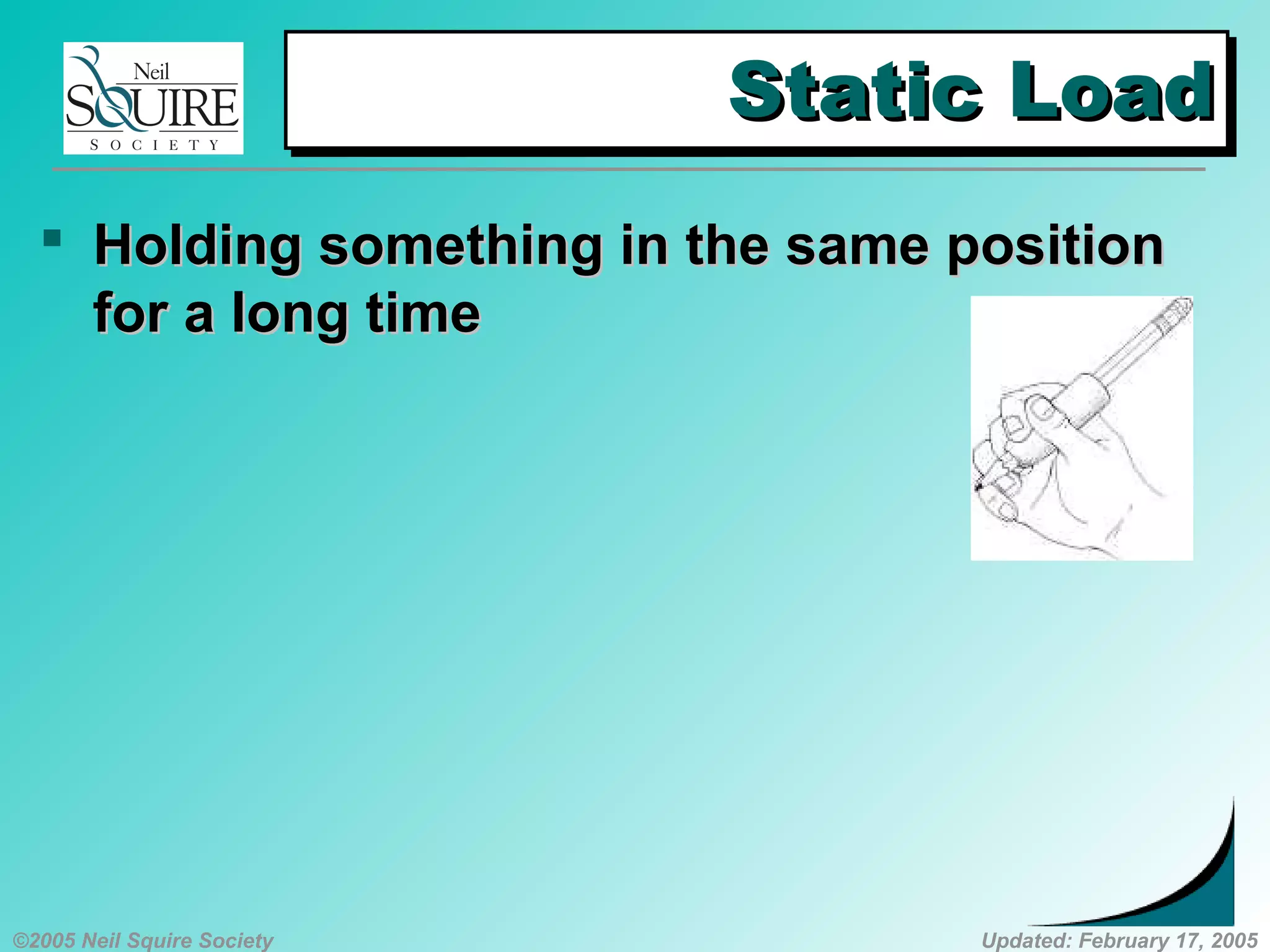
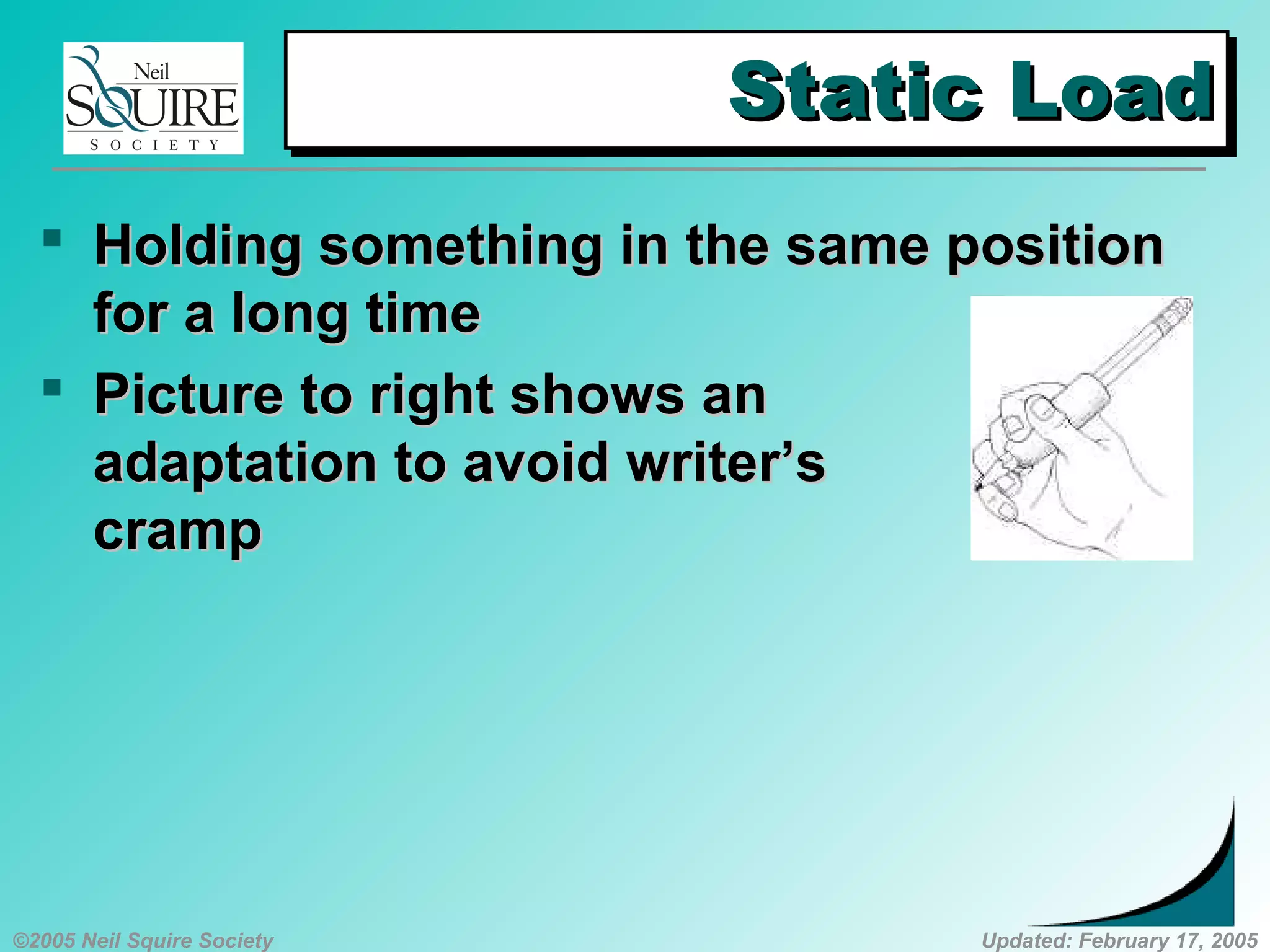
 PPicture to right shows anicture to right shows an
adaptation to avoid writer’sadaptation to avoid writer’s
crampcramp
©2005 Neil Squire Society Updated: February 17, 2005
Static LoadStatic LoadStatic LoadStatic Load
 HoldingHolding something in the same positionsomething in the same position
for a long timefor a long time
 PPicture to right shows anicture to right shows an
adaptation to avoid writer’sadaptation to avoid writer’s
crampcramp
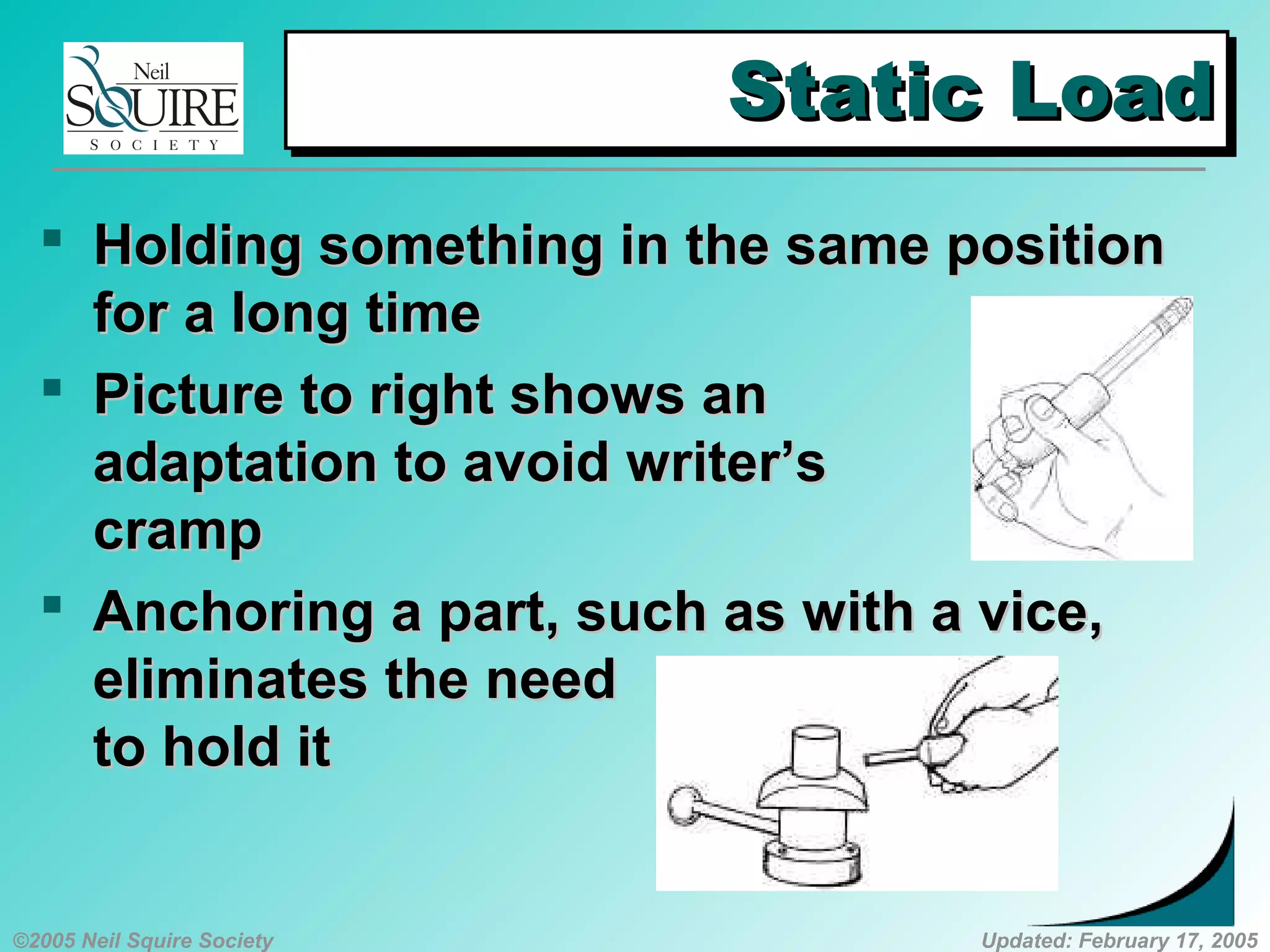
 AAnchoringnchoring aa part, such as with a vice,part, such as with a vice,
eliminates the needeliminates the need
to hold itto hold it
©2005 Neil Squire Society Updated: February 17, 2005
Reduce Pressure PointsReduce Pressure PointsReduce Pressure PointsReduce Pressure Points
©2005 Neil Squire Society Updated: February 17, 2005
Reduce Pressure PointsReduce Pressure PointsReduce Pressure PointsReduce Pressure Points
 Watch out for places where your bodyWatch out for places where your body
contacts a hard surfacecontacts a hard surface
©2005 Neil Squire Society Updated: February 17, 2005
Reduce Pressure PointsReduce Pressure PointsReduce Pressure PointsReduce Pressure Points
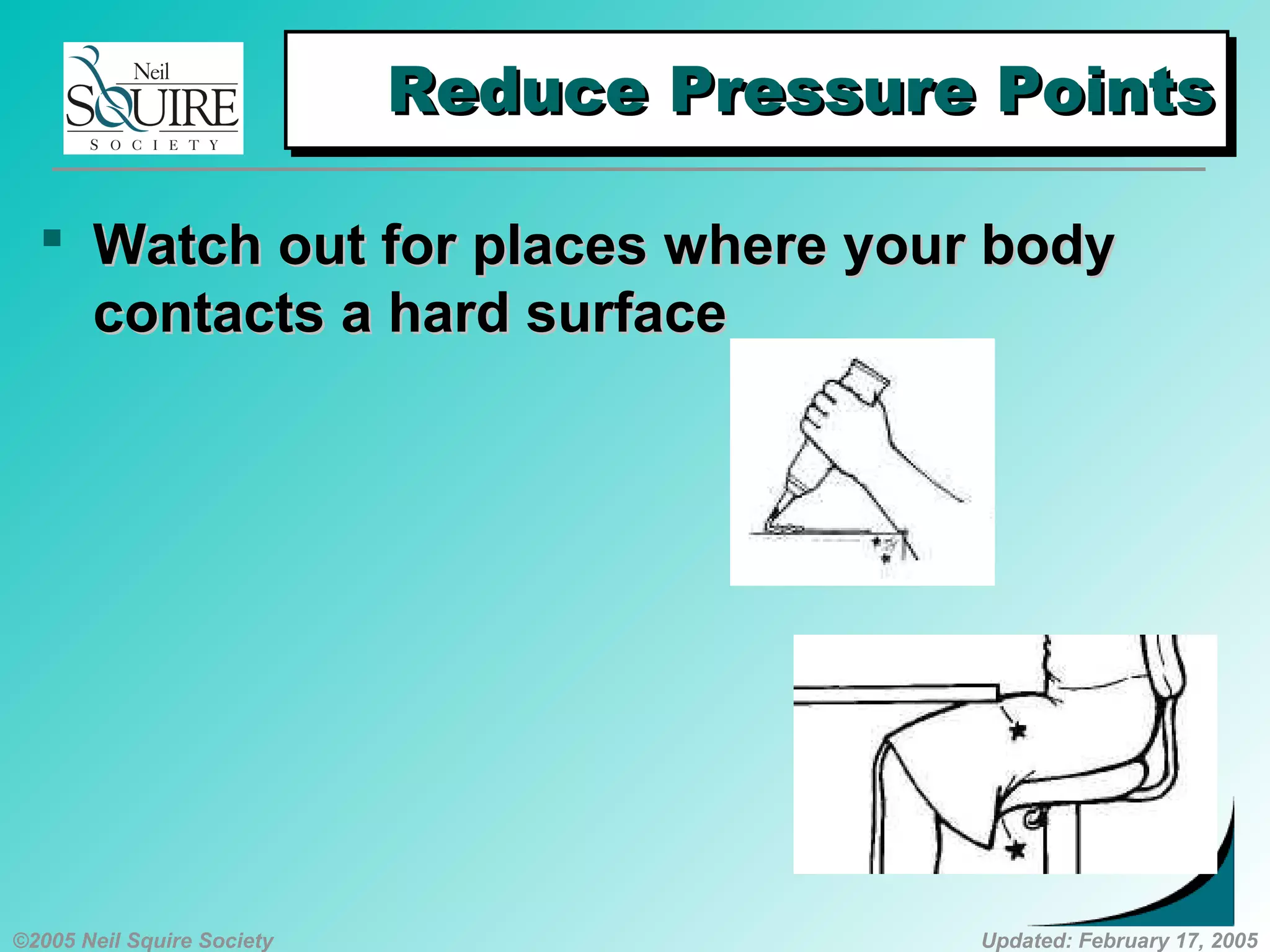
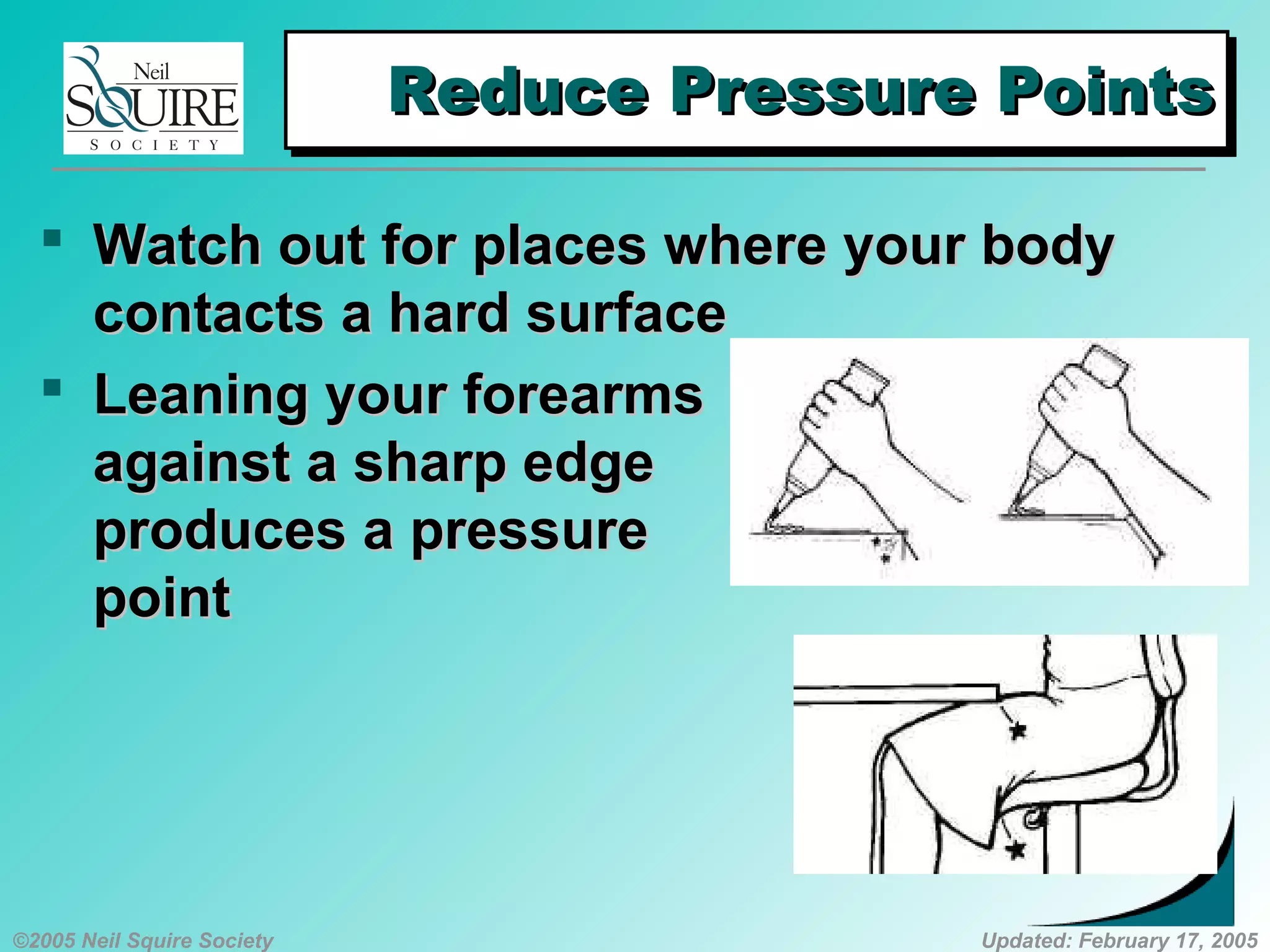
 Watch out for places where your bodyWatch out for places where your body
contacts a hard surfacecontacts a hard surface
 Leaning your forearmsLeaning your forearms
against a sharp edgeagainst a sharp edge
produces a pressureproduces a pressure
pointpoint
©2005 Neil Squire Society Updated: February 17, 2005
Reduce Pressure PointsReduce Pressure PointsReduce Pressure PointsReduce Pressure Points
 Watch out for places where your bodyWatch out for places where your body
contacts a hard surfacecontacts a hard surface
 Leaning your forearmsLeaning your forearms
against a sharp edgeagainst a sharp edge
produces a pressureproduces a pressure
pointpoint
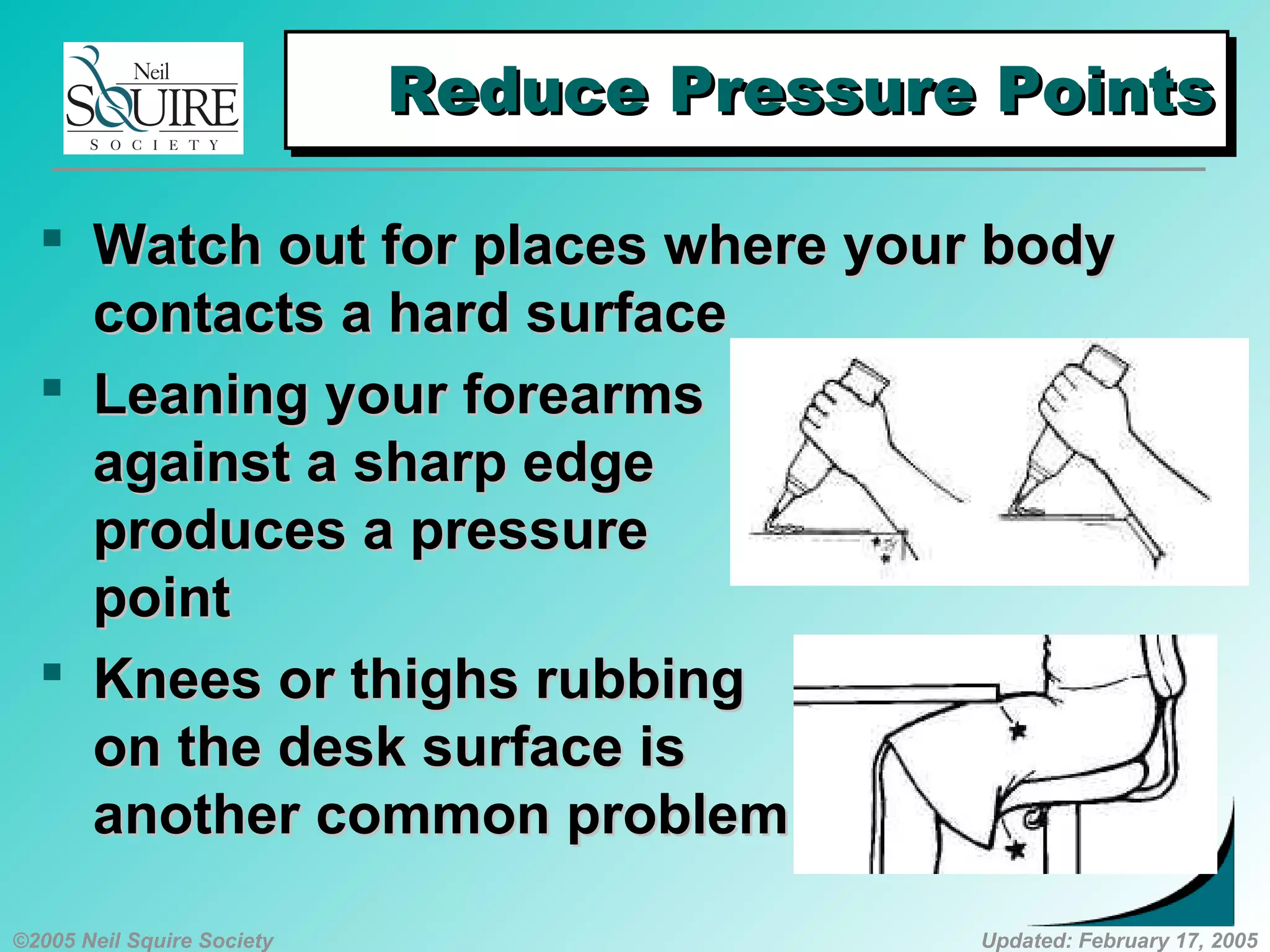
 KKnees or thighs rubbingnees or thighs rubbing
on the desk surface ison the desk surface is
another common problemanother common problem
©2005 Neil Squire Society Updated: February 17, 2005
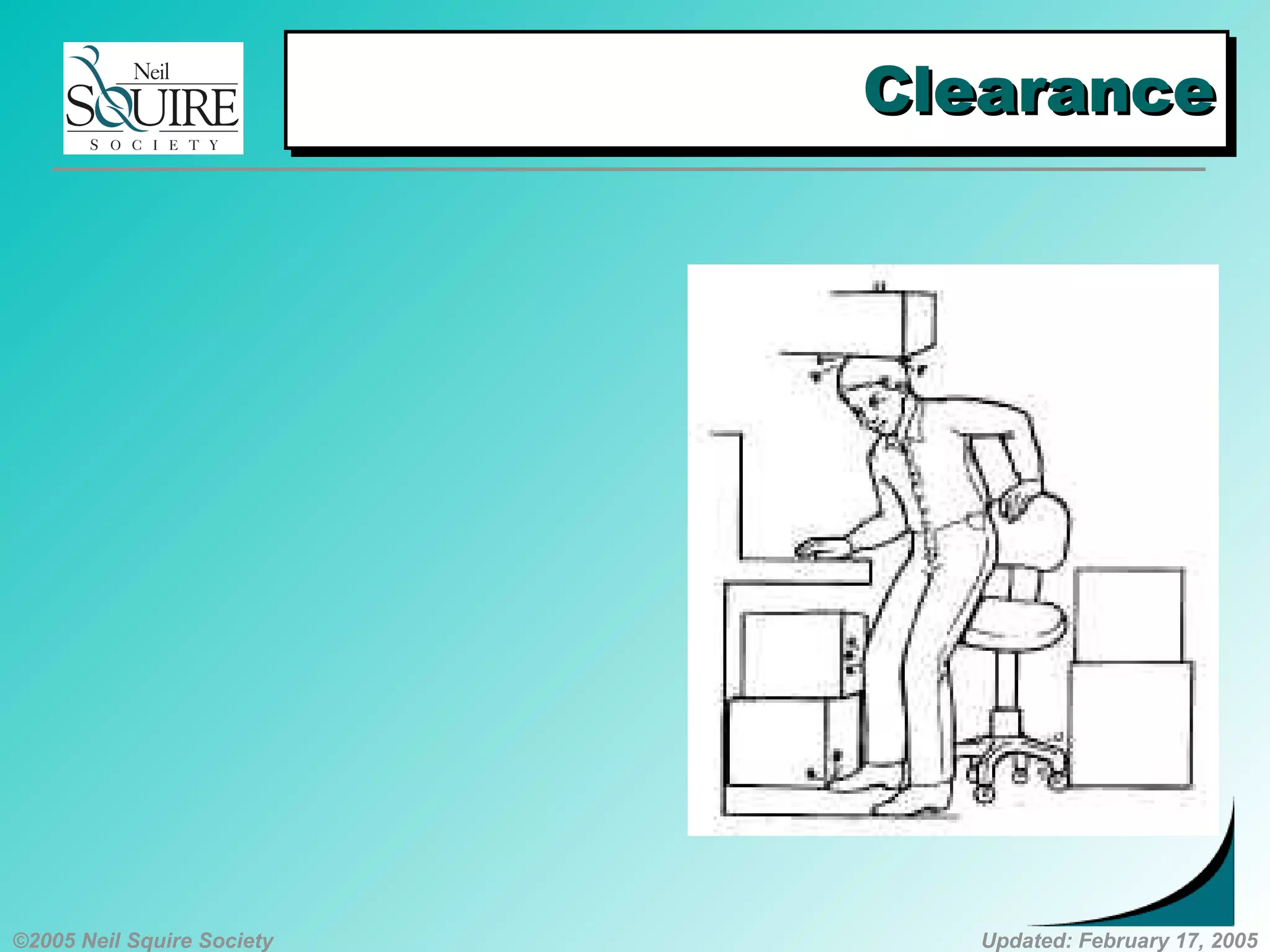
ClearanceClearanceClearanceClearance
©2005 Neil Squire Society Updated: February 17, 2005
ClearanceClearanceClearanceClearance
 Avoid clutter inAvoid clutter in
your workspaceyour workspace
©2005 Neil Squire Society Updated: February 17, 2005
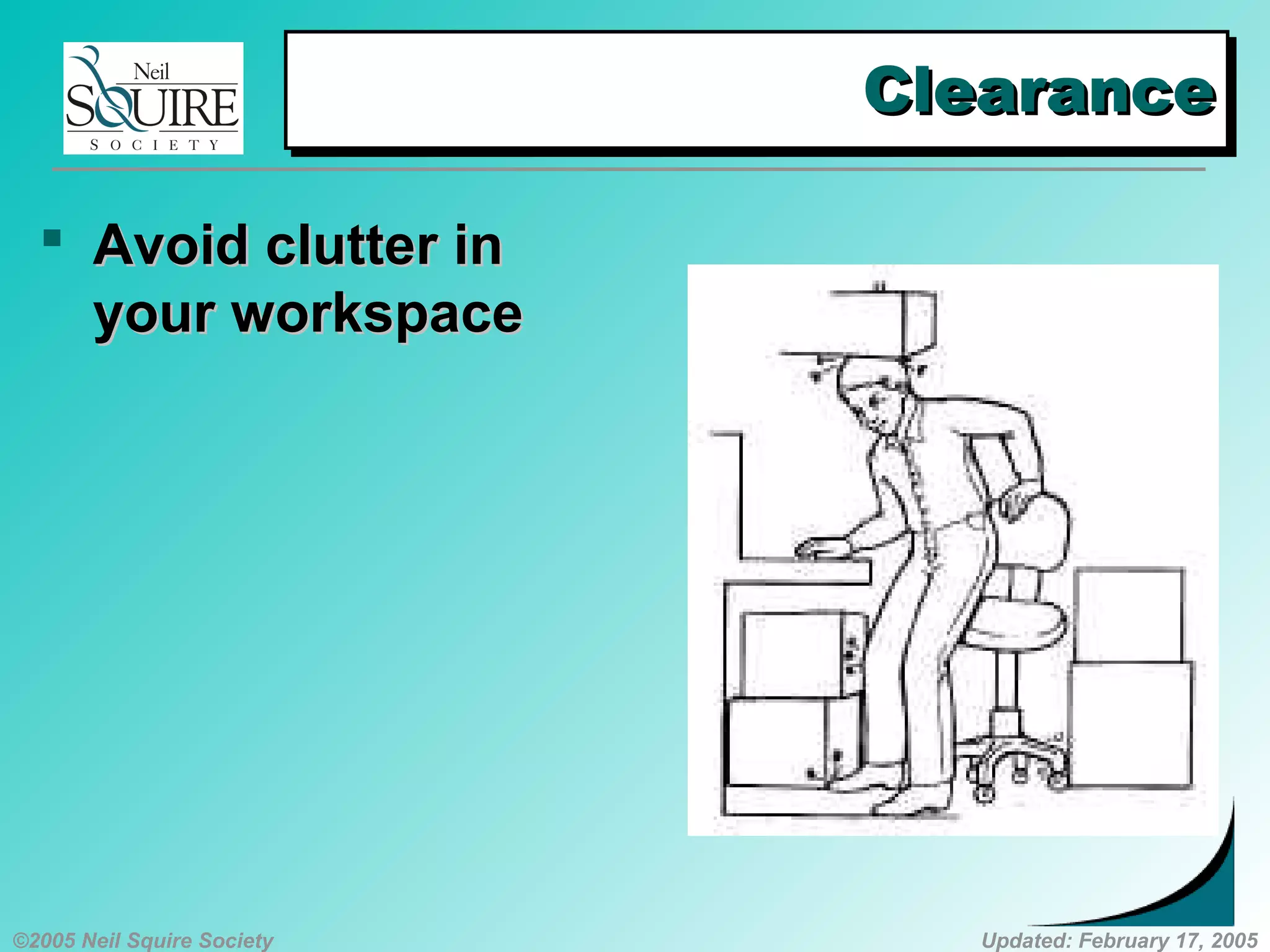
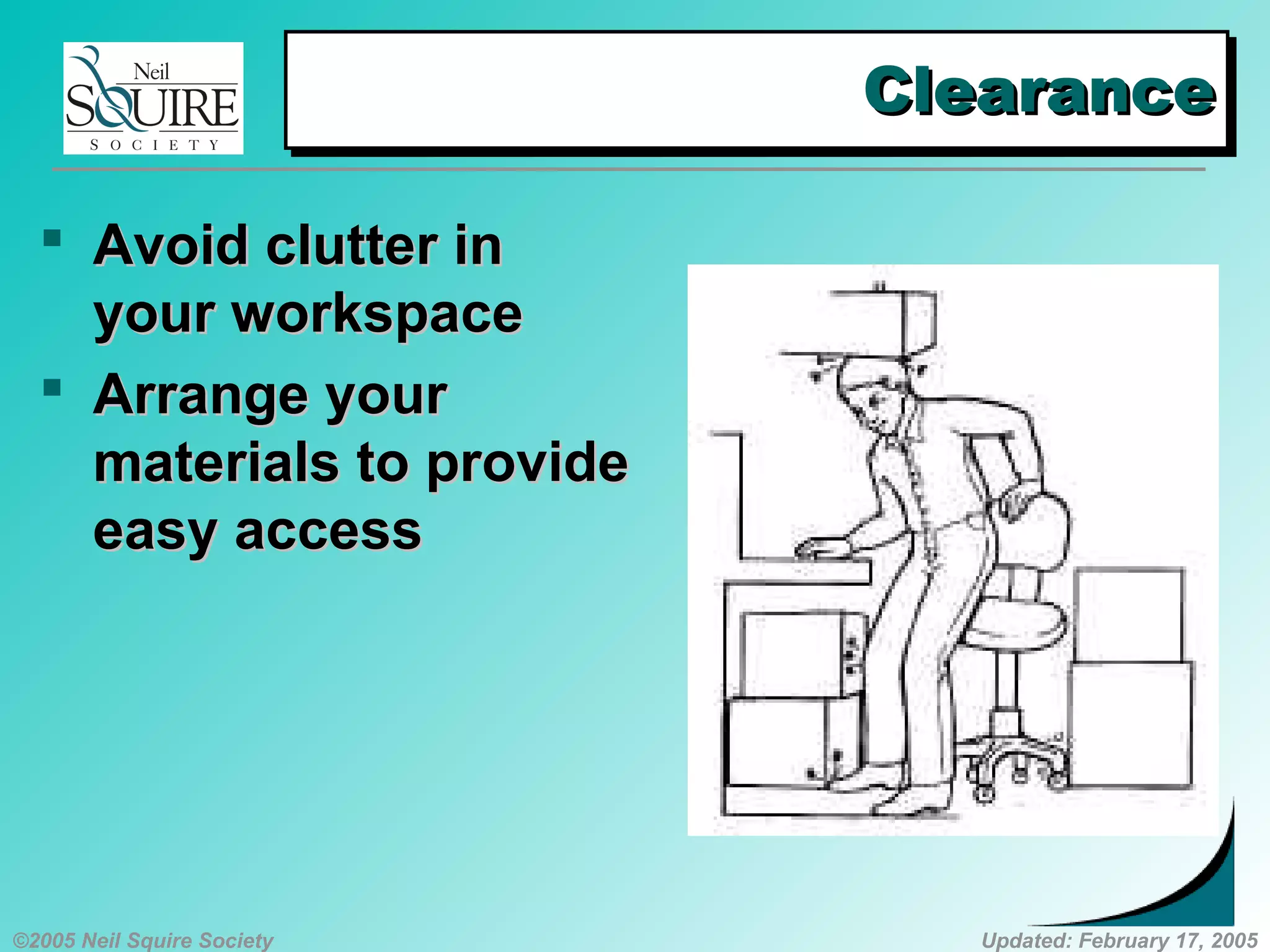
ClearanceClearanceClearanceClearance
 Avoid clutter inAvoid clutter in
your workspaceyour workspace
 Arrange yourArrange your
materials to providematerials to provide
easy accesseasy access
©2005 Neil Squire Society Updated: February 17, 2005
Adequate LightingAdequate LightingAdequate LightingAdequate Lighting
©2005 Neil Squire Society Updated: February 17, 2005
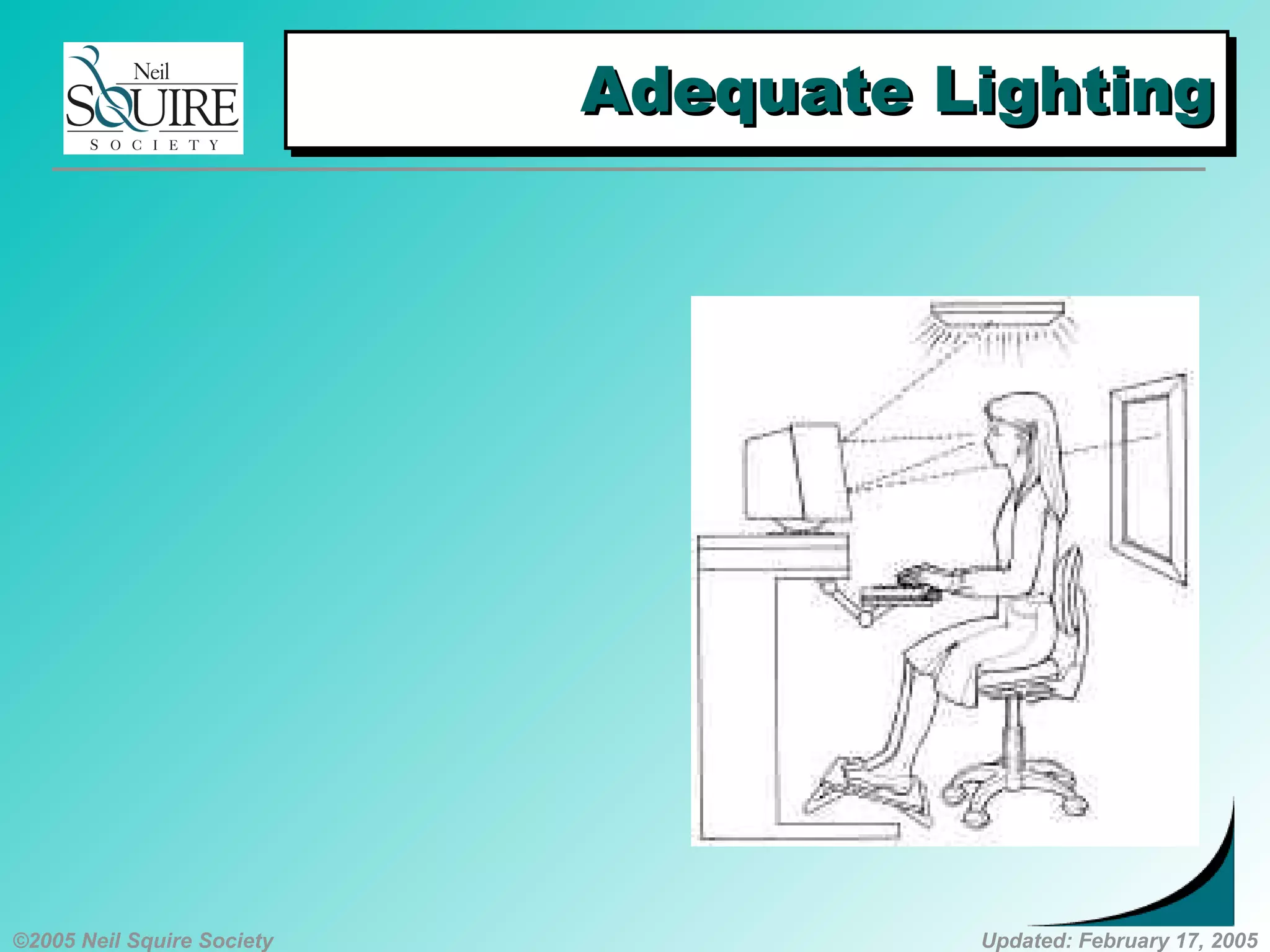
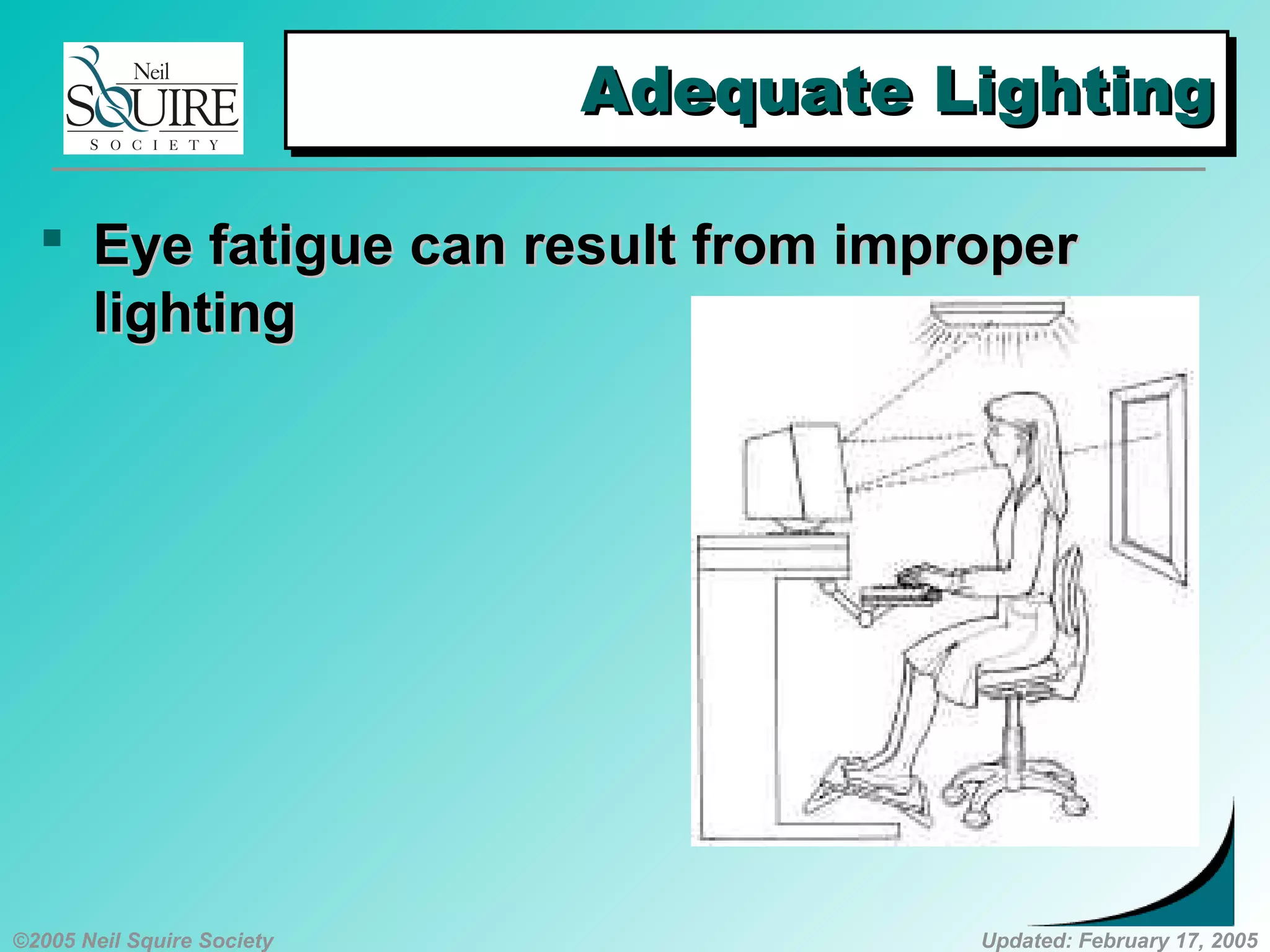
Adequate LightingAdequate LightingAdequate LightingAdequate Lighting
 Eye fatigue can result from improperEye fatigue can result from improper
lightinglighting
©2005 Neil Squire Society Updated: February 17, 2005
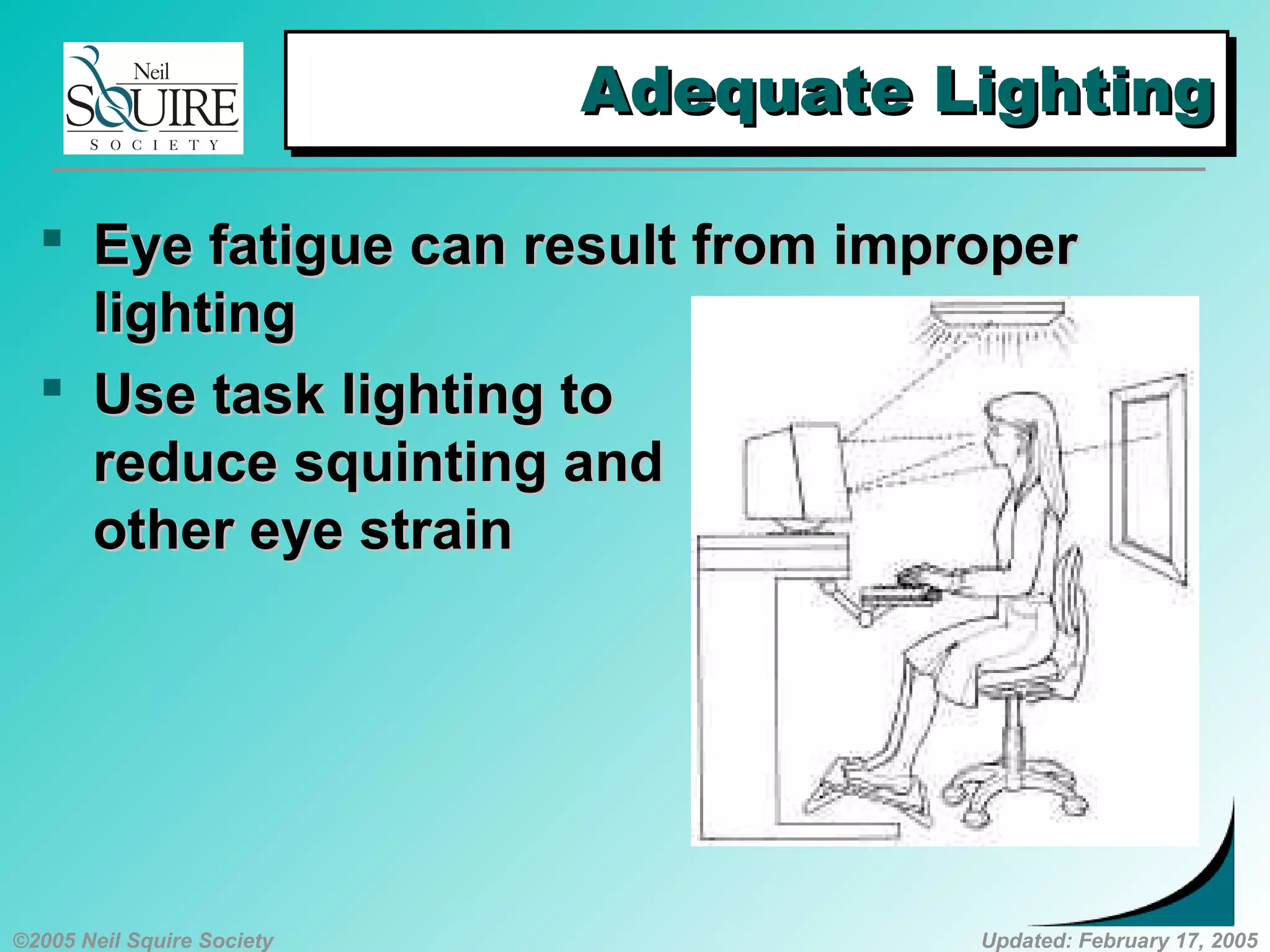
Adequate LightingAdequate LightingAdequate LightingAdequate Lighting
 Eye fatigue can result from improperEye fatigue can result from improper
lightinglighting
 Use task lighting toUse task lighting to
reduce squinting andreduce squinting and
other eye strainother eye strain
©2005 Neil Squire Society Updated: February 17, 2005
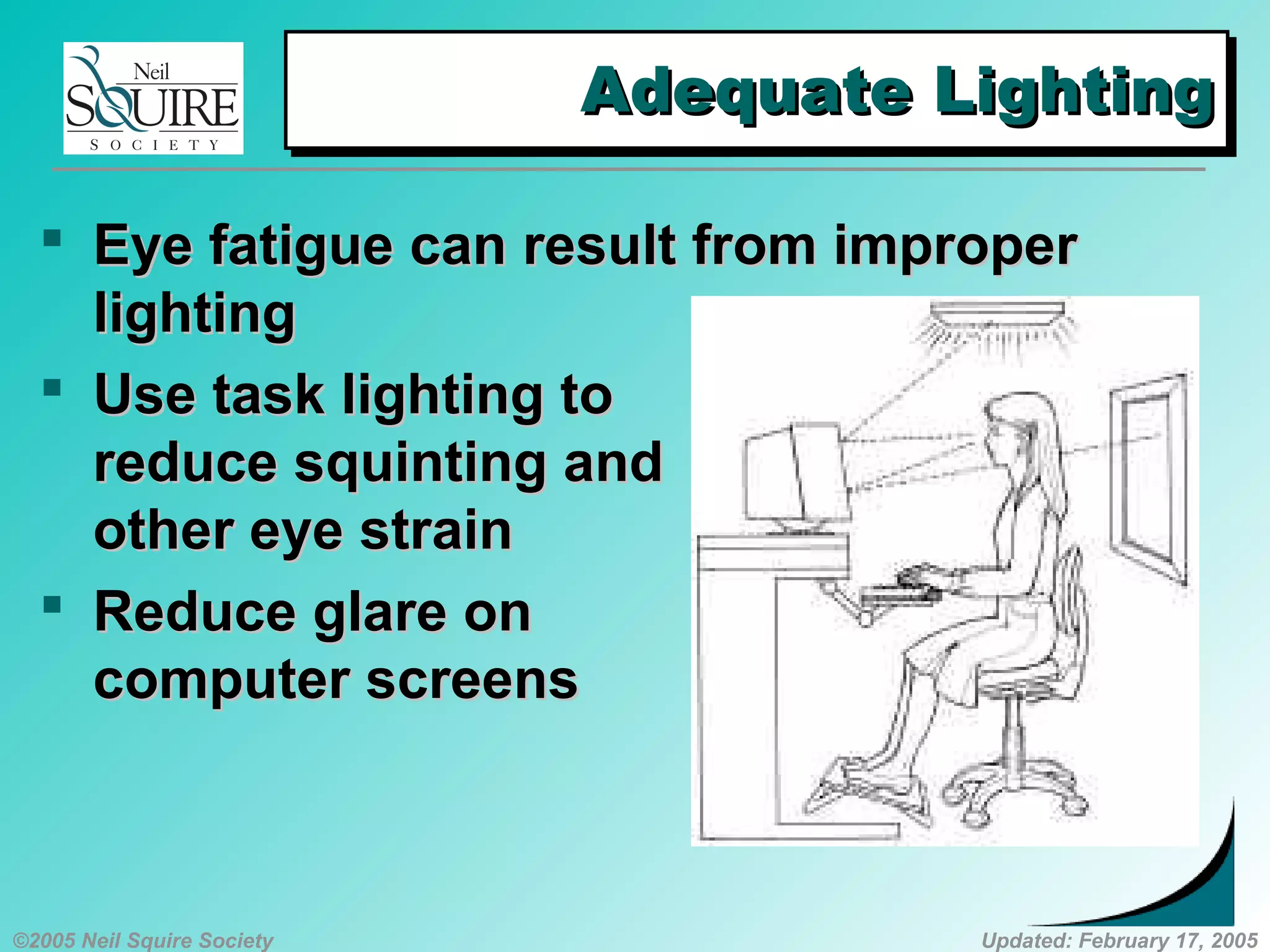
Adequate LightingAdequate LightingAdequate LightingAdequate Lighting
 Eye fatigue can result from improperEye fatigue can result from improper
lightinglighting
 Use task lighting toUse task lighting to
reduce squinting andreduce squinting and
other eye strainother eye strain
 Reduce glare onReduce glare on
computer screenscomputer screens
©2005 Neil Squire Society Updated: February 17, 2005
SummarySummary
Combining Work SimplificationCombining Work Simplification
and Energy Conservationand Energy Conservation
Ideas for around the homeIdeas for around the home
Workspace ConsiderationsWorkspace Considerations
Combining Work SimplificationCombining Work Simplification
and Energy Conservationand Energy Conservation
Ideas for around the homeIdeas for around the home
Workspace ConsiderationsWorkspace Considerations
©2005 Neil Squire Society Updated: February 17, 2005
Wrap UpWrap Up
Thank you for attending.

Work simplification (1)

  • 1.
    ©2005 Neil SquireSociety Updated: February 17, 2005 Brought to you by the Neil Squire Society Work SimplificationWork Simplification && Energy ConservationEnergy Conservation
  • 2.
    ©2005 Neil SquireSociety Updated: February 17, 2005 Session AgendaSession Agenda In this presentation we will coverIn this presentation we will cover the following topics:the following topics: What is “Work Simplification”?What is “Work Simplification”? What is “Energy Conservation”?What is “Energy Conservation”? How can this help me?How can this help me? Ideas for around the houseIdeas for around the house Workspace ConsiderationsWorkspace Considerations What is “Work Simplification”?What is “Work Simplification”? What is “Energy Conservation”?What is “Energy Conservation”? How can this help me?How can this help me? Ideas for around the houseIdeas for around the house Workspace ConsiderationsWorkspace Considerations
  • 3.
    ©2005 Neil SquireSociety Updated: February 17, 2005 Work SimplificationWork SimplificationWork SimplificationWork Simplification
  • 4.
    ©2005 Neil SquireSociety Updated: February 17, 2005 Work SimplificationWork SimplificationWork SimplificationWork Simplification
  • 5.
    ©2005 Neil SquireSociety Updated: February 17, 2005 Work SimplificationWork SimplificationWork SimplificationWork Simplification In the workplace:In the workplace:  A system to analyze work andA system to analyze work and reduce unnecessary or duplicatereduce unnecessary or duplicate activitiesactivities  Developed in 1921 by Frank andDeveloped in 1921 by Frank and Lillian GilbrethLillian Gilbreth
  • 6.
    ©2005 Neil SquireSociety Updated: February 17, 2005 Work SimplificationWork SimplificationWork SimplificationWork Simplification  Every task of a job is representedEvery task of a job is represented by a symbol and presented in aby a symbol and presented in a flow chartflow chart
  • 7.
    ©2005 Neil SquireSociety Updated: February 17, 2005 Work SimplificationWork SimplificationWork SimplificationWork Simplification  The chart is analyzed for duplicationThe chart is analyzed for duplication of work and unnecessary tasksof work and unnecessary tasks
  • 8.
    ©2005 Neil SquireSociety Updated: February 17, 2005 Work SimplificationWork SimplificationWork SimplificationWork Simplification  A better method is developed to getA better method is developed to get the job donethe job done
  • 9.
    ©2005 Neil SquireSociety Updated: February 17, 2005 Work SimplificationWork SimplificationWork SimplificationWork Simplification Reduce the amount of workReduce the amount of work Divide the task into smaller, moreDivide the task into smaller, more manageable componentsmanageable components Find better ways of doing a taskFind better ways of doing a task Find easier ways of doing a taskFind easier ways of doing a task Goals:Goals:
  • 10.
    ©2005 Neil SquireSociety Updated: February 17, 2005 Energy ConservationEnergy ConservationEnergy ConservationEnergy Conservation
  • 11.
    ©2005 Neil SquireSociety Updated: February 17, 2005 Energy ConservationEnergy ConservationEnergy ConservationEnergy Conservation
  • 12.
    ©2005 Neil SquireSociety Updated: February 17, 2005 Energy ConservationEnergy ConservationEnergy ConservationEnergy Conservation  Recognize your energy limitsRecognize your energy limits
  • 13.
    ©2005 Neil SquireSociety Updated: February 17, 2005 Energy ConservationEnergy ConservationEnergy ConservationEnergy Conservation  Recognize your energy limitsRecognize your energy limits Be realistic about what you canBe realistic about what you can accomplishaccomplish Don’t abuse your good daysDon’t abuse your good days Take frequent rest breaksTake frequent rest breaks Be realistic about what you canBe realistic about what you can accomplishaccomplish Don’t abuse your good daysDon’t abuse your good days Take frequent rest breaksTake frequent rest breaks
  • 14.
    ©2005 Neil SquireSociety Updated: February 17, 2005 Energy ConservationEnergy ConservationEnergy ConservationEnergy Conservation  Reduce your physical stressReduce your physical stress
  • 15.
    ©2005 Neil SquireSociety Updated: February 17, 2005 Energy ConservationEnergy ConservationEnergy ConservationEnergy Conservation  Reduce your physical stressReduce your physical stress Prioritize your “To Do” listPrioritize your “To Do” list ““Let go” of unnecessary workLet go” of unnecessary work Eat healthily and exerciseEat healthily and exercise Don’t over-stretch or strainDon’t over-stretch or strain Take breaksTake breaks Prioritize your “To Do” listPrioritize your “To Do” list ““Let go” of unnecessary workLet go” of unnecessary work Eat healthily and exerciseEat healthily and exercise Don’t over-stretch or strainDon’t over-stretch or strain Take breaksTake breaks
  • 16.
    ©2005 Neil SquireSociety Updated: February 17, 2005 Energy ConservationEnergy ConservationEnergy ConservationEnergy Conservation  Work efficientlyWork efficiently
  • 17.
    ©2005 Neil SquireSociety Updated: February 17, 2005 Energy ConservationEnergy ConservationEnergy ConservationEnergy Conservation  Work efficientlyWork efficiently Use ergonomic principles in allUse ergonomic principles in all your activities, not justyour activities, not just computer workcomputer work Have all required materialsHave all required materials within easy reachwithin easy reach Think safetyThink safety Use ergonomic principles in allUse ergonomic principles in all your activities, not justyour activities, not just computer workcomputer work Have all required materialsHave all required materials within easy reachwithin easy reach Think safetyThink safety
  • 18.
    ©2005 Neil SquireSociety Updated: February 17, 2005 Energy ConservationEnergy ConservationEnergy ConservationEnergy Conservation  Pace yourselfPace yourself
  • 19.
    ©2005 Neil SquireSociety Updated: February 17, 2005 Energy ConservationEnergy ConservationEnergy ConservationEnergy Conservation  Pace yourselfPace yourself Know what speed is best for youKnow what speed is best for you Use pulse rate and shortness ofUse pulse rate and shortness of breath as guidelinesbreath as guidelines Plan your day to match yourPlan your day to match your energy levelsenergy levels Know what speed is best for youKnow what speed is best for you Use pulse rate and shortness ofUse pulse rate and shortness of breath as guidelinesbreath as guidelines Plan your day to match yourPlan your day to match your energy levelsenergy levels
  • 20.
    ©2005 Neil SquireSociety Updated: February 17, 2005 Energy ConservationEnergy ConservationEnergy ConservationEnergy Conservation  BreatheBreathe
  • 21.
    ©2005 Neil SquireSociety Updated: February 17, 2005 Energy ConservationEnergy ConservationEnergy ConservationEnergy Conservation  BreatheBreathe Breathe deeplyBreathe deeply Focus on your body rhythm as aFocus on your body rhythm as a means of relaxation and restmeans of relaxation and rest Use pursed-lip breathing as aUse pursed-lip breathing as a means of controlling shortnessmeans of controlling shortness of breathof breath Breathe deeplyBreathe deeply Focus on your body rhythm as aFocus on your body rhythm as a means of relaxation and restmeans of relaxation and rest Use pursed-lip breathing as aUse pursed-lip breathing as a means of controlling shortnessmeans of controlling shortness of breathof breath
  • 22.
    ©2005 Neil SquireSociety Updated: February 17, 2005 Energy ConservationEnergy ConservationEnergy ConservationEnergy Conservation  Recognize your energy limitsRecognize your energy limits  Reduce your physical stressReduce your physical stress  Work efficientlyWork efficiently  Pace yourselfPace yourself  BreatheBreathe
  • 23.
    ©2005 Neil SquireSociety Updated: February 17, 2005 CombineCombine Work SimplificationWork Simplification && Energy ConservationEnergy Conservation Work SimplificationWork Simplification && Energy ConservationEnergy Conservation
  • 24.
    ©2005 Neil SquireSociety Updated: February 17, 2005 Work SimplificationWork Simplification && Energy ConservationEnergy Conservation Work SimplificationWork Simplification && Energy ConservationEnergy Conservation  Reduce the amount of workReduce the amount of work andand recognize your energy limitsrecognize your energy limits
  • 25.
    ©2005 Neil SquireSociety Updated: February 17, 2005 Work SimplificationWork Simplification && Energy ConservationEnergy Conservation Work SimplificationWork Simplification && Energy ConservationEnergy Conservation  Reduce the amount of workReduce the amount of work andand recognize your energy limitsrecognize your energy limits Eliminate unnecessary tasksEliminate unnecessary tasks Combine or eliminate steps of a taskCombine or eliminate steps of a task Delegate tasksDelegate tasks Use professional services for someUse professional services for some taskstasks Eliminate unnecessary tasksEliminate unnecessary tasks Combine or eliminate steps of a taskCombine or eliminate steps of a task Delegate tasksDelegate tasks Use professional services for someUse professional services for some taskstasks
  • 26.
    ©2005 Neil SquireSociety Updated: February 17, 2005  Find better ways of doing a taskFind better ways of doing a task andand work efficientlywork efficiently Work SimplificationWork Simplification && Energy ConservationEnergy Conservation Work SimplificationWork Simplification && Energy ConservationEnergy Conservation
  • 27.
    ©2005 Neil SquireSociety Updated: February 17, 2005  Find better ways of doing a taskFind better ways of doing a task andand work efficientlywork efficiently Organize your work areasOrganize your work areas Store frequently used items withinStore frequently used items within easy reach of the work areaeasy reach of the work area Gather all items needed beforeGather all items needed before beginning a taskbeginning a task Think ergonomicsThink ergonomics Organize your work areasOrganize your work areas Store frequently used items withinStore frequently used items within easy reach of the work areaeasy reach of the work area Gather all items needed beforeGather all items needed before beginning a taskbeginning a task Think ergonomicsThink ergonomics Work SimplificationWork Simplification && Energy ConservationEnergy Conservation Work SimplificationWork Simplification && Energy ConservationEnergy Conservation
  • 28.
    ©2005 Neil SquireSociety Updated: February 17, 2005  Break a job into smaller tasksBreak a job into smaller tasks andand pace yourselfpace yourself … continued Work SimplificationWork Simplification && Energy ConservationEnergy Conservation Work SimplificationWork Simplification && Energy ConservationEnergy Conservation
  • 29.
    ©2005 Neil SquireSociety Updated: February 17, 2005  Break a job into smaller tasksBreak a job into smaller tasks andand pace yourselfpace yourself Work at a steady, moderate paceWork at a steady, moderate pace Plan frequent, short rest breaksPlan frequent, short rest breaks rather than one long breakrather than one long break Alternate active and quiet tasksAlternate active and quiet tasks RestRest beforebefore becoming fatiguedbecoming fatigued Work at a steady, moderate paceWork at a steady, moderate pace Plan frequent, short rest breaksPlan frequent, short rest breaks rather than one long breakrather than one long break Alternate active and quiet tasksAlternate active and quiet tasks RestRest beforebefore becoming fatiguedbecoming fatigued … continued Work SimplificationWork Simplification && Energy ConservationEnergy Conservation Work SimplificationWork Simplification && Energy ConservationEnergy Conservation
  • 30.
    ©2005 Neil SquireSociety Updated: February 17, 2005  Break a job into smaller tasksBreak a job into smaller tasks andand pace yourselfpace yourself Arrange tasks so that the moreArrange tasks so that the more physical work is done when yourphysical work is done when your energy level is highestenergy level is highest Distribute heavy tasks overDistribute heavy tasks over several daysseveral days Alternate light and heavy tasksAlternate light and heavy tasks Arrange tasks so that the moreArrange tasks so that the more physical work is done when yourphysical work is done when your energy level is highestenergy level is highest Distribute heavy tasks overDistribute heavy tasks over several daysseveral days Alternate light and heavy tasksAlternate light and heavy tasks Work SimplificationWork Simplification && Energy ConservationEnergy Conservation Work SimplificationWork Simplification && Energy ConservationEnergy Conservation
  • 31.
    ©2005 Neil SquireSociety Updated: February 17, 2005  Find easier ways of doing a taskFind easier ways of doing a task andand decrease your physical stressdecrease your physical stress Work SimplificationWork Simplification && Energy ConservationEnergy Conservation Work SimplificationWork Simplification && Energy ConservationEnergy Conservation
  • 32.
    ©2005 Neil SquireSociety Updated: February 17, 2005  Find easier ways of doing a taskFind easier ways of doing a task andand decrease your physical stressdecrease your physical stress Sit to perform tasksSit to perform tasks Keep your back straightKeep your back straight Slide or push objects instead of liftingSlide or push objects instead of lifting Use a cart or basket to carry itemsUse a cart or basket to carry items Avoid over-stretching, twisting,Avoid over-stretching, twisting, stooping, or strainingstooping, or straining Sit to perform tasksSit to perform tasks Keep your back straightKeep your back straight Slide or push objects instead of liftingSlide or push objects instead of lifting Use a cart or basket to carry itemsUse a cart or basket to carry items Avoid over-stretching, twisting,Avoid over-stretching, twisting, stooping, or strainingstooping, or straining Work SimplificationWork Simplification && Energy ConservationEnergy Conservation Work SimplificationWork Simplification && Energy ConservationEnergy Conservation
  • 33.
    ©2005 Neil SquireSociety Updated: February 17, 2005  Find easier ways of doing a taskFind easier ways of doing a task andand decrease your physical stressdecrease your physical stress Use proper work heightsUse proper work heights Use the tool that fits the jobUse the tool that fits the job Use lightweight toolsUse lightweight tools Use power tools wherever possibleUse power tools wherever possible Use proper work heightsUse proper work heights Use the tool that fits the jobUse the tool that fits the job Use lightweight toolsUse lightweight tools Use power tools wherever possibleUse power tools wherever possible Work SimplificationWork Simplification && Energy ConservationEnergy Conservation Work SimplificationWork Simplification && Energy ConservationEnergy Conservation
  • 34.
    ©2005 Neil SquireSociety Updated: February 17, 2005 How can thisHow can this help me?help me? How can thisHow can this help me?help me?
  • 35.
    ©2005 Neil SquireSociety Updated: February 17, 2005 Case StudyCase Study Anna:Anna:  Hired as a part-timeHired as a part-time accountantaccountant  Needs attendant care inNeeds attendant care in morning and at nightmorning and at night  Active social lifeActive social life  Limited energyLimited energy (max. 8 hours per day)(max. 8 hours per day)
  • 36.
    ©2005 Neil SquireSociety Updated: February 17, 2005 Case StudyCase Study Anna:Anna: Recognize her energy limitsRecognize her energy limits  20 hours work per20 hours work per week - maximumweek - maximum  Some of her work canSome of her work can be done from homebe done from home  Schedule that matchesSchedule that matches her energy levelsher energy levels  Consider personal care and transitConsider personal care and transit time when setting scheduletime when setting schedule
  • 37.
    ©2005 Neil SquireSociety Updated: February 17, 2005 Case StudyCase Study Anna:Anna: Reduce the amount of work at homeReduce the amount of work at home  Delegate householdDelegate household choreschores  Change or increaseChange or increase attendant hoursattendant hours  ““Let go” of unnecessaryLet go” of unnecessary taskstasks
  • 38.
    ©2005 Neil SquireSociety Updated: February 17, 2005 Case StudyCase Study Anna:Anna: Work efficientlyWork efficiently  Setup a home officeSetup a home office  Work materials shouldWork materials should be within easy reachbe within easy reach  Analyze the job tasks toAnalyze the job tasks to find new simpler waysfind new simpler ways to do the workto do the work  Discuss job sharing and re-distributionDiscuss job sharing and re-distribution of tasksof tasks
  • 39.
    ©2005 Neil SquireSociety Updated: February 17, 2005 Case StudyCase Study Anna:Anna: Break job into smaller tasksBreak job into smaller tasks  Decide which parts ofDecide which parts of the job can be donethe job can be done at homeat home  Set priorities for today’sSet priorities for today’s workwork  Spread houseworkSpread housework throughout the weekthroughout the week
  • 40.
    ©2005 Neil SquireSociety Updated: February 17, 2005 Case StudyCase Study Anna:Anna: Pace HerselfPace Herself  Schedule the detailedSchedule the detailed work for high energywork for high energy timestimes  Schedule the repetitiveSchedule the repetitive work for low energywork for low energy timestimes  Take regular breaksTake regular breaks  Schedule time for social activitiesSchedule time for social activities
  • 41.
    ©2005 Neil SquireSociety Updated: February 17, 2005 Case StudyCase Study Anna:Anna: Find easier ways to do a taskFind easier ways to do a task  Research simplerResearch simpler accounting systemsaccounting systems  Sort papers before filingSort papers before filing  Robot vacuum cleanerRobot vacuum cleaner  Set up automaticSet up automatic payments for householdpayments for household billsbills
  • 42.
    ©2005 Neil SquireSociety Updated: February 17, 2005 Case StudyCase Study Anna:Anna: Decrease her physical stressDecrease her physical stress  Set up your work spaceSet up your work space at home and at officeat home and at office ergonomicallyergonomically  Use AT for computerUse AT for computer accessaccess  Move your computer onMove your computer on top of the desk so youtop of the desk so you don’t need to stretch to reach itdon’t need to stretch to reach it
  • 43.
    ©2005 Neil SquireSociety Updated: February 17, 2005 Case StudyCase Study Anna:Anna:  Recognize energy limitsRecognize energy limits  Reduce her work at homeReduce her work at home  Work efficientlyWork efficiently  Break into smaller tasksBreak into smaller tasks  Pace herselfPace herself  Look for easier waysLook for easier ways  Decrease her physical stressDecrease her physical stress
  • 44.
    ©2005 Neil SquireSociety Updated: February 17, 2005 Ideas forIdeas for Around the HouseAround the House Ideas forIdeas for Around the HouseAround the House
  • 45.
    ©2005 Neil SquireSociety Updated: February 17, 2005 KitchenKitchenKitchenKitchen
  • 46.
    ©2005 Neil SquireSociety Updated: February 17, 2005 KitchenKitchenKitchenKitchen  SSit on a stool at a table or pull-out cuttingit on a stool at a table or pull-out cutting board when preparing foodboard when preparing food
  • 47.
    ©2005 Neil SquireSociety Updated: February 17, 2005 KitchenKitchenKitchenKitchen  SSit on a stool at a table or pull-out cuttingit on a stool at a table or pull-out cutting board when preparing foodboard when preparing food  SSlide, don’t lift, heavy pots across alide, don’t lift, heavy pots across a countercounter
  • 48.
    ©2005 Neil SquireSociety Updated: February 17, 2005 KitchenKitchenKitchenKitchen  SSit on a stool at a table or pull-out cuttingit on a stool at a table or pull-out cutting board when preparing foodboard when preparing food  SSlide, don’t lift, heavy pots across alide, don’t lift, heavy pots across a countercounter  AArrange storage so that frequently usedrrange storage so that frequently used items are the most accessibleitems are the most accessible
  • 49.
    ©2005 Neil SquireSociety Updated: February 17, 2005 KitchenKitchenKitchenKitchen  SSit on a stool at a table or pull-out cuttingit on a stool at a table or pull-out cutting board when preparing foodboard when preparing food  SSlide, don’t lift, heavy pots across alide, don’t lift, heavy pots across a countercounter  AArrange storage so that frequently usedrrange storage so that frequently used items are the most accessibleitems are the most accessible  SStack similar items togethertack similar items together
  • 50.
    ©2005 Neil SquireSociety Updated: February 17, 2005 KitchenKitchenKitchenKitchen  SSit on a stool at a table or pull-out cuttingit on a stool at a table or pull-out cutting board when preparing foodboard when preparing food  SSlide, don’t lift, heavy pots across alide, don’t lift, heavy pots across a countercounter  AArrange storage so that frequently usedrrange storage so that frequently used items are the most accessibleitems are the most accessible  Stack similar items togetherStack similar items together  UUsese aa tea trolley, or apron with largetea trolley, or apron with large pockets, to transport itemspockets, to transport items
  • 51.
    ©2005 Neil SquireSociety Updated: February 17, 2005 HousecleaningHousecleaningHousecleaningHousecleaning
  • 52.
    ©2005 Neil SquireSociety Updated: February 17, 2005 HousecleaningHousecleaningHousecleaningHousecleaning  UUse long-handled aids to minimizese long-handled aids to minimize bendingbending
  • 53.
    ©2005 Neil SquireSociety Updated: February 17, 2005 HousecleaningHousecleaningHousecleaningHousecleaning  UUse long-handled aids to minimizese long-handled aids to minimize bendingbending  PPut furniture on castors so it is easy tout furniture on castors so it is easy to pushpush
  • 54.
    ©2005 Neil SquireSociety Updated: February 17, 2005 HousecleaningHousecleaningHousecleaningHousecleaning  UUse long-handled aids to minimizese long-handled aids to minimize bendingbending  PPut furniture on castors so it is easy tout furniture on castors so it is easy to pushpush  PPut cleaning bucket on wheeledut cleaning bucket on wheeled platformplatform
  • 55.
    ©2005 Neil SquireSociety Updated: February 17, 2005 HousecleaningHousecleaningHousecleaningHousecleaning  UUse long-handled aids to minimizese long-handled aids to minimize bendingbending  PPut furniture on castors so it is easy tout furniture on castors so it is easy to pushpush  PPut cleaning bucket on wheeledut cleaning bucket on wheeled platformplatform  FFillill bucketsbuckets with a pitcherwith a pitcher
  • 56.
    ©2005 Neil SquireSociety Updated: February 17, 2005 HousecleaningHousecleaningHousecleaningHousecleaning  UUse long-handled aids to minimizese long-handled aids to minimize bendingbending  PPut furniture on castors so it is easy tout furniture on castors so it is easy to pushpush  PPut cleaning bucket on wheeledut cleaning bucket on wheeled platformplatform  FFillill bucketsbuckets with a pitcherwith a pitcher  TTipip bucketsbuckets to emptyto empty
  • 57.
    ©2005 Neil SquireSociety Updated: February 17, 2005 WorkspaceWorkspace ConsiderationsConsiderations WorkspaceWorkspace ConsiderationsConsiderations
  • 58.
    ©2005 Neil SquireSociety Updated: February 17, 2005 Reach EnvelopeReach EnvelopeReach EnvelopeReach Envelope
  • 59.
    ©2005 Neil SquireSociety Updated: February 17, 2005 Reach EnvelopeReach EnvelopeReach EnvelopeReach Envelope  TThings you usehings you use frequently should befrequently should be within the reachwithin the reach envelope of yourenvelope of your forearmsforearms
  • 60.
    ©2005 Neil SquireSociety Updated: February 17, 2005 Reach EnvelopeReach EnvelopeReach EnvelopeReach Envelope  TThings you usehings you use frequently should befrequently should be within the reachwithin the reach envelope of yourenvelope of your forearmsforearms  TThings used lesshings used less frequently should befrequently should be within the reach of yourwithin the reach of your full armfull arm
  • 61.
    ©2005 Neil SquireSociety Updated: February 17, 2005 Reach EnvelopeReach EnvelopeReach EnvelopeReach Envelope  OneOne way to expand the reachway to expand the reach envelope is to use a workstationenvelope is to use a workstation with a cutoutwith a cutout
  • 62.
    ©2005 Neil SquireSociety Updated: February 17, 2005 StandingStandingStandingStanding
  • 63.
    ©2005 Neil SquireSociety Updated: February 17, 2005 StandingStandingStandingStanding  WhenWhen standing at a workstanding at a work surface, put one foot on asurface, put one foot on a footrestfootrest
  • 64.
    ©2005 Neil SquireSociety Updated: February 17, 2005 StandingStandingStandingStanding  WhenWhen standing at a workstanding at a work surface, put one foot on asurface, put one foot on a footrestfootrest  ThisThis helps to maintainhelps to maintain proper spinal columnproper spinal column alignmentalignment
  • 65.
    ©2005 Neil SquireSociety Updated: February 17, 2005 Reaching into ContainersReaching into ContainersReaching into ContainersReaching into Containers
  • 66.
    ©2005 Neil SquireSociety Updated: February 17, 2005 Reaching into ContainersReaching into ContainersReaching into ContainersReaching into Containers  ReachingReaching into containers can causeinto containers can cause shoulder and arm problemsshoulder and arm problems
  • 67.
    ©2005 Neil SquireSociety Updated: February 17, 2005 Reaching into ContainersReaching into ContainersReaching into ContainersReaching into Containers  ReachingReaching into containers can causeinto containers can cause shoulder and arm problemsshoulder and arm problems  LoweringLowering and tiltingand tilting the container canthe container can alleviate many ofalleviate many of these problemsthese problems
  • 68.
    ©2005 Neil SquireSociety Updated: February 17, 2005 CarryingCarryingCarryingCarrying
  • 69.
    ©2005 Neil SquireSociety Updated: February 17, 2005 CarryingCarryingCarryingCarrying  HandholdsHandholds on boxeson boxes reduce the amount ofreduce the amount of exertion needed to carryexertion needed to carry
  • 70.
    ©2005 Neil SquireSociety Updated: February 17, 2005 CarryingCarryingCarryingCarrying  HandholdsHandholds on boxeson boxes reduce the amount ofreduce the amount of exertion needed to carryexertion needed to carry  CarryCarry the item close tothe item close to your body to reduceyour body to reduce postural stressespostural stresses
  • 71.
    ©2005 Neil SquireSociety Updated: February 17, 2005 Uneven SurfacesUneven SurfacesUneven SurfacesUneven Surfaces
  • 72.
    ©2005 Neil SquireSociety Updated: February 17, 2005 Uneven SurfacesUneven SurfacesUneven SurfacesUneven Surfaces  AvoidAvoid repetitive tasks that requirerepetitive tasks that require moving between uneven surfacesmoving between uneven surfaces
  • 73.
    ©2005 Neil SquireSociety Updated: February 17, 2005 Uneven SurfacesUneven SurfacesUneven SurfacesUneven Surfaces  AvoidAvoid repetitive tasks that requirerepetitive tasks that require moving between uneven surfacesmoving between uneven surfaces  RearrangeRearrange the work so that the items arethe work so that the items are on the same levelon the same level
  • 74.
    ©2005 Neil SquireSociety Updated: February 17, 2005 PositioningPositioningPositioningPositioning
  • 75.
    ©2005 Neil SquireSociety Updated: February 17, 2005 PositioningPositioningPositioningPositioning  PositioningPositioning of itemsof items is crucialis crucial
  • 76.
    ©2005 Neil SquireSociety Updated: February 17, 2005 PositioningPositioningPositioningPositioning  PositioningPositioning of itemsof items is crucialis crucial  InIn first picture thefirst picture the cylinders are toocylinders are too high, resulting inhigh, resulting in hunched shouldershunched shoulders andand winged elbowswinged elbows
  • 77.
    ©2005 Neil SquireSociety Updated: February 17, 2005 PositioningPositioningPositioningPositioning  PositioningPositioning of itemsof items is crucialis crucial  InIn first picture thefirst picture the cylinders are toocylinders are too high, resulting inhigh, resulting in hunched shouldershunched shoulders andand winged elbowswinged elbows  The sThe second picture shows a neutralecond picture shows a neutral positionposition
  • 78.
    ©2005 Neil SquireSociety Updated: February 17, 2005 Static LoadStatic LoadStatic LoadStatic Load
  • 79.
    ©2005 Neil SquireSociety Updated: February 17, 2005 Static LoadStatic LoadStatic LoadStatic Load  HoldingHolding something in the same positionsomething in the same position for a long timefor a long time
  • 80.
    ©2005 Neil SquireSociety Updated: February 17, 2005 Static LoadStatic LoadStatic LoadStatic Load  HoldingHolding something in the same positionsomething in the same position for a long timefor a long time  PPicture to right shows anicture to right shows an adaptation to avoid writer’sadaptation to avoid writer’s crampcramp
  • 81.
    ©2005 Neil SquireSociety Updated: February 17, 2005 Static LoadStatic LoadStatic LoadStatic Load  HoldingHolding something in the same positionsomething in the same position for a long timefor a long time  PPicture to right shows anicture to right shows an adaptation to avoid writer’sadaptation to avoid writer’s crampcramp  AAnchoringnchoring aa part, such as with a vice,part, such as with a vice, eliminates the needeliminates the need to hold itto hold it
  • 82.
    ©2005 Neil SquireSociety Updated: February 17, 2005 Reduce Pressure PointsReduce Pressure PointsReduce Pressure PointsReduce Pressure Points
  • 83.
    ©2005 Neil SquireSociety Updated: February 17, 2005 Reduce Pressure PointsReduce Pressure PointsReduce Pressure PointsReduce Pressure Points  Watch out for places where your bodyWatch out for places where your body contacts a hard surfacecontacts a hard surface
  • 84.
    ©2005 Neil SquireSociety Updated: February 17, 2005 Reduce Pressure PointsReduce Pressure PointsReduce Pressure PointsReduce Pressure Points  Watch out for places where your bodyWatch out for places where your body contacts a hard surfacecontacts a hard surface  Leaning your forearmsLeaning your forearms against a sharp edgeagainst a sharp edge produces a pressureproduces a pressure pointpoint
  • 85.
    ©2005 Neil SquireSociety Updated: February 17, 2005 Reduce Pressure PointsReduce Pressure PointsReduce Pressure PointsReduce Pressure Points  Watch out for places where your bodyWatch out for places where your body contacts a hard surfacecontacts a hard surface  Leaning your forearmsLeaning your forearms against a sharp edgeagainst a sharp edge produces a pressureproduces a pressure pointpoint  KKnees or thighs rubbingnees or thighs rubbing on the desk surface ison the desk surface is another common problemanother common problem
  • 86.
    ©2005 Neil SquireSociety Updated: February 17, 2005 ClearanceClearanceClearanceClearance
  • 87.
    ©2005 Neil SquireSociety Updated: February 17, 2005 ClearanceClearanceClearanceClearance  Avoid clutter inAvoid clutter in your workspaceyour workspace
  • 88.
    ©2005 Neil SquireSociety Updated: February 17, 2005 ClearanceClearanceClearanceClearance  Avoid clutter inAvoid clutter in your workspaceyour workspace  Arrange yourArrange your materials to providematerials to provide easy accesseasy access
  • 89.
    ©2005 Neil SquireSociety Updated: February 17, 2005 Adequate LightingAdequate LightingAdequate LightingAdequate Lighting
  • 90.
    ©2005 Neil SquireSociety Updated: February 17, 2005 Adequate LightingAdequate LightingAdequate LightingAdequate Lighting  Eye fatigue can result from improperEye fatigue can result from improper lightinglighting
  • 91.
    ©2005 Neil SquireSociety Updated: February 17, 2005 Adequate LightingAdequate LightingAdequate LightingAdequate Lighting  Eye fatigue can result from improperEye fatigue can result from improper lightinglighting  Use task lighting toUse task lighting to reduce squinting andreduce squinting and other eye strainother eye strain
  • 92.
    ©2005 Neil SquireSociety Updated: February 17, 2005 Adequate LightingAdequate LightingAdequate LightingAdequate Lighting  Eye fatigue can result from improperEye fatigue can result from improper lightinglighting  Use task lighting toUse task lighting to reduce squinting andreduce squinting and other eye strainother eye strain  Reduce glare onReduce glare on computer screenscomputer screens
  • 93.
    ©2005 Neil SquireSociety Updated: February 17, 2005 SummarySummary Combining Work SimplificationCombining Work Simplification and Energy Conservationand Energy Conservation Ideas for around the homeIdeas for around the home Workspace ConsiderationsWorkspace Considerations Combining Work SimplificationCombining Work Simplification and Energy Conservationand Energy Conservation Ideas for around the homeIdeas for around the home Workspace ConsiderationsWorkspace Considerations
  • 94.
    ©2005 Neil SquireSociety Updated: February 17, 2005 Wrap UpWrap Up Thank you for attending.