Franklin Public Schools
      School Budget Drivers
             Salary
        Health Insurance
         Transportation
        Special Education
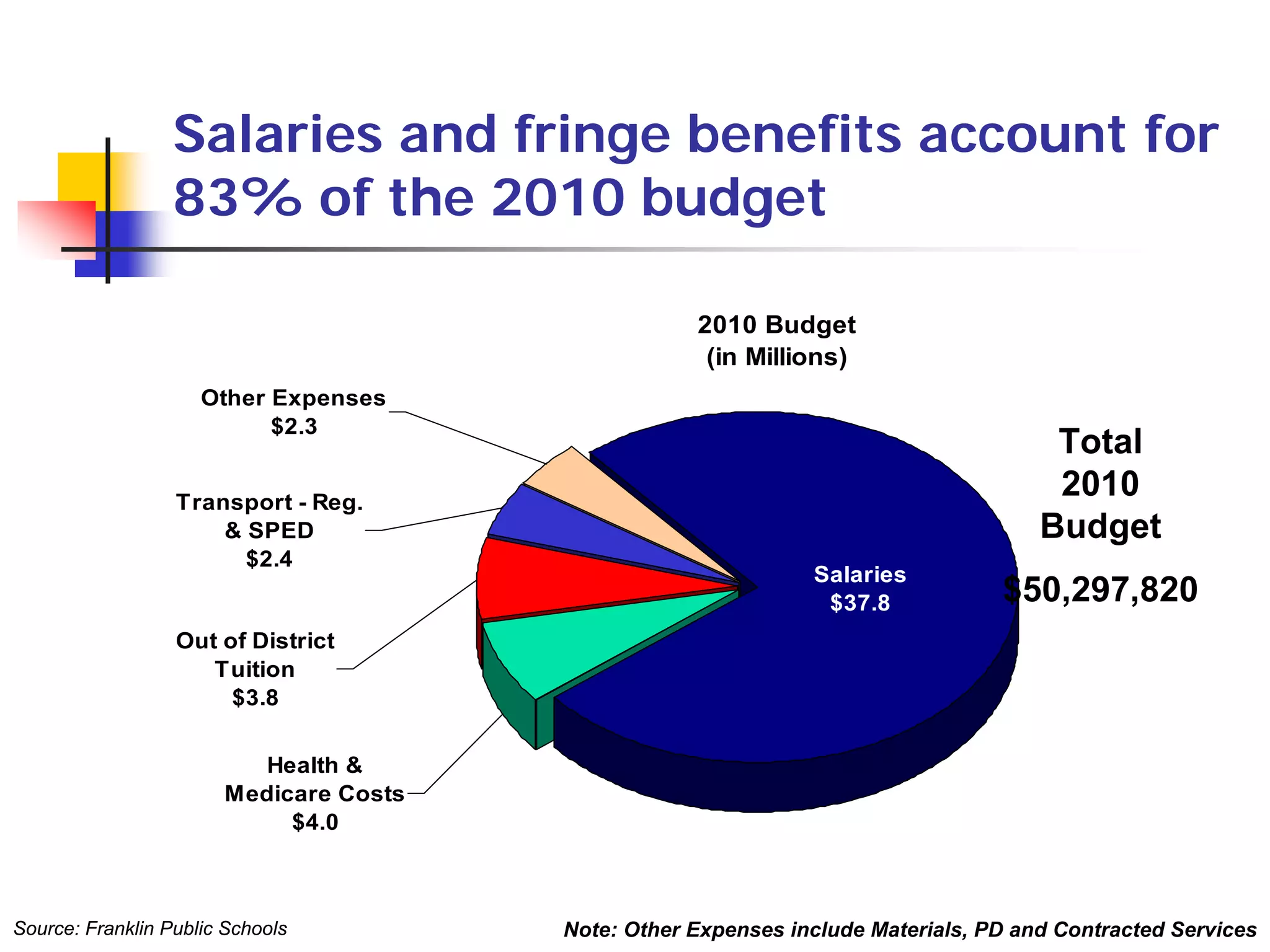
Salaries and fringe benefits account for
                  83% of the 2010 budget

                                                    2010 Budget
                                                     (in Millions)
                     Other Expenses
                           $2.3
                                                                                      Total
                  Transport - Reg.
                                                                                      2010
                      & SPED                                                         Budget
                        $2.4
                                                               Salaries
                                                                $37.8            $50,297,820
                  Out of District
                     Tuition
                       $3.8

                         Health &
                       Medicare Costs
                            $4.0


Source: Franklin Public Schools         Note: Other Expenses include Materials, PD and Contracted Services
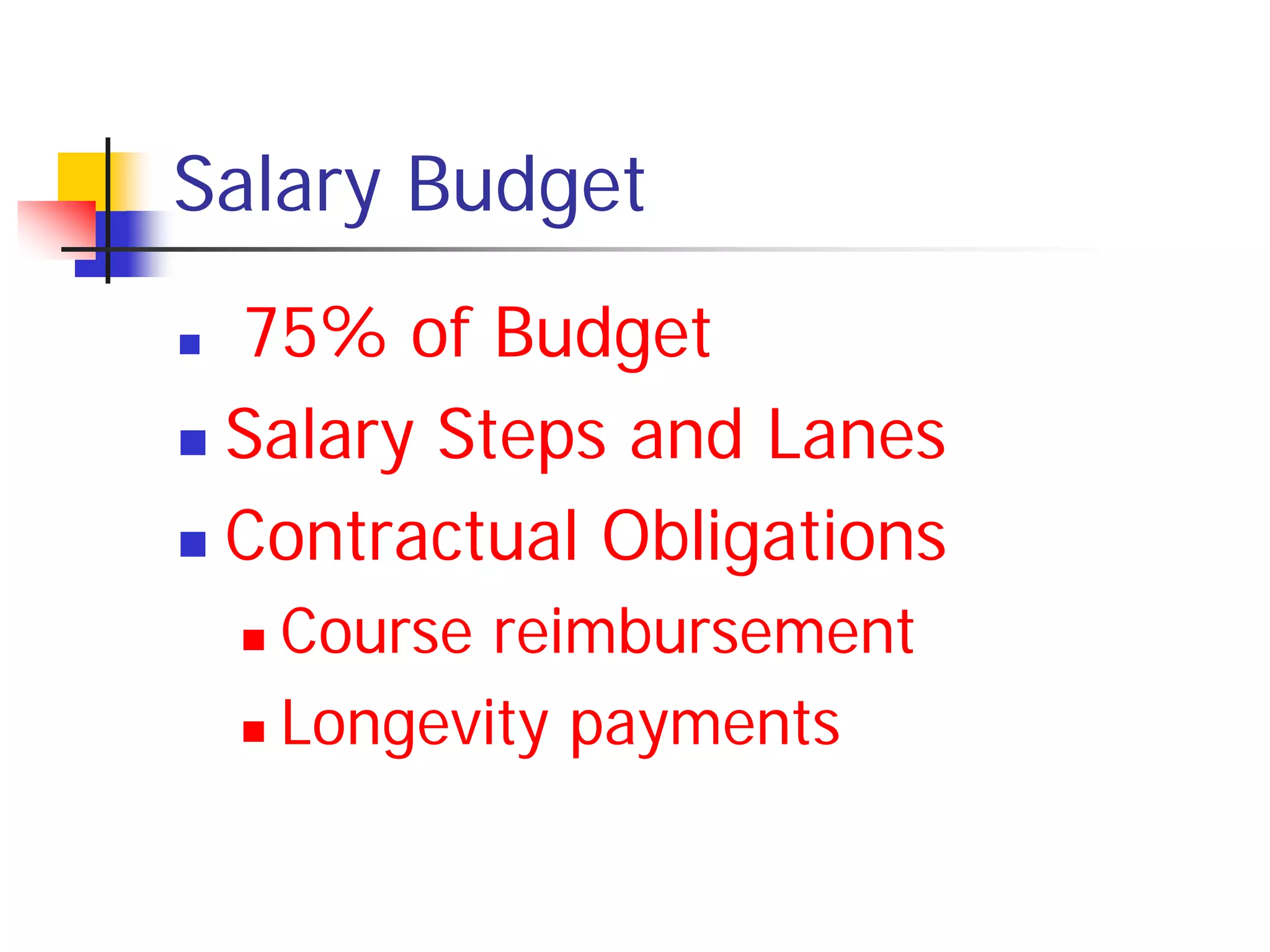
Salary Budget
 75% of Budget
 Salary Steps and Lanes

 Contractual Obligations

     Course reimbursement
     Longevity payments
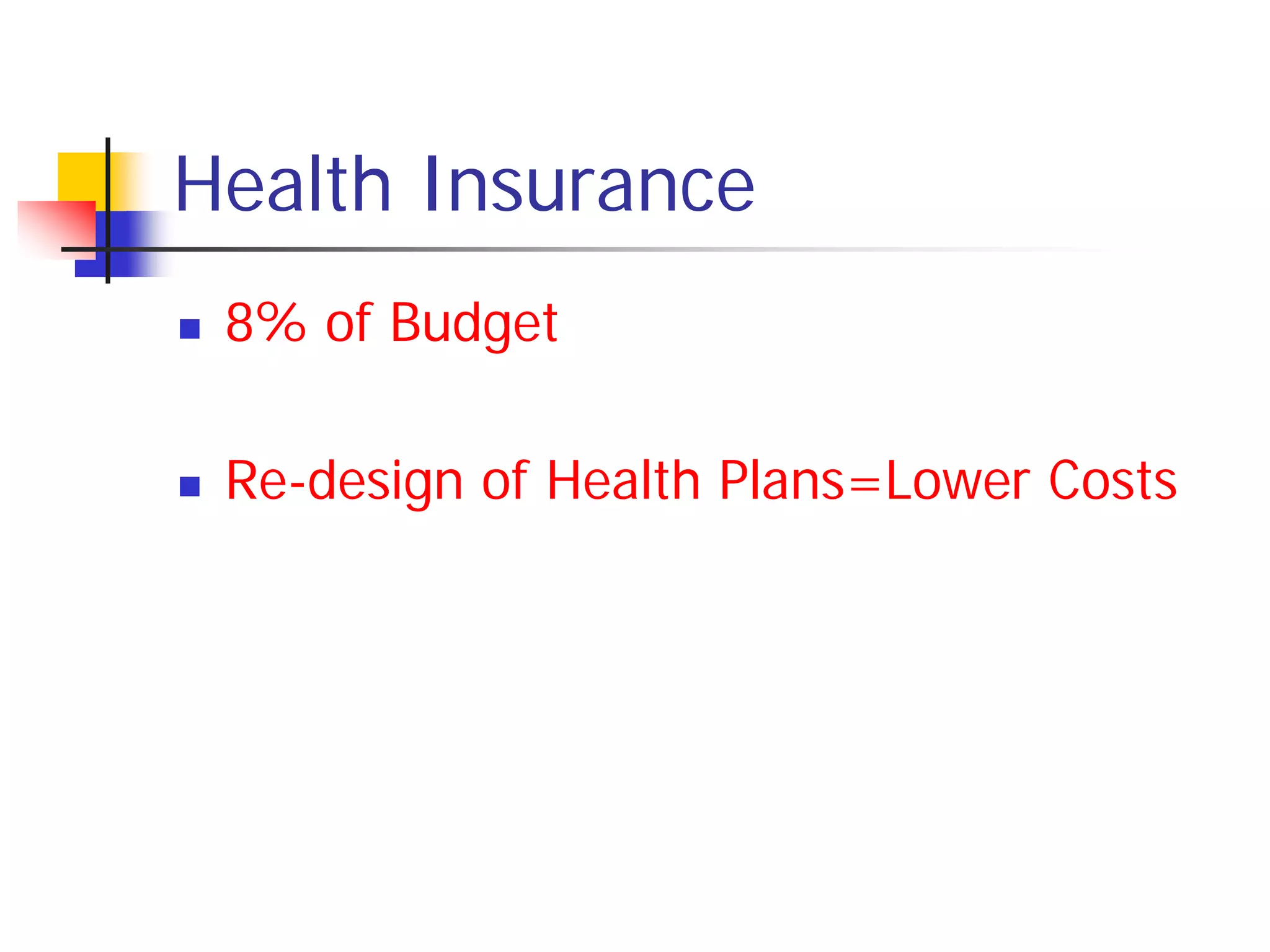
Health Insurance
   8% of Budget

   Re-design of Health Plans=Lower Costs
Transportation
 Cost of contract – 2.4M overall
 Pay to Ride

 In- district Special Education

 Out of district Special Education
  Transportation
Special Education


 Programmatic and Budgetary
      Requirements
  Franklin Public Schools

Sally Winslow & Beth Fitzmaurice
        January 25, 2010
General Assumptions
   Special Education services for eligible
    students are mandated by federal and
    state regulations
   The Federal Law is IDEIA 2004
    (Individuals with Disabilities Education
    Improvement Act)
   The State Law is 603 CMR 28:00
    (formerly Chapter 766)
General Assumptions
   All school districts must follow federal
    requirements under the law

   State requirements must at a minimum
    be consistent with federal law, but can
    exceed federal requirements
General Assumptions
   Under the law, school districts are
    required to provide eligible students
    with a Free and Appropriate Public
    Education (FAPE) within the Least
    Restrictive Environment (LRE)
General Assumptions
   The school district must be able to provide services
    to students with a range of needs

   The types of services and programming provided
    continually change to reflect the current needs of
    students

   Most students will access the curriculum through
    services/programs within the school district (LRE)

   Some children with more intensive, low incidence
    disabilities will require highly specialized outside
    placements in order to access the curriculum
General Assumptions
   Recommendations around eligibility and
    placements are made by the Special
    Education “TEAM”
   The TEAM develops an “IEP” (Individual
    Education Program) which includes services
    to be implemented in the LRE for that child
   Recommendations to place a child in an out
    of district placement are made only after all
    options within the school have been
    exhausted (LRE)
Types of Evaluations
   Psychological (Cognitive)
   Academic Achievement
   Educational History
   Classroom Teacher Report
   Home Assessment
   Speech & Language
   Occupational Therapy
   Physical Therapy
   Specialty Evaluations
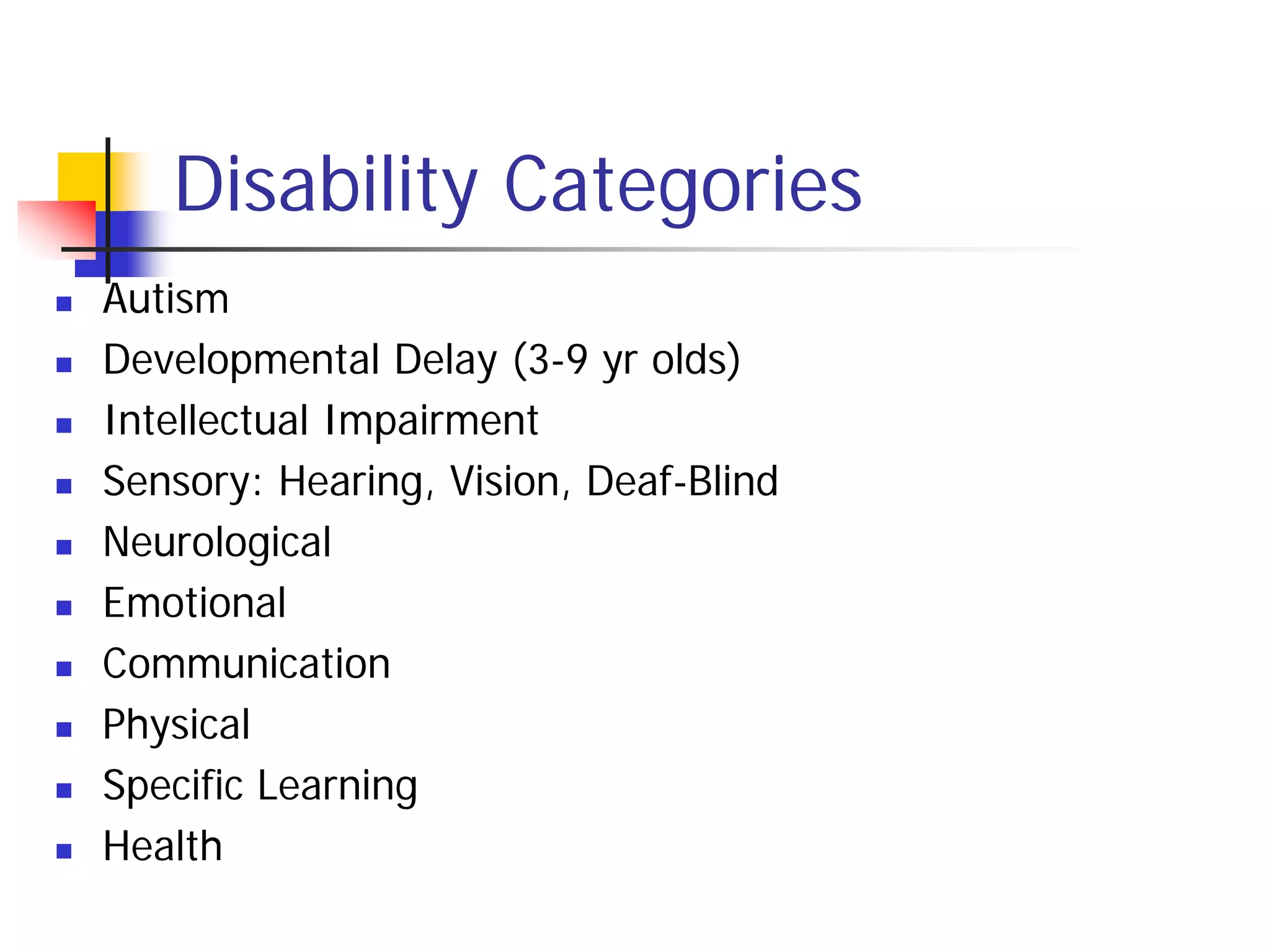
Disability Categories
   Autism
   Developmental Delay (3-9 yr olds)
   Intellectual Impairment
   Sensory: Hearing, Vision, Deaf-Blind
   Neurological
   Emotional
   Communication
   Physical
   Specific Learning
   Health
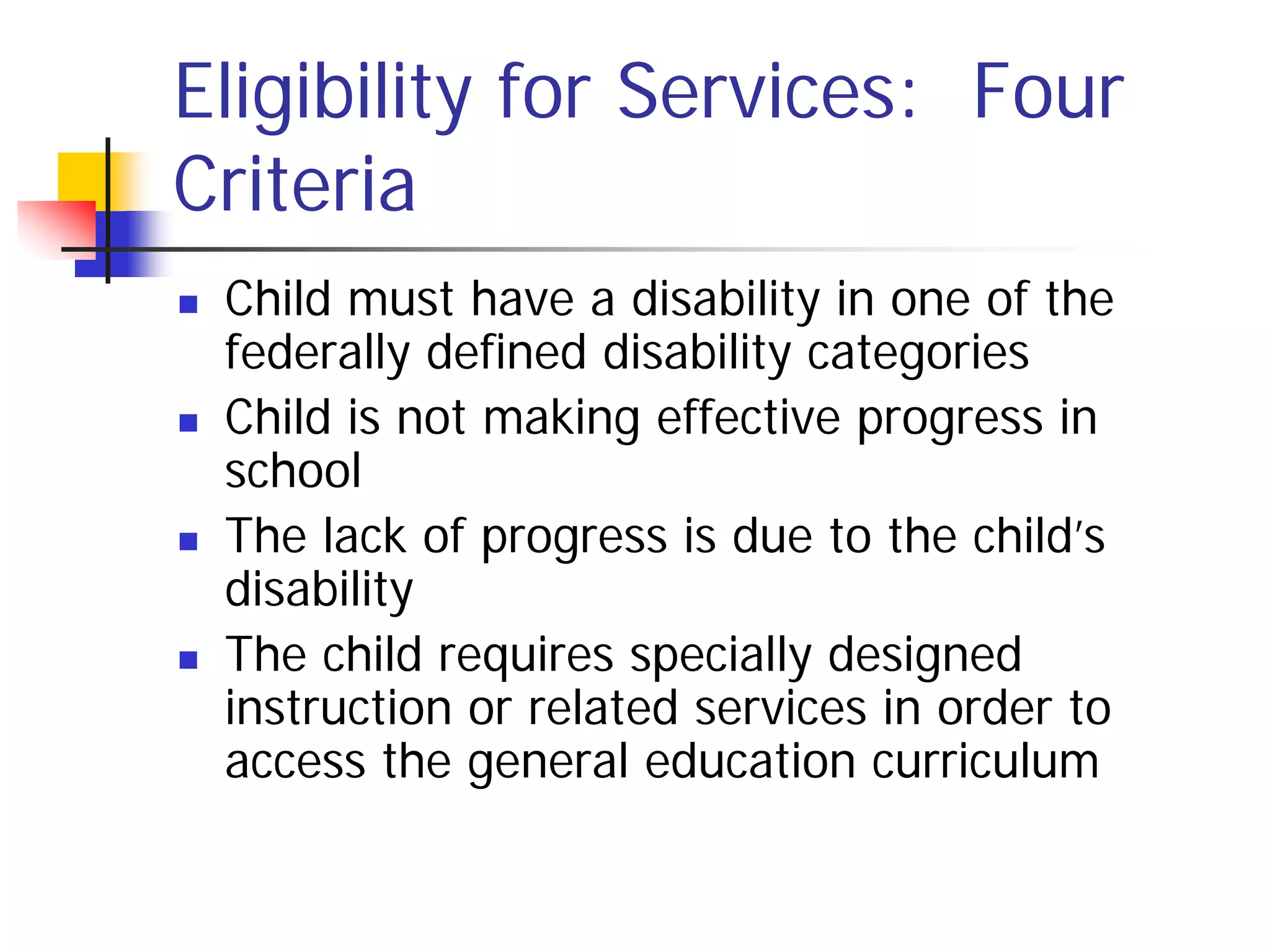
Eligibility for Services: Four
Criteria
   Child must have a disability in one of the
    federally defined disability categories
   Child is not making effective progress in
    school
   The lack of progress is due to the child’s
    disability
   The child requires specially designed
    instruction or related services in order to
    access the general education curriculum
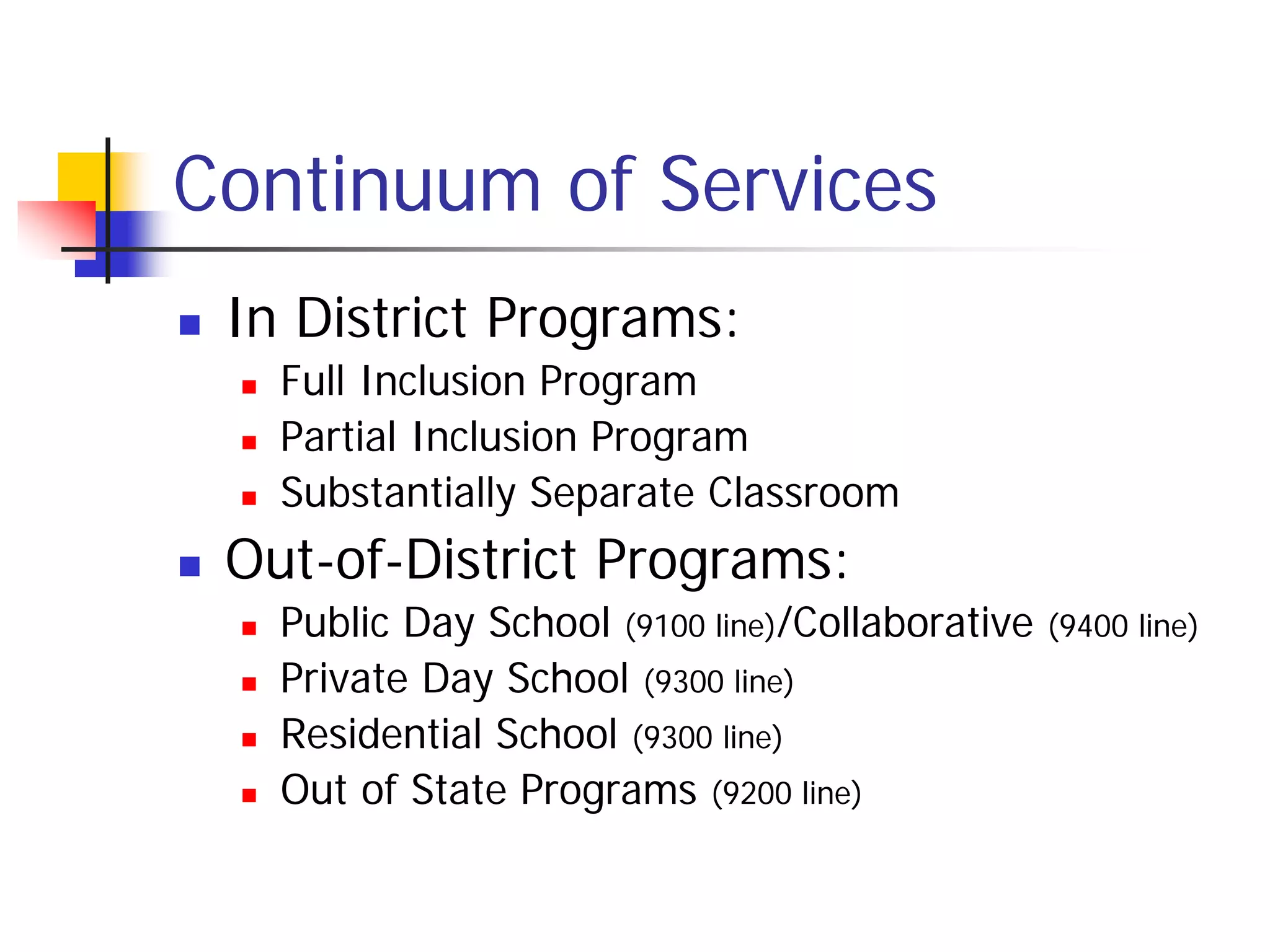
Continuum of Services
   In District Programs:
       Full Inclusion Program
       Partial Inclusion Program
       Substantially Separate Classroom
   Out-of-District Programs:
       Public Day School (9100 line)/Collaborative   (9400 line)
       Private Day School (9300 line)
       Residential School (9300 line)
       Out of State Programs (9200 line)
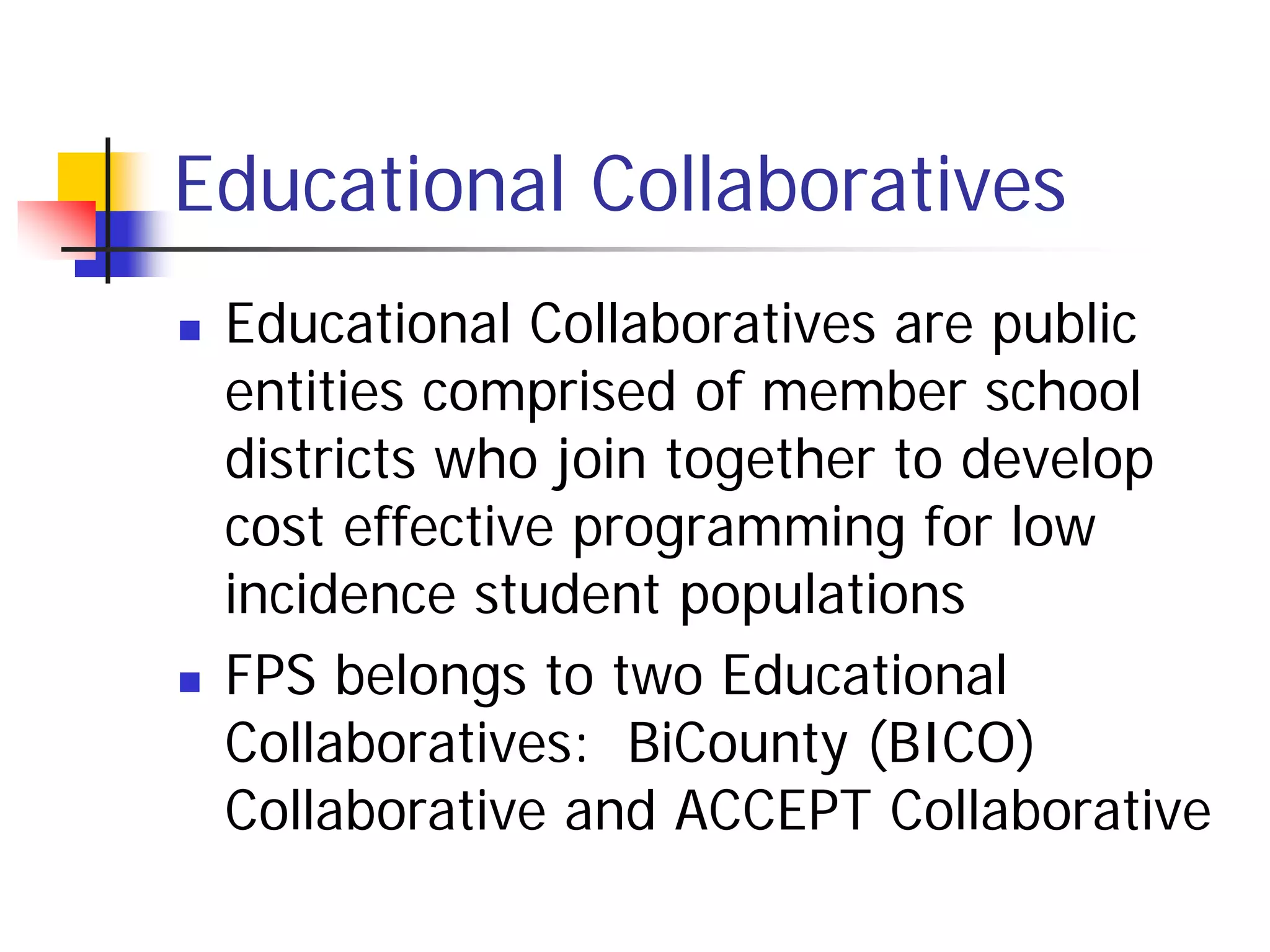
Educational Collaboratives
   Educational Collaboratives are public
    entities comprised of member school
    districts who join together to develop
    cost effective programming for low
    incidence student populations
   FPS belongs to two Educational
    Collaboratives: BiCounty (BICO)
    Collaborative and ACCEPT Collaborative
Educational Collaboratives
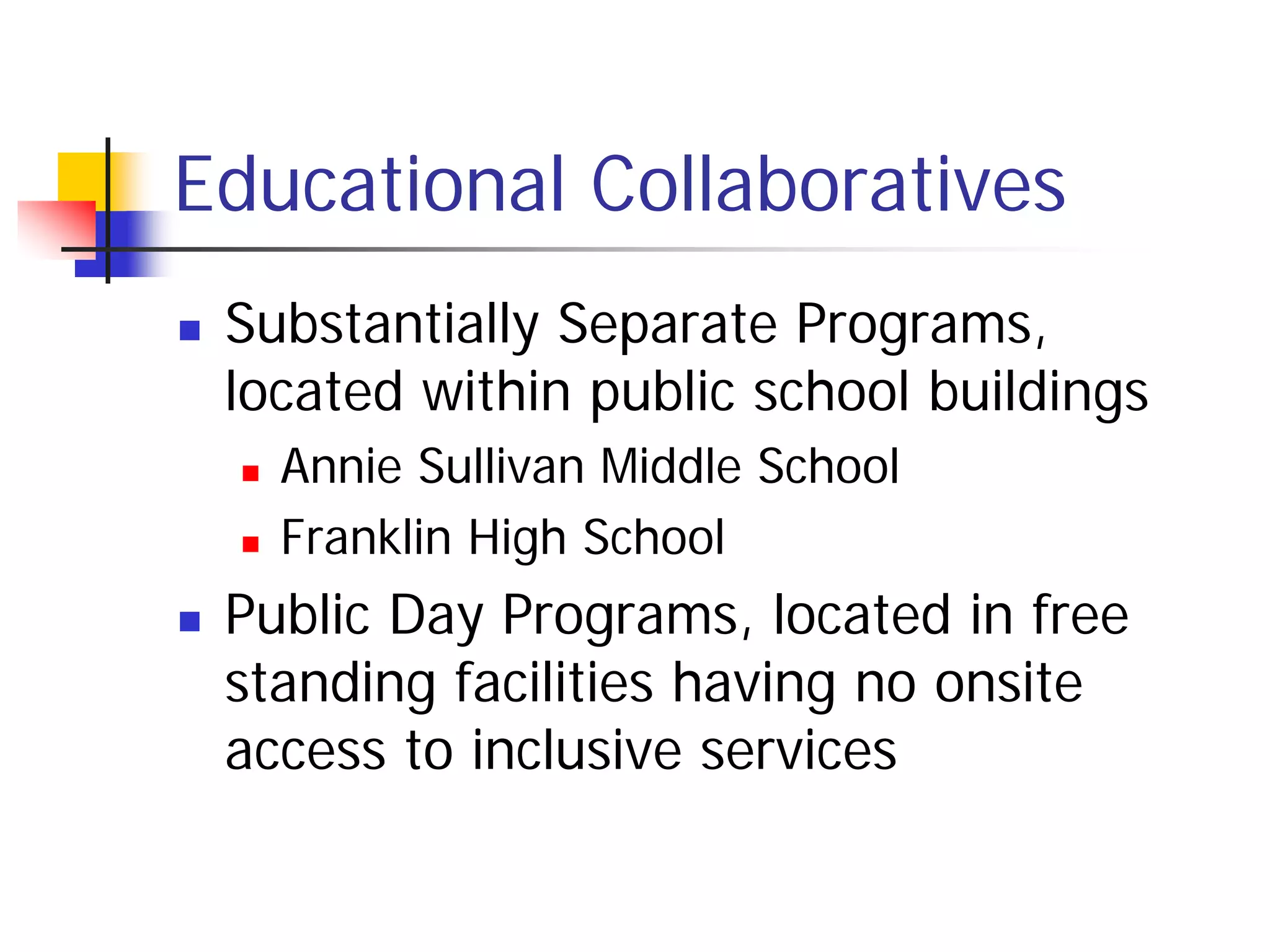
   Substantially Separate Programs,
    located within public school buildings
       Annie Sullivan Middle School
       Franklin High School
   Public Day Programs, located in free
    standing facilities having no onsite
    access to inclusive services
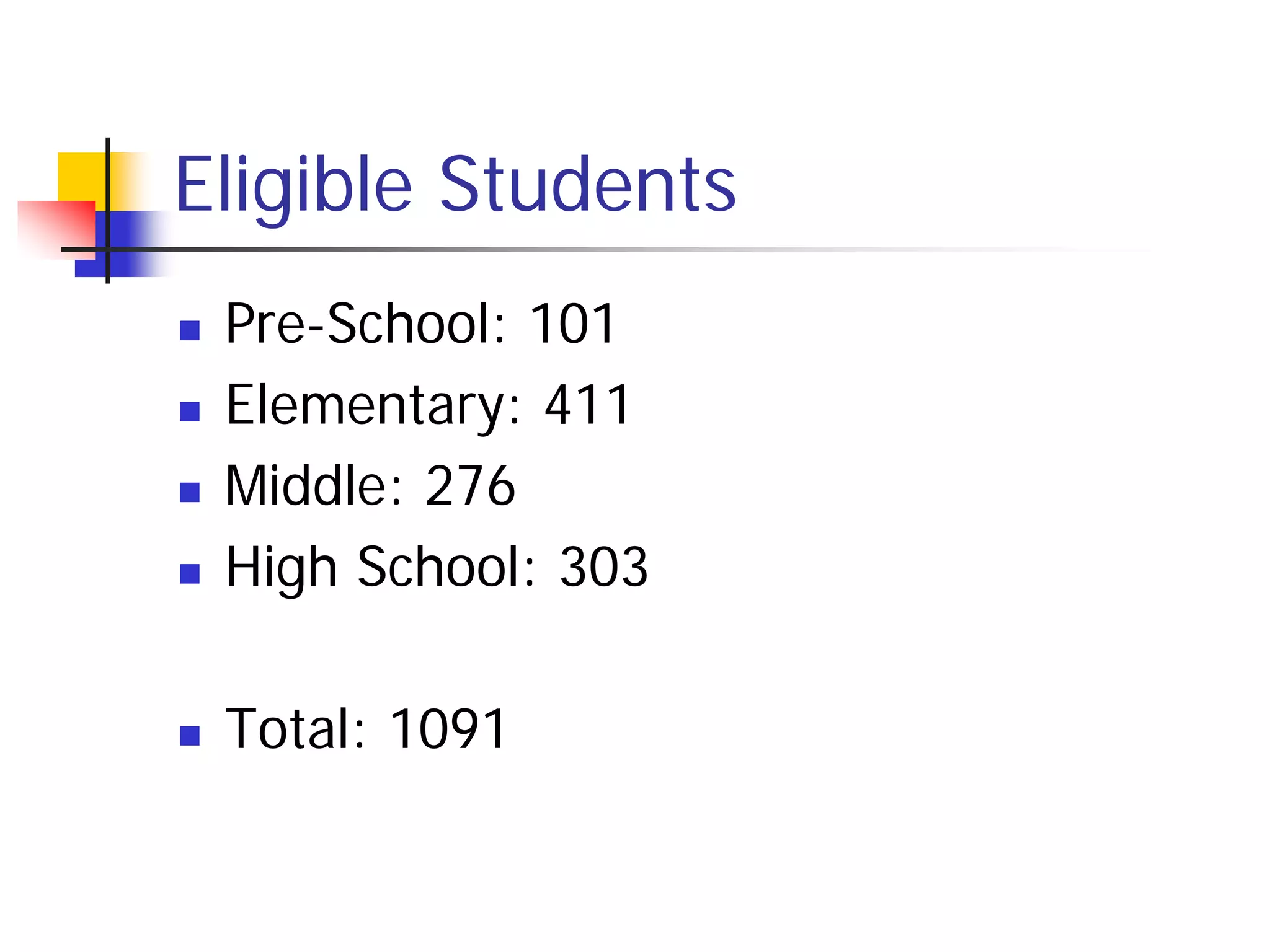
Eligible Students
   Pre-School: 101
   Elementary: 411
   Middle: 276
   High School: 303

   Total: 1091
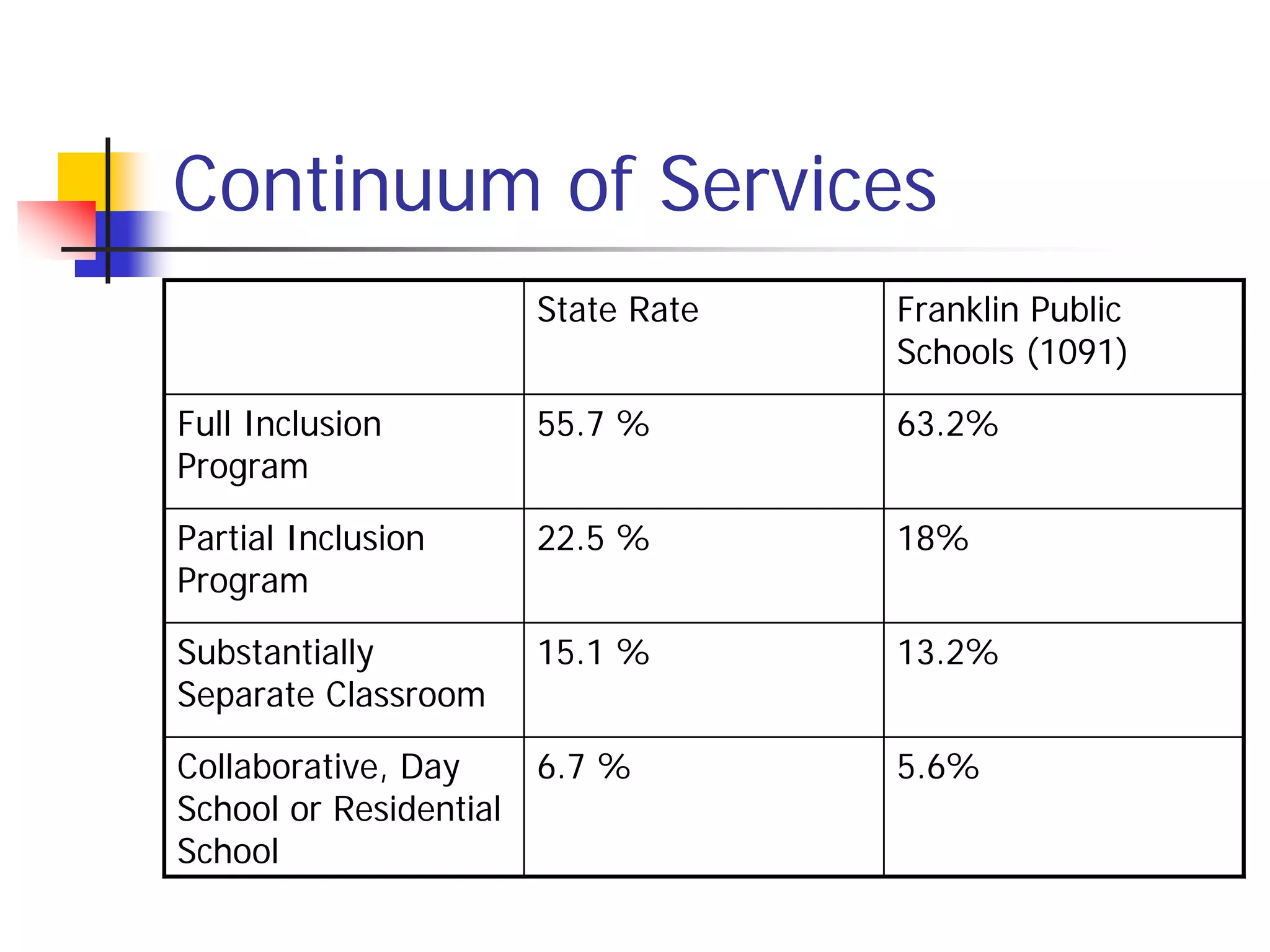
Continuum of Services
                        State Rate   Franklin Public
                                     Schools (1091)

Full Inclusion          55.7 %       63.2%
Program

Partial Inclusion       22.5 %       18%
Program

Substantially           15.1 %       13.2%
Separate Classroom

Collaborative, Day      6.7 %        5.6%
School or Residential
School
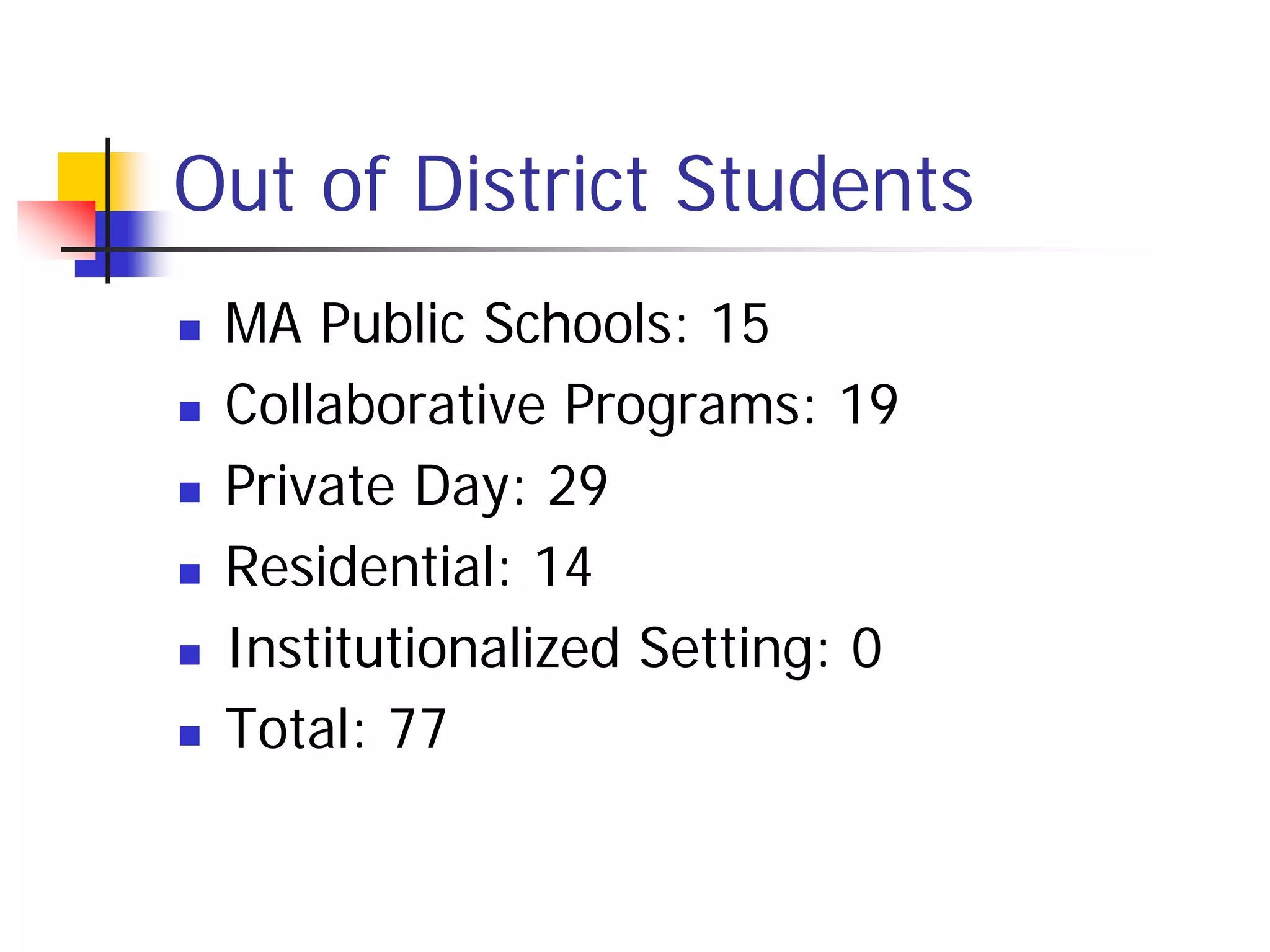
Out of District Students
   MA Public Schools: 15
   Collaborative Programs: 19
   Private Day: 29
   Residential: 14
   Institutionalized Setting: 0
   Total: 77
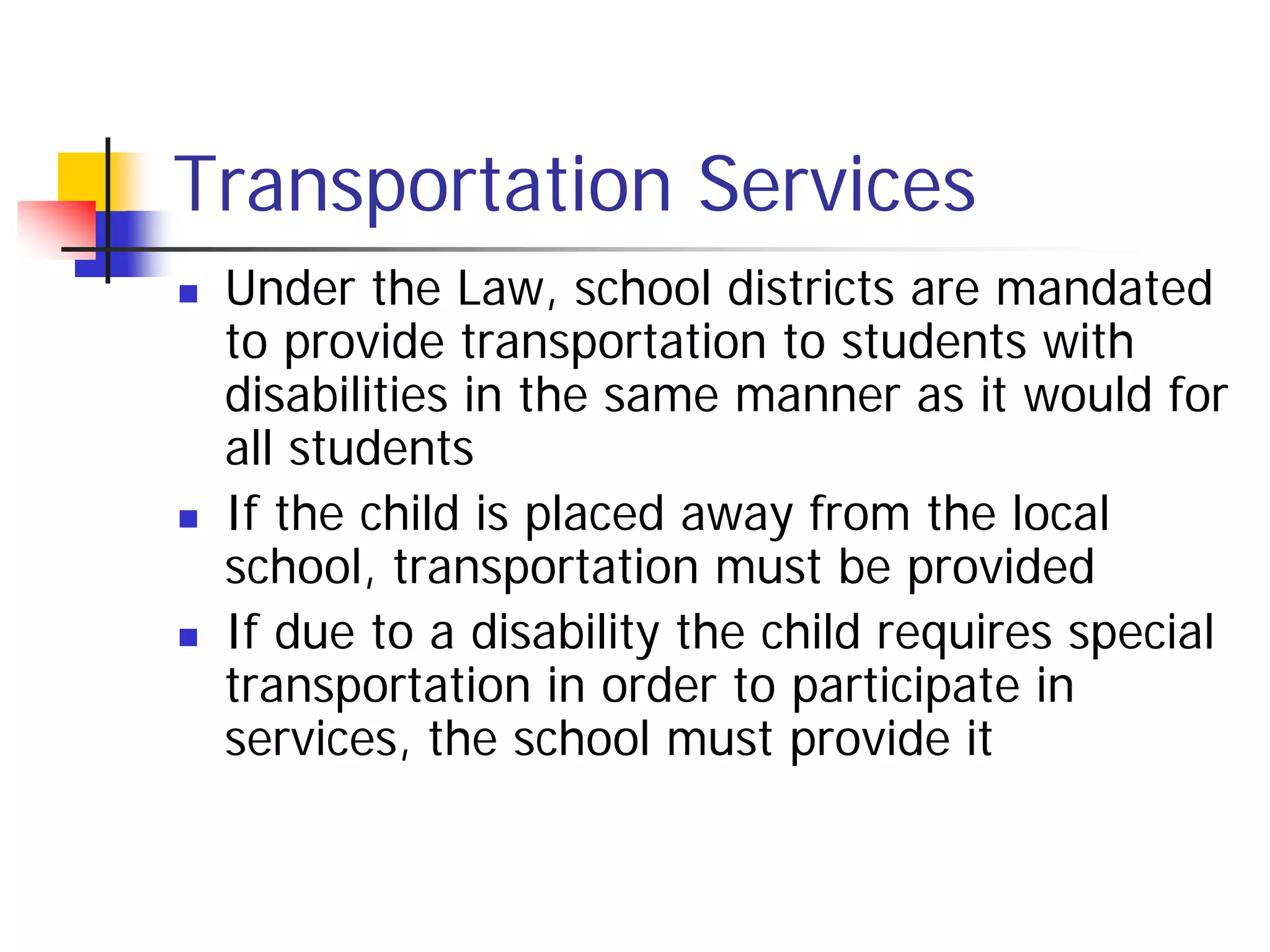
Transportation Services
   Under the Law, school districts are mandated
    to provide transportation to students with
    disabilities in the same manner as it would for
    all students
   If the child is placed away from the local
    school, transportation must be provided
   If due to a disability the child requires special
    transportation in order to participate in
    services, the school must provide it
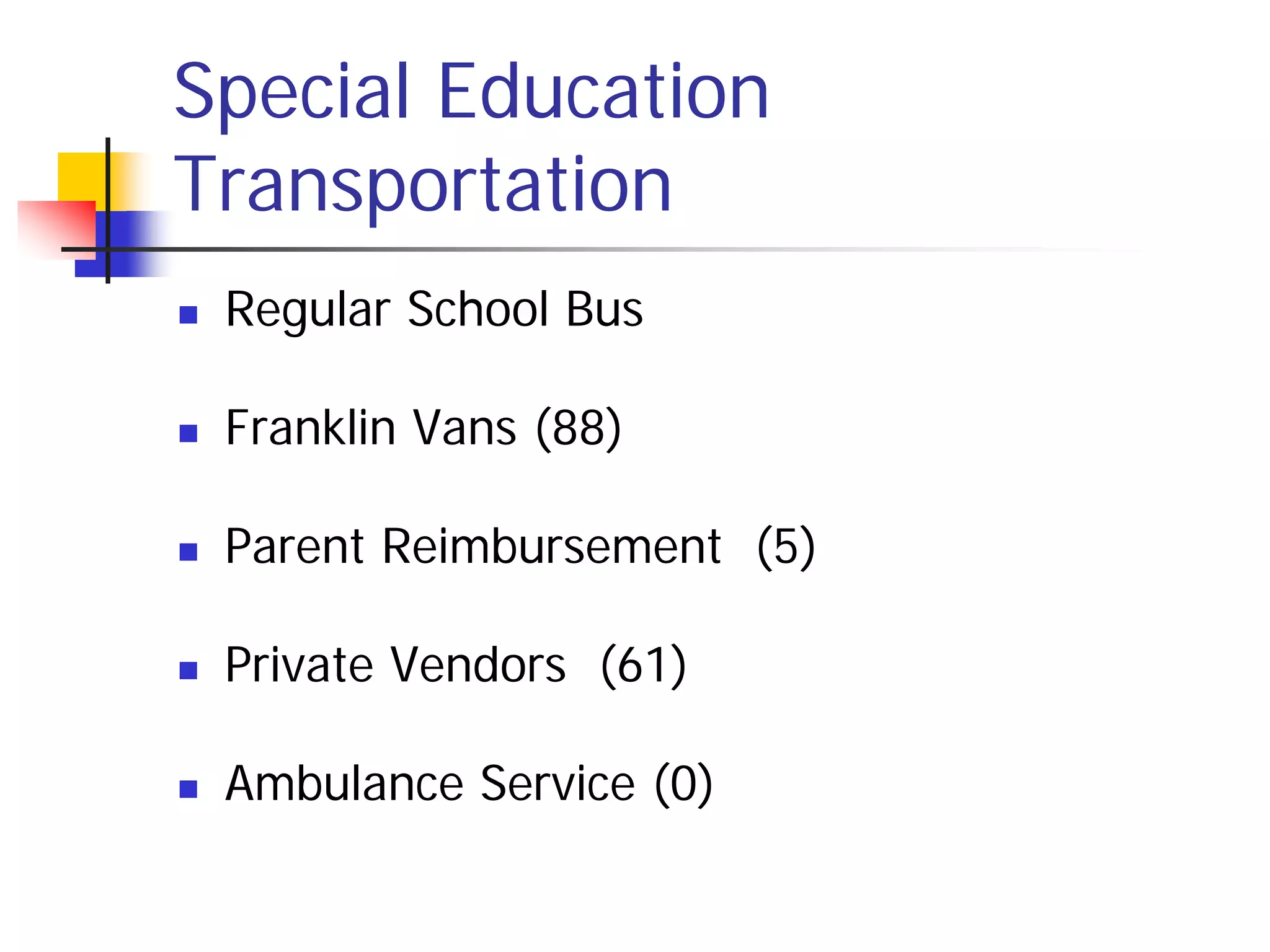
Special Education
Transportation
   Regular School Bus

   Franklin Vans (88)

   Parent Reimbursement (5)

   Private Vendors (61)

   Ambulance Service (0)
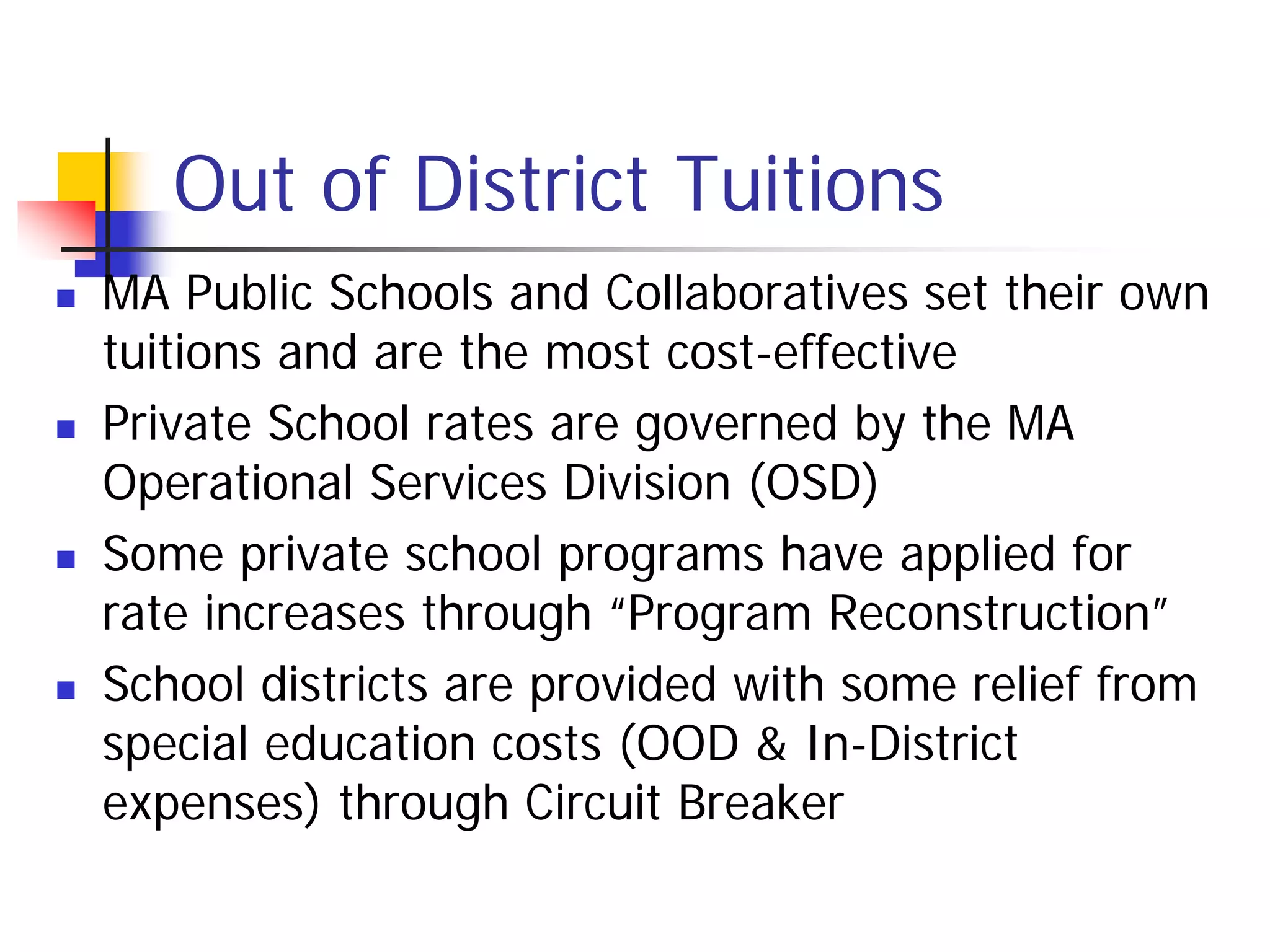
Out of District Tuitions
   MA Public Schools and Collaboratives set their own
    tuitions and are the most cost-effective
   Private School rates are governed by the MA
    Operational Services Division (OSD)
   Some private school programs have applied for
    rate increases through “Program Reconstruction”
   School districts are provided with some relief from
    special education costs (OOD & In-District
    expenses) through Circuit Breaker
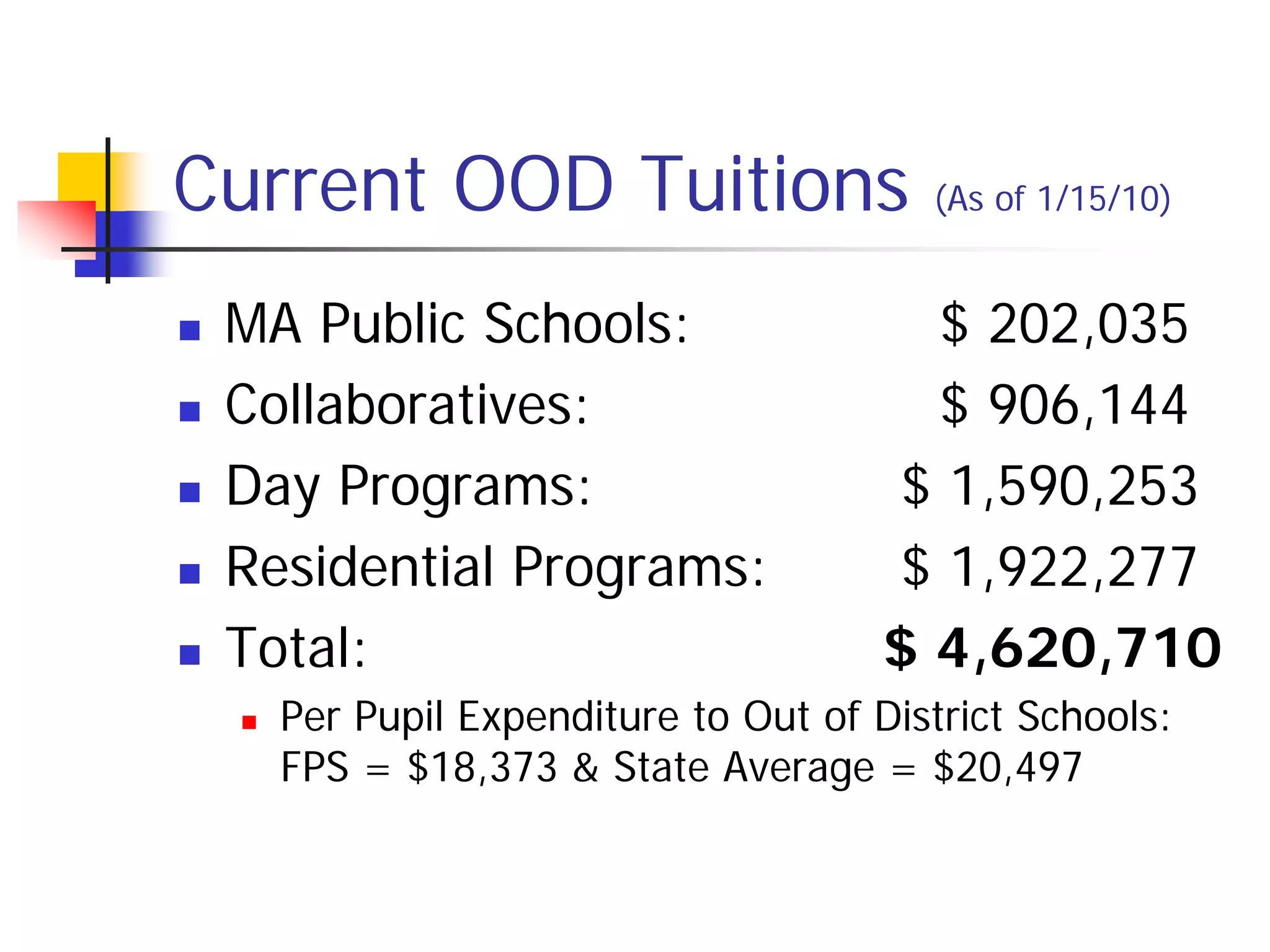
Current OOD Tuitions                       (As of 1/15/10)


   MA Public Schools:                     $ 202,035
   Collaboratives:                        $ 906,144
   Day Programs:                        $ 1,590,253
   Residential Programs:                $ 1,922,277
   Total:                               $ 4,620,710
       Per Pupil Expenditure to Out of District Schools:
        FPS = $18,373 & State Average = $20,497
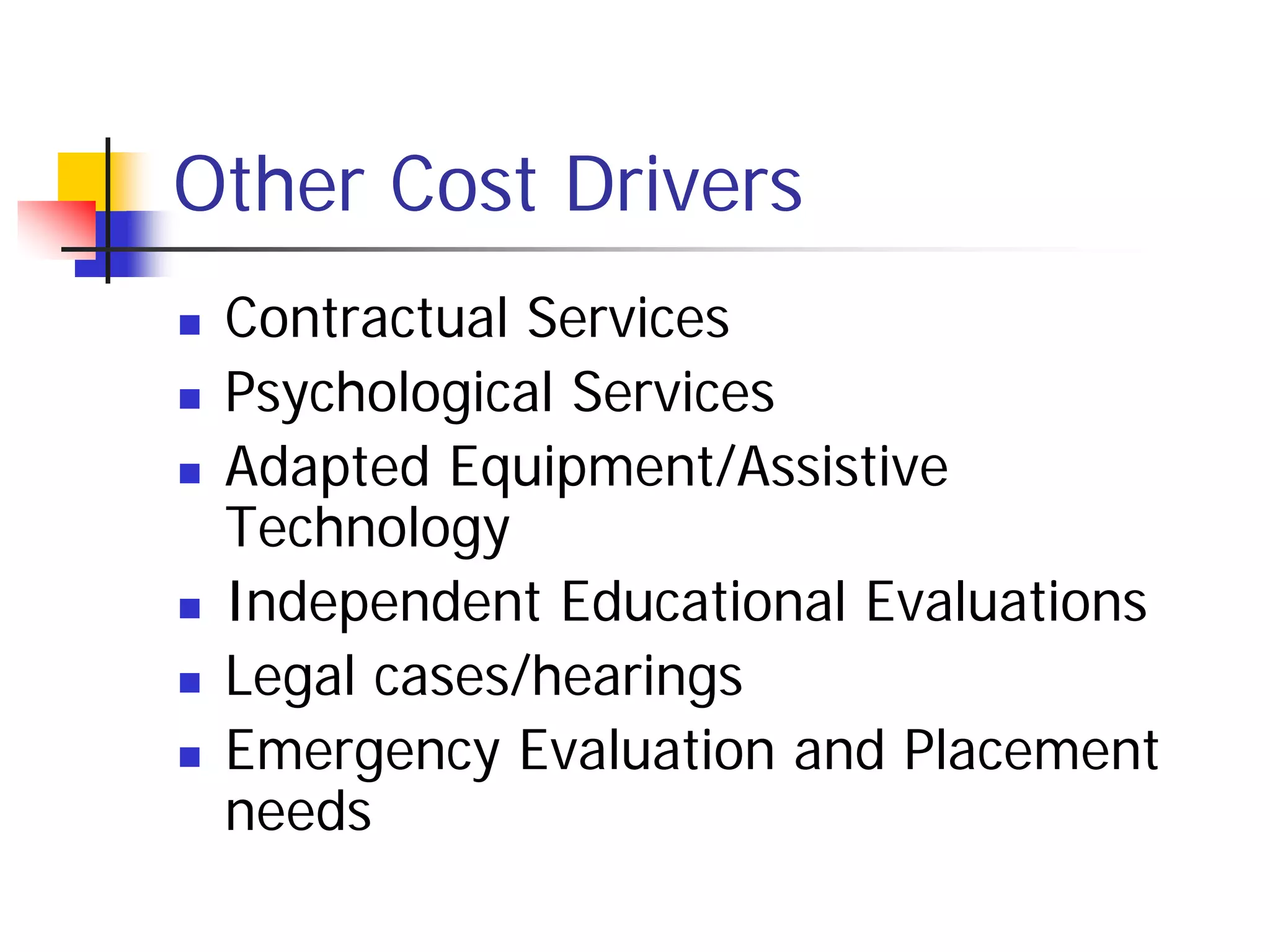
Other Cost Drivers
   Contractual Services
   Psychological Services
   Adapted Equipment/Assistive
    Technology
   Independent Educational Evaluations
   Legal cases/hearings
   Emergency Evaluation and Placement
    needs
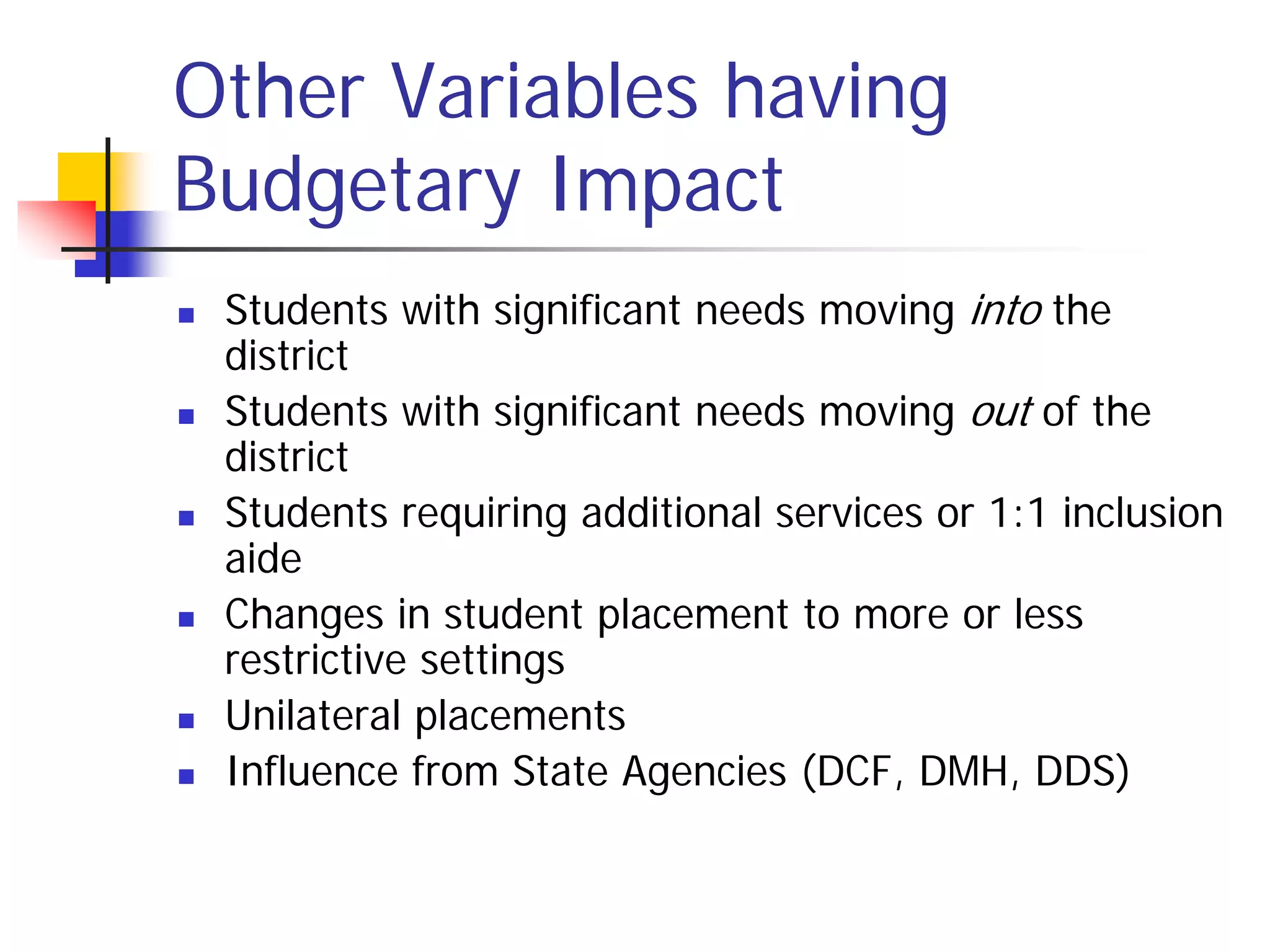
Other Variables having
Budgetary Impact
   Students with significant needs moving into the
    district
   Students with significant needs moving out of the
    district
   Students requiring additional services or 1:1 inclusion
    aide
   Changes in student placement to more or less
    restrictive settings
   Unilateral placements
   Influence from State Agencies (DCF, DMH, DDS)
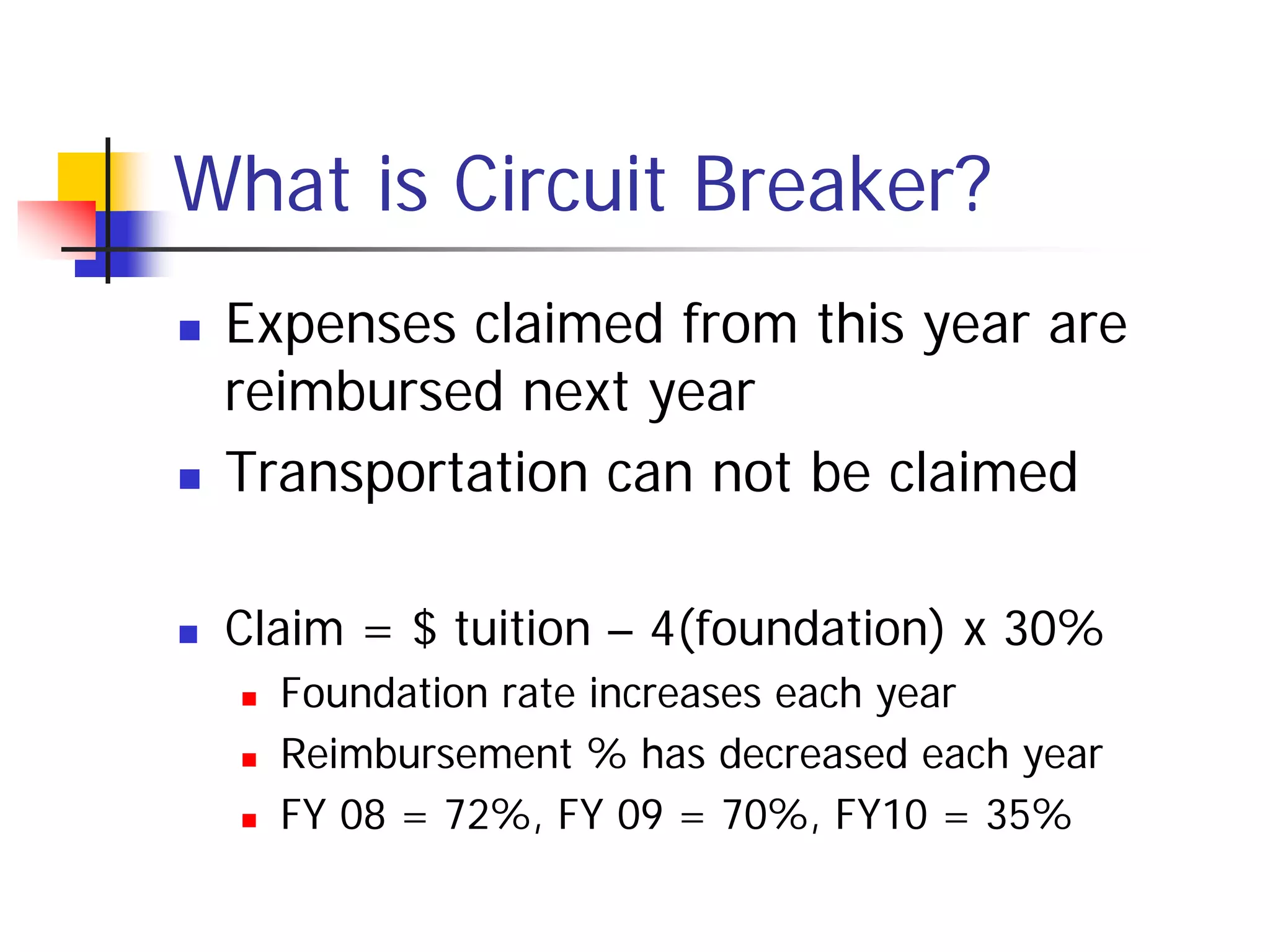
What is Circuit Breaker?
   Expenses claimed from this year are
    reimbursed next year
   Transportation can not be claimed

   Claim = $ tuition – 4(foundation) x 30%
       Foundation rate increases each year
       Reimbursement % has decreased each year
       FY 08 = 72%, FY 09 = 70%, FY10 = 35%
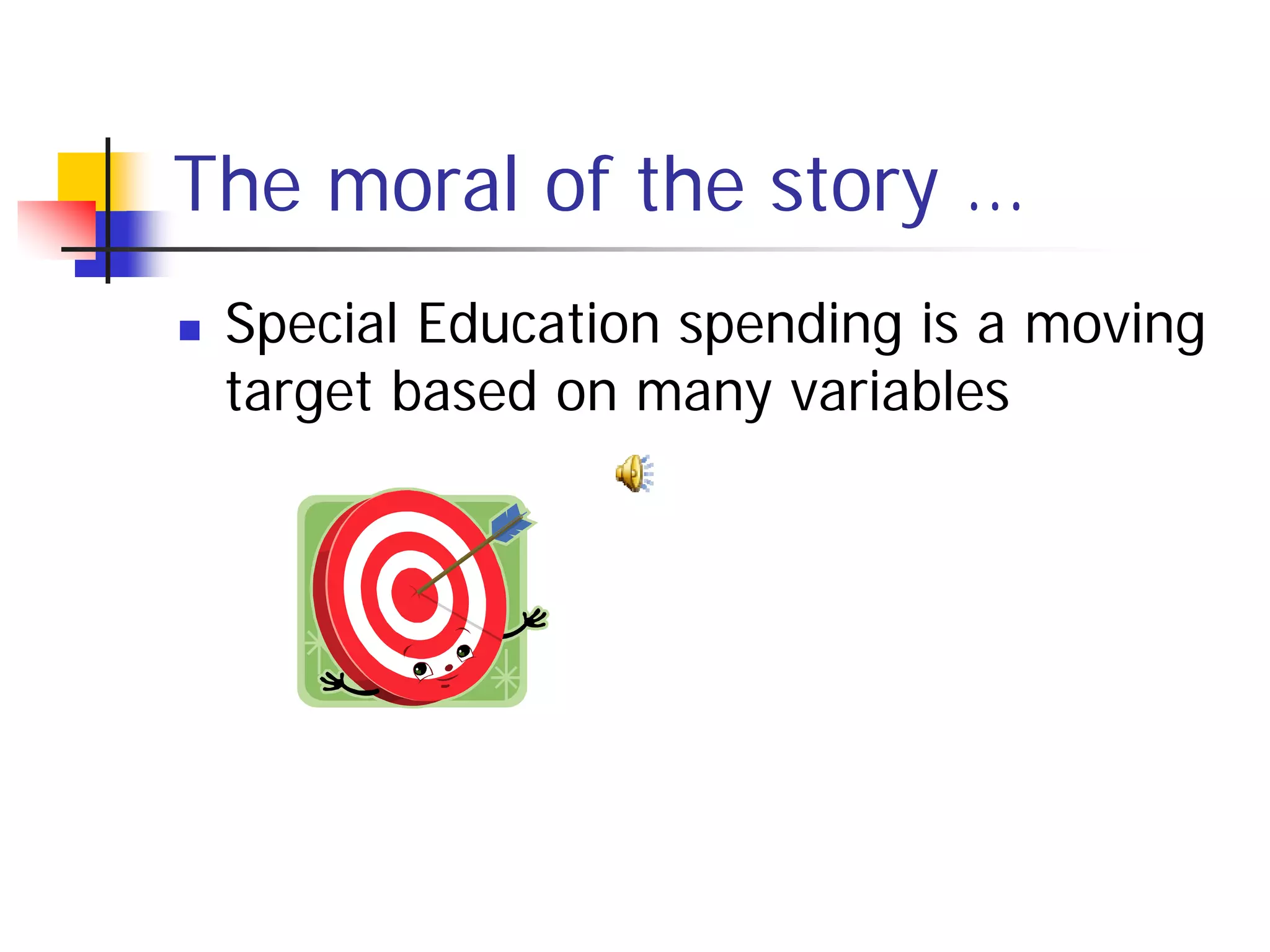
The moral of the story …
   Special Education spending is a moving
    target based on many variables
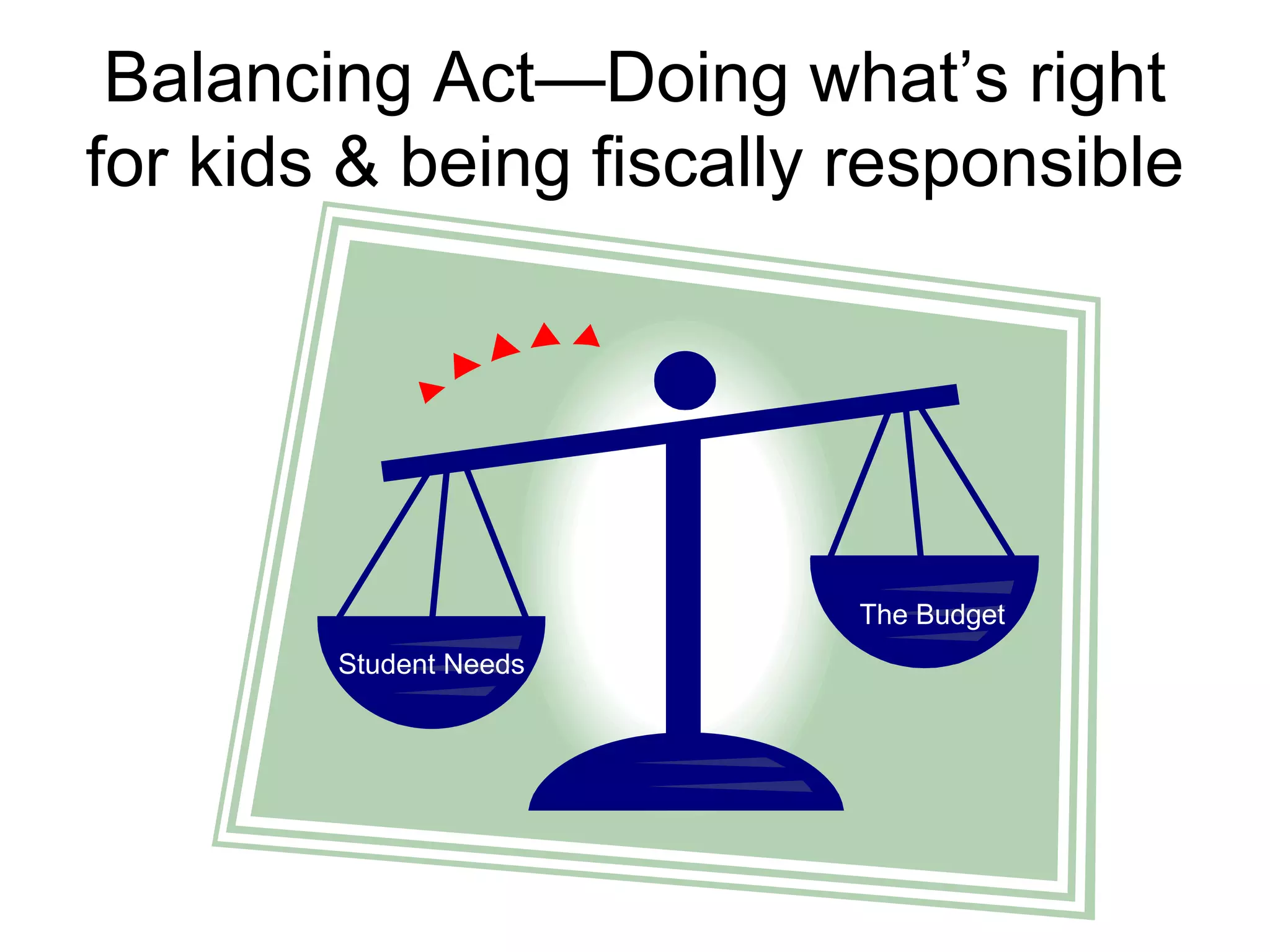
Balancing Act—Doing what’s right
for kids & being fiscally responsible


                          The Budget
        Student Needs

FPS - Understanding the Budget 1/25/10

  • 1.
    Franklin Public Schools School Budget Drivers Salary Health Insurance Transportation Special Education
  • 2.
    Salaries and fringebenefits account for 83% of the 2010 budget 2010 Budget (in Millions) Other Expenses $2.3 Total Transport - Reg. 2010 & SPED Budget $2.4 Salaries $37.8 $50,297,820 Out of District Tuition $3.8 Health & Medicare Costs $4.0 Source: Franklin Public Schools Note: Other Expenses include Materials, PD and Contracted Services
  • 3.
    Salary Budget  75%of Budget  Salary Steps and Lanes  Contractual Obligations  Course reimbursement  Longevity payments
  • 4.
    Health Insurance  8% of Budget  Re-design of Health Plans=Lower Costs
  • 5.
    Transportation  Cost ofcontract – 2.4M overall  Pay to Ride  In- district Special Education  Out of district Special Education Transportation
  • 6.
    Special Education Programmaticand Budgetary Requirements Franklin Public Schools Sally Winslow & Beth Fitzmaurice January 25, 2010
  • 7.
    General Assumptions  Special Education services for eligible students are mandated by federal and state regulations  The Federal Law is IDEIA 2004 (Individuals with Disabilities Education Improvement Act)  The State Law is 603 CMR 28:00 (formerly Chapter 766)
  • 8.
    General Assumptions  All school districts must follow federal requirements under the law  State requirements must at a minimum be consistent with federal law, but can exceed federal requirements
  • 9.
    General Assumptions  Under the law, school districts are required to provide eligible students with a Free and Appropriate Public Education (FAPE) within the Least Restrictive Environment (LRE)
  • 10.
    General Assumptions  The school district must be able to provide services to students with a range of needs  The types of services and programming provided continually change to reflect the current needs of students  Most students will access the curriculum through services/programs within the school district (LRE)  Some children with more intensive, low incidence disabilities will require highly specialized outside placements in order to access the curriculum
  • 11.
    General Assumptions  Recommendations around eligibility and placements are made by the Special Education “TEAM”  The TEAM develops an “IEP” (Individual Education Program) which includes services to be implemented in the LRE for that child  Recommendations to place a child in an out of district placement are made only after all options within the school have been exhausted (LRE)
  • 12.
    Types of Evaluations  Psychological (Cognitive)  Academic Achievement  Educational History  Classroom Teacher Report  Home Assessment  Speech & Language  Occupational Therapy  Physical Therapy  Specialty Evaluations
  • 13.
    Disability Categories  Autism  Developmental Delay (3-9 yr olds)  Intellectual Impairment  Sensory: Hearing, Vision, Deaf-Blind  Neurological  Emotional  Communication  Physical  Specific Learning  Health
  • 14.
    Eligibility for Services:Four Criteria  Child must have a disability in one of the federally defined disability categories  Child is not making effective progress in school  The lack of progress is due to the child’s disability  The child requires specially designed instruction or related services in order to access the general education curriculum
  • 15.
    Continuum of Services  In District Programs:  Full Inclusion Program  Partial Inclusion Program  Substantially Separate Classroom  Out-of-District Programs:  Public Day School (9100 line)/Collaborative (9400 line)  Private Day School (9300 line)  Residential School (9300 line)  Out of State Programs (9200 line)
  • 16.
    Educational Collaboratives  Educational Collaboratives are public entities comprised of member school districts who join together to develop cost effective programming for low incidence student populations  FPS belongs to two Educational Collaboratives: BiCounty (BICO) Collaborative and ACCEPT Collaborative
  • 17.
    Educational Collaboratives  Substantially Separate Programs, located within public school buildings  Annie Sullivan Middle School  Franklin High School  Public Day Programs, located in free standing facilities having no onsite access to inclusive services
  • 18.
    Eligible Students  Pre-School: 101  Elementary: 411  Middle: 276  High School: 303  Total: 1091
  • 19.
    Continuum of Services State Rate Franklin Public Schools (1091) Full Inclusion 55.7 % 63.2% Program Partial Inclusion 22.5 % 18% Program Substantially 15.1 % 13.2% Separate Classroom Collaborative, Day 6.7 % 5.6% School or Residential School
  • 20.
    Out of DistrictStudents  MA Public Schools: 15  Collaborative Programs: 19  Private Day: 29  Residential: 14  Institutionalized Setting: 0  Total: 77
  • 21.
    Transportation Services  Under the Law, school districts are mandated to provide transportation to students with disabilities in the same manner as it would for all students  If the child is placed away from the local school, transportation must be provided  If due to a disability the child requires special transportation in order to participate in services, the school must provide it
  • 22.
    Special Education Transportation  Regular School Bus  Franklin Vans (88)  Parent Reimbursement (5)  Private Vendors (61)  Ambulance Service (0)
  • 23.
    Out of DistrictTuitions  MA Public Schools and Collaboratives set their own tuitions and are the most cost-effective  Private School rates are governed by the MA Operational Services Division (OSD)  Some private school programs have applied for rate increases through “Program Reconstruction”  School districts are provided with some relief from special education costs (OOD & In-District expenses) through Circuit Breaker
  • 24.
    Current OOD Tuitions (As of 1/15/10)  MA Public Schools: $ 202,035  Collaboratives: $ 906,144  Day Programs: $ 1,590,253  Residential Programs: $ 1,922,277  Total: $ 4,620,710  Per Pupil Expenditure to Out of District Schools: FPS = $18,373 & State Average = $20,497
  • 25.
    Other Cost Drivers  Contractual Services  Psychological Services  Adapted Equipment/Assistive Technology  Independent Educational Evaluations  Legal cases/hearings  Emergency Evaluation and Placement needs
  • 26.
    Other Variables having BudgetaryImpact  Students with significant needs moving into the district  Students with significant needs moving out of the district  Students requiring additional services or 1:1 inclusion aide  Changes in student placement to more or less restrictive settings  Unilateral placements  Influence from State Agencies (DCF, DMH, DDS)
  • 27.
    What is CircuitBreaker?  Expenses claimed from this year are reimbursed next year  Transportation can not be claimed  Claim = $ tuition – 4(foundation) x 30%  Foundation rate increases each year  Reimbursement % has decreased each year  FY 08 = 72%, FY 09 = 70%, FY10 = 35%
  • 28.
    The moral ofthe story …  Special Education spending is a moving target based on many variables
  • 29.
    Balancing Act—Doing what’sright for kids & being fiscally responsible The Budget Student Needs