2012 PENNSYLVANIA
BUDGET ANALYSIS
United Way of Pennsylvania
2011 NON PROFIT BUDGET SURVEY


 In late 2011, United Way of
 Pennsylvania conducted a survey
 of over 800 nonprofits across the
 Commonwealth to assess the
 impact of state budget cuts.
2011 NON PROFIT BUDGET
SURVEY

Results include:
• 69 percent of agencies
received a funding cut in
2011-12 state budget.
• 80 percent of agencies
report conditions related to
the economy have increased
demand for services.
2011 NON PROFIT BUDGET
              SURVEY


If your organization's state funding
has been cut, how much have state
funding revenues declined by
percentage?
20 percent or less     77%
21 to 30 percent       9%
31 or more percent     14%
2011 NON PROFIT BUDGET SURVEY

Select all the ways the budget cuts
this year (FY 11-12) have impacted
your organization?
•We have laid off staff 52 %
•We have canceled programs
completely 32 %
•We have cut back program hours
46%
•We have expanded our waiting list
for services 45%
2011 NON PROFIT BUDGET
             SURVEY
If your organization maintains a waiting
list, how many people were put on a waiting
list as a result of FY 11-12 budget cuts?

1 to 20        58%
21 to 40       18%
41 to 50       3%
51 or more     21%
2011 NON PROFIT BUDGET SURVEY

How have your non-governmental sources of
funds (ie: private foundation grants,
individual donations) changed in the last 12
months?
Our non-governmental funding           36%
has remained flat
Our non-governmental funding has       38%
decreased
SUPPORT FREE
ENTERPRISE AND JOB
CREATION
C Comprehensive Job Matching System – The budget continues
support for a new workforce development system that will
dramatically improve job search capabilities by p y adding
sophisticated “spidering” technology linked to numerous job
posting engines.


p Keystone Works – The budget provides $2.5 million to
facilitate the rapid return to work for recently unemployed
individuals. Keystone Works will provide employer-driven
training opportunities for unemployed workers.


t Targeted Industry Cluster Certificate Program – In
partnership with the Pennsylvania Higher Education Assistance
Agency (PHEAA), the Corbett administration will create a
Targeted Industry Cluster Certificate Program for certain high-
priority occupations. In the first year, the budget recommends
$5 million targeted to the energy, agriculture and building and
construction industry clusters.
INDUSTRY PARTNERSHIPS
 The Governor’s proposed budget for 2012-13
  lowers the budget for Industry Partnerships from
  $1.613 million to $1.452 million.
 The budget leaves at zero the budget for
  “Training Activities.” This line item had funded
  Industry Partnership incumbent worker training.
 Peak of $15 million (from 2005-06 to 2008-09),
  declining to $5.834 million to 2010-11 before
  being zeroed out in 2011-12.
VALUE OF INDUSTRY
  PARTNERSHIPS
INDUSTRY PARTNERSHIPS
 Nero from Pittsburgh
 Employed at a local laundry facility for over ten
  year before they closed
 The Labor-Management Clearinghouse
 “I’m not the kind of guy that would be satisfied
  just [lying] around collecting unemployment. I
  need to be working.”
 Nero was soon referred to a hospitality partner of
  the L-MC, the Sheraton Station Square
 The L-MC team and the Sheraton worked
  together to identify Nero’s strengths to find a
  position that best suited his personality and their
  hiring needs
STUDENT ACHIEVEMENT
EDUCATION BLOCK GRANT

The 2012-13 budget proposes $6.5
billion in Student Achievement
Education Block Grant funds for
school districts. According to the
Administration, this new
approach provides flexibility to
local education decision-makers
to allocate funding to best achieve
academic goals and meet legal
requirements while reducing
administrative burdens and
compliance costs.
STUDENT ACHIEVEMENT
EDUCATION BLOCK GRANT
The following appropriations will be
  “block-granted:”

   Basic Education Funding - $5.35
    billion
   Pupil Transportation - $542.3
    million (including Intermediate
    Unit special education
    transportation funding)
   Nonpublic and Charter
    Transportation - $77.7 million
   Social Security – $504.8 million to
    school districts and $36.8 million
    for intermediate units
FUNDING SCHOOLS AND
STUDENTS
Other Education Highlights:

   Early Intervention – $206.2 million for
    an increase of $8.1 million, or 4 percent,
    from 2011-12
   Higher Education Programs – almost
    $1.4 billion in total funds supporting the
    state-related universities, the State
    System of Higher Education, community
    colleges and students seeking higher
    education opportunities, including:
     $221.9 million for Community Colleges,
      plus $46 million in capital funds
     Level funding with 2011-12 for Penn
      College of Technology ($13.6 million)
      and
     Thaddeus Stevens College of
      Technology ($10.3 million)
EDUCATION CHANGES
o Pre-K and Head Start were not cut beyond
5% in the Budgetary Reserve.
 
o However, state funds for child care were cut
by more than $24M and the DPW press release
notes “Under the proposed budget.

o Attendance and work hour requirements will
be tightened to ensure the Child Care Works
supplement is being used by parents who need
services due to work commitments, and for
children who are attending on a regular basis.”

o Nurse Family Partnerships and family
centers were level funded. Level funding is
required to comply with the maintenance of
effort requirements for federal home visiting
funds.  Early Intervention received funding
increases to meet the mandated requirements.
HIGHER EDUCATION
Program        2011-12 Actual   2012-13 Proposed
State System
               $412,751            $330,201
Penn State
               $227,694            $163,461
Community Colleges
               $230,727            $221,926
University of Pittsburgh
               $136,076            $95,253
Temple University
              $139,917             $97,942
Lincoln University
               $11,163             $11,163
PHEAA
               $380,900            $361,800
CRIMINAL JUSTICE AND ENHANCED
PUBLIC SAFETY
Department of Corrections
 Level-funds the department’s budget for
  the first time in more than a decade
  through a combination of operational
  efficiencies and legislative reforms
 Legislative reforms that will enable the
  department to expand existing programs
  such as State Intermediate Punishment,
  Recidivism Risk Reduction Incentive and
  Motivational Boot Camp
 Will work closely with the Board of
  Probation and Parole to improve
  management of the parole docket and
  expand the use of parole violation centers
 Provides $8.2 million to address the pay
  compression issue for most corrections
  managers
CRIMINAL JUSTICE AND
ENHANCED PUBLIC SAFETY
Board of Probation and Parole
 An increase of $5.3 million, or 5.1 percent, for 53
  positions approved in the 2011-12 budget and 13
  new positions in 2012-13
 $792,000 for costs related to implementing Act
  111 of 2011 (Megan’s Law)
 Allows counties to keep adult probation fees
HUMAN SERVICES
DEVELOPMENT FUND BLOCK
GRANT


The 2012-13 budget proposes to change the
relationship between the state and local governments
in the delivery of critical human services programs
by consolidating multiple human services programs
into a single block grant. According to the
Administration, this will provide counties with the
flexibility to move funds where each locality needs
them most.
HUMAN SERVICES
  DEVELOPMENT FUND BLOCK
  GRANT
                                                        (Dollar Amount in Thousands)
Proposed Block Grant Appropriations              2011-12     2012-13      Reduction
Mental Health Services – Community Programs      $550,469 $440,376        $110,093

Intellectual Disabilities – Community Programs   $144,974   $115,979     $28,995

County Child Welfare Special Grants              $48,533    $38,826      $9,707

Behavioral Health Service                        $47,908    $38,326      $9,582

Homeless Assistance Program                      $20,551    $16,441      $4,110

Human Services Development Fund (HSDF)           $14,956    $11,965
  $2,991

Act 152 Drug and Alcohol Program (Outpatient)    $14,727    $11,782
  $2,945

Total                                            $842,118   $673,695     $168,423
HUMAN SERVICES
PROGRAMS
P Foster Care Enhancements
$4.5 million in savings generated through increased federal funds
to support additional youth ages 18 to 21 in foster care.

t Adult Protective Services
$1.7 million to implement an adult protective services system to
protect physically and cognitively impaired individuals ages 18
through 59.

t HealthChoices Expansion
Transfers funds from the fee-for-service program to the capitation
program to expand the HealthChoices physical health program
statewide. This proposal is budget-neutral.

s Children’s Health Insurance Program
$101.6 million, an increase of 4.4 percent, to provide health
insurance for approximately 195,500 children.

i State Food Purchase Program
$17.3 million to maintain funding for this program. The
Department of Agriculture will implement a more efficient
structure for managing this program, reducing administrative costs
and increasing the amount of food that will be purchased for those
in need.
HUMAN SERVICES REFORMS
General Assistance Program Reform
 Savings of $319.3 million from the elimination of
  the cash assistance benefits provided through the
  General Assistance program, and from revisions to
  the eligibility criteria for Medical Assistance
  benefits provided the program, including
  minimum work requirements for medically needy
  recipients

Revised Provider Reimbursements
 $59 million in savings generated from a reduction
  to provider reimbursement rates or alternative
  provider cost containment.

Program Integrity
 $50 million in savings generated through the
  implementation of an automated audit system to
  identify waste, fraud and abuse for provider
  payments and through intensive review and case
  management of high-cost consumers enrolled in
  Medical Assistance programs that reimburse for
  services based on utilization and fee schedules.
HUMAN SERVICES REFORMS
Child Care Reimbursement Reform
 $10 million in savings from a reduction in
  paid absences and a decrease in
  reimbursement rates for unregulated
  relative and neighbor care.

Medical Assistance for Workers with
  Disabilities Premium Reform
 $10 million in savings from increasing the
  monthly premium rate paid by MAWD
  program recipients. The premium rate has
  remained unchanged since the program
  began in 2001.

Hospital Application Process Revisions
 $10 million in savings to maintain
  recipients enrolled through the hospital
  application process in the fee-for-service
  program, rather than managed care, until
  redetermination.
OLDER PENNSYLVANIANS
   $4.7 billion in total funds to provide
    home and community-based services and
    nursing home care to persons with
    disabilities and older Pennsylvanians
   $286.1 million for the Property Tax /
    Rent Rebate program, which assists
    606,000 older Pennsylvanians
   $248.2 million in Lottery Funds for
    PENNCARE, which provides home and
    community-based services to older
    Pennsylvanians
   $244.8 million to provide Pharmaceutical
    Assistance Contract for the Elderly
    (PACE) and PACE Needs Enhancement
    Tier (PACENET) to 303,550 older
    Pennsylvanians
   $81 million in Lottery Funds to support
    the Older Pennsylvanians Shared Ride
    program
IMPACT ON PENNSYLVANIANS
WHO IS IMPACTED?
 People  previously in state Mental
  Health hospitals
 People with intellectual disabilities
  and their families
 Abused and neglected children
 Homeless individuals and families
 People with serious physical
  disabilities
UNINTENDED
          CONSEQUENCES/COSTS
   Mental Health Cuts = hospitalization, incarceration,
    institutionalization
   Intellectual Disabilities Cuts = hospitalization, out-of-
    home placements, state institutionalization
   Child Welfare Cuts = child welfare and juvenile court
    placements
   Homeless Assistance Cuts = more street homeless
   HSDF Assistance Cuts for people with physical
    disabilities = more assistive living
   Drug and Alcohol Cuts = higher criminal activity to
    maintain addiction, more hospitalization costs, more
    jail and criminal justice costs
LACKAWANNA COUNTY IMPACT

   For the second year in a row, our shelter has
    turned away more battered women and their
    children they we were able to house due to lack of
    beds.

   Budget cuts have impacted employment training
    resulting in fewer clients being served.

   Serving more homeless a meal and
    more people sleeping outside.
STATEWIDE IMPACT
-   In the first 5 months of the operating
    year, we have turned away 273
    unduplicated requests for emergency
    shelter services

    - When the funds run out 2-3 months prior
    to the end of our fiscal year there will be
    many families and domestic violence
    clients that will be living on the streets in
    unsafe
STATEWIDE IMPACT
A  nurse is only at the center 16 hour per
  week vs. 40 hours
 The child care we are able to provide has
  declined...and that puts a burden on the
  mother when she has appt. or needs to go to
  work.
 A family of 5 would receive enough groceries
  to last a week. Now they receive enough
  groceries to last 3 - 4 days.
 Clients continue to face foreclosure and we
  are unable to assist them in any capacity.
UNITED WAY BUDGET
               PRINCIPLES


   To the greatest extent possible, avoid significant cuts
    to benefits and services to our most vulnerable
    Pennsylvanians: poor individuals and families,
    pregnant women and young children, low income
    elderly, individuals with disabilities, and veterans.
   Protect funding for prevention services that save
    more expensive interventions later on.
   Consider the state’s existing investment in successful
    programs such as industry partnerships, which
    combine public and private money to keep
    Pennsylvania business competitive, while enhancing
    training and career pathway opportunities for
    Pennsylvania’s workforce.
UNITED WAY BUDGET PRINCIPLES


 Utilize completed evaluations or other
  measurements to determine where to make cuts.
 Consider ways in which the state can more
  efficiently and effectively deliver services, such as
  by reducing the vast array of state 800 numbers,
  particularly those that are contracted with out of
  state providers, and supporting those services
  with 2-1-1.
 Consistent with commitment to an on-time
  budget, provide budget language to ensure that
  local governments and providers receive timely
  allocations and direction from the
  Commonwealth so that there is a predictable and
  stable cycle of services provision.  
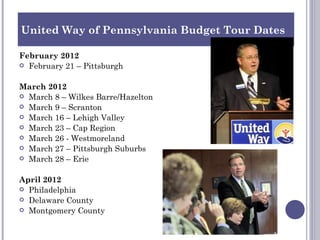
United Way of Pennsylvania Budget Tour Dates

February 2012
 February 21 – Pittsburgh


March 2012
 March 8 – Wilkes Barre/Hazelton
 March 9 – Scranton
 March 16 – Lehigh Valley
 March 23 – Cap Region
 March 26 - Westmoreland
 March 27 – Pittsburgh Suburbs
 March 28 – Erie


April 2012
 Philadelphia
 Delaware County
 Montgomery County

 
HOW CAN WE “POWER UP”
        THE ADVOCACY?


 Mobilization/ Community Organizing
 Building a Broad Coalition

 Direct Advocacy with Elected Officials

 Engagement of Key Influencers as Champions

 Building Statewide Partnerships/ Alliances

 Creative Communications

 Advertising
MAKE YOUR VOICE HEARD


 Get engaged with United Way or budget
  coalitions.
 Meet with your county commissioners
  and legislators.
 Ask your staff, board members, and
  clients to tell their stories!
CONTACT INFORMATION
   United Way of Pennsylvania
         909 Green Street
  Harrisburg, Pennsylvania 17102
       Phone: (717)238-7365
        Fax: (717)238-7414

            Facebook
             Twitter

Proposed FY2012 Commonwealth Budget :: ANALYSIS

  • 1.
  • 2.
    2011 NON PROFITBUDGET SURVEY In late 2011, United Way of Pennsylvania conducted a survey of over 800 nonprofits across the Commonwealth to assess the impact of state budget cuts.
  • 3.
    2011 NON PROFITBUDGET SURVEY Results include: • 69 percent of agencies received a funding cut in 2011-12 state budget. • 80 percent of agencies report conditions related to the economy have increased demand for services.
  • 4.
    2011 NON PROFITBUDGET SURVEY If your organization's state funding has been cut, how much have state funding revenues declined by percentage? 20 percent or less 77% 21 to 30 percent 9% 31 or more percent 14%
  • 5.
    2011 NON PROFITBUDGET SURVEY Select all the ways the budget cuts this year (FY 11-12) have impacted your organization? •We have laid off staff 52 % •We have canceled programs completely 32 % •We have cut back program hours 46% •We have expanded our waiting list for services 45%
  • 6.
    2011 NON PROFITBUDGET SURVEY If your organization maintains a waiting list, how many people were put on a waiting list as a result of FY 11-12 budget cuts? 1 to 20 58% 21 to 40 18% 41 to 50 3% 51 or more 21%
  • 7.
    2011 NON PROFITBUDGET SURVEY How have your non-governmental sources of funds (ie: private foundation grants, individual donations) changed in the last 12 months? Our non-governmental funding 36% has remained flat Our non-governmental funding has 38% decreased
  • 8.
    SUPPORT FREE ENTERPRISE ANDJOB CREATION C Comprehensive Job Matching System – The budget continues support for a new workforce development system that will dramatically improve job search capabilities by p y adding sophisticated “spidering” technology linked to numerous job posting engines. p Keystone Works – The budget provides $2.5 million to facilitate the rapid return to work for recently unemployed individuals. Keystone Works will provide employer-driven training opportunities for unemployed workers. t Targeted Industry Cluster Certificate Program – In partnership with the Pennsylvania Higher Education Assistance Agency (PHEAA), the Corbett administration will create a Targeted Industry Cluster Certificate Program for certain high- priority occupations. In the first year, the budget recommends $5 million targeted to the energy, agriculture and building and construction industry clusters.
  • 9.
    INDUSTRY PARTNERSHIPS  TheGovernor’s proposed budget for 2012-13 lowers the budget for Industry Partnerships from $1.613 million to $1.452 million.  The budget leaves at zero the budget for “Training Activities.” This line item had funded Industry Partnership incumbent worker training.  Peak of $15 million (from 2005-06 to 2008-09), declining to $5.834 million to 2010-11 before being zeroed out in 2011-12.
  • 10.
    VALUE OF INDUSTRY PARTNERSHIPS
  • 11.
    INDUSTRY PARTNERSHIPS  Nerofrom Pittsburgh  Employed at a local laundry facility for over ten year before they closed  The Labor-Management Clearinghouse  “I’m not the kind of guy that would be satisfied just [lying] around collecting unemployment. I need to be working.”  Nero was soon referred to a hospitality partner of the L-MC, the Sheraton Station Square  The L-MC team and the Sheraton worked together to identify Nero’s strengths to find a position that best suited his personality and their hiring needs
  • 12.
    STUDENT ACHIEVEMENT EDUCATION BLOCKGRANT The 2012-13 budget proposes $6.5 billion in Student Achievement Education Block Grant funds for school districts. According to the Administration, this new approach provides flexibility to local education decision-makers to allocate funding to best achieve academic goals and meet legal requirements while reducing administrative burdens and compliance costs.
  • 13.
    STUDENT ACHIEVEMENT EDUCATION BLOCKGRANT The following appropriations will be “block-granted:”  Basic Education Funding - $5.35 billion  Pupil Transportation - $542.3 million (including Intermediate Unit special education transportation funding)  Nonpublic and Charter Transportation - $77.7 million  Social Security – $504.8 million to school districts and $36.8 million for intermediate units
  • 14.
    FUNDING SCHOOLS AND STUDENTS OtherEducation Highlights:  Early Intervention – $206.2 million for an increase of $8.1 million, or 4 percent, from 2011-12  Higher Education Programs – almost $1.4 billion in total funds supporting the state-related universities, the State System of Higher Education, community colleges and students seeking higher education opportunities, including:  $221.9 million for Community Colleges, plus $46 million in capital funds  Level funding with 2011-12 for Penn College of Technology ($13.6 million) and  Thaddeus Stevens College of Technology ($10.3 million)
  • 15.
    EDUCATION CHANGES o Pre-Kand Head Start were not cut beyond 5% in the Budgetary Reserve.   o However, state funds for child care were cut by more than $24M and the DPW press release notes “Under the proposed budget. o Attendance and work hour requirements will be tightened to ensure the Child Care Works supplement is being used by parents who need services due to work commitments, and for children who are attending on a regular basis.” o Nurse Family Partnerships and family centers were level funded. Level funding is required to comply with the maintenance of effort requirements for federal home visiting funds.  Early Intervention received funding increases to meet the mandated requirements.
  • 16.
    HIGHER EDUCATION Program 2011-12 Actual 2012-13 Proposed State System $412,751 $330,201 Penn State $227,694 $163,461 Community Colleges $230,727 $221,926 University of Pittsburgh $136,076 $95,253 Temple University $139,917 $97,942 Lincoln University $11,163 $11,163 PHEAA $380,900 $361,800
  • 17.
    CRIMINAL JUSTICE ANDENHANCED PUBLIC SAFETY Department of Corrections  Level-funds the department’s budget for the first time in more than a decade through a combination of operational efficiencies and legislative reforms  Legislative reforms that will enable the department to expand existing programs such as State Intermediate Punishment, Recidivism Risk Reduction Incentive and Motivational Boot Camp  Will work closely with the Board of Probation and Parole to improve management of the parole docket and expand the use of parole violation centers  Provides $8.2 million to address the pay compression issue for most corrections managers
  • 18.
    CRIMINAL JUSTICE AND ENHANCEDPUBLIC SAFETY Board of Probation and Parole  An increase of $5.3 million, or 5.1 percent, for 53 positions approved in the 2011-12 budget and 13 new positions in 2012-13  $792,000 for costs related to implementing Act 111 of 2011 (Megan’s Law)  Allows counties to keep adult probation fees
  • 19.
    HUMAN SERVICES DEVELOPMENT FUNDBLOCK GRANT The 2012-13 budget proposes to change the relationship between the state and local governments in the delivery of critical human services programs by consolidating multiple human services programs into a single block grant. According to the Administration, this will provide counties with the flexibility to move funds where each locality needs them most.
  • 20.
    HUMAN SERVICES DEVELOPMENT FUND BLOCK GRANT (Dollar Amount in Thousands) Proposed Block Grant Appropriations 2011-12 2012-13 Reduction Mental Health Services – Community Programs $550,469 $440,376 $110,093 Intellectual Disabilities – Community Programs $144,974 $115,979 $28,995 County Child Welfare Special Grants $48,533 $38,826 $9,707 Behavioral Health Service $47,908 $38,326 $9,582 Homeless Assistance Program $20,551 $16,441 $4,110 Human Services Development Fund (HSDF) $14,956 $11,965 $2,991 Act 152 Drug and Alcohol Program (Outpatient) $14,727 $11,782 $2,945 Total $842,118 $673,695 $168,423
  • 21.
    HUMAN SERVICES PROGRAMS P FosterCare Enhancements $4.5 million in savings generated through increased federal funds to support additional youth ages 18 to 21 in foster care. t Adult Protective Services $1.7 million to implement an adult protective services system to protect physically and cognitively impaired individuals ages 18 through 59. t HealthChoices Expansion Transfers funds from the fee-for-service program to the capitation program to expand the HealthChoices physical health program statewide. This proposal is budget-neutral. s Children’s Health Insurance Program $101.6 million, an increase of 4.4 percent, to provide health insurance for approximately 195,500 children. i State Food Purchase Program $17.3 million to maintain funding for this program. The Department of Agriculture will implement a more efficient structure for managing this program, reducing administrative costs and increasing the amount of food that will be purchased for those in need.
  • 22.
    HUMAN SERVICES REFORMS GeneralAssistance Program Reform  Savings of $319.3 million from the elimination of the cash assistance benefits provided through the General Assistance program, and from revisions to the eligibility criteria for Medical Assistance benefits provided the program, including minimum work requirements for medically needy recipients Revised Provider Reimbursements  $59 million in savings generated from a reduction to provider reimbursement rates or alternative provider cost containment. Program Integrity  $50 million in savings generated through the implementation of an automated audit system to identify waste, fraud and abuse for provider payments and through intensive review and case management of high-cost consumers enrolled in Medical Assistance programs that reimburse for services based on utilization and fee schedules.
  • 23.
    HUMAN SERVICES REFORMS ChildCare Reimbursement Reform  $10 million in savings from a reduction in paid absences and a decrease in reimbursement rates for unregulated relative and neighbor care. Medical Assistance for Workers with Disabilities Premium Reform  $10 million in savings from increasing the monthly premium rate paid by MAWD program recipients. The premium rate has remained unchanged since the program began in 2001. Hospital Application Process Revisions  $10 million in savings to maintain recipients enrolled through the hospital application process in the fee-for-service program, rather than managed care, until redetermination.
  • 24.
    OLDER PENNSYLVANIANS  $4.7 billion in total funds to provide home and community-based services and nursing home care to persons with disabilities and older Pennsylvanians  $286.1 million for the Property Tax / Rent Rebate program, which assists 606,000 older Pennsylvanians  $248.2 million in Lottery Funds for PENNCARE, which provides home and community-based services to older Pennsylvanians  $244.8 million to provide Pharmaceutical Assistance Contract for the Elderly (PACE) and PACE Needs Enhancement Tier (PACENET) to 303,550 older Pennsylvanians  $81 million in Lottery Funds to support the Older Pennsylvanians Shared Ride program
  • 25.
  • 26.
    WHO IS IMPACTED? People previously in state Mental Health hospitals  People with intellectual disabilities and their families  Abused and neglected children  Homeless individuals and families  People with serious physical disabilities
  • 27.
    UNINTENDED CONSEQUENCES/COSTS  Mental Health Cuts = hospitalization, incarceration, institutionalization  Intellectual Disabilities Cuts = hospitalization, out-of- home placements, state institutionalization  Child Welfare Cuts = child welfare and juvenile court placements  Homeless Assistance Cuts = more street homeless  HSDF Assistance Cuts for people with physical disabilities = more assistive living  Drug and Alcohol Cuts = higher criminal activity to maintain addiction, more hospitalization costs, more jail and criminal justice costs
  • 28.
    LACKAWANNA COUNTY IMPACT  For the second year in a row, our shelter has turned away more battered women and their children they we were able to house due to lack of beds.  Budget cuts have impacted employment training resulting in fewer clients being served.  Serving more homeless a meal and more people sleeping outside.
  • 29.
    STATEWIDE IMPACT - In the first 5 months of the operating year, we have turned away 273 unduplicated requests for emergency shelter services - When the funds run out 2-3 months prior to the end of our fiscal year there will be many families and domestic violence clients that will be living on the streets in unsafe
  • 30.
    STATEWIDE IMPACT A nurse is only at the center 16 hour per week vs. 40 hours  The child care we are able to provide has declined...and that puts a burden on the mother when she has appt. or needs to go to work.  A family of 5 would receive enough groceries to last a week. Now they receive enough groceries to last 3 - 4 days.  Clients continue to face foreclosure and we are unable to assist them in any capacity.
  • 31.
    UNITED WAY BUDGET PRINCIPLES  To the greatest extent possible, avoid significant cuts to benefits and services to our most vulnerable Pennsylvanians: poor individuals and families, pregnant women and young children, low income elderly, individuals with disabilities, and veterans.  Protect funding for prevention services that save more expensive interventions later on.  Consider the state’s existing investment in successful programs such as industry partnerships, which combine public and private money to keep Pennsylvania business competitive, while enhancing training and career pathway opportunities for Pennsylvania’s workforce.
  • 32.
    UNITED WAY BUDGETPRINCIPLES  Utilize completed evaluations or other measurements to determine where to make cuts.  Consider ways in which the state can more efficiently and effectively deliver services, such as by reducing the vast array of state 800 numbers, particularly those that are contracted with out of state providers, and supporting those services with 2-1-1.  Consistent with commitment to an on-time budget, provide budget language to ensure that local governments and providers receive timely allocations and direction from the Commonwealth so that there is a predictable and stable cycle of services provision.  
  • 33.
    United Way ofPennsylvania Budget Tour Dates February 2012  February 21 – Pittsburgh March 2012  March 8 – Wilkes Barre/Hazelton  March 9 – Scranton  March 16 – Lehigh Valley  March 23 – Cap Region  March 26 - Westmoreland  March 27 – Pittsburgh Suburbs  March 28 – Erie April 2012  Philadelphia  Delaware County  Montgomery County  
  • 34.
    HOW CAN WE“POWER UP” THE ADVOCACY?  Mobilization/ Community Organizing  Building a Broad Coalition  Direct Advocacy with Elected Officials  Engagement of Key Influencers as Champions  Building Statewide Partnerships/ Alliances  Creative Communications  Advertising
  • 35.
    MAKE YOUR VOICEHEARD  Get engaged with United Way or budget coalitions.  Meet with your county commissioners and legislators.  Ask your staff, board members, and clients to tell their stories!
  • 36.
    CONTACT INFORMATION United Way of Pennsylvania 909 Green Street Harrisburg, Pennsylvania 17102 Phone: (717)238-7365 Fax: (717)238-7414 Facebook Twitter