10x Performance Improvements
                                 in 10 steps
                               A Case Study
                                     Ronald Bradford
                                http://ronaldbradford.com

                                   FOSDEM - 2010.02
Sunday, February 7, 2010
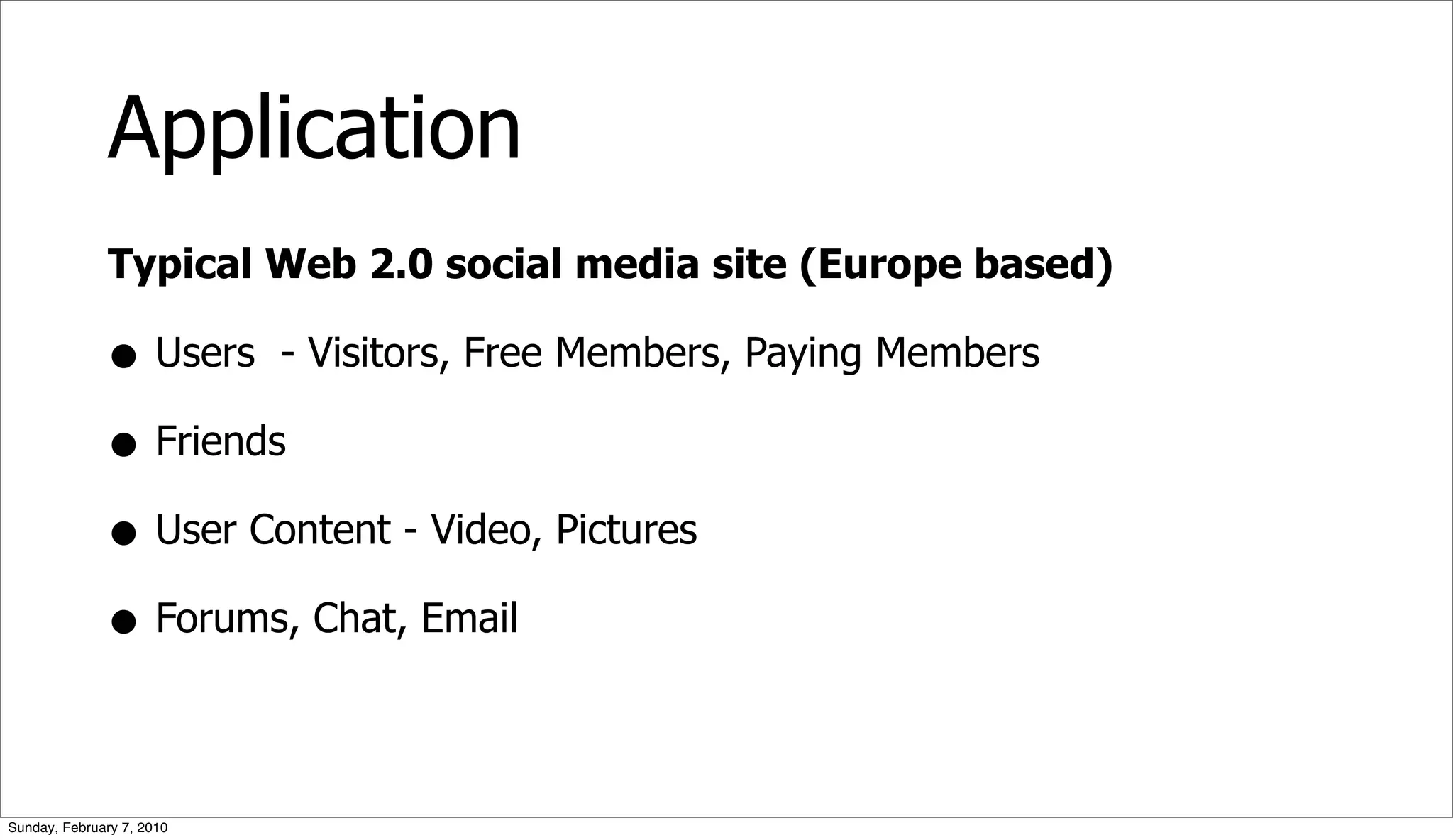
Application
              Typical Web 2.0 social media site (Europe based)
              • Users - Visitors, Free Members, Paying Members
              • Friends
              • User Content - Video, Pictures
              • Forums, Chat, Email

Sunday, February 7, 2010
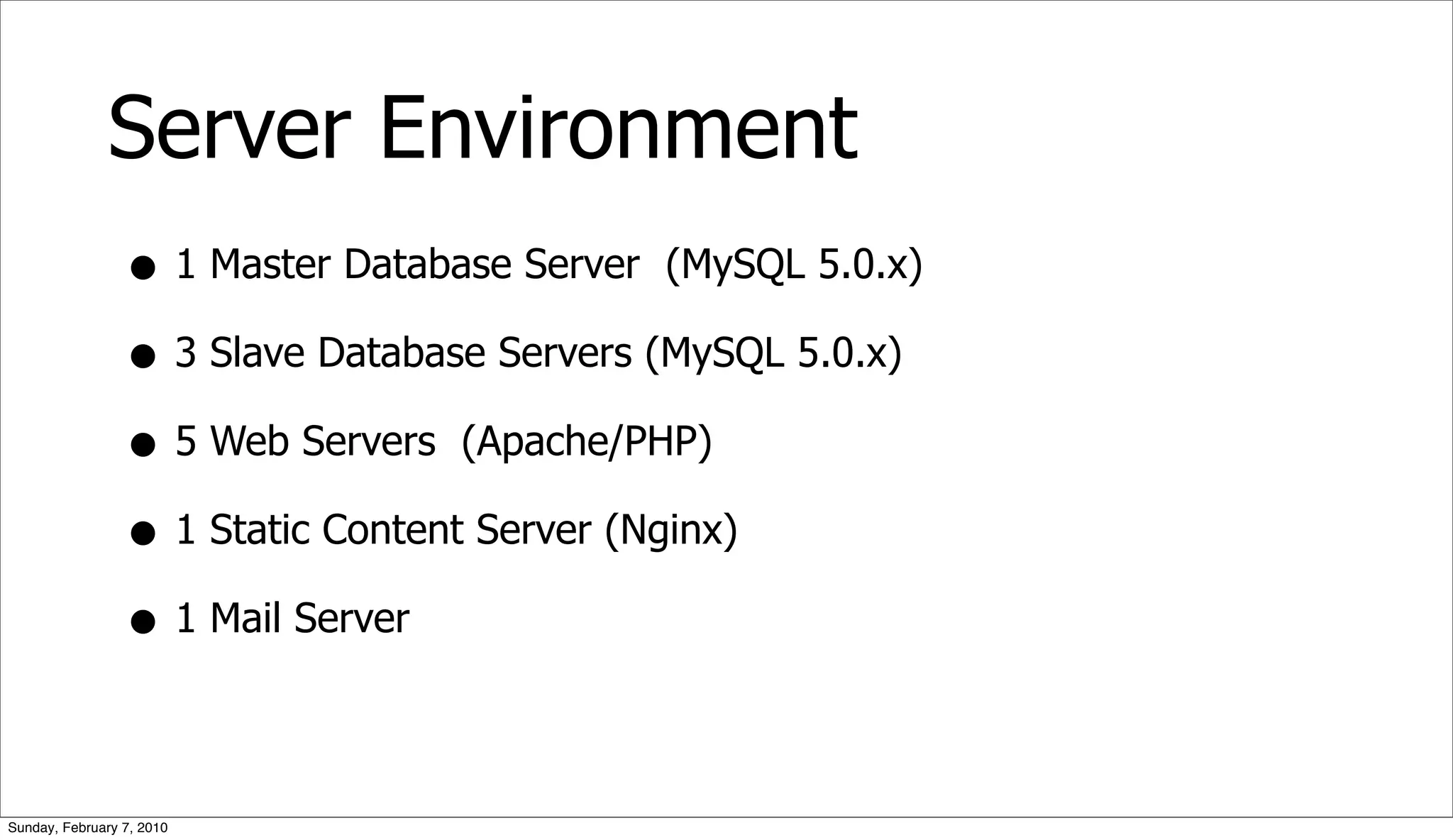
Server Environment
                 • 1 Master Database Server (MySQL 5.0.x)
                 • 3 Slave Database Servers (MySQL 5.0.x)
                 • 5 Web Servers (Apache/PHP)
                 • 1 Static Content Server (Nginx)
                 • 1 Mail Server

Sunday, February 7, 2010
Step 1


                    Monitor, Monitor, Monitor


Sunday, February 7, 2010
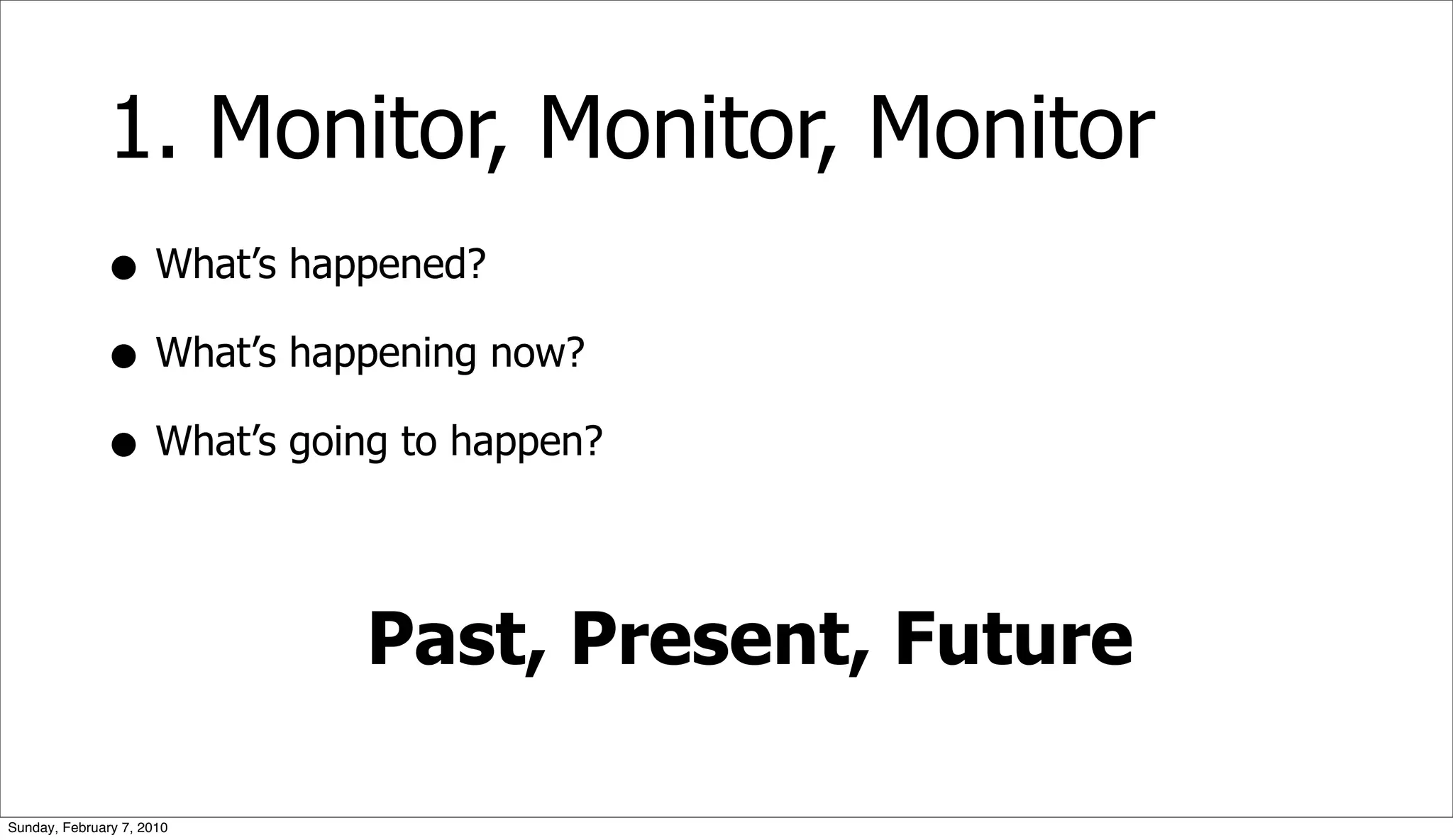
1. Monitor, Monitor, Monitor
              • What’s happened?
              • What’s happening now?
              • What’s going to happen?

                           Past, Present, Future

Sunday, February 7, 2010
1. Monitor, Monitor, Monitor
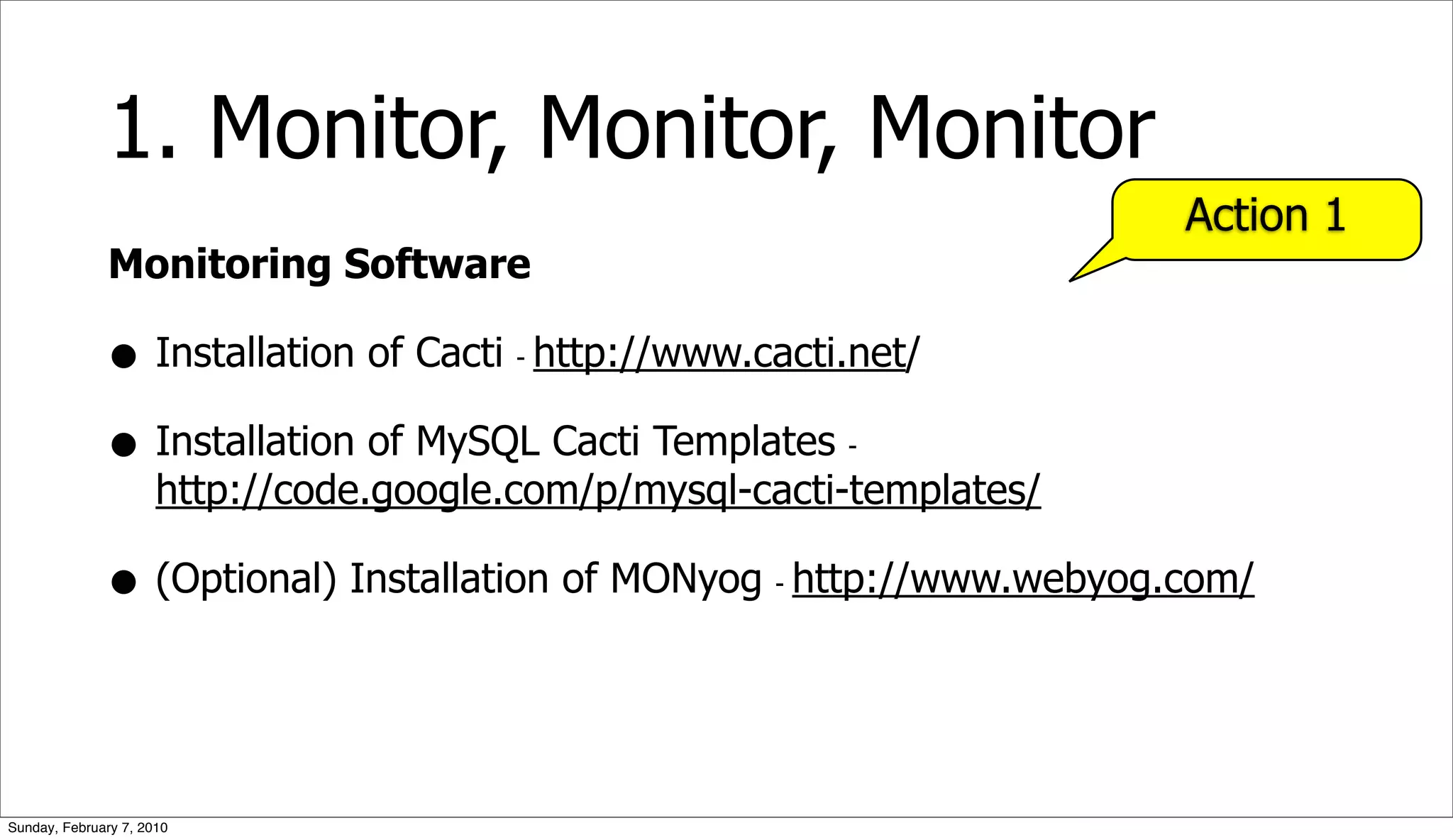
                                                                            Action 1
              Monitoring Software

              • Installation of Cacti http://www.cacti.net/
                                         -


              • Installation of MySQL Cacti Templates       -
                      http://code.google.com/p/mysql-cacti-templates/

              • (Optional) Installation of MONyog     -   http://www.webyog.com/


Sunday, February 7, 2010
1. Monitor, Monitor, Monitor
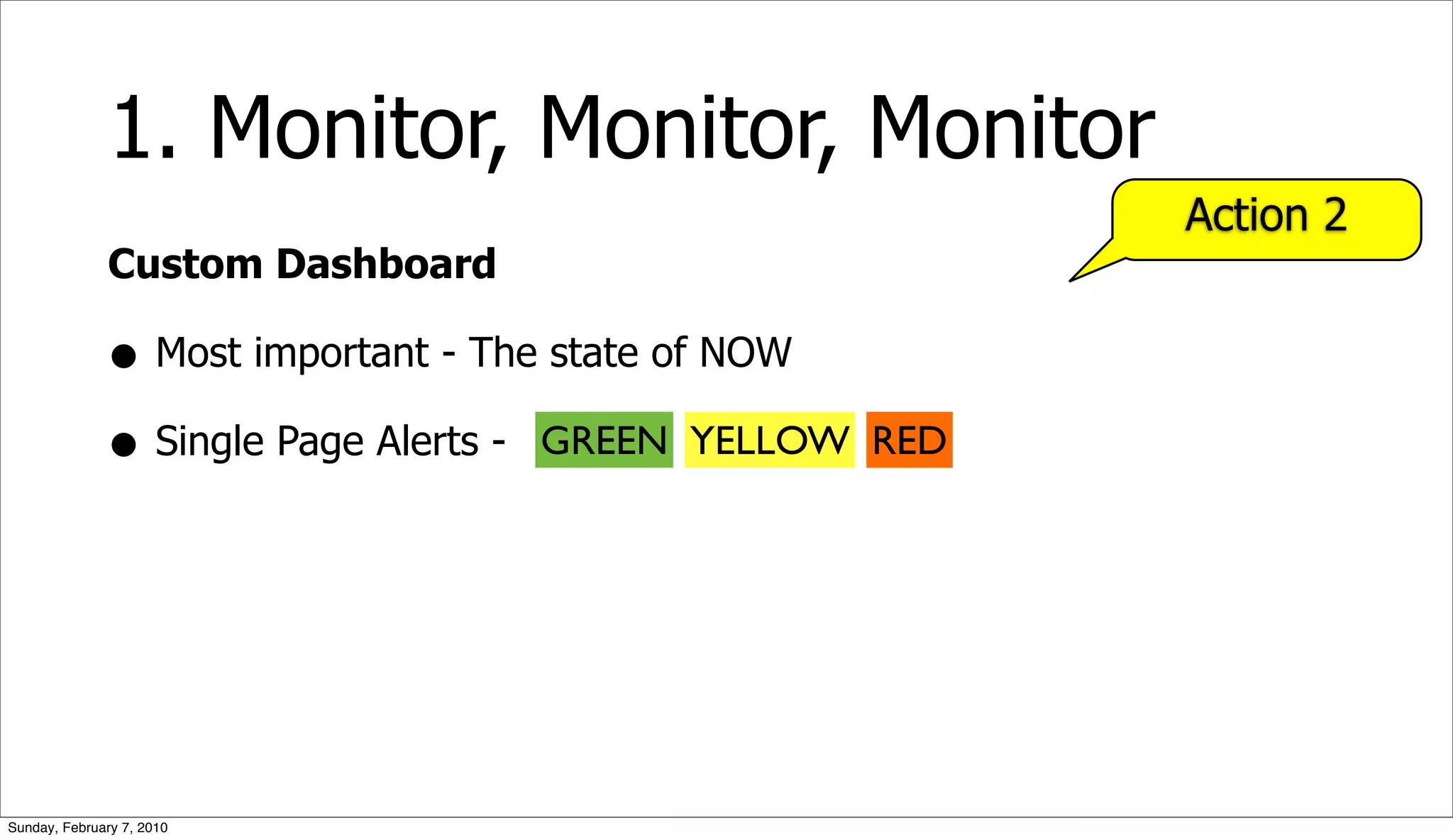
                                                          Action 2
              Custom Dashboard

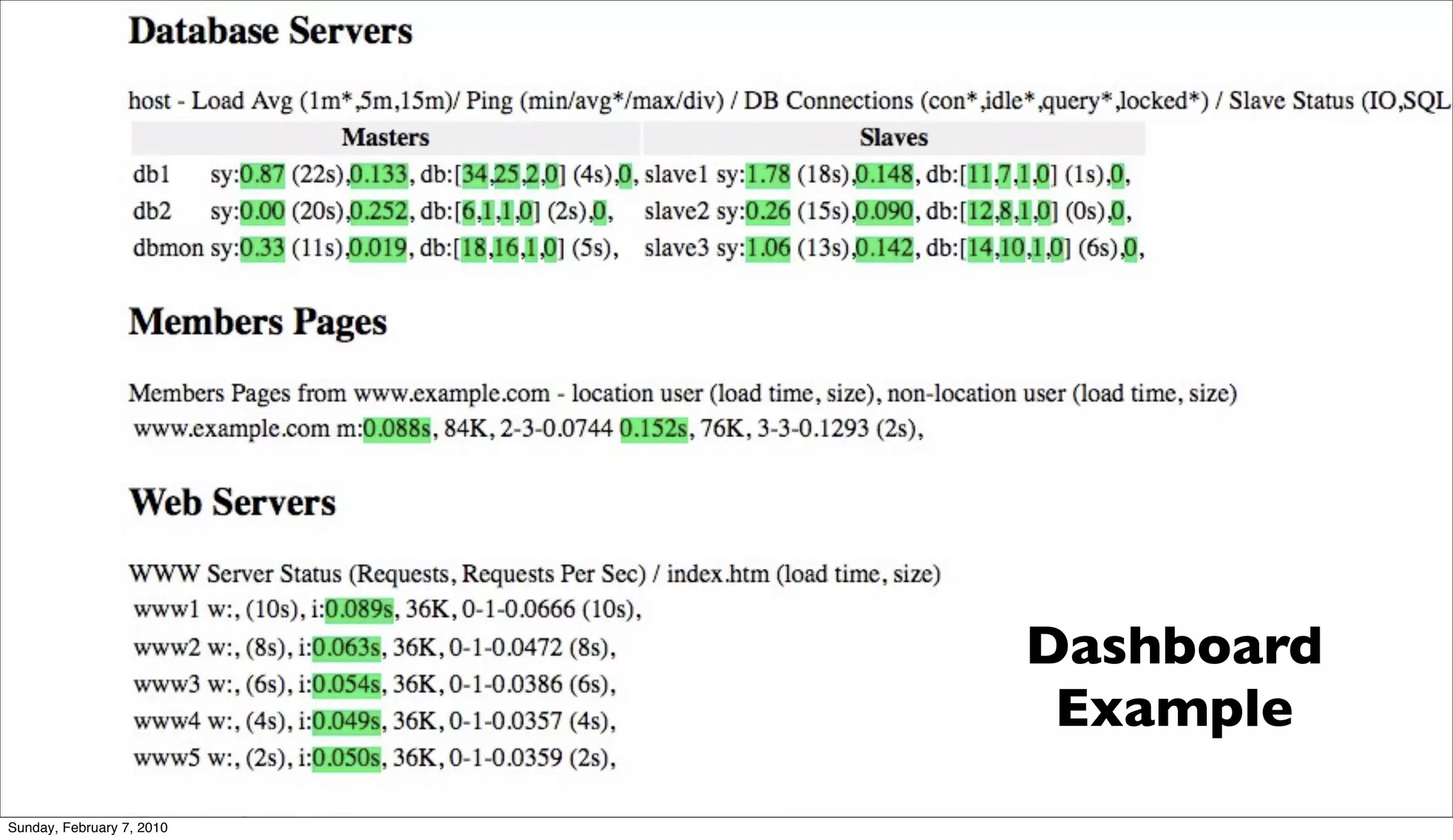
              • Most important - The state of NOW
              • Single Page Alerts - GREEN YELLOW   RED


Sunday, February 7, 2010
Screen print goes here


                                                    Dashboard
                                                     Example
Sunday, February 7, 2010
1. Monitor, Monitor, Monitor
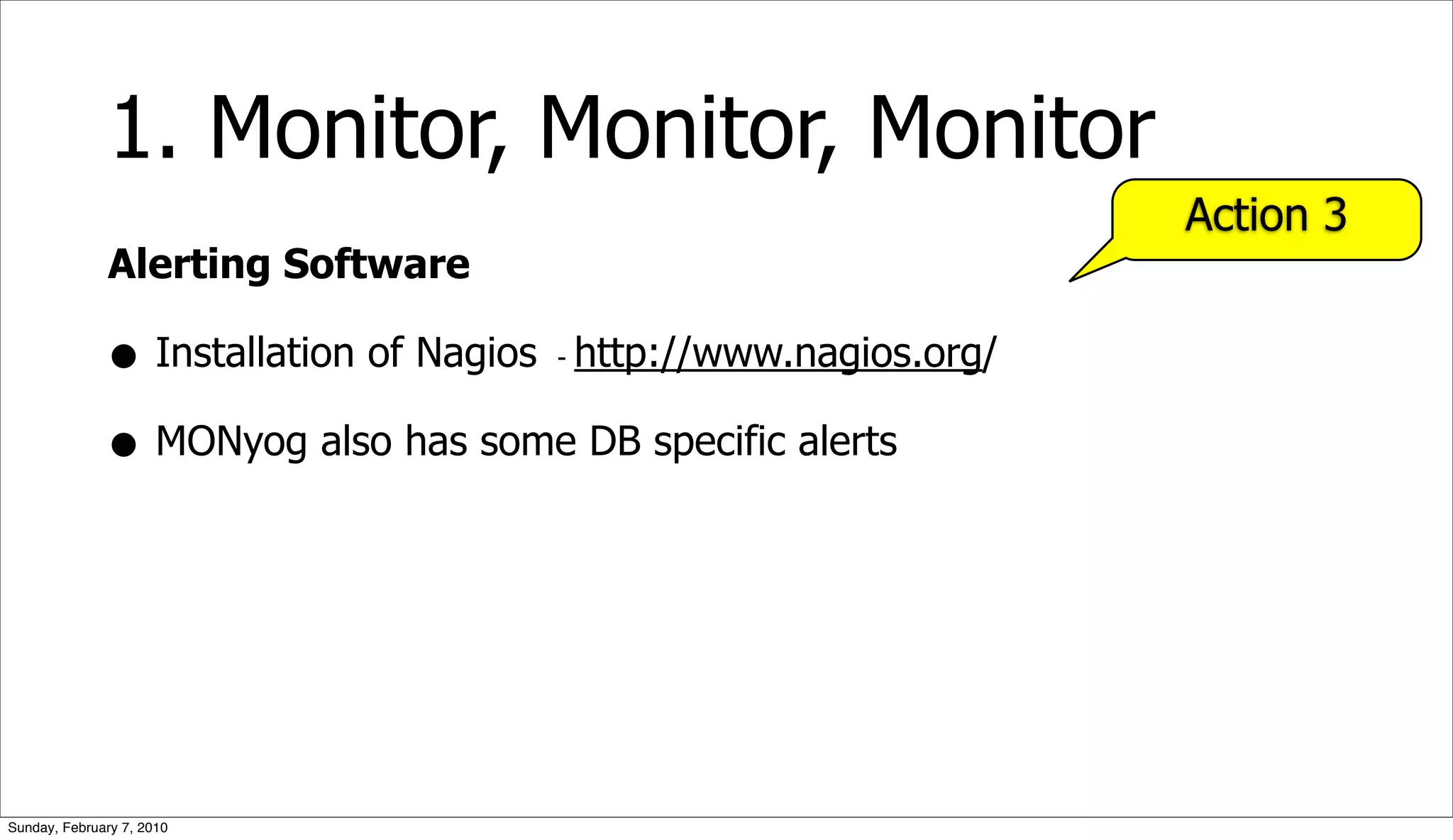
                                                                Action 3
              Alerting Software

              • Installation of Nagios http://www.nagios.org/
                                     -


              • MONyog also has some DB specific alerts


Sunday, February 7, 2010
1. Monitor, Monitor, Monitor
                                             Action 4
              Application Metrics

              • Total page generation time


Sunday, February 7, 2010
Step 2


                             Identify problem SQL


Sunday, February 7, 2010
2. Identify Problem SQL
              Identify SQL Statements

              • Slow Query Log
              • Processlist
              • Binary Log
              • Status Statistics

Sunday, February 7, 2010
2. Identify Problem SQL
              Problems

              • Sampling
              • Granularity
              Solution

              • tcpdump + mk-query-digest

Sunday, February 7, 2010
2. Identify Problem SQL
                                                                              Action 1
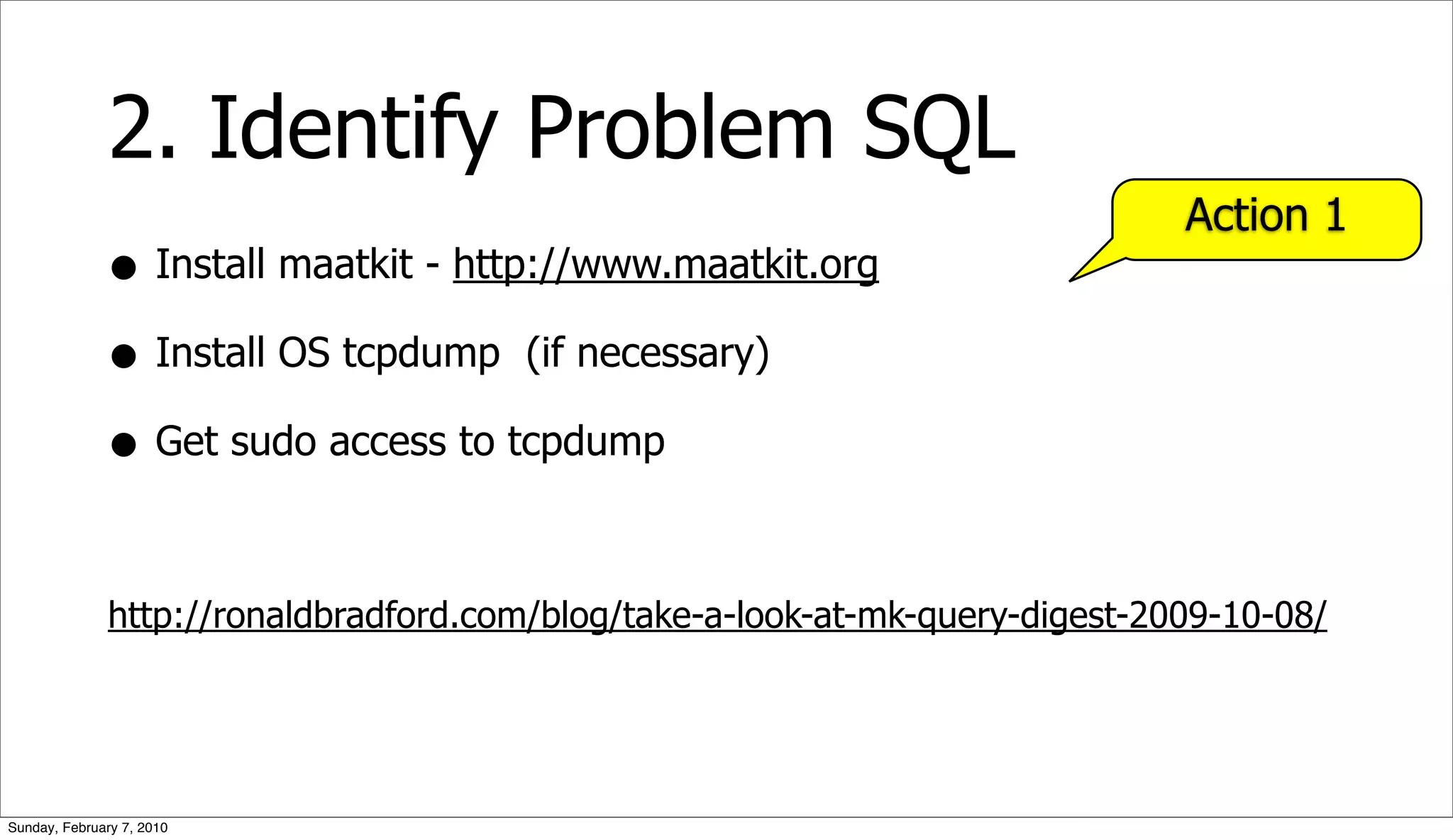
              • Install maatkit - http://www.maatkit.org
              • Install OS tcpdump (if necessary)
              • Get sudo access to tcpdump

              http://ronaldbradford.com/blog/take-a-look-at-mk-query-digest-2009-10-08/


Sunday, February 7, 2010
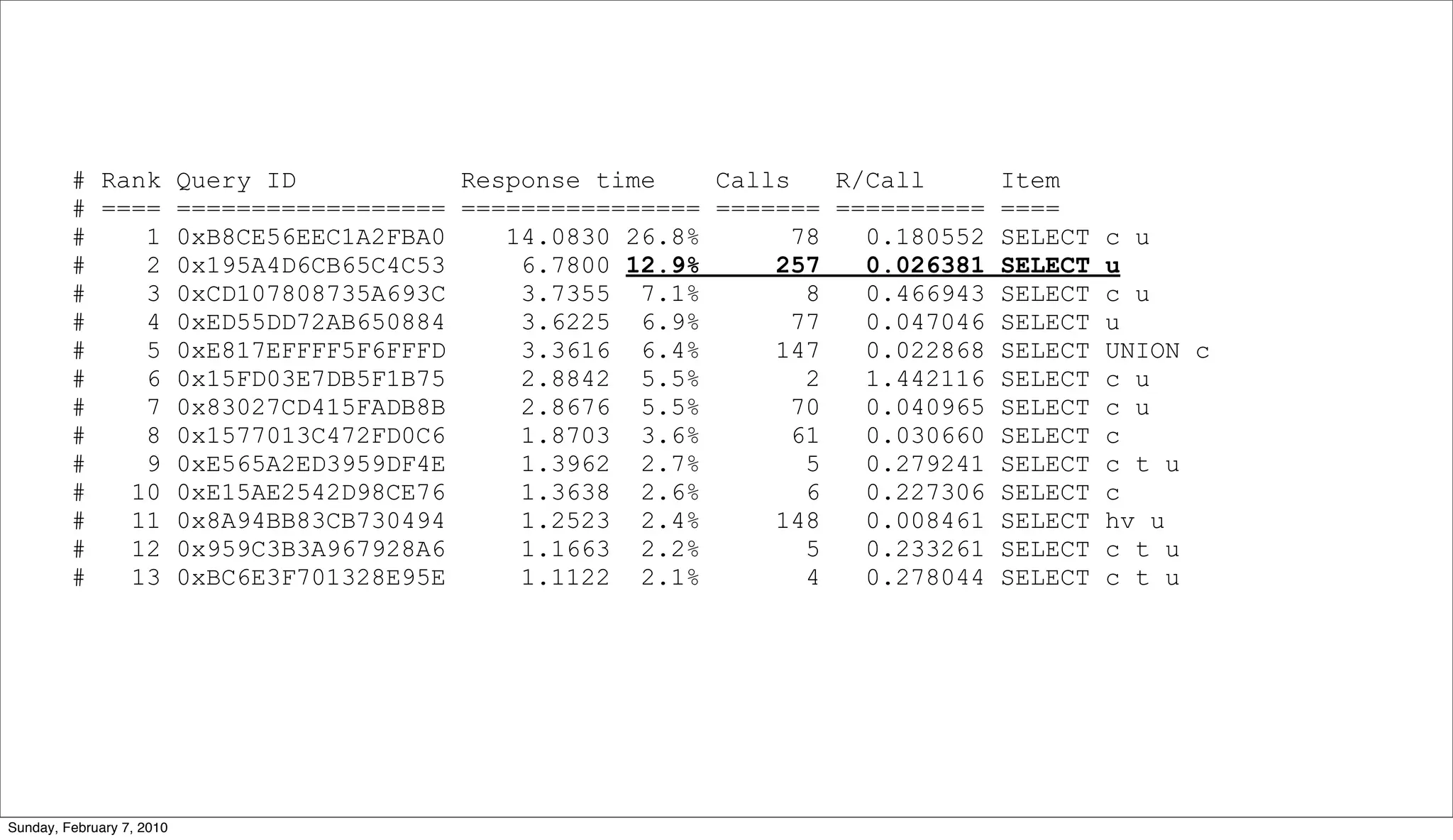
# Rank Query ID           Response time    Calls    R/Call       Item
         # ==== ================== ================ ======= ==========    ====
         #    1 0xB8CE56EEC1A2FBA0    14.0830 26.8%       78   0.180552   SELECT   c u
         #    2 0x195A4D6CB65C4C53     6.7800 12.9%     257    0.026381   SELECT   u
         #    3 0xCD107808735A693C     3.7355 7.1%         8   0.466943   SELECT   c u
         #    4 0xED55DD72AB650884     3.6225 6.9%        77   0.047046   SELECT   u
         #    5 0xE817EFFFF5F6FFFD     3.3616 6.4%      147    0.022868   SELECT   UNION c
         #    6 0x15FD03E7DB5F1B75     2.8842 5.5%         2   1.442116   SELECT   c u
         #    7 0x83027CD415FADB8B     2.8676 5.5%        70   0.040965   SELECT   c u
         #    8 0x1577013C472FD0C6     1.8703 3.6%        61   0.030660   SELECT   c
         #    9 0xE565A2ED3959DF4E     1.3962 2.7%         5   0.279241   SELECT   c t u
         #   10 0xE15AE2542D98CE76     1.3638 2.6%         6   0.227306   SELECT   c
         #   11 0x8A94BB83CB730494     1.2523 2.4%      148    0.008461   SELECT   hv u
         #   12 0x959C3B3A967928A6     1.1663 2.2%         5   0.233261   SELECT   c t u
         #   13 0xBC6E3F701328E95E     1.1122 2.1%         4   0.278044   SELECT   c t u


Sunday, February 7, 2010
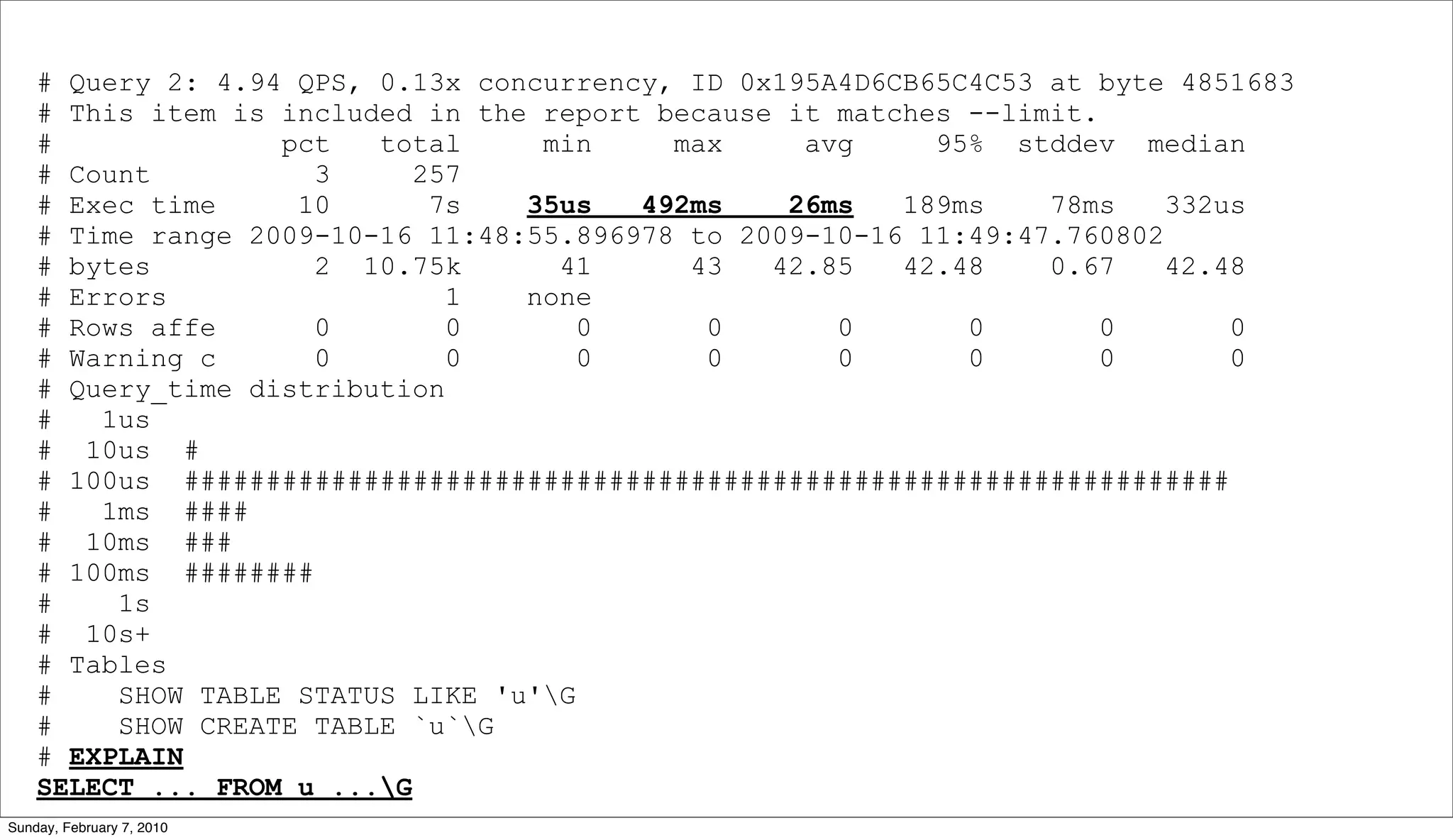
# Query 2: 4.94 QPS, 0.13x concurrency, ID 0x195A4D6CB65C4C53 at byte 4851683
    # This item is included in the report because it matches --limit.
    #              pct   total     min     max     avg     95% stddev median
    # Count          3      257
    # Exec time     10       7s   35us   492ms    26ms   189ms    78ms    332us
    # Time range 2009-10-16 11:48:55.896978 to 2009-10-16 11:49:47.760802
    # bytes          2 10.75k       41      43   42.85   42.48    0.67    42.48
    # Errors                  1   none
    # Rows affe      0        0       0      0       0       0        0       0
    # Warning c      0        0       0      0       0       0        0       0
    # Query_time distribution
    #   1us
    # 10us #
    # 100us ################################################################
    #   1ms ####
    # 10ms ###
    # 100ms ########
    #    1s
    # 10s+
    # Tables
    #    SHOW TABLE STATUS LIKE 'u'G
    #    SHOW CREATE TABLE `u`G
    # EXPLAIN
    SELECT ... FROM u ...G
Sunday, February 7, 2010
2. Identify Problem SQL
                                                        Action 2
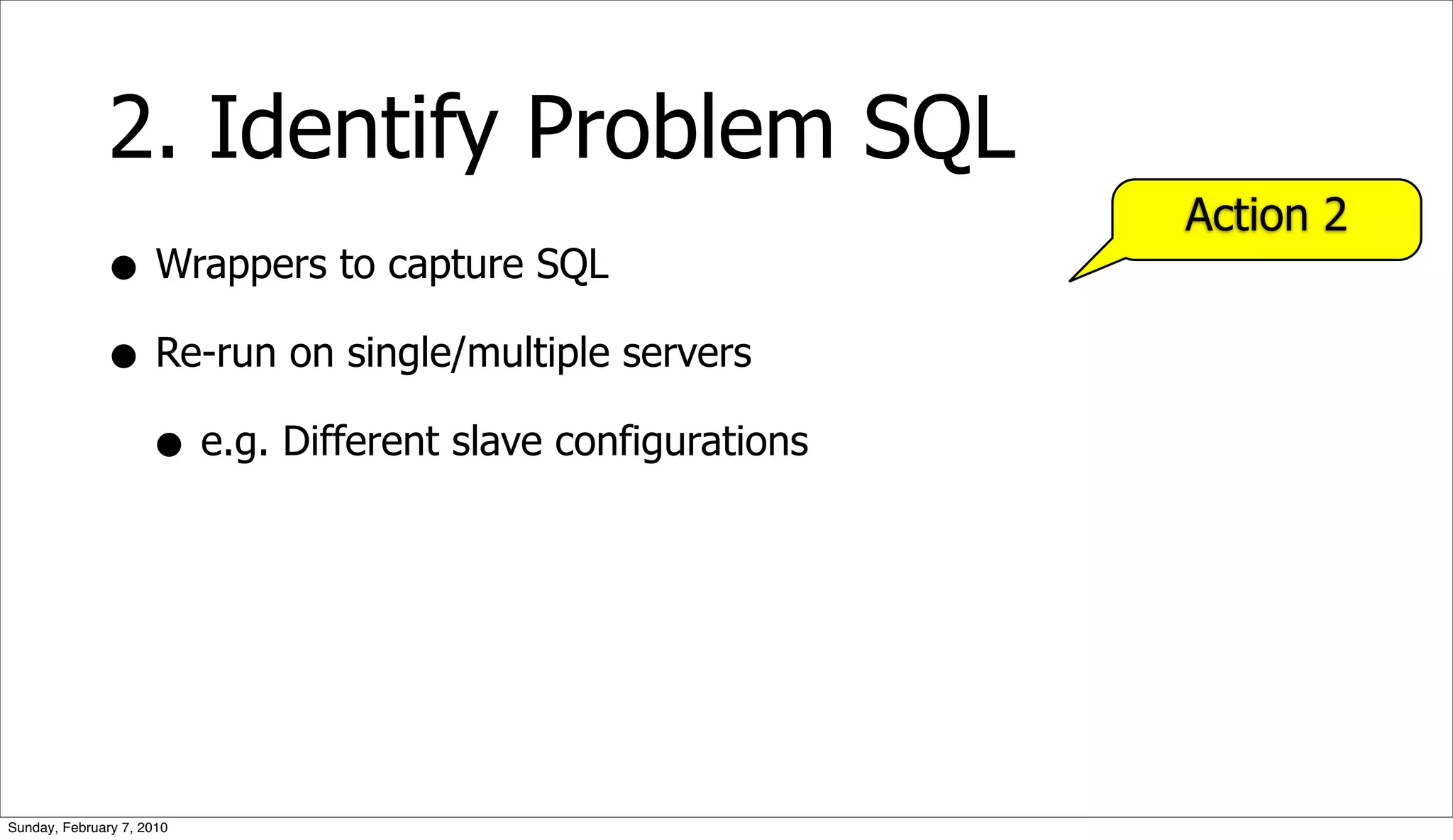
              • Wrappers to capture SQL
              • Re-run on single/multiple servers
                • e.g. Different slave configurations


Sunday, February 7, 2010
2. Identify Problem SQL
                                                                  Tip

              • Enable General Query Log in Development/Testing
              • Great for testing Batch Jobs


Sunday, February 7, 2010
2. Identify Problem SQL
                                                                     Action 3
              Application Logic

              • Show total master/slave SQL statements executed
              • Show all SQL with execution time (admin user only)
                                                                      Tip

              • Have abstracted class/method to execute ALL SQL

Sunday, February 7, 2010
Step 3


                             Analyze problem SQL


Sunday, February 7, 2010
3. Analyze Problem SQL
              • Query Execution Plan (QEP)
                • EXPLAIN [EXTENDED] SELECT ...
              • Table/Index Structure
                • SHOW CREATE TABLE <tablename>
              • Table Statistics
                • SHOW TABLE STATUS <tablename>
Sunday, February 7, 2010
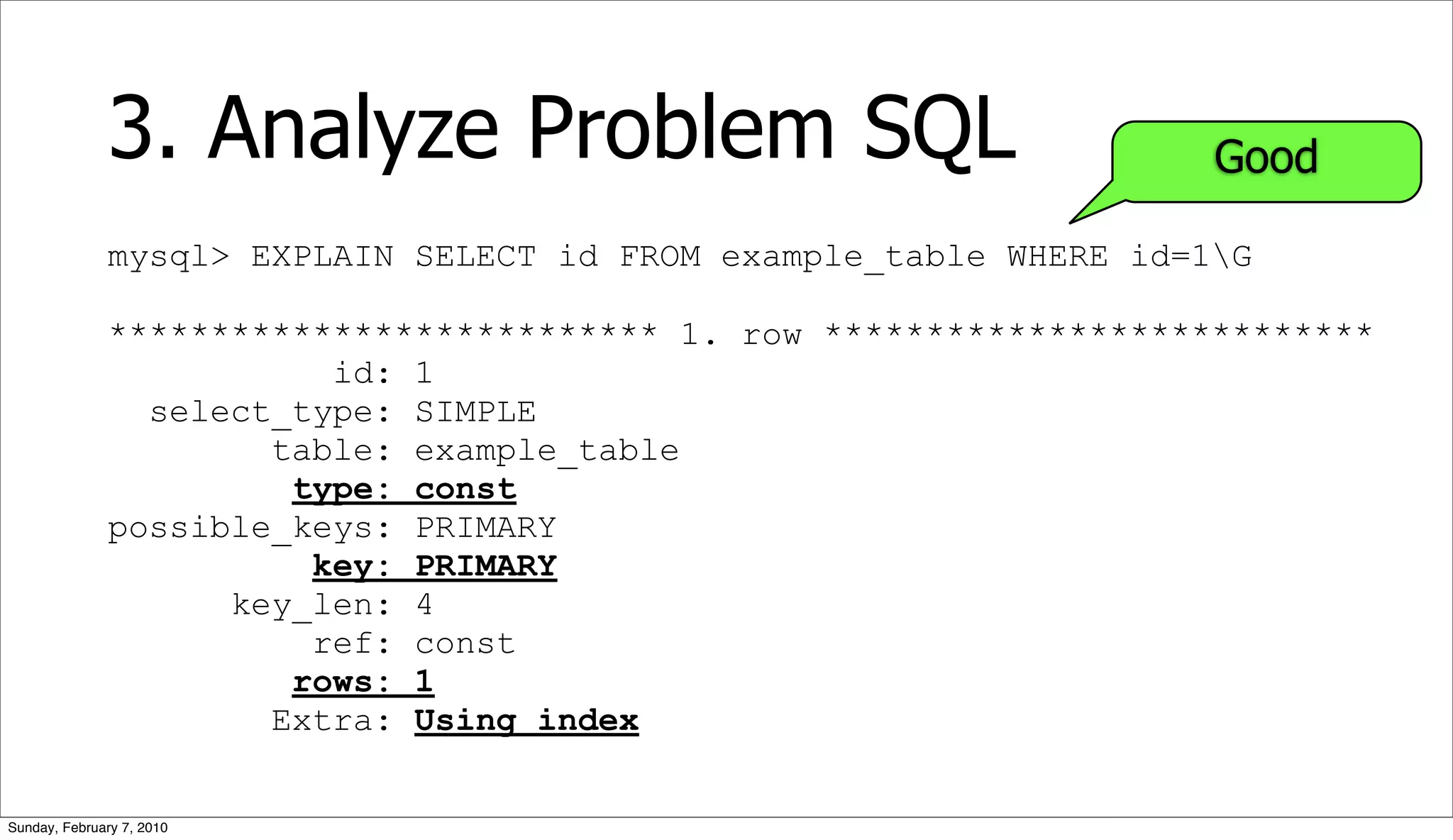
3. Analyze Problem SQL                                Good

              mysql> EXPLAIN SELECT id FROM example_table WHERE id=1G

              *************************** 1. row ***************************
                         id: 1
                select_type: SIMPLE
                      table: example_table
                       type: const
              possible_keys: PRIMARY
                        key: PRIMARY
                    key_len: 4
                        ref: const
                       rows: 1
                      Extra: Using index


Sunday, February 7, 2010
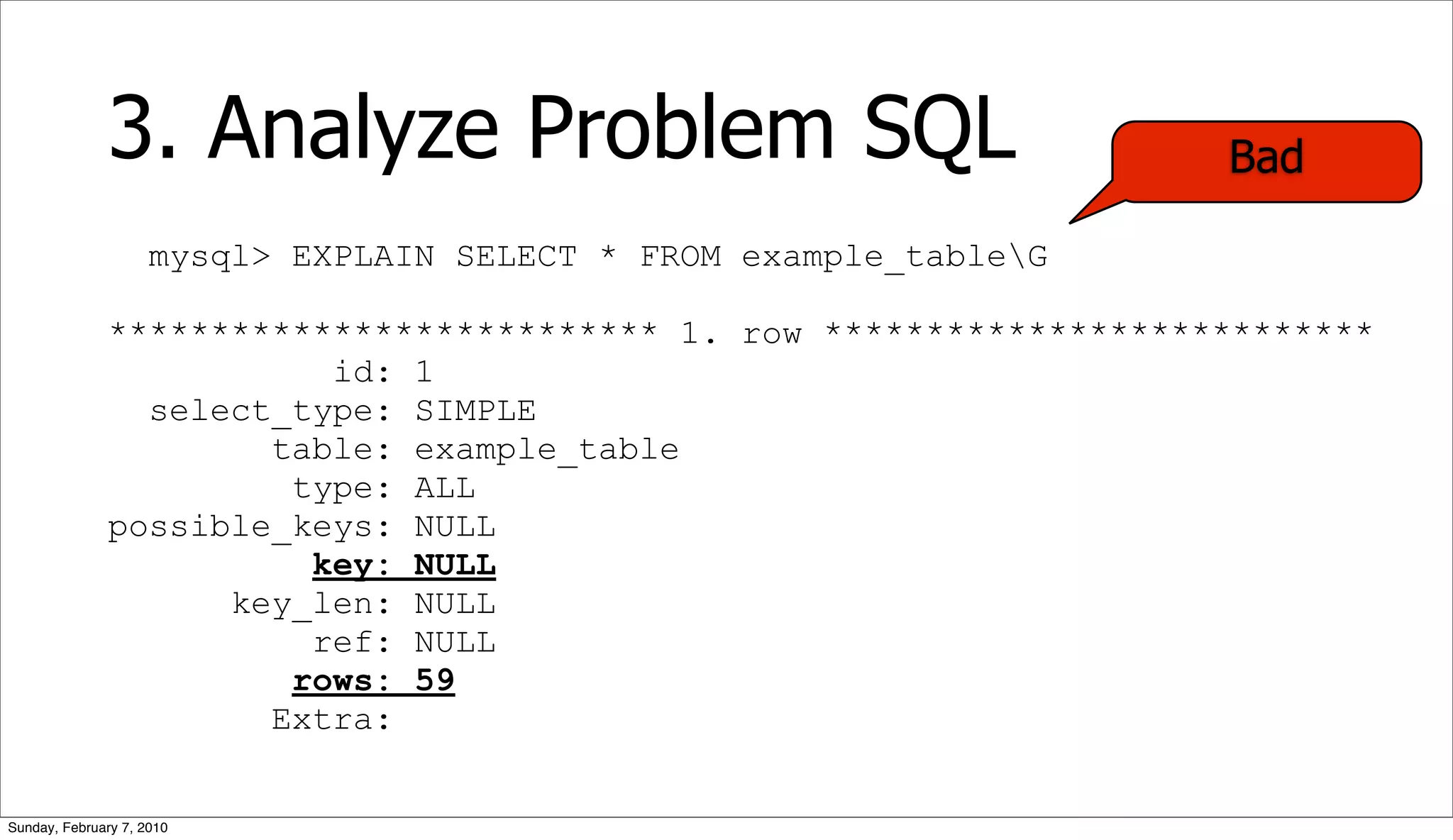
3. Analyze Problem SQL                                Bad

                     mysql> EXPLAIN SELECT * FROM example_tableG

              *************************** 1. row ***************************
                         id: 1
                select_type: SIMPLE
                      table: example_table
                       type: ALL
              possible_keys: NULL
                        key: NULL
                    key_len: NULL
                        ref: NULL
                       rows: 59
                      Extra:


Sunday, February 7, 2010
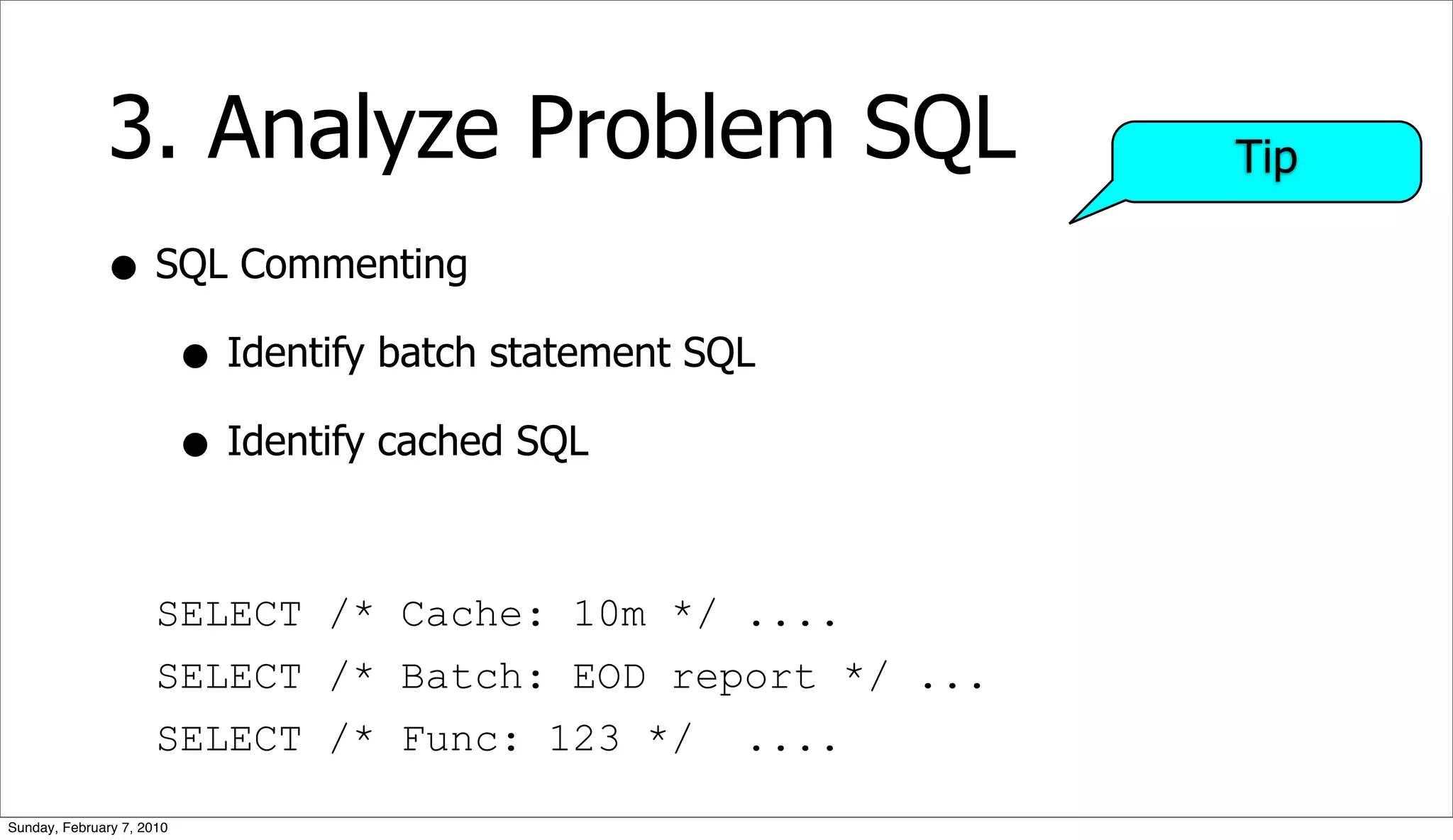
3. Analyze Problem SQL                       Tip

              • SQL Commenting
                 • Identify batch statement SQL
                 • Identify cached SQL

                      SELECT /* Cache: 10m */ ....
                      SELECT /* Batch: EOD report */ ...
                      SELECT /* Func: 123 */   ....

Sunday, February 7, 2010
Step 4


                               The Art of Indexes


Sunday, February 7, 2010
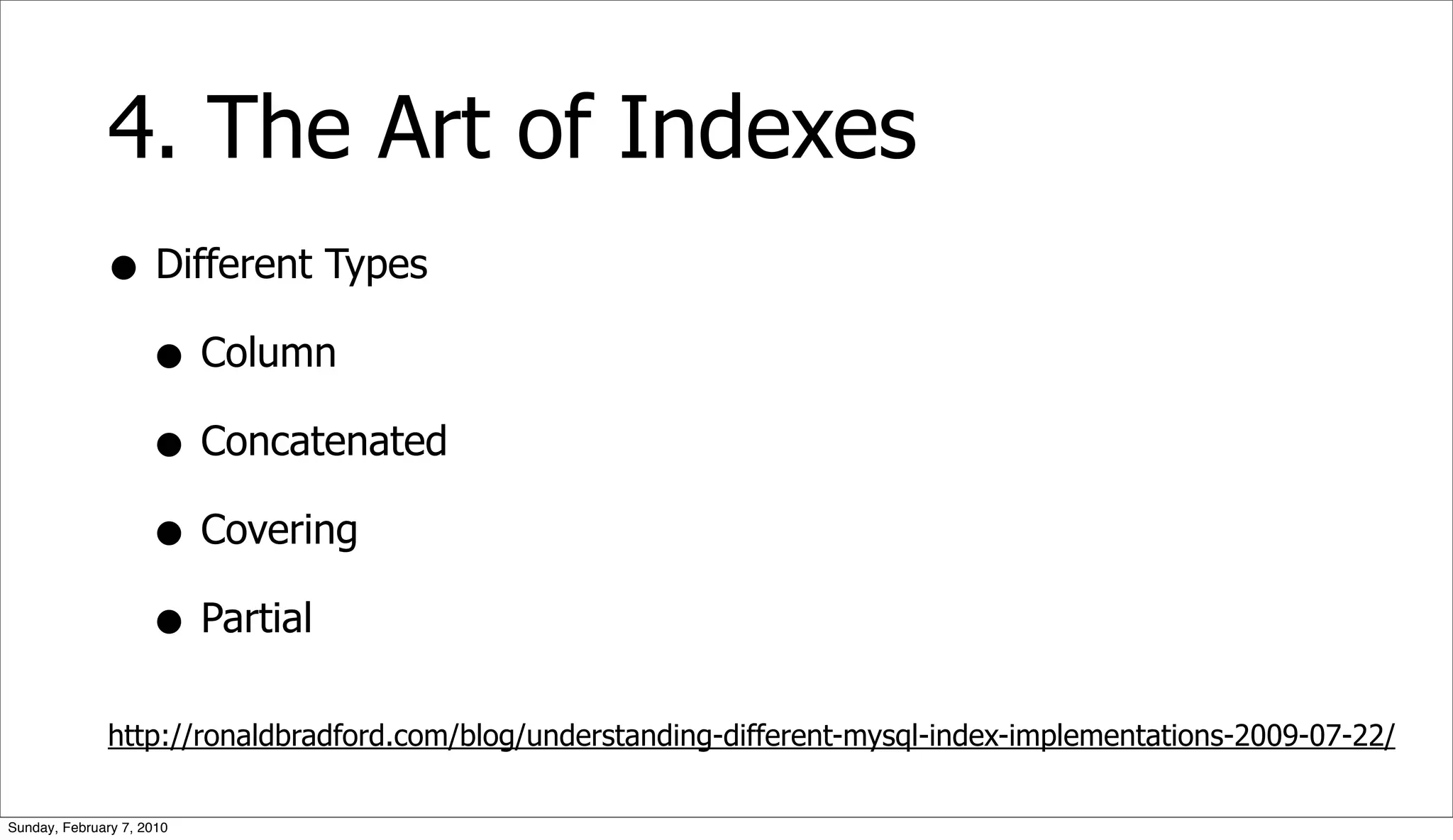
4. The Art of Indexes
              • Different Types
                • Column
                • Concatenated
                • Covering
                • Partial
              http://ronaldbradford.com/blog/understanding-different-mysql-index-implementations-2009-07-22/

Sunday, February 7, 2010
4. The Art of Indexes
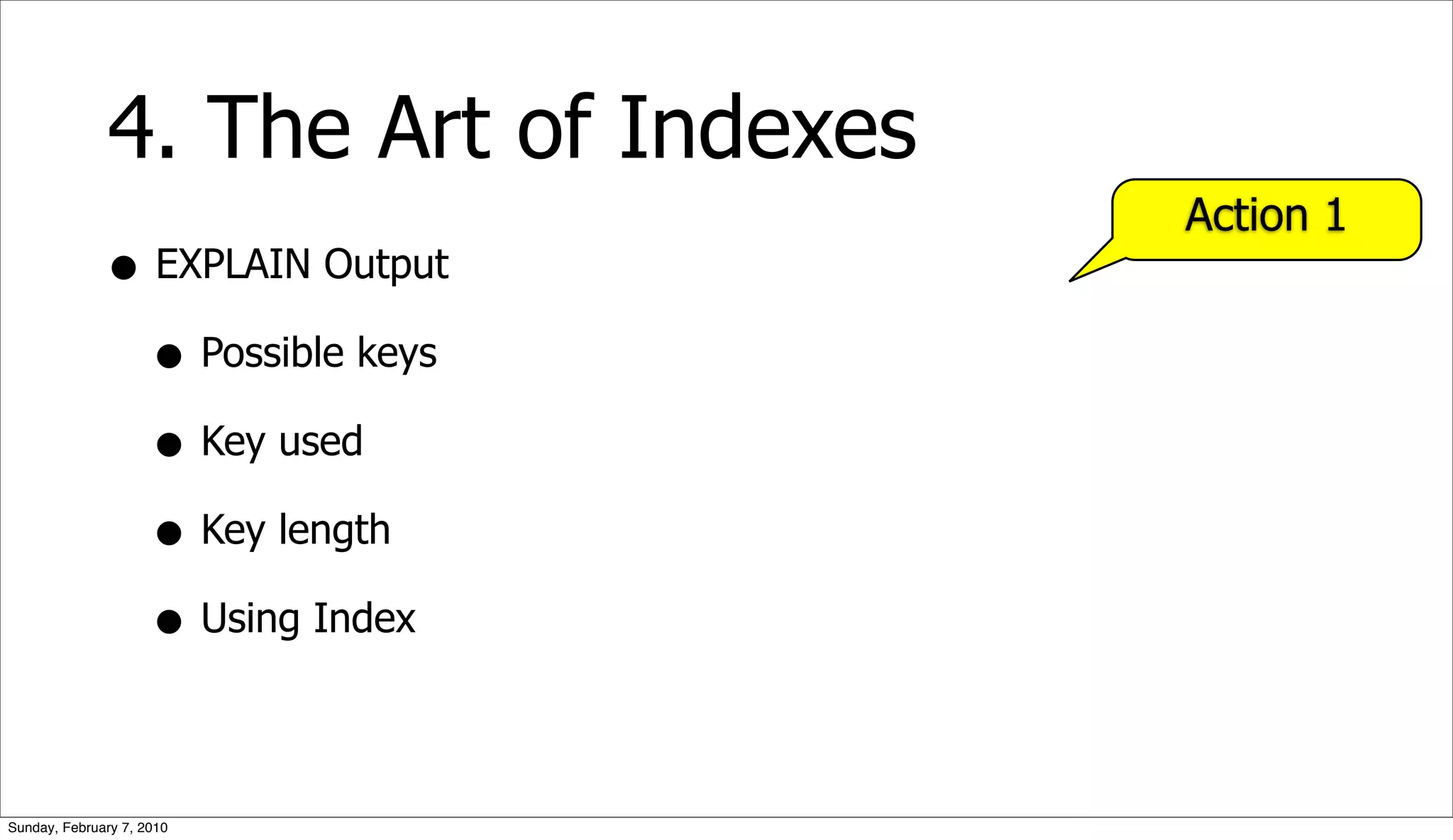
                                      Action 1
              • EXPLAIN Output
                • Possible keys
                • Key used
                • Key length
                • Using Index

Sunday, February 7, 2010
4. The Art of Indexes                     Tip

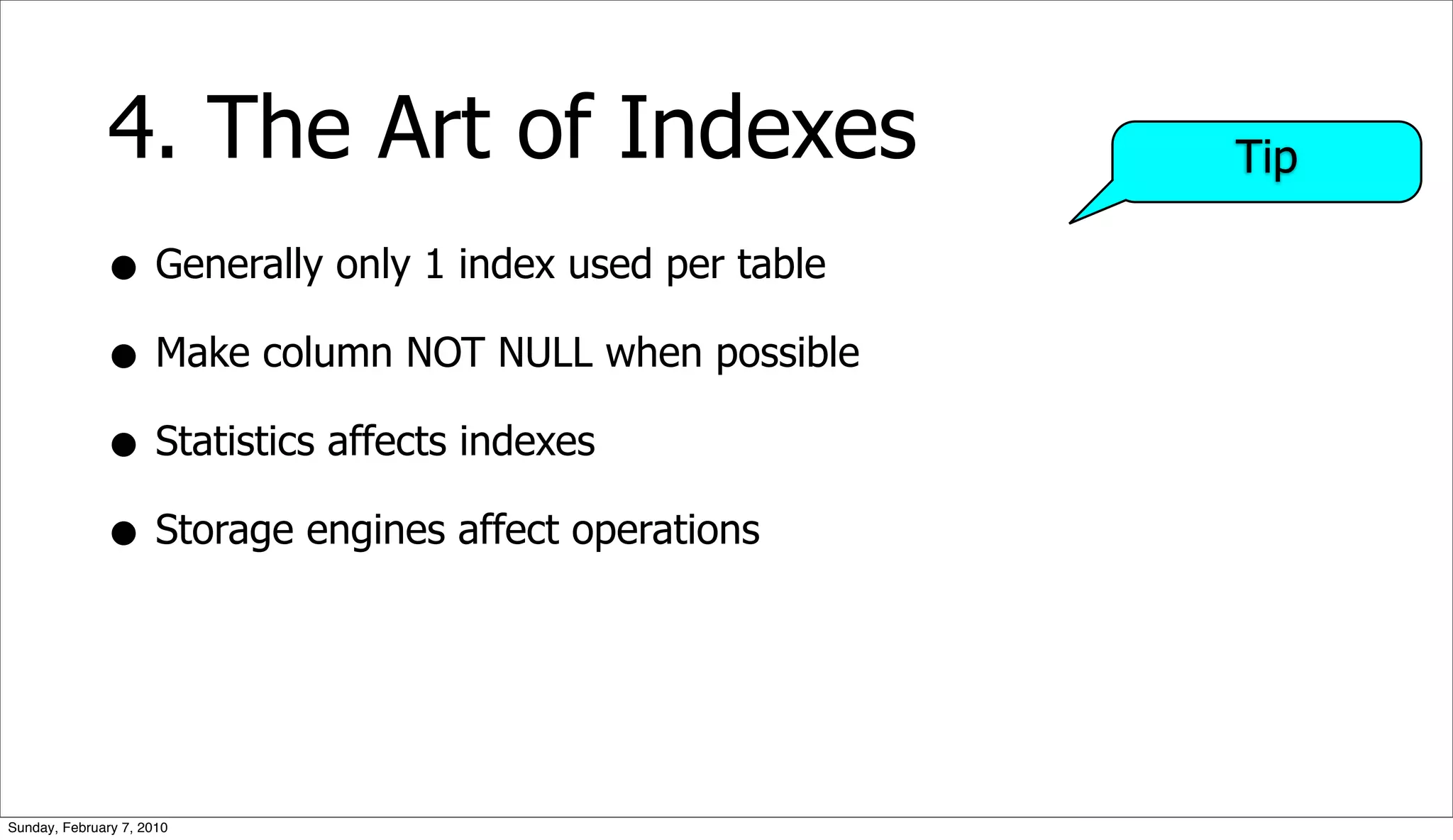
              • Generally only 1 index used per table
              • Make column NOT NULL when possible
              • Statistics affects indexes
              • Storage engines affect operations


Sunday, February 7, 2010
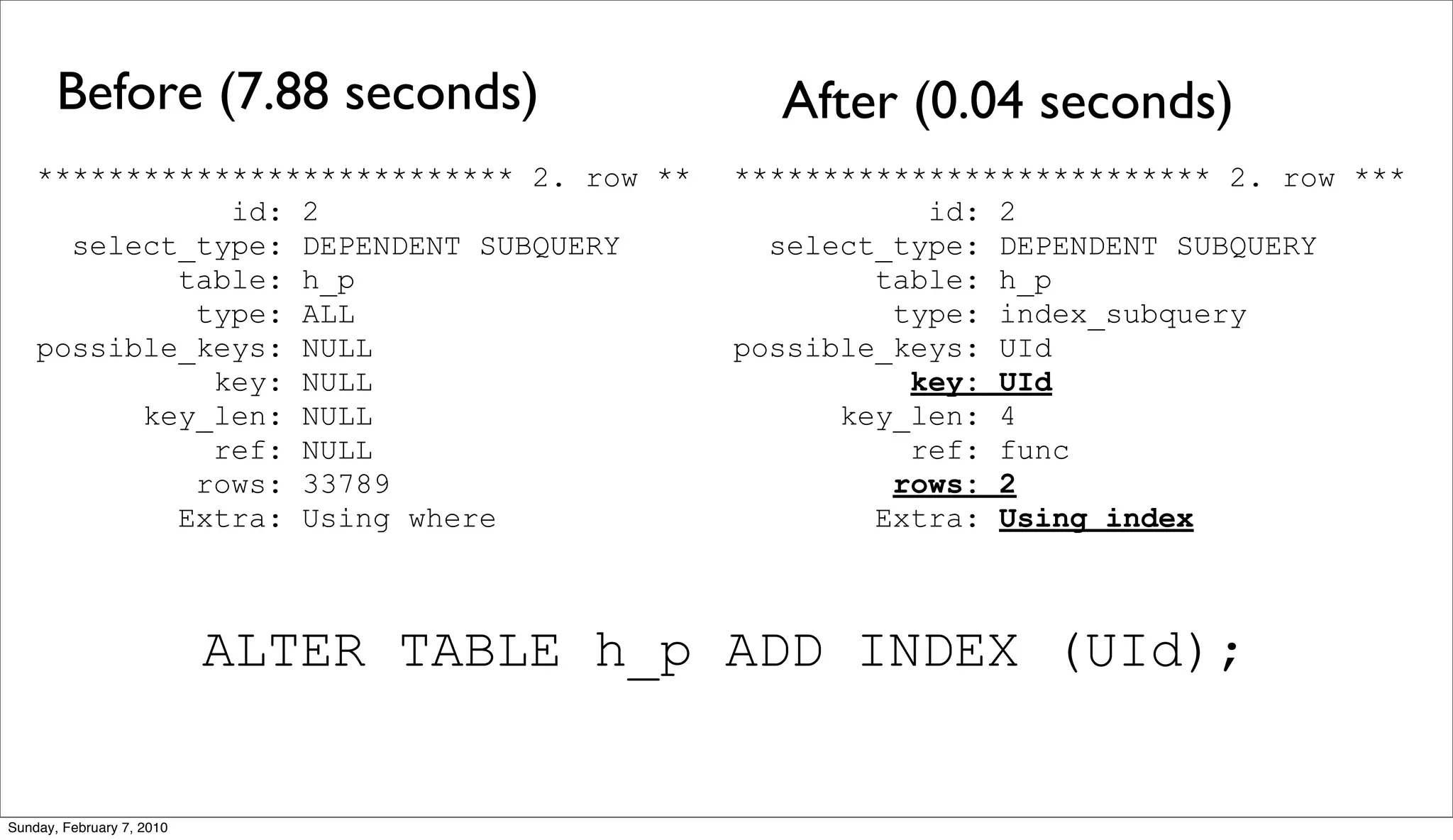
Before (7.88 seconds)                  After (0.04 seconds)
    *************************** 2. row **   *************************** 2. row ***
               id: 2                                   id: 2
      select_type: DEPENDENT SUBQUERY         select_type: DEPENDENT SUBQUERY
            table: h_p                              table: h_p
             type: ALL                               type: index_subquery
    possible_keys: NULL                     possible_keys: UId
              key: NULL                               key: UId
          key_len: NULL                           key_len: 4
              ref: NULL                               ref: func
             rows: 33789                             rows: 2
            Extra: Using where                      Extra: Using index


                           ALTER TABLE h_p ADD INDEX (UId);


Sunday, February 7, 2010
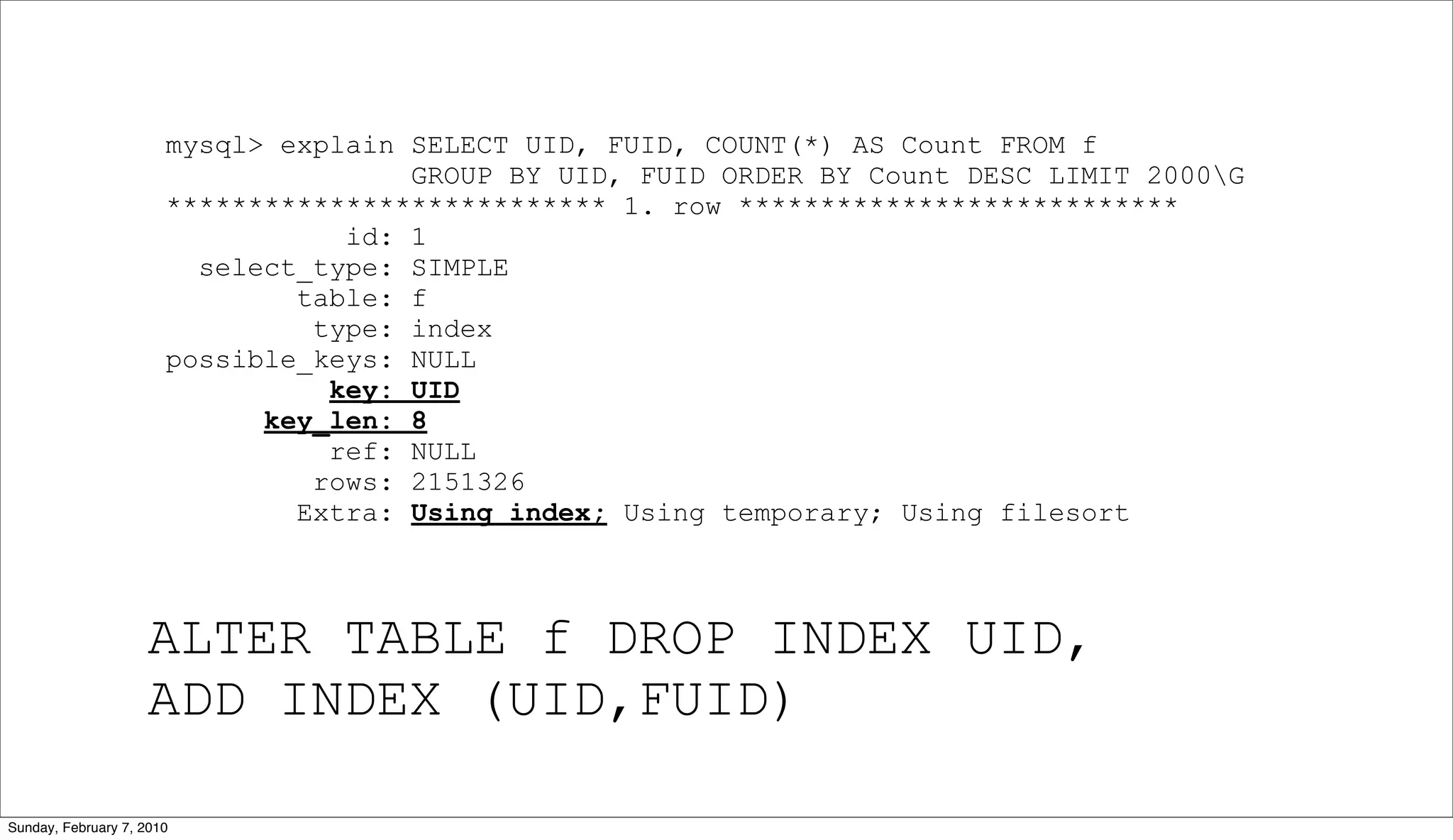
mysql> explain SELECT UID, FUID, COUNT(*) AS Count FROM f
                                      GROUP BY UID, FUID ORDER BY Count DESC LIMIT 2000G
                       *************************** 1. row ***************************
                                  id: 1
                         select_type: SIMPLE
                               table: f
                                type: index
                       possible_keys: NULL
                                 key: UID
                             key_len: 8
                                 ref: NULL
                                rows: 2151326
                               Extra: Using index; Using temporary; Using filesort


                    ALTER TABLE f DROP INDEX UID,
                    ADD INDEX (UID,FUID)

Sunday, February 7, 2010
4. The Art of Indexes


                           Indexes can hurt performance


Sunday, February 7, 2010
Step 5


                            Offloading Master Load


Sunday, February 7, 2010
5. Offloading Master Load
              • Identify statements for READ ONLY slave(s)
                • e.g. Long running batch statements


                     Single point v scalable solution

Sunday, February 7, 2010
Step 6


                                    Improving SQL


Sunday, February 7, 2010
6. Improving SQL
              • Poor SQL Examples
                 • ORDER BY RAND()
                 • SELECT *
                 • Lookup joins
                 • ORDER BY
                           The database is best for storing
                            and retrieving data not logic
Sunday, February 7, 2010
Step 7


                                Storage Engines


Sunday, February 7, 2010
7. Storage Engines
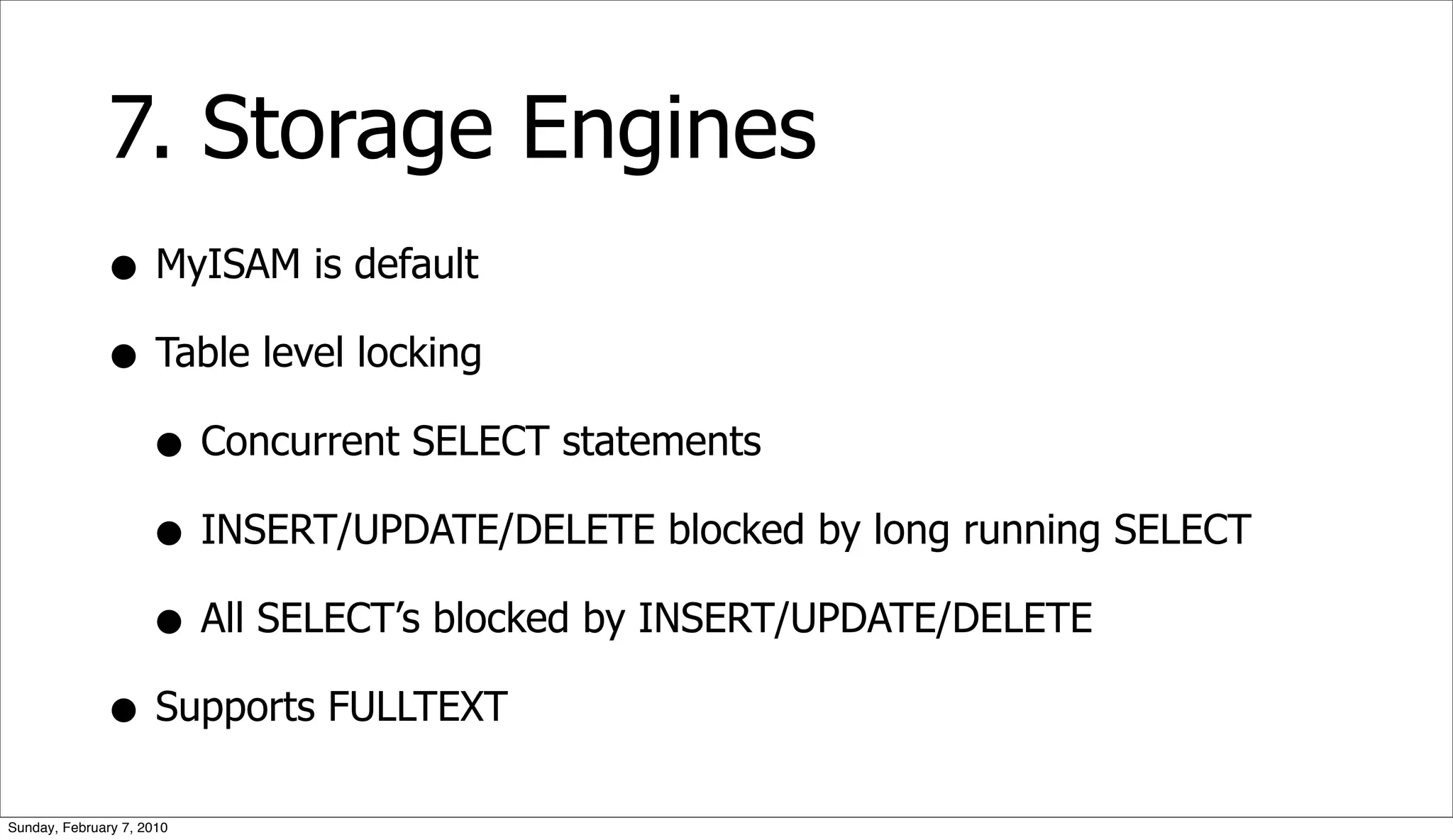
              • MyISAM is default
              • Table level locking
                • Concurrent SELECT statements
                • INSERT/UPDATE/DELETE blocked by long running SELECT
                • All SELECT’s blocked by INSERT/UPDATE/DELETE
              • Supports FULLTEXT
Sunday, February 7, 2010
7. Storage Engines
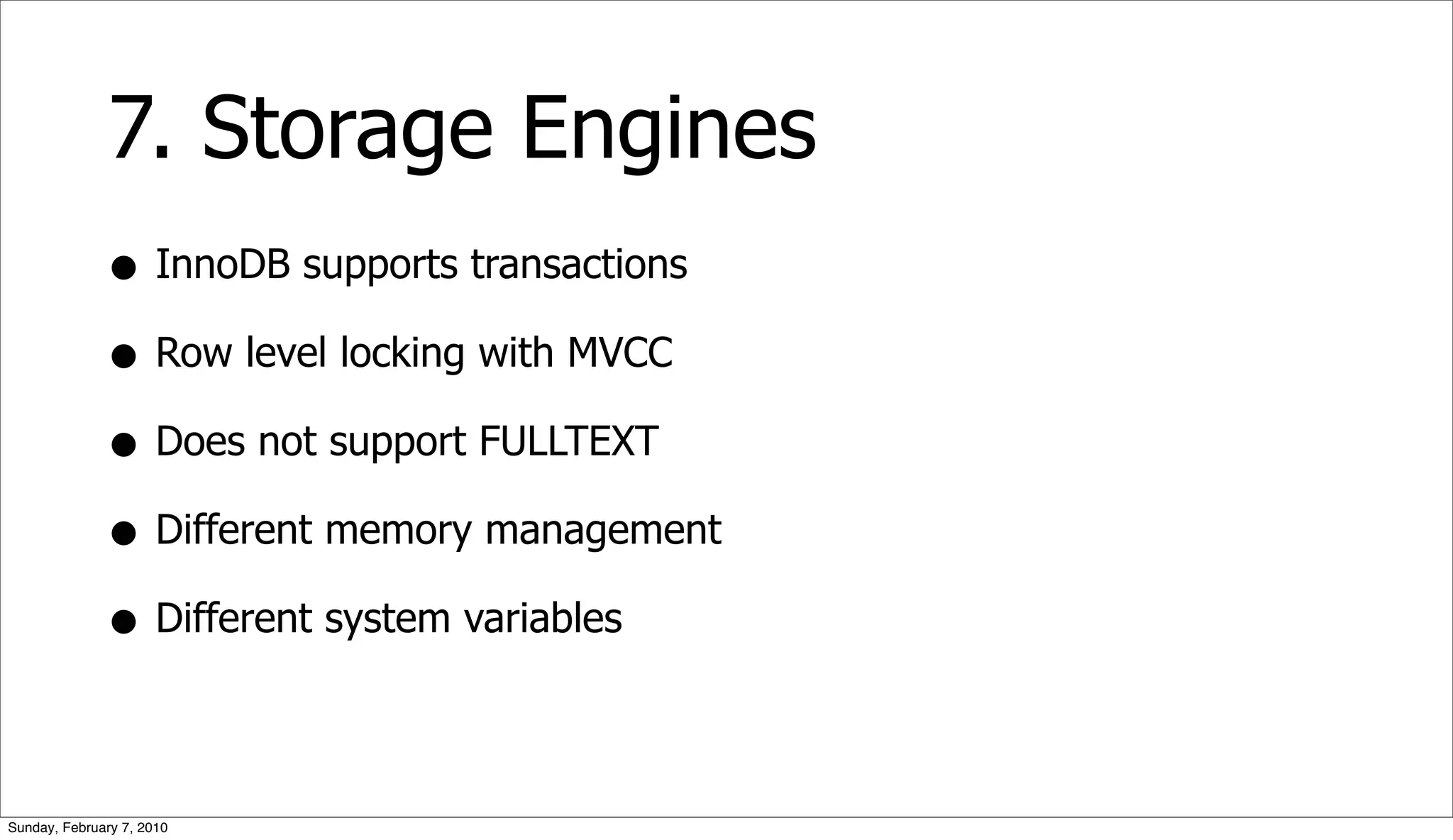
              • InnoDB supports transactions
              • Row level locking with MVCC
              • Does not support FULLTEXT
              • Different memory management
              • Different system variables

Sunday, February 7, 2010
7. Storage Engines
              • There are other storage engines
                • Memory
                • Archive
                • Blackhole
                • Third party

Sunday, February 7, 2010
7. Storage Engines
              Using Multiple Engines

              • Different memory management
              • Different system variables
              • Different monitoring
              • Affects backup strategy

Sunday, February 7, 2010
7. Storage Engines
                                                   Action 1
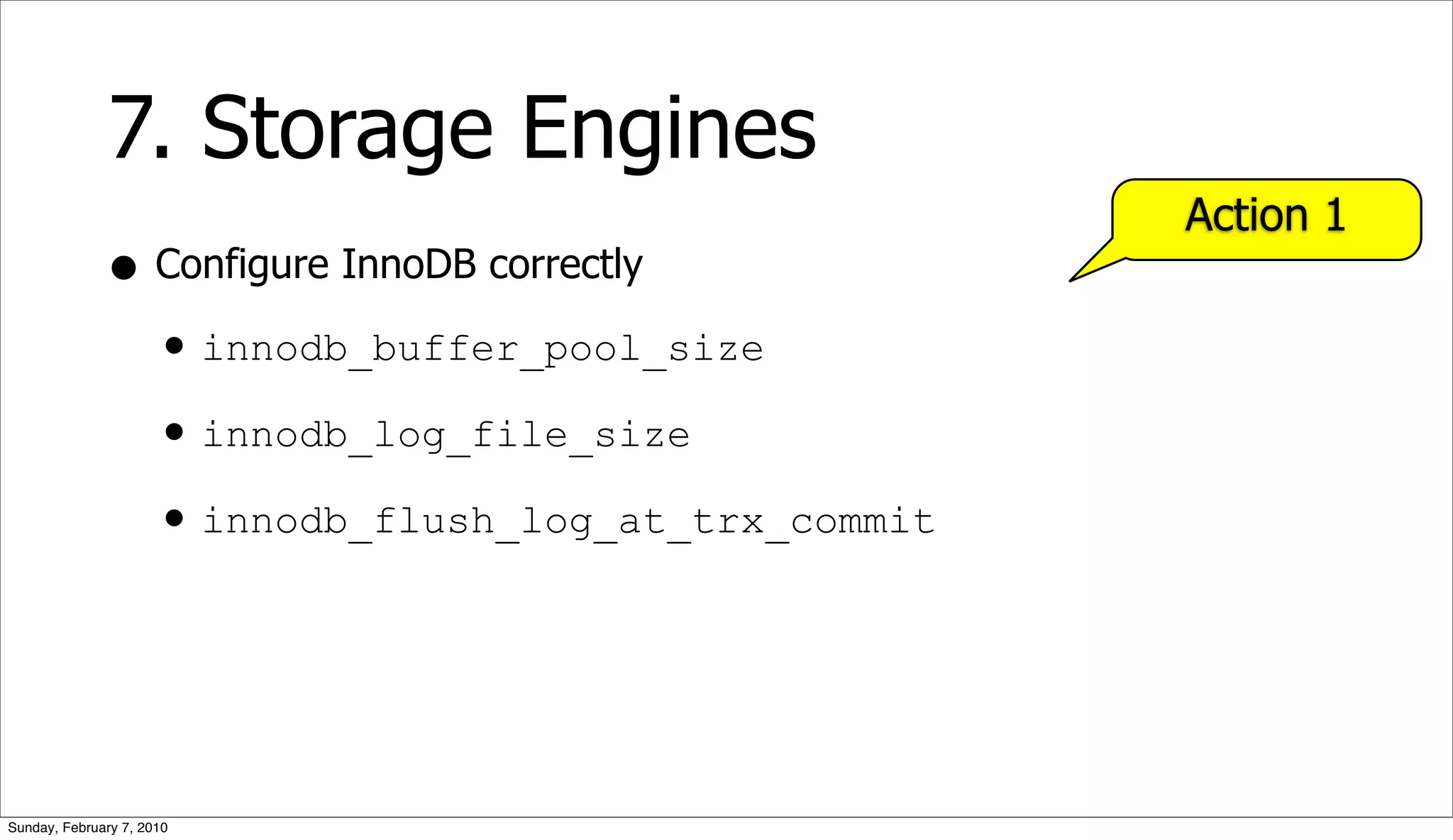
              • Configure InnoDB correctly
                • innodb_buffer_pool_size
                • innodb_log_file_size
                • innodb_flush_log_at_trx_commit


Sunday, February 7, 2010
7. Storage Engines
                                                   Action 2
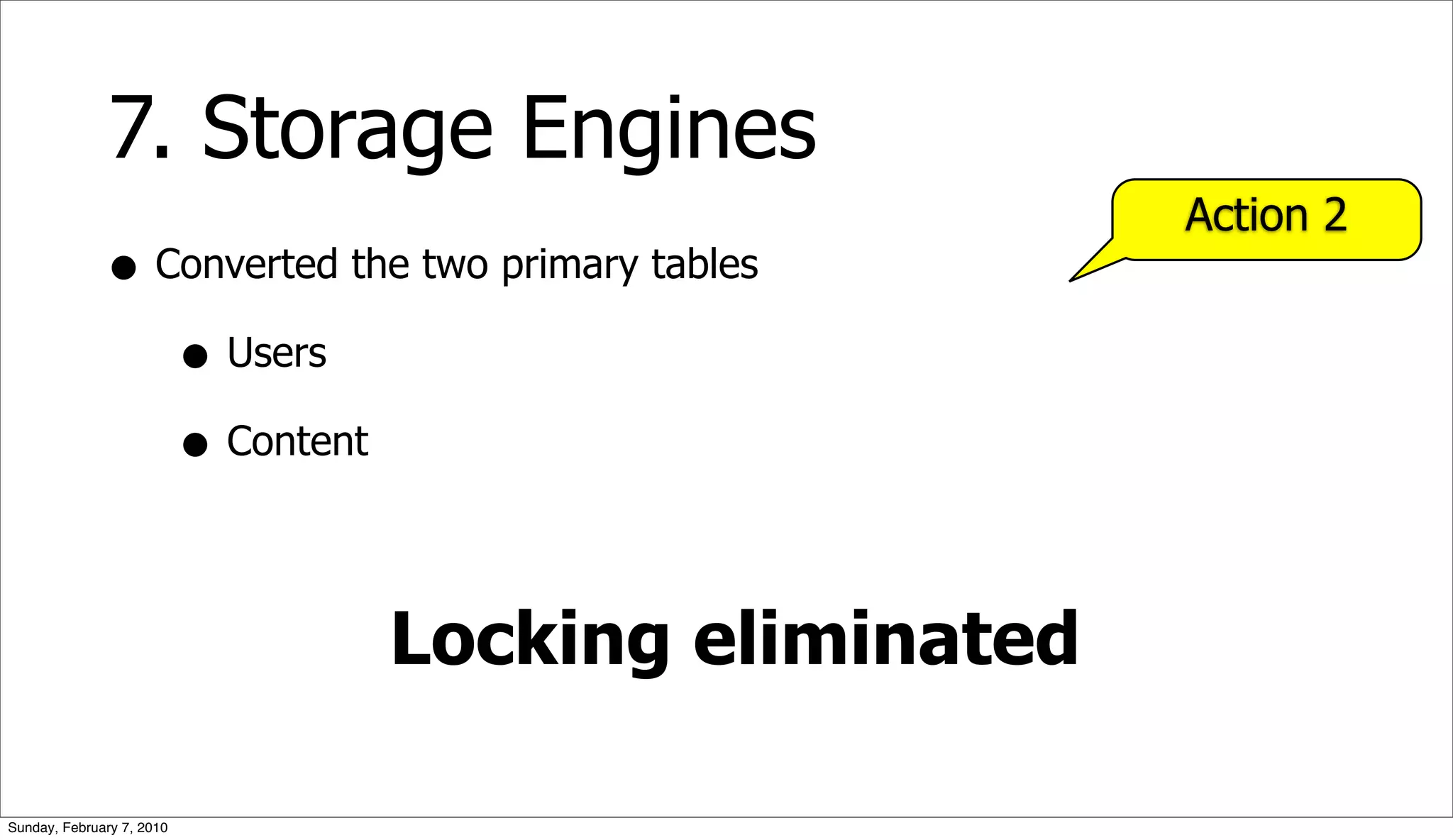
              • Converted the two primary tables
                 • Users
                 • Content

                            Locking eliminated

Sunday, February 7, 2010
Step 8


                                    Caching


Sunday, February 7, 2010
8. Caching
                                                                Action 1
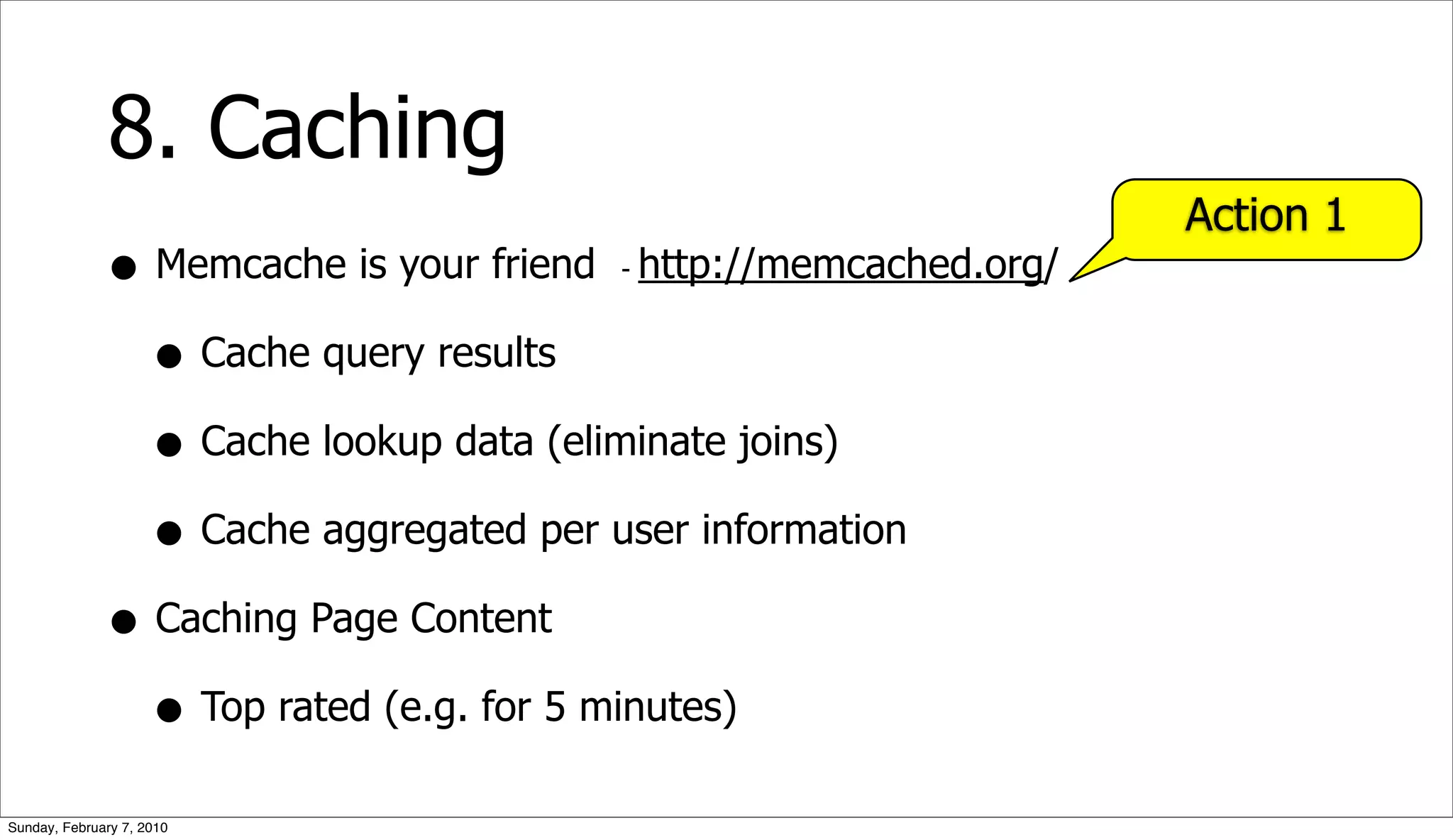
              • Memcache is your friend http://memcached.org/
                                       -


                • Cache query results
                • Cache lookup data (eliminate joins)
                • Cache aggregated per user information
              • Caching Page Content
                • Top rated (e.g. for 5 minutes)
Sunday, February 7, 2010
8. Caching
                                                            Action 2
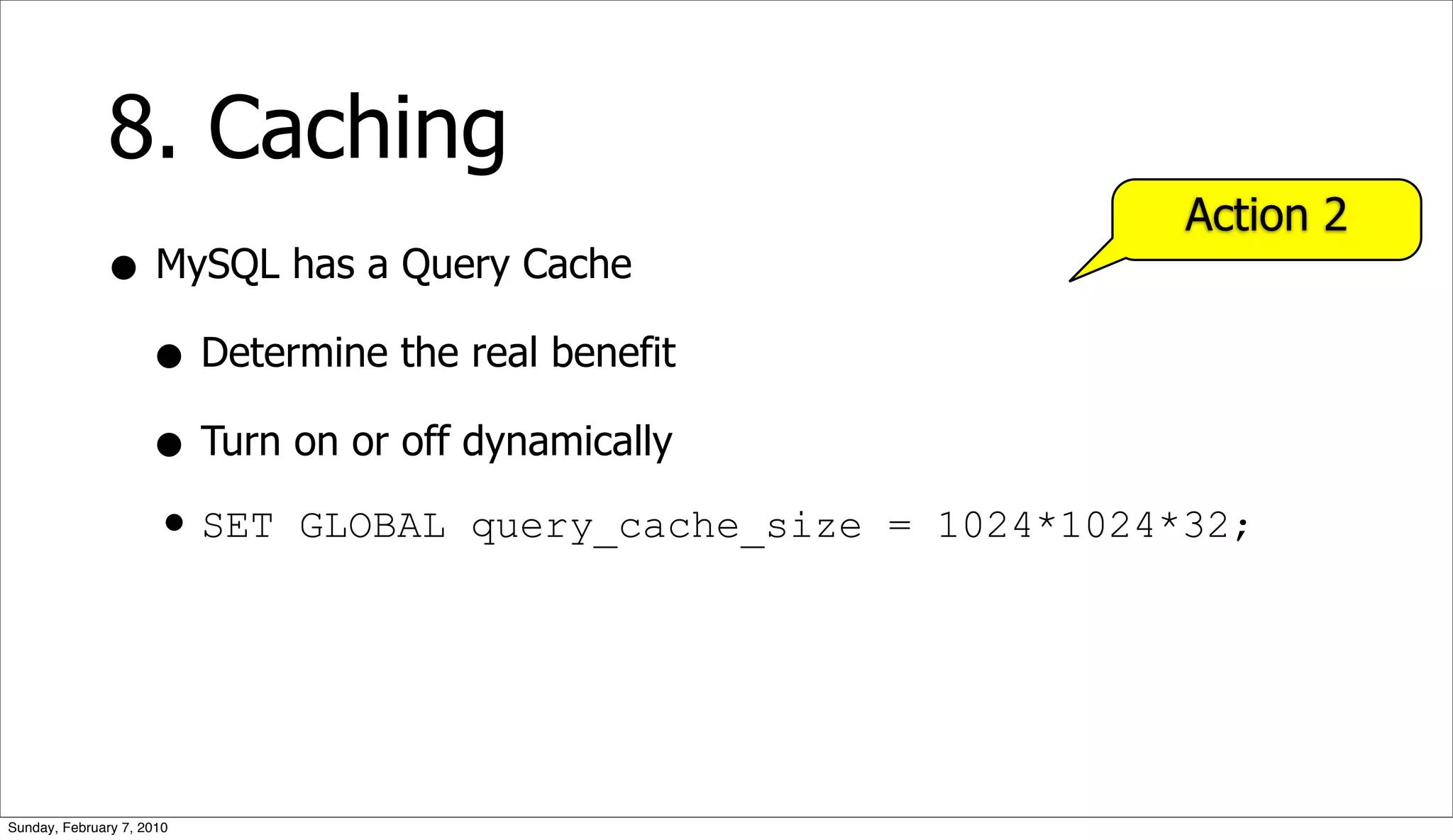
              • MySQL has a Query Cache
                • Determine the real benefit
                • Turn on or off dynamically
                • SET GLOBAL query_cache_size   = 1024*1024*32;


Sunday, February 7, 2010
8. Caching                                   Tip


                              The best performance
                             improvement for an SQL
                           statement is to eliminate it.


Sunday, February 7, 2010
Step 9


                                    Sharding


Sunday, February 7, 2010
9. Sharding
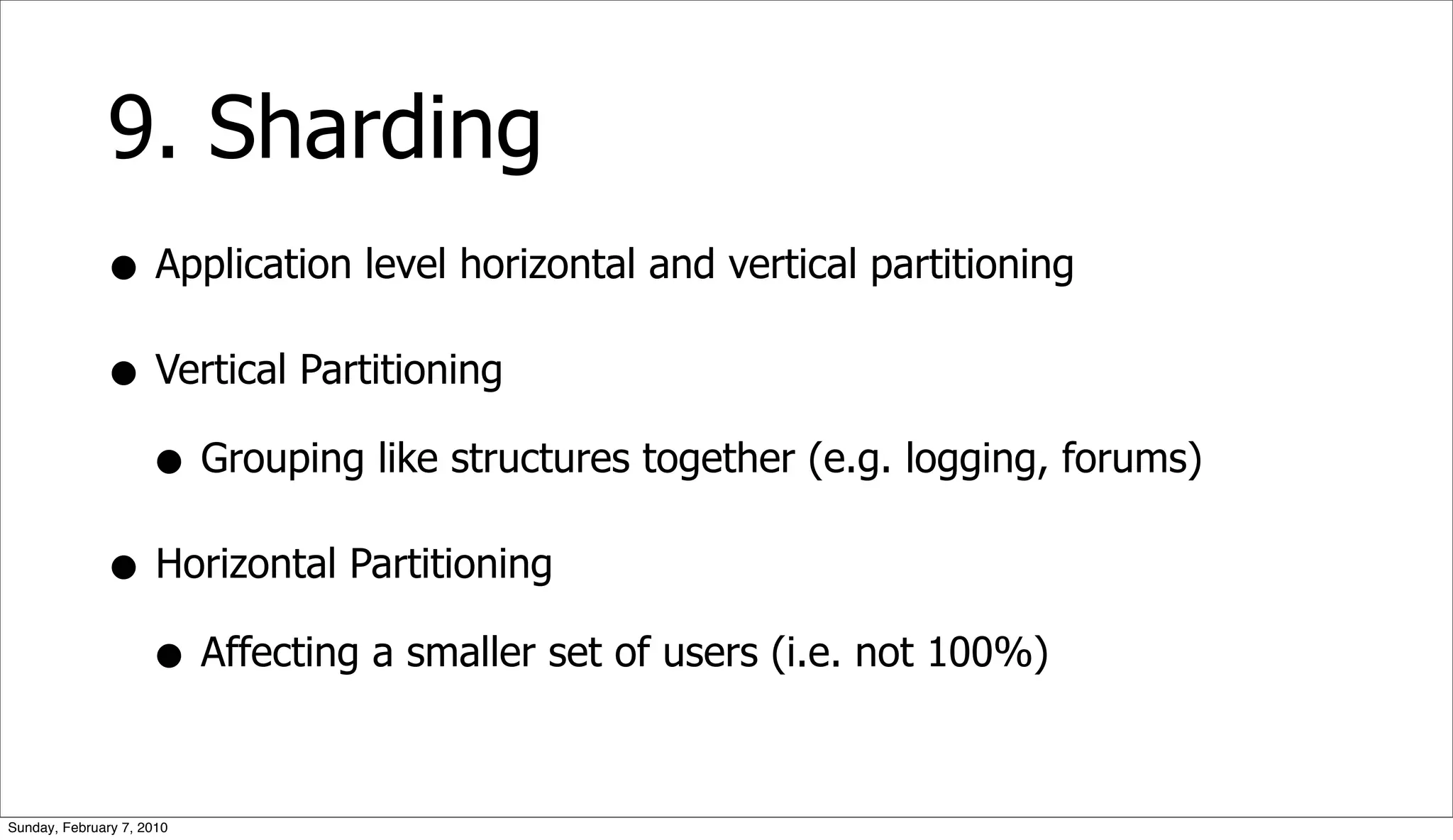
              • Application level horizontal and vertical partitioning
              • Vertical Partitioning
                • Grouping like structures together (e.g. logging, forums)
              • Horizontal Partitioning
                • Affecting a smaller set of users (i.e. not 100%)

Sunday, February 7, 2010
9. Sharding
                                                                Action 1
              • Separate Logging
                 • Reduced replication load on primary server


Sunday, February 7, 2010
Step 10


                            Database Management


Sunday, February 7, 2010
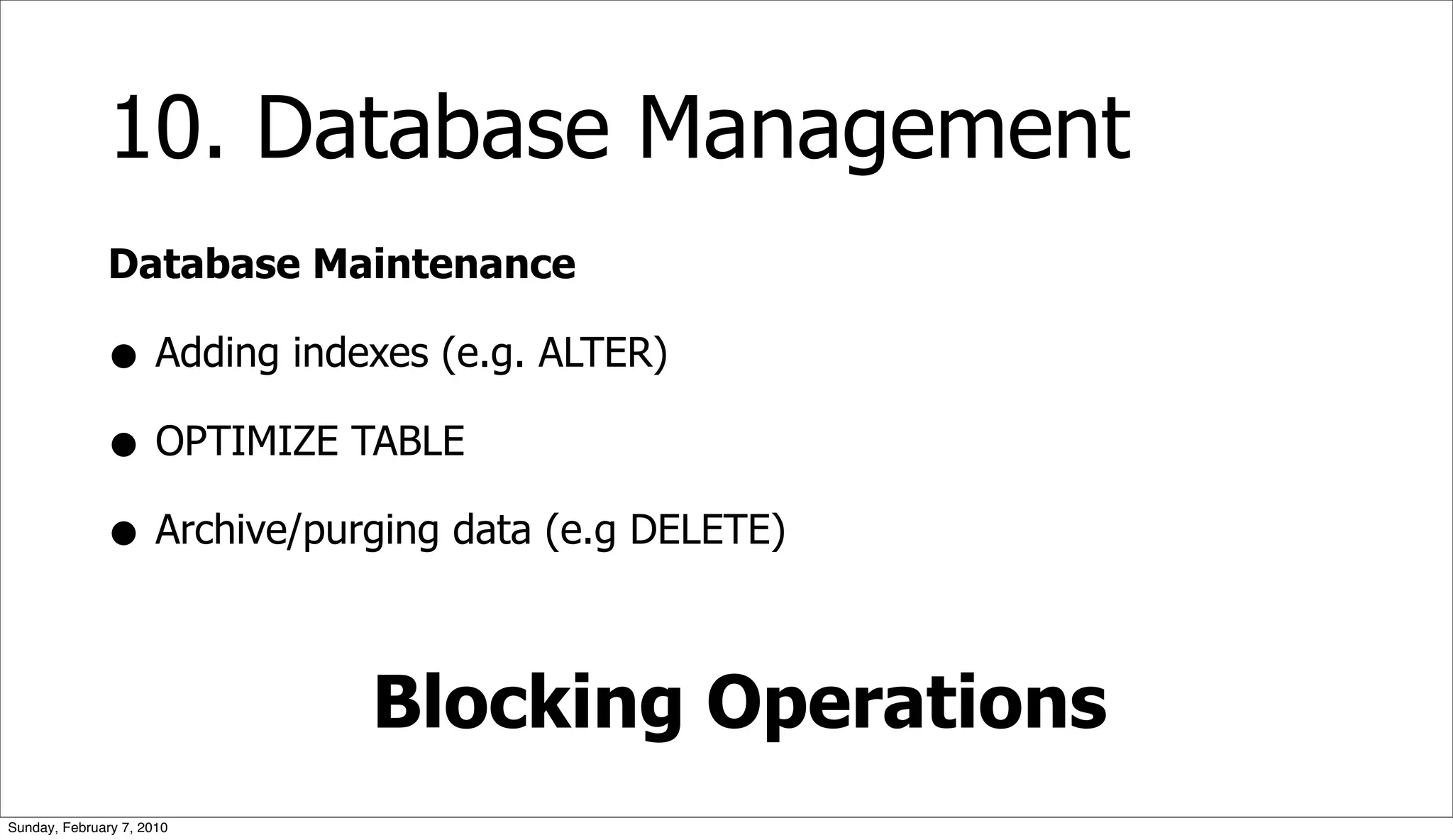
10. Database Management
              Database Maintenance

              • Adding indexes (e.g. ALTER)
              • OPTIMIZE TABLE
              • Archive/purging data (e.g DELETE)

                           Blocking Operations
Sunday, February 7, 2010
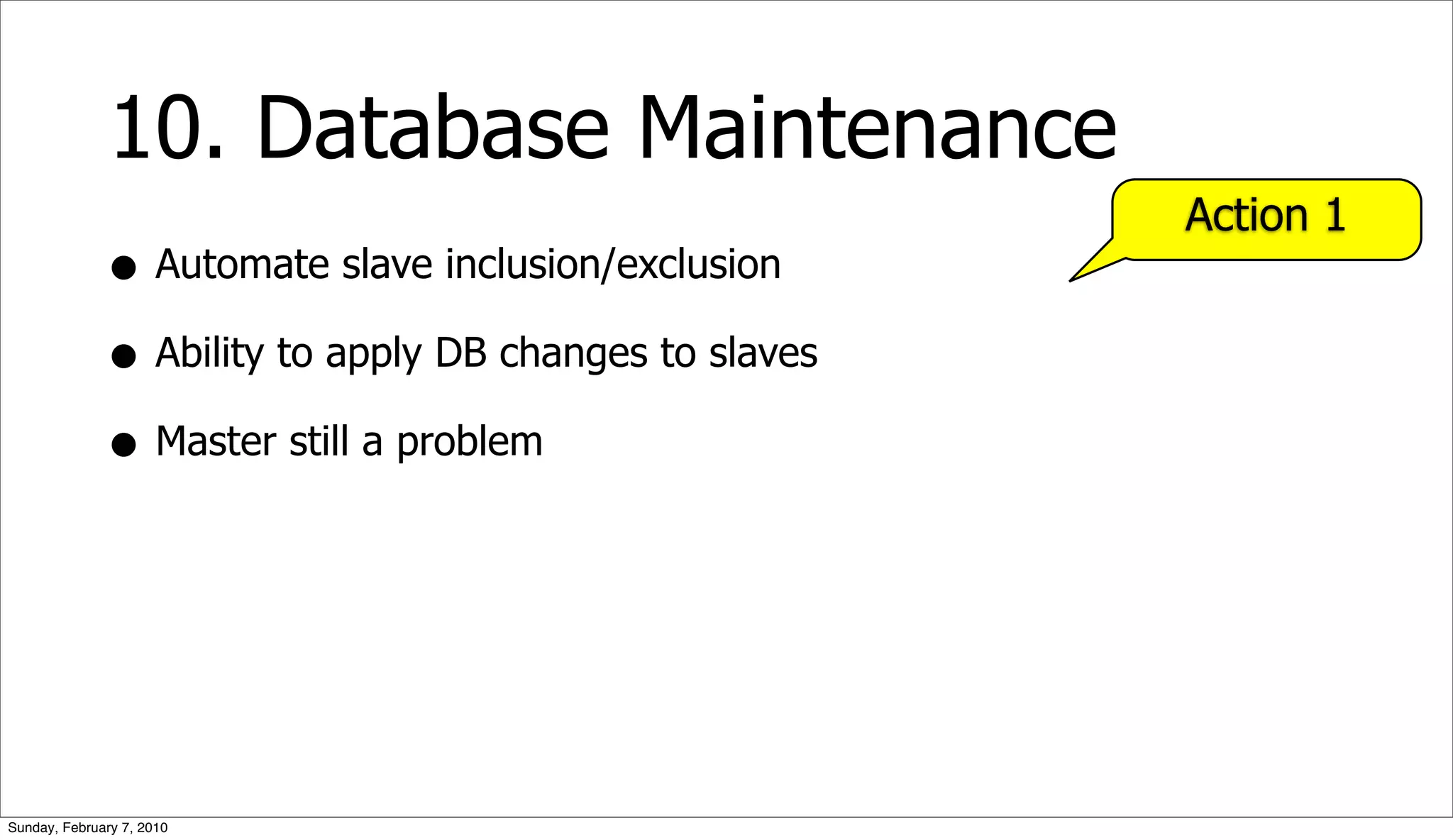
10. Database Maintenance
                                                        Action 1
              • Automate slave inclusion/exclusion
              • Ability to apply DB changes to slaves
              • Master still a problem


Sunday, February 7, 2010
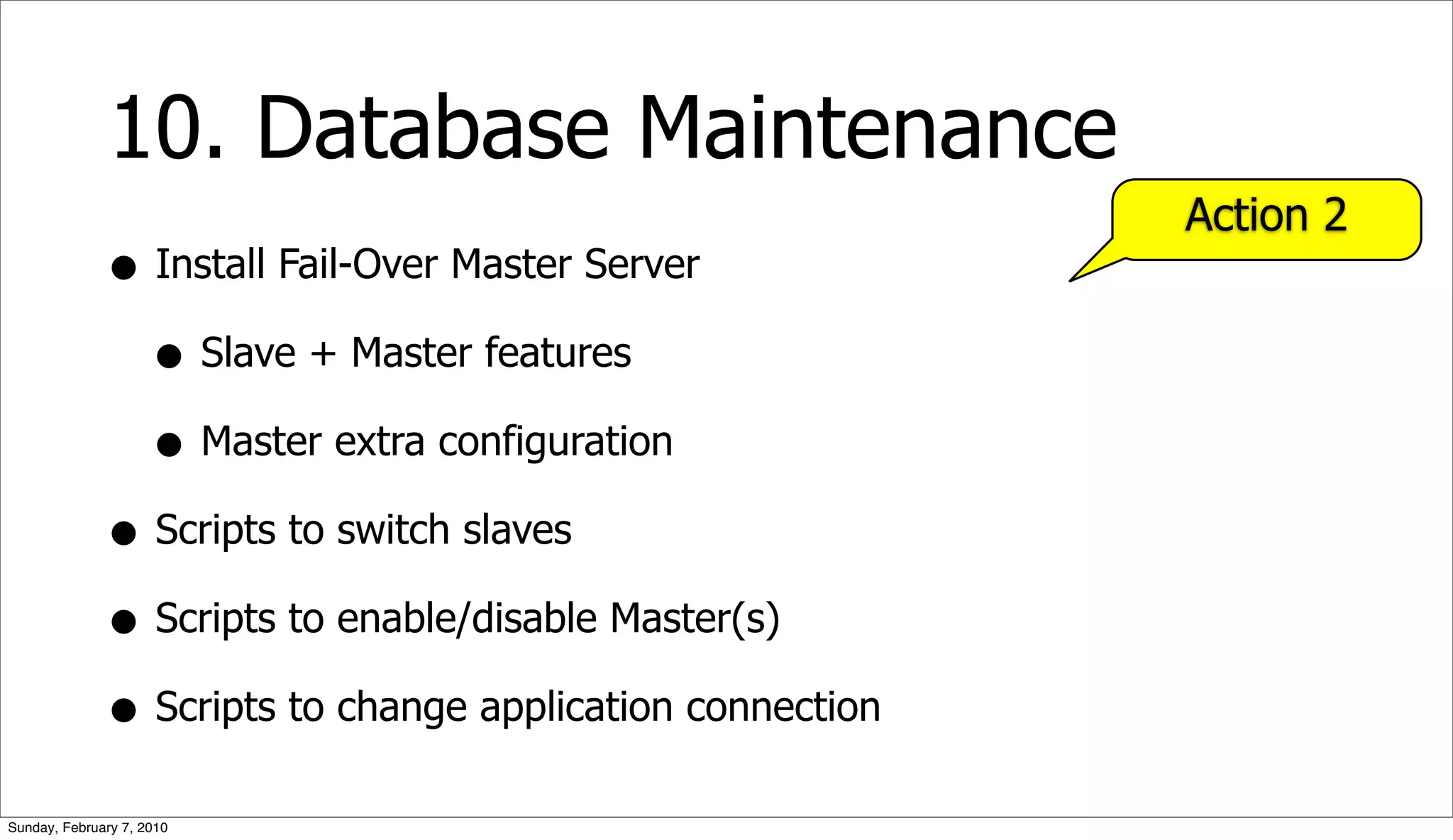
10. Database Maintenance
                                                           Action 2
              • Install Fail-Over Master Server
                • Slave + Master features
                • Master extra configuration
              • Scripts to switch slaves
              • Scripts to enable/disable Master(s)
              • Scripts to change application connection
Sunday, February 7, 2010
10. Database Maintenance

                              Higher Availability
                                      &
                           Testing Disaster Recovery

Sunday, February 7, 2010
Bonus


                           Front End Improvements


Sunday, February 7, 2010
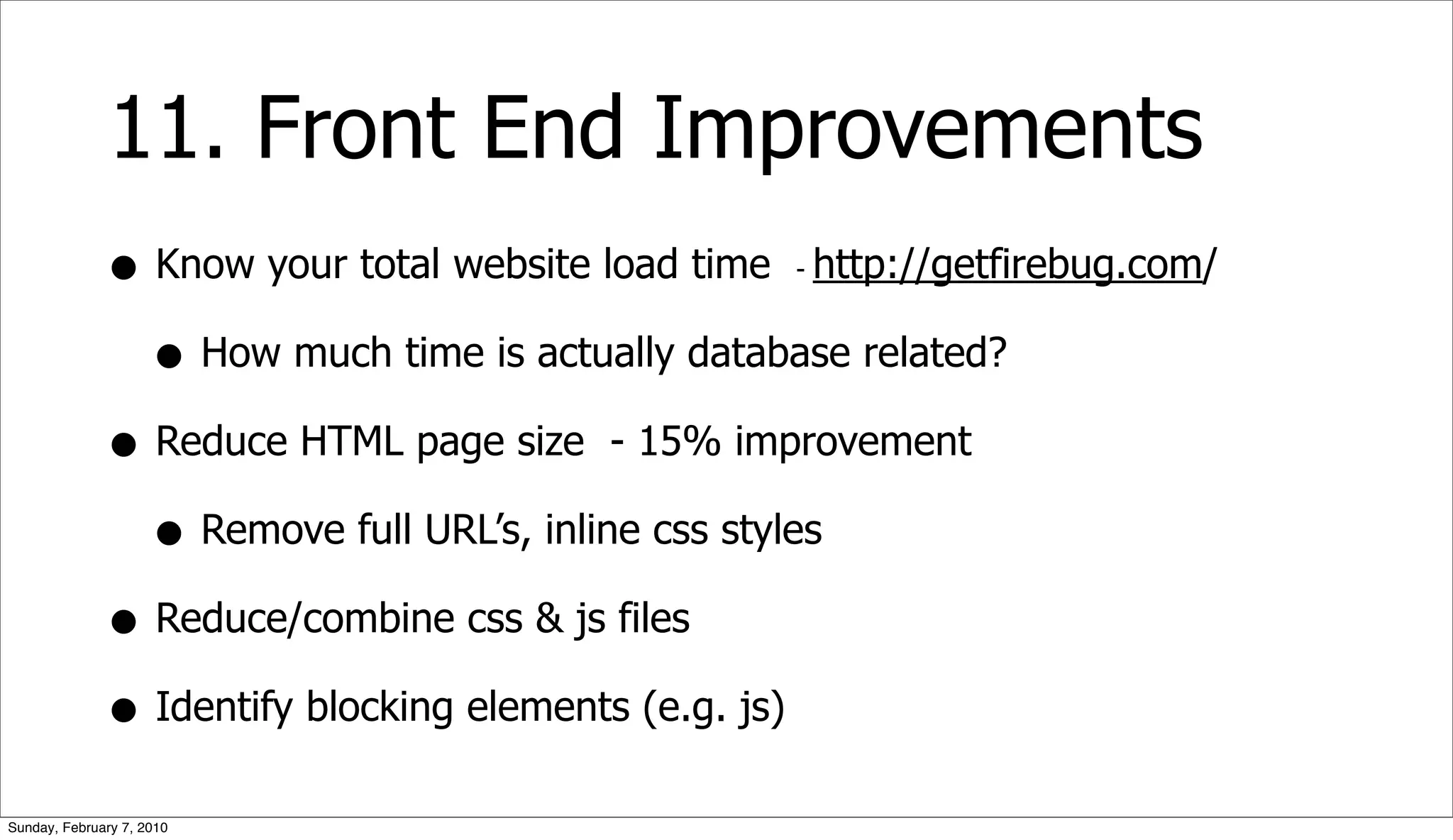
11. Front End Improvements
              • Know your total website load time http://getfirebug.com/
                                                 -


                • How much time is actually database related?
              • Reduce HTML page size - 15% improvement
                • Remove full URL’s, inline css styles
              • Reduce/combine css & js files
              • Identify blocking elements (e.g. js)
Sunday, February 7, 2010
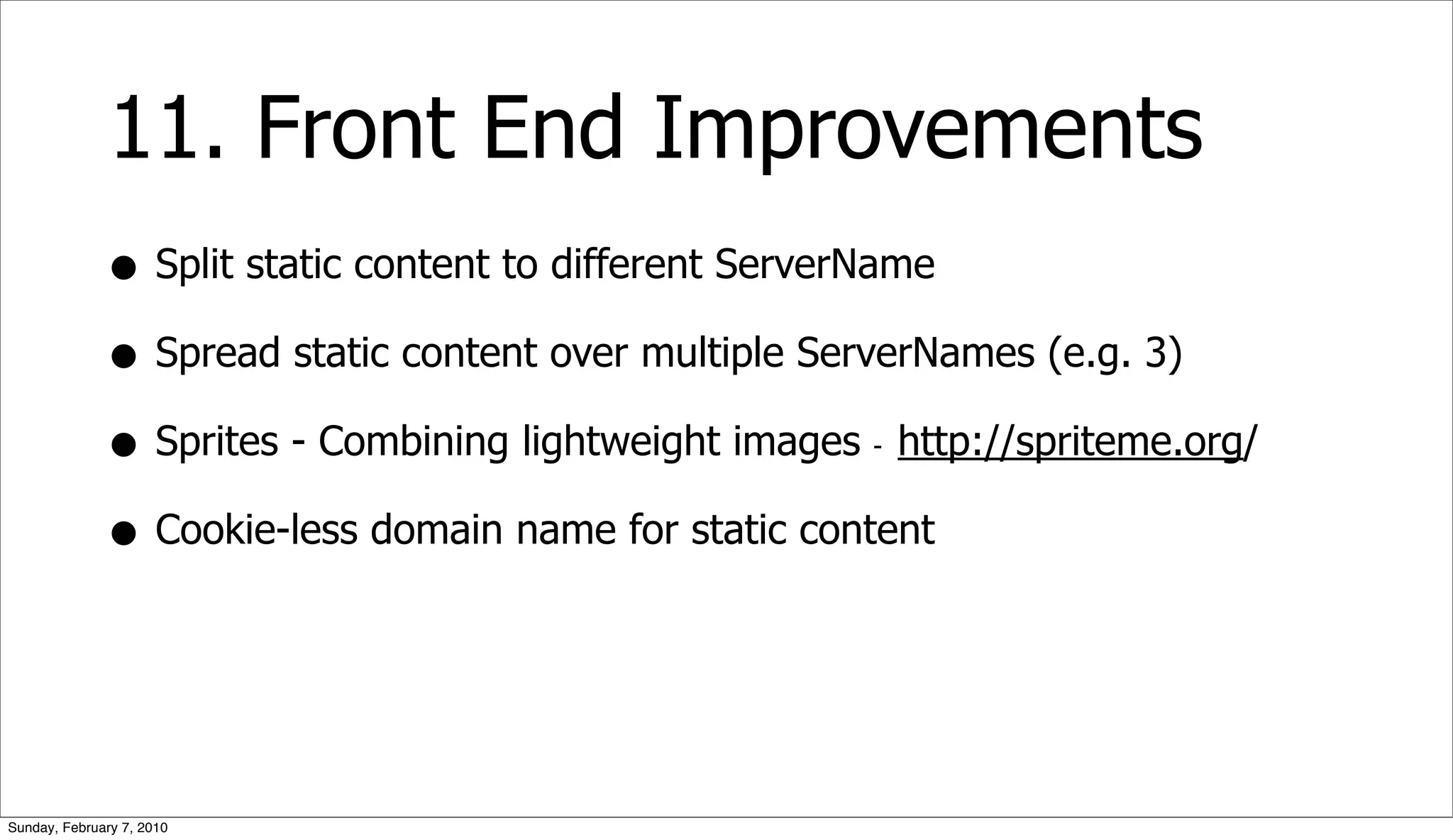
11. Front End Improvements
              • Split static content to different ServerName
              • Spread static content over multiple ServerNames (e.g. 3)
              • Sprites - Combining lightweight images http://spriteme.org/
                                                      -


              • Cookie-less domain name for static content


Sunday, February 7, 2010
Conclusion


Sunday, February 7, 2010
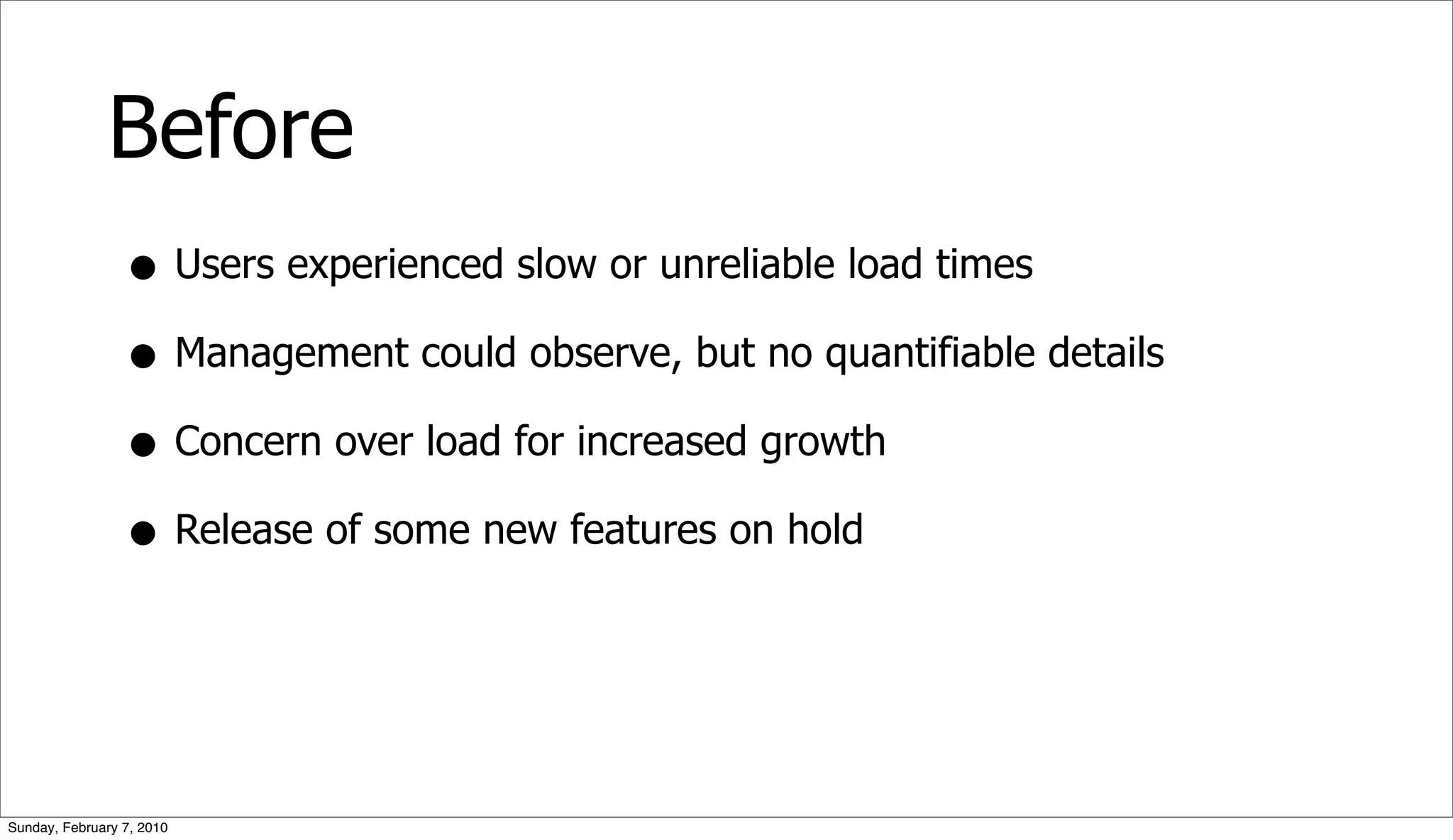
Before
                 • Users experienced slow or unreliable load times
                 • Management could observe, but no quantifiable details
                 • Concern over load for increased growth
                 • Release of some new features on hold


Sunday, February 7, 2010
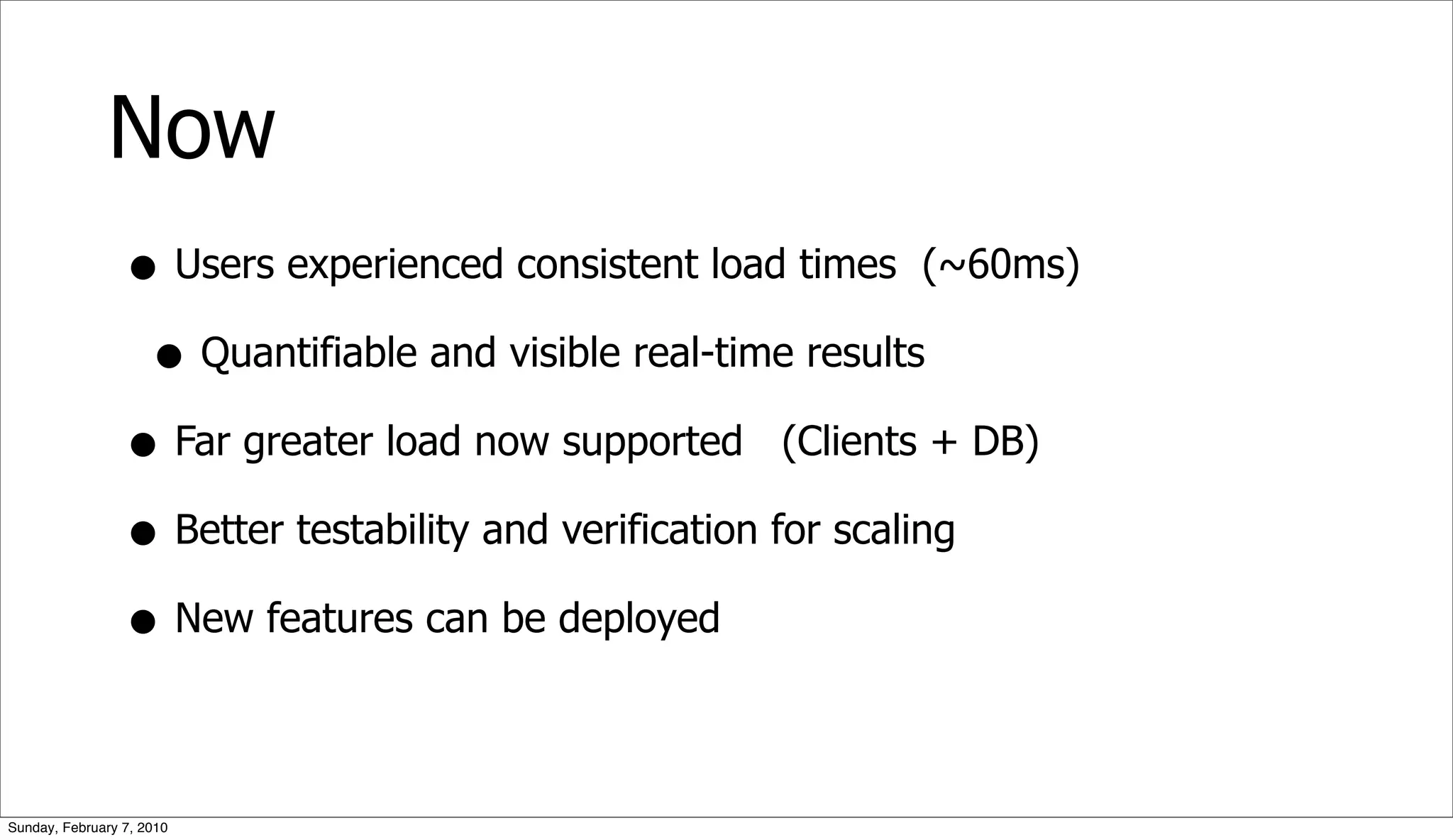
Now
                 • Users experienced consistent load times (~60ms)
                  • Quantifiable and visible real-time results
                 • Far greater load now supported (Clients + DB)
                 • Better testability and verification for scaling
                 • New features can be deployed

Sunday, February 7, 2010
Consulting Available Now


                           http://ronaldbradford.com


Sunday, February 7, 2010

10x Performance Improvements - A Case Study

  • 1.
    10x Performance Improvements in 10 steps A Case Study Ronald Bradford http://ronaldbradford.com FOSDEM - 2010.02 Sunday, February 7, 2010
  • 2.
    Application Typical Web 2.0 social media site (Europe based) • Users - Visitors, Free Members, Paying Members • Friends • User Content - Video, Pictures • Forums, Chat, Email Sunday, February 7, 2010
  • 3.
    Server Environment • 1 Master Database Server (MySQL 5.0.x) • 3 Slave Database Servers (MySQL 5.0.x) • 5 Web Servers (Apache/PHP) • 1 Static Content Server (Nginx) • 1 Mail Server Sunday, February 7, 2010
  • 4.
    Step 1 Monitor, Monitor, Monitor Sunday, February 7, 2010
  • 5.
    1. Monitor, Monitor,Monitor • What’s happened? • What’s happening now? • What’s going to happen? Past, Present, Future Sunday, February 7, 2010
  • 6.
    1. Monitor, Monitor,Monitor Action 1 Monitoring Software • Installation of Cacti http://www.cacti.net/ - • Installation of MySQL Cacti Templates - http://code.google.com/p/mysql-cacti-templates/ • (Optional) Installation of MONyog - http://www.webyog.com/ Sunday, February 7, 2010
  • 7.
    1. Monitor, Monitor,Monitor Action 2 Custom Dashboard • Most important - The state of NOW • Single Page Alerts - GREEN YELLOW RED Sunday, February 7, 2010
  • 8.
    Screen print goeshere Dashboard Example Sunday, February 7, 2010
  • 9.
    1. Monitor, Monitor,Monitor Action 3 Alerting Software • Installation of Nagios http://www.nagios.org/ - • MONyog also has some DB specific alerts Sunday, February 7, 2010
  • 10.
    1. Monitor, Monitor,Monitor Action 4 Application Metrics • Total page generation time Sunday, February 7, 2010
  • 11.
    Step 2 Identify problem SQL Sunday, February 7, 2010
  • 12.
    2. Identify ProblemSQL Identify SQL Statements • Slow Query Log • Processlist • Binary Log • Status Statistics Sunday, February 7, 2010
  • 13.
    2. Identify ProblemSQL Problems • Sampling • Granularity Solution • tcpdump + mk-query-digest Sunday, February 7, 2010
  • 14.
    2. Identify ProblemSQL Action 1 • Install maatkit - http://www.maatkit.org • Install OS tcpdump (if necessary) • Get sudo access to tcpdump http://ronaldbradford.com/blog/take-a-look-at-mk-query-digest-2009-10-08/ Sunday, February 7, 2010
  • 15.
    # Rank QueryID Response time Calls R/Call Item # ==== ================== ================ ======= ========== ==== # 1 0xB8CE56EEC1A2FBA0 14.0830 26.8% 78 0.180552 SELECT c u # 2 0x195A4D6CB65C4C53 6.7800 12.9% 257 0.026381 SELECT u # 3 0xCD107808735A693C 3.7355 7.1% 8 0.466943 SELECT c u # 4 0xED55DD72AB650884 3.6225 6.9% 77 0.047046 SELECT u # 5 0xE817EFFFF5F6FFFD 3.3616 6.4% 147 0.022868 SELECT UNION c # 6 0x15FD03E7DB5F1B75 2.8842 5.5% 2 1.442116 SELECT c u # 7 0x83027CD415FADB8B 2.8676 5.5% 70 0.040965 SELECT c u # 8 0x1577013C472FD0C6 1.8703 3.6% 61 0.030660 SELECT c # 9 0xE565A2ED3959DF4E 1.3962 2.7% 5 0.279241 SELECT c t u # 10 0xE15AE2542D98CE76 1.3638 2.6% 6 0.227306 SELECT c # 11 0x8A94BB83CB730494 1.2523 2.4% 148 0.008461 SELECT hv u # 12 0x959C3B3A967928A6 1.1663 2.2% 5 0.233261 SELECT c t u # 13 0xBC6E3F701328E95E 1.1122 2.1% 4 0.278044 SELECT c t u Sunday, February 7, 2010
  • 16.
    # Query 2:4.94 QPS, 0.13x concurrency, ID 0x195A4D6CB65C4C53 at byte 4851683 # This item is included in the report because it matches --limit. # pct total min max avg 95% stddev median # Count 3 257 # Exec time 10 7s 35us 492ms 26ms 189ms 78ms 332us # Time range 2009-10-16 11:48:55.896978 to 2009-10-16 11:49:47.760802 # bytes 2 10.75k 41 43 42.85 42.48 0.67 42.48 # Errors 1 none # Rows affe 0 0 0 0 0 0 0 0 # Warning c 0 0 0 0 0 0 0 0 # Query_time distribution # 1us # 10us # # 100us ################################################################ # 1ms #### # 10ms ### # 100ms ######## # 1s # 10s+ # Tables # SHOW TABLE STATUS LIKE 'u'G # SHOW CREATE TABLE `u`G # EXPLAIN SELECT ... FROM u ...G Sunday, February 7, 2010
  • 17.
    2. Identify ProblemSQL Action 2 • Wrappers to capture SQL • Re-run on single/multiple servers • e.g. Different slave configurations Sunday, February 7, 2010
  • 18.
    2. Identify ProblemSQL Tip • Enable General Query Log in Development/Testing • Great for testing Batch Jobs Sunday, February 7, 2010
  • 19.
    2. Identify ProblemSQL Action 3 Application Logic • Show total master/slave SQL statements executed • Show all SQL with execution time (admin user only) Tip • Have abstracted class/method to execute ALL SQL Sunday, February 7, 2010
  • 20.
    Step 3 Analyze problem SQL Sunday, February 7, 2010
  • 21.
    3. Analyze ProblemSQL • Query Execution Plan (QEP) • EXPLAIN [EXTENDED] SELECT ... • Table/Index Structure • SHOW CREATE TABLE <tablename> • Table Statistics • SHOW TABLE STATUS <tablename> Sunday, February 7, 2010
  • 22.
    3. Analyze ProblemSQL Good mysql> EXPLAIN SELECT id FROM example_table WHERE id=1G *************************** 1. row *************************** id: 1 select_type: SIMPLE table: example_table type: const possible_keys: PRIMARY key: PRIMARY key_len: 4 ref: const rows: 1 Extra: Using index Sunday, February 7, 2010
  • 23.
    3. Analyze ProblemSQL Bad mysql> EXPLAIN SELECT * FROM example_tableG *************************** 1. row *************************** id: 1 select_type: SIMPLE table: example_table type: ALL possible_keys: NULL key: NULL key_len: NULL ref: NULL rows: 59 Extra: Sunday, February 7, 2010
  • 24.
    3. Analyze ProblemSQL Tip • SQL Commenting • Identify batch statement SQL • Identify cached SQL SELECT /* Cache: 10m */ .... SELECT /* Batch: EOD report */ ... SELECT /* Func: 123 */ .... Sunday, February 7, 2010
  • 25.
    Step 4 The Art of Indexes Sunday, February 7, 2010
  • 26.
    4. The Artof Indexes • Different Types • Column • Concatenated • Covering • Partial http://ronaldbradford.com/blog/understanding-different-mysql-index-implementations-2009-07-22/ Sunday, February 7, 2010
  • 27.
    4. The Artof Indexes Action 1 • EXPLAIN Output • Possible keys • Key used • Key length • Using Index Sunday, February 7, 2010
  • 28.
    4. The Artof Indexes Tip • Generally only 1 index used per table • Make column NOT NULL when possible • Statistics affects indexes • Storage engines affect operations Sunday, February 7, 2010
  • 29.
    Before (7.88 seconds) After (0.04 seconds) *************************** 2. row ** *************************** 2. row *** id: 2 id: 2 select_type: DEPENDENT SUBQUERY select_type: DEPENDENT SUBQUERY table: h_p table: h_p type: ALL type: index_subquery possible_keys: NULL possible_keys: UId key: NULL key: UId key_len: NULL key_len: 4 ref: NULL ref: func rows: 33789 rows: 2 Extra: Using where Extra: Using index ALTER TABLE h_p ADD INDEX (UId); Sunday, February 7, 2010
  • 30.
    mysql> explain SELECTUID, FUID, COUNT(*) AS Count FROM f GROUP BY UID, FUID ORDER BY Count DESC LIMIT 2000G *************************** 1. row *************************** id: 1 select_type: SIMPLE table: f type: index possible_keys: NULL key: UID key_len: 8 ref: NULL rows: 2151326 Extra: Using index; Using temporary; Using filesort ALTER TABLE f DROP INDEX UID, ADD INDEX (UID,FUID) Sunday, February 7, 2010
  • 31.
    4. The Artof Indexes Indexes can hurt performance Sunday, February 7, 2010
  • 32.
    Step 5 Offloading Master Load Sunday, February 7, 2010
  • 33.
    5. Offloading MasterLoad • Identify statements for READ ONLY slave(s) • e.g. Long running batch statements Single point v scalable solution Sunday, February 7, 2010
  • 34.
    Step 6 Improving SQL Sunday, February 7, 2010
  • 35.
    6. Improving SQL • Poor SQL Examples • ORDER BY RAND() • SELECT * • Lookup joins • ORDER BY The database is best for storing and retrieving data not logic Sunday, February 7, 2010
  • 36.
    Step 7 Storage Engines Sunday, February 7, 2010
  • 37.
    7. Storage Engines • MyISAM is default • Table level locking • Concurrent SELECT statements • INSERT/UPDATE/DELETE blocked by long running SELECT • All SELECT’s blocked by INSERT/UPDATE/DELETE • Supports FULLTEXT Sunday, February 7, 2010
  • 38.
    7. Storage Engines • InnoDB supports transactions • Row level locking with MVCC • Does not support FULLTEXT • Different memory management • Different system variables Sunday, February 7, 2010
  • 39.
    7. Storage Engines • There are other storage engines • Memory • Archive • Blackhole • Third party Sunday, February 7, 2010
  • 40.
    7. Storage Engines Using Multiple Engines • Different memory management • Different system variables • Different monitoring • Affects backup strategy Sunday, February 7, 2010
  • 41.
    7. Storage Engines Action 1 • Configure InnoDB correctly • innodb_buffer_pool_size • innodb_log_file_size • innodb_flush_log_at_trx_commit Sunday, February 7, 2010
  • 42.
    7. Storage Engines Action 2 • Converted the two primary tables • Users • Content Locking eliminated Sunday, February 7, 2010
  • 43.
    Step 8 Caching Sunday, February 7, 2010
  • 44.
    8. Caching Action 1 • Memcache is your friend http://memcached.org/ - • Cache query results • Cache lookup data (eliminate joins) • Cache aggregated per user information • Caching Page Content • Top rated (e.g. for 5 minutes) Sunday, February 7, 2010
  • 45.
    8. Caching Action 2 • MySQL has a Query Cache • Determine the real benefit • Turn on or off dynamically • SET GLOBAL query_cache_size = 1024*1024*32; Sunday, February 7, 2010
  • 46.
    8. Caching Tip The best performance improvement for an SQL statement is to eliminate it. Sunday, February 7, 2010
  • 47.
    Step 9 Sharding Sunday, February 7, 2010
  • 48.
    9. Sharding • Application level horizontal and vertical partitioning • Vertical Partitioning • Grouping like structures together (e.g. logging, forums) • Horizontal Partitioning • Affecting a smaller set of users (i.e. not 100%) Sunday, February 7, 2010
  • 49.
    9. Sharding Action 1 • Separate Logging • Reduced replication load on primary server Sunday, February 7, 2010
  • 50.
    Step 10 Database Management Sunday, February 7, 2010
  • 51.
    10. Database Management Database Maintenance • Adding indexes (e.g. ALTER) • OPTIMIZE TABLE • Archive/purging data (e.g DELETE) Blocking Operations Sunday, February 7, 2010
  • 52.
    10. Database Maintenance Action 1 • Automate slave inclusion/exclusion • Ability to apply DB changes to slaves • Master still a problem Sunday, February 7, 2010
  • 53.
    10. Database Maintenance Action 2 • Install Fail-Over Master Server • Slave + Master features • Master extra configuration • Scripts to switch slaves • Scripts to enable/disable Master(s) • Scripts to change application connection Sunday, February 7, 2010
  • 54.
    10. Database Maintenance Higher Availability & Testing Disaster Recovery Sunday, February 7, 2010
  • 55.
    Bonus Front End Improvements Sunday, February 7, 2010
  • 56.
    11. Front EndImprovements • Know your total website load time http://getfirebug.com/ - • How much time is actually database related? • Reduce HTML page size - 15% improvement • Remove full URL’s, inline css styles • Reduce/combine css & js files • Identify blocking elements (e.g. js) Sunday, February 7, 2010
  • 57.
    11. Front EndImprovements • Split static content to different ServerName • Spread static content over multiple ServerNames (e.g. 3) • Sprites - Combining lightweight images http://spriteme.org/ - • Cookie-less domain name for static content Sunday, February 7, 2010
  • 58.
  • 59.
    Before • Users experienced slow or unreliable load times • Management could observe, but no quantifiable details • Concern over load for increased growth • Release of some new features on hold Sunday, February 7, 2010
  • 60.
    Now • Users experienced consistent load times (~60ms) • Quantifiable and visible real-time results • Far greater load now supported (Clients + DB) • Better testability and verification for scaling • New features can be deployed Sunday, February 7, 2010
  • 61.
    Consulting Available Now http://ronaldbradford.com Sunday, February 7, 2010