


Practical MySQL Tuning

UKOUG Conference 2011
          th
December 5 , Birmingham

      Oli Sennhauser
  Senior MySQL Consultant, FromDual

 oli.sennhauser@fromdual.com

            www.fromdual.com          1
FromDual
●   FromDual provides neutral and independent:
    ●  Consulting for MySQL (on-site and remote)
     ● Remote-DBA / MySQL operations


     ● Support for Galera (synchronous MySQL Replication)


     ● Support for MySQL (Basic and Silver)


     ● Training for MySQL


●   Consulting Partner of Open Database Alliance
    (ODBA.org)
●   Oracle Silver Partner (OPN)
●   More information at: www.fromdual.com

                          www.fromdual.com                  2
Our customer


               www.fromdual.com   3
Content
●   FromDual Performance Balance
●   Critical Resources
●   Hardware / OS
●   Database parameter
●   Application-Tuning
●   Architecture & Design
●   Measuring

                    www.fromdual.com   4
The FromDual way of PT
●   Whom of you has or had Performance
    problems with MySQL?
●   Whom of you has a systematic way for
    Performance Tuning?


    → Many roads lead to Rome!

●   Starting point: Customer cries because he
    has a Performance Problem!
                     www.fromdual.com           5
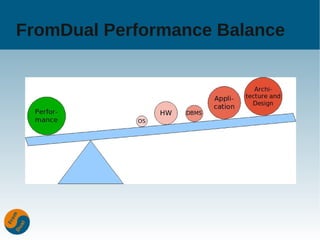
FromDual Performance Balance
Collecting facts
●   How does the problem look like?
    ● DB is suddenly, sometimes or since ever slow?
    ● What exactly is slow?


    ● New version was released?


    ● Somebody has tinkered around?


    ● We are short before going live and still much too slow?


●   Have we historical performance data?
●   Best case if:
    You can (at will) simulate the problem
    ●


  ● Predict the problem or if it happens periodic.


→ Find the pattern!
                           www.fromdual.com                     7
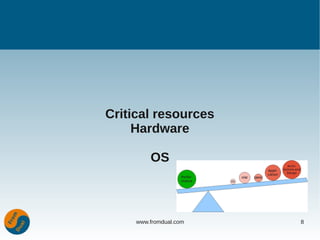
Critical resources
     Hardware

         OS


     www.fromdual.com   8
Critical resources
●   Find the bottle-neck / the limiting resource:

●   Fortunately „only“:
    ●   CPU
    ●   Memory (RAM)
    ●   I/O (IOPS, throughput)
    ●   Network (FpS, throughput)

●   But how? → find the critical resource!
                       www.fromdual.com             9
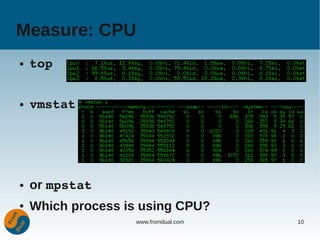
Measure: CPU
●   top


●   vmstat


●   or mpstat
●   Which process is using CPU?
                   www.fromdual.com   10
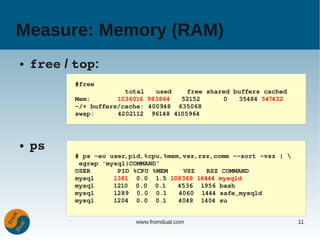
Measure: Memory (RAM)
●   free / top:
           #free
                        total   used    free shared buffers cached
           Mem:       1036016 983864   52152      0   35484 547432
           ­/+ buffers/cache: 400948  635068
           swap:      4202112  96148 4105964


●   ps
           # ps ­eo user,pid,%cpu,%mem,vsz,rsz,comm ­­sort ­vsz | 
            egrep 'mysql|COMMAND'
           USER       PID %CPU %MEM    VSZ   RSZ COMMAND
           mysql     1361  0.0  1.5 108368 16444 mysqld
           mysql     1210  0.0  0.1   4536  1956 bash
           mysql     1289  0.0  0.1   4060  1444 safe_mysqld
           mysql     1204  0.0  0.1   4048  1404 su


                          www.fromdual.com                            11
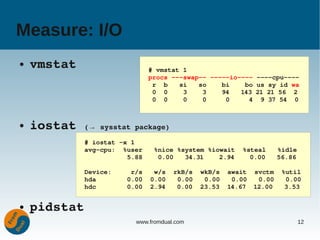
Measure: I/O
●   vmstat                     # vmstat 1
                               procs ­­­swap­­ ­­­­­io­­­­ ­­­­cpu­­­­
                                r  b   si   so    bi    bo us sy id wa
                                0  0    3    3    94   143 21 21 56  2
                                0  0    0    0     0     4  9 37 54  0


●   iostat (→ sysstat package)
              # iostat ­x 1
              avg­cpu:  %user   %nice %system %iowait  %steal   %idle
                         5.88    0.00   34.31    2.94    0.00   56.86

              Device:     r/s   w/s  rkB/s  wkB/s  await  svctm  %util
              hda        0.00  0.00   0.00   0.00   0.00   0.00   0.00
              hdc        0.00  2.94   0.00  23.53  14.67  12.00   3.53


●   pidstat
                           www.fromdual.com                             12
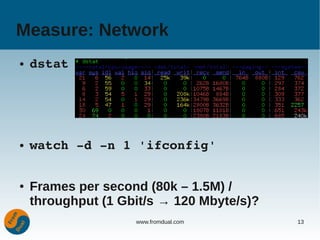
Measure: Network
●   dstat


●   watch ­d ­n 1 'ifconfig'


●   Frames per second (80k – 1.5M) /
    throughput (1 Gbit/s → 120 Mbyte/s)?
                    www.fromdual.com       13
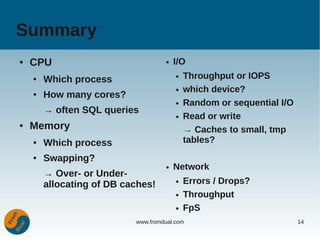
Summary
●   CPU                             ●   I/O
    ●   Which process                   ●   Throughput or IOPS
                                        ●   which device?
    ●   How many cores?
                                        ●   Random or sequential I/O
        → often SQL queries
                                        ●   Read or write
●   Memory                                  → Caches to small, tmp
    ●   Which process                       tables?
    ●   Swapping?
                                    ●   Network
        → Over- or Under-
        allocating of DB caches!        ●   Errors / Drops?
                                        ●   Throughput
                                        ●   FpS
                           www.fromdual.com                            14
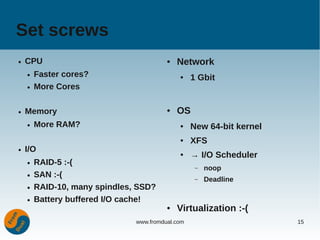
Set screws
●   CPU                                  ●   Network
    ●   Faster cores?                        ●    1 Gbit
    ●   More Cores

●   Memory                               ●   OS
    ●   More RAM?                            ●    New 64-bit kernel
                                             ●    XFS
●   I/O                                      ●    → I/O Scheduler
    ●   RAID-5 :-(
                                                   –   noop
    ●   SAN :-(                                    –   Deadline
    ●   RAID-10, many spindles, SSD?
    ●   Battery buffered I/O cache!
                                         ●   Virtualization :-(
                               www.fromdual.com                       15
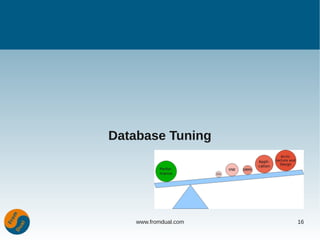
Database Tuning


    www.fromdual.com   16
MySQL Tuning
●   Which Storage Engine are you using at the
    moment?
●   Which MySQL version? (→ 5.1 and newer)
●   At the moment: about 330 MySQL parameter
      → but only 8 (9) of those are primarily
      significant!
      → Rough-Tuning
●   All other parameters only after detailed
    benchmarking...
      → Fine-Tuning
                        www.fromdual.com        17
InnoDB Rough-Tuning
●   innodb_buffer_pool_size
    ●   about 80% of RAM on a dedicated server
    ●   SHOW STATUS LIKE 
        'Innodb_buffer_pool_pages%';
●   innodb_log_file_size
    ● Big = faster, but longer recovery times → 2 x 256 M
●   innodb_flush_log_at_trx_commit
    ● 0, 2 for top performance, 1 for reliability
●   sync_binlog
    ●   != 0 → often very slow
                           www.fromdual.com                 18
MySQL Rough-Tuning
●   key_buffer_size
    ●   about 25 – 33% of RAM on dedicated machine
    ●   SHOW STATUS LIKE 'Key_blocks_%';
●   table_open_cache
    ●   Running connections x used tables → 2 – 4k is not unusable!
        See Open[ed]_tables.
●   table_definition_cache
    ● See Open[ed]_table_definitions → 512 – 4096 is not
      unusable!
●   query_cache_type/query_cache_size
    ●   Do not make too big (<= 128 M), bad for very high
        concurrency!
                               www.fromdual.com                   19
Further aid
●   How to measure?
    ●   SHOW GLOBAL STATUS;
    ●   SHOW ENGINE INNODB STATUSG
●   ca. 330 variables
●   ca. 310 Status informations
●   MySQL Database Health Check:
        http://www.fromdual.com/mysql-database-health-check
●   MySQL Docu, Server Status Variables:
        http://dev.mysql.com/doc/refman/5.5/en/server-status-variables.html
●   That's it, so far...! :)

                                  www.fromdual.com                            20
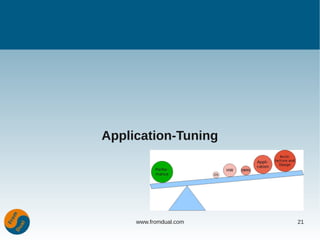
Application-Tuning


     www.fromdual.com   21
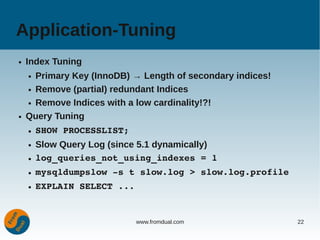
Application-Tuning
●   Index Tuning
    ● Primary Key (InnoDB) → Length of secondary indices!
    ● Remove (partial) redundant Indices


    ● Remove Indices with a low cardinality!?!


●   Query Tuning
    ●   SHOW PROCESSLIST;
    ●   Slow Query Log (since 5.1 dynamically)
    ●   log_queries_not_using_indexes = 1
    ●   mysqldumpslow ­s t slow.log > slow.log.profile
    ●   EXPLAIN SELECT ...


                             www.fromdual.com               22
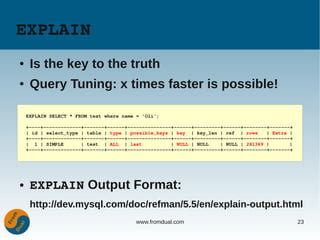
EXPLAIN
●    Is the key to the truth
●    Query Tuning: x times faster is possible!

    EXPLAIN SELECT * FROM test where name = 'Oli';

    +­­­­+­­­­­­­­­­­­­+­­­­­­­+­­­­­­+­­­­­­­­­­­­­­­+­­­­­­+­­­­­­­­­+­­­­­­+­­­­­­­­+­­­­­­­+
    | id | select_type | table | type | possible_keys | key  | key_len | ref  | rows   | Extra |
    +­­­­+­­­­­­­­­­­­­+­­­­­­­+­­­­­­+­­­­­­­­­­­­­­­+­­­­­­+­­­­­­­­­+­­­­­­+­­­­­­­­+­­­­­­­+
    |  1 | SIMPLE      | test  | ALL  | last          | NULL | NULL    | NULL | 261369 |       |
    +­­­­+­­­­­­­­­­­­­+­­­­­­­+­­­­­­+­­­­­­­­­­­­­­­+­­­­­­+­­­­­­­­­+­­­­­­+­­­­­­­­+­­­­­­­+


●    EXPLAIN Output Format:
     http://dev.mysql.com/doc/refman/5.5/en/explain-output.html
                                         www.fromdual.com                                          23
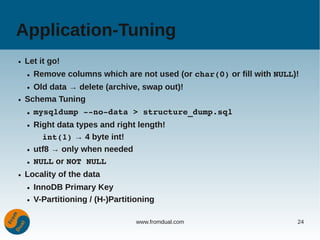
Application-Tuning
●   Let it go!
    ●   Remove columns which are not used (or char(0) or fill with NULL)!
    ● Old data → delete (archive, swap out)!
●   Schema Tuning
    ●   mysqldump ­­no­data > structure_dump.sql
    ●   Right data types and right length!
          int(1) → 4 byte int!
    ●   utf8 → only when needed
    ●   NULL or NOT NULL
●   Locality of the data
    ●   InnoDB Primary Key
    ●   V-Partitioning / (H-)Partitioning

                                    www.fromdual.com                    24
Architecture & Design


      www.fromdual.com   25
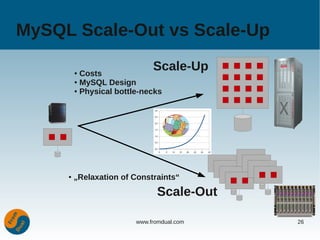
MySQL Scale-Out vs Scale-Up

         ● Costs
                              Scale-Up
         ● MySQL Design

         ● Physical bottle-necks


     ●   „Relaxation of Constraints“
                                Scale-Out

                         www.fromdual.com   26
The MySQL Scale-Out approach

                        Application
                  ro
                                 rtw
                                              Slave Reporting
                            Master

                                                  Slave Backup

     Slave 1      Slave 2         Slave 3
                                            ...


               Load balancer


                       www.fromdual.com                          27
Architectonic possibilities
●   RDBMS are a slow technology!
    ● Hence: Cache (hot data into a cache!)
    ● MySQL Memcached Plugin / Memcached


    ● HandlerSocket


    ● MySQL Cluster


●   Abstraction layers (ORM, Frameworks, etc.)
    ● Fast development process but
    ● Standard == „non optimized“ → bad for performance!


●   BLOB's are bad for RDBMS
    ● Put on a filer
    ● Blob Streaming (PBMS)


●   Sharding / distributing
    ●   manually
    ●   Spider SE
    ●   MySQL Replication (r/w Traffic Split)
    ●   MySQL Cluster
    ●   Synchronous Replication with Galera

                                            www.fromdual.com   28
Monitoring


 www.fromdual.com   29
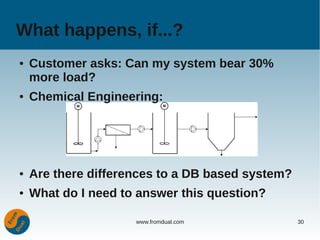
What happens, if...?
●   Customer asks: Can my system bear 30%
    more load?
●   Chemical Engineering:


●   Are there differences to a DB based system?
●   What do I need to answer this question?

                     www.fromdual.com             30
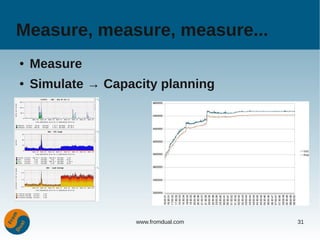
Measure, measure, measure...
●   Measure
●   Simulate → Capacity planning


                    www.fromdual.com   31
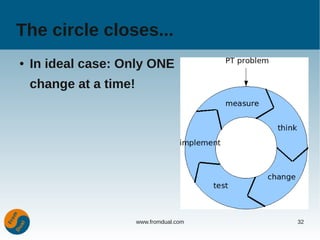
The circle closes...
●   In ideal case: Only ONE
    change at a time!


                        www.fromdual.com   32
Q&A


                 Questions ?

                 Discussion ?


 We have some time for face to face questions...


                    www.fromdual.com               33

UKOUG 2011: Practical MySQL Tuning

  • 1.
    Practical MySQL Tuning UKOUGConference 2011 th December 5 , Birmingham Oli Sennhauser Senior MySQL Consultant, FromDual oli.sennhauser@fromdual.com www.fromdual.com 1
  • 2.
    FromDual ● FromDual provides neutral and independent: ● Consulting for MySQL (on-site and remote) ● Remote-DBA / MySQL operations ● Support for Galera (synchronous MySQL Replication) ● Support for MySQL (Basic and Silver) ● Training for MySQL ● Consulting Partner of Open Database Alliance (ODBA.org) ● Oracle Silver Partner (OPN) ● More information at: www.fromdual.com www.fromdual.com 2
  • 3.
    Our customer www.fromdual.com 3
  • 4.
    Content ● FromDual Performance Balance ● Critical Resources ● Hardware / OS ● Database parameter ● Application-Tuning ● Architecture & Design ● Measuring www.fromdual.com 4
  • 5.
    The FromDual wayof PT ● Whom of you has or had Performance problems with MySQL? ● Whom of you has a systematic way for Performance Tuning? → Many roads lead to Rome! ● Starting point: Customer cries because he has a Performance Problem! www.fromdual.com 5
  • 6.
  • 7.
    Collecting facts ● How does the problem look like? ● DB is suddenly, sometimes or since ever slow? ● What exactly is slow? ● New version was released? ● Somebody has tinkered around? ● We are short before going live and still much too slow? ● Have we historical performance data? ● Best case if: You can (at will) simulate the problem ● ● Predict the problem or if it happens periodic. → Find the pattern! www.fromdual.com 7
  • 8.
    Critical resources Hardware OS www.fromdual.com 8
  • 9.
    Critical resources ● Find the bottle-neck / the limiting resource: ● Fortunately „only“: ● CPU ● Memory (RAM) ● I/O (IOPS, throughput) ● Network (FpS, throughput) ● But how? → find the critical resource! www.fromdual.com 9
  • 10.
    Measure: CPU ● top ● vmstat ● or mpstat ● Which process is using CPU? www.fromdual.com 10
  • 11.
    Measure: Memory (RAM) ● free / top: #free              total   used    free shared buffers cached Mem:       1036016 983864   52152      0   35484 547432 ­/+ buffers/cache: 400948  635068 swap:      4202112  96148 4105964 ● ps # ps ­eo user,pid,%cpu,%mem,vsz,rsz,comm ­­sort ­vsz |   egrep 'mysql|COMMAND' USER       PID %CPU %MEM    VSZ   RSZ COMMAND mysql     1361  0.0  1.5 108368 16444 mysqld mysql     1210  0.0  0.1   4536  1956 bash mysql     1289  0.0  0.1   4060  1444 safe_mysqld mysql     1204  0.0  0.1   4048  1404 su www.fromdual.com 11
  • 12.
    Measure: I/O ● vmstat # vmstat 1 procs ­­­swap­­ ­­­­­io­­­­ ­­­­cpu­­­­  r  b   si   so    bi    bo us sy id wa  0  0    3    3    94   143 21 21 56  2  0  0    0    0     0     4  9 37 54  0 ● iostat (→ sysstat package) # iostat ­x 1 avg­cpu:  %user   %nice %system %iowait  %steal   %idle            5.88    0.00   34.31    2.94    0.00   56.86 Device:     r/s   w/s  rkB/s  wkB/s  await  svctm  %util hda        0.00  0.00   0.00   0.00   0.00   0.00   0.00 hdc        0.00  2.94   0.00  23.53  14.67  12.00   3.53 ● pidstat www.fromdual.com 12
  • 13.
    Measure: Network ● dstat ● watch ­d ­n 1 'ifconfig' ● Frames per second (80k – 1.5M) / throughput (1 Gbit/s → 120 Mbyte/s)? www.fromdual.com 13
  • 14.
    Summary ● CPU ● I/O ● Which process ● Throughput or IOPS ● which device? ● How many cores? ● Random or sequential I/O → often SQL queries ● Read or write ● Memory → Caches to small, tmp ● Which process tables? ● Swapping? ● Network → Over- or Under- allocating of DB caches! ● Errors / Drops? ● Throughput ● FpS www.fromdual.com 14
  • 15.
    Set screws ● CPU ● Network ● Faster cores? ● 1 Gbit ● More Cores ● Memory ● OS ● More RAM? ● New 64-bit kernel ● XFS ● I/O ● → I/O Scheduler ● RAID-5 :-( – noop ● SAN :-( – Deadline ● RAID-10, many spindles, SSD? ● Battery buffered I/O cache! ● Virtualization :-( www.fromdual.com 15
  • 16.
    Database Tuning www.fromdual.com 16
  • 17.
    MySQL Tuning ● Which Storage Engine are you using at the moment? ● Which MySQL version? (→ 5.1 and newer) ● At the moment: about 330 MySQL parameter → but only 8 (9) of those are primarily significant! → Rough-Tuning ● All other parameters only after detailed benchmarking... → Fine-Tuning www.fromdual.com 17
  • 18.
    InnoDB Rough-Tuning ● innodb_buffer_pool_size ● about 80% of RAM on a dedicated server ● SHOW STATUS LIKE  'Innodb_buffer_pool_pages%'; ● innodb_log_file_size ● Big = faster, but longer recovery times → 2 x 256 M ● innodb_flush_log_at_trx_commit ● 0, 2 for top performance, 1 for reliability ● sync_binlog ● != 0 → often very slow www.fromdual.com 18
  • 19.
    MySQL Rough-Tuning ● key_buffer_size ● about 25 – 33% of RAM on dedicated machine ● SHOW STATUS LIKE 'Key_blocks_%'; ● table_open_cache ● Running connections x used tables → 2 – 4k is not unusable! See Open[ed]_tables. ● table_definition_cache ● See Open[ed]_table_definitions → 512 – 4096 is not unusable! ● query_cache_type/query_cache_size ● Do not make too big (<= 128 M), bad for very high concurrency! www.fromdual.com 19
  • 20.
    Further aid ● How to measure? ● SHOW GLOBAL STATUS; ● SHOW ENGINE INNODB STATUSG ● ca. 330 variables ● ca. 310 Status informations ● MySQL Database Health Check: http://www.fromdual.com/mysql-database-health-check ● MySQL Docu, Server Status Variables: http://dev.mysql.com/doc/refman/5.5/en/server-status-variables.html ● That's it, so far...! :) www.fromdual.com 20
  • 21.
    Application-Tuning www.fromdual.com 21
  • 22.
    Application-Tuning ● Index Tuning ● Primary Key (InnoDB) → Length of secondary indices! ● Remove (partial) redundant Indices ● Remove Indices with a low cardinality!?! ● Query Tuning ● SHOW PROCESSLIST; ● Slow Query Log (since 5.1 dynamically) ● log_queries_not_using_indexes = 1 ● mysqldumpslow ­s t slow.log > slow.log.profile ● EXPLAIN SELECT ... www.fromdual.com 22
  • 23.
    EXPLAIN ● Is the key to the truth ● Query Tuning: x times faster is possible! EXPLAIN SELECT * FROM test where name = 'Oli'; +­­­­+­­­­­­­­­­­­­+­­­­­­­+­­­­­­+­­­­­­­­­­­­­­­+­­­­­­+­­­­­­­­­+­­­­­­+­­­­­­­­+­­­­­­­+ | id | select_type | table | type | possible_keys | key  | key_len | ref  | rows   | Extra | +­­­­+­­­­­­­­­­­­­+­­­­­­­+­­­­­­+­­­­­­­­­­­­­­­+­­­­­­+­­­­­­­­­+­­­­­­+­­­­­­­­+­­­­­­­+ |  1 | SIMPLE      | test  | ALL  | last          | NULL | NULL    | NULL | 261369 |       | +­­­­+­­­­­­­­­­­­­+­­­­­­­+­­­­­­+­­­­­­­­­­­­­­­+­­­­­­+­­­­­­­­­+­­­­­­+­­­­­­­­+­­­­­­­+ ● EXPLAIN Output Format: http://dev.mysql.com/doc/refman/5.5/en/explain-output.html www.fromdual.com 23
  • 24.
    Application-Tuning ● Let it go! ● Remove columns which are not used (or char(0) or fill with NULL)! ● Old data → delete (archive, swap out)! ● Schema Tuning ● mysqldump ­­no­data > structure_dump.sql ● Right data types and right length! int(1) → 4 byte int! ● utf8 → only when needed ● NULL or NOT NULL ● Locality of the data ● InnoDB Primary Key ● V-Partitioning / (H-)Partitioning www.fromdual.com 24
  • 25.
    Architecture & Design www.fromdual.com 25
  • 26.
    MySQL Scale-Out vsScale-Up ● Costs Scale-Up ● MySQL Design ● Physical bottle-necks ● „Relaxation of Constraints“ Scale-Out www.fromdual.com 26
  • 27.
    The MySQL Scale-Outapproach Application ro rtw Slave Reporting Master Slave Backup Slave 1 Slave 2 Slave 3 ... Load balancer www.fromdual.com 27
  • 28.
    Architectonic possibilities ● RDBMS are a slow technology! ● Hence: Cache (hot data into a cache!) ● MySQL Memcached Plugin / Memcached ● HandlerSocket ● MySQL Cluster ● Abstraction layers (ORM, Frameworks, etc.) ● Fast development process but ● Standard == „non optimized“ → bad for performance! ● BLOB's are bad for RDBMS ● Put on a filer ● Blob Streaming (PBMS) ● Sharding / distributing ● manually ● Spider SE ● MySQL Replication (r/w Traffic Split) ● MySQL Cluster ● Synchronous Replication with Galera www.fromdual.com 28
  • 29.
  • 30.
    What happens, if...? ● Customer asks: Can my system bear 30% more load? ● Chemical Engineering: ● Are there differences to a DB based system? ● What do I need to answer this question? www.fromdual.com 30
  • 31.
    Measure, measure, measure... ● Measure ● Simulate → Capacity planning www.fromdual.com 31
  • 32.
    The circle closes... ● In ideal case: Only ONE change at a time! www.fromdual.com 32
  • 33.
    Q&A Questions ? Discussion ? We have some time for face to face questions... www.fromdual.com 33