


Operating
Hybrid Infrastructure
Creating Operating Environments that Span
Clouds and Physical Infrastructures
Rob Hirschfeld, CEO
RackN
Data Center Automation for Hybrid Infrastructure Exchanges
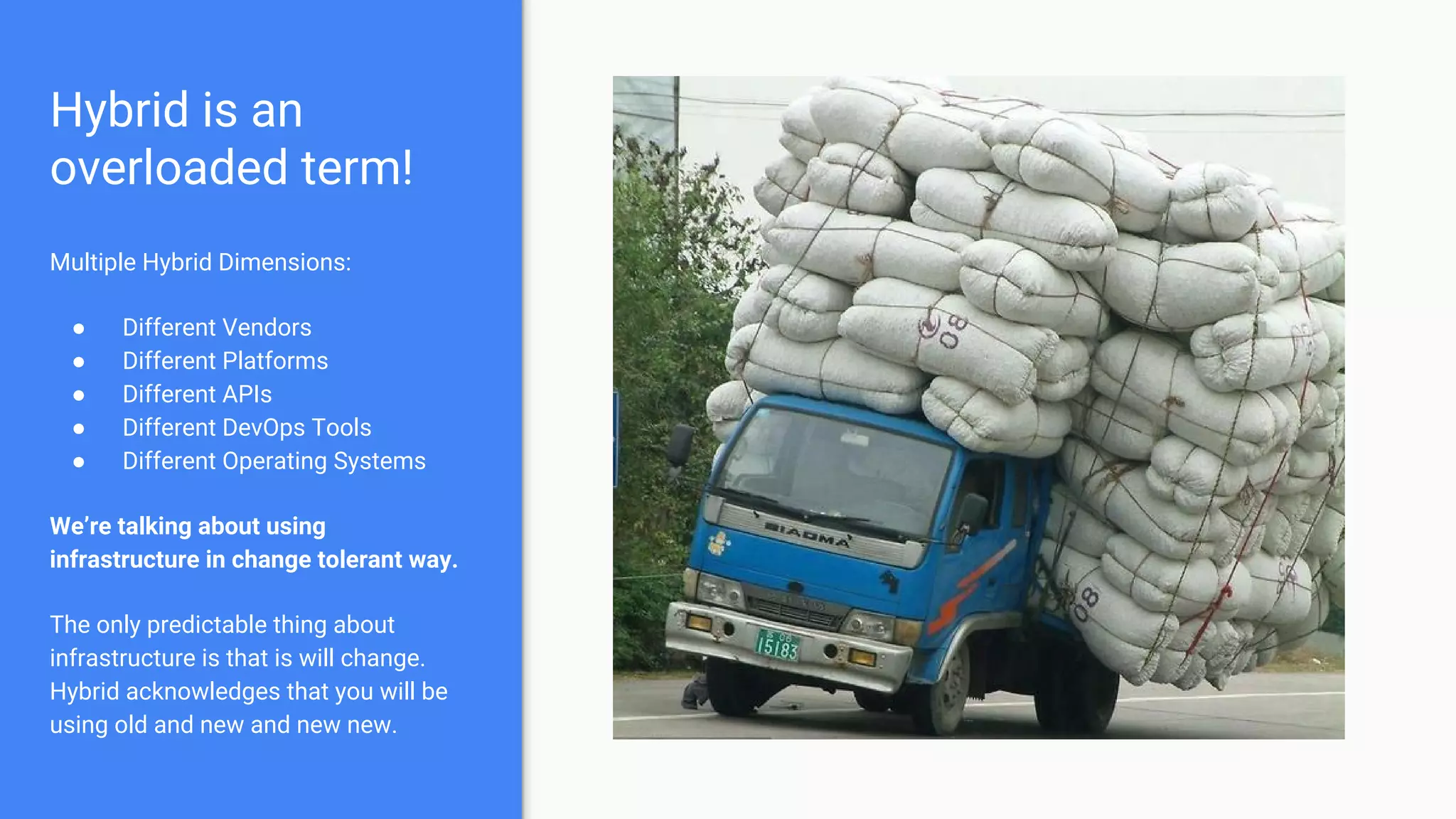
Hybrid is an
overloaded term!
Multiple Hybrid Dimensions:
● Different Vendors
● Different Platforms
● Different APIs
● Different DevOps Tools
● Different Operating Systems
We’re talking about using
infrastructure in change tolerant way.
The only predictable thing about
infrastructure is that is will change.
Hybrid acknowledges that you will be
using old and new and new new.
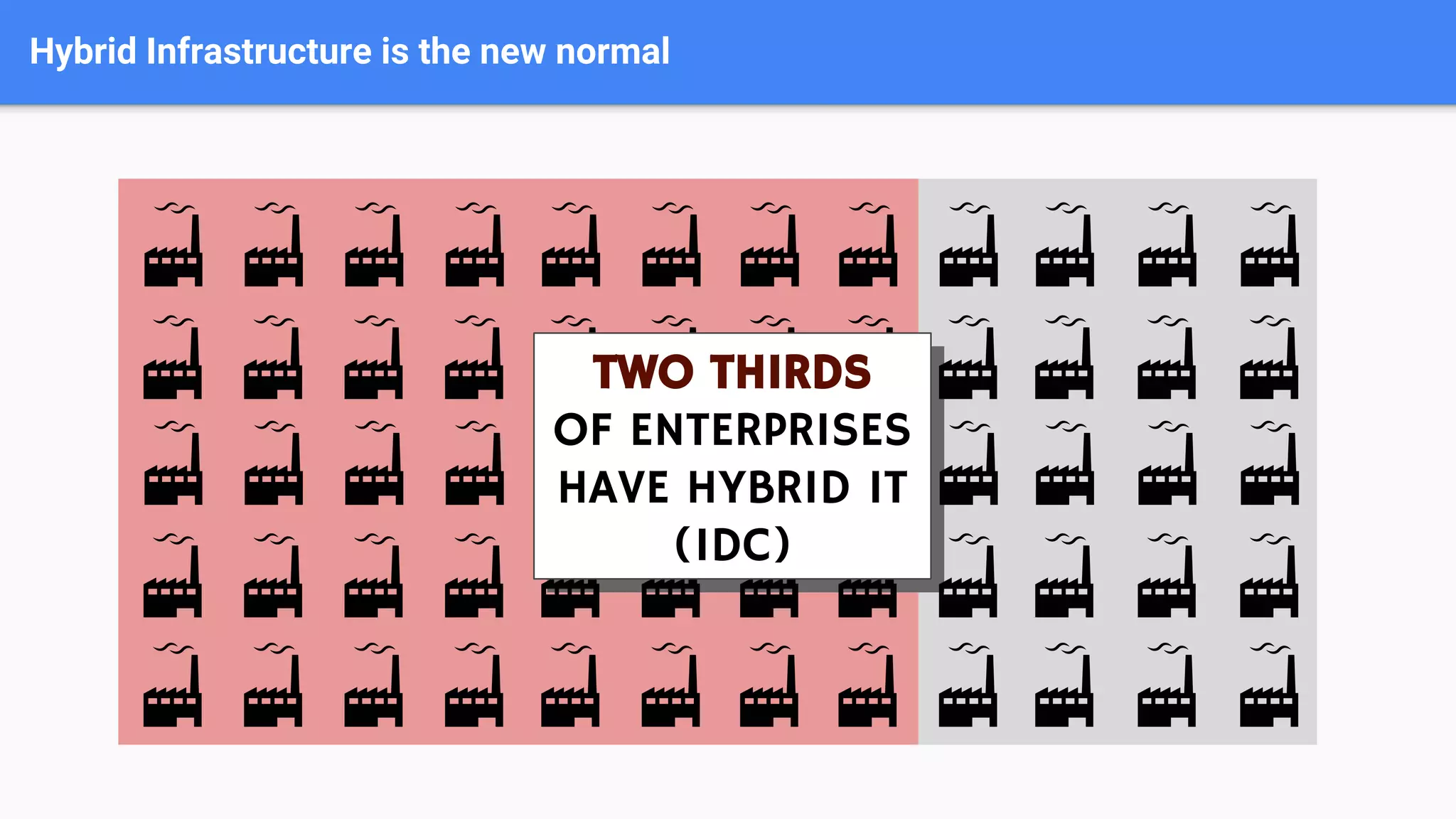
Hybrid Infrastructure is the new normal
TWO THIRDS
OF ENTERPRISES
HAVE HYBRID IT
(IDC)
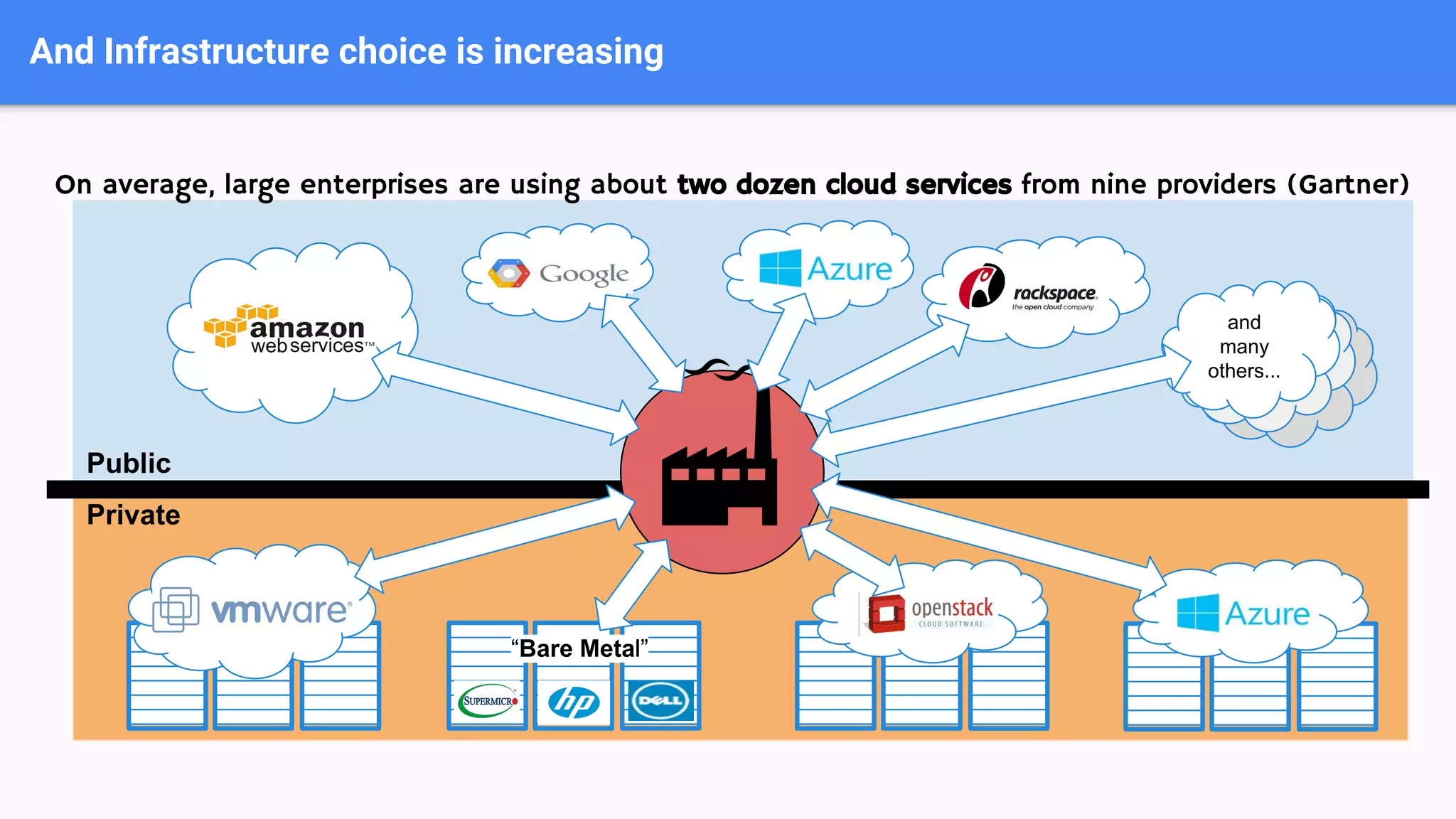
And Infrastructure choice is increasing
and
many
others...
and
many
others...
AWS
GCE Azure RackSpac
e
and
many
others...
“Bare Metal”
On average, large enterprises are using about two dozen cloud services from nine providers (Gartner)
VMware OpenStack OpenStack
Public
Private
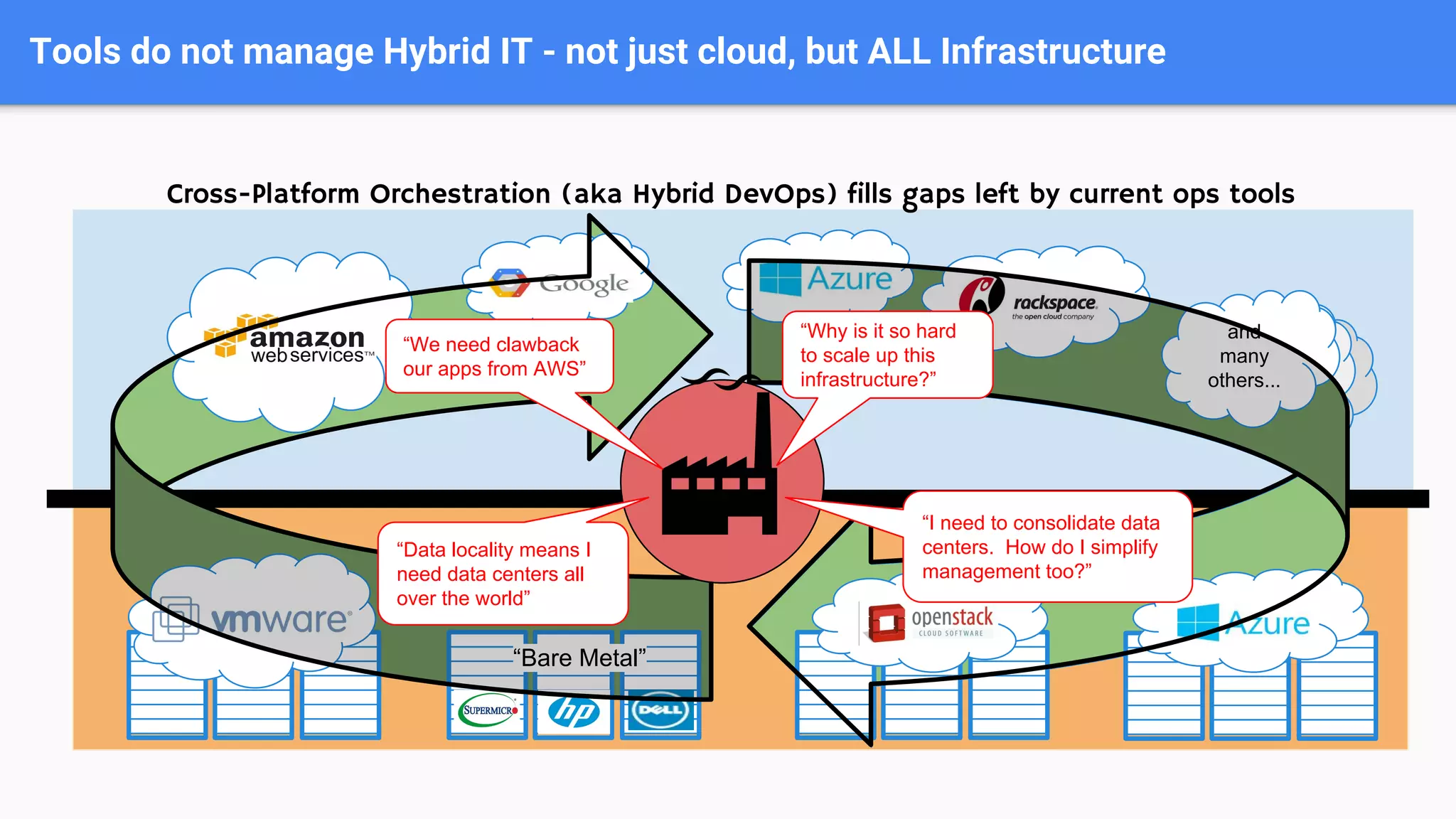
Tools do not manage Hybrid IT - not just cloud, but ALL Infrastructure
Cross-Platform Orchestration (aka Hybrid DevOps) fills gaps left by current ops tools
and
many
others...
and
many
others...
AWS
GCE Azure RackSpac
e
and
many
others...
“Bare Metal”
VMware OpenStack OpenStack
“Why is it so hard
to scale up this
infrastructure?”
“We need clawback
our apps from AWS”
“Data locality means I
need data centers all
over the world”
“I need to consolidate data
centers. How do I simplify
management too?”
So…. we need a single API!
No.
No single API or Platform wins.
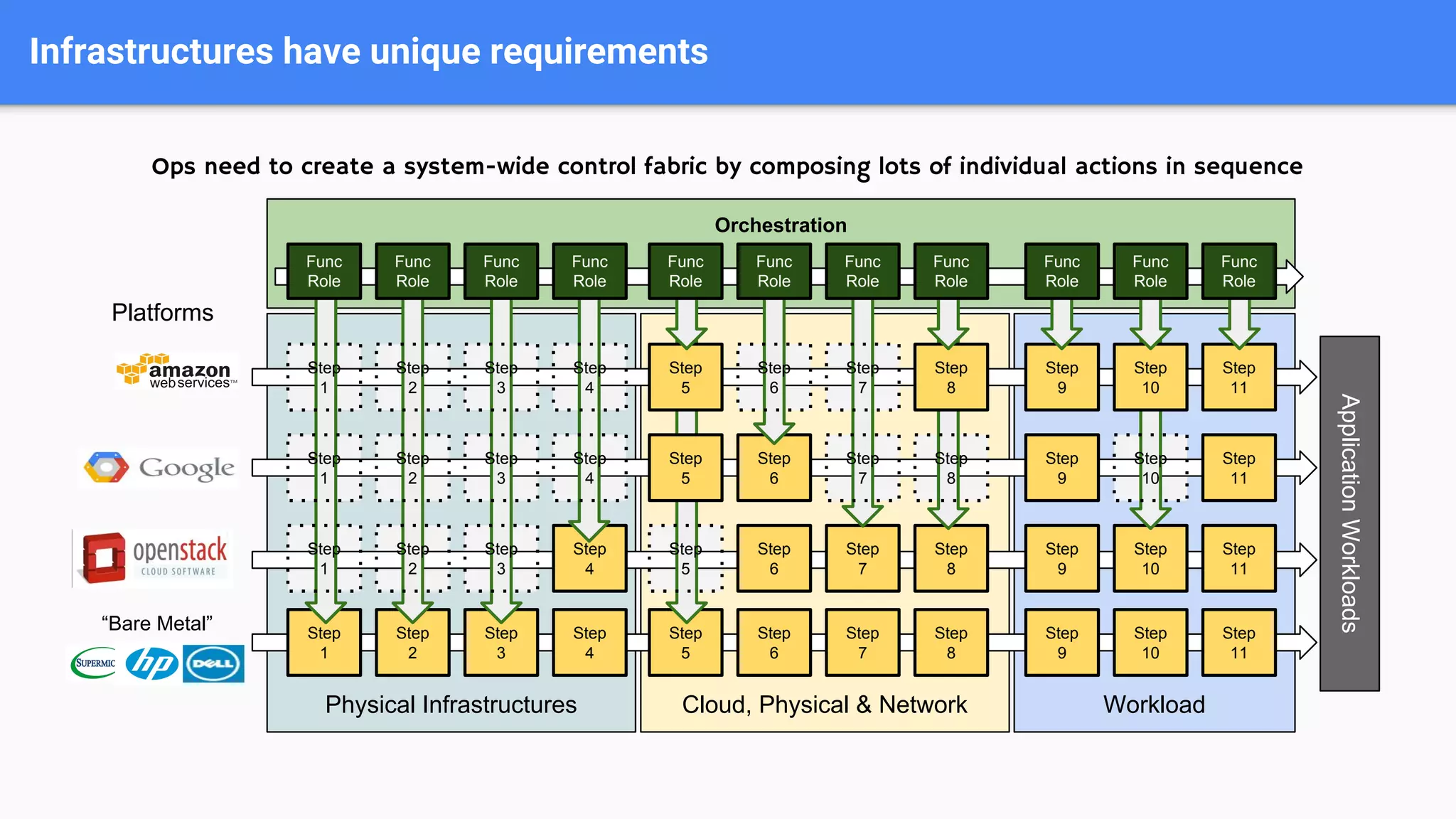
Infrastructures have unique requirements
Platforms
WorkloadCloud, Physical & NetworkPhysical Infrastructures
Step
2
Step
6
Step
7
Step
1
Step
3
Step
4
Step
2
Step
7
Step
1
Step
3
Step
4
Step
8
Step
10
Step
2
Step
1
Step
3
Step
5
Step
9
Step
11
Step
6
Step
9
Step
11
Step
6
Step
7
Step
4
Step
8
Step
9
Step
10
Step
11
Step
2
Step
6
Step
7
Step
1
Step
3
Step
4
Step
5
Step
8
Step
9
Step
10
Step
11
ApplicationWorkloads
“Bare Metal”
Ops need to create a system-wide control fabric by composing lots of individual actions in sequence
Orchestration
Step
5
Step
5
Step
8
Step
10
Step
2
Step
3
Step
4
Step
1
Step
2
Step
1
Step
3
Step
4
Step
2
Step
1
Step
3
Step
6
Step
7
Step
7
Step
8
Step
10
Step
5
Func
Role
Func
Role
Func
Role
Func
Role
Func
Role
Func
Role
Func
Role
Func
Role
Func
Role
Func
Role
Func
Role
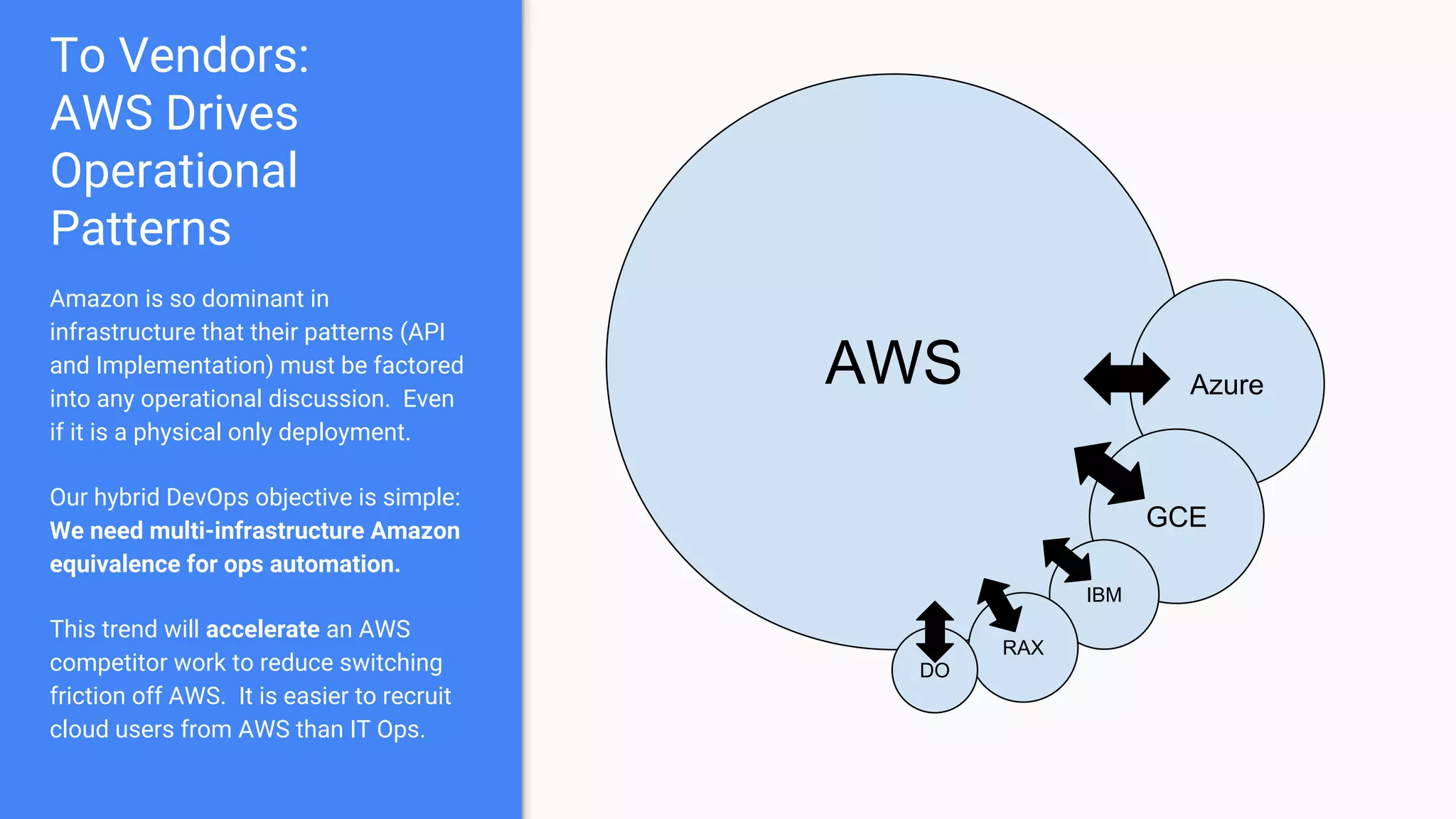
To Vendors:
AWS Drives
Operational
Patterns
AWS Azure
GCE
IBM
RAX
DO
Amazon is so dominant in
infrastructure that their patterns (API
and Implementation) must be factored
into any operational discussion. Even
if it is a physical only deployment.
Our hybrid DevOps objective is simple:
We need multi-infrastructure Amazon
equivalence for ops automation.
This trend will accelerate an AWS
competitor work to reduce switching
friction off AWS. It is easier to recruit
cloud users from AWS than IT Ops.
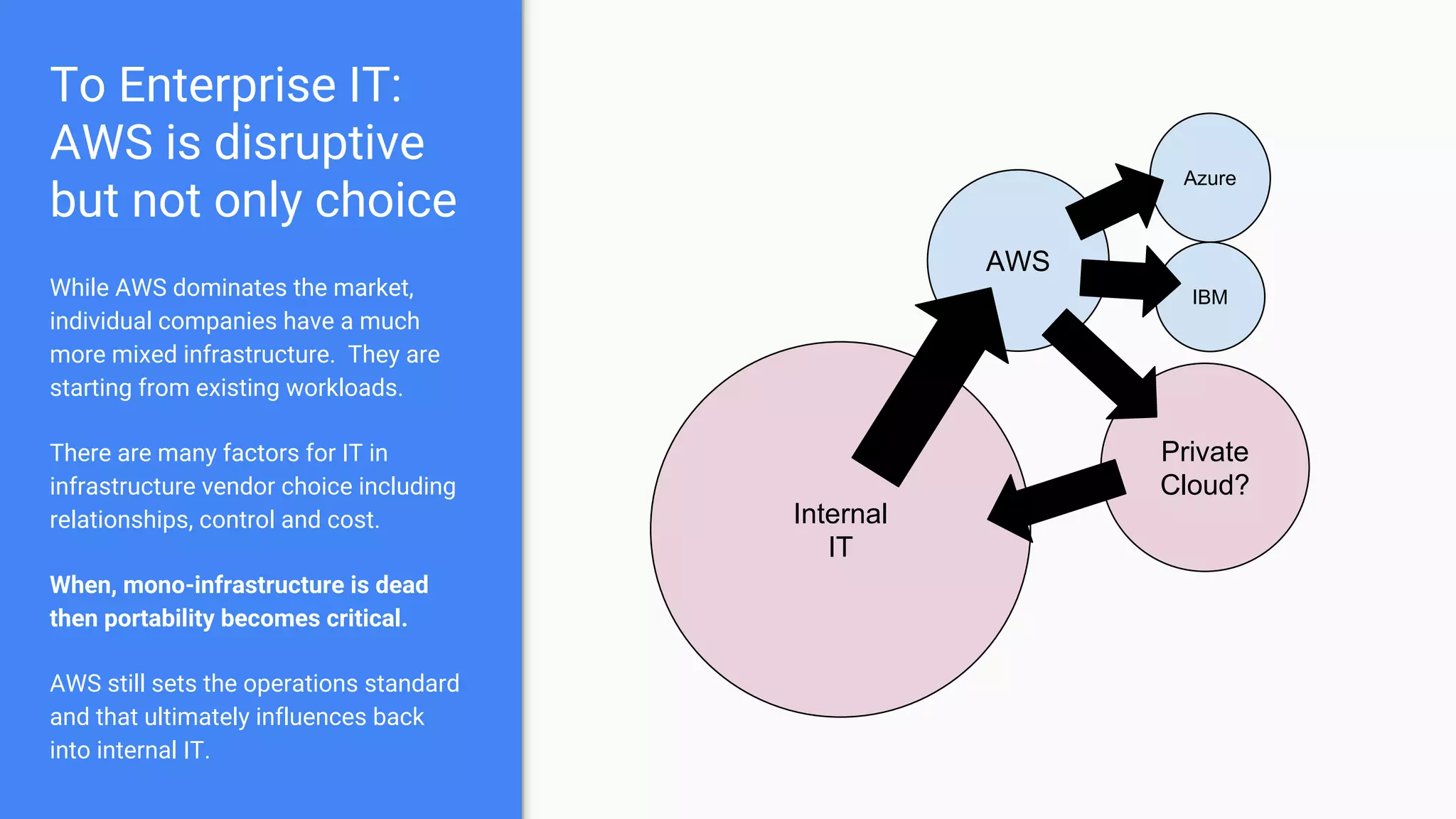
To Enterprise IT:
AWS is disruptive
but not only choice
While AWS dominates the market,
individual companies have a much
more mixed infrastructure. They are
starting from existing workloads.
There are many factors for IT in
infrastructure vendor choice including
relationships, control and cost.
When, mono-infrastructure is dead
then portability becomes critical.
AWS still sets the operations standard
and that ultimately influences back
into internal IT.
AWS
Azure
IBM
Private
Cloud?
Internal
IT
What makes
Hybrid hard?
Beneficial Diversity.
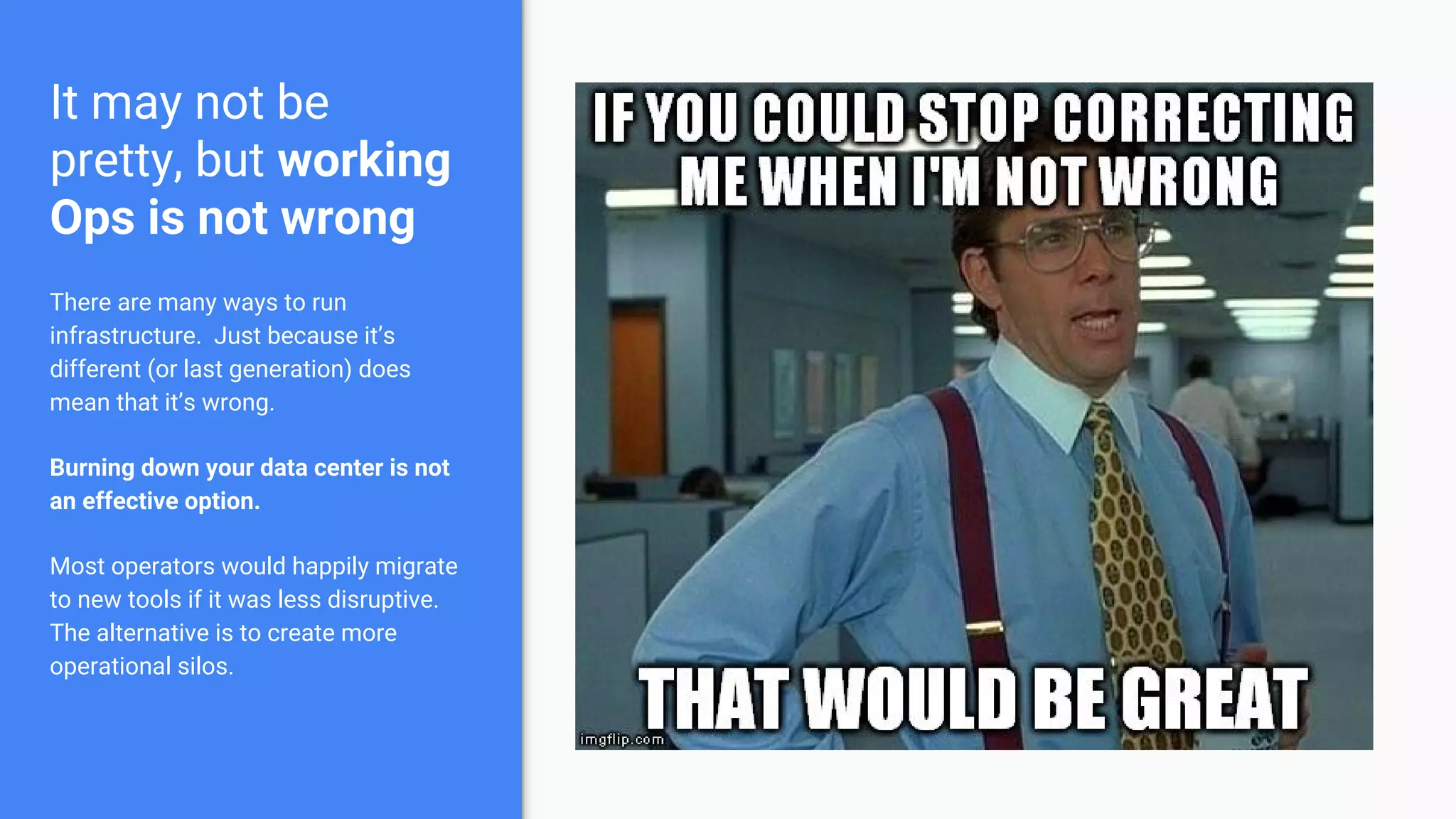
It may not be
pretty, but working
Ops is not wrong
There are many ways to run
infrastructure. Just because it’s
different (or last generation) does
mean that it’s wrong.
Burning down your data center is not
an effective option.
Most operators would happily migrate
to new tools if it was less disruptive.
The alternative is to create more
operational silos.
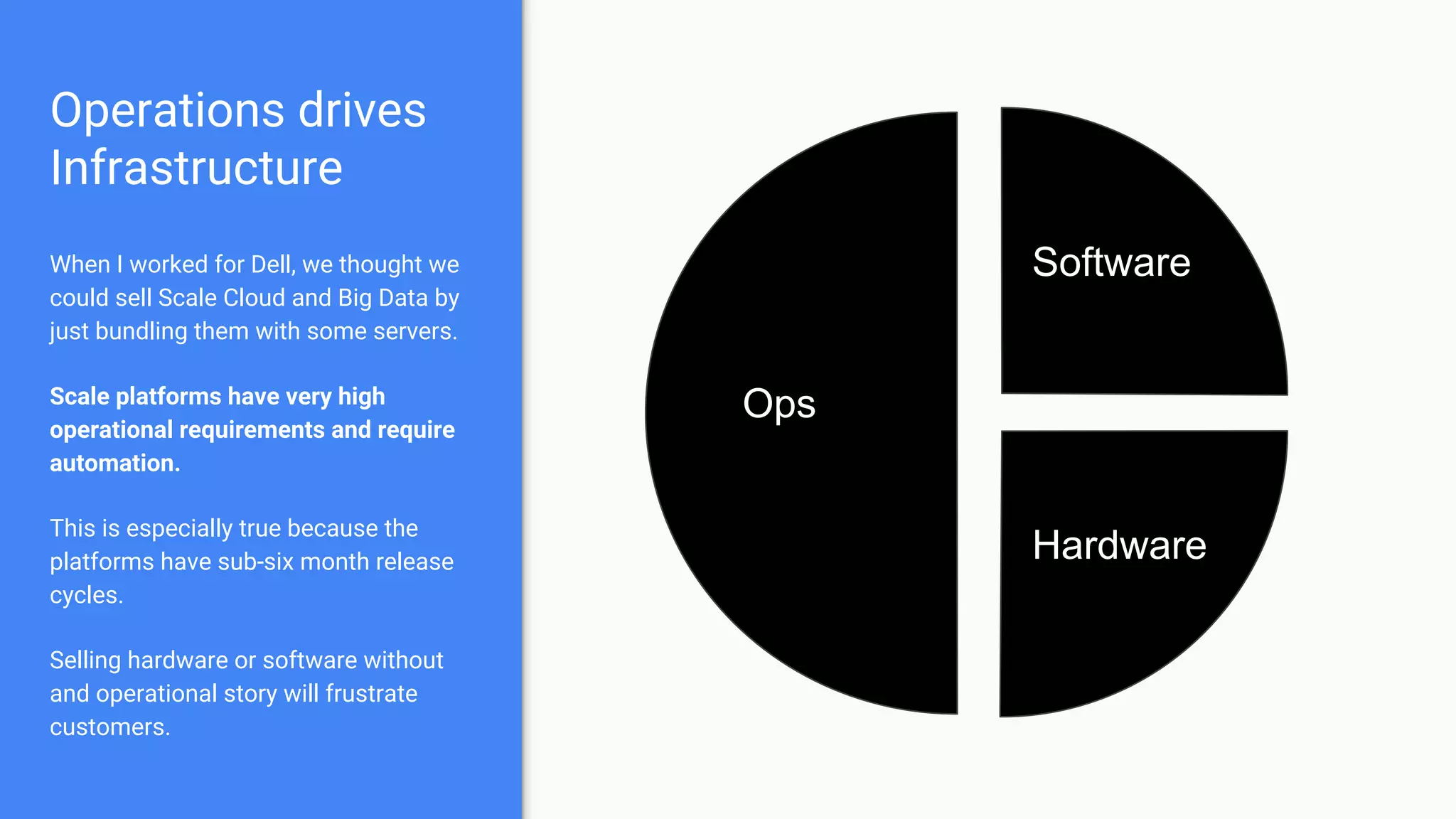
Operations drives
Infrastructure
Software
Hardware
Ops
When I worked for Dell, we thought we
could sell Scale Cloud and Big Data by
just bundling them with some servers.
Scale platforms have very high
operational requirements and require
automation.
This is especially true because the
platforms have sub-six month release
cycles.
Selling hardware or software without
and operational story will frustrate
customers.
Data Center Ops
APP
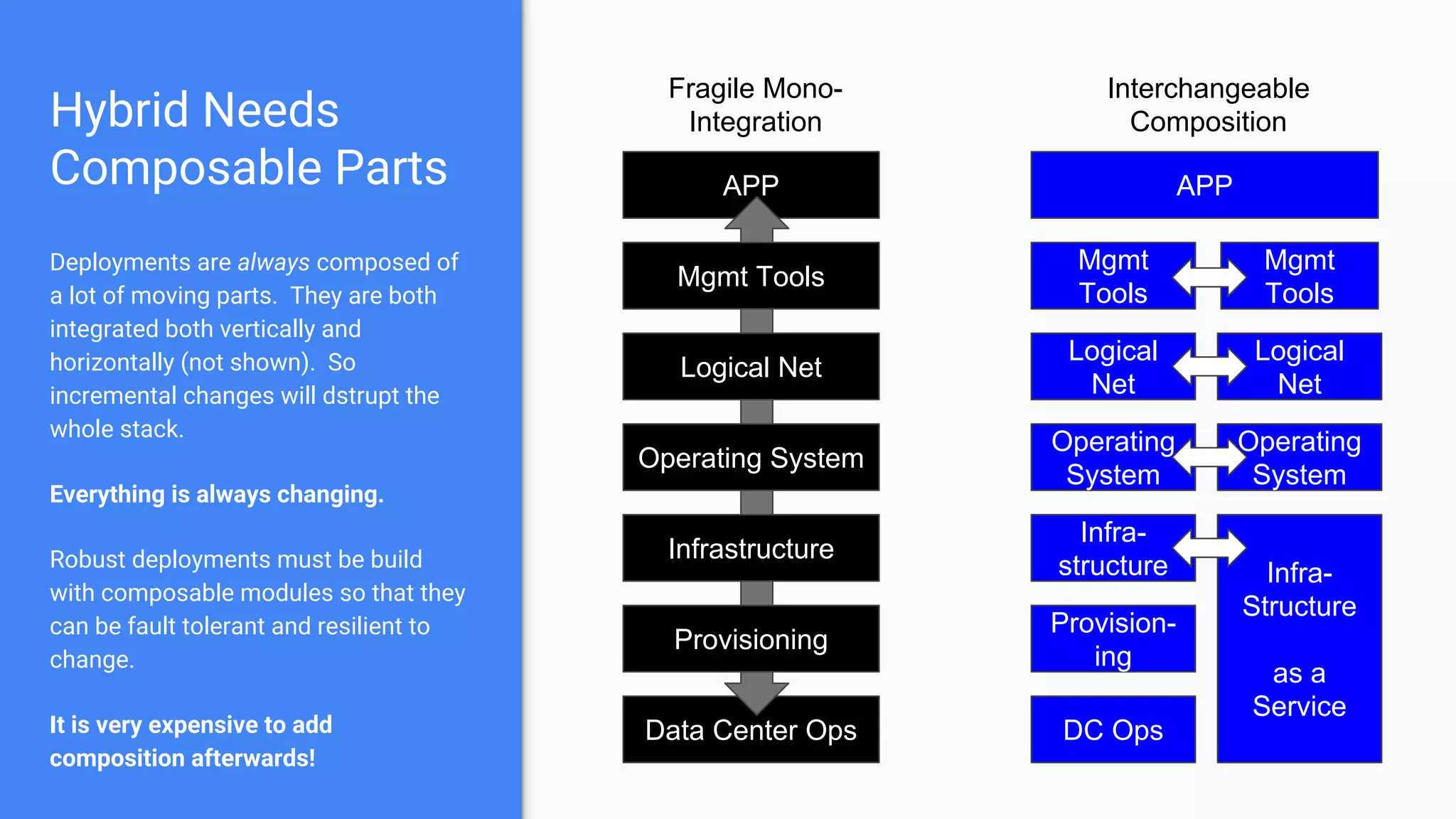
Hybrid Needs
Composable Parts
Deployments are always composed of
a lot of moving parts. They are both
integrated both vertically and
horizontally (not shown). So
incremental changes will dstrupt the
whole stack.
Everything is always changing.
Robust deployments must be build
with composable modules so that they
can be fault tolerant and resilient to
change.
It is very expensive to add
composition afterwards!
Mgmt Tools
Logical Net
Operating System
Infrastructure
Provisioning
APP
Mgmt
Tools
Logical
Net
Operating
System
Infra-
structure
Provision-
ing
DC Ops
Fragile Mono-
Integration
Interchangeable
Composition
Mgmt
Tools
Logical
Net
Operating
System
Infra-
Structure
as a
Service
In Summary:
● Hybrid Infrastructure is new normal
● Amazon is the Ops benchmark
● Embrace operations automation
● Invest in making it composable
My blog http://RobHirschfeld.com
@zehicle on Twitter

OpenServerSummit: Operating Hybrid Infrastructure

  • 1.
    Operating Hybrid Infrastructure Creating OperatingEnvironments that Span Clouds and Physical Infrastructures Rob Hirschfeld, CEO RackN Data Center Automation for Hybrid Infrastructure Exchanges
  • 2.
    Hybrid is an overloadedterm! Multiple Hybrid Dimensions: ● Different Vendors ● Different Platforms ● Different APIs ● Different DevOps Tools ● Different Operating Systems We’re talking about using infrastructure in change tolerant way. The only predictable thing about infrastructure is that is will change. Hybrid acknowledges that you will be using old and new and new new.
  • 3.
    Hybrid Infrastructure isthe new normal TWO THIRDS OF ENTERPRISES HAVE HYBRID IT (IDC)
  • 4.
    And Infrastructure choiceis increasing and many others... and many others... AWS GCE Azure RackSpac e and many others... “Bare Metal” On average, large enterprises are using about two dozen cloud services from nine providers (Gartner) VMware OpenStack OpenStack Public Private
  • 5.
    Tools do notmanage Hybrid IT - not just cloud, but ALL Infrastructure Cross-Platform Orchestration (aka Hybrid DevOps) fills gaps left by current ops tools and many others... and many others... AWS GCE Azure RackSpac e and many others... “Bare Metal” VMware OpenStack OpenStack “Why is it so hard to scale up this infrastructure?” “We need clawback our apps from AWS” “Data locality means I need data centers all over the world” “I need to consolidate data centers. How do I simplify management too?”
  • 6.
    So…. we needa single API!
  • 7.
    No. No single APIor Platform wins.
  • 8.
    Infrastructures have uniquerequirements Platforms WorkloadCloud, Physical & NetworkPhysical Infrastructures Step 2 Step 6 Step 7 Step 1 Step 3 Step 4 Step 2 Step 7 Step 1 Step 3 Step 4 Step 8 Step 10 Step 2 Step 1 Step 3 Step 5 Step 9 Step 11 Step 6 Step 9 Step 11 Step 6 Step 7 Step 4 Step 8 Step 9 Step 10 Step 11 Step 2 Step 6 Step 7 Step 1 Step 3 Step 4 Step 5 Step 8 Step 9 Step 10 Step 11 ApplicationWorkloads “Bare Metal” Ops need to create a system-wide control fabric by composing lots of individual actions in sequence Orchestration Step 5 Step 5 Step 8 Step 10 Step 2 Step 3 Step 4 Step 1 Step 2 Step 1 Step 3 Step 4 Step 2 Step 1 Step 3 Step 6 Step 7 Step 7 Step 8 Step 10 Step 5 Func Role Func Role Func Role Func Role Func Role Func Role Func Role Func Role Func Role Func Role Func Role
  • 9.
    To Vendors: AWS Drives Operational Patterns AWSAzure GCE IBM RAX DO Amazon is so dominant in infrastructure that their patterns (API and Implementation) must be factored into any operational discussion. Even if it is a physical only deployment. Our hybrid DevOps objective is simple: We need multi-infrastructure Amazon equivalence for ops automation. This trend will accelerate an AWS competitor work to reduce switching friction off AWS. It is easier to recruit cloud users from AWS than IT Ops.
  • 10.
    To Enterprise IT: AWSis disruptive but not only choice While AWS dominates the market, individual companies have a much more mixed infrastructure. They are starting from existing workloads. There are many factors for IT in infrastructure vendor choice including relationships, control and cost. When, mono-infrastructure is dead then portability becomes critical. AWS still sets the operations standard and that ultimately influences back into internal IT. AWS Azure IBM Private Cloud? Internal IT
  • 11.
  • 12.
    It may notbe pretty, but working Ops is not wrong There are many ways to run infrastructure. Just because it’s different (or last generation) does mean that it’s wrong. Burning down your data center is not an effective option. Most operators would happily migrate to new tools if it was less disruptive. The alternative is to create more operational silos.
  • 13.
    Operations drives Infrastructure Software Hardware Ops When Iworked for Dell, we thought we could sell Scale Cloud and Big Data by just bundling them with some servers. Scale platforms have very high operational requirements and require automation. This is especially true because the platforms have sub-six month release cycles. Selling hardware or software without and operational story will frustrate customers.
  • 14.
    Data Center Ops APP HybridNeeds Composable Parts Deployments are always composed of a lot of moving parts. They are both integrated both vertically and horizontally (not shown). So incremental changes will dstrupt the whole stack. Everything is always changing. Robust deployments must be build with composable modules so that they can be fault tolerant and resilient to change. It is very expensive to add composition afterwards! Mgmt Tools Logical Net Operating System Infrastructure Provisioning APP Mgmt Tools Logical Net Operating System Infra- structure Provision- ing DC Ops Fragile Mono- Integration Interchangeable Composition Mgmt Tools Logical Net Operating System Infra- Structure as a Service
  • 15.
    In Summary: ● HybridInfrastructure is new normal ● Amazon is the Ops benchmark ● Embrace operations automation ● Invest in making it composable My blog http://RobHirschfeld.com @zehicle on Twitter