Enabling the Journey to Automation
By Amjad Afanah
2
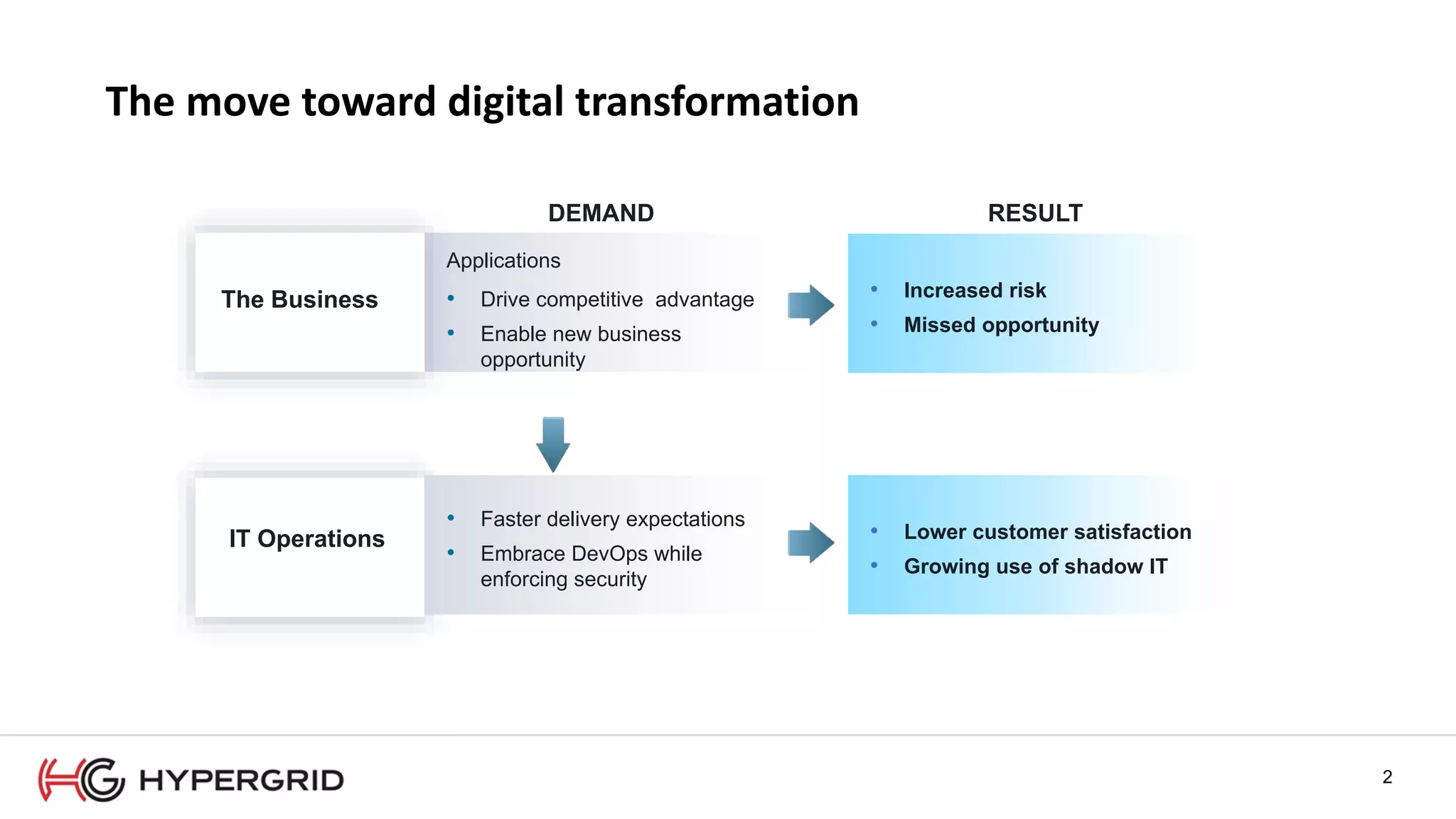
Applications
• Drive competitive advantage
• Enable new business
opportunity
IT Operations
DEMAND
• Faster delivery expectations
• Embrace DevOps while
enforcing security
The Business
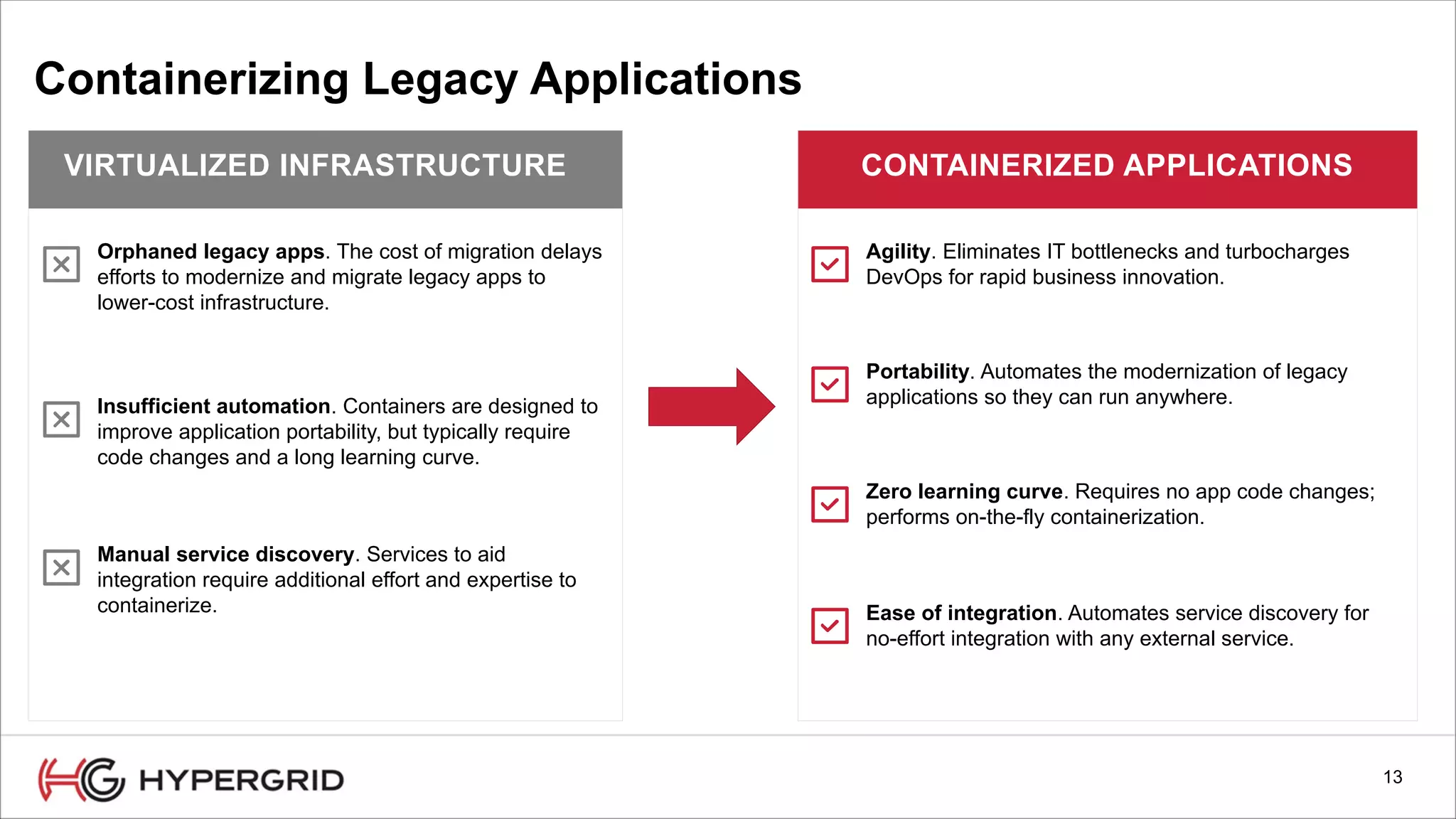
RESULT
• Lower customer satisfaction
• Growing use of shadow IT
• Increased risk
• Missed opportunity
The move toward digital transformation
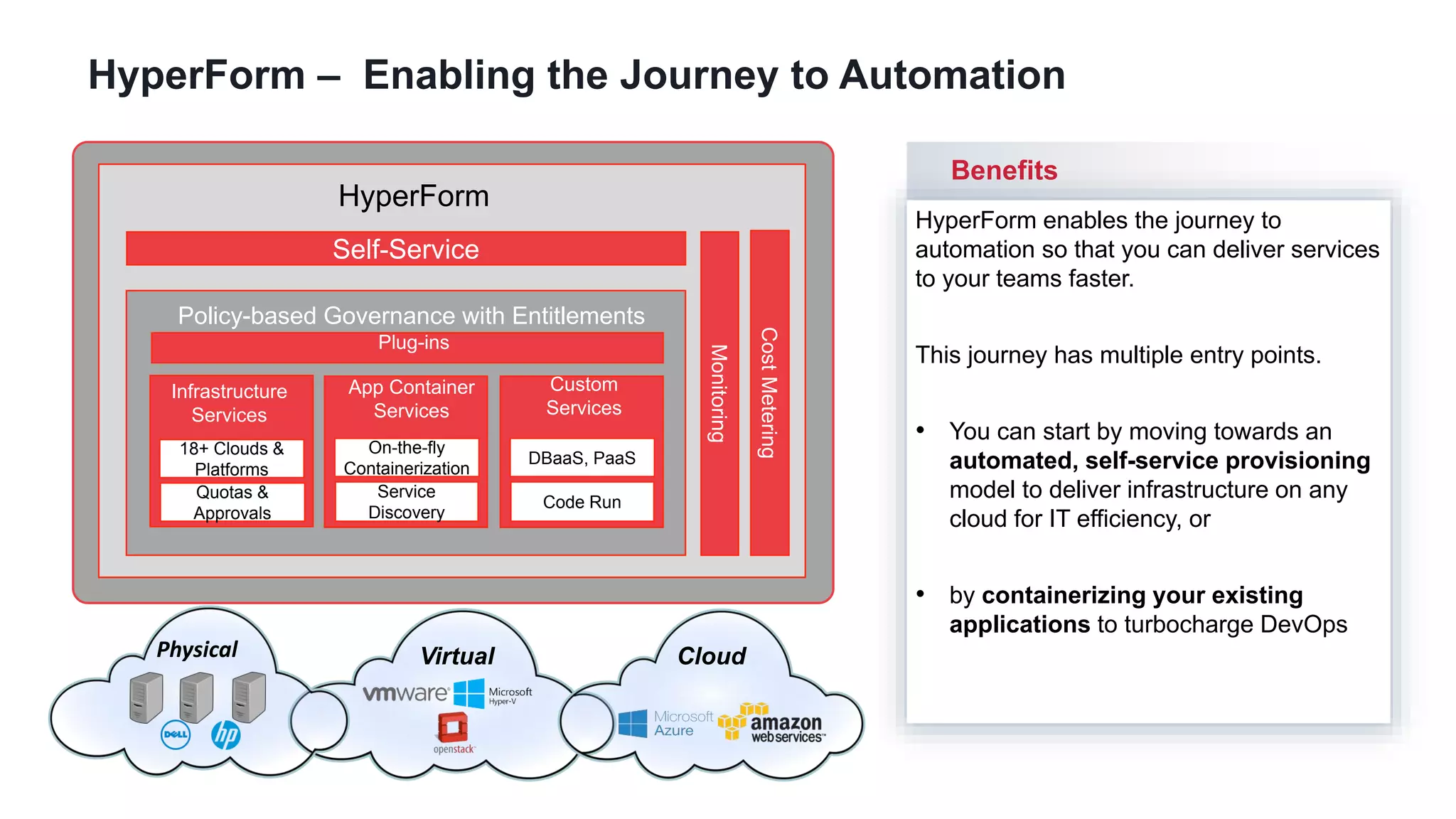
Benefits
HyperForm enables the journey to
automation so that you can deliver services
to your teams faster.
This journey has multiple entry points.
• You can start by moving towards an
automated, self-service provisioning
model to deliver infrastructure on any
cloud for IT efficiency, or
• by containerizing your existing
applications to turbocharge DevOps
HyperForm – Enabling the Journey to Automation
Physical Virtual Cloud
HyperForm
Self-Service
Policy-based Governance with Entitlements
Monitoring
CostMetering
Infrastructure
Services
App Container
Services
Custom
Services
18+ Clouds &
Platforms
Quotas &
Approvals
On-the-fly
Containerization
Service
Discovery
DBaaS, PaaS
Code Run
Plug-ins
4
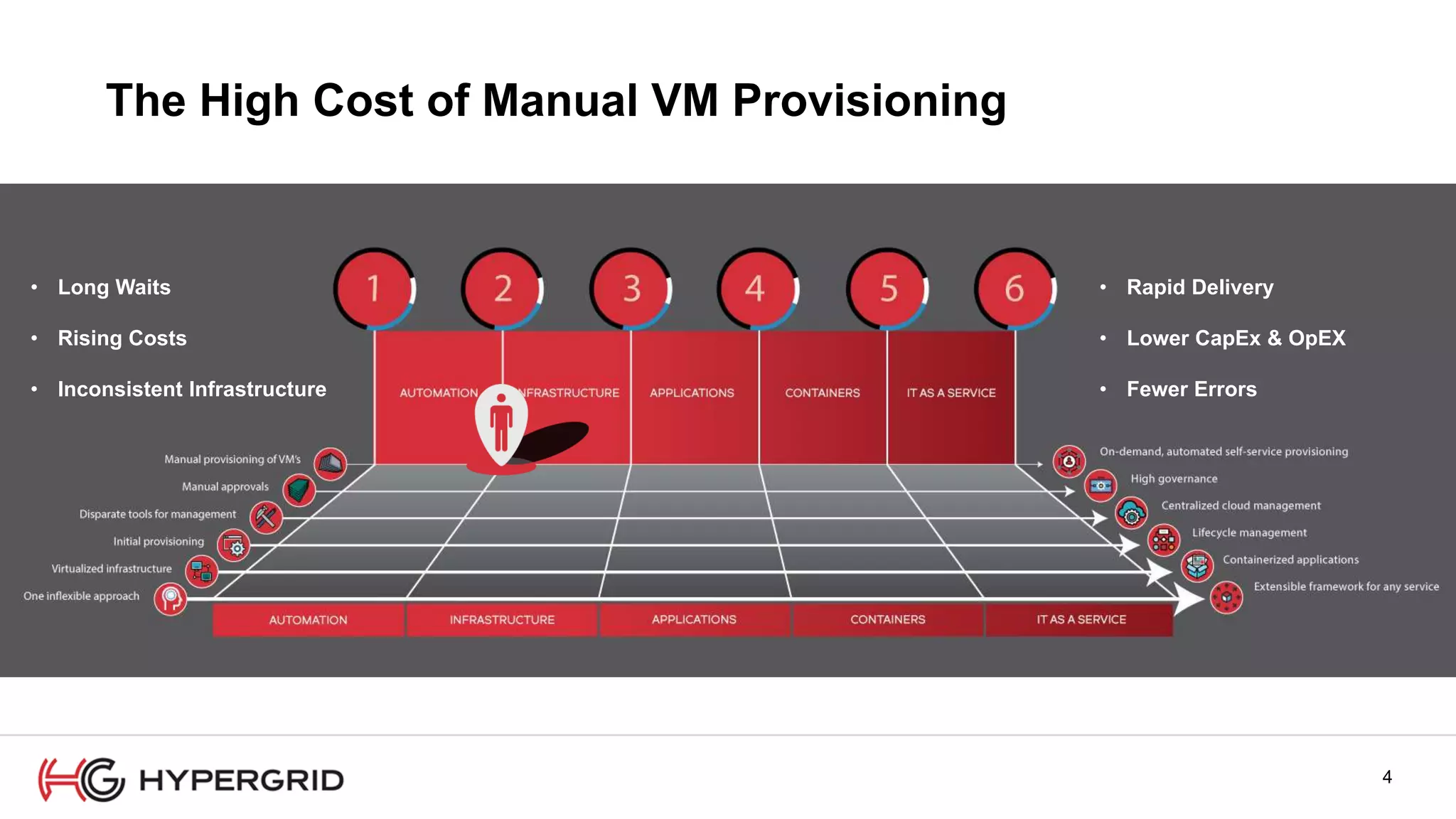
The High Cost of Manual VM Provisioning
• Long Waits
• Rising Costs
• Inconsistent Infrastructure
• Rapid Delivery
• Lower CapEx & OpEX
• Fewer Errors
4
5
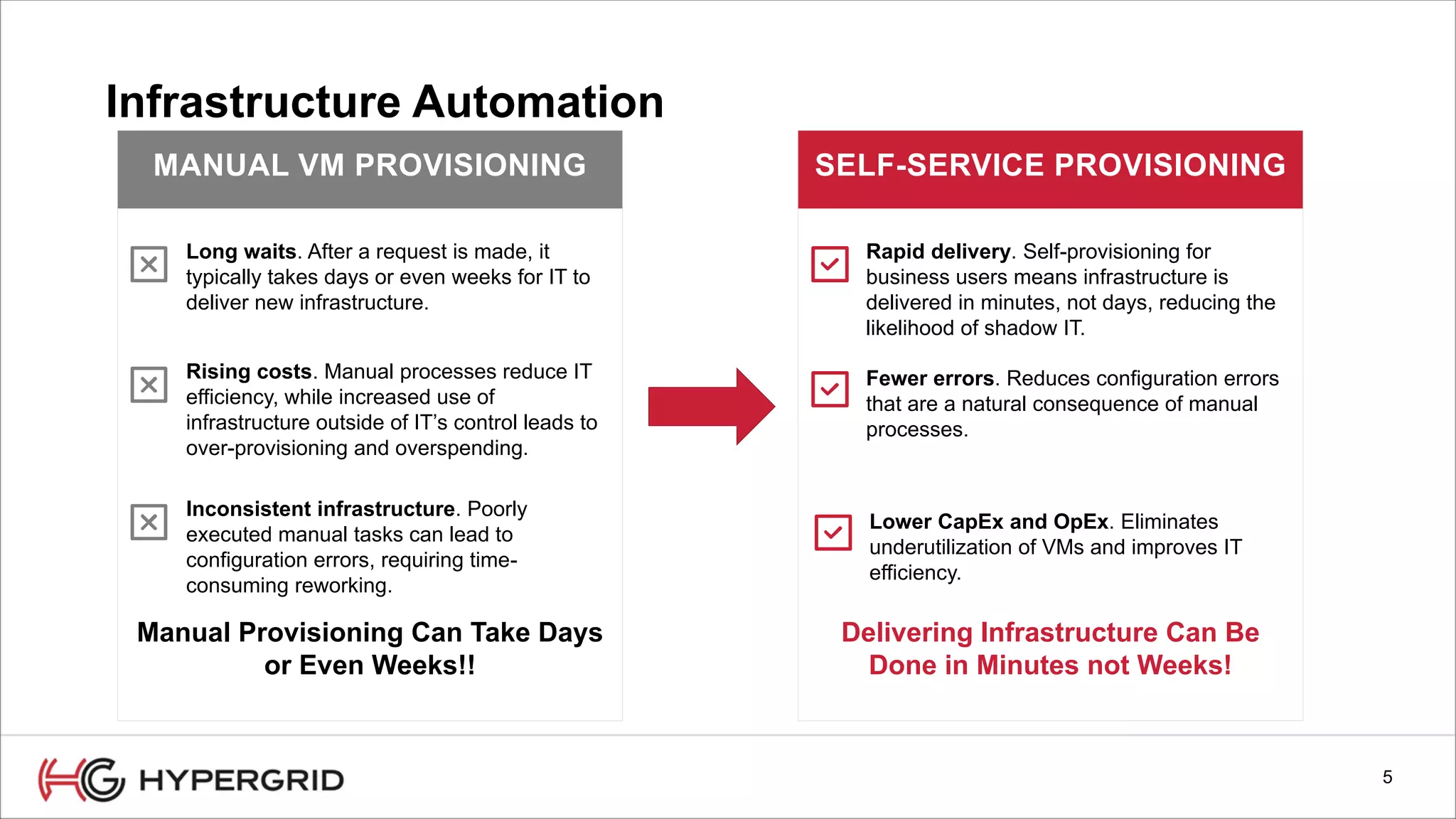
Infrastructure Automation
MANUAL VM PROVISIONING
Long waits. After a request is made, it
typically takes days or even weeks for IT to
deliver new infrastructure.
SELF-SERVICE PROVISIONING
Rising costs. Manual processes reduce IT
efficiency, while increased use of
infrastructure outside of IT’s control leads to
over-provisioning and overspending.
Manual Provisioning Can Take Days
or Even Weeks!!
Delivering Infrastructure Can Be
Done in Minutes not Weeks!
Rapid delivery. Self-provisioning for
business users means infrastructure is
delivered in minutes, not days, reducing the
likelihood of shadow IT.
Fewer errors. Reduces configuration errors
that are a natural consequence of manual
processes.
Inconsistent infrastructure. Poorly
executed manual tasks can lead to
configuration errors, requiring time-
consuming reworking.
Lower CapEx and OpEx. Eliminates
underutilization of VMs and improves IT
efficiency.
6
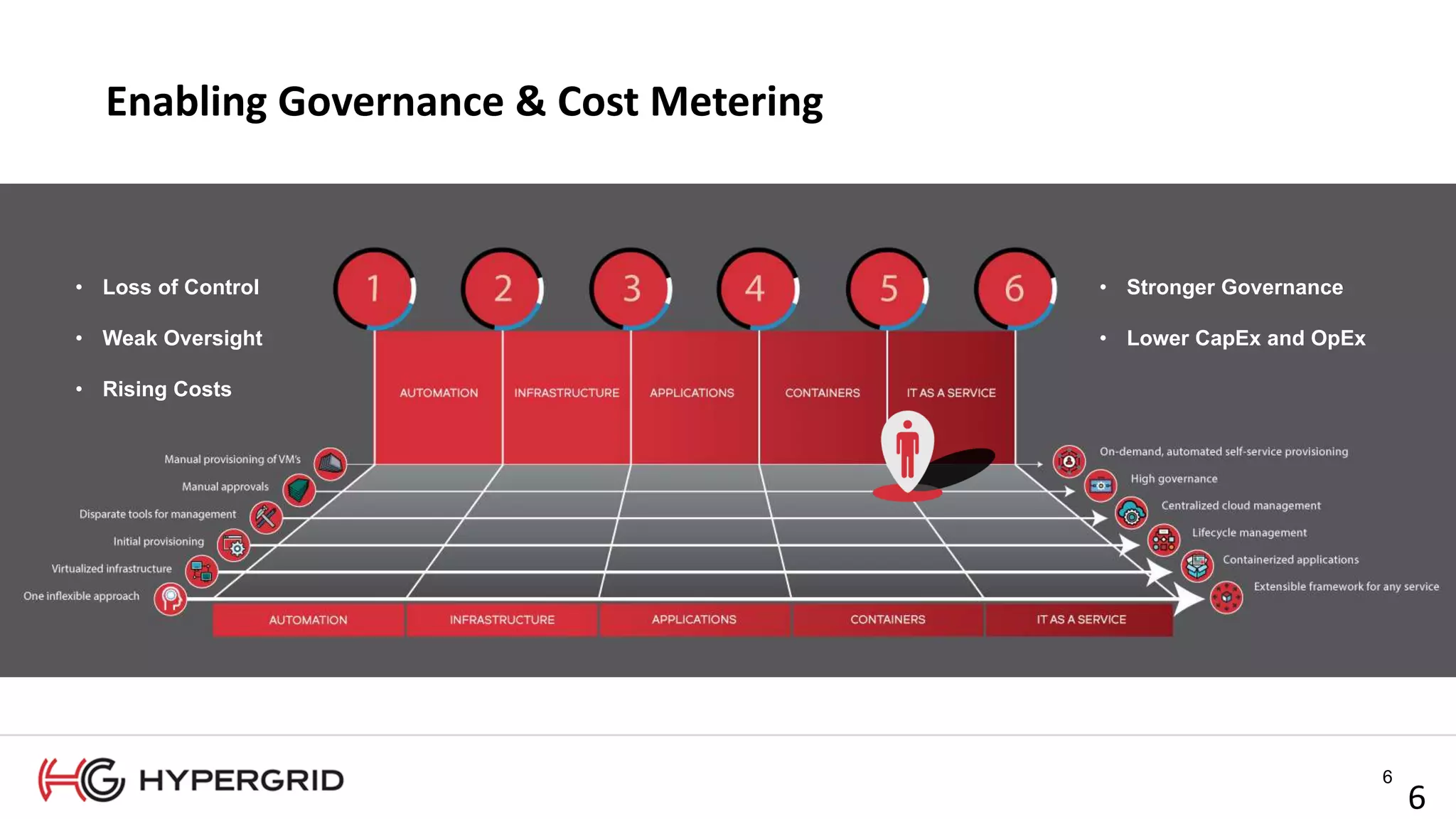
Enabling Governance & Cost Metering
6
66
• Loss of Control
• Weak Oversight
• Rising Costs
• Stronger Governance
• Lower CapEx and OpEx
6
7
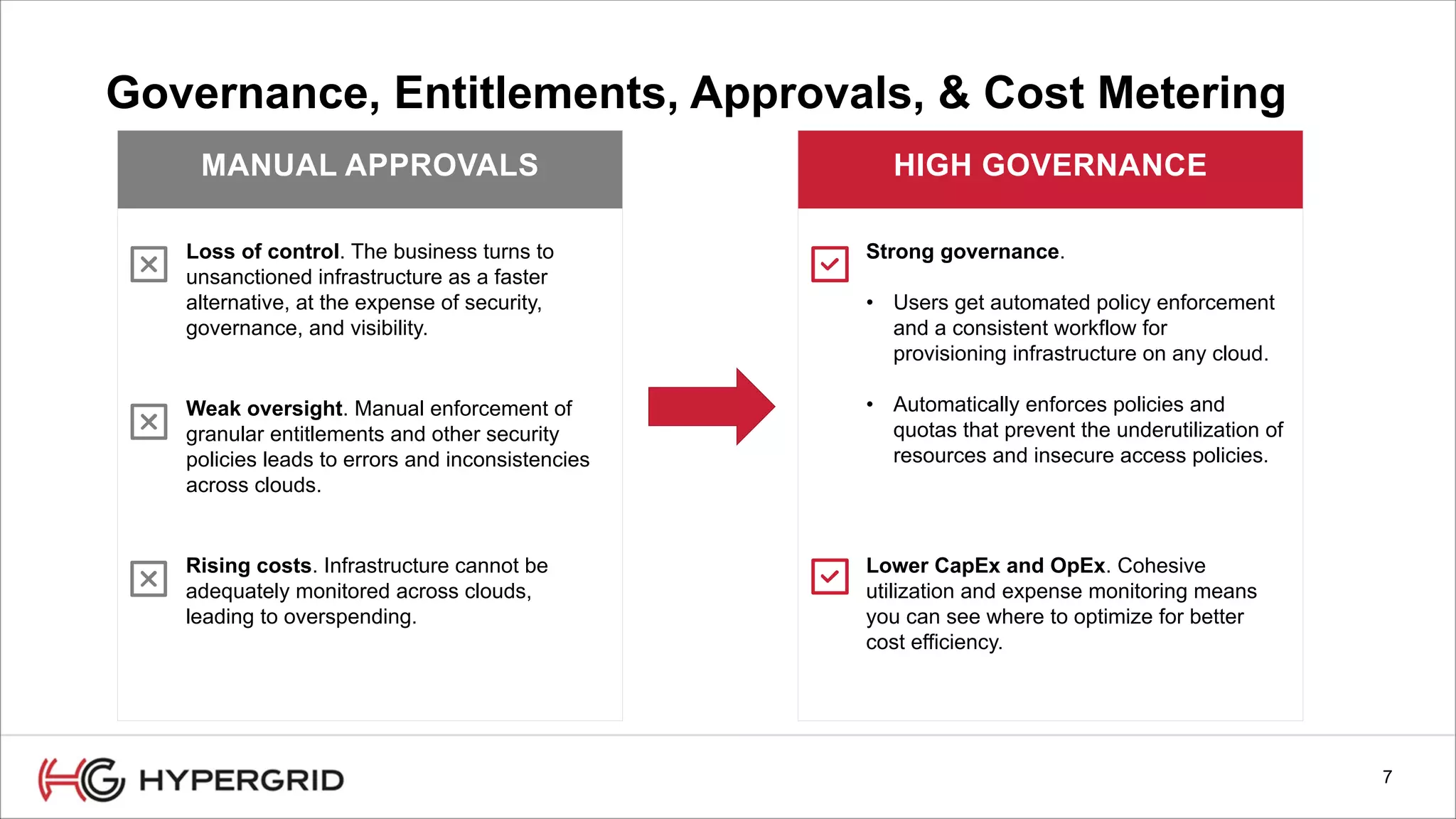
Governance, Entitlements, Approvals, & Cost Metering
MANUAL APPROVALS
Loss of control. The business turns to
unsanctioned infrastructure as a faster
alternative, at the expense of security,
governance, and visibility.
HIGH GOVERNANCE
Weak oversight. Manual enforcement of
granular entitlements and other security
policies leads to errors and inconsistencies
across clouds.
Strong governance.
• Users get automated policy enforcement
and a consistent workflow for
provisioning infrastructure on any cloud.
• Automatically enforces policies and
quotas that prevent the underutilization of
resources and insecure access policies.
Rising costs. Infrastructure cannot be
adequately monitored across clouds,
leading to overspending.
Lower CapEx and OpEx. Cohesive
utilization and expense monitoring means
you can see where to optimize for better
cost efficiency.
8
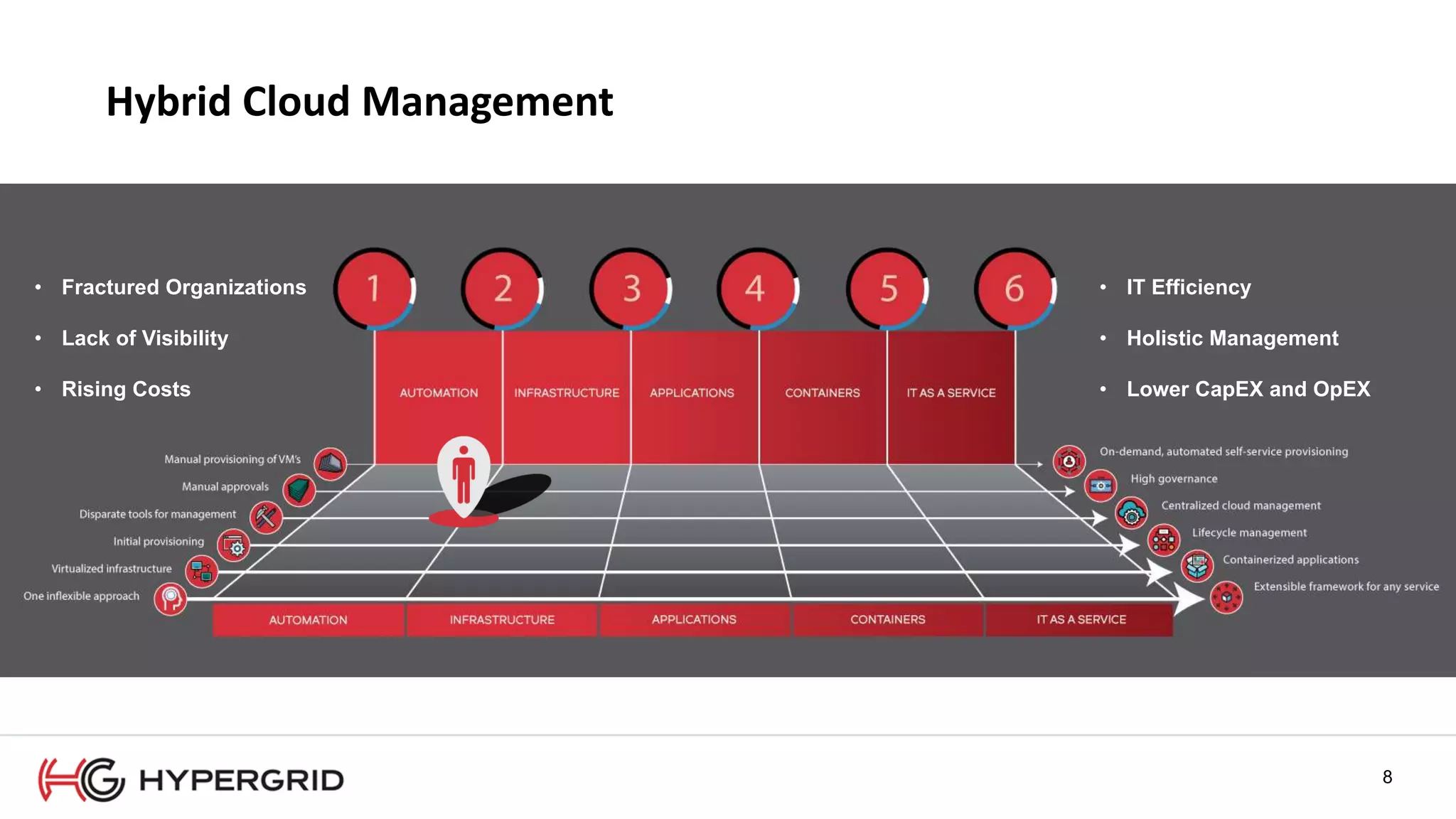
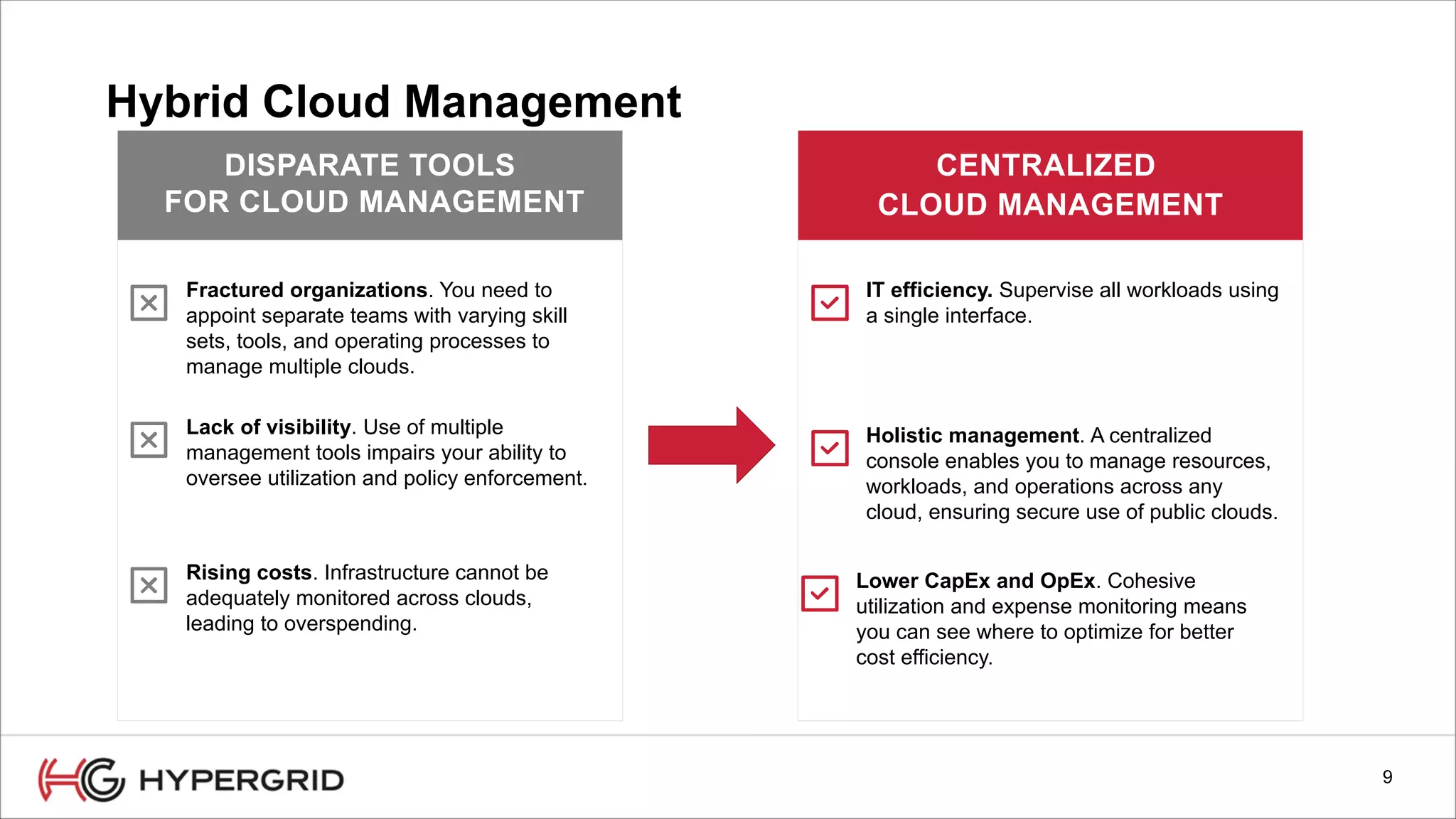
Hybrid Cloud Management
8
• Fractured Organizations
• Lack of Visibility
• Rising Costs
• IT Efficiency
• Holistic Management
• Lower CapEX and OpEX
8
9
Hybrid Cloud Management
DISPARATE TOOLS
FOR CLOUD MANAGEMENT
Fractured organizations. You need to
appoint separate teams with varying skill
sets, tools, and operating processes to
manage multiple clouds.
CENTRALIZED
CLOUD MANAGEMENT
IT efficiency. Supervise all workloads using
a single interface.
Lack of visibility. Use of multiple
management tools impairs your ability to
oversee utilization and policy enforcement.
Rising costs. Infrastructure cannot be
adequately monitored across clouds,
leading to overspending.
Holistic management. A centralized
console enables you to manage resources,
workloads, and operations across any
cloud, ensuring secure use of public clouds.
Lower CapEx and OpEx. Cohesive
utilization and expense monitoring means
you can see where to optimize for better
cost efficiency.
10
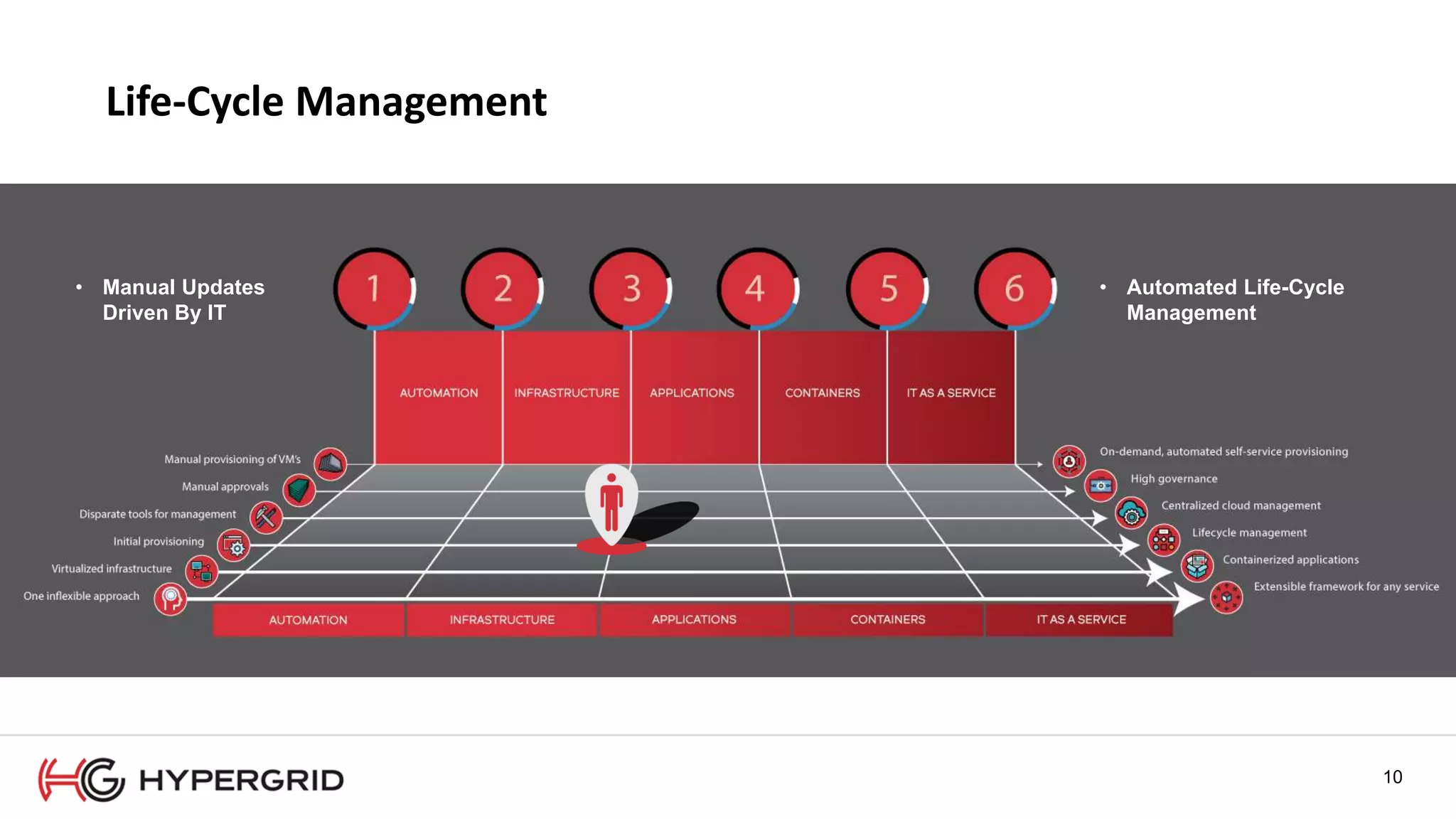
Life-Cycle Management
1010
• Manual Updates
Driven By IT
• Automated Life-Cycle
Management
10
11
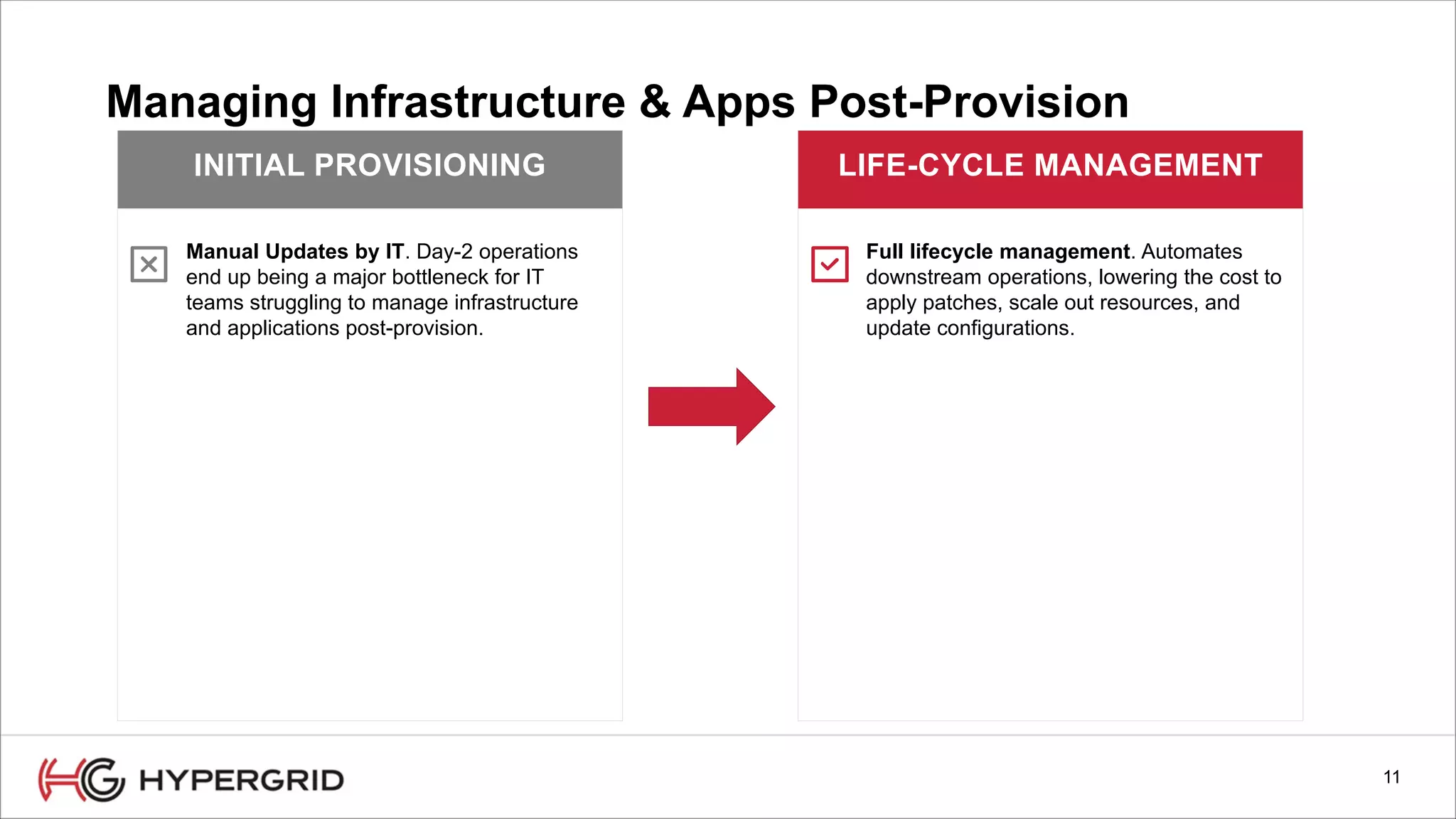
Managing Infrastructure & Apps Post-Provision
INITIAL PROVISIONING
Manual Updates by IT. Day-2 operations
end up being a major bottleneck for IT
teams struggling to manage infrastructure
and applications post-provision.
LIFE-CYCLE MANAGEMENT
Full lifecycle management. Automates
downstream operations, lowering the cost to
apply patches, scale out resources, and
update configurations.
12
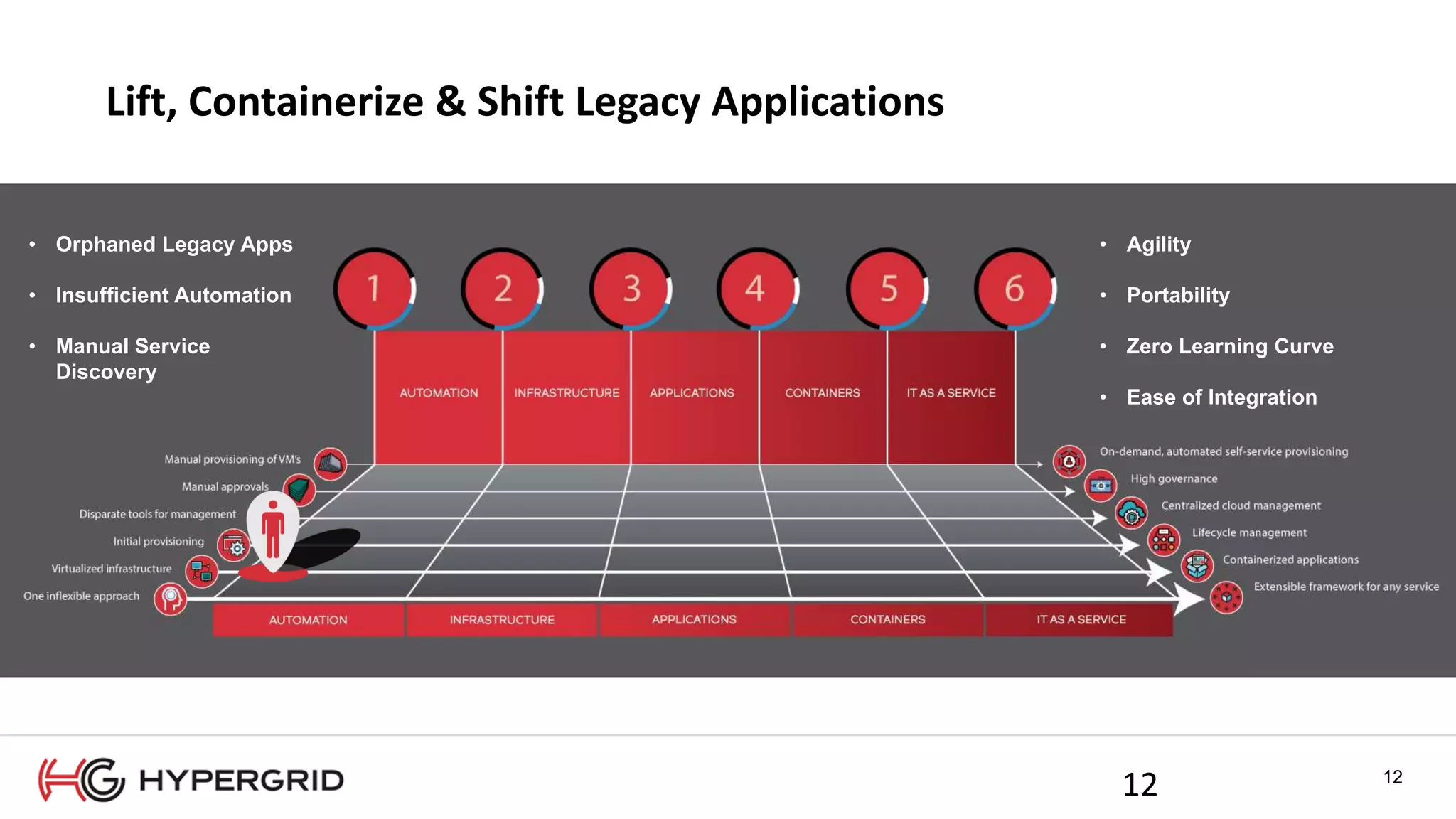
Lift, Containerize & Shift Legacy Applications
12
121212
• Orphaned Legacy Apps
• Insufficient Automation
• Manual Service
Discovery
• Agility
• Portability
• Zero Learning Curve
• Ease of Integration
12
13
Containerizing Legacy Applications
VIRTUALIZED INFRASTRUCTURE
Orphaned legacy apps. The cost of migration delays
efforts to modernize and migrate legacy apps to
lower-cost infrastructure.
CONTAINERIZED APPLICATIONS
Insufficient automation. Containers are designed to
improve application portability, but typically require
code changes and a long learning curve.
Agility. Eliminates IT bottlenecks and turbocharges
DevOps for rapid business innovation.
Portability. Automates the modernization of legacy
applications so they can run anywhere.
Manual service discovery. Services to aid
integration require additional effort and expertise to
containerize.
Zero learning curve. Requires no app code changes;
performs on-the-fly containerization.
Ease of integration. Automates service discovery for
no-effort integration with any external service.
14
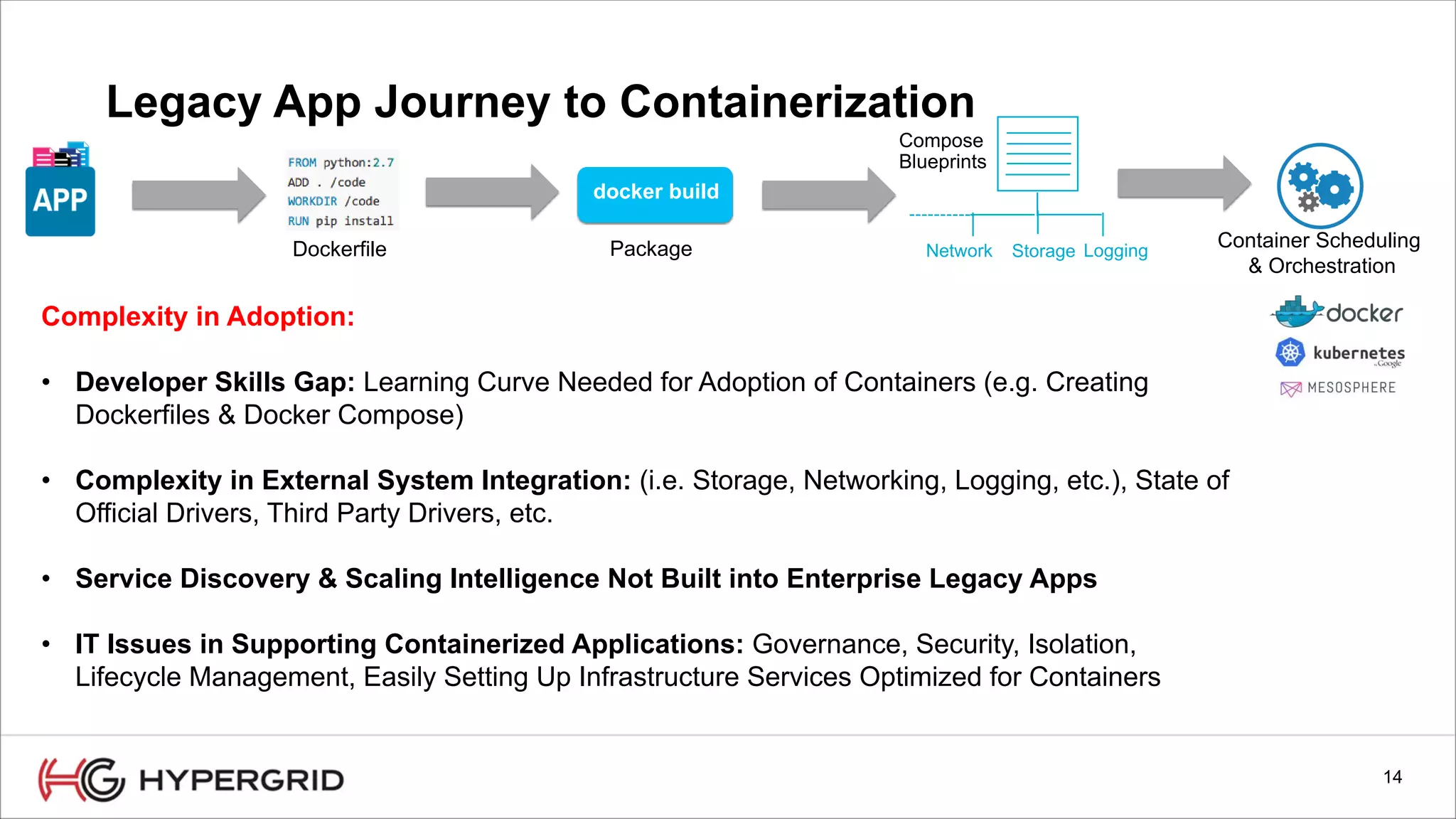
Dockerfile
docker build
Container Scheduling
& Orchestration
Package
Complexity in Adoption:
• Developer Skills Gap: Learning Curve Needed for Adoption of Containers (e.g. Creating
Dockerfiles & Docker Compose)
• Complexity in External System Integration: (i.e. Storage, Networking, Logging, etc.), State of
Official Drivers, Third Party Drivers, etc.
• Service Discovery & Scaling Intelligence Not Built into Enterprise Legacy Apps
• IT Issues in Supporting Containerized Applications: Governance, Security, Isolation,
Lifecycle Management, Easily Setting Up Infrastructure Services Optimized for Containers
Compose
Blueprints
Network Storage Logging
Legacy App Journey to Containerization
15
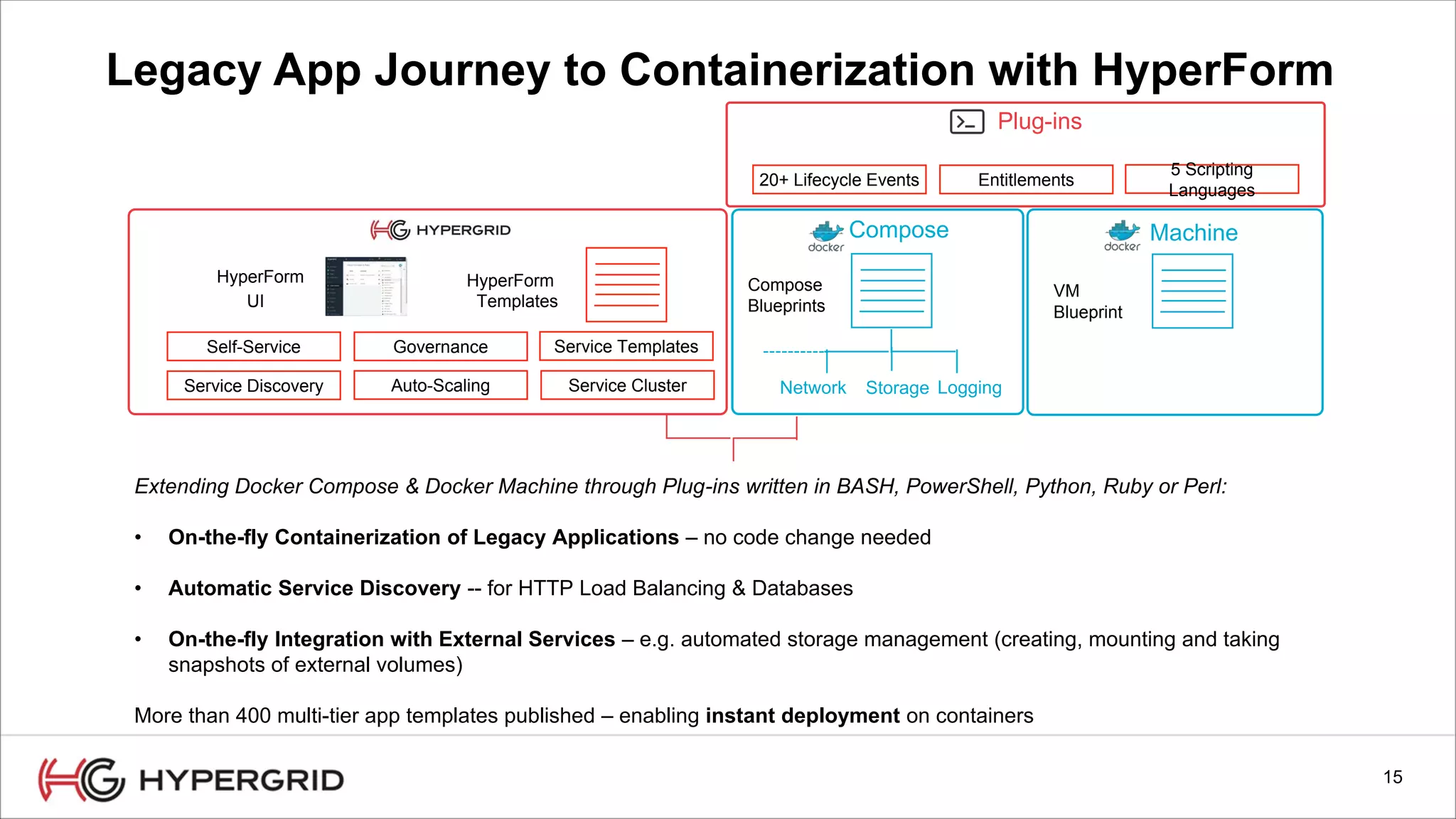
Extending Docker Compose & Docker Machine through Plug-ins written in BASH, PowerShell, Python, Ruby or Perl:
• On-the-fly Containerization of Legacy Applications – no code change needed
• Automatic Service Discovery -- for HTTP Load Balancing & Databases
• On-the-fly Integration with External Services – e.g. automated storage management (creating, mounting and taking
snapshots of external volumes)
More than 400 multi-tier app templates published – enabling instant deployment on containers
Legacy App Journey to Containerization with HyperForm
Auto-ScalingService Discovery
Self-Service Governance
HyperForm
Service Templates
Service Cluster
Compose
Templates
HyperForm
UI
Compose
Blueprints
Machine
VM
Blueprint
Network Storage Logging
Plug-ins
20+ Lifecycle Events Entitlements
5 Scripting
Languages
16
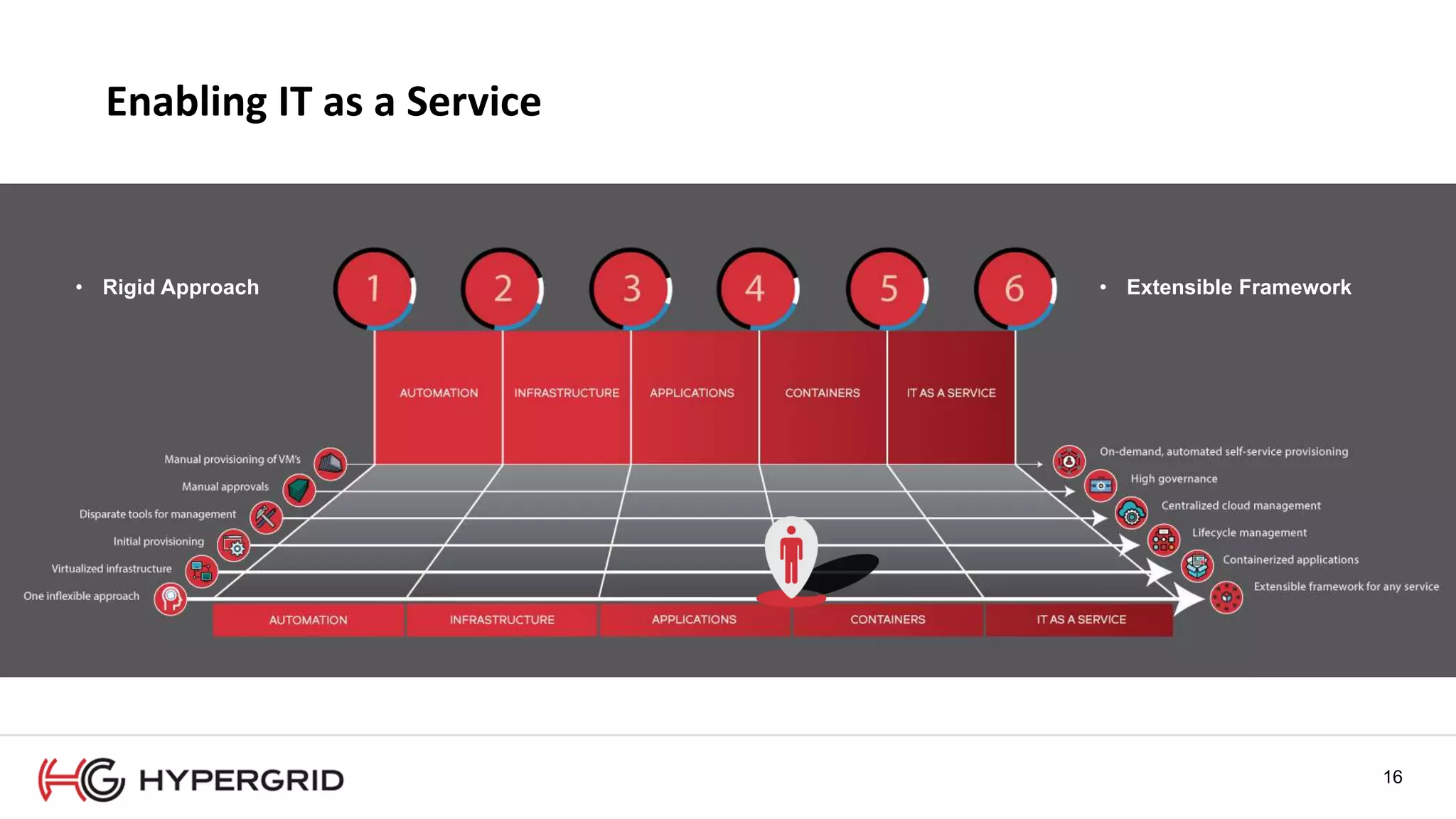
Enabling IT as a Service
16161616
• Rigid Approach • Extensible Framework
16
17
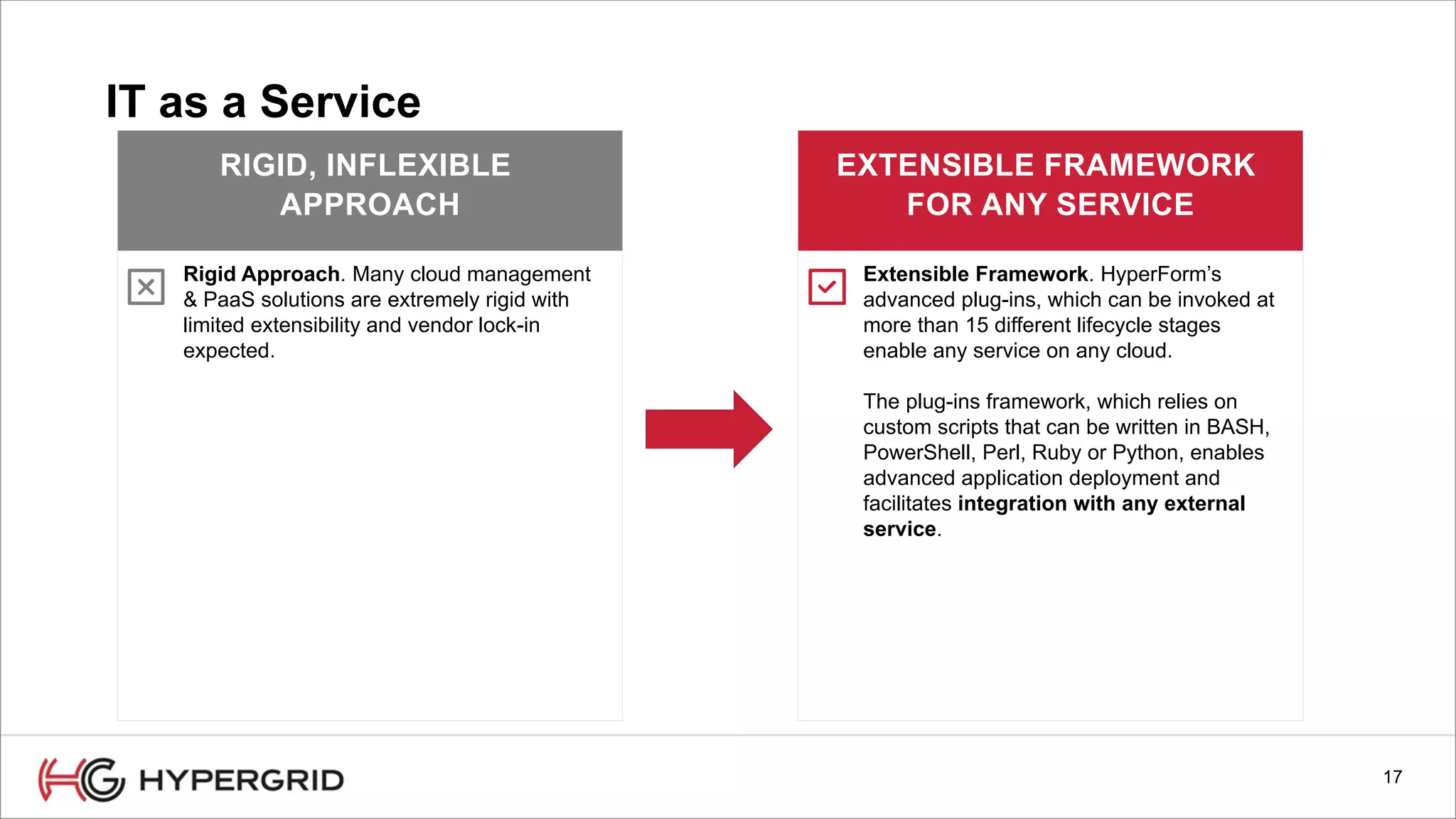
IT as a Service
RIGID, INFLEXIBLE
APPROACH
Rigid Approach. Many cloud management
& PaaS solutions are extremely rigid with
limited extensibility and vendor lock-in
expected.
EXTENSIBLE FRAMEWORK
FOR ANY SERVICE
Extensible Framework. HyperForm’s
advanced plug-ins, which can be invoked at
more than 15 different lifecycle stages
enable any service on any cloud.
The plug-ins framework, which relies on
custom scripts that can be written in BASH,
PowerShell, Perl, Ruby or Python, enables
advanced application deployment and
facilitates integration with any external
service.
18
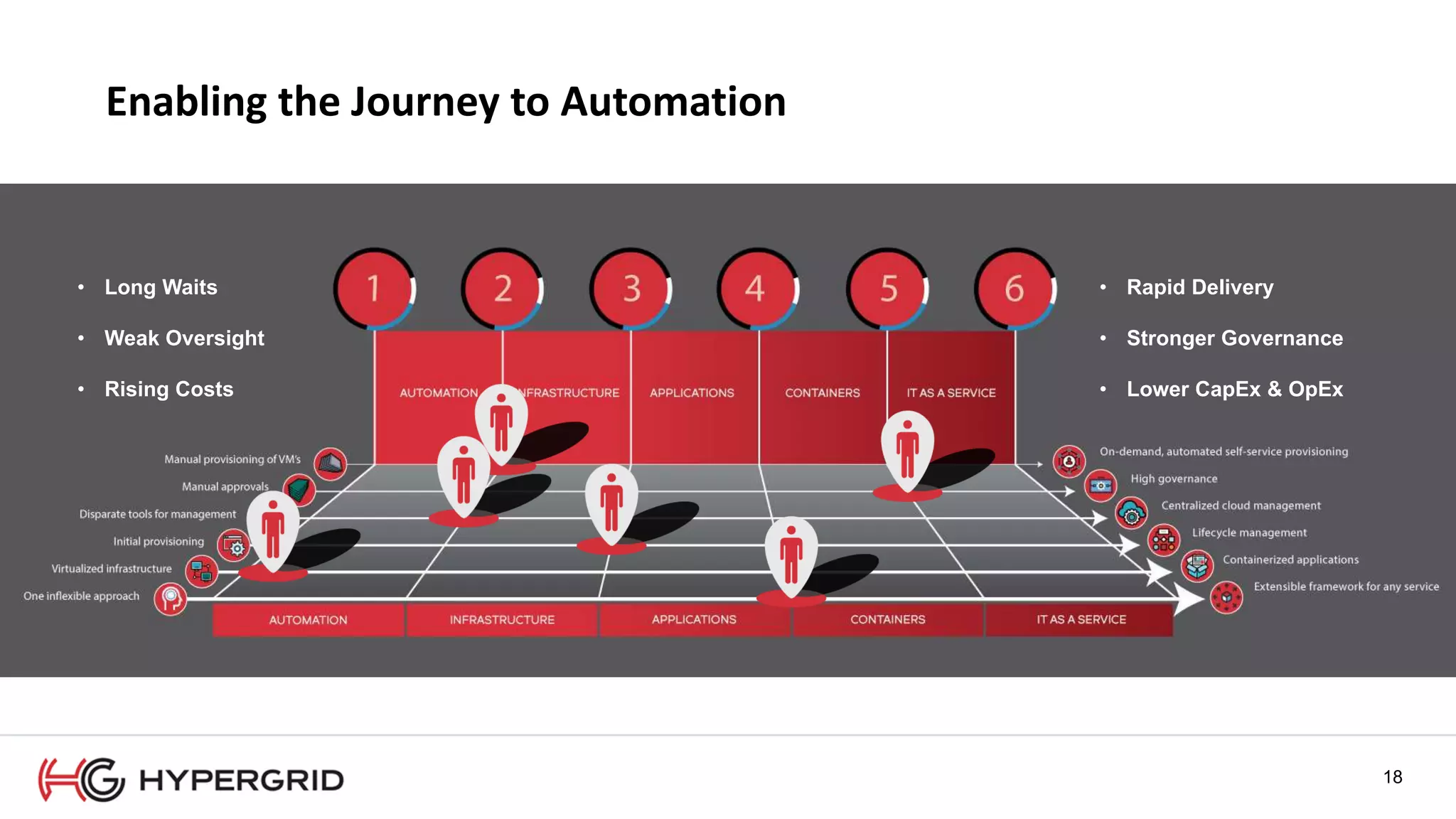
Enabling the Journey to Automation
• Long Waits
• Weak Oversight
• Rising Costs
• Rapid Delivery
• Stronger Governance
• Lower CapEx & OpEx
19
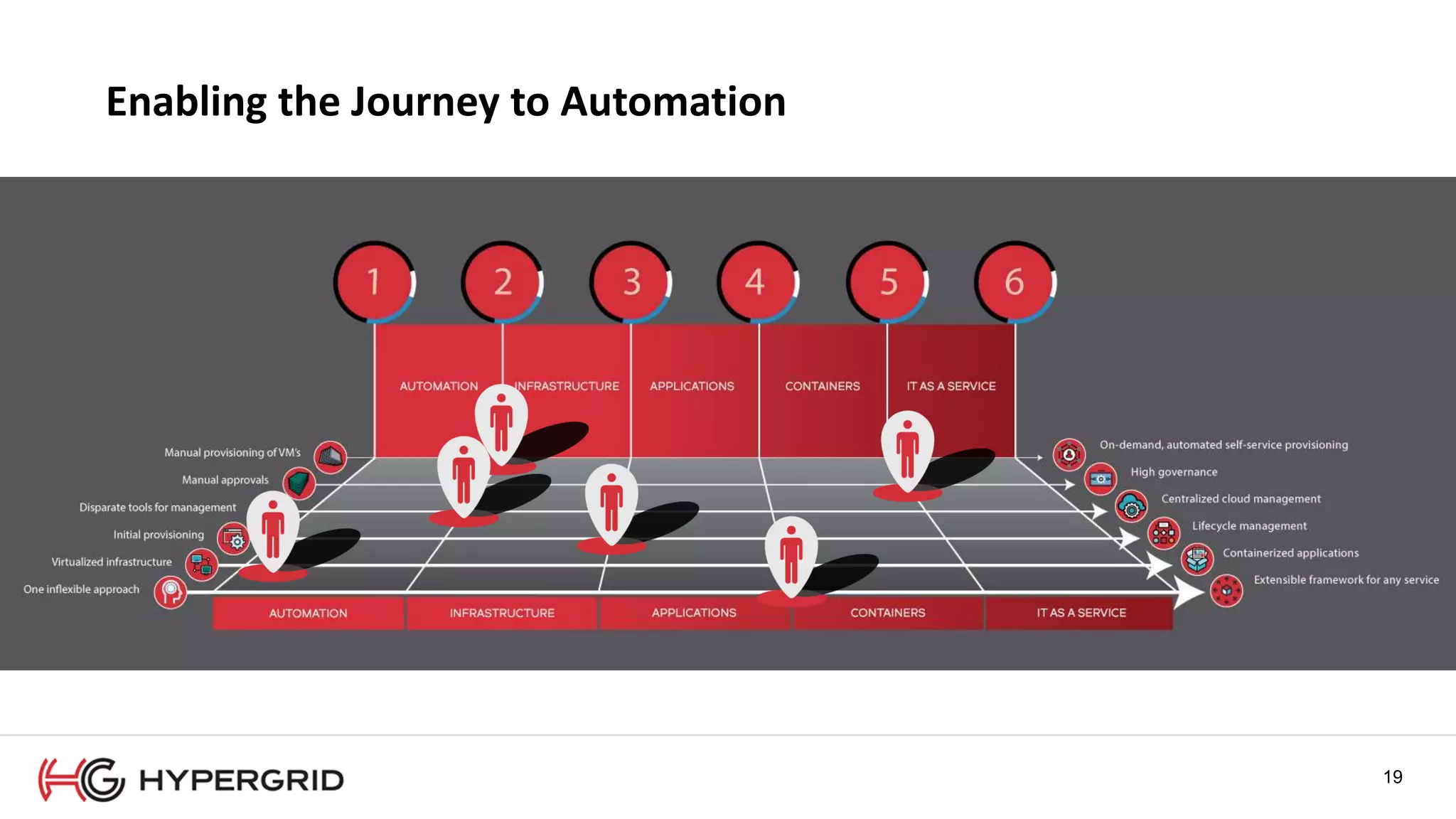
Enabling the Journey to Automation
HyperGrid Journey to Automation

HyperGrid Journey to Automation

  • 1.
    Enabling the Journeyto Automation By Amjad Afanah
  • 2.
    2 Applications • Drive competitiveadvantage • Enable new business opportunity IT Operations DEMAND • Faster delivery expectations • Embrace DevOps while enforcing security The Business RESULT • Lower customer satisfaction • Growing use of shadow IT • Increased risk • Missed opportunity The move toward digital transformation
  • 3.
    Benefits HyperForm enables thejourney to automation so that you can deliver services to your teams faster. This journey has multiple entry points. • You can start by moving towards an automated, self-service provisioning model to deliver infrastructure on any cloud for IT efficiency, or • by containerizing your existing applications to turbocharge DevOps HyperForm – Enabling the Journey to Automation Physical Virtual Cloud HyperForm Self-Service Policy-based Governance with Entitlements Monitoring CostMetering Infrastructure Services App Container Services Custom Services 18+ Clouds & Platforms Quotas & Approvals On-the-fly Containerization Service Discovery DBaaS, PaaS Code Run Plug-ins
  • 4.
    4 The High Costof Manual VM Provisioning • Long Waits • Rising Costs • Inconsistent Infrastructure • Rapid Delivery • Lower CapEx & OpEX • Fewer Errors 4
  • 5.
    5 Infrastructure Automation MANUAL VMPROVISIONING Long waits. After a request is made, it typically takes days or even weeks for IT to deliver new infrastructure. SELF-SERVICE PROVISIONING Rising costs. Manual processes reduce IT efficiency, while increased use of infrastructure outside of IT’s control leads to over-provisioning and overspending. Manual Provisioning Can Take Days or Even Weeks!! Delivering Infrastructure Can Be Done in Minutes not Weeks! Rapid delivery. Self-provisioning for business users means infrastructure is delivered in minutes, not days, reducing the likelihood of shadow IT. Fewer errors. Reduces configuration errors that are a natural consequence of manual processes. Inconsistent infrastructure. Poorly executed manual tasks can lead to configuration errors, requiring time- consuming reworking. Lower CapEx and OpEx. Eliminates underutilization of VMs and improves IT efficiency.
  • 6.
    6 Enabling Governance &Cost Metering 6 66 • Loss of Control • Weak Oversight • Rising Costs • Stronger Governance • Lower CapEx and OpEx 6
  • 7.
    7 Governance, Entitlements, Approvals,& Cost Metering MANUAL APPROVALS Loss of control. The business turns to unsanctioned infrastructure as a faster alternative, at the expense of security, governance, and visibility. HIGH GOVERNANCE Weak oversight. Manual enforcement of granular entitlements and other security policies leads to errors and inconsistencies across clouds. Strong governance. • Users get automated policy enforcement and a consistent workflow for provisioning infrastructure on any cloud. • Automatically enforces policies and quotas that prevent the underutilization of resources and insecure access policies. Rising costs. Infrastructure cannot be adequately monitored across clouds, leading to overspending. Lower CapEx and OpEx. Cohesive utilization and expense monitoring means you can see where to optimize for better cost efficiency.
  • 8.
    8 Hybrid Cloud Management 8 •Fractured Organizations • Lack of Visibility • Rising Costs • IT Efficiency • Holistic Management • Lower CapEX and OpEX 8
  • 9.
    9 Hybrid Cloud Management DISPARATETOOLS FOR CLOUD MANAGEMENT Fractured organizations. You need to appoint separate teams with varying skill sets, tools, and operating processes to manage multiple clouds. CENTRALIZED CLOUD MANAGEMENT IT efficiency. Supervise all workloads using a single interface. Lack of visibility. Use of multiple management tools impairs your ability to oversee utilization and policy enforcement. Rising costs. Infrastructure cannot be adequately monitored across clouds, leading to overspending. Holistic management. A centralized console enables you to manage resources, workloads, and operations across any cloud, ensuring secure use of public clouds. Lower CapEx and OpEx. Cohesive utilization and expense monitoring means you can see where to optimize for better cost efficiency.
  • 10.
    10 Life-Cycle Management 1010 • ManualUpdates Driven By IT • Automated Life-Cycle Management 10
  • 11.
    11 Managing Infrastructure &Apps Post-Provision INITIAL PROVISIONING Manual Updates by IT. Day-2 operations end up being a major bottleneck for IT teams struggling to manage infrastructure and applications post-provision. LIFE-CYCLE MANAGEMENT Full lifecycle management. Automates downstream operations, lowering the cost to apply patches, scale out resources, and update configurations.
  • 12.
    12 Lift, Containerize &Shift Legacy Applications 12 121212 • Orphaned Legacy Apps • Insufficient Automation • Manual Service Discovery • Agility • Portability • Zero Learning Curve • Ease of Integration 12
  • 13.
    13 Containerizing Legacy Applications VIRTUALIZEDINFRASTRUCTURE Orphaned legacy apps. The cost of migration delays efforts to modernize and migrate legacy apps to lower-cost infrastructure. CONTAINERIZED APPLICATIONS Insufficient automation. Containers are designed to improve application portability, but typically require code changes and a long learning curve. Agility. Eliminates IT bottlenecks and turbocharges DevOps for rapid business innovation. Portability. Automates the modernization of legacy applications so they can run anywhere. Manual service discovery. Services to aid integration require additional effort and expertise to containerize. Zero learning curve. Requires no app code changes; performs on-the-fly containerization. Ease of integration. Automates service discovery for no-effort integration with any external service.
  • 14.
    14 Dockerfile docker build Container Scheduling &Orchestration Package Complexity in Adoption: • Developer Skills Gap: Learning Curve Needed for Adoption of Containers (e.g. Creating Dockerfiles & Docker Compose) • Complexity in External System Integration: (i.e. Storage, Networking, Logging, etc.), State of Official Drivers, Third Party Drivers, etc. • Service Discovery & Scaling Intelligence Not Built into Enterprise Legacy Apps • IT Issues in Supporting Containerized Applications: Governance, Security, Isolation, Lifecycle Management, Easily Setting Up Infrastructure Services Optimized for Containers Compose Blueprints Network Storage Logging Legacy App Journey to Containerization
  • 15.
    15 Extending Docker Compose& Docker Machine through Plug-ins written in BASH, PowerShell, Python, Ruby or Perl: • On-the-fly Containerization of Legacy Applications – no code change needed • Automatic Service Discovery -- for HTTP Load Balancing & Databases • On-the-fly Integration with External Services – e.g. automated storage management (creating, mounting and taking snapshots of external volumes) More than 400 multi-tier app templates published – enabling instant deployment on containers Legacy App Journey to Containerization with HyperForm Auto-ScalingService Discovery Self-Service Governance HyperForm Service Templates Service Cluster Compose Templates HyperForm UI Compose Blueprints Machine VM Blueprint Network Storage Logging Plug-ins 20+ Lifecycle Events Entitlements 5 Scripting Languages
  • 16.
    16 Enabling IT asa Service 16161616 • Rigid Approach • Extensible Framework 16
  • 17.
    17 IT as aService RIGID, INFLEXIBLE APPROACH Rigid Approach. Many cloud management & PaaS solutions are extremely rigid with limited extensibility and vendor lock-in expected. EXTENSIBLE FRAMEWORK FOR ANY SERVICE Extensible Framework. HyperForm’s advanced plug-ins, which can be invoked at more than 15 different lifecycle stages enable any service on any cloud. The plug-ins framework, which relies on custom scripts that can be written in BASH, PowerShell, Perl, Ruby or Python, enables advanced application deployment and facilitates integration with any external service.
  • 18.
    18 Enabling the Journeyto Automation • Long Waits • Weak Oversight • Rising Costs • Rapid Delivery • Stronger Governance • Lower CapEx & OpEx
  • 19.

Editor's Notes

  • #4 Connectivity Connect to pre-created NSX virtual distributed router for optimized east-west traffic Support NSX edge router, which adds overlapping IP addresses across apps Security Isolate multimachine service to only allow traffic between VMs within that service On-demand security by applying pre-defined NSX security policies (such as, a distributed firewall or third-party solutions) to instantiated VMs Select NSX security tags for dynamic security service consumption (such as DB servers, PCI, and so on) based on type of workload Availability Support for on-demand (one-armed model) and pre-created NSX load balancer Support for third-party NSX partner load balancing services