Mode 2 Revision to ISO 18000-7

           DASH7 Alliance
           20 July 2010


Copyright © DASH7 Alliance
Motivations, and New Ideas

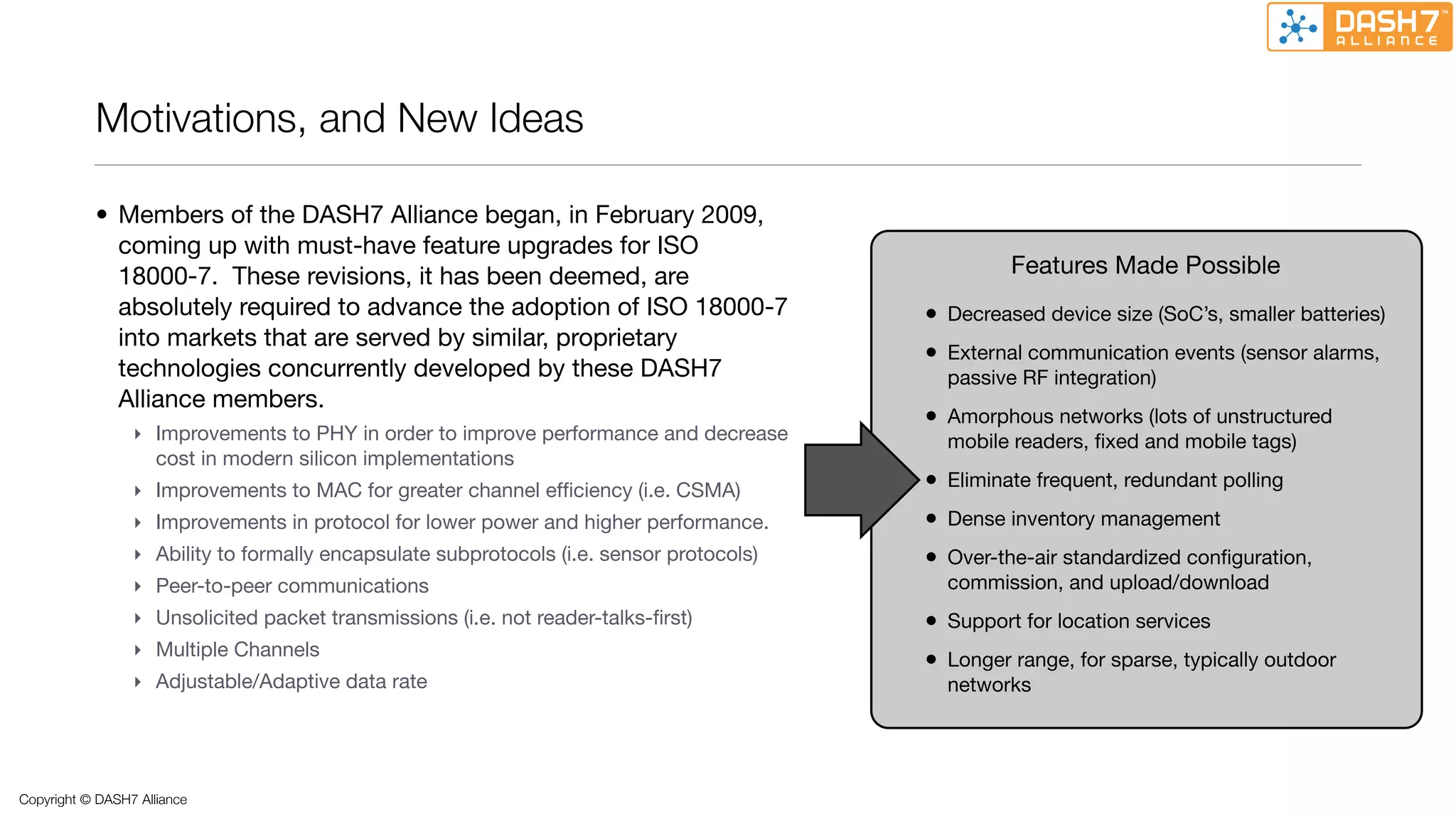
           • Members of the DASH7 Alliance began, in February 2009,
             coming up with must-have feature upgrades for ISO
             18000-7. These revisions, it has been deemed, are                                     Features Made Possible
             absolutely required to advance the adoption of ISO 18000-7                   • Decreased device size (SoC’s, smaller batteries)
             into markets that are served by similar, proprietary
                                                                                          • External communication events (sensor alarms,
             technologies concurrently developed by these DASH7                             passive RF integration)
             Alliance members.
                                                                                          • Amorphous networks (lots of unstructured
                 ‣ Improvements to PHY in order to improve performance and decrease         mobile readers, fixed and mobile tags)
                   cost in modern silicon implementations
                 ‣ Improvements to MAC for greater channel efficiency (i.e. CSMA)          • Eliminate frequent, redundant polling
                 ‣ Improvements in protocol for lower power and higher performance.       • Dense inventory management
                 ‣ Ability to formally encapsulate subprotocols (i.e. sensor protocols)   • Over-the-air standardized configuration,
                 ‣ Peer-to-peer communications                                              commission, and upload/download
                 ‣ Unsolicited packet transmissions (i.e. not reader-talks-first)          • Support for location services
                 ‣ Multiple Channels
                                                                                          • Longer range, for sparse, typically outdoor
                 ‣ Adjustable/Adaptive data rate                                            networks


Copyright © DASH7 Alliance
Revised PHY
           More options, but actually more uniform in design

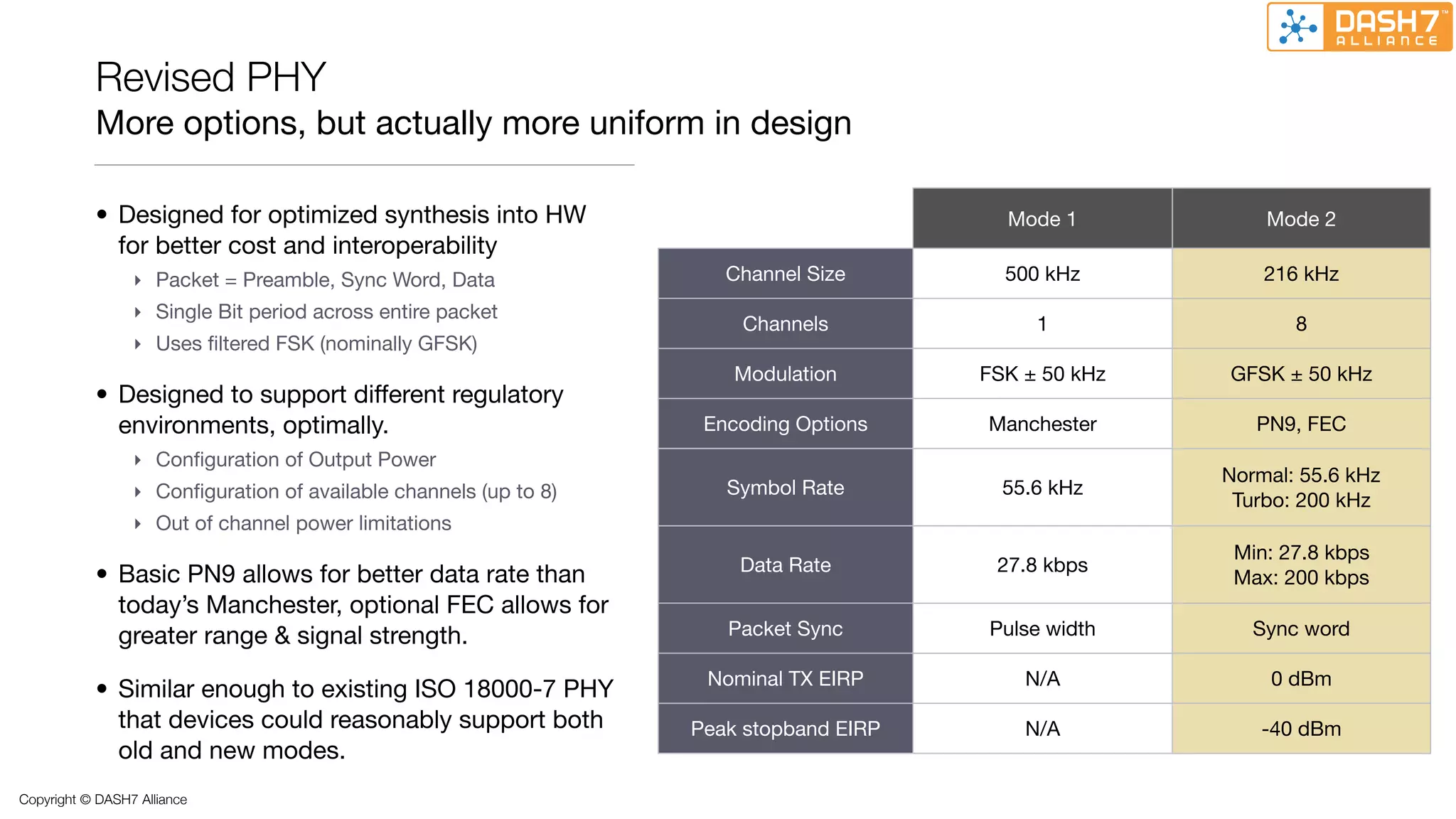
           • Designed for optimized synthesis into HW                                    Mode 1           Mode 2
             for better cost and interoperability
                 ‣ Packet = Preamble, Sync Word, Data                Channel Size        500 kHz          216 kHz
                 ‣ Single Bit period across entire packet
                                                                      Channels              1                8
                 ‣ Uses filtered FSK (nominally GFSK)
                                                                      Modulation       FSK ± 50 kHz   GFSK ± 50 kHz
           • Designed to support different regulatory
             environments, optimally.                              Encoding Options    Manchester        PN9, FEC
                 ‣ Configuration of Output Power
                                                                                                      Normal: 55.6 kHz
                 ‣ Configuration of available channels (up to 8)      Symbol Rate         55.6 kHz
                                                                                                       Turbo: 200 kHz
                 ‣ Out of channel power limitations
                                                                                                       Min: 27.8 kbps
                                                                      Data Rate         27.8 kbps
           • Basic PN9 allows for better data rate than                                                Max: 200 kbps
             today’s Manchester, optional FEC allows for
             greater range & signal strength.                        Packet Sync       Pulse width       Sync word

                                                                   Nominal TX EIRP         N/A            0 dBm
           • Similar enough to existing ISO 18000-7 PHY
             that devices could reasonably support both           Peak stopband EIRP       N/A           -40 dBm
             old and new modes.
Copyright © DASH7 Alliance
Device Settings
                                                                                                                      New
           Beyond just “tag & reader”                                                                                Gateway

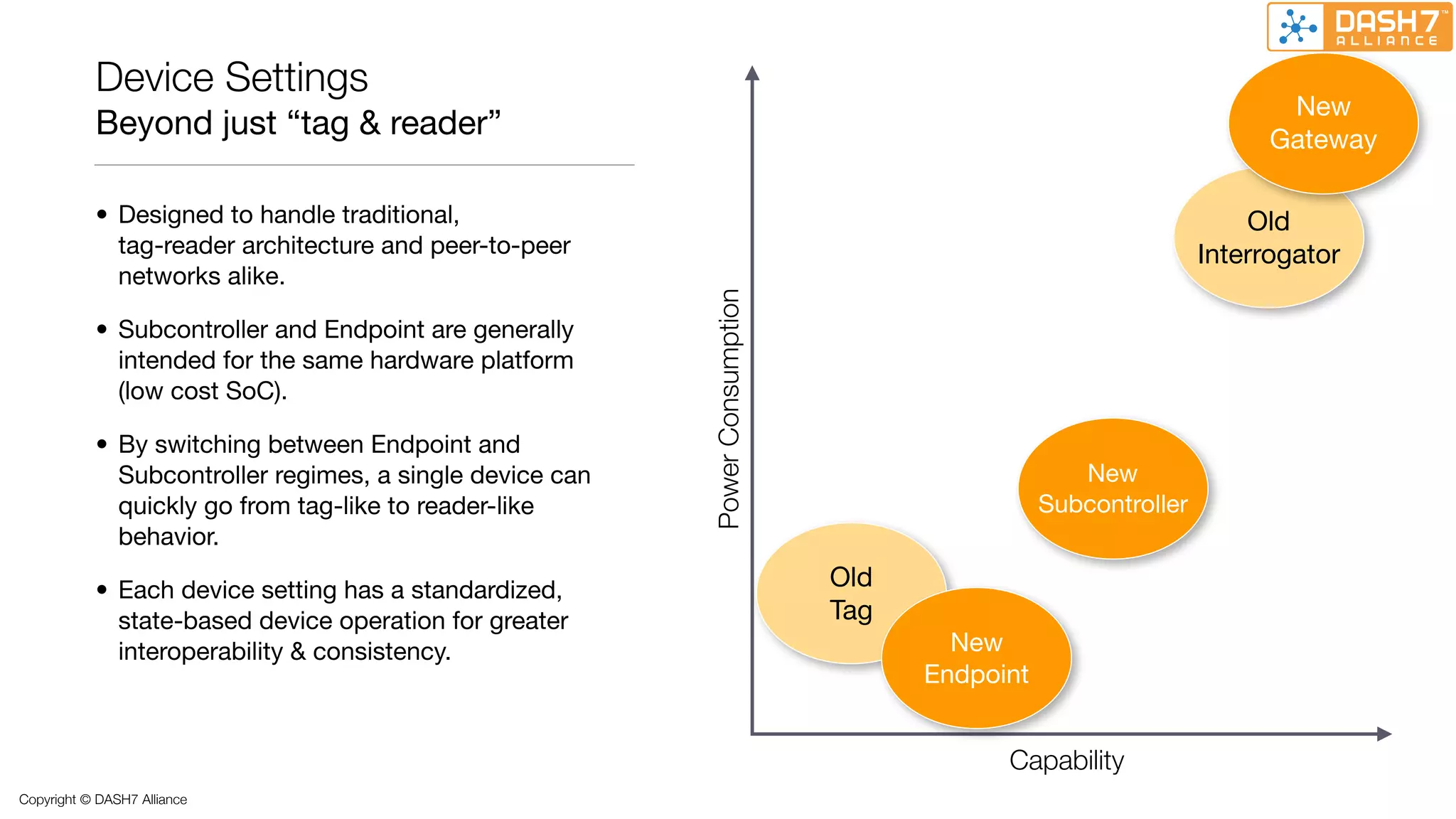
           • Designed to handle traditional,                                                                       Old
             tag-reader architecture and peer-to-peer                                                          Interrogator
             networks alike.


                                                          Power Consumption
           • Subcontroller and Endpoint are generally
             intended for the same hardware platform
             (low cost SoC).

           • By switching between Endpoint and
             Subcontroller regimes, a single device can                                           New
             quickly go from tag-like to reader-like                                           Subcontroller
             behavior.

           • Each device setting has a standardized,                          Old
             state-based device operation for greater                         Tag
             interoperability & consistency.                                          New
                                                                                    Endpoint


                                                                                          Capability
Copyright © DASH7 Alliance
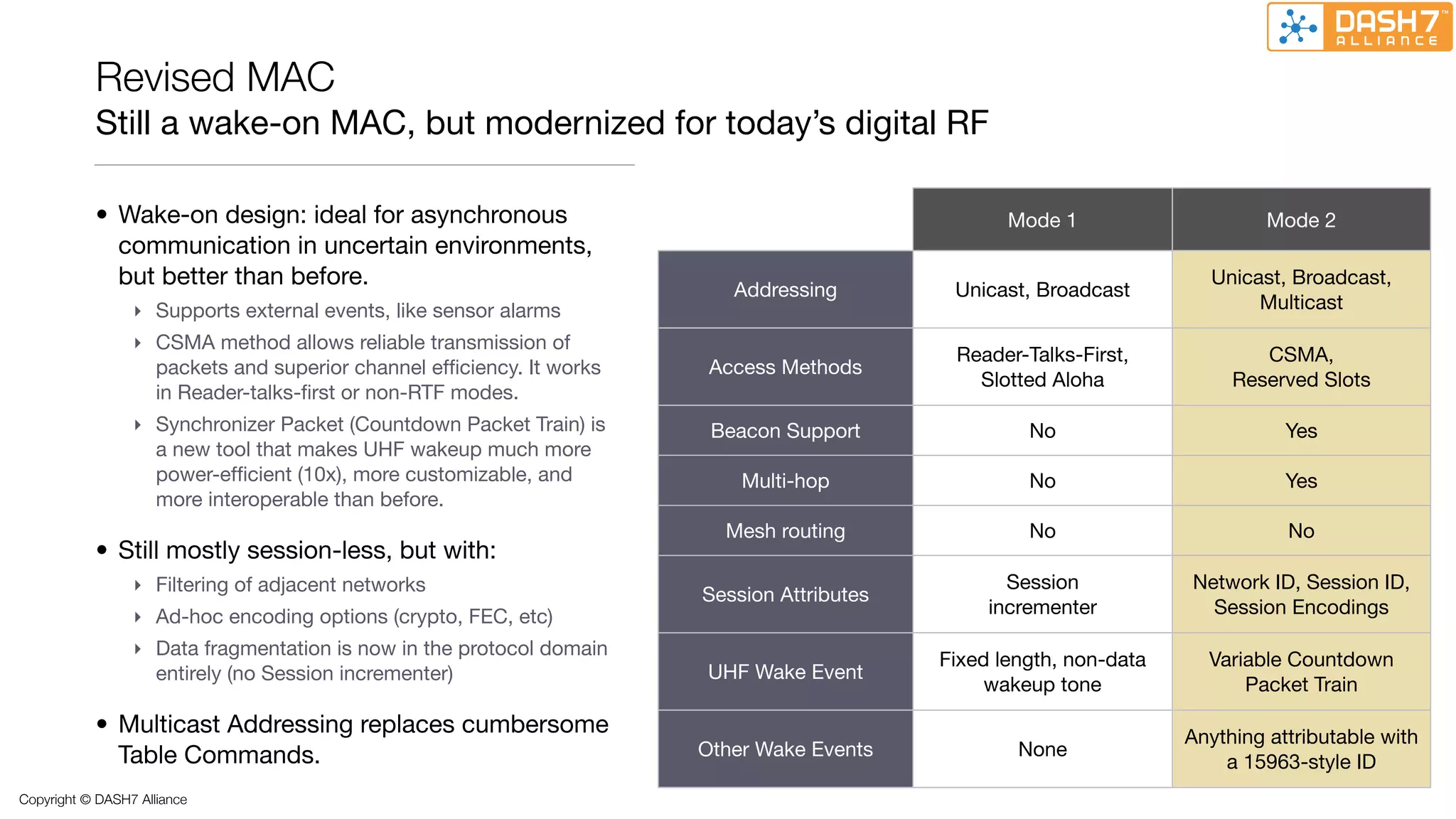
Revised MAC
           Still a wake-on MAC, but modernized for today’s digital RF

           • Wake-on design: ideal for asynchronous                                               Mode 1                     Mode 2
             communication in uncertain environments,
             but better than before.                                     Addressing         Unicast, Broadcast
                                                                                                                      Unicast, Broadcast,
                 ‣ Supports external events, like sensor alarms                                                            Multicast
                 ‣ CSMA method allows reliable transmission of
                                                                                            Reader-Talks-First,             CSMA,
                   packets and superior channel efficiency. It works    Access Methods
                                                                                              Slotted Aloha              Reserved Slots
                   in Reader-talks-first or non-RTF modes.
                 ‣ Synchronizer Packet (Countdown Packet Train) is     Beacon Support               No                         Yes
                   a new tool that makes UHF wakeup much more
                   power-efficient (10x), more customizable, and           Multi-hop                 No                         Yes
                   more interoperable than before.
                                                                        Mesh routing                No                         No
           • Still mostly session-less, but with:
                 ‣ Filtering of adjacent networks                                                 Session           Network ID, Session ID,
                                                                      Session Attributes
                 ‣ Ad-hoc encoding options (crypto, FEC, etc)                                   incrementer           Session Encodings

                 ‣ Data fragmentation is now in the protocol domain
                                                                                           Fixed length, non-data     Variable Countdown
                   entirely (no Session incrementer)                  UHF Wake Event
                                                                                                wakeup tone               Packet Train

           • Multicast Addressing replaces cumbersome                                                               Anything attributable with
             Table Commands.                                          Other Wake Events            None
                                                                                                                        a 15963-style ID
Copyright © DASH7 Alliance
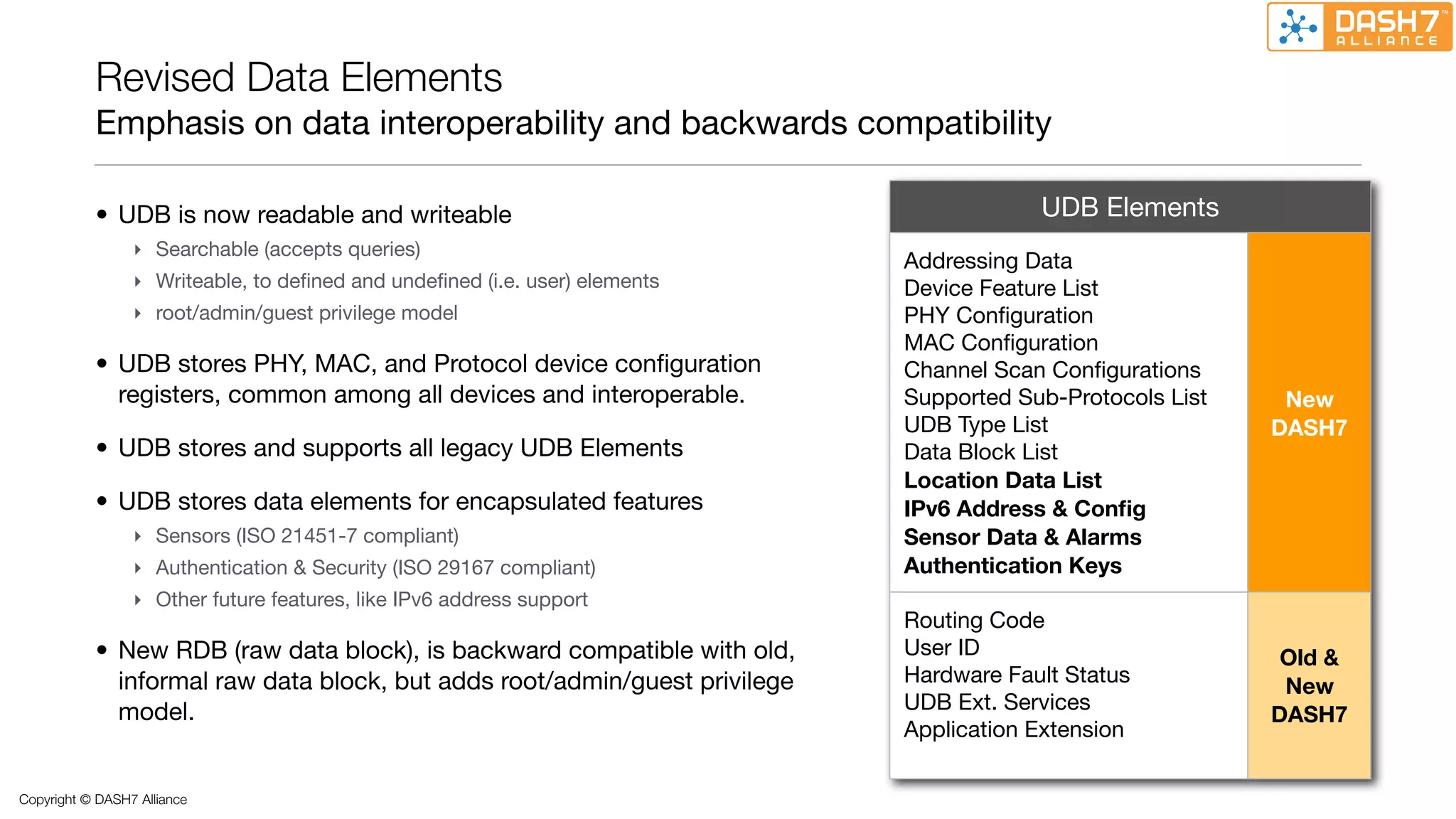
Revised Data Elements
           Emphasis on data interoperability and backwards compatibility

           • UDB is now readable and writeable                                          UDB Elements
                 ‣ Searchable (accepts queries)
                                                                            Addressing Data
                 ‣ Writeable, to defined and undefined (i.e. user) elements   Device Feature List
                 ‣ root/admin/guest privilege model                         PHY Configuration
                                                                            MAC Configuration
           • UDB stores PHY, MAC, and Protocol device configuration          Channel Scan Configurations
             registers, common among all devices and interoperable.         Supported Sub-Protocols List    New
                                                                            UDB Type List                  DASH7
           • UDB stores and supports all legacy UDB Elements                Data Block List
                                                                            Location Data List
           • UDB stores data elements for encapsulated features             IPv6 Address & Config
                 ‣ Sensors (ISO 21451-7 compliant)                          Sensor Data & Alarms
                 ‣ Authentication & Security (ISO 29167 compliant)          Authentication Keys
                 ‣ Other future features, like IPv6 address support
                                                                            Routing Code
           • New RDB (raw data block), is backward compatible with old,     User ID                         Old &
             informal raw data block, but adds root/admin/guest privilege   Hardware Fault Status           New
             model.                                                         UDB Ext. Services
                                                                                                           DASH7
                                                                            Application Extension

Copyright © DASH7 Alliance

DASH7 Mode 2 Summary

  • 1.
    Mode 2 Revisionto ISO 18000-7 DASH7 Alliance 20 July 2010 Copyright © DASH7 Alliance
  • 2.
    Motivations, and NewIdeas • Members of the DASH7 Alliance began, in February 2009, coming up with must-have feature upgrades for ISO 18000-7. These revisions, it has been deemed, are Features Made Possible absolutely required to advance the adoption of ISO 18000-7 • Decreased device size (SoC’s, smaller batteries) into markets that are served by similar, proprietary • External communication events (sensor alarms, technologies concurrently developed by these DASH7 passive RF integration) Alliance members. • Amorphous networks (lots of unstructured ‣ Improvements to PHY in order to improve performance and decrease mobile readers, fixed and mobile tags) cost in modern silicon implementations ‣ Improvements to MAC for greater channel efficiency (i.e. CSMA) • Eliminate frequent, redundant polling ‣ Improvements in protocol for lower power and higher performance. • Dense inventory management ‣ Ability to formally encapsulate subprotocols (i.e. sensor protocols) • Over-the-air standardized configuration, ‣ Peer-to-peer communications commission, and upload/download ‣ Unsolicited packet transmissions (i.e. not reader-talks-first) • Support for location services ‣ Multiple Channels • Longer range, for sparse, typically outdoor ‣ Adjustable/Adaptive data rate networks Copyright © DASH7 Alliance
  • 3.
    Revised PHY More options, but actually more uniform in design • Designed for optimized synthesis into HW Mode 1 Mode 2 for better cost and interoperability ‣ Packet = Preamble, Sync Word, Data Channel Size 500 kHz 216 kHz ‣ Single Bit period across entire packet Channels 1 8 ‣ Uses filtered FSK (nominally GFSK) Modulation FSK ± 50 kHz GFSK ± 50 kHz • Designed to support different regulatory environments, optimally. Encoding Options Manchester PN9, FEC ‣ Configuration of Output Power Normal: 55.6 kHz ‣ Configuration of available channels (up to 8) Symbol Rate 55.6 kHz Turbo: 200 kHz ‣ Out of channel power limitations Min: 27.8 kbps Data Rate 27.8 kbps • Basic PN9 allows for better data rate than Max: 200 kbps today’s Manchester, optional FEC allows for greater range & signal strength. Packet Sync Pulse width Sync word Nominal TX EIRP N/A 0 dBm • Similar enough to existing ISO 18000-7 PHY that devices could reasonably support both Peak stopband EIRP N/A -40 dBm old and new modes. Copyright © DASH7 Alliance
  • 4.
    Device Settings New Beyond just “tag & reader” Gateway • Designed to handle traditional, Old tag-reader architecture and peer-to-peer Interrogator networks alike. Power Consumption • Subcontroller and Endpoint are generally intended for the same hardware platform (low cost SoC). • By switching between Endpoint and Subcontroller regimes, a single device can New quickly go from tag-like to reader-like Subcontroller behavior. • Each device setting has a standardized, Old state-based device operation for greater Tag interoperability & consistency. New Endpoint Capability Copyright © DASH7 Alliance
  • 5.
    Revised MAC Still a wake-on MAC, but modernized for today’s digital RF • Wake-on design: ideal for asynchronous Mode 1 Mode 2 communication in uncertain environments, but better than before. Addressing Unicast, Broadcast Unicast, Broadcast, ‣ Supports external events, like sensor alarms Multicast ‣ CSMA method allows reliable transmission of Reader-Talks-First, CSMA, packets and superior channel efficiency. It works Access Methods Slotted Aloha Reserved Slots in Reader-talks-first or non-RTF modes. ‣ Synchronizer Packet (Countdown Packet Train) is Beacon Support No Yes a new tool that makes UHF wakeup much more power-efficient (10x), more customizable, and Multi-hop No Yes more interoperable than before. Mesh routing No No • Still mostly session-less, but with: ‣ Filtering of adjacent networks Session Network ID, Session ID, Session Attributes ‣ Ad-hoc encoding options (crypto, FEC, etc) incrementer Session Encodings ‣ Data fragmentation is now in the protocol domain Fixed length, non-data Variable Countdown entirely (no Session incrementer) UHF Wake Event wakeup tone Packet Train • Multicast Addressing replaces cumbersome Anything attributable with Table Commands. Other Wake Events None a 15963-style ID Copyright © DASH7 Alliance
  • 6.
    Revised Data Elements Emphasis on data interoperability and backwards compatibility • UDB is now readable and writeable UDB Elements ‣ Searchable (accepts queries) Addressing Data ‣ Writeable, to defined and undefined (i.e. user) elements Device Feature List ‣ root/admin/guest privilege model PHY Configuration MAC Configuration • UDB stores PHY, MAC, and Protocol device configuration Channel Scan Configurations registers, common among all devices and interoperable. Supported Sub-Protocols List New UDB Type List DASH7 • UDB stores and supports all legacy UDB Elements Data Block List Location Data List • UDB stores data elements for encapsulated features IPv6 Address & Config ‣ Sensors (ISO 21451-7 compliant) Sensor Data & Alarms ‣ Authentication & Security (ISO 29167 compliant) Authentication Keys ‣ Other future features, like IPv6 address support Routing Code • New RDB (raw data block), is backward compatible with old, User ID Old & informal raw data block, but adds root/admin/guest privilege Hardware Fault Status New model. UDB Ext. Services DASH7 Application Extension Copyright © DASH7 Alliance