Prepared by:
           ShahrulAfifi B Zakaria.
Nur Muhammad Kamil B Mohd Izhari.
Preparing Wet Concrete.
   What is concrete?
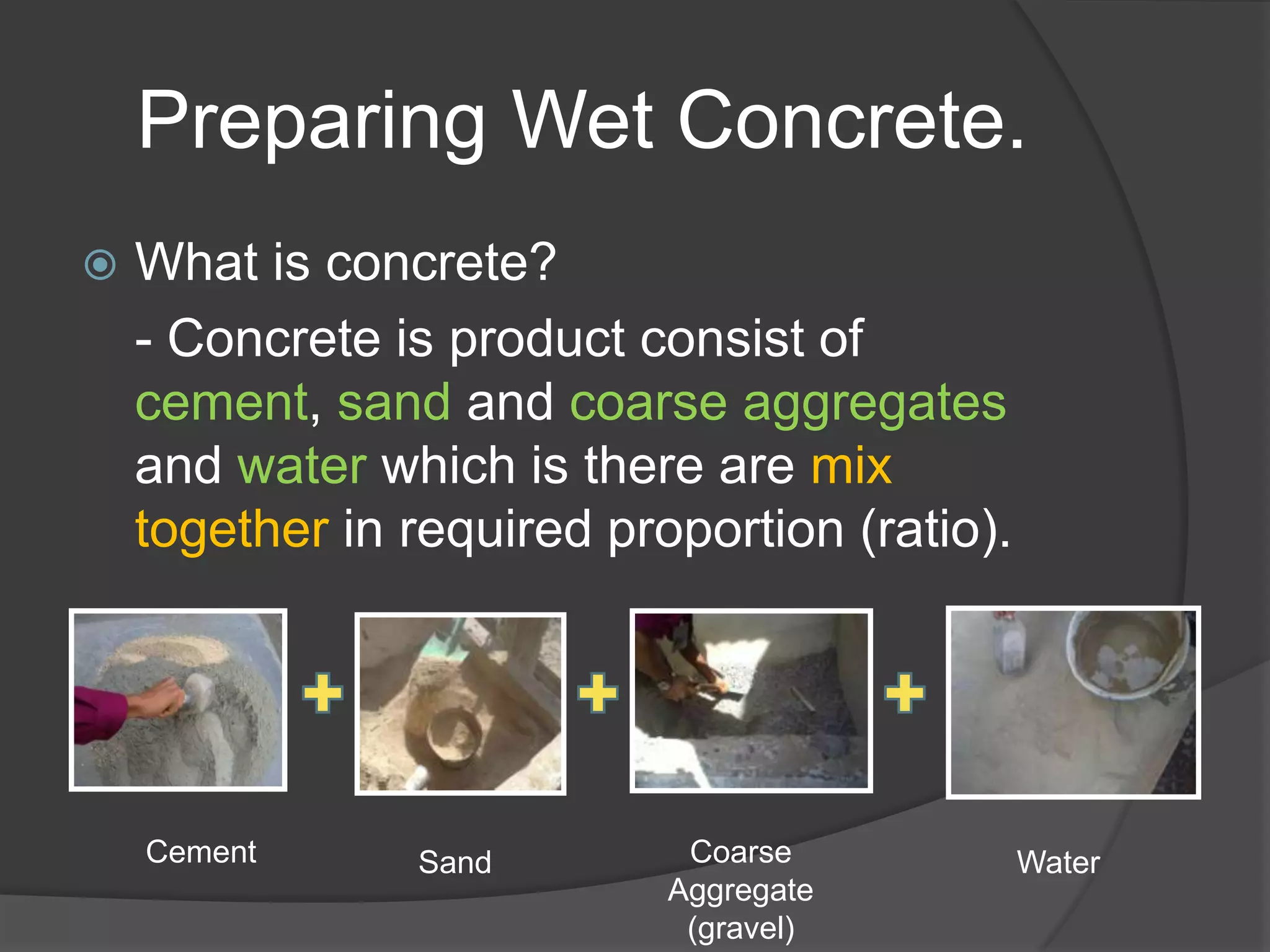
    - Concrete is product consist of
    cement, sand and coarse aggregates
    and water which is there are mix
    together in required proportion (ratio).


    Cement      Sand         Coarse            Water
                            Aggregate
                             (gravel)
Preparing Wet Concrete.
   Water /Cement Ratio.
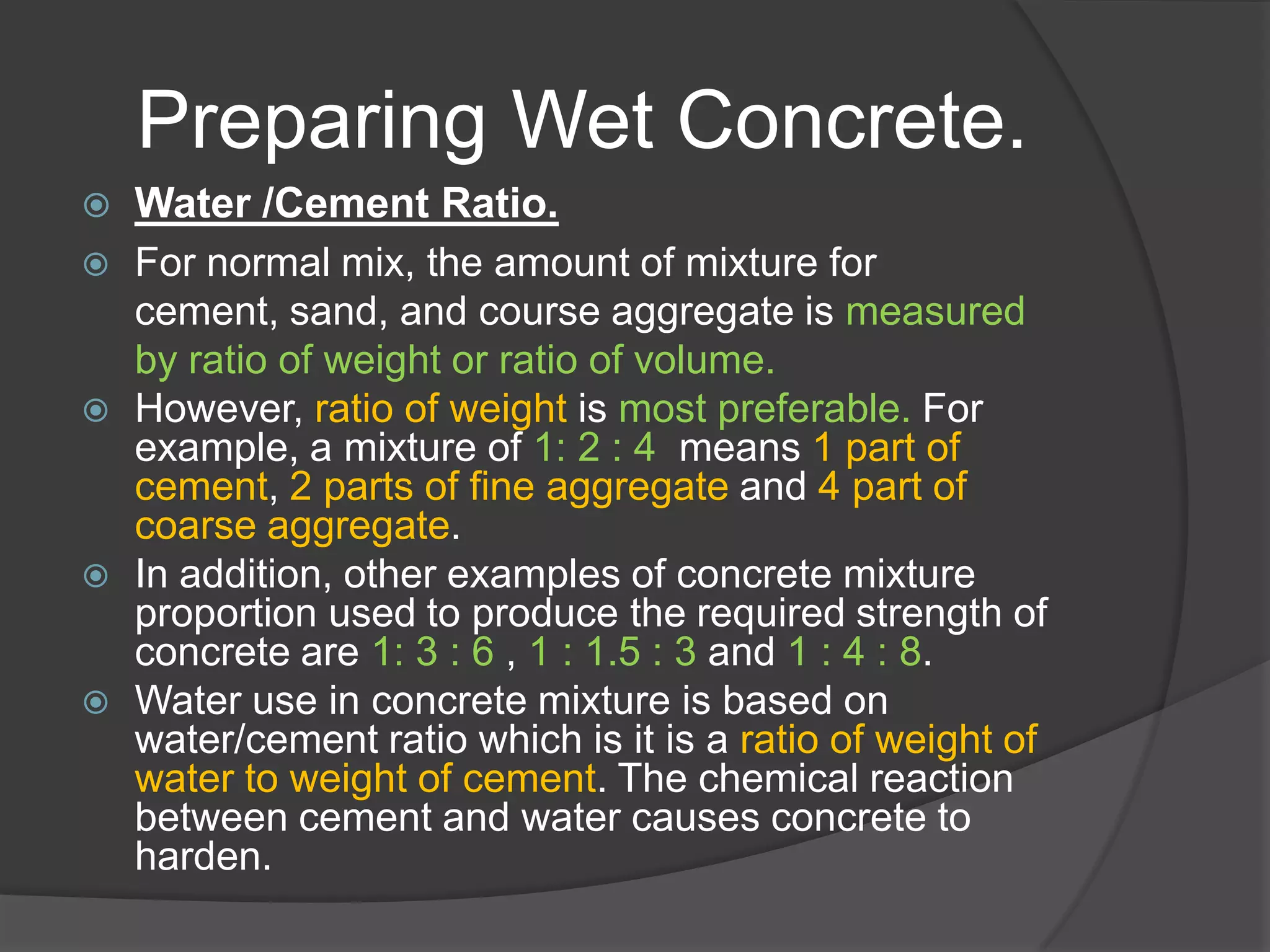
   For normal mix, the amount of mixture for
    cement, sand, and course aggregate is measured
    by ratio of weight or ratio of volume.
   However, ratio of weight is most preferable. For
    example, a mixture of 1: 2 : 4 means 1 part of
    cement, 2 parts of fine aggregate and 4 part of
    coarse aggregate.
   In addition, other examples of concrete mixture
    proportion used to produce the required strength of
    concrete are 1: 3 : 6 , 1 : 1.5 : 3 and 1 : 4 : 8.
   Water use in concrete mixture is based on
    water/cement ratio which is it is a ratio of weight of
    water to weight of cement. The chemical reaction
    between cement and water causes concrete to
    harden.
Preparing Wet Concrete.


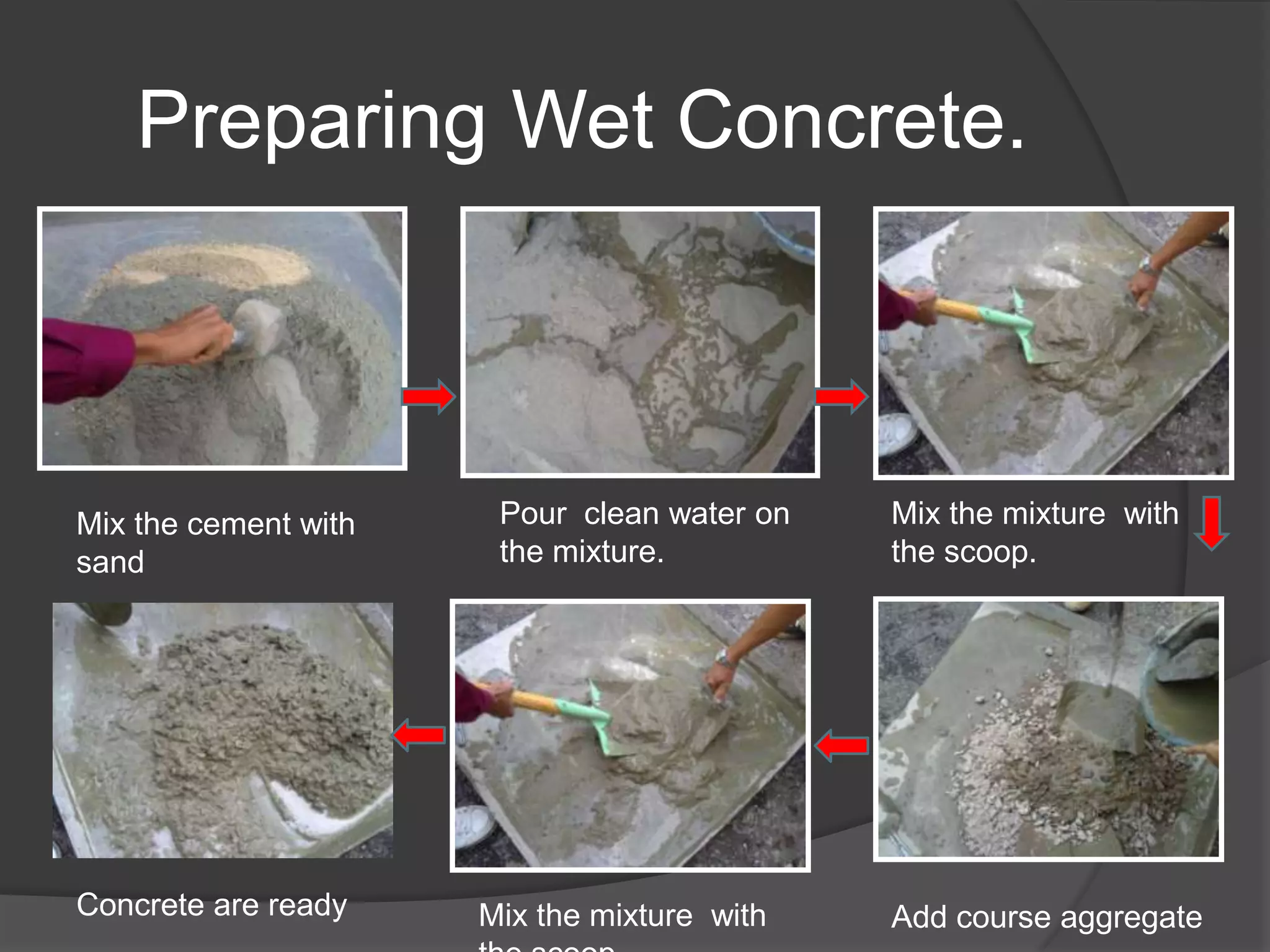
Mix the cement with    Pour clean water on   Mix the mixture with
sand                   the mixture.          the scoop.


Concrete are ready    Mix the mixture with   Add course aggregate
Concrete Test
    Devide into 2 Test:-
    i.    Slump Test
    ii.   Cube Test.
 Concrete Slump Test is a one of test that
  usually conducted to measure
  workability of fresh concrete.
 Concrete Cube Test is a test conducted
  to determine the strength of concrete.
Slump Test
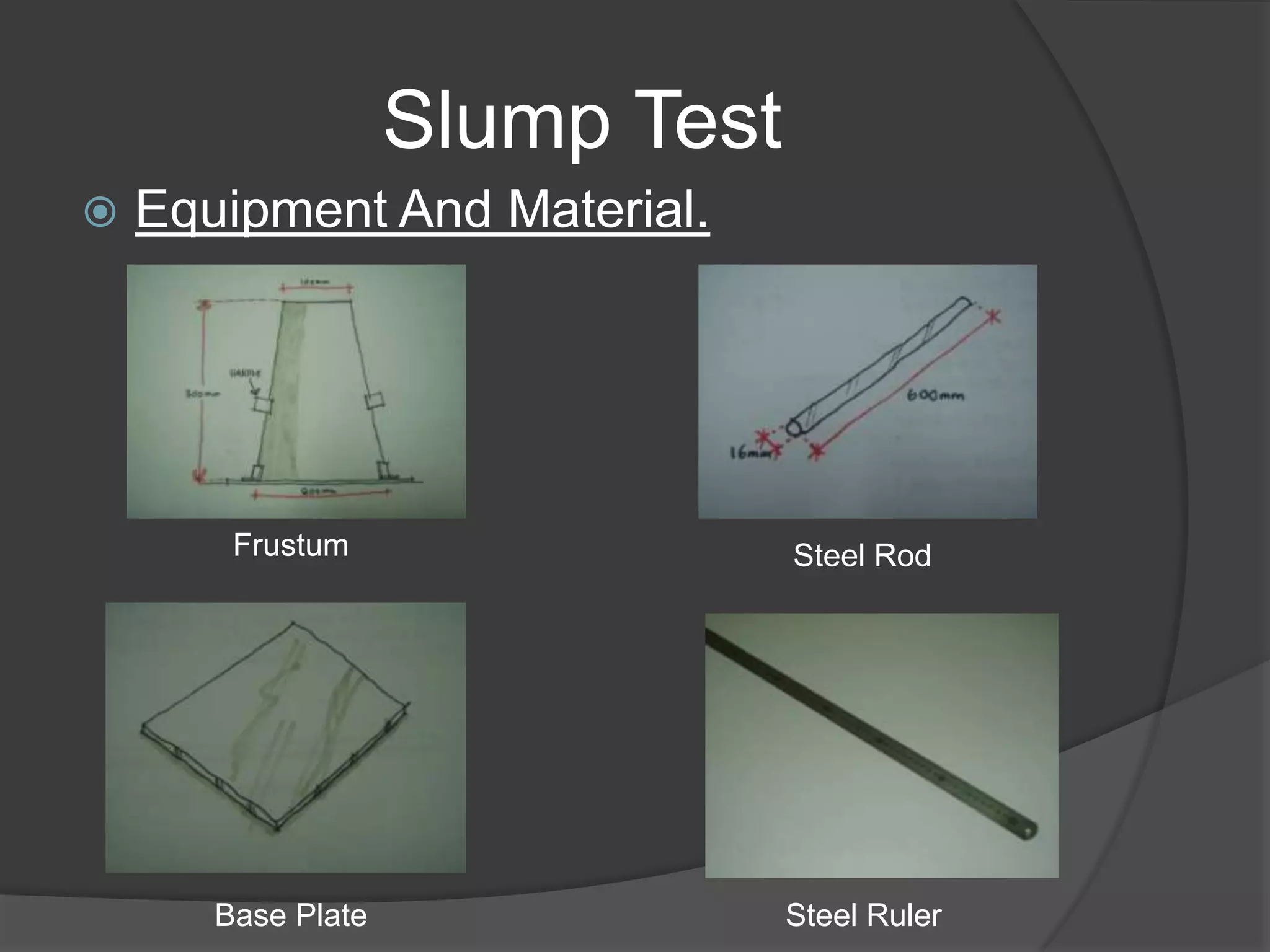
   Equipment And Material.


        Frustum                  Steel Rod


       Base Plate                Steel Ruler
Slump Test
      Procedures:

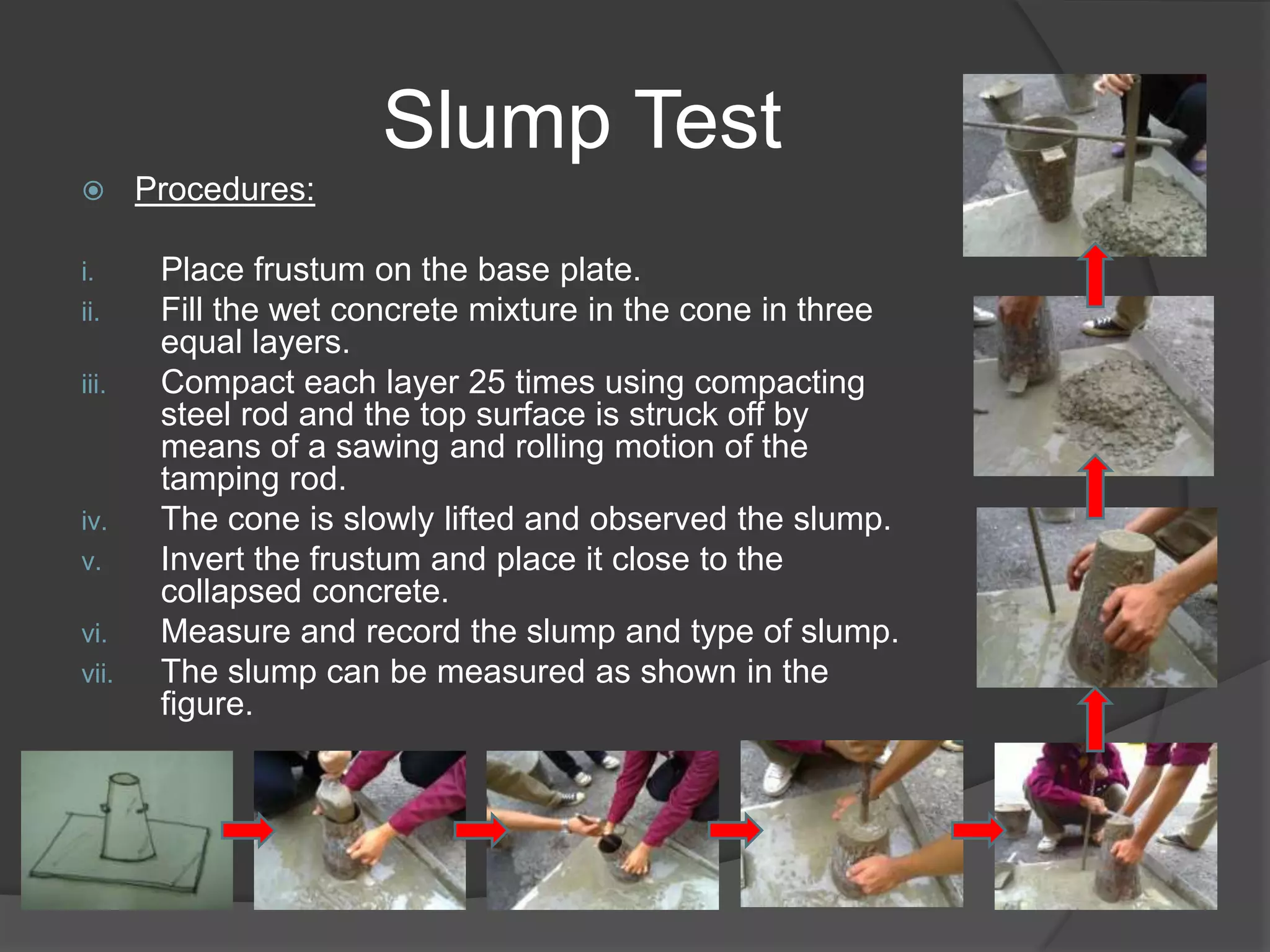
i.      Place frustum on the base plate.
ii.     Fill the wet concrete mixture in the cone in three
        equal layers.
iii.    Compact each layer 25 times using compacting
        steel rod and the top surface is struck off by
        means of a sawing and rolling motion of the
        tamping rod.
iv.     The cone is slowly lifted and observed the slump.
v.      Invert the frustum and place it close to the
        collapsed concrete.
vi.     Measure and record the slump and type of slump.
vii.    The slump can be measured as shown in the
        figure.
Slump Test
   Result.
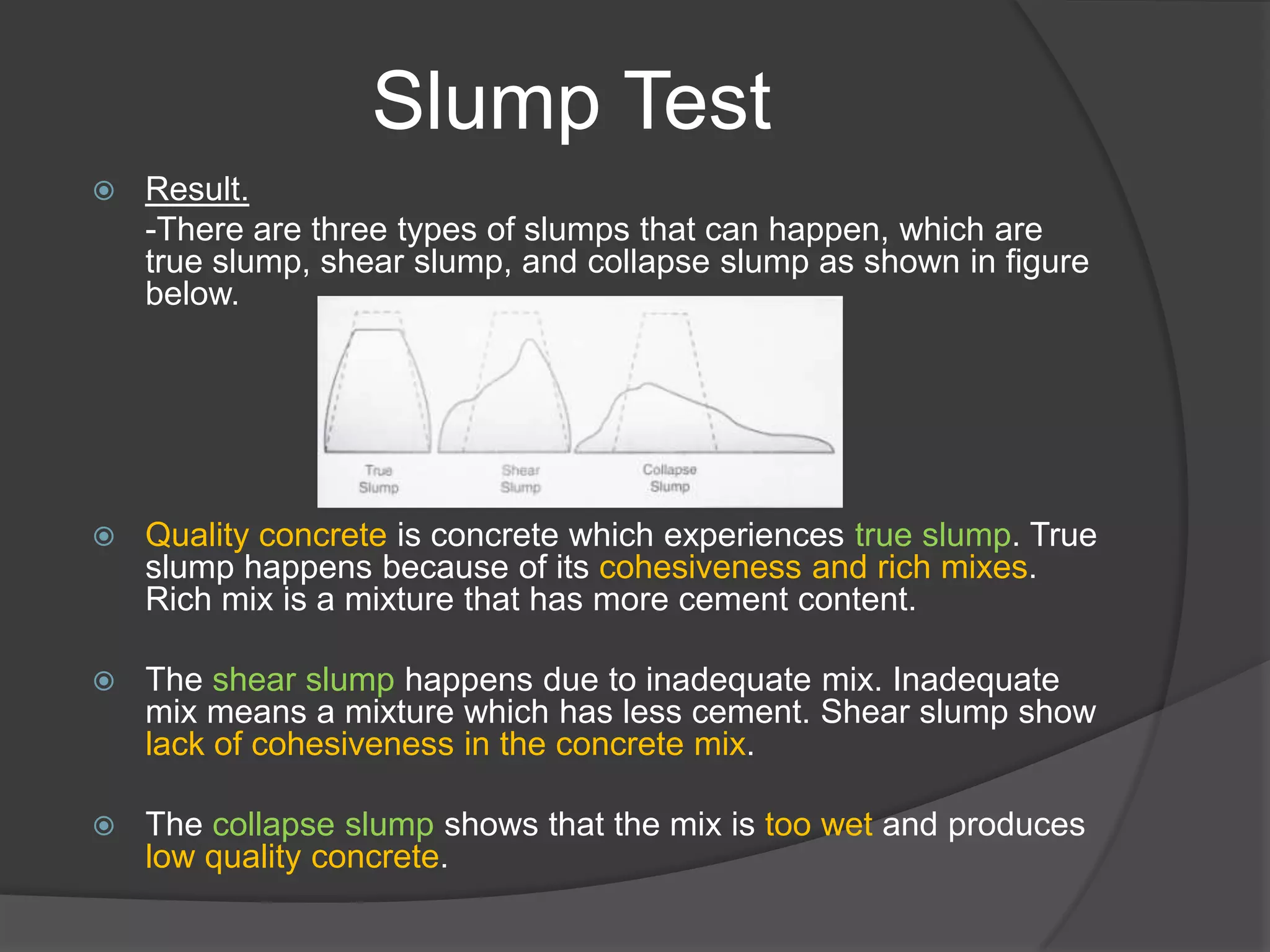
    -There are three types of slumps that can happen, which are
    true slump, shear slump, and collapse slump as shown in figure
    below.


   Quality concrete is concrete which experiences true slump. True
    slump happens because of its cohesiveness and rich mixes.
    Rich mix is a mixture that has more cement content.

   The shear slump happens due to inadequate mix. Inadequate
    mix means a mixture which has less cement. Shear slump show
    lack of cohesiveness in the concrete mix.

   The collapse slump shows that the mix is too wet and produces
    low quality concrete.
Cube Test
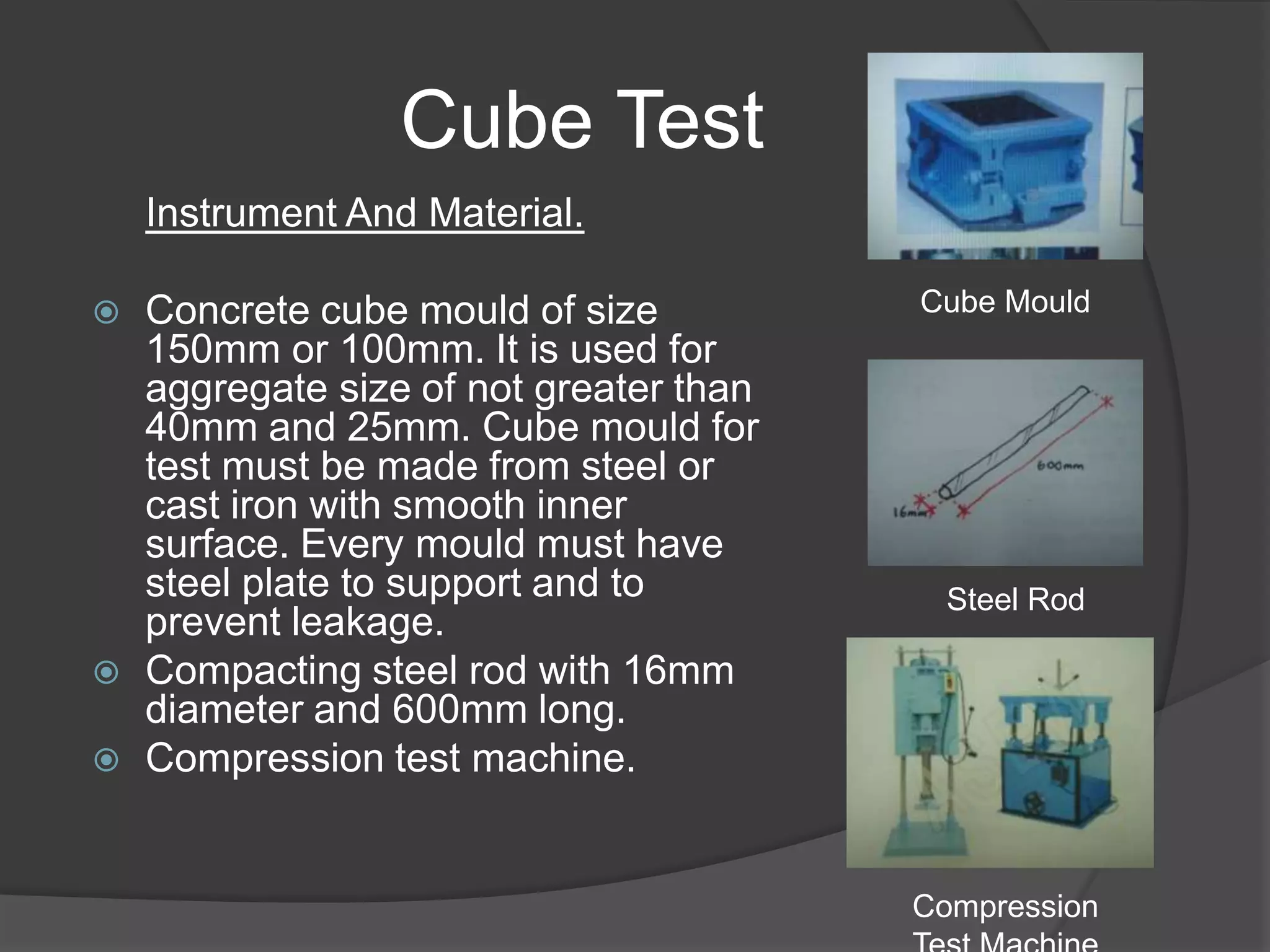
    Instrument And Material.

   Concrete cube mould of size          Cube Mould
    150mm or 100mm. It is used for
    aggregate size of not greater than
    40mm and 25mm. Cube mould for
    test must be made from steel or
    cast iron with smooth inner
    surface. Every mould must have
    steel plate to support and to          Steel Rod
    prevent leakage.
   Compacting steel rod with 16mm
    diameter and 600mm long.
   Compression test machine.


                                         Compression
Cube Test
   Procedures.
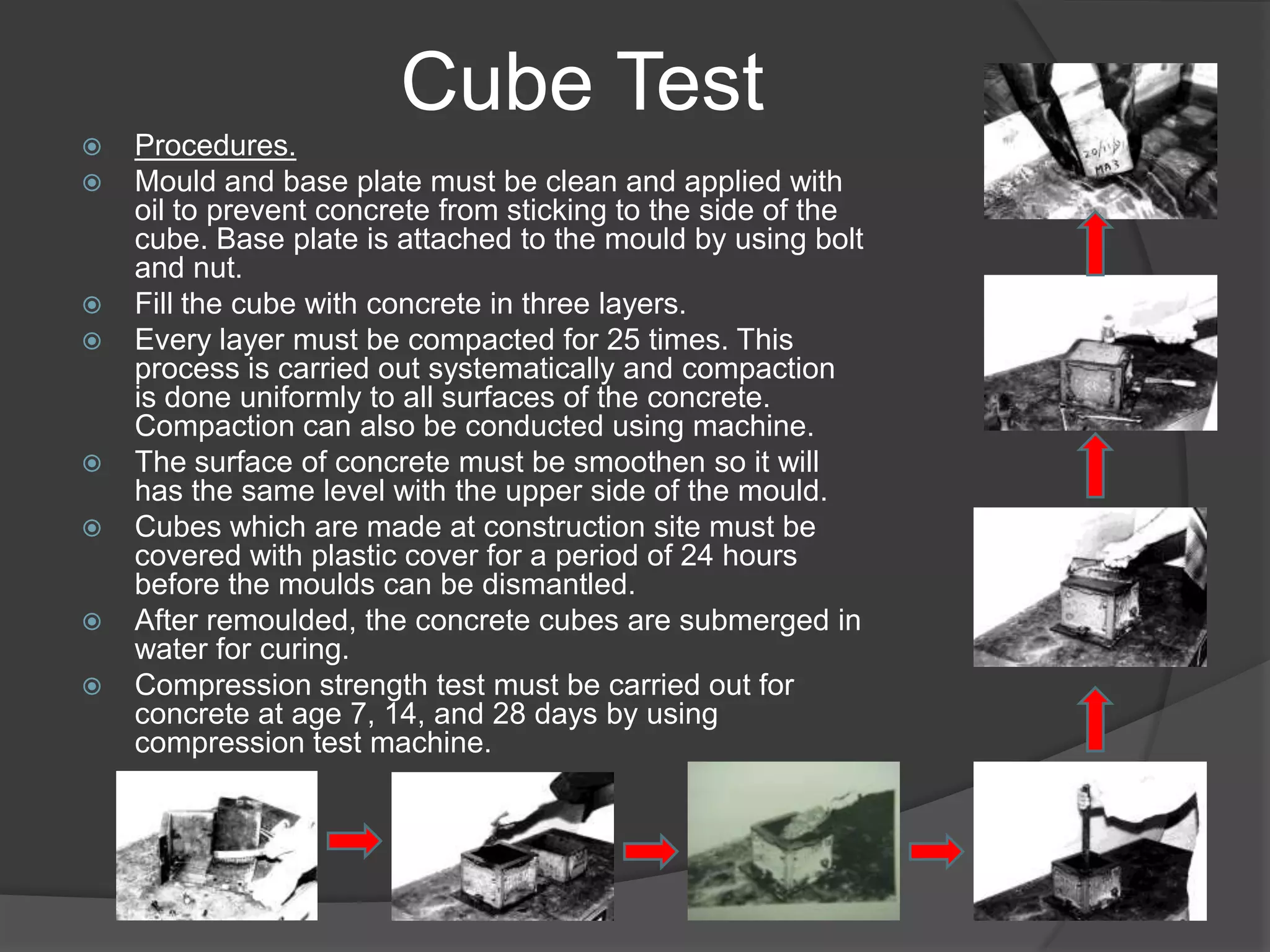
   Mould and base plate must be clean and applied with
    oil to prevent concrete from sticking to the side of the
    cube. Base plate is attached to the mould by using bolt
    and nut.
   Fill the cube with concrete in three layers.
   Every layer must be compacted for 25 times. This
    process is carried out systematically and compaction
    is done uniformly to all surfaces of the concrete.
    Compaction can also be conducted using machine.
   The surface of concrete must be smoothen so it will
    has the same level with the upper side of the mould.
   Cubes which are made at construction site must be
    covered with plastic cover for a period of 24 hours
    before the moulds can be dismantled.
   After remoulded, the concrete cubes are submerged in
    water for curing.
   Compression strength test must be carried out for
    concrete at age 7, 14, and 28 days by using
    compression test machine.
Cube Test
   Result.

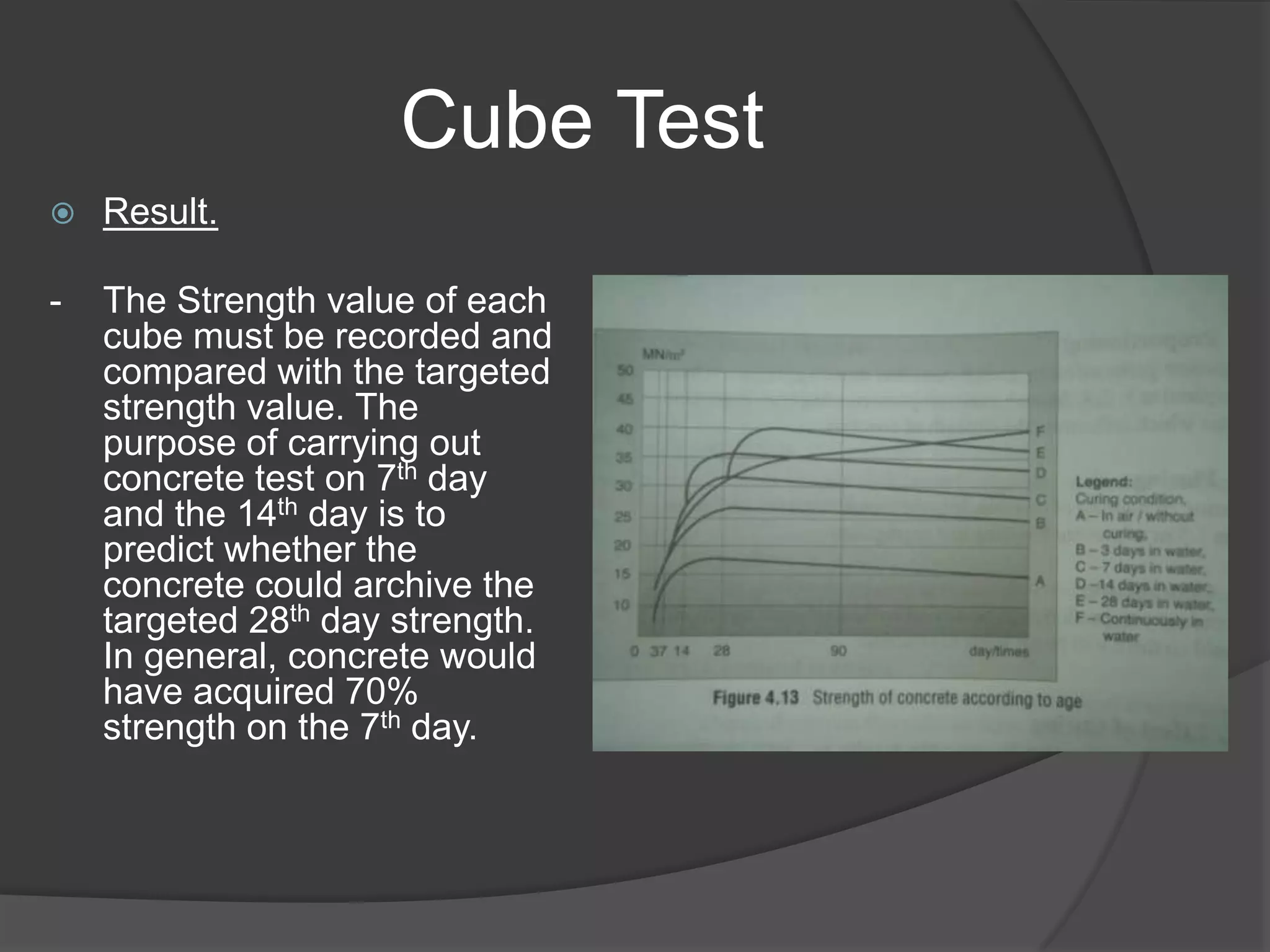
-   The Strength value of each
    cube must be recorded and
    compared with the targeted
    strength value. The
    purpose of carrying out
    concrete test on 7th day
    and the 14th day is to
    predict whether the
    concrete could archive the
    targeted 28th day strength.
    In general, concrete would
    have acquired 70%
    strength on the 7th day.
Reference
 Yusop Bin Paal, Werdah Binti Abdul
  Halim, Sarifah Binti Daud. (Pengajian
  Kejuruteraan Awam Tingkatan 4),DBP
  Kuala Lumpur,2005.
 Google Image Search.
 http://en.wikipedia.org/wiki/Concrete_slu
  mp_test.

                                   Thank You.

Concrete test on site

  • 1.
    Prepared by: ShahrulAfifi B Zakaria. Nur Muhammad Kamil B Mohd Izhari.
  • 2.
    Preparing Wet Concrete.  What is concrete? - Concrete is product consist of cement, sand and coarse aggregates and water which is there are mix together in required proportion (ratio). Cement Sand Coarse Water Aggregate (gravel)
  • 3.
    Preparing Wet Concrete.  Water /Cement Ratio.  For normal mix, the amount of mixture for cement, sand, and course aggregate is measured by ratio of weight or ratio of volume.  However, ratio of weight is most preferable. For example, a mixture of 1: 2 : 4 means 1 part of cement, 2 parts of fine aggregate and 4 part of coarse aggregate.  In addition, other examples of concrete mixture proportion used to produce the required strength of concrete are 1: 3 : 6 , 1 : 1.5 : 3 and 1 : 4 : 8.  Water use in concrete mixture is based on water/cement ratio which is it is a ratio of weight of water to weight of cement. The chemical reaction between cement and water causes concrete to harden.
  • 4.
    Preparing Wet Concrete. Mixthe cement with Pour clean water on Mix the mixture with sand the mixture. the scoop. Concrete are ready Mix the mixture with Add course aggregate
  • 5.
    Concrete Test  Devide into 2 Test:- i. Slump Test ii. Cube Test.  Concrete Slump Test is a one of test that usually conducted to measure workability of fresh concrete.  Concrete Cube Test is a test conducted to determine the strength of concrete.
  • 6.
    Slump Test  Equipment And Material. Frustum Steel Rod Base Plate Steel Ruler
  • 7.
    Slump Test  Procedures: i. Place frustum on the base plate. ii. Fill the wet concrete mixture in the cone in three equal layers. iii. Compact each layer 25 times using compacting steel rod and the top surface is struck off by means of a sawing and rolling motion of the tamping rod. iv. The cone is slowly lifted and observed the slump. v. Invert the frustum and place it close to the collapsed concrete. vi. Measure and record the slump and type of slump. vii. The slump can be measured as shown in the figure.
  • 8.
    Slump Test  Result. -There are three types of slumps that can happen, which are true slump, shear slump, and collapse slump as shown in figure below.  Quality concrete is concrete which experiences true slump. True slump happens because of its cohesiveness and rich mixes. Rich mix is a mixture that has more cement content.  The shear slump happens due to inadequate mix. Inadequate mix means a mixture which has less cement. Shear slump show lack of cohesiveness in the concrete mix.  The collapse slump shows that the mix is too wet and produces low quality concrete.
  • 9.
    Cube Test Instrument And Material.  Concrete cube mould of size Cube Mould 150mm or 100mm. It is used for aggregate size of not greater than 40mm and 25mm. Cube mould for test must be made from steel or cast iron with smooth inner surface. Every mould must have steel plate to support and to Steel Rod prevent leakage.  Compacting steel rod with 16mm diameter and 600mm long.  Compression test machine. Compression
  • 10.
    Cube Test  Procedures.  Mould and base plate must be clean and applied with oil to prevent concrete from sticking to the side of the cube. Base plate is attached to the mould by using bolt and nut.  Fill the cube with concrete in three layers.  Every layer must be compacted for 25 times. This process is carried out systematically and compaction is done uniformly to all surfaces of the concrete. Compaction can also be conducted using machine.  The surface of concrete must be smoothen so it will has the same level with the upper side of the mould.  Cubes which are made at construction site must be covered with plastic cover for a period of 24 hours before the moulds can be dismantled.  After remoulded, the concrete cubes are submerged in water for curing.  Compression strength test must be carried out for concrete at age 7, 14, and 28 days by using compression test machine.
  • 11.
    Cube Test  Result. - The Strength value of each cube must be recorded and compared with the targeted strength value. The purpose of carrying out concrete test on 7th day and the 14th day is to predict whether the concrete could archive the targeted 28th day strength. In general, concrete would have acquired 70% strength on the 7th day.
  • 12.
    Reference  Yusop BinPaal, Werdah Binti Abdul Halim, Sarifah Binti Daud. (Pengajian Kejuruteraan Awam Tingkatan 4),DBP Kuala Lumpur,2005.  Google Image Search.  http://en.wikipedia.org/wiki/Concrete_slu mp_test. Thank You.