Mirco Dotta
@mircodotta
Akka Streams
Asynchronous non-blocking streaming made easy
Cascata	
  Piumogna	
  a	
  Faido
Reactive	
  Applications
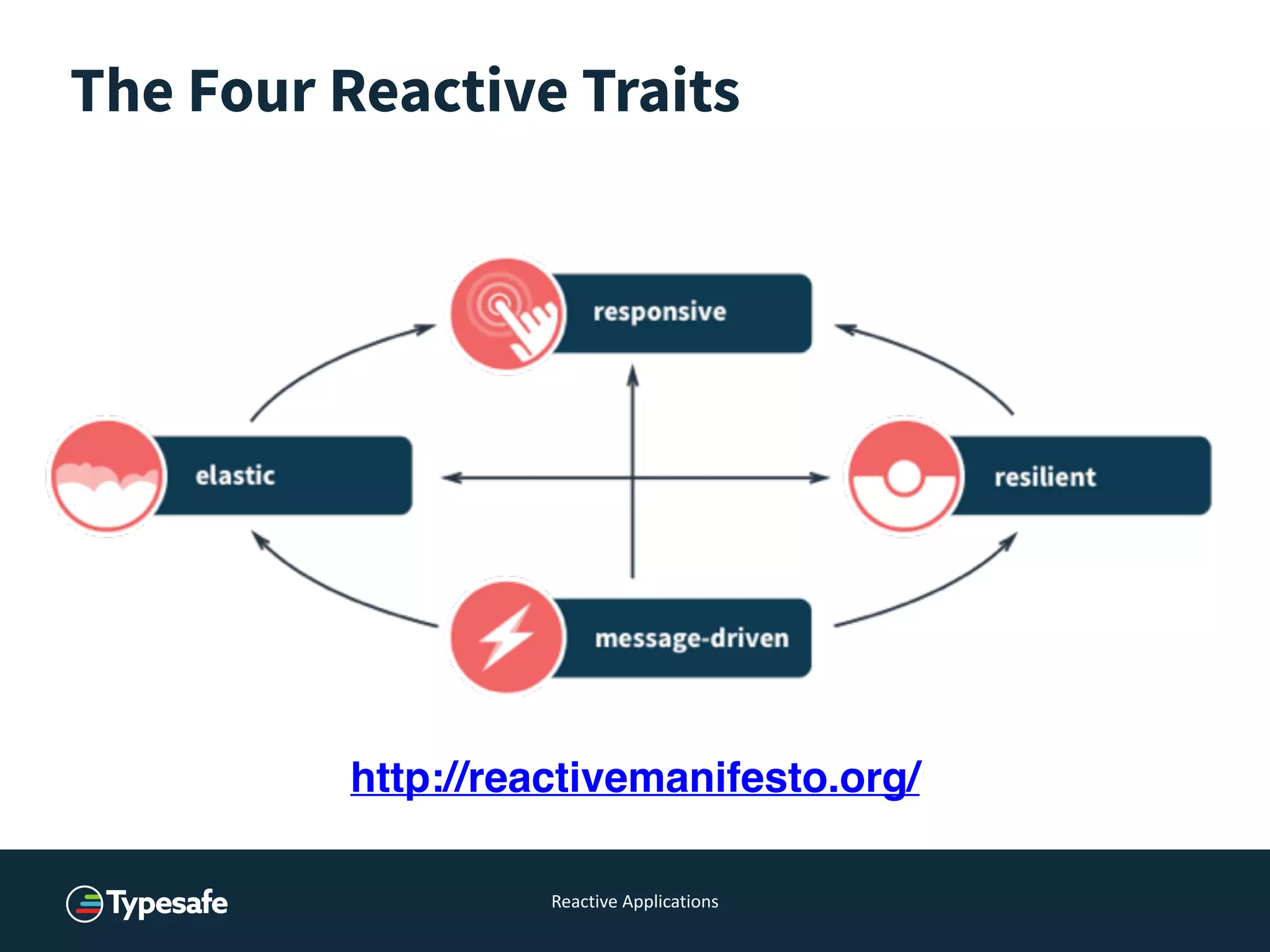
The Four Reactive Traits
http://reactivemanifesto.org/
Why Reactive?
Why Reactive?
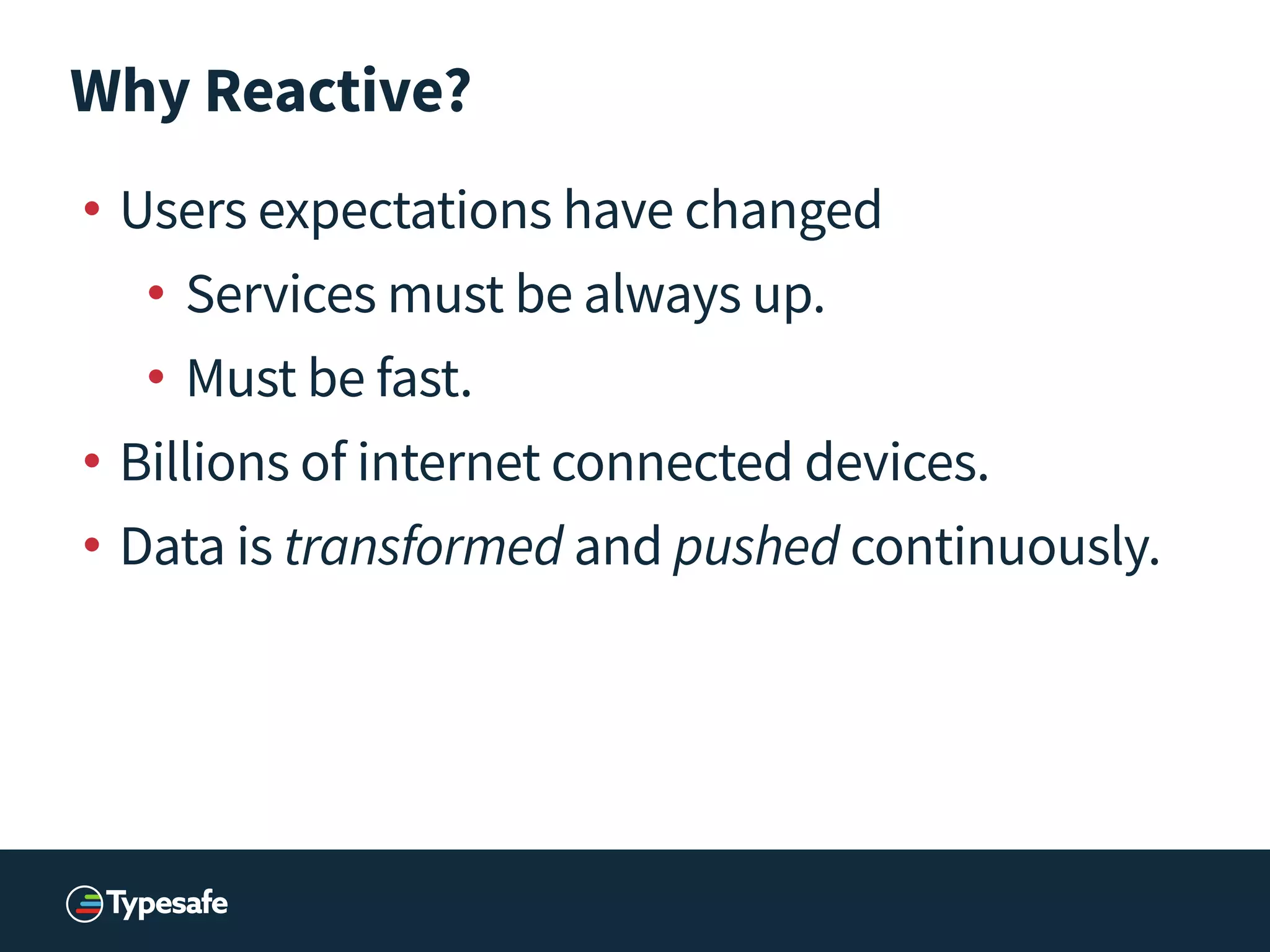
• Users expectations have changed
• Services must be always up.
• Must be fast.
• Billions of internet connected devices.
• Data is transformed and pushed continuously.
Reactive Streams
An initiative for providing
Standardised(!)
Back-pressured
Asynchronous
Stream processing
!
http://www.reactive-streams.org/
Reactive Streams: Who?
!
• Kaazing
• Netflix (rxJava)
• Pivotal (reactor)
• RedHat (vert.x)
• Twitter
• Typesafe (akka-streams & slick)
• Doug Lea proposed an implementation for JDK9!
!
!
Standardised!
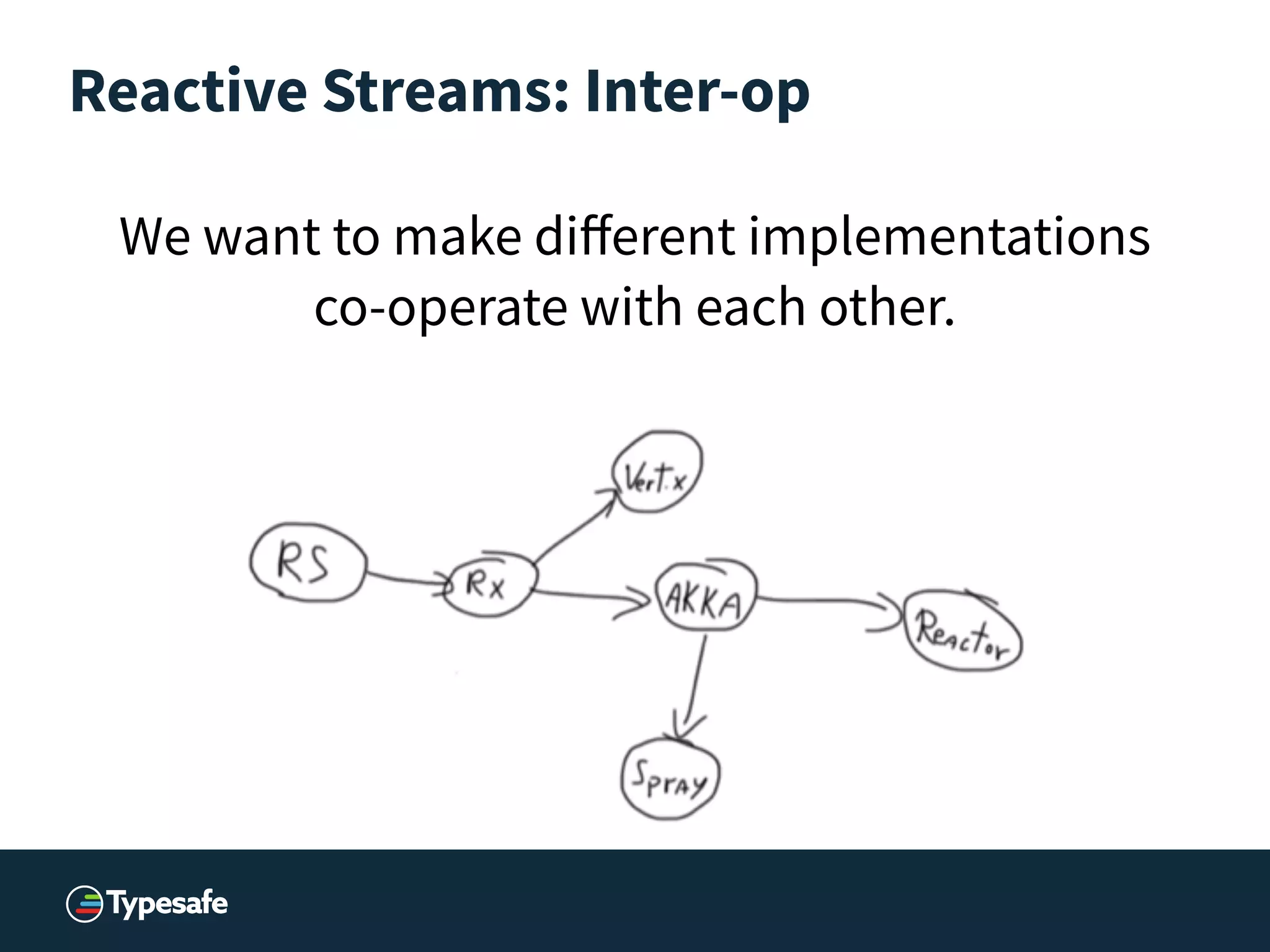
Reactive Streams: Inter-op
!
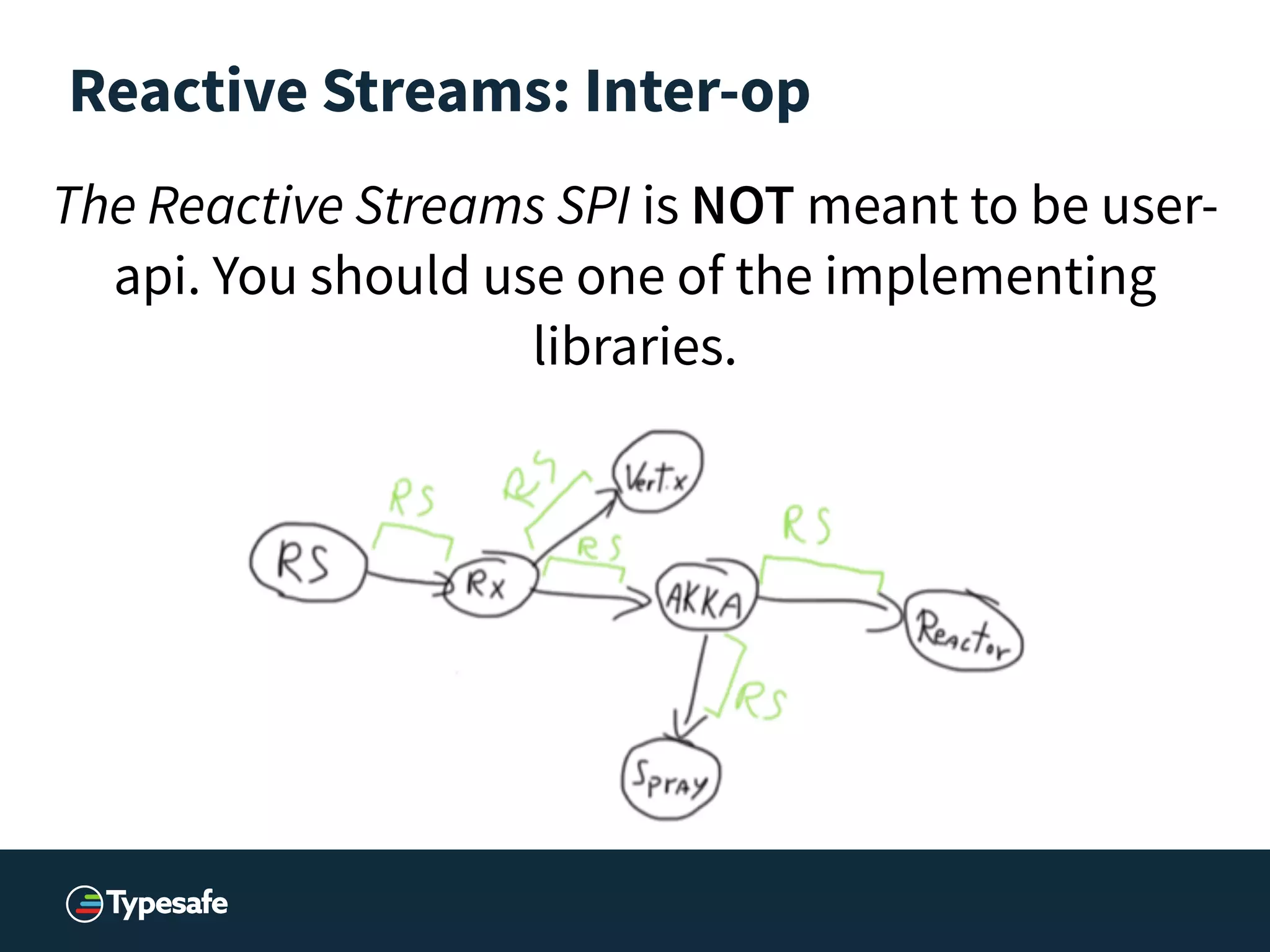
We want to make different implementations
co-operate with each other.
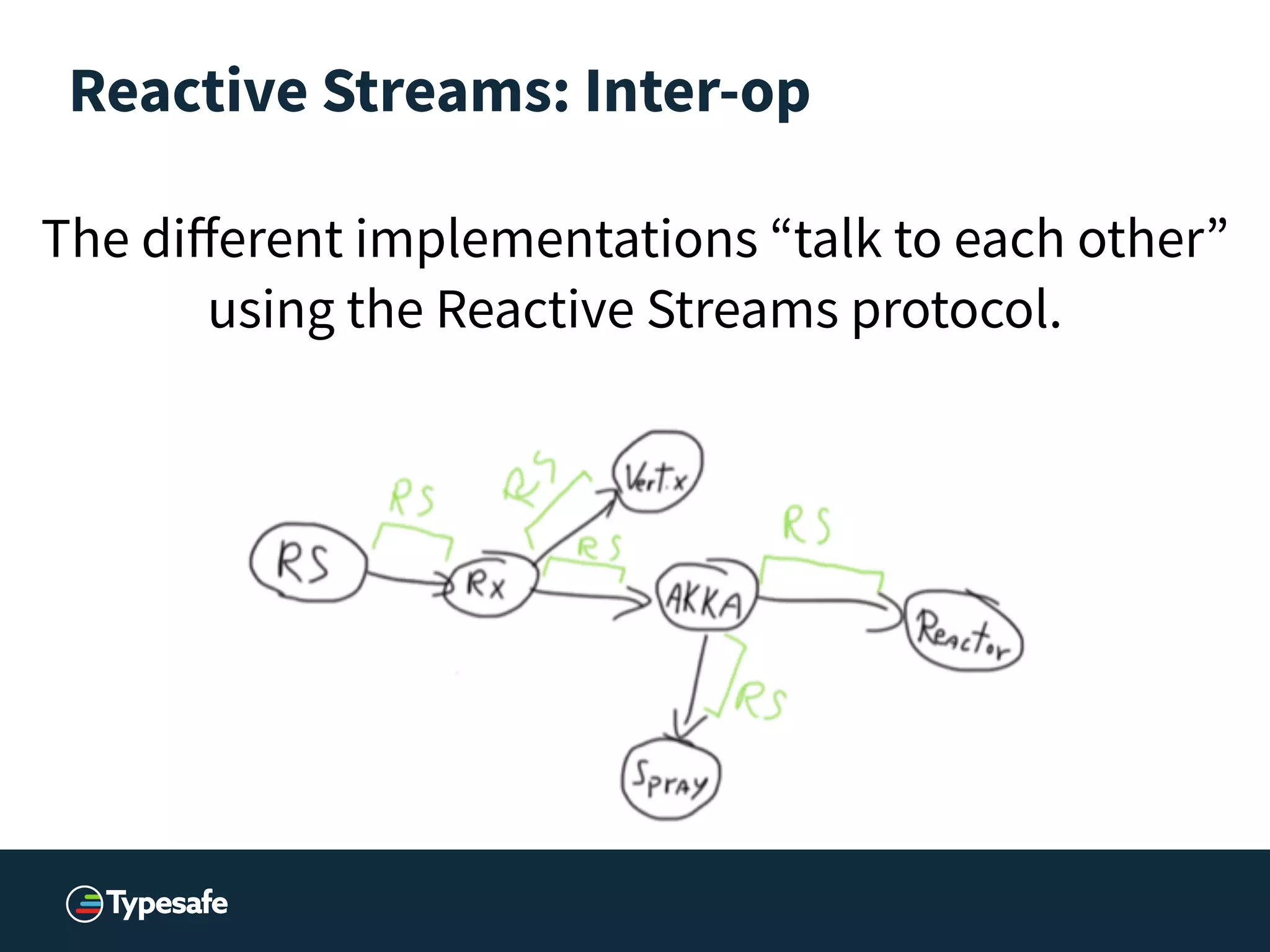
Reactive Streams: Inter-op
The different implementations “talk to each other”
using the Reactive Streams protocol.
Reactive Streams: Inter-op
// here are a few imports that you are not seeing!
object ScalaMain extends App {!
EmbeddedApp.fromHandler(new Handler {!
override def handle(ctx: Context): Unit = {!
// RxJava Observable!
val intObs = Observable.from((1 to 10).asJava)!
! // Reactive Streams Publisher!
val intPub = RxReactiveStreams.toPublisher(intObs)!
! // Akka Streams Source!
val stringSource = Source(intPub).map(_.toString)!
! // Reactive Streams Publisher!
val stringPub = stringSource.runWith(Sink.fanoutPublisher(1, 1))!
! // Reactor Stream!
val linesStream = Streams.create(stringPub).map[String](new reactor.function.Function[String, String] {!
override def apply(in: String) = in + "n"!
})!
! // and now render the HTTP response (RatPack)!
ctx.render(ResponseChunks.stringChunks(linesStream))!
}!
! }).test(new Consumer[TestHttpClient] {!
override def accept(client: TestHttpClient): Unit = {!
val text = client.getText()!
println(text)!
system.shutdown()!
}!
})!
} https://github.com/rkuhn/ReactiveStreamsInterop
Reactive Streams: Inter-op
The Reactive Streams SPI is NOT meant to be user-
api. You should use one of the implementing
libraries.
Akka Streams
Akka Streams: Basics
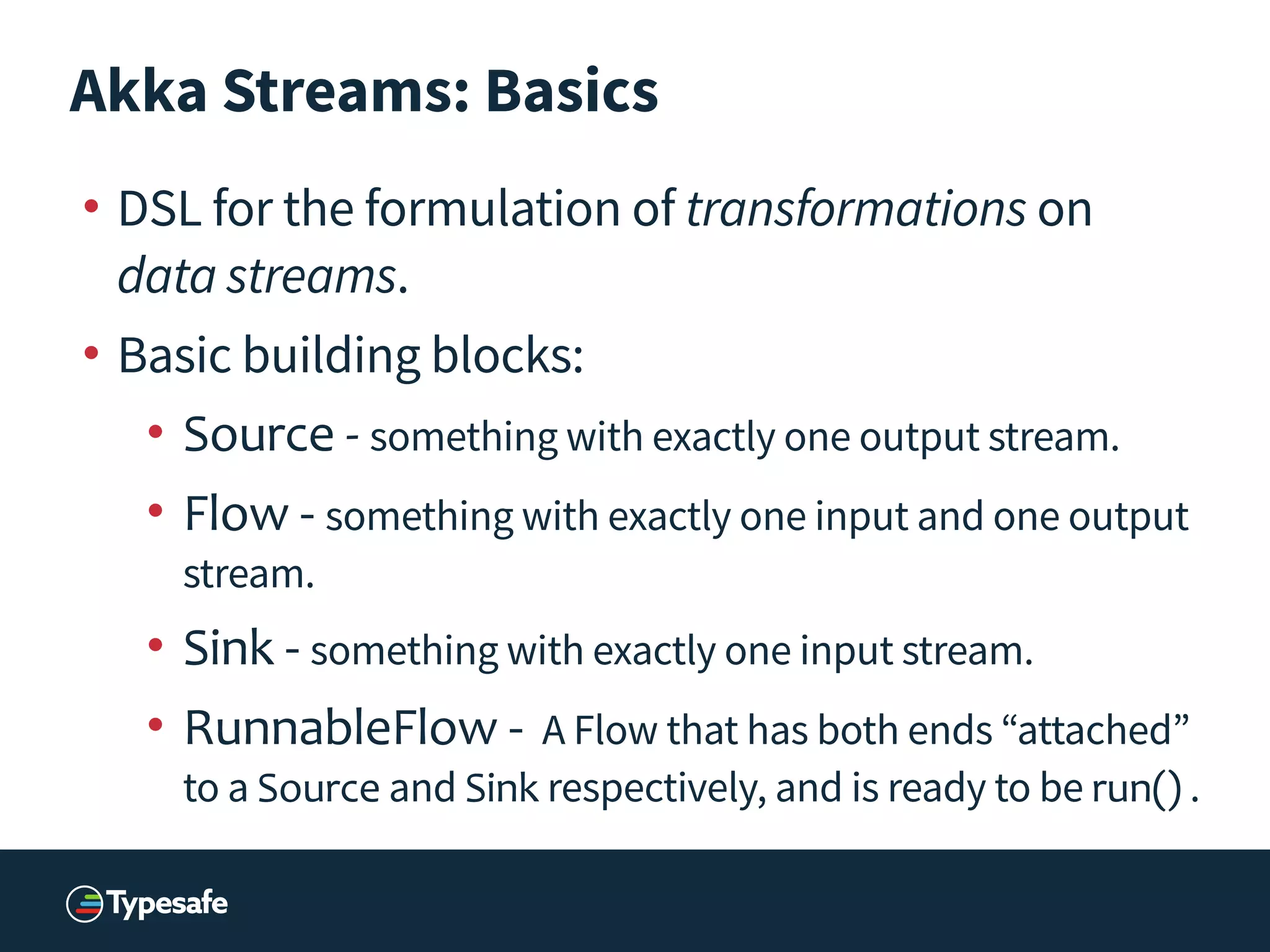
• DSL for the formulation of transformations on
data streams.
• Basic building blocks:
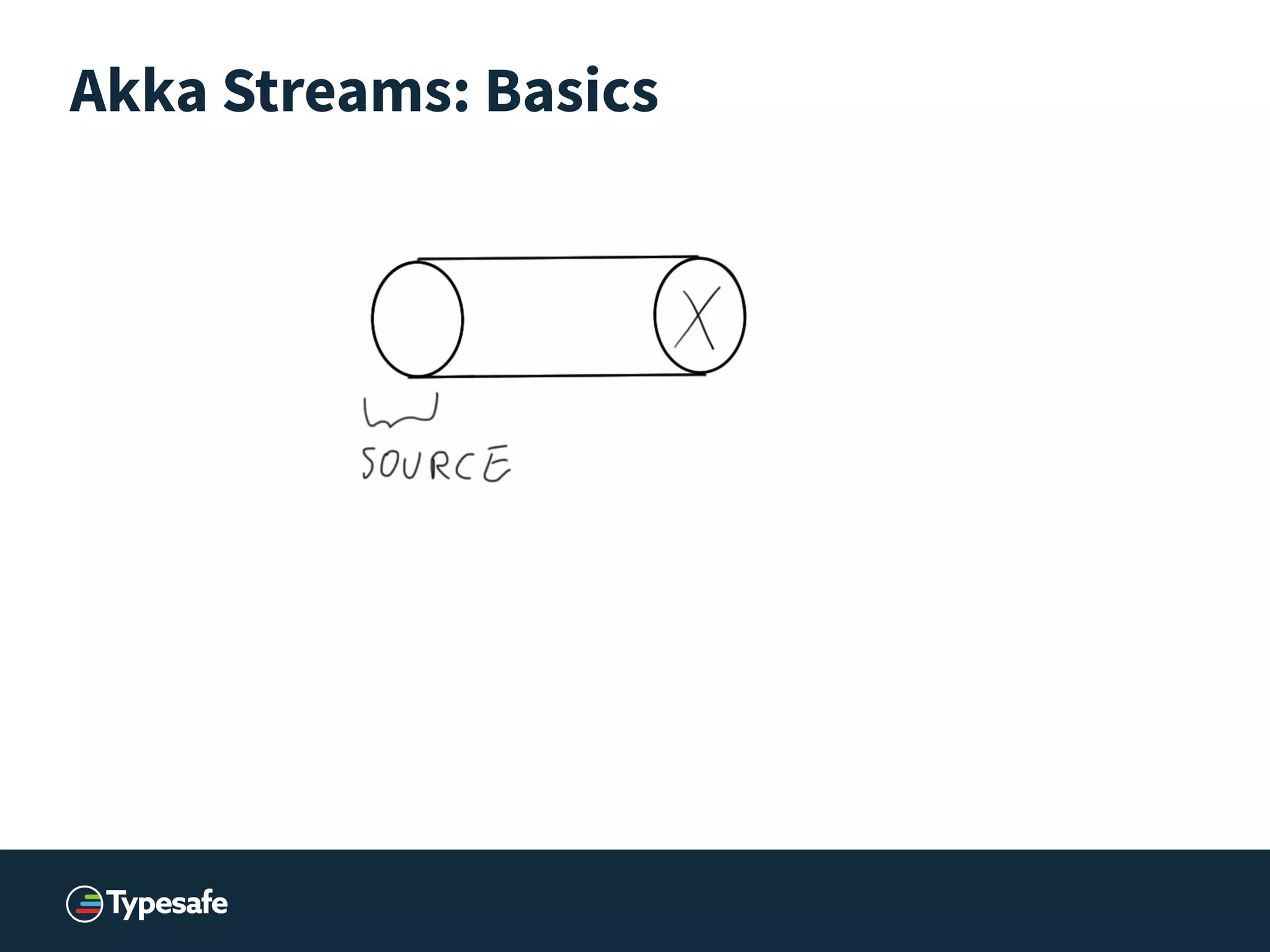
• Source	
  -­‐	
  something with exactly one output stream.
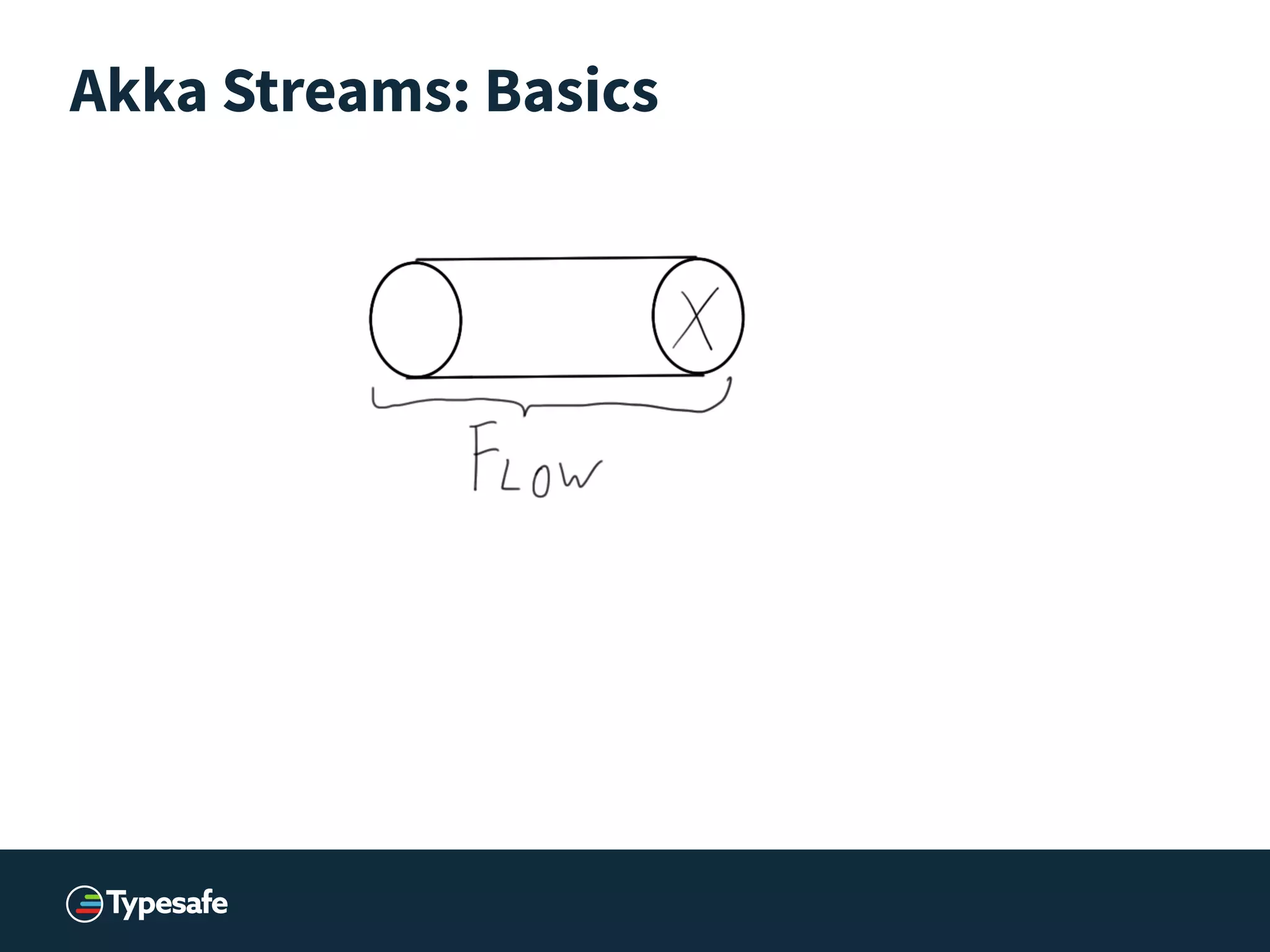
• Flow - something with exactly one input and one output
stream.
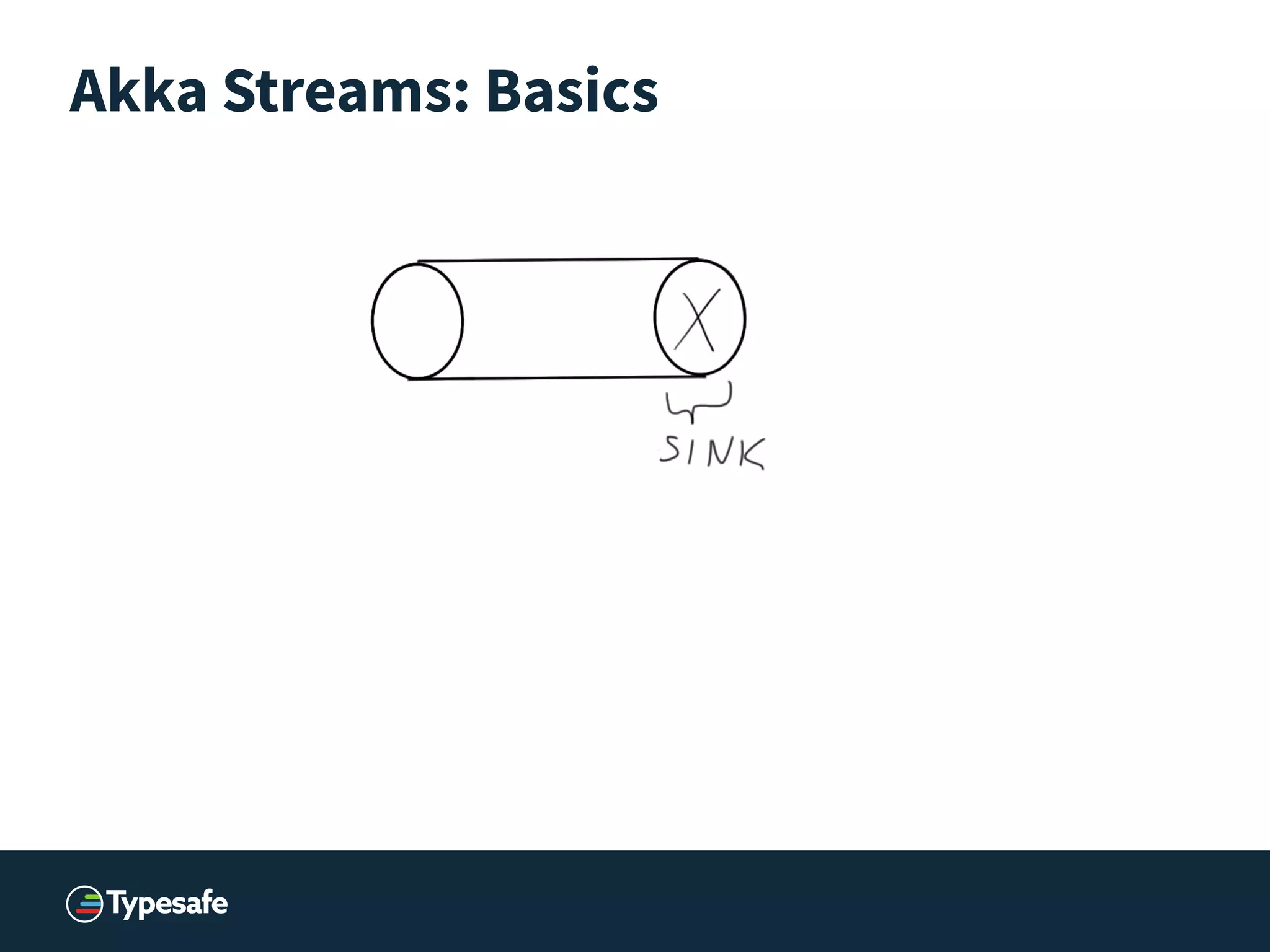
• Sink - something with exactly one input stream.
• RunnableFlow - A Flow that has both ends “attached”
to a Source and Sink respectively, and is ready to be run() .
Akka Streams: Basics
Demo 1
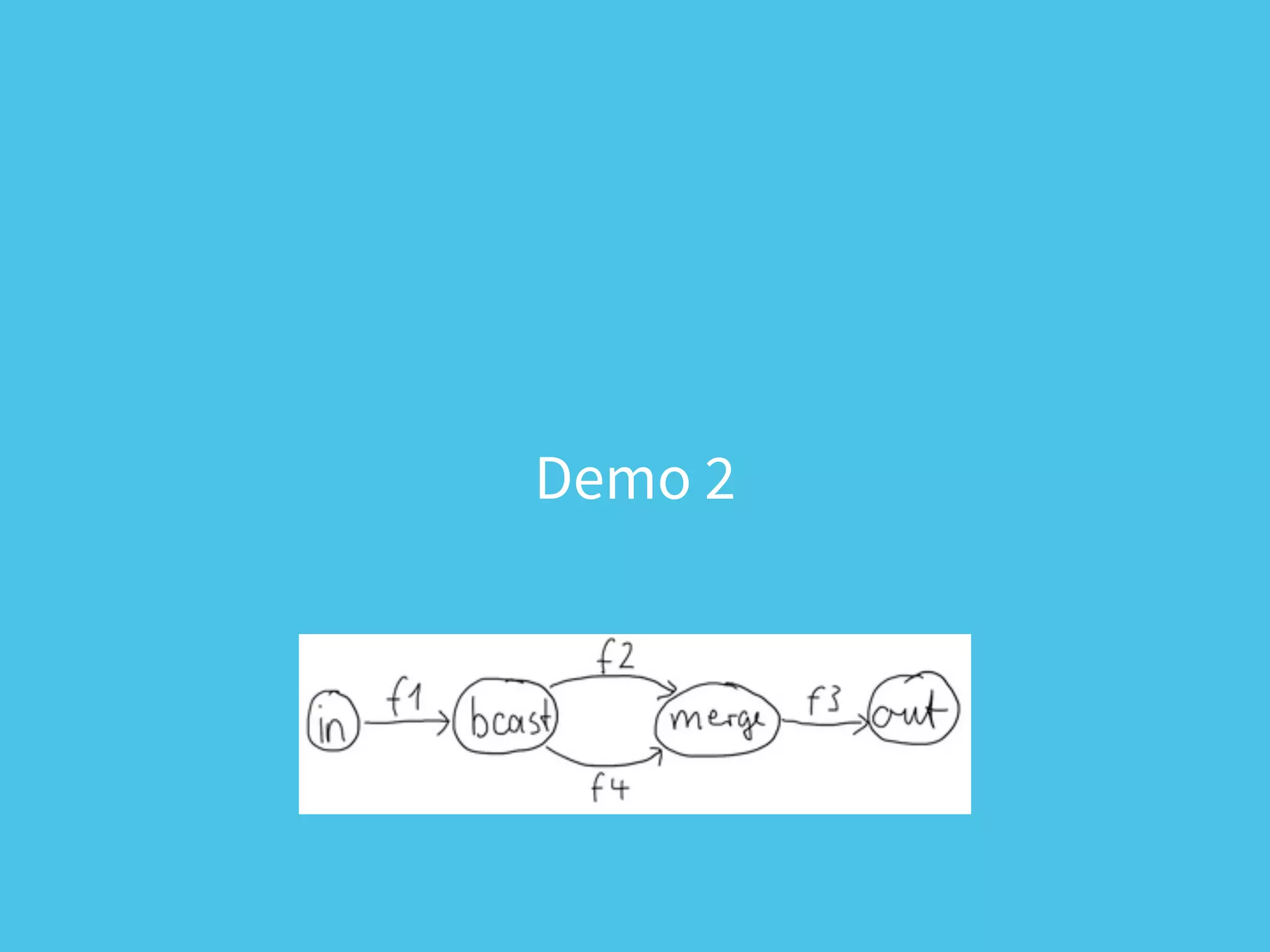
Akka Streams: Graph
• Source, Flow, and	
  Sink	
  are good for expressing
linear computations.
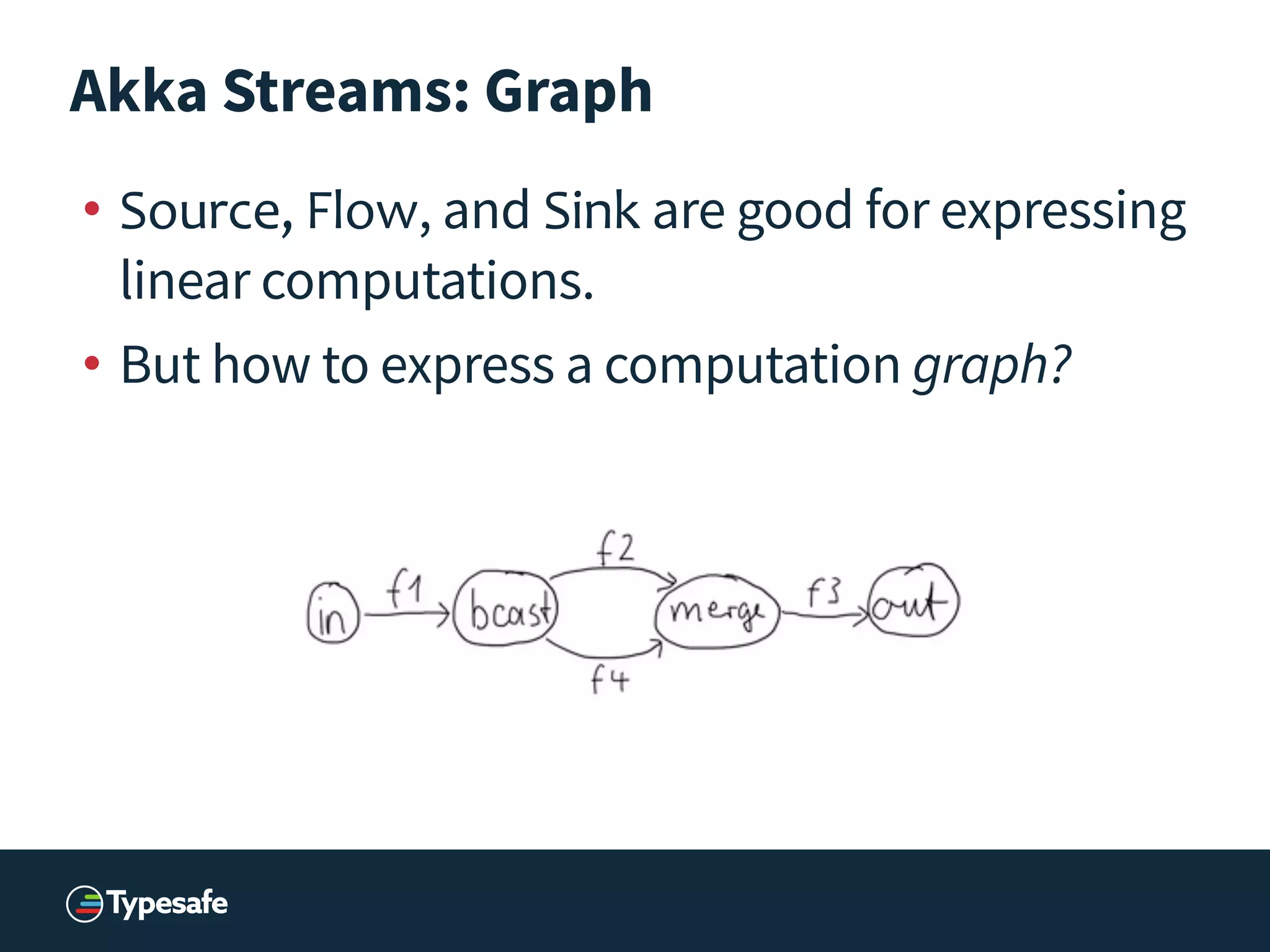
• But how to express a computation graph?
Demo 2
Akka Streams: Fan-out
• Broadcast	
  -­‐	
   given an input element emits to each
output.
• Balance- given an input element emits to one of its
output ports.
• UnZip - splits a stream of (A,B) tuples into two
streams, one of type A and on of type B.
• FlexiRoute	
  -­‐ enables writing custom fan out
elements using a simple DSL.
Akka Streams: Fan-in
• Merge	
  -­‐	
   picks randomly from inputs pushing them one
by one to its output.
• MergePreferred	
  - like Merge but if elements are
available on preferred port, it picks from it, otherwise
randomly from others.
• 	
  ZipWith(fn)- takes a function of N inputs that
given a value for each input emits 1 output element.
Akka Streams: Fan-in cont’d
• Zip	
  - is a ZipWith specialised to zipping input streams
of A and B into an (A,B) tuple stream.
• Concat	
  - concatenates two streams (first consume
one, then the second one).
• FlexiMerge	
  - enables writing custom fan-in
elements using a simple DSL.
Demo 3
What is back-pressure?
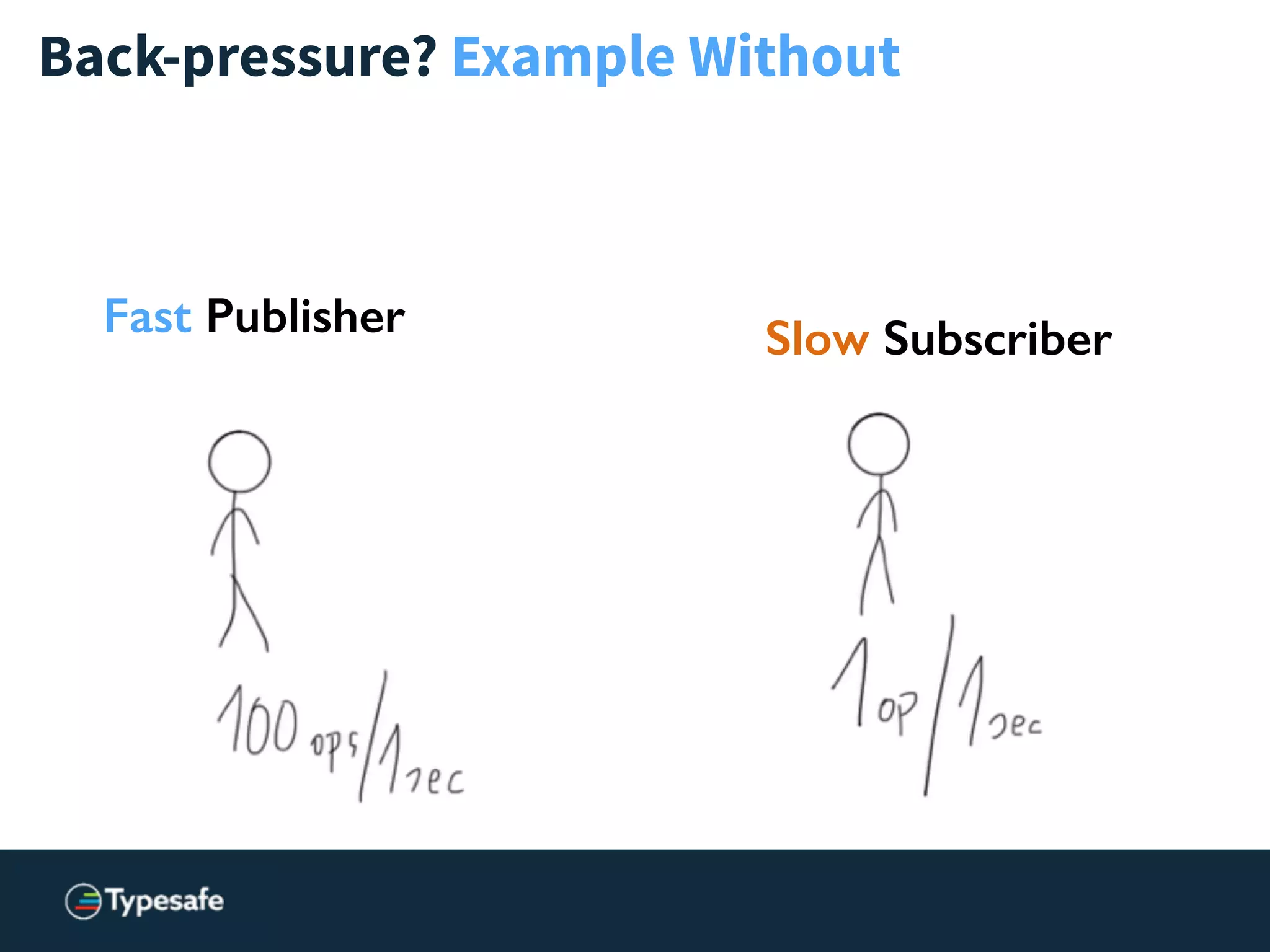
Back-pressure? Example Without
Publisher[T] Subscriber[T]
Back-pressure? Example Without
Fast Publisher Slow Subscriber
Back-pressure?
“Why would I need that!?”
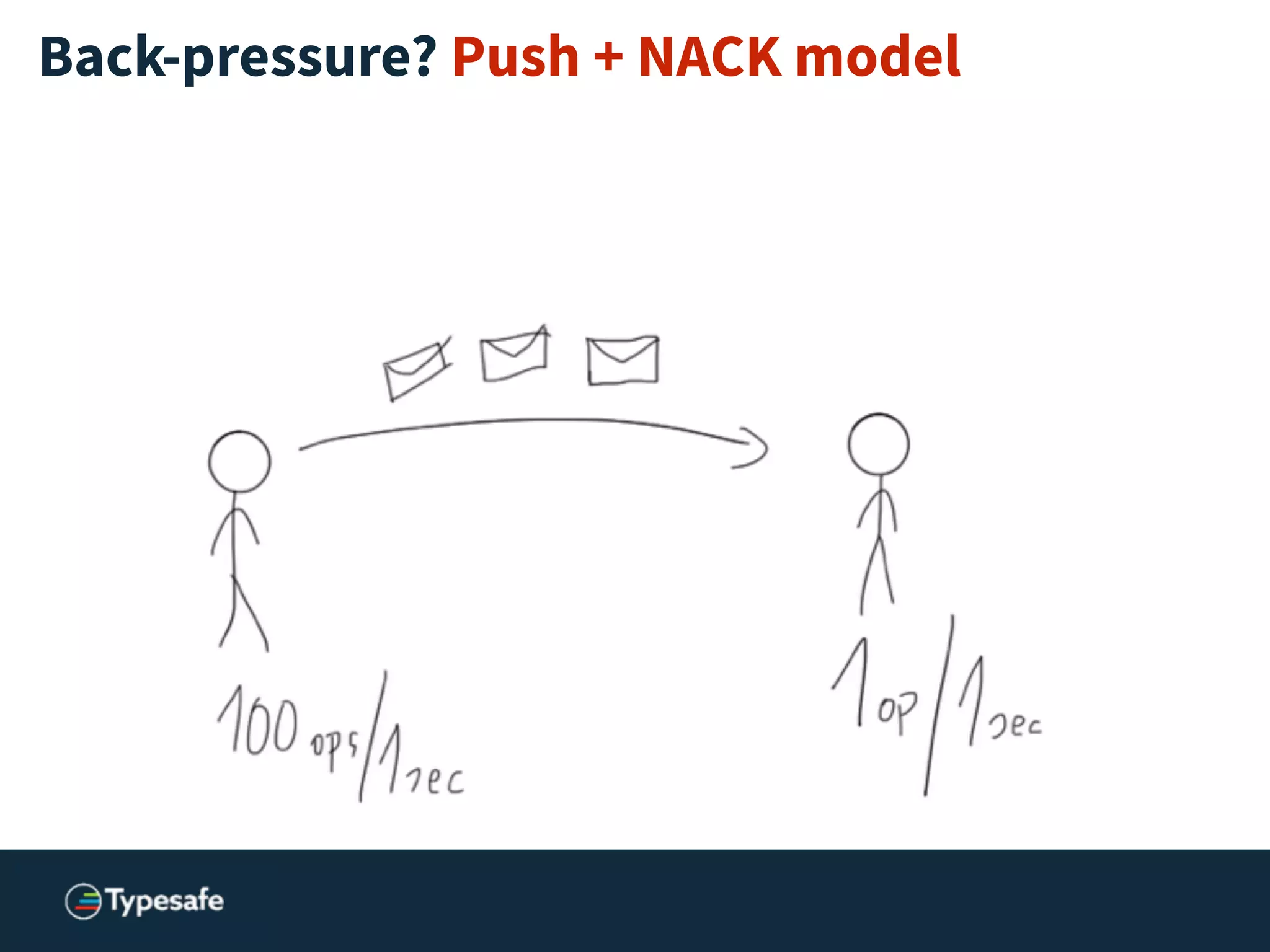
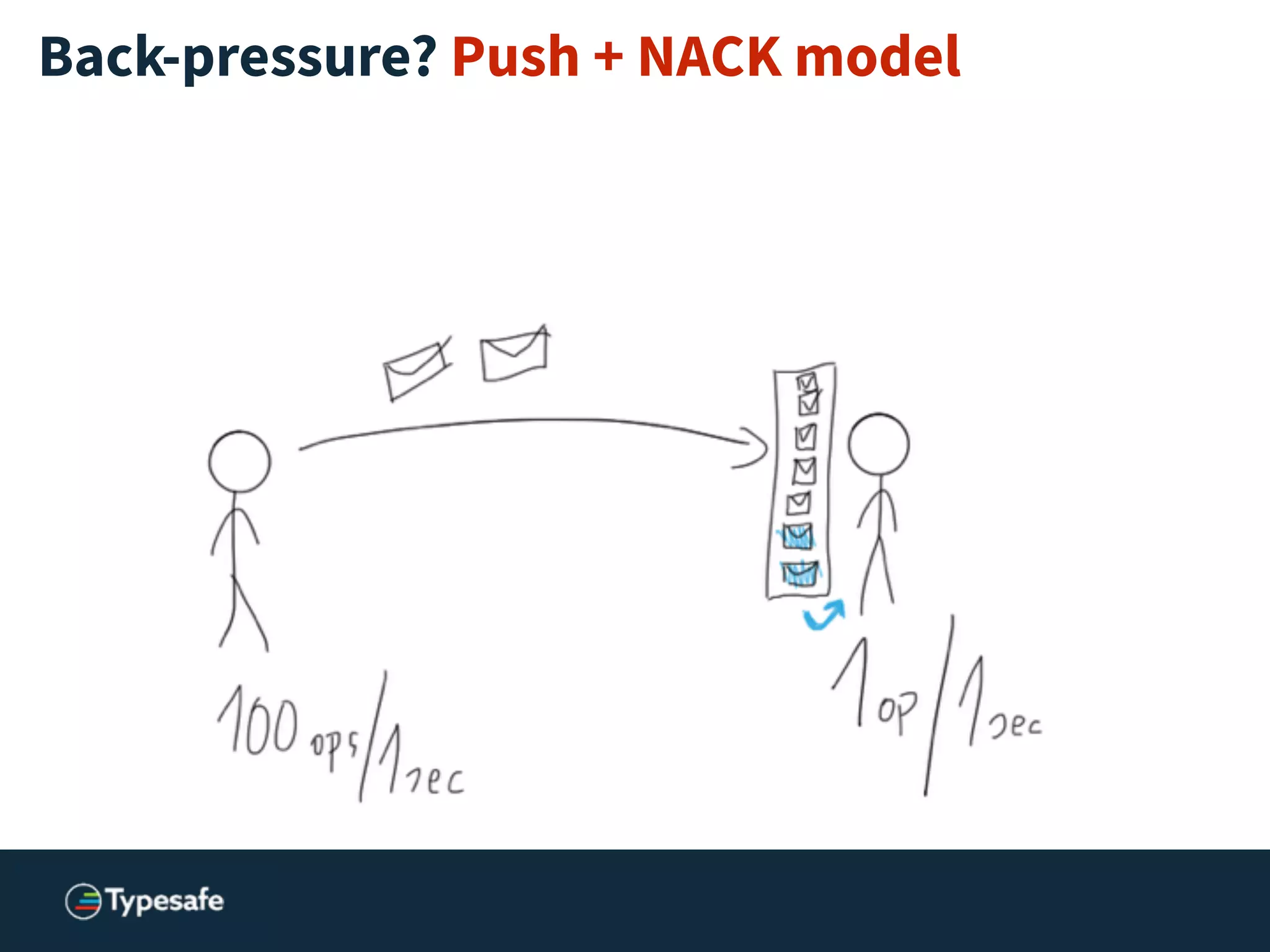
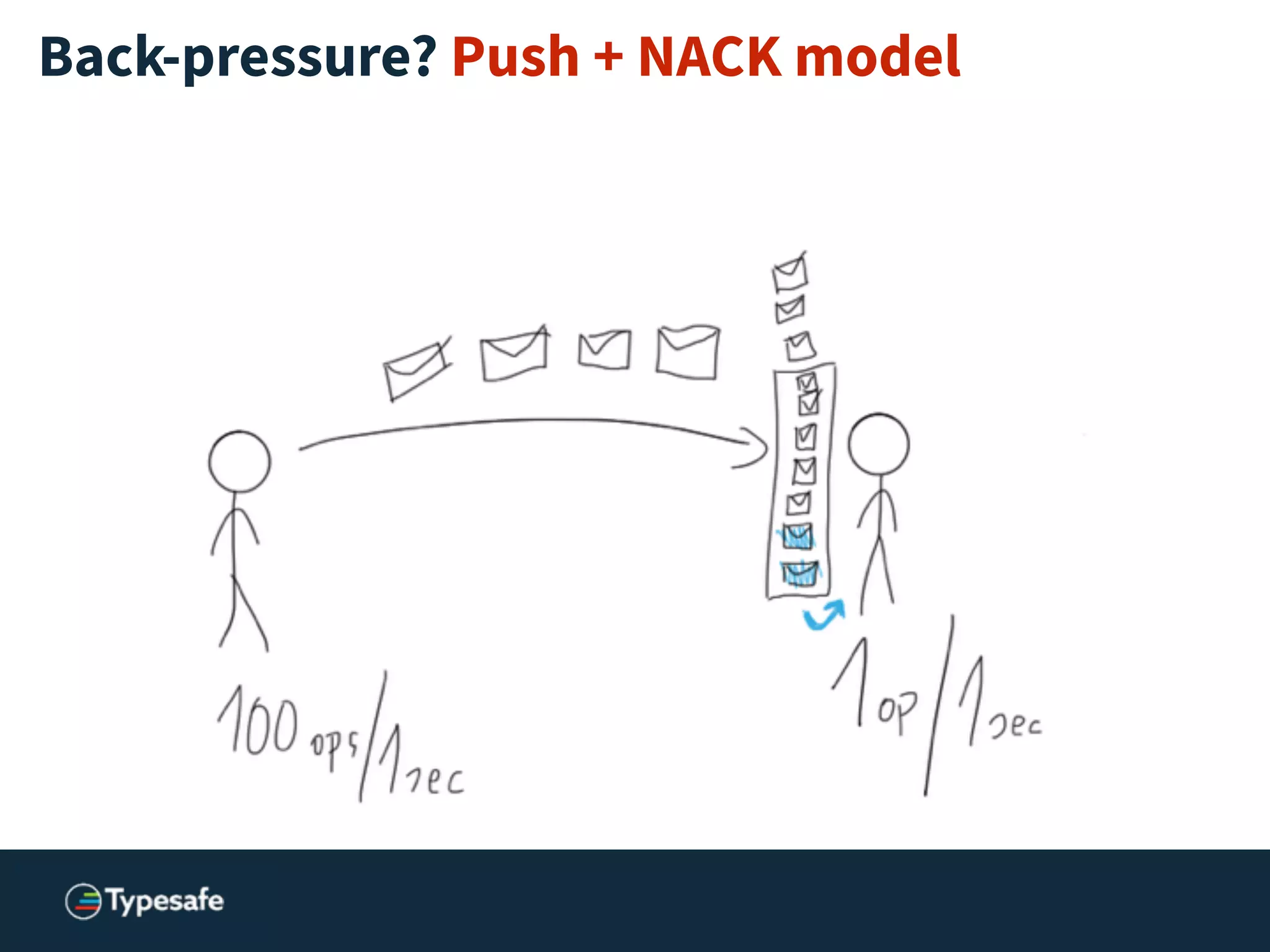
Back-pressure? Push + NACK model
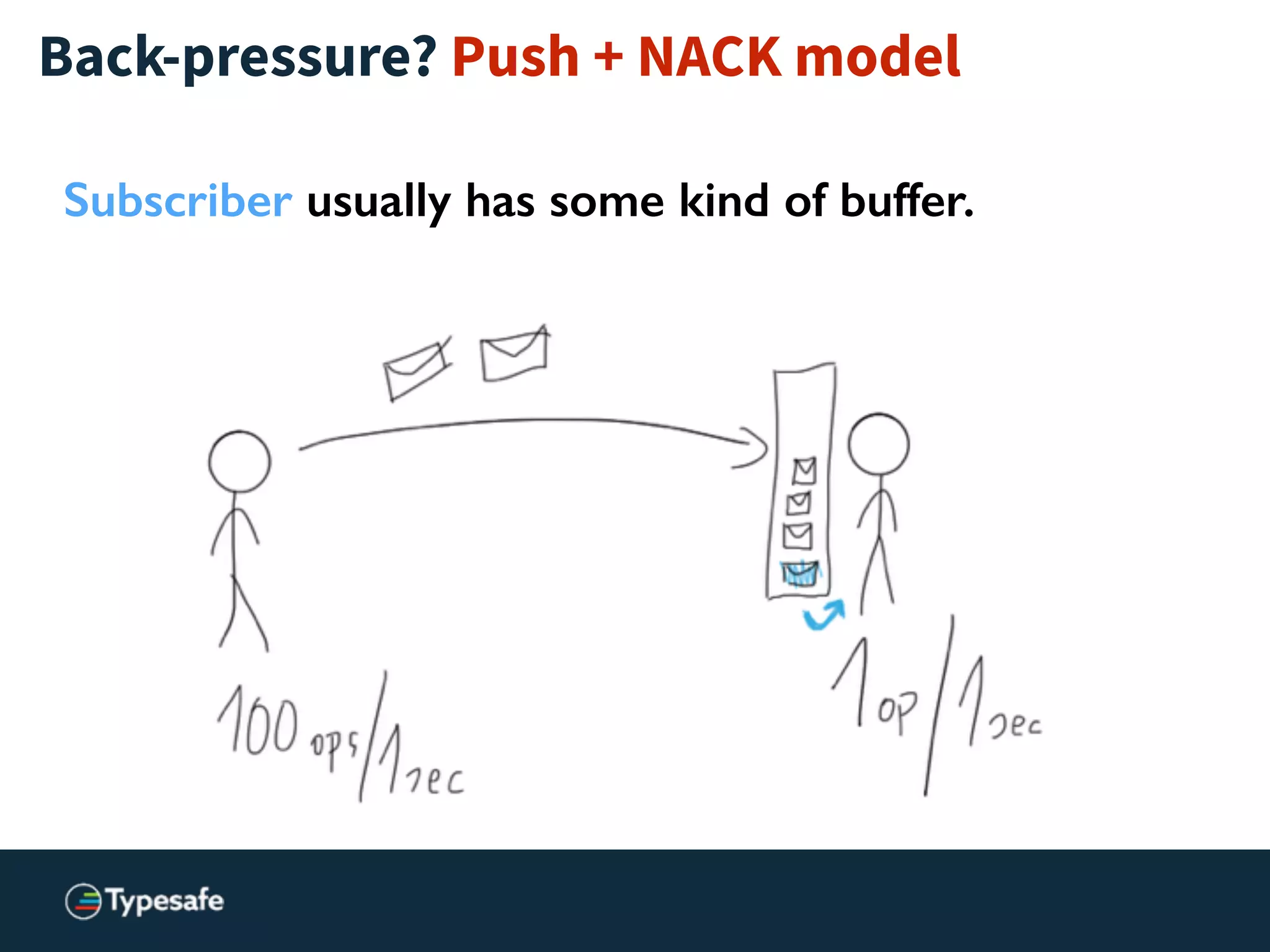
Subscriber usually has some kind of buffer.
Back-pressure? Push + NACK model
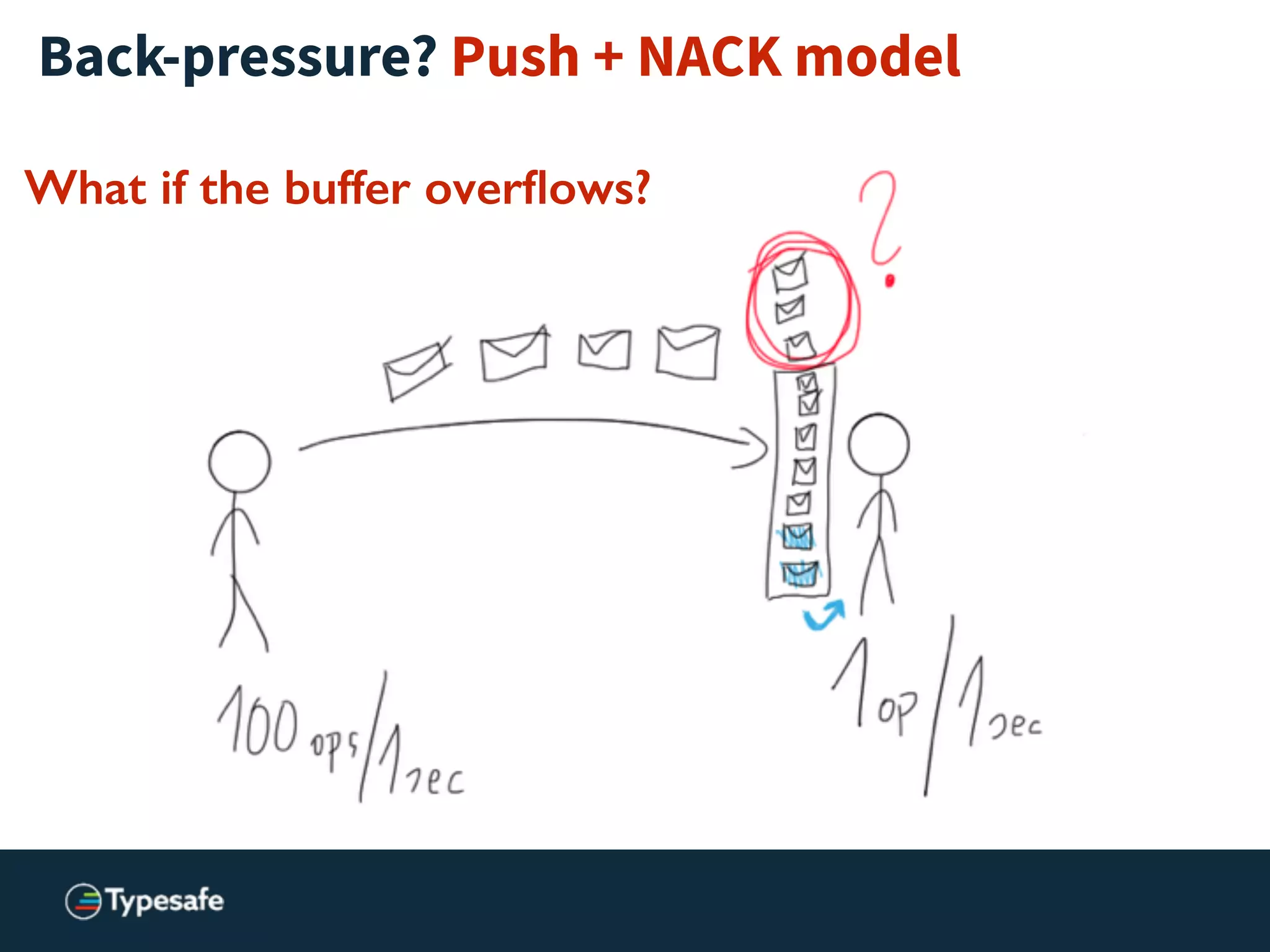
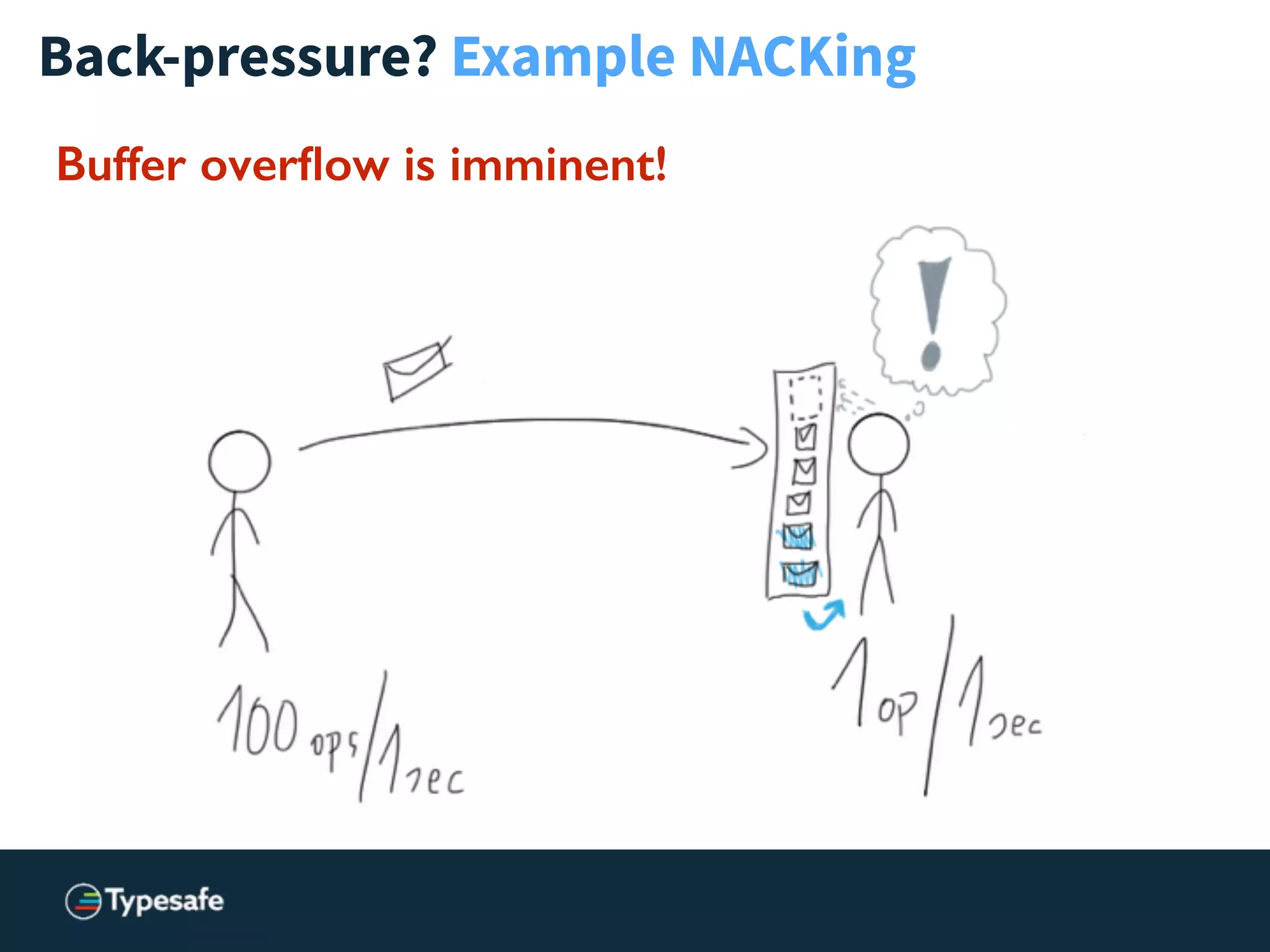
What if the buffer overflows?
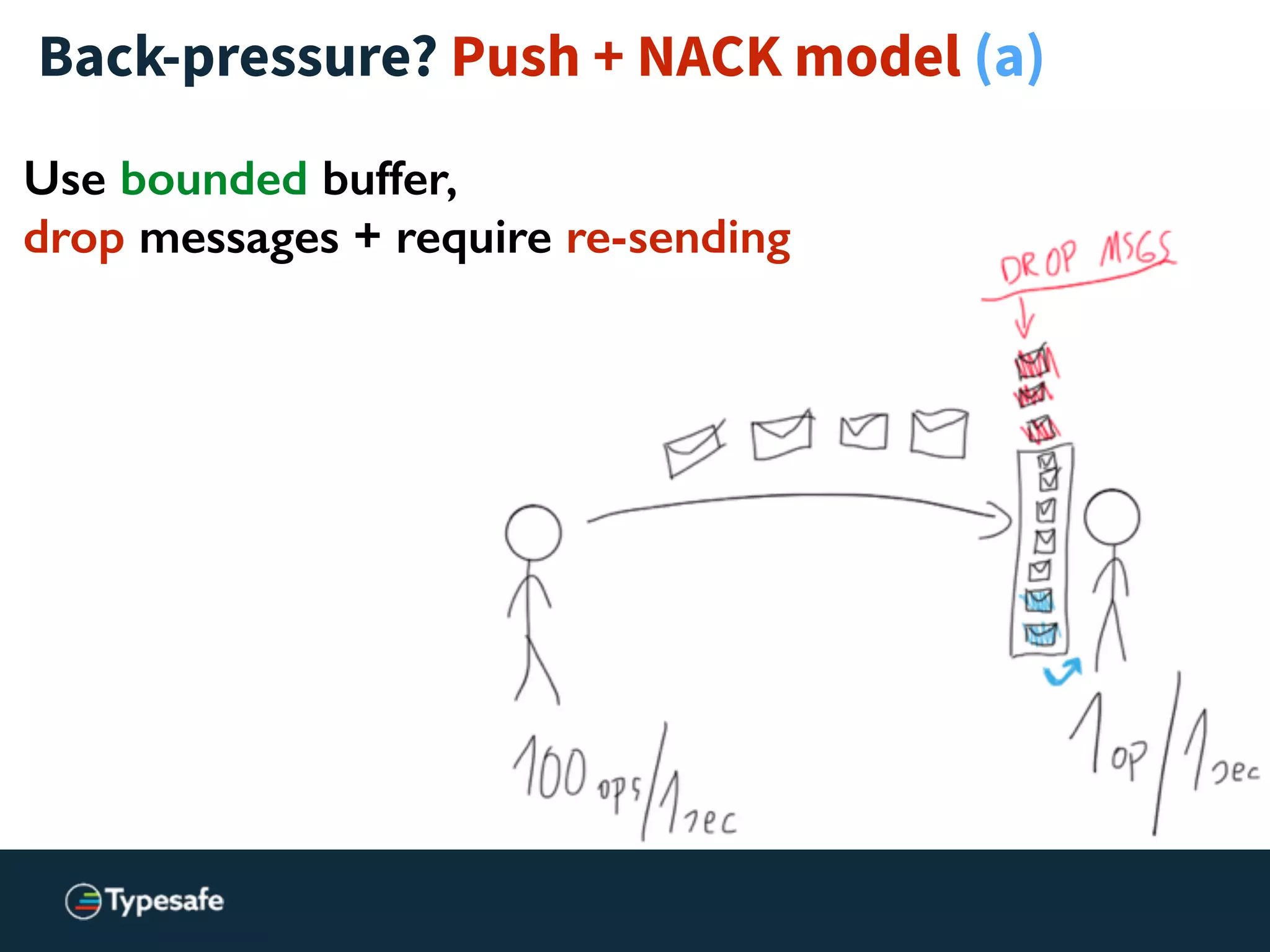
Back-pressure? Push + NACK model (a)
Use bounded buffer,
drop messages + require re-sending
Back-pressure? Push + NACK model (a)
Kernel does this!	

Routers do this!	

(TCP)
Use bounded buffer,
drop messages + require re-sending
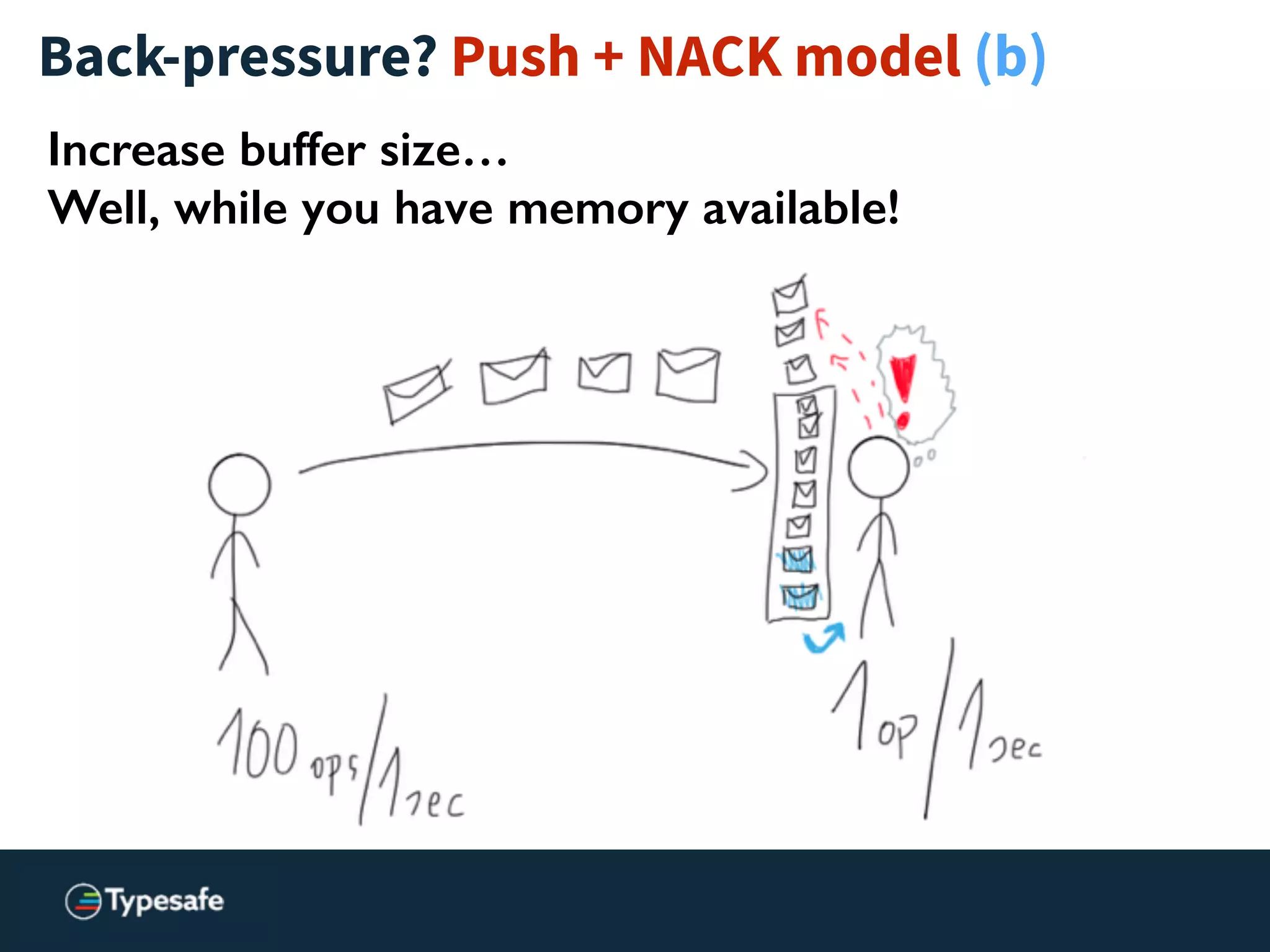
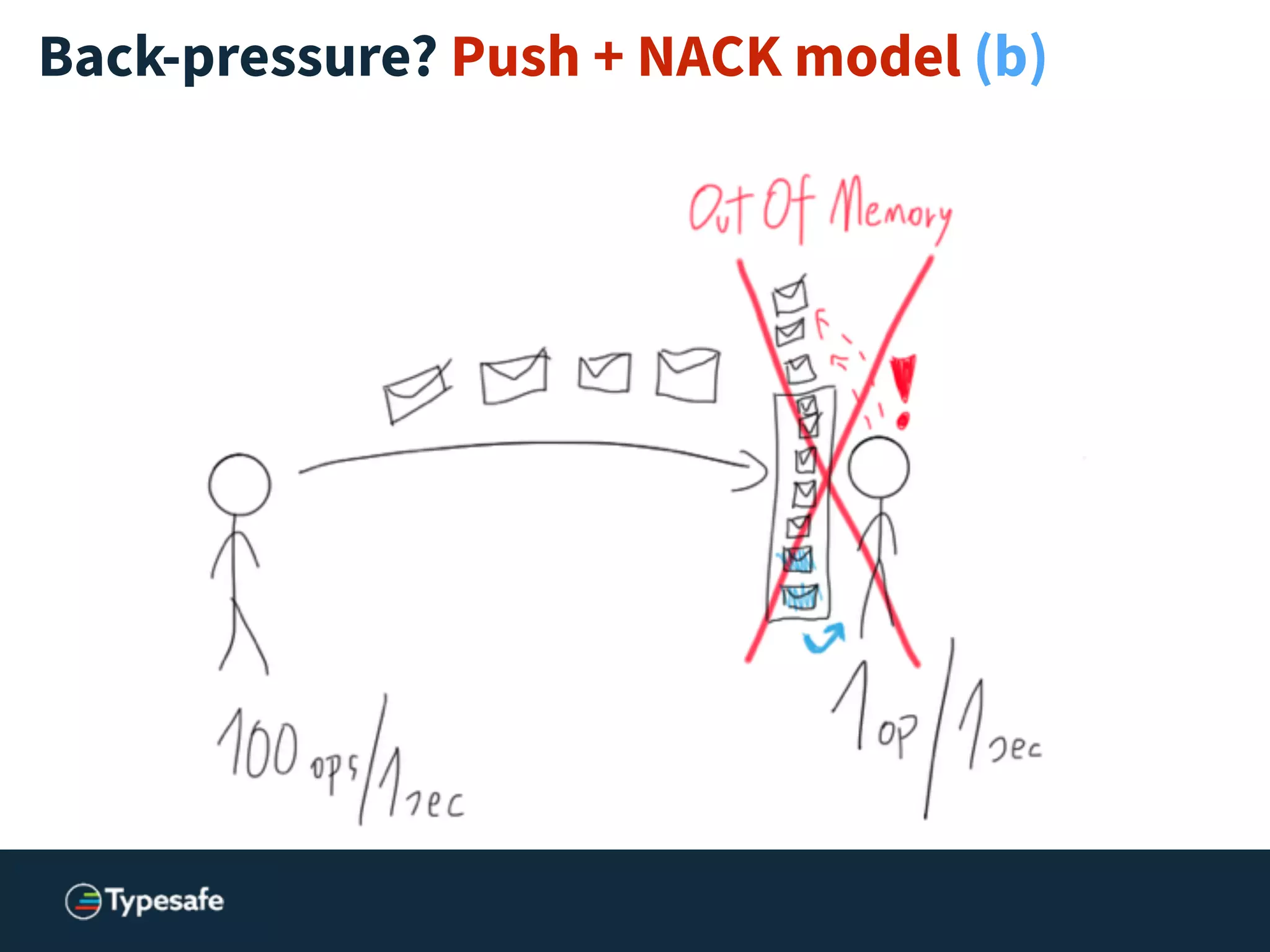
Back-pressure? Push + NACK model (b)
Increase buffer size…
Well, while you have memory available!
Back-pressure? Push + NACK model (b)
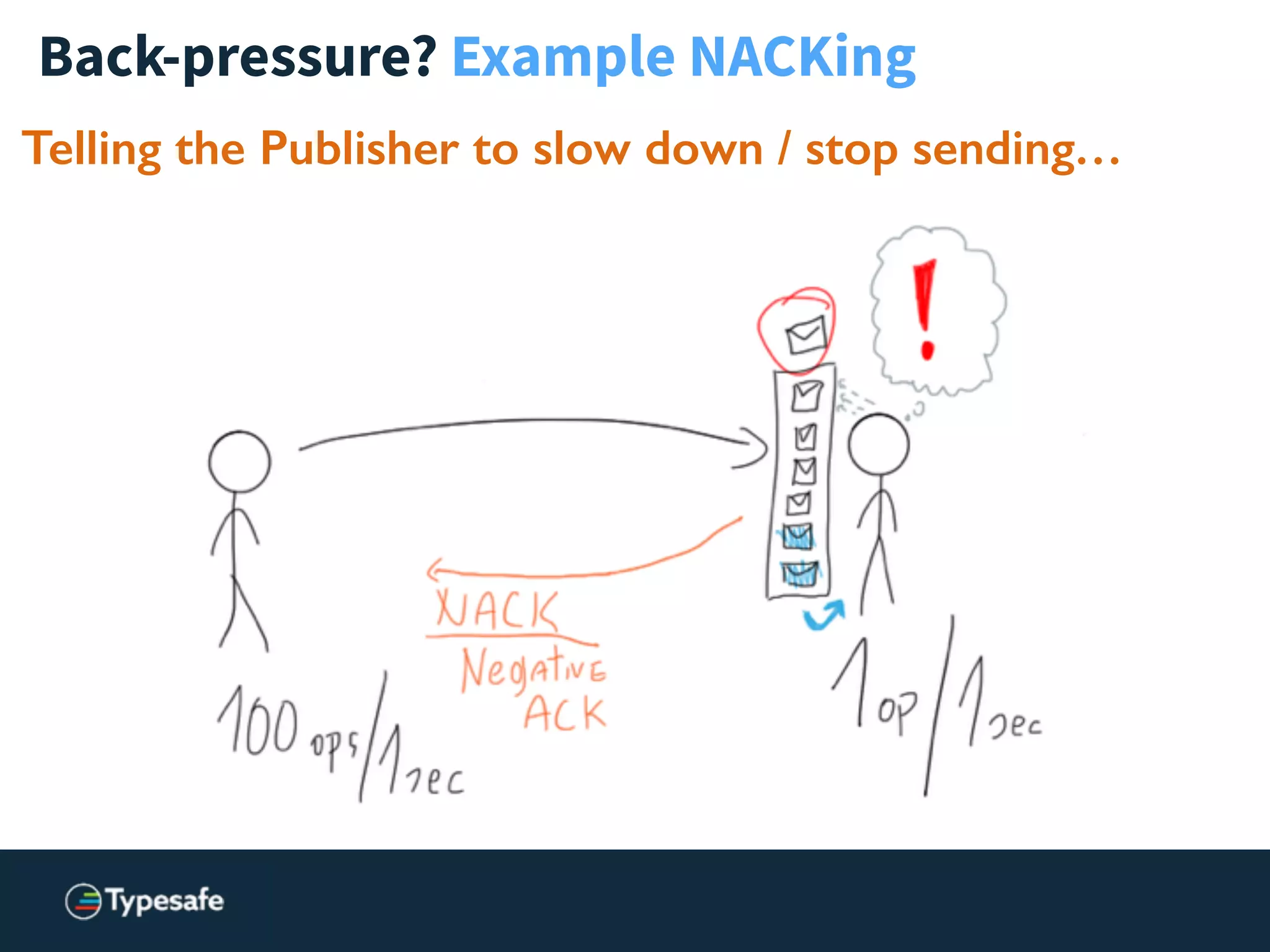
Negative ACKnowledgement
Back-pressure? Example NACKing
Buffer overflow is imminent!
Back-pressure? Example NACKing
Telling the Publisher to slow down / stop sending…
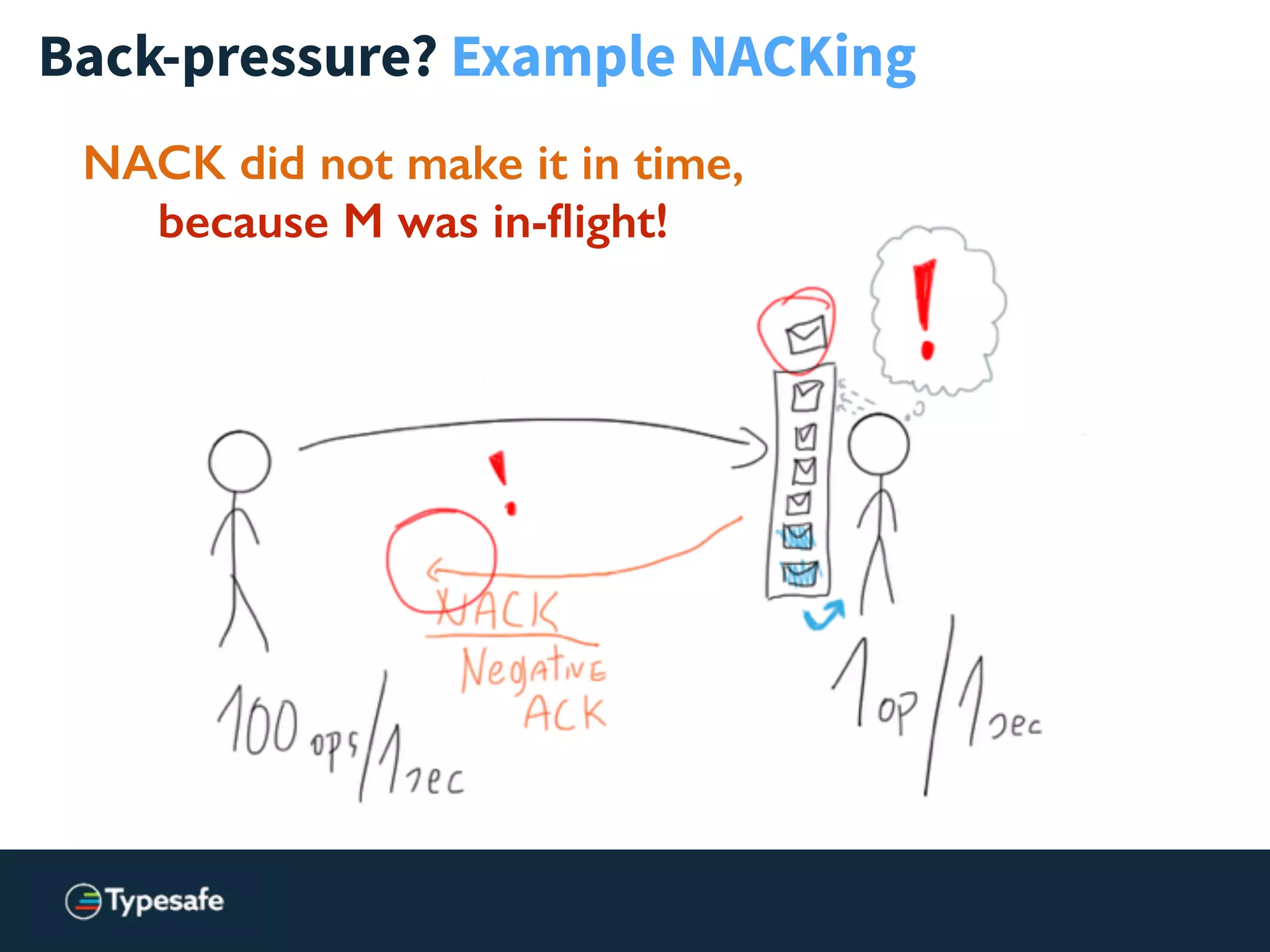
Back-pressure? Example NACKing
NACK did not make it in time,
because M was in-flight!
Back-pressure?
NACKing is NOT enough.
Back-pressure?
!
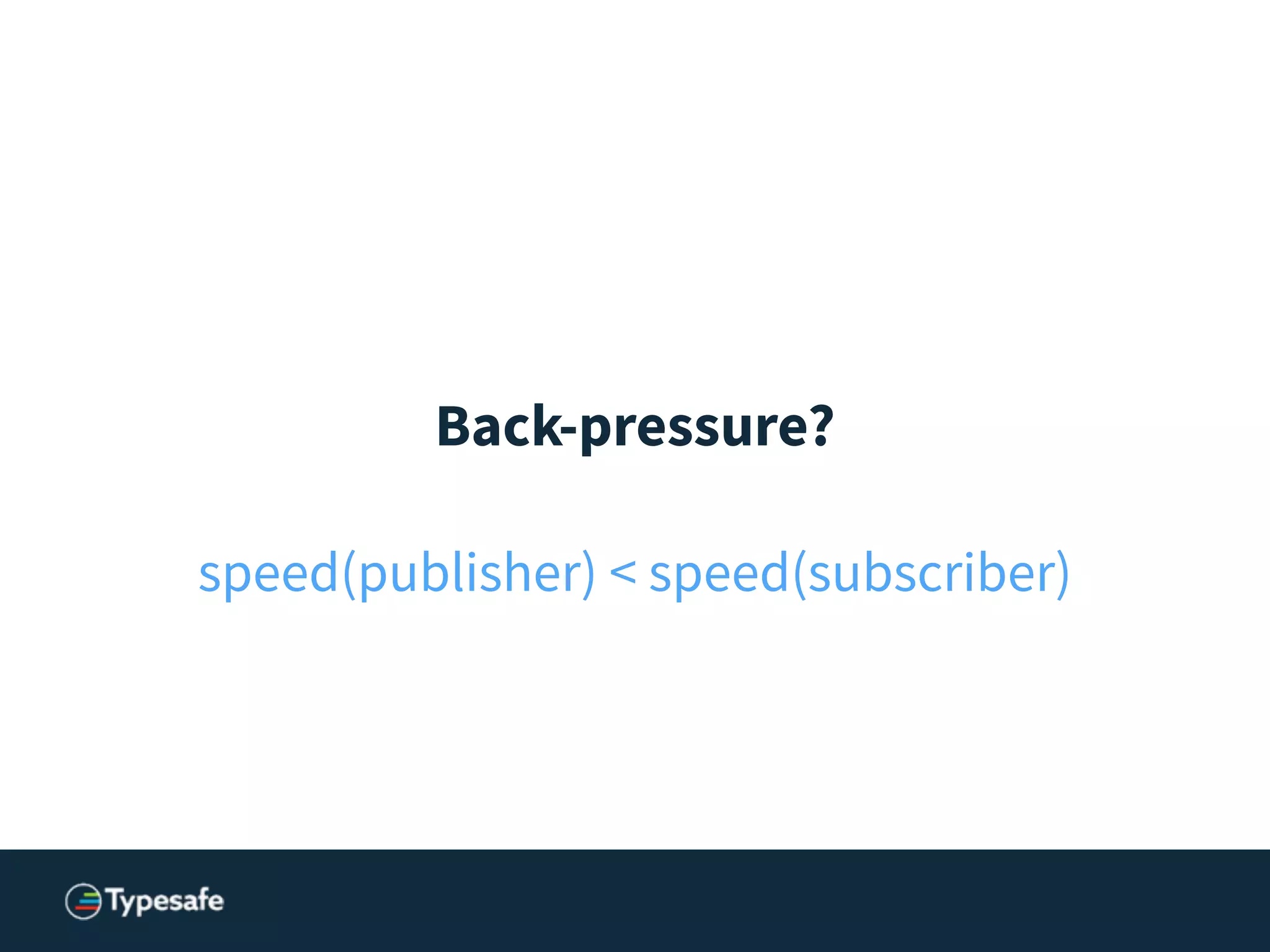
speed(publisher) < speed(subscriber)
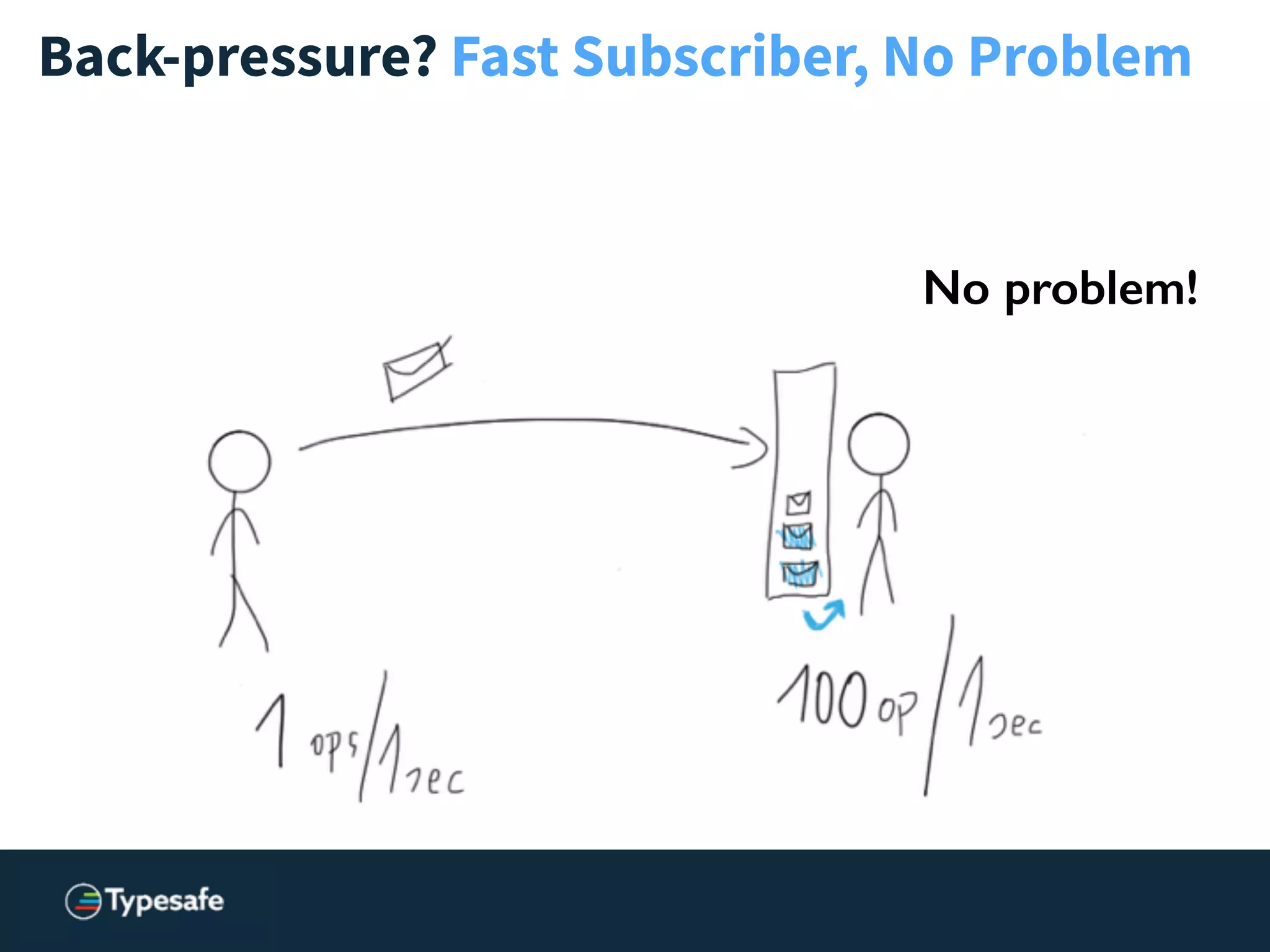
Back-pressure? Fast Subscriber, No Problem
No problem!
Back-pressure?
Reactive-Streams
=
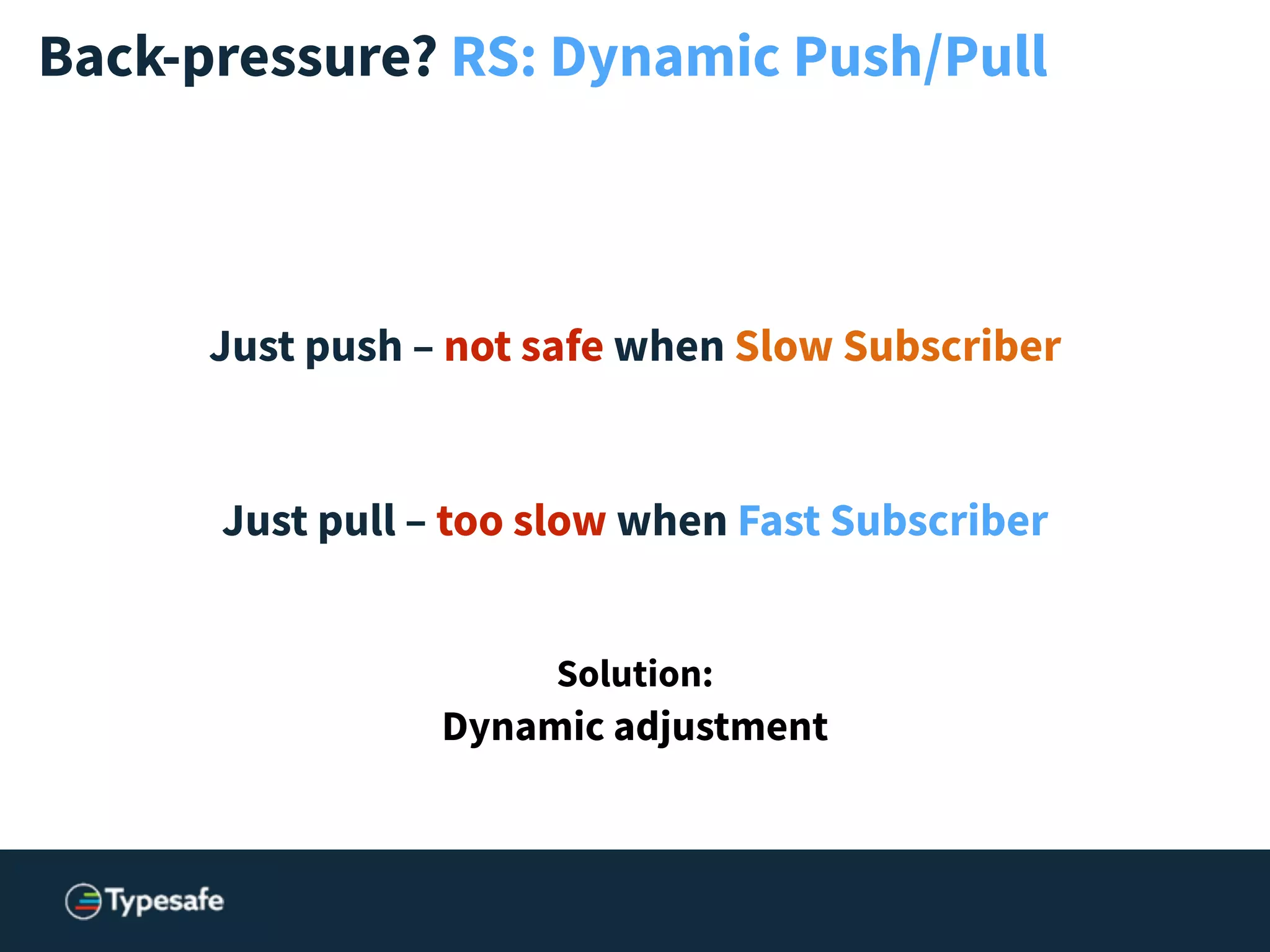
Just push – not safe when Slow Subscriber
!
!
Just pull – too slow when Fast Subscriber
Back-pressure? RS: Dynamic Push/Pull
!
!
!
Solution:
Dynamic adjustment
Back-pressure? RS: Dynamic Push/Pull
Just push – not safe when Slow Subscriber
!
!
Just pull – too slow when Fast Subscriber
Back-pressure? RS: Dynamic Push/Pull
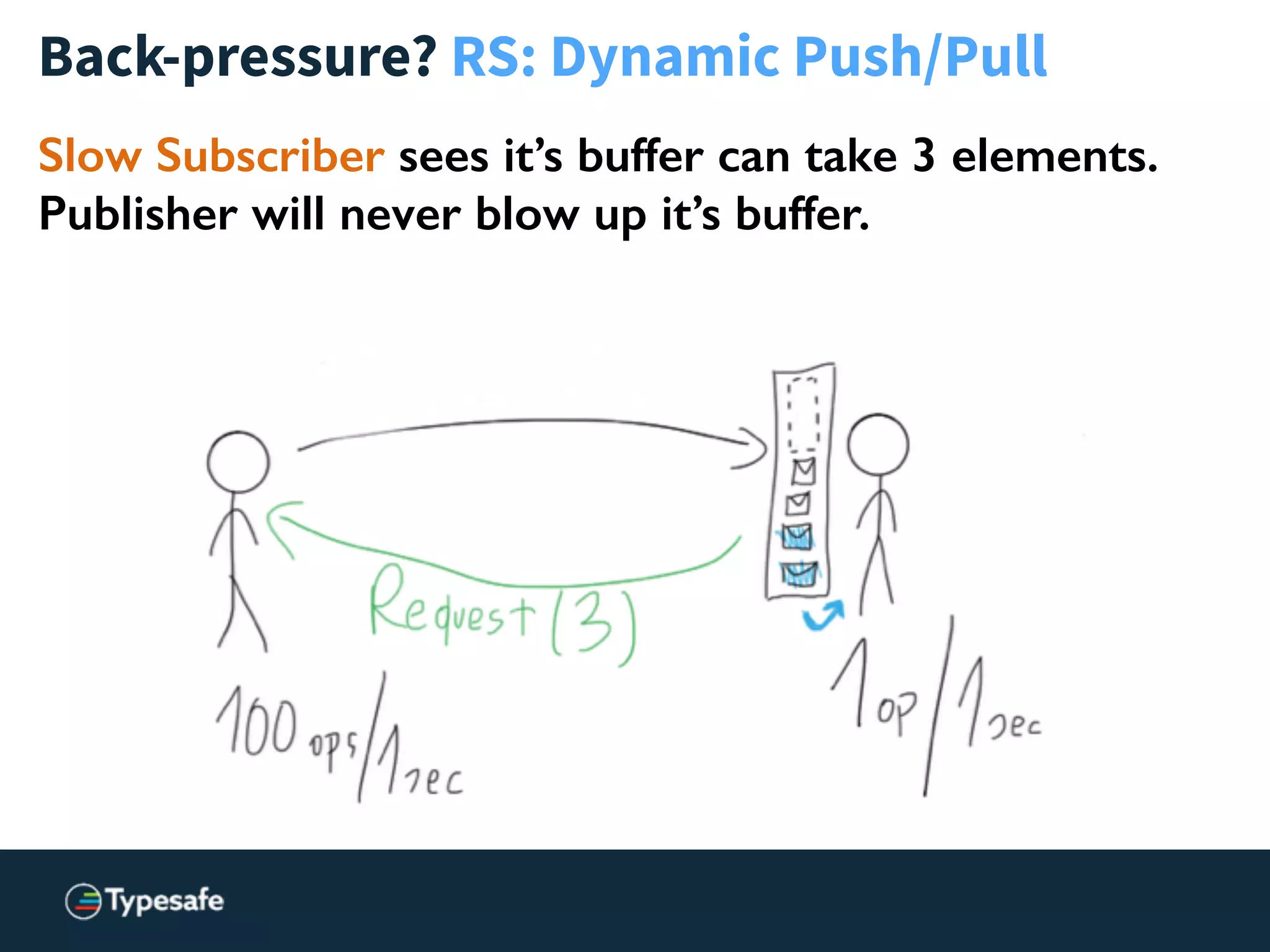
Slow Subscriber sees it’s buffer can take 3 elements.
Publisher will never blow up it’s buffer.
Back-pressure? RS: Dynamic Push/Pull
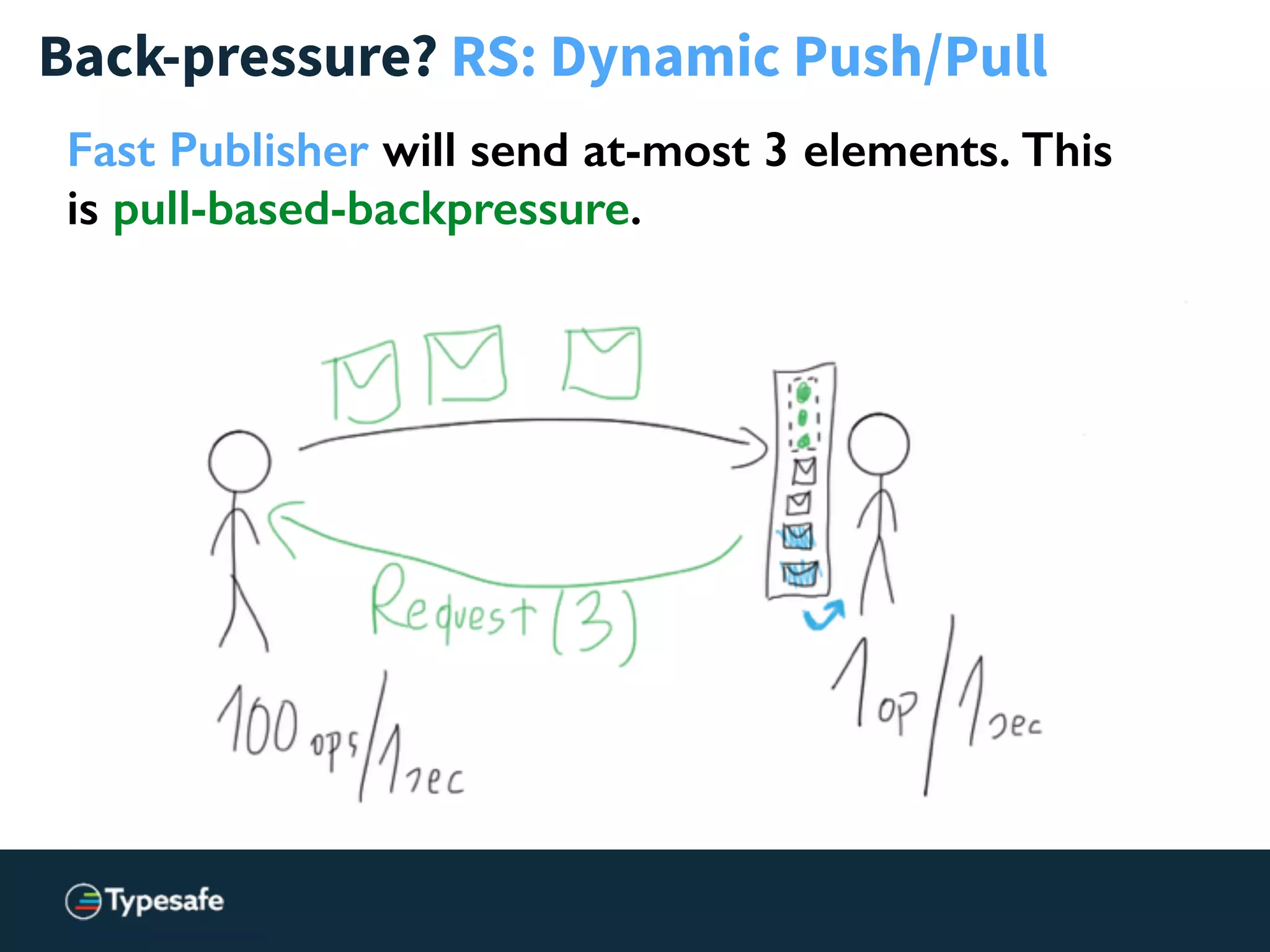
Fast Publisher will send at-most 3 elements. This
is pull-based-backpressure.
Back-pressure? RS: Dynamic Push/Pull
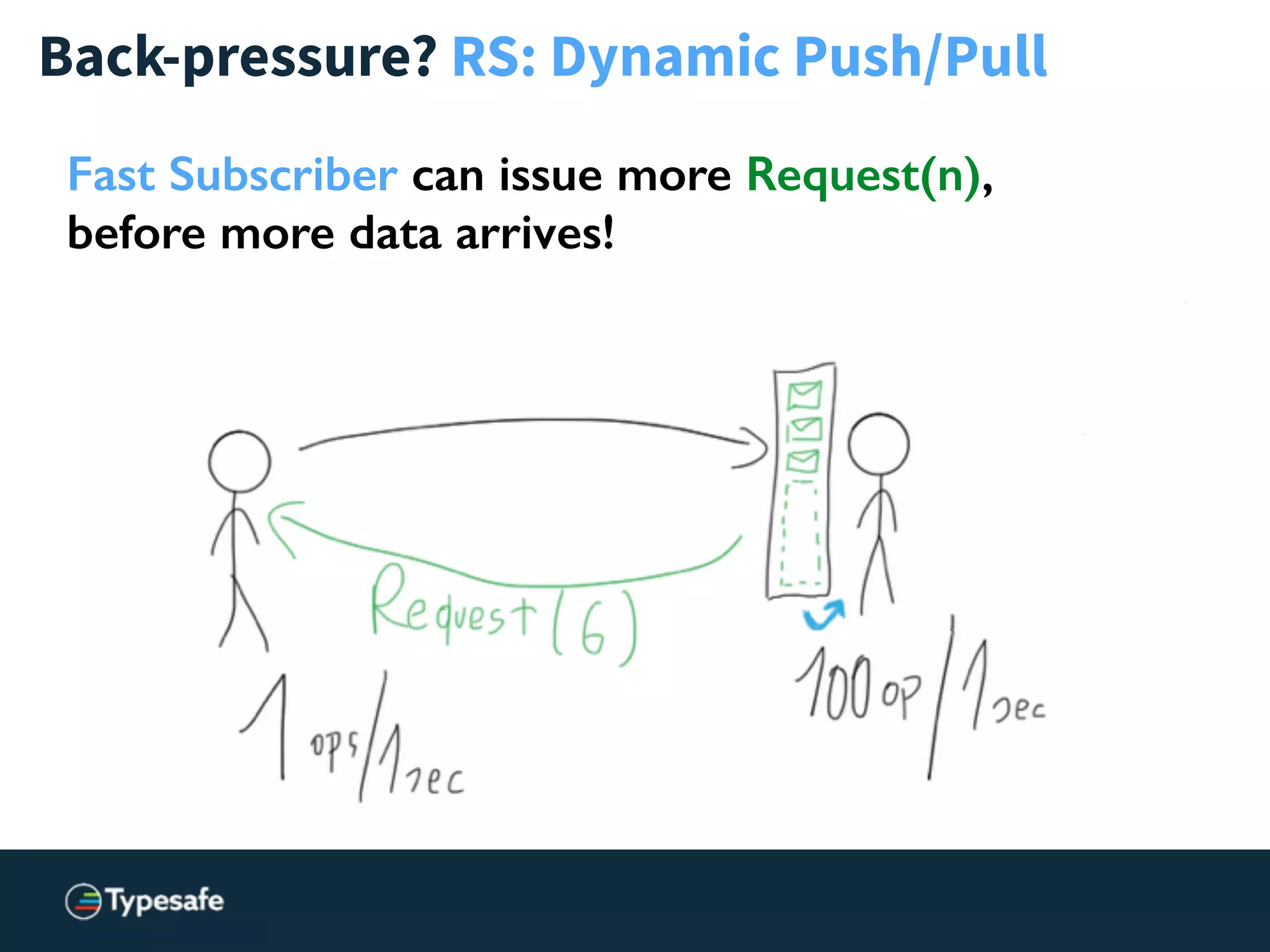
Fast Subscriber can issue more Request(n),
before more data arrives!
Back-pressure? RS: Dynamic Push/Pull
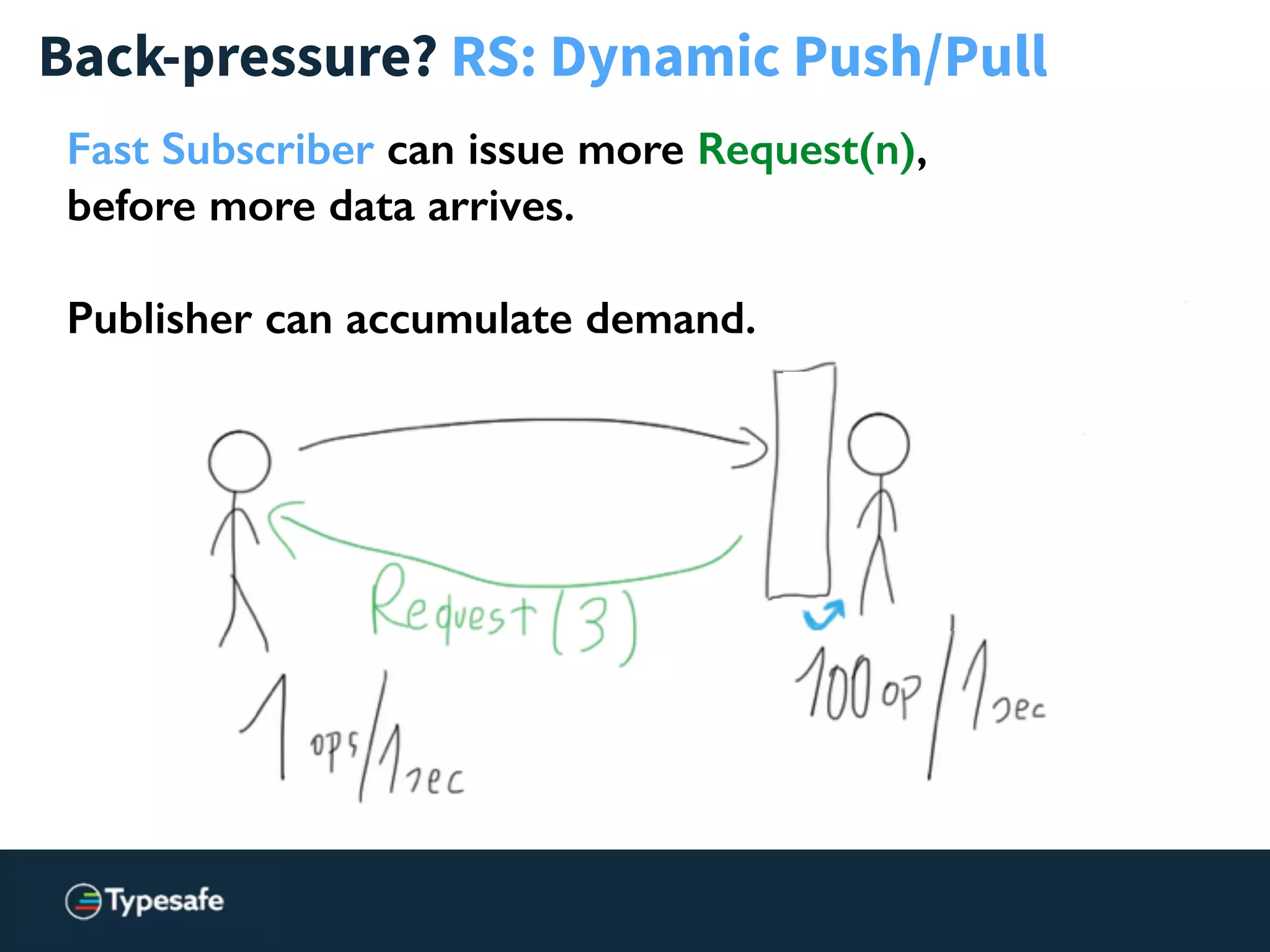
Fast Subscriber can issue more Request(n),
before more data arrives.
!
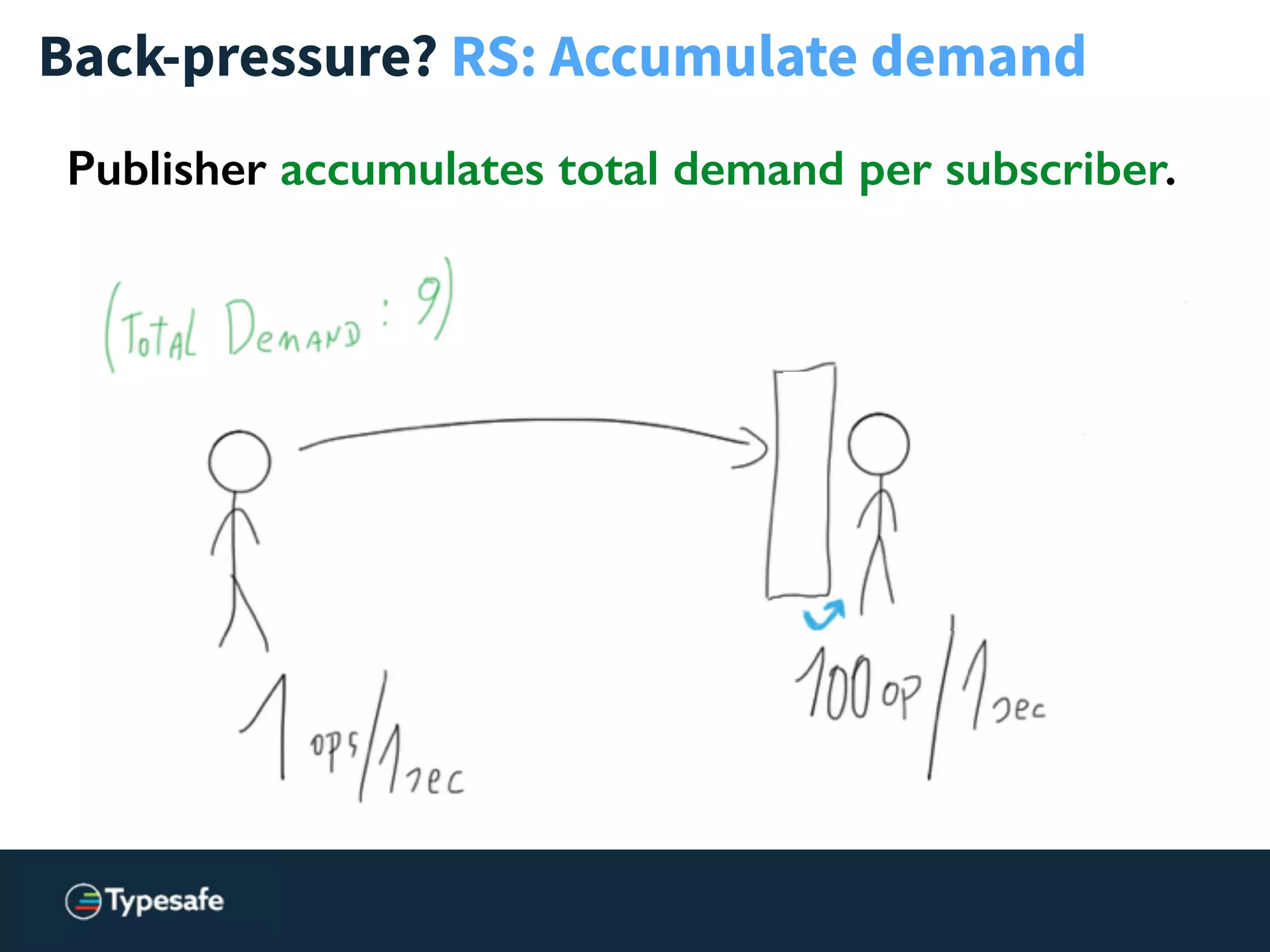
Publisher can accumulate demand.
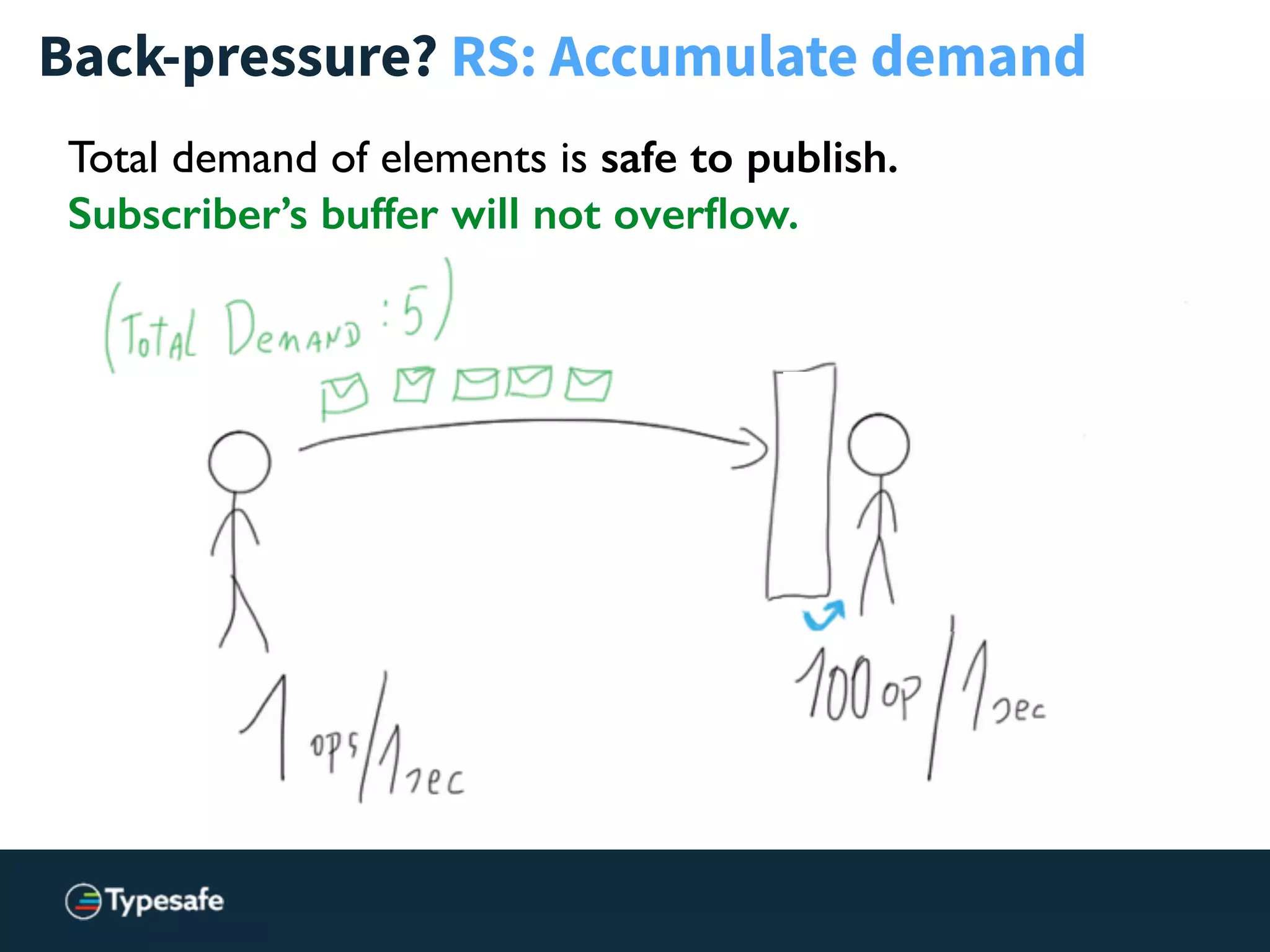
Back-pressure? RS: Accumulate demand
Publisher accumulates total demand per subscriber.
Back-pressure? RS: Accumulate demand
Total demand of elements is safe to publish.
Subscriber’s buffer will not overflow.
Demo 4
Is that really all there is to know?
• Naaaa, there is a lot more for you to explore!
• If the existing building blocks are not enough, define
your owns.
• Use mapAsync/mapAsyncUnordered for
integrating with external services.
• Streams Error Handling.
• Handling TCP connections with Streams.
• Integration with Actors.
What now?
• Use it:

"com.typesafe.akka" %% "akka-stream-experimental" % "1.0-M5"
• Check out the Activator template

Akka Streams with Java8orScala.
• Akka Streams API doc and user guide for both
Java8 and Scala.
• Code used for the demos https://github.com/
dotta/akka-streams-demo/releases/tag/v01
Next Steps
• Akka Streams RC1 soon (before end of April).
• Inclusion in future JDK (shooting for JDK9)
• We aim at polyglot standard (JS, wire proto)
• Try it out and give feedback!
• http://reactive-streams.org/
• https://github.com/reactive-streams
©Typesafe 2015 – All Rights Reserved

Akka streams