By
MILIND A. PELAGADE
ME (Production)
GECA, Aurangabad.
 Import means bring (goods or services) into
a country from abroad for sale.
 The buyer of such goods and services is
referred to an importer who is based in the
country of import whereas the overseas
based seller is referred to as an exporter.
 Thus an import is any good (e.g.garments) or
service brought in from one country to
another country in a legitimate fashion,
typically for use in trade
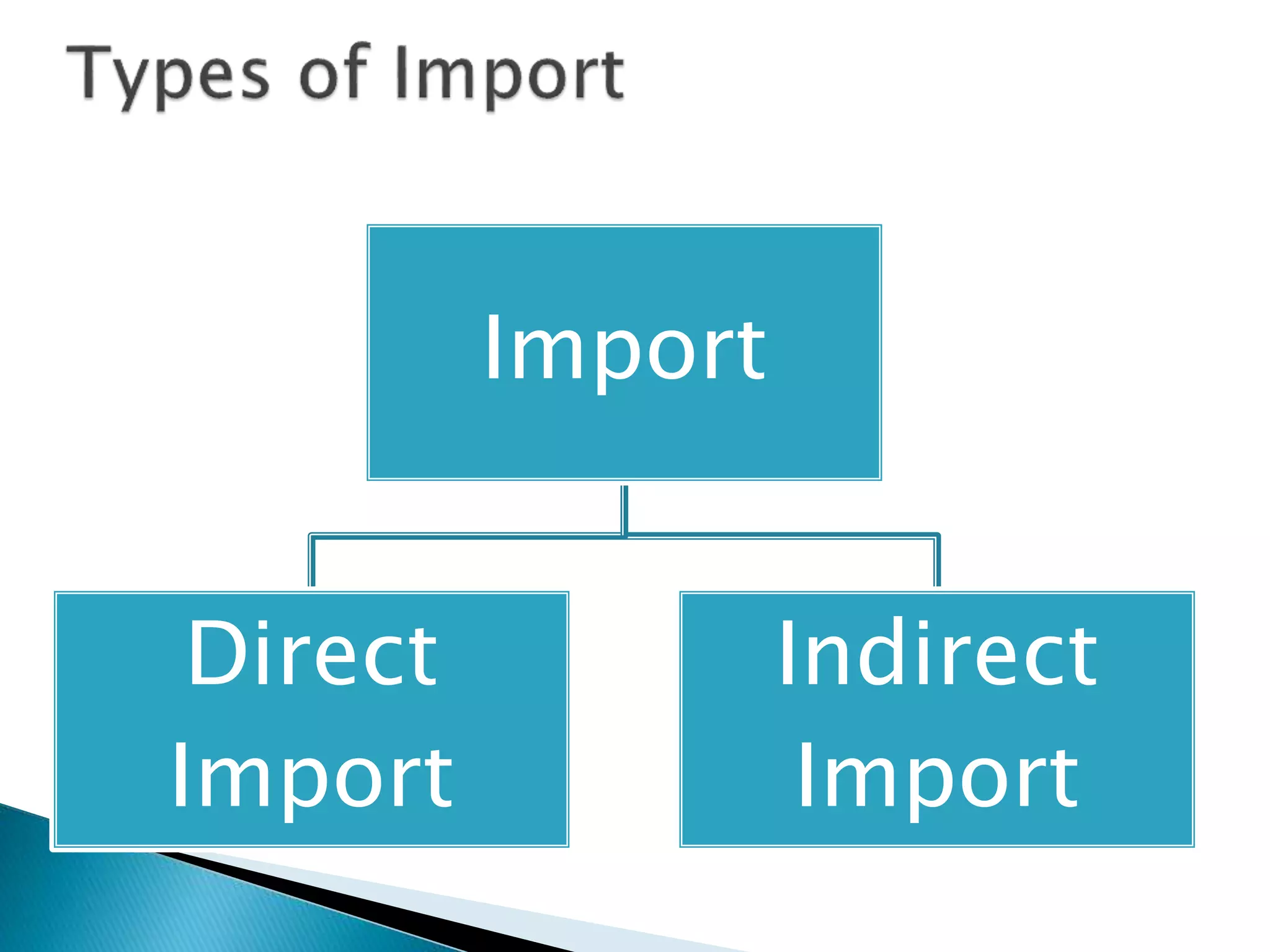
Import
Direct
Import
Indirect
Import
Direct Import
Direct-import refers to a type of business
importation involving a major retailer (e.g. Wal-
Mart) and an overseas manufacturer. A retailer
typically purchases products designed by local
companies that can be manufactured overseas.
Indirect Import
In a direct-import program, the retailer bypasses
the local supplier (colloquial middle-man) and
buys the final product directly from the
manufacturer, possibly saving in added costs. This
type of business is fairly recent and follows the
trends of the global economy.
 If company importing for first time, it has to check
whether the item is allowed or not( using
RED(BLUE) Book).
 Get list of local manufacturers and Ask for
Quotations from them.
 If local manufacturers are unable to supply get a
written statement from them.
 Submit the statement to Government to get
Clearance for Import.
 Government will might suggest names of suppliers
or could write themselves to suppliers and clear
the item for Import.
 After Import Clearance is obtained a company has
to go through following stages:-
1. Locating Foreign Source of Supply
2. Procurement of the item
3. Documentation
 Documents Required For IMOPRT of an Item:-
1. Bill of Lading / Airway bill :
Bill of lading under sea shipment or Airway bill
under air shipment is carrier’s document required to be
submitted with customs for import customs clearance
purpose. Bill of lading or Airway bill issued by carrier provides
the details of cargo with terms of delivery.
2. Invoice:
Invoice is required for import customs clearance for
value appraisal by concerned customs official. Assessable
value is calculated on the basis of terms of delivery of goods
mentioned in commercial invoice. The concerned officer
verifies the value mentioned in commercial invoice matches
with the actual market value of same goods. This method of
inspection by officer of customs prevents fraudulent activities
of importer or exporter by over invoicing or under invoicing.
3. Bill of Entry:
Bill of entry is one of the major import document for import
customs clearance. As explained previously, Bill of Entry is the legal
document to be filed by CHA or Importer duly signed. Bill of Entry is
one of the indicators of ‘total outward remittance of country’
regulated by Reserve Bank and Customs department. Bill of entry
must be filed within thirty days of arrival of goods at a customs
location.
4. Import License
Import license may be required as one of the documents for
import customs clearance procedures and formalities under specific
products. This license may be mandatory for importing specific
goods as per guide lines provided by government. Import of such
specific products may have been being regulated by government
time to time. So government insist an import license as one of the
documents required for import customs clearance to bring those
materials from foreign countries.
5. Insurance certificate
Insurance certificate is a supporting document
against importer’s declaration on terms of delivery.
Insurance certificate under import shipment helps
customs authorities to verify, whether selling price
includes insurance or not. This is required to find
assessable value which determines import duty amount.
6. Purchase order/Letter of Credit
A purchase order reflects almost all terms and
conditions of sale contract which enables the customs
official to confirm on value assessment. If an import
consignment is under letter of credit basis, the importer
can submit a copy of Letter of Credit along with the
documents for import clearance.
7. Industrial License if any
An industrial license copy may be required under specific
goods importing. If Importer claims any import benefit as per
guidelines of government, such Industrial License can be
produced to avail the benefit. In such case, Industrial license
copy can be submitted with customs authorities as one of the
import clearance documents.
8. DEEC/DEPB /ECGC or any other documents for duty benefits
If importer avails any duty exemptions against imported
goods under different schemes like DEEC/DEPB/ECGC etc.,
such license is produced along with other import clearance
documents.
.
9. Central excise document if any
If importer avails any central excise benefit under
imported goods, the documents pertaining to the same need
to be produced along with other import customs clearance
documents
10. GATT/DGFT declaration.
As per the guidelines of Government of India, every
importer needs to file GATT declaration and DGFT declaration
along with other import customs clearance documents with
customs. GATT declaration has to be filed by Importer as per
the terms of General Agreement on Tariff and Trade.
Import and Import procedures

Import and Import procedures

  • 1.
    By MILIND A. PELAGADE ME(Production) GECA, Aurangabad.
  • 2.
     Import meansbring (goods or services) into a country from abroad for sale.  The buyer of such goods and services is referred to an importer who is based in the country of import whereas the overseas based seller is referred to as an exporter.  Thus an import is any good (e.g.garments) or service brought in from one country to another country in a legitimate fashion, typically for use in trade
  • 3.
  • 4.
    Direct Import Direct-import refersto a type of business importation involving a major retailer (e.g. Wal- Mart) and an overseas manufacturer. A retailer typically purchases products designed by local companies that can be manufactured overseas. Indirect Import In a direct-import program, the retailer bypasses the local supplier (colloquial middle-man) and buys the final product directly from the manufacturer, possibly saving in added costs. This type of business is fairly recent and follows the trends of the global economy.
  • 6.
     If companyimporting for first time, it has to check whether the item is allowed or not( using RED(BLUE) Book).  Get list of local manufacturers and Ask for Quotations from them.  If local manufacturers are unable to supply get a written statement from them.  Submit the statement to Government to get Clearance for Import.  Government will might suggest names of suppliers or could write themselves to suppliers and clear the item for Import.
  • 7.
     After ImportClearance is obtained a company has to go through following stages:- 1. Locating Foreign Source of Supply 2. Procurement of the item 3. Documentation
  • 8.
     Documents RequiredFor IMOPRT of an Item:- 1. Bill of Lading / Airway bill : Bill of lading under sea shipment or Airway bill under air shipment is carrier’s document required to be submitted with customs for import customs clearance purpose. Bill of lading or Airway bill issued by carrier provides the details of cargo with terms of delivery. 2. Invoice: Invoice is required for import customs clearance for value appraisal by concerned customs official. Assessable value is calculated on the basis of terms of delivery of goods mentioned in commercial invoice. The concerned officer verifies the value mentioned in commercial invoice matches with the actual market value of same goods. This method of inspection by officer of customs prevents fraudulent activities of importer or exporter by over invoicing or under invoicing.
  • 9.
    3. Bill ofEntry: Bill of entry is one of the major import document for import customs clearance. As explained previously, Bill of Entry is the legal document to be filed by CHA or Importer duly signed. Bill of Entry is one of the indicators of ‘total outward remittance of country’ regulated by Reserve Bank and Customs department. Bill of entry must be filed within thirty days of arrival of goods at a customs location. 4. Import License Import license may be required as one of the documents for import customs clearance procedures and formalities under specific products. This license may be mandatory for importing specific goods as per guide lines provided by government. Import of such specific products may have been being regulated by government time to time. So government insist an import license as one of the documents required for import customs clearance to bring those materials from foreign countries.
  • 10.
    5. Insurance certificate Insurancecertificate is a supporting document against importer’s declaration on terms of delivery. Insurance certificate under import shipment helps customs authorities to verify, whether selling price includes insurance or not. This is required to find assessable value which determines import duty amount. 6. Purchase order/Letter of Credit A purchase order reflects almost all terms and conditions of sale contract which enables the customs official to confirm on value assessment. If an import consignment is under letter of credit basis, the importer can submit a copy of Letter of Credit along with the documents for import clearance.
  • 11.
    7. Industrial Licenseif any An industrial license copy may be required under specific goods importing. If Importer claims any import benefit as per guidelines of government, such Industrial License can be produced to avail the benefit. In such case, Industrial license copy can be submitted with customs authorities as one of the import clearance documents. 8. DEEC/DEPB /ECGC or any other documents for duty benefits If importer avails any duty exemptions against imported goods under different schemes like DEEC/DEPB/ECGC etc., such license is produced along with other import clearance documents. .
  • 12.
    9. Central excisedocument if any If importer avails any central excise benefit under imported goods, the documents pertaining to the same need to be produced along with other import customs clearance documents 10. GATT/DGFT declaration. As per the guidelines of Government of India, every importer needs to file GATT declaration and DGFT declaration along with other import customs clearance documents with customs. GATT declaration has to be filed by Importer as per the terms of General Agreement on Tariff and Trade.