Overview March 2009 Airline booking process
Agenda Overview of airline booking process Overview of systems involved Introduction to booking engines
Overview of airline booking process
Booking process The process of searching for and booking of available airline seats Involves multiple steps, executed one by one
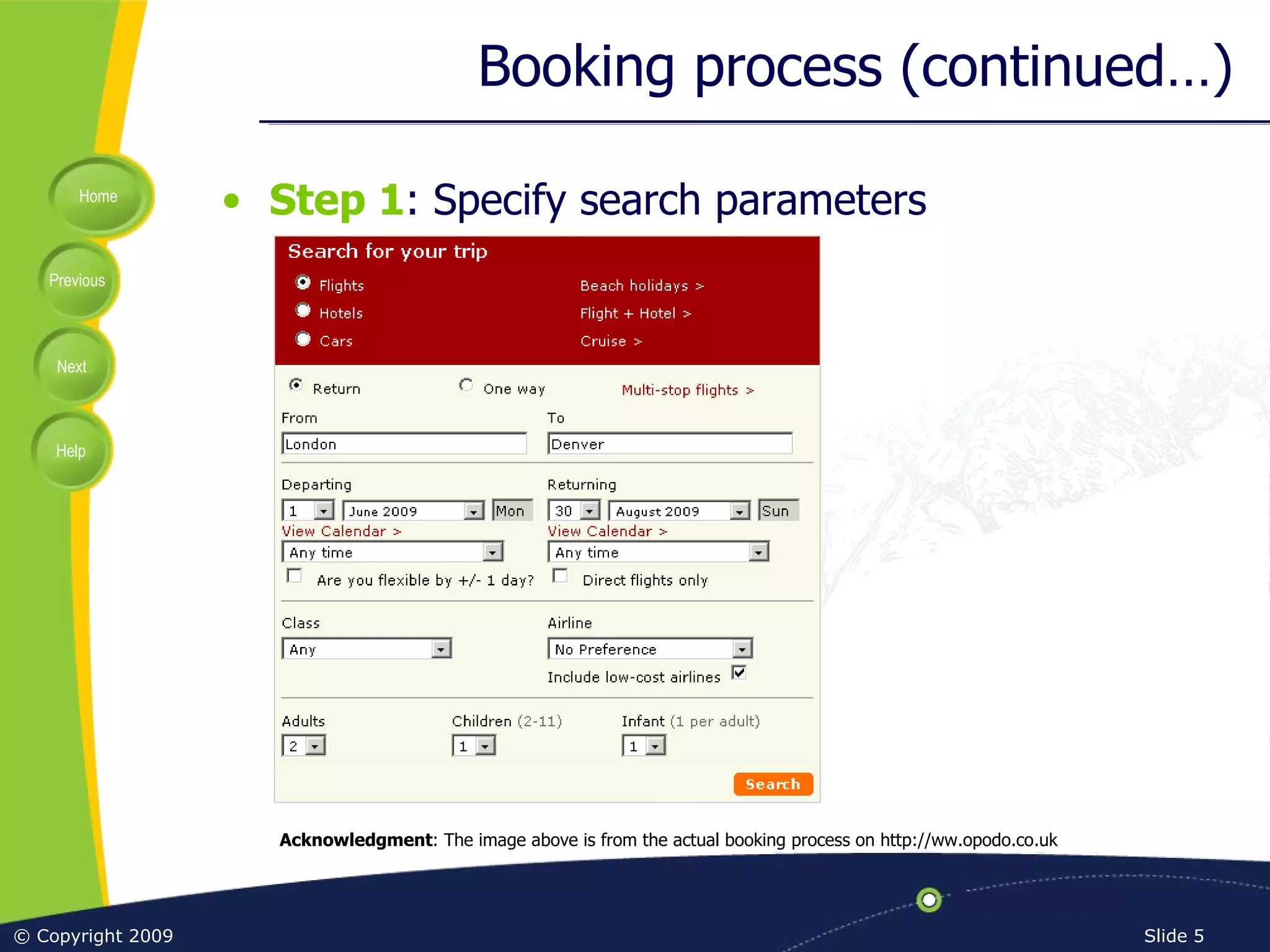
Booking process (continued…) Step 1 : Specify search parameters Acknowledgment : The image above is from the actual booking process on http://ww.opodo.co.uk
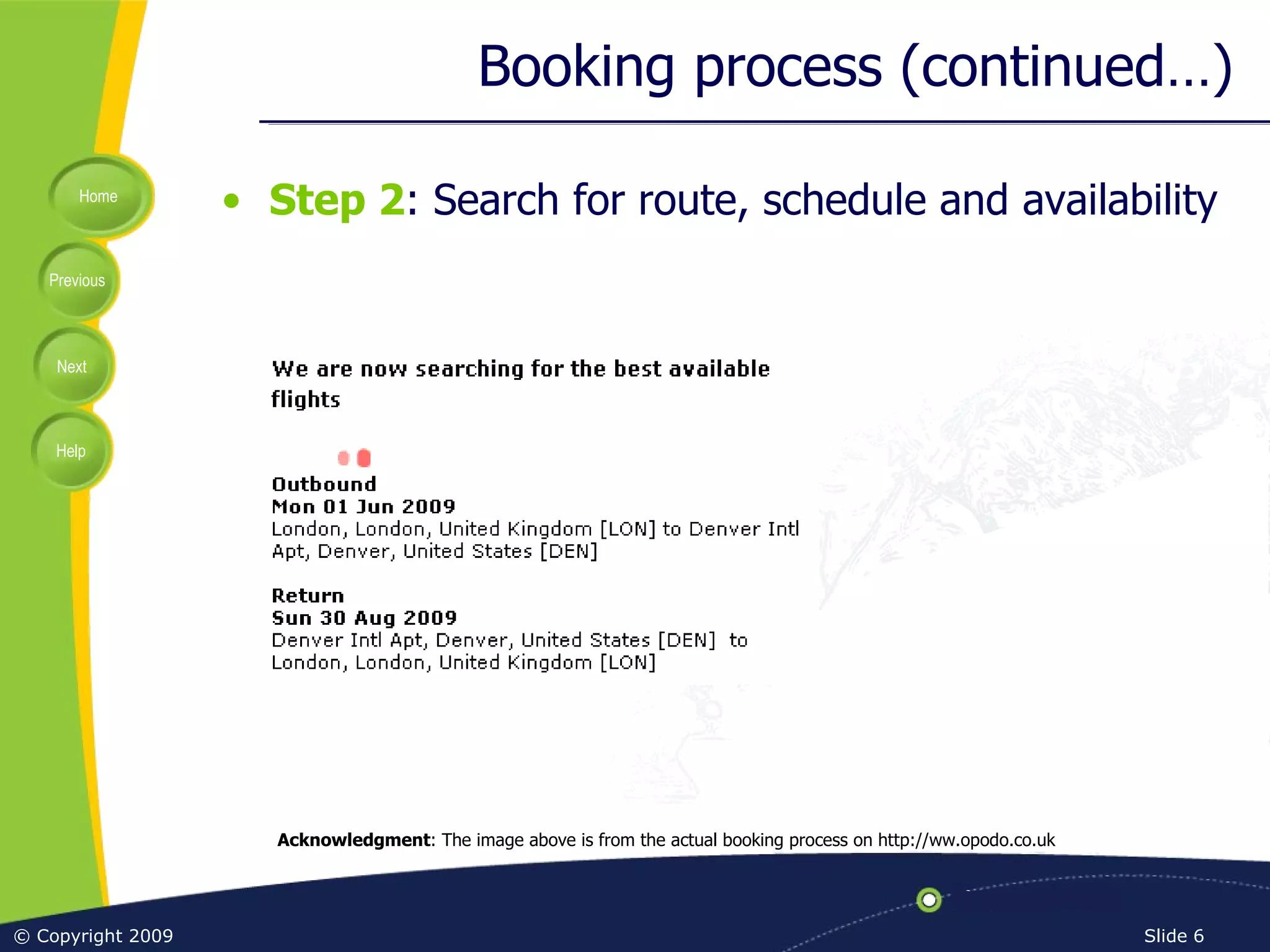
Booking process (continued…) Step 2 : Search for route, schedule and availability Acknowledgment : The image above is from the actual booking process on http://ww.opodo.co.uk
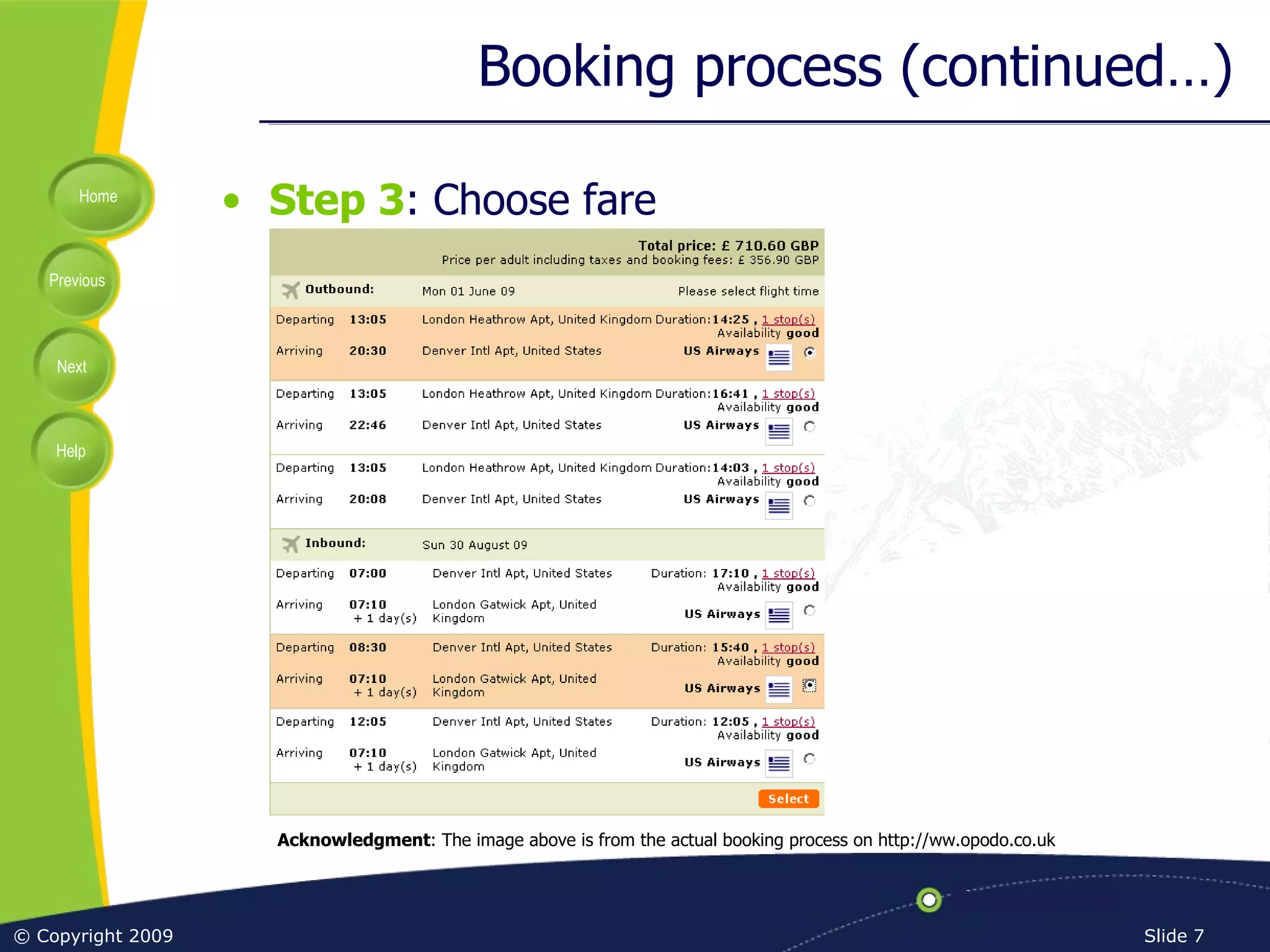
Booking process (continued…) Step 3 : Choose fare Acknowledgment : The image above is from the actual booking process on http://ww.opodo.co.uk
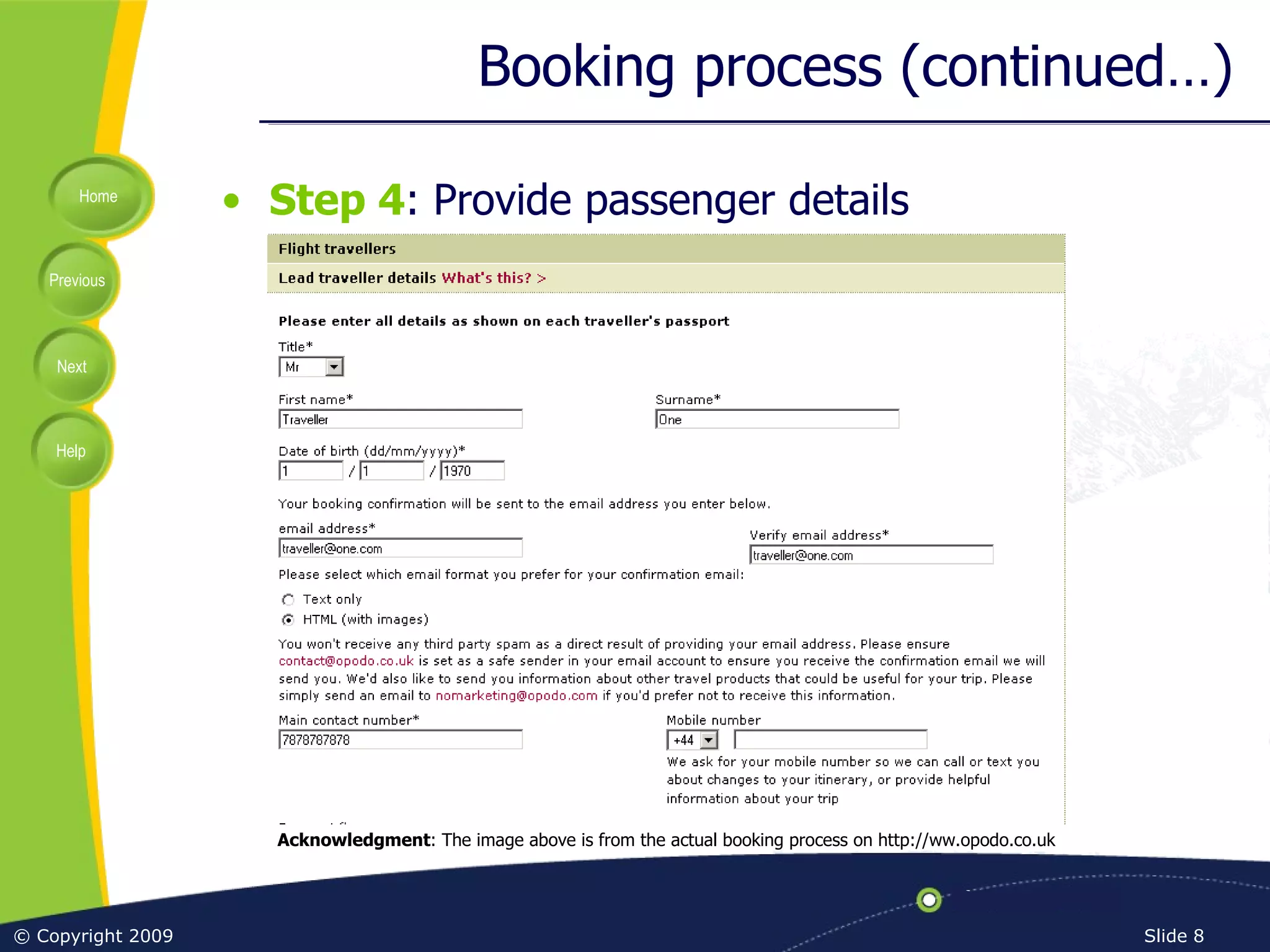
Booking process (continued…) Step 4 : Provide passenger details Acknowledgment : The image above is from the actual booking process on http://ww.opodo.co.uk
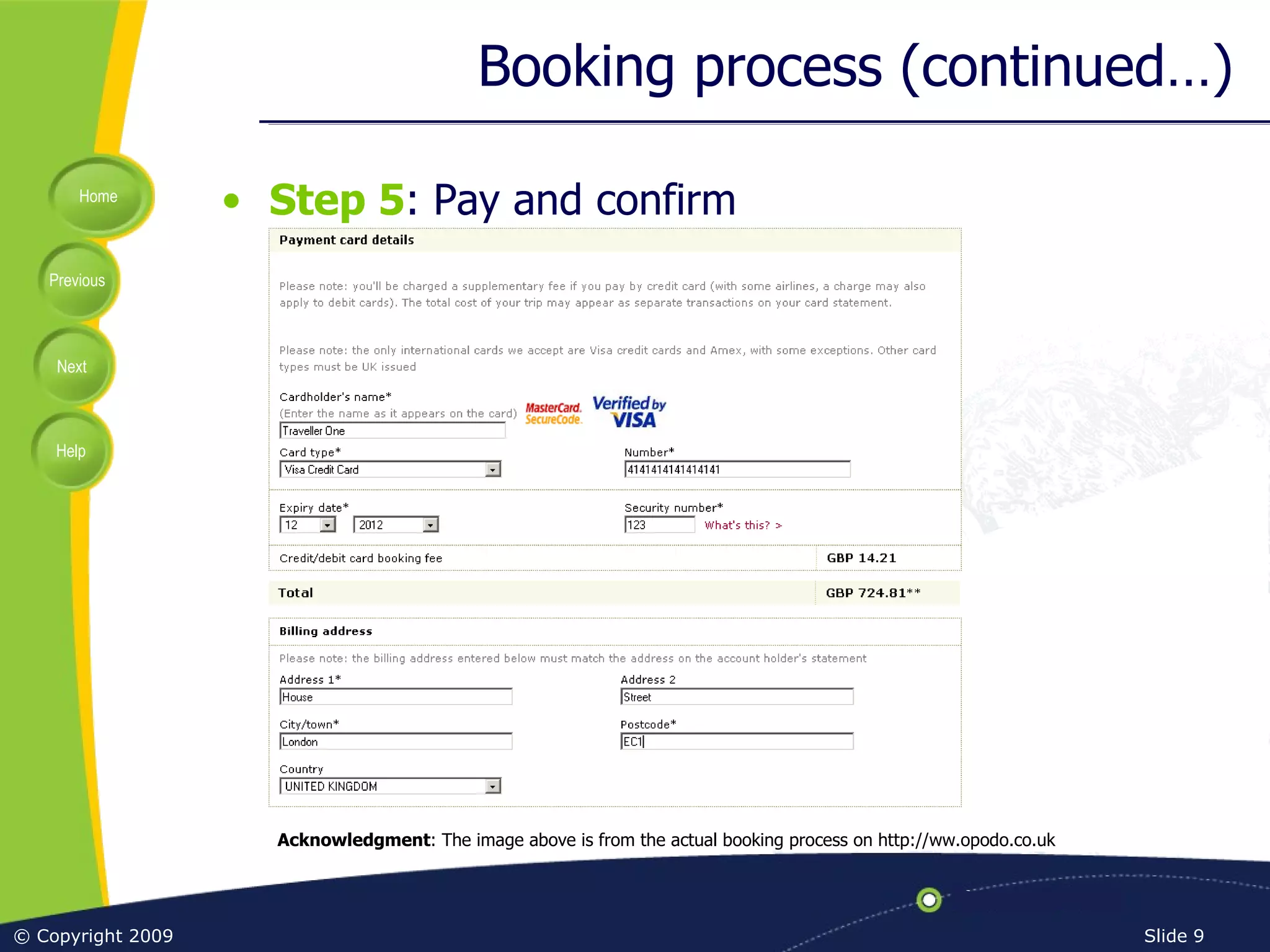
Booking process (continued…) Step 5 : Pay and confirm Acknowledgment : The image above is from the actual booking process on http://ww.opodo.co.uk
Airline booking process and systems involved
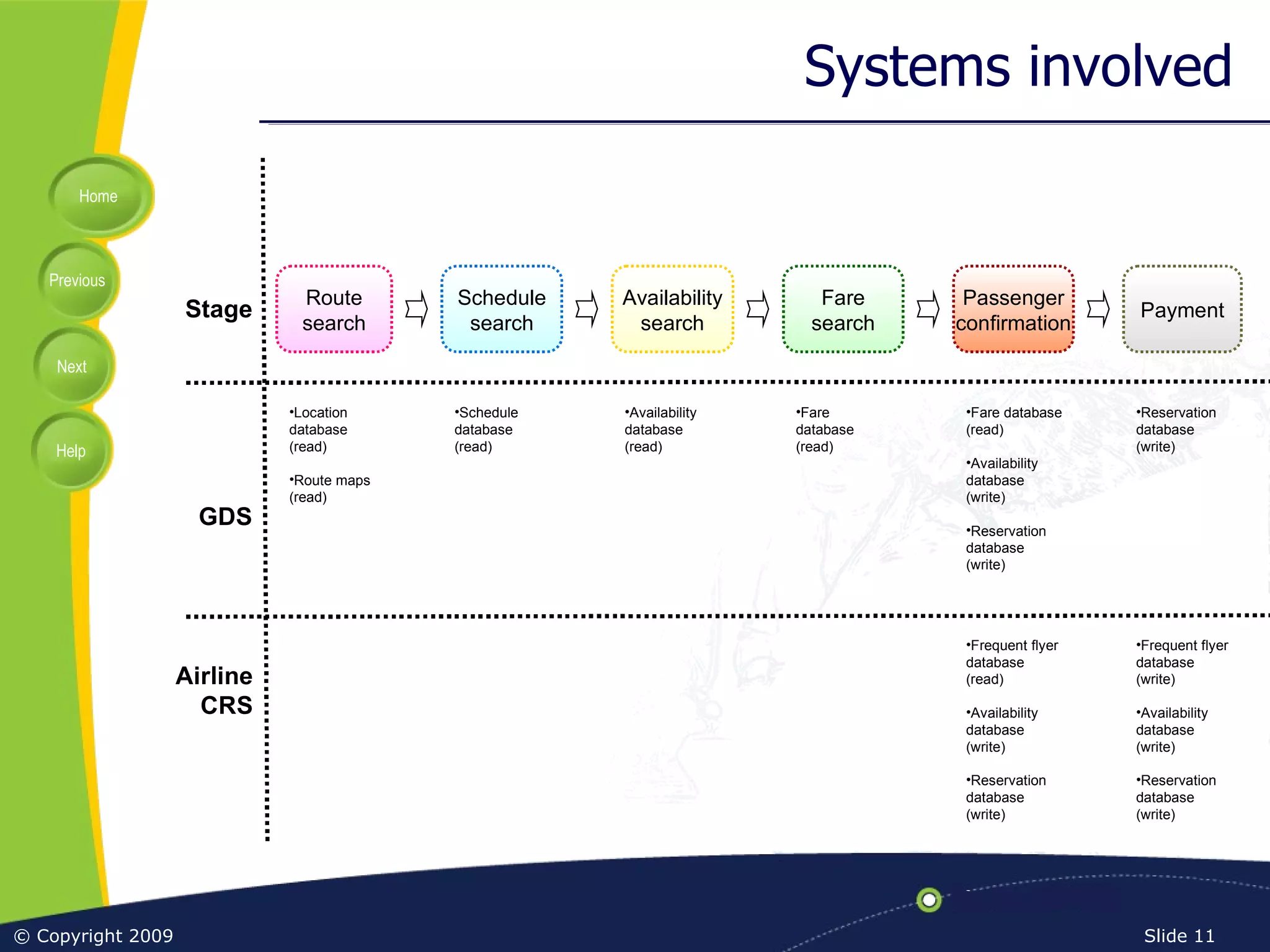
Systems involved Stage GDS Airline CRS Route search Availability search Fare search Passenger confirmation Payment Schedule search Location database (read) Route maps (read) Schedule database (read) Availability database (read) Fare  database (read) Frequent flyer database (read) Availability database (write) Reservation database (write) Fare database (read) Availability database (write) Reservation database (write) Reservation database (write) Frequent flyer database (write) Availability database (write) Reservation database (write)
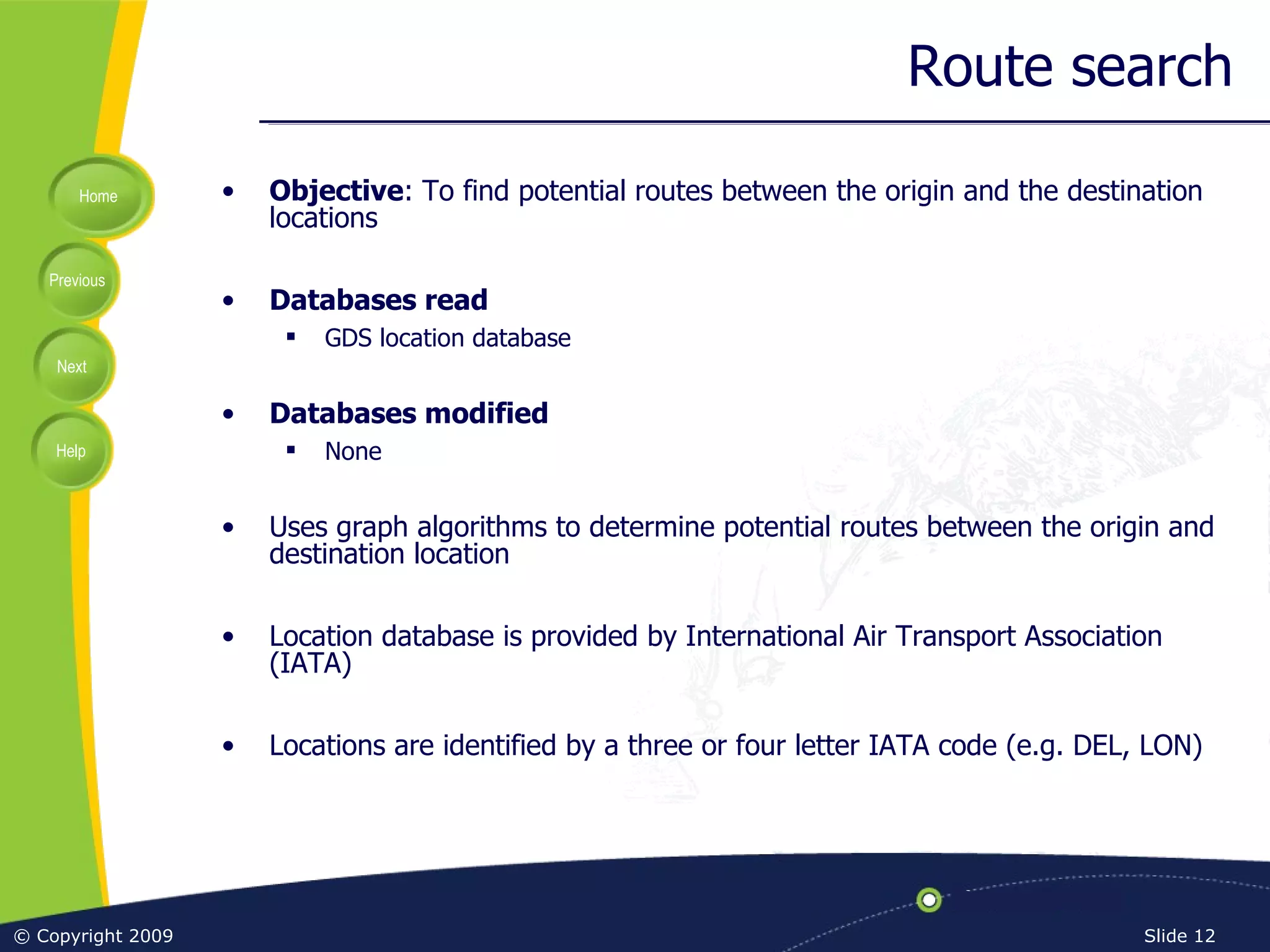
Route search Objective : To find potential routes between the origin and the destination locations Databases read GDS location database Databases modified None Uses graph algorithms to determine potential routes between the origin and destination location Location database is provided by International Air Transport Association (IATA) Locations are identified by a three or four letter IATA code (e.g. DEL, LON)
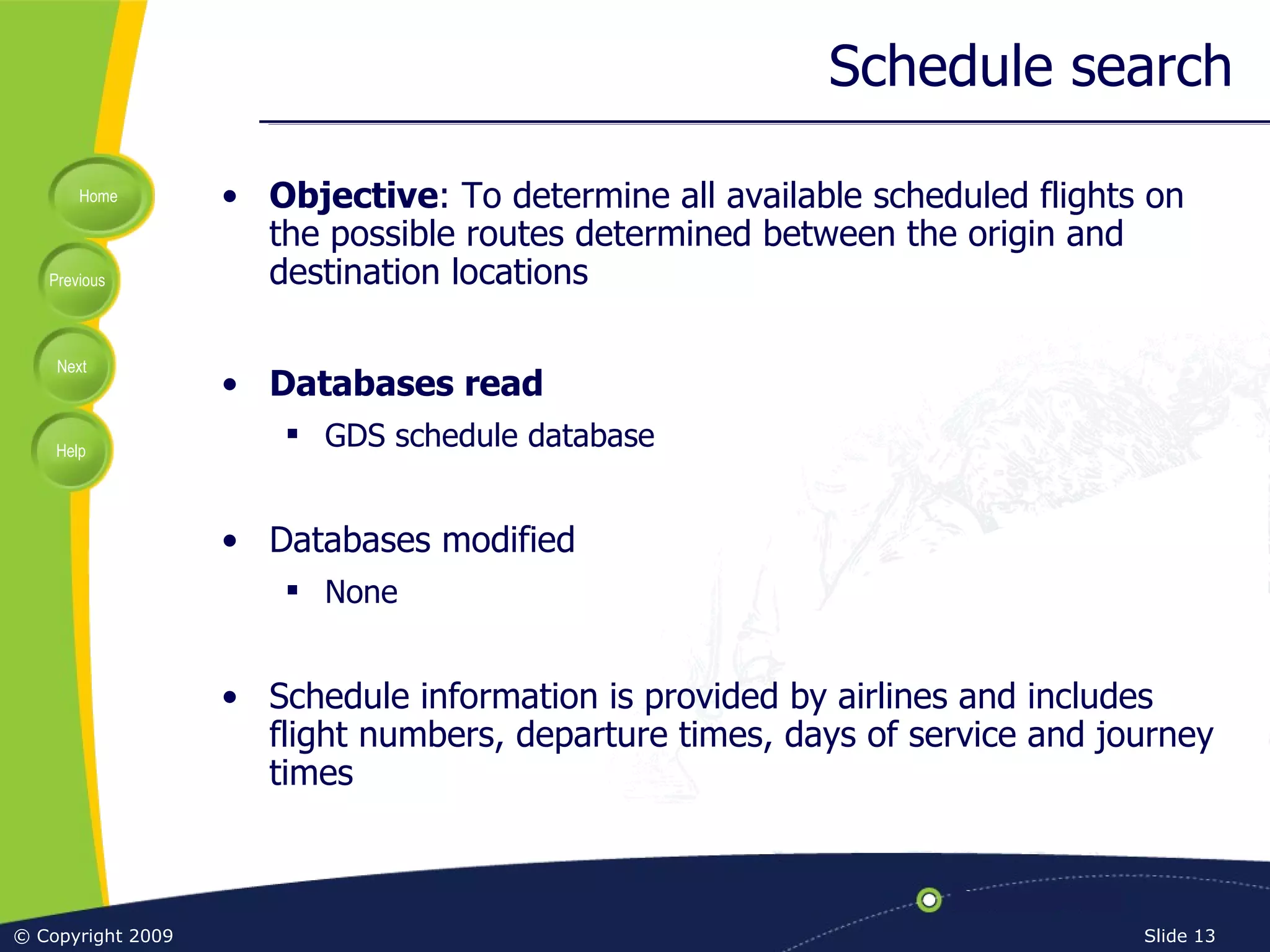
Schedule search Objective : To determine all available scheduled flights on the possible routes determined between the origin and destination locations Databases read GDS schedule database Databases modified None Schedule information is provided by airlines and includes flight numbers, departure times, days of service and journey times
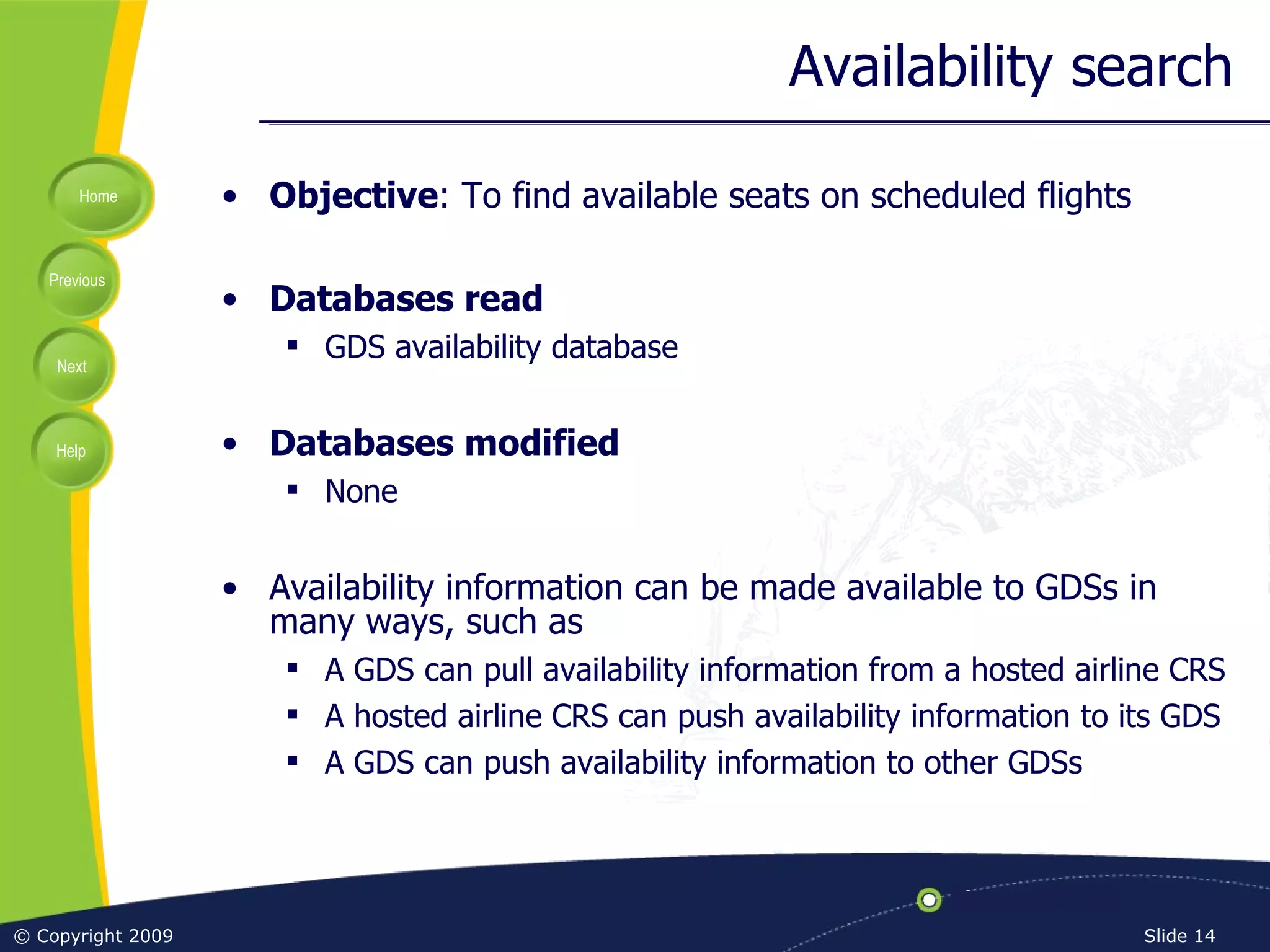
Availability search Objective : To find available seats on scheduled flights Databases read GDS availability database Databases modified None Availability information can be made available to GDSs in many ways, such as A GDS can pull availability information from a hosted airline CRS A hosted airline CRS can push availability information to its GDS A GDS can push availability information to other GDSs
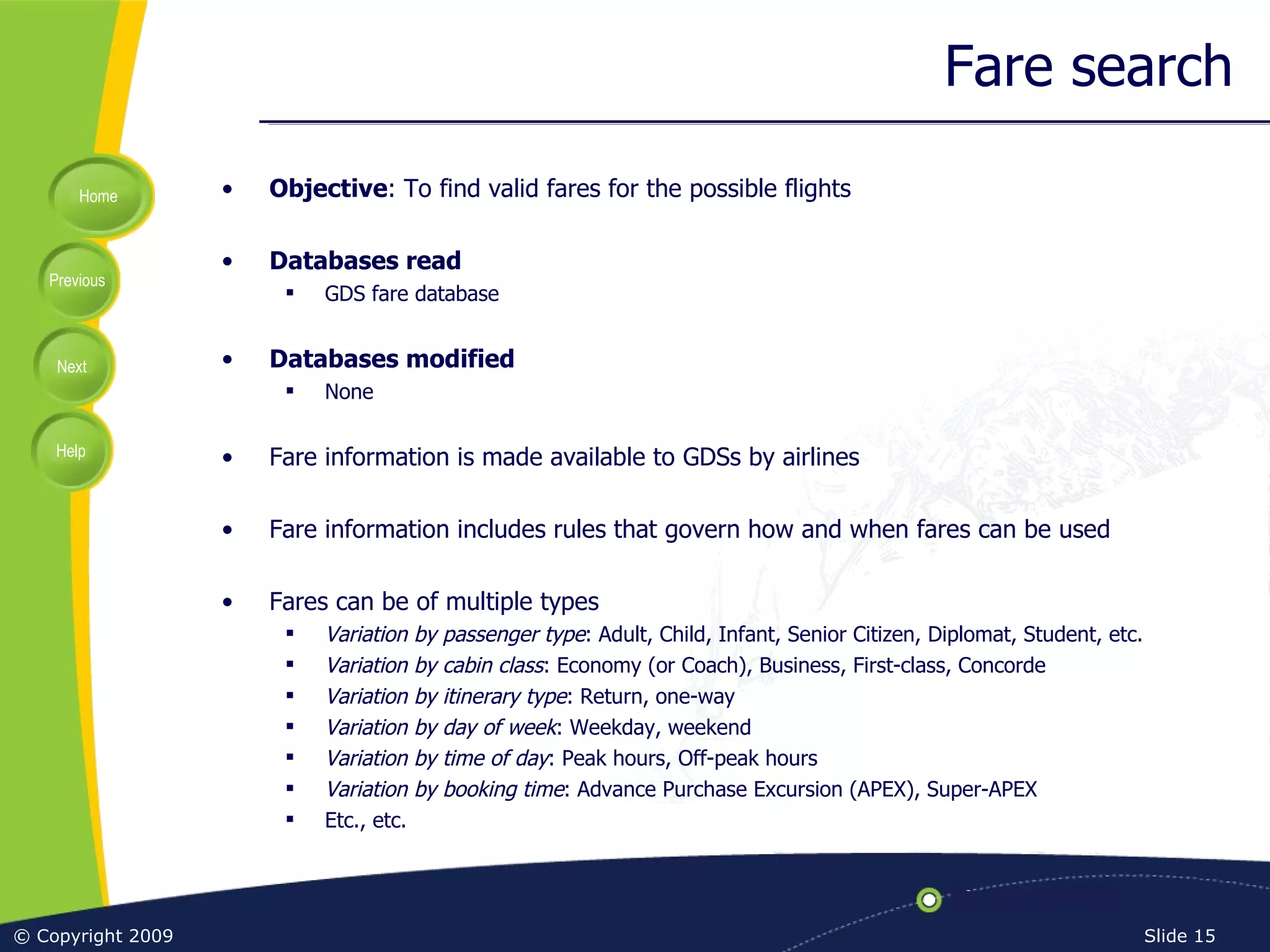
Fare search Objective : To find valid fares for the possible flights Databases read GDS fare database Databases modified None Fare information is made available to GDSs by airlines Fare information includes rules that govern how and when fares can be used Fares can be of multiple types Variation by passenger type : Adult, Child, Infant, Senior Citizen, Diplomat, Student, etc. Variation by cabin class : Economy (or Coach), Business, First-class, Concorde Variation by itinerary type : Return, one-way Variation by day of week : Weekday, weekend Variation by time of day : Peak hours, Off-peak hours Variation by booking time : Advance Purchase Excursion (APEX), Super-APEX Etc., etc.
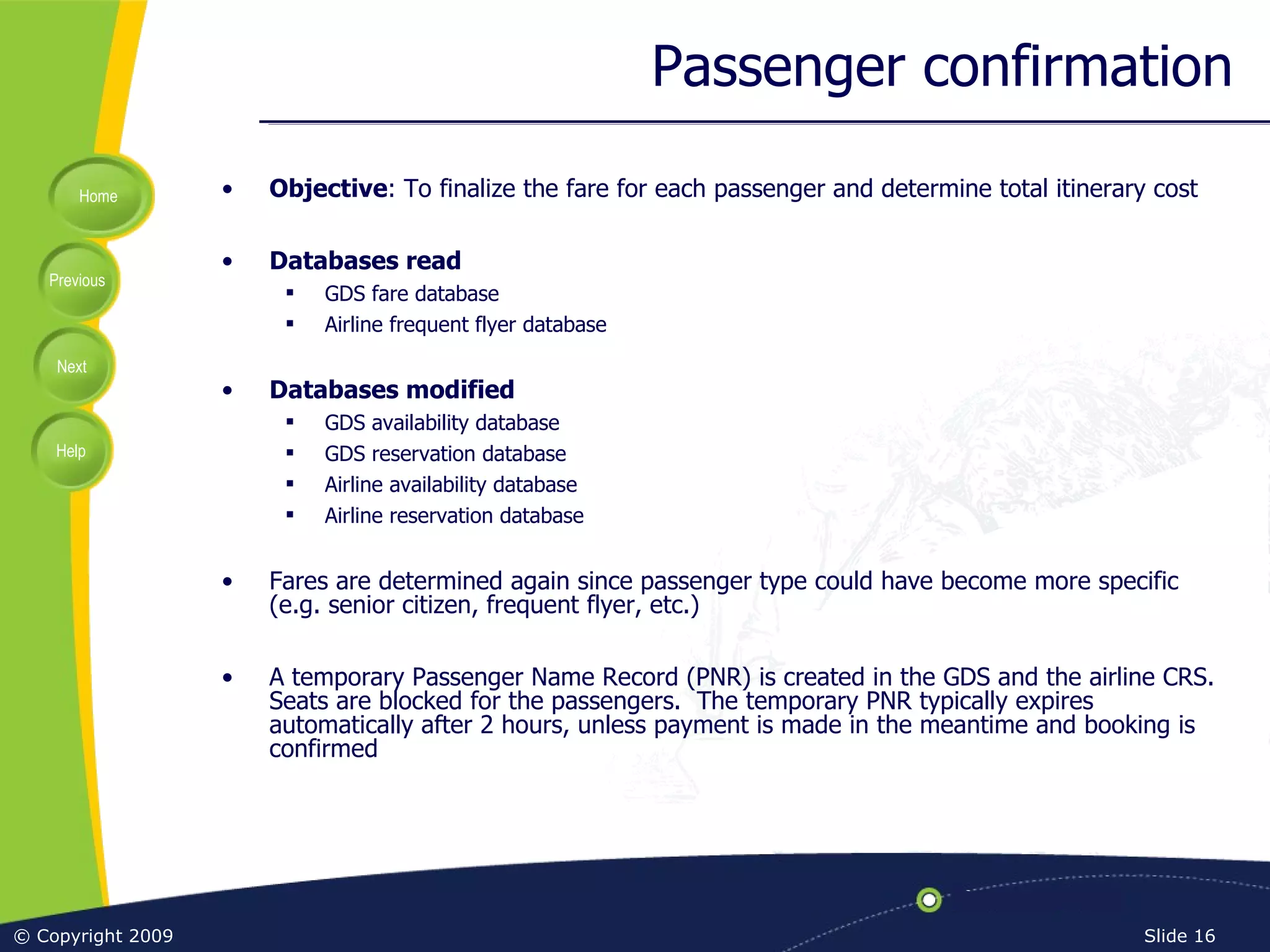
Passenger confirmation Objective : To finalize the fare for each passenger and determine total itinerary cost Databases read GDS fare database Airline frequent flyer database Databases modified GDS availability database GDS reservation database Airline availability database Airline reservation database Fares are determined again since passenger type could have become more specific (e.g. senior citizen, frequent flyer, etc.) A temporary Passenger Name Record (PNR) is created in the GDS and the airline CRS.  Seats are blocked for the passengers.  The temporary PNR typically expires automatically after 2 hours, unless payment is made in the meantime and booking is confirmed
Payment Objective : To take payment for the booking and confirmed it Databases read None Databases modified GDS availability database GDS reservation database Airline availability database Airline reservation database Payment information is attached to the PNR and the PNR is confirmed in the GDS and the airline CRS At times, the temporary PNR may get split into multiple PNRs in the airline CRS at this stage.  This would happen if any fare used for creating the temporary PNR ceases to be valid at the time of booking confirmation
Introduction to booking engines
Historical background The advent of Internet and e-Commerce opened up channels for airlines to take their inventory directly to consumers (passengers) However, since the airline CRSs and GDSs were based on mainframes, customers did not have direct access to these systems
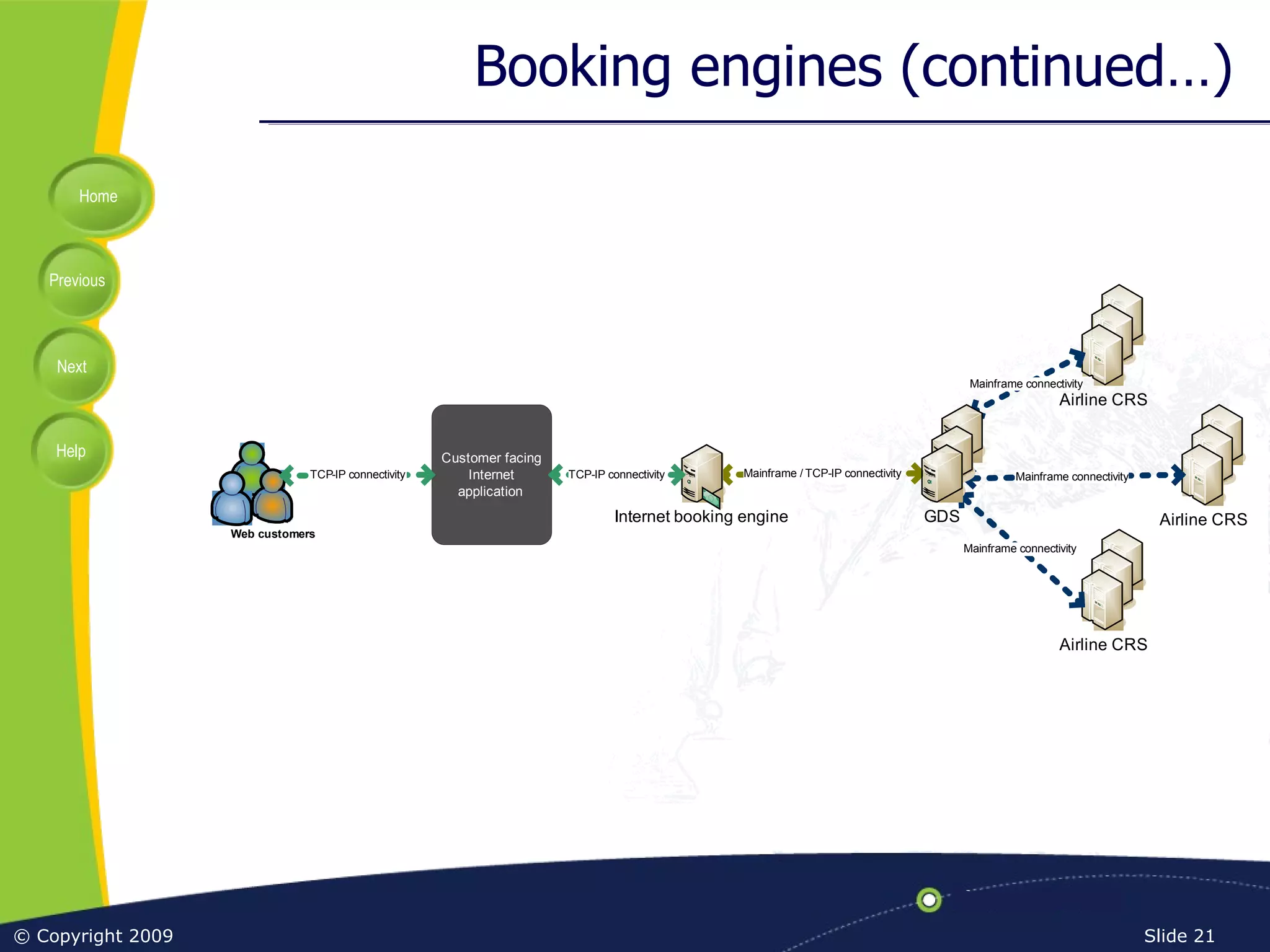
Booking engines The impedance mismatch between legacy mainframe technologies and TCP/IP based Internet applications led to the creation of Internet Booking Engines (IBEs) An Internet Booking Engine (or booking engine in short) is an application (or group of applications) that provides access to airline data through the Internet
Booking engines (continued…)
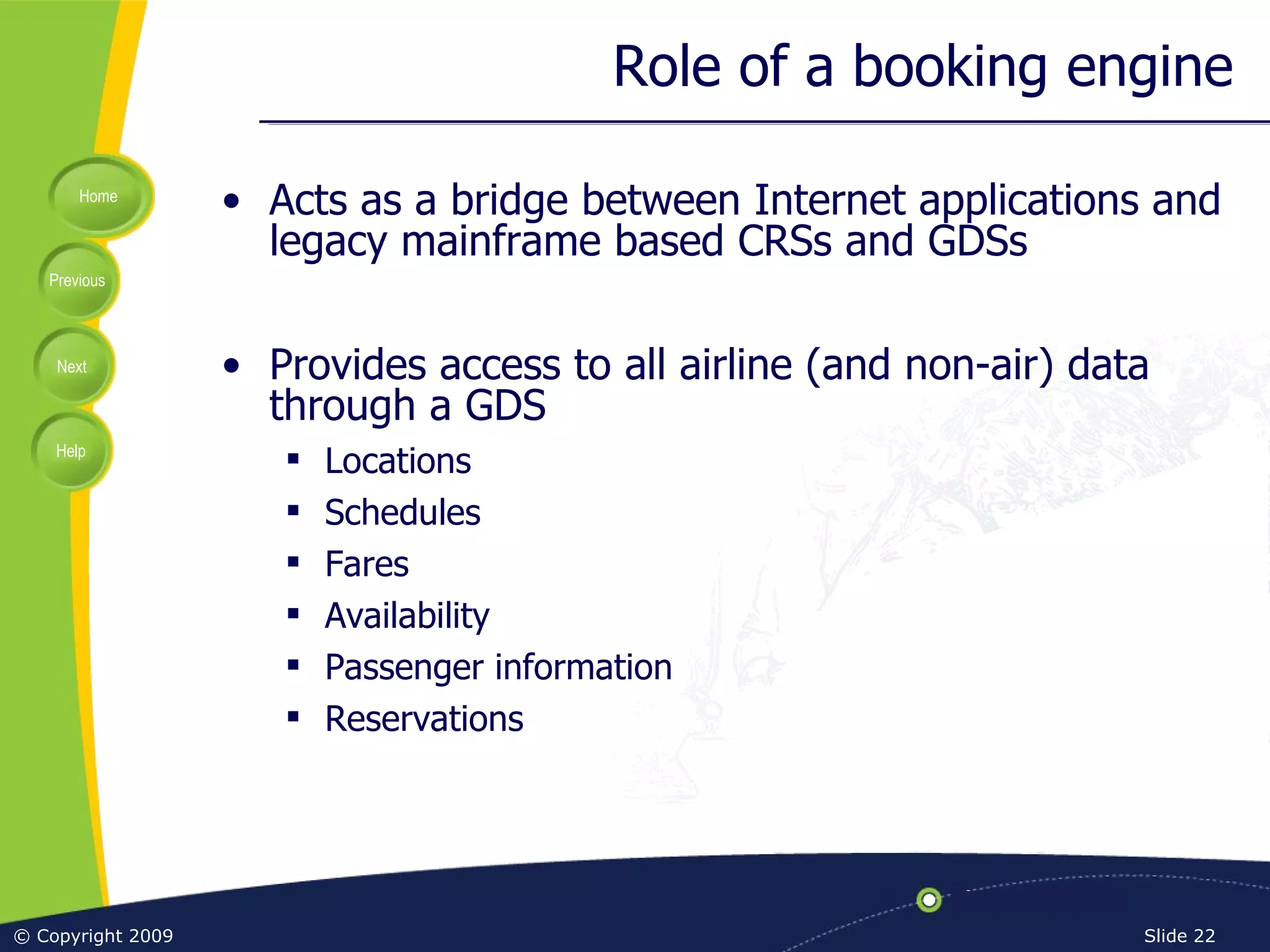
Role of a booking engine Acts as a bridge between Internet applications and legacy mainframe based CRSs and GDSs Provides access to all airline (and non-air) data through a GDS Locations Schedules Fares Availability Passenger information Reservations
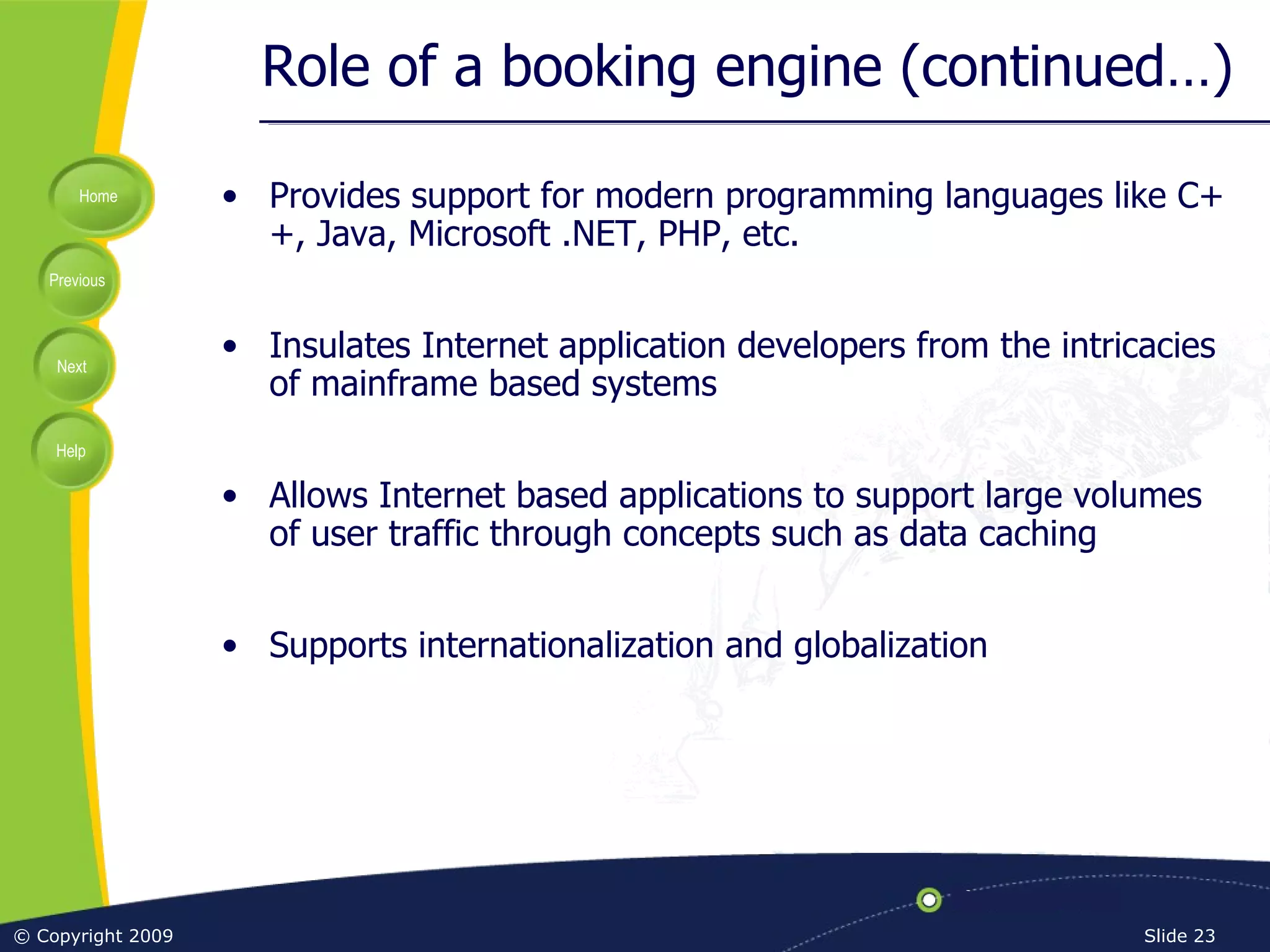
Role of a booking engine (continued…) Provides support for modern programming languages like C++, Java, Microsoft .NET, PHP, etc. Insulates Internet application developers from the intricacies of mainframe based systems Allows Internet based applications to support large volumes of user traffic through concepts such as data caching Supports internationalization and globalization
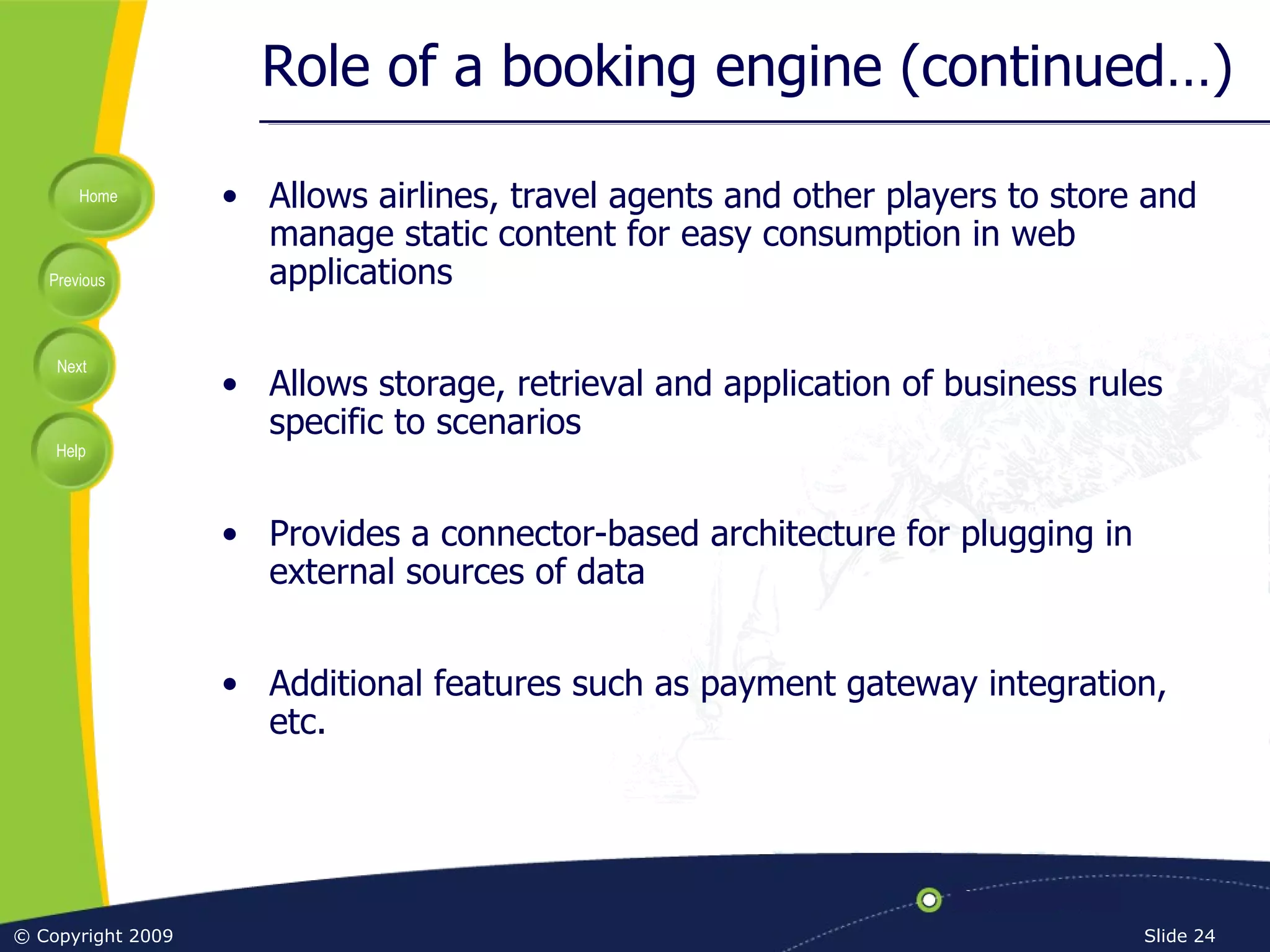
Role of a booking engine (continued…) Allows airlines, travel agents and other players to store and manage static content for easy consumption in web applications Allows storage, retrieval and application of business rules specific to scenarios Provides a connector-based architecture for plugging in external sources of data Additional features such as payment gateway integration, etc.
Major booking engines Amadeus e-Commerce suite Offered as a software-as-a-service (SaS) or hosted solution Multiple built-in pages supporting Web 2.0 and CSS/XHTML that can be readily leveraged by small websites Modular, allowing purchase on individual modules (schedule, pricing, etc.) Does not support any standards Used by  www.opodo.com Datalex Travel Distribution Platform Offered as a software-as-a-service (SaS) or hosted solution Supports out-of-GDS fares, thereby reducing reliance on GDSs Supports OpenTravel (an open travel industry standard) where possible Used by many major airlines
Major booking engines (continued…) Galileo Online Travel Offered as a software-as-a-service (SaS) or hosted solution Web services based architecture Highly stable solution SITA Aero suite
Important terms in the booking process
Search types Schedule search : When customer is interested only in checking flight timetables.  Also known as  Calendar search Fare search : When a customer is interested in seat availability at (usually) the lowest price
Flight types Non-stop : No break in journey between the origin (location of first departure) and final destination (location of last touch-down) Direct : One or more breaks in journey between the origin and final destination without passengers having to disembark from the aircraft Stop-over : One or more breaks in journey between the origin and final destination with passengers having to disembark from aircraft either to change flights or to wait outside the aircraft.  Sometimes referred to as  Indirect Change-of-gauge : A special type of stop-over flight where passengers have to change aircrafts at an intermediate point but the flight number remains the same
Cabin classes Allow an aircraft to be divided into multiple classes of service.  Higher classes are usually more comfortable, come with additional services and are more expensive Economy : The most basic class of service on most aircrafts.  Provides basic seat accommodation and minimal in-flight catering service.  Commonly purchased by leisure or family travellers.  Known as  Coach  in North America Business : Provides higher quality of service such as better seat accommodation and catering service.  Commonly purchased by business travellers (executives) First-class : Most expensive and most comfortable class, usually with personalized in-flight catering and entertainment service
Booking codes Used by airlines to introduce price discrimination within a cabin class 26 booking codes are possible (A-Z) Economy class booking codes : Y, B, M, H, N, G, K, L, O, Q, R, S, T, U, V, W, X Business class booking codes : C, J, D, I, Z First-class booking codes : F, A, P, R
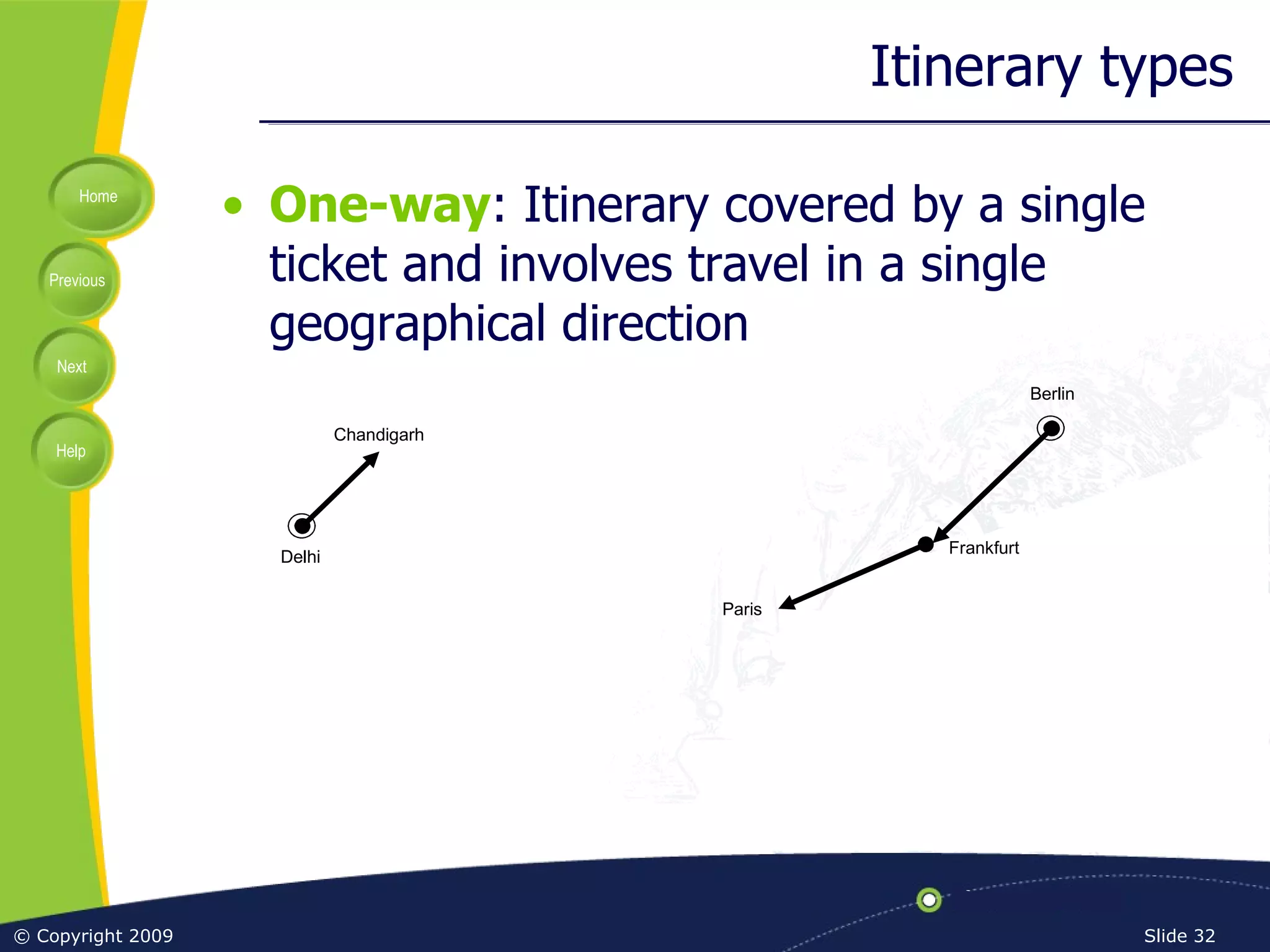
Itinerary types One-way : Itinerary covered by a single ticket and involves travel in a single geographical direction Delhi Chandigarh Frankfurt Berlin Paris
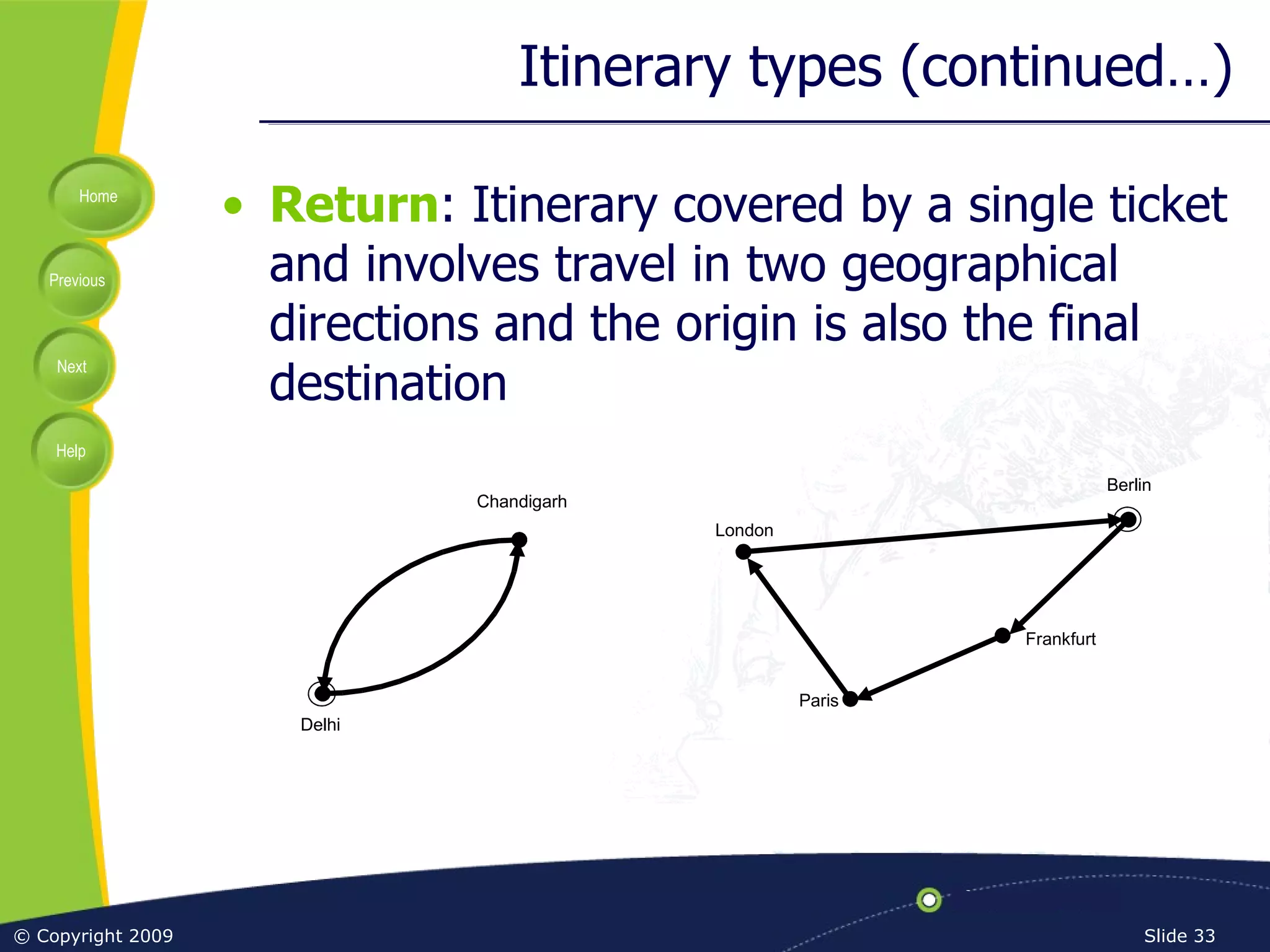
Itinerary types (continued…) Return : Itinerary covered by a single ticket and involves travel in two geographical directions and the origin is also the final destination Delhi Chandigarh Frankfurt Berlin Paris London
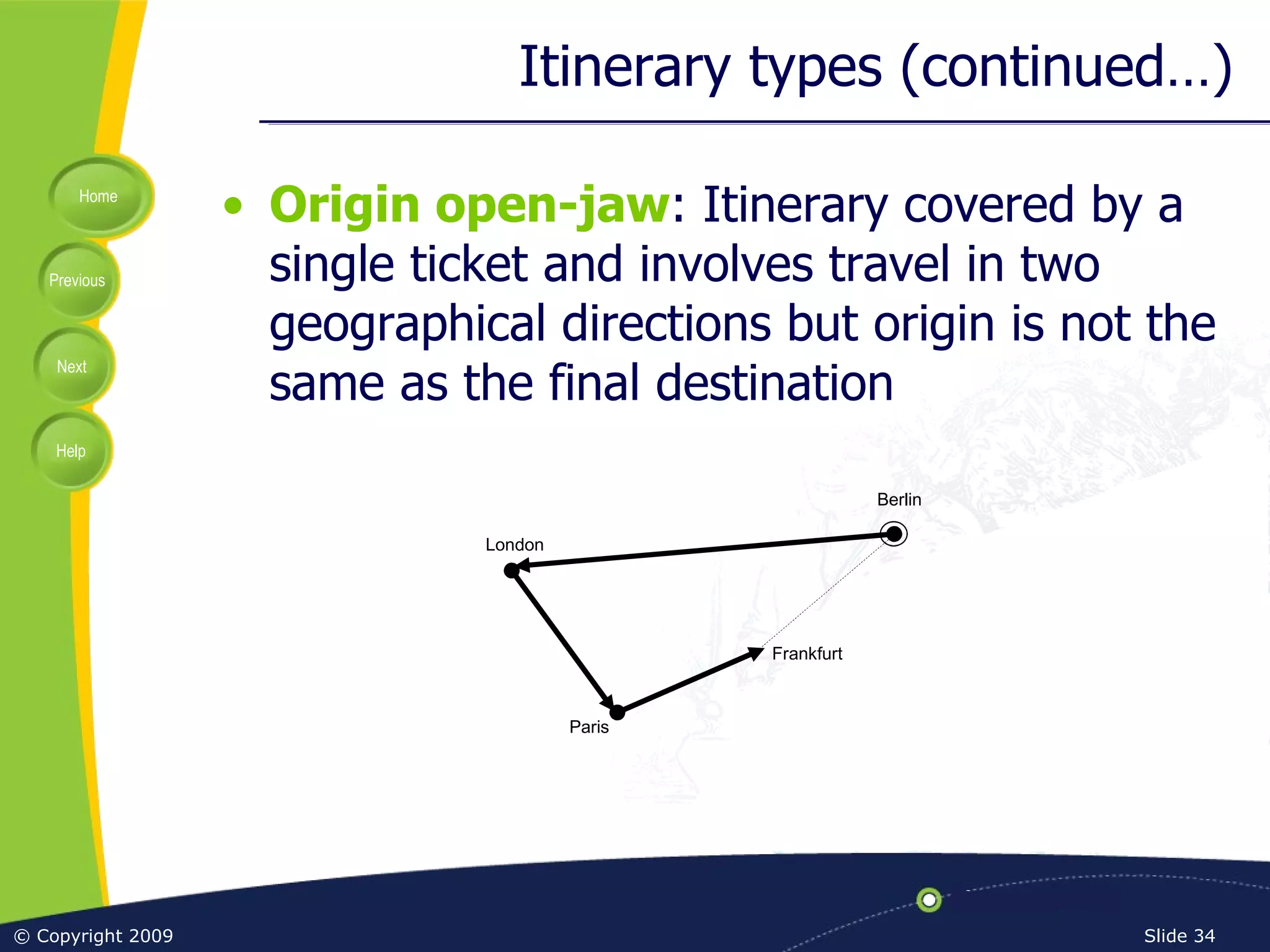
Itinerary types (continued…) Origin open-jaw : Itinerary covered by a single ticket and involves travel in two geographical directions but origin is not the same as the final destination Frankfurt Berlin Paris London
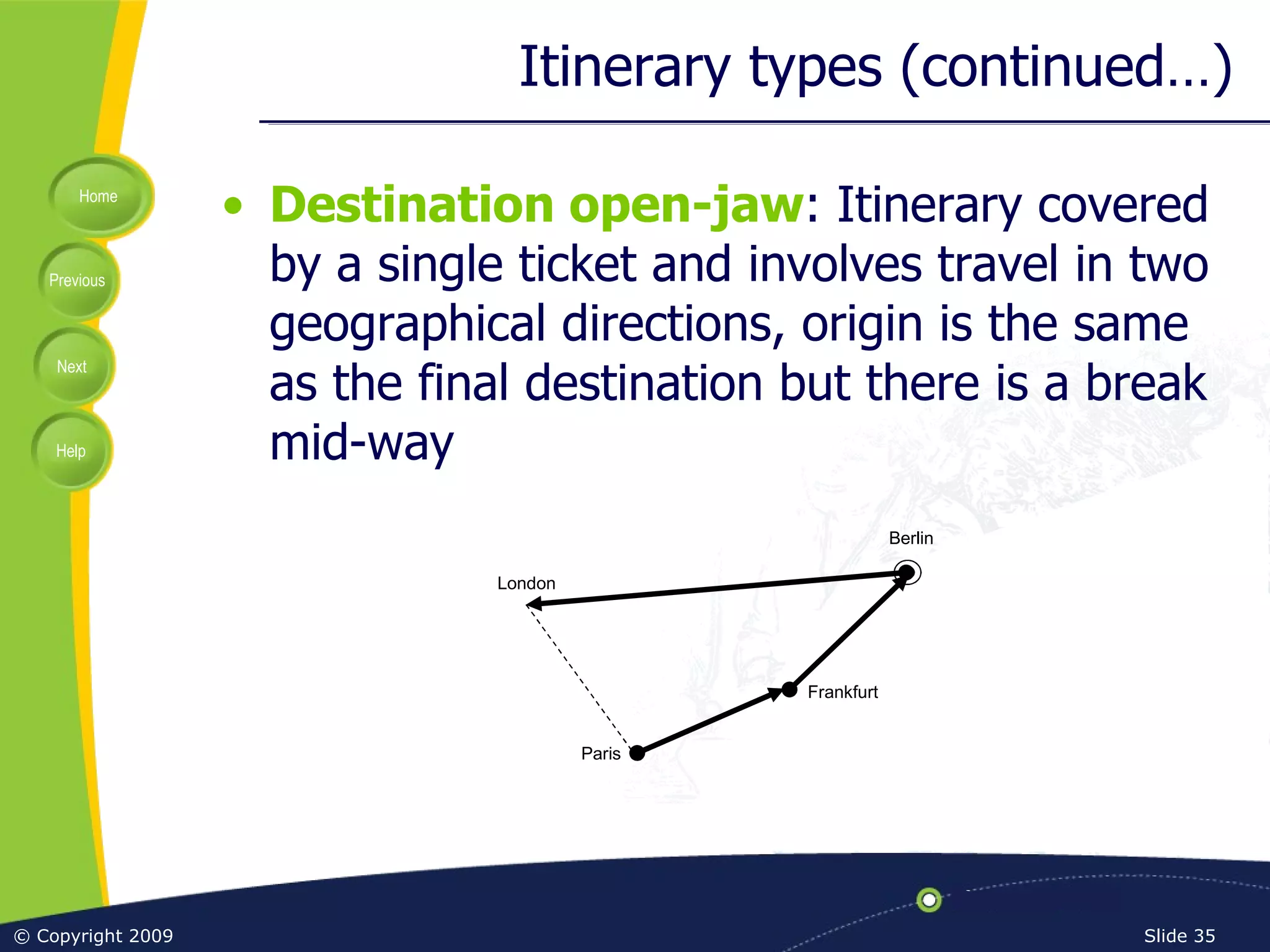
Itinerary types (continued…) Destination open-jaw : Itinerary covered by a single ticket and involves travel in two geographical directions, origin is the same as the final destination but there is a break mid-way Frankfurt Berlin Paris London
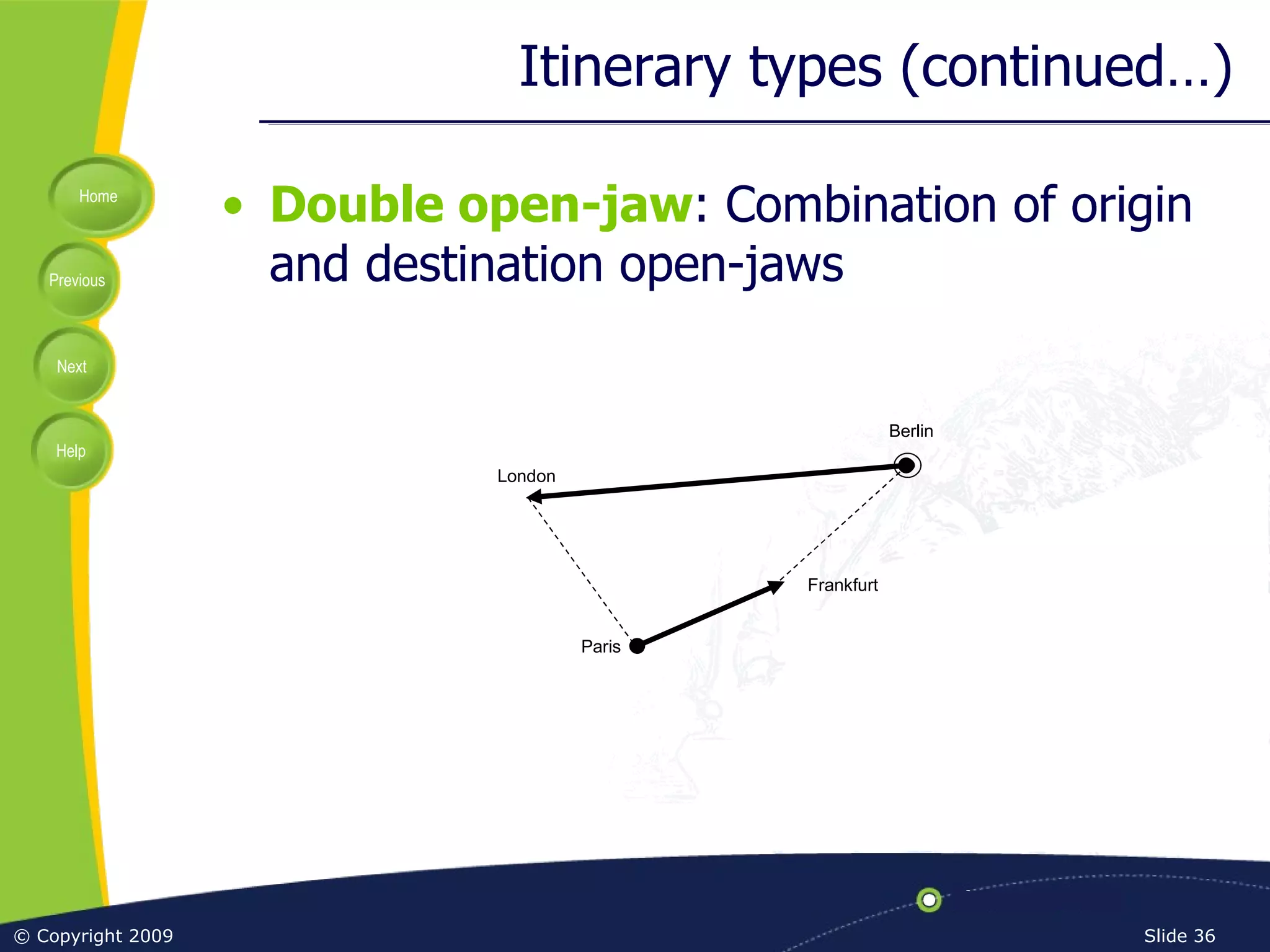
Itinerary types (continued…) Double open-jaw : Combination of origin and destination open-jaws Frankfurt Berlin Paris London
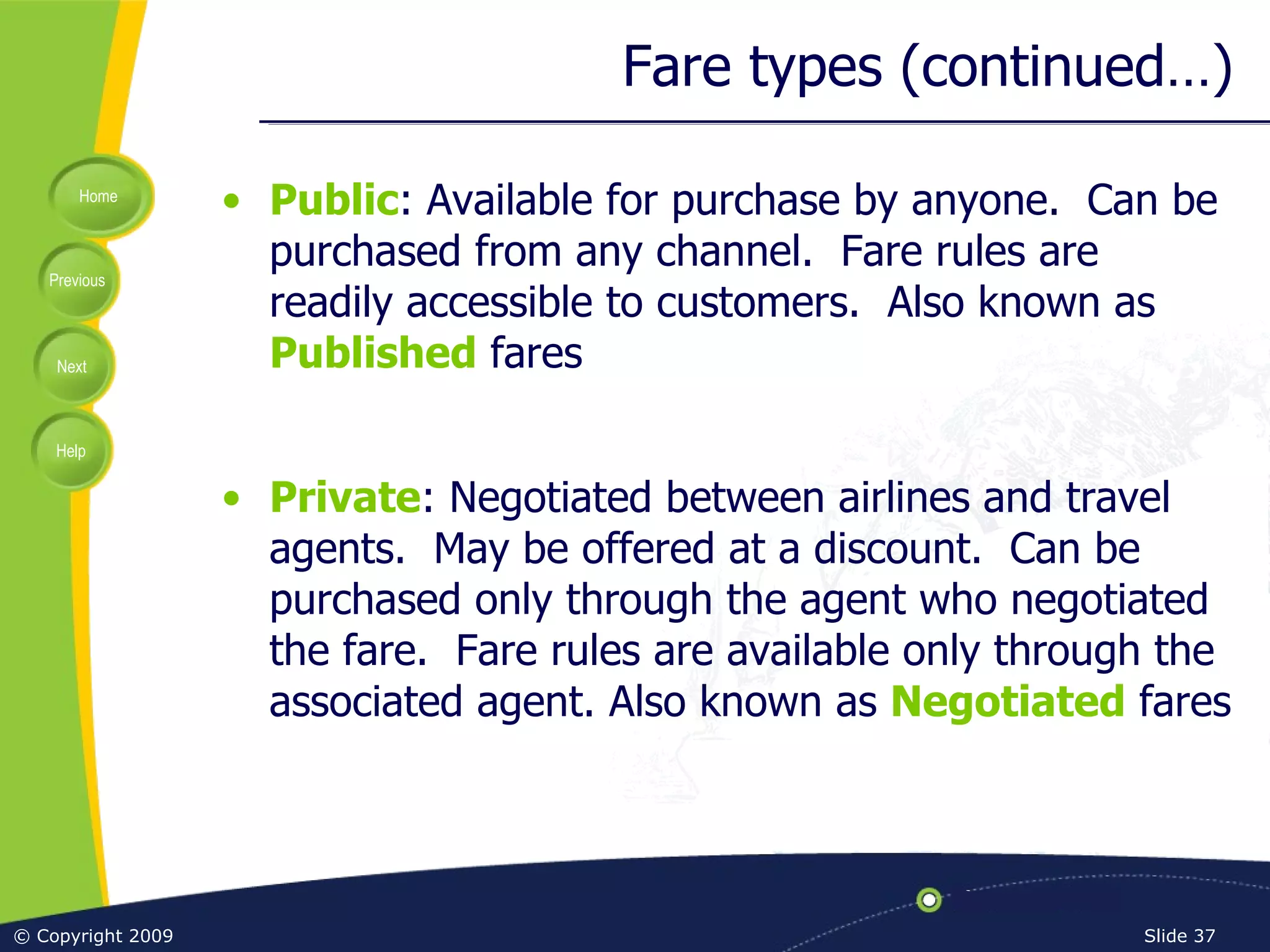
Fare types (continued…) Public : Available for purchase by anyone.  Can be purchased from any channel.  Fare rules are readily accessible to customers.  Also known as  Published  fares Private : Negotiated between airlines and travel agents.  May be offered at a discount.  Can be purchased only through the agent who negotiated the fare.  Fare rules are available only through the associated agent. Also known as  Negotiated  fares
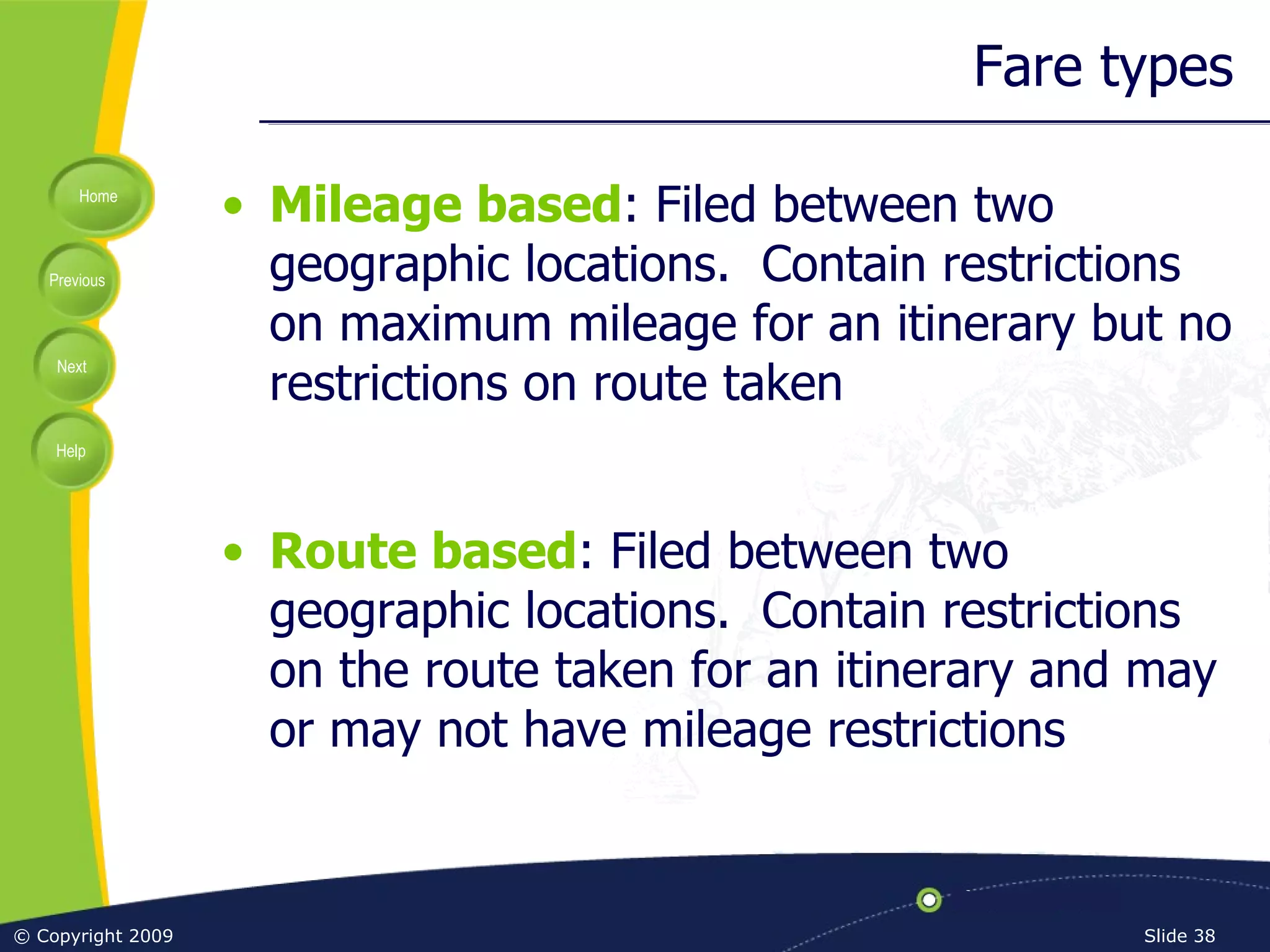
Fare types Mileage based : Filed between two geographic locations.  Contain restrictions on maximum mileage for an itinerary but no restrictions on route taken Route based : Filed between two geographic locations.  Contain restrictions on the route taken for an itinerary and may or may not have mileage restrictions
Fare types (continued…) One-way : A mileage based fare that can be used to price all types of itineraries Return : A mileage based fare that can be used to price only return or open-jaw itineraries Half return : A mileage based fare that can be used to price return itineraries using the full fare or one-way itineraries using half the full fare
Recap and summary
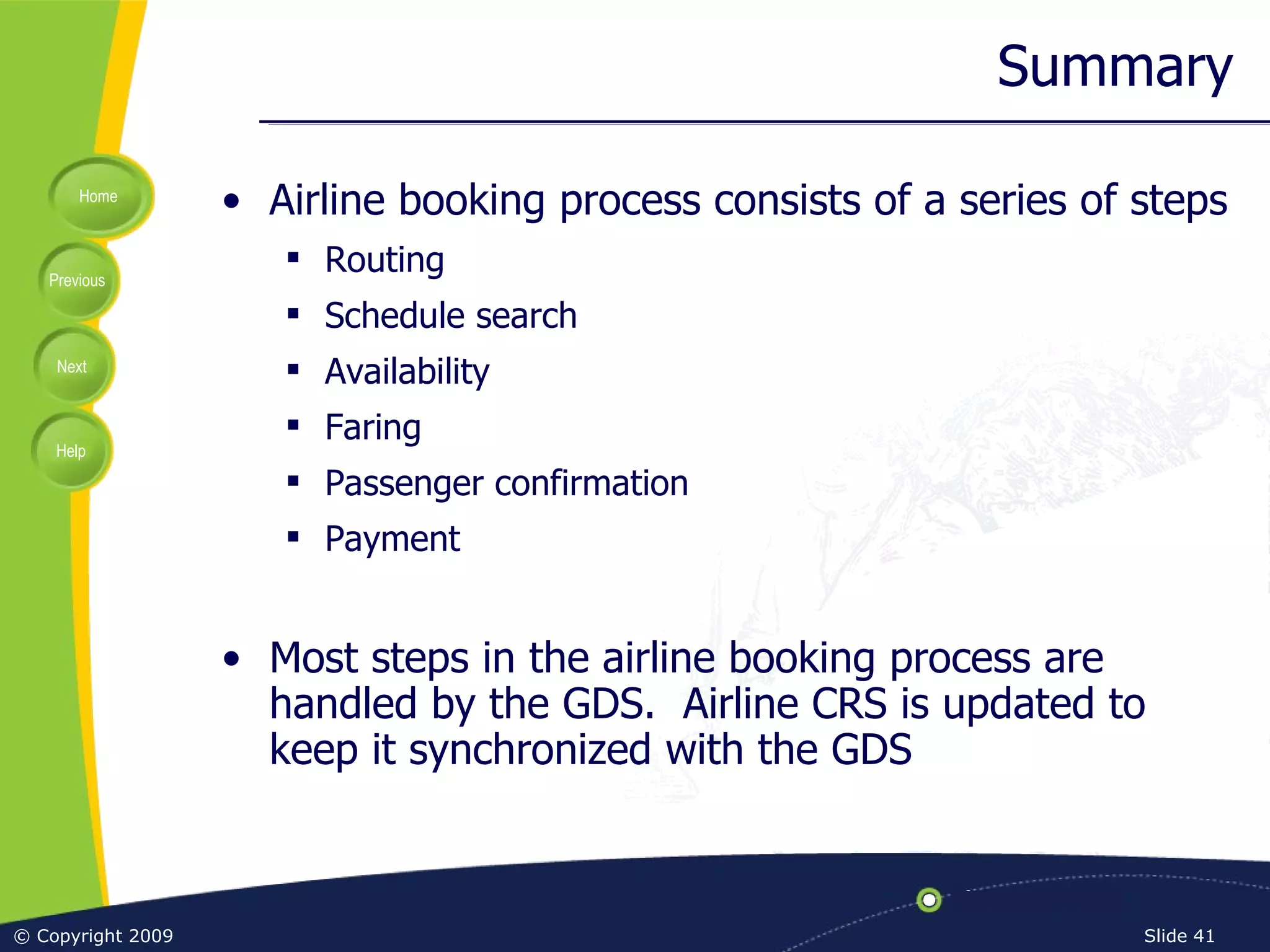
Summary Airline booking process consists of a series of steps Routing Schedule search Availability Faring Passenger confirmation Payment Most steps in the airline booking process are handled by the GDS.  Airline CRS is updated to keep it synchronized with the GDS
Summary (continued…) Internet booking engines were created to bridge the impedance mismatch between mainframe based GDSs and Internet technologies Most GDS companies offer one or more booking engines.  Non-GDS companies like DataLex and SITA also offer popular booking engines Internet application developers must access GDS through a booking engine
Questions?

Overview of airline booking process

  • 1.
    Overview March 2009Airline booking process
  • 2.
    Agenda Overview ofairline booking process Overview of systems involved Introduction to booking engines
  • 3.
    Overview of airlinebooking process
  • 4.
    Booking process Theprocess of searching for and booking of available airline seats Involves multiple steps, executed one by one
  • 5.
    Booking process (continued…)Step 1 : Specify search parameters Acknowledgment : The image above is from the actual booking process on http://ww.opodo.co.uk
  • 6.
    Booking process (continued…)Step 2 : Search for route, schedule and availability Acknowledgment : The image above is from the actual booking process on http://ww.opodo.co.uk
  • 7.
    Booking process (continued…)Step 3 : Choose fare Acknowledgment : The image above is from the actual booking process on http://ww.opodo.co.uk
  • 8.
    Booking process (continued…)Step 4 : Provide passenger details Acknowledgment : The image above is from the actual booking process on http://ww.opodo.co.uk
  • 9.
    Booking process (continued…)Step 5 : Pay and confirm Acknowledgment : The image above is from the actual booking process on http://ww.opodo.co.uk
  • 10.
    Airline booking processand systems involved
  • 11.
    Systems involved StageGDS Airline CRS Route search Availability search Fare search Passenger confirmation Payment Schedule search Location database (read) Route maps (read) Schedule database (read) Availability database (read) Fare database (read) Frequent flyer database (read) Availability database (write) Reservation database (write) Fare database (read) Availability database (write) Reservation database (write) Reservation database (write) Frequent flyer database (write) Availability database (write) Reservation database (write)
  • 12.
    Route search Objective: To find potential routes between the origin and the destination locations Databases read GDS location database Databases modified None Uses graph algorithms to determine potential routes between the origin and destination location Location database is provided by International Air Transport Association (IATA) Locations are identified by a three or four letter IATA code (e.g. DEL, LON)
  • 13.
    Schedule search Objective: To determine all available scheduled flights on the possible routes determined between the origin and destination locations Databases read GDS schedule database Databases modified None Schedule information is provided by airlines and includes flight numbers, departure times, days of service and journey times
  • 14.
    Availability search Objective: To find available seats on scheduled flights Databases read GDS availability database Databases modified None Availability information can be made available to GDSs in many ways, such as A GDS can pull availability information from a hosted airline CRS A hosted airline CRS can push availability information to its GDS A GDS can push availability information to other GDSs
  • 15.
    Fare search Objective: To find valid fares for the possible flights Databases read GDS fare database Databases modified None Fare information is made available to GDSs by airlines Fare information includes rules that govern how and when fares can be used Fares can be of multiple types Variation by passenger type : Adult, Child, Infant, Senior Citizen, Diplomat, Student, etc. Variation by cabin class : Economy (or Coach), Business, First-class, Concorde Variation by itinerary type : Return, one-way Variation by day of week : Weekday, weekend Variation by time of day : Peak hours, Off-peak hours Variation by booking time : Advance Purchase Excursion (APEX), Super-APEX Etc., etc.
  • 16.
    Passenger confirmation Objective: To finalize the fare for each passenger and determine total itinerary cost Databases read GDS fare database Airline frequent flyer database Databases modified GDS availability database GDS reservation database Airline availability database Airline reservation database Fares are determined again since passenger type could have become more specific (e.g. senior citizen, frequent flyer, etc.) A temporary Passenger Name Record (PNR) is created in the GDS and the airline CRS. Seats are blocked for the passengers. The temporary PNR typically expires automatically after 2 hours, unless payment is made in the meantime and booking is confirmed
  • 17.
    Payment Objective :To take payment for the booking and confirmed it Databases read None Databases modified GDS availability database GDS reservation database Airline availability database Airline reservation database Payment information is attached to the PNR and the PNR is confirmed in the GDS and the airline CRS At times, the temporary PNR may get split into multiple PNRs in the airline CRS at this stage. This would happen if any fare used for creating the temporary PNR ceases to be valid at the time of booking confirmation
  • 18.
  • 19.
    Historical background Theadvent of Internet and e-Commerce opened up channels for airlines to take their inventory directly to consumers (passengers) However, since the airline CRSs and GDSs were based on mainframes, customers did not have direct access to these systems
  • 20.
    Booking engines Theimpedance mismatch between legacy mainframe technologies and TCP/IP based Internet applications led to the creation of Internet Booking Engines (IBEs) An Internet Booking Engine (or booking engine in short) is an application (or group of applications) that provides access to airline data through the Internet
  • 21.
  • 22.
    Role of abooking engine Acts as a bridge between Internet applications and legacy mainframe based CRSs and GDSs Provides access to all airline (and non-air) data through a GDS Locations Schedules Fares Availability Passenger information Reservations
  • 23.
    Role of abooking engine (continued…) Provides support for modern programming languages like C++, Java, Microsoft .NET, PHP, etc. Insulates Internet application developers from the intricacies of mainframe based systems Allows Internet based applications to support large volumes of user traffic through concepts such as data caching Supports internationalization and globalization
  • 24.
    Role of abooking engine (continued…) Allows airlines, travel agents and other players to store and manage static content for easy consumption in web applications Allows storage, retrieval and application of business rules specific to scenarios Provides a connector-based architecture for plugging in external sources of data Additional features such as payment gateway integration, etc.
  • 25.
    Major booking enginesAmadeus e-Commerce suite Offered as a software-as-a-service (SaS) or hosted solution Multiple built-in pages supporting Web 2.0 and CSS/XHTML that can be readily leveraged by small websites Modular, allowing purchase on individual modules (schedule, pricing, etc.) Does not support any standards Used by www.opodo.com Datalex Travel Distribution Platform Offered as a software-as-a-service (SaS) or hosted solution Supports out-of-GDS fares, thereby reducing reliance on GDSs Supports OpenTravel (an open travel industry standard) where possible Used by many major airlines
  • 26.
    Major booking engines(continued…) Galileo Online Travel Offered as a software-as-a-service (SaS) or hosted solution Web services based architecture Highly stable solution SITA Aero suite
  • 27.
    Important terms inthe booking process
  • 28.
    Search types Schedulesearch : When customer is interested only in checking flight timetables. Also known as Calendar search Fare search : When a customer is interested in seat availability at (usually) the lowest price
  • 29.
    Flight types Non-stop: No break in journey between the origin (location of first departure) and final destination (location of last touch-down) Direct : One or more breaks in journey between the origin and final destination without passengers having to disembark from the aircraft Stop-over : One or more breaks in journey between the origin and final destination with passengers having to disembark from aircraft either to change flights or to wait outside the aircraft. Sometimes referred to as Indirect Change-of-gauge : A special type of stop-over flight where passengers have to change aircrafts at an intermediate point but the flight number remains the same
  • 30.
    Cabin classes Allowan aircraft to be divided into multiple classes of service. Higher classes are usually more comfortable, come with additional services and are more expensive Economy : The most basic class of service on most aircrafts. Provides basic seat accommodation and minimal in-flight catering service. Commonly purchased by leisure or family travellers. Known as Coach in North America Business : Provides higher quality of service such as better seat accommodation and catering service. Commonly purchased by business travellers (executives) First-class : Most expensive and most comfortable class, usually with personalized in-flight catering and entertainment service
  • 31.
    Booking codes Usedby airlines to introduce price discrimination within a cabin class 26 booking codes are possible (A-Z) Economy class booking codes : Y, B, M, H, N, G, K, L, O, Q, R, S, T, U, V, W, X Business class booking codes : C, J, D, I, Z First-class booking codes : F, A, P, R
  • 32.
    Itinerary types One-way: Itinerary covered by a single ticket and involves travel in a single geographical direction Delhi Chandigarh Frankfurt Berlin Paris
  • 33.
    Itinerary types (continued…)Return : Itinerary covered by a single ticket and involves travel in two geographical directions and the origin is also the final destination Delhi Chandigarh Frankfurt Berlin Paris London
  • 34.
    Itinerary types (continued…)Origin open-jaw : Itinerary covered by a single ticket and involves travel in two geographical directions but origin is not the same as the final destination Frankfurt Berlin Paris London
  • 35.
    Itinerary types (continued…)Destination open-jaw : Itinerary covered by a single ticket and involves travel in two geographical directions, origin is the same as the final destination but there is a break mid-way Frankfurt Berlin Paris London
  • 36.
    Itinerary types (continued…)Double open-jaw : Combination of origin and destination open-jaws Frankfurt Berlin Paris London
  • 37.
    Fare types (continued…)Public : Available for purchase by anyone. Can be purchased from any channel. Fare rules are readily accessible to customers. Also known as Published fares Private : Negotiated between airlines and travel agents. May be offered at a discount. Can be purchased only through the agent who negotiated the fare. Fare rules are available only through the associated agent. Also known as Negotiated fares
  • 38.
    Fare types Mileagebased : Filed between two geographic locations. Contain restrictions on maximum mileage for an itinerary but no restrictions on route taken Route based : Filed between two geographic locations. Contain restrictions on the route taken for an itinerary and may or may not have mileage restrictions
  • 39.
    Fare types (continued…)One-way : A mileage based fare that can be used to price all types of itineraries Return : A mileage based fare that can be used to price only return or open-jaw itineraries Half return : A mileage based fare that can be used to price return itineraries using the full fare or one-way itineraries using half the full fare
  • 40.
  • 41.
    Summary Airline bookingprocess consists of a series of steps Routing Schedule search Availability Faring Passenger confirmation Payment Most steps in the airline booking process are handled by the GDS. Airline CRS is updated to keep it synchronized with the GDS
  • 42.
    Summary (continued…) Internetbooking engines were created to bridge the impedance mismatch between mainframe based GDSs and Internet technologies Most GDS companies offer one or more booking engines. Non-GDS companies like DataLex and SITA also offer popular booking engines Internet application developers must access GDS through a booking engine
  • 43.