Introduction March 2009 Airline reservation systems
Agenda Key airline terms Introduction to Computerized Reservation Overview of Global Distribution Systems
Key airline terms
Important terms Aircraft : A vehicle capable of air transport, such as an airplane, a helicopter, etc. Airline : A company that provides air transport services for passengers or freight under license from a recognized public authority.  Also known as  Carrier  in some geographies Scheduled airline : An airline that operates its flights to a fixed schedule, i.e. flight timings are fixed
Important terms Charter airline : An airline whose flights do not have a fixed schedule Cabin : A class of service usually identified by a unique set of services offered (e.g. Economy, Business, First, etc.) Flight : A trip made by an aircraft between two geographical locations
Important terms (continued…) Itinerary : A route of journey proposed by a traveler Ticket : (Usually) a printed piece of paper or card showing that its holder has the right to use services on one or more specific flights Travel agency : A business that attends to the travel needs of an individual or a group of individuals
History of Computerized Reservation Systems
Background Airlines need to maintain multiple types of information Route information : Covers the destinations served by the airline Aircraft information : Information on the aircrafts used by the airline Schedule information : Covers information on days and times on which the flights operated by the airline are scheduled to run Fare information : Prices for various flights Reservation information : Passenger and cargo reservations, including information on passenger tickets
Background (continued…) Prior to 1950 all this information was published by airlines in large books, with separate books for each type of information Travel agents had a really tough time looking through multiple books for booking tickets that covered multiple airlines It was impossible to get a real-time view of the inventory (available seats on a flight) since airlines could synchronize data from multiple locations only once a day
Background (continued…) In order to make a booking, a customer would call up a travel agent, providing them details of their itinerary Travel agent would first look up airlines, flights and schedules matching the customer’s itinerary Customer would then call up individual airlines to check seat availability Once seat availability was confirmed, travel agent would look up the price appropriate for the flights selected and inform the customer Upon confirmation from the customer, travel agent would call the airlines back to reserve the seats
Background (continued…) In 1950  American Airlines  decided to set up a computerized system that would allow real-time access to all its data across all its offices and travel agents As a result,  Semi-Automated Business Research Environment , or  SABRE  was born in 1964.  It was the first computerized airline system (CRS) in the world SABRE  was developed as a joint effort between IBM and American Airlines
Background (continued…) When created,  SABRE  ran on two IBM 7090 mainframes.  The system was upgraded to IBM S/360 in 1972 In the 1970s and 80s multiple CRSs came up in North America The first non-North American CRS was developed jointly by Air France, Lufthansa, Iberia and SAS in 1987.  It was named  Amadeus
Overview of Computerized Reservation Systems
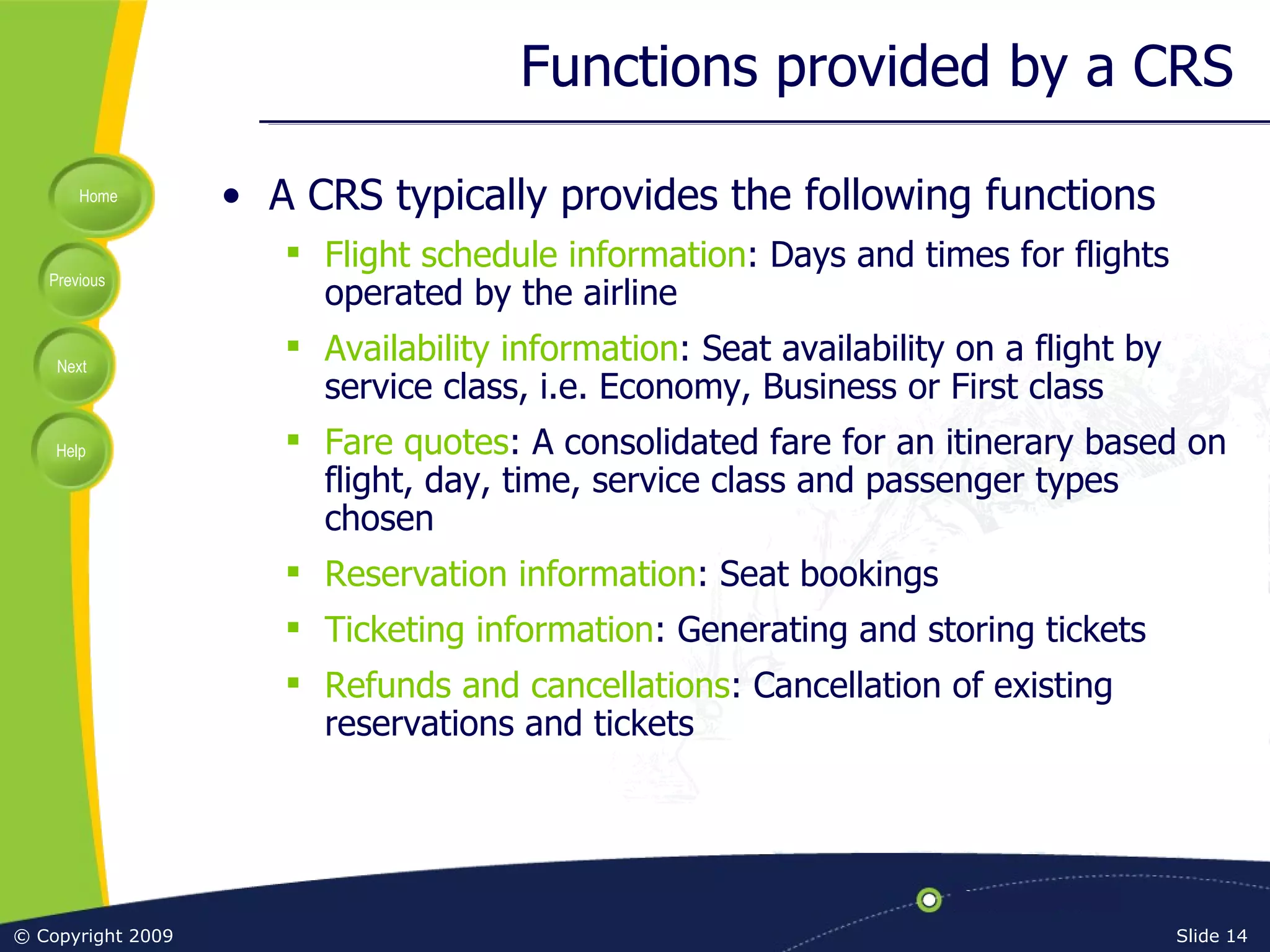
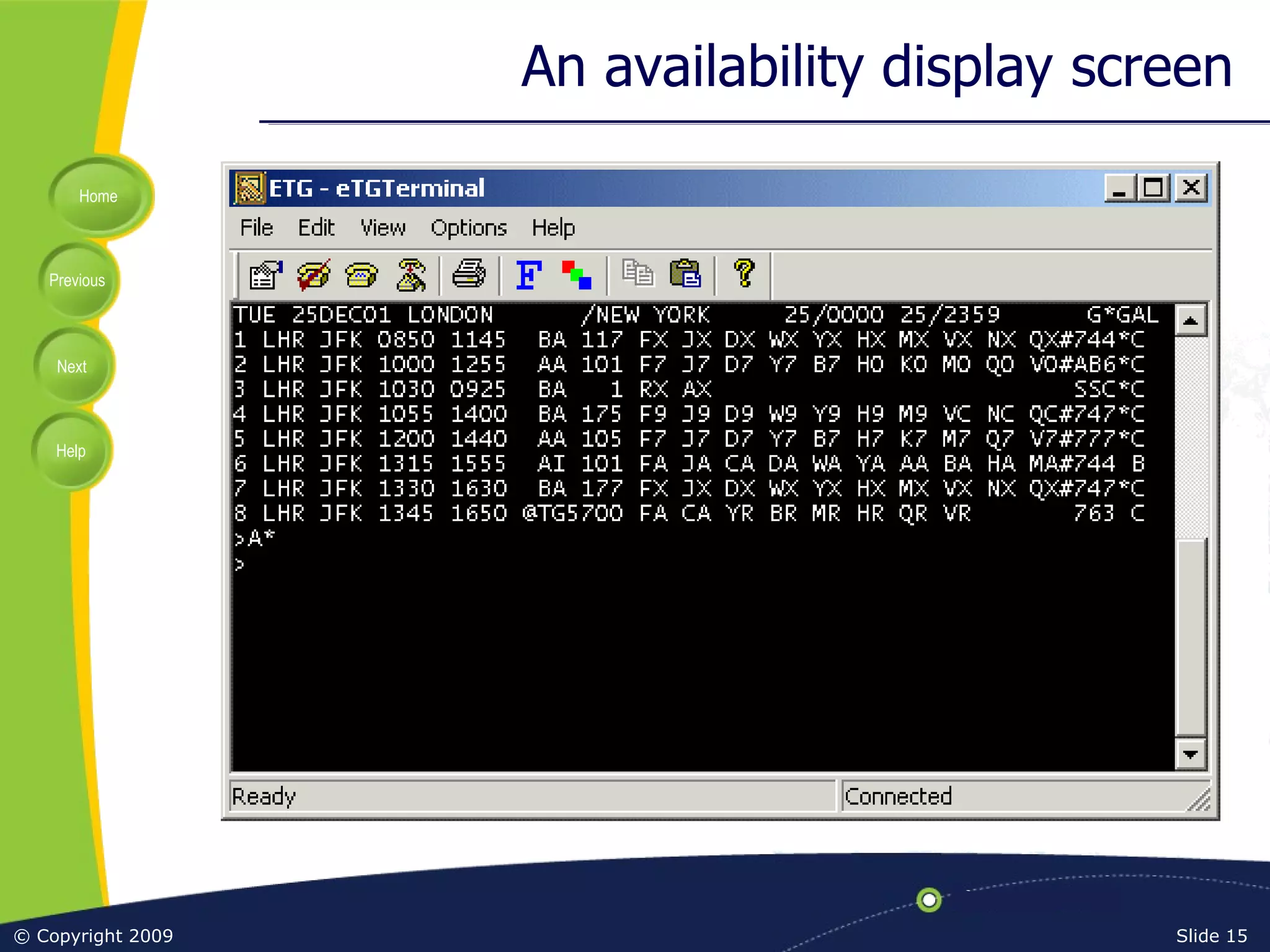
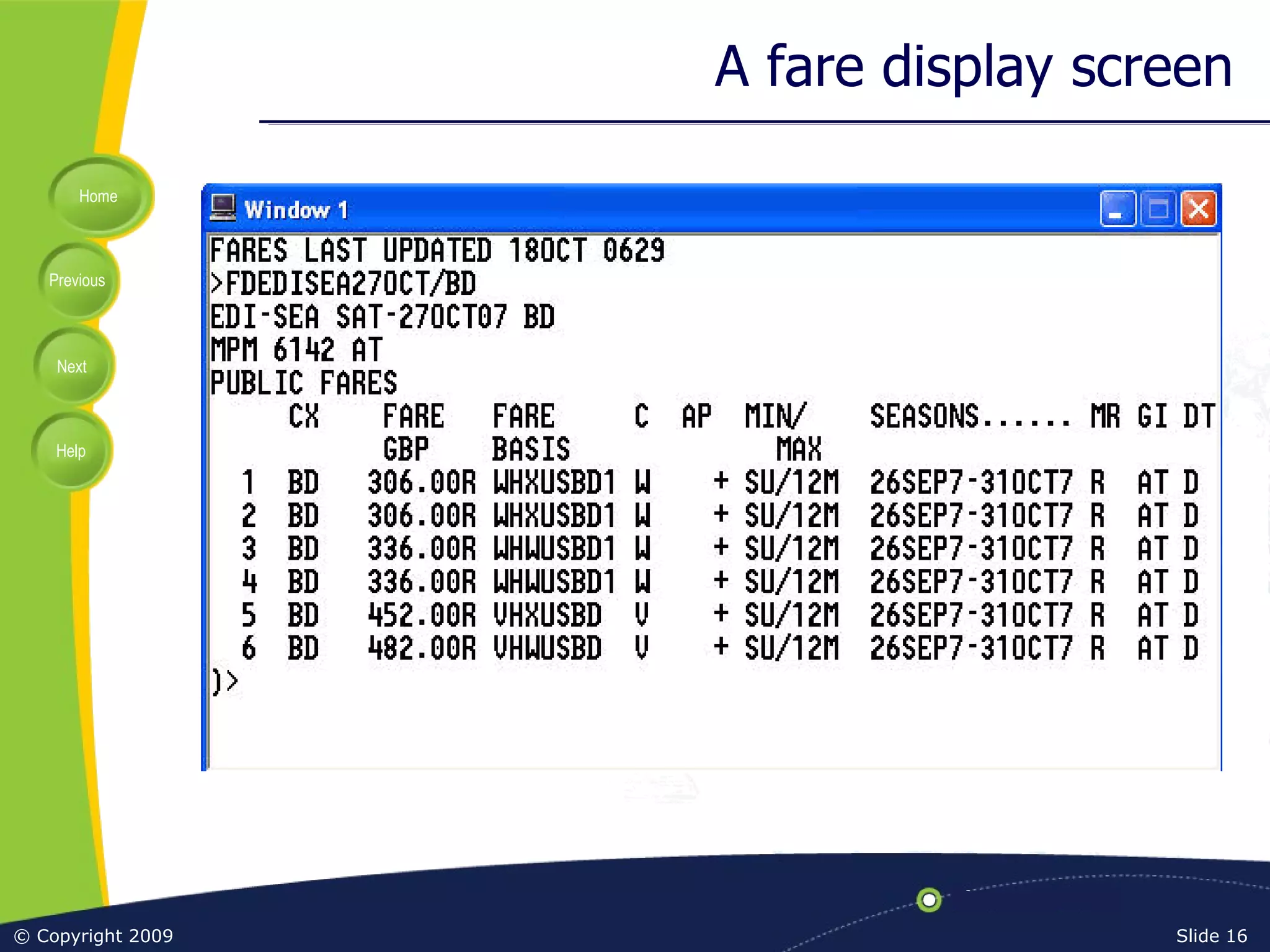
Functions provided by a CRS A CRS typically provides the following functions Flight schedule information : Days and times for flights operated by the airline Availability information : Seat availability on a flight by service class, i.e. Economy, Business or First class Fare quotes : A consolidated fare for an itinerary based on flight, day, time, service class and passenger types chosen Reservation information : Seat bookings Ticketing information : Generating and storing tickets Refunds and cancellations : Cancellation of existing reservations and tickets
An availability display screen
A fare display screen
Overview of Global Distribution Systems
History behind Global Distribution Systems Although the CRSs simplified the task of maintaining airline data, they brought in new problems In order to handle increasing passenger traffic, large computer systems were required for CRSs.  This created a cost burden for airlines, especially the smaller ones which did not have enough money to spend on expensive mainframe technology CRSs were airline specific.  This required travel agencies who wanted to sell tickets for multiple airlines to have individual connections to each airline separately Availability and fare searches across airlines was not possible since each airline had its own CRS.  Since most passengers were interested in purchasing the cheapest fare rather than a specific airline, travel agents had to spend inordinate amount of time to determine cheapest fares across airlines
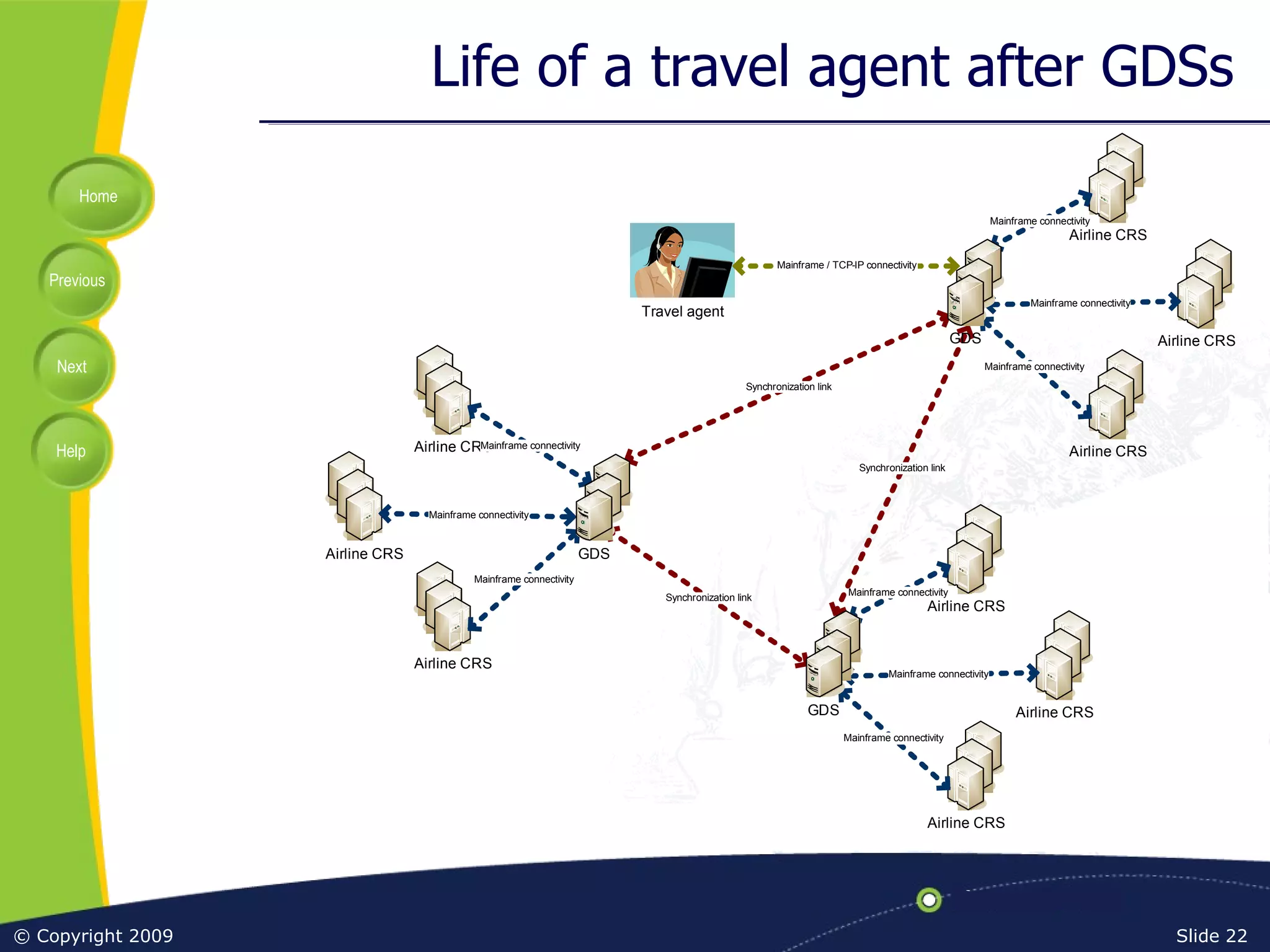
The birth of Global Distribution Systems CRSs recognized the need to host data for more than one airline in order to bring efficiencies to a growing airline industry Thus, CRSs transformed from being single airline reservation systems to multi airline distribution systems (GDSs) These GDSs also decided to share data among each other to bring in additional efficiencies
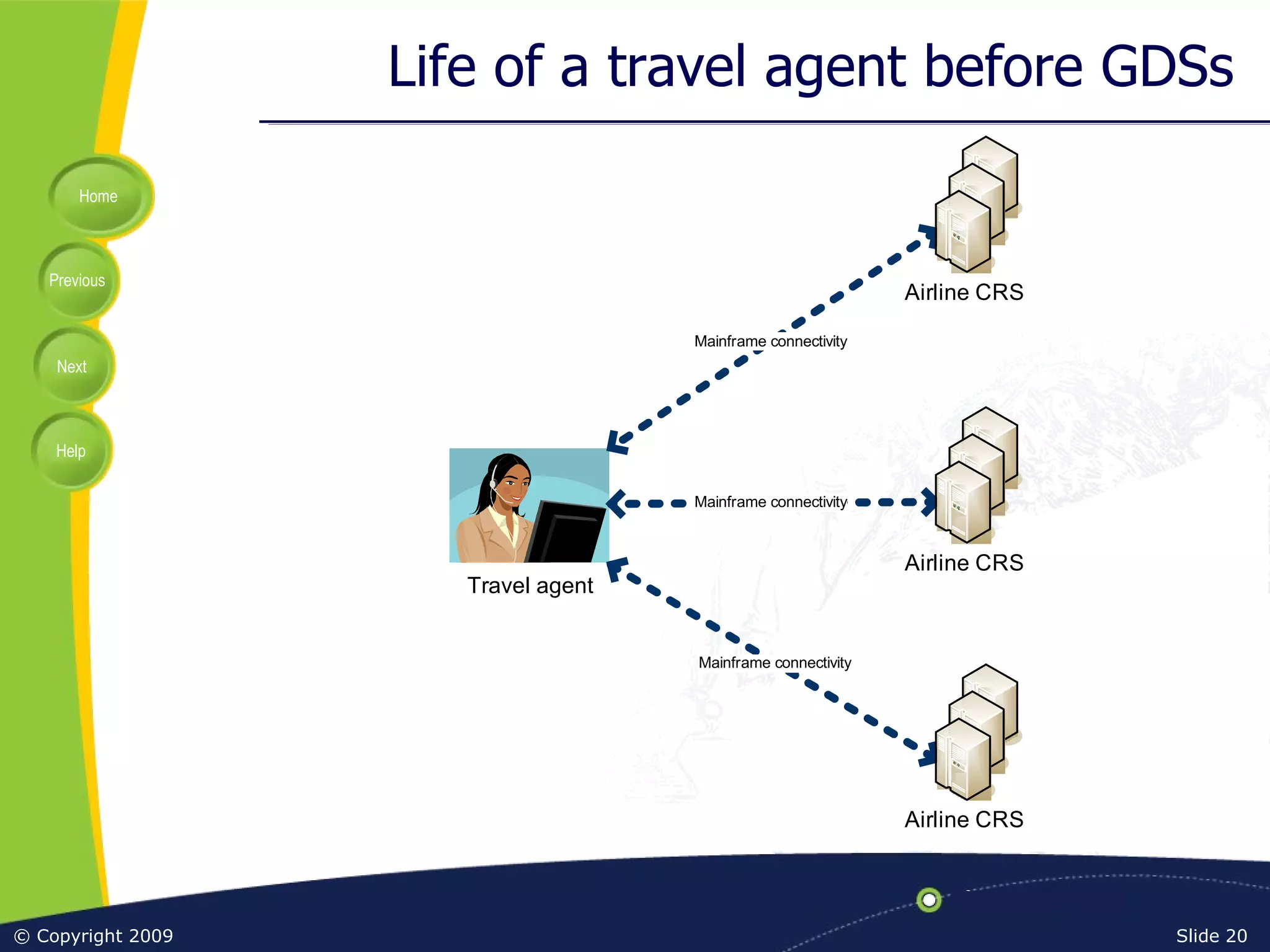
Life of a travel agent before GDSs
Problems before advent of GDSs Travel agents required individual connections to airlines If two or more airlines used different mainframe systems, travel agents had to use and be trained on different mainframe clients Inability to perform direct searches across airline systems Combining airline inventories a tedious process because inventory searches and reservations had to be performed in individual airline CRSs separately
Life of a travel agent after GDSs
Advantages of a GDS Simplified access to possibly all airlines, through a single interface Ability to connect to multiple airlines either through legacy mainframe clients or modern PC based clients Less maintenance and up-keep overhead Ability to combine airline inventories
How GDSs have evolved Due to airline CRSs being based on mainframes, GDSs have been based on mainframes as well Over the last few decades, GDSs have started providing direct connectivity from non-mainframe clients such as PCs GDSs have also started leasing hosting space (hardware, software and connectivity) to airlines which do not want to create and host their own CRSs The advent of Internet has seen GDSs offer innovative products suited for accessing airline information over the Internet
How GDSs have evolved (continued…) GDSs now provide access to non-air products as well: Car rentals Hotel booking Packaged holidays Cruises and ships Railways Local road transport: bus, tram, taxi
Major GDSs in operation today Amadeus Founded in 1987 by Air France, Iberia, Lufthansa and SAS Head-quartered in Madrid, Spain Largest booking share in Europe Third largest booking share across the globe Used by  www.ebookers.com ,  www.expedia.co.uk  and  www.opodo.com Galileo Founded in 1993 by 11 major North American and European airlines Head-quartered in Atlanta, Georgia, USA Second largest booking share across the globe Used by  www.cheaptickets.com ,  www.ebookers.com
Major GDSs in operation today (continued…) SABRE Founded in 1964 by American Airlines and IBM Head-quartered in Southlake, Texas, USA Largest booking share across the world Used by  www.expedia.com ,  www.travelocity.com Worldspan Founded in 1990 by Delta Airlines, Northwest Airlines and Transworld Airlines Merged with Galileo in 2006 Used by  www.orbitz.com ,  www.hotwire.com ,  www.priceline.com
Recap and summary
Summary Airlines need to store multiple types of information such as routes, schedule, fares and reservations Travel agents need access to multiple pieces of information before making a reservation Before 1950 airline information was stored, distributed and accessed through non-electronic media
Summary (continued…) First computerized airline reservation system (airline CRS), SABRE created in 1964 as a collaboration between IBM and American Airlines CRSs evolved into GDSs over a period of time 4 major GDSs operational today – SABRE, Worldspan, Galileo and Amadeus
Questions?

Introduction to airline reservation systems

  • 1.
    Introduction March 2009Airline reservation systems
  • 2.
    Agenda Key airlineterms Introduction to Computerized Reservation Overview of Global Distribution Systems
  • 3.
  • 4.
    Important terms Aircraft: A vehicle capable of air transport, such as an airplane, a helicopter, etc. Airline : A company that provides air transport services for passengers or freight under license from a recognized public authority. Also known as Carrier in some geographies Scheduled airline : An airline that operates its flights to a fixed schedule, i.e. flight timings are fixed
  • 5.
    Important terms Charterairline : An airline whose flights do not have a fixed schedule Cabin : A class of service usually identified by a unique set of services offered (e.g. Economy, Business, First, etc.) Flight : A trip made by an aircraft between two geographical locations
  • 6.
    Important terms (continued…)Itinerary : A route of journey proposed by a traveler Ticket : (Usually) a printed piece of paper or card showing that its holder has the right to use services on one or more specific flights Travel agency : A business that attends to the travel needs of an individual or a group of individuals
  • 7.
    History of ComputerizedReservation Systems
  • 8.
    Background Airlines needto maintain multiple types of information Route information : Covers the destinations served by the airline Aircraft information : Information on the aircrafts used by the airline Schedule information : Covers information on days and times on which the flights operated by the airline are scheduled to run Fare information : Prices for various flights Reservation information : Passenger and cargo reservations, including information on passenger tickets
  • 9.
    Background (continued…) Priorto 1950 all this information was published by airlines in large books, with separate books for each type of information Travel agents had a really tough time looking through multiple books for booking tickets that covered multiple airlines It was impossible to get a real-time view of the inventory (available seats on a flight) since airlines could synchronize data from multiple locations only once a day
  • 10.
    Background (continued…) Inorder to make a booking, a customer would call up a travel agent, providing them details of their itinerary Travel agent would first look up airlines, flights and schedules matching the customer’s itinerary Customer would then call up individual airlines to check seat availability Once seat availability was confirmed, travel agent would look up the price appropriate for the flights selected and inform the customer Upon confirmation from the customer, travel agent would call the airlines back to reserve the seats
  • 11.
    Background (continued…) In1950 American Airlines decided to set up a computerized system that would allow real-time access to all its data across all its offices and travel agents As a result, Semi-Automated Business Research Environment , or SABRE was born in 1964. It was the first computerized airline system (CRS) in the world SABRE was developed as a joint effort between IBM and American Airlines
  • 12.
    Background (continued…) Whencreated, SABRE ran on two IBM 7090 mainframes. The system was upgraded to IBM S/360 in 1972 In the 1970s and 80s multiple CRSs came up in North America The first non-North American CRS was developed jointly by Air France, Lufthansa, Iberia and SAS in 1987. It was named Amadeus
  • 13.
    Overview of ComputerizedReservation Systems
  • 14.
    Functions provided bya CRS A CRS typically provides the following functions Flight schedule information : Days and times for flights operated by the airline Availability information : Seat availability on a flight by service class, i.e. Economy, Business or First class Fare quotes : A consolidated fare for an itinerary based on flight, day, time, service class and passenger types chosen Reservation information : Seat bookings Ticketing information : Generating and storing tickets Refunds and cancellations : Cancellation of existing reservations and tickets
  • 15.
  • 16.
  • 17.
    Overview of GlobalDistribution Systems
  • 18.
    History behind GlobalDistribution Systems Although the CRSs simplified the task of maintaining airline data, they brought in new problems In order to handle increasing passenger traffic, large computer systems were required for CRSs. This created a cost burden for airlines, especially the smaller ones which did not have enough money to spend on expensive mainframe technology CRSs were airline specific. This required travel agencies who wanted to sell tickets for multiple airlines to have individual connections to each airline separately Availability and fare searches across airlines was not possible since each airline had its own CRS. Since most passengers were interested in purchasing the cheapest fare rather than a specific airline, travel agents had to spend inordinate amount of time to determine cheapest fares across airlines
  • 19.
    The birth ofGlobal Distribution Systems CRSs recognized the need to host data for more than one airline in order to bring efficiencies to a growing airline industry Thus, CRSs transformed from being single airline reservation systems to multi airline distribution systems (GDSs) These GDSs also decided to share data among each other to bring in additional efficiencies
  • 20.
    Life of atravel agent before GDSs
  • 21.
    Problems before adventof GDSs Travel agents required individual connections to airlines If two or more airlines used different mainframe systems, travel agents had to use and be trained on different mainframe clients Inability to perform direct searches across airline systems Combining airline inventories a tedious process because inventory searches and reservations had to be performed in individual airline CRSs separately
  • 22.
    Life of atravel agent after GDSs
  • 23.
    Advantages of aGDS Simplified access to possibly all airlines, through a single interface Ability to connect to multiple airlines either through legacy mainframe clients or modern PC based clients Less maintenance and up-keep overhead Ability to combine airline inventories
  • 24.
    How GDSs haveevolved Due to airline CRSs being based on mainframes, GDSs have been based on mainframes as well Over the last few decades, GDSs have started providing direct connectivity from non-mainframe clients such as PCs GDSs have also started leasing hosting space (hardware, software and connectivity) to airlines which do not want to create and host their own CRSs The advent of Internet has seen GDSs offer innovative products suited for accessing airline information over the Internet
  • 25.
    How GDSs haveevolved (continued…) GDSs now provide access to non-air products as well: Car rentals Hotel booking Packaged holidays Cruises and ships Railways Local road transport: bus, tram, taxi
  • 26.
    Major GDSs inoperation today Amadeus Founded in 1987 by Air France, Iberia, Lufthansa and SAS Head-quartered in Madrid, Spain Largest booking share in Europe Third largest booking share across the globe Used by www.ebookers.com , www.expedia.co.uk and www.opodo.com Galileo Founded in 1993 by 11 major North American and European airlines Head-quartered in Atlanta, Georgia, USA Second largest booking share across the globe Used by www.cheaptickets.com , www.ebookers.com
  • 27.
    Major GDSs inoperation today (continued…) SABRE Founded in 1964 by American Airlines and IBM Head-quartered in Southlake, Texas, USA Largest booking share across the world Used by www.expedia.com , www.travelocity.com Worldspan Founded in 1990 by Delta Airlines, Northwest Airlines and Transworld Airlines Merged with Galileo in 2006 Used by www.orbitz.com , www.hotwire.com , www.priceline.com
  • 28.
  • 29.
    Summary Airlines needto store multiple types of information such as routes, schedule, fares and reservations Travel agents need access to multiple pieces of information before making a reservation Before 1950 airline information was stored, distributed and accessed through non-electronic media
  • 30.
    Summary (continued…) Firstcomputerized airline reservation system (airline CRS), SABRE created in 1964 as a collaboration between IBM and American Airlines CRSs evolved into GDSs over a period of time 4 major GDSs operational today – SABRE, Worldspan, Galileo and Amadeus
  • 31.